Looking for a new compact family-friendly runaround? Car safety features will always be an important factor when choosing your next family car, as strong safety credentials provide peace of mind and protection in the event of an accident.
Small cars aren’t traditionally associated with strong safety. In recent years, however, that has changed as car brands now fit their new smallest models with on-board safety systems that even the most expensive luxury cars didn’t have a decade or so ago.
The organisation we consult to find out a car’s safety credentials in the UK is independent crash tester Euro NCAP, which regularly tests new cars in every aspect of vehicle safety. Though it may take a few months or years after the car’s official arrival, the organisation’s goal is to assess the safety of all new mainstream cars and rates each car in four areas: adult occupant protection, child occupant protection, vulnerable road user protection (mainly cyclists and pedestrians) and safety assistance technology (accident avoidance and mitigation). The car is then given an overall star rating out of five.
So, with that in mind, which new small cars are the safest? We have listed our top five picks below, which include both petrol-powered and all-electric models.
Euro NCAP regularly updates its test standards to reflect ongoing technology developments. Because of this, we’ve only included models that have launched in the UK over the past four years, as a five-star model assessed in 2017 might not necessarily be a five-star car today.
Here at The Car Expert, we firmly believe that safety is a core component of any new car. Our unique Expert Rating Index includes the full Euro NCAP results for all cars tested and keeps them up to date, as well as incorporating these safety credentials into the car’s overall score.
Five of the safest new small cars
All of our picks below have been given a five-star safety rating from Euro NCAP and are fitted with features to both help prevent collisions and protect ooccupants if a crash can’t be avoided. These include autonomous emergency braking, software to detect driver fatigue and a system to notify emergency services when a crash happens.
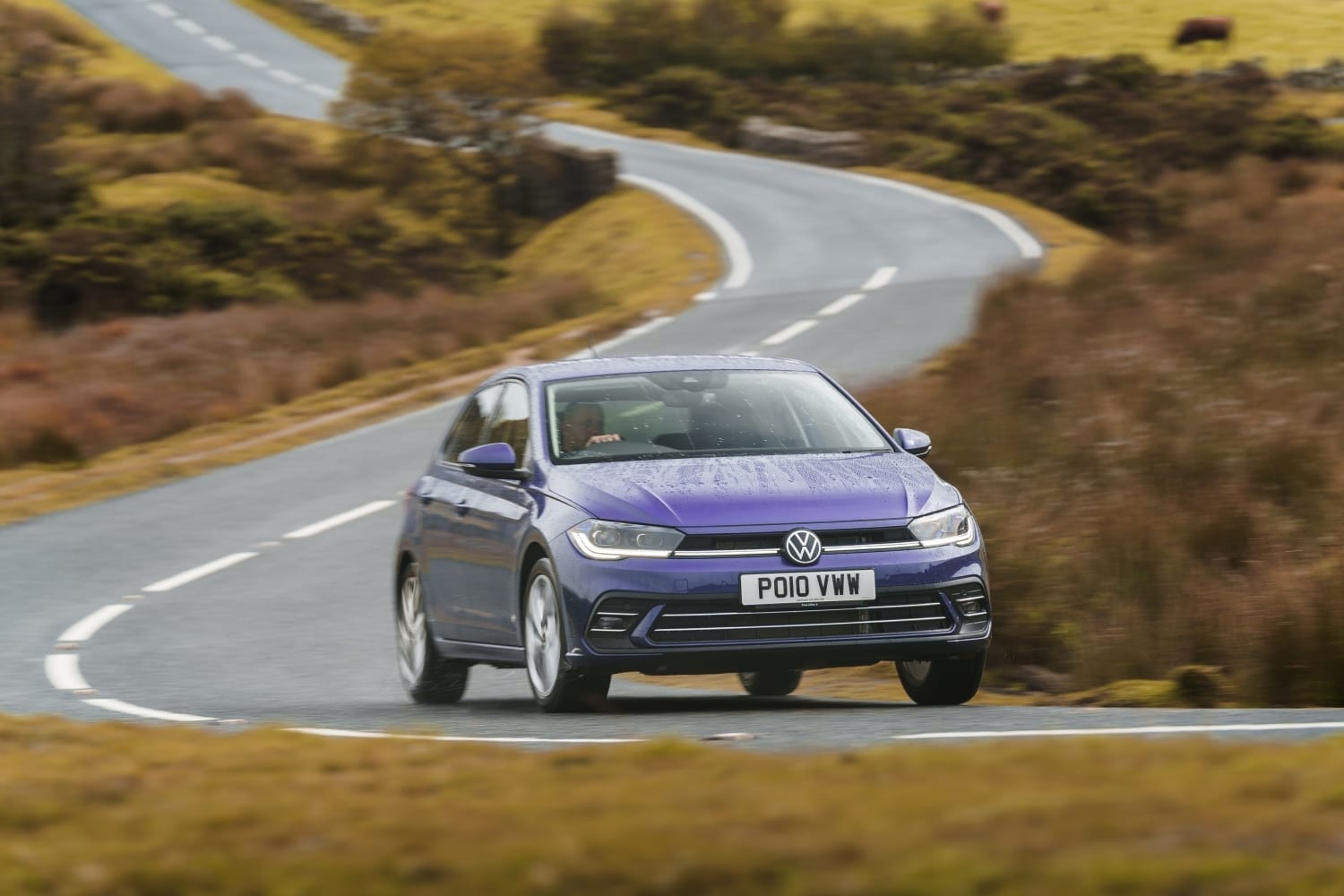
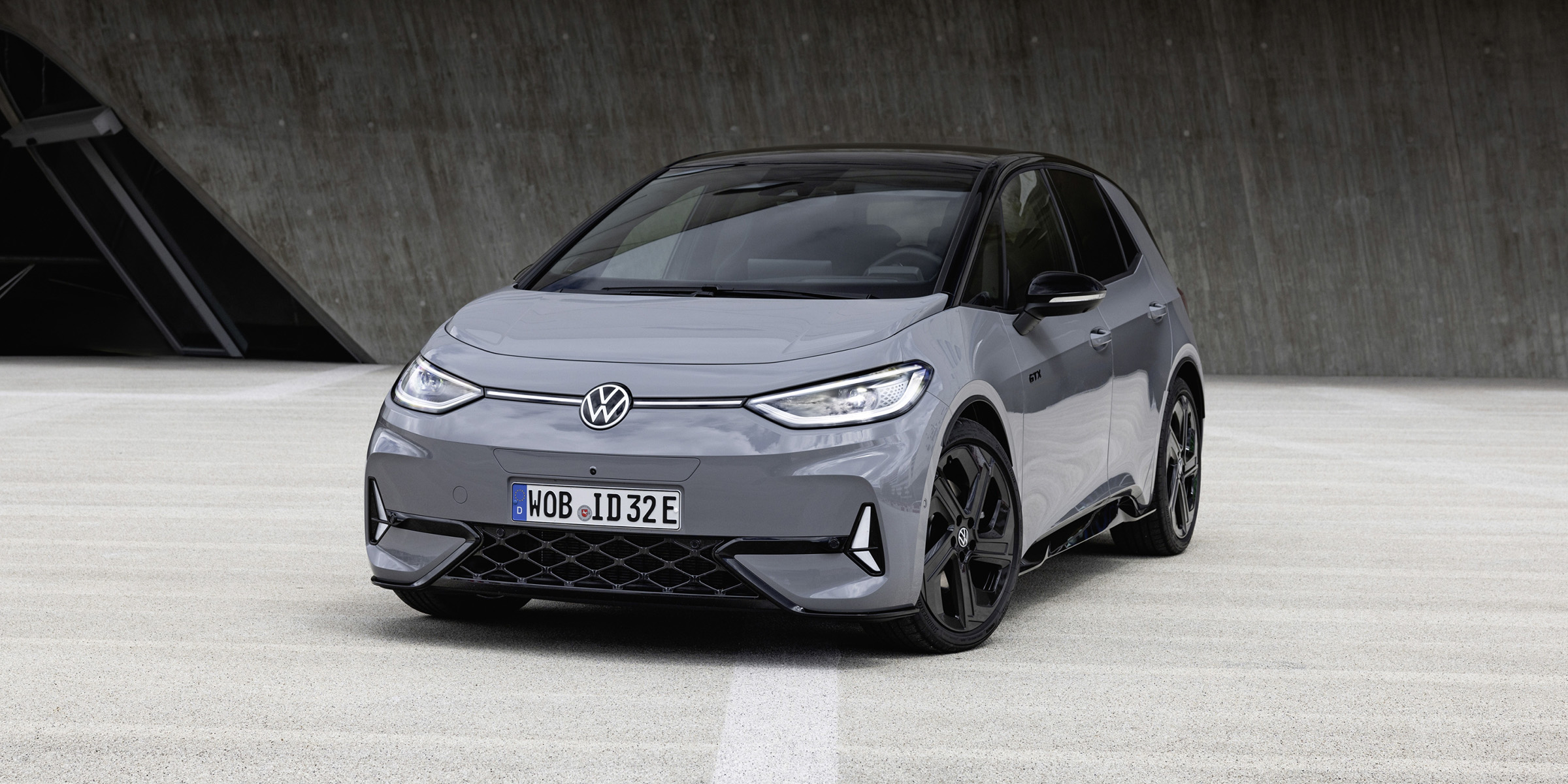
Passing its Euro NCAP tests with flying colours back in early 2022, the facelifted version ofthe Volkswagen Polo was highlighted for its impressive driver and passenger protection in the event of a collision.
This was the second time the Polo has been awarded a five-star rating from Euro NCAP, after its first crash test in late 2017. The German supermini has the best adult occupant protection score of any car on this list – meaning it offers the best crash protection for the driver and adult passengers – and it’s a very good all-rounder with high scores in the other categories.
The Volkswagen Polo currently holds a very good New CarExpert Rating of A with a score of 76% in our Expert Rating Index, which puts it at the top of the small car segment.
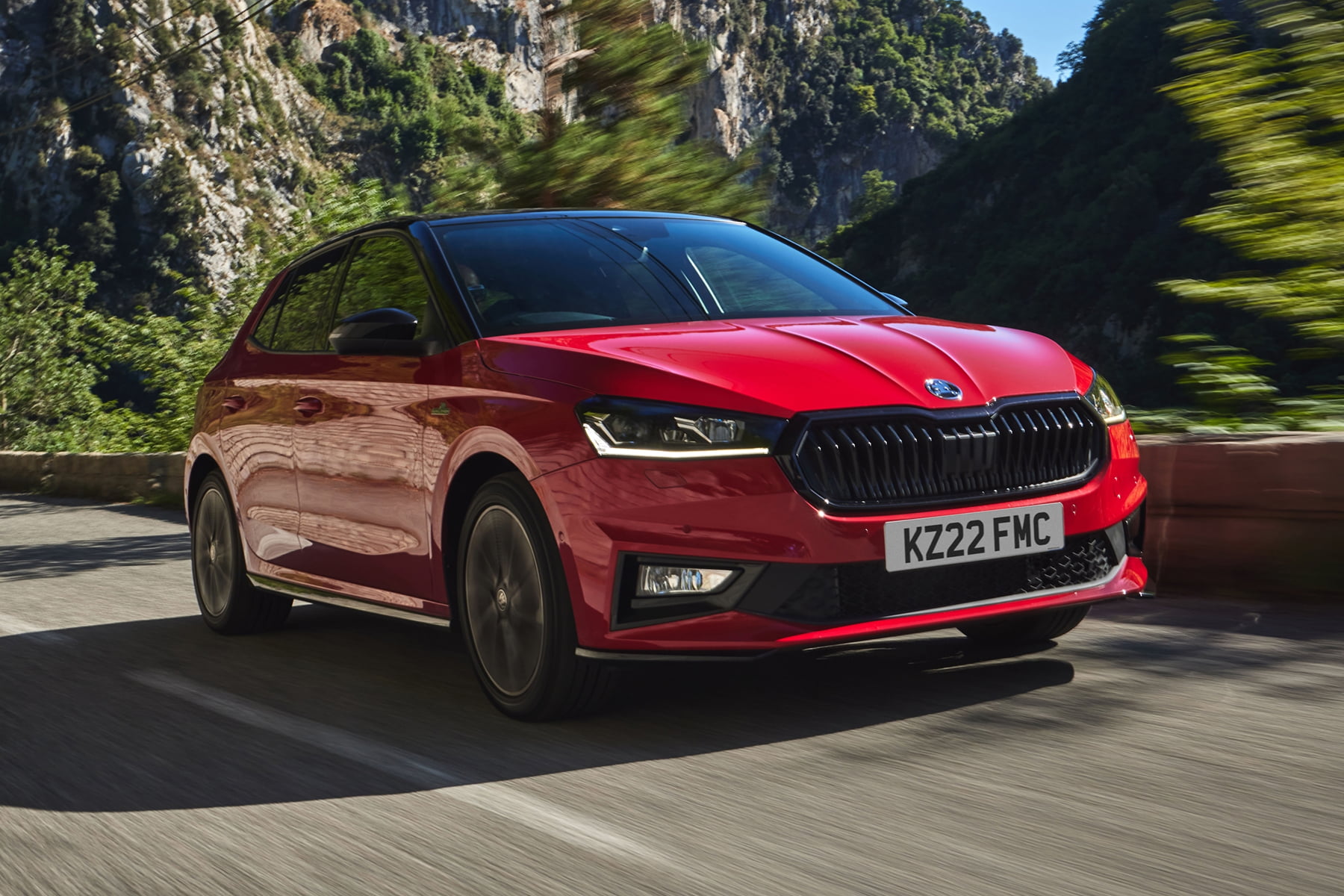
Closely related to the Polo, the Skoda Fabia was tested by Euro NCAP in late 2021. Despite Skoda being the budget brand of the Volkswagen Group – with the Fabia costing less off the showroom floor than the Polo – it still scored a five-star rating.
While Skoda’s smallest offering doesn’t hold the best score in any of Euro NCAP’s categories, the Fabia performed well in every test, with no notable points of concern. That said, the Fabia doesn’t have the centre airbag countermeasures that the Polo has, leading to a lower adult occupant protection score.
The Skoda Fabia currently holds a New CarExpert Rating of A with a score of 74% in our Expert Rating Index, which puts it near the top of the small car segment.
Why have we included two cars together? Well, because they are essentially the same supermini. In order to add a hybrid hatchback to its range, Mazda turned to Toyota, launching a re-badged version of the Yaris that is not related to the petrol-powered Mazda 2 supermini.
The Yaris – and by extension the 2 Hybrid that has the same assessment scores – was the first car to be put through Euro NCAP’s tougher 2020 crash testing regime, and it performed exceptionally well. The hatchback recorded very good protection scores for both adults and children, and Euro NCAP was also impressed by the long list of accident avoidance technology fitted as standard – giving the supermini a safety assistance rating that trumps most bigger and more expensive cars.
Both cars currently hold a New CarExpert Rating of A with a score of 75% in our industry-leading Expert Rating Index.
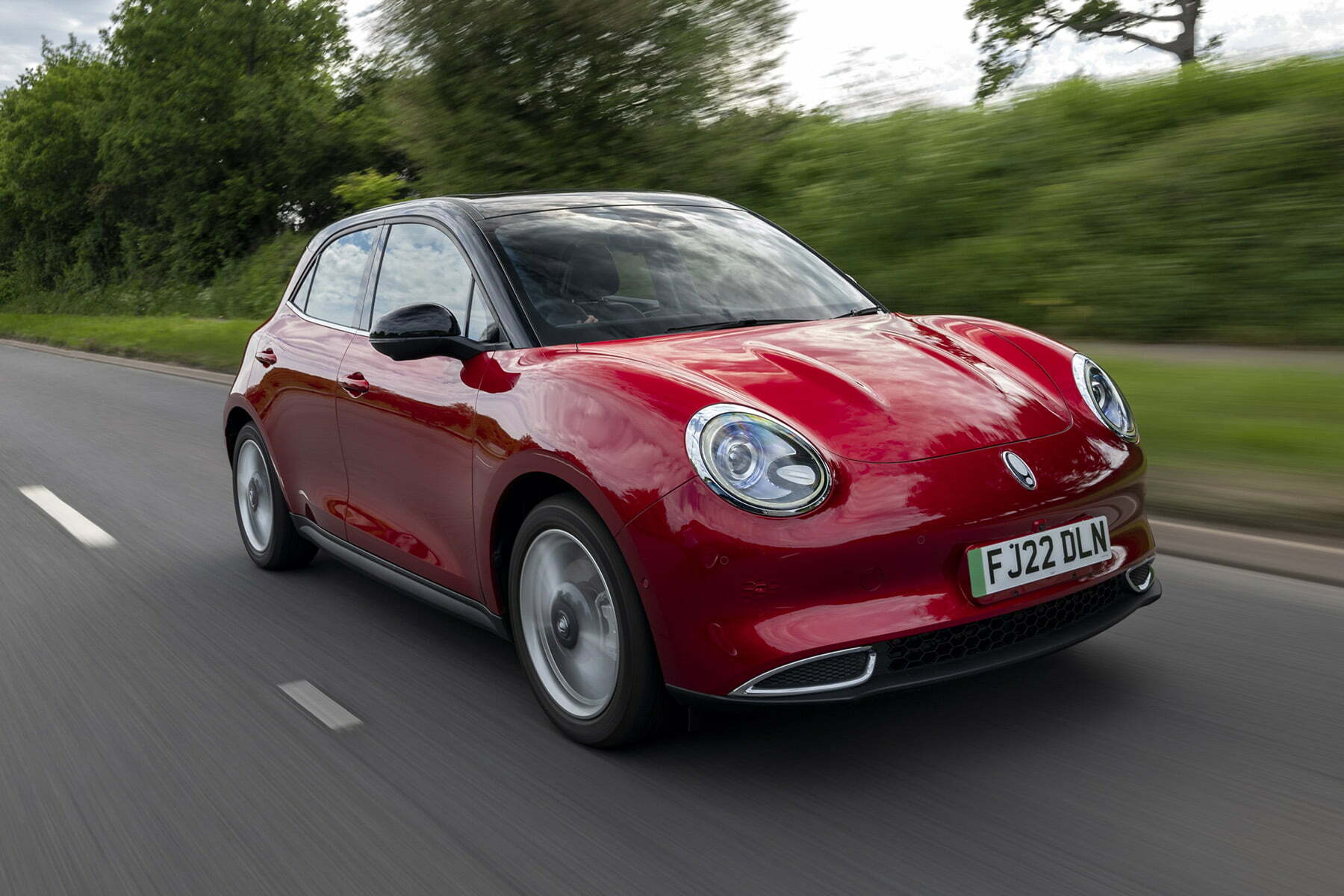
You may not have heard of the GWM Ora 03 – you might even know it by its old name, the ‘Funky Cat’ – but this electric Chinese hatchback is Euro NCAP’s recommended small family car, as it excelled during its crash test assessments in late 2022.
Besides its strong adult occupant protection score, the supermini has a much better safety assistance technology score (that helps to avoid the crash before it happens) than any other car in this bracket – a score that many much larger cars cannot beat.
The GWM Ora 03 currently holds a New CarExpert Rating of A with a score of 74% in our Expert Rating Index – a commendable score that puts it towards the top of the small car segment.
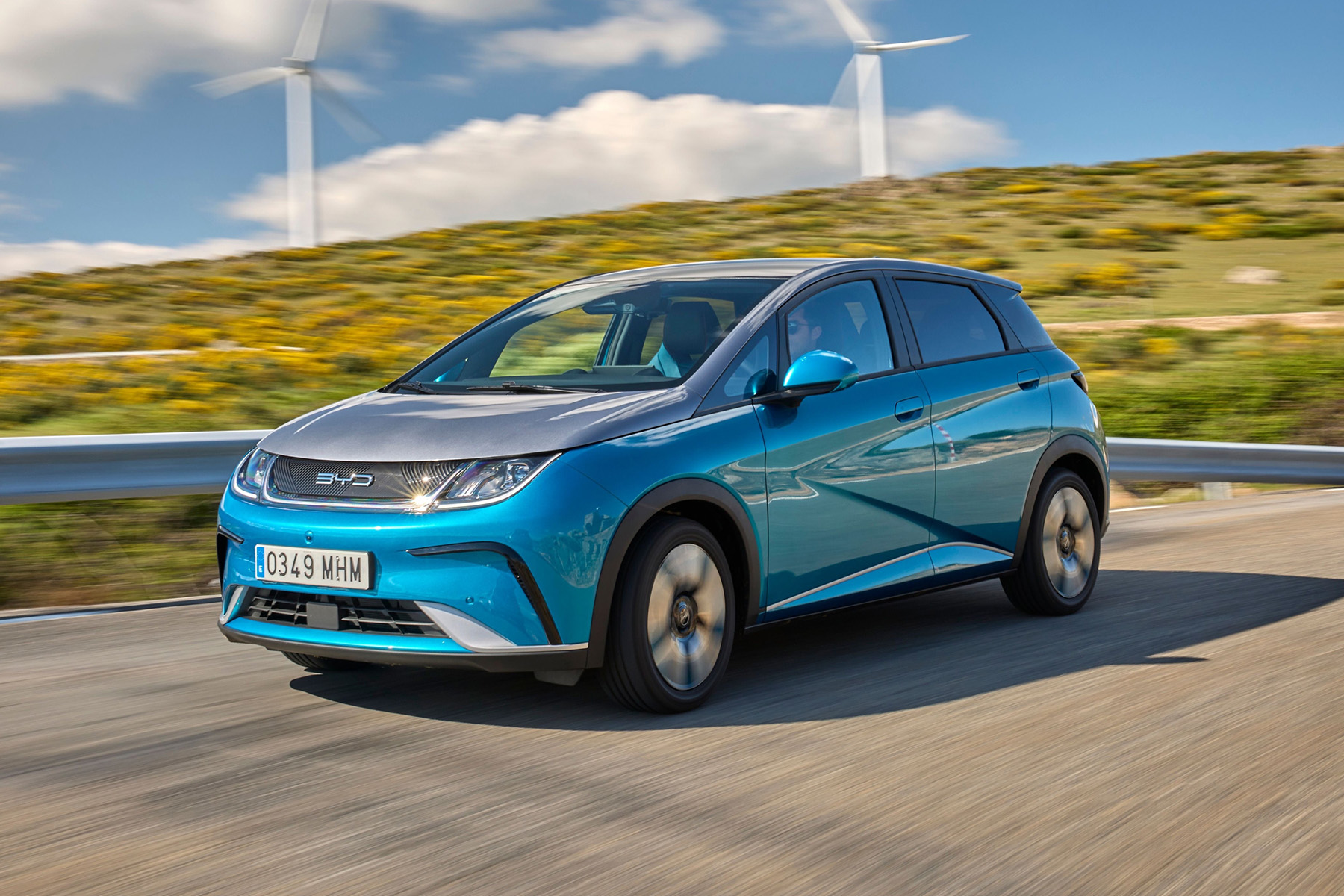
Another electric supermini from a Chinese brand, the BYD Dolphin is the latest small car to be assessed by Euro NCAP, and for families, it is perhaps the most impressive battery-powered choice.
The Dolphin has the highest child occupant protection and vulnerable road user protection (pedestrians and cyclists) scores of any car on this list, and it performed well in the adult protection and safety tech categories too.
The BYD Dolphin currently holds a New CarExpert Rating of A with a score of 76%, a fraction behind the segment-leading Volkswagen Polo in our Expert Rating Index.
That sums up our top supermini picks when it comes to safety, but please note that many other compact options have commendable five-star safety credentials, including but not limited to:
Mazda is something of a niche brand in the UK, which is rather surprising given its popularity in places like the USA and Australia – and, of course, its home market of Japan.
At a time when car companies are launching new EVs almost every week, Mazda has just the one electric model in its range – the short-range MX-30 small SUV. And to give us the impression that Mazda’s calendars are actually going backwards in time rather than forwards, the company’s newest model is a large SUV powered by an all-new… diesel engine.
Here in the UK, diesel sales have been in decline ever since Volkswagen’s Dieselgate scandal back in 2015. Most car manufacturers have been eliminating diesel engines from their range altogether, and diesel sales have slipped to almost irrelevant levels. Yet here’s Mazda launching a brand new one.
So, is there any point in buying a new diesel SUV in 2024, especially since the CX-60 is also available with a plug-in hybrid alternative? We spent a week with a mid-spec Mazda CX-60 diesel to find out.
What is it?
As of right now, the CX-60 is the largest model in the Mazda range. That will change shortly, as the even bigger CX-80 is due to arrive before the end of this year. Although it’s bigger than the Mazda CX-5, it’s still a five-seat vehicle. The CX-80 will offer a third row for those who need the two extra seats.
As well as being a larger SUV than the CX-5, this is also Mazda’s first model available with a plug-in hybrid powertrain, which we’ve driven previously. That’s the version that Mazda expects to be the biggest-selling model, which is no surprise.
Who is this car aimed at?
Mazda wants the CX-60 to push the brand up a league in terms of pricing and reputation. So rather than competing with the likes of the Toyota RAV4 or Honda CR-V, the company wants the CX-60 to be compared with premium SUVs like the Audi Q5, BMW X3 and Mercedes-Benz GLC.
But that’s a daunting task. Given how impenetrable the big three premium German brands are, it’s more likely that the CX-60 will end up fighting for sales with vehicles like the Lexus NX, Genesis GV70 and Jaguar F-Pace.
With its new diesel engine option, Mazda will also be targeting customers who want to tow caravans or trailers on a regular basis. For everyone else, the plug-in hybrid is likely to be a better bet.
Who won’t like it?
Many bigger names than Mazda have tried to take on the troika of Audi, BMW and Mercedes. Most of those bigger names have come off second-best. There are simply plenty of customers who will not consider a Mazda to be a worthy alternative to the big three.
And the model we’re looking at here is the diesel-powered CX-60. That’s going to rule out the vast majority of new car buyers, whether private or business customers.
First impressions
My first day with the Mazda CX-60 was disappointing, to be honest. The day it arrived was also the day I gave back a Hyundai Ioniq 5, so for a brief while I had both cars on my driveway. Two minutes of jiggling the two cars around so that the Hyundai man could take his car away was revealing. Stepping out of the Ioniq 5 and into the CX-60 felt like I’d gone back in time by about a decade – and sounded like it.
The (electric) Hyundai was silent and smooth as it moved away from rest, while the diesel engine in the Mazda rattled into life with more noise and vibration than I expected from a brand-new motor. The transmission clunked as it engaged and there was old-school diesel lag as you put your foot on the accelerator and waited for the CX-60 to respond.
The cabin, too, looked a generation behind the space-age and spacious Hyundai. For a bigger, taller car, the Mazda has less room all round and the interior design is far more conservative. The second of those points is obviously a design choice that some customers may well prefer, while the first is simply a difference between a conventional fossil-fuel car and an EV, which has natural packaging advantages.
If you’re familiar with other models in the Mazda range, then the CX-60 looks pretty much exactly how you’d expect a larger Mazda SUV to look. If you’re not, it looks and feels like a really well-finished Audi SUV from about ten years ago.
What do you get for your money?
Once we’ve got the first impressions out of the way, it’s time to look a bit harder at exactly what you’re getting for your money with the Mazda CX-60.
There are three trim levels available; base-spec ‘Exclusive-Line’, mid-spec ‘Homura’ and top-spec ‘Takumi’. You can have any of those three with the plug-in hybrid powertrain, which combines a 2.5-litre petrol engine with an electric motor to produce 327hp, or a 3.3-litre diesel engine with a power output of 254hp. Both of these drive all four wheels and your only gearbox is an eight-speed automatic.
On the entry-level Exclusive-Line version, you can also choose an entry-level engine, which is a detuned version of the 3.3-litre diesel that produces 200hp and only drives through the rear wheels. This is the cheapest model in the CX-60 range, starting at just over £45K. Surprisingly, the plug-in hybrid is only £50 dearer, while the more powerful 254hp diesel is an extra £2.6K.
All three models get a good level of standard equipment, so base-spec buyers won’t feel like they’re missing out on key features or technology. Leather seats (heated in front), a head-up display, 12-inch central display screen, dual-zone climate control, adaptive cruise control, auto headlights and wipers, and wireless Apple CarPlay/Android Auto.
Stepping up from Exclusive-Line to mid-spec Homura costs just under £3K more money. For that, you get upgraded from 18-inch satin grey alloys to 20-inch gloss black wheels, heating for rear-seat passengers and ventilation for the front seats, electric adjustment for the front seats, some colour variations for exterior trim pieces, and an upgraded Bose stereo system.
If you go all the way up to Takumu specification, it’s more than £4K over the Homura. That buys you white nappa leather rather than black regular leather, machine-polished alloys (still 20 inches), white maple wood interior trim and higher-quality dashboard materials, and some slightly different exterior trim colours. You also get a suite of more advanced accident-avoidance safety technology, which is a £2K option on lower-spec models.
If you’re looking for Mazda new car warranty information, good luck finding it on the Mazda UK website. All you get is flowery talk about how Mazda cares about you with ‘extensive’ warranty cover. In reality, Mazda’s UK warranty is one of the stingiest in the business, at three years or 60,000 miles. In the Republic of Ireland, by comparison, Mazda will give you six years – double the warranty cover for the same car…
We like: Mostly good equipment levels on all models We don’t like: Only top-spec model gets all the safety kit as standard, stingy warranty
What’s the Mazda CX-60 like inside?
The Mazda CX-60’s cabin is a familiar environment, partly because it seems to have cherry picked all the best car interiors from the mid-2010s. If you’re currently driving a five-to-ten-year-old BMW or Audi, the CX-60 is going to feel very comfortable. But it lacks the wow factor of a brand-new BMW, or the latest generation of Hyundai, Kia or Nissan electric cars.
The fit and finish all seem impressive, but the layout looks at least a generation behind the latest models from other brands. It’s certainly functional, and having proper switches and buttons for key controls is a big win, but the cabin design feels dated.
Space in the front is not as generous as you might expect, not helped by a large transmission tunnel between deiver and passenger. At least this provides plenty of elbow space and room for a proper rotary controller – like the sort other brands used a decade ago.
The front seats are comfy, even on longer journeys. Visibility is decent and the only quibble in terms of driving position is that I would have preferred the steering wheel to extend just a bit further out. The wheel itself is excellent, something that can’t be said for a lot of new cars (including the Hyundai I mentioned earlier). The thickness and shape are perfect, and the buttons are logically laid out.
The central screen is 12 inches in letterbox format, mounted atop the dashboard. Unlike most car manufacturers, Mazda has resisted the urge to rely on a giant touchscreen to controls everything – in fact, this screen is not actually a touchscreen at all. It’s controlled by the central knob, which is both good and bad.
When working through Mazda’s own menu system, it works well and the movements are all logical. But trying to use Apple CarPlay or Android Auto with the rotary controller, rather than tapping a touchscreen, is more frustrating. These are systems that are designed for touch input, and trying to twirl your way around an Apple satnav display and menu system in order to change your radio station on the Mazda operating system was far more convoluted than simply tapping directly on the screen. The perfect solution would be to keep the rotary controller but also have touchscreen control for the best of both worlds. Some cars still do this, although not many.
Rear cabin space is certainly decent for a pair of adults, although there are no bonus recline or sliding functions to enhance the rear-seat experience. Boot space is also decent at 570 litres, which is better than some rivals.
We like: Fit and finish are first class; steering wheel is pretty much perfect We don’t like: Rotary controller works very well for Mazda menus, not so much for phone-based systems
What’s the Mazda CX-60 like to drive?
We drove the 254hp diesel with all-wheel drive, although the 200hp rear-wheel drive model is likely to feel similar in most everyday situations.
I haven’t personally driven this car with the plug-in hybrid engine (our colleague Andrew has), but I’m fairly sure it’s the one I would choose. For most customers, the diesel is likely to be a backwards choice. It’s surprisingly noisy and harsh around town – especially given that this is a brand-new engine design – and has the laggy throttle response that we won’t miss once diesels are finally made extinct. The gearbox is also a bit clunky at times, rather than being smooth and seamless in its operation.
Once you get onto an A-road or motorway, however, things improve significantly. At speed, the engine settles down although it’s still never truly quiet. It also responds better to acceleration, which means overtaking is comfortable rather than concerning – although this is probably one situation where the extra performance of the 254hp diesel would be noticeable over the 200hp version.
Apart from the engine, the CX-60 is a very nice to car to drive in most situations. The steering feels sharp and responsive, and has a bit more weight to it than most family cars – certainly not enough to feel heavy, but enough to make you feel connected to the front wheels. It’s very well judged. The ride is firm but controlled, so it will bounce a bit on undulating roads but settles again quickly.
The higher-spec Homura and Takumi models get larger 20-inch wheels, which are not particularly forgiving on speed bumps and potholes. The entry-level Exclusive-Line versions get smaller 18-inch wheels, which are likely to be a bit better at cushioning sharp bumps. Overall, however, if you’re used to popular Audi S-line or BMW M Sport wheels and suspension specifications, this is no certainly worse.
Even by family SUV standards, the turning circle on the CX-60 is fairly poor, which means u-turns and shopping centre car parking tend to be multi-point manoeuvres.
We like: Comfortable and fuel-efficient on the open road We don’t like: Turning circle is poor, diesel engine not suited to town driving
How safe is the Mazda CX-60?
The Mazda CX-60 was tested by Euro NCAP in late 2022 and awarded a top five-star rating. It has good scores in every category (adult protection, child protection, pedestrian/cyclist protection and accident avoidance).
While this is very good news, only the top-spec Takumi models gets the complete suite of accident avoidance technology as standard, like rear cross-traffic detection which is excellent for helping detect vehicles or pedestrians when reversing out of a parking space.
Takumi also gets adaptive cruise control, which speeds up and slows down in accordance with traffic around you, while the rest of the range only has standard cruise control.
For lower-level models, you have to pay £1,900 for an optional ‘convenience and driver assistance pack’ to get these features.
Verdict
There are many things to like about the Mazda CX-60. It’s well-built, logically laid out and decently roomy in most directions. For many growing families, it will be a better size than the smaller CX-5. Boot size is particularly good.
Equipment levels are decent across all models and it’s more enjoyable to drive than most family SUVs. It does exactly what you need and expect from a family car, and it does it in comfort if not in great style.
Developing an all-new diesel engine for this car (and the larger CX-80 coming soon) seems a curious decision, however, given how completely the diesel new car market has collapsed in the UK and most parts of the world. Unless you’re towing, or just really hate plug-in hybrids, there’s no good reason to buy the diesel. For an all-new engine design, it’s also surprisingly noisy and harsh, which rather detracts from the otherwise lovely cabin ambience.
That diesel engine rather sums up the CX-60. While every other car company is launching new EVs, Mazda has launched a new diesel SUV that looks and feels a generation behind the times. For a model that claims to be taking the fight to premium brands, it falls short.
At the end of the week, my final impression was very similar to my first impression – that Mazda has given us an excellent interpretation of a ten-year-old Audi, but hasn’t really come up with anything new or different.
Power: 254 hp Torque: 550 Nm Top speed: 136 mph 0-60 mph: 7.4 seconds
Fuel economy: 51.4 mpg (combined) CO2 emissions: 142 g/km Euro NCAP safety rating:Five stars (November 2022) TCE Expert Rating:A (71%) as of September 2024
Buy a Mazda CX-60
If you’re looking to buy a new or used Mazda CX-60, The Car Expert’s partners can help you find the right car
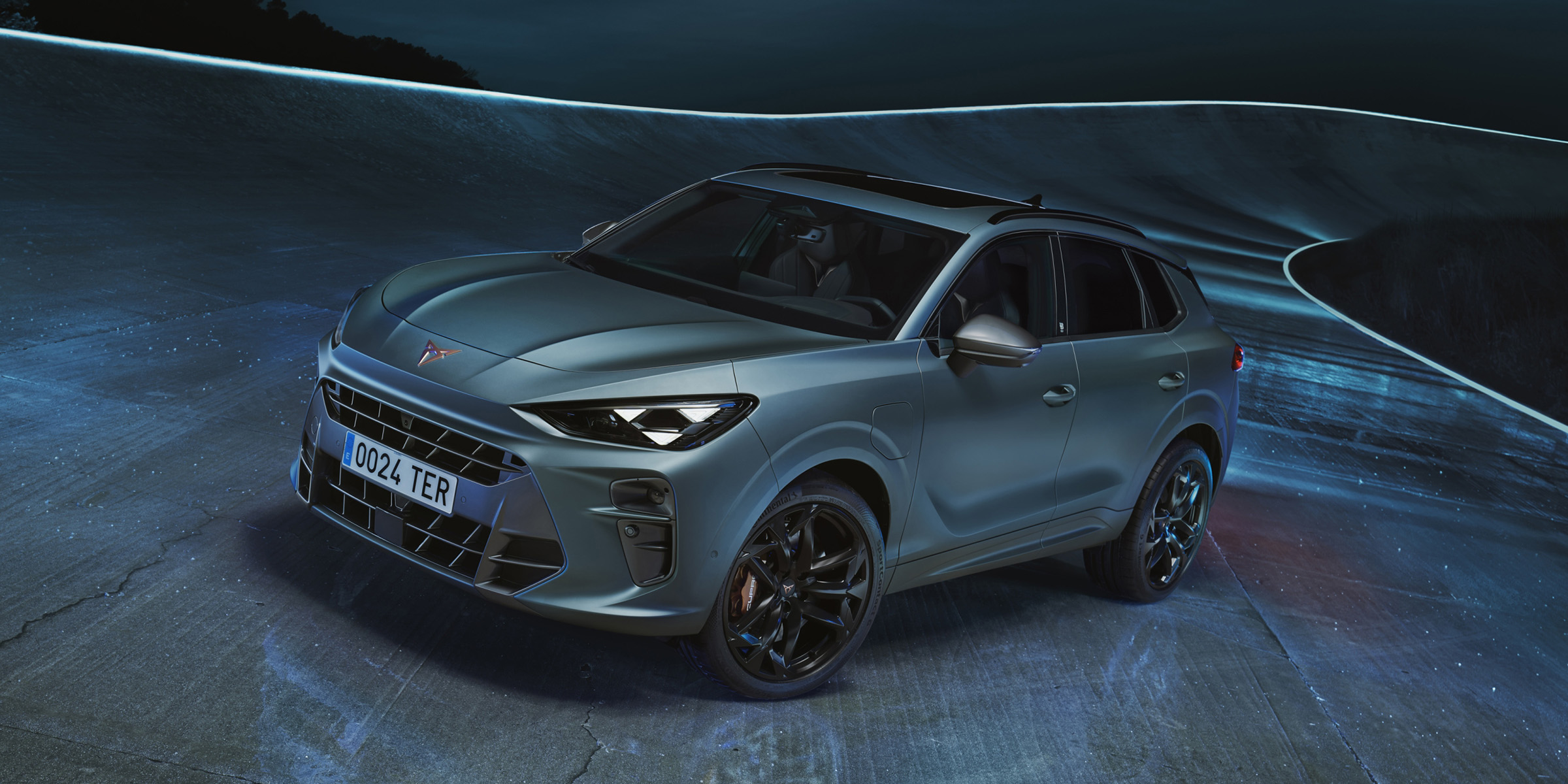
Cupra has unveiled a new high-performance mid-sized SUV – the Terramar – which will be available with traditional petrol, petrol mild-hybrid or plug-in hybrid power.
Named after an old racing circuit in Spain that had close ties to the Cupra brand, the Terramar will sit above the high-riding Ateca and Formentor in the Cupra range, and is set to arrival the sales of the Kia Sportage and Hyundai Tucson when it arrives in the UK early next year.
Based on the same foundations as the new Skoda Kodiaq, Cupra says that it has further tuned the Terramar to provide greater driver engagement than the other cars based on the same architecture, modifying the adaptive damper suspension setup to improve cornering and braking, and slightly lowering the ride height.
The SUV range will include five different powertrain options, starting with the cheapest 150hp front-wheel drive 1.5-litre petrol mild-hybrid. That is followed by two all-wheel drive 2.0-litre straight-petrol options with the latter carrying the brand’s high-performance ‘VZ’ badge, offering 200hp and 261hp outputs respectively.
The range-toppers are 1.5-litre plug-in hybrids that are mated to a 20kW battery. The first has an output of 200hp, and the second ‘VZ’ 272hp, and Cupra adds that the latter provides an electric-only driving range of over 70 miles. Regardless of the model you choose, all are paired with a seven-speed automatic gearbox. The VZ models can also be specced with optional ‘performance’ brakes.
Inside, a ten-inch digital instrument cluster behind the steering wheel is paired with a 13-inch central infotainment screen that houses most of the car’s function controls. The car also comes with a premium Sennheiser stereo system and wireless smartphone charging.
The SUV’s bucket seats are upholstered in a material called ‘Seaqueal yarn’ which is made of recycled marine plastics, though a leather trim option ‘tanned by plant-based materials’ is also available on the options list.
That sums up what we know about the new Cupra Terramar so far. More details, including UK pricing and specifications, are sure to follow in the coming months.
Private new car sales in August ended up almost exactly the same as last year, being just 0.2% or 55 units ahead of last August according to industry data published by the Society of Motor Manufacturers and Traders (SMMT) this morning.
Fleet registrations were down 1%, however, meaning the overall market ended up slightly down on the same month last year. It’s the first time in more than two years that the overall market has been down – mind you, with a summer that consisted of an Olympic games, a general election and the Euros football tournament, it’s not surprising that deliveries are down.
It’s also worth pointing out that August last year was the worst August private new car sales performance since 2012, so in improvement of 0.2% is hardly worth getting excited about…
What will be far more interesting is how the market performs in September, traditionally the second-largest month of the year after March. New number plates rolled out this week, which is traditionally a big boost to registration numbers. However, March’s results for private new car sales were pretty dire, so the industry will be hoping for much better this month.
August and February, the two months immediately preceding number plate changes, are always the slowest months of the year and see significant fluctuations in results, depending on how many manufacturers are pushing cars out and how many are holding back for the plate-change months. So there’s no point reading too much into the August sales data, and any particularly good or bad results should be taken with a pinch of salt.
Source: SMMT
EV sales continue to outperform the overall market
If you read a lot of the articles published by various mainstream media outlets, you’d be forgiven for thinking that electric car sales have completely stopped. But that’s entirely untrue. New EV sales have outperformed the overall new car market virtually all year long and that overperformance is accelerating. That’s not surprising, given the requirements of all major car companies to now have minimum EV sales numbers.
In August, EV sales were up 11% against an overall market that was down 1%. Meanwhile, petrol registrations were down 10% and diesel down 7%. Basic hybrids were up 36%, while plug-in hybrids were surprisingly down 12% after about a year of steady growth.
Although we just mentioned above that numbers should be taken with a pinch of salt, one noteworthy point about August’s EV results is that they came despite yet another poor month for Tesla – the UK’s biggest electric car brand – whose sales were down 25% on the same month last year. That’s good news for the overall market, and also suggests that EV sales will be further bolstered once Tesla gets its German factory issues sorted out.
Source: SMMT
Good month, bad month
There’s always quite a lot of market fluctuation across the various car companies in August, and this year was no different.
Volkswagen continued to be the UK’s top-selling car brand, ahead of Audi, Ford, Kia and BMW. In volume terms, rather than percentage, Volvo had the largest growth year-on-year with registrations up by almost 1,200 units. Going in the other direction, Vauxhall had the largest fall with sales down by almost 2,300 units.
Puma back on top
The Ford Puma was the UK’s best-selling new car in August, returning to the top of the pile after the Kia Sportage – which dropped to second – had been the number one car for the last couple of months. That means that the Puma edges further ahead of the Sportage in the race for the 2024 sales crown, with a lead of more than 2,000 units with fourth months to go.
Volkswagen had three cars in the top ten, with the Polo, Golf and T-Roc all making the best-sellers’ list. The T-Roc also jumped from tenth to ninth in year-to-date sales.
However, with September likely to be a massive month for car sales, the year-to-date top ten could look rather different next month. Check back in on 4th October to find out!
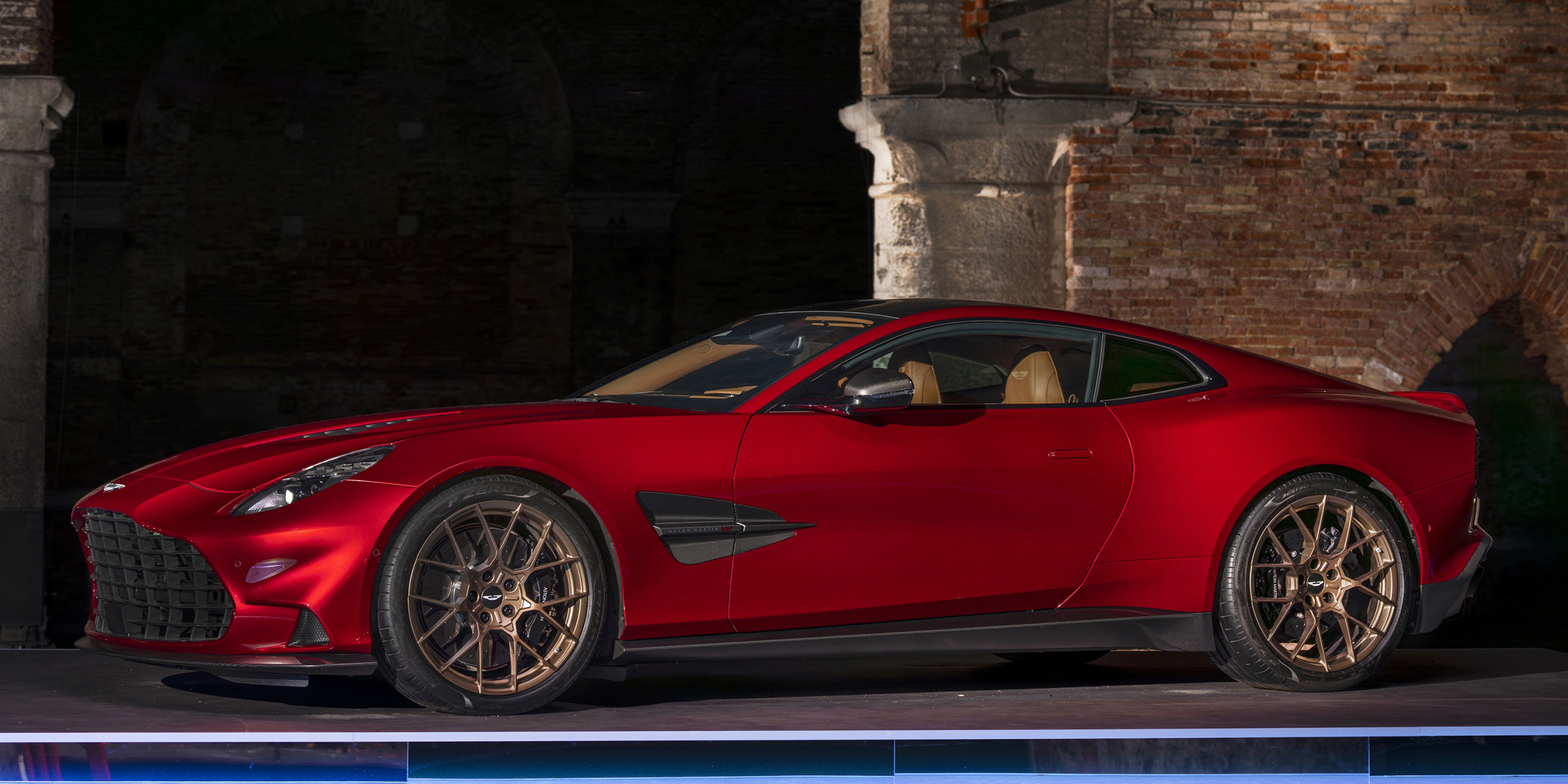
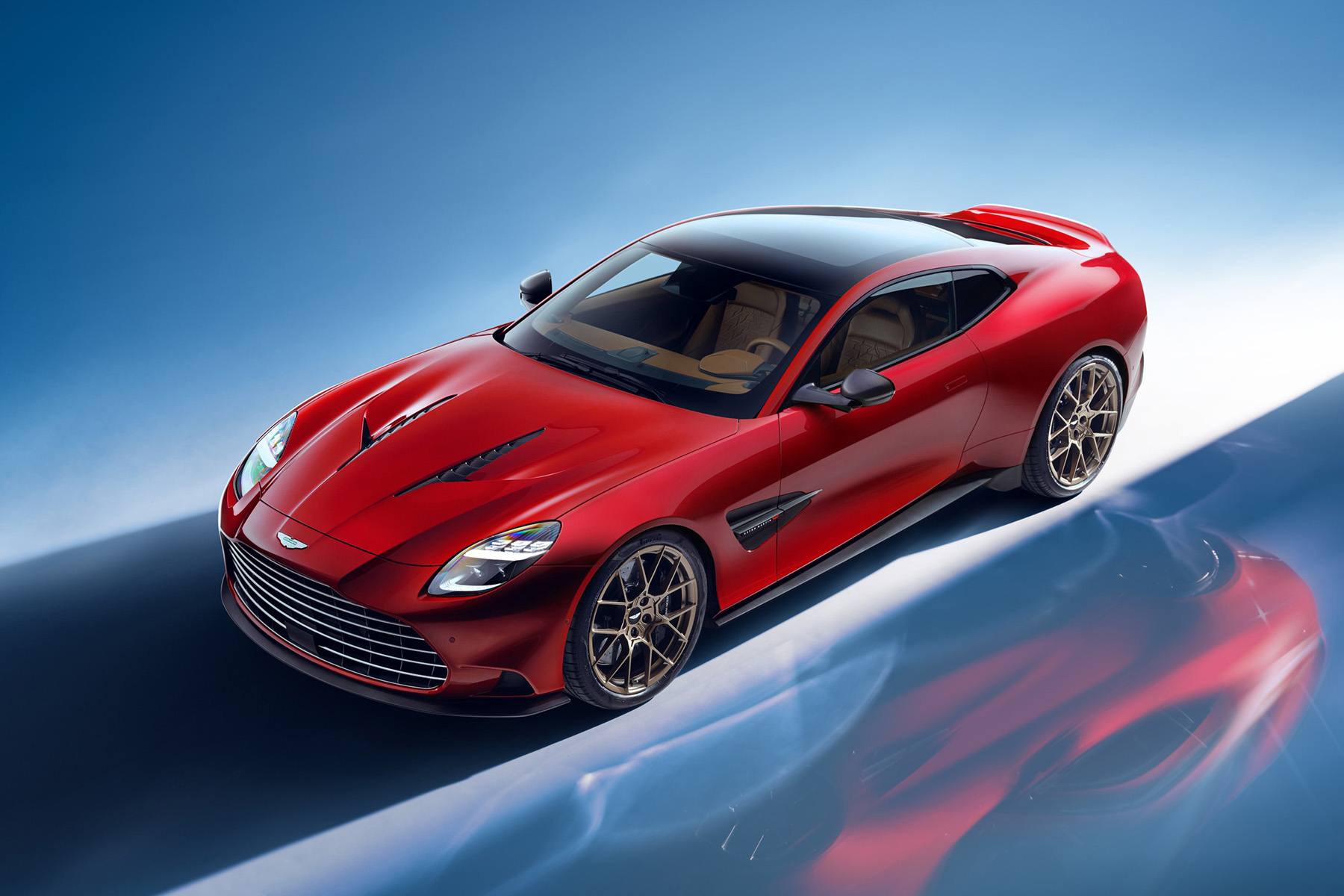
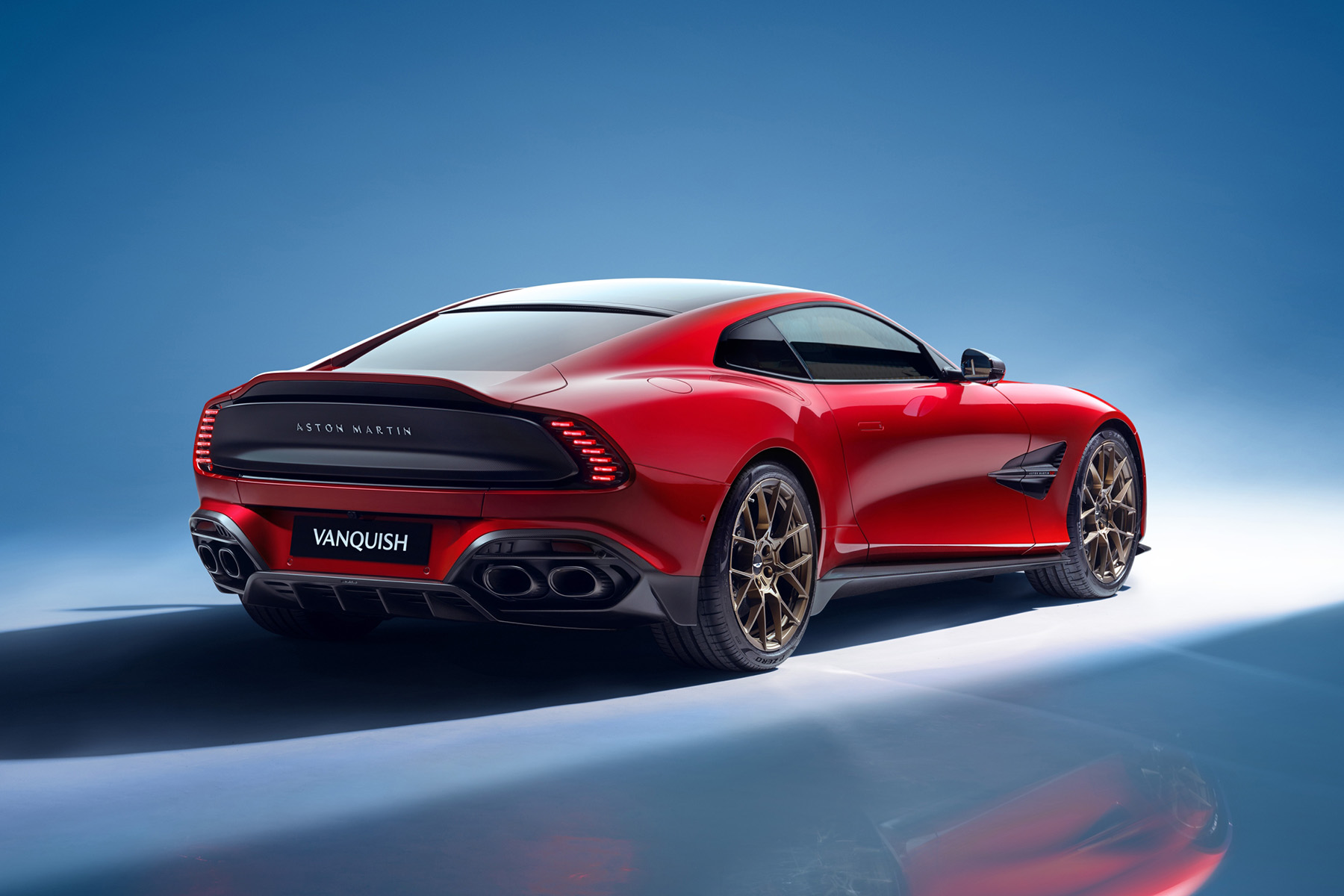
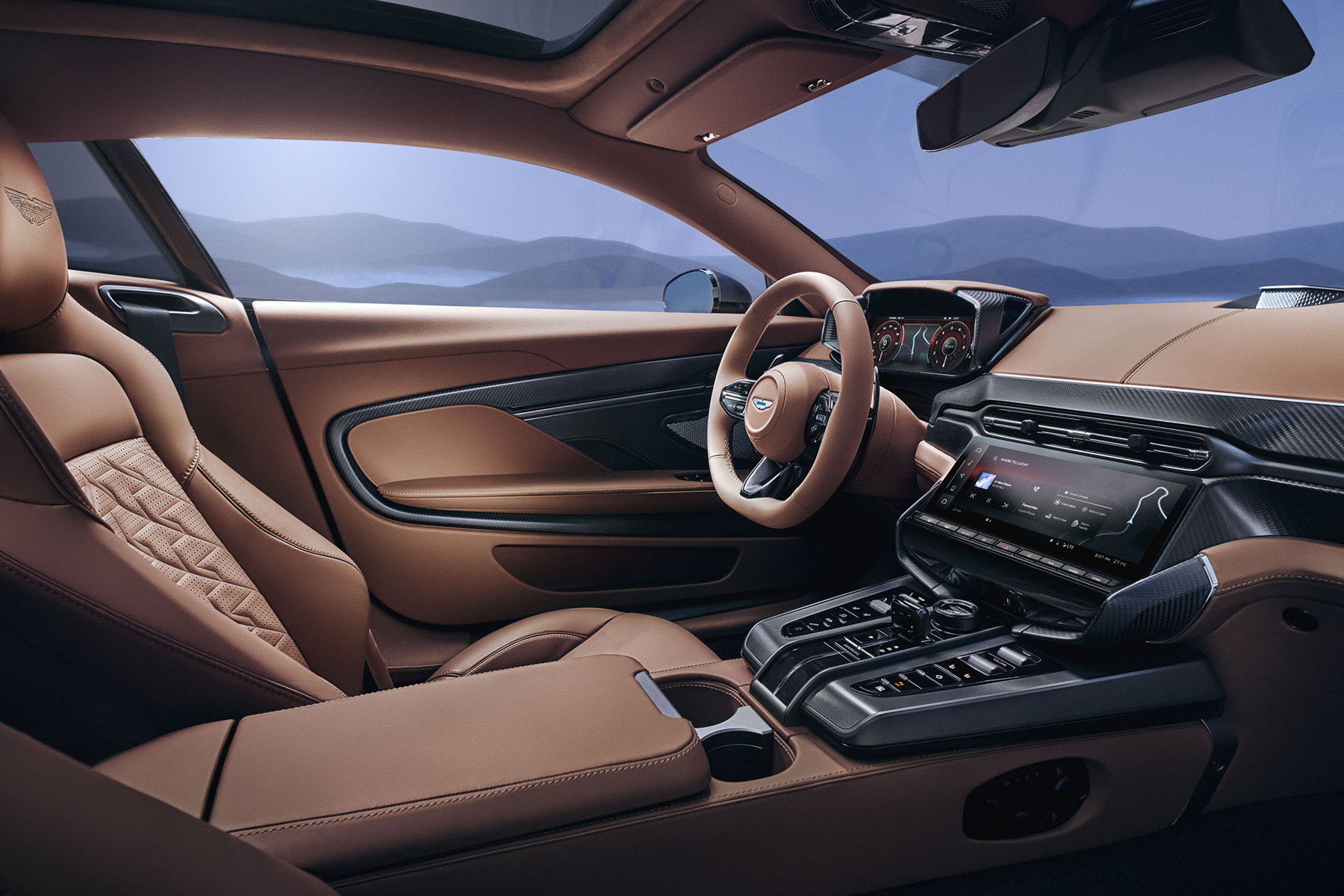
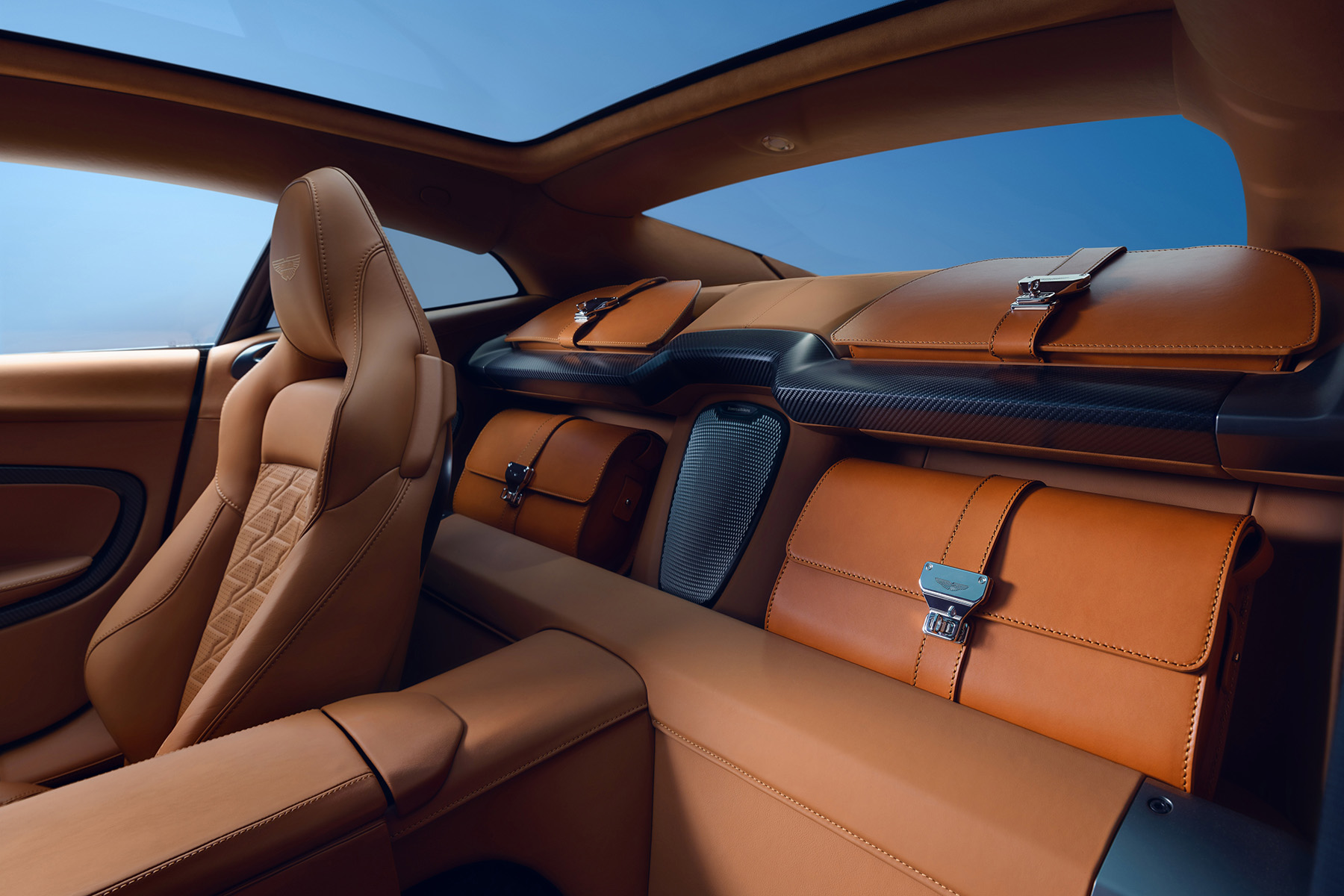
Limited to just 1,000 models a year, the Aston Martin Vanquish has returned for its third-generation – a model that its manufacturer calls an “unprecedented combination of refined comfort” and “supercar performance.”
Sitting above the Vantage and DB12 in Aston Martin range, this is the first Vanquish model to go on sale since the old second-generation Vanquish was retired in 2018, and since then the flagship supercar has been given a performance boost, a new chassis and exterior design, and a new interior that Aston Martin says “sets new standards of modern luxury.”
While the car is slightly longer than previous versions (most of this length being added to the sculpted bonnet before the windscreen), the Vanquish is still strictly a two-seater coupé. The car has a fresh front bumper, fender and wide veined grille design, the latter being 13% larger than the grille on the brand’s DBS 770 Ultimate to aid cooling for the large engine.
Also new are the flush door handles and frameless door mirrors that marginally improve the car’s aerodynamic profile. The bodywork is largely made of carbon fibre, which reduces the car’s curb weight, and sits on new stiffer chassis foundations with the latest Bilstein DTX suspension technology (also a feature on the DB12 grand tourer) that provides “ultra-fast” shock absorber response times to improve ride quality and body control.
The coupé sits on ‘super-lightweight’ 21-inch alloy wheels with carbon ceramic brakes, wrapped in premium Pirelli P ZERO tyres that can reduce noise inside the car thanks to a sound-absorbing device on the inside of the tyre.
Inside, the Vanquish comes with a similar interior layout to that of the DB12, with a ten-inch digital instrument cluster behind the steering wheel and a ten-inch infotainment touchscreen embed between the dashboard and the thick centre console.
The new vanquish is powered by a 5.2-litre V12 petrol engine – an upgraded version of the old DB11’s V12 – that produces 835hp and provides a 0-62mph sprint time of 3.3 seconds. Top speed is electronically-limited at 214mph.
Though in limited supply, the new Aston Martin Vanquish is now available to order. While Aston Martin has not confirmed the car’s price tag, the Vanquish pricing reportedly stretches over the £300k mark.
Chinese car brand Omoda has officially launched in the UK, with its first models now on sale.
Omoda is one of two new car brands from Chinese manufacturer Chery launching in the UK this year. The other is Jaecoo, and the two brands will be distributed and sold jointly through a network of up to 100 dealerships across the country.
Unlike other new entrants in the UK car market, Omoda and Jaecoo are not going all-in on EV models just yet, and will be offering a range of petrol, hybrid and EV models. The goal is to help build short-term sales during the UK’s transition to electric power, and Chery has ambitious sales targets for both brands.
Chery is one of China’s largest and oldest car manufacturers – although ‘old’ is a relative term, since the Chinese car industry is really only about 30 years old. It was founded in 1997, and builds nearly two million cars a year under its own name as well as other brand names it owns. It’s also China’s largest exporter of cars and has been for the last 20 years, accounting for about half of production.
Omoda and Jaecoo are two new brands owned by Chery, and are the company’s two main export brands – particularly for Europe and Russia. The cars that are going to make up the Omoda and Jaecoo families will be cherry-picked (Chery-picked? Sorry, I’ll get my coat…) from Chery’s extensive range of vehicles sold in China and other Asian markets under its own name or by one of its other brands (like Exeed, which we won’t be getting in Europe).
Omoda is intended to be a brand that epitomises sportiness and fashion, while Jaecoo is intended to be more practical and premium. For the foreseeable future, both will be offering a range of SUV/crossover vehicles of different sizes and with a choice of petrol, hybrid or electric power. There are currently no plans for hatchback/saloon/estate/sports car models, although these may come along later.
Omoda will launch first, with cars now arriving in showrooms. Jaecoo is on track to arrive before the end of the year.
Omoda has more than 60 dealers already signed up to sell cars from the two new brands. The company’s official UK website has all the locations available.
The dealers already signed up include major groups like Arnold Clark, Listers and Endeavour, which all have multiple sites across the UK. Omoda’s goal is to get to 100 UK dealers by the end of this year.
The company has no plans to offer direct sales at this time, unlike some other new brands like Tesla. It expects that about 40% of sales will be to fleets, so many people’s first contact with the brand will be through fleet purchases rather than dealer showrooms.
Omoda had its official UK launch in London last week, having had cars on display at various events across the country since Easter.
Omoda E5
Where does Omoda fit into the new car market?
Omoda says its goal is to offer “affordable premium” to UK customers. It claims that it will not be the cheapest brand in the marketplace, but that it will offer customers more for their money than they get from existing brands.
What that means is that pricing will be comparable to brands like Hyundai and Kia, but the company is benchmarking premium brands like Audi, BMW and Mercedes-Benz for equipment and quality. Customers can expect to see advanced technology – including safety technology – at price points well below European rivals.
What models will Omoda be selling?
Omoda’s UK operation will commence with two versions of a mid-sized crossover vehicle, the Omoda 5 (petrol) and Omoda E5 (electric). It’s a Nissan Qashqai-sized vehicle, so Omoda is aiming right at the heart of the family car market. This model has already been on sale in China and some other international markets for a couple of years, where it’s usually called a Chery Omoda C5. It has been tested by Euro NCAP and holds a five-star safety rating, which is certainly a good start.
The Omoda 5 will be powered by a 1.6-litre petrol engine, with a 1.5-litre hybrid model expected to be added to the range early next year. Pricing starts at £25K, which is in line with the company’s promise of not being the cheapest in the market. However, once you factor in the level of standard equipment that’s likely to be included (final specs are yet to be announced), it will certainly be thousands of pounds cheaper than an equivalent model from the likes of Volkswagen or Peugeot.
The Omoda E5 is, as you might guess, the electric version of the 5. It starts at £33K for a very well-equipped vehicle. It has a 204hp electric motor and a 61kWh battery, providing an estimated 257-mile driving range in official EU/UK lab tests. Like the petrol version, that puts it thousands of pounds below similar electric SUVs from established big-name brands.
It’s easy to tell the 5 and the E5 apart – at least from the front – as they have quite different front-end styling. The petrol 5 has a huge grille that stretches right across the front of the car, while the electric E5 has a much sharper nose with no grille. Inside the cabin, there are a few layout and switchgear differences between the two models as well, based on the requirements of their different powertrains.
Omoda 5 (left, with large grille) and E5 (right, with no grille)
By the end of the year, we may see the larger Omoda 9 SUV reaching UK showrooms. This will be available in both petrol and plug-in hybrid versions initially, although an electric version seems inevitable eventually, and will be offered in a choice of front-wheel drive and four-wheel drive. This model is already sold in China as the Exeed RX. Of particular note is a quite lovely interior design, that is more than comparable with some premium-brand models in the large SUV category. Expect pricing to be in the £35K-£40K ballpark, depending on spec and powertrain.
By next summer, we should also see the Omoda 7 (which, unsurprisingly, will sit between the 5 and 9), and by the autumn/winter of next year we should also see the Omoda 3 (no prizes for guessing that this will be smaller than the 5). As yet, we have no details at all on these vehicles, other than the fact that they will be SUV-style vehicles rather than any other kind of car.
Omoda says that all of its models are designed to be built as petrol, hybrid or electric cars, so it can react quickly to market demand for any fuel type. Don’t be expecting any diesels, however.
Omoda 9 (sold in other markets as the Exeed RX)
What else should I know about Omoda before making a buying decision?
Omoda says that it has been working hard for more than a year to prepare for its UK launch, and is planning to hit the ground running.
All models will come with a seven-year/100,000-mile new car warranty, which is one of the best in the industry. To address concerns of parts shortages that are affecting serving and repairs for some other new brands, especially with EVs, Omoda has put in place a logistics partnership with DHL that promises next-day delivery of parts anywhere in the UK.
The company has a finance partnership in place with BNP Paribas and a leasing partnership with Arval UK to provide PCP and PCH offers for consumers.
Omoda has big ambitions for the UK
Although it will only have pair of models on sale to start with, and will only be selling cars for about half the year, Omoda still expects to sell 10,000 new cars in 2024. After that, it wants to build up to 30,000 cars a year in 2025 and 2026, then up to 50,000 cars in 2027 and 2028. That would put it in the top 20 car brands for UK sales based on latest sales figures.
The company expects that about 40% of sales will be to fleets, which is not surprising. It hasn’t provided any projections of the split in petrol and electric models for the 5 and E5, but says that it can easily adjust to changing demand levels over time.
And, of course, it’s not just one new brand being launched. The company is bringing two separate brands to the UK market at the same time, with Jaecoo set to join Omoda before the end of the year. The two brands will be sold side-by-side in dealerships, with all dealers required to take both brands rather than just one or the other.
Although we don’t have anywhere near as much information about Jaecoo just yet, it’s safe to assume that all of the behind-the-scenes work will be the same for both brands.
Should I be concerned about buying a Chinese car?
Understandably, many car buyers are hesitant when it comes to spending many thousands of pounds on a new car from a brand-new Chinese brand, for several reasons.
Chinese cars tend to be perceived as cheap and of poor quality compared to European vehicles. The first of those two perceptions is quite accurate, since Chinese-brand vehicles (including MG, which has retained little more than the MG name and logo from the Rover days) are almost always sold more cheaply than cars from European or Japanese or Korean brands.
The second perception is not necessarily true at all, and changing rapidly. Most new Chinese cars on sale now or on their way to the UK this year have scored excellent safety ratings – including the Omoda 5 (but not the E5, which has not been awarded a rating as yet). Reliability from brands like MG has been comparable to mainstream European brands, and Omoda is unlikely to be any different.
The company’s chief engineer is Peter Matkin, who is ex-Jaguar Land Rover and heads up a team sourced from many other European brands. Chery has a technical centre in Frankfurt which works on adapting new models to suit European roads and customers. The Omoda 5, for example, is benchmarked against the Hyundai Kona on price but against models from Audi/BMW/Mercedes-Benz for engineering and quality. We haven’t driven the cars yet, but the material quality looks to be as good as any other brand in a similar price range.
The Omoda 5 has been on sale in other markets for more than two years already, so the company will have hopefully ironed out any new-model bugs. The E5 is new, having only recently started production, but is based on the 5 rather than being an all-new model.
All Omoda and Jaecoo models will come with a seven-year new car warranty, which gives reassurance to customers, and the company is intent on making sure that any part is available to any dealer in the UK on a next-day basis – including complete EV battery packs.
With 60-odd dealers already signed up to start selling Omoda and Jaecoo, and another 40 expected by the end of this year, you’re likely to be well within range of a service centre anywhere in the UK if you have any problems. And based on the company’s bold sales targets, you’re likely to start seeing Omoda 5 and E5 models on a street near you very soon.
If the company hits those targets, it will have 100,000 Omodas on UK roads in about three years’ time. Chery claims that it’s here for the long haul with both Omoda and Jaecoo, and the company certainly has the resources to support its European expansion.
What about tariffs on Chinese cars?
The EU has started applying import tariffs to Chinese-built cars, with allegations that China is subsidising its car manufacturers to undercut the European car industry in an unfair manner. The UK government, however, has not shown any interest in following suit at this time.
It’s entirely possible that additional tax could be levied on cars built in China in coming years. However, this will affect a lot of companies, not just Chinese brands like Omoda and Jaecoo. Many companies now build cars in China, so any additional tariffs could catch out European brands as well.
Even if Westminster moved with unusual haste, it’s unlikely to get anything done this year. So any pricing advantages that brands like Omoda have is likely to last for the foreseeable future, and it’s entirely possible that there’ll end up being no additional taxing on Chinese-built cars anyway.
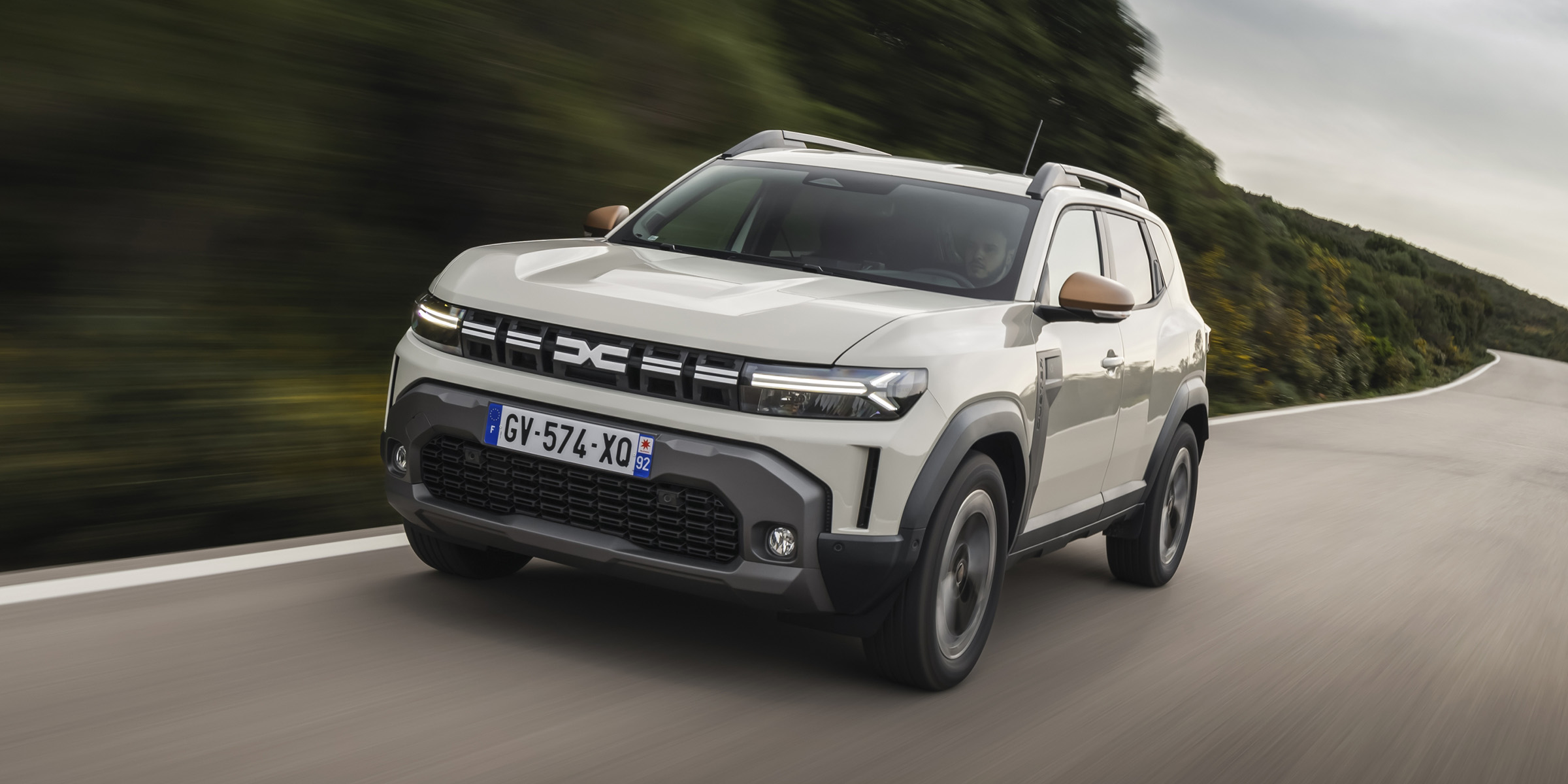
The new third-generation Dacia Duster SUV is now available to order in the UK, which introduces an on-board tech overhaul, new hybrid engine options, more interior space and a fresh but pretty familiar exterior design.
Sporting the Romanian brand’s latest insignia, this new Duster is built on a different platform – the same foundations that underpin the current Renault Clio and Dacia Sandero.
This makes the SUV a bit wider and lower than the current iteration, and Dacia says that there is an extra three centimetres of legroom in the back and a bit more luggage space in the boot – 472 litres in total. The driving position is higher too, thanks to around a centimetre of extra ground clearance.
The SUV’s exterior looks are more of an evolution of the previous design, instead of a complete departure. Dacia says it has given the car a “more assertive” appearance to make the SUV look tougher and durable.
While the outside is mildly familiar, the interior certainly isn’t. This third-generation Duster has had a dashboard overhaul that introduces an angled 10-inch infotainment touchscreen with wireless Android Auto and Apple CarPlay connectivity and a seven-inch digital instrument cluster, though these come with the middling ‘Expression’ trim and up.
Buyers looking at the lead-in ‘Essential’ grade should expect a smaller four-inch media screen behind the steering wheel and smartphone holder in the centre of the dash that uses your phone to run the infotainment functions. That said, entry-level models do still come with a decent on-board tech offering, including cruise control and rear parking sensors. Upgrading to the ‘Expression’ adds larger 17-inch alloy wheels and a reversing camera.
Sitting at the top of the range is the ‘Journey’ and ‘Extreme’ trim duo. The former gets bigger 18-inch alloy wheels, fog lights, automatic air-con, keyless entry, a wireless smartphone charger and a sound system upgrade. The latter focuses more on off-road practicality, with washable upholstery and rubber floor mats in the cabin and boot. The ‘Extreme’ also comes with electric folding door mirrors and some extra ‘Copper Brown’ styling touches, inside and out.
Like the Dacia Jogger people carrier, the Duster is offered with the brand’s ‘Hybrid 140’ engine, which pairs a 1.6-litre petrol engine with an electric motor and starter-generator for a total output of 140hp. This will sit alongside the more conventional (and presumably cheaper) 1.2-litre ‘TCe 130’ petrol which comes with a 48V mild-hybrid boost and the ‘TCe 100 Bi-Fuel’ which runs on liquefied petroleum gas (LPG) as well as regular unleaded.
Pricing for the new Duster begins at just under £19k for the lead-in ‘Essential’ trim and 100hp Bi-Fuel engine configuration, rising to near £27k for the top-spec ‘Extreme’ paired with the ‘Hybrid 140’ powertrain. The first customer orders are expected to arrive on UK roads in November.
Mountains, lakes, medieval villages, skiing and hiking trails – is there anything that Switzerland doesn’t offer? A small but beautiful central European country, Switzerland is rightly on the destination list of thousands of UK motorists.
Are you a keen skier? A mountain walker? Perhaps you like boating and water sports? Or maybe camping in some of Europe’s most stunning scenery attracts? Whatever the case, the land of the Swiss could be for you. And it’s easy to drive there.
Business also thrives in the country, with banking and finance among the top industries, while chocolate manufacture, watch making and the Geneva Motor Show are other reasons why, as a businessperson (or vehicle fan), you could be making a car trip there.
However, if you are one of the thousands of UK motorists who does choose Switzerland for a touring holiday, you’ll need some careful planning before hitting the road there. Switzerland is clean, peaceful and attractive and the country is relatively close to the UK. Landlocked between France, Italy and Germany, the Swiss border is reached courtesy of a lovely drive through French countryside.
But driving in Switzerland is a completely different experience from doing so in the UK, even once you have got used to driving on the ‘other’ side of the road.
It’s much more than that and planning a driving holiday or taking your car on to Swiss roads on business, requires careful planning and a good understanding of what you can, and can’t do behind the wheel while you’re there.
This isn’t just for your safety and convenience. Get on the wrong side of the Swiss police and you could end up with an on-the-spot fine or even confiscation of your car. So, for a relaxed and trouble-free excursion, it’s well worth spending a couple of hours planning your trip to make sure you have everything you need for your Alpine tour.
Here The Car Expert looks at the most important elements to consider when planning to drive in Switzerland, and we’ve included a handy checklist. As each journey is unique, always check that you have everything covered for your particular visit.
Basic rules
You must be 18 years or over to drive in Switzerland and you should hold a full UK driving licence. Just the licence card will do, as the paper counterpart is no longer a requirement. An international driving permit is not necessary either.
You’ll need to prove that you have car insurance cover so take your certificate with you (but you don’t need a European ‘green card’) and you must carry with you documents that show the identity of the car, such as a V5 registration certificate or ‘logbook’. Always carry your personal ID or passport with you too as you could be asked to show these.
The vehicle’s ‘home country’ must be displayed on it. A ‘UK’ sticker is acceptable, which can have the Union Flag incorporated in it, but a small UK badge on both number plates is also fine. The ‘GB’ symbol is no longer allowed, even within the European ‘golden stars’, and the same goes for country emblems such as the English, Scottish or Welsh flags.
We don’t recommend any drinking of alcohol if you are going to drive but it’s worth knowing the country’s rules on this. The drink drive limit is 0.5 g/l (also expressed as 0.05%) although for new drivers with less than three years’ experience, it’s 0.1 g/l (0.01%). By comparison, it’s 0.8 g/l in England and Wales. Swiss police can ask you to take a breath test at any time and the same goes for drugs testing. If you’re involved in an accident, a blood test for alcohol might also be required.
Speed limits
Speed limits are shown in metric (km/h) rather than imperial (mph). In built-up areas the top speed permitted is 50 km/h (30 mph). This should be well signposted. Moving out of built-up areas and on to more open roads the limits rise to between 80 km/h and 100 km/h (50 mph and 60 mph), depending on local authorities. Speeds can differ regionally so keep a close eye out for signs. Motorways have a blanket 120 km/h (approximately 75 mph) limit.
You are not allowed any kind of speed camera detection equipment when driving through Switzerland and that includes satnav units with the camera detection built-in. If that’s the case, make sure yours is disabled before you head off.
Swiss authorities don’t look kindly on speeders, and you could receive a steep fine for creeping over the limit. Go more than 10 km/h (6 mph) over the limit in a built-up area and you could face a 250 CHF (Swiss franc) fine – that’s about £225. Even a 5km/h (3 mph) indiscretion on a motorway can attract a 20 CHF (£18) penalty. Higher speeds will almost certainly result in a summons which usually means a minimum 400 CHF (£360) fine.
What to carry in the car
As well as the essential documents we have listed, you are required to carry or show certain other items in your car. You should always have a warning triangle inside the vehicle (not in the boot) in case of breakdown at the side of the road or motorway.
And talking of M-ways you must have a motorway sticker (known as a vignette) for your car, van, camper van or even trailer if you have one. They cost 40 CHF (£36) each and should be stuck inside the vehicle’s windscreen or, in the case of a trailer, on a visible part that can’t be removed. These can be bought online (e-vignette) or as a sticker which are available at petrol stations, post office and garages. There’s a 200 CHF (£180) fine (plus the cost of the sticker) if you’re caught without one.
If you wear glasses or contact lenses you are required to carry a spare pair in the car. Heading for the snow? You should have snow chains ready and be prepared to put them on when road signs tell you to. Make sure your headlamps are converted for travel on the right side of the road or fix converter stickers to the lenses to avoid dazzling oncoming drivers.
Specialist suppliers, such as motoring organisations, sell ‘European driving kits’ for around £25, which contain everything you are likely to need, including a first aid kit which is sensible but not mandatory.
Seatbelt and other rules
Seatbelt rules are the same as in the UK: if your car has them, they must be worn. It’s the driver’s responsibility to make sure everyone is buckled up and there’s a 60 CHF (£50) fine for failing to wear one. Children under the age of 12 and less than 150 cm in height must be sat in a European safety approved child seat.
Driving
Keep to the right-hand lane as much as possible but if you are overtaking do so on the left. Use indicators to move out to overtake and also when returning to the right-hand lane after passing a vehicle. You can pass on either side in a built-up area if traffic is moving slowly. Do not overtake anything if you’re approaching a level crossing
Similar to the UK, at roundabouts you should give way to vehicles already on them. Let buses pull away from stops if they are signalling to do so, while trams have priority in most places – the exception is where one is emerging from a B-road on to a major road.
Trams operate in major Swiss cities, such as Geneva, Lausanne and Zurich. If you want to pass one do so on the right where possible, although you can also use the left side if there’s no alternative and you’re not near a junction. Trams can be overtaken on either side in a one-way street.
Emergency vehicles with blue lights showing have priority over everything, rather like in the UK.
In built up areas, where there is a blind or sharp bend with limited visibility, you should sound your horn to warn others of your whereabouts. At night, flash your lights instead.
Traffic signals are red, amber and green and follow a similar pattern to the UK. However, a flashing amber light means you can proceed with caution, while a green arrow indicates you can turn in that direction and have priority to do so. A green arrow with a flashing amber light means you can turn but be aware of, and give way to, pedestrians. If the green arrow is pointed left, you can go, but should give away to oncoming traffic.
If you are towing a caravan ensure that your car and the ‘van don’t exceed 18.75 metres in length, 4 metres in height and 2.55 metres in width. Make sure you can see clearly behind you with the use of two wide rear-view mirrors.
Unleaded, diesel and LPG fuel is widely available. Fuel stations on main roads are usually open between 7am and 8pm while some motorway service stations stay open all night. Where forecourts are closed, automatic pumps are often available.
Parking
Local parking restriction signs vary between towns so look before you pull up anywhere. In addition to these controls, parking is not allowed in narrow roads, where visibility is greatly impaired, at bus or tram stops, along a solid yellow line, within five metres of a junction, five metres before and after a pedestrian crossing, on main roads outside of built up areas, or on a road with a solid white central line if there is less than three metres space between vehicle and line.
Many towns and cities use parking meters to control stays, allowing between 15 minutes and two hours parking at a time. You are not allowed to go back and continually replenish a meter with coins. Wheel clamps are not used in Switzerland but, where a car is deemed to be parked dangerously, it can be towed away.
Emergency number
Swiss motorways have orange emergency phones on them. In Europe you can also dial 112 and make contact with emergency services such as fire, ambulance or police, 24 hours a day. They will speak English as well as a number of other European languages.
Checklist
Must haves:
Driving licence
Passport
Vehicle insurance
MOT certificate
V5 or vehicle ID
UK sticker or number plate markings
Vignette motorway sticker (if you will use a motorway)
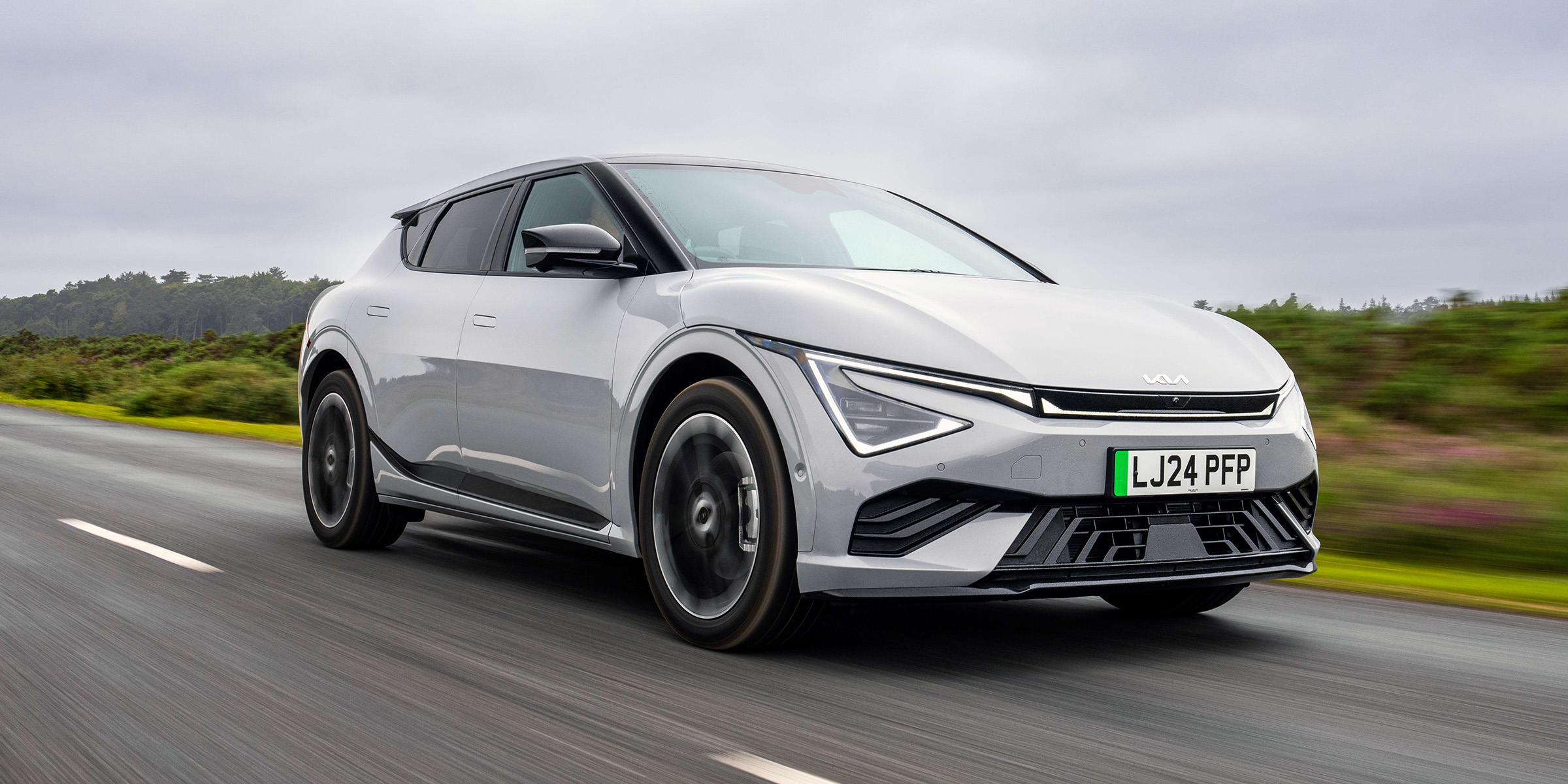
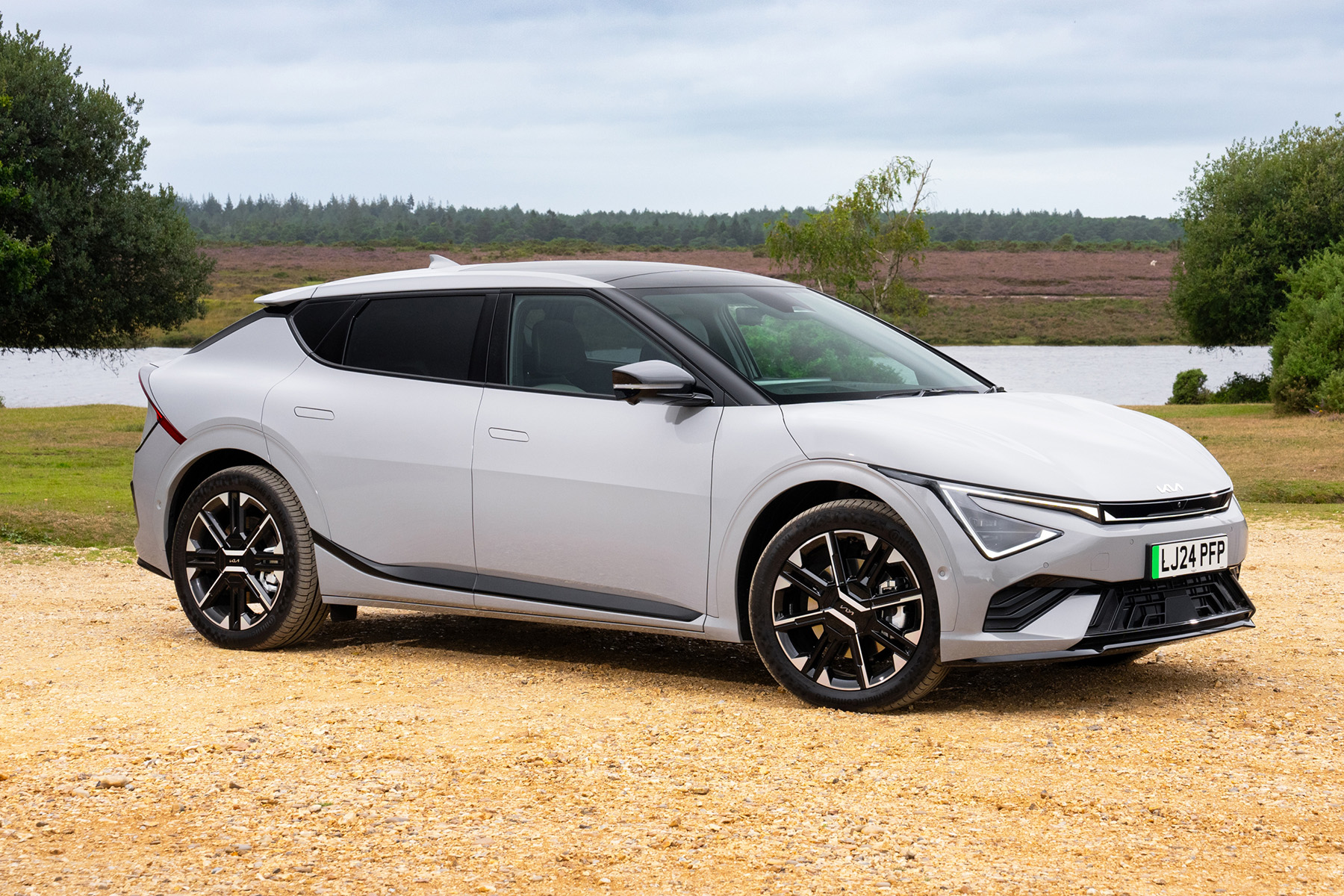
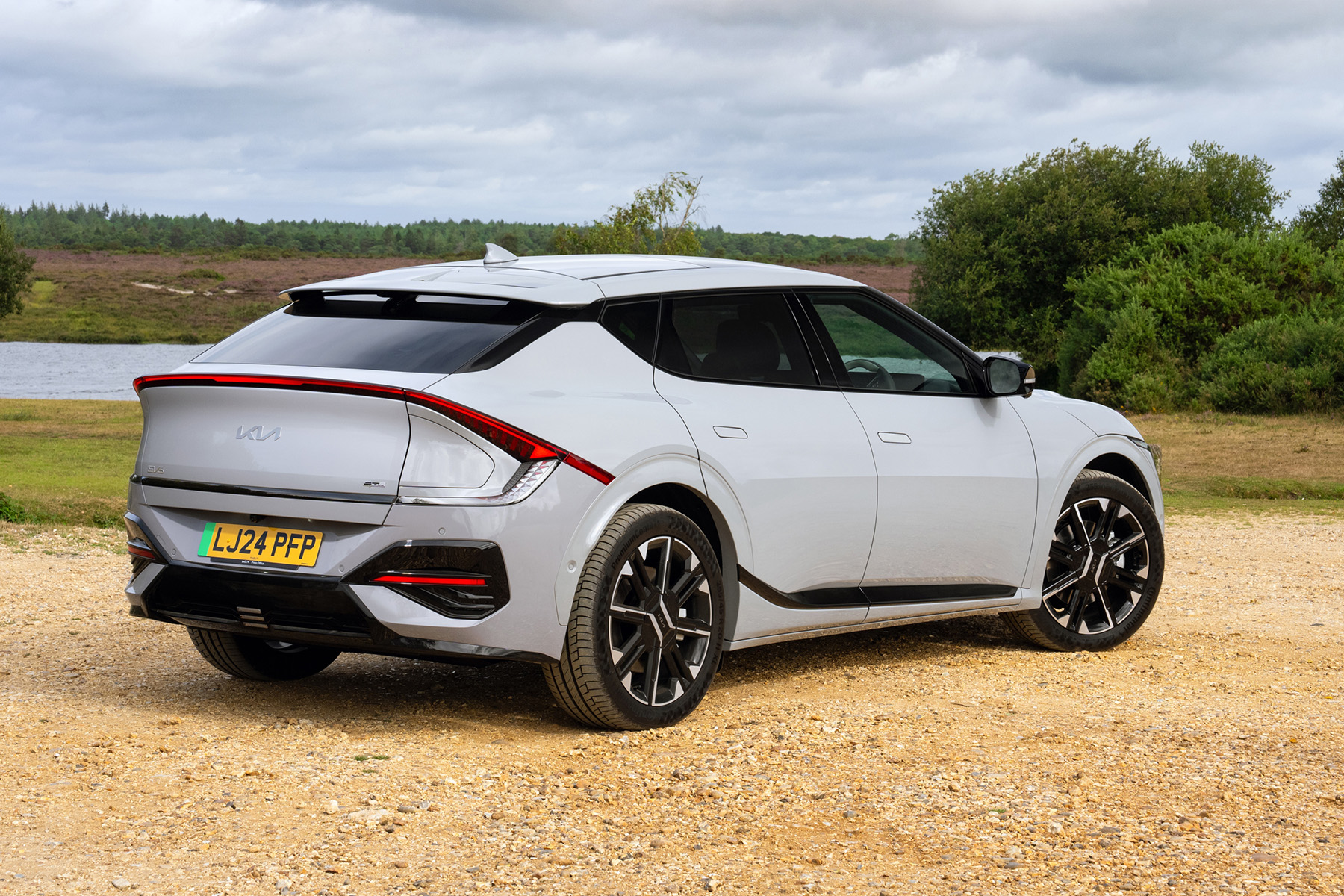
Kia has revised its widely-acclaimed EV6 crossover line-up, introducing a new larger entry-level battery and a minor exterior refresh.
This update comes as Kia tries to keep the model up to date with newer rivals like the Ford Capri and Mini Countryman that have arrived in recent months. The range still includes three trim options – the lead-in ‘Air’, ‘GT-Line’ and top-spec ‘GT-Line S’ – which are all powered by a new battery pack.
Available with both single-motor rear-wheel drive and dual-motor all-wheel drive configurations, this larger 225hp 84kWh battery replaces the 77kWh battery option previously available and can reportedly travel up to 361 miles on a single charge (347-mile maximum for the ‘GT-Line S’) – instead of the 295 miles the previous entry-level model could muster.
All-wheel drive versions (available only with the ‘GT-Line’ and ‘GT-Line S’ trims) have a reduced range, but offer a faster 0-62mph sprint time of 5.3 seconds – more than two seconds faster than the standard car. Top speed is capped at 115mph for rear-wheel drive models, and at 116mph for all-wheel drive models.
Compatible with ultra rapid charging speeds of up to 350kW, Kia adds that the revised EV6 can be charged from 10% to 80% battery in 18 minutes.
Alongside the powertrain upgrade, Kia has given the EV6 a few subtle exterior design revisions, including a new triangular LED headlight design with narrow daytime running lights that are similar to those deployed in the brand’s larger EV9 SUV range. There are also new 19- and 20-inch alloy wheel designs to choose from.
Now available to configure and order on Kia’s website, the revised EV6 range now costs over £45k as standard, with pricing stretching up to just over £57k for the all-wheel drive ‘GT-Line S’.
Winner of The Car Expert’s ‘Car of the Year‘ title in 2022, the Kia EV6 currently holds an excellent New Car Expert Rating of A, with a score of 83%.
Make and model: Mini Cooper Electric Description: New all-electric version of lifestyle-pitched small car Price range: from £30,000 to £34,500
Mini says: “Mini takes a giant leap into the digital era and the brand’s all-electric future.” We say: A more practical electric version of a car many will buy because it’s a Mini.
Few car manufacturers are as busy as Mini right now, the brand relaunching its entire range over the course of 2024.
Mind you that range is going to be rather simpler than in the past, as there will only be three models. Various names such as One and Clubman have been consigned to history, and instead we have Cooper – now encompassing the entire core Mini line-up – the Countryman SUV and a new model coming later in 2024 and called the Aceman. This will be a car designed to fit squarely in the middle between Cooper and Countryman.
The range re-invention also marks Mini’s move into an all-electric future with only the new Countryman also offered with a petrol engine. Hang on, we hear you say, Mini has already launched a new petrol-powered Cooper this year, and it looks just like the one in the picture above…
Well, pictures can deceive. While the petrol Cooper has the same visuals as the Cooper Electric, under the shell it’s a heavily-updated version of the previous model, which has been around since 2014. For the all-new Mini, keep reading…
What is it?
The Mini Cooper Electric is the fourth generation of the car that BMW reinvented back at the turn of the century. Where once Cooper signified an engine in the Mini line-up, now it is used to identify the entire core supermini range, which will encompass a five-door, the three-door we are testing here and a convertible which we should see before the end of 2024.
The car is available in two forms, the Cooper E and SE. Both promise more power and crucially more miles per charge over their predecessors – the poor range has been a criticism regularly levelled at previous electric Minis.
The new Cooper E has a power output of 184hp equivalent to the former SE but with its range increased by close to 50 miles to an official figure of 190 miles. The SE, which is expected to be by far the most popular of the two, houses a larger battery and so packs even more power at 218hp, with an official range extended to 250 miles.
Other major changes include a complete reworking of the styling outside and in, much more technology and a distinctly healthier level of standard equipment.
Who is this car aimed at?
When BMW relaunched the Mini brand, it succeeded in creating some of the level of cult following that the classic original 1959 car enjoyed. Despite the brand being diluted since by too many derivatives and some serious girth gaining, many Minis are still bought because they are Minis and owners love to be seen driving them – and these owners vary widely, from lucky youngsters with their first cars to pensioners.
The Mini also scores with those who enjoy driving because it’s great fun to get behind the wheel of. The phrase ‘go-kart handling’ appeared in the first press releases and has been so over-used since, but the car does have excellent on-the-road dynamics, which Mini has now faced the challenge of transferring to the electric version.
One area where the previous Mini Electric didn’t score highly was with its poor driving range, hampered by the car being a converted petrol hatch that was never intended to take an electric motor when it was first conceived. The new model was designed from Day One to be electric, so there are no compromises in its design. As a result, Mini expects many more customers to be attracted to the new one.
Who won’t like it?
There still exist traditionalists who write off the current Mini, saying it sullies the heritage of that 1950s original especially because it’s anything but mini in size. The new one is actually fractionally smaller than its predecessor (and the new visual treatment makes it look smaller, which is a plus) but it would still dwarf a classic Mini.
Others who might be put off include those who consider the Mini as something very British. While Mini’s home is still very much Cowley in Oxford, this new Mini Electric is built in Austria, as is its Countryman Electric big sister. Production from Oxford will be starting in the next year or so, however, so it won’t be long before you’ll be able to get a British-built Mini Cooper EV.
First impressions
On first view you will immediately be able to tell the new Mini from its predecessors, thanks to a new styling regime dubbed ‘Charismatic Simplicity’ (who thinks up these names?). All the detailing and plastic add-ons of previous models are no longer, while the distinctive clam-shell shape bonnet has gone too.
What we have now is a much minimalist exterior of smooth expanses which has divided opinions. Something to break up the panels a little would not go amiss, though of course totally smooth surfaces, extending to flush doorhandles, does aid electric range. And signature MINI elements remain, notably the circular headlamps and a now much more visible grille line shaped just like the Minis of old.
What do you get for your money?
Prices start at £30K for the Cooper E and £34.5K for the Cooper SE and the car is offered in three trim levels, dubbed Classic, Exclusive (plus £2.2K) and Sport (plus £3.5K). The differences primarily involve styling, alloy wheel options and the interior look.
The cabin is based on a knitted textile design on the dash and fascia surfaces which we are told makes much greater use of sustainable materials, and there are contrasting designs for the three trim levels. The Sport also includes some of the long-established John Cooper Works styling touches, notably on the steering wheel.
Common to all is a much longer standard equipment list. Navigation is standard for example, as are a heated steering wheel, a parking assist driver aid with blind-spot warning, a digital personal assistant allowing the driver to voice-control various functions with the words “Hey Mini…” and Mini’s ‘Experience Modes’, a selection of sound and vision offerings of which more shortly…
The Level 1 options package costs £2K though it comes as standard with SE models. It adds such niceties as heated front seats, adaptive LED headlamps, a head-up display in front of the windscreen displaying such information as speed and navigation directions, and wireless phone charging with a cooling feature to prevent said phone overheating.
Also part of the Level 1 package is ‘Comfort Access’, a digital key which allows unlocking and locking with the key in your pocket. This can be allied to a smartphone allowing the key to be shared with family or friends by means of a text message.
Level 2 costs £4K adding all of the above plus a panoramic glass sunroof, upmarket surround sound audio plus the technical bits you need for various autonomous driving functions under the banner of ‘Driving Assistant plus’. This comes fitted as part of the Level 3 package, and it includes active cruise control, a front-facing camera aiding the sat nav and features such as lane-keeping and automatically maintaining speed limits.
Other features in the £6.5K Level 3 package include electric seats with the driver’s having a massage function, and an internal camera – this allows the taking of selfies by occupants (we kid you not) but becomes a security feature while away from the car, for example recording a break-in.
What’s the Mini Cooper Electric like inside?
For many years the first box to tick when getting into a Mini was whether you’d fit in it – space inside was cramped in a way one would not expect in a car so much bigger than its inspiration, especially in the back seats. This has improved over time and the latest one improves things again, the electric powertrain helping with the interior packaging. We sat in the back and it remains cosy but now comparable to similar-sized rivals. You wouldn’t want to travel hundreds of miles on a rear seat, however, especially with tall front-seat occupants.
That knitted design on the surfaces is certainly different – made we are told from 90% polyester. It’s quite stylish but we wonder over its long-term ability to remain pristine.
The controls continue the minimalist theme, with far fewer switches to cope with. The front remains dominated by the huge central dial, some 24cm in diameter, in traditional Mini fashion. This is now a touchscreen controlling most of the car’s functions, to the point where the driver doesn’t have their own display – everything is read from the touchscreen or if you can afford it the head-up display. It’s quite easy to get used to but this traditionalist would prefer to see such essential information as the car’s speed directly ahead on his own display.
You know how you have to update your phone or computer operating system? Well the Mini has undergone the same, apparently jumping from BMW’s ‘operating system 5’ to system 9. Among the extra ‘functionality’ this has provided are the ‘Hey Mini’ assistant and the ‘Experiences’ which are definitely a Mini thing.
Basically by using a toggle switch below the that big round screen you can choose from half a dozen settings – names such as ‘Core’, ‘Vivid’, ‘Balance’, ‘Timeless’ (our favourite), ‘Green’ (very irritating as it keeps lecturing the driver every time one accelerates) and yes ‘Go-kart’. They change the background colour and design of the digital bits, oh and the noise, read on…
What’s the Mini Cooper Electric like to drive?
The Cooper Electric launch event offered the opportunity from some serious mileage around A and B roads around the Cotswolds in both the E and SE models. Both are more powerful than the cars they’ve replaced and even the base model feels swift on its way from 0 to 62mph in 7.3 seconds. The SE cuts this to 6.7 seconds and the instant torque availability of the electric motor makes overtaking slower traffic in particular a rapidly completed operation.
It handles like a Mini too. Okay this is a more practical car with a sensible range but a Mini should always be fun to drive, and thankfully it fulfils the brief. I won’t say ‘go-kart handling’ again (whoops) but it does produce excellent grip through twisty bits, a car that will very much outhandle the average supermini rival while also remaining very well-behaved at slower speeds on more urban roads.
Oh yes, the ‘Experiences’. Depending on which setting you choose you get a very electronic audio accompaniment, especially under hard acceleration. The sounds make not the slightest attempt to replicate the audio of a petrol engine, but instead something more akin to what you might expect when accelerating a land speeder in Star Wars… This is definitely a Marmite feature, but kids in the back will love it…
One other oddity is the front-facing camera that forms part of the Level 3 options package. As one approaches a junction it puts an image of the view ahead on top the navigation map and superimposes sat-nav direction symbols on said image. We’d argue keeping one’s eyes on the road would be a better option than looking at a central screen but it does have an additional safety function, recording and storing information if the car suffers an impact.
How safe is the Mini Cooper Electric?
As of August 2024, the Mini Cooper Electric has not been crash-tested by Euro NCAP so we can’t yet definitively answer that question.
The major electronic driver aids such as autonomous braking are of course present, while lane-keeping and blind-spot monitoring also feature in the standard specification. But it’s shame that to get adaptive cruise control you have to shell out more than £6,000 for the top options package. Pay out of course and you will also get the front-facing camera with its useful extra function as a dash cam in an accident.
Mini Cooper Electric economy, battery range and charging
Using the EU/UK government lab testing procedures, Mini quotes an official driving range of up to 190 miles for the Cooper E, 250 miles for the Cooper SE. In real-world driving, you’ll be unlikely to reach these figures, but the more popular SE should routinely go more than 200 miles between charges – much better than the car it replaces and plenty for typical owners of this sort of car.
The car accepts rapid DC charging up to 95kW allowing replenishment from 10 to 80% in half an hour. With a suitable charger plugged in ten minutes, or one coffee, will add more than 100 miles to the range.
Using an 11kW AC charger replenishment from zero to full takes four and a quarter hours on the E, another hour with the SE. And charging can be controlled using the Mini smartphone app.
Verdict
The new Mini Cooper Electric is certainly a major overhaul of the car with most of the changes for the better, creating a much more practical machine which has not lost the enjoyment factor that is expected to come with Mini ownership.
To get the most out of the car, however, you will need to invest in the options packages, and then compared to rivals it will start to look expensive.
Find your next new or used car with Auto Trader. Find out more
Find your next new or used car with Carwow. Find out more
Lease a Mini Cooper Electric
If you’re looking to lease a new Mini Cooper Electric, The Car Expert’s partners can help you find a competitive deal
Personal contract hire deals from Carparison Leasing. Find out more
Personal contract hire deals from Leasing.com. Find out more
Personal contract hire deals from Rivervale Leasing. Find out more
Subscribe to a Mini Cooper Electric
Subscriptions are becoming a very popular way for consumers to try a car for a few weeks or months to help decide whether it’s for them. If you’re interested in a car subscription, The Car Expert’s partners can help. (PS: What’s a car subscription?)
Vauxhall has announced the price list for its upcoming Frontera SUV which includes both hybrid and electric model options, and in what is a UK first, both powertrain options have the same price tag.
Based on the same foundations as the compact Citroën ë-C3 crossover, this brand-new family car revives the ‘Frontera’ moniker formerly used by chunky Vauxhall SUVs in the 1990s and early 2000s, and will sit between the smaller Mokka and larger Grandland in Vauxhall’s current SUV range.
Since we first covered the new Frontera in May, Vauxhall has revised the trim line-up down from three grades to two different trims – the entry-level ‘Design’ and the top-spec ‘GS’ (dropping the previously-planned range-topping ‘Ultimate’ from the new range).
Three powertrains will be offered, starting with the 100hp 1.2-litre turbocharged petrol engine and 28hp electric motor hybrid pairing. A slightly more powerful 136hp 1.2-litre hybrid will also be offered. The most expensive will be the 113hp Frontera Electric, which can reportedly muster up to 186 miles on a single charge.
Both the lead-in 100hp petrol-hybrid and 113hp electric variant will go on sale by the end of the year with the same price tag – around £23k. This makes the 136hp petrol-hybrid the most expensive powertrain option (before the arrival of a ‘long range’ electric model next year), costing just under £25k.
Smart has unveiled its largest model to date – the Smart #5 SUV – which will challenge the likes of the Skoda Enyaq and Nissan Ariya on the UK market when it arrives next Summer.
This new battery-powered five-seater SUV has been given a more rugged exterior design than that of its smaller #1 and #3 siblings, including a boxy silhouette, roof rails and a new LED headlight design. That said, the #5 is built on the same foundations as the brand’s other models and some of the same Smart underpinnings remain, including short front and rear overhangs, a protruding rear end and concealed door handles.
Smart says that the #5 is its most “versatile vehicle to date”, marketing the car as both a capable electric off-roader and a upmarket “tech-savvy” SUV.
The car’s outdoor-orientated equipment includes an electric trailer hitch and a roof-mounted light bar (top-spec ‘Summit’ trim only), while the optional ‘Adventurers’ Collection’ package adds more underbody protection, side steps, a side bag, and a ladder. In addition, all of the SUV’s seats are designed to also function as makeshift beds.
Inside, almost the entire dashboard space is taken up by two 13-inch AMOLED infotainment touchscreens that Smart says have a smooth response time due to the car’s advanced high-power AMD computer chip. Behind the steering wheel sits a 10-inch digital instrument display and the car also has an AI-powered voice assistant that takes the visual form of animal avatar – a lion to be exact.
The flagship piece of on-board tech aboard the #5 is the 26-inch augmented reality head-up display – a system that projects driving information onto the windscreen. The interior also has ambient lighting with 256 colours to choose from and a 21-speaker Sennheiser audio system.
The cabin has 34 smaller storage cubbies, 72 litres of frunk space, and up to 1,530 litres of luggage room in the rear with the rear seats stowed.
The car’s full powertrain details are yet to be confirmed, but the manufacturer has announced that the #5 is powered by a 100kWh battery that can provide single charge travel distances of up to 348 miles and that, using an ultra fast charging station, the SUV can be charged from 10% to 80% in 15 minutes. The car will launch with two trim level options – the entry-level ‘Premium’ and the range-topping ‘Summit’.
More Smart #5 details, including UK pricing, will follow in the coming months. The smaller #3 crossover is already on sale in the UK for just under £33k, and the #5 is very likely to be more expensive.
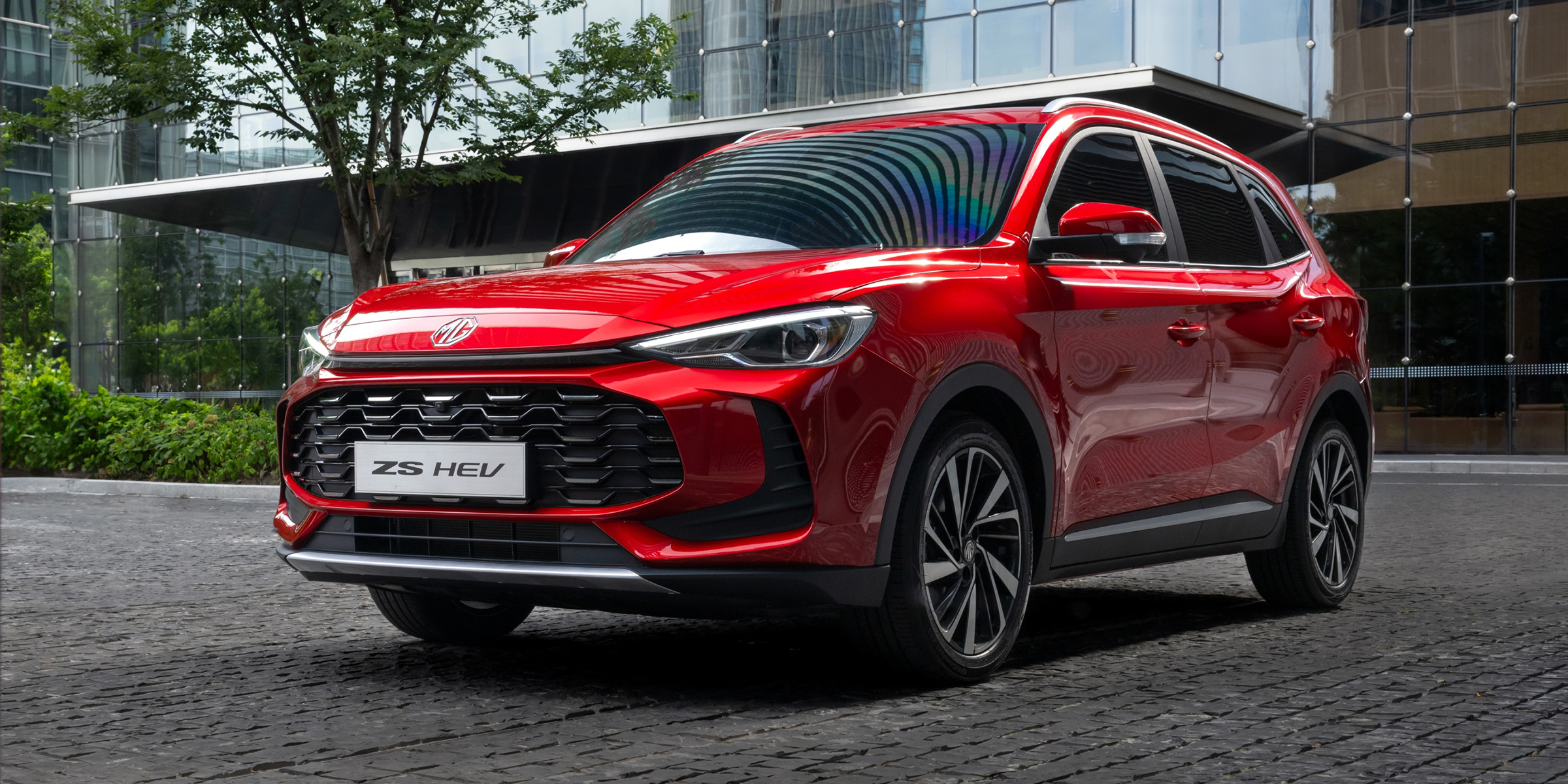
MG has unveiled its latest iteration of the ZS SUV/crossover – a hybrid-only range that is set to challenge the sales of the popular Nissan Juke and Ford Puma.
Powered by the same 196hp 1.5-litre petrol engine and an electric motor pairing as the new MG 3 Hybrid+ hatchback, the new-look ZS Hybrid+ can provide short periods of electric-only driving thanks to the additional 2kW battery that also reportedly ups the car’s fuel efficiency to 55mpg. A 0-62mph sprint takes a reported 8.7 seconds in the new ZS.
MG adds that it is also planning to offer traditional petrol models, but they won’t arrive until next year. An all-electric equivalent is also in the works, but it won’t carry the ZS nameplate, instead being based on the battery-powered MG 4 hatchback.
Like the larger second-generation MG HS SUV that has recently arrived in the UK, the new ZS comes with a large front grille and narrow LED headlights that stretch further up the bonnet, as well as thin angular air intakes and LED tail lights.
The standard equipment list offered with the lead-in ‘SE’ trim includes a 12-inch infotainment screen in the cabin, alongside a seven-inch digital instrument cluster, a rear view parking camera, rear parking sensors and keyless entry. The SUV has 443 litres of luggage space in the boot, which expands to 1,457 litres with the rear seats folded.
The top-spec ‘Trophy’ trim adds bigger 18-inch alloy wheels, a 360-degree surround view camera, heated front seats with a leather-effect upholstery and a heated steering wheel.
All models are compatible with Android Auto and Apple CarPlay, and come with a seven-year/80,000-mile warranty. Prices for the crossover will begin at just under £22k when the Hybrid+ arrives in UK showrooms in October this year.
Make and model: Lexus RX 450h+ Description: Large SUV Price range: from £62,140
Lexus says: “Lexus has undertaken a complete reinvention of the RX large luxury SUV, building on the model’s great heritage and breaking new design and technology boundaries to increase the breadth of its capabilities and its appeal to an even wider customer base.”
We say: After featuring in the range for more than two decades, the latest generation Lexus RX has been updated with a new plug-in hybrid option and minimalistic, screen-focused interior.
First appearing in 1998, the Lexus RX is now in its fifth generation with four generations of hybrid versions behind it. The latest model update has seen a plug-in hybrid variant called the RX 450h+ added. More generally, there’s also more technology and a comprehensive styling refresh both inside and out.
The entire Lexus range now features hybrid engine options, while there’s two fully electric models to choose from: the Lexus RZ and the Lexus UX. The RX is still the largest model in the lineup which means it’s slightly more expensive than both electric models.
The RX is the largest SUV in the Lexus lineup. It competes with the likes of the Audi Q7, BMW X5 and Volvo XC90 and, unlike some, has long been available with a hybrid engine. Lexus used to offer the RX L which came with a third row of seats to make it into a seven seater but it’s now offered strictly as a five seat car. If having seven seats is a must, the Land Rover Discovery, Mercedes-Benz GLE or the Hyundai Santa Fe can be had with an extra two seats.
For even better fuel economy, the RX is available as a plug-in hybrid. This offers much greater electric driving range than the basic hybrid, but requires regular charging to make the most out of its official 42 mile electric-only range.
First impressions
The latest RX reflects the latest evolution of Lexus styling, similar to the slightly smaller RZ electric SUV. The size and overall proportions are similar to the previous model – with a slightly longer bonnet – but the overall effect is more cohesive, especially in the way the grille is incorporated into the front-end design.
The interior has been simplified to make room for a bigger touchscreen and there are fewer buttons than before. The concept behind the interior space is to make everything easy and accessible so the driver can focus on driving. The interior door handles are electronic so to open them you have to rest your hand on the door and push the button with your thumb. While it makes the door panel more minimalistic, it seems to be an unnecessary change that takes some time to get used to.
We like: Modern styling retaining large proportions We don’t like: Handle release buttons inside
What do you get for your money?
There are four different trim options available for RX 350h and RX 450h+ models: Premium Pack, Premium Plus Pack, F Sport Design and Takumi. The RX 500h variant is only available in the F Sport specification. Pricing ranges from £62K to £77K depending on engine and trim level.
Premium Pack trim gets 19-inch alloy wheels, a 14-inch touchscreen, wireless phone charger, roof rails, powered tailgate, heated front seats and five USB charging ports, a sunroof is optional. Safety equipment includes blind spot monitoring, rear cross traffic alert, LED headlights with automatic high beams and Lexus safety system+.
Premium Plus Pack adds 21-inch alloy wheels, leather seats and steering wheel, powered tailgate with a kick sensor, head-up display, ventilated front seats and the extended safety package with lane change assist and front cross traffic alert. A panoramic roof is optional and a driver monitor comes as standard with this trim level.
F Sport Design for the 350h and 450h+ models adds exterior styling features including matt black 21-inch wheels, F Sport front and rear bumpers with silver inserts, black door mirrors with silver inserts, and silver F Sport badging. F Sport for the 500h includes features from the Premium Plus Pack as well as F Sport styling, black brake callipers, variable suspension and active sound control.
Takumi has an automatic parking feature, wood and leather steering wheel, heated rear seats, 21-speaker Mark Levinson sound system, rear sunshade and panoramic roof.
As standard, the RX range comes with a three-year warranty which can be extended by a year or 10,000 miles when the vehicle is serviced with an authorised Lexus workshop. This can extend up to ten years or 100,000 miles, whichever comes first.
We like: Entry-level spec has a good amount of equipment We don’t like: Some safety technology is reserved for higher trim levels
What’s the Lexus RX like inside?
The big car look on the outside is mirrored inside with a spacious cabin. Compared to the previous generation the layout is simplified with fewer buttons. Climate control buttons are semi-physical with dials to control temperature and integrated screen buttons for the majority of other functions. Physical shortcut buttons are added below to demist the front or rear screens.
A 14-inch touchscreen comes as standard across all trim levels and home, music, navigation, phone, apps and settings buttons are housed along the right hand side of the screen, closest to the driver. Wireless Apple CarPlay and wired Android Auto are standard fitment and simplify the multimedia interface even further.
Drivers can connect their car to the Lexus Link app which can lock and unlock the car remotely and set either air conditioning or heating before you get in the car. There are touch sensitive buttons on the steering wheel for additional menu options which are shown on the head up display if the car is fitted with this.
There’s plenty of room in the back for tall adults and headroom isn’t an issue either. While the middle section of the floor is slightly lifted, it’s unlikely to make middle passengers uncomfortable and retains a decent amount of legroom. When there’s not someone sitting in the middle, the seat back folds out to reveal two cup holders and a storage space in addition to large door bins.
It’s got a big boot, although it’s beaten by rivals like the BMW X5 or Volvo XC90 but there’s still a good amount of space with some underfloor storage too. The rear seats can be released from buttons in the boot, which makes it much easier to quickly load long luggage. The seat backs also recline improve comfort for rear passengers.
We like: Functional features like seat releases in the boot We don’t like: Some climate control functions in the screen
What’s under the bonnet?
The RX range has two hybrid options and one plug-in hybrid version. The RX 350h is the entry-level model, with a 2.5-litre petrol engine and electric motor. This is a regular or basic hybrid, so it can’t be externally charged and relies on the petrol engine to generate electricity (either directly like a generator, or indirectly by recuperating spent energy when the car is coasting or braking).
RX 450h+ is the first plug-in hybrid model to feature in the RX range after a long line of standard hybrids. This uses the same 2.5-litre engine, but a larger battery means you can do a lot more driving with the electric motor with less reliance on the petrol engine. According to the (useless) EU/UK government lab tests, official fuel economy is around 235mpg. In reality, of course, it’s nowhere near that. Electric-only range is officially 42 miles and the vehicle can drive up to 80mph on electric power.
The RX 450h+ defaults to drive using only electric but the driver can choose whether they want to conserve battery power and use the engine instead or let the vehicle decide when to use electric power. The engine can also be used to charge the battery in preparation for low emission zones or extra power going uphill while towing, for example. The battery can be charged in around two hours 45 minutes with a 230V/32A connection.
The RX 500h has a 2.4-litre turbo hybrid engine. It’s the quickest of the range as it’s designed to be a performance model. The system has been created to deliver great power and acceleration whilst offering good fuel economy thanks to the hybrid integration.
For all models, unbraked towing capacity is limited to 750kg and braked towing capacity is 2,000kg. This should be more than enough for towing trailers or caravans.
What’s the Lexus RX 450h+ like to drive?
On the road the RX feels large, thanks to its high ride height and size, but it doesn’t make it intimidating to drive though. It’s easy to get comfortable in the driver’s seat and the cabin is nearly always quiet. We tried the RX 450h+ plug-in hybrid, which handles all the electric power and battery management itself to create a calm environment even when the battery is depleted. In addition to being able to charge externally, the RX 450h+ can recuperate energy under braking and coasting or use the petrol engine to generate electricity.
Visibility is very good all round, which makes it easier to account for the size of the vehicle when parking. The rear quarter windows improve rearward visibility and help to eliminate any blind spots, mostly during reversing, as blind spot monitoring comes as standard. Parking sensors and cameras also aid manoeuvring and the car can display a 360-degree view around when you’ve parked so you don’t have to open the door to check you’re within the lines.
The RX is fitted with a suite of safety features such as road sign assist which notifies you every time the speed limit changes and if you’re exceeding it. This can be useful in unfamiliar areas but it can be turned off if it gets too annoying. Under harder acceleration the engine can get a little noisy, but for the large majority of driving situations it remains quiet and unobtrusive.
It rides nicely on the road with minimal lean around corners. If you go for the F Sport version the suspension will be set up to enhance performance rather than long distance comfort. The hybrid system uses regenerative braking to add some power back into the battery while you’re driving but the brake pedal itself can be quite sensitive. It confidently stops the car but gentle pressure is advised while you get used to the feel.
There are lots of assistance and safety features included in the RX specification such as obstacle anticipation assist. This is designed to detect a hazard ahead such as a pedestrian stepping out into the road. If the system determines a risk of collision, it automatically activates the brakes and steers to avoid the obstacle without leaving the lane the vehicle is in. From Premium Plus Pack upwards, a driver monitoring system can trigger visual and audible alerts if the driver appears to be distracted or not concentrating. In the event the driver doesn’t respond to a warning, the system can stop the car and call for assistance.
While the interior handles take some time to get used to, the electronic latching system can prevent collisions. As the handle is linked to the blind spot monitor, it can stop the door from being opened if a car or cyclist is approaching the vehicle.
We like: Good all round direct and camera visibility We don’t like: Sensitive brake feel
Verdict
With plenty of specifications to choose from alongside two hybrids and a plug-in hybrid, there are options to suit different needs in the RX range. The extra electric reserves of the RX 450h+ plug-in hybrid help to provide a relaxing driving experience and good fuel economy for long journeys or regular short trips, using electric power only. We always recommend considering access to charging and getting into the habit of charging a plug-in hybrid at every opportunity to get the maximum benefit.
Some competitors offer a bigger boot, but the RX still has ample space for passengers and luggage. The range is competitively priced and well equipped at all trim levels. The RX L hasn’t been brought back for this generation so if a seven-seater is a must the RX isn’t in the running. For everything else though, the Lexus RX 450h+ fits the bill as a large luxury SUV that’ll be comfortable and spacious for everyone.
Similar cars
If you’re looking at the Lexus RX, you might also be interested in these alternatives.
CO2 emissions: 26 g/km Euro NCAP safety rating:5 stars TCE Expert Rating: A (73%) (as of August 2024)
Buy a Lexus RX
If you’re looking to buy a new or used Lexus RX, The Car Expert’s partners can help you find the right car
Search less, live more. We make finding the right car simple. Find out more
Search for your next new or used car with Auto Trader. Find out more
Discover great deals available on both new and used cars. Find out more
Lease a Lexus RX
If you’re looking to lease a new Lexus RX, The Car Expert’s partners can help you find a competitive deal
Personal contract hire deals from Carparison Leasing. Find out more
Personal contract hire deals from Leasing.com. Find out more
Personal contract hire deals from Rivervale Leasing. Find out more
Subscribe to a Lexus RX
Subscriptions are becoming a very popular way for consumers to try an electric car for a few weeks or months to help decide whether it’s a suitable alternative to a petrol car. If you’re interested in a car subscription, The Car Expert’s partners can help. (PS: What’s a car subscription?)
With ever-growing motoring costs, we all look for the best deal possible when the annual insurance renewal comes around. And for many motorists, that means finding the best price for their social, domestic & pleasure (SD&P) cover.
But if you use your car to get to work and have not notified your insurer of this, you could be driving with insufficient cover.
It’s one thing being a courier and using your car for deliveries across the country – that’s generally accepted as business use. But what about commuting to your normal place of work or office? Or going to see clients? Perhaps visiting different work sites or locations?
Risk experts have warned that not all drivers using their own cars for work will have the correct insurance in place. Work-related journeys all need additional business cover, which should be discussed with an insurer before any policy is put into place.
Using a car for a regular commute to a place of work can constitute a ‘business use’ which is not covered on a regular SD&P policy. Even driving a friend or relative to a rail station for them to catch a train to work every day can be classed as a ‘work-related journey’ which should have adequate insurance cover.
Recent research by risk management experts Safe2Drive, shows that significant numbers of UK motorists mistakenly believe that their standard car insurance policy covers them for business use.
Businesses have a duty of care to ensure the safety and well-being of their employees beyond the confines of the workplace. This includes support for ‘grey fleet’ vehicles, which are privately owned vehicles used for business driving. Duty of care measures include verifying that workers have the appropriate insurance coverage for business use, adequate driver training, and help with regular maintenance of the vehicle.
As a company does not own the grey fleet vehicles, the business must manage more challenging problems as the responsibility lies with the employer to ensure the safety of their drivers and the vehicles they use.
Failure to have the correct insurance could lead to serious consequences for both employer and employee, including legal non-compliance, claims refused, fines and penalties, increased costs and in some cases a criminal record.
What are the different types of car insurance?
Social, Domestic & Pleasure – Normal use of a private vehicle, including visiting friends and family, driving to the shops or supermarket and using the vehicle for days out and holiday trips.
Social with commuting – As above but adding in a clause which covers you for a regular commute to a permanent place of work. This can include going to a rail station and leaving the car in its car park every day.
Business use – Cover that is added in for any type of work-related driving. There are different levels of cover, from using a car to get another office or a meeting, driving to collect equipment or a colleague, up to using the vehicle regularly for site visits or multiple client appointments.
Commercial use – Full-on business use, such as using a car as a taxi, a driving school car or a delivery vehicle. This is a clearer-cut category for most motorists but, in any case, the insurer would be able to advise which level you need.
It’s had its fair share of bad times with the Bosnian War 25 years ago and, more recently, civil unrest and anti-Government protests, but Bosnia and Herzegovina is trying to settle down to make itself a place that people want to go and visit again. Indeed, tourism is one of its main industries now.
With Croatia surrounding its north and west regions, Montenegro to the south and Serbia bordering its east flank, Bosnia has just a small coastline of around 12 miles around the town of Neum. But inland, the country boasts beautiful mountain roads, vast forestation, winding rivers and waterfalls and other natural sights which have helped to increase tourism over the last decade.
With a warm climate, clean water and untouched nature, this Balkan country has certainly returned to the ‘must-see’ lists of many adventure seekers. Walking, hiking and water sports such as kayaking are all important attractions for holidaymakers.
The major cities such as capital Sarajevo, Mostar and Banja Luka offer art, history, medieval architecture and a buzzing nightlife with bars, restaurants and clubs all presenting a warm welcome.
The cuisine is influenced by Mediterranean and Turkish cultures and include boiled meat with plenty of potatoes and vegetables. Bosnia’s much-loved national dish of Bosanski Lonac, for example, consists of vegetables stewed with meat and herbs.
From a business point of view, manufacturing is dominant, with wood and furniture high up the export list, along with steel and coal. Tourism continues to help boost the country’s coffers – according to the World Tourism Organisation, Bosnia has had one of the highest tourism growth rates in the last 10 to 15 years.
It’s possible to drive to Bosnia if you have the time, going through central Europe and heading south east, and you would pass through some wonderful scenic areas along the way.
But that’s a big drive and flying in and hiring a vehicle is the more likely option for travel. You’ll find a wide selection of car rental companies operating from the country’s main airports of Sarajevo, Banja Luka and Tuzla.
Driving in Bosnia is a completely different experience from doing so in the UK, not just because the people there drive on the right side of the road. Planning a driving holiday or using a car on business, requires careful planning and a good understanding of what you can and can’t do behind the wheel while there.
Here The Car Expert looks at the most important elements to consider when planning to drive in Bosnia, and we’ve included a handy checklist. As each journey is unique, always check that you have everything covered for your particular visit.
Basic rules
You must be 18 years or more and hold a full driving licence to get behind the wheel in Bosnia. Just the licence card will do, as the paper counterpart is no longer a requirement. International Driving Permits are recognised but are not a necessity.
You’ll need to prove that you have car insurance if you take your own vehicle to Bosnia so always have your certificate with you. You should also always carry with you documents that show the identity of the vehicle, such as a V5C ‘logbook’. And always have your passport or other form of ID.
If it’s registered in the UK, your vehicle’s ‘home country’ must be shown on it. A ‘UK’ sticker on the rear is one way to do this but you can also show a small UK badge on both number plates if you wish. The ‘GB’ badge is no longer allowed, even within European ‘golden stars’ and the same goes for country signs such as the English, Scottish or Welsh flags.
It’s quite likely you’ll be using a hire car, in which case always have the rental agreement paperwork with you while driving. You must be at least 21 years old to rent a car, but some types of vehicle might require a higher driver’s age – check with the rental company. You must also have held a full licence for at least one year.
Motorists under 23 years of age or anyone who has had a driving licence for less than one year can not drive at night, between 11pm and 5am.
Speed limits
Speed limits are shown in kilometres (km/h) rather than miles (mph). In built-up areas the speed limit is 50 km/h (31 mph). Outside of towns the limit is 80 km/h (50 mph) while main A-roads (expressways) have a 100 km/h (62 mph) top speed. These limits can vary from region to region so always keep an eye on local signage.
Motorways have a blanket 130 km/h (80 mph) limit. Traffic police are vigilant and will stop you for speeding and issue a spot fine.
Speed camera detection devices are illegal when driving on Bosnian roads and that includes those built into navigation units, so ensure this feature is switched off. And don’t use a mobile phone while driving unless it is ‘hands-free’.
Blood alcohol limits
We don’t recommend any drinking of alcohol if you are going to drive, but you should be aware of the country’s limit. For drivers over 21 it’s 0.3 g/l (0.3 milligrams) blood alcohol level. If you are under that age or have had a full driving licence for less than three years, the limit is zero. If you have been drinking alcohol you must not travel in the front seat, even as a passenger.
For comparison, it’s 0.8 g/l (0.8 milligrams) in England and Wales.
Penalties for a positive alcohol test are severe and range from a fine, severity dependant on the amount over the limit you are, or even licence confiscation.
What to carry in your car
You must have in your car a warning triangle, first aid kit and Hi-Viz reflective jacket which must be worn if you have broken down or been in an accident outside of urban areas. In the latter case you must wait until police arrive before you can go.
The authorities expect you to have headlamp converters for your headlights (or have manually adjusted lamps) so you don’t dazzle on-coming drivers. And consider carrying some spare bulbs with you.
Specialist suppliers, such as motoring organisations, sell ‘European driving kits’ for £25-£30, which contain everything you are likely to need for a Continental road trip, and it’s well worth investing in one.
Seatbelts
Seatbelt rules are the same as in the UK: if your car has them, they must be worn. It’s the driver’s responsibility to make sure everyone is buckled up. Children must be fastened in too – any child under 12 years of age must sit in the rear of the car and in a suitable child seat. Babies under two years can travel in the front if they are in a rear facing child seat with the car’s airbag switched off.
Driving
Keep to the right-hand lane as much as possible but if you are overtaking you must do so on the left. Many roads in Bosnia are single lane with little or no chance to overtake so be prepared so sit in a line of traffic going at 50 or 60 km/h. Don’t risk trying to get past someone unless it’s absolutely safe to do so.
Roads outside of main cities are often poorly surfaced and have no lighting. Local drivers might ‘tailgate’ you or attempt dangerous overtakes, so be vigilant and just let them through.
There are many mountainous roads and, if you are driving uphill, you have the right of way – others should pull over to let you pass.
You will usually give way to vehicles using the ‘main’ road unless signs state otherwise. At crossroads that have no controls or road markings, give priority to vehicles on your right. Always give way to emergency vehicles as soon as you can. If someone is waiting to cross a road at a pedestrian crossing, you must stop for them.
In Bosnia you should use dipped headlamps all year round, day and night. Horns should be used sparingly – there are often signs showing a hooter which forbids their use.
Cars on the inside of roundabouts have the right of way. Let them exit safely, and always signal your intentions well in advance so that other drivers know what you are planning. There are trams in Sarajevo. If you see one on your left, it has priority.
It can get extremely cold in Bosnia and you will be expected to have the appropriate winter tyres fitted to your car between 15th November and 15th April. Rental companies should have those covered but it’s worth checking. If it snows you must use snow chains. This is also the case if the relevant road sign advises it. Chains should be a part of any travel equipment during the cold months.
There are no specific laws related to towing if you are taking a trailer or caravan through Bosnia but make sure you can see clearly behind you with the use of two wide rear-view mirrors.
Traffic signs
Traffic lights are red, amber and green and follow a similar pattern to the UK, although there is no ‘red and amber’ before you set off.
Road signs usually have pictures which are self-explanatory and include the ‘traffic queue ahead’, ‘road narrows’ and ‘low flying aircraft’ warning signs that UK drivers will be familiar with. There are some notable other warnings though, including a picture of three children in a yellow background, meaning simply ‘Children!’, a car tilting over which means ‘Rolling over’, and a man pushing a cart meaning ‘No handcarts’. There’s a highly pictorial sign showing a car, a house and two people playing football, which means ‘Living street’.
Warning signs are generally triangles with a red border, prohibitory signs are round with a red outline, mandatory instruction ‘order’ signs are circles with a blue background, while information signs are square and generally blue.
Most signs will be written in Bosnian, such as Skolska patrola (School patrol), Bolnica (Hospital) and Policija (Police), but the hexagonal stop sign features the word ‘Stop’ in English. Directional signs are generally yellow squares with the town names written in Bosnian and English and the distances shown in kilometres.
Fuel availability
Unleaded and diesel fuel and are widely available on Bosnian roads and there is growing coverage for electric vehicles (EVs). Fuel areas with cafes and rest stops are popular with tourists and locals. Debit and credit cards are widely accepted.
Some sections of Bosnia’s 200 km of motorways are paid for by tolls. Some routes are free though. The amount is based on the type of vehicle and the section of M-way being used. Payment is made simply, at a toll booth using cash or credit/debit card. It costs about £4.50 to use the A1 route near Sarajevo. The tolls system is closely monitored and failure to pay can mean a fine of nearly £90, so it’s worth paying at the right time.
Parking
There is plenty of space to park your car in the major Bosnian cities. Monitored car parking lots and underground car parks are widely available and it’s recommended that these are used rather than trying to find somewhere on a public road. In any case, don’t do this at night and never leave valuables on show.
Places where it’s forbidden to park are marked with ‘No Parking’ signs – ignore these and you will get a fine and possibly have your car towed away.
The closer you are to the city centre the more expensive the fee will be. In Sarajevo the central ‘Zone 0’ and ‘Zone 1’ areas only allow for a maximum two hours of parking. Contactless payment by card is available in many areas.
Parking is prohibited if facing traffic, on pavements, across building exits, fire lanes, on grass or at any place that would inhibit access of emergency vehicles. Cars will be towed away in these cases.
Emergency number
In Bosnia, as with most of Europe, you can dial 112 and make contact with emergency services such as fire, ambulance or police, 24 hours a day. Operators will speak English, French other European languages.
A range-topping high-power version of the Volkswagen ID.3 is now available to order in the UK, which is the German brand’s quickest-accelerating electric car to date.
Called the ID.3 GTX Performance – which is more powerful than the ID.3 GTX hot hatch which is set to go on sale in the UK later this year – this sporty hatchback is described by Volkswagen as the “electric counterpart to the Golf GTI Clubsport“, and is mechanically identical to the Cupra Born VZ which went on sale in July.
Alongside a sports suspension upgrade and a new dynamic chassis control system that improve steering precision, the GTX Performance also comes with a slightly larger 79kWh battery (as opposed to the regular 77kWh unit in the ID.3 range) and a more powerful rear-mounted electric motor that boosts the power output up to 326hp.
The car can reportedly complete a 0-62mph sprint in 5.7 seconds, which is a tenth of a second slower than the Born VZ and almost two seconds slower than the ridiculously quicker MG 4 XPower.
The larger battery pack does provide a range of up to 369 miles on a single charge however, which is a great deal more than the XPower’s 200-mile maximum. The hot hatch is compatible with DC charging speeds of up to 185kW, which can charge the battery from 10% to 80% in 26 minutes.
The car sits on large 20-inch alloy wheels and comes with a few extra exterior tweaks compared to the standard range, including a sportier front bumper and rear diffuser design, some gloss black accents and ‘arrowhead’ LED daytime running lights.
Pricing for the Volkswagen ID.3 GTX Performance now begins at just over £46k. This is almost £2k more expensive than the similar Cupra Born VZ.
With used electric car (EV) choices widening and prices finally starting to fall to realistic levels for many more households, there’s never been a better time to make the all-electric switch. In fact, many second-hand electric models are now similarly priced to their petrol-powered counterparts.
New EV sales grew slowly but steadily during the 2010s, but really took off from 2020. There are now more than a million EVs on UK roads, but about three-quarters of those are less than three years old, so many of them are only now starting to hit the used car market for the first time. That means there’s now a lot more choice for customers, which has also brought prices down significantly from where they were a couple of years ago.
We analysed all the used electric cars available at several price points, using the thousands of deals listed on the website of our partner Motors. Then, we consulted our industry-leading Expert Rating Index to see which models have the highest ratings for safety, running costs, reliability and favourable reviews from motoring journalists.
Every car listed below has used models available to purchase now. Our list concentrates on cars no more than five years old (and most no more than three) because there’s a lot more choice. Once you start going back more than five years, you’re largely restricted to Teslas, Nissan Leafs and a few Smart city cars.
With our comprehensive Expert Ratings data and hundreds of media reviews backing our recommendations, you can be confident that this is the definitive guide to the best used EV bargains that are on sale in the UK right now.
The pricing estimates and model age figures used in this article are based on actual listings on Motors and are accurate as of August 2024. The used car market is constantly shifting, and it’s likely that these prices will increase or decrease further in the coming months.
Part of the previous Volkswagen Golf Mk7 line-up, the e-Golf was one of the best all-electric hatchbacks on the market a few years back. The EV industry now offers superior electric powertrains and on-board tech, but the e-Golf is still a great value-for-money choice in this budget bracket. It also drives much like a regular petrol-powered Golf, but quieter, which makes it ideal for buyers looking for their first EV.
The Volkswagen Golf Mk7 range holds a Used Car Expert Rating of B in our Expert Rating Index, with a score of 69%.
Another electrified version of a UK favourite, the Vauxhall Corsa-e (renamed the Corsa Electric as part of last year’s facelift) stands out due to its well-equipped cabin and comfortable driving experience, but it can get rather cramped in the back.
Roomy, affordable and reliable – the second-generation Nissan Leaf was the best selling electric car worldwide not that long ago. That said, it has also been surpassed by newer rivals that offer a longer battery range.
For a few thousand more than the old e-Golf, you can instead opt for its replacement. The Volkswagen ID.3 is now fairly cheap on the used market, and has been widely praised for its performance and decent battery range, as well as overall comfort and ease of use. That’s if you can live with the rather fiddly infotainment, which Volkswagen took a few years to improve.
The Volkswagen ID.3 holds a Used Car Expert Rating of A in our Expert Rating Index, with a score of 78%.
A sign of the rapidly growing used EV market if there ever was one, you can now buy a four-year old Tesla for a smidge under £15k. The mid-sized saloon is tech-laden and offers punchy performance, but ride comfort can be harsh and build quality patchy.
While this is the previous version of the Kona Electric, this compact SUV is still impressive, even by current standards. It’s practical, fun to drive and is affordably priced on the used market.
A few years ago the Jaguar I-Pace was generally considered to be one of the best electric cars on sale – albeit one of the most expensive. Now, the latter is no longer the case. Praised for its battery range, sports car performance and its polished and practical interior, the I-Pace is currently more affordable on the used market than other upmarket second hand SUVs from the likes of Audi and Mercedes-Benz, and it comes with excellent safety credentials too.
The Jaguar I-Pace holds a Used Car Expert Rating of B in our Expert Rating Index, with a score of 66%.
Designed to be an attractive low-price gateway to EV ownership, it’s no surprise that the well-received MG 4 hatchback offers great value-for-money on the used market too.
The Mégane E-Tech is a stylish crossover-style hatchback that offers intuitive infotainment, a competitive battery range and a comfortable ride. That said, rear visibility isn’t great and the car’s boot design isn’t very practical.
The award-winning Skoda Enyaq is one of the most practical EVs out there, commended for its spacious cabin with a large boot, its long battery range and its comfortable driving experience. Importantly, the SUV is a value-for-money pick on both the new and used market. There’s currently a wide selection of low-mileage used models listed online for under £25k.
The Skoda Enyaq holds a Used Car Expert Rating of A in our Expert Rating Index, with a score of 79%.
The sporty Ford Mustang Mach-E is an accomplished all-rounder that blends impressive straight-line performance with a spacious and comfortable interior. The car’s handling isn’t considered to be great, however.
This retro-modern Hyundai is larger than it looks and is well-mannered on the road. Reviewers are also impressed by the car’s powertrain and on-board tech, but alternatives have a softer ride.
Currently the world’s most popular electric car, the family-friendly Tesla Model Y has been praised by reviewers for its impressive performance and battery range. It may be more expensive on the used market than some similarly-sized rivals, but its class-leading on-board tech makes it a stand-out EV choice which includes worldwide access to Tesla’s acclaimed Supercharger charging network.
The Tesla Model Y holds a Used Car Expert Rating of A in our Expert Rating Index, with a score of 72%.
The Kia EV6 is a sleek family-sized electric car that is slightly sportier than its Hyundai Ioniq 5 counterpart, but just as well-designed and spacious inside. Like the Hyundai though, its ride quality has been criticised.
A spacious SUV with a refined and high-quality interior, the Nissan Ariya is a good value-for-money choice in the £30k price bracket due to its generous standard equipment list. It’s not very exciting to drive, though.
Its eye-catching van-shaped styling may not be for everyone, but the Volkswagen ID. Buzz can’t be beat when it comes to interior space and practicality. Ideal for large families, the ID. Buzz people carrier can quietly and comfortably handle long distances on a single charge. Like other Volkswagen EVs however, reviewers take issue with the car’s rather confusing infotainment.
The Volkswagen ID. Buzz holds a Used Car Expert Rating of A in our Expert Rating Index, with a score of 78%.
Another well-received electric Volkswagen with an impressive battery range the relatively new ID.7 saloon has just started to appear on the used car market with some reasonable prices.
Polarising exterior looks aside, the BMW iX is a large luxurious SUV with impressive infotainment and a class-leading battery range. Its pricing has been slashed on the used market, but alternatives are still cheaper.
For the definitive rankings of the best used family cars for every budget, we’ve used The Car Expert’s industry-leading Expert Rating index. The index analyses new car reviews from 35 of the top UK motoring websites, plus Euro NCAP safety data, reliability data and running cost data. A number of complex algorithms come together to give us overall new and used car ratings.
The algorithms constantly recalculate and update the Expert Rating scores every time new data points are added (we’re currently at about 7.5 million!) to make sure you’re getting the most accurate and reliable recommendations for every new car – and a growing number of used cars as well.
The new electric Cupra Tavascan coupé-SUV range will soon be available to order in the UK, with four models to choose from.
We first covered the Tavascan after the model’s official debut in April last year – this being Cupra’s second all-electric model – so this SUV has been a long time coming. Described back then by its manufacturer as “a glimpse of what the brand’s future electric models will look like”, the Tavascan will launch as a competitor to the popular Tesla Model Y SUV.
The SUV’s exterior looks “remains faithful” to the Tavascan 2019 concept car, with its angular front end features including triangular Matrix LED headlights, a large grille and pronounced bonnet indents. The Tavascan’s sloping roof line and sharp door panel contours lead to a full-width rear tail light that features an illuminated Cupra badge in the centre.
The SUV sits on 21-inch alloy wheels finished in black and bronze, which are wrapped in performance tyres as standard.
Cupra will launch the car with two powertrains and four trim levels. The cheaper ‘V1’ and ‘V2’ is powered by a 77kWh battery and electric motor pairing that produces 286hp and a reported maximum range of 352 miles, which is a longer travel distance that the surpasses what the range topping Tesla Model Y ‘Long Range’ can muster.
The second more powerful option is powered by the same 77kWh battery, but is tuned more for performance. Available with the ‘VZ1’ and ‘VZ2’ trims, this 340hp powertrain can complete a 0-62mph sprint in 5.5 seconds – 1.3 seconds faster than the entry-level version. Top speed is electronically capped at 112mph. The SUV is compatible with up to 11kW AC charging and 135kW DC fast-charging stations.
Available to reserve now but officially launching on 11th September, pricing for the Cupra Tavascan will start at just over £47k for the ‘V1’, rising to nearly £61k for the range-topping ‘VZ2’.
Does anyone driving a car today not know the Volkswagen Golf? Celebrating its 50th anniversary in 2024, this is a car that remarkably, replaced the VW Beetle and in the process became a standard bearer for a whole new format, the front-wheel-drive hatch.
Many a rival has come and gone since then, but the Golf has simply remained as a constant presence, Volkswagen jealously guarding the car’s reputation of being just a little more upmarket and of better quality than contenders produced by the likes of Ford and Vauxhall. So far 37 million Golfs have been built, 2.3 million of them for the UK.
The current, eighth-generation Golf has been on sale since 2019, and the 50th anniversary coincides with the usual mid-life update. Volkswagen calls it the ‘Golf 8.5’, which may be over-egging it somewhat, although the revamp does extend to engine updates and even changes to the car’s chassis.
What is it?
The 2024 Volkswagen Golf is an extensive update of the Golf 8, which arrived in UK showrooms in 2019 and was widely seen as a much changed for the better car compared to its predecessor. There were gripes, though, and Volkswagen claims that customer feedback has driven some of the changes on the new car. It also makes use of updated technology launched on recent new models, particularly the all-new Tiguan SUV that went on sale earlier this year.
What this means for customers is more tech, particularly a new digital cockpit, and improvements to the engines, especially the plug-in hybrid models which get bigger batteries and more range as a result.
The plug-in hybrids are part of an extensive choice of power running across both the five-door hatch and five-door estate versions of the Golf. You can also have regular petrol (with mild hybrid assistance) or turbo diesel, but not a fully electric model – we’ll explain why shortly…
Who is this car aimed at?
The Golf has long suited and continues to suit a wide range of customers, being regarded as competent a family car as it is a fleet driver’s motorway muncher. Much of this appeal is generated from past reputation, the Golf always regarded as just a bit better than the car park crowd. This is no longer true, as today there are some very good rivals out there, but the Golf continues to sell in vast numbers and generate many happy owners.
Who won’t like it?
If you are convinced by the switch to electric and want an electric Golf, you can’t have one right now. There was an electric e-Golf version of the previous (2012 to 2019) model, but from 2020 Volkswagen launched its ID range of models. The ID.3 is essentially the electric equivalent of the Golf, and it’s likely that the next generation of that model will merge with the next-generation Golf (probably keeping the Golf name) as fossil-fuel Golfs finally disappear.
As for when that will be, we’re not really sure at the moment. You’d normally expect a car to have a life span of seven to eight years, with a major update halfway through. That would put the next-gen Golf’s arrival in about 2027 or 2028. However, like many car manufacturers, Volkswagen is keeping an eye on EV sales around the world. If take-up is not growing sufficiently, we may well see a ‘Golf 8.75’ with a further round of updates instead to prolong internal combustion power for a few more years.
First impressions
Well it looks like a Golf… Visually there are few changes to the latest variant, even considering the changes underneath. The usual facelift fare of updating the front and rear lamps has taken place, and you can now specify more powerful LED beams up front with a range of some 500 metres.
Other changes include a horizontal light bar in the front grille to give the car a little bespoke personality at night, aided by perhaps the most novel update, the VW badge on the bonnet now being illuminated. A good thing, perhaps, that the 1980s trend of Beastie Boys fans stealing VW badges is long in the past – replacing one would now be rather more costly…
The exterior tweaks succeed in maintaining the Golf’s recognisable proportions, but they also leave it looking just a little dated amongst more recent rivals which have come to market with more radical visual treatments.
What do you get for your money?
The new Golf range is extensive – there are two body choices in the five-door hatch and estate, up to six trim levels (depending on the engine) for the hatch and three for the estate, and seven current engines, with more to follow.
Currently the buyer can choose between petrol units of 115 or 150hp, a 150hp mild hybrid petrol unit and two petrol/electric plug-in hybrids of 204 or 272hp – the latter in the sports-pitched GTE model. You can even still buy a diesel if you really feel the need (although almost no-one will), with a choice of 115hp or 150hp engines.
Both plug-in hybrids now make use of a larger battery giving them an official all-electric range of more than 80 miles, around double previous versions. They can also now use DC rapid chargers, which is relatively unusual for a plug-in hybrid vehicle.
On the road prices start at £27K for the hatch models, with the estates about £1,400 dearer. Plug-in hybrid variants start from just under £37K.
Standard equipment on the entry-level ‘Life’ models, include the new digital dashboard and infotainment system. Wireless smartphone integration, front and rear parking sensors and adaptive cruise control come as standard on all variants too.
There’s some interesting new technology on the options list, including a 360-degree bird’s eye view monitor and from Autumn 2024, Park Assist Pro, a natty system that allows you to park the car while standing alongside it, using your smartphone.
What’s the Volkswagen Golf like inside?
It’s within the car where far more visible changes are evident, with the infotainment system hardware and software first seen on the new Tiguan earlier this year. Volkswagen’s latest operating system is promised to be more intuitive and user-friendly, following some criticism of its predecessor. And it is, though still not quite as simple to use as those of some rivals.
The system is based around a central screen of close to 13 inches mounted atop the centre console. Unlike may rivals, the screen still looks tacked onto the dashboard as an afterthought rather than smoothly integrated. You can issue commands via touch or using an ‘AI-powered’ voice control.
Not everyone is ready for such advances, however, and VW has taken note as it’s not all pokes of the touchscreen – there are now a row of illuminated physical switches at the base of the central screen, while an the steering wheel has returned to offering proper buttons rather than the unpopular haptic touch controls of the pre-facelift version.
To more basic matters – VW claims to have applied more premium materials to the doors, dash and upholstery, again a source of criticism in the 2019 version. They look okay, but rivals have upped their game and the Golf doesn’t stand above its opposition to the level it once did.
Similarly the space for both people and luggage are not class-leading, but plenty enough for most owners.
What’s the Volkswagen Golf like to drive?
Disappointedly there were no plug-in hybrid versions to try on the Golf launch event, despite going on sale with the rest of the engine options. More powerful models, including the latest Golf GTI, will arrive in showrooms later in 2024. So we contented ourselves with the 1.5-litre mild hybrid petrol unit of 150hp in a hatch, and an estate fitted with the 2.0-litre 115hp diesel.
While Volkswagen engines have attracted emissions-cheating controversy in recent years, their mechanical qualities have never been in doubt. Both the petrol and diesel units in our test cars were refined in their power delivery and quiet in operation.
All of which combines well with an on-the-road performance that is confident, producing a comfortable ride and very little extraneous noise even at motorway speeds. The car remains poised through corners without proving particularly exciting – enthusiastic drivers will find little to enthuse them, but the vast majority of owners will be happy with a car that is very easy to live with.
How safe is the Volkswagen Golf?
The eighth generation Golf was crash-tested by Euro NCAP in 2019, gaining a top-level five-star rating, and it retained it when retested in 2022 after the safety body tightened its test protocols.
The Golf comes with an extensive safety specification including a full suite of driver-assistance technology, and it’s pleasing to note that adaptive cruise control is standard even on entry-level Life versions. Useful extras such as a rear traffic alert and lane-change assistance systems come with higher trim levels but the essentials are on every model.
Volkswagen Golf fuel economy
Once if you wanted high fuel economy you went diesel. Now, even if you can get them, they no longer stand well clear of their petrol counterparts. All of the petrol engines are officially certified at above 50mpg, the mild hybrids at 53.3mpg, whereas the two diesels just crest 60mpg.
The less than real-world method of measuring plug-in hybrid economy produces stratospheric ratings above 940mpg, but more pertinent, especially for fleet drivers and their benefit-in-kind tax, is the CO2 emissions figures of 6-8g/km. The petrol and mild-hybrid engines range from 120 to 127g/km.
Verdict
Usually mid-life facelifts produce little to get excited about but this package of updates to the Volkswagen Golf is significant and wide-ranging. The Golf has remained a favourite car for many buyers for half a century because it does everything expected of it to a high standard and this update will keep it very much in contention with much younger rivals.
Model tested: Volkswagen Golf Match 1.5 eTSI / Estate Life 2.0 TDI Price (as tested): £31,475 / £32,670 Engine: 1.5-litre petrol / 2.0-litre diesel Gearbox: seven-speed auto / six-speed manual
Fuel economy: 53.0mpg / 64.3mpg Euro NCAP safety rating: Five stars (2019) TCE Expert Rating:A (80%) as of August 2024)
Buy a Volkswagen Golf
If you’re looking to buy a new or used Volkswagen Golf, The Car Expert’s partners can help you find the right car
Search less, live more. We make finding the right car simple. Find out more
Search for your next new or used car with Auto Trader. Find out more
Discover great deals available on both new and used cars. Find out more
Lease a Volkswagen Golf
If you’re looking to lease a new Volkswagen Golf, The Car Expert’s partners can help you find a competitive deal
Personal contract hire deals from Carparison Leasing. Find out more
Personal contract hire deals from Leasing.com. Find out more
Personal contract hire deals from Rivervale Leasing. Find out more
Subscribe to a Volkswagen Golf
Subscriptions are becoming a very popular way for consumers to try a car for a few weeks or months to help decide whether it’s for them. If you’re interested in a car subscription, The Car Expert’s partners can help. (PS: What’s a car subscription?)
Make and model: Toyota C-HR Description: Small SUV/crossover Price range: from £31,300
Toyota says: “The all-new Toyota C-HR combines stand-out styling, an engaging drive and class-leading efficiency with a focus on European customer expectations of premium quality and sustainability.”
We say: Toyota has overhauled its model range with striking new designs and the C-HR is no different, targeting the small SUV market.
This is the second generation of the Toyota C-HR. Since the model made its debut in 2017, more than 840,000 units have been sold across Europe. It sits somewhere in the middle of Toyota’s range as a small SUV or crossover bodystyle.
The model was updated in 2023 to reflect the futuristic styling and technology-forward ethos of the rest of Toyota’s line up. The brand’s range includes an increasing number of hybrid options as well as its all-electric Toyota bZ4X SUV.
In our Expert Rating Index, as of August 2024, media reviews of the Toyota C-HR have earned the car an overall Expert Rating of B with a score of 65%. As the car was released recently, we don’t yet have a score for it as a used pick.
What is the Toyota C-HR?
The C-HR is classed as a small SUV or crossover so it sits in the same category as the likes of the SEAT Ateca, Skoda Karoq and Ford Kuga. The model is only available with basic hybrid and plug-in hybrid options so it’s designed to have good fuel economy and emit less emissions. When the C-HR first came to the UK there weren’t as many small SUV competitors but the market has grown as demand in this segment has increased.
The next model up from this in Toyota’s range is the RAV4 which also now comes as a basic hybrid or plug-in hybrid. Alternatively, if you’re ready to go fully electric, the bZ4X is Toyota’s first electric SUV which offers a range of up to 318 miles. For those looking for something even larger and more capable, the latest generation of the Toyota Land Cruiser will be available in the UK later this year.
First impressions
The curves of the previous generation C-HR have faded away in favour of a more angular design. It brings the small SUV’s styling closer to that of the bZ4X and emphasises Toyota’s new generation of futuristic looks. Unusually, the C-HR features two-tone paintwork on the higher trim levels which includes the roof and rear of the vehicle in black while the rest is a colour of your choosing.
Toyota positions the C-HR as an upmarket SUV with additional features to make the body look sleek. This includes flush door handles that pop out when you unlock the car and retract when you drive away. Inside, the focus is on the central touch screen and on top trim level options ambient lighting can be set to one of 64 different colours.
We like: Futuristic styling and colour options We don’t like: Flush door handles are an unnecessary addition
What do you get for your money?
There’s five trim levels available: Icon, Design, Excel, GR Sport, and Premiere Edition. These all come with a hybrid engine or Design, Excel and GR Sport can be specified as plug-in hybrids.
Icon gets 17-inch alloy wheels, fabric upholstery, and an eight-inch touchscreen with wireless Apple CarPlay and Android Auto. Standard safety equipment includes adaptive cruise control, road sign assist, lane trace assist and a blind spot monitor with safe exit assist which detects if you’re likely to open your door into the path of a vehicle approaching from the rear. As the entry point to the C-HR range, Icon starts from £31,300.
Design adds 18-inch alloy wheels, rear privacy glass, powered tailgate and parking sensors with automatic brake function. The driver’s display and the central screen are enlarged to 12 inches and it comes with a wireless phone charger. This trim level starts at £34,695 for the hybrid and £39,145 for the plug-in hybrid. From this level bi-tone paint finishes and a panoramic glass roof can be specified as optional extras.
Excel gets slightly bigger wheels again at 19 inches and bi-tone paintwork comes as standard at this level. In the front there’s sports seats with suede-effect upholstery, overhead there’s a panoramic roof and this trim gets a 360-degree view of the car. Additional safety features include lane change assist, front cross traffic alert, adaptive high-beam headlights, cornering lights and a driver monitoring system. For the hybrid option Excel starts at £38,160, and the plug-in hybrid begins at £42,610.
GR Sport starts at either £40,655 or £43,540 depending on which type of hybrid suits you best. It gets 20-inch alloy wheels, a head-up display and JBL audio. Unlike the other trim levels, GR Sport gets Toyota Gazoo Racing inspired exterior and interior styling. This trim can be specified with additional safety and premium packs to add features such as a panoramic roof, digital rearview mirror and lane change assist.
Premiere Edition gets all of the standard and optional features included in the Excel trim level with the addition of leather upholstery and bi-tone paintwork in Sulphur metallic with Astral Black roof and rear quarters. This top trim is priced from £42,730 and only available with a hybrid engine.
As standard, the C-HR range comes with a three-year warranty. After this point owners can extend their warranty period by 12 months/10,000 miles with a service at an authorised Toyota workshop. This can extend up to 10 years/100,000 miles as long as services after the three year mark are completed by a qualifying workshop.
We like: Distinct trim levels with good amount of optional extras We don’t like: More expensive than close competitors
What’s the Toyota C-HR like inside?
In the front, the C-HR feels reasonably spacious and easy to get familiar with. The touch screen tilts towards the driver which makes it slightly closer to reach. Underneath, there’s a bank of climate control buttons which are intuitive and simple to use. There’s a small shelf in front of the passenger and a glovebox beneath.
In the back, head and leg room isn’t as generous as competitors. With a short driver in front it gives rear passengers a bit more leg space but the sloping roof also limits rear access with small rear doors and windows. Some cars in this class receive a folding centre console in the rear from the middle seat back which houses cup holders but these are instead integrated into the rear doors instead.
The boot is a decent size but it has quite a large lip to lift luggage over and doesn’t get an adjustable floor height. The plug-in hybrid versions have a higher boot floor but this is fixed and reduces boot room slightly. Regardless, the C-HR’s boot should be plenty big enough for daily tasks, weekends away and occasionally filling it to the brim for longer holidays.
We like: Well thought out media layout for the driver We don’t like: Restricted rear leg and head room
What’s under the bonnet?
The C-HR is available in three different configurations: a 1.8-litre petrol hybrid, a 2.0-litre petrol hybrid and a 2.0-litre plug-in hybrid. The plug-in hybrid is the most powerful option and can travel up to 41 miles on electric only. This makes it ideal for short commutes and city driving. It comes with all the cables you need to charge at home using a three-pin plug or at a wall box. To get the most out of a plug-in hybrid, it needs to be charged regularly so you can maximise the use of its electric-only range and save fuel.
The basic hybrid options don’t have the facility to be externally charged so the electric-only driving range is limited to a few miles. But if you don’t have access to charging at home or work, or the plug-in model is outside of your budget, then the standard hybrids might be a better fit.
Whilst towing is unlikely to be a primary objective for most customers, all versions can tow up to 725kg so summer holiday trips with a trailer full of camping gear are sorted.
What’s the Toyota C-HR like to drive?
The steering and accelerator feel very light. It’s easy to manoeuvre the car and it only needs gentle inputs to go where you want it to. A one-pedal driving mode can be selected to make it easy to drive in stop start traffic or the brake pedal is very responsive with normal driving. Thanks to the hybrid power, the C-HR gets up to speed reasonably quickly and doesn’t feel like it’s lacking in power. Obviously, it’s not designed to be a sports car so if you put your foot down it can be a little noisy but for the majority of daily driving it’s easy to get along with.
Visibility out of the rear is a bit limited due to the sloping roofline so the reversing camera and mirrors help you get a good sense of what’s behind. Like an increasing number of modern cars, the C-HR has a number of pings and dings to alert you of various things such as the speed limit and lane-keeping assistance. These can be turned off through a menu in the driver’s display, but they have to be deactivated every time you get into the car thanks to new EU regulations.
As the C-HR range has various different wheel sizes, the smaller options are likely to provide the most comfortable ride. That’s not to say the larger wheels are uncomfortable but smaller wheels are generally more forgiving over potholes and uneven road surfaces. Standard safety equipment includes intelligent adaptive cruise control, lane departure alert, lane trace assist, road sign assist, blind spot monitoring, hill-start assist and eCall which automatically contacts emergency services in the event of an accident.
We like: Easy to drive and make the most of electric power We don’t like: Restricted rear visibility
Verdict
The Toyota C-HR sits on the smaller end of the small SUV scale but it comes well equipped and it’s very easy to live with. The hybrid engine options give it great fuel efficiency which can be maximised with the plug-in variant. Inside, it has the right balance of modern and traditional with a large touchscreen display and simple climate control buttons.
For young families or those who occasionally have rear passengers, the C-HR fits the bill. It sits closer to a large hatchback so for extra rear passenger and boot space, competitors can offer more room. With access to charging the plug-in hybrid version could make a very economical ride but given its higher price point, the 1.8-litre basic hybrid should provide more than enough oomph, affordability and comfort.
Similar cars
If you’re looking at the Toyota C-HR, you might also be interested in these alternatives.
CO2 emissions: 110 g/km Euro NCAP safety rating:5 stars TCE Expert Rating: 65% (as of August 2024)
Buy a Toyota C-HR
If you’re looking to buy a new or used Toyota C-HR, The Car Expert’s partners can help you find the right car
Search less, live more. We make finding the right car simple. Find out more
Search for your next new or used car with Auto Trader. Find out more
Discover great deals available on both new and used cars. Find out more
Lease a Toyota C-HR
If you’re looking to lease a new Toyota C-HR, The Car Expert’s partners can help you find a competitive deal
Personal contract hire deals from Carparison Leasing. Find out more
Personal contract hire deals from Leasing.com. Find out more
Personal contract hire deals from Rivervale Leasing. Find out more
Subscribe to a Toyota C-HR
Subscriptions are becoming a very popular way for consumers to try an electric car for a few weeks or months to help decide whether it’s a suitable alternative to a petrol car. If you’re interested in a car subscription, The Car Expert’s partners can help. (PS: What’s a car subscription?)
Maserati has unveiled its new GT2 Stradale supercar in California, which is slightly more powerful than the brand’s MC20 flagship.
This new track-focused supercar is described by its manufacturer as the “technical and stylistic” midpoint between Maserati’s mid-engined MC20 sports car and its new GT2 race car designed for the brand’s return to GT competitions.
Maserati insists that the supercar is well-rounded, explaining that the GT2 Stradale “evokes style and racing performance without sacrificing the best driving experience on the road.” Taking exterior design cues from both the MC20 and GT2, the Stradale is powered by the same 3.0-litre twin-turbocharged V6 engine but is 60kg lighter than its MC20 sibling.
This weight reduction, as well as engine tuning that adds an extra 10hp and the GT2’s aerodynamics, means that the GT2 Stradale can complete a 0-62mph sprint in 2.8 seconds – a tenth of a second faster than the MC20. The engine’s total output is 640hp, and top speed is capped at 199mph.
Inside, the car comes with Alcantara leather-trimmed carbon fibre sport seats, and a digital instrument cluster and infotainment screen pairing installed on a suede-look dashboard. The steering wheel is also wrapped in Alcantara leather and comes with integrated gear shift lights.
To give the Stradale a race car feel, Maserati has also given the car a GT2 Stradale badge on the dashboard and lightweight fabric pulls instead of normal door handles.
The options list includes several personalisation options, including paint colours from its ‘Fuoriserie’ range and extra carbon fibre trim for the cabin.
While the GT2 Stradale is now available to configure on Maserati’s website, the brand is yet to announce the supercar’s UK price and model allocation (how many cars are coming to the UK for sale).
Part of its latest high-power M5 line-up, BMW’s performance-focused ‘M’ division has debuted the new M5 Touring – an estate version with a stretched roofline with a unique roof spoiler.
Besides providing supercar-rivalling pace and acceleration, BMW says that this new M5 range “combines electrifying performance with an unrivalled long-distance capability”, pointing to the fact that the performance car is now a petrol plug-in hybrid, combining a 4.4-litre twin-turbocharged V8 petrol engine with a 19kWh battery and electric motor.
The added battery boosts the car’s output to 727hp – up from last generation’s petrol-only 567hp – and gives the car an estimated electric-only driving range of 38 to 42 miles.
BMW adds that this plug-in hybrid configuration can provide a fuel consumption of up to 166mpg – a large improvement over the last model’s average consumption of 25mpg. Top speed is limited to 155mph (can be pushed up to 189mph with the optional ‘M Drivers’ package’), and this Touring estate can reportedly complete a 0-62mph sprint in 3.6 seconds. This is two tenths of a second slower to 62mph than the Audi RS6 Avant.
In basic terms, the M5 Touring is the same car as the saloon version but with a bit more practicality. It has slightly wider wheel arches and is around four centimetres longer and seven centimetres wider than the standard M5.
Both versions of the new M5 come with larger blacked-out kidney grilles with an illuminated surround, more pronounced air intakes and sharper bonnet contour lines in the front, and a chunky two-section quad-exhaust diffuser on the rear bumper. The Touring’s extended rear roofline ends with a spoiler that provides extra downforce.
Inside, the M5 Touring comes with a familiar interior design, including a curved continuous digital instrument cluster and infotainment display that juts out of the dashboard, and front seats that are both heated and ventilated.
A premium Bowers & Wilkins sound system is included as standard, while an optional panoramic sunroof can be installed for an additional fee. The list of on-board tech features includes semi-autonomous parking assistance, which can cover distances of up to 200 metres on its own.
Now available to order in the UK, the third-generation BMW M5 Touring costs over £112k as standard, with the first customer deliveries expected to arrive on UK roads early next year.
The Subaru Crosstrek is the newest addition to the Subaru range after its all-electric model Solterra joined the lineup in 2023. It replaces the XV in the line-up, which was sold across two generations (2010-2017 and 2017-2024).
Most of Subaru’s range has a very specific audience, but the Crosstrek feels more applicable to customers who are not as focused on ruggedness and practicality. The Crosstrek feels like a good middle ground for drivers who only need that functionality occasionally instead of every day.
As of August 2024, our award-winning Expert Rating Index doesn’t yet include results for the Subaru Crosstrek as we don’t have enough safety data or running cost information just yet, but Subaru will be hoping that the new model improves on the previous XV model, which earned a lowly rating of D (with a score of just 59%) as a new car purchase, and a C grade (with a score of64%) as a used pick.
What is it?
The Crosstrek is the replacement for Subaru’s XV model. It’s a small SUV / crossover which essentially means it’s higher and slightly larger than a hatchback. It’s the smallest model in Subaru’s range and comes with just one hybrid engine option.
There’s plenty of competition in the SUV market so the Crosstrek could be looked at alongside the likes of the Kia Stonic, Dacia Duster and Hyundai Kona. For a bit more space, the Seat Ateca, Skoda Karoq, or Ford Kuga could be alternatives to consider. Crosstrek finds itself somewhere between small SUV and medium SUV ranges, so once you’ve decided on a budget, this will help to inform which other cars you might also consider.
First impressions
Compared to the Outback the Crosstrek looks small in the flesh but inside it’s spacious and shares a very similar interior layout. Externally, it features chunky black plastic wheel arches and trim around the bumper. It sits noticeably higher than a hatchback but not quite as high as a standard SUV. This makes it very easy to get in and out of and doesn’t make you step up into or down into the car.
In keeping with the rest of Subaru’s range, the Crosstrek is much more modern compared to its predecessor and the angular styling gives it a bit more personality. Inside, the touchscreen is the main focus and everything feels solidly put together. True to Subaru’s reputation it feels built to last and comes with lots of safety equipment as standard.
We like: Feels built to last and has good safety features We don’t like: Just one engine option
What do you get for your money?
The Crosstrek range starts from £34,290 and rises to £36,290. Two trim options are available: Limited, or Touring. If you fancy a special paint finish that doesn’t come as standard then that costs an extra £595 on top of the purchase price.
Subaru offers a range of different finance options with PCP deals coming in at £298.75 a month with a £7,620 deposit for the entry-level spec. Personal and business contract hire deals are a little more expensive on the monthly amount or Subaru has a 50/50 deal. This is where you pay a 50% deposit, then pay the final 50% a year later with 0% APR.
Limited trim comes with roof rails, six-way manually adjustable driver’s seat, heated front seats, Apple CarPlay and Android Auto, rear view camera, and tyre pressure monitoring. Touring adds synthetic leather seat trim, sunroof, 10-way power adjustable driver’s seat, and sat nav.
Safety equipment includes adaptive cruise control, lane departure prevention, traffic sign recognition, intelligent speed limiter, blind spot monitoring, lane change assist and reverse automatic braking.
The Crosstrek comes with a three-year / 60,000 mile warranty, which is pretty much the bare minimum and no more these days, while the battery is covered under an eight-year / 100,000 mile warranty.
We like: All safety equipment is included as standard We don’t like: Short warranty compared to rivals
What’s the Subaru Crosstrek like inside?
The interior feels like it’s made to be hard wearing. In the centre of the dash is a large integrated touchscreen which has some real buttons surrounding it to help with climate controls. While the screen layout is easy to navigate on the move thanks to the large icons, it can be a bit laggy. With Apple CarPlay and Android Auto connected, the user experience is much smoother.
In the back there’s a good amount of legroom and most passengers will be comfortable with the amount of headroom as well. There’s also enough space for three adults to sit alongside each other without feeling uncomfortable on longer journeys.
The boot space is more than adequate for everyday use and the weekly shop but rivals like the Ford Puma, Dacia Duster and the Hyundai Kona have bigger boots. With the seats down loading space opens up to make room for much larger items. Unlike others in this category the Crosstrek doesn’t have additional storage space underneath the boot floor.
We like: Robust, well laid out cabin We don’t like: Small boot compared to rivals
What’s under the bonnet?
Subaru offers the Crosstrek with one engine option, a 2.0-litre petrol engine with hybrid assistance. Although the Crosstrek can drive on electric power alone, it’s rather limited compared to most hybrid models from other manufacturers. Running purely on electricity, it can go for about a mile and reach no more than 25mph, so it’s generally only useful for stop-start urban traffic.
The main role of the electric motor is to provide additional support to the petrol engine, helping to improve fuel economy by reducing load on the engine. Subaru claims that it offers a 10% benefit in fuel economy compared to the same engine without electric support.
Fuel economy is officially rated at 37mpg but, for real-world driving, expect this to vary between 32 to 35mpg. With very economical driving, 40mpg could be achieved. Despite it being the smallest model in Subaru’s lineup, the manufacturer hasn’t skimped on giving the Crosstrek good towing capacity. It can tow a braked trailer up to 1,270kg.
What’s the Subaru Crosstrek like to drive?
The Crosstrek feels much lighter on the road than the Outback. It feels much easier to manoeuvre as it’s a shorter car, all round visibility is very good and aided by a reversing camera. For local journeys it’s easy to jump in and go and the hybrid engine helps it to stay quiet and smooth. The higher ride height gives you a better view of the road and makes the car feel safer than a hatchback where you might be sat lower down.
If you put your foot down the engine can be a bit noisy but this is mostly a product of the type of transmission this car has. Once it’s up to speed it quietens down again. Driving it smoothly and speeding up gradually elicits the best response. This means it can feel underpowered compared to other SUVs that are quicker. However, the Crosstrek is built for off-road driving as well as on-road, so if this is a priority its straight line power isn’t as important.
We like: Great driving position and visibility We don’t like: Engine feels a bit underpowered
Verdict
The Subaru Crosstrek is a good alternative to a standard hatchback model thanks to the elevated ride height and decent space for rear passengers. If you drive it in a measured way then it’s a very smooth and quiet ride but for enthusiastic drivers who are after a bit more power then there are sportier SUVs out ther.
Like the rest of Subaru’s lineup, the Crosstrek is aimed at drivers who might need to take the car off-road or be more adventurous with how they use it. However, this is perhaps the company’s best option, aside from the all-electric Solterra, for drivers who won’t necessarily use the car for these activities.
CO2 emissions: 174 g/km Euro NCAP rating: Not yet tested (August 2024) TCE Expert Rating: Not yet rated (August 2024)
Buy a Subaru Crosstrek
If you’re looking to buy a new or used Subaru Crosstrek, The Car Expert’s partners can help you find the right car
Search less, live more. We make finding the right car simple. Find out more
Search for your next new or used car with Auto Trader. Find out more
Discover great deals available on both new and used cars. Find out more
Lease a Subaru Crosstrek
If you’re looking to lease a new Subaru Crosstrek, The Car Expert’s partners can help you find a competitive deal
Personal contract hire deals from Carparison Leasing. Find out more
Personal contract hire deals from Leasing.com. Find out more
Personal contract hire deals from Rivervale Leasing. Find out more
Subscribe to a Subaru Crosstrek
Subscriptions are becoming a very popular way for consumers to try an electric car for a few weeks or months to help decide whether it’s a suitable alternative to a petrol car. If you’re interested in a car subscription, The Car Expert’s partners can help. (PS: What’s a car subscription?)
With so many new cars and new brands popping up almost every week, how do you give a car a name people can remember? Here’s our take on when car companies get it right, or wrong, or just confuse everyone.
Naming a car can be a marketing headache. Some car manufacturers don’t even bother, preferring to use numbers or some kind of alphanumeric combination. You might think that a simple number is a lot less evocative than a proper name, but try mentioning the number 911 near a Porsche enthusiast…
But most of the time, a proper name tends to be more memorable than a simple number or model code – even if it’s an unofficial name. For example, no-one ever refers to Volkswagen’s most famous car as the Type 1, which is its official title; to the whole world, it’s simply the Beetle (even though Volkswagen never used that name).
Old names for new cars
You can understand why car makers want to revive old names when they launch new cars, or simply cling onto them for decade after decade. After over a century of cars, coming up with a new name that nobody else owns is a huge task. For example, Elon Musk wanted to call his range of Teslas the Model S, Model E, Model X and Model Y (spelling out S.E.X.Y.). Unfortunately for Elon, Ford owned the rights to the Model E name and wasn’t interested in selling them. So we got the Tesla Model 3 instead.
For legacy car companies, bringing back a well-loved old name has often worked spectacularly well. In 2001 BMW brought us an all-new Mini which looked a little like the old one which had only just gone out of production. The Mini Cooper tag was already secured for the future and after Clubman and Countryman had their revivals it was time to invent the Paceman and the Aceman. Nice and neat.
Volkswagen had a good 21 years from the ‘New Beetle’ (despite technically never having had an ‘old’ Beetle…), the ‘new’ Fiat 500 of 2007 became a million-seller and spawned larger versions with the same face. The 2020 500 Electric picked up that style, which was stretched to add the 600e, although bringing back the 124 sports car didn’t last long.
It’s only just gone on sale in France, but it seems buyers are likely to go crazy for the new Renault 5, bringing back a name last seen in 1996 but with a real visual link to the original – then it’s reviving the even more legendary Renault 4 (last sold here 1992).
Ford is having good and bad days with old names. It worked with the Puma, the UK’s best-selling car last year and about to get an electric version. The nearest Puma ancestor was the well-liked little coupé of 1997-2002, and nobody seems to mind that today’s Puma is chalk and cheese in comparison.
However, Ford has faced criticism for its more recent attempts to revive other famous names from its history. Its first electric car was a large SUV and in a move that infuriated car enthusiasts – especially back home in America – it was called the Mustang Mach-E and given various Mustang design cues. Today, the Mustang Mach-E comfortably sits alongside the legendary petrol powered coupé in both North America and Europe, and there are plenty of Mustang fans who own the electric SUV as their daily car and a petrol version – either modern or classic – as their second car.
Having weathered that storm, Ford’s trying it again. This time it’s resurrecting a name last used in the 1980s on a sporty rear-wheel-drive coupé that’s still loved by many today – the Capri.
Like the electric Mustang, the new Ford Capri is a large five-door electric SUV. It’s based on the new Ford Explorer EV (wand both are based on a Volkswagen platform), which also revived another of Ford’s legendary American model names for European car buyers. To be fair, the Explorer was never a popular Ford model in Europe, but still is in the USA and Ford is trying to build on its ‘heritage’ names across its range.
Even before it’s in the showrooms, the new Capri seems to have mightily annoyed many people by looking nothing at all like its namesake. At least the Mustang Mach-E has plenty of clear visual references to the classic Ford sports car, which the Capri lacks. Is it a big mistake? Time will tell, but Ford has certainly scooped a lot of free publicity in the process. For a lot of younger people, ‘Capri’ may not have any real association with Ford anyway – or certainly not a specific association with what was largely a poor man’s Mustang.
Random names
Another approach used by car companies is to make up a new word – the Renault Twingo was made up of twist+swing+tango, or create a name which almost sounds like a real word but isn’t. Other made-up names include the Hyundai Ioniq 5, Kia Stonic, Vauxhall Mokka and Grandland. Toyota even did the same for a whole car company when launching its premium brand Lexus in the 19080s.
Alternatively, you could introduce real words that have nothing to do with cars but stick in your mind, hopefully in a good way. This is the option preferred by Chinese manufacturers which are big names at home but unknown in Europe.
GWM Ora was formed in 2018 as a subsidiary of Great Wall Motors, which is the eighth-largest automobile manufacturer in China. Ora stands for ‘Open, Reliable and Alternative’’ and is aimed at younger people. Its first EV in 2022 was called the GWM Funky Cat. In Europe it also sold the hybrid sub-brand Wey, the Wey Coffee 01 and Coffee 02 SUVs. It seems that this was too much coffee and one too many cats. The Funky Cat is now the GWM Ora 03, the Wey Coffees now the GWM Wey 05 and GWM Wey 03.
On the other hand, BYD (Build Your Dreams) offers the Seal and Dolphin models. The cars have nothing to do with aquatic creatures apart from being a smooth shape, but hey, what’s not to like about seals and dolphins? In China, it also has a model called the Seagull, but that’s not currently available in the UK.
Still, could be worse. Mitsubishi launched a sporty coupé model back in the 1980s called the Starion. Except that it was supposed to be called the ‘Stallion’ (since it was inspired by the Ford Mustang, and Mitsubishi also had a model called the Colt), but got caught up in an embarrassing example of Japanese mispronunciation of English words. The company hurriedly came up with a story that suggested that the name was a portmanteau of ‘Star of Orion’, but no-one fell for it.
Mitsubishi did have some form with poor naming choices. For decades, Mitsubishi’s large SUV was called the Pajero in most of the world but it was changed to Shogun or Montero in certain markets. It turns out that the original name was quite insulting in Spanish…
Alphabet soup
Many car manufacturers have used various alphanumeric combinations as model names to position their models, although the names usually had a logical structure. Today, you’d be forgiven that some car manufacturers have completely lost the plot.
Then there is the tactic of a seemingly random mix of lower and upper case letters with numbers. Some even throw in a punctuation mark of some description.
Nobody’s been able to make any sense of the Honda e:Ny1. This bizarre combination of lower-case letter, colon, upper-case letter, another lower-case letter and number was quickly interpreted by motoring journos everywhere (and even some Honda people) as being a play on the word “anyone”, until being severely told off by higher-up Honda spokespeople. You must pronounce it as “E-N-Y-1”, although apparently the colon is silent…
Then there’s the Toyota bZ4X, a mid-size electric SUV. Like the Honda, the clunky combination of lower case and upper case lettering is infuriating to both grammar pedants and auto-correct software. Toyota explains it’s the first model to be launched in its bZ ‘beyond zero’ family of zero-emission vehicles, and that the name references the size of the car (4 means mid-size, apparently) and vehicle type (X means crossover or SUV). There will be more bZ models with equally catchy names coming soon, we are told.
Mercedes gives its electric models an ‘EQ’ designation (EQA, EQB, EQC, EQE, EQS and EQV so far). But that doesn’t tell you what sort of car each of those are – and the EQE and EQS are sold as both saloons and SUVs, just to make it more complicated. Except the new electric version of the G-Class isn’t called the EQG, as it was changed at the last minute to become the “Mercedes-Benz G 580 with EQ Technology”.
When numerical logic goes wrong
There’s always been a logic to numbers going up as cars go up in size. BMW, for example, built its reputation on the 3 Series, 5 Series and 7 Series for its small, medium and large saloons. Audi adopted its ‘A’ naming strategy in the 1990s, ranging from A2 to A8 as the cars went from smallest to largest.
But this became more complicated as brands started offering a greater variety of body styles. Traditional saloons, hatchbacks and estates were joined by MPVs and SUVs, there was a run on coupés and cabriolets, then we got swoopier saloons and estates that the Germans like to (incorrectly) call ‘four-door coupés’ and ‘shooting brakes’, and then something called a ‘coupé SUV’. So we needed more letters and numbers to cover all eventualities, and then we needed to find some way to differentiate electric cars from petrol models.
This has resulted in something of a confusing mess. We could give you pages of confusing nomenclature, but we can see your eyes glazing over so we’ll just highlight a few examples.
Audi is in the process of rearranging its numbering so that even numbers are for electric models (like the new A6 and Q6 models, for example), while odd numbers denote fossil-fuel models. So the new A5 saloon replaces the old A4 saloon, while the A6 and A8 replacements will apparently be named the A7 and A9. The old A5 coupé and cabriolet models have disappeared, while the current A7 will also vanish soon.
This has led to plenty of confusion as this is gradually rolled out, with Audi currently offering both the Q8 (which is a petrol- or diesel-powered SUV) and the Q8 e-tron (which is a completely unrelated electric SUV)
Volkswagen has the names ID.3, ID.4, ID.5 and ID.7 for its electric models, which seems sensible until you add in the ID. Buzz, which sits between the ID.5 and ID.7 in terms of size but isn’t called the ID.6…
Aston Martin has a long tradition of DB cars, starting with the DB2 (at which point the old car was hastily renamed the DB1). But after the DB7, Aston Martin decided to jump a number and go straight to the DB9. It then skipped DB10 as well because that was a James Bond movie special, so went straight on to DB11 and now DB12. We bet there won’t be an ‘unlucky’ 13 either, so we expect the DB12’s replacement to be the DB14.
Peugeot has followed a logical three-digit naming tradition since the 1950s and its current range includes the 208, 308, 408 and 508. For its SUV models, it adds another zero – so you get 2008, 3008 and 5008. Of course, car companies can’t help making a mess of things and Peugeot’s certainly done that.
The 208, for example, is pronounced as “Two-Oh-Eight” in the same fashion that Peugeot has used for as long as its three-digit system has existed. But the SUV version of that car, the 2008, is most definitely not the “Two-Double-Oh-Eight” as literally everyone who’s not a Peugeot employee calls it. According to Peugeot people, it absolutely must be pronounced as “Two Thousand and Eight”. Which would be fine if the hatch was called the “Two Hundred and Eight”, but is otherwise contradictory nonsense.
Then there’s Smart. For its new electric SUV that relaunched the brand after a long run of tiny city cars, it went with the name #1. Seems logical for the first model of a new generation, right? That’s because you almost certainly pronounced it in your head as “Number One”. But it’s actually supposed to be “Hashtag One”. To confuse things further, the second model was the #3 and the third model will be called the #5. Maybe Smart just doesn’t like even numbers?
In a ray of hope for common-sense car naming, Kia is keeping things simple with its new range of electric cars: EV3, EV6 and EV9, with an EV4 and EV5 on the way.
Likewise, Swedish EV brand Polestar has the 2, 3 and 4 models, with the next two cars set to be called (unsurprisingly) the 5 and 6. Clear and logical, if not particularly exciting. Although there’s inevitably one wrinkle there – if you’re wondering what happened to the Polestar 1, it did actually exist. It was a very expensive, strictly limited-production performance flagship model that didn’t really have anything to do with the rest of the brand. It wasn’t even an EV, which is a slightly odd choice for an EV-only car company. Because it is obviously asking too much for things to be simple…