Not many European countries drive on the left side of the road as we do in the UK, but Malta is one of them. That makes it slightly easier to adjust to if you’re considering a motoring holiday on the island, but there’s still plenty to comprehend before you go there.
A former British colony, Malta continues to drive on the left side of the road with the steering wheel on the right side of the car, so that’s one less thing to worry about if you’re planning a visit to the Mediterranean island and want to explore it by road.
Using a vehicle is a very good way to see Malta with its beautiful beaches, rich history and stunning architecture. It’s a small island – just 316km2 in size – so it’s easy to squeeze in all the sights you want to see in a relatively small time period.
Situated all alone in the middle of the Med, Malta is made up of five islands. Malta, Gozo and Comino are all inhabited while two others, Kemmunett and Filfla, make up the archipelago. Sicily lies to the north and Tunisia to the west, with the rest of Africa below it to the south.
A succession of countries have ruled Malta at various times, including the British, French and Romans, and the country’s 7,000-year history is testament to that. It means there’s an abundance of architecture and art to explore, and the island is home to three UNESCO world heritage sites.
Architecture goes back centuries to ancient temples and churches, while more recent Gothic, Baroque and Neoclassical designs and styles can be seen at almost every turn.
Hot, dry weather and attractive beaches make Malta a popular destination for sun seekers. The coast is quite rocky but local people make the most of what sand they have and use the sea to great effect – water sports are very popular here. Diving is particularly well followed and there are several wrecks to explore off the coastline.
Cuisine is heavily weighted towards Italy, and Sicily in particular, but there are also influences from France, Spain and Africa. These can all be eaten in a wide variety of hotels and restaurants throughout the island. Nightlife is also good with bars, clubs and live music venues all operating, especially during the summer months.
As a tiny land mass, Malta has a small economy. But it’s a thriving one, driven by manufacturing, aviation and shipping, and business is welcomed on the island.
Flying in and hiring a vehicle is really the only option for a motoring holiday and you’ll find a wide selection of car rental companies, such as Avis, Alamo and Europcar, all operating from the country’s main airport, Malta International.
The Maltese might use the same side of the road as the British, but driving in Malta is a completely different experience from doing so in the UK. Planning a driving holiday or using a car on business, requires careful planning and a good understanding of what you can, and can’t do behind the wheel while there.
Here The Car Expert looks at the most important elements to consider when planning a holiday or business trip to Malta, and we’ve included a handy checklist. As each journey is unique, always check that you have everything covered for your particular visit.
Basic rules
You must be at least 18 years old and hold a full driving licence to get behind the wheel in Malta. Just the licence card will do, as the paper counterpart is no longer a requirement. International Driving Permits are recognised but are not a necessity.
You can ship your own car in Malta and if you do that, you’ll need to prove that you have car insurance so always have your certificate with you. You should also always carry with you documents that show the identity of the vehicle, such as a V5C ‘logbook’. And always have your passport or other form of ID.
If it’s registered in the UK, your vehicle’s ‘home country’ must be shown on it. A ‘UK’ sticker on the rear is one way to do this but you can also display a small UK badge on both number plates if you wish. The ‘GB’ badge is no longer allowed, even within European ‘golden stars’ and the same goes for country signs such as the English, Scottish or Welsh flags.
It’s more likely you’ll be using a hire car, in which case always have the rental agreement paperwork with you while driving. You must be at least 21 to drive a rental car although customers under 25 might be charged a ‘young driver’ surcharge. Check with the rental company first. You will also need to show you have held a full driving licence for at least two years.
We don’t recommend any drinking of alcohol if you are going to drive, but you should be aware of the country’s limit. It’s 0.8 g/l (0.08%) blood alcohol level, which is the same as in England and Wales. Breath tests are usually required after any accident where someone has been injured or where a possible motoring offence has been committed.
The police can stop anyone they suspect of being ‘over the limit’ and if that test proves positive another will have to be taken at the local police station.
Penalties for a positive test range from a fine of up to €2,300 (approx. £1,900) to a six-month confiscation of driving licence or even a prison sentence.
Speed limits
Speed limits are shown in kilometres (km/h) rather than miles (mph). In built-up areas the speed limit is 50 km/h (31 mph). Outside of towns the limit is between 60 km/h (37 mph) and 80 km/h (50 mph) depending on district, so keep an eye on local signage. There are no motorways in Malta.
Speed cameras are used in the country, but these are forewarned using a white square sign with a black camera image on it. The speeding fine is usually €100 (£85) but it depends on severity of offence. Speed camera detection devices are illegal when driving on Maltese roads and will be confiscated by the police. And don’t use a mobile phone while driving unless it is ‘hands-free’. The fine is €200 (£170).
What to carry in the car
The rental company will probably take care of this but it’s always worth checking you have the legally required warning triangle in the car in case of breakdown or accident. It’s also recommended you have a hi-viz jacket, fire extinguisher, first aid kit and spare bulbs for the car’s headlamps, although these are not a legal necessity.
Specialist suppliers, such as motoring organisations, sell ‘European driving kits’ for £25-£30, which contain everything you are likely to need for a Continental road trip, and it’s well worth investing in one.
Seatbelts
Seatbelt rules are the same as in the UK: if your car has them, they must be worn. It’s the driver’s responsibility to make sure everyone is buckled up – there’s a €50 (£42) fine for not using one.
And children need to be fastened in too – any child under 135 cm tall must ride in the rear of the car. Children over this height and up to 150 cm can go in the front but must be in an approved child restraint for their size. If no restraints are available, the child may travel in the rear with an adult belt on.
Driving
Keep to the left-hand lane as much as possible but if you are overtaking you must do so on the right. Never attempt to overtake on or near a level crossing, pedestrian crossing or major junction. Local drivers rarely indicate and can pull out suddenly especially if they want to pass you.
You will usually give way to vehicles using the ‘main’ road unless signs state otherwise. At crossroads that have no controls or road markings, give priority to vehicles coming from your right. The same goes for roundabouts, although Maltese drivers are notorious for failing to give way at these traffic islands and for never using their indicators, so extra care must be taken here. Always give way to emergency vehicles as soon as you can.
You do not need to use dipped headlights, but only use full beam on unlit roads. Switch on your dipped lights when entering a tunnel. Horns must be used sparingly – they are not allowed to be sounded in built-up areas between 11pm and 6am, unless in an emergency.
There are no specific laws for towing a trailer or caravan, but you must ensure that your car has the correct towing fittings and apparatus. Make sure you can see clearly behind you with the use of two wide rear-view mirrors.
If you are involved in an accident, however minor, you must tell the police and rental company (if applicable) and get an insurance accident report. If you don’t you could end up paying the whole repair bill before you leave the island.
Traffic signs
Traffic lights are red, amber and green and follow a similar pattern to the UK. Road signs usually have pictures which are self-explanatory and are similar to those used in the UK. They include the ‘low flying aircraft, ‘elderly people crossing’ and ‘roadworks’ warning signs that UK drivers will be familiar with. There’s an additional sign showing a hooter which means ‘no use of horn or motor noise’.
Warning signs are triangles with a red outline, regulation signs are circles with a red border or blue circles with white arrows, while information and places of interest signs are square or round and mostly brown.
Directional signs are generally blue squares with the town names written in Maltese and the distances shown in kilometres. Most signs will be written in English, including ‘Stop’, ‘School’ and ‘Disabled people’.
Main (arterial) roads are advised with blue signs and white letters while secondary (distributor) roads have yellow signs with black lettering.
Fuel availability
Unleaded and diesel fuel are widely available on Malta’s roads. Some locals say there are too many fuel stations: certainly, every town or village has at least one service site. LPG liquid gas and CNG natural gas are offered at some points.
Stations are open 24 hours a day, usually with an attendant in daytime hours and a self-service set-up during the night. Cash or credit card is accepted. Many service areas will have tyre inflators and puncture repair services, along with food, drink and spare parts shops.
Parking
Take care where you park in Malta as this element of motoring is strictly controlled. Parking enforcement officers oversee traffic laws and will punish rule-breakers. The larger towns have street parking meters which often only give one or two hours’ time limits but there are also covered car parks. Some towns, such as Valletta and Floriana offer cheap or even free park and ride services. There is a charge to enter Valletta in a car during daytime hours – the maximum amount is €6.50 (£5.50).
If you’re planning to park on the road look for markings: white markings are for general parking, yellow lines mean no parking, green bays are usually for residents while blue bays are time restricted often allowing parking between 8am and 6pm only. Stay well away from disabled parking bays unless you have the correct badge displayed. Cars badly parked or causing an obstruction will be clamped or even towed away. There’s a fee for release with either of these.
Emergency number
In Malta, as with most of Europe, you can dial 112 and make contact with emergency services such as fire, ambulance or police, 24 hours a day. Operators will speak English, French other European languages.
Lexus has rolled out a minor update to its NX hybrid SUV which adds more on-board tech to the standard equipment list and an optional panoramic sunroof.
The brand admits that this range refresh is “not radical”, but that it adds “a touch of extra lustre to the model” as Lexus looks to challenge the UK sales of close competitors like the Audi Q5, BMW X3, and Volvo XC60.
To start, the NX 350h hybrid has a renamed entry-level trim. The ‘Urban’ is essentially identical to the previous lead-in option, but introduces wireless smartphone compatibility for both Android Auto and Apple CarPlay infotainment services. Key features include 18-inch alloy wheels, front and rear parking sensors, heated front seats, a motorised tailgate and a ten-speaker audio system.
Moving up the trim levels, the mid-range ‘Premium’ available with both the NX 350h hybrid and NX 450h+ plug-in hybrid now includes eight-way power adjustable front seats, adding to a trim grade that already included illuminated door handles, rear privacy glass, a heated steering wheel, and blind spot monitoring tech.
The options list for the ‘Premium’, which includes a larger 14-inch infotainment display to replace the standard ten-inch one, has been expanded to include a panoramic sunroof which Lexus says brings “more light into the cabin than the previous sunroof.” This sunroof comes as standard with the top-spec ‘Takumi’ trim levels.
Finally, the NX is now available with an extra exterior colour option – ‘Sonic Copper’ – which is paired with sand-coloured leather interior trimmings. Pricing for the NX starts at over £44k for the 350h, and at just under £50k for the 450h+.
The Lexus NX currently holds a New CarExpert Rating of A with a score of 75%. This score is competitive in the medium SUV class and makes the NX the highest-scoring Lexus in our Expert Rating Index.
A new iteration of the Skoda Octavia vRS is now available to order in the UK, which its manufacturer says is its most powerful vRS model to date.
Based on the standard Octavia saloon and estate – a car widely praised for its family car credentials – this new vRS model differentiates itself from the standard range thanks to restyled sporty front and rear bumpers and a new ‘vRS’ logo on the black surround radiator grille, as well as black side window trim and wing mirrors.
At the back, the new bumper diffuser and tailpipes are also finished in black while the estate models also feature black roof rails as standard. The car sits on 19-inch ‘anthracite’ alloy wheels, instead of the standard car’s 16-inch alloys.
Stepping inside, the vRS comes with a leather steering wheel and aluminium pedal covers as part of a jet black interior trim finish with the same 13-inch infotainment screen as the standard Octavia and electronically-adjustable sports seats with a massage function.
The car is powered a 2.0-litre four-cylinder petrol engine – much like the previous Octavia vRS – but with a 20hp boost. While not as economical as the Octavia, Skoda is keen to stress that this 265hp vRS variant is “remarkably efficient”, as it has a fuel consumption of around 41mpg.
A 0-62mph sprint reportedly takes 6.4 seconds (saloon). This is only two tenths of a second slower off the mark than parent brand Volkswagen’s equivalent – the Golf GTI – and for a slightly cheaper price tag.
Now available to order in the UK, the Skoda Octavia vRS currently costs a few hundred under £39k, while pricing for the estate version starts at just under £40k.
The standard Skoda Octavia currently holds an Expert Rating of A, with a score of 77%. That’s a fairly impressive score, and the highest for any petrol-powered Skoda in our Expert Rating Index.
Volkswagen has added a new trim option to its T-Roc R options list which finishes the car in black and comes with several extra bits of on-board equipment over the standard model.
The performance-enhanced T-Roc R is the latest Volkswagen model to receive the brand’s ‘Black Edition’ treatment, after the Golf hatchback and Tiguan SUV. As you might guess, this trim’s key attraction is its all-black exterior finish with roof rails, wing mirrors and 19-inch alloy wheels painted the same dark colour as the bodywork.
Volkswagen stresses that this range-topping T-Roc R choice offers both “style and substance”, the latter referring to the longer list of on-board equipment that includes a rear-view parking camera, heated front seats, a motorised boot lid and a tilting and sliding panoramic sunroof. The ‘Black Edition’ also comes with a six-speaker Beats sound system.
Now on sale, the Volkswagen T-Roc R ‘Black Edition is available for over £44k – a thousand more than the standard T-Roc R trim option.
Make and model: Hyundai Ioniq 5 Premium Description: Mid-sized hatchback, electric motor Price range: £45,900 (plus options)
Hyundai says: “The Ioniq 5 doesn’t just herald a new era for electric vehicle design, but for performance and capability.”
We say: The Hyundai Ioniq 5 is one of the best new EVs you can buy. It’s quiet and smooth to drive, while the sharp styling is still a stand-out feature.
There’s a lot of noise in the media about Chinese EVs at the moment, but it’s the Korean car brands that are currently leading the way in broadening the electric marketplace with a range of market-leading models. And although Hyundai had offered worthy models for several years, it was the launch of the Hyundai Ioniq 5 in 2021 (followed by its closely related cousin, the Kia EV6) that pushed the Hyundai group – which also includes premium brand Genesis – to the front of the pack.
It’s been three years since the Ioniq 5 was launched and its mid-life facelift is imminent, but it remains one of the highest-rated new cars on sale according to our award-winning Expert Rating Index. Media reviews have been positive, while it also scores top marks for its safety rating and low running costs.
So what makes the Ioniq 5 so popular with media reviewers? We spent a week with a middle-of-the-range Ioniq 5 to find out.
What is it?
As with many electric models, pigeon-holing the Hyundai Ioniq 5 in comparison to conventional petrol or diesel cars is a bit tricky because the packaging of an electric vehicle is laid out differently. Instead of an engine, gearbox, fuel tank and exhaust, we have a compact electric motor but a bulky battery.
Size-wise, it’s slightly shorter than a BMW 3 Series or Audi A4 overall, but the wheelbase (the length between the front and rear wheels) is much longer and the overhangs (in front of the front wheels and behind the rear wheels) are shorter. That means you have significantly more cabin space, allowing five adults to travel comfortably.
You sit a bit higher than you would in a conventional saloon or hatchback – almost as high as SUV or crossover family cars.
So it’s a mid-sized car with the cabin space of a bigger car. You sit higher than a normal car but not as high as an SUV. It’s available in either rear-wheel drive or all-wheel drive versions, with a range of trim and performance levels. And it’s getting a light mid-life upgrade in the second half of 2024 – nothing dramatic, but the usual minor exterior redesigns and trim changes, plus improved battery capacities for slightly longer driving range.
Who is this car aimed at?
The Hyundai Ioniq 5 is right in the middle of the EV family car market, pitched against a growing number of rivals from almost every major car manufacturer.
Underneath its retro-futuristic surface, the Ioniq 5 is closely related to the Kia EV6 and Genesis GV60; all are about the same size and share most of their hardware. It’s no coincidence that all three brands are part of the same family – the Hyundai and Kia are almost direct rivals in the mainstream family market, while the Genesis is aimed a more premium audience.
Who won’t like it?
The majority of people who won’t like the Ioniq 5 are the sort of customers who are unlikely to even consider it.
With any electric car, you’ll get people who are simply not interested. That’s unfortunate, as most of the anxieties car buyers have about electric cars are more perception than reality. It’s slowly changing over time, but there remains a large minority of car buyers who claim that they will ‘never’ drive an electric car.
In addition, there will be people who won’t be able to come around to the idea of paying £45K for a Hyundai, regardless of the powertrain. They’re likely to prefer a £45K petrol Audi/BMW/Mercedes and that’s that.
First impressions
It’s been around for three years already, but the Ioniq 5 is still one of the most distinctively styled new cars on sale. It’s also bigger than it looks, being basically crossover-size without the butch SUV styling.
Hyundai and Kia have taken huge steps in their design over the last decade, with bold vehicles that chart their own styling direction, rather than looking like cheap knock-offs of European models. The Ioniq 5 has been a statement car for Hyundai, with its sharp, retro-futuristic lines combined with EV proportioning.
The 1980s-inspired detailing is done beautifully, being distinctive without kitsch, although one wonders how well it will age as the current Eighties pop-culture revival fades.
Inside, the first impression is one of spaciousness. Being an EV, the space between driver and passenger is very open (there’s no automatic or manual gearbox that normally fills the space), so you have plenty of room for storage – and on certain trim levels, a centre console that can slide forwards and backwards.
The dashboard layout is an exercise in minimalism, which looks wonderful but does have practical weaknesses that we’ll come to a bit later.
What do you get for your money?
Once we’ve got the first impressions out of the way, it’s time to look a bit harder at exactly what you’re getting for your money with the Hyundai Ioniq 5.
As this is being written, the Ioniq 5 is about to get a mid-life update here in the UK. Visually, you won’t notice a lot of difference although there will be a new N Line trim that looks sportier. There will be slightly redesigned bumpers and new alloy wheel designs, along with a couple of new colours.
Mechanically, the most important part of the update is that the Ioniq 5 will get slightly bigger batteries (the smaller goes from 58kWh to 63kWh, while the larger grows from 77kWh to 84kWh) for better driving range, along with standard heat pumps and pre-conditioning systems. We’ll cover those below.
From launch, there have been three trim levels for the Ioniq 5 – SE Connect, Premium and Ultimate – as well as a special edition Namsan Edition last year. As part of the mid-life update, SE Connect becomes Advanced, while N Line and N Line S trims have been added to the range.
Trying to decide which is the best model for your needs means working your way through a matrix of five trim levels, three levels of electric motor performance, two battery sizes and two drive options (rear wheels only or all four wheels). For example, lower-spec Advance and Premium models are only available in rear-wheel drive, with either of the two batteries (and which come with different power outputs), while N-Line and Premium models are only available with the larger battery, but with a choice of rear-wheel drive or all-wheel drive, which again are linked to different motor outputs.
Pricing starts at £40K, which gets you an Advance-spec car with the smaller battery and rear-wheel drive, and runs up to £56K for an N Line S model with the larger battery and all-wheel drive.
If you’re looking at a used pre-facelift Ioniq 5, there’s a different trim and specification matrix to consider. For example, we drove a Premium-spec car with all-wheel drive and a 325hp motor – which is no longer available in the facelifted range.
Overall trim levels are good across the board. We’re not going to get into the detail here because there are too many variations to cover. It’s all a bit confusing and feels unnecessary – Tesla manages to sell plenty of Model 3 and Model Y electric cars with a very limited number of choices…
Spend some time looking at the spec sheet or used car listings to make sure any model you’re thinking about has all the key features you want before making a decision.
We like: Facelift models get battery conditioning and heat pumps as standard (previously optional) We don’t like: Too many combinations of performance, battery, specification and driving wheels
What’s the Hyundai Ioniq 5 like inside?
If you’re stepping into the Hyundai Ioniq 5 from a similarly sized petrol or diesel car, the biggest difference you’ll notice is the abundance of space in every direction. Combined with a minimalist approach to the controls – most things are managed from the central touchscreen – it gives the cabin a very open feel.
The battery is laid out like a big pancake under the floor, which means you sit higher than a conventional car – more or less a similar position to most SUV or crossover family cars. The motor takes up much less space than an engine and gearbox, freeing up a lot of room in the front of the cabin.
A lack of gearbox means no wall between the driver and passenger, and the footwell area is also largely open. The centre space is used for a storage console that can also be slid forwards or backwards depending on how you want the space to be arranged. The drive selector is located on the steering column, freeing up even more useful space in the centre console. With the console pushed back, the driver can exit from the passenger side relatively easily to help in tight parking situations.
Rear-seat passengers also benefit, with plenty of legroom and no central tunnel for the middle passenge to straddle. In fact, Hyundai claims the cabin is similar in size to what you’d usually find in the next category up (so the space of an Audi A6 or BMW 5 Series in a car the size of an Audi A4 or BMW 3 Series). The rear seats also slide forwards and backwards to let you choose between more legroom or more boot space. Head room is good, and better than its Kia EV6 sibling.
The seats are comfy and sofa-like, rather than heavily bolstered in the typical German fashion. We found them comfortable enough for a couple of hours, but seating is always a personal preference so you should test drive yourself before making any buying decision. We also wish the steering wheel had just a bit more reach adjustment so you could pull it out further.
Boot space is good at just under 530 litres, with the hatchback shape providing more space and better accessibility than a saloon but not as much as an estate or SUV. There’s a hidden tray under the boot floor as well as a small frunk (front trunk) for additional storage space, either of which are a good place to keep your charging cables but not much more.
The dashboard is dominated by a pair of 12-inch wide screens mounted side by side. The driver’s screen replaces traditional gauges, while the central screen is a touchscreen for controlling almost all the car’s functions. There’s also a row of buttons for key functions under the screen (although no overall ‘home’ button, annoyingly), and dedicated air-conditioning controls.
The driver’s screen is generally good, although some of the screen is blocked by the steering wheel. The fonts are also fairly small and difficult to read, so we’d prefer to see less information and larger fonts. Most car manufacturers tend to do the same thing – presumably it looks good in the design studio, but it’s not always easy to read on the move. At least the key speed information is large and smack in the middle of the screen.
The central touchscreen is clear and easy to read, although all the usual caveats about trying to operate touchscreens on the move apply here as they do in any car – it’s simply not as easy or safe as physical buttons. Apple CarPlay and Android Auto are both standard, although in wired form only so your phone has to be plugged into a USB port in the front footwell at all times.
Some models offer the option of digital wing cameras instead of traditional mirrors, but these tend to prove divisive among reviewers. Our car didn’t have them so we can’t offer an opinion.
Finally, the facelifted models will get a rear windscreen wiper. For whatever reason, the original versions don’t have this and the rear window gets dirty quite easily.
We like: Abundance of space in well-laid out interior We don’t like: Frunk is too small to be really useful, Apple CarPlay and Android Auto not wireless
What’s the Hyundai Ioniq 5 like to drive?
The Hyundai Ioniq 5 is definitely configured for comfort rather than handling, which is likely to be just fine for most families.
The Ioniq 5 is a heavy car, thanks to the battery pack, but this is placed along the bottom of the car so it keeps the centre of gravity low, helping to reduce roll in cornering. However, it does make the ride feel lumpy on poor quality roads and over potholes or speed humps. To be fair, that’s also the case on most executive saloons or SUVs with ‘sports packs’ or large alloy wheels. A back-to-back comparison with our usual family car, a Volvo V60 estate with R-Design sports suspension and 19-inch wheels, resulted in the Hyundai feeling more comfortable for both front and rear occupants.
Assuming that you’re happy to keep your driving within the confines of the speed limits on any given road, the Ioniq 5 is generally a very comfortable car to drive. There are three driving modes – eco (which is default on start-up), normal and sport – plus a snow mode if it gets icy.
Acceleration will very much depend on which model you’re driving. The entry-level SE Connect only offers about 170hp, which is fine for urban driving but will feel a little underdone when overtaking on a country road with four people and luggage on board. The 228hp motor will be fine for most people, while the 325hp twin-motor set-up with all-wheel drive offers strong performance in every situation.
Our car was the 325hp version. Immediate response is very strong, especially in normal or sport modes where the accelerator pedal is more sensitive. Fortunately, there’s none of the queasiness that you get from flooring the throttle in a Tesla, which will keep your passengers happy (and your upholstery clean).
We spent most of the week in eco mode, which requires pressing harder on the accelerator to get a response but is good for normal day-to-day driving. Sport mode, on the other hand, felt mostly unnecessary. Having tried it once, we immediately switched back to normal mode and never felt the need to try it again.
Steering is very light, as it is in most modern cars, but nicely direct so you don’t have to turn the wheel endlessly like you do in many older cars. That doesn’t mean the car likes changing direction suddenly, however, so it’s not really a car for enthusiastic driving. It’s definitely more suited to cruising than hustling.
Braking feel is well judged, which is not always the case in electric cars. In lighter braking applications, the car doesn’t actually use the brake pads to slow down – the electric motor does that instead. This is used to generate electricity to eke out a few more miles of battery range (and reduces brake pad wear significantly), but on some EVs it makes the brakes feel a bit unnatural when you stand harder on the pedal and the brake pads are called in to slow the car more rapidly. Pleasingly, the Ioniq 5 doesn’t suffer from this at all, so the brakes feel perfectly normal.
We like: Comfortable ride in most situations We don’t like: Sport mode likely to be fairly irrelevant for most people, ride crashes over speed bumps and potholes
How safe is the Hyundai Ioniq 5?
It’s all good news on the safety front. Euro NCAP tested the Ioniq 5 in 2021 and awarded it a five-star rating, and that score is still valid today. On top of that, all the safety kit is included as standard rather than costing extra. That means top marks from us.
It scored well in all the crash tests, with good protection for both adults and children in the event of a collision. There are ISOFIX child seat mounting points in both outer rear seats, but not in the middle or in the front passenger seat.
In terms of avoiding an accident in the first place, the Ioniq 5 also performs well. Although autonomous emergency braking (AEB) systems are now compulsory on all new cars in Europe, the level of performance varies. The Hyundai scored well in all of these tests.
Accident avoidance systems – like advanced cruise control, blind-spot assist, lane-keeping assist and so on – are standard on all models, which is something we particularly like to see. They all work well, without trying to pull the car in different directions like you get on some other vehicles.
Hyundai Ioniq 5 economy, battery range and charging
The Car Expert’s unique Expert Rating Index pulls running cost data from across the entire new car market, and the Ioniq 5 performs very well here, scoring an A-grade from us overall.
One of the most important factors for an EV is its electrical efficiency – the equivalent of fuel economy for a petrol or diesel car. The Ioniq 5 scores a C-grade here, which is fairly middling. The lower-performance, rear-wheel drive models are better as they use less electricity, although they tend to come with smaller batteries so you don’t really get longer range.
Official driving range figures vary from 238 miles with the smallest 58kWh battery to 320 miles on the largest 80kWh battery. Call it 200 miles to 300 miles and you’ll be pretty safe. All-wheel drive models lose about 13 miles of range compared to the rear-wheel drive versions, which isn’t much of a penalty given the additional performance on offer.
Standard on all facelift models is a battery heating system with pre-conditioning and heat pump, which provides better battery efficiency in all temperatures. This was introduced last year on the original model and it’s worth looking out for if you’re buying a used Ioniq 5.
When you want to charge up, the news is good. With a maximum 350kW charging rate, the Ioniq 5 can support the fastest chargers currently available in the UK. However, these chargers are currently rare and are more expensive to use than other chargers, so it’s not a big deal at the moment. But once more of them start rolling out, this will become a more useful advantage over many other EVs.
The charging flap is located on the right-rear corner of the car, which means you will probably need to reverse into most public charging bays to connect the cable. The Ioniq 5 comes with two charging cables; a 5.0-metre Type 2 cable for wallbox or fast chargers, and a 6.5-metre Type 3 cable for plugging into a regular three-point plug. This last-mentioned cable is not recommended for regular use, however, as it would take you more than a whole day to charge any of the batteries on offer…
Verdict
It’s more than three years old now, but the Hyundai Ioniq 5 is still one of the best new EVs you can buy. It’s no surprise that it’s one of the highest-rated cars in our Expert Rating Index, with excellent scores for safety, running costs and obviously zero exhaust emissions.
The new car warranty on the Ioniq 5 is good as well, covering you for five years with unlimited miles. The battery is covered for eight years, although with a 100,000 mile limit. This is one area where the Kia EV6 is better, as it comes with a seven-year new car warranty.
The Hyundai is whisper-quiet, smooth and relaxing to drive. The sharp styling is still a stand-out feature and looks like nothing else on the road without being wacky. The tech is good and everything works well, so your EV learning curve should be relatively short.
Charging is pretty much future-proof, as you’ll be able to take advantage of the growing number of ultra-rapid charging points across the UK in coming years.
We drove the Kia EV6 recently and raved about it. The Hyundai Ioniq 5 is every bit as good, and in many ways even better. Underneath, the two cars are very similar so your preference will likely be dictated by styling, specific key features on the model you’re looking at, and any deals on offer. Overall, we’d say the Ioniq 5 is a better family car thanks to its comfier seats, better rear headroom for adults and larger boot. But it’s a narrow victory and will depend on your priorities.
Right now is a good time to buy either a new or used EV, as prices are much better than they have been previously and there are good deals around as well. If you’re looking at changing your car and are in the market for a new or near-new EV, the Hyundai Ioniq 5 is one of the finest around.
Model tested: Hyundai Ioniq 5 Premium Price (as tested): £48,990 (including £725 for premium paint) Engine: Twin electric motors, all-wheel drive Gearbox: single-speed automatic
Power: 239 kW / 325 hp Torque: 605 Nm Top speed: 115 mph 0-60 mph: 5.2 seconds
Electric range: 307 miles CO2 emissions: 0 g/km Euro NCAP safety rating: Five stars (November 2022) TCE Expert Rating:A (81%) as of August 2024
Buy a Hyundai Ioniq 5
If you’re looking to buy a new or used Hyundai Ioniq 5, The Car Expert’s partners can help you find the right car
Search less, live more. We make finding the right car simple. Find out more
Search for your next new or used car with Auto Trader. Find out more
Discover great deals available on both new and used cars. Find out more
Lease a Hyundai Ioniq 5
If you’re looking to lease a new Hyundai Ioniq 5, The Car Expert’s partners can help you find a competitive deal
Personal contract hire deals from Carparison Leasing. Find out more
Personal contract hire deals from Leasing.com. Find out more
Personal contract hire deals from Rivervale Leasing. Find out more
Subscribe to a Hyundai Ioniq 5
Subscriptions are becoming a very popular way for consumers to try an electric car for a few weeks or months to help decide whether it’s a suitable alternative to a petrol car. If you’re interested in a car subscription, The Car Expert’s partners can help. (PS: What’s a car subscription?)
Audi has confirmed its UK pricing and trim structure for a new A5 saloon and estate range that has now replaced the brand’s current A4 line-up.
This range revision comes as the German marque looks to give its petrol-powered cars odd line-up numbers, while battery-powered EVs take the even ones. This should mean that we will eventually get an electric A4 range.
Unveiled last month, the new A5 saloon and ‘Avant’ estate are built on a new platform and are available with pure-petrol and petrol or diesel mild-hybrid powertrains in a range that includes standard and sportier ‘S5’ models.
The new range includes three different trim levels and five different engine options. The range kicks off with a standard 150hp front-wheel drive petrol model, followed by more powerful 204hp petrol and a diesel mild-hybrids. The diesel ‘TDI’ mild-hybrid is also available with ‘quattro’ all-wheel drive. The range is topped with a 362hp 3.0-litre V6 petrol engine which is only available with the S5.
Key trim level features
Entry-level ‘Sport’ (from £41,950)
18-inch alloy wheels
Comfort suspension
LED headlights rear lights
Electrically adjustable, heated and folding wing mirrors
Windscreen with acoustic glass
Front centre armrest
12-inch digital instrument cluster
15-inch infotainment screen
Wireless smartphone charging
Heated front seats
Three-zone climate control
Leather upholstery
Multi-coloured ambient LED Interior lighting
Leather multi-function steering wheel with shift paddles
Rear view parking camera
Adaptive cruise control
Lane departure warning
Traffic sign recognition
Mid-range ‘S Line’ (from £44,100)
All ‘Sport’ features that are not replaced
19-inch alloy wheels
Sports suspension
‘S line’ exterior styling
Rear privacy glass
Alternate multi-function steering wheel with shift paddles, flattened top and bottom
Black cloth headlining
Aluminium door sill inserts
Pedals and footrest in stainless steel
Top-spec ‘Edition 1’ (from £49,100)
All lower trim features that are not replaced
20-inch alloy wheels
Matrix LED headlights
Black styling pack plus & black door mirrors
Black door handles
Dark chrome finish to exhaust tailpipes
Brake callipers painted in red
Keyless go system with safelock
Microfibre/artificial leather upholstery
Softwrap in Dinamica microfibre with contrast stitching
Passenger side infotainment display
Surround view parking camera
Lane departure warning with emergency assist
Lane change assistant
Rear cross traffic assist and rear turn assist
The three trim levels – ‘Sport’, ‘S Line’ and ‘Edition 1’ – are available across the A5 and A5 ‘Avant’ engine range, apart from the range-topping S5 which is only available with the ‘Edition 1’ trim. On top of the trim level features displayed above, the S5 also comes with a sportier front bumper and air intake design, OLED tail lights, a panoramic sunroof with switchable transparency, a heated steering wheel, a head-up display and a more advanced Bang & Olufsen sound system.
Pricing for the range begins at just under £42k, rising to over £70k for the S5 Avant. Opting for an ‘Avant’ estate over a saloon model adds roughly £2k to the asking price.
The long-running slump in private new car sales continued in July, with no apparent end in sight to the current predicament according to the figures published this week by the Society of Motor Manufacturers and Traders (SMMT).
Officially, the industry is celebrating 24 consecutive months of growth in new car registrations, but that’s all thanks to post-recovery and growth in the fleet sector. For private new car sales, it’s a very different story. July was the ninth consecutive month of falling private new car sales year-on-year. Ten of the last 12 months, and 15 of the last 24 months, have also been down year-on-year.
Private sales were down 11% in July, fractionally ahead of the year-to-date average of 12%. That’s about 59,000 fewer cars registered to private owners in the first seven months of this year compared to last. In comparison, fleet registrations were up 13% in July, which is well short of the year-to-date total of 21% growth.
Source: SMMT
EV sales growing but political games abound
Electric vehicle registrations continue to outperform the overall market, despite another poor month for market-leader Tesla, increasing by 19% against overall market growth of 3%. The SMMT lamented that private EV sales fell in terms of market share, while also conceding that actual private new car registrations actually increased by 1% – which looks good compared to overall private new car sales falling by 11%. But the industry is doing its best to talk down EV growth as it tries to appeal for government grants, so this is nothing really new.
The UK’s ZEV (zero emissions vehicle) mandate means that car companies are each supposed to sell 22% electric vehicles from their overall totals, but the reality is that very few brands are currently achieving this, while others are heavily discounting to try and hit their targets. There are also loopholes that allow underachieving car companies to buy credits from overachieving companies, while plug-in hybrids also provide a smaller level of contribution to the overall targets.
Hybrid (+31%) and plug-in hybrid (+12%) sales were also well up in July, while petrol (-6%) and diesel (-22%) sales fell.
What the numbers show is that the transition away from pure petrol and diesel cars is starting to accelerate, although many buyers are preferring to take the smaller step of moving to a hybrid – with or without a plug – rather than jumping straight to a purely electric vehicle.
Source: SMMT
Good month, bad month
Despite the overall market being fairly flat, there are always brands that do better or worse than the rest. Here’s how they performed in July.
It was a good month for Abarth, BMW, BYD, Citroën, Cupra, Dacia, Genesis, Honda, Hyundai, Jeep, Land Rover, Mercedes-Benz, Nissan, Peugeot, Renault, SEAT, Smart, Subaru and Volvo. All of these brands outperformed the overall market by at least 10% (so had growth of at least 12.5% compared to the same month last year).
Meanwhile, results weren’t so cheerful for Alfa Romeo, Alpine, Audi, Bentley, DS Automobiles, Ford, GWM Ora, Ineos, Lexus, Maserati, Mazda, Polestar, Porsche, Skoda, Suzuki, Tesla, Toyota and Vauxhall. All of these brands underachieved against the overall market by at least 10% (so sales fell by at least 7.5% compared to last July)
That means that the following brands were more or less where you’d expect them to be: Fiat, Jaguar, KGM (nee SsangYong), Kia, MG, Mini and Volkswagen. All of these were within 10% better or worse than the overall market.
Volkswagen was comfortably the best-selling brand in July, ahead of BMW, Kia, Audi and Nissan. Of the volume brands, Volvo had a particularly strong month with registrations up more than 60%. Ford had another pretty awful month, with registrations down 31%.
Sportage stays on top
For the third month in a row, and the fourth time this year, the Kia Sportage was the UK’s best-selling new car. With five months to go, the Sportage is edging ever closer to the overall top spot, currently only 1,600 units behind the Ford Puma.
The Volvo XC40 was a surprise fourth place in the best-sellers list, while the Volkswagens Golf and Polo were the only two hatchback models in the top ten for July – everything else being an SUV/crossover vehicle. Volkswagen had three cars in the top ten: Golf in fifth, T-Roc in seventh and Polo in ninth.
We’ll have our usual analysis of the top ten in coming days.
This is the all-new Audi A6 e-tron, a car which both does and doesn’t replace the previous Audi A6. We’ll explain…
Audi has been reshuffling its model names to more clearly differentiate between its traditional fossil-fuel models and its new electric models. The plan is that electric – e-tron, in Audi-speak – models will get even numbers (A4, A6, A8, Q2, Q4, Q6, Q8, etc.), while petrol/diesel/hybrid models will get odd numbers (A1, A3, A5, A7, Q3, Q5, Q7, etc.).
That means that the car that will directly replace the previous Audi A6 will be called the Audi A7, while the current Audi A7 Sportback will cease to exist. Similarly, the recently launched Audi A5 replaces the previous Audi A4.
This new Audi A6 e-tron will essentially be the electric alternative to the upcoming A7. Unlike the previous A6, it won’t be available as a saloon. But it will be available as a liftback (called Sportback), like the former A7, as well as an estate (called Avant). Yes, it’s confusing.
The Audi A6 e-tron (and higher-performance S6 e-tron) will compete against its traditional German rivals – in this case, the BMW i5 and Mercedes-Benz EQE models.
Audi A6 e-tron AvantAudi A6 e-tron Sportback
The new A6’s styling is sleek, with an emphasis on aerodynamics. Careful attention has been paid to how flows over, under and through the car to maximise efficiency and therefore driving range. The most notable example of this is the latest version of Audi’s camera-based rear view mirror system, replacing traditional wing mirrors. This is likely to be optional, although full UK specifications won’t be revealed until next month.
Audi also promises that the A6 e-tron will have advanced and distinctive lighting technology both front and rear, helping drivers to see better at night while also providing clearer information to cars following behind.
Inside the cabin, digital screens abound. As is now commonplace, the driver will have a digital display behind the steering wheel – in this case 12 inches in size – while in the centre of the dashboard is a 14-inch touchscreen display powered by Google Android Automotive OS. Additionally, there will be an optional 11-inch display for the front passenger, which will be clever enough to project its display in a way that the driver will not be able to see it while the car is moving.
There will be plenty of technology options, like an advanced new head-up display and electrically dimming panoramic sunroof, which we’ll explore in more detail once the UK pricing and specifications are announced in September.
There will be two electric motor options available from launch, with potentially more to come down the line. The first is a rear-wheel drive 270kw (367hp) version, while the top-spec S6 versions will offer 370kw (503hp) and all-wheel drive.
Audi S6 e-tron SportbackAudi S6 e-tron Avant
All models will offer a 100kWh battery, that Audi claims will offer an official driving range of up to 450 miles for the A6 Sportback and 430 miles for the A6 Avant. In real-world driving, you can expect close to 400 miles depending on your circumstances. Battery range for the S6 versions is still to be confirmed, but will presumably be slightly less due to the extra weight and performance.
If you can find a fast enough charging point, all models can accept rapid charging of up to 270kW, meaning you can charge from 10%-80% in 21 minutes (public charging measurement figures usually only go to 80% as the speeds then slow down to protect the battery).
Audi also claims that the regenerative braking system will be able to handle up to 95% of everyday braking needs. Not only will that preserve your brake pads, but it will recuperate more wasted energy as you slow down, boosting your driving range in urban driving.
Full UK pricing and specification information will be available in early September, and it’s likely that the first cars will start arriving here by the end of the year.
Jaguar – a classic automotive name, renowned as one of the most British of car manufacturers, a symbol of upmarket quality forged in a time when British cars ruled the world. But it’s a brand that has been through a tumultuous time lately, with an uncertain future.
William Lyons started his car company in the 1930s but it was in the 1950s that Jaguar really made its name – its sports cars were well-built and their performance proven in the most toughest of motor races, the Le Mans 24 Hours. This success made them highly desirable, which rubbed off on the brand’s range of upmarket-pitched saloons.
The Lyons mantra, of making value-for-money cars that had ‘grace, space and pace’, impressed buyers. Through the 1960s, driving a Jaguar saloon or sports car was a sure sign of success. But this image would be severely tested in subsequent years as Jaguar fell victim to the various mergers that led to the ill-starred British Leyland.
Later owners of Jaguar included Ford, which won few fans by fitting Jaguar cars with parts from its Mondeo production line, and then Indian giant Tata, which initially seemed to be reviving Jaguar but then reverted into a predictable tale of poor sales and monetary losses.
Various rebrands have not helped to encourage confidence in the Jaguar of today, and with the model range currently being gutted for a switch to electric vehicles, predictions of the big cat’s future success remain less than confident.
Jaguar started life as the Swallow Sidecar Company, set up in 1922 by motorcycle enthusiasts William Lyons and William Walmsley. This evolved into SS Cars in the mid-1930s, which produced upmarket vehicles based on Standard-Triumph chassis – the origin of the SS name has never been proven but some sources claim it stood for Standard Swallow.
‘Jaguar’ was initially a specific range of models in the SS Cars family, rather than the brand name. However, the SS name (along with a Germanic-looking logo), was less than palatable in the aftermath of the second world war thanks to Nazi connotations. As such, the whole company was renamed after the popular Jaguar models.
In 1950, Jaguar leased the factory that became its home, Browns Lane in Coventry, from fellow UK car maker Daimler. Ten years later, the company bought out Daimler altogether, its name being applied to the most luxurious Jaguar cars.
Jaguar’s reputation rocketed throughout the 1950s thanks to its desirable sports cars such as the C-type, D-type and the iconic E-type. The cars looked desirable while their performance was proven on the race track – Jaguar won the Le Mans 24 Hours five times in the 1950s, beating the likes of Ferrari and Mercedes-Benz, and would return to win the race again in 1988 and 1990.
The 1960s saw Jaguar producing, alongside the highly desired E-type, a series of saloons such as the Mk1 and Mk2, cars which proved popular among others with police forces and which have found enduring fame on various British TV shows.
The company was worried about its future, however, as it had never made its own bodies – these were produced by the specialist Pressed Steel, which was taken over by the British Motor Corporation (BMC) in 1965. Lyons agreed to merge Jaguar into BMC, which also owned Austin and Morris. Eventually all would become part of the calamitous British Leyland, which had to be taken over by the government in 1975 to prevent it from collapsing.
Jaguar’s reputation suffered in this period but was seperated out and privatised in 1984, when the company again returned to quality and profit. This attracted US automotive monolith Ford, which snapped up Jaguar in 1989. Ford subsequently created the Premier Automotive Group, which also included Aston Martin, Volvo and Land Rover.
1964 Jaguar E-Type2021 Jaguar F-Type
Under Ford’s ownership, Jaguar launched two volume-pitched saloons called the S-Type and X-Type, with criticisms of the latter including too many components taken from the parts bin of the Ford Mondeo. Jaguar never made a profit in Ford’s ownership and also became increasingly entwined with Land Rover, the two attracting similar customers. In 2008, Ford was decided to sell off both Jaguar and Land Rover – the sale attracted wide interest and Indian giant Tata won the bidding war.
Tata established a new company called Jaguar Land Rover (JLR) to administer the two brands, and the future looked bright for a while – new models such as the XE/XF/XJ saloons, the first Jaguar SUV in the F-Pace and a long-awaited successor to the E-Type dubbed the F-Type, were sold from ever more impressive dealerships.
However, times have got steadily tougher, with years of losses and stagnating sales. Most recently, the inevitable switch to electrification has added an extra complication. Jaguar launched its first (and so far only) EV, the I-Pace, in 2019. However, that model will be imminently discontinued.
The first of three new electric models is expected next year so the current model range is being culled. Production of the F-Type, XE and XF has already ceased, while the E-Pace small SUV and I-Type EV (both of which are built by another company in Austria) will end in coming months. The F-Type SUV will be Jaguar’s only model until the first of the all-new EVs is launched.
Also plummeting in number are Jaguar dealerships, while each of those outlets left are being revamped into something called a ‘House of Brands’. Jaguar has merely a space in the showroom alongside the other three ‘families’ – Range Rover, Discovery and Defender. It’s a very long way from the glory years of the 1950s…
What models does Jaguar have and what else is coming?
Jaguar is a brand in transformation and how long any of its six current models are still going to be available in showrooms is open to question. Five of the six have officially been cancelled, so you’ll have to move quickly if you want to find any remaining new stock.
The only continuing model in the Jaguar range is the mid-sized F-Pace SUV, a mid-sized model that went on sale in 2016 and was facelifted in 2020. It sits on the same platform as the Range Rover Velar from sister brand Land Rover.
Jaguar’s one electric model is the I-Pace. It is a standalone model, sharing nothing with any other Jaguar or Land Rover model. Like the E-Pace, it’s built by a third-party factory in Austria, and it will also be killed off very shortly.
The two Jaguar saloons – the smaller XE and larger XF – have now ended production and will not be replaced. The XE went on sale in 2015 as a rival to the likes of the BMW 3 Series, Audi A4 and Mercedes C-Class, but never touched its German rivals for popularity.
The XF also dates from 2015 and was offered in both saloon and estate form. Again rivalling German market leaders like the BMW 5 Series, Audi A6 and Mercedes E-Class, it also bows out without ever coming close to matching their sales success.
The F-Type sports car was available as a coupé and convertible, launched way back in 2012 and discontinued only a few months ago. It proved initially popular, but sales trailed off dramatically after the first few years.
Future Jaguar models, and when they might appear, have attracted much media speculation. The brand has said it intends to become electric only by 2025 and the first newcomer, due before the end of 2024, will be an upmarket four-door GT model with a price tag potentially stretching into six figures.
We’ll then apparently see a large SUV taking on sister brand Range Rover, followed by a large limousine. But pundits are looking at Jaguar’s potential future with concern…
Where can I try a Jaguar car?
How close your nearest Jaguar dealer is may well depend on when you are reading this. In 2022, the brand had more than 80 outlets but as part as parent JLR’s latest ‘Reimagine’ strategy dealer numbers are being massively pruned.
The remaining outlets are being revamped into a what JLR calls its ‘House of Brands’ approach, with Jaguar merely one of the four ‘families’ alongside three names from sister Land Rover. Some predictions claim Jaguar could end up with just 20 outlets across the UK.
A Jaguar fact to impress your friends
For many years Jaguars were instantly recognisable by a prominent chrome sculpture of a leaping jaguar on their bonnets. Known as the ‘leaper’, it was first mounted on an SS Jaguar 100 car in 1938.
Eventually, increasing pedestrian safety legislation spelt the end of the leaper, and Jaguar shifted to a roundel bearing a snarling big cat’s face (called the ‘growler’). But the shape of the leaper lives on today in the company’s logo.
Summary
There is a lot of glorious history around Jaguar involving some superlative and much-desired cars, but there is also a feeling that in today’s market such things mean very little for a brand increasingly losing significance.
Even its own dealerships are now dominated by the products of sister brand Land Rover – the much-awaited electric reimagining of Jaguar will without doubt decide the brand’s future.
The car industry’s rush towards electrified motoring has introduced plenty of different low-emission options for buyers to choose from in the last decade – some more economical and eco-friendly than others.
While the focus has inevitably been on the plethora of new EV models being launched on almost a weekly basis, there’s also growing demand for vehicles that combine internal combustion and electrical power – regular hybrids (that can’t be plugged into an external socket) and plug-in hybrids (which can be externally charged).
Over the last last few years, plug-in hybrids have been rather overlooked by both car buyers and car manufacturers, with most buyers preferring to either stick with a more basic hybrid or jump straight to a fully electric car. But this has been changing over the last 12 months.
Half-year data published by the Society of Motor Manufacturers and Traders (SMMT) for the first six months of 2024 shows that new plug-in hybrid registration numbers are up by more than 30% in the UK compared to the first half of last year.
This does need to be taken in context – plug-in hybrid sales are less than half of fully electric cars, and about two-thirds of basic hybrids, both of which have surged over the last four years. But plug-in hybrids have overtaken diesel sales in the last 12 months and are growing more rapidly than any other form of power.
So, why is plug-in hybrid demand now rising, and would a new plug-in hybrid model be a good fit for you and your needs?
What is a plug-in hybrid?
With the sheer number of hybridised and full-electric car choices now available on the market, it can be pretty confusing when trying to differentiate between them on your search for a new set of wheels.
While there are some outliers that need further explanation – like Nissan’s ‘ePower’ hybrid system and the Mazda MX-30 R-EV – we can generally split new cars into five different powertrain categories. Simply put:
Traditional internal combustion-powered car – A car with a petrol or diesel engine that runs on fuel alone, as we’ve all come to know over the last 100+ years.
Mild hybrids – A mild hybrid uses that same petrol or diesel engine, but adds a small boost of electric assistance that usually slightly increases fuel economy and not much else. Often goes by the erroneous abbreviation of MHEV (mild hybrid electric vehicle) – this is nothing but industry propaganda, as a mild hybrid can’t run as an electric car.
Regular hybrid – Again, a hybrid makes use of the same petrol engine (almost never a diesel engine) you’re used to, but also has an electric motor and battery as a secondary power source. It can drive on electric power alone for a few miles and only if you’re being gentle on the accelerator. You don’t plug these models in, they recharge using the engine and braking system. Again, often erroneously referred to as a HEV (hybrid electric vehicle), but it’s usually a petrol-dominated car in practice.
Plug-in hybrid – These models pair a petrol (or sometimes a diesel) engine with a more powerful electric motor and a bigger battery that you can plug in to charge. Plug-in hybrids offer more electric-only driving range on full charge than a hybrid. Often called a PHEV (plug-in hybrid electric vehicle), but we don’t use this at The Car Expert because most of them are still predominantly petrol-powered in the real world.
Electric cars – Remove the combustion-powered engine from the equation and you get a purely electric car. The battery is usually much bigger and the electric motor (or motors) more powerful, and these cars can travel the furthest on electric power.
A plug-in hybrid comes with both a fuel filler neck and a charging socket. The fuel tank feeds petrol or diesel to the combustion engine, while the battery charged by the charging socket powers up the electric motor, which works in tandem with the engine (or on its own if you choose) to power the car.
When the battery is charged, it makes the combustion engine more efficient and charge can be used to power the car’s stop/start, so you don’t burn fuel in slow moving traffic. The electric-only range won’t come close to matching the travel distance a full fuel tank can provide, usually anywhere between 15 and 50+ miles depending on the model.
Why opt for a plug-in hybrid?
The rising demand for plug-in hybrids reflects both the increasing interest in battery-powered vehicles from consumers and the manufacturer’s need to sell more eco-friendly models. When compared to petrol and all-electric cars, they offer several benefits.
A half-way house between petrol and electric motoring
Interested in swapping your petrol car for an electric one but not entirely convinced? Plug-in hybrids are a good half-way house that allow you to drive on traditional fuel or electric charge (or both at the same time) at your discretion. Opting for a plug-in hybrid is also a good choice if you live in an area with limited public electric charging infrastructure.
Good for long-distance journeys
Most new EVs on sale offer a real-world battery range of 200-ish miles, and there are a growing number of models that can do more than 300 miles. But for some drivers, that’s still not enough.
If you rack up hundreds of miles on a regular basis, choosing a plug-in hybrid model means less planning trips around petrol pumps and charging stations, while still enjoying electric power for local driving.
Cheaper to run than traditional combustion-powered cars
The average daily commute in the UK is around nine miles – it hasn’t really fluctuated much over the last 20 years – and a plug-in hybrid can handle these shorter trips on just electric power. If you can regularly charge your car using the electricity grid at home, it means fewer trips to the petrol pumps and large annual travel cost savings.
The usual default drive setting for a plug-in hybrid pairs the engine and electric motor to work in tandem, which makes the car more fuel efficient for out-of-town journeys too.
Quiet driving experience
In electric mode, a plug-in hybrid drives just like a full EV, which means near-silence and significantly smoother travel than while running as a petrol or diesel car.
Most plug-in hybrids use only the electric motor when setting off and while driving at lower speeds, with the engine only kicking in later as you get up to speed or require more power – assuming you have enough electricity in the battery, of course.
Tax benefits
Plug-in hybrid cars benefit from personal and business tax cuts because of their lower environmental footprint when compared to traditional fossil-fuel cars. Both road tax and benefit in kind (BiK) are lower for plug-in hybrid vehicles as they’re based on CO2 emissions.
Highest-ranked models available as plug-in hybrids in our Expert Rating Index
Beyond the advantages, there are some drawbacks, starting with the higher upfront purchase or finance deal cost when compared to a traditional petrol-powered car.
And while the plug-in hybrid can offer the best of both worlds – EV driving around town and petrol power for longer journeys – it also has the flipside of giving you the worst of both worlds. Usually, that means you’re either driving around in an electric car and dragging around several hundreds kilograms of engine/gearbox/exhaust, or conversely driving a petrol car and dragging around several hundreds kilos of dead battery and electric motor. Obviously, neither of these situations are very efficient compared to either a pure petrol or pure electric car.
Plug-in hybrids have a smaller battery than a fully electric car, which means its electric driving range is much less. That means that you need to put the battery on charge after pretty much every journey to get the most out of the potential running cost benefits of an EV. By comparison, you might only need to charge a full EV once a week or even once a fortnight.
Any buyer looking at a new plug-in hybrid should also consider installing a proper wall box at home – which will cost you about £1,000 – as a regular household three-pin plug charges the battery at a much slower rate.
Unlike fully electric cars, plug-in hybrids generally aren’t compatible with fast public chargers (though some are), and therefore electric cars are almost always faster to charge.
Finally, as we covered here, full-electric cars are nearly always cheaper to service, and opting for a plug-in hybrid comes with the same combustion-powered engine maintenance costs as a standard petrol car.
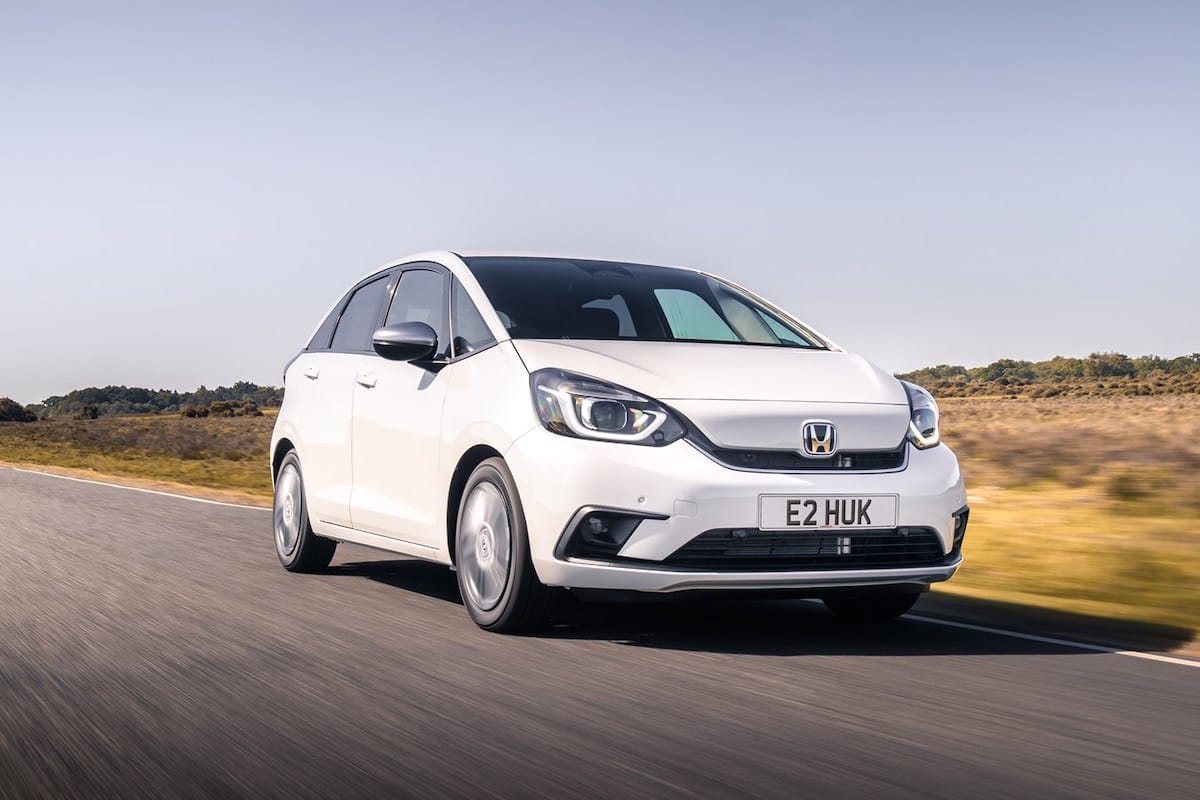
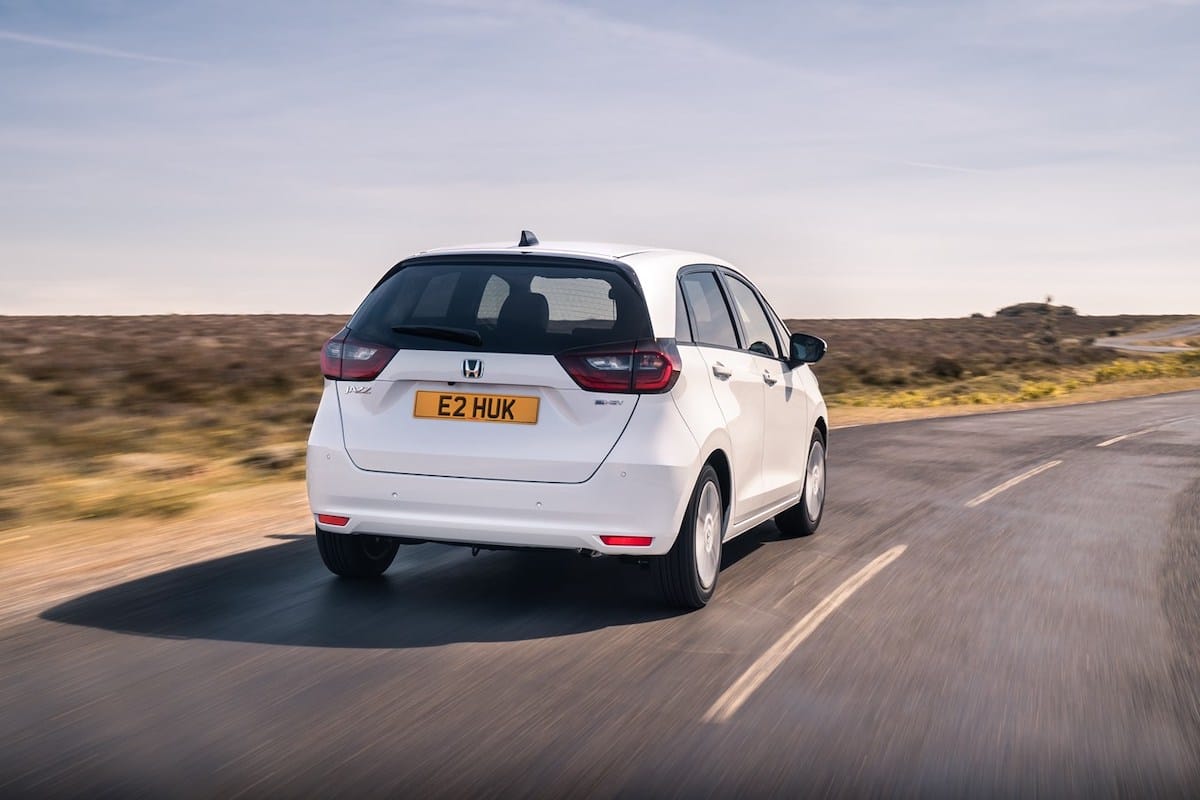
The Honda Jazz is a five-door supermini-class small hatchback. This model was launched in the summer of 2020, with the only engine option being a 1.5-litre petrol-electric hybrid.
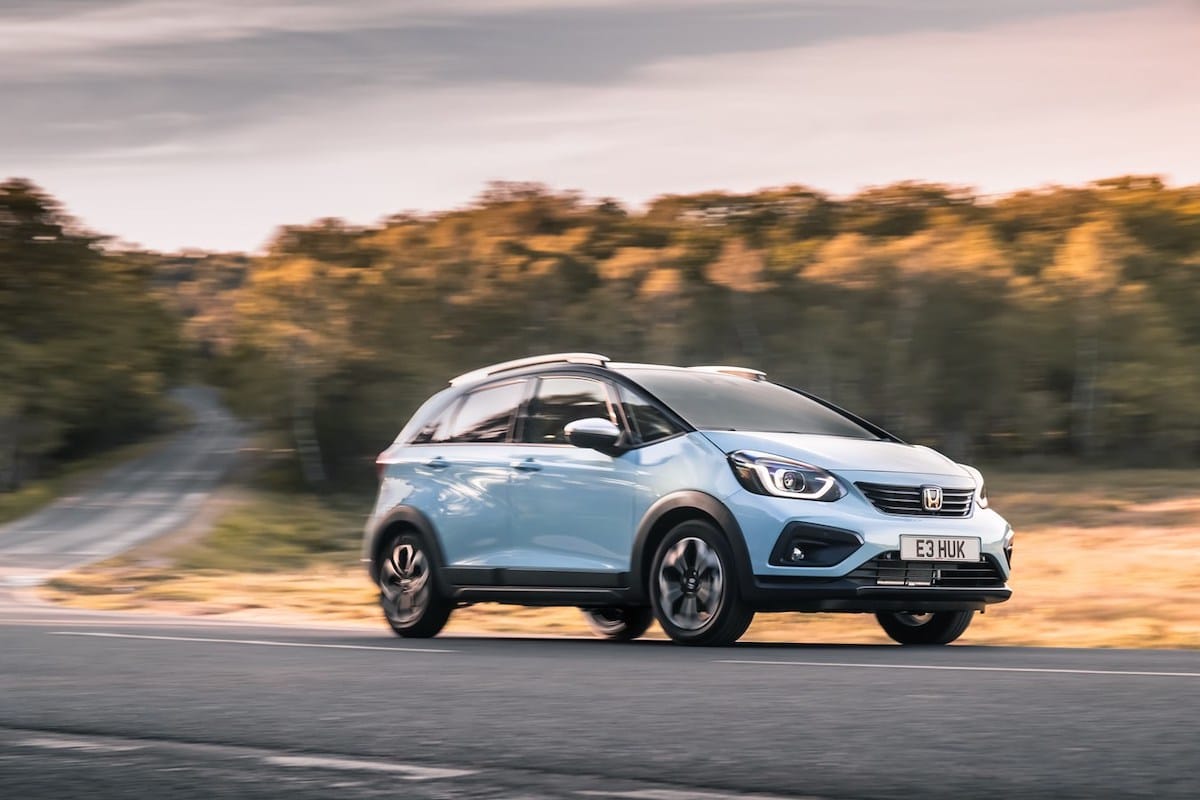
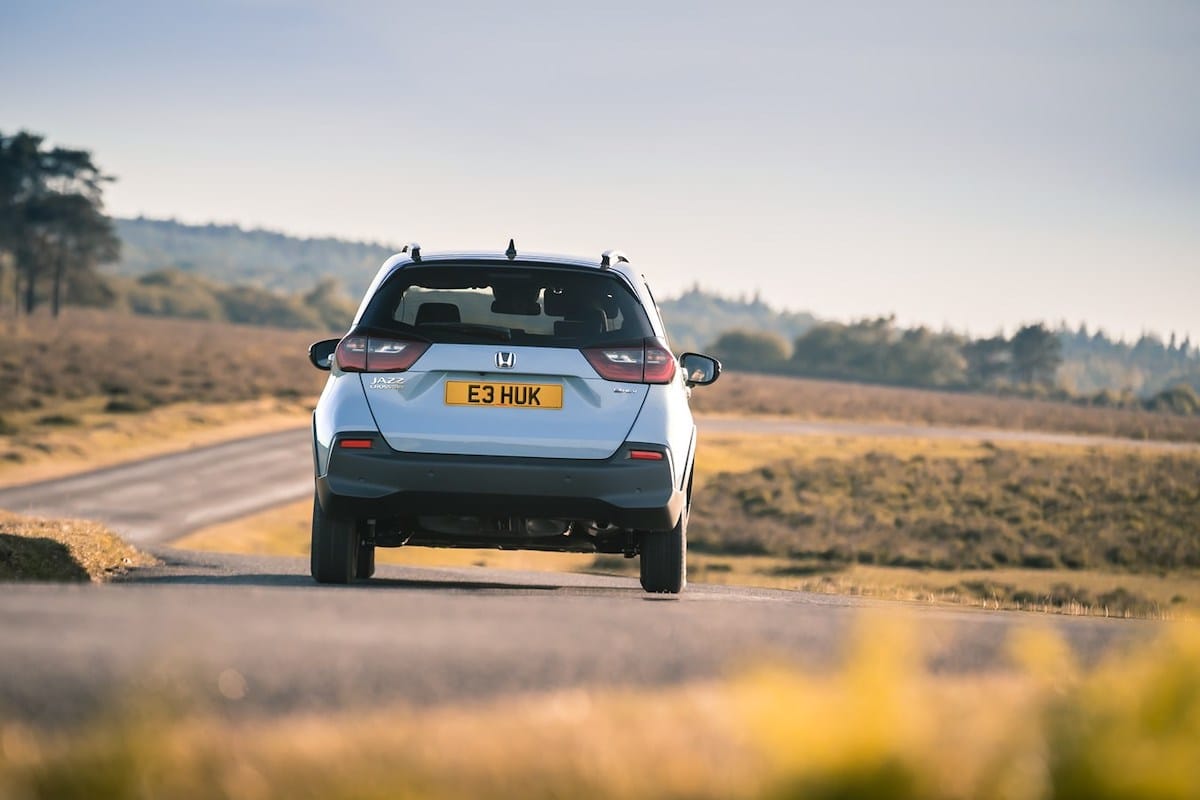
The Jazz is also available as a faux off-road version called the Jazz Crosstar, which sits a little bit higher and has big grey plastic trim pieces but is no better at crossing the Sahara than an ordinary Jazz.
It has been praised for its practicality, with more room for both passengers and luggage than similarly sized rivals. The hybrid system also makes it economical for urban driving. The regular Jazz usually scores better than the Crosstar when tested separately.
As of February 2026, the Honda Jazz holds a New Car Expert Rating of B with a score of 66%, which puts it right in the middle of a large and very competitive field of small cars. It scores top marks for its low CO2 emissions and exceptional reliability record, while its running costs are also generally low. However, Honda’s new car warranty is only average and the Jazz’s media review scores are poor, which drags down the overall rating.
Highlighted reviews and road tests from across the UK automotive media. Click any of the boxes to view.
Featured reviews
“The Honda Jazz has carved its own niche in being the ultra practical option in this segment that will massively appeal to those who aren’t passionate about their mode of transport. It’s the ultimate head-over-heart supermini.”
Model reviewed: 1.5-litre petrol/electric hybrid EX
Model reviewed: Range overview Score: 8 / 10 “Practical, efficient and highly-specced, the hybrid Honda Jazz supermini is an attractive if relatively pricey package” Author: Ellis Hyde, Paul Adam Read review
Model reviewed: 1.5-litre petrol/electric hybrid EX Style Score: 8 / 10 “The EX Style maintains the typical Honda Jazz plus points of a fabulously spacious cabin and brilliant fuel economy. The hybrid system is very slick, and the ride and handling are more than up to the job. However, we can’t help but feel that this range-topper doesn’t really add enough to warrant the extra cost over the already generously equipped models further down the range.” Read review
Model reviewed: 1.5-litre petrol automatic Crosstar Score: 6 / 10 “With a higher price point and only a modest increase in kit, the Honda Jazz Crosstar really is a case of image over substance. It’s slightly less efficient than the regular Jazz and despite the increased size, boot capacity takes a hit as well.” Read review
Auto Trader
Model reviewed: Range overview Score: 6 / 10 “Part supermini, part pint-sized people carrier, the Honda Jazz remains a master of useful interior space and flexibility. New from 2020 are the standard hybrid powertrain, and addition of the Jazz Crosstar to the range.” Read review
Business Car
Model reviewed: 1.5-litre petrol/electric hybrid SR Score: 8 / 10 “All versions of the Honda Jazz get the full suite of safety features – refreshing on a small car – including a new centre airbag between the driver and front passenger, which will ultimately become mandatory.” Read review
Car
Model reviewed: Range overview Score: 8 / 10 “The Jazz is peak Honda. Full of clever solutions for its customers, whether they live in a city and need maximum interior versatility in a car that fits in a tiny parking space, or simply want an economical car that’s easy but not punitively boring to drive. It deserves your admiration if you like engineering.” Read review
Car Keys
Model reviewed: 1.5-litre petrol/electric hybrid Crosstar Score: 8 / 10 “If you like your supermini to wear chunkier and more rugged styling, then the addition of this Crosstar variant to the Honda Jazz range will be appreciated. It retains all the charm of the standard car – its unique interior, efficiency and impressive powertrain, but adds extra visual flair.” Read review
Model reviewed: Range overview Score: 8 / 10 “Fundamentally, the Honda Jazz remains similar to before. It’s still the safe, sensible and practical choice that its loyal buyers love. Not everything needs to be as ‘sporty’ or ‘dynamic’ as possible, and the Jazz continues to keep its own little segment of the market – carving out a niche for itself. “ Read review
Carbuyer
Model reviewed: Range overview Score: 8.2 / 10 “The quirky Honda Jazz is even smoother and cheaper to run with a hybrid powertrain” Read review
Company Car Today
Model reviewed: EX “Some obvious and well-executed improvements, especially with the cabin, combine with a good hybrid powertrain offering decent running costs to make the Honda Jazz a clever and efficient small car.” Read review
Daily Mail
Model reviewed: 1.5-litre petrol/electric Crosstar EX “Visibility in the new Honda Jazz hatchback is much improved, thanks to a wider windscreen and much thinner pillars. The Crosstar variant has a reduced size SUV-style that is more flexible, funky and practical than the standard version. This is my favourite.” Read review
Daily Mirror
Model reviewed: Crosstar Score: 6 / 10 “To those of you who have had a string of Jazzes and are considering moving up to this generation, I’d really recommend a go in the Crosstar version.” Read review
Driving Electric
Model reviewed: Range overview Score: 7 / 10 “The now hybrid-only Honda Jazz is technologically impressive, very efficient and practical – but not much fun to drive.” (James Howe) Read review
Eurekar
Model reviewed: 1.5-litre petrol/electric hybrid EX “The Honda Jazz’s interior is minimalist yet classy. The central touchscreen and seven-inch digital instrument cluster are simple and easy to read. Interestingly, in response to consumer demand, Honda has reinstated physical controls for heating and ventilation underneath the touchscreen.” Read review
Model reviewed: 1.5-litre petrol/electric hybrid Crosstar “It’s surprising just how often the Honda Jazz Crosstar runs on purely electric in town and city as you purr around in silence. It’s only when you put your right foot down really hard, or are driving on the motorway, that you notice that power is also coming from the engine.” Read review
Fleetworld
Model reviewed: Hybrid “Pleasingly, the Jazz marks a return to form for Honda and the Hybrid is comfortably better than the competition it faces today. However, that comes at a price premium and there are compelling new rivals en route that may dull its shine.” Read review
Heycar
Model reviewed: Crosstar Score: 6 / 10 “The standard Honda Jazz is an excellent car, with low running costs and a versatile interior. The Jazz Crosstar builds on that with rugged styling and some extra equipment as standard. Its oddity factor gives it some appeal but, in truth, its relatively high price tag makes it difficult to justify.” Read review
Model reviewed: Range overview Score: 8 / 10 “No one ever regretted buying a Honda Jazz. It’s the sort of car that’ll continue to surprise you with its practicality, reliability and frugal fuel economy. The latest model is more appealing than ever, thanks to a modern cabin and clever hybrid engine setup.” Read review
Honest John
Model reviewed: Range overview Score: 8 / 10 “If you’re looking for a versatile small car that won’t cost a fortune to run, the new hybrid Honda Jazz is a brilliant option. It’s more appealing than ever before, thanks to fresh new looks and a revamped interior. On the downside, it’s a little expensive, and the hybrid setup won’t appeal to everyone.” Read review
Parkers
Model reviewed: Range overview Score: 7 / 10 “Versatile, grown-up hatchback gains hybrid tech” Read review
The Sun
Model reviewed: “The Honda Jazz is a well thought out, perfectly executed sensible that makes life simple.” Read review
The Sunday Times
Model reviewed: Range overview Score: 8 / 10 “Flawed, but could prove to be one of the more satisfying superminis/compact crossovers long-term.” Read review
The Telegraph
Model reviewed: 1.5-litre petrol-electric hybrid EX Score: 6 / 10 “If you already own a Honda Jazz and are looking at replacing it, this will be automotive catnip. If you aren’t already a Jazz aficionado, there’s not a lot here to convince you to to get the latest one unless you really like the fuel savings and the engineering.” Read review
Top Gear
Model reviewed: Range overview Score: 6 / 10 “Unbelievably roomy, versatile, and easy to recommend. But would you want one yourself? That’s a harder question…” Read review
Safety rating
Independent crash test and safety ratings from Euro NCAP
Clean Air Index: 6.7 / 10 Energy Efficiency Index: 7 / 10 Greenhouse Gas Index: 5.6 / 10
Three-and-a-half stars
The Honda Jazz was awarded a 3.5-star eco rating from Green NCAP in July 2021. Green NCAP said: “The Honda Jazz 1.5 i-MMD Hybrid represents the latest in petrol-hybrid and diesel technologies, and performs well.
“It achieves high scores for Energy Efficiency and also does very well for Clean Air. The Greenhouse Gas Index is the weakest of the three areas of assessment, but the Honda emerges with a solid 3½ star rating.”
Reliability rating
Reliability data provided exclusively for The Car Expert by MotorEasy
Total claims: 73 Average repair cost: £252.17 Last updated: April 2025
As of April 2025 (our most recent data point), the Honda Jazz has an outstanding reliability rating of 94%, according to warranty data provided exclusively to us by our commercial partner, MotorEasy. This score applies to both this generation Jazz and previous (pre-2020) generations, which is good news if you are considering a used Honda Jazz.
The repair bills claimed under warranty to date have been very inexpensive – with the exception of gearbox issues, which have a bill of more than £800. In fairness, that’s still less than average gearbox repair bills for most other cars.
All in all, the Jazz looks like being a reliable choice as a used car.
Running cost rating
Monthly cost of ownership data provided exclusively for The Car Expert by Clear Vehicle Data
Fuel consumption
Average
Score
Petrol models
48 mpg
C
Hybrid models
63 mpg
A
CO₂ output
Average
Score
Variation
Score
Petrol models
134 g/km
A
Hybrid models
102 g/km
A
Insurance group
Average
Score
Variation
Score
All models
22
A
Service and maintenance
Cost
Score
Year 1
£137
A
Year 2
£372
A
Year 3
£610
A
Year 4
£788
A
Year 5
£1,122
A
Overall
£3,029
A
The Honda Jazz is a very affordable car to own and run, according to whole-life cost numbers provided exclusively to The Car Expert by our data partner, Clear Vehicle Data.
While the fuel consumption of petrol models sits around the market average, the data suggests that hybrid models are much more economical. Both insurance and maintenance costs are predicted to be cheap too.
Warranty rating
New car warranty information for the Honda Jazz
Overall rating
C
50%
New car warranty duration
3 years
New car warranty mileage
60,000 miles
Battery warranty duration
8 years
Battery warranty mileage
100,000 miles
Honda’s new car warranty is pretty much the bare minimum offered in the UK, with a duration of three years and a limit of 60,000 miles. Other rivals in the price bracket do better (and in some cases, much better). Additionally, the battery components of the hybrid system are covered by a separate eight-year/100,000-mile warranty.
If you are purchasing an ‘Approved Used’ Honda Jazz from an official Honda dealership, you will get a minimum 12-month warranty included. If you are buying a used Jazz from an independent dealership, any warranty offered will vary and will probably be managed by a third-party warranty company. If you are buying a used Jazz from a private seller, there are no warranty protections beyond anything that may be left on the original new car warranty.
If you’re looking to buy a used car that is approaching the end of its warranty period, a used car warranty is usually a worthwhile investment. Check out The Car Expert’s guide to the best used car warranty providers, which will probably be cheaper than a warranty sold by a dealer.
Awards
Trophies, prizes and awards that the Honda Jazz has received
2023
Carbuyer Awards – Best Used Hybrid Car
Similar cars
If you’re looking at the Honda Jazz, you might also be interested in these alternatives
Schools are finishing for the term, workplaces are shutting up and families are packing their belongings in readiness for the summer vacation. And that means millions of cars will be hitting the roads and heading for the holiday hotspots at home and abroad.
Cars will feature highly again this year when it comes to planning a vacation. More than 13 million UK drivers will take friends and relatives away using the family vehicle this year, says a new survey.
Long journeys
And many of those will be holidaying at home and abroad, opening up all sorts of issues when it comes to planning for a long road trip.
The research, from car service and repair specialist (and partner of The Car Expert) Kwik Fit, shows that 4.5 million drivers are planning their main holiday in the UK, but will also be taking the car abroad this summer.
And almost double that number – nearly nine million drivers – will have their main holiday overseas but will also be going on a summer break in the UK and relying on the car to get them and their families there safely.
Around 16 million people say they will be using their car as their main mode of travel for at least one of their summer holidays, the research reveals. Those using their car for a UK destination and will be covering an average of less than 400 miles, although 7% of them will be clocking up more than 1,000 miles.
The research also found that those heading overseas in their own car this summer – around 4.5 million holidaymakers – will travel an average more than 600 miles, although 8% will top a whopping 2,000 miles.
Simple car checks
But despite these lengthy journeys, often with heavy loads of luggage and passengers, a significant proportion of owners will get into their car without making any checks before hitting the road.
More than a third (35%) of drivers say they don’t even check their tyre pressures, while only a half (45%) look at their tyre tread. Many drivers will also neglect to check their car’s vital fluids. The survey found that four out of 10 motorists (41%) don’t check their screen wash is topped up, 46% won’t look at their oil level, 62% ignore the coolant and 67% won’t bother with their brake fluid.
Overseas regulations
But vehicle condition isn’t the only aspect of holiday motoring that drivers are neglecting, says Kwik Fit. Only a third (37%) of drivers heading overseas will thoroughly check the road regulations of the country they are going to.
Four out of 10 (39%) say they will do a quick check online, while 12% will rely on their ferry or tunnel booking information. Nearly one in eight (12%) say either they don’t need to do any checks because they have travelled to a country before, or they simply won’t bother with any research whatsoever.
As The Car Expert has highlighted in our popular Driving in… series, neglecting to do any prior foreign travel checks could be storing up trouble for motorists, as regulations change across Europe.
Some European cities require cars to display a sticker identifying their level of emissions now, while other foreign towns ban some vehicles altogether. In France, for example, the penalty for non-compliance is harsh and can be as high as €450 (£370).
Other rules which have changed in recent years include the requirement, since Brexit, to display a UK sticker and to cover up any GB emblem or country flag, including on the numberplate. Drivers are also required in most countries to carry their vehicle’s V5C document (logbook), a first aid kit, fire extinguisher and a hi-viz vest, which must be inside the car, not in the boot.
“It’s quite worrying to see just how many drivers will be setting off without making the proper checks on their vehicle, or the rules of the road at their destination,” says a spokesperson for Kwik Fit.
“Advance preparation can save a lot of hassle, and a few simple checks – especially tyres and fluids – can help prevent problems en route. And as well as car checks, making sure drivers know the latest rules for their journey is a sensible measure.
“The last thing they need is to be pulled over and fined for not displaying a sticker that costs only a few pounds or for having their hi-viz in the boot.”
Many car service and repair companies, including Kwik Fit, will carry out a free vehicle health check for customers, which could be a sensible decision for drivers before they set off on a long journey.
The Cupra Formentor SUV and Cupra Leon hatchback and estate have received a mid-life refresh that is now available to order in the UK.
As we reported back in May, the update introduces more “aggressive” exterior looks for both model ranges, including sharper triangular LED headlights and a wider grille design on a new ‘shark-nose’ front fascia that also features the brand’s updated logo.
Inside, the interior layout of both models remains largely the same, but there are new material options for the dashboard and seat trims, and a new 13-inch infotainment screen (an inch larger than before) sits above two touch-sensitive sliders for the media volume and heating controls. An optional 12-speaker Sennheiser sound system has also been added to the options list.
Both cars will be available with traditional petrol, mild-hybrid and plug-in hybrid engine options. The pre-facelift options remain, including the lead-in 150hp 1.5-litre petrol, but with a new 333hp 2.0-litre petrol engine option with four-wheel drive and a 272hp plug-in hybrid (joining the 200hp PHEV already available) that can reportedly muster an electric-only driving range of around “over 70 miles”.
Now available to order with seven different trim levels to choose from – starting with the lead-in ‘V1’ up to the range-topping ‘1st Edition’ models – pricing for the Cupra Formentor now starts at over £33k. The Leon, which has the same trim level choices, has a slightly cheaper starting price point of just north of £31k for the hatchback, while the Leon estate now costs £33k.
The Cupra Leon and Formentor both currently hold a New Car Expert Rating of A with a score of 72%.
Skoda has revised its electric Enyaq SUV line-up with the addition of two new trim grade choices – the ’50’ and ’50 Edition’ – which come with a smaller battery and drop the car’s entry-level price.
Introduced to the electric SUV range to “bring down the cost of switching to a new Enyaq”, the new trims are powered by a 52kWh battery pack – a lower capacity than the 58kWh and the range-topping 77kWh options previously available,
To make way for the new ’50’ and ’50 Edition’ trim levels, the 58kWh Enyaq ’60’ has been discontinued – a change that Skoda says was lowered the SUV’s entry-level price by £2k.
The rear-wheel drive 170hp ’50’ and ’50 Edition’ have a reported battery range of 234 miles and can complete a 0-62mph sprint in 9.1 seconds. Top speed is capped at 99mph. By comparison, the 77kWh ’85 Edition’ is said to muster up to 358 miles on a single charge and has a 0-62mph sprint time of 6.7 seconds, but is over £7k more expensive.
The new entry-level ’50’ spec includes 19-inch alloy wheels, artificial leather upholstery, a digital instrument cluster and LED headlights. The slightly more expensive ’50 Edition’ adds more advanced Matrix LED headlights, heated front seats, an electronically-adjustable drivers seat and adaptive cruise control.
Pricing for the Skoda Enyaq range now begins at just under £37k. The SUV holds a New Car Expert Rating of A, with a score of 82%. It has excellent scores across every category, with the caveat that we don’t yet have reliability data at this time.
Cars have become so technical and complicated in the last 20 years that repairing them is now a skilled and technical exercise which requires training and knowledge to carry out.
That’s why it’s so much rarer to see someone tinkering with their car – bonnet up and wheels off – on a Sunday morning than it was two decades ago.
It means that if your car requires some attention or a repair, probably your only choice is to take it to a professional workshop or garage. And that’s where you must trust in the person who will be looking after your vehicle and rely on them when they tell you what’s wrong and how they are going to fix it.
But can they be trusted? Will they do the work they promise? Are you likely to get a fair cost for the parts and labour? And is there a chance they might add in other ‘repairs’ that your car didn’t even need in the first place?
A recent study revealed that 56% of British drivers – potentially 28 million people – believe they have been scammed or overcharged after taking their car to a mechanic, while 40 million drivers admit to being fearful of the possibility of being conned or having to pay higher costs of repair than they should.
The survey, by car service marketplace Fixter, shows that more than a quarter (27%) of UK motorists would rather drive their car in poor condition than risk being scammed at the garage – a decision that’s fraught with danger, illegal in some cases, and a risk to other road users.
The survey found that 70% of drivers aged 25-35, were the most sceptical of garages, with 63% of 35-48 year olds, 52% of those aged 50-64 and 43% of 65-plus drivers unsure about taking their car to a mechanic. Ten million women drivers said they face feelings of anxiety and stress about going to a workshop.
Reduce the risk of garage scams
Conduct a pre-work check
It’s important to check your car before it goes in for work such as a service, so you can see what changes have been made. Oil, coolant and tyres can all be easily checked beforehand. Take a photo of any issues pre-service so you can compare them after.
Ask for an itemised list
Always make sure you know what is being done to your car. Ensure you ask for a list so you can more easily identify what repairs have been made.
Technical jargon
A good way for mechanics to fool customers is to use garage jargon and technical terms. Ask for a proper explanation if there’s something you don’t understand. If the mechanic can’t give it to you in your terms, consider looking elsewhere. Try to get a grip of the basic workings of your car so that you don’t look like a complete novice when you go in.
Unnecessary part replacement
You arrive to collect your car to be told that certain parts were needed after the mechanic had looked at them. Did they really have to be replaced? Ask to see the components that have been taken from your car and request an explanation as to why they had to be changed.
Parts overcharging
If you don’t know how much parts typically cost for your car, how can you check them when the garage bill arrives? Once you’re told what parts your car needs, go online to get an idea of what they cost. It won’t be exact but at least you’ll know roughly if the garage is being honourable.
Not actually replacing parts
If you’re having work done deep inside the car’s engine that you’ll never be able to look at, how do you know that new parts have been fitted? One way to find out is to ask to see the old parts that came out. You can even take them away with you. If the garage can’t do this, be suspicious and ask questions.
Fluid replacements
You’re given a list of fluids that had to be replaced in your car and each carries a charge. Some liquids, such as transmission fluid, are designed to last up to 100,000 miles. Do your research and check what the owner’s handbook says on all your car’s liquid replacements.
Higher bill than quote
Is the final bill way higher than you were expecting? Did extra work ‘have to be done’? Get a written quote for planned work, including parts and labour rates, before anything is started, and confirm that the bill will match it. Honest mechanics will call you first if an unexpected expensive problem needs fixing. If your garage won’t agree to a written quote, go elsewhere.
Test drive the car
It’s important not to just dash home after a car service. Ask yourself if anything feels different while you drive and if everything is functioning as it was before.
Make and model: Renault Captur Description: Small SUV/crossover Price range: from £21,095
Renault says: “Known as Clio’s big brother – with even more tech, the new Renault Captur is as versatile and multi-talented as ever before.”
We say: The small SUV market is highly competitive but the Renault Captur does a great job at standing out with its technology and hybrid engine option.
This is the second-generation Renault Captur, launched in 2019. The company has now updated the Captur in line with a number of new models and updates to its overall range.
Since the original model’s launch in 2013, more than 194,000 units have been sold in the UK and more than two million across Europe. When the first model was initially released more than a decade ago, the Captur was one of the few small SUV/crossover models available at the time. It has since seen rising competition from other manufacturers with cars in the same segment.
Captur is the brand’s smallest SUV, with the Megane, Scenic, Symbioz, Arkana, Austral and Rafale sitting above the Captur in Renault’s lineup and the Clio just below.
As of July 2024, the Renault Captur holds an overall New Car Expert Rating of A with a score of 72%. As a used buy it’s rated even better at 76%.
What is it?
Based on the the Renault Clio small hatchback, the Captur is a small SUV that seats five. It sits higher than the Clio, offering a bit more practicality and ease when getting in and out. Over the past few years, competition in this category has boomed as the SUV bodystyle has become more desirable.
If you’re looking at the Captur, you might also be considering similar sized cars such as the Dacia Duster, Nissan Juke, SEAT Arona, or the Peugeot 2008. This segment caters to drivers who don’t need a large SUV but equally want a higher ride height than a hatchback and more space for passengers and luggage.
First impressions
In keeping with the rest of Renault’s lineup, the updated Captur has a fresher, more modern feel. Externally, the styling has been refreshed to include a new grille with Renault’s latest logo, and some sleeker new headlamp and tail light designs. There are also some striking new alloy wheel designs.
Inside, the interior has been updated with a new screen and infotainment system powered by Google to make it more intuitive. The refresh includes a digital driver’s display. Interior materials are a mix of plastics, fabric and synthetic leather as Renault has omitted real leather and chrome from the Captur to improve the car’s sustainability credentials.
We like: Modern updated styling and interior We don’t like: Limited seat adjustability
What do you get for your money?
The Captur comes in a choice of three trim levels: ‘evolution’, ‘techno’ and ‘esprit Alpine’. Pricing for trim options depends on which engine you opt for, either a petrol or hybrid which we’ll discuss in more detail later on. Entry-level evolution starts from £21K with the petrol engine or £24.5K in its hybrid guise. In the middle comes techno at just under £23K or from £26.3K, and esprit Alpine is only available with the hybrid engine from £28K.
As standard, evolution comes with 17-inch wheels, rear parking sensors, reversing camera, rear sliding seats, wireless Apple CarPlay and Android Auto, seven-inch digital driver display, wireless phone charger, ten-inch touchscreen, and keyless entry and start.
Techno trim adds 18-inch alloy wheels, roof bars, electrically folding door mirrors, three driving modes, ten-inch driver display, and two rear USB-C ports. The top specification esprit Alpine includes 19-inch alloy wheels, heated front seats, heated steering wheel, two-tone paint with a contrasting roof colour, and adaptive cruise control with speed limiter.
Standard safety equipment covers Isofix points on the outer rear seats, cruise control and speed limiter, traffic sign recognition, active emergency braking, driver attention alert, emergency lane keep assist, hill start assist and a tyre pressure warning light.
The Captur comes with a three-year / 60,000 mile warranty.
We like: Tech focused specification throughout all trim levels We don’t like: Heated seats reserved for top specification
What’s the Renault Captur like inside?
The interior layout has been simplified to focus on the screen in the centre of the dash. The previous iteration of the Captur had three round dials underneath the screen for climate control. These functions have now been integrated into a switch strip along the bottom of the screen. This means the climate control features are displayed on the screen and controlled with proper switches or via the touchscreen for things like heated seats on the top trim level.
There’s a good amount of legroom in the back and the outer rear seat backs are inset so rear passengers. This creates a bolsters on either side so instead of the outer passengers bumping into the middle passenger going around a bend, it’s easier to stay put. The outer seats also have Isofix points. Depending on whether you need to prioritise legroom or boot space, the rear seats slide forward as a bench up to 16 cm.
In the boot, there’s a false floor that can be lifted up to reveal more space underneath. The false floor makes the boot floor the same height as the boot lip so it’s easy to load luggage straight in and out. The hybrid’s boot space is a little bit smaller than the petrol engine. When the seats are folded down the load space sits at the same height as the false floor.
Depending on which trim level you go for there’s a different gearstick and the centre console floats on the esprit Alpine trim to add an extra storage shelf.
We like: Updated intuitive Google-led touchscreen We don’t like: Cheap feeling plastic strip below climate controls
What’s under the bonnet?
Renault offers the Captur with two engine options. The 1.0-litre petrol engine is available with evolution or techno trim levels. It comes with a six-speed manual gearbox and has official fuel economy figures of about 47mpg. For those that want to use a Captur to tow, the petrol engine can handle more weight, with an unbraked trailer up to 645kg or a braked trailer up to 1,200kg – ideal for a small caravan.
The petrol/electric hybrid unit is quicker and more powerful than the petrol engine, and fuel economy should be better with official figures stating 60mpg is possible.
It’s a conventional hybrid, rather than a more substantial plug-in hybrid, so you can’t plug the Captur hybrid into an external charging point and it means you only get a small amount of driving range in electric mode. All of the electricity is ultimately generated, either directly or indirectly, by the petrol engine. There’s a button inside the car that can keep battery charge over 40% to save it for things like going uphill or towing.
The hybrid comes with a six-speed automatic gearbox and, due to the addition of the battery and electric motor, is heavier than its petrol counterpart. This means towing is limited to 720kg for an unbraked trailer and 750kg for a braked one.
What’s the Renault Captur like to drive?
The seating position in the Captur is quite high, so for taller drivers we’d recommend going for a test drive to see if the position is comfortable for you. The steering wheel is adjustable for reach and height, and the seats are either manually or electrically adjustable depending on the trim level.
As the esprit Alpine trim has larger wheels, the ride is firmer than the 18-inch wheels on the techno trim. The hybrid option we tried was very quiet at low speeds, and was only noisy when you put your foot all the way to the floor. For normal driving, it’s relaxed and easy to position on the road.
Different driving modes called Eco, Comfort and Sport are available to tweak the driving experience to suit the situation. On the right-hand side of the steering wheel, there’s a button called the My Safety Switch. This allows the driver to customise the safety features they would like to use and turns off the ones they don’t want.
We like: Smooth and quiet hybrid driving experience We don’t like: High seating position in the cabin
Verdict
The Renault Captur is a great example of a small SUV that has a good amount of technology and practicality. It also seems competitively priced for cash buyers and those looking for finance or lease agreements.
Unlike the touchscreen systems in some rival cars, the new Google-based display in the Captur is easy to use and doesn’t require Apple CarPlay or Android Auto for it to be simple to use on the go. A rear sliding bench is a rare feature which allows for plenty of different boot configurations along with additional storage space under the boot floor.
Renault expects around 60% of customers to go for the hybrid powertrain and the majority to opt for the techno trim level. We agree this appears to be the best value option for the equipment and driving experience with prices starting from just over £26K. As always, we recommend test driving a Captur to make sure it’s the right fit for you.
CO2 emissions: 105 g/km Euro NCAP safety rating: Five stars (2019) TCE Expert Rating:A (72%) as of July 2024
Buy a Renault Captur
If you’re looking to buy a new or used Renault Captur, The Car Expert’s partners can help you find the right car
Search less, live more. We make finding the right car simple. Find out more
Search for your next new or used car with Auto Trader. Find out more
Discover great deals available on both new and used cars. Find out more
Lease a Renault Captur
If you’re looking to lease a new Renault Captur, The Car Expert’s partners can help you find a competitive deal
Personal contract hire deals from Carparison Leasing. Find out more
Personal contract hire deals from Leasing.com. Find out more
Personal contract hire deals from Rivervale Leasing. Find out more
Subscribe to a Renault Captur
Subscriptions are becoming a very popular way for consumers to try a car for a few weeks or months to help decide whether it’s for them. If you’re interested in a car subscription, The Car Expert’s partners can help. (PS: What’s a car subscription?)
While there’s a lot of noise about electric cars, and debate about the pace at which the world is shifting from fossil-fuel cars to EVs, there’s one aspect of electrification that hasn’t gained as much attention. It’s the sheer variety of mobility options that electric power has given us, dispelling the idea that we all need conventional cars in which to get around.
Electric micro-mobility is becoming a big business. But what do we mean by micro-mobility? Well, pretty much any kind of transport that is smaller than a conventional car. So it covers electrically-assisted bicycles, electric scooters, electric mopeds and motorbikes, and so-called ‘microcars’ or ‘nanocars’.
All of these vehicles ca fill particular niches in urban environments, where total journeys may only be a few miles but may not be well served on a bus or train, or in a taxi. Many UK and European cities already have a vibrant offering of rental e-bikes and e-scooters, which can be very convenient for short trips across the city if you don’t have any luggage to carry, and the market for electric mopeds is also steadily growing – although you’re still exposed to the elements and not able to carry much in the way of baggage. So the next step up is the microcar.
These tiny electric city cars are classified as quadricycles, which means they don’t have to meet many of the legal standards for safety that conventional cars do. However, that does allow them to be much smaller and lighter than normal cars – about half the size and less than half the weight – making them exceptionally cheap to run.
Small is beautiful
In cities like London or Manchester, the number of cars queued throughout the streets with one or two people on board creates enormous congestion. Not only while getting from A to B, but also parked up on the side of the road or in car parks. And every year, cars get longer, wider, taller and heavier – making the clogging of our cities even worse.
We have seen various attempts at making very small cars, most notably from the Mercedes-owned brand, Smart. The original Smart Fortwo was a genuine attempt to address increasing congestion with a small city car. But over three generations, it also got bigger and heavier as it was required to comply with tougher environmental and safety legislation.
With the rapidly advancing technology in electric vehicle, however, we’re starting to see fresh attempts to build tiny electric city cars. Electric power creates opportunities to reduce size, as electric motors and relatively small batteries take up much less space than a petrol engine plus a gearbox plus a fuel tank plus an exhaust system and all the other associated bits that a petrol-powered car needs.
The first attempts at electric city cars came a couple of decades ago, with dreadful vehicles like the G-Wiz. Because they were categorised as quadricyles (like a quad bike) rather than cars, they didn’t have to meet the same safety criteria that all cars do. And as a result, they weren’t fitted with much in the way of even basic safety equipment, resulting in at least one death in London in what was a very low-speed collision.
Thankfully, things have moved on and there are now several manufacturers entering the electric city car market. They are still categorised as quadricycles rather than cars, but the standard of vehicle is now much higher.
Renault offered the Twizy for about a decade, which sat two people in a tandem arrangement. However, that model was discontinued a couple of years ago. A successor is apparently on the cards but UK availability has not been announced.
The biggest name to launch into the world of electric city cars is Stellantis, one of the world’s largest car companies, through its brands Citroën and Fiat. Citroën has made a lot of noise about its smallest model, the Ami, which launched a couple of years ago and is now available in the UK. The Ami also forms the basis for a new model from Fiat, the Topolino, which is likely to arrive next year.
Citroën AmiFiat TopolinoRenault Twizy
The sounds of Silence
Having an automotive colossus like Stellantis in the microcar market gives it far more credibility than it has had in the past, but the Citroën Ami and Fiat Topolino are not necessarily the class leaders in this sector.
A new player is Spanish manufacturer Silence, which is owned by colossal infrastructure and energy company, Acciona. Backed by Nissan, Silence produces a couple of electric mopeds and has now launched a microcar called the S04, which will be sold in the UK through Nissan dealers later this year.
The Silence S04 follows a similar formula to the Citroën Ami and Renault Twizy, being a very short and narrow two-seater vehicle. How short and narrow? The S04 and Twizy are just 2.3m long, with the Ami being slightly longer at 2.4m. To give you an idea of how small that it, that’s shorter than the original 1998 Smart Fortwo (2.5m long). Even the original 1959 Mini was three metres long…
In terms of width, the Silence, Renault and Citroën all clock in at about 1.3m wide, which is again narrower than an old Mini (1.4m) or the original Smart (1.5m).
When you compare these nanocars with a traditional supermini hatchback, the scale is even more impressive. They’re a staggering 40% shorter than a Volkswagen Polo, for example, which is just over four metres long, and nearly 30% narrower. They’re also about 60% lighter, depending on specification.
Having such a small footprint means that nanocar designers have to get creative with packaging. The Twizy arranged its occupants in a tandem seating arrangement, with the passenger directly behind the driver and with a very limited view. The S04 and Ami have a staggered side-by-side layout with the driver slightly ahead of the passenger, which gives a bit more room for twirling the steering wheel without banging elbows.
Is the Silence S04 the ultimate city car?
Silence S04
The Silence S04 recently had its global media launch at Acciona’s headquarters in Madrid, which The Car Expert attended. What was surprising is how much the S04 looks to have moved the microcar goalposts compared to the more basic Citroën Ami.
Despite being slightly shorter in overall length, the S04 offers slightly more cabin space (although it’s obviously still pretty cosy) and a creditable amount of boot space at 247 litres. That’s 37 litres more than you get on a brand-new electric Mini Cooper three-door hatchback, and about 247 litres more than you get in a Citroën Ami, which doesn’t have a boot at all.
The clever packaging of the S04 is made possible thanks to its two electric motors. Unlike the Ami, which uses a conventional single electric motor in the front of the car, the S04 has two small motors mounted inside the rear wheels. These in-wheel motors take up less space while providing better performance. They also allow better control for stability in slippery conditions, as the left and right wheels can be controlled separately depending on how much grip each has available.
But the Silence S04’s biggest party trick is having two removable batteries. These are two cubes with integrated wheels and handles, a bit like a pair of small suitcases, which are mounted under the seats. They can simply be popped out and wheeled away to be charged or swapped (Silence has a rapidly expanding battery swap network of 140 stations throughout Spain’s biggest cities, and is planning to offer something similar in major UK cities once it commences sales later this year).
Those batteries give the S04 an official driving range of up to 90 miles, which is about twice as far as the Ami. For a car that’s never likely to leave the city, that’s likely to be plenty since you can remove the batteries to charge them at home, thereby overcoming one of the regular complaints of EVs in cities. A word of warning, though – each battery pack weighs about 40kg, so you’re not going to be lugging it up flights of stairs. You’ll need either an elevator or a ground-floor plug.
Silence S04 vs Citroën Ami vs Fiat Topolino electric city cars
The biggest difference between the Silence S04 and the Stellantis twins (the Citroën Ami and Fiat Topolino are essentially the same car with a few visual differences) is the price.
As of July 2024, Citroën Ami prices run from £7,700 to £8,700 depending on specification. UK pricing for the Fiat Topolino has not been announced, but is likely to start at around £8,000 as well. The Silence S04, however, will start at £15,000. That could stop a lot of potential customers in their tracks.
Now, the S04 has a lot going for it over the Ami and Topolino, so the price difference can be explained away quite logically. You get more cabin space, and a proper boot with decent luggage space, which makes the S04 as usable around town as a much bugger car. You get twice as much driving range, plus a pair of removable batteries so you don’t have to worry about not having access to an on-street or public charging point. That makes it a viable option for far more people than any other EV.
You get many more comfort features – like proper doors, proper windows that are even electric, electric mirrors, keyless access via your smartphone, and so on.
You also get more performance and better brakes, which means the S04 is better able to keep up with the cut and thrust of city traffic. The lower-spec L6e version has a top speed of just 28mph, same as the Ami and with similarly sluggish acceleration, while the higher-spec L7e (an extra £1,000) claims a top speed of 54mph and far more rapid acceleration. In reality, you wouldn’t want to take any of these cars beyond a 30mph zone. The L7e’s advantage is its better acceleration rather than a higher top speed.
Still, that price point looks high when Dacia is about to launch the all-electric Spring, a proper electric car, for the same starting price as the S04. It will be basic, but it will seat four people with more boot space and offer an official driving range of 140 miles, with a top speed that’s (just barely) compatible with UK motorway speed limits. Yes, it’s a different sort of vehicle and it will cost more to run, but its larger size is likely to appeal more to private customers who are looking for a conventional car.
Where the Silence S04 is likely to do well is with inner-city businesses, like couriers, who will benefit from its tiny size and tiny running costs. There will be a dedicated single-seat cargo version, as we’ve also seen with the Ami and Twizy, where the passenger seat is replaced with more cargo space.
Another key target market will be moped riders who want to move up to the relative comfort of a covered cabin, but without the bulk and running costs of a normal car. Citroën has been promoting the Ami as an alternative to scooters and mopeds rather than as an alternative to regular cars, and Silence is likely to do well in the same market.
A bright future for electric mobility
We’ve only had a short drive of the S04 through Madrid, but it was clear that it’s a step ahead of the Citroën Ami in pretty much every way. Once we’ve had the benefit of a longer drive on UK roads, we’ll update you with a more comprehensive review.
What’s clear is that electric power is able to give us a big step forward in urban mobility. Whether you want an eco-friendly electric moped instead of a traditional petrol-powered Vespa, an electrically-assisted bicycle to help you stay fit while making your cross-town commute a lot easier, an e-scooter that’s quicker and more fun than catching a tube or bus, or a microcar that’s a real buzz for zipping around the city, the EV revolution is creating all sorts of exciting possibilities.
The Cupra Born VZ – a more potent version of the electric Born hatchback – is now on sale in the UK with pricing and trim specifications now confirmed.
Called the ‘VZ’ – which stands for ‘veloz’, Spanish for ‘fast’ – this high performance version of the electric Born hatch comes with a 40% horsepower boost over the former range-topper, the 230hp Born ‘e-boost’ powertrain, as well as some improvements to the driving dynamics and some minor cosmetic alterations.
The hot hatch can reportedly muster 322hp – slightly more power than the petrol Volkswagen Golf R – and complete a 0-62mph sprint in 5.7 seconds – one second faster than the Born e-Boost. The electric hatch’s top speed has been increased too, from 99mph to 124mph.
Other areas of mechanical improvement include the steering and suspension, which Cupra says are now ‘sportier’, and the braking which is reportedly more robust in the rear to handle the higher performance. The car sits on 20-inch alloy wheels as standard and is available with a unique ‘Dark Forest’ exterior colour scheme.
Inside, the model comes with grey bucket seats and a Sennheiser Premium sound system. Keyless entry is also included, as is a wireless smartphone charging pad.
This added performance and equipment increases up-front purchase costs by a significant amount. Pricing for the new VZ starts at a few hundred under £45k – £10k more than the standard Born and around the same price as the latest batch of high-performance Toyota GR Yaris petrol models that have now sold out in the UK.
The Cupra Born currently holds a New Car Expert Rating of A, with a score of 81% in our Expert Rating Index. It has excellent results in every category, with the only caveat being that we don’t yet have enough data to issue a reliability rating.
The Mercedes-Benz E-Class is a large executive car, available in either saloon and estate body styles. This is the latest sixth-generation model which became available in the UK in the second half of 2023.
Likely to be the last combustion-powered Mercedes-Benz range to arrive here in the UK, the E-Class has been warmly received by the British motoring media, with wide praise for its plush and spacious interior, as well as the competitive electric range of plug-in hybrid versions.
“The Mercedes-Benz E-Class is roomier and more advanced than before”, says Top Gear’s Joe Holding, but if agile driving dynamics are a key priority, he recommends a test drive of the latest BMW 5 Series instead.
Carwow adds that, while the E-Class is loaded with “cool technology” as standard, reflections off the large infotainment screen are “distracting”, and notes that plug-in hybrid versions come with a reduced boot capacity.
As of July 2025, the Mercedes-Benz E-Class holds a New Car Expert Rating of A, with a score of 72%. It scores top marks for its outstanding safety rating and low CO2 emissions, while its media review scores are also good. However, the running cost numbers are high, which is fairly unsurprising for a Mercedes.
“The latest E-Class is a technical tour de force, and it continues to be a comfortable and upmarket cruiser that will leave you relaxed even after spending a whole day at the wheel. But it’s not without issues. It feels as if the car’s tech is taking over inside, and it’s not as spacious as you might expect, particularly in the rear.”
Model reviewed: 2.0-litre diesel (mild hybrid) automatic E 220d saloon AMG Premium Plus Score: 8 / 10 “The latest Mercedes E-Class is a technical tour de force, and it continues to be a comfortable and upmarket cruiser that will leave you relaxed even after spending a whole day at the wheel. The mild-hybrid E 220 d is efficient, but it’s also noisy when pushed, spoiling the cabin ambience.” Author: Dean Gibson Read review
Model reviewed: Estate range Score: 7 / 10 “The Mercedes E-Class is a technological tour de force, but from behind the wheel it suffers from a distinct lack of character. The plug-in hybrid powertrain really delivers in terms of efficiency, but that comes at the cost of practicality, which is a shame given this car’s otherwise spacious estate body. We expect emerging rivals from BMW and Audi will add some competitive spice to this sector once again.” Author: Berend Sanders Read review
Model reviewed: 2.0-litre petrol/electric plug-in hybrid E 300 e Score: 9 / 10 “For anyone considering a premium saloon as their next company car, there’s a serious amount of tech and comfort available here, and at a really appealing BiK tax rate. And better still, decent real-world electric range means that you could conceivably use your E 300 e as an electric car several days of the week – making it a proper bridge towards a full EV, and no mistake.” Author: John McIlroy Read review
Auto Trader
Model reviewed: Saloon range Score: 8 / 10 “The sixth-generation Mercedes-Benz E-Class shifts from an established premium saloon to a luxury saloon, and it’s brimming with technology too.” Author: Dan Trent Read review
Car
Model reviewed: Estate range Score: 8 / 10 “The E-Class Estate is up there as one of the best cars Mercedes currently makes. Wonderfully spacious, upmarket and loaded with tech (too much, you could argue), it’s an executive estate car that certainly makes an impression.” Author: Ted Welford Read review
Model reviewed: Range overview Score: 6 / 10 “An uninspiring engine combined with what seems to be rather thoughtlessly set-up steel-sprung suspension doesn’t have the makings of a decent short drive, let alone a long-standing relationship.” Author: Jake Groves Read review
Model reviewed: 2.0-litre petrol/electric plug-in hybrid E 300e Score: 8 / 10 “The latest Mercedes-Benz E-Class turns up the tech and efficiency into a mostly positive result. Some of the E’s controls feel like they need a little more modulation so they’re less twitchy, but the E300e’s electric-only range and the cruising refinement offered fresh out of the box mean the latest E-Class is more than worth a look for the well-to-do corporate commuter.” Author: Jake Groves Read review
Carbuyer
Model reviewed: Range overview Score: 8.8 / 10 “The latest Mercedes E-Class offers exceptional levels of comfort, a beautiful interior and one of the most advanced infotainment systems ever.” Author: Charlie Harvey, John McIlroy Read review
Carwow
Model reviewed: Estate range Score: 8 / 10 “The Mercedes-Benz E-Class is a fantastic large estate with a huge boot, great engine selection and outstanding comfort – shame it costs so much and some of the tech seems pointless.” Author: Tom Wiltshire Read review
Evo
Model reviewed: E300e plug-in hybrid Score: 8 / 10 “The new Mercedes E-class proves there’s still life in the traditional, well engineered exec saloon.” Author: Stuart Gallagher Read review
Honest John
Model reviewed: Saloon range Score: 8 / 10 “Appropriately enough for a model of such importance, the Mercedes E-Class is pretty much everything the company can do, condensed into one car. Thing is, it’s also quite a few things we wish they hadn’t done.” Read review
Parkers
Model reviewed: E-Class saloon Score: 7.2 / 10 “The latest Mercedes-Benz E-Class is a sleek-looking machine that majors on dazzling technology. The suite of screens, the fancy ambient lighting and the general appearance of the interior are sure to catch the eye of even the most jaded passengers.” Author: Alan Taylor-Jones Read review
Model reviewed: E-Class estate Score: 8.2 / 10 “Yes. If you’re looking for a large premium estate car, the new Mercedes E-Class is up there with the best. Mercedes has traded a marginal bit of space on this new model but in the process upped with the style with minimal compromise.” Author: Ted Welford Read review
The Sunday Times
Model reviewed: 2.0-litre diesel automatic E 220 d Score: 8 / 10 “The desire and effort to move the Mercedes-Benz E-Class further upwards to a more luxurious standing than before has proven mostly successful. The only aspect where it falters is in its diesel engine, which sometimes lacks refinement if not performance. There’s a reason why true luxury cars don’t use four-cylinder diesels these days. Nevertheless, the latest E-Class delivers a polished and enjoyable driving experience.” Author: Dave Humphreys Read review
The Telegraph
Model reviewed: Range overview Score: 8 / 10 “Mercedes wanted to boast about the new electronics and driver aids in this new car but, to be honest, they weren’t the most impressive traits of the new E-class. What left us slack jawed was the creamy ride, the effortless mile eating and the sheer economy of these sophisticated cars.” Author: Andrew English Read review
Top Gear
Model reviewed: Estate range Score: 7 / 10 “Had enough of the family SUV? The Mercedes-Benz E-Class proves there’s still plenty of life in the estate.” Read review
Model reviewed: Saloon range Score: 7 / 10 “A fine, relaxing executive saloon. Provided you’re able to ignore the distracting tech. And coarse four cylinder engine.”
Read review
Safety rating
Independent crash test and safety ratings from Euro NCAP
Independent economy and emissions ratings from Green NCAP
No eco rating
As of July 2025, the Mercedes-Benz E-Class has not been assessed by Green NCAP.
Reliability rating
Reliability data provided exclusively for The Car Expert by MotorEasy
No reliability rating
As of July 2025, we don’t have enough reliability data on the Mercedes-Benz E-Class to generate a reliability rating.
The Car Expert’s reliability information is provided exclusively to us using extended warranty data from our partner, MotorEasy. As soon as we have sufficient data on the E-Class, we’ll publish the score here.
Running cost rating
Monthly cost of ownership data provided exclusively for The Car Expert by Clear Vehicle Data
Fuel consumption
Average
Score
Petrol models
42 mpg
C
Diesel models
51 mpg
B
Plug-in hybrid models
535 mpg
A
CO₂ output
Average
Score
Variation
Score
Petrol models
154 g/km
B
Diesel models
147 g/km
B
Plug-in hybrid models
13 g/km
A
Battery range
Average
Score
Variation
Score
Plug-in hybrid models
67 miles
C
Insurance group
Average
Score
Variation
Score
All models
43
D
Service and maintenance
Cost
Score
Year 1
£363
C
Year 2
£848
C
Year 3
£1,382
C
Year 4
£1,675
C
Year 5
£2,192
C
Overall
£6,460
C
Running costs for the Mercedes-Benz E-Class range are a mixed bag, according to data provided exclusively to The Car Expert by our commercial partner, Clear Vehicle Data.
Fuel economy is disappointing for petrol models but good for diesel-engined versions. The plug-in hybrid models look amazing on paper, but this is largely thanks to ridiculous EU/UK government lab tests that are completely inadequate for plug-in hybrids. There is no way you will ever travel for 535 miles on a single gallon (4.5 litres) of fuel and some electricity…
The battery range of the plug-in hybrid model is good compared to most rivals, even if you won’t hit 70 miles in real-world driving. It means that most households could do most of their weekly driving without using any petrol, as long as you can plug the E-Class in regularly.
Warranty rating
New car warranty information for the Mercedes-Benz E-Class
Overall rating
B
68%
Petrol or diesel models
C
41%
Hybrid or plug-in hybrid models
A
82%
New car warranty duration
3 years
New car warranty mileage
Unlimited miles
Battery warranty duration
8 years
Battery warranty mileage
100,000 miles
Mercedes-Benz’s new car warranty is only average, and not as attractive as some other cars in a similar price bracket as the E-Class.
The duration is three years, with no limit on mileage – although, in reality, the mileage numbers are likely to be fairly irrelevant as most cars only cover about 10,000 miles each year.
In addition to the standard new car warranty, the E-Class plug-in hybrid models have an eight-year/100,000-mile warranty for the battery components. The overall rating above is a mix of the different models.
Similar cars
If you’re looking at the Mercedes-Benz E-Class, you might also be interested in these alternatives.
MG’s renaissance over the last decade has seen the famous old British brand transformed into a builder of budget-priced family cars. It’s a far cry from the glory days (assuming you’re wearing rose-tinted glasses) of the MGA, MGB and MGC sports cars.
Not any more. The Cyberster makes a big statement for MG, being a sports car unlike anything the brand has ever built – and unlike anything else in the new car market. It’s an all-electric, two-seat roadster that propels MG into an entirely new demographic.
MG’s London studio had been working on sports car concepts for several years, and the concept that would eventually become the Cyberster was displayed at the Shanghai motor show in 2021. It received such an overwhelmingly positive response that MG immediately approved it for production.
On one hand, this is a £60K MG, which is well beyond anything else in the brand’s line-up. On the other hand, it’s a £60K sports car with straight-line performance that embarrasses gold-label supercars at three times the price.
So, how should be look at this car? Is it a very expensive MG, or a bargain supercar? We went along to the UK launch in Scotland to find out.
What is it?
The MG Cyberster is currently one of a kind in the new car market – a two-seat roadster powered by electricity. Other brands (notably Polestar) have plans to launch their own electric roadsters in the next couple of years, but right now there’s nothing else like the Cyberster.
It’s available in two specifications: Trophy for £55K and GT for £60K, the only visible difference being 19-inch wheels on the Trophy and 20-inch wheels on the GT. Under the bonnet, the GT gets an extra electric motor at the front, making it a 500hp all-wheel-drive vehicle car. The Trophy, meanwhile, has a single motor producing 340hp and is rear-wheel-drive only.
A coupé concept was unveiled at last weekend’s Goodwood Festival of Speed, and would make a logical extension to the Cyberster family. There’s no word on whether it will go into production, but it would appear a fairly safe bet.
Who is this car aimed at?
If you’re looking for a sports car that provides maximum bang for bucks, you’ll struggle to find anything that gives a bigger bang than the MG Cyberster GT. It has a similar price tag to a Porsche Boxster, but absolutely trounces the Porsche in terms of performance and standard equipment.
It’s generally pretty easy to make an electric car go fast in a straight line, and we see lots of EV performance cars with stunning acceleration figures. But it’s still staggering to find out that the Cyberster GT is just as fast from 0-62mph as the legendary McLaren F1…
On top of that, the MG scores highly when it comes to street theatre with its electrically operated scissor doors. For ultimate show-off points, you can open and close the doors with the car key.
Who won’t like it?
Inevitably, there will be potential customers who will refuse to countenance an electric sports car, no matter the price. And there will also be potential customers who won’t even bother to look at a £60K MG electric sports car.
Straight-line performance isn’t everything, even for a performance car. Driving enjoyment, through the way a car steers and handles, is absolutely vital to a sports car. There will be sports car buyers who will prefer the superb driving enjoyment of a Porsche Boxster to the break-neck pace of the Cyberster.
First impressions
The MG Cyberster has a modern style that still manages to look fairly conventional – there are no crazy angles or wilfully controversial elements that you’d see on any new BMW, for instance. The arrow-style tail lights are a bit over the top – you’re not quite sure whether they’re indicators showing your intended direction or Mini-style Union Jack motifs (it seems to be the latter).
The party piece is undoubtedly the electrically operated scissor doors, for Lamborghini-style street theatre at a fraction of the price. Unusual doors seem to fascinate just about everyone that sees them, whether it’s on an MG or a Rolls-Royce, so it makes you wonder why more manufacturers don’t make more of an effort to offer something different.
Inside, the dashboard is very screen-heavy with four separate displays. It looks state-of-the-art but the functionality leaves quite a bit to be desired, as we’ll come to shortly.
What do you get for your money?
Once we’ve got the first impressions out of the way, it’s time to look a bit harder at exactly what you’re getting for your money with the MG Cyberster.
At the car’s launch, there are two trim levels – Trophy for £55K and GT for £60K. Trophy gets a single electric motor producing 340hp and driving the rear wheels. The GT has a twin-motor setup, one for the front wheels and one for the rear – making it all-wheel drive – with a total of 500hp.
The only visible way to tell the difference between a Trophy and a GT model is to look at the wheels. The Trophy has 19-inch alloy wheels, while the GT gets 20-inch wheels in a different pattern.
There are no options other than metallic paint and soft-top colour, with everything else being standard equipment. And the equipment levels are good, covering everything you’d expect to have and plenty of stuff you’d have to pay extra for on a Porsche Boxster – like electric memory seats, LED headlights, auto-folding wing mirrors, heated steering wheel, Bose stereo and so on. In fact, a quick comparison of specification sheets shows that you’d have to add more than £10,000 of options to a Boxster to get close to what the Cyberster offers as standard.
The only problem with loading up on all the standard kit is that it adds even more weight to an already heavy car, and the Cyberster GT weighs more than 2.2 tonnes. That’s not far off the starting weight for a Bentley Continental GT…
We like: No extra cost add-ons – it’s all standard We don’t like: Equipment levels are more suited to a comfortable GT cruiser than a sports car
What’s the MG Cyberster like inside?
Sliding into the MG Cyberster cockpit gives two immediate impressions. Firstly, everything looks and feels to be of a high quality. Secondly, it’s a bit tighter than you’d like if you’re even approaching six feet tall.
The cabin layout is dominated by a total of four separate screens – three in front of the driver and one in the centre of the dashboard. It looks impressive, but then you start to actually use the screens and find that the functionality is disappointing.
In front of the driver is the main 12-inch screen with all the usual dashboard information – speed, battery charge, any warning messages (which are almost constant and annoying), and so on. Either side of the main screen are smaller seven-inch touchscreens. The left screen handles navigation, Apple CarPlay/Android Auto, stereo and so on. The right screen, for reasons best known to MG, allows you to look at the upcoming week’s weather, send an email or read performance summaries and information. None of which you would want to do while driving, so it’s essentially useless.
The side screens have a further problem in that, if you place your hands on the steering wheel at the conventional “ten to two” position, your hands block most or all of the displays. I had to take my left hand off the steering wheel every time I wanted to look at the satnav screen, which is ridiculous. It’s amazing that this managed to make it through the whole design process without anyone in the design office noticing that this would be a problem.
The screen in the lower middle of the dash adjusts the climate control and seats. It’s a bit fiddly to use and, in my car at least, didn’t always respond to touch inputs (I’ve had similar issues with other MG cars previously). To make it worse, every time you try to use the centre screen, the Cyberster will bong at you and issue warning messages that tell you to “focus on driving”. In fact, it does this almost every time you look away from straight ahead, whether it’s to check your mirrors or adjust any other settings via a button or one of the many touchscreens.
The seats are firm, although not uncomfortable, so you shouldn’t get any lower back aches on longer trips or feel the desperate need to jump out and stretch your legs. But if you prefer your seats to be soft and supple, these are not those sort of seats. Which is something of a pity, given that the spec sheet and performance of the Cyberster would be great for long distance, grand touring adventures.
The seating position is also compromised for taller drivers, who are likely to have to slump down a bit to look through the windscreen rather than staring directly at the header rail across the top of the screen. This is not unusual for a roadster, where a low windscreen is part of the whole design, but it’s made worse here because the seat itself is mounted higher than ideal because you have the batteries arranged underneath the floor.
MG explained that the batteries are very slim compared to most EVs, and the battery pack under the floor is no taller than a Coke can. That’s certainly an impressive technical achievement, but out on the road I couldn’t help wishing that my seat was mounted about a Coke can lower… In a sports car, a low seating position is crucial for maximising driving feel, and this is a bit of a miss for the Cyberster. Again, in a comfortable GT cruiser, this would be less of an issue than in an open-topped sports car. However, everyone is shaped slightly differently so you may feel absolutely fine.
I’d also have preferred to be able to push my seat back a little further, and pull the steering wheel out a little further. Only a few centimetres, but it would help to feel more relaxed and less bunched-up. There’s a small amount of storage space behind the two seats rather than a solid wall, so it should be possible to make the seat slides a fraction longer.
Obviously there are no rear seats in this two-seat roadster. The storage space behind the seats is welcome and will no doubt be useful for Cyberster owners. The boat is pretty small, especially if you’re carrying the charging cables with you. Officially, it’s about 250 litres, which is better than some other roadsters. Despite the long nose, there’s no under-bonnet storage space. Pack light if you and a passenger are planning to go away for more than a night.
We like: Very quiet and smooth at low-to-medium speeds We don’t like: Not enough room or seating adjustment for taller drivers
What’s the MG Cyberster GT like to drive?
It’s fast. Really fast. Brutally fast. On a motorway or A-road, it will accelerate from 50mph to 70mph faster than your brain can process. And being an electric car, the response is absolutely instant. With any kind of petrol car – even a supercar – acceleration builds as the revs rise, because a petrol engine simply cannot deliver all of its performance at idle. Broadly speaking, more revs equals more performance.
Electric cars don’t work that way. You get everything all at once as soon as you hit the accelerator. Hit it hard, and your insides will go gooey as the Cyberster GT rockets forward. As the MG team was keen to point out, the 0-62mph time is equal to the legendary McLaren F1. It’s likely that the 0-30 time is even quicker, because even the McLaren’s mighty V12 engine has to get some revs into it to deliver maximum performance.
The other characteristic of an electric car is that the top speed doesn’t match to a similar petrol car. Again, this is due to the nature of electric motors. So the Cyberster GT tops out at 125mph while the McLaren will go on to almost double that. Obviously, given that out national speed limit is 70mph and most European countries are approximately 80-ish mph, this is not that important, but it shows how concentrated an EV’s performance is compared to a petrol car.
The brakes are supplied by famed Italian manufacturer Brembo and they’re strong, although don’t have quite the reassuring feel you’d like given how ferociously the Cyberster accelerates. Although they didn’t have great feel, I found the braking performance to be perfectly good during my drive time. A couple of other journalists, however, suggested that they found the brakes starting to fade after a few heavy stops (they must have been pushing a lot harder than I was!).
The Cyberster may be a heavy car, but most of the weight is kept very low down – as mentioned, the batteries are built into the floor of the car – which means that the car stays very flat during cornering, with almost no roll. That’s good news for both ride and handling, as it means the suspension doesn’t have to be extra stiff to counteract the roll. If you’ve ever driven an SUV into a corner a bit too quickly and experienced it leaning over on its wheels, you’ll know how alarming that feels. No concerns about that here.
The ride is good given the car’s weight. In fact, it feels lighter than the specification sheet shows. It’s still a sports car rather than a limousine, so you’ll certainly feel potholes and speed humps, but it’s better than many similar cars.
So, objectively speaking, the MG Cyberster GT does everything you’d want it to do. There’s only one real problem – it’s not actually that much fun to drive. The car is defined and dominated by its incredibly impressive electric motors. But once you’ve had enough of short bursts of missile-like acceleration (and they’re very short bursts if you want to avoid losing your licence), the rest of the driving experience is a but numb.
I spent most of the driving route through the Scottish highlands thinking I’d be having much more fun in a Mazda MX-5, which has 60% less power but a much more tactile and sporty feel as you wind through corner after corner at legal speeds.
Those who drove both the GT and Trophy models back-to-back on the launch reported that the steering on the Trophy felt better as the car is about 100kg lighter and it’s rear-wheel drive, so the front wheels don’t have to drive the car as well as steer it. I suspect the slightly less frenetic acceleration of the Trophy model may also make it easier to drive along winding B-roads. Hopefully we’ll get the chance to put that one to the test soon and report back.
We like: Missile-like acceleration is incredible – just warn your passenger in advance We don’t like: The rest of the driving experience is not actually that much fun
How safe is the MG Cyberster?
The MG Cyberster has not been yet tested by Euro NCAP, so we can’t give a definitive answer to that question. It’s also possible that it will never be tested, given its likely modest sales numbers. Most sports cars don’t get put through Euro NCAP testing, so this is not unusual.
The Cyberster comes equipped with all the latest accident avoidance technology that we now expect to see on new cars – blind-spot assist, lane-keeping assist, adaptive cruise control, and so on. It also has the usual complement of airbags to protect you if an accident can’t be avoided.
Recent MG models have performed very well in Euro NCAP testing, so the company does have a good track record – which also dispels the myth in some quarters that Chinese cars are less safe than European cars – but that’s all theoretical for now. We’ll update this section if Euro NCAP
MG Cyberster economy, battery range and charging
The MG Cyberster has a 77kWh battery, which gives an official range (according to government lab tests) of 276 miles for the GT version and 316 miles for the Trophy model. Call it 240 miles and 280 miles, respectively, in real-world driving conditions and you’re probably close to the mark. While that’s not as far as you’ll go in a number of family electric SUVs these days, it’s likely to be plenty for this sort of car.
If you’re charging from a public charger, the maximum charging rate is 144kW. That’s not as fast as some new EVs, but is fast enough for most public chargers, which tend to have a maximum charging rate from 50kW to 150kW.
Best-case scenario at a 150kW charger is a 20%-80% charge time (the default measurement for public charging) of 38 minutes. If you’re charging at home from a 7kW wallbox, which is what most home chargers produce, you’re looking at a 10%-100% charge time (the default measurement for home charging) of about 10.5 hours. Both of these times are about what you’d expect from any new EV.
The Cyberster features a relatively new technology called Vehicle to Load, which means you can use the car’s battery to power regular household devices like a fridge or electric pump. That’s great for camping, although you might struggle to find a fridge that will fit in the boot. More realistically, it means you can run something like a vacuum cleaner from the battery when you’re cleaning your car, without having to try and run an extension cord from your house to the driveway.
Verdict
The Cyberster is currently in a class of one. It’s not just a new car for MG, it’s a new kind of car for the whole industry. Elon Musk has been talking about a new electric Tesla Roadster for longer than it has taken MG to design, develop and build its new electric sports car.
Yes, you can buy a low-volume, insane-level performance EV supercar for many hundreds of thousands of pounds from the likes of Lotus or Rimac, but this is the first electric sports car with a vaguely sensible price tag.
In terms of specification and figures, the Cyberster GT is a very good car. Yes, it’s a £60K MG, but you get an impressive level of standard kit and stunning performance. It’s worth the money, although we’d be tempted to forego the extra performance and take the Trophy model for £5K less cash.
The difficulty in judging the Cyberster GT is that it feels like would be better pitched as a GT than as a sports car. With a but more legroom and storage space, it would be a lovely car for long-distance driving. The slightly numb driving experience would be more enjoyable to live with on a more relaxed A-road drive, rather than attacking winding B-roads.
If MG decides to put the coupé concept into production, and it manages to eke out a bit more legroom and storage space – both of which should be achievable without the retractable roof – it might be a real winner as an electric grand tourer. But as a sports car, the MG Cyberster GT feels more like a near-miss.
Model tested: MG Cyberster GT Price (as tested): £60,715 (including £725 for premium paint) Engine: Two electric motors (one front, one rear) Gearbox: Single-speed, all-wheel drive
Power: 375 kW / 496 hp Torque: 725 Nm Top speed: 125 mph 0-60 mph: 3.2 seconds
Electric range: 276 miles CO2 emissions: 0 g/km Euro NCAP safety rating: Not tested (as of July 2024) TCE Expert Rating: Not yet rated (as of July 2024)
Buy a MG Cyberster
If you’re looking to buy a new or used MG Cyberster, The Car Expert’s partners can help you find the right car.
Find your next new or used car with Auto Trader. Find out more
Find your next new or used car with Carwow. Find out more
Lease a MG Cyberster
If you’re looking to lease a new MG Cyberster, The Car Expert’s partners can help you find a competitive deal.
Personal contract hire deals from Carparison Leasing. Find out more
Personal contract hire deals from Leasing.com. Find out more
Personal contract hire deals from Rivervale Leasing. Find out more
Subscribe to a MG Cyberster
Subscriptions are becoming a very popular way for consumers to try an electric car for a few weeks or months to help decide whether it’s a suitable alternative to a petrol car. If you’re interested in a car subscription, The Car Expert’s partners can help. (PS: What’s a car subscription?)
The all-electric Hyundai Ioniq 5 hatchback has been updated with bigger battery options, more range, new trim levels and cheaper pricing.
This update comes as Hyundai tries to keep the Ioniq 5 up to date with newer battery-powered competitors like the Smart #3 and MG 4, which both have cheaper pricing.
Starting with the exterior looks, the car’s design has undergone very slight modifications, including refreshed front and rear bumpers and an even thicker rear spoiler. Two new bodywork colours have also been added to the range – a metallic red with no extra charge and a pearlescent blue – and the car sits on 19-inch alloy wheels as standard (20-inch alloys also available).
Inside, the centre console can now slide backwards and forwards and comes with physical buttons for the climate control and the heated seat controls. Hyundai also says it has refreshed the seat upholstery and door armrest design, and the brand has added a dark surround for the audio speakers.
The same digital instrument cluster and infotainment screen pairing is fixed to the dashboard, but the brand says that the screen’s reflection is reduced.
The most notable change that has been rolled out as part of this update is on the powertrain side. The range now consists of bigger 170hp 63kWh, 228hp 84kWh and 325hp 84kWh (‘N Line’, ‘Ultimate’ and ‘N Line S’ trims only) battery pack options that improve the cars travel distance on a single charge.
The 64kWh ‘Standard Range’ has a reported range of 273 miles, while the 84kWh ‘Long Range’ can reportedly complete a 354-mile run on a full battery. By comparison, the best the previous Ioniq 5 line-up could offer was a range of 315 miles. The 325hp ‘Long Range’ is of course the fastest edition (below the Ioniq 5 N hot hatch), with a 0-62mph sprint time of 5.3 seconds.
Alongside the existing ‘Advance’, ‘Premium’ and ‘Ulitmate’ trims already available, the Ioniq 5 is also now available in new ‘N Line’ and ‘N Line S’ grades, which are not to be confused with the performance-focused Ioniq 5 N, but Hyundai says have been inspired by the new hot hatch with a number of sportier design features.
Finally, Hyundai has decided to drop the car’s pricing. The Ioniq 5 price list now begins at just under £40k – around £3k less than the previous entry-level cost. ‘N Line’ prices stretch above £47k, while the range-topping ‘N Line S’ costs over £52k.
The Hyundai Ioniq 5 currently holds a New Car Expert Rating of A, with a score of 81%. Its media reviews are excellent and it produces zero tailpipe emissions, while its running costs are generally very good as is its safety rating.
Audi has unveiled a new A5 saloon and estate range which isn’t a direct replacement for the A5 Sportback and A5 Coupé currently on sale. Instead, this new range will replace the A4, as Audi looks to slim down its ICE-powered options.
This range revision comes as the German marque looks to give its petrol-powered cars odd line-up numbers, while battery-powered EVs take the even ones. This should mean that we will eventually get an electric A4 range.
Built on new foundations – and not the old A4 platform that Audi has used for nearly two decades – the new A5 will be available with pure-petrol and petrol or diesel mild-hybrid powertrains in a range that includes standard and sportier ‘S5’ saloon and ‘Avant’ estate models.
Compared to the Current A4, the new saloon and estate has been given some notable exterior design changes. The front grille is wider and the new OLED headlights narrower – lights that adopt a similar light signature to that of brand’s electric ‘e-tron’ models, and can display eight different patterns and have a Dynamic mode that continually changes the pattern.
Audi has given the car slightly thicker wheel arches and the A4’s false exhaust tips have been replaced due to customer feedback. The A5’s new ‘Premium Platform Combustion’ foundations make this a bigger car than the A4, adding seven centimetres between the front and back wheels, and around a centimetre in width too, which increases interior space.
Like the new Q6 e-tron SUV, a large curved display sprawls across the dashboard, combining a 12-inch digital instrument cluster and a 15-inch infotainment touchscreen. ‘Edition 1’ models also come with another 11-inch media display on the passenger side.
Finally, lets talk about engines. The range begins with a 150hp 2.0-litre petrol engine, which will also be available with 48 volts of added mild-hybrid power, which boosts output to 204hp. There is also a 204hp 2.0-litre mild-hybrid diesel. All are paired with an automatic gearbox and Audi notes that mild-hybrid models offer a reduced reaction time on start up. Both front-wheel drive and ‘quattro ultra’ all-wheel drive models will be available.
The top-spec ‘S5’ is instead powered by a 3.0-litre V6 petrol engine which has the same mild-hybrid boost. Output stands at 362hp – 20hp more than the previous S4’s diesel V6.
That sums up what we know so far about the new A5. More details are on the way in the coming months as we close in on the family car’s UK arrival, including pricing and more trim specification details, and Audi adds that a plug-in hybrid powertrain with an electric-only range of 62 miles will follow next year.
There’s a certain magic and mystique to Iceland. Lava rocks, black beaches, geo-thermal lakes and a sun that barely sets in the summer: there’s interest and excitement at every turn.
Set in the Arctic Circle, Iceland is not a place to expect tropical temperatures and a seaside holiday. But there is much to see and do if you decide to visit the country for a vacation – and exploring by car is a great way to do that.
An island situated between the North Atlantic and Arctic Oceans, Iceland has a history of volcanic activity. There are regular volcano eruptions and the ground shows much evidence of lava and dark-coloured sands.
But that doesn’t dampen the spirits of the inhabitants – the people are very friendly and the country ranks highly in terms of quality of life, economy, education and peace. Iceland has no army, relying only on a small coast guard.
In terms of business the island has always relied heavily on fishing but more recently, tourism, fish products and aluminium production have boosted the coffers. Tourism has particularly been developed and there is lots for visitors to experience.
Art features highly with capital city Reykjavik home to several galleries such as the Municipal Galley and the National Gallery of Iceland. Bars and restaurants feature highly in a vibrant nightlife, and food lovers will enjoy a ‘different’ style of cuisine which relies more on meat with little or no spicing.
Porramatur is the traditional dish which includes shark and ram’s meat with cheese. Coffee also features highly on the Icelandic people’s menu.
While Iceland isn’t necessarily the first country on your holiday list – and you can’t drive there without using a ferry – it is certainly worth considering a visit, if only for the open roads and sights from the driver’s seat. The Highlands and the Westfjords are highlights for beautiful, untouched scenery and nature.
So if you are one of many UK motorists who does choose Iceland’s roads when it comes to planning a vacation, you’ll need some careful organisation before going there.
Although it’s possible to bring in a car on a ferry, flying in and hiring a vehicle is the most obvious option and you’ll find a selection of car rental companies, including Hertz, Avis and Budget, operating at Keflavik International, the main airport, and other arrival points such as Reykjavik and Akureyri.
Driving in Iceland is a completely different experience from doing so in the UK. And that isn’t just because the Icelanders drive on a different side of the road from us.
It’s much more than that and planning a driving holiday or taking your car to the Arctic on business, requires careful planning and a good understanding of what you can, and can’t do behind the wheel while there.
It’s well worth spending some time planning your trip and making sure you have everything in place for your Nordic excursion before you leave. Here The Car Expert looks at the most important elements to consider when planning to drive in Iceland, and we’ve included a handy checklist. As each journey is unique, always check that you have everything covered for your particular visit.
Basic rules
You must be 17 years old or over to drive in Iceland and you should hold a full UK driving licence. This will allow you 30 days of motoring in the country. Just the licence card will do, as the paper counterpart is no longer a requirement.
You’ll need to prove that you have minimum third party car insurance cover for your vehicle so take your certificate with you (but you don’t need a European ‘green card’). If you are hiring a vehicle (which is quite likely) you will need to be at least 20 years old and have held a driving licence for at least a year.
Always also carry with you documents that show the identity of your car, such as a V5C ‘logbook’ or the hire car agreement papers. And always have your personal ID or passport with you too.
Your vehicle’s ‘home country’ must be shown on it. A ‘UK’ sticker on the rear is one way to do this but you can also show a small UK badge on both number plates if you wish. The ‘GB’ badge is no longer allowed, even within European ‘golden stars’ and the same goes for country signs such as the English, Scottish or Welsh flags.
Speed limits
Speed limits are shown in kilometres (km/h) rather than miles (mph). In built-up areas the speed limit is 30-50 km/h (18-31 mph) while on more open roads the limit rises to 80 km/h (50 mph) on gravel roads and 90 km/h (56 mph) where the route is tarmacked. There are no motorways in Iceland, and therefore no tolls, but you can use the main ring road which runs around the entire coastline of the island, almost 830 miles long.
Speed humps and speed cameras are used to control traffic in Iceland, and there are lots of roadside cameras dotted throughout the road network. However, you are allowed to use radar detection equipment in your car.
Get stopped for speeding in Iceland, and you will likely get an on-the-spot fine of 23,500 Krona (ISK) (£130) for a small amount over the limit rising, depending on gravity, to 80,000 ISK (£450) for a serious offence.
Roads and conditions change quickly in Iceland so the best way is to watch for speed signs and stick to them. Don’t ever use a mobile phone while driving unless it is ‘hands-free’.
Blood alcohol limits
We don’t recommend any drinking of alcohol if you are going to drive but it’s worth knowing the limits. In Iceland’s case this is zero. There is a 0 g/l limit for all drivers so be careful if you have had a few drinks ‘the night before’ too. By comparison, it’s 0.8 g/l (0.8 milligrams) in England and Wales.
If there is any suspicion of drinking and driving by the police, you’ll probably be asked to take a breath test. Iceland takes a dim view of drinking (or drug use) and driving and the penalty for a first offence can reach 100,000 ISK (£560).
What to carry in the car
You must carry in your car a first aid kit, fire extinguisher, warning triangle and a Hi-Viz reflective jacket in case you have to leave your car at the roadside. Although not compulsory it’s a good idea to have spare bulbs with you for the car’s lights, especially as you have to have dipped headlights switched on at all times.
Specialist suppliers, such as motoring organisations, sell ‘European driving kits’ for around £25, which contain everything you are likely to need for a Continental road trip, and it’s well worth investing in one.
Make sure your lights are adjusted so they don’t dazzle oncoming traffic and if you meet someone on a narrow road you will be expected to slow right down so that loose gravel doesn’t fly up and hit their windscreen. They will be doing the same for you.
Seatbelt rules
Seatbelt rules are the same as in the UK: if your car has them, they must be worn. It’s the driver’s responsibility to make sure everyone is buckled up – there’s a 20,000 ISK (£115) fine for not using one.
Children under 135 cm in height must be an appropriate child seat or carrier. Minors who are over 150 cm tall may use adult seat belts but they cannot sit in front of an active airbag.
Driving
Keep to the right-hand lane as much as possible but if you are overtaking do so on the left. You will usually give way to vehicles on the ‘main’ road at a junction unless signs state otherwise. Buses and emergency vehicles always take priority.
You will find a lot of roundabouts on Icelandic roads, especially so in Reykjavik. Cars on the inside lane of roundabouts have priority over those going around the outside so look out for other traffic carefully – this is the cause of many accidents involving visitors.
Horns should be used sparingly but you are allowed to sound yours when you are overtaking and of course in the case of an emergency.
It will get cold and wintry in Iceland and you will be expected to have the appropriate winter tyres fitted to your vehicle from early November until mid-April. Those dates can be changed by the authorities if weather conditions are especially bad. Rental cars will be fitted with the correct winter tyres if they are required.
There are no specific towing rules in Iceland but make sure you can see all around you with the use of wide rear-view mirrors and ensure other drivers know your intentions with early signalling.
Mountain ‘F-roads’ (the F stands for Fjall or mountain) are open only for limited periods during the year so check with your rental company if you are planning to drive there. Rural roads can become single lane in places and bridges can also be narrow, allowing only one car to cross at a time. Always drive slowly and with extra care in winter conditions.
Four-wheel drive vehicles are ideal for Iceland, but never venture off-road in one. It’s illegal, as Iceland wants to preserve its flowers and vegetation, and can lead to high fines and even imprisonment.
Traffic signs
Traffic lights are red, amber and green and follow a similar pattern to the UK. Don’t turn on a red unless arrows indicate that you can. There are spot fines for ignoring a red light of up to 15,000 ISK (£85).
Road signs usually have pictures which are self-explanatory and look similar to those in the UK. There are a few extra ones such as ‘reindeer’, ‘snowmobiles prohibited’, ‘loose gravel’ and ‘road grading ahead’. The stop sign has the word ‘Stop’ in English although ‘stop for checkpoint’ reads: ‘Stans Eftirlit’.
Mandatory instructions are usually blue circles with white symbols, prohibitory signs are generally yellow circles with a red border while warning signs are yellow triangles with the red border.
Directional signs are generally yellow with the town name written in Icelandic and the distance shown in kilometres. A place name will be in blue with yellow writing.
Fuel availability
Fuel stations are plentiful and electric charge points are growing but there are still some areas where access to both are limited so keep an eye on the fuel gauge. Popular fuel brands include OB, N1 and Atlantsolia. Garages accept credit card payment and pre-paid fuel cards, available from fuel outlets and stations.
Parking
In built up areas such as Reykjavik and Akureyri, parking is controlled using special zones, multi-storey car parks and pay-and-display on-street areas. Ticket machines take coins and cards – you input your car registration number only: there is no ticket to put in the windscreen. There are also Apps such as Parka, to download that you can pay with.
Parking is at its most expensive in Reykjavik’s centre but as the city is quite small, even a five-minute walk in from your car will save you money. Charges start at about £2 per hour. Illegally parked cars will be ticketed and fined 3400 ISK (£20).
If you do park on the street, make sure you are facing the direction of traffic and only in a marked bay. If there are no road markings it’s illegal to stop there. Don’t cross oncoming traffic to get to a parking space. Avoid roadside space outside of towns.
The Vadlaheidi Tunnel in the north of the country is about five miles long and costs 1850 ISK (£10) to pass each time you go – there is no ‘return charge’ option.
Emergency number
In Iceland, as with most of Europe, you can dial 112 and make contact with emergency services such as fire, ambulance or police, 24 hours a day. Operators will speak English, French other European languages.
The new car market is changing significantly, with more electric cars gradually growing their market share while petrol and diesel cars are reducing in number. This is being forced by the (previous) government’s zero emission vehicle mandate, which sets minimum targets for electric vehicles from all major car brands.
Fleet business has been better, so the overall market is up 6% on the first half of last year. But it’s been an up-and-down year for several car manufacturers – especially those who are behind on their EV targets.
Let’s take a look at which car brands are flying high and which are struggling as we pass the halfway point of 2024. We’ve ranked them in order of overall registrations, from largest to smallest.
The German giant remains the UK’s favourite car brand in 2024 so far, although growth of 5% is slightly behind the overall market growth of 6%. However, Volkswagen has strengthened its position over the last three months after a slow start to the year. At the end of the first half of 2024, its market share of 8.3% is almost exactly the same as it was a year ago.
Volkswagen has a large range of electric cars on offer (ID.3, ID.4, ID.5, ID.7[above] and ID. Buzz), but sales haven’t been as sparkling as the company would like, and it’s believed to be behind on its 2024 EV sales target. That should mean some good deals on Volkswagen EV models over the second half of the year.
It’s been a strong first half of the year for BMW, with new car sales up by a third over the same period last year. However, it’s worth noting that 2023 was a comparatively poor year for the company. It jumps to second place overall, up from sixth at the same point last year.
BMW is believed to be one of the best-placed companies in terms of EV sales, meaning it won’t have to discount heavily throughout the rest of 2024 to hit its mandated targets. The company has a strong range of EVs on offer (i4, i5[above], i7, iX, iX1, iX2, iX3), which mostly score very highly on our Expert Rating Index.
Audi remains the third-best-selling car company in 2024, just as it was this time last year. But it has sold significantly fewer cars this year – about 3,000 units – compared to a year ago. With sales down by 4% against a market that’s up by 6%, Audi remains a powerhouse of the UK car market but one that’s not as strong as it was.
The company has a small but potent choice of EV models (Q4 e-tron, Q8 e-tron, e-tron GT) on sale at the moment, with the Q6 e-tron[above] joining the line-up shortly and an A6 e-tron also likely to appear before the end of the year. But it is believed to need to sell quite a few more EVs to hit its ZEV mandate target for the year.
As it was a year ago, Kia is the fourth biggest car brand in terms of UK new car sales, outpacing its parent company Hyundai. However, its sales haven’t kept up with overall market growth (up 3% against market growth of 6%), representing a slight fall in market share from 6.2% to 6% over the last 12 months.
Kia has some of the best EVs on sale at the moment (Soul EV, Niro EV, EV6, EV9[above]) and is believed to be close to its 2024 EV sales targets. However, it will be looking forward to the arrival of the smaller EV3 SUV to help boost electric sales before the end of the year.
A facelifted EV6 is also apparently in the pipeline and should arrive in the UK before Christmas, along with updates for its petrol-powered Picanto small hatchback and a significant update to its petrol and hybrid Sorento large SUV models.
For decades, Ford was the UK’s favourite car brand. But now it’s only the fifth biggest in terms of sales, slipping from second last year. Ford’s passenger car range has shrunk over the last few years, with the Fiesta, Mondeo, Galaxy and S-Max all consigned to history and the Focus set to disappear next year as well. Of course, the company remains massively popular with its van range where it holds an impressive market dominance.
Ford’s EV range leaves much to be desired as well. The Mustang Mach-E is a lovely car but doesn’t sell in big enough numbers – or with enough profitability – to help Ford’s overall numbers. The new Explorer is a crossover-styled EV (it’s actually a Volkswagen ID.4 under the skin) that’s arriving in showrooms about now after a year-long delay, and it will soon by joined by the all-new Capri EV. This isn’t a coupé sports car like the original Capri, but a slightly sleeker SUV than the Explorer (and is basically a Volkswagen ID.5 underneath).
Ford’s approach of dusting off classic names from its history and applying them to EV SUV models hasn’t been universally popular, and the company has a big job ahead of it to head its EV sales targets. Ford has said that it won’t be paying any fines for selling too many petrol cars/not enough EVs, which may mean that it simply stops selling certain petrol models in coming months to avoid missing its EV quota.
Nissan has been on a bit of a roll for the last couple of years, as the UK continues to enjoy success with its British-built Qashqai[above] and Juke models. In fact, these two cars make up more than three quarters of all Nissan sales in the UK.
Nissan has outpaced the overall market in 2024, with sales up 22% against the overall market growth of 6%. In fact, its sales are up 75% over the last two years, which is a remarkable achievement for a volume car company.
In terms of electric models, Nissan has the excellent Ariya SUV and the now-out-of-production Leaf saloon. The company is believed to be behind on its EV targets for 2024, so expect some cracking deals on the Ariya in coming months…
Mercedes-Benz had a slow year in 2023, particularly in the first half of the year, so its growth of of 21% in the first half of this year (against overall market growth of 6%) isn’t quite as impressive when you consider that it had fallen by 7% last year (against overall market growth of 18%).
Mercedes is believed to be ahead of target on its EV sales quota so far this year, so you probably won’t see any massive discounting on its EQA, EQB, EQE saloon, EQE SUV[above], EQS saloon, EQS SUV or EQV models in coming months, other than to hold position against its competitors.
For many years, Toyota has argued that hydrogen fuel cell-powered EV were a better bet than battery-powered EVs. Unfortunately for Toyota, almost no-one else has agreed. Governments around the world, and the rest of the global car industry, have moved decisively towards battery EVs. In fact, the number of hydrogen stations in the UK has dwindled to almost zero in the last year.
Toyota is now urgently trying to catch up on its EV model range, but we won’t see an influx of new electric models for a few years. As of right now, the company only has the weirdly named bZ4X mid-sized SUV in its line-up, and that model hasn’t exactly been selling its socks off. This is seriously hampering Toyota’s efforts to hit its 2024 EV sales targets, although it can claim some credit for its wide range of hybrid models.
As we pass the halfway point of 2024, Toyota sales are down 9% and the company has fallen from fifth to eighth place in terms of brand sales. Like Ford, it’s a brand that may have to stop selling some of its petrol and hybrid models before the end of the year to avoid breaching its EV quota.
Hyundai’s registrations were almost exactly the same as they were 12 months ago, at just over 46,000 cars. That, of course, represents a net fall given that the overall market grew by 6%. It also means that Hyundai has slipped from eighth to ninth in the manufacturer sales rankings.
The Hyundai Ioniq 5[above] remains one of the stand-out new EVs on the market, while the Kona Electric small SUV and Ioniq 6 saloon are also excellent. The company is apparently slightly behind its EV sales targets, but not by a huge amount so it should be able to meet its requirements by the end of the year without too much discounting.
It’s been a disappointing six months for Vauxhall, with sales well off the pace of the overall market. It’s down 8% on last year, which isn’t great news as it underachieved against the overall market in the first half of last year as well. The company did have a much stronger second half of the year in 2023, so it will be hoping to repeat that this year.
Although Vauxhall has a solid choice of electric models (Corsa Electric, Astra Electric, Mokka Electric, Combo Life Electric, Vivaro Life Electric), none of them appear to be selling well enough to get Vauxhall close to its 2024 EV sales quota. The company does have two new SUVs joining the family later this year – the new Frontera small SUV [above] will replace the ageing Crossland, while the new Grandland replaces the current model. Both will be available in electric versions, which may help get Vauxhall over the line.
MG’s revival over the last few years has been a success story for its Chinese owners, and the brand has broken into the top ten for new car sales this year, moving up one place to tenth from last year. MG has outperformed the market for a few years’ running now, and this looks set to continue for the rest of this year.
Key to the brand’s relentless improvement has been a notable improvement in quality and equipment levels – the latest MG models are able to compete on broadly even terms with big-name rivals, rather than relying on budget pricing to excuse its fairly average model range as it did in the past.
The MG 4 (our reigning Car of the Year) remains the company’s top-performing electric model, along with the ZS EV small SUV and the MG 5 estate. New to the line-up is the Cyberster electric roadster[above], while the petrol and hybrid HS mid-size SUV has just been revealed at the Goodwood Festival of Speed and the all-new MG 3 hybrid small hatchback has only recently been launched as well. Expect MG to be an even bigger player in years to come.
The Czech arm of the giant Volkswagen Group holds its 12th place position in the new car market, with sales growth that just outperforms the overall market. Its growth has slowed down slightly from last year (where it grew by 51%), but with a couple of crucial new models arriving in the next few months, Skoda may have a strong end to the year.
In terms of electric models, Skoda currently only has the Enyaq mid-sized SUV. It may be joined by a smaller EV SUV model called the Elroq before the end of the year, while all-new versions of the popular Superb and Kodiaq models are also hitting UK showrooms about now. Skoda is apparently a little behind its EV sales targets, although the Volkswagen Group is able to trade credits within its brands to avoid any fines, so we don’t really know how well the company is placed overall.
Peugeot remains in 13th place on the sales charts, despite increasing sales by 14% in the first half of the year compared to 2023 – although the first half of last year was a poor period for Peugeot (down 5% against a market that was up 18%), so most of this year’s improvement was cancelling out last year’s losses.
Peugeot has been updating most of its big-selling models over the last year, with updates to its small 208 hatch and all-new generations of the 3008 and 5008 SUVs, along with a new 408 coupé-SUV [above] and an electric version of the 308 hatch and estate.
The company now has a decent range of electric cars (e-208, e-308, e-2008, e-3008, e-5008 and e-Rifter), but none of them are apparently selling in large enough numbers for Peugeot to hit its EV sales quota. Expect aggressive discounting of Peugeot EV models over the next six months.
Land Rover is another brand that has seen solid growth – up 18% compared to the first six months of last year – but remains in the same place on the manufacturer pecking order. This comes despite the brand having no new models in 2024.
In terms of electric vehicles, there’s nothing to report as yet. An electric version of the flagship Range Rover should be on sale soon, but that’s not going to sell enough units to allow Land Rover to hit its EV sales targets. Presumably the company will be looking to buy credits from elsewhere in order to avoid fines for not meeting its quota.
Good sales news for Volvo, with strong growth in 2024 following on from similar improvements in the first half of 2023. It also moves up one spot to 15th in the brand sales rankings.
Of particular importance is the sales performance of its newest and smallest model, the EX30 small electric SUV[above]. It hasn’t been completely smooth sailing, however, with the EX30 currently being recalled for technical problems.
Volvo also recently announced that it is bringing back its two estate models, the V60 and V90, which had been dropped from the UK range last year. These will only be available as plug-in hybrids, and are only likely to sell in limited numbers, but it does provide welcome relief from the endless parade of SUVs offered by most car brands.
Volvo’s electric line-up is performing well, with the EX30 joining the electric EX40 (formerly XC40 Recharge) and EC40 (formerly C40) models in showrooms. Before the end of the year, Volvo will also have the enormous EX90 electric SUV to replace the venerable XC90 model that has been on sale for almost a decade. An all-new luxury electric MPV model called the EM90 may reach the UK late this year, but is more likely to arrive next year.
It’s been a very strong start to the year for Renault, with new car sales up 65% over the first half of 2023. The company also moves up from 18th to 16th place on the sales leaderboard.
Several models in the Renault range have been replaced or updated over the last year, with new or improved versions of the Clio, Captur and Austral (replacing the unloved Kadjar) on offer in UK showrooms. There are also new EVs hitting the market, with the eagerly anticipated Renault 5 retro-electric small hatch [above] soon to be joined by a new Scenic E-Tech EV mid-size SUV and Espace E-Tech large SUV.
The more sportily styled models in the Renault range have also been re-branded as Alpine trim levels, replacing the previous RS-line models. This ties in the Alpine sports brand more closely to the Renault mothership, much like Fiat does with Abarth and Mercedes does with AMG.
Tesla has endured a tough 2024 to date. Despite the Model Y being the world’s best-selling car of 2023 (of any type, not just ‘best-selling electric car’), the company has endured problems trying to keep up supply this year.
There have been strikes and fires at its German factory where the Model Y is built, while sales of the Model 3[above] were restricted as the company overhauled its popular saloon over winter. Expect the second half of the year to be stronger for Tesla, assuming it can get its labour disputes in Germany sorted soon.
Surprisingly, SEAT has enjoyed a strong start to the year, with sales up 34% on the same period last year – which itself was up 25% on the previous year.
It’s surprising because SEAT hasn’t had any new models in what seems like a long time, and parent company Volkswagen appears to have little interest in promoting its Spanish value brand – all the effort seems to be going to SEAT’s performance spin-off brand, Cupra.
Industry sources have suggested to The Car Expert that SEAT has been aggressively chasing fleet deals, as it has little in the way of new product to woo consumers. The company also has zero EV models at present, so will be relying on trading credits within the overall Volkswagen Group results to ensure it avoids government fines.
Mini’s slow results for the first half of 2024 reflect an almost-complete overhaul of its model range in the last few months, rather than a lack of interest in the brand.
The entire Mini range (hatchback, convertible, Countryman, Clubman) is being replaced, with the new models being designed as EVs from the start rather than being converted from existing petrol models. The Clubman estate model is gone, to be replaced shortly with a new model called Aceman. The hatchback models will now be called Cooper[above].
Expect Mini to have a strong second half of the year, as its new electric range finally arrives in showrooms.
Honda has had a good six months, with registrations up 24% compared to the same period last year. The company’s latest models are inevitably SUVs of various sizes, but the Civic hatch remains a stand-out car.
In terms of electric vehicles, the cute-but-impractical Honda e has gone, leaving the small and awfully named e:Ny1[above] as the only electric model in the family. As well as having a daft name (you must pronounce it “E-N-Y-1”, not “Anyone”, or else Honda will be unhappy with you…), the e:Ny1 isn’t really a very good car. Honda is apparently well behind its 2024 EV sales target, so expect heavy promotions and offers for the don’t-call-it-Anyone over the next few months.
Renault’s budget brand has seen modest growth this year so far, although slightly behind the curve compared to the overall new car market (5% vs. 6%). Despite this, it’s actually moved up a place, from 22nd to 21st, in the manufacturer sales table compared to the same point last year.
Dacia has two new models of interest this year – the all-new Duster small SUV and the electric Spring even-smaller SUV [above], which will also be the UK’s cheapest new car when it arrives in the next few months. However, the Spring is unlikely to sell in enough numbers to help Dacia hit its EV sales quota for 2024, so it will be relying on parent company Renault to have enough credits to cover both brands.
Modest growth of 1% means that Citroën has fallen behind the market in 2024, after a similar underachievement in 2023. It has also slipped a spot, falling behind Dacia and dropping from 21st to 22nd place in the manufacturer sales race at the year’s halfway point.
An all-new C3 and electric ë-C3[above] model range should help capture some fresh sales in the second half of the year, but otherwise it’s hard to see where new business is going to come from for Citroën. Its electric models are also falling behind the market, with the ë-C4 and ë-C4 X not exactly flying out of showrooms, and the van-based ë-Berlingo and ë-SpaceTourer people carriers not adding many sales either.
After a strong 2023, Mazda sales have gone into reverse in 2024. A 13% drop against an overall market growth of 6% is bad news, with the company struggling to convince car buyers of its value in the marketplace.
Mazda’s only electric model, the MX-30[above], is hampered by poor battery range – a result of Mazda misreading customer expectations. A range-extender hybrid version has been added to the line-up this year, but it may well be too late to rescue the MX-30’s sales. Most Mazda models are well regarded by motoring journalists, but are failing to make an impact in customers’ eyes.
If you’re not an avid follower of the world car industry, Cupra is the performance spin-off brand from Spanish brand SEAT. Parent company Volkswagen seems to view Cupra as having stronger prospects than SEAT, as it has prioritised new models and marketing on Cupra while SEAT has languished.
Being a new brand with a growing model range, it’s not surprising that Cupra sales have comfortably exceeded the overall new car market. The sole EV model is the Cupra Born hatchback, which is a tweaked version of the Volkswagen ID.3. It was originally supposed to be a SEAT, but Volkswagen decided that it would do better with a Cupra badge. By the end of the year, the Born should be joined by an electric coupé-SUV called the Tavascan[above].
Suzuki has enjoyed a strong couple of years in terms of sales, although its run may be coming to an end. Despite sales up 11% compared to the first six months of last year, Suzuki doesn’t have any EVs currently on sale and has announced it will drop a few of its current models over the next year.
A new Swift has just been launched [above], but there won’t be a replacement for the Swift Sport version. The ageing Ignis small crossover is approaching the end of its production life and won’t be replaced. The Swace is nothing more than a rebadged Toyota Corolla estate and will be discontinued, and the Jimny small SUV will be killed off a second time (it was launched as a passenger car but failed to meet new emissions test so was relaunched as a commercial vehicle, and will now fail new emissions tests for LCVs).
Suzuki’s first electric car should be unveiled in coming months, although it may not reach the UK until next year. So the company has zero chance of meeting its EV sales targets for 2024…
The sales numbers for Jaguar look good, with impressive growth of 57% compared to the overall market growth of just 6%. This has come almost entirely from the brand’s SUV models (E-Pace, F-Pace and electric I-Pace[above]), as its saloon models (XE and XF) have now ended production, as has the F-Type sports car.
An all-new electric Jaguar saloon to rival the Porsche Taycan is likely to be unveiled later this year, but is not expected to go on sale until next year. That means Jaguar’s EV sales targets are dependent on the ageing I-Pace SUV.
After enjoying strong growth during 2023, sales numbers have come crashing back down for Porsche in 2024. This is partly due to a range overhaul, with upgrades to the Panamera, Cayenne, 911 and Taycan models over the last year. There has also been a slowdown in Taycan sales after a frenzy over its first couple of years on sale. Porsche’s EV model has been highly regarded, but a glut of two-year-old Taycans hitting the used car market has hurt resale values quite dramatically.
An all-new electric Macan SUV model joins the Porsche line-up later this year, although it remains to be seen how much this will boost Porsche’s sales. The updated 911 range will also arrive shortly. On the other hand, Boxster and Cayman models are now reaching the end of their lives ahead of all-new electric replacements due to be launched next year.
Fiat sales have been sliding over the last couple of years, underachieving by a long way against the overall market. This is partly due to an ageing model line-up that is gradually being addressed, with models like the Tipo, Panda and (petrol) 500 all well past their use-by dates.
The electric 500e model (which is completed unrelated to the petrol version) continues to lead the way for Fiat, along with the larger 600e electric crossover model. The company has also announced an electric Grande Panda model [above], which should provide a competitively priced option for new car buyers when it arrives sometime before the end of this year.
Fiat is now part of the enormous Stellantis group, so it will be able to exploit loopholes in the EV sales mandate by trading credits with other family brands – although none of them seem to be selling enough EVs to be ahead of target at the moment.
Lexus is following up a strong 2023 with another impressive sales performance in the first half of 2024. With some fresh models in the line-up, as well as a new small crossover called the LBX that brings the brand to a lower price point, Lexus is on a growth spurt.
Like its parent brand Toyota, Lexus is struggling to shift electric cars. It has two in the range, the mid-sized RZ[above] and the smaller UX, both of which have just received substantial price cuts to help shift stock so that Lexus can hit its EV sales quota. The company is also offering discounted finance, subsidised home charging points and own-brand insurance products to help bring down the total ownership costs of its electric models.
Jeep has turned around a stagnant 2023 with a huge improvement in 2024, more than doubling the number of cars sold in the first six months of the year. This eye-catching figure needs to be taken in context, however, as we’re now getting down to the bottom half of of the sales chart where overall numbers are much smaller – so a big increase or decrease in sales involves fewer cars than at the top of the tables.
Jeep’s growth is being driven by its only electric model, the Avenger small SUV[above], and steady sales of some of its older fossil-fuel models. Like other brands in the enormous Stellantis family, there’s also a strong emphasis on fleet sales rather than private customers.
The growth number for BYD is fairly irrelevant, since it was only just getting started last year – just 100 sales of the Atto 3 crossover for the first half of 2023 compared to 2,900 in 2024. In the last year, it has added the small Dolphin hatch and the highly regarded Seal saloon[above].
In worldwide sales, BYD is now battling Tesla to be the world’s largest electric car company. Its high-profile sponsorship of the current European football championships is also driving brand awareness, so we can expect BYD sales to continue their rapid upwards trajectory for the next few years.
The company has already signed some major fleet deals and is expanding its model range quickly. It might currently only rank 31st on the manufacturer sales charts, but expect another massive improvement by the end of this year.
Swedish brand Polestar is a spin-off EV-only brand from Volvo, and has had a tough start to 2024. This is largely due to it still only having one model currently available for sale, the Polestar 2. The company is also being split more comprehensively from Volvo to stand on its own two feet, which has involved a bit of restructuring trauma.
Things are looking up for Polestar sales, however, with two new models set to join the family in the next few months. The imaginatively named Polestar 3 and Polestar 4[above] models should hit UK roads by about September, and are set to be joined next year by Polestars 5 and 6. They probably paid some marketing agency a fortune to come up with those model names…
In countries like the USA and Australia, Subaru is a big-name brand that sells boatloads of new cars every year. In the UK, however, it’s a minnow fighting to stay relevant against more familiar European names and new Asian start-ups.
But things are at least growing for Subaru, with sales up 30% ion the first half of this year, following a strong year in 2023. Hopefully the company is finally emerging from the doldrums of recent years, when we wondered why it even bothered continuing in the UK since it sold so few cars.
Subaru has a small but focused line-up of crossover models, all of which are highly capable of going off-road to places that your average SUV would never reach. The brand has a loyal following in rural areas, and is smart enough to give its customers what they want. At present, Subaru only has one electric model – the Solterra, which is a rebadged Toyota bZ4X. But it seems to be selling in sufficient numbers to ensure that Subaru will hit its EV sales quota by the end of the year.
The Smart brand has been through a complete metamorphosis over the last year. Tiny city cars are out, and more generic electric crossovers are in. “If you can’t beat them, join them,” I guess. The good news for Smart is that this has resulted in immediate sales success, with registrations jumping from less than 200 to more than 1,000 for the first half of the year.
Mercedes-owned Smart has partnered with Chinese giant Geely to produce an all-new range of electric models, starting with the #1 (No no no, not “Number 1”. You pronounce it “Hashtag 1”. Yes, I am being serious.) Next up is the Hashtag 3 (no, I don’t know what happened to the #2).
KGM Motors is the new name for SsangYong, a result of a change of ownership for the beleaguered Korean brand. It has also coincided with an update for the small Tivoli SUV [above] and an all-new model called the Torres, available with either petrol or electric power.
It remains to be seen how successful the new owners will be at growing the company, but it remains one of the smallest brands in terms of sales numbers and appears vulnerable to a horde of new Chinese brands launching in the UK with budget-priced SUVs.
Like BYD, GWM Ora is another new Chinese car company that only started UK operations last year. As such, its impressive-sounding growth needs to be taken in context.
GWM currently only has one model on sale in the UK, the Ora 03[above]. Despite only being on sale for about a year, it’s already undergone a name change from the dubious-sounding ‘Ora Funky Cat’ – turns out that it didn’t seem as funky to Western audiences as it did back in China…
Despite its growth, the immediate future for GWM seems a bit shaky. Like other Chinese car brands, it is set to have large tariffs slapped on its cars by the EU (although not here in the UK). As a result, GWM has basically closed its European offices and is going to manage operations from back in China. Will this be a short-term setback or a prelude to a full withdrawal from European sales? We’ll keep you posted.
A solid start for Alfa Romeo in 2024, with the caveat that it’s coming off a poor performance in 2023. It’s another brand where impressive-sounding growth in percentage terms is only based on a small number of cars.
Alfa was still in the middle of its last relaunch under Fiat ownership when it was merged into the enormous Stellantis group, so its new masters are implementing yet another reboot for Italy’s most seductive (yet hopelessly underachieving) car company.
The newest model in the Alfa Romeo range is the MilanoJunior small electric SUV [above], which is basically a better-looking Jeep Avenger. Embarrassingly, the company had to change the name just a couple of days after its global launch thanks to a dispute with the Italian government, which took offence to an Italian company naming its car after the city of Milan – Alfa’s ancestral home – when the car will be built in Poland.
Apparently, the government’s ire doesn’t extend to American brand Ford calling its new German-built SUV the Capri, however…
Yet another brand in the burgeoning Stellantis portfolio, DS was spun off from Citroën several years ago to offer a more premium French car experience. Sales, however, have not exactly been premium with the company struggling to convince buyers to give up their premium German cars.
DS will apparently be leading the French EV revolution, with fossil-fuel models being phased out fairly quickly. As of right now, however, the only electric model is an EV version of the DS 3 small crossover[above]. With so many different brands in the Stellantis family competing for attention and investment, you wonder how long DS will remain a viable proposition.
After a strong 2023 (in percentage terms, at least), 2024 has been a sales disappointment for Genesis. Just over 500 new cars were registered in the first six months of this year, a 31% decrease on the same period last year.
The brand’s UK division has been restructured, being brought directly under control of parent company Hyundai rather than being allowed to operate independently. It’s pushing on, however, with the launch of its new ‘Magma’ performance range at this week’s Goodwood Festival of Speed.
At least Genesis doesn’t have to worry about hitting its EV sales quota, with a line-up that includes the GV60[above], Electrified GV70 and Electrified G80. Apparently, about 85% of UK sales are for its electric models, which isn’t that surprising as they’re far superior to the brand’s petrol and diesel cars.
It’s been a difficult couple of years for Bentley in terms of UK sales. The first half of this year has been nearly 40% down on the same period in 2023, which in turn was down 13% on 2022.
The company has been overhauling its product offering, with the Bentaga SUV being comprehensively updated last year and the Continental GT[above] getting a similar refresh right now. Like other luxury car brands, Bentley is also increasingly looking at low-volume, limited-edition models to generate its income, rather than relatively higher-volume models with skinnier profit margins.
Bentley’s first electric model was due to be launched in 2025, but has apparently now been pushed back by at least a year.
Abarth is a performance brand for fast Fiat enthusiasts, with only two models – a faster petrol Fiat 500 and a faster electric Fiat 500. There’s only so many of those that a company can sell, although sales are up this year off the back of the new electric Abarth 500e [above].
There will finally be another Abarth model arriving later this year – a faster version of the Fiat 600 electric crossover. It will boost sales, but not by any great amount.
Maserati is another Stellantis brand in the middle of a reboot. The line-up is looking rather fresher than it has for a while, with the Grecale mid-sized SUV and MC20 supercar now joined by the new GranTurismo and GranCabrio [above] GTs. All are available with a choice of petrol or electric power.
Meanwhile, the older models – Quattroporte and Ghibli saloons, and Levante large SUV, have been quietly discontinued. Stellantis is also gradually weaning Maserati away from its long-term partnership with Ferrari, which no longer supplies Maserati with V8 engines, but still builds and paints a number of Maserati bodyshells in its Maranello factory before trucking them up the road to Maserati’s factory in nearby Modena.
The evergreen Alpine A110 sports car lives on in an endless procession of special-edition models. But finally, later this year, the Alpine range will double with an all-new model that should dramatically increase sales.
The new Alpine A290 [above] is a hotted-up version of the new retro-tastic Renault 5 small electric hatchback. Launched the Le Mans 24-hour race last month, it should reach UK showrooms before the end of the year.
After launching with a splash last year, Ineos Automotive’s answer to the discontinued old-school Land Rover Defender, the Grenadier, is enduring a difficult second year of sales.
The company has also announced that it is delaying the launch of its electric SUV, to be called the Fusilier. Ostensibly, this is because of concerns about the flatlining EV market. But it’s entirely likely that flatlining sales of the Grenadier may be a bigger reason…
Several low-volume or luxury brands (like Aston Martin, Bugatti, Caterham, Ferrari, Lamborghini, Lotus, Morgan and Rolls-Royce, among others) don’t report monthly sales numbers so we can’t track their performances over time. In any case, with so few models sold each year, you’d inevitably see wild fluctuation in percentage terms almost every month.
It’s probably safe to say that Ferrari is making loads of money while Aston Martin is running up large losses, since that’s the way things have been for both brands since approximately forever. Bugatti and Rolls-Royce are halo brands for parent companies Volkswagen and BMW, respectively, so their financial performances tend to be absorbed into the overall group numbers rather than disclosed separately.
In the late 1980s, the three largest Japanese car makers – Toyota, Honda and Nissan – all decided to launch upmarket sister brands. Honda produced Acura, Nissan came up with Infiniti and from Toyota we got Lexus.
All three have proven especially successful in the US, and today Acura and Infiniti are primarily US brands. Lexus, however, is also in 90 countries across the world and the biggest seller of premium cars in its home market of Japan.
While Honda has never tried to launch Acura in Europe, both Nissan and Toyota decided there were rich pickings to be had for their premium brands. Infiniti crashed and burned, lasting just 12 years in the UK, but Lexus has proven rather more resilient – first going on sale in 1990, Lexus dealers are today established and successful operators on the British market.
Lexus succeeded first on its quality – “the relentless pursuit of perfection” became a slogan for the brand – and later for its hybrid drivetrains. At a time long before the rise of electric vehicles, when Toyota was pioneering hybrid cars as a green move for mainstream buyers, Lexus was doing the same for those with more money to spend.
The seed for Lexus was sown in 1983 when Toyota initiated a project called ‘Flagship 1’ to “build the world’s best car”. This became the Lexus LS 400 and the Toyota team were set numerous challenging goals for their new car including an ‘anti-ageing’ programme – a car with 50,000 miles on the clock that should look, feel and drive just like a brand-new one.
Meanwhile the Japanese government introduced restrictions on car exports, which made it significantly more profitable for manufacturers to sell their more expensive models abroad. As a result, and after much research – particularly in north America – Toyota launched Lexus in 1989. By the end of the year more than 16,000 LS 400s had been sold, most of them to American buyers.
Lexus launched in the UK in 1990 with just the LS, the smaller GS saloon not joining the line-up until 1993. By this time Lexus was adding more models in the US, where the brand was outselling BMW and Mercedes-Benz, and topping customer satisfaction surveys.
There were innovations too – in 1998 the second-generation LS 400 was the first European car to offer satellite navigation as standard, and the LS 430 of 2000 debuted air suspension, keeping the car level no matter what the load or road surface. Other Lexus introductions included a host of safety features such as collapsible steering columns and twin-chamber airbags.
1998 Lexus LS 4002002 Lexus 2054 concept
The brand had such a top reputation by this time that when movie director Steven Spielberg made sci-fi thriller Minority Report, set in 2054, he had Lexus create the car that star Tom Cruise drove.
Remarkably despite its global success, Lexus did not launch in its home market of Japan until 2005, where it proved an instant success. A year later the GS 450h marked the debut of the hybrid drivetrain – presented as a greener way to drive, Lexus and sister brand Toyota earned much positive publicity in following years as perceived pioneers of the technology.
Lexus reached a new milestone in 2011 with the LFA, a carbon-fibre supercar – just 500 were made and they sold out instantly. By 2019, Lexus dealers could be found in 90 countries and the brand sold its 10 millionth vehicle that year, of which 1.6 million were hybrid-powered. A year later Lexus made the next step with its full electric vehicle, the UX 300e.
What models does Lexus have and what else is coming?
Lexus was once all about upmarket saloons challenging the likes of the BMW 5 Series and Mercedes S-Class, but these days the marque’s nine-strong current line-up is dominated by SUV models, denoted by ‘X’ in the brand’s two-letter model naming system.
The UX, NX and RX are SUVs going up in size and all available as regular hybrids. The UX, launched in 2019, was the first compact SUV from Lexus, and in 2020 it was joined by an electric version, the brand’s first BEV.
The mid-sized NX, targeting the likes of the BMW X3 and Audi Q5, is also the first Lexus model offered as a plug-in hybrid and one of the most warmly received, one media review dubbing it “The best car Lexus has launched for years”.
The larger RX, pitched as an alternative to a BMW X5 or Land Rover Discovery Sport, is one of the longest-lasting Lexus models – the current version which arrived in showrooms at the end of 2022 is the fifth generation, and again has earned very positive reviews.
The RZ, on sale early in 2023, is the second EV from Lexus and effectively an electric alternative to the NX – it’s closely related to the Toyota bZ4X and Subaru Solterra, but quite a lot more expensive.
Most recent addition to the SUV line-up is the LBX, which arrived in the Spring of 2024. This is the upmarket version of the Toyota Yaris Cross – the smallest Lexus available and currently only on sale in regular hybrid form.
Lexus has not entirely abandoned traditional cars. The ES is a large executive saloon and was sold in the USA for many years before first being offered to British buyers in 2019. It’s only sold as a hybrid and in terms of refinement many reviewers consider this car very comparable to the best from the German premium brands.
There is an even larger Lexus saloon, the LS – it only comes as a hybrid with a 3.5-litre petrol engine, though you can have all-wheel-drive. This car is probably the least highly regarded of the brand’s line-up, lovely inside but not that great to drive.
Finally sports car fans are not forgotten – the most potent model in the Lexus range is the LC, offered in coupe and convertible form with either a 359hp hybrid powertrain or with a 5-litre V8 petrol engine pushing out 500hp. Reviewers love the V8, less so the hybrid…
In terms of new models Lexus is set to buck a market trend and launch an MPV in 2024. The second-generation of the LM, previously only sold in China, will be offered with a hybrid drivetrain to European buyers.
The hope is to attract the luxury VIP transport market, struggling to find suitable machines to replace axed models such as the Ford Galaxy and Volkswagen Sharan. In standard form the LM has seven seats, but it can be ordered with just four.
The most exciting new Lexus is expected in 2026 – the Electrified Sport will be a spiritual successor to the LFA supercar of 2011, and while the exact potency of its electric powertrain is yet to be revealed, it is said to be able to go from 0 to 62mph in only two seconds.
Where can I try a Lexus car?
Lexus is an upmarket brand so it doesn’t have as many dealerships as more mainstream manufacturers – in total there are around 50 across the UK. Some are attached to outlets of sister brand Toyota but many are standalone – Lexus Chester, for example, is run by a group that also has Mazda and Skoda outlets on the same site.
Hybrid powertrains helped enhance the reputation of Lexus in the premium market, but the standout reason for the brand’s success has always been quality. From the start the team working on creating the first Lexus cars was encouraged to be obsessive about their detail, while also urged to build in the highest levels of reliability.
That this priority has persisted is proven by the brand’s repeated high performance in customer quality and satisfaction surveys – especially in the US where Lexus consistently dominates the very highly regarded J. D. Power survey.
A Lexus fact to impress your friends
Drive a Lexus? You could have been driving an Alexis… There have been several explanations of the Lexus name, from simply meaning ‘luxury and high-end technology’ to ‘luxury exports to the US’…
In fact the name doesn’t mean anything specific – world-renowned advertising agency Saatchi & Saatchi was commissioned to produce a name for Toyota’s new luxury brand, and front runner among more than 200 options they came up with was ‘Alexis’.
Toyota’s suits were worried, however, that Alexis sounded too much like a person than a car – they might have been influenced by the fact that actress Joan Collins was playing a character called Alexis Colby in the big-hit US soap opera Dynasty at the time.
The solution was simple – they dropped the first letter, and changed the ‘i’ to a ‘u’ to produce Lexus…
Summary
Lexus is an upmarket Japanese brand that has steadily built up a big presence on the automotive scene – while several years of hybrid publicity helped its cause, the brand has succeeded primarily due to the quality of its cars.