





Cars and mobile phones continue to merge. Automatic updates, improvements, and fixes to the software in a growing number of new cars are already here and set to become the norm.
It’s going to be part of motoring life – especially for electric cars – but the carmakers assure us it’ll be as painless as possible, will save you time and money and will improve your car throughout its life. The jargon is Over-The-Air updates (OTA).
Car software updates themselves aren’t new. Many owners have had to pay to buy a new SD card or even a CD (remember them?) from a dealer to update sat-nav maps, while dealers regularaly plug in cars for updates or safety recalls while cars are with them.
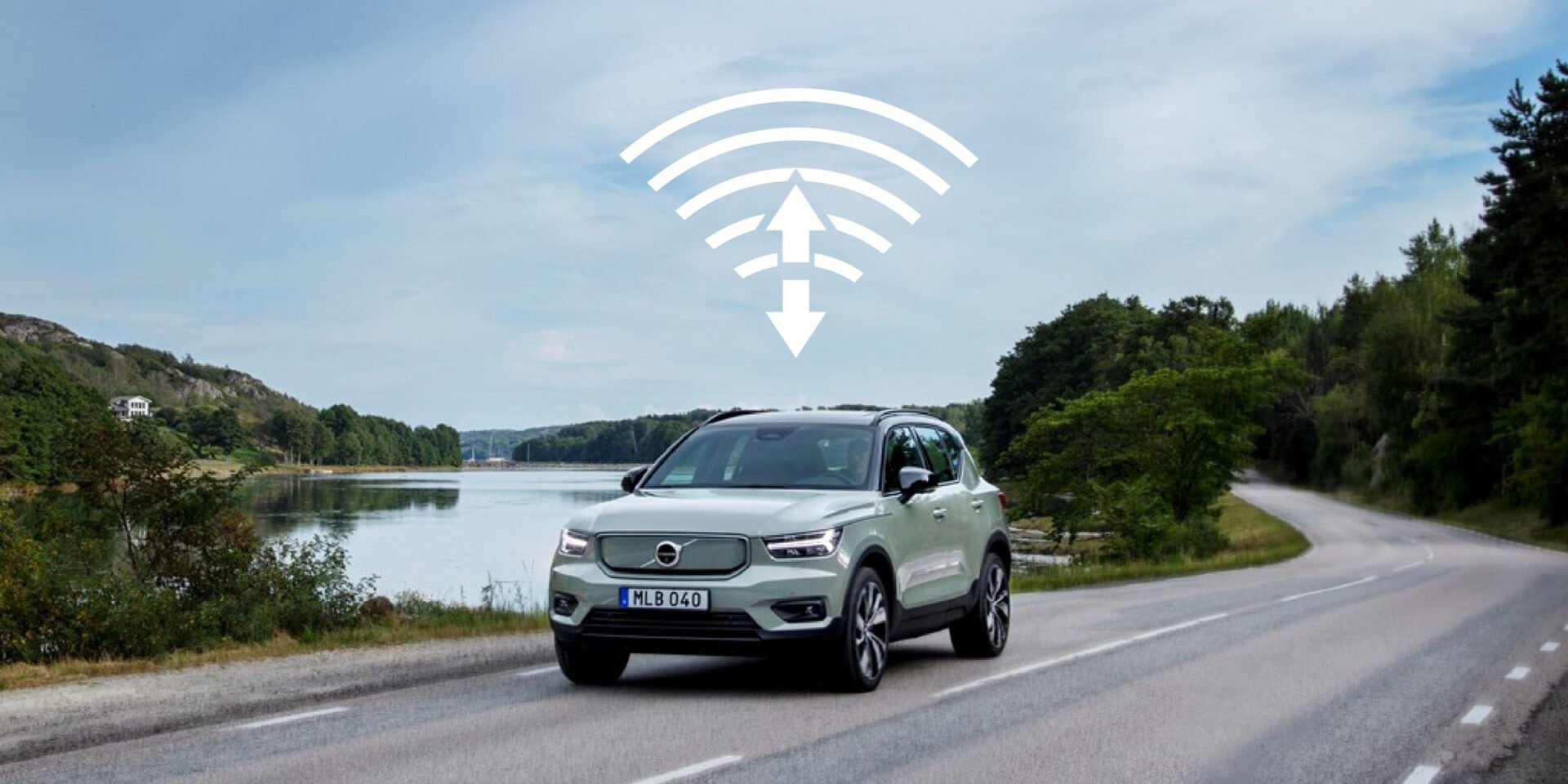
‘Connected cars’ come with a built-in SIM card or microchip and antenna. Sometimes called ‘always on’, there’s no subscription and they use the mobile phone data network (provided there is stable coverage) to provide wi-fi for the car to connect to the internet, other cars, and the road infrastructure.
This built-in wi-fi can be used to download large amounts of data to the car’s systems. It no longer has to be taken to a dealer as it can download data from a cloud-based server run by the manufacturer.


For example, Mercedes says that more than 50 electronic components in the new S-Class can be updated with new software over-the-air (OTA). These include the entire infotainment system, the driver display, the driving assistance and lighting systems. Renault reckons OTA means 85% to 90% of vehicles will have up-to-date software, compared to the previous 60%, at best, through its dealerships.
Some makes, such as Volvo’s all-electric brand Polestar ask owners to bring the car to a service centre when it notifies you that an update is ready but will in time be able to be downloaded anywhere. Providing updates since 2020, it’s already on version P1.7 which includes a Range Assistant app which shows energy information.
OTA updates enable carmakers to get new cars onto the market more quickly, debug them as they go along and then offer enhancements and entirely new features that might not exist when customers first take delivery.
Will it cost me anything?
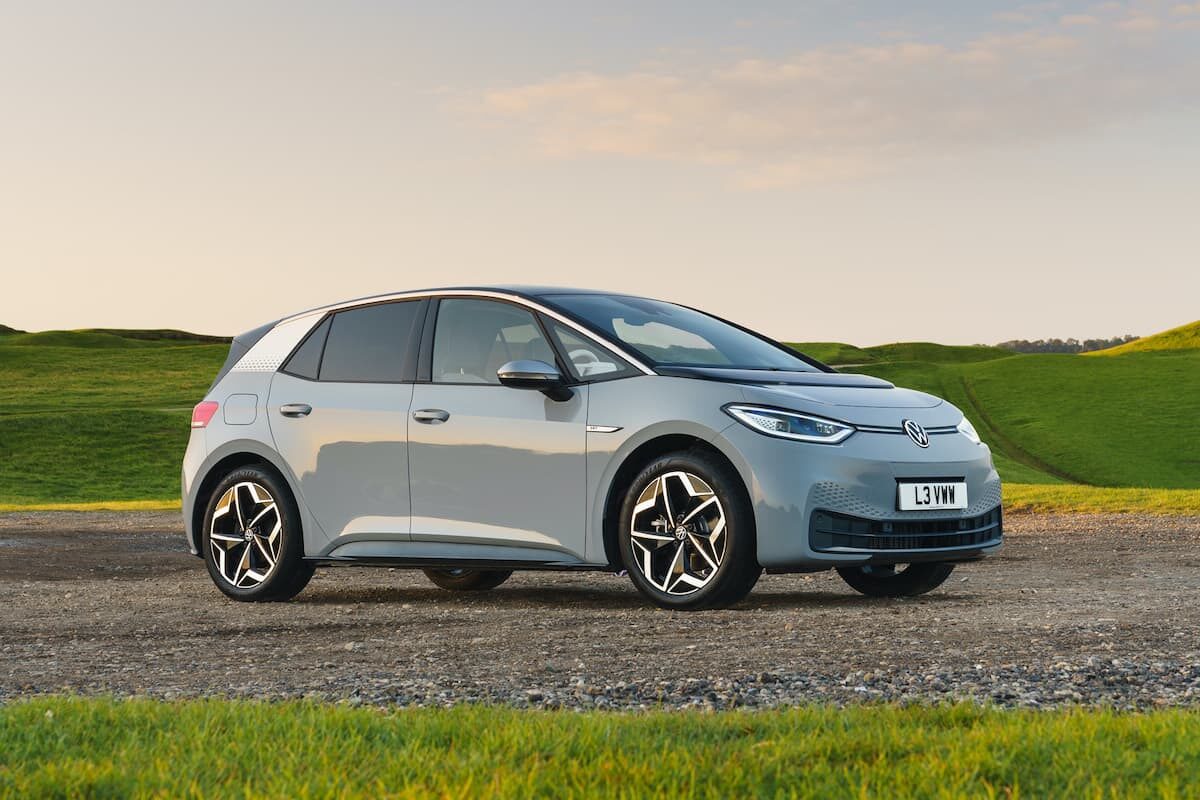
In general, manufacturers have so far provided software updates for free and are likely to continue to do so. Tesla has been the pioneer of OTA updates (from 2012.) Volkswagen, which had to fixes a few glitches in some of its recent models after they launched, has said that for now it plans to provide its customers with free software for the new electric ID. range around every three months.
Further ahead, OTA will be a new opportunity for carmakers to make money, selling paid-for services and functions that the customer can order when needed such as parking assistance, improved battery performance for long journeys, or automated driving. The ability to take these features will be built into the cars at the factory from new then activated on demand. This may mean fewer trim levels and the ability to offer a low starting price, but longer options lists.
Tesla owners can already purchase Autopilot, Enhanced Autopilot or Full Self-Driving Capability at any time and the Autopilot software required will be downloaded to their cars. This is because all Teslas built since October 2016 come as standard with the Autopilot hardware of camera, radar and ultrasonic sensors.
We asked a few carmakers, but none could say whether once these features are paid for, they stay with the car for life or have to be repurchased when it changes owner. How many of us are driving a used car with an-out-of-date navigation system because we don’t fancy paying a hefty charge to have a dealer update?
OTA updates are separate from apps that offer connected services. These are currently widely offered for a monthly fee and pair an app on your phone and the car’s infotainment system to offer things like smart navigation with real-time information, media streaming and Internet radio. All Teslas come with what it calls Standard Connectivity, which provides access to most connectivity features over wi-fi only, in addition to basic maps and navigation and music streaming over Bluetooth. Connectivity networks for these apps are provided by mobile data companies.
How an OTA update works
OTA updates are promised to be as easy as smartphone updates. They are downloaded automatically, in the background without the driver knowing while the car is in use (and connected).
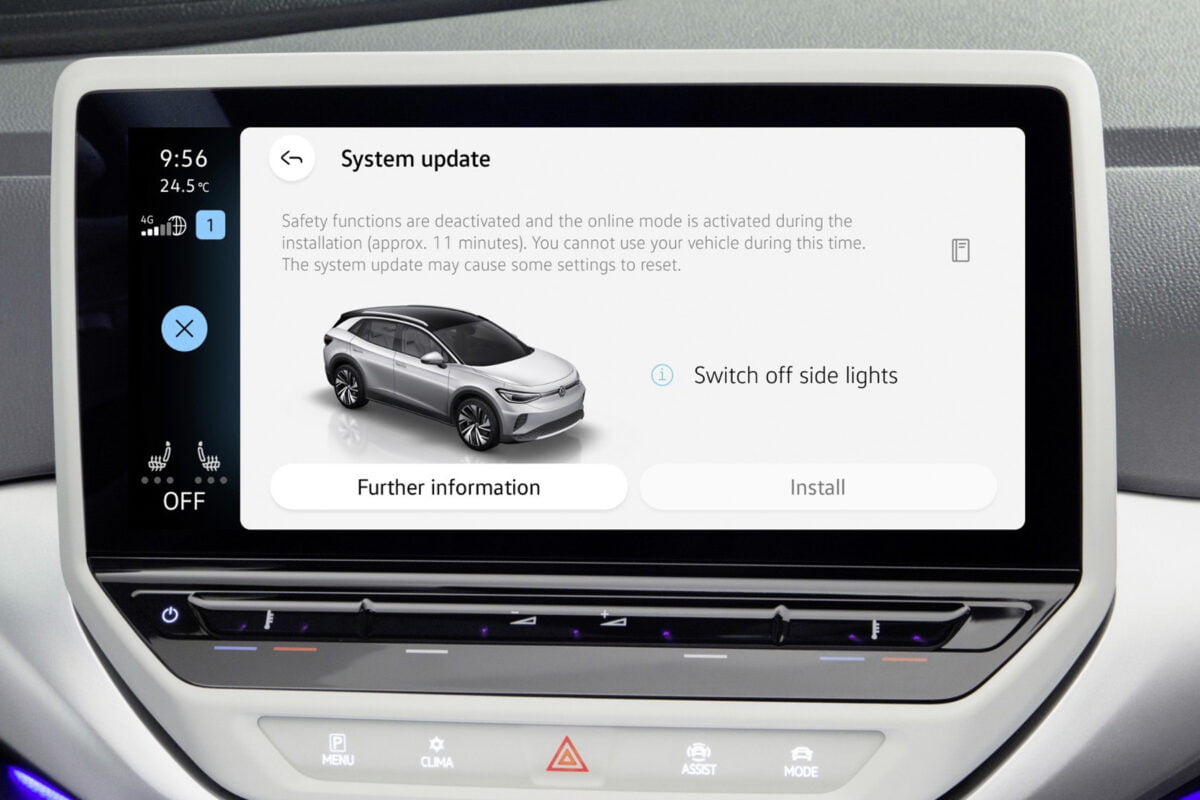
When the driver stops and the ignition is switched off (or more likely the electric motor) a message pops up on the infotainment system/and or mobile phone app to announce the update and asks the user whether they want to install it now (and gives a time estimate). Most installs are claimed to be done in minutes, (Ford claims under two minutes for some of the features for the electric Ford Mustang Mach-E), but they can be as long as overnight. Polestar recommends completing updates when the car is plugged in and charging overnight.
To complete the installation, the driver must have parked, and in the case of a Volkswagen ID.3 or ID.4, made sure the battery level is at least 50 %. Then remove the charging cable, turn off the lights, etc. and start the install. On your return, a message on the infotainment system will tell you if the update was installed successfully.

What if it fails to work?
Realising that customers are going to lose faith if OTA updates don’t work smoothly (and some still don’t), carmakers try to build in reliable operation during a wide range of unexpected events such as engine switching off during download or update, battery charge depletion or network failure.
However, there will be times when a trip back to the dealer might be called far. The good news is that new European regulations will come into force in 2024 which will require manufacturers to make this latest technology reliable.
Another issue is making sure carmakers adhere to the same standards for updating and upgrading cars which may have a life of 20 years.
German auto technology giant Robert Bosch GmbH has been providing over-the-air software updates for in-car systems since 2017. Given that some of today’s vehicles already feature more than 100 control units and is only going to get more complex, Bosch says it is imperative to keep the this manageable. It’s now leading a consortium of 13 companies and research institutions including Mercedes-Benz in the Software-Defined Car (SofDCar) project which aims to establish rules and processes for controlling all software updates and upgrades in the future.
Part of the project involves developing an extended digital twin – a virtual image of the vehicle’s development and runtime data. In the future, this twin will encompass the data distributed across the vehicle and in the cloud – from the time a vehicle is manufactured until it is scrapped.

Is it secure?
Carmakers protect OTA channels from any data hacking by using encryption technologies. For those worried that their cars will be spying on them, OTA updates have to be compliant with EU General Data Protection Regulations (GDPR).
Whatever happens, data collected by the car is always kept anonymous. Drivers are never required to provide authentication.