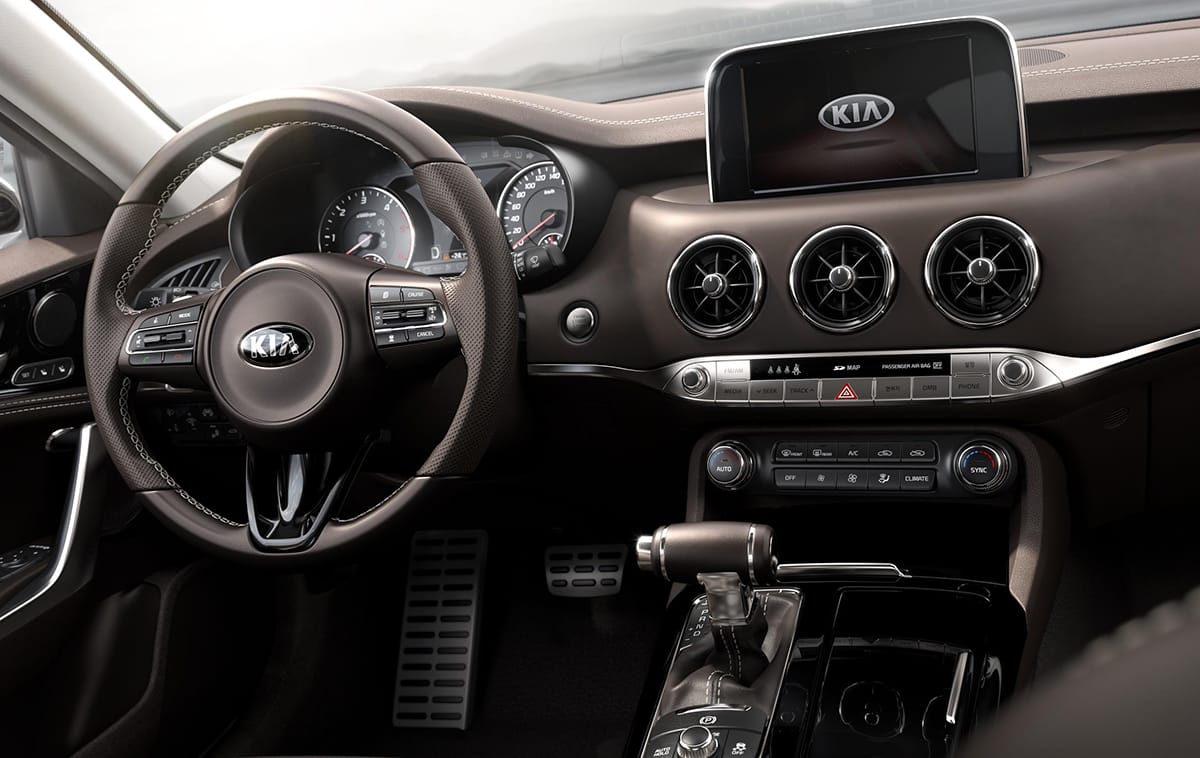
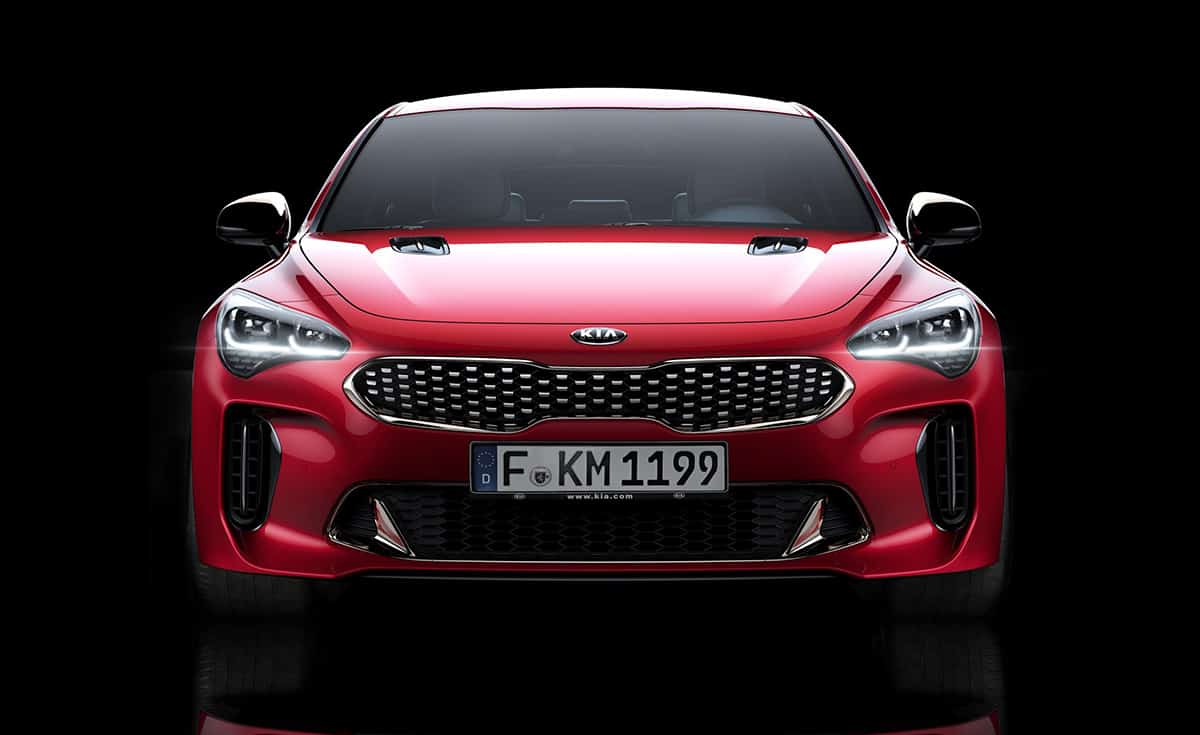
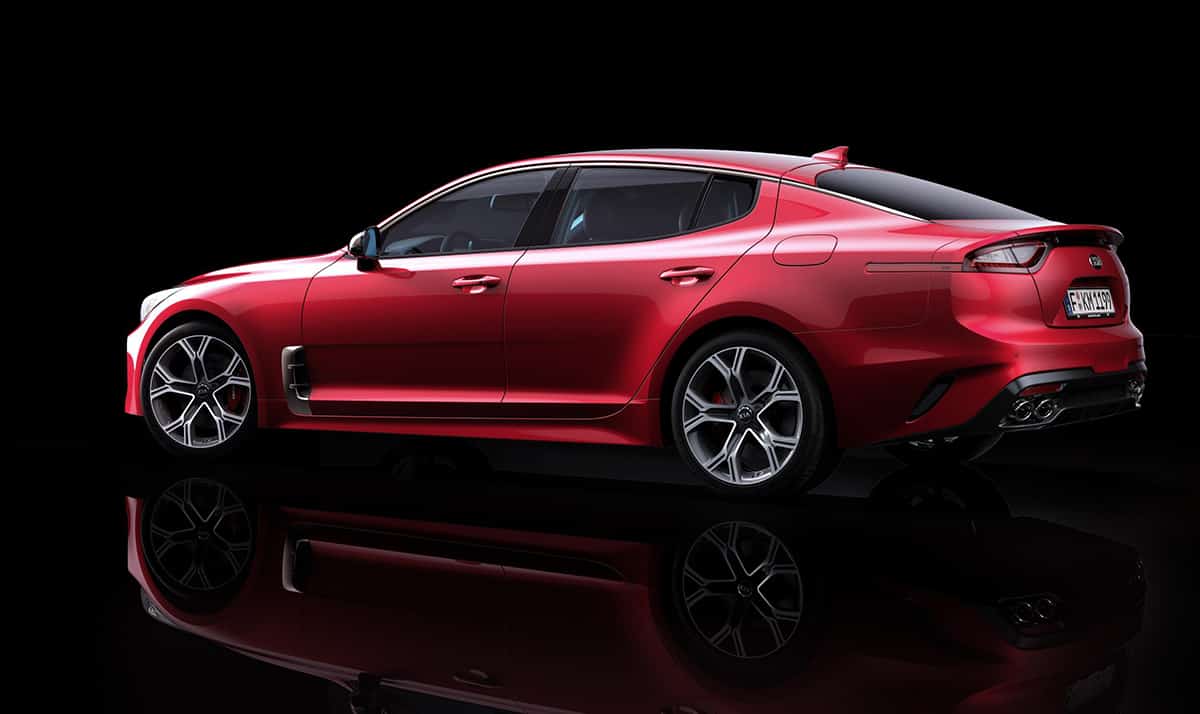
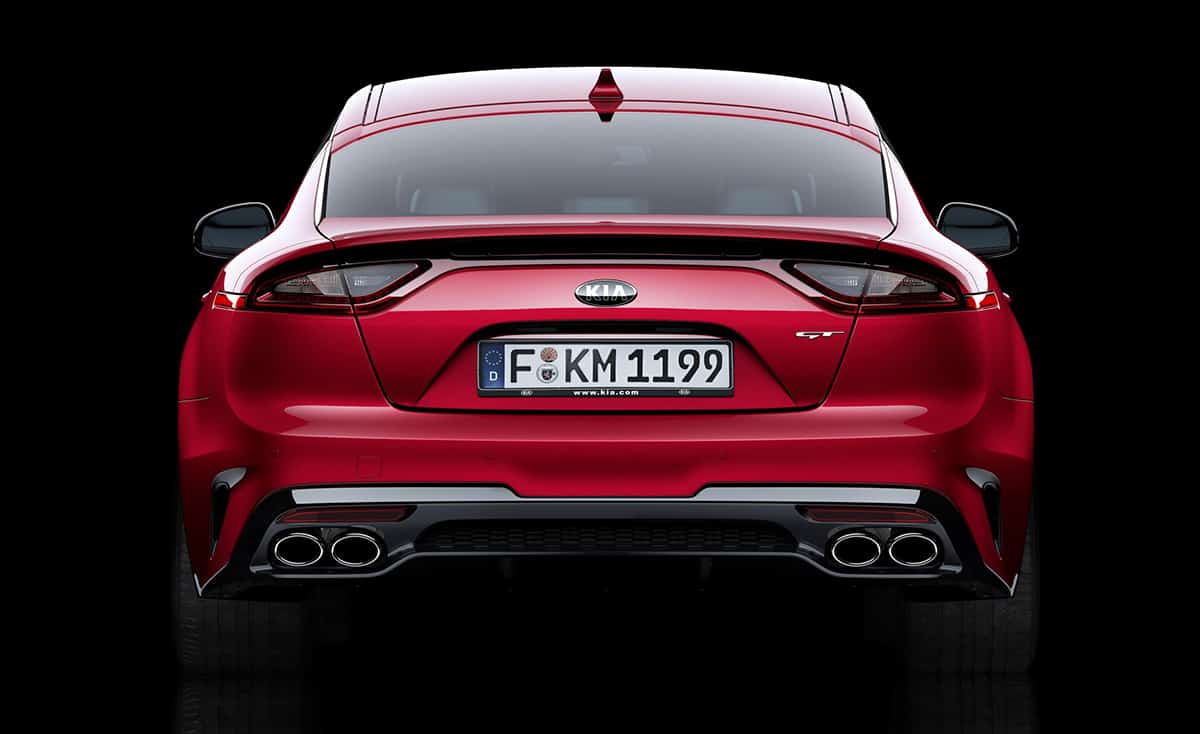
The Kia Stinger, unveiled at the North American International Auto Show in Detroit, is a car charged with redefining the Korean brand’s image.
The Stinger is a fastback sports saloon, the highest-performance production vehicle in the history of Kia, and set to pitch the brand into battle against the performance versions of the premium German manufacturers’ biggest sellers, the BMW 3 Series, Audi A4 and Mercedes-Benz C-Class. The car’s creators are promising that the car will shake up a segment dominated by European products.
Design of the four-door, five-seater has been overseen by Peter Schreyer, Kia Motors’ Chief Design Officer, and the brand’s Frankfurt design team. It was evolved from the GT concept first shown as long ago as 2011, and includes themes from the Stinger GT4 concept car from the Detroit show in 2014.
Potent GT version
Kia says that eventually the Stinger will be offered with ‘multiple engine and drivetrain configurations’, but currently two powertrains have been announced. Standard fit will be a 2.0-litre turbocharged four-cylinder unit with around 255hp and 346Nm of torque, but most interest surrounds the 3.3-litre twin-turbo V6 unit which is targeting 365hp, 510Nm and a 5.1-second 0-62mph time. This will make the Stinger more potent than an Audi S4 and is expected to be offered in a range-topping GT model.
Both engines will be matched to a new eight-speed auto transmission with steering wheel paddle shifts, first released in Kia’s K900 luxury saloon, and a rear-wheel-drive transmission. Rear drive is considered essential for true performance cars while all-wheel drive will be available in some markets.
The Stinger’s throttle mapping, transmission, suspension and steering will boast several driving modes selectable through an electronic system.
The car’s chassis has been developed by a team led by Albert Biermann, formerly at the M performance division of BMW. He describes the Stinger as “a special event,” for the Kia brand. “Because nobody expects such a car, not just the way it looks but also the way it drives – it’s a wholly different animal,” he says.
A large car
At 2.9m, the wheelbase of the Kia Stinger is longer than many mid-sized saloons such as the Audi A4, Infiniti Q50 and Mercedes CLS. The car also boasts greater length (4.8m) and width (1.9m) than much of the segment, and Kia promises spacious interior and boot space.
The chassis is 55% high-strength steel with a MacPherson Strut front suspension and a multi-link rear from which are hung 19-inch wheels. A first for Kia is Dynamic Stability Damping Control, adjustable electronically by the driver.
The production Kia Stinger will arrive in showrooms late in 2017. Prices are yet to be announced, but industry sources predict the GT version could cost around £43,000.
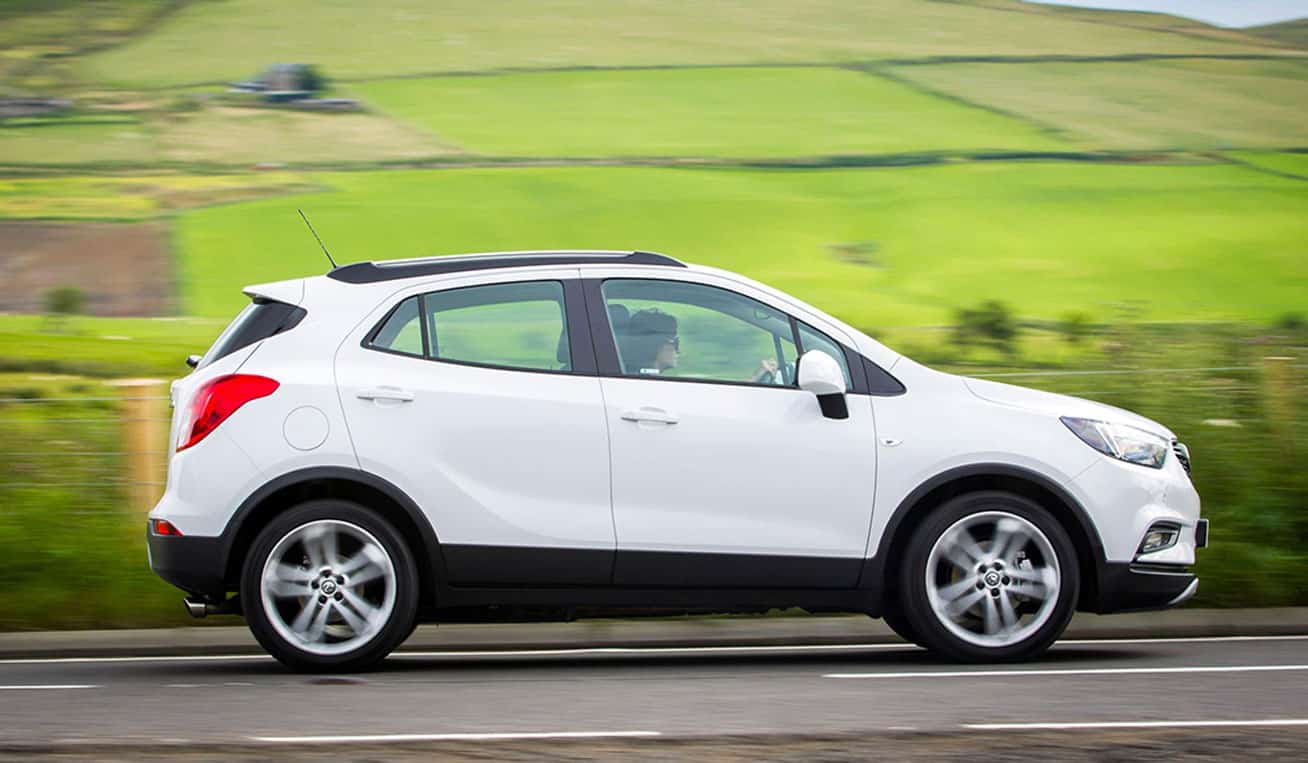
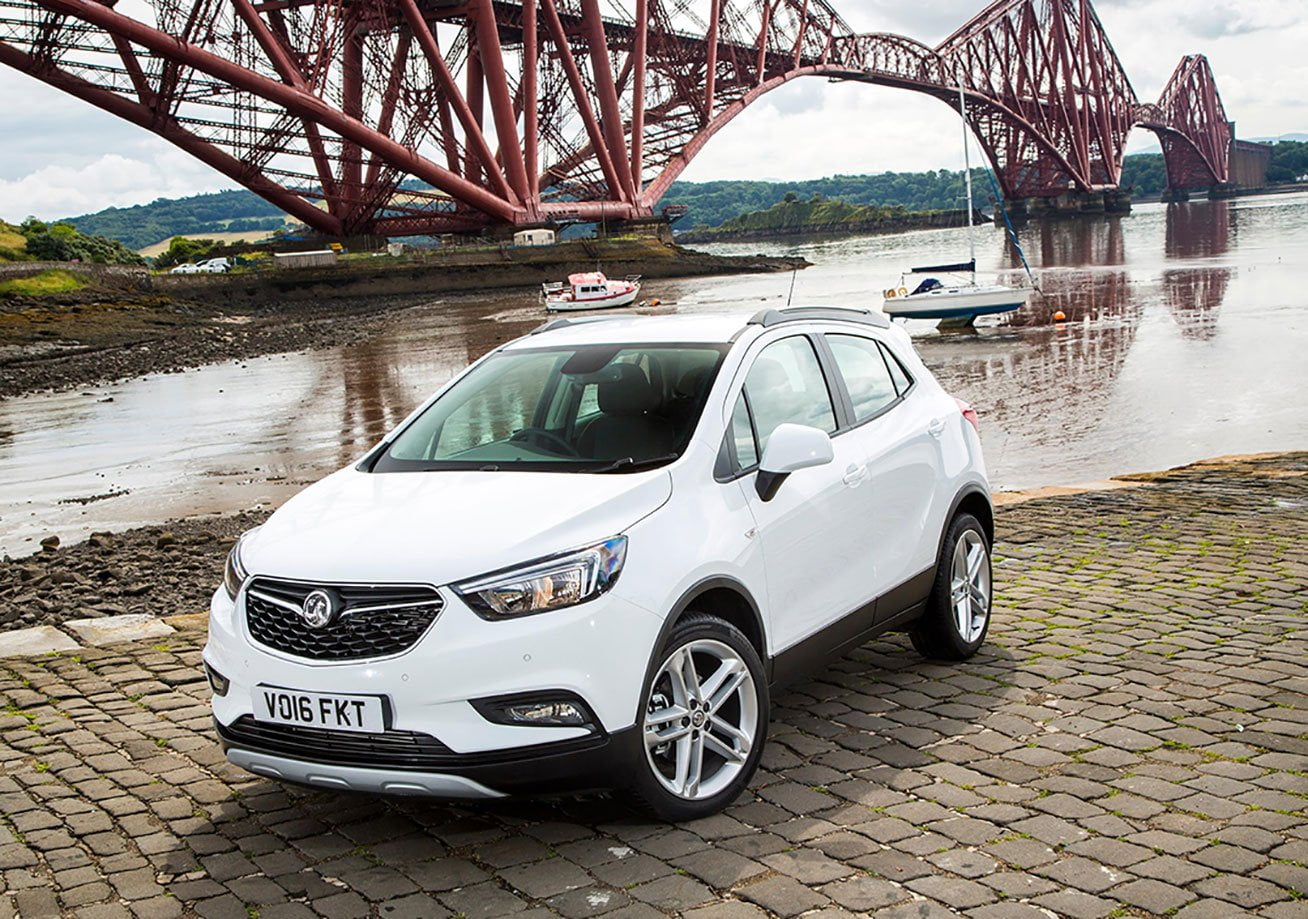
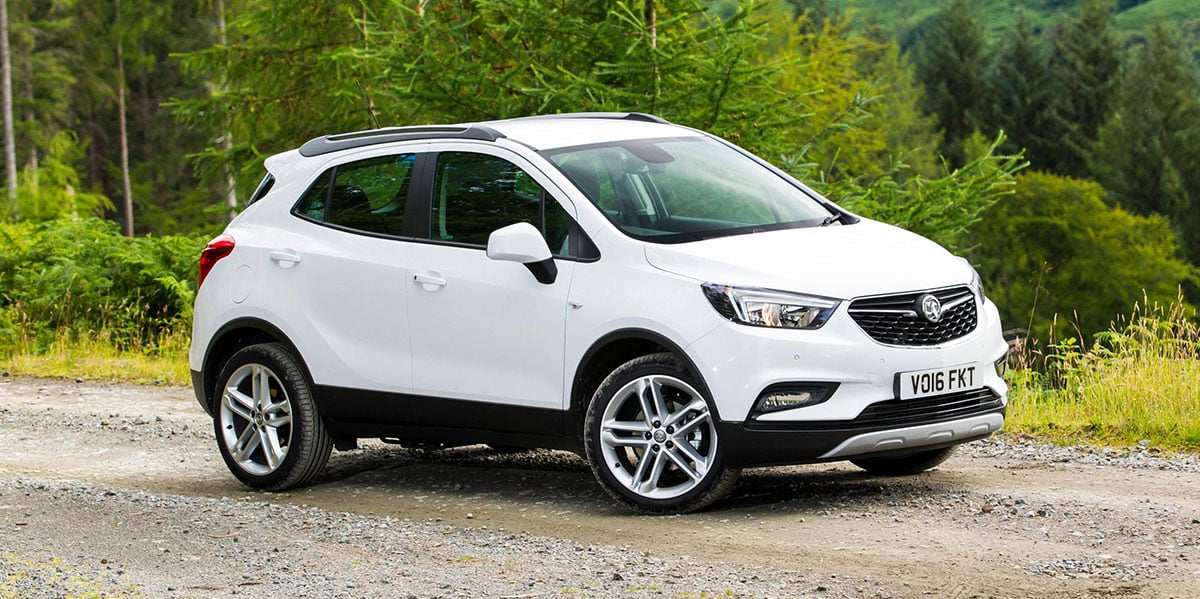
What is it? The Vauxhall Mokka X is a major update to the four-year-old Mokka crossover
Key features: Revised styling, improved interior, new name
Our view: The updates add appeal to the model but the Vauxhall Mokka X is still overshadowed by rivals
Type of review: Taster test
The Vauxhall Mokka first appeared in late 2012 and while it has not exactly written many headlines, it has proved a major sales success for the Griffin brand. And while every manufacturer needs to be in the crossover market right now those already in it cannot sit back – new models and new rivals are appearing all the time.
So rather than simply produce a typical mid-life refresh, Vauxhall has chosen to present the car as a new model. The extra ‘X’ sees the Mokka head up a new crossover line from Vauxhall and before the end of 2017 it will be joined by sister models the Crossland X and Grandland X.
Mechanically, the car gains an extended engine line-up, adding a more powerful 1.4-litre turbo petrol unit of 152hp and the 1.6-litre ‘whisper-jet’ diesel with 110hp.
You can only buy the new range-topping petrol engine with all-wheel-drive and an auto gearbox. Current evidence shows, however, that the vast majority of buyers will be happy with front-wheel-drive – wanting the looks not the ability. And with more drivers turning back to petrol we opted instead to try a Mokka (sorry, Mokka X) fitted with the less powerful 1.4 unit of 140hp.
This really is all one needs – it offers reasonable pace, hitting 62mph from rest in 9.9 seconds and returning combined-cycle fuel economy of 47mpg, though with the trade-off of 140g/km CO2 emissions. On the road it is reasonably refined, feeling pacey but not coarse, the six-speed manual gearbox more satisfying than the auto and the car riding well.
Of course the diesels will provide greater fuel economy – the new unit returns combined cycle figures of up to 72mpg, its more powerful 136hp sister 69mpg, with CO2 emissions down to 103 and 106g/km respectively. But you will need to consider carefully whether your running cost savings will justify the price jump of close to £2,000.
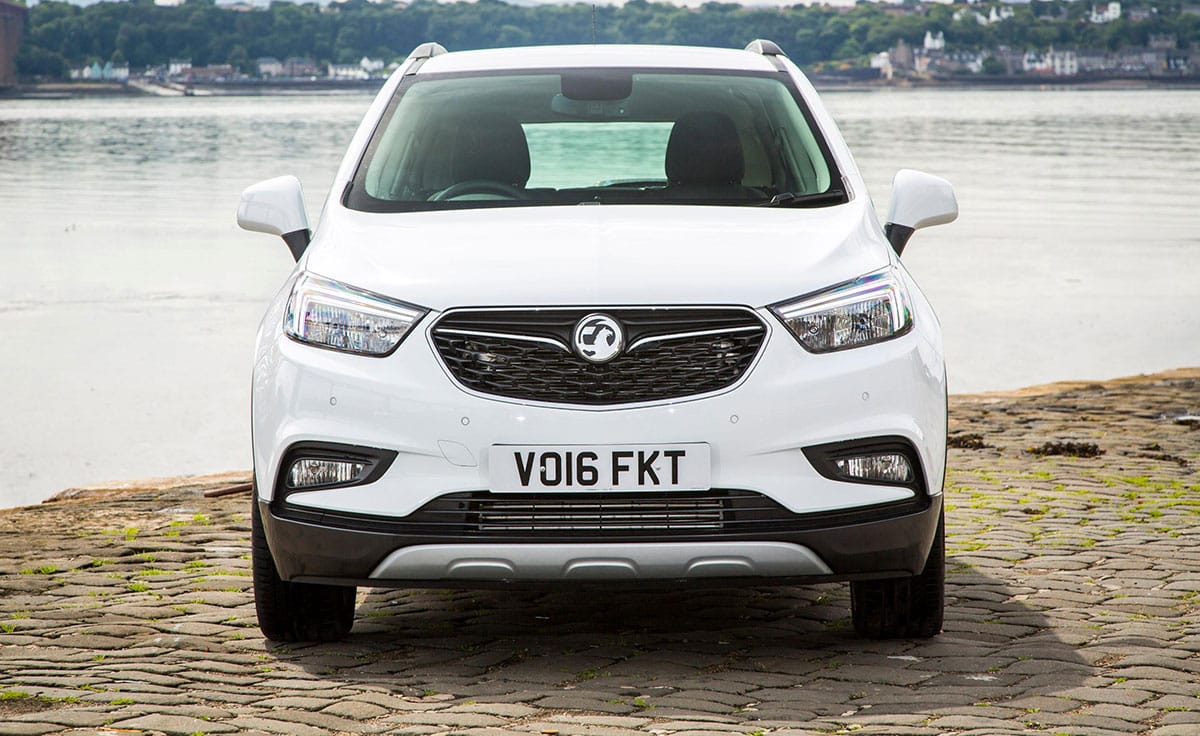
The major changes to the Mokka X are to the exterior styling, and the quality of the interior. From the front you will easily tell an X from a Mokka – the new design is a definite improvement, the elements appear much more integrated.
The creases are softer, the grille wider, the chrome add-ons are gone, and the headlamps are less dominating and with daytime running lights built in. The Mokka X also follows other Vauxhall models in being able to be specified with the optional AFL LED lights that adapt to driving conditions over nine different settings.
At the rear you will need more assistance from the registration plate to identify a new Mokka X. The main differences are in the lower bumper area, notably much less obvious reflectors.
Inside the Mokka X adopts the latest Vauxhall thinking on dash layouts as seen on the recent Astra. Now dominated by the seven-inch touchscreen of the IntelliLink system, the result is a decluttered, more user-friendly layout.
The car also gains quite a lot of technology. The IntelliLink offers smartphone app integration through Android Auto and Apple CarPlay, as well as more typical features such as Bluetooth and audio streaming.
The upper two of the four Mokka X trim levels see the IntelliLink screen grow by an extra inch and add extra features, including an integrated navigation system and the ability to watch videos when the car is at rest.
OnStar, the Vauxhall personal assistant service, is also standard across the Mokka range. While headlined by its automatic reaction function in an emergency, for example alerting emergency services if the car crashes, OnStar also offers a wide range of additional features. These can range from navigation advice through one of the advisors contacted through a button in the cabin, to controlling functions such as door locking through a smartphone app. Vauxhall claims with some justification that OnStar is the industry leader in such connected services.
Far fewer changes to rear end.
IntelliLink touchscreen dominates less cluttered instrument panel.
Rear seats fold down to increase cargo space.
Verdict
The Vauxhall Mokka was due for an update and the Mokka X is a lot more than window dressing. The changes do not turn the car into a class leader – compare prices particularly in the higher trim levels and several perhaps more appealing rivals will compete for attention. But the entry-level models, in particular, are certainly worthy of consideration and the Mokka X should continue the line’s strong sales performance.
Model tested:Vauxhall Mokka X 1.4T 140PS
Price: From £18,310 (Range starts £17,590)
On sale: October 2016
Engine: 1.4-litre petrol, 140hp, 200Nm
0-62mph and max speed*: 9.9sec, 120mph
Economy and emissions*: 47.1mpg ,140g/km
Key rivals: Nissan Juke, Honda HR-V, Renault Captur
Test date: December 2016
* = front-wheel-drive version
The next Nissan Leaf electric car will be built with the brand’s newly-developed ProPilot technology, enabling autonomous driving on single-lane roads.
Plans for the car have been revealed as part of a keynote speech by Nissan CEO Carlos Ghosn at the Consumer Electronics Show in Las Vegas.
The new Nissan Leaf is expected to replace the current car (above) at a date that the brand will not currently reveal – industry sources suggest that 2018 is likely.
A next-generation Leaf will certainly offer a much greater range than the current car – based on the example of the IDS concept shown at the Tokyo Motor Show in 2015, a 340-mile capability is predicted.
The Leaf is the world’s best-selling EV with more than 250,000 sold. In the process its makers claim to have saved more than 497,000 tons of CO2 emissions – equivalent to those of 52,000 US homes.
Electric infrastructure
Nissan adds that it focusing on vehicle electrification and diversifying its powertrains and fuel systems to suit markets around the world. As well as the core electric vehicle (EV) technology it is developing e-Power hybrids and e-bio fuel-cell vehicles.
SAM technology will help autonomous cars deal with situations such as this.
Other technology being explored includes using the batteries of EVs not just for driving but to store energy for a number of home and society uses.
Ghosn’s speech to the CES show, an event gaining increasing importance in the motor industry, focused mainly on autonomous technology and connected driving.
During the show Nissan demonstrated artificial intelligence in vehicles, by a link-up to a NASA research centre. Dubbed Seamless Autonomous Mobility (SAM) the technology is designed to allow millions of autonomous cars to operate safely and smoothly alongside each other.
SAM will ensure that autonomous vehicles do not make decisions on actions when they should not, for example if coming across an accident. Instead they will communicate with a human ‘Mobility Manager’ for advice, and in turn learn from the experience, while communicating with other SAM-equipped vehicles.
According to former NASA scientist Maarten Sierhuis, who is now director of the Nissan Research Center in Silicon Valley, the goal is to change the transportation infrastructure.
“We want to reduce fatalities and ease congestion – we need a huge number of vehicles out there,” says Sierhuis. “What we are doing at Nissan is finding a way so that we can have this future transportation system not in 20 years or more, but now.”
Advancing connectivity
Ghosn also announced that the Renault-Nissan Alliance is continuing its partnership on the development and deployment of advanced connected technologies.
These include Microsoft Cortana, an in-vehicle virtual personal assistant that will allow the vehicle to adapt to personalised driver settings. The system will even understand different driver preferences in a shared vehicle, making each driver feel like they are in their own car.
The CES Show is becoming more important for car manufacturers to attend.
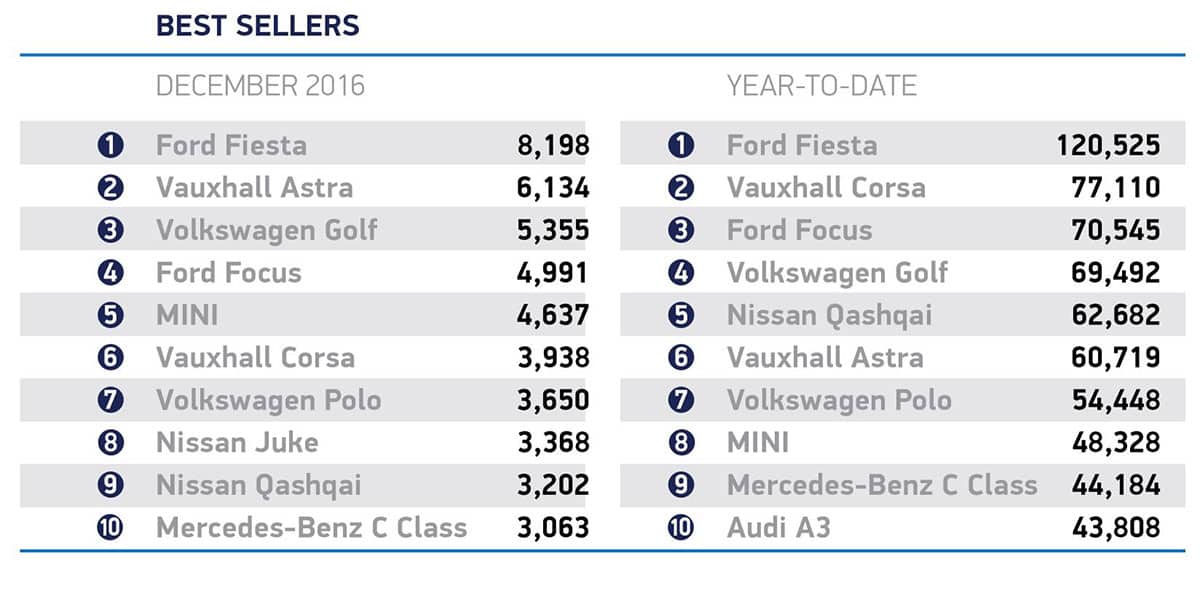
The Ford Fiesta was the most popular new car in the UK in 2016 – as it has been for many years.
According to new figures released by the Society of Motor Manufacturers & Traders (SMMT), a total of 120,525 Ford Fiesta models were registered in the UK over the year. This was more than 43,000 ahead of the runner-up in the new car top ten, the Vauxhall Corsa.
However the 77,110 registrations of the Corsa remain a strong performance in a year that saw Vauxhall fighting negative publicity resulting from at times misguided fire reports in older models.
The Ford Focus claims third place on 70,545 registrations, nosing ahead of its family hatch rival the Volkswagen Golf (69,492). And the Nissan Qashqai retains top spot in the booming crossover market, fifth overall on 62,682.
Meanwhile the SMMT figures highlight which manufacturers had a strong 2016 and which suffered. The highest growth in percentage terms came from Infiniti, the Nissan luxury brand up almost 142%. However its 2,891 cars registered represents a market share of only 0.1%.
Similarly registrations for Abarth, the Fiat performance brand, are up 45% but represent only 3,966 cars, 0.15% market share, while the 41% growth from Bentley sees the number of cars registered up by just 569 cars, to 1,948.
The 2016 New Car Top Ten table has a familiar look about it.
Much more impressive is the 45% rise recorded by Jaguar, which registered almost 11,000 more cars in 2016 taking the British manufacturer’s total to 34,822. Sister brand Land Rover was up 20% at 79,534.
Premium makes target volume
The figures tell a less rosy tale for the volume manufacturers. Ford registered more UK cars than any other manufacturer in 2016, at 318,316. This represents almost 12% of the entire market but is 5% down on 2015.
Second biggest maker remains Vauxhall with 250,955 registrations, down almost 7%. The 207,028 recorded by Volkswagen is a slide of 8%. And the clue could be in the next largest figures – the 182,593 registrations of BMW are up 9%, the 177,304 of Audi up 6%, and Mercedes-Benz with 169,828 up a very strong 17%. It seems more buyers than ever are realising they can own premium models previously thought of as unobtainable.
And the largest slide on the UK market? If one ignores Chevrolet, still recorded despite no longer being officially sold in the UK, the wooden spoon goes to Mitsubishi. The Japanese brand registered 18,237 cars in 2016, almost 20% fewer than in 2017.
Infiniti is the brand seeing the greatest percentage growth in 2016.
More cars were registered in the UK than ever before in 2016, the market reaching almost 2.7 million.
Despite sales slipping in December, only the second month of the year to record a negative result, the market saw its fifth consecutive year of growth.
According to new figures released by the Society of Motor Manufacturers & Traders (SMMT), 178,022 new cars were registered in December, 1.1% down on the same month in 2015.
However they contributed to a year-long total of 2,692,786 – 2.3% up on 2015 and a new record for the UK market.
The SMMT, which at the start of 2015 predicted that the market would “hold steady” in 2016 after soaring 6.3% in 2015, put the current strength in car sales down to fleet demand.
Fleet registrations grew to a record 1.38 million units, and while the private market remains high , with more than 1.2 million private buyers registering a new car in 2016, demand did fall after the first quarter of 2016.
Sales slipped in December but did not prevent a record year.
Meanwhile the popularity of diesel cars is continuing to slip. They were down 6.8% in December, claiming 47% of the market compared to 49.8% a year before, and have slid back slightly over the year, holding 47.7% (2015 – 48.5%).
More buyers going electric
The appeal of alternatively fuelled vehicles (AFVs) is still climbing strongly, up 22.2% across the year. Plug-in hybrids and petrol electric hybrids, in particular, experienced significant growth, with demand up 41.9% and 25.1% respectively, while more than 10,000 motorists chose to go fully electric in 2016 – up 3.3% on 2015.
According to SMMT chief executive Mike Hawes, the market grew despite 2016’s political and economic uncertainties, and he puts this down to car makers offering “an incredible range” of innovative and high tech models.
“2017 may well be more challenging as sterling depreciation raises the price of imported goods but, with interest rates still at historic lows and a range of new models arriving in 2017, there are still many reasons for consumers to consider a new car in 2017,” Hawes says.
And continuing to focus on the Brexit process, Hawes adds; “Looking longer term, the strength of this market will rest on our ability to maintain our current trading relations and, in particular, avoid tariff barriers which could add significantly to the cost of a new car.”
After its post-recession lows the UK car industry is now soaring.
McLaren is to unveil the second generation Super Series at the Geneva motor show in March.
Forming the brand’s first-ever replacement of one of its product families, the new model to be unveiled at Geneva is also the first of 15 new cars scheduled under McLaren Automotive’s bold ‘Track 22’ business plan revealed at the 2016 Geneva show.
The current Super Series is typified by the McLaren 650S, launched in both Coupe and Spider form in 2014. It followed on from the first of the McLaren Automotive line and effectively the initial Super Series model, the 12C of 2011, which itself gained a Spider sister in 2012. The current Super Series family of supercars was completed by the 675LT Coupe and Spider of 2015.
For the second-generation line McLaren has created a new monocoque central structure, dubbed Monocage II and formed completely of carbon fibre.
While offering increased rigidity it also saves 18kg in weight over the carbon fibre/metal structure used in the initial Super Series models. McLaren states that the first new Super Series model will weigh in at just 1,283kg.
Other advantages offered by Monocage II include a wider entrance for occupants and lower sills. Inside the car the driver’s view will be improved, while the centre of gravity will be lowered for improved handling.
The McLaren 650S is the brand’s core model and a member of the first Super Series line.
McLaren is so proud of its new monocoque that it will even offer owners the opportunity of specifying a ‘Visible Monocage’ option that will feature exposed carbon fibre material on the inside of the windscreen pillars.
According to McLaren Automotive CEO, Mike Flewitt, the Super Series is the core of the brand’s business and the epitome of what McLaren is all about.
“(It) personifies the blend of extreme performance, crafted luxury and unparalleled driver involvement that is the McLaren heartland,” Flewitt says.
“This is the first time we have replaced a product family and the new Super Series will be absolutely true to McLaren’s pioneering spirit in being a revolutionary leap forwards, both for our brand and the supercar segment,” he adds.
Virtually every motor show has seen something new from McLaren, most recently the bold Track 22 business plan.
Sketches released before Christmas of the new Kia Picanto have now been followed by photos of the car itself.
The third-generation version of the city car will make its public debut at the Geneva motor show in March and then go on sale during the Spring of 2017.
According to its creators the new Kia Picanto is designed to present a more assertive, distinctive look in its sector, with bolder body lines and sculpting to its surfaces.
The car measures up at exactly the same overall length as its predecessor, 3595mm, but has a 15mm longer wheelbase at 2400mm. This has the effect of pushing the wheels further into the corners of the car. Combined with a shorter front but longer rear overhang it both frees up greater interior space and emphasizes the Picanto’s looks.
Kia is also highlighting the new interior design which is said to be more efficiently packaged with a dash boasting a ‘floating’ touchscreen entertainment system.
Powertrain details are still to be revealed, and the new Picanto will be sold as a five-door model only, reflecting the decline in popularity of three-door versions among buyers. The car is shown in Kia’s sporty-look GT Line trim level and new, bold paint options will also be available.
Kia has released the first sketches of the new Kia Picanto city car, which is expected to make its public debut at the Geneva motor show in March.
While revealing little in detail about the car at this point, the brand says that it will retain its compact size but be better packaged and with a bolder look – the sketches show a strong family resemblance to the new Rio supermini that launches early in 2017.
According to its creators the new Picanto will also offer a ‘youthful and energetic exterior and interior design’, with more options to personalise the car as is currently the market trend. The latest technology is also promised as part of the cars specification.
Having been one of the first A-segment cars to offer a five-door variant alongside the traditional three-door, in its third-generation version the Picanto will follow the industry trend, being sold in five-door form only and reflecting a general dropping off in popularity for small three-door models.
No details regarding powertrains have yet been released – these will be revealed closer to the car’s launch. The new Picanto is expected on sale in the second half of 2017.
The Audi Q8 concept will debut at the North American International Auto Show next month, previewing a future range-topping model for the German brand’s SUV line-up.
The concept is described by Audi as a ‘near-production study’ that ‘represents a synthesis of the emotional styling of a coupé and the spaciousness that typifies an SUV.’
The Audi Q8 is also stated to be ‘unlocking a new segment’ though it will clearly be targeting full-size coupe SUVs such as the BMW X6.
Details of the concept are currently scarce though it is said to have a four-seater layout, despite the large exterior dimensions, so suggesting a luxury model.
In concept form the Audi Q8 certainly has an imposing front end – its brand signature octagonal single frame grille is considerably wider than in current production cars from Audi, while the car is also said to have many design elements harking back to the original Audi quattro of the 1980s, notably the very wide rear screen pillars.
According to the brand’s Head of Design Marc Lichte the Audi Q8 concept is “a new spearhead within our Q model line” with a design that strongly evokes sportiness and prestige.
“What’s more, we believe an important aspect of this showcar is that it offers a spacious interior with four equally comfortable seats, even with the flat roof line,” Lichte says.
The production Q8 is expected on sale in 2018 and its powertrain options are likely to include a hybrid – the sketches of the concept released ahead of the car’s debut in Detroit on 9th January show it wearing e-tron badges.
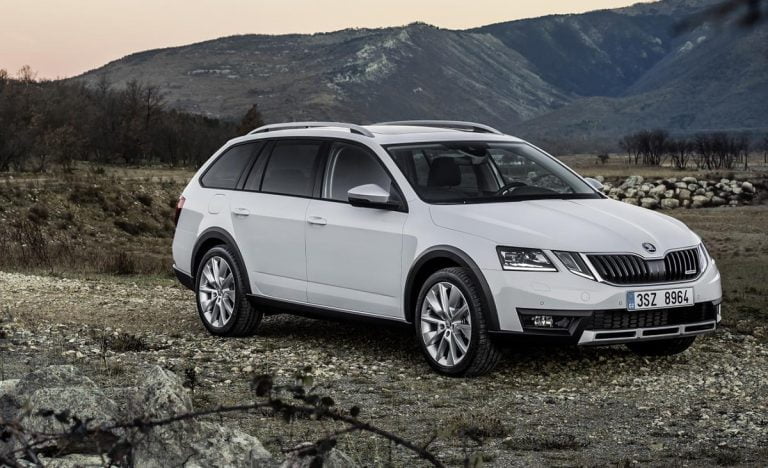
The Skoda Octavia Scout soft-roader has been updated to match the rest of the recently facelifted Octavia line-up.
Retaining its all-wheel-drive and ground clearance increased by 30mm over the estate, the new Skoda Octavia Scout gains a revised front-end styling treatment and equipment upgrades.
Visually the most obvious difference is to the headlamps, which are now dual, full-LED units with adaptive technology. LED technology also features in the fog and tail lights.
The approach and departure angles have been increased, to 16.6 and 14.5 degrees respectively, to further aid the car’s off-road abilities. The Octavia Scout also boasts an electronic differential lock on both axles.
Buyers can also specify an off-road function, which maintains a constant speed without needing the driver’s input, particularly downhill.
New versions of the Skoda Octavia Scout also now feature several of the brand’s ‘Simply Clever’ items, including a heated steering wheel and seats with a ‘Thermo-Flux’ function which, from time to time, increases the air and moisture permeability to make the seats more comfortable in varying climate conditions.
The Skoda Octavia Scout is available with two versions of a 2.0 TDI diesel engine with either 150 or 184hp.
Infotainment systems now replicate those in other Octavias, with central touchscreens and the range-topping versions including a Columbus navigation system with a 9.2-inch monitor and a wi-fi hotspot.
Driver assistance systems are also upgraded, Trailer Assist, Blind Spot Detect and Rear Traffic Alert all included. Also available is the Crew Protect Assist function, which closes windows and the sunroof in the event of an impending accident and tensions the seat belts on the front seats, and an improved Front Assist function, which includes City Emergency Brake and predictive Pedestrian Protection.
The BMW 5 Series will gain a plug-in hybrid model in March with the launch of the £43,985 530e.
Described by its makers as completing the 5 Series range, the newcomer has also been dubbed the most efficient version of the car yet – official CO2 emissions figures will be just 46g/km alongside combined cycle fuel economy of more than 141mpg.
The BMW 530e combines the typical 2-litre petrol engine of 184hp with a 95hp electric motor for a combined output of 252hp alongside 420Nm of torque. It produces a 0-62mph time of 6.2 seconds and can go on to 146mph.
BMW claims that the car can clock up almost 400 miles on one tank of fuel, and can also cover up to 29 miles on electric power alone at speeds of up to 87mph.
The powertrain remains rear-wheel-drive, the electric motor placed between the engine and the eight-speed Steptronic auto transmission, making use of the gearboxes ratios and negating the need for a weight-adding torque converter.
The lithium-ion battery pack is mounted under the rear seat, ensuring that the car can still offer a 410-litre boot volume with a flat floor. Charging of the battery takes five hours from a domestic socket or under three hours using the 3.7kW BMW I wallbox.
Added to the cockpit controls is eDrive, a button alongside the Driving Experience Control switch, with its Sport, Comfort and Eco Pro settings. The eDrive adds three more driving modes: Auto eDrive, Max eDrive and Battery Control.
In the Auto mode, which is the default setting, the engine and electric motor work together for the best efficiency in all driving situations – the all-electric top speed in this mode is 56mph.
The Max Mode allows the BMW 530e to drive on electric power alone, and makes available the 87mph maximum speed. However, kicking down on the accelerator pedal will cause the engine to cut in, such as when needing extra pace for overtaking.
Battery Control mode lets the driver set the charge level for the high-voltage battery manually, between 30 and 100 per cent of maximum charge, allowing that proportion of the battery’s capacity to be reserved for all-electric driving at a later point in the journey.
The battery management system either keeps the battery’s charge constant at the selected level or increases it to the pre-set value, with the electric motor acting as a generator. As a result it is it possible to conserve or even increase the electric power available, for example while travelling on the motorway, to ensure that later on the car can be driven on zero emissions through for example an urban area.
Visually the BMW 530e can be distinguished from its sister models by blue slates on the kidney grille, blue wheel hub covers, the charging socket located between the front wheel arch and the A-pillar on the driver’s side and ‘eDrive’ emblems on the rear screen.On the inside the illuminated sill panels bear eDrive lettering.
Order books have been opened and prices revealed for the forthcoming Mercedes-Benz E-Class Coupe.
As The Car Expert reported when the new E-Class Coupé was unveiled last week, it will arrive on UK roads in April 2017 following its public debut at the North American Auto Show in Detroit in January.
The range will comprise three models – prices start from £40,135 for the E 220 d, the E 300 costs from £41,025, while the E 400 4Matic starts from £50,775.
The 2.0-litre diesel of the Mercedes-Benz E-Class Coupé E 220 d produces 194hp and 400Nm of torque, and will likely appeal to fleet buyers with CO2 emissions of 119g/km and combined cycle fuel economy of 61.4mpg, along with a 0-62mph time of 7.4 seconds.
The E 300 relies on 2.0-litre turbo petrol power, putting out 245hp and torque of 370Nm while the current range-topping E 400 4Matic has a biturbo 3.0-litre V6 petrol engine of 333hp and 480Nm.
Only one trim level, AMG Line, will be available for the car. Highlights of the AMG Line include 19-inch alloy wheels each with five twin spokes, LED headlights and tail lights, parking sensors and a reversing camera.
Owners will also find amongst the equipment a seat belt feeder, Magic Vision Control, touch pads on the steering wheel, Artico and Dinamica upholstery, heated seats, ambient lighting with a choice of 64 colours and an 8.4-inch infotainment screen with a Garmin navigation system.
The E 400 upgrades the navigation to the Mercedes Comand Online system with a 12.3-inch screen, while E 300 models also gain a sports exhaust system.
Options include the £2,795 Premium Equipment Line that adds a memory package, panoramic sunroof, and Keyless Go entry and starting. At £3,895, a Plus version also includes a Multibeam LED intelligent light system and a Burmester surround sound system.
For £595 owners can add some extra safety in the form of the Lane Tracking Package that includes Blind Spot Assist and Active Lane Keeping Assist. Or for £1,695 the Driving Assistance package adds Drive Pilot (including steering, lane change, emergency stop distance and speed limit aids); Active Brake Assist with a cross-traffic function, Evasive Steering Assist and Pre-Safe Plus.
The Comand Online infotainment with its 12.3in screen is available on E 200 and 300 cars for £1,495 and can be combined with the £495 12.3-inch cockpit display to create a widescreen cabin effect.
Other options include Air Body Control air suspension (£1,495 but standard on the E 400) and alongside the Premium or Premium Plus packages and the 360-degree camera, a Remote Parking Pilot which allows the vehicle to be parked using a smart phone. This costs £89 for a three-year subscription.
Due to be launched from next summer, the Volkswagen Tiguan Allspace will be a version of the Tiguan extended by 220mm in length, with 110mm added to the wheelbase and an interior layout that will be able to seat up to seven.
Few details have yet been released about the car, but it is widely expected to be sold with the same engine line-up as the big-selling current model, stretching across petrol units of 1.4 and 2.0 litres and 2.0-litre diesels.
Following its unveiling at Detroit on 9th January, initially the new model will be launched in the USA and then China before coming to the UK.
The Tiguan Allspace name will only be used for European markets. In all other parts of the world, the car will be known simply as the Tiguan.
What is it? The new Citroën C3 is the third generation of the French supermini. Key features: Distinctive looks, lots of space, much personalisation. Our view: The new C3 adds a distinctive option to the supermini market, but not at the expense of practicality with many plusses and few minuses. Type of review: First UK drive
Citroën has been on a mission for a while now – a bold campaign to redefine itself as a mainstream brand with cars that stand out from the rest, but not for the wrong reasons. Once known for its style the brand is seeking to establish that image once more – “Our ambition is to make Citroën an aspirational brand for customers and a truly iconic brand once again,” says spokesman John Handcock, introducing the new Citroën C3.
With such goals, it is no surprise that in producing the third-generation of the brand’s best-seller, Citroën has not stuck with the practical and reasonably safe formula that has produced 3.6 million sales globally, 200,000 in the UK, since the original C3 went on sale in 2002.
No, the new Citroën C3 showcases the brand’s latest design language and on first viewing is instantly recognisable as a smaller sister to the mould-breaking C4 Cactus introduced in 2014.
Style inside and out
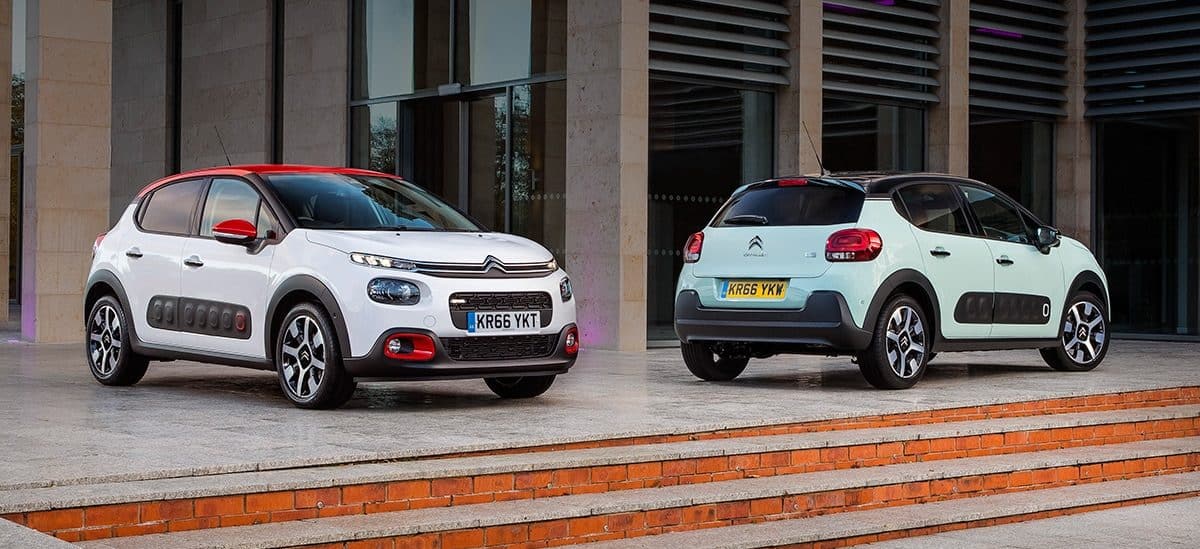
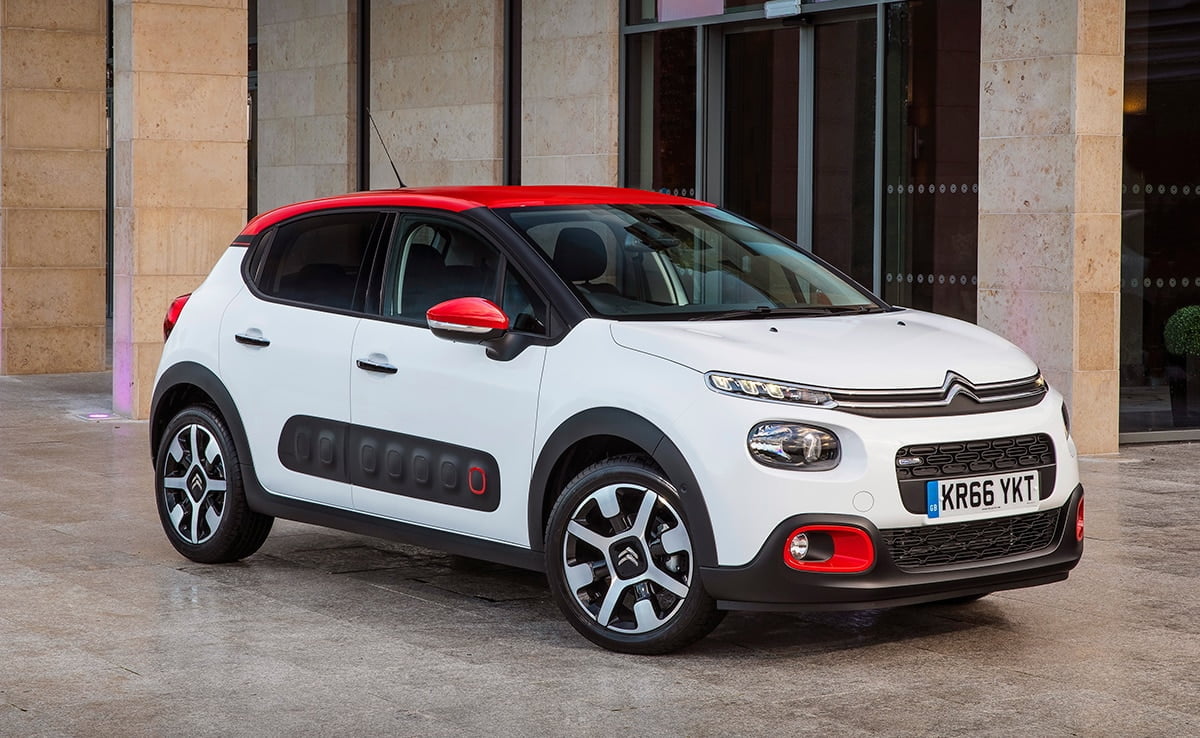
Obvious styling pointers are the two-tier headlamp layout, the double chrome strips running from the grille to the pencil-thin daytime running lamps, and most obviously the ‘airbump’ moulded panels on the doors. Added for both style and we are told protection, these were derided by some when the Cactus launched with them, but you do see quite a few C4s on the roads these days… However in the case of the C3 a customer can buy an entry-level version without airbumps should they prefer.
The new C3 has a high stance, which together with the muscular wheelarch extensions gives it the look of a crossover. Yet it also has a roofline 40mm lower than its admittedly somewhat bulbous predecessor.
Two-tone roof adds distinction and sunroof can be specified.
Pencil-slim daytime running lights a signature styling element.
Airbumps first seen on C4 Cactus – only entry-level C3s can’t have them.
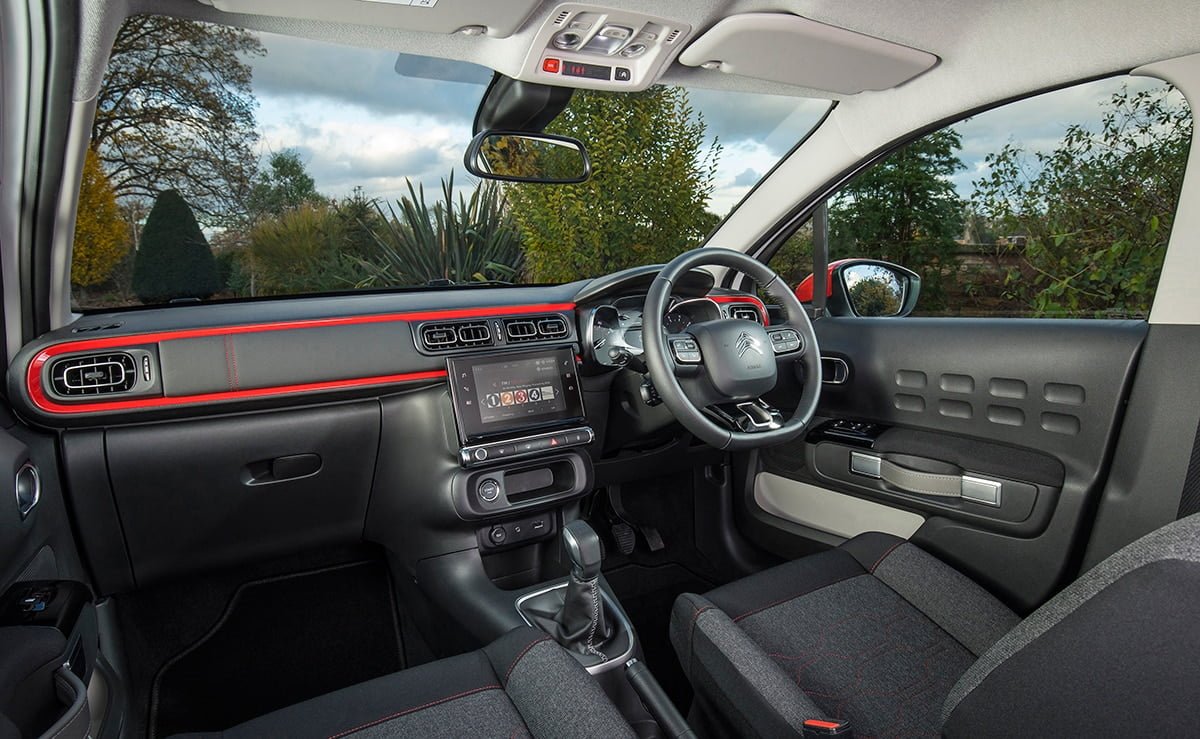
Despite its reduced height, the C3 immediately feels spacious when one gets inside. Some of this is due to practical measures, such as the more comfortable seats, with 2cm more shoulder width, installed under the ‘Advanced Comfort’ programme that Citroën is presenting as a priority. But much is also due to perception – the full-width dashboard, for example, another feature evolved from the C4, immediately gives an impression of a very wide car, while the interior also feels light and airy, the result of carefully selected materials and particularly emphasised if one chooses the optional panoramic sunroof.
It is practical – the rear seats have plenty of room for young travellers and enough to transport adults, and are easy to access thanks to the five-door layout. And at 300 litres, the boot space is larger than either the C3’s best-selling competitor, the Ford Fiesta, or its in-house rival the Peugeot 208.
Fit and finish, meanwhile is excellent, definitely at the top of the mainstream market, while there are some delightful details – this reviewer’s favourite being the interior door pulls that are apparently ‘inspired by travel’ and look just like suitcase straps.
Personalisation is also a major feature of the C3 – nine exterior colours are combined with three roof options, and the interior can be specified too, with the dash edges in particular picked out in one of three colours.
Wide dash emphasises interior space.
The interior and be styled in one of three colours.
Adults will find rear seat space to level not usual in superminis.
Boot volume of 300 litres beats some big-selling rivals.
Details make a great deal of difference on the Citroën C3, such as these delightful door pulls.
Citroën C3 powertrains
The C3 launches with engines already familiar in the PSA range. The three petrol options are all versions of the 1.2-litre three-cylinder PureTech petrol unit, with either 68, 82 or 110hp and all evolved from the winner of the ‘Engine of the Year’ title two years running. A pair of diesels are both four-cylinder 1.6-litre BlueHDi units with either 75 or 100 horses.
Currently all are matched to a five-speed manual gearbox, which is unusual in a market increasingly settling on six speeds. The EAT6 auto unit will be available in the range, but not until February 2017. And the largest petrol and both diesels also feature start-stop technology, which has the odd effect of allowing the 110hp petrol engine to outdo both its smaller siblings in economy and emissions, shaving the latter to a very creditable 103g/km.
On the launch event The Car Expert tried this petrol engine, and the 100hp diesel. We know the engines from previous Citroën, Peugeot and DS models and they did not surprise with their refinement or enthusiasm. In this environment the 110 feels quite sporty in fact.
Citroën is not currently saying whether there will be more engine options – though we would expect some. With the C3 the focus of the brand’s return to the World Rally Championship, a hot hatch version would seem to be a given.
Citroën C3 suspension tuned to comfort and provides quality ride.
That Advanced Comfort programme has been employed in redesigning the suspension and the result is a pretty comfortable ride in most situations. However it is naturally tuned to the soft side and at higher speeds hitting potholes or the like will transmit the resultant crash and bump through to the cabin.
In corners the C3 remains poised and upright, and goes where it is pointed. There are cars in the segment with better handling dynamics, but far more that can’t match the C3 for its prowess in the bendy bits.
Niggles? Just a couple. The clutch pedal seems to be placed quite close to the centre console tunnel and we found ourselves regularly catching our feet on it, while the gear shift on our models felt a touch notchy rather than slick.
The nine exterior colour options include this shade, described as Almond Green.
Specifications and options
The Citroën C3 launches with a choice of three trim levels, Touch, Feel and the Flair which formed the specification of all the launch event models. Lots of technology has been added to the model, apparently as demanded by customers, and it is good to see that much of the safety tech is standard equipment, such as hill-start assist, lane departure warning and traffic sign alerts.
To get much of the ‘nice to have’ tech, you will have to spend more than the £10,995 that buys the entry-level Touch model. Rear parking sensors and a camera only come with Flair trim, and while on the entry versions you do get a DAB radio with Bluetooth, to include hands-free operation, the seven-inch touchscreen, Mirror Link and Apple CarPlay phone compatibility will require buying from Feel upwards. And while Citroën offers its impressive Connect navigation system, with live traffic alert and features such as accident blackspot highlighting, it’s a £500 option, even on Flair versions.
Summing up the new Citroën C3 is an impressive launch – possibly the most effective supermini that the brand has offered for some time, and certainly a car that will turn the heads of those who traditionally buy its rivals.
McLaren Automotive has set a milestone with the building of the 10,000th car at its factory.
Car number 10,000, a 570S finished in Ceramic Grey paintwork from the McLaren Special Operations ‘Defined’ palette, has emerged from the brand’s Production Centre in Woking, Surrey. However it won’t be going far, being retained as part of the McLaren heritage collection.
The milestone has been reached just over five years after the first car, a McLaren 12C, was completed, and less than two years since car number 5,000 was built.
In early 2016, a second shift was introduced into the McLaren Production Centre to cater for the increased volume that resulted from the introduction of the Sports Series family, today comprising the 540C, 570S and 570GT. This took capacity at the Production Centre from 10 to 20 cars per day.
The year of 2016 has also seen the announcement of the brand’s third year of profitability in the first five years it has been producing cars – unprecedented in the automotive industry.
The brand is currently on target to almost double its sales in 2016 compared to 2015, from 1,654 cars last year to more than 3,000 cars in 2016, of which over 90 per cent will be exported.
McLaren Automotive CEO Mike Flewitt believes the short time in which the 10,000 milestone has been reached shows the growth of the company.
According to Chief Executive Officer, Mike Flewitt, the fact that it took the company 42 months to build 5,000 cars and just 22 months to build the next 5,000 speaks volumes about the pace of development at McLaren.
“Much of that development is thanks to the introduction of the Sports Series family of cars and it’s therefore fitting that the 10,000th car is a McLaren 570S,” Flewitt says.
The McLaren Production Centre took 14 months to build, from breaking ground until 18th July 2011 when the first car, a 12C, was approved for shipping. The facility has since been the only location where McLaren cars have been built, from the initial 12C and 12C Spider, through to the 650S and 675LT in the Super Series, as well as each of the 375 highly-bespoke P1 cars.
Today, the Production Centre employs around 750 people out of a total of approximately 1,750 staff at McLaren Automotive.
Aston Martin has begun construction of its new factory at St Athan in south Wales.
The plant, which reuses the ‘super hangars’ of the former MoD base on the site, will be the home of the new Aston Martin SUV, production of which is scheduled to begin in 2019.
Aston Martin symbolically marked the physical start of the project when contracts were exchanged between company CEO Dr Andy Palmer and Welsh First Minister Carwyn Jones AM, finalising the sale of the site.
In February Aston Martin announced the selection of St Athan as its second manufacturing facility, choosing it from 20 potential locations across the globe. The plant is part of a £200 million investment by the company which has also seen a recruitment drive for 750 new employees to work at the new site – some of these are already training, building the Aston Martin DB11 at the brand’s existing Gaydon facility in Warwickshire.
Phase I of the build process involves the creation of the customer and staff reception areas, administration and management offices and the employee restaurant. Local Welsh firm TRJ Contracting has been selected to carry out this part of the project.
Phase II will commence in April 2017 when Aston Martin gains access to the three super hangars that will house the new manufacturing facility.
The three ex-MoD ‘super hangars’ will form the heart of the Aston Martin plant.
Dr Palmer describes the exchanging of the contract, giving first access to the St Athan facility, as a “milestone in our 103-year history”.
“Work now starts in earnest to turn our plans into reality – since taking the decision to build our first SUV in Wales we have been impressed with the commitment and approach from both the MOD and the Welsh Government in making this project work,” Dr Palmer says.
After numerous online leaks, the new Mercedes-Benz E-Class coupe has been unveiled ahead of its expected debut at the Detroit motor show in January.
Unlike the previous generation E-Class coupe, which was actually based on a C-Class platform, the new model is based on the same architecture as the E-Class saloon launched earlier this year. The new car is now physically larger than its little brother, unlike the old model which was virtually identical in size to the C-Class coupe.
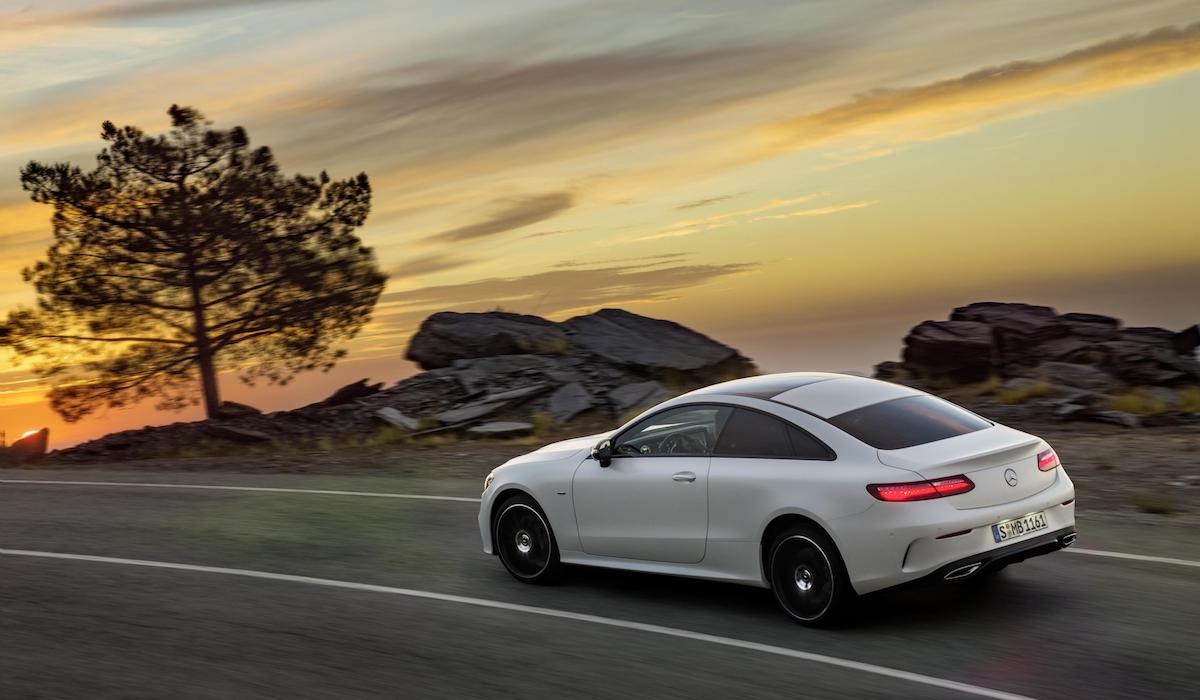
The exterior styling bears a strong resemblance to Mercedes’ recent models, the E-Class saloon, C-Class saloon and coupe. As with the saloon models, spotting the difference between an E-Class coupe and its little brother is fairly difficult. The big difference is the glasshouse design, as the E-Class follows previous generations with a pillarless sweeping roof arc and opening rear windows. The C-Class coupe has a conventional B-pillar and fixed rear windows.
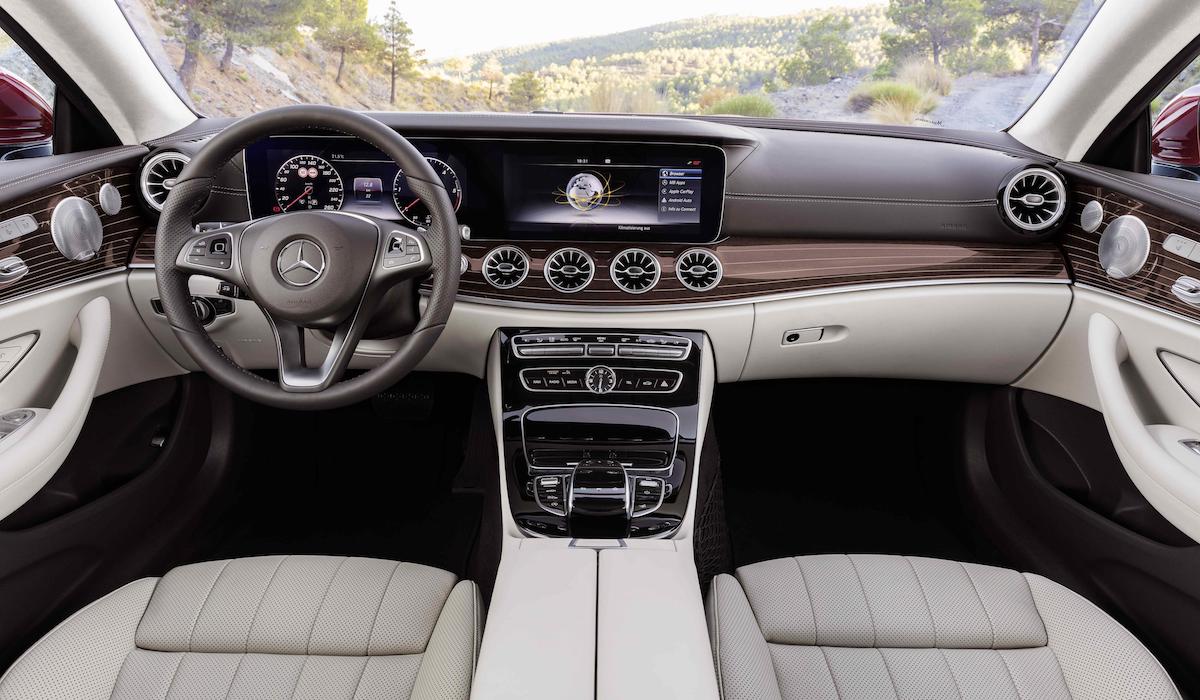
Inside, the new E-Class coupe has adopted the layout from the saloon variant, including the optional dual 12-inch screens which between them cover a large amount of the dashboard. The new model is also significantly roomier than the previous model, which will particularly benefit rear passengers.
AMG E-Class coupe on the way?
Mercedes-AMG is believed to be planning its own versions of the new E-Class coupe, which are yet to be announced. The performance brand did not produce an E63 version of the previous coupe because it did not feel the structure was strong enough to cope with such a high level of performance (since the old model was basically a C-Class coupe with the B-pilar chopped out).
The E-Class coupe is likely to be loaded up with luxury features and options to distance itself from the C-Class coupe underneath it in the huge Mercedes-Benz range. Air suspension will be available, along with all the latest safety and comfort technologies that Mercedes can offer.
Mercedes-Benz E-Class coupe
1 of 5
UK pricing and specification has yet to be announced, but the range is expected to follow the previous model’s mix of petrol and diesel engines. At the global announcement of the new E-Class coupé, the engine line-up consisted of a 194hp 2.0-litre diesel, a 2.0-litre petrol engine in both 184 and 245hp variants, and a 3.0-litre V6 petrol unit producing 333hp. The petrol engines are carried over from the previous model, while the diesel is new to the E-Class coupe but already used in the C-Class and E-Class saloons.
Further down the track, an E-Class cabriolet seems inevitable, along with further engine variants and possibly a hybrid model. Diesel versions dominated UK sales for the previous model, and are expected to do so again with the new one.
It is likely that UK specifications will follow the SE and AMG Line trims already established. The new E-Class coupe is expected to arrive in the UK in April 2017.
While the end of the year brings a clutch of awards in the automotive world, those from Euro NCAP will mean more than most to the average motorist.
The safety body has announced its three best-in-class accolades from the 18 new models it subjected to crash tests in 2016.
The Toyota Prius topped the large family car category, the Hyundai Ioniq was the best small family car and the Volkswagen Tiguan was named best small off-roader.
Also effectively ‘best in class’ was the Mercedes-Benz E-Class, but it was the only executive car tested. However Euro NCAP states that it performed well and was especially noted for its exceptional performance in child occupant protection.
“With an automatic passenger airbag disabling system and excellent dynamic test results, it is clear that Daimler has invested greatly in an area of assessment recently made more demanding by Euro NCAP,” the testers say.
The best-in-class accolades are even more relevant as the year saw some significant changes to Euro NCAP’s ratings scheme, with the automotive industry reacting accordingly.
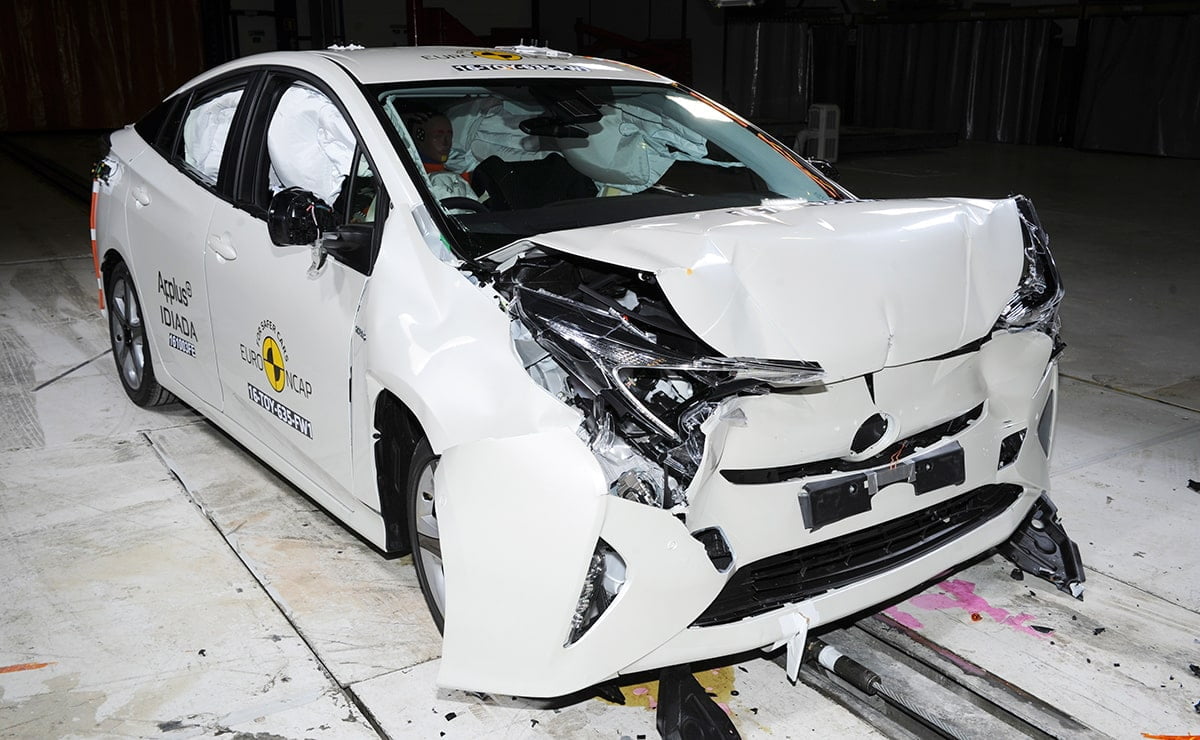
The Toyota Prius took one of three best-in-class accolades.
For example, the inclusion of tests for pedestrian-detecting autonomous braking systems drove a huge increase in the fitting of technology described by the testers as ‘life-saving.’
While some manufacturers offers such systems as an option, it was good to see many fitting it as standard equipment. The Prius was the first car to undergo tests of its AEB Pedestrian technology – its standard-fitted safety pack, ‘Toyota Safety Sense’, performed well and managed to recognise and avoid or reduce the severity of potential crashes with pedestrians.
Euro NCAP testers also highlighted the excellent performance of the new SEAT Ateca in these tests.
The best in class accolade was based solely on cars tested with safety measures supplied as standard equipment. However EuroNCAP points out that several manufacturers are now taking advantage of its newly introduced dual rating system, which awards a second star total to cars when they are fitted with safety equipment available as options.
Many makers specify safety packs as options, these usually including the auto-braking technology often with pedestrian protection included. EuroNCAP performed such tests on superminis, small family cars and one pickup – the Suzuki Ignis, for example scored three stars in standard form and a top five stars with its Dual Camera brake support system, standard on top models, optional on others.
According to Euro NCAP secretary general, Michiel van Ratingen, the safety body recognizes that some technologies are expensive and it may not be possible for manufacturers to include them as standard equipment across the range and, at the same time, keep entry-level cars affordable for the target market.
“The dual rating scheme lets them phase in sales more gradually, keeping cars affordable but, at the same time, giving consumers the chance to take advantage of these important safety technologies – we’re pleased to see such a broad uptake of pedestrian-detecting AEB systems in 2016, as standard or as an option,” van Ratingen says.
Here enduring a side impact, the Hyundai Ioniq also earned crash-test praise.
However no details of the new car have been released apart from a sketch, and a timescale for its introduction has not been stated.
The Toyota announcement says merely that the brand “will use experience gained from its full-blooded return to the World Rally Championship to develop and improve its road car technology and expand the Yaris range with a new performance-focused model.”
The sketch suggests that the Yaris hot hatch will be styled to take on rivals such as the Ford Fiesta ST and forthcoming hot hatch superminis from Kia, Nissan and Volkswagen. Enlarged wheels under extended arches, further bodywork add-ones including a rear spoiler, and a low ride height are all indicated in the sketch.
The hot hatch could be powered by a 1.6-litre turbo engine, like the WRC version, though with rather less than the 380hp of the competition car. Likely direct rival the Ford Fiesta ST puts out a maximum of 200hp.
Industry sources also suggest that the car could be dubbed the Toyota Yaris Gazoo, linking it directly to the motorsport programme.
Ferrari has surprised the automotive world with a new limited-edition model called the Ferrari J50, unveiled today in Tokyo.
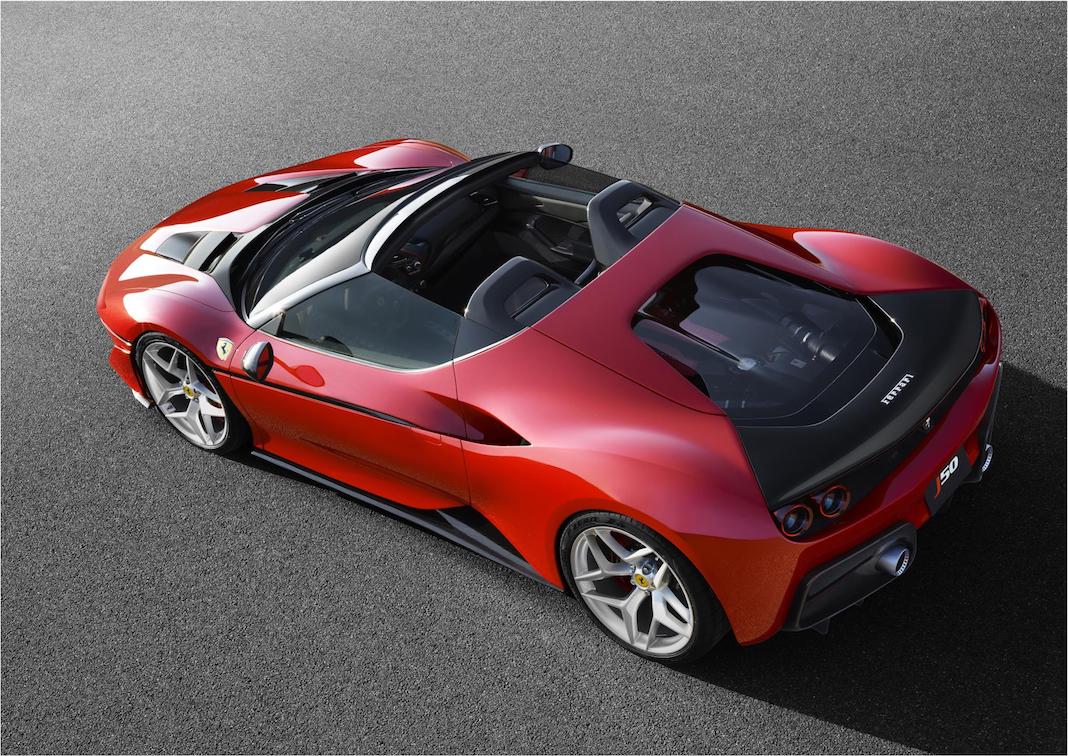
Only ten examples of the new Ferrari J50 will be built by its Special Projects division, based on the still-new Ferrari 488 Spider. The targa body form is designed to echo the successful GTS models of the 1970s and 1980s, starting with the Dino 246 GTS and then achieving considerable success with the 308 GTS and its successors.
The exterior styling is a major departure from Ferrari’s existing range, with a more minimalist approach and more horizontal lines. It gives the J50 a futuristic and very different look from its 488 Spider sister, although there are numerous nods to famous Ferrari models from the last 50 years.
Ferrari J50 blends style and substance
As with all modern Ferraris, the exterior design is a combination of art and science. The J50 displays detailed aerodynamic developments with a number of significant functional solutions. The radiators have been positioned closer together, and the front bumper has been completely redesigned. The windscreen header rail has been lowered allowing more airflow over the aero foil and thus over the rear spoiler.
The rear is aggressively styled, with the quadruple taillight design widening the car visually under a high-downforce wing profile. The rear diffuser shape is apparently inspired by jet engine afterburners to give the car a powerful stance. The wheels are a 20-inch forged alloy design, crafted specifically for this limited-edition model.
The engine is the same 3.9-litre V8 found in the Ferrari 488, boosted by 20hp to produce 690hp in the J50, and running through a seven-speed double-clutch transmission.
Inside, the cockpit layout is lifted almost entirely from the 488 Spider, with unique trim adorning the seats in a pattern which echoes the rear bonnet. The targa top is a two-piece carbon fibre affair, which can be stowed behind the seats for open-top driving.
The Ferrari J50 was unveiled during a special celebration held at the National Art Center in Tokyo to commemorate the 50th anniversary of Ferrari in Japan.
A very limited edition of 25 Aston Martin DB4 G.T. models is to be built, each expected to cost around £1.5 million and to be effectively replicas of originals dating from 1959.
The Aston Martin DB4 G.T. Continuation follows a current trend, already undertaken by the likes of Jaguar with its lightweight E-type, to either continue the model numbers of classic cars, or fill in gaps in the original run.
Aston Martin Works will build the cars at the sports car brand’s original home of Newport Pagnell, returning car production to the Buckinghamshire town after a 10-year gap.
Each will be to lightweight specification, constructed for track use only, and following the original blueprints of the 1959 version. This was evolved from the production Aston Martin DB4, and launched in the same year Aston Martin took outright victory in the Le Mans 24hrs.
The DB4 G.T. was shorter, lighter and more aerodynamic than its production stablemate, and used a more powerful version of the car’s 3.7-litre straight-six cylinder engine. It won its very first race, at Silverstone driven by Stirling Moss.
Aston Martin built 75 DB4 G.T. cars between 1959 and 1963, of which just eight were to an even more bespoke lightweight specification. If one was to come up for sale today its price would comfortably exceed £3m.
Newport Pagnell, here building cars in 1959, will again be the production base for the DB4 G.T.
The new car will be built to replicate the original but also to blend in modern construction techniques, particularly in performance, handling, braking and safety – power will be rated at 340bhp to the rear wheels through a four-speed manual transmission and limited slip differential.
The new line will be numbered from 0203R, the VIN number of the last original DB4 G.T. being 0202R.
To enable owners to enjoy their cars to the full, Aston Martin will also be creating a two-year track driving programme around great race circuits of the world, with expert instructors on hand to the level of the brand’s multiple Le Mans 24hrs class winner Darren Turner.
According to the commercial director of Aston Martin Works, Paul Spiers, the DB4 G.T. Continuation will combine the authenticity of a hand-crafted David Brown era car with sympathetic application of modern engineering advancements and performance enhancements.
“The DB4 G.T. Continuation is a fusion of classic design and contemporary methods,” says Spiers, adding that the production base at Newport Pagnell is equally notable.
“The DB4 G.T. Continuation is hand built in the same location as its illustrious forebears, and marks the return of production to the historic home of Aston Martin for the first time since the last Vanquish S was completed in 2007,” he says.
Like their forebears the new Aston Martin DB4 G.T owners will be able to enjoy their cars at top international circuits.
What is it? The Audi A5 is an all-new version of a highly successful coupé. Key features: Weight saving, sharper shape, more space and tech. Our View: The second generation of the Audi A5 builds on the success of the first model, evolved in all areas without losing the original appeal. Type of review: First UK drive
A typically busy year of launches for Audi ends with the first deliveries of the new, second-generation Audi A5 Coupe, and this is an important model for the brand.
It might not be one of the core, larger-volume models, but the A5 is Audi’s contender in a market where desirability is everything. The brand’s Jon Zammett claims that the two-door, booted car is the spiritual successor to the original Audi Quattro of the early 1980s, and that when the first A5 went on sale in 2007 it revolutionised a market that until then had consisted totally of four-door saloons.
Audi A5 Coupe styling
There is no doubt that the A5 has been a major success for Audi, and as a result while the Mk2 version may be completely new from the ground up, it is also an evolution of what has gone before.
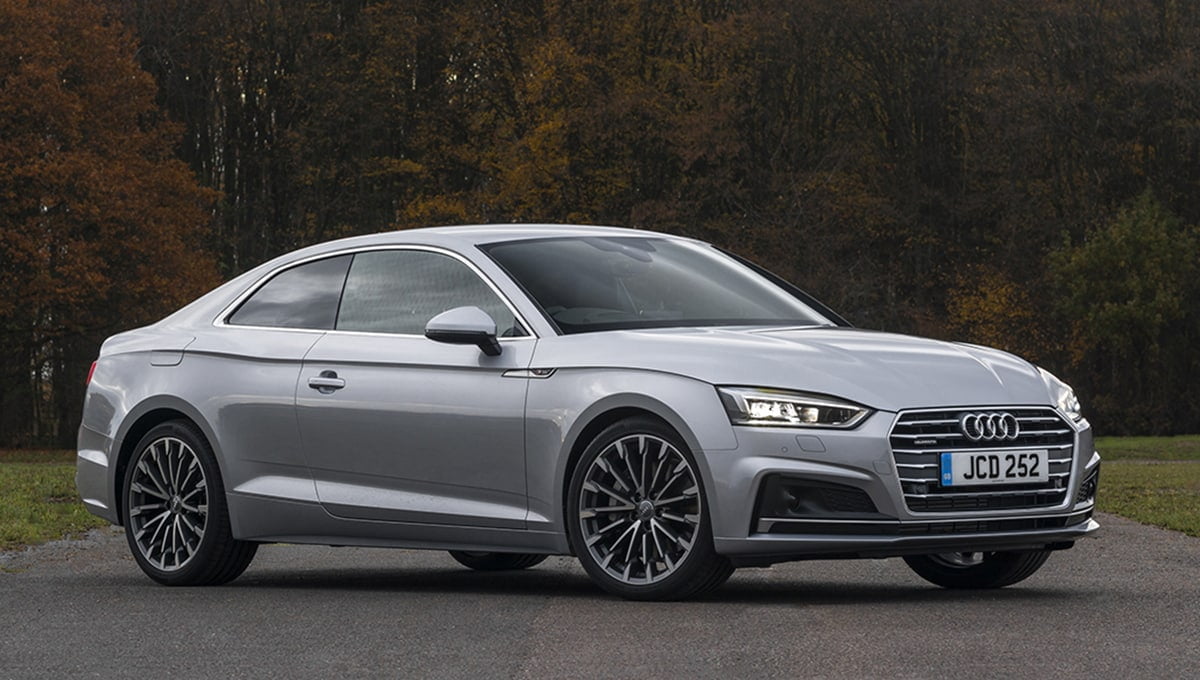
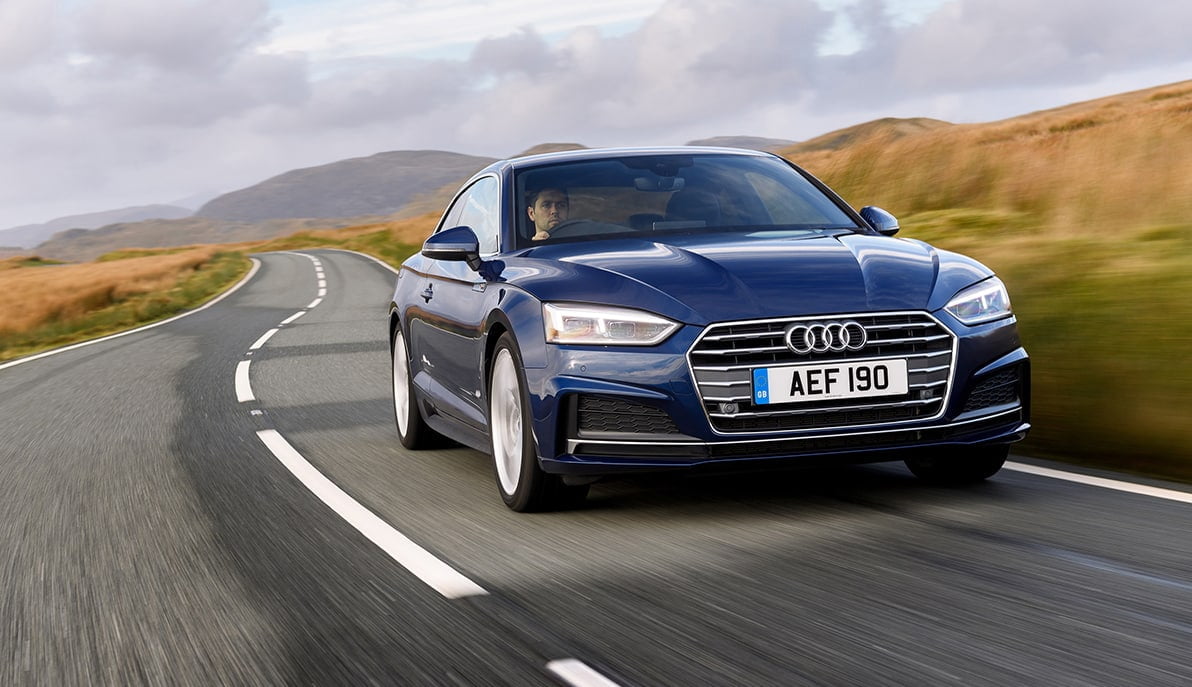
So the styling of the new car’s body is fresh, but existing A5 owners will immediately recognise it as a member of the family, with details passed down such as the wave-shaped shoulder line, long bonnet and wheel-on-each-corner proportions.
There are changes of course, most visually in the grille that is noticeably wider, but flatter, while the windscreen pillars have been shifted further back – the car looks the part.
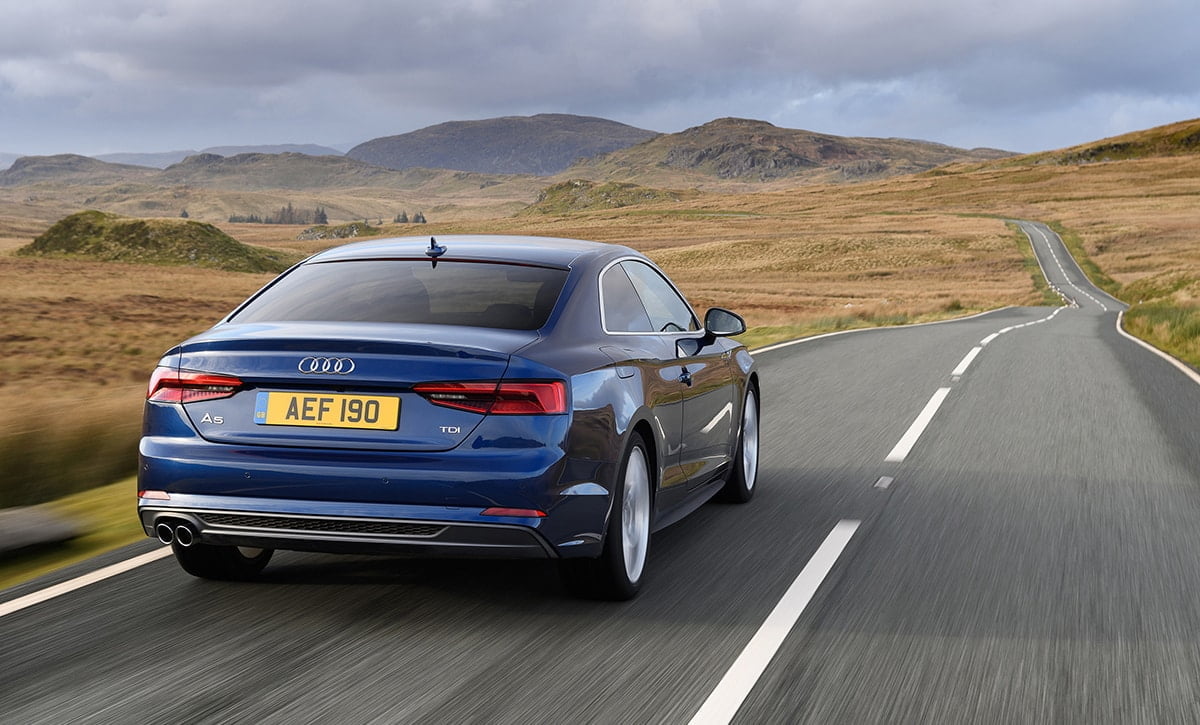
The aerodynamics have been improved. Measures such as relocating the mirrors from the base of the windscreen pillar to the tops of the doors allow Audi to claim the A5’s CD figure of 0.25 as best-in-class. Combined with weight saving of up to 60kg, this is good news in the eco department.
The diet comes courtesy of Audi’s latest multi-material construction techniques, a process we’ve seen on several other models now. The new Audi A5 sits on the latest evolution of the VW Group’s widely employed MLB architecture – it is 47mm longer than its predecessor at 4,673mm, while the width loses 8mm to measure up at 1,846mm. At 1,371mm the height is only a single digit less than its predecessor but still one of the lowest in the segment.
The wheelbase grows too, by 13mm, which frees up some extra interior space, and certainly there is no lack of interior room in either front or back seats. And then there is the boot, 10 litres larger than its predecessor at 465 litres.
Inside the Audi A5 Coupe
Step inside, and first-generation A5 owners will notice big changes, while anyone who drives a 2016 Audi will be in familiar surroundings. In this case evolving from the likes of the Audi A4, the latest cockpit design offers great quality and attention to detail – the ambient lighting, for example can be adjusted by 30 shades.
What one gets in terms of equipment will depend on which of the three trim levels, SE, Sport or S line, is chosen, and how deeply the ever-more widened options list is dipped into. Zammett says that typical A5 customers will have no qualms about spending £4,000 more on the top-spec versions; “it’s not a price-sensitive car, people choose a coupé as a lifestyle choice,” he adds.
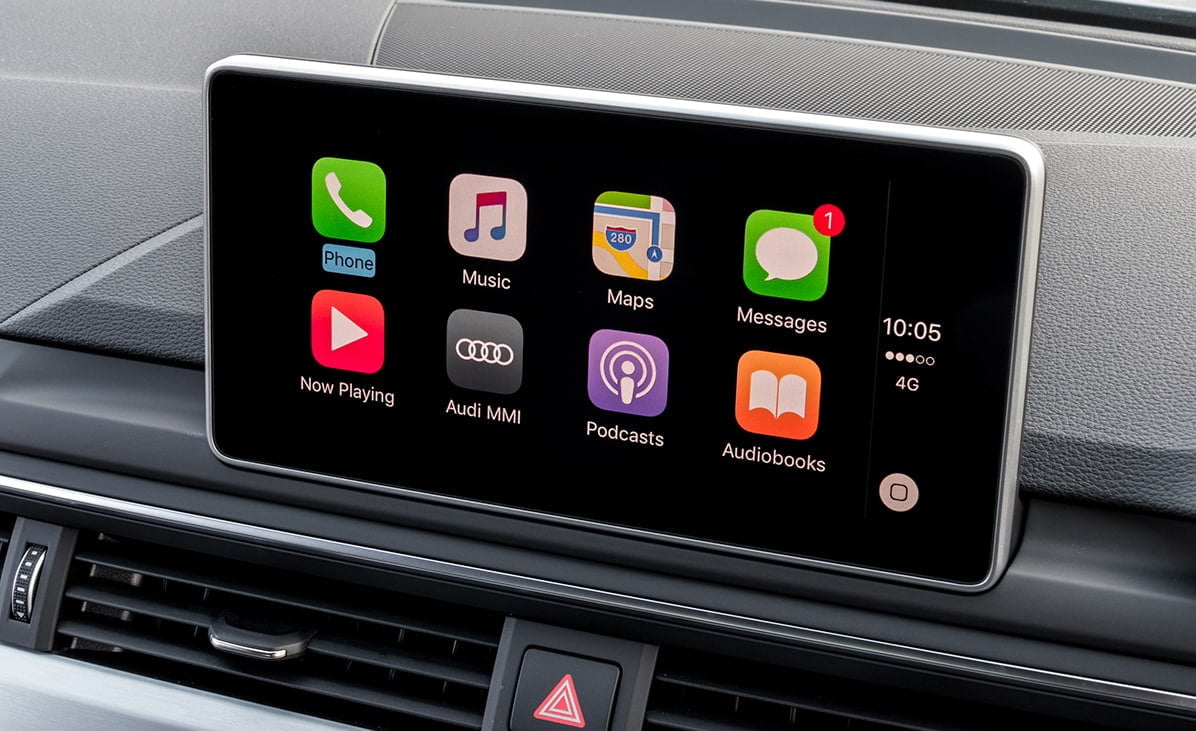
It’s pretty likely, therefore, that many will go for the MMI navigation plus upgrade which extends the touchscreen monitor atop the centre console to eight inches and crucially dumps the analogue dash dials for the now well-known Audi digital cockpit.
At launch the A5 customer has a choice of a petrol engine and two diesels – plus a somewhat special petrol unit. All are improved over predecessors, with quite a lot more power and up to 22% better fuel economy.
By far the majority of sales, particularly to fleet buyers, will come from the 2.0-litre TDI diesel of 190hp – in its most economical form, mounted in an Ultra designated car, it returns combined cycle fuel economy of more than 70mpg, and CO2 emissions of just 105g/km.
On the road
The Car Expert drove the Audi A5 Coupe 190 TDI on the launch event and it fulfils the brief in all areas – a wide spread of usable power with plenty of low-down torque, plus refined cruising at motorway speeds.
If one wants more power with similar economy, the six-cylinder 3.0-litre diesel of 218hp ticks all the boxes, and it will be available from early 2017 in a significantly more potent 286hp version.
For petrol fans the current engine of choice is a 2.0-litre unit of 252hp – or one can go for the Audi S5 performance model, unusually launching at the same time as the first new A5s – it uses a newly developed 3.0-litre version of the six-cylinder engine with 354hp on offer, 21 horses more than the previous S5. We’ll be producing a separate test on the S5 soon.
If there has been a regular criticism of Audi cars in the recent past it has been for ride quality. Not so the new Audi A5. Whether in standard front-wheel-drive versions or with the quattro all-wheel-drive that is optional across the range and standard on 3.0-litre diesels, the car rides roads in comfort, smothers poor surfaces and corners with confidence-inducing precision.
Aiding the basics is of course plenty of technology – Audi tells us that some 30 driver assist systems are available for the A5. The Audi Drive Select offers plenty of choice in the car’s setup, the options list includes such notables as adaptive suspension with damper control, and there are a host of new technologies that can for example keep the A5 in its motorway lane, move and stop the car in a traffic queue, even stop the driver exiting the door and being hit by a passing car – certainly perusing the choices available and adding up the costs will be a major part of the A5 buying process…
First deliveries of the coupé are underway as this is published and the car will soon have plenty of siblings for company in showrooms. The Audi A5 range is now a family – the five-door Sportback variant arrives in January, and a cabriolet will not be far behind.
The new Audi A5 Coupe achieves its purpose – it builds on the success of the initial model and keeps Audi firmly in the battle for dominance of a sector where desirability means as much, perhaps more, to the customer as does specification.
Models tested:Audi A5 Coupe 2.0 TDI S tronic 190PS On Sale: December 2016 Range price: £36,480-£41,375. Audi S5: £47,000 Insurance groups: TBA Engines: Petrol 2.0. Diesel 2.0, 3.0. Audi S5: Petrol 3.0 Power (hp):252. 190, 218. Audi S5: 354 Torque (Nm):370. 400, 400. Audi S5: 500. 0-62mph (sec):5.8. 7.7, 6.2. Audi S5: 4.7. Top speed (mph): 155. 146*, 155. Audi S5: 155 Fuel economy (combined, mpg): 47.9. 67.3*, 61.4. Audi S5: 38.2 CO2 emissions (g/km): 141. 111*, 123. Audi S5: 170. Key rivals:BMW 4 Series, Mercedes-Benz C-Class coupé Test Date: November 2016 * = with 18-inch wheels. With 17-inch – 130mph, 70.6mpg, 105g/km
In 2014, sales in the used car market started to pick up real pace and have showed little sign of slowing down since.
Between January and June this year, more than four million used cars changed hands in the UK, according to figures from the Society of Motor Manufacturers and Traders (SMMT). That’s a record number for the first six months, and the trend appears to be continuing, which is expected to make 2016 a record year for used car sales.
This increase in sales, fuelled by an 8% jump in demand, has been married to five years of consecutive growth in the new car market. Quite simply, there are more cars in the used car market now, so prices are competitive and the consumer’s choice is huge. However, with more cars to choose from, there is inevitably a larger chance of buying a bad one.
So what measures can you take to avoid driving off in a lemon?
V5C form – Is the seller the registered keeper of the car? If the answer is no, then you should ask why. There’s a chance this is a quick sell, with the seller trying to get the lemon off their hands without even registering it in their own name.
MOT certificates – Check the mileage information carefully, and make sure it lines up with the service history and the odometer on the car. Any period of very low (or zero) annual mileage may mean the car has been off the road for a long period of time for substantial repairs. Also look for any advisories – it is not illegal for a dealer to sell a used car with MOT advisory notices, but you should treat any advisories as imminent repair bills.
Car history – If you are uncertain about the seller then look into getting a full vehicle check from a registered mechanic or breakdown cover company.
Consider the valuation carefully
Understanding the true value of the car you’re looking at is, well, invaluable, for a number of reasons – the obvious one being that you don’t want to overpay for a car… but actually it’s underpaying that is more likely to leave you with a lemon. If the deal looks too good to be true, it usually is!
There are a number of valuation services online that only require the vehicle’s mileage, registration and car insurance renewal month to generate a reasonably accurate figure to start your own calculations.
Run through an inspection checklist
An inspection checklist is great to have in your armoury at a dealership or during a private sale. Mainly because you’re going into a pretty stressful environment, and forgetting little details will be inevitable.
You’ll most likely remember to check the condition of the tyres and the wear and tear of the bodywork, but what about the spare tyre or any dampness under the floor mats? There are plenty of example checklists available online, so a quick search will yield some good choices.
Be vigilant during the test drive
An American study by DMEautomotive found that one in six car buyers do not take a test drive at all when buying a car. That’s an extraordinary statistic considering what a substantial investment buying a car is for most of us.
Not only should you insist on a test drive, it’s also vital to be extra alert when you do, particularly with a used car. Have a think about how you are most likely to use the car and then take it into those environments. If you’re driving in the city, take it up and down hills – and then into areas with plenty of traffic. Test the clutch for a high biting point, and the brakes for a slow response rate. Both factors could mean the car is need of a trip to the mechanic.
If you’re planning on commuting everyday on the motorway, don’t be afraid to find the nearest dual carriageway to see how it runs above 60mph. Does the steering hold the car straight? Is the engine tone consistent?
Mechanical checks really worth investigating
Having a cynical mindset is a good starting point when you buy a used car, although there are plenty of well-meaning car dealerships and private sellers out there. For now, though, let’s pretend there aren’t.
The odometer (mileage counter) is the big one to look out for here. Worn screws around the panel could mean it’s been replaced or tampered with. Remember to double check the mileage against the MOT certificate.
Under the bonnet, other surprises may await. Look for warning signs of leaks or spilled fluids – check the oil filler cap, brake fluid reservoir, windscreen washer bottle and radiator.
Right at the front there should be a saddle which holds the top of the radiator and connects the front wings. You should see it screwed onto the car’s frame. If there is any welding, you will want to forget the car. Welding, in general, is a big red flag that you should always question.
But what if I’ve already bought the lemon?
With the Consumer Rights Act 2015, car buyers are well protected if they do business with a dealership, although far less so with a private seller. Your rights depend on how quickly you take action, with the possibility of a full refund protected by law for only 30 days.
For more information on getting that lemon out of your life, check out The Car Expert’s guide to your rights on rejecting a car.
The first examples of the reborn Alpine sports car range will be members of a limited edition run.
Alpine, which has been relaunched by Renault, is opening order books for the ‘Première Edition’ versions of its forthcoming, yet to be named production car.
Only 1955 versions of the Premiere Edition will be made, the number recalling the year when Alpine founder Jean Rédélé established the company.
The cars will be priced in France at between €55,000 and €60,000, including taxes, and the only way to reserve an example is through a bespoke app downloadable from the Alpine website at alpinecars.com. The top price would equate to around £51,000 in the UK.
Reserving the Alpine Première Edition using the app and making an initial payment of €2,000 will allow customers to select their preferred number – from 1 to 1,955 – depending on availability.
This number will appear on a plaque fixed to the centre console and customers will also be able to specify the colour of their car from either ‘Bleu Alpine’ (Blue), ‘Noir Profond’ (Black) or ‘Blanc Solaire’ (White).
“The Première Edition versions of the new model will be the first to come off the line and we wanted to allow Alpine fans to choose the number of their car,” says Alpine managing director Michael van der Sande.
“The interest that the announcement of Alpine’s return has generated across the globe inspired us to give sports car enthusiasts and Alpine fans early opportunity to reserve the new car.”
Few technical details of the car have been made available so far. Alpine says these will be released in the first quarter of 2017, and adds that the car will be capable of a 0-62mph time of 4.5 seconds. Industry sources suggest it will use a 1.8-litre version of the 1.6 turbo engine in the Renault Clio RS, with about 250hp available.
Alpine deliveries are expected to begin in late 2017.
The all-new version of the flagship Lexus LS model will be unveiled at the Detroit motor show in January.
The reveal of the fifth-generation saloon at the Detroit show will come exactly 28 years after the first LS 400 launched the Lexus brand at the same show.
Details of the new Lexus LS are currently scarce, its makers only saying that it will offer a bold new look, with a coupe-like silhouette, while still boasting plenty of interior space.
However the car is expected to closely follow the LF-FC concept unveiled at the 2015 Tokyo Motor Show.
The car will be built on an extended version of Lexus’s new global architecture for luxury vehicles (GA-L) rear-wheel drive platform, which also underpins the forthcoming Lexus LC luxury coupe. Lexus adds that the LS will ‘feature visionary technology.’
The production Lexus LS is expected on sale in 2018, as a rival to the likes of the Audi A8, BMW 7 Series and Mercedes-Benz S-Class. Powertrain options will include a hybrid unit with more than 500hp on tap. In 2019 the car could gain a hydrogen engine, using the technology developed by parent brand Toyota most recently in the Mirai.
The Lexus LS is widely expected to be based on the LF-FC concept shown at Tokyo in 2015.
For all the latest news on the 2017 Detroit Auto Show, keep checking our dedicated Detroit page here at The Car Expert.



 The
The