Find an Expert Rating: 
Home Blog Page 169

Geneva 2016: Nissan debuts auto vision

Nissan is unveiling not just new cars but a new mantra for its future products at the Geneva Motor Show.

Intelligent Mobility is described as a vision pushing towards a safer and more sustainable future, and builds on Nissan’s extensive experience in electric powertrains and intelligence in vehicles.

The brand is pursuing twin aims of zero emissions and zero road fatalities and says that Intelligent Mobility will guide its future product range. Decisions on powertrains, how cars are driven and the role they play in society will all be made based on the programme, while making driving more enjoyable will still be a central part of future decisions.

According to Nissan CEO Carlos Ghosn, Intelligent Mobility is a framework to move customers around the world towards a safer and more sustainable future.

“To realise this vision, Nissan has launched a long-term strategy, supported by significant R&D investments – this enabled Nissan to introduce the breakthrough LEAF, the world’s first mass production EV, in 2010, years before any of our competitors.,” Ghosn says.

“It has also driven our development of cutting-edge autonomous drive technologies, which will be available in a range of mass production models by 2020 – these steps are allowing Nissan to deliver the benefits of EV and autonomous drive innovations to as many customers as possible and, ultimately, to lead the way toward a new era of mobility.”

The three cores of the programme are Intelligent Driving – creating more driver confidence led by autonomous drive technology, Intelligent Power – adding more efficiency and more power, spearheaded by electric vehicles, and Intelligent Integration – offering new links between vehicles and the society in which they operate.

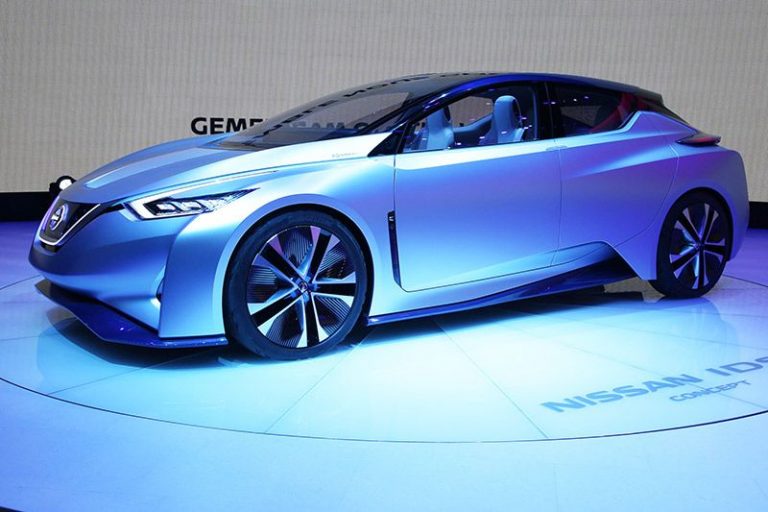
Vehicles on show in Geneva demonstrating the technology include the IDS Concept, making its European debut after being first unveiled at the Tokyo show in October 2015. This car – the IDS stands for Intelligent Driving System – boasts a complex system of sensors and artificial intelligence.

Also on display is an autonomous version of the mass-selling Qashqai SUV. Nissan will demonstrate the system on European roads later this year – the car able to drive in heavy traffic without driver input – and launch production versions in 2017, stating that the Qashqai will become the first Piloted Drive vehicle available in Europe.

Geneva 2016: Maserati Levante SUV takes the stage

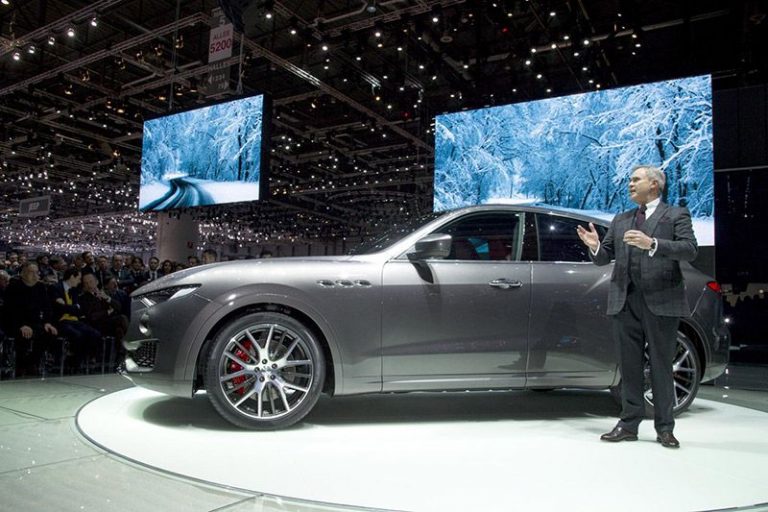
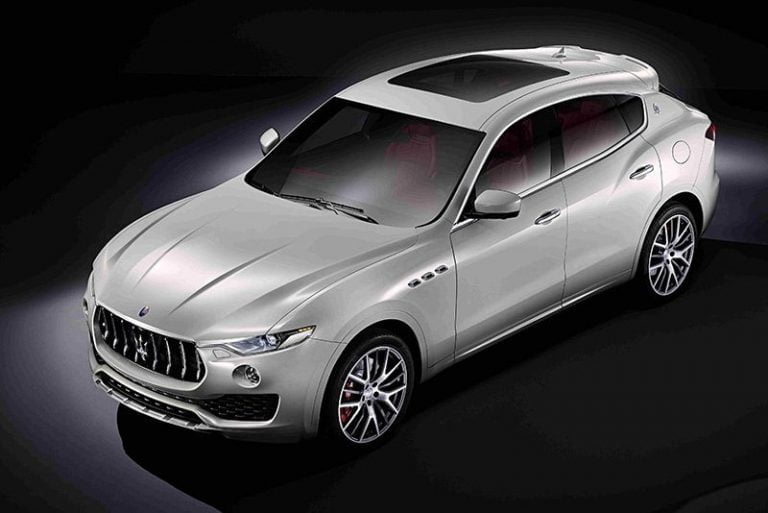
The Levante SUV, unveiled at the Geneva Motor Show, sends Maserati in a new direction as the Italian luxury brand celebrates its centenary.

The car will widen Maserati’s potential market as a more practical alternative to the brand’s current sports cars and saloons, a direction already followed by rivals such as Bentley with the Bentayga.

Not the first Maserati to be named after a wind, the SUV is said to reflect its name, the Levante being a warm Mediterranean wind that can quickly change from a light breeze to a major force.

The car’s styling, particularly the front end, reflects the Alfieri sports car concept, unveiled at the Geneva show in 2014.

The Levante is promised to offer all the characteristics of an SUV, but also maintain the performance credentials typical of previous Maserati product. Power options range across a 3-litre V6 twin-turbo petrol engine of 345 or 423bhp, or a 271bhp 3-litre V6 turbodiesel, and all versions will be fitted with an eight-speed auto gearbox and the Q4 intelligent all-wheel drive system.

The most powerful version will produce 0-62mph sprint times of 5.2 seconds and go on to 164mph, while returning combined cycle fuel consumption of 26mpg and CO2 emissions of 253g/km.

The lower-powered petrol has a 6.0-second 0-62mph time and 156mph top speed, similar fuel economy and a 249g/km CO2 emissions figure, while the diesel will return 39mpg, CO2 emissions of 189g/k, for a 6.9-seocnd 0-62mph time and 143mph top speed.

Maserati believes the Levante will also score on its handling, combining a double-wishbone front and multi-link rear suspension with a perfect 50:50 front to rear weight distribution and the lowest centre of gravity in its class.

The electronic damping system includes air springs with five ride levels plus a park level, allowing plenty of options between sporty handling and a high clearance for off roading.

Inside occupants have use of an updated version of the Maserati Touch Control touchscreen-based control system, which combines an 8.4in screen with a rotary control on the transmission tunnel.

UK pricing is yet to be confirmed for the Levante, Maserati currently only stating the price for the Swiss market of its unveiling –75,900 Swiss Francs (around £54,600).

Geneva 2016: Mercedes C-Class drops its top

Mercedes-Benz is extending the choice in its C-Class range with the first-ever Cabriolet, unveiled at the Geneva show.

The C-Class drop-top will go on sale in the summer, and is based on the Coupe variant of the BMW 3 Series rival. It virtually matches the Coupe for dimensions, only adding 4mm to the car’s height which in turn increases rear-seat headroom by 12mm, though front-seat occupants lose 4mm.

The soft-top is fabric and fully automated, opening and closing in less than 20 seconds at speeds up to 31mph. When folded down it sits in its own compartment in the boot, in the process reducing boot capacity from 360 to 280 litres.

On entry-level models the roof fabric is black, while it is also available as an acoustic soft-top, with better sound insulation, in dark brown, dark blue, dark red or black.

Inside the car replicates the Coupe on which it is based, though occupants gain the Airscarf head-rest mounted heating system typical of Mercedes open-topped models.

Eight different engines will be offered with the cabriolet. The two diesels are both four-cylinder models, the 167 C220d, also available in 4Matic all-wheel-drive form, and the 201bhp C 250 d.

All bar two of the six petrol engines are four-cylinder units, starting with the 154bhp C 180 and the 181bhp C 200, the latter also offered with 4Matic. The C 250 offers 208bhp, the C 300 241bhp, while the range is completed by two V6 models, both 4Matic equipped as standard. The C 400 has 328bhp on tap, while the top-line AMG C 43 variant offers 361bhp.

Geneva 2016: Audi Q2 takes a bow

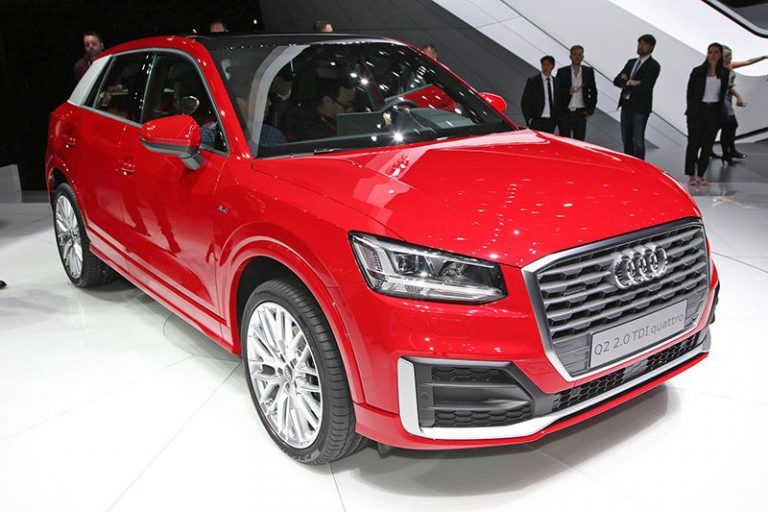
Audi’s burgeoning model line-up is set to gain another member in the Q2 family, unveiled at the Geneva Motor Show.

The fourth member of the brand’s SUV family, the Q2 is a compact SUV tasked with widening Audi’s customer base, particularly towards younger drivers, and as such it is more than simply a smaller variant of the Q3.

Led by head of design Marc Lichte, Audi’s designers have come up with a bolder, more rugged look for the Q2, majoring on vertical surfaces and edges. “In the Audi Q2 we have developed a distinctively geometric form language with model-specific design characteristics – the car exhibits an independent character within the Q family,” Lichte says.

The front is dominated by a high-mounted grille with large air intakes either side, while the car’s shoulder line is high, the roof low and sloping down towards the rear. Adding an element of sportiness, a roof spoiler and a rear diffuser complete the exterior visuals.

UK buyers will be able to choose from four engines. These comprise the familiar 1.0-litre three-cylinder TFSI petrol of 114bhp, and a four-cylinder variant of 1.4 litres, and a pair of diesels of 1.6 114bhp and 2.0 148bhp. A 2.0 TFSI petrol unit will follow in 2017 and assume the position of most powerful option with 187bhp.

A six-speed manual gearbox will be standard, but the S tronic dual-clutch auto will also be available across all versions. The 148bhp diesel unit can be chosen in front or quattro all-wheel-drive form, while quattro will be standard with the 187bhp petrol.

Audi says that the Q2 will benefit from significant technology passed down from the brand’s larger models, with the options list including the much-praised virtual cockpit, as well as head-up displays and the park assist driver aid.

Safety systems include as standard the Audi pre sense front, recognizing issues with vehicles or pedestrians crossing in front and if necessary initiating hard braking, while buyers will also be able to specify adaptive cruise control with a Stop & Go function, traffic jam assist, lane-departure warning, side assist, lane-keeping assistant, traffic sign recognition and rear cross-traffic assist. 

Not surprisingly Audi’s MMI control system is fitted in the cockpit of the Q2, while the appeal of customisation to younger drivers will also be catered for with a host of equipment, colour and trim options.

Order books for the Q2 open in July 2016 at prices yet to be announced – first deliveries will be in the autumn.

Geneva 2016: Bentley Mulsanne gets stretched

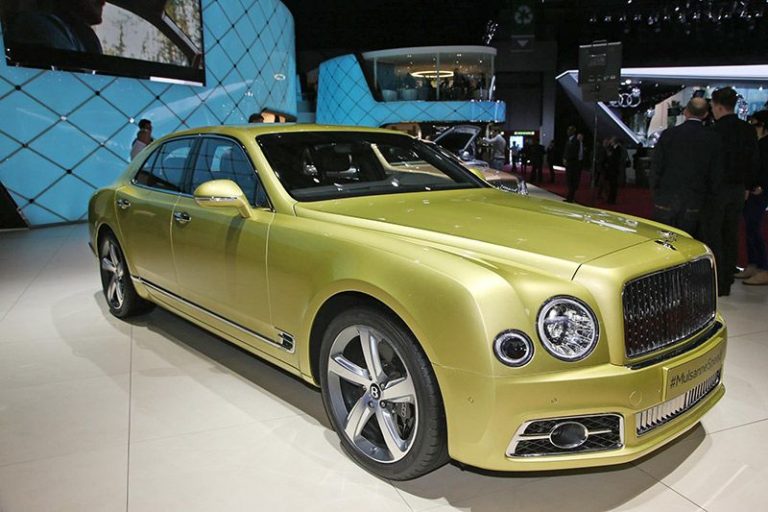
Bentley is showcasing the latest incarnation of its flagship Mulsanne range at the Geneva show with significant changes to the big saloon including a stretched version.

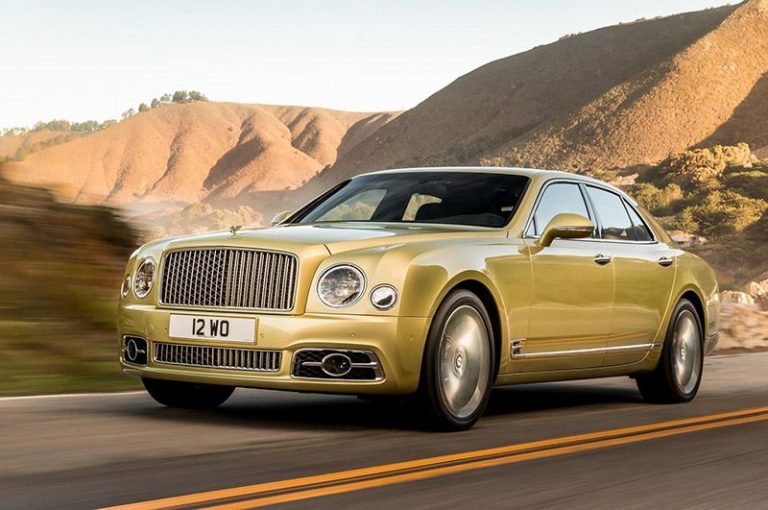
The new Mulsanne line-up will consist of three models – the stock Mulsanne, the performance-pitched Mulsanne Speed (pictured above) and an all-new model the Mulsanne Extended Wheelbase (EWB).

With the EWB, Bentley says, it is setting a new benchmark for rear-seat passenger comfort, the model adding some 250mm to its wheelbase which allows the fitting of airline-style additions including electronic legrests. These are integrated into the bases of the two individual rear seats and extend outwards and pivot.

The two seats are separated by a console finished to typical Bentley craftsmanship standards and containing USB ports, pen holders, cup holders and a storage pocket with a glass cover.

The Speed, meanwhile, is powered by an uprated version of the 6.75-litre twin-turbo V8 engine. Its 530bhp is 25 horses more than the standard unit while torque rises from 752 to 811lbft, producing a 4.8-second 0-60mph time and a 190mph top speed.

Changes across the range include subtle styling revisions, the most notable a front grille that is 80mm wider and more prominent. The chassis is also completely updated to add further refinement to the ride, and further modified for Sport versions, while the technology available to occupants makes full use of the latest advances available through Bentley’s VW group parent, including a new touchscreen infotainment system.

Bentley Motors chairman and chief executive Wolfgang Dürheimer describes the Mulsanne as the epitome of the brand’s DNA – exquisite, individual and powerful. “It defines luxury in the automotive world and offers a unique Bentley blend of luxury and performance,” he says.

“The three distinct handcrafted models are now available. The Mulsanne, with its understated elegance and sporting purpose, remains the consummate luxury limousine; the Mulsanne Speed is the pinnacle of luxury and performance thanks to its immense power, torque and refinement; and now the Mulsanne Extended Wheelbase, with its extraordinary airline-style seats and rear-passenger bias, becomes the new benchmark in automotive comfort,” Dürheimer adds.

Geneva 2016: the £1.9m 261mph Bugatti Chiron

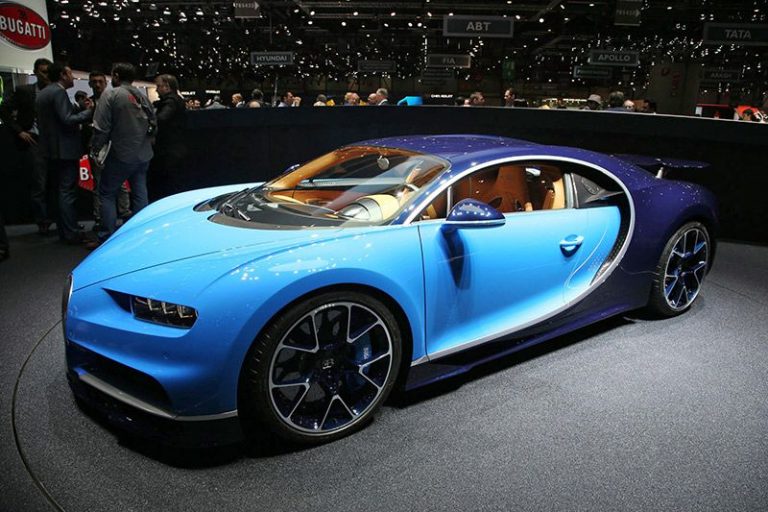
Bugatti has officially unveiled the successor to its legendary Veyron at the Geneva motor show, with a promise that the Chiron will take its predecessor’s speed record.

The French luxury brand describes the Chiron simply as the most powerful, fastest, most luxurious and most exclusive production super sports car in the world.

“The Chiron is very well-positioned to become the next world speed record holder and reach a maximum speed significantly above the record currently held by Bugatti,” the brand says.

It will also be just about the most expensive production car built, with a price tag of £1.9 million. But despite this Bugatti says that around a third of the planned 500-strong production run – 50 more than the Veyron achieved – have already been reserved, potential buyers putting down deposits of at least 200,000 Euros.

The Chiron is evolved from the Vision Gran Turismo concept that debuted at the Frnakfurt Motor Show in September 2015. The all-carbonfibre car is also according to Bugatti a completely new model, not an updated Veyron.

Power comes from a complete redevelopment of the 8.0-litre W16 engine that powered the Veyron, with four new turbochargers added and peak output boosted to 1479bhp – 1500PS. Alongside this maximum torque goes up to 1180lbft, put through an all-wheel-drive transmission.

Bugatti says that the Chiron will accelerate beyond 62mph in less than 2.5 seconds, with its top road speed limited – to 261mph… This is mainly to ensure the tyres can cope with the car’s excessive demands. While the unlimited speed has not been quoted by Bugatti, it is predicted to be at least 285mph.

Only one Chiron will be built a week, with deliveries beginning in the autumn of 2016, meaning that the car could be in production for much of the next decade.

According to Bugatti president Wolfgang Dürheimer, the Chiron is the result of the brand’s efforts to make the best even better. “It is part of human nature to cross boundaries and set new records – to run 100 m faster than ever before, to fly even further into space and to enter new realms, this striving is also our driving force at Bugatti,” Dürheimer says.

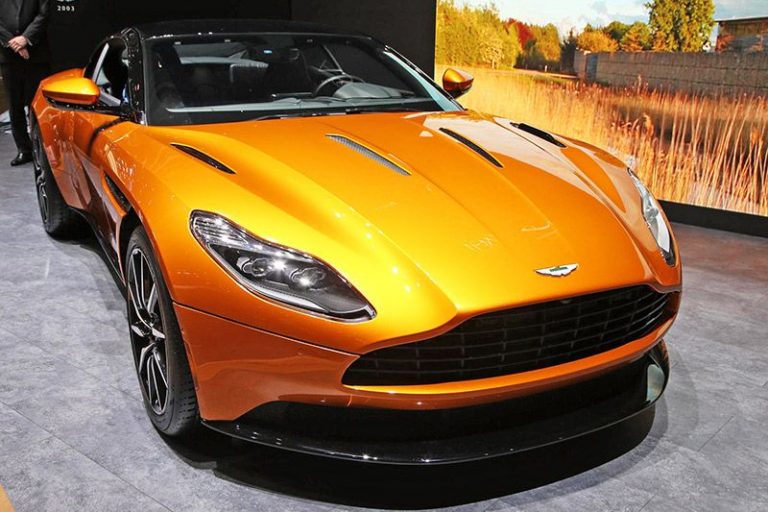
Geneva 2016: Aston Martin DB11 debuts

Aston Martin describes the DB11, unveiled at the Geneva motor show, as the “most powerful, most efficient and most dynamically gifted DB model” in the brand’s history.

As a result, the new Grand Tourer is regarded as “the most significant new Aston Martin since the introduction of the DB9 in 2003”.

The DB11 is the first car launched under the brand’s ‘Second Century’ growth plan and begins a new design era for Aston Martin. According to CEO Andy Palmer the brand aspires to make the most beautiful cars in the world and the DB11 is the absolute embodiment of what an Aston Martin should be.

“We have worked tirelessly to ensure that DB11 combines both exceptional design with the latest technology throughout – a brand-new bonded aluminium platform, clever aerodynamics, a new characterful twin-turbo V12 and class-leading infotainment systems are just a few aspects which make this the sports car that will proudly spearhead Aston Martin’s second century plan,” Palmer says.

The DB11’s 5.2-litre engine sits inside a lighter, stronger, and more space-efficient bonded aluminium structure. Peak power is 600bhp, alongside 516lbft of torque, which endows the car with a 0-62mph time of 3.9 seconds and a maximum speed of 200mph, as well as improved efficiency.

Upgrades across the car encompass a suite of new technologies, including multiple driver-selectable dynamic modes – GT, Sport and Sport Plus, an eight-speed automatic ZF transmission, new electric power steering and Torque Vectoring by braking, and adaptive damping with firmer settings.

As a result, according to Aston Martin, the DB11 will combine exceptional ride comfort with the performance ability expected of a sports car.

Inside, meanwhile, features a new instrument cluster based around a full-colour 12-inch TFT LCD display, with a second, centrally-mounted eight-inch TFT infotainment screen. It can be configured using either a rotary control or an optional touchpad, and features include a new satellite navigation and audio system, auto-park assist and a 360-degree birds-eye view camera.

More basic requirements have also been addressed, with the DB11 offering increased interior room particularly in the rear seats, and wider door openings.

First deliveries of the DB11 begin towards the end of 2016, at prices starting from £154,900.

Aston Martin DB11 on video

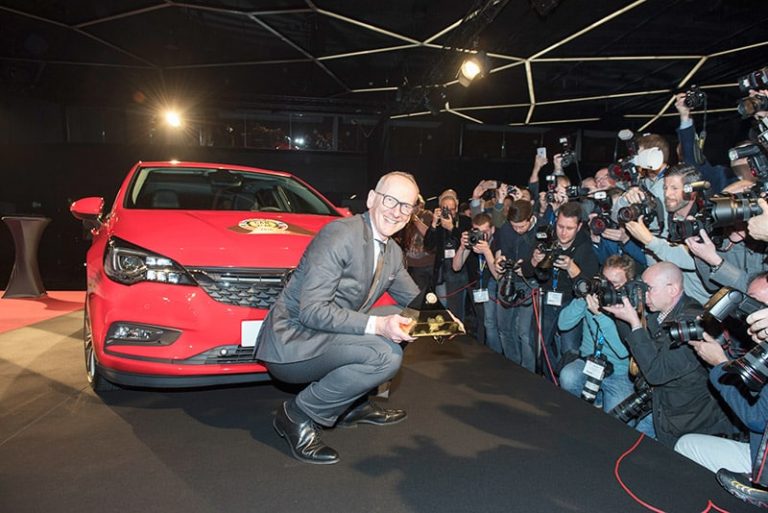
Astra takes European Car of the Year title

The Vauxhall Astra is the 2016 European Car of the Year.

In one of the closest competitions for some time, the British-built hatchback triumphed over the Volvo XC90, scoring 309 points to the 294 of its Swedish rival.

It is the fifth time Vauxhall/Opel has won in the 52 years of the competition, the most recent being the Ampera range-extender electric car in 2012. The Astra Mk2, Omega A and Insignia also took the trophy.

The result of the competition, which is voted for by 58 leading motoring journalists from 22 European countries, was announced in Geneva on the eve of the annual motor show.

Seven cars were shortlisted, with each journalist having 25 points to allocate across them – awarding no more than 10 points to an individual car or equal first place points and scoring at least five of the seven cars.

Third place was taken by the Mazda MX-5 with 202 points, followed by the Audi A4 (189), Jaguar XE (163), Skoda Superb (147) and the BMW 7 Series (143).

Following the competition, the points allocated by all the juries were published on caroftheyear.org and revealed that the British jury’s vote differed significantly from the overall vote. For the UK journalists the Mazda MX-5 was a clear winner, followed by the Volvo XC90, with the Vauxhall Astra finishing joint third with the Skoda Superb.

The award was presented to Vauxhall/Opel CEO Dr Karl-Thomas Neumann by Car of the Year President Hakan Matson.

Vauxhall chairman and MD Rory Harvey is delighted with the accolade, commenting; “To be named European Car of the Year by judges throughout Europe is a testament to the hard work that has gone into the Astra. This is the new model’s first full year of sales, and it has already been well received.”

DS set to electrify Geneva show

DS Automobiles will debut an electric-powered concept car at the Geneva Motor Show on 1st March.

The DS E-Tense is revealed just as the upmarket sub-brand puts its latest DS 3 on sale, completing the revamp of its three-strong range to give them a completely separate identity to parent company Citroën.

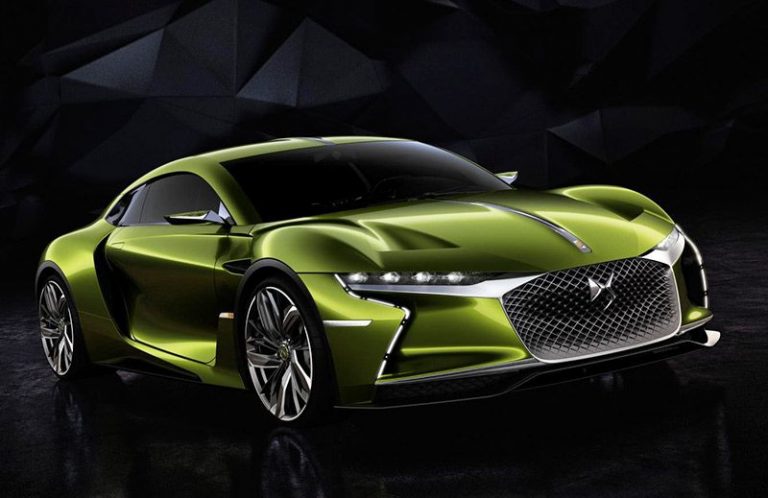
On display at Geneva a year after the show hosted the official launch of DS Automobiles, the DS E-Tense is described as an electric supercar with more than 395bhp and 381lbft of torque from its zero-emissions powertrain.

The car is also said to have a range of around 190 miles, the lithium-ion battery pack located under the chassis to keep the centre of gravity low and aid even torque distribution to the all-wheel-drive transmission.

DS is working hard to build its own image under its ‘Spirit of avant-garde design’ mantra, and the concept mixes distinctive styling, latest technology and collaboration with leading fashionable names.

The two-seater DS E-Tense measures 4.72 metres long and 1.29m high, and is built around a carbon-fibre monocoque chassis. Its styling is evolved from the Divine DS unveiled at the 2015 Geneva show. – it has a coupe silhouette with a central ‘spine’ plated in chrome, and is finished in a metallic green colour. And like the Divine DS there is no rear screen, the driver provided with their view out of the back digitally.

DS signatures include the ‘DS wings’ front-end detailing and roof-mounted rear indicators that nod back to the original Citroën DS of 1955. The LED daytime running lights are active, able to rotate through 180 degrees.

1602_DS_E-Tense_02

The brand says that more than 800 hours were spent designing and upholstering the interior, which includes an updated version of DS’s signature ‘watch strap’ design on the seats and dash. Said dash is formed from cold steel while the steering wheel boasts a novel tulip shape.

Luxury brands contributing to the car include French fine leather good maker Moynat, that has supplied a helmet harness that can double as a bag when out of the car, BRM Chronographers, providing a driver’s watch that also fixes to the car’s centre console, and Focal, which has created the nine-speaker audio system.

DS sees the all-electric DS E-Tense as fitting in with the brand’s increasing presence in the electric power arena – the DS Virgin Racing team competes in the FIA Formula E Championship, a world series for all-electric single seater cars, and on 6th February DS driver Guy Bird took victory for the team in Buenos Aires.

Infiniti Q30 review

What is it? The Infiniti Q30 is the company’s hatchback hope for European growth.
Key features: Distinctive style, well-finished interior, refined cruising.
Our View: Distinctive, generally well finished and will rack up many a motorway mile without fuss.
Type of review: First UK drive


Infiniti itself would likely admit that its European growth has not been as rapid as the brand would have liked. Nissan’s luxury arm, so successful in America, has discovered like Lexus before it that European audiences are somewhat more conservative in adopting new names – particularly those who present themselves as upmarket cousins to known volume manufacturers.

The Q30 is the car that carries Infiniti’s hopes of changing that perception. Unlike the large saloons previously offered by Infiniti, this is a hatchback, launching the brand into the high volume, if highly competitive C segment. It also brings the entry point of owning an Infiniti down from the £28,000 of the Q50 to only £20,500, so it should appeal to a wider range of potential customers.

In the UK market in particular the Infiniti Q30 seeks to gain followers through its ‘Britishness’. The car was both designed and developed in the UK, at the Nissan group’s Paddington and Cranfield centres, and it is being built on a brand new line at Nissan’s enormous plant in Sunderland – the first Infiniti constructed in Britain.

Infiniti won’t say how many Q30s it is hoping to sell in the UK, only that the brand expects to double its British sales year-on-year. So there is no doubting the importance of the Q30 and its crossover-style sister the QX30, coming in June 2016, to the brand’s volume aspirations.

The Infiniti Q30 will compete against stiff opposition, the brand hoping to steal sales from core performers in the established premium brands – the Audi A3, BMW 1 Series and Mercedes A-Class. And the latter is a particularly interesting rival as it is also effectively a sister car to the Q30. A joint programme between the two brands sees the two cars built on the same platform and Infiniti powering its car with engines that are mostly built by DaimlerBenz. The exception, oddly, is the powerplant expected to be most popular, the Renault-sourced 1,5 diesel.

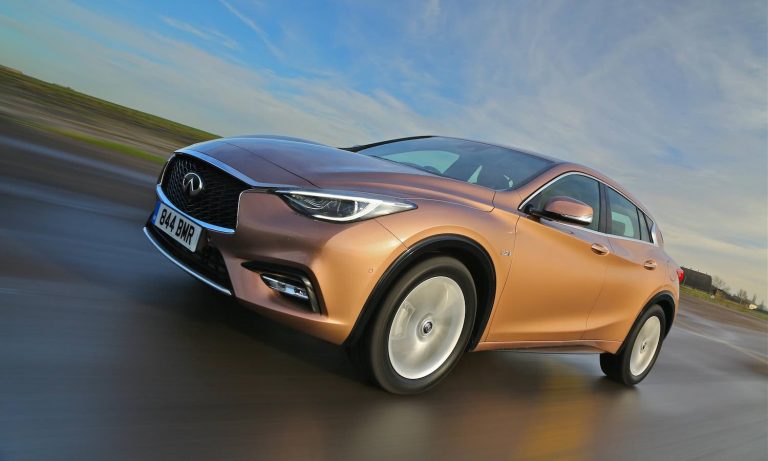
Visually the Q30 scores some early plus points. It’s quite a large hatchback, outstretching its A-Class relation in all areas, and Infiniti’s oft-quoted ‘design-led approach’ is highly evident in the styling. Bold swoops and curves run right through the car’s profile to end at a large grille with the eye-like headlamps effectively mounted on the front of the wheel arches. In the company car parks where Infiniti hopes to gain half of its Q30 sales the car will certainly stand out amongst the usual German fare.

Slip inside and one will likely first notice the higher-than-usual seating position – something that has proven popular with those that have already tried the Q30. Just how high depends on the model. Base and Premium trim variants of the car have an overall height of 1495mm, with the Sport that drops 20mm closer to the ground.

Sport versions also get their own bespoke bumpers which on the front expose a deal of extra grille. The alloy wheels expand from 18 to 19 inches, the side sills are body coloured and there are chromed rectangular exhaust finishers.

We digress – the second notable aspect of the car’s interior is the effort to create a quality environment, that mostly works. There is much trimming and stitching, use of leather and suede and combinations of two-tone finishes that certainly up the ambience, though the soft-touch surfacing used in lower-down areas doesn’t quite come up to the standard of the rest.

Despite the strong coupe-like styling of the shell, the Q30 doesn’t lack for interior space up front. It’s not so great in the rear where head and particularly legroom are less generous, but at a quoted 430 litres boot space is comparable to rivals.

The instrument layout is unremarkable and suggests further evidence of the Mercedes collaboration. There is a touchscreen which can also be controlled from a rotary dial and buttons between the front seats – it works adequately enough but there are better systems that feel more modern in rival cars.

For UK buyers Infiniti offers four engine options – 1.6-litre 121bhp and 2.0 208bhp petrols and 1.5 108bhp and 2.2 168bhp diesels. Both six-speed manual and seven-speed transmissions are available, while the 2-litre petrol and 2.2 diesel units can also be specified with all-wheel-drive transmissions.

The Car Expert tried out the engines likely to appeal to the widest range of buyers, the 1.6 petrol and 1.5 diesel – the latter is expected to take by far the majority of Infiniti Q30 sales. Both our test cars were in Premium trim, again expected to attract most buyers especially in the fleet market.

The 1.6 petrol is smooth, refined and ultimately has more power – but it feels somewhat held back at slow speeds. The diesel is 2.5 seconds slower to 62mph but offers an impression of much more eagerness, and negotiating the traffic-choked northern suburbs of Manchester on a week day it was the diesel that we felt happier with.

Once out on the open road both engines settle down to a steady rhythm and combined with a chassis that effectively soaks up the bumps, travelling in the Infiniti Q30 certainly feels suitably premium. As an aside, cars fitted with the larger 2.2 diesel also get Active Noise Cancellation, which emits sound waves from the four door speakers to cancel out any booming noise from the engine.

The steering is excellently weighted and compliant in use – the test route made it difficult to find any roads with which to seriously test the Q30’s cornering prowess, but the overall impression was of a car that it will be easy to complete long distances in without excessive fatigue. Again, this fits in very much with the likely customer base.

The Premium trim comes with a suitably long options list but one needs to study the price list carefully as there are a number of varieties of Premium, based partly around their interior colours, and which you choose can have an effect on standard equipment, most notably the navigation system. This, a package that includes traffic sign recognition and the only way to have DAB digital radio, is standard on Premium and Sport City Black models, but optional on others, and comes with a sizeable £1200 price tag.

Overall, Nissan still faces a challenge in seriously establishing its premium brand on the UK market, but the Infiniti Q30 is by far the most likely model to achieve such success. It’s distinctive, it’s generally well finished and it will rack up many a motorway mile without fuss.

Infiniti Q30 – key specifications

Models tested: Infiniti Q30 1.5D Premium Tech Manual, Q30 1.6t Premium Manual
On Sale: Jan 2016
Range price:
£20,550-£31,180
Insurance groups:
13-26.
Engines: Petrol 1.6, 2.0. Diesel 1.5, 2.2.
Power (bhp):
121, 208. 108, 168.
Torque (lb/ft): 148, 258. 192, 258.
0-62mph (sec):
9.4*, 7.3**. 11.9*, 8.3**.
Top speed (mph): 124*, 143**. 118*, 137**.
Fuel economy (combined, mpg): 48.7*, 45.6**. 68.9*, 64.2*.
CO2 emissions (g/km):
138*, 143**. 108*, 115**.
Key
rivals: Mercedes A-Class, Audi A3
Test Date: February 2015.
* = best figure (varies with auto gearbox, trim level) ** = front-wheel drive version.

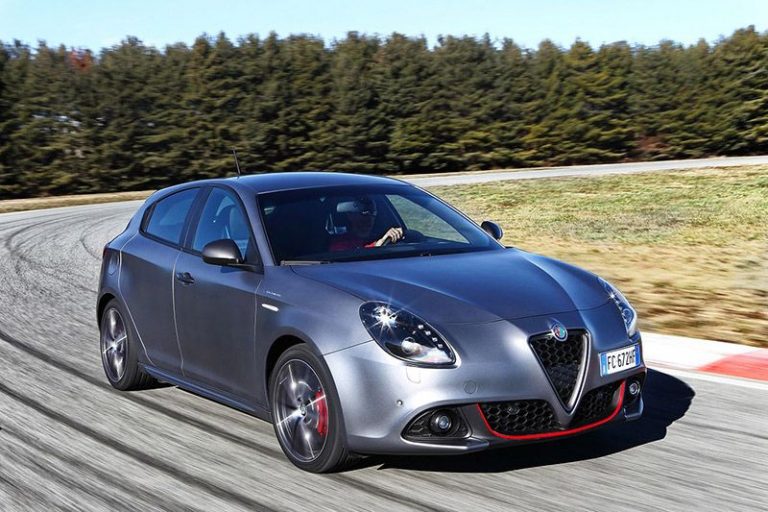
Alfa makes over its Giulietta

Alfa Romeo has unveiled the facelifted version of its Giulietta hatchback.

Simultaneous launches were held in five European locations, the main event being staged at the Alfa Romeo Museum in Arese, Italy to reveal what are generally subtle upgrades.

Mechanically the car is virtually unchanged, aside from the option for the first time to match the 120hp 1.6-litre JTDM-2 turbo diesel engine with the Alfa TCT twin dry-clutch transmission.

A refreshed styling treatment majors on the front end and serves to being the Giulietta closer to its sports saloon sister, the Giulia. Details include a honeycomb grille, piano block bumper inserts with red detailing on sports-trim models, and remodelled surrounds to the head and fog lamps.

Other visual signatures include new designs for the Alfa Romeo and Giulietta badges, new alloy wheel designs revised exhaust tail pipes and a pair of new exterior colour options, Alfa White and Lipari Grey.

Inside the revisions extend across the seat upholstery, dash and door panel finishes, while the Fiat Group’s Uconnect infotainment system is fitted with smartphone compatibility.

Giulietta owners will also now be able to specify Alfa Performance, a new service which Alfa Romeo says has been “specifically created to enhance the driving experience”. It uses digital gauges and instruments to allow drivers to control various parameters of the car, measure their performance using imers and see driving statistics on their smartphone, in addition to receiving real-time driving tips.

The revised Giulietta range will debut at the Geneva Motor Show on 1st March and go on UK sale on 1st April, prices starting from £18,450. It will now be offered in five renamed trim levels, recalling classic models of the past – Giulietta, Super, Tecnica, Speciale and Veloce.

Wales wins Aston Martin crossover factory

The UK is to gain a new car manufacturing facility – Aston Martin will build its forthcoming crossover at St Athan in Wales.

The decision, which will create the premium brand’s second manufacturing location alongside its existing base at Gaydon in Warwickshire, is part of a £200m investment in Aston Martin’s UK operations.

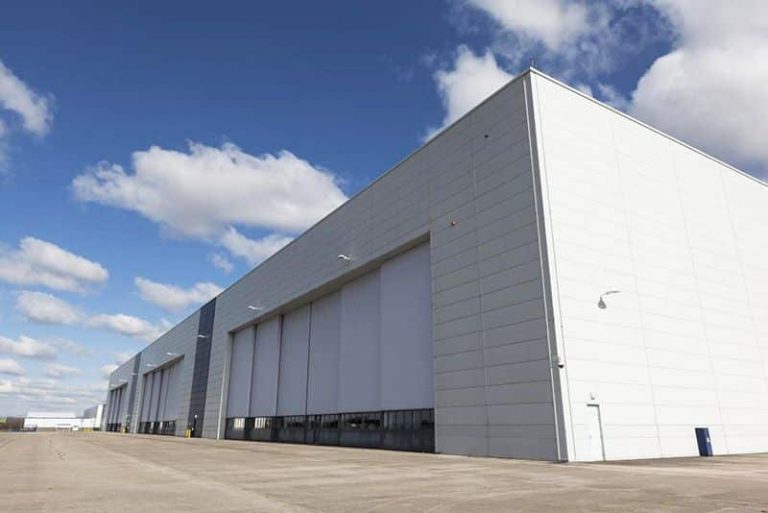
The St Athan site in Glamorgan will make use of an existing Ministry of Defence site – three ‘super hangars’ will be transformed into the new plant, with construction beginning in 2017.

St Athan will be the sole UK production location for Aston Martin’s new crossover that will be evolved from the DBX concept revealed at the Geneva Motor Show in March 2015. Production is expected to begin in 2020.

At Gaydon the new DB11 – replacement for the DB9 – will begin production in Autumn 2016, and from 2018 the all-electric RapidE will also be built at the Warwickshire facility.

Aston Martin estimates that by 2020 1,000 new posts will be created within the company by the expansion, and a further 3,000 jobs are likely in the supply chain and local businesses around the factories.

Announcing the investment, Aston Martin CEO Dr Andrew Palmer reveals that more than 20 potential global locations for the new manufacturing facility were analysed in detail.

“We were consistently impressed with the focus on quality, cost and speed from the Welsh Government team,” Palmer says.

“As a great British company, we look forward to St Athan joining Gaydon as our second centre of hand-crafted manufacturing excellence.”

First Minister of Wales, Carwyn Jones is welcoming the announcement. “We have been working closely with the company for almost two years in the face of fierce competition from other potential sites across the world,” he says.

“Our success today is testament to the reputation, dedication and skills of the Welsh workforce, all qualities that are synonymous with such a luxury, hand-crafted brand as Aston Martin”.

Rolls-Royce Phantom line reaches zenith

Rolls-Royce will end production of the current seventh-generation Phantom line in 2016.

The model, which when launched 13 years ago started the revival of the luxury brand under the ownership of BMW, will make way for the forthcoming new Phantom that will use the aluminium architecture currently being widely tested by Rolls-Royce.

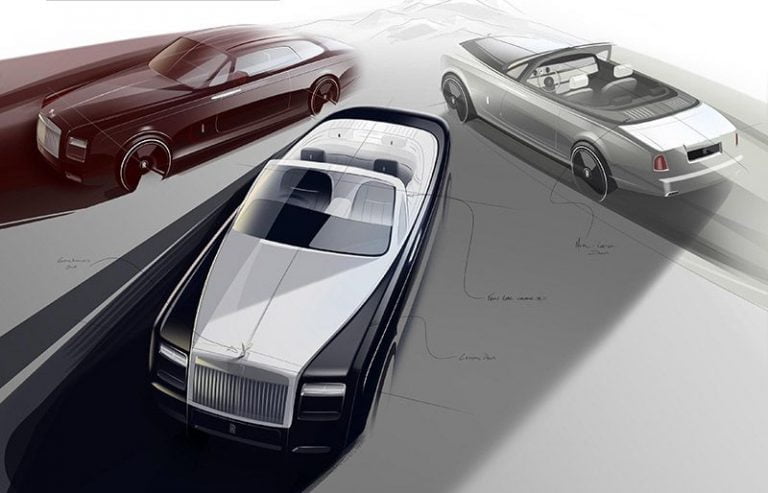
The new Phantom, not expected until 2018, will not include Coupé or Drophead Coupé models, and Rolls-Royce will end production of these variants in November with special editions numbering 50 examples and dubbed Phantom Zenith.

Elements of these cars will include a Tailgate Hosting Area; laser etched armrests depicting the original launch locations of the 100EX model at the Villa D’Este and 1the 01EX in Geneva; bespoke instrument dials and a special treatment of the Spirit of Ecstasy figurine.

Each customer is also promised a ‘money cannot buy’ portable memento of his or her purchase, the form of which has not been specified, whilst the cars will be offered to clients in a palate of bespoke colour combinations from Rolls-Royce’s history.

According to Rolls-Royce director of design Giles Taylor Zenith will be the pinnacle of the brand’s skills; “Zenith will be the sum of all the best features of Phantom Coupé and Drophead Coupé, with a few surprises added – we expect huge demand for these 50 fine motor cars as we shall not look upon their like again.”

Geneva debut for Megane Sport Tourer

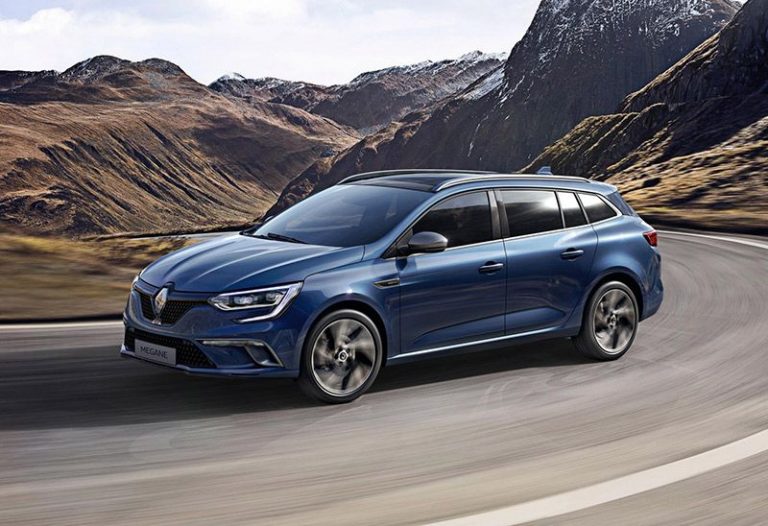
Renault’s Megane Sport Tourer will make its world debut at the Geneva Motor Show on 1st March.

The estate version of the Megane is evolved directly from the latest and more high-tech hatch range that debuted at the Frankfurt show in September 2015 and is due on UK sale in the summer of 2016.

The car looks similar to the hatch from the front, with an extended rear end to accommodate what Renault describes as the longest load length in the segment. The interior will be modular, with a number of possible layouts, while extra capacity will be available from rails mounted on the roof – these are finished in matte anodised aluminium on all models except the sports-pitched GT, which gets dark metal versions.

Similarly GT models will be fitted with styling details evolved from the brand’s Renault Sport subsidiary, notably a bespoke front bumper, honeycomb mesh radiator grille and a wide lower air inlet with air scoops either side. The rear gains a chromed exhaust tailpipe and a diffuser.

Renault is so far offering few mechanical details concerning the Sport Tourer, particularly its engine line-up, though this is expected to replicate units available in the hatch range.

The car will be displayed at Geneva in GT trim and this version is most likely to be offered with the 163bhp diesel and the same 202bhp petrol unit used in the hatch GT.

In what Renault claims is a segment-first Sports Tourers will be able to be purchased with the 4Control four-wheel steering system already announced on the hatch

Prices are yet to be announced for the Sport Tourer though it is expected they will be broadly in line with the current model, starting from around £18,500.

Three times better for Bentley Mulsanne?

Bentley is to unveil a facelifted version of its range-topping Mulsanne at the Geneva Motor Show on 1st March.

The revamp sees the model separated out into three versions – the Mulsanne, Mulsanne Speed and Mulsanne Extended Wheelbase. The cars are tailored according to their name with the extended version majoring on the 250mm of extra rear-seat legroom, airliner-like legrests and bespoke rear sunroof while the Speed boasts a 4.9-second 0-62mph time.

Styling changes include a complete front-end revamp creating what Bentley describes as a more modern and integrated look. The front is dominated by a stainless steel vertical-vane grille, 80mm wider than its predecessor and according to its creators recalling classic past Bentleys such as the 8 Litre of 1930.

The all-LED headlamps are adaptive and include greatly increased night vision capabilities and are fitted into a new one-piece bumper, radiator shell and bonnet.

Inside there are redesigned seats offered in either fluted or quilted finish, new door trims and armrests and bespoke glass switches, together with a choice of 24 leather colours.

1602_Bentley_Mulsanne

Updated technology includes a new eight-inch touchscreen-based infotainment system connected to a 60GB hard drive for storing media.

Optional is the Naim for Bentley Premium Audio system, built for the car and described as the world’s most powerful automotive unit. It includes 20 speakers, 20 channels, a 2,200 watt amplifier and Super Tweeters.

Rear-seat passengers, meanwhile can also make use of the Bentley Entertainment Tablet – a pair of 10.2in Android devices offering 4G, WiFi and Bluetooth and integrated into the backs of the front seats. A touch of a button deploys the screens from their stowed positions.

First deliveries of the new Mulsanne will be in summer 2016.

Maserati Levante SUV revealed ahead of Geneva premiere

The new Maserati Levante SUV, regarded as a game-changer for the Italian luxury brand, has been officially revealed.

The car is due to be unveiled at the Geneva Motor Show on 1st March and it is believed Maserati had no plans to preview that reveal until leaked images of the Levante appeared on a Dutch website.

Maserati first indicated its plans to add an SUV to its range in 2011 when it unveiled the Kubang concept. The move towards crossover-type vehicles follows the lead of fellow luxury brands such as Bentley, with Rolls-Royce also known to be working on such a vehicle.

The pictures of the Maserati Levante clearly show the effort that has been put into maintaining the family design lineage in a vehicle that is very different to the current Quattroporte, Ghibli, GranTurismo and GranCabrio sports and saloon models.

The front end is heavily sculpted but retains the signature Maserati grille, into which the top sections of the split headlamps flow. Along the sides there are more Maserati-specific details, notably the three air vents on the wings, a trapezoidal rear door pillar with the brand’s ‘Saetta’ logo and large, frameless door windows.

The rear end is particularly aerodynamic for an SUV, with a sharply tapered window and a roof spoiler.

Official technical details are scarce, particularly with regard to powertrains, Maserati only said that petrol and diesel alternatives will be available., all Euro6 emissions compliant. According to the leaked information on the Dutch website these will include the 3-litre V6 petrol engine of the Ghibli and Quattroporte in two levels of power, and a 3-litre V6 diesel.

Maserati is stating that the Levante’s chassis will “combine the outstanding on-road performance typical of every Maserati with unrivalled handling even on very low-grip surfaces and an excellent off-road performance and ride.”

All versions, the brand adds, will include electronic suspension with controlled damping and air springs, which can be set on several levels, ‘Q4’ intelligent all-wheel drive and an eight-speed automatic transmission specially calibrated for the new SUV.

First examples of the Maserati Levante have apparently already come off the production line at the plant in Mirafiori, Turin. It will launch in Europe in the spring, with sales going global later in 2016.

Revamped Ford Kuga boosts SUV line-up

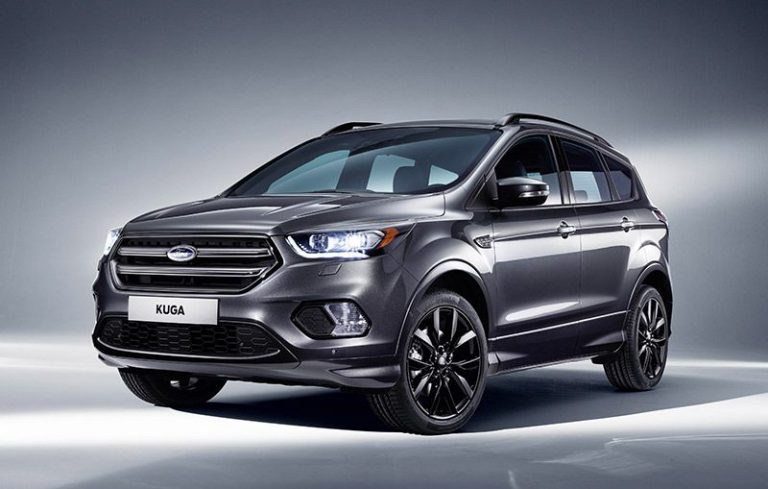
The facelifted Ford Kuga SUV features a new diesel engine, along with more technology and connectivity, and will arrive in showrooms in October.

The new 118bhp 1.5-litre TDCi diesel is available in front-wheel-drive versions of the SUV only, and compared to the unit is replaces is said to improve combined cycle fuel economy and CO2 emissions by around five per cent to 64.2mpg and 115g/km.

The other engine choices remain the same in the updated Ford Kuga, the 147bhp 2-litre diesel in either front or all-wheel-drive format and efficiency from 60.1mpg and 122g/km, and 1.5-litre EcoBoost petrol engines of 118, 147 or 179bhp, the most frugal being the 118 with 45.6mpg and 143g/km.

Prime change to the cabin is the addition of Ford’s latest Sync 3 infotainment system. Updated on the basis of what the brand says were more than 22,000 comment son the previous version, Sync 3 allows drivers to control audio, navigation and climate functions plus connected smartphones using simple, more conversational voice commands.

The system is based around an eight-inch colour touchscreen that can be operated in similar way to a smartphone or tablet, with larger buttons and for the first time pinch-and-swipe operation. It is compatible with the Apple CarPlay and Android Auto systems.

The latest Perpendicular Parking driver aid is now available for the Kuga, as is an enhanced version of the Active City Stop collision avoidance system; and Ford’s Adaptive Front Lighting System for improved visibility in low light.

1602_ford_Kuga_03

Styling changes are included bringing the Kuga into line with other Ford products. The recipe ranges across a large upper trapezoidal grille and a smaller lower grille flanked by new headlamps incorporating LED Daytime Running Lights and fog lamps, restyled tail lamps, new alloy wheel designs and a new exterior colour, Copper Pulse.

Inside there are subtle modifications adding to the look and comfort for occupants, including a reduction in buttons and additions such as a new electronic parking brake.

The new Ford Kuga will arrive in showrooms in October, just as Ford will also be launching its new larger sister, the Edge. With the smaller EcoSport updated last year, the brand feels it is now best placed to take its share of an SUV market expected to treble in 2016 compared to 2013. Such vehicles have been predicted by one industry analyst to take 27 per cent of the entire car market by 2020.

Audi A4 Avant – the new leader in the premium estate market?

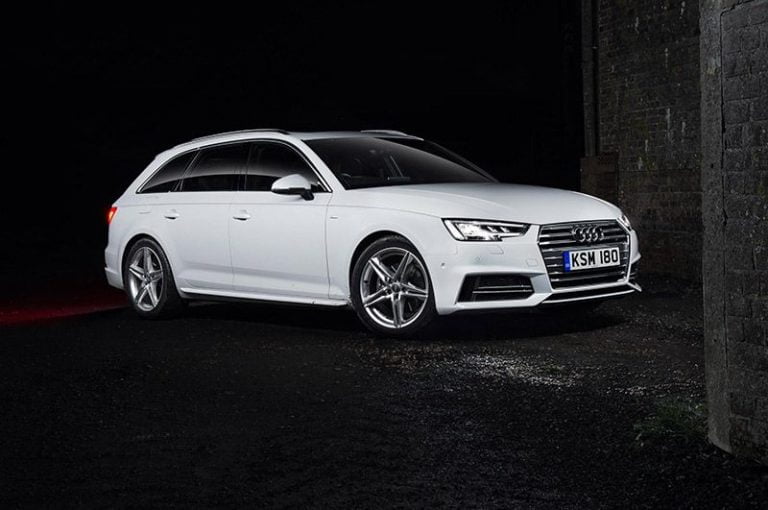
The latest Audi A4 Avant is now arriving on UK roads, at prices starting from £27,300.

The estate version of the A4 boasts a number of improvements over its predecessor, including a 505-litre luggage bay that Audi claims as best in class.

Fold down the rear seats and the space available extends to 1,510 litres, while occupants also gain more space in the new interior, both front seat head and shoulder room and rear legroom improved.

Visually the car looks similar to the previous A4 Avant though Audi insists there is no carry-over. It is built like the saloon on an all-new platform and claims the best aerodynamic efficiency in the class with a drag factor of 0.26.

The A4 Avant is going on sale with a choice of four and six-cylinder engines ranging from 148 to 268bhp. The entry-level 1.4 TFSI petrol versions will arrive in April, while the petrol line-up also includes a 2.0 TFSI with 187bhp and a front-wheel-drive powertrain, and a 248bhp variant with quattro all-wheel-drive.

Diesel variants start with the 148bhp 2.0 TDI and include a 187bhp version, a 3.0 V6 TDI of 215bhp offered in FWD or quattro format and the range-topping 3.0 V6 TDI quattro of 268bhp.

1602_Audi_A4_Avant_02

Depending on model six-speed manual or seven-speed S tronic auto gearboxes are supplied while the most efficient ‘ultra’ variants are available across the range, the lowest figures returned by the 2.0 TDI 148bhp ultra with 70.6mpg and CO2 emissions of 104g/km.

Standard equipment includes 17-inch alloy wheels, xenon or LED headlights with LED daytime running lights, a smartphone interface, three-zone climate control, a seven-inch colour MMI monitor screen and the Audi Drive Select driver aid.

A host of driver assistance systems feature on the options list, as do the much-praised virtual cockpit display and Matrix LED headlights.

Vauxhall speaks highly of GT interior

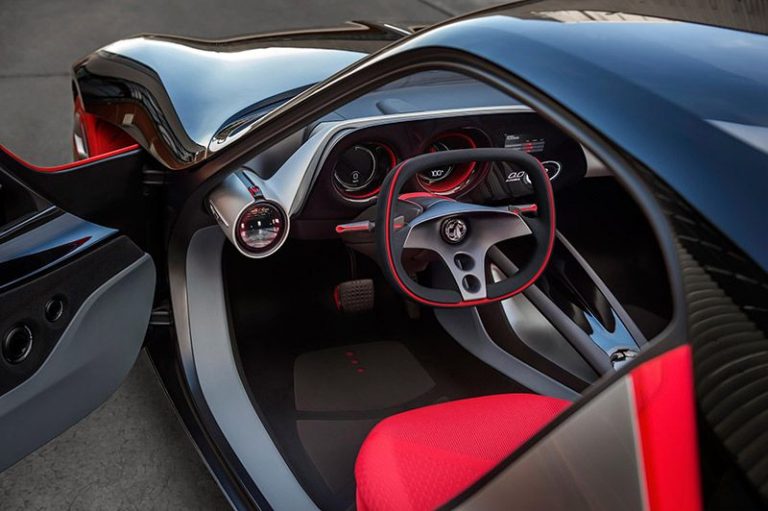
Vauxhall/Opel has unveiled the interior of its GT Concept, which will debut at the 2016 Geneva Motor Show in March.

The mid-engined sports car boasts a completely button-less dash layout dubbed the Human Machine Interface (HMI).

According to its designers the car is operated entirely by a combination of voice control and a central touchpad. The HMI is self learning, recognising a driver’s habits and adapting to their requirements.

As a result the car will respond to spoken words and can set the controls accordingly, examples being the interior temperature, the destination and even individual music preferences. Vauxhall adds that the system learns from every command, even over a period of years.

Instead of speaking to the car, the driver can issue commands to the GT concept through a round touchpad on the centre console. Two circular projectors either side of the steering wheel can display various types of information in three-dimensional form – the right-hand projector instrument can vary from navigation information to fuel consumption or even g-forces if the car is being driven in performance style. In this form, for example, the HMI will set accelerator, transmission and engine to offer the most effective performance.

The HMI also acts as a safety monitor and can alert the driver with a spoken warning if for example a motorcycle is following close behind the car. This system is aided by the camera mounted behind the front wheel arches. These replace the side mirrors and show what is happening both next to and behind the car.

Vauxhall/Opel describes the GT concept as a vision of potential future sports cars with no suggestion that it could directly evolve into a production model, though the reaction to it at the Geneva show could influence its future chances.

Kia Optima Sportswagon estate targets fleets

0

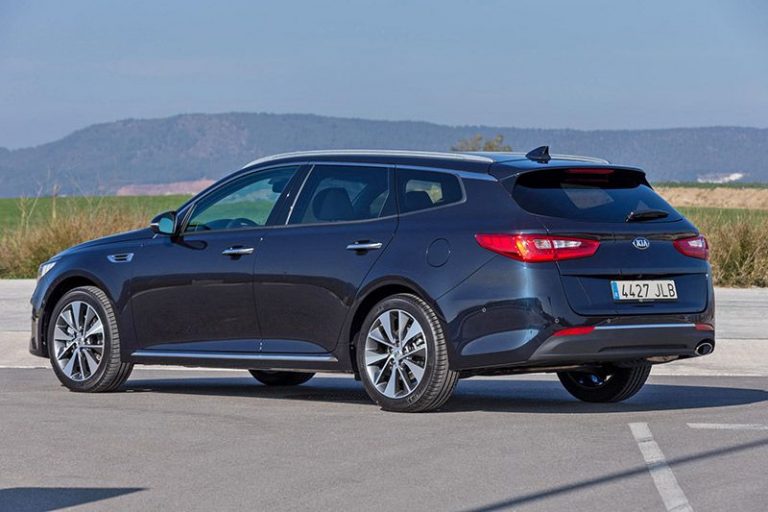
Kia will unveil its first large family car estate at the Geneva motor show, in the shape of the Optima Sportswagon.

Evolved from the Sportspace concept shown by Kia at the 2015 Geneva event, the Optima Sportswagon will go on sale late in 2016 as a rival to the likes of the Ford Mondeo Estate.

It is expected to find the major part of its sales in the fleet sector, Kia regarding the new Optima as its main fleet contender. It is also a sector where estate models sell significantly more than saloon variants.

The Optima Sportswagon replicates the saloon’s dimensions in both the 1,860mm width and 4,855mm length, but is 5mm higher, at 1,470mm, due to the enlarged boot which offers 553 litres of space, 48 litres more than the saloon. This is more than direct estate rivals the Ford Mondeo, Vauxhall Insignia and Mazda 6.

Kia says that a number of features built into the car make it a more practical proposition than rival estates. The rear seats as standard are split-folding to a 40:20:40 ratio, which allows long items such as skis to be accommodated in the middle while still allowing two occupants to sit on the outer rear seats.

A safety barrier net is built into the backs of the rear seats while pop-up sliding luggage rails help secure items in the boot. A power tailgate can open the rear of the car automatically when the key is in proximity.

European engine options will range across 2-litre petrol units of 160bhp and 241bhp, and the likely biggest-selling diesel of 1.7 litres and 139bhp. The less-powerful petrol engine will be six-speed manual and six-speed auto transmission options, its larger sister with the six-speed auto only, and the diesel with the manual or a seven-speed DCT auto ‘box.

In other aspects the Optima Sportswagon will replicate the saloon version, notably its connectivity options – the infotainment system including compatibility with both Android Auto and Apple CarPlay smartphone systems.

Volvo V90 flagship estate to debut in Geneva

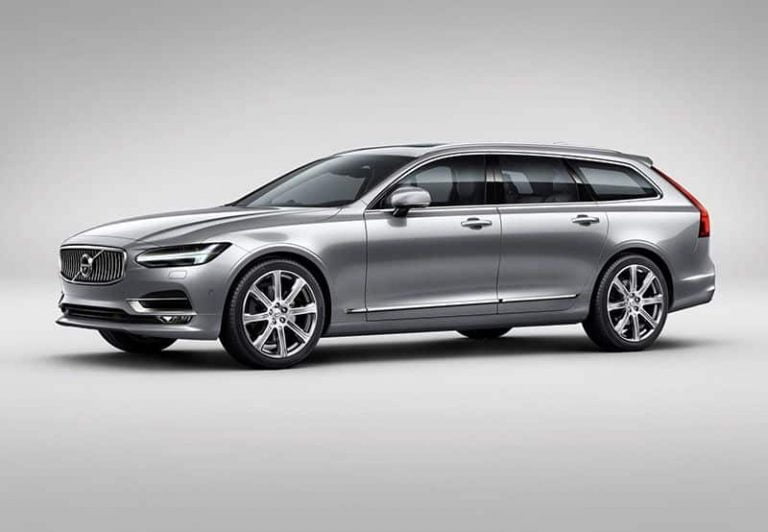
Volvo’s new S90 premium saloon, on sale in the summer, will be joined by a V90 estate version before the end of 2016.

The Volvo V90 will debut at the Geneva Motor Show on 1st March, and when it arrives in showrooms is expected to sit alongside the S90 and XC90 SUV to give the Swedish brand a range-topping dynasty to take on the mass hitters of the segment – the BMW 5 Series and Mercedes-Benz E-Class.

The Volvo V90 offers a 1,526-litre rear storage space, including compartments under the floor. It is built on the same SPA (Scaleable Product Architecture) platform as its saloon sister and will be offered with a similar powertrain line-up, including PowerPulse diesel engines and the T8 Twin Engine petrol plug-in hybrid.

Volvo adds that technology in the V90 will include the Pilot Assist semi-autonomous drive system, the most advanced standard safety package on the market, including Large Animal Detection and Run-off Road Mitigation, and connectivity that incorporates smartphone integration with Apple CarPlay.

According to Volvo president and CEO Håkan Samuelsson, Volvo is still known as the definitive estate brand to many people. “While the Volvo brand today stands for more than estates, we are proud to carry forward this rich heritage with the V90,” he says.

What it’s made of– the new Volvo V90 on video:

Jaguar F-Type SVR to cost from £110K

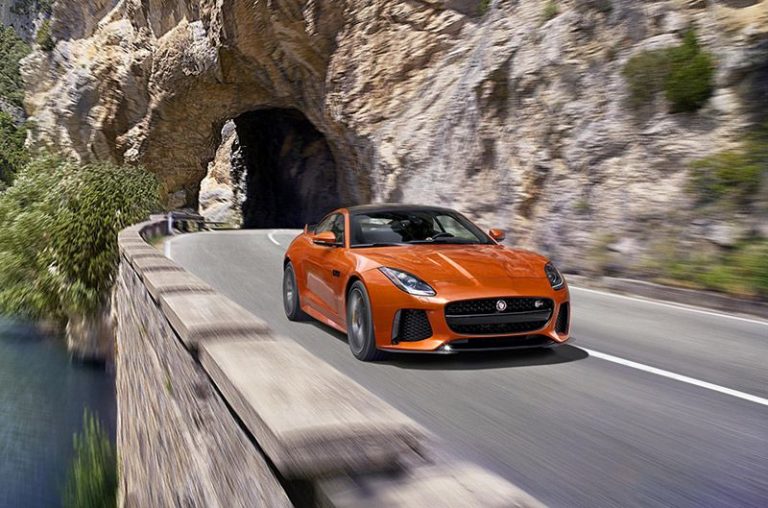
Jaguar is now taking orders for what is described as the fastest version of its F-Type sports car yet built.

The Jaguar F-Type SVR has been developed by Jaguar Land Rover Special Operations – in coupe form it boasts a 3.5-second 0-60mph time and a 200mph top speed.

Its convertible sister returns the same 0-60mph time but tops out at 195mph, while both variants return combined cycle fuel economy of 25mpg and CO2 emissions of 269g/km.

The F-Type SVR is set to be officially unveiled at the Geneva Motor Show on 1st March, with first customers receiving their cars in summer 2016 at a price from £110,000 for the Coupe and £115,485 for the Convertible.

Currently the most powerful Coupe, the F-Type R in 541bhp 5.0 V8 Supercharged AWD format, costs £91,660 and offers a 4.1-second sprint time and a 186mph top speed. Its mileage and emissions figures match those of the SVR.

The SVR achieves its extra pace through a wide-ranging programme of upgrades. It too is all-wheel-drive, and uses the 5.0-litre V8 supercharged engine, but producing 566bhp, plus a torque figure boosted from 502 to 516lbft.

Allied to the extra power is a weight saving, of at least 25kg over the F-Type R and as much as 50kg depending on options fitted such as the carbon ceramic brake package and carbon fibre roof. The SVR includes an uprated chassis, lighter 20-inch aluminium forged wheels with wider tyres acted on new dampers, thicker anti-roll bars and stiffer rear knuckles.

1602_Jaguar_F-Type_SVR_02

The car has a new aerodynamic package, with a smoother drag factor, ranging across front bumper and splitter, flat underfloor, carbon fibre active rear wing and rear venturi.

The exhaust is changed too, a titanium and Inconel system which both adds more muscle to the engine note and saves 16kg alone. And the car’s electronics are all retuned, bespoke calibrations being applied to the Quickshift transmission and the Electric Power-Assisted Steering, Adaptive Dynamics, Torque Vectoring, Dynamic Stability Control and All-Wheel Drive systems.

Marking out the SVR on the inside, the seats are upholstered in a bespoke Lozenge Quilt pattern, the instrument binnacle and centre console coated in a suede cloth, a specific SVR steering wheel added along with anodised aluminium paddle shifters.

According to Jaguar design director Ian Callum, creating the F-Type SVR has allowed the company to do something dramatic with what is already a special car. “Every additional form, line or component is there for a reason, and contributes to the car’s increased performance as well as its presence,” Callum says.

“Cutting-edge aerodynamics have always been fundamental to Jaguar design, and everything from the enlarged air intakes to the active rear wing is essential to the dramatic looks and 200mph potential of the new F-Type SVR.”

In action – Jaguar’s F-Type SVR…  

Renault launches its Alpine revival

Renault’s Alpine sports car brand is to make a comeback, with its first production model unveiled before the end of 2016.

Group Renault chairman Carlos Ghosn has announced the long-predicted return of the Alpine name, which was originally planned to be a joint venture with UK sports car manufacturer Caterham. The joint programme was agreed in 2012 but ended when Renault bought out Caterham’s stake in 2014.

At a ceremony in Monte Carlo, chosen to recall the Monte Carlo Rally successes of the original Alpine A110 in the early 1960s, Ghosn revealed a concept that will debut at the Geneva Motor Show on 1st March.

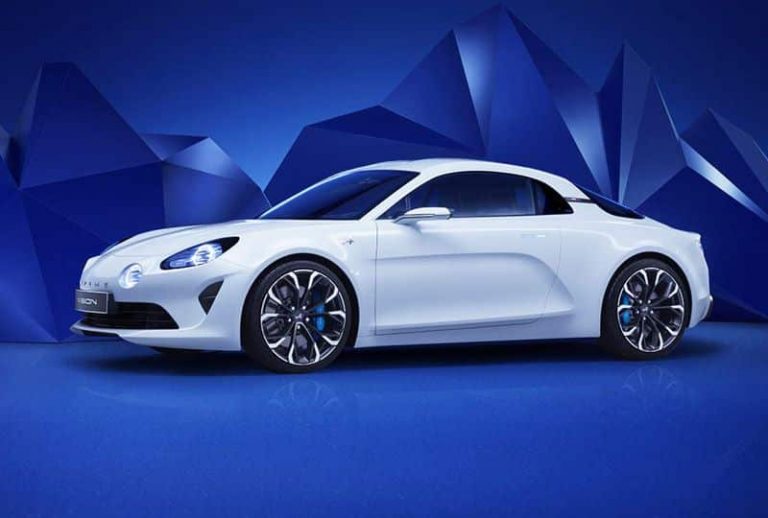
The Alpine Vision is a mid-engined two-seater sports car and gives a strong hint as to the production model. Renault says that a dedicated team will spend the next 12 months building “an outstanding car, very close to today’s show car in terms of design, weight, handling, agility and attention to detail.”

Technical details of the concept are currently sparse, Renault only stating that it is powered by a new four-cylinder turbocharged engine built by Renault Sport, and which combined with the low weight of the car will ensure a sub four-second 0-62mph time for the production car.

Renault adds that motorsport will be an essential part of the brand’s programme – a Signatech-Alpine Racing Team has won two European endurance championships and the LMP2 class in the World Endurance Championship (WEC) – in 2016 the team will enter two Alpine LMP2 cars in the WEC, including the Le Mans 24hrs.

“Motorsports and sports cars are deeply rooted in the DNA of Groupe Renault,” Ghosn says.

“Earlier this month we announced our return to Formula One with a Renault team, and today we are announcing Alpine. This is an exciting next step in our strategy to leverage talent and technology between road and track, and we look forward to reaching new customers in the sport premium cars segment.”

The Alpine will be built in Dieppe, France, and be sold initially in Europe.

SsangYong Tivoli to go XL

SsangYong will show an extended version of its Tivoli crossover at next month’s Geneva Motor Show.

The SsangYong Tivoli XLV will be displayed alongside a hybrid concept dubbed the SIV-2, which previews a major new model expected on sale in around 2018.

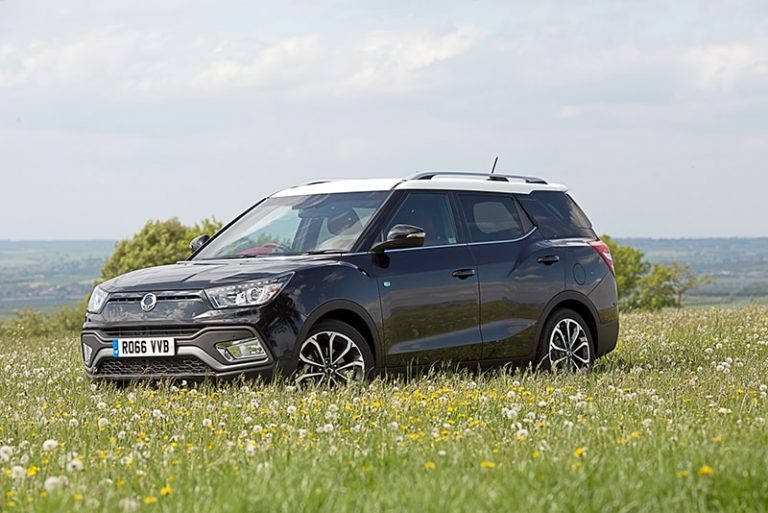
Expected on sae in summer 2016, the Tivoli XLV is evolved from the XLV Air that was concept unveiled at the Frankfurt show in September 2015. SsangYong says that favourable feedback to the concept has resulted in the production model.

Sitting on the same 2600mm wheelbase as the current Tivoli, the XLV’s extra length of 235mm is all behind the C pillar (behind the rear door), boosting luggage space from 423 to 720 litres.

UK specification of the Tivoli XLV is yet to be announced, but it will go on sale with either the 1.6-litre petrol or diesel engines already available with the standard Tivoli, with six-speed manual or six-speed auto transmission and in two or four-wheel-drive format.

The SIV-2 – the letters stand for Smart Interface Vehicle – previews a future SsangYong SUV that the Korean brand clearly has major plans for, saying that it will “evolve to become a key strategic model within the SsangYong range.

Following on from the SUV-1 that debuted at Geneva in 2013, the concept is expected to evolve into a large SUV that SsangYong will pitch against the likes of the segment-leading Nissan Qashqai.

Few details have yet been released about the SUV-2. But propelling the concept is a mild hybrid powertrain, combining a 1.5-litre direct injection turbocharged petrol engine and a 10kW electric motor-generator with a 500Wh lithium ion battery.

SsangYong adds that the concept and its powertrain have been developed to accept future alternatives such as plug-in hybrid or full electric systems.

Automatic braking – the next big car safety innovation?

There is a big push at the moment to have all new cars fitted with autonomous emergency braking (AEB) systems, with several big-name road safety organisations claiming that these auto-braking systems could reduce thousands of crashes and save many lives each year. But what exactly are they talking about?

What is autonomous emergency braking?

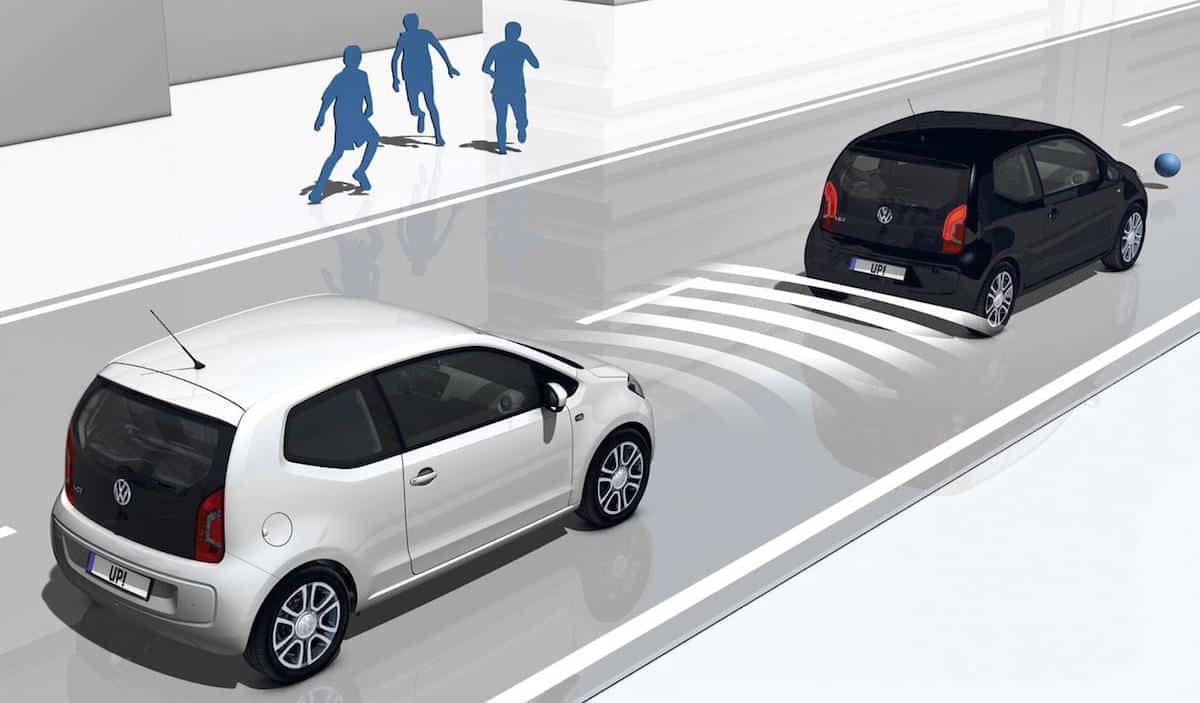
Simply put, an autonomous emergency braking system detects that you are approaching a stationary or slow-moving object in front and provides a collision warning. If the driver does not respond quickly enough, the AEB system can apply the brakes to slow or stop the car on its own. Newer systems can even detect pedestrians and cyclists, rather than just other vehicles.

AEB systems are sometimes called city braking systems (or similar), as they are usually most effective at speeds under 20mph where they can usually avoid an impact altogether. At higher speeds, the system may not be able to prevent an accident altogether, but it can significantly reduce the impact speed and therefore reduce the damage done to both car and occupants.

How does an AEB system work?

The system is based around a laser or camera (or both, or multiples of each), which scans the road ahead as you are driving. If it detects a stationary or slow-moving object up ahead, the system will give off a warning – usually beeping and/or lights and/or a message. Some systems will also start preparing the car for braking by bringing the brake pads right up close to the brake disc, so that when the brake is activated they are applied instantly – it saves milliseconds, but every faction is important.

If the driver does not respond within a certain time limit, the system will automatically start applying the brakes (and cutting engine power) irrespective of what the driver is doing.  If the car is moving towards a stationary object at less than 20mph at the time, the system can usually avoid an impact altogether. At speeds above 20mph, the car may well not stop entirely before an impact occurs, but the impact speed will be greatly reduced.  Some more sophisticated systems are able to operate at up to 140mph (although if you’re travelling towards a stationary object at that speed, it’s still going to be a big accident).

The AEB system is integrated into the car’s existing stability program (ESP) system (which has been a standard requirement in Europe for a number of years now). The ESP system can already control the brakes and accelerator with no input from the driver, so adding AEB does not require extensive modification of the car’s existing control systems – especially for new models where it is designed-in to begin with.

Ford Active City Stop

What is it like?

Seeing autonomous braking in action is definitely eye-opening. I first experienced an automatic braking system on an Audi A8 in Munich several years ago.  The car was able to follow the vehicle in front at over 100mph on an autobahn, and was able to come to a complete stop without me touching the brake pedal at all when the car in front slowed and stopped.

Low-speed AEB is equally impressive. When on a Mercedes-Benz training programme for the new C-Class (I worked for a Mercedes dealer at the time), we had to drive towards a large wooden wall at 30mph. The car started beeping but we were told to ignore it and maintain speed.  With no driver response, the car cut the accelerator input and applied maximum braking, pulling up centimetres from the wall every time.  Even at what seemed a low speed, the level of braking force was much more violent then a human driver would ever be likely to apply, even in an emergency.  But the wheels did not lock, meaning the driver could steer around the obstacle if necessary.

Why is it important?

UK car safety institute Thatcham Research says that a quarter of all car crashes are nose-to-tail impacts. AEB systems can reduce this number significantly, and even if an accident is unavoidable, the system can at least reduce the severity of the impact. At the very least, it could save you thousands in car insurance costs; and at the most, it could save lives and reduce serious injuries. Newer systems that can detect pedestrians and cyclists are even more advanced, and can reduce fatalities and injuries for vulnerable road users – even if the collision is not the driver’s fault.

There have also been many reports of insurance fraud with regards to whiplash from nose-to-tail impacts, and con artists engineering low-speed car accidents to claim on insurance. This obviously costs the rest of us money though increased insurance premiums.

Some insurance companies are offering reduced insurance premiums of up to 10% to vehicles with standard AEB systems.

Volkswagen up! autonomous city braking

How much does it cost?

There have been some somewhat misleading articles published over the last few days, implying that a basic AEB system costs as little as £37. Unfortunately, it’s not that simple. A basic kit of sensors might cost a manufacturer £37, but it has to be properly mounted to fit the car, integrated with the rest of the car’s systems and then extensively tested to make sure everything works properly. And that’s all expensive stuff.

WhatCar? highlights the Volkswagen Golf, which has AEB as standard on most models, to argue that all cars should be fitted with this technology. However, a basic AEB system is available as an option on several other models in the Volkswagen family, and it costs more than £200.  Assuming that VW applies the same profit margin as it does on other options, it’s costing them a lot more than £37 to fit.

For the AEB system to actually work, the car also has to have a number of other systems as well. Many of these systems are now standard, but they still have to be made to work with AEB, such as the ability to apply full braking pressure without the driver touching the brake pedal.

Many manufacturers offer AEB in conjunction with other safety systems. While AEB might be standard on most Volkswagen Golf models, the sister Audi A3 model range only offers AEB in conjunction with an adaptive cruise control system, meaning the cost starts at £575 depending on specification and other options.

So, in short, it’s not as cheap as some of the headlines suggest. However, even at a couple of hundred pounds, it’s still worthwhile.

So how soon will all cars have AEB?

The push to make automatic braking systems standard is only going to grow stronger. EuroNCAP, the independent crash-testing body, already gives higher scores to cars fitted with AEB systems. This has started to trigger a response from mainstream manufacturers to start fitting it as standard equipment.

Although the systems have been on sale for a number of years with several manufacturers, the uptake from customers when given the choice to buy AEB as an option has been very low – Thatcham suggests less than 2% of car buyers choose to pay for AEB when they have the choice. Why is this so?

Well, it’s probably twofold. Firstly, car buyers are notoriously reticent to pay extra for safety-related options. In recent history, safety features like airbags, anti-lock brakes and stability systems started off as options, as all struggled to find favour. Generally, customers would rather spend money on trinkets they can see, like a satnav or sunroof, than on a safety system that they hope they will never need. Dealers know this, so they don’t order stock with safety options since they know customers won’t want to pay for them.

Secondly, car salespeople are notoriously poor at explaining safety systems with anything like the same sort of zeal they apply to flogging overpriced car-cleaning crap or GAP insurance which earns them big commissions. And they are also incentivised to sell the cars they have in stock – and as just mentioned, dealers don’t order cars with safety options for stock…

Like seat belts, airbags and stability systems, there is no doubt that autonomous emergency braking systems will become standard equipment eventually. Virtually every new car that it launched now has it either as standard fitment or available as an option. If you are looking to buy a new car, it’s definitely worth having.