What is it?
The Ford Fiesta Active is the first launch in a new SUV-inspired trim level from the brand.
Key features
Raised ride height, ‘slippery’ drive mode, extra body mouldings.
Our view
The Ford Fiesta Active might be regarded as a ‘faux’ SUV with the emphasis on appearance rather than capability, but many buyers buy such vehicles for that very reason.
Ford has done a good job of adding a more muscular style and raising the ride height without ruining the Fiesta’s much-praised handling, and the resultant car will likely attract significant numbers of buyers – those who would like an SUV, but not the weight or cost that comes with them.
Similar cars
Peugeot 2008, Nissan Juke. Hyundai i20 Active
Ford has done a good job of adding SUV style and raising the ride height without ruining the Fiesta’s handling
Full review
Introduction
The latest Ford Fiesta launched in early 2017 and simply replaced its predecessor at the top of the UK best-seller charts, so in now reviewing the Ford Fiesta Active, are we focusing on a mere new trim level?
Yes we are, but one which Ford considers will widen its potential customer base. Active is a major launch that goes beyond just the Fiesta – a similar version of the Ka+ launches alongside the Fiesta and we’ll be reviewing that shortly, while the next Ford Focus coming later in 2018 will include an Active variant.
So what is it? Well, Ford will tell us the range is designed to appeal to those buyers who like the look of an SUV but don’t want the perceived compromises, such as running costs and expense.
This is yet another car designed, we are told, to appeal to “outdoor and adventurous” types, who prefer to be outside walking the dogs along a beach than inside watching TV. So it gains elements, but only elements, of ‘SUV-ness’ (Ford’s word, not ours…).
Ford’s marketing types add that Active models are to the brand’s proper SUVs, the EcoSport and Kuga, like the ST-Line trim level is to the full-house ST hot hatches – elements of the proper cars, “in a more accessible package for a wider selection of drivers”.
To make a Fiesta Active one takes the standard version, raises the ride height (though not by that much), adds ‘muscular’ body mouldings and roof rails, plus a more hard-wearing interior, and a couple of bespoke exterior colours.
Yes, basically this is a faux SUV, a lot cheaper than developing a full-house model line, especially as Ford is confident that what is not exactly that radical an upgrade package will earn the Active 15% of the Fiesta’s gargantuan sales mix.
The arrival of the Active sees the Fiesta range now available in five distinct lines (with sub trims within each). Entry level is Zetec, Titanium is the core best-seller, ST-Line the sporty version, Vignale the luxury angle, and now we have Active for the – well active…
There are three versions of the new model, dubbed Active 1, Active B&O Play and the range-topping Active X, each separated by £1,100. The pricing is on a par with the mainstream ST-Line and Titanium models, which Ford says is to give customers a direct choice between the three different formats.
Common to all the Active models is a ride height raised by about 2cm over the stock Fiesta, together with a 1cm wider track. This is combined with retuned suspension – according to Ford, the hydraulic rebound stops are designed to produce a better ride over the rougher roads this car is intended to traverse.
Be clear, this is not an off-roader, and it’s certainly not all-wheel-drive, but Active customers are expected to want to drive down muddy tracks, uneven surfaces and the like, and the suspension will be expected to smother the inevitable bumps and jolts.
Also as a result, the cockpit-selectable drive modes on versions with the six-speed manual transmission gain an extra setting, ‘Slippery’. This changes the Electronic Stability Control and traction control, as well as making tiny throttle and brake adjustments to maintain grip on surfaces such as mud, snow or ice.
Equally on Ford’s mind, of course, will be not compromising the road-holding and handling for which the Fiesta is renowned…
Other Active additions include bolder body mouldings – plastic spats on the wheels and on the front, back and sills, plus the silver-finish roof rails. The exterior effect is completed by a dark mesh grille and bright scuff plates, bespoke 17-inch alloy wheels and the availability of exclusive body colours, ‘Lux Yellow’ and ‘Silver Fox.’
One major plus for the Active models is that choosing one does not mean missing out on the elements that make the Fiesta the UK’s number one car. This includes the safety package. The Fiesta boasts a five-star Euro NCAP safety rating, and the technology available for it includes frontal collision warning and autonomous braking, pedestrian detection, traffic sign recognition, rear parking cameras and the like. Note, however, that much of it will require delving into the options list.
Inside the Ford Fiesta Active
Just over a year ago when we first drove the seventh-generation Fiesta we were impressed by the revolution inside the car. It remains a cosy supermini in the rear, and of course the Active model doesn’t change any of that, but the big change was in the dash which was sensibly laid out with intuitive placing of the vital controls.
In the Active the main change is to the surfaces, which we are told now consist of more hard-wearing fabrics, developed in a new testing facility at Ford’s Dunton centre in Essex and aimed at owners with muddy boots and soggy passengers.
Ford expects the entry Active 1 to be the big seller in the line-up but choose the more expensive versions and the extras include interior upgrades – B&O Play models gain colour detailing, the Active X partial leather trim.
Dominating the top of the centre console is the touchscreen of the Sync3 connectivity system. This comes as standard on all models, but whether you get a six-inch or an eight-inch screen depends on which model chosen.
Sync3 is a definite plus of the model – it includes DAB radio and smartphone compatibility through Apple CarPlay or Android Auto, plus voice-activated commands of a range of smartphone apps.
Further tech is also available, such as the MyKey, which helps make loans of the car to the kids a painless experience by restricting just how enthusiastically they can drive it.
Driving the Ford Fiesta Active
One compromise that won’t need to be made by going Active is in powertrain choice. Depending on version, the car is available with 85, 100, 125 and 140hp petrol engines, all of them variations on the 1.0-litre three-cylinder unit.
While many superminis can’t be bought with a diesel engine these days, Ford offers two, both of 1.5 litres and with 85 or 120hp. Finally, both six-speed manual and auto transmissions are available across the range.
The 85hp engines, petrol and diesel, are only offered with the Active 1, but it is the 100hp unit that is expected to take the biggest slice of sales, and it is this version that The Car Expert drove on the launch event.
This is a proven engine with a string of awards behind it, and it is no surprise to find that it is refined in use and up with the competition in acceleration times, economy and emissions. It is a unit well suited to its surroundings.
Where the Active is likely to most differ from its Fiesta siblings is in its ride and handling, due to the jacked-up suspension. But the elevation is not radical and does not harm the much-heralded ride comfort of the car – in fact the Active feels just a little more cosseting on less than perfect surfaces.
In corners this model perhaps rolls just a little more than a stock Fiesta, but not to any degree that is a concern – everything is well controlled, the car as placeable as ever and the steering well weighted.
Summary
Ford might have taken a perceived cheaper option in turning the Fiesta into a sort-of-SUV but one gets the impression that buyers won’t mind one bit. The Fiesta Active adds a little bit of SUV style and some nice-to-have extras, but crucially does not harm any of the attributes that have made the Fiesta the car that everyone wants to beat.
Perhaps the scariest aspect of the Fiesta Active is its cost. Prices for the range start from £17,795 and our Active 1 test car with the 100hp engine has a list price of £18,095. However, our cars also boasted a few options – metallic paint, the useful Driver Assistance Pack, rear parking sensors, the B&O Play sound system and curiously a CD player.
All this lot pushes the price to £20,640. Yes, the £20 grand supermini is becoming a norm, but it still seems to be a lot to pay for a small car…
The Toyota Camry is to return to the UK, as a hybrid model to take on rivals including the Ford Mondeo Hybrid.
The large Toyota saloon will replace the current Avensis, which is set to be dropped from the Toyota line-up after persistently declining sales.
Camrys have not been sold in the UK since 2004, but the model is a major part of the Toyota line-up in other markets and the world’s best-selling saloon. The car enjoys a high reputation and profile in the US – Toyota Camrys have won two of the last three championship titles in NASCAR, America’s biggest motorsport series.
When the Camry goes on UK sale in 2019 it will be offered only with a hybrid drivetrain. This will effectively be the same unit already offered in the hybrid version of the RAV4 SUV, combining a 2.5-litre petrol engine with an electric motor. The car’s arrival will extend Toyota’s hybrid choices to eight, stretching right across the Japanese brand’s model range.
Toyota is not providing any specification or pricing details of the 2019 Camry yet, but says it expects the car to ‘maintain the company’s presence in the large and executive saloon market.’
The current Camry uses the Toyota New Global Architecture platform that also underpins a host of Toyota’s latest European models. It is a larger car than the Avensis that it will replace, and is expected to be more attractive to buyers, especially in the fleet market, as a result.
The Toyota Camry’s US profile is helped by constant success in NASCAR racing, Kyle Busch here celebrating with a burnout after winning the Coca-Cola 600 at Charlotte Motor Speedway on 27th May. (Photo: Sarah Crabill/Getty Images for NASCAR)
The much-trailed new Volvo S60 has been revealed, at the brand-new American factory where it will be built.
The new mid-sized model, which will join its already launched V60 estate sister in showrooms, will be the first Volvo manufactured in the USA, at a new plant in Charleston, South Carolina. The plant will begin production in the Autumn and from 2021 will also build the next-generation XC90.
The S60 will also be the first Volvo in the modern era that will not be offered with a diesel engine option. Volvo says this is a clear demonstration of its commitment to electrification and a future beyond internal combustion engines – the brand announced last year that all its cars offered from 2019 will be electrified in some form.
Four engines, two hybrids
Buyers will choose between the traditional T5 and T6 petrol engines and a pair of hybrid petrol units with both turbocharging and supercharging – the T6 Twin Engine all-wheel-drive hybrid produces a combined 340hp, while the T8 Twin Engine version, familiar from the Volvo 90 series, offers 400hp. However, the brand is not yet saying whether all four engines will be offered in UK 60 models.
Described as a ‘sports saloon,’and set to rival the mass-selling BMW 3 Series and Audi A4, the new S60 provides few surprises with its styling, both due to its estate sister already being on sale, and the fact that it is effectively a smaller version of the highly successful S90 series.
Both the S60 and V60 are built on Volvo’s versatile Scaleable Product Architecture (SPA) platform and share their safety tech and infotainment systems – which again are all lifted from both the XC60 SUV and the 90 Series. Autonomous emergency braking is standard, and Volvo adds that its City Safety with Autobrake technology is the only system on the market to recognise pedestrians, cyclists and large animals.
The Sensus Connect infotainment system offers Apple CarPlay, Android Auto and 4G smartphone compatibility on a tablet-style screen.,
The S60 can also be specified with the Pilot Assist system, which can take a degree of steering, acceleration and braking from the driver at speeds up to 80mph. Volvo says this has been upgraded for the S60 with improvements to its cornering performance.
Prices for the S60 are expected to be announced closer to its UK market launch likely early in 2019. It will also be available on the ‘Care by Volvo’ subscription scheme recently unveiled with the XC40 – this puts drivers in the car by means of a monthly flat-fee subscription, with no down payment, rather than ownership. The brand describes Care by Volvo as “making having a car as transparent, easy and hassle-free as having a phone.”
Audi has unveiled the all-new A1 Sportback – a second generation and completely rethought version of the A1 with the aim of putting a bigger dent in sales of the Mini.
Since its launch in 2010, the A1 has proven a strong seller for Audi and has become its third most popular model in the UK. But it only attracts around half the customers that the Mini does, and Audi wants a much bigger slice of that market – particularly younger buyers.
So the new A1 – available to order from September and on the roads in November – is a completely new design from the ground up. For a start, it comes solely in Sportback form – which is Audi speak for having five doors.
As a result, the body has grown in length by just over 5cm, the car now a tad more than four metres long. Combined with unchanged width and height of 1.7 and 1.4 metres, the result is a low-slung profile.
Just as important in Audi’s eyes is a more sporty exterior look, again seeking that younger, fashion-led audience. So the single-frame grille is wide and placed as low as possible, while the three flat slits in the bonnet are said to recall the iconic Sport quattro rally car of 1984.
The car boasts a contrasting and dark roof finish, this ending above the rear screen pillar and helping to emphasise the low look – in fact, all of the side styling is designed to draw the eye downwards.
Audi’s familiar SE, Sport and S Line trim options will be offered on the A1 Sportback and the S line models will include styling elements to further emphasise the sporty image, among them larger air inlets, additional trim on the sills, a long slit between the grille and bonnet and a larger rear wing.
Inside has seen a major rethink too – gone has gone the ‘signature Audi’ dash layout, in its place a fascia full of sharp angles and with the major screens angled towards the driver. All but entry-level A1s will include an MMI touchscreen, which depending on model can range up to ten inches in size and include the features of Audi’s much-admired Virtual Cockpit.
At launch, the A1 Sportback will be offered with three engine options, all petrol. The 30 TFSI will employ a 1.0-litre three-cylinder unit with 116hp, there will be a 1.5-litre 150hp offering in the 35 TFSI, and a range-topping 2.0-litre unit with 200hp. This will come with a six-speed automatic transmission as standard, while the other two will offer a choice between a manual six-speed or seven-speed auto.
Shortly after launch, a new entry-level model will join the A1 Sportback range – this will be powered by the 25 TFSI engine with 95hp. An S1 version is also in Audi’s plans with 250hp. There has been no mention of any diesel engine options.
Prices for the A1 Sportback are yet to be announced – industry observers suggest they will rise closer to the £16,605 starting price of the MINI. Two ‘Launch Edition’ versions will also be available at launch – we are told they will be offered “in a range of vivid colours” with one having a design-led styling treatment and the other more sporty.
Coventry has seen its fair share of new car production over the last 100 years. But a brand-new production facility opened last year that is building new cars unlike pretty much anything attempted in the area before, and last month I was lucky enaough to join a private visit for a tour.
This is a new Jaguar facility, it has already been put to good use building three of the company’s newest models: the E-Type, the XK SS and the D-Type… If those names sound suspiciously similar to some famous Jaguar models from about 60 years ago, let me explain. Jaguar Land Rover Classics is building limited-run “continuation” vehicles of some of its most famous models.
New build, old style
The first of these was a run of six lightweight E-Type coupés, followed by nine XK SS roadsters, and now in production are 25 D-Type racing cars. All are brand-new vehicles, but built to exactly the same specifications as the original models from the 1950s and 1960s.
The continuation projects are quite controversial within the classic car world. Every single part of each vehicle is brand new, with nothing left from the original production runs. There is none of the original tooling and no-one involved played any part in the production of the originals.
Essentially the only difference between these cars and other third-party replicas is that they are built by a company owned by Jaguar Land Rover itself. Well, that and the price tags; the six E-Type continuations sold for a million pounds apiece, the XKSS pushed the price up to about £1.5 million and a new D-Types will set you back about £1.8 million.
Oh, and unlike the originals, the new ones are not street-legal as (unsurprisingly) they don’t meet any modern safety or emissions criteria. This is particularly ironic for the XK SS continuation models, which were originally created as road-going versions of the original D-Type racing car. So the XK SS continuation model is a track-only reproduction of a road-going version of a track-only car…
JLR Classic points out that original lightweight E-Type, XK SS and D-Type models have been changing hands for many millions of pounds in recent years, so these continuation models are not competing in the same marketplace.
In any case, all 40 continuation build slots were sold to hand-picked customers before they were even publicly announced, so Jaguar is not especially concerned by anyone’s disapproval.
Fortunately, the workmanship is commensurate with the price tag, and in reality much better than the original racing cars that were knocked up in a far more rapid and roughshod manner. The technicians go about their craft in spotless, brightly-lit and quiet work bays, with each car taking about three months to build.
More than continuation models
If you can’t quite stretch into seven figures for a classic Jaguar, JLR Classics has a range of other projects on the go, with Land Rover Series One restorations starting at about £65K and “reborn” Jaguar E-Type Series One models at about £270K.
There’s also a number of work bays dedicated to maintaining XJ220 supercars from the 1990s, and a programme of one-off bespoke vehicles like Project Dylan, a fully-electric Jaguar E-Type unveiled last year and recently famous as the wheels of choice for Harry and Meghan’s post-wedding escape. If you thought the continuation project was divisive, the electric E-Type was originally referred to within Jaguar as Project Marmite…
Behind the workshop is an immaculately-assembled collection of a few hundred classic cars – mainly but certainly not exclusively JLR models – from the last hundred years or so. We weren’t allowed to take photos in there on my recent visit, but the collection of assembled vehicles is simply mouth-watering. From pre-war (and pre-Jaguar) vehicles through to the C-X75 vehicles hand-built for the last James Bond movie, SPECTRE, there’s something for every genre of car enthusiast.
JLR Classics public factory tours are available from £49, and have proved very popular since the facility opened last June. It’s well worth a visit.
The Mitsubishi Shogun Sport will go on UK sale in July at prices starting from £37,775.
The Shogun Sport currently sells in Asia as the Pajero Sport, and Mitsubishi hopes it will become one of its best-sellers in the UK, capitalising on the current popularity of SUVs among UK buyers.
Adding the Sport to the existing Shogun, the Outlander and the smaller ASX, and with the L200 pick-up also in the line-up and a new Eclipse Sport model set for launch later in 2018, the brand believes it will offer the widest range of 4×4 models in the market.
The Shogun Sport is a large seven-seat SUV aimed at the traditional end of the market, with full off-road ability. Available only with a 2.4-litre turbo diesel engine of 181hp, it is fitted with Mitsubishi’s Super Select II all-wheel-drive system with a rear differential lock, and a terrain control system with four standard settings – gravel, mud/snow, sand and rock.
New eight-speed auto
Launching with the model is a new eight-speed automatic transmission. This is said by Mitsubishi to improve fuel economy and emissions, while it includes a Sport mode manual override allowing the driver to change gear with shift paddles on the steering wheel or with the lever. When off-road in sand or rock mode the transmission prevents the driver from unintentionally shifting up a gear to ensure all torque required is available.
The car will launch in two variants. The £37,775 price tag buys the Shogun Sport 3, highlights of its specification including leather upholstery, electric seats, a reversing camera with parking sensors, keyless operation and smartphone compatibility for Apple CarPlay and Android Auto.
The Shogun Sport 4, costing an extra £2,000, adds a number of extras, particularly to the safety package. This gains adaptive cruise, control, a forward collision airing with autonomous braking, blind-spot warning and a 360-degree camera. It also includes an Ultrasonic mis-acceleration Mitigation System – this reduces the chance and severity of hitting obstacles when the driver mistakenly presses the accelerator when stationary or at speeds of up to 6mph.
Other additions to the Shogun Sport 4 include heated front seats, an upgraded audio system and headlamp washers.
EDITOR’S NOTE: This article is from 2018, and we have a new article with running costs for 2022 that shows the average running costs have now increased to about £220 a month.
One of the things we always preach here at The Car Expert is that you need to make sure you can comfortably afford to run whatever car you’re looking at buying. Now a new report has helped put some numbers on those running costs.
The report, commissioned by Kwik-Fit, has calculated that the average UK motorist spends £162 per month on running their car. That covers things like fuel, insurance, road tax and servicing, and doesn’t include the cost of the car itself.
Kwik-Fit’s research found that the average monthly car finance payment was just over £226. Given that most car buyers (both new and used) are borrowing money from somewhere to pay for their car, that means that the average total monthly spend on a car is about £400 per month in the UK.
Based on £162 per month, the annual running cost of a car averages out at just under £2,000. Obviously, some of those expenses are small, regular amounts like fuel, which accounts for an average of £67 per month. Other costs are larger, annual bills like a service (average of £191) or unexpected repairs and breakdowns (average of £159).
As part of your new or used car purchasing plans, you should look carefully at your likely expenses to make sure you have enough in hand each month to cover your known expenses and put towards any unexpected costs that may pop up. I’ve just spent more than £500 on an annual service and new brakes for our family car, which is enough to go way over the average costs shown in the table below. If you don’t have enough of a buffer in your finances to cover these bills when they crop up, it’s very easy to fall into financial trouble.
The table below shows the average amounts drivers spend each month on their motoring costs.
Item
Average monthly spend
Fuel
£67.63
Car insurance
£31.64
Routine maintenance and servicing
£15.96
Unexpected repairs and breakdowns
£13.26
Vehicle excise duty (road tax)
£12.16
Breakdown cover
£6.96
Parking permits and tickets
£6.89
Cleaning
£4.15
Fines
£3.69
Monthly average total (excluding finance)
£162.33
Finance
£226.12
Monthly average total (including finance payments)
£388.45
Source: Kwik Fit
The research also threw up some other interesting numbers. Almost a third of respondents said that they kept their car cleaning costs down by only using household cleaners. People, no! Household detergents are far too harsh for your car’s paintwork and will eat it up, leaving your car looking faded and splotchy in no time.
Of more concern was the suggestion that 8% of motorists spend nothing on routine maintenance, trying to save pennies by not having their car serviced at all.
Kwik Fit’s communications director, Roger Griggs, says this could be a false economy: “Regular servicing is important to ensure a car is running efficiently, and also to pick up any issues before they create long-term damage. As with most things in life, prevention is usually better than cure.”
Servicing plans – check the fine print
The purpose of the research was to promote Kwik-Fit’s service plan offer, matching similar plans offered by manufacturers and car dealers. Any service plan can be a good way to spread your annual maintenance expenses, but you need to look carefully at the fine print to ensure that any terms and conditions suit your needs.
The Kwik-Fit plan allows you to take your car to any Kwik-Fit garage in the UK, but has limitations on the age and mileage of the vehicle, and the plan only lasts for one year. Some dealer plans offer a multi-year plan but lock you into that specific dealership for servicing, which is no good if you move house to the other side of the country.
Keep some cash handy for unplanned expenses
Finally, we can only repeat what we’ve already said above and repeatedly in recent years. Any car can go wrong at any time with expensive consequences, so you need to make sure your wallet can cope with it.
It doesn’t have to be a breakdown or failure – it could be a puncture or damaged wheel from hitting a pothole. It could be a broken window from a vandal or thief. It could be that you accidentally put the wrong fuel in your tank during a moment’s inattention (it happens every four minutes), or any sort of unexpected drama.
If you are so financially stretched that you can’t deal with these inevitable demands on your bank account, you are very likely to hit money troubles at some stage of your car ownership. Choose a cheaper (or cheaper to run) car.
The look of the next Suzuki Jimny SUV has been revealed in an official picture released by its makers.
The fourth-generation model will launch first in Japan and is not expected on UK roads until early in 2019.
It has always been regarded as a traditional SUV in the Suzuki line-up, with proper off-road ability and its own core fan base as a result.
It is clear from the pictures that Suzuki will not be seeking to change this image. The Jimny retains its signature square, rugged exterior styling and also the traditional ladder chassis employed by the more robust off-roaders.
Also revealed is the use of a rigid three-link suspension system, and part-time four-wheel-drive with a low-range transfer gearbox – again answering the demands of off-roaders.
Current trends to personalisation will be encouraged by a trio of two-tone exterior finishes alongside the five single colours.
Suzuki describes the interior as ‘straightforward, down-to-earth beauty’ but the image shows the brand’s signature centre console layout topped by its standard infotainment screen with satnav and smartphone compatibility for systems such as Apple CarPlay.
So far no details have been released regarding the engines that will power the new Jimny. Industry sources suggest they will include the 1.2-litre and 1.0-litre turbo petrol units currently available in other Suzuki models, and will not include a diesel option, Suzuki having dropped all diesel form its UK range in recent months.
Suzuki launched the first Jimny in 1970 and has since sold 2.85 million around the world. The popularity of such cars, especially in countries such as India, has helped make Suzuki the eighth largest car manufacturer in the world, with 3.16 million sales in 2017.
The production version of the BMW 8 Series coupe has been unveiled at the Le Mans 24 Hours race.
Dealers have already opened order books, at prices starting from £76,270. Built at the brand’s Dingolfing plant, which also produces the 7 Series, the 8 Series is expected on the roads from November.
Described by its makers as “the start of a new chapter in BMW’s long and illustrious history of making iconic and sensational sports cars” and “one of the most exciting new models to emerge in years”, the new coupe continues a BMW tradition of reserving the 8 designation for its top-level cars – previous examples include the Z8 roadster and the current i8 electric coupe.
It has been developed alongside the BMW M8 GTE world endurance racer, which gave BMW good reason to unveil the production car at Le Mans, the blue riband event of entrance racing.
Initially, the 8 Series will be available with two engine options – the entry 840d will use a 3.0-litre six-cylinder turbo diesel engine with 320hp and 680Nm of torque. While capable of a 0-62mph time of 4.9 seconds, it will also return 46mpg with CO2 emissions of 160g/km.
The lead M850i, costing from £100,045, will employ BMW’s latest 4.4-litre V8 petrol engine, at 530hp 68 horses more powerful than the unit it replaces, and with 750Nm of torque, up by 100Nm. Hitting 62mph from rest in 3.7 seconds, it is quoted at 28.3mpg and with emissions of 228g/km.
Both engines are matched to an eight-speed automatic transmission and all-wheel drive. The transmission has undergone several improvements including reduced weight, an updated electronic controller and revised ratios. This has helped efficiency by reducing engine speeds.
The transmission also boasts steering-wheel shift paddles for manual control and a launch-control function to enable the most potent acceleration from a standing start.
The all-wheel drive system is rear-biased, with all its torque directed to the rear wheels except when conditions demand more grip on the front axle.
Technology features heavily in the 8 Series – particularly in terms of safety and connectivity. A suite of driver assistance systems under the title of BMW Personal Co-Pilot includes camera, ultrasonic and radar detectors. Cruise control with autonomous braking is standard, as is collision and pedestrian warning, and a head-up display.
Connectivity services include a digital personal mobility assistant service, that integrates with smartphone compatibility extending across Apple and Android devices, as well as Alexa and Google smart devices. It even integrates with Microsoft Office software.
Thatcham Research and the ABI (Association of British Insurers) have demanded greater clarity from carmakers regarding the autonomous capabilities of their vehicles. This follows increasing instances of crashes attributed to an over-reliance on autonomous technology, which has not yet developed to the point of driving the car independently.
Risks to UK drivers have been detailed in a new paper, titled “Assisted and Automated Driving Definition and Assessment.” It highlights the dangerous ambiguity surrounding some driver support technologies, particularly criticising the misleading names given to these systems, such as Tesla’s Autopilot or Nissan’s ProPilot, by carmakers.
Matthew Avery, Head of Research at Thatcham Research, commented: “We are starting to see real-life examples of the hazardous situations that occur when motorists expect the car to drive and function on its own. Specifically, where the technology is taking ownership of more and more of the driving task, but the motorist may not be sufficiently aware that they are still required to take back control in problematic circumstances.”
Avery stresses that “fully automated vehicles that can own the driving task from A to B, with no need for driver involvement whatsoever, won’t be available for many years to come. Until then, drivers remain criminally liable for the safe use of their cars and as such, as the capability of current road vehicle technologies must not be oversold.”
Thatcham Research has released a video showing what can happen when a motorist thinks a car can drive itself, which you can see below:
To guide both carmakers and legislatures, Thatcham Research has written a list of ten criteria that every assisted vehicle must meet before it can be considered automated. It has also revealed details of a new consumer testing programme to assess assisted driving systems against these ten criteria.
The first round of tests will take place this summer. Elements of the test include: Studying manufacturers’ promotional literature to see how clearly the system capabilities are explained, analysing how drivers cope with enabling the systems, and assessing what happens when the driver is required to take back control. The results will be published in the Autumn.
The latest consumer car finance figures show that customers are still borrowing more and more money on both new and used cars.
Results for April 2018, released last week by the Finance and Leasing Association, show that the number of new car finance deals matched the strong growth in private new car sales in the same month, bouncing back from a very poor month in April last year. The value of that lending continued to increase, resulting in about a 3% increase in average new car borrowing on private new cars.
Used cars also had a very strong month in April, after a small drop in March. While used car sales figures for the quarter won’t be released for a few months, a 20% increase in the number of used car finance deals was recorded. Combined with a 28% increase in the amount of money lent to consumers, this resulted in a 6% increase in the average borrowing on used cars. This made April the strongest month of the year to date for used car finance, which is unusual.
Cars bought on finance by consumers through dealerships
New business
Apr 2018
% change on prev. year
3 months to Apr 2018
% change on prev. year
12 months to Apr 2018
% change on prev. year
New cars
Value of advances (£m)
1,606
+31%
5,883
+2%
18,962
+1%
Number of cars
81,734
+27%
300,464
-4%
974,659
-8%
Used cars
Value of advances (£m)
1,569
+28%
4,474
+15%
16,282
+14%
Number of cars
134,159
+20%
383,666
+10%
1,406,333
+8%
Total cars
Value of advances (£m)
3,174
+29%
10,357
+7%
35,244
+6%
Number of cars
215,893
+23%
684,130
+3%
2,380,992
+1%
Data (c) Finance and Leasing Association
Finance market continuing at record levels
Looking back at the results o er the last 12 months, the value of lending on new cars continues to increase despite the sales slump of the last year. Meanwhile, the used car market is continuing its steady march onwards and upwards. In fact, the total lending on used cars is closing in on the lending for new cars (albeit based on a greater number of deals).
Nearly 90% of all private new car sales are financed at point of sale through dealer-sourced finance, a number which continues to creep upwards. The majority of these sales are funded using a personal contract purchase (PCP), with an ever-decreasing number of private new car buyers using cash or other sources of finance to purchase their cars.
The Lexus RX 450h is a petrol-electric premium large SUV.
Key features
Hybrid drivetrain, top-quality interior, good safety package
Our view
The Lexus RX 450h is a quality premium SUV with the very worthwhile extra element of the economy and efficiency of its hybrid drivetrain.
The recent addition of an F Sport trim level adds an extra performance element, and to the overall appeal of a model that should be a serious consideration against the Audi Q7 or Volvo XC90.
Similar cars
Audi Q7, Volvo XC90, Range Rover Sport
Visually the RX makes quite a statement, with the Lexus signature ‘spindle grille’ dominating the front end.
Full review
Introduction
The buyer seeking a large, upmarket SUV has quite a choice these days, with more new models consistently expanding the options available. But for many years, the Lexus RX offered something no rival could – a hybrid drivetrain.
Now, however, both of the perceived closest rivals to the Lexus, the Audi Q7 and Volvo XC90, also include versions with electric motors. But both are plug-in, as opposed to traditional, hybrids – while boasting fuel economy in treble figures and CO2 emissions in only double, and thus the resultant tax advantages, they also cost a lot more to buy; £8,000 plus for the Volvo, £13,000 for the Audi.
So for those wanting a hybrid, but with not-too-deep pockets, the Lexus remains the prime choice. Is it a good one?
Buying and owning the Lexus RX 450h
The Lexus RX has been around since 1998 and the fourth-generation model launched in 2015. It was on a new platform with a longer wheelbase, freeing up more interior space, and the comfort and luxury elements expected in a premium SUV were improved.
Visually the car makes quite a statement. The Lexus signature ‘spindle grille’ dominates the front end, with the angular styling and lots of chrome detailing ensuring the RX is easy to spot in the company car park.
At a time when petrol is reasserting itself over diesel, the Lexus RX 450h offers a major advantage – better than 50mpg fuel economy and CO2 emissions of 127g/km are the sort of figures one would expect from a diesel version of a vehicle this size. This is a big petrol SUV that a company car driver can seriously consider.
Trim levels for our RX 450h range across four – SE, Luxury, F Sport and Premier. Generally, the Luxury has been considered the best value for money, but the recently released F Sport has added a new element to the range – it’s pitched as a more performance-orientated model, the major addition being self-levelling air suspension.
Our test car is to F Sport spec – visually it gains some bespoke detailing, a black finish to the mesh grille and satin chrome bits. And it sits as standard on 20-inch wheels, more purposeful than the standard 18-inch rims.
More importantly, the F Sport includes adaptive variable suspension, or AVS, as standard. Each damper is individually electronically controlled according to road conditions – soft and smothering on rougher surfaces, firmed up to keep the car upright when cornering at speed.
F Sport also adds a couple of extra settings to the driver-controlled Drive Mode Select – configuring a number of parameters across the car including suspension damping, engine output, the response from the throttle.
On SE and Luxury versions the Drive Mode Select options are Normal, Eco or Sport – they act as their names suggest. F Sport (and range-topping Premier) models add Sport S and Sport S+ modes.
Sport S makes the accelerator react even quicker than in Sport mode, the hybrid system biasing itself towards performance, while Sport S+ also sharpens up the power steering and further stiffens the suspension.
When crash-tested by Euro NCAP in 2015, the RX clocked up a top-notch five-star rating. It comes as standard with the Lexus Safety System+. Its suite of active safety systems includes autonomous emergency braking, which on the range-topping Premier models is also part of the rear cross-traffic alert, so stopping a driver reversing out of a space straight into the path of a car, or a pedestrian.
Also included are the other systems that are fast becoming the norm these days – adaptive cruise control, lane-keeping, auto high beams, traffic sign recognition and on Premier models a blind-spot monitor and parking sensors upgraded to include bird’s-eye view panoramic camera.
The system also includes a ‘sway warning’ which detects if the car is moving about its lane, perhaps because the driver is becoming drowsy, and sounds an alert.
Inside the Lexus RX 450h
The RX cabin is very plush and beautifully put together
The new platform of the fourth-generation RX adds some 12cm to the car’s length, and 5cm of this is in the wheelbase. That means more interior space, particularly as the RX is only available as a five-seater, unlike the XC90 or Q7 that can be had with seven. To match those, Lexus now offers the RX L – a longer version of the RX with two additional seats.
It is a spacious interior – particularly in the rear where the floor has been lowered to increase the headroom. Even if you don’t slide back the rear bench seat to free up more room you will travel in supreme comfort, especially as you can recline the rear seats too. The boot, at 453 litres with the seats up and 924 litres with them folded, is not huge but more than adequate.
If there is one aspect that Lexus is renowned for, it is the quality of its interiors. The RX cabin is very plush indeed, beautifully put together, and on the F Sport extending to perforated leather on the upholstery, steering wheel and gear lever (including a white version should you desire), and sporty details such as aluminium drilled pedals.
In fact, there are lovely details throughout the interior – a favourite of this reviewer is the centre console holder that can be adjusted in depth between 7cm and 11cm to suit both cups and bottles.
Our F Sport gets the 12-inch touchscreen in the centre console (SE versions make do with an eight-inch screen). It’s effective in use, the navigation system easy to program and follow, while it also controls the optional and quality-sounding Mark Levinson hi-fi system fitted to our car.
Driving the Lexus RX 450h
Acceleration is refined and reasonably swift, while the RX rides in a very comfortable manner
The powertrain of the 450h matches a 3.5-litre V6 engine driving the front wheels to a pair of electric motors – a 123kW version up front and a 50kW equivalent in the rear, providing the all-wheel-drive system.
It’s refined system, particularly when moving at slow speeds when the electric motors take care of things and the RX glides along almost in silence. However it takes very little acceleration for the engine to cut in, and even relatively restrained depressing of the right-hand pedal results in lots of engine revs, and a noticeable, if not particularly intrusive, audio note.
Still, acceleration itself is refined and reasonably swift, passing 62mph in 7.7 seconds. Mind you hauling around electric motors and battery packs makes the Lexus a heavyweight vehicle, more than two tonnes in all, and so it is not as quick as the electric versions of the Audi or Volvo.
Once up to speed, the RX rides in a very comfortable manner indeed; a relaxed cruiser for eating up motorway miles.
Point the car at a succession of corners and it copes well, to a degree. It stays reasonably upright (particularly if one makes use of the extra drive modes to stiffen up the suspension). With the electronic dampers of the AVS working hard, it effectively leans into the corners in a controlled fashion. The steering feedback is not as sharp as on some rivals, but it is all very controllable.
Summary
Many buyers see the Lexus as a standard bearer for hybrid powertrains in the premium market – after all, the brand and its Toyota sister have been doing “the H word” for a long time.
Where some potential buyers are mistaken, however, is in thinking the Lexus is, as a result, a bit of an oddity. It is instead a worthy contender in the upmarket SUV sector, performing all aspects of what most buyers would require in such a car very well.
That the Lexus RF450h is a hybrid, with its petrol engine but un petrol-like economy and efficiency, is a very worthwhile extra.
Fuel additives have been around almost as long as cars themselves. Different products are available that claim to increase your horsepower, improve your fuel economy or generally make your engine more efficient.
Here in the UK, the market leader for fuel additives is Redex. The Redex brand dates back nearly 100 years, created in a time when the quality of petrol was generally poor and engines were far more problematic. Additives like Redex would help keep the fuel system clean of impurities and deposits that would build up inside your engine, helping your motor run smoother and last longer.
Of course, things have changed since then. The quality of petrol or diesel at your local service station has improved significantly, and you can buy premium fuels that contain cleaning additives straight from the pump. Engine design has moved on a long way as well, although newer engines are more sensitive to fuel quality. So is there still a need for fuel additives in the 21st century?
The famous Redex Round-Australia Trials
Back in my home country of Australia, Redex became famous in the 1950s for sponsoring a series of Round-Australia Trials. Standard production vehicles competed in a ‘race’ around Australia, covering up to 10,000 miles through some very inhospitable country – the main roads between state capitals were often still dirt tracks, let alone modern motorways. The fortnight-long events were front-page news around the country, with more than 150,000 spectators generally attending the start and finish in Sydney, and enormous crowds turning up at every checkpoint along the way.
An FJ Holden participates in the Redex Round-Australia Trial (image (c) Holts)
The only modifications you could make to your car were to add a comfier seat (a standard vinyl bench seat was not conducive to 10,000 miles of racing around Australia) and additional fuel tanks. The latter were needed because petrol stations were sometimes more than 500 miles apart.
Competitors were also required to carry picks and shovels to help extricate themselves from inevitable trouble, as well as enough food and water to survive if they broke down. More than half the entries each year would fail to finish, as 1950s production cars were largely unable to cope with some of the toughest driving conditions in the world.
Rather than an outright race, the events took the form of a reliability trial. Bonnets and radiators were sealed up before the start, and competitors would earn points for completing each leg on time and without damage. Finishing late, damaging your car or having to conduct repairs would get you penalised. Breaking your bonnet seal to work on your engine would earn so many penalty points that you were basically out of the running. The winning crew was the one who dropped the fewest points over the journey, rather than the first across the line.
My Redex Round-Surrey Trial
I’m undertaking a three-month trial of Redex fuel additives in my 2013 Mazda MX-5 to see if I can find any noticeable improvements to performance or fuel economy. Now we have plenty of potholes and rubbish roads here in Surrey, England, but obviously nothing like outback Australia (and nor am I interested in finding any such tracks in my little Mazda!), but I’m still going to try and invoke the spirit of the old Redex Trials to make things a little bit competitive.
The whole idea is to see whether adding Redex to my fuel tank improves my car’s performance and/or economy, so we need to try and eliminate as many variables as possible. Clearly, this won’t be a properly scientific lab test, but we can take care of some basics:
I will be using regular 95-octane petrol, from the same petrol station each time unless that’s not possible for some reason.
I will be using a full tank of petrol for each reading, filling the tank to the first ‘click’ at the bowser and then running the tank down until the red light comes on.
I will check the tyre pressures at each fill, if possible, to make sure they stay at the correct levels
I have set the car’s display screen so that it doesn’t show either my fuel consumption or the trip distance, so I won’t know how I’m going until I fill up
I have access to two other vehicles, so if I’m going to be doing any trips that are unlike my regular driving and would yield noticeably different fuel economy (for example, a long motorway journey), I can use another car.
How it works
My normal driving pattern of mixed urban and A-road driving, with occasional motorway travel, generally yields a fuel economy average of about 30-32 mpg.
At every fill-up, I will be taking a note of my trip meter mileage and the amount of fuel added to work out my fuel consumption for that tankful.
I kicked off my Redex trial a couple of weeks ago, and the recommendation from the team at Redex was to add a 500mL bottle of their “Redex 5-in-1 Advanced Fuel System Clean Up”. This is a concentrated product that aims to clean deposit build-up from the engine’s fuel injectors. For subsequent fills, I will be adding a 90mL bottle of ‘regular’ Redex petrol system cleaner each time.
The products Redex have sent me are specific to petrol engines, but the company produces a similar range for diesel engines as well.
The fourth-generation BMW X5 has been unveiled, its makers claiming that it will set the standard against upmarket rivals such as the Jaguar F-Pace and Audi Q7.
The car – which BMW continues to call a Sports Activity Vehicle rather than an SUV – goes on UK sale this month at prices starting from £56,710. First deliveries are expected later in the year.
Changes to the X5 include a new styling treatment, completely redesigned interior and the latest technology, which extends to the highest level of autonomous capability yet seen on one of BMW’s X range.
The car also promises major improvements in comfort and refinement, due primarily to being built on a new platform closely related to that used on the latest 5 Series and 7 Series ranges. Its wheelbase is 4cm longer than the outgoing X5, and the vehicles as a whole is larger – just shy of 4cm longer, 7cm wider and 2cm higher.
New X5 variants will be offered with a choice of two diesel engines and a single petrol unit, all of three litres. Range-topper is the M50d, powered by a six-cylinder diesel with four turbochargers and producing 400hp along with 760Nm of torque and accelerating from 0-62mph in 5.2 seconds.
The diesel in the xDrive 30d produces 265hp and 620Nm of torque, returning a 6.5-second 0-62mph time, while the petrol engine in the xDrive40i offers 340hp and 450Nm, with a 0-62mph time of 5.5 seconds.
All engines will be combined with an eight-speed automatic transmission and the latest version of BMW’s xDrive all-wheel-drive system. On the road it biases towards the rear axle, but can split drive between the front and rear according to conditions and the surface.
The chassis has also seen major changes. options available now include an off-road package which has air suspension all round – previously it was on the rear axle only. Four-wheel steering can also now be specified.
Built in Spartanburg, South Carolina in the USA, the X5 has been a major success for BMW since the first version launched in 1999. Since then more than 2.2 million have been sold.
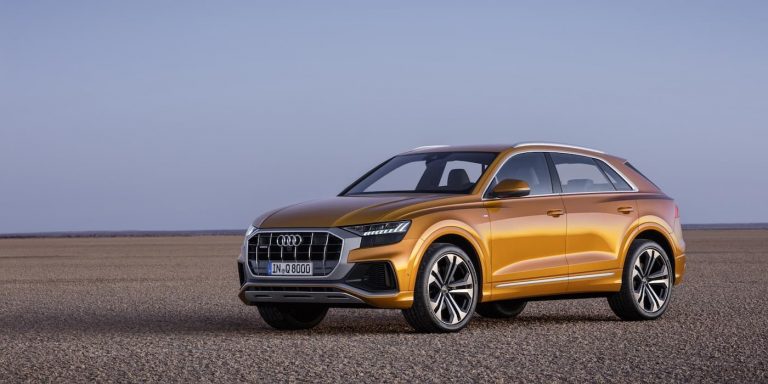
The Audi Q8 will arrive in UK showrooms in the summer as a new direct challenger to the likes of the Range Rover Sport.
Effectively the new model is Audi’s much-admired luxury car the A8, but in an SUV package – a rapidly growing part of the premium sector. The Q8 is evolved from the first and largest member of Audi’s SUV family, the Q7, and remarkably that car will remain the largest, as the newcomer is 6cm shorter in length, and due to its coupe styling has a roof some 10cm lower.
However, it is being pitched as a luxury model – the Q8 has shorter body overhangs than its sister both front and rear, and so will offer similar levels of interior space. it will also only be available with five seats, not the seven that can be had in the Q7.
The interior layout is also new with the cockpit focused on two large touchscreens and the equipment including the latest-technology navigation.
Initially, the Q8 will go on sale with a six-cylinder 3.0-litre TDI diesel proucing 286hp. This will propel the car through 62mph from rest in 6.3 seconds and onto a top speed of 144mph.
Audi also intends to add a less-powerful version of the 3.0-litre diesel, with 231hp, and a 3.0-litre petrol version with 340hp – these are expected on sale early in 2019.
Launch versions will also be to the familiar S line specification, with HD Matrix LED lights, 21-inch alloy wheels and adaptive air suspension sport included as standard.
Soon after launch, Audi intends to launch a more upmarket version of the Q8 dubbed Vorsprung. It will include all-wheel steering, 22-inch alloy wheels, a head-up display and a full leather package as standard.
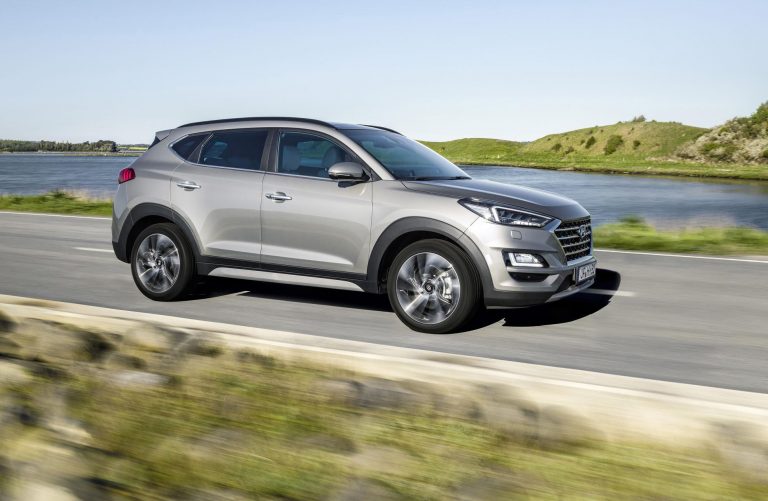
The next Hyundai Tucson will be the first model from the Korean brand to be equipped with a mild hybrid drivetrain.
The revamped compact SUV – Hyundai’s best-selling model in Europe – launches later in the summer, and as well as the powertrain changes will also offer design changes and upgraded technology.
Hyundai already offers a full hybrid model in the Ioniq, but the Tucson unit is said to be not only the first for the brand but one of the first in the industry. It matches a 48-volt lithium-ion battery and a mild-hybrid starter generator to the 2.0-litre diesel engine.
Under acceleration the generator supports the engine with up to 12kW of energy, reducing the pulling power needed and therefore improving fuel consumption. It cuts the load on the engine under light acceleration and provides extra torque when the engine needs it for hard acceleration.
The system automatically switches between assisting the engine and recovering energy to the battery, which is carried out when coasting and braking. This again aids fuel economy and reduces CO2 emissions – Hyundai claims savings of up to 7% and adds that all Tucson engines will meet the new Euro 6d Temp emission standards.
Initially, the technology is being paired with the 186hp diesel engine that is the most powerful in the Tucson line-up. Versions employing the unit also include all-wheel-drive and either a six-speed manual or the new eight-speed auto transmission. By Spring 2019, the new mild hybrid unit will also be combined with Hyundai’s new 1.6-litre Smart Stream diesel engines.
Toyota has announced increased savings and more models for its scrappage scheme for cars ordered this month.
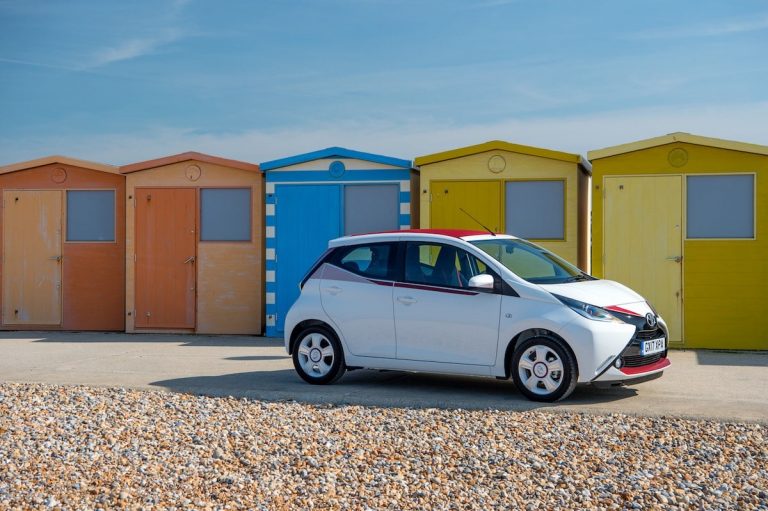
The headline offer is £2,000 off the price of a new Toyota Aygo with a qualifying part-exchange vehicle to be scrapped. The Yaris hybrid has also been added back onto the scheme, after being removed earlier in the year.
Toyota has also clarified the part-exchange requirements slightly, now accepting any vehicle registered up to 30 June 2010 rather than “up to seven years old” previously.
In addition, Toyota is offering 0% PCP finance on selected models, which can be taken in conjunction with the scrappage offer.
The company claims that it has taken more than 7,000 new car orders under its scrappage scheme since being launched last September. The Aygo has accounted for about 40% of those sales, and Toyota is also pleased than almost two-thirds of its scrappage scheme sales have been ‘conquest’ orders from customers who previously drove a different make of car.
The complete list of vehicles covered by the scrappage scheme is as follows:
Model
Scrappage allowance
Aygo
£2,000
Yaris (petrol)
£2,500
Yaris Hybrid
£1,500
Auris and Auris Hybrid
£3,000
Verso
£3,500
RAV4 and RAV4 Hybrid
£2,500
C-HR
£1,000
Avensis
£3,500
Prius family
£2,000
GT86
£2,000
Land Cruiser
£4,000
Hilux
£2,000
Proace
£2,000
The Car Expert checks the small print
This offer is a part-exchange allowance, for selected used cars part-exchanged against selected new cars.
Your current car can be from any brand, but must have been first registered before 1 July 2010.
You must be the owner of the part-exchange vehicle and the buyer of the new car (same name and registered address).
You must have owned the old car for at least six months (to stop people buying an old banger for £200 and then getting a £4,000 part-exchange allowance for it).
The scrappage price is fixed for any car part-exchanged as part of the scheme, not an allowance on top of the car’s value. You are effectively getting nothing for your car, but a discount on the new car (although it won’t be written that way on the contract).
You must order your new car by 30 June and take delivery by 10 September 2018.
The offer is not dependent on you taking any finance package or other products.
If you drive a diesel-engined car registered since 2014, chances are you might one day encounter a warning light indicating that an AdBlue top-up is required.
Don’t worry though, as The Car Expert has put together this handy guide to everything you need to know about what AdBlue is and what you need to do.
The good news is that it keeps your engine environmentally friendly, is relatively inexpensive and you can top-up yourself. The bad news though is if you ignore the warning light for too long your engine will fail to start.
The AA reported the number of AdBlue-related breakdowns went up every month over the course of 2016 with the organisation now dealing with more than a 1,000 every month, those figures are set to grow as more cars hit the road.
Why was AdBlue introduced?
When the latest Euro-6 engines became mandatory from 1 September 2014, the EU ruled that new diesel engines needed to reduce harmful NOx (nitrogen oxides) pollutants emitted by diesel engines by 56% over the previous generation Euro-5 engines.
It was a tall order, but the car industry responded with an additive, trademarked AdBlue, which helps break down NOx in the exhaust system.
The technology has been around in heavy good vehicles since around 2004 and is now pretty much standard in diesel car and van engines bigger than 1.6 litres.
What is AdBlue?
AdBlue is a diesel exhaust fluid (DEF) consisting of synthetically produced urea (reports of AdBlue using animal urine are an urban myth) mixed with deionised water. It’s non-toxic, non-flammable and biodegradable.
AdBlue can be purchased in bottles from service stations, car accessory shops and online.
Expect to pay around £1.50 for a 1-litre bottle and £10 for a 10-litre container. However, the smaller bottles are designed to screw directly on to the filler and are therefore easier to dispense.
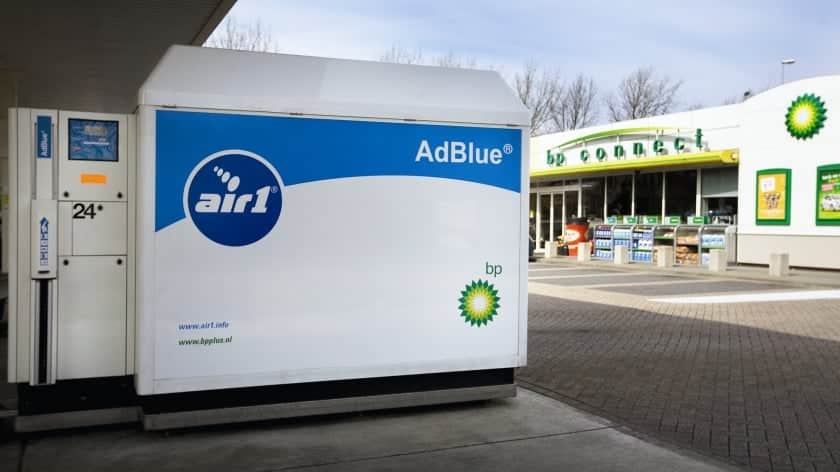
Also, look out for blue pumps springing up next to diesel pumps at service stations around the country with prices from around 60p a litre.
How much you’ll need depends on your tank size, which is separate from your fuel tank, and can vary from 5-20 litres.
Usage depends on driving style so to be on the safe side reckon on one litre per 500-600 miles, so if you’re a high-mileage company car driver you’ll need to make regular top-ups.
How does it work?
Here’s the clever scientific part. The technology behind AdBlue is called Selective Catalytic Reduction (SCR), which requires the controlled injection of AdBlue into the exhaust chamber, when the engine’s running.
The aqueous urea vaporises and decomposes to form ammonia and carbon dioxide. Within the SCR catalyst, the NOx are catalytically reduced by the ammonia into water and nitrogen, which are both harmless; and these are then released through the exhaust.
The process neutralises NOx emissions by 80-90%. It can also help reduce fuel consumption by up to 5%.
How do I know when to top-up?
All cars equipped with SCR technology will have warning lights as standard and these will typically alert you when you’re down to around three litres or 1,200 miles, depending on your driving style.
SCR-fitted cars also have an on-board computer display with a read-out of the current level. Some will also tell you how many starts you have left when the level is low, if you exceed it your car will not re-start as it would be operating with illegal emission levels. A trip to your dealer would then probably be required to reset the system.
Depending on annual mileage and usage you may not need to do your own refills as they could fall within the car’s scheduled annual services, so your dealer will do it for you; although there will be a charge.
How do I know if my car requires AdBlue?
If it’s diesel-engined and was registered after 1 September 2014 then chances are it requires AdBlue.
Also, some brands have helpfully incorporated the word Blue into model names: Mercedes-Benz Bluetec, Peugeot and Citroën BlueHDI and Ford EcoBlue.
Where’s my AdBlue refilling point?
Unfortunately, carmakers have not standardised on the location for the refilling point which explains why some owners are oblivious that their car requires AdBlue until the warning light comes on.
The most obvious and owner-friendly place is behind the fuel flap alongside where you fill up with diesel, with the AdBlue point bearing a distinctive blue cap.
However, many brands have opted to locate it in under the boot floor, with some even positioning inaccessibly under the spare wheel, making refills a chore.
If in doubt check your owner’s manual.
Can I put AdBlue straight into the diesel tank?
Absolutely not! Putting AdBlue direct into your diesel tank can cause you a world of misery akin to misfuelling with petrol.
If you do this then don’t switch on the engine. Immediately contact a reputable specialist to drain your tank.
Likewise, if the filling point is in the engine bay, as it is on many vans, you don’t want to get it muddled up with screenwash or oil.
New car registration result for May 2018 have been published by the Society of Motor Manufacturers and Traders (SMMT) this morning, showing modest growth of just over 3% on the same month last year.
It’s the second month of modest growth over 2017 figures, although it needs to be borne in mind that the second quarter of 2017 was very poor as a result of changes to road tax and the general election. The numbers are still lower than results from May 2014 – 2016 but, nevertheless, car companies and dealerships will be heartened to see a second month of stability rather than substantial decline.
It was a particularly positive month for private new car registrations, up 10% on the same month last year. This will be heartening for car dealers as that means a significant increase in the number of customers visiting their showrooms, whereas fleet and business sales often never touch showrooms at all. Fleet sales were fractionally down on last May’s numbers, and business numbers were down (although business registrations only make up about 3% of total numbers).
Market share for diesel cars was up fractionally on last month, which may be an indication that demand and supply are starting to settle at around 30% of total market share. Diesel sales were still down more than 23% on last year, but this is the first result in a long time where diesel’s market share hadn’t declined further than the previous month.
Alternatively-fuelled vehicles (essentially electric and hybrid cars) were up slightly to just under 6% of the total market share, which is the best it has been all year – although more rapid growth is still needed to help the industry start moving towards the government’s target of 100% by 2040.
It was a good month for superminis, SUVs and sports cars, which all saw strong growth over the same month last year. In what was the hottest May on record, convertibles also saw strong growth on last year’s results.
Of the mainstream manufacturers, it was a poor month for Nissan (down 18%), Mercedes-Benz (down 9%) and Fiat (down 35%). Meanwhile, things were happier at Volkswagen (up 15%), Land Rover (up 17%), SEAT (up 46%) and Renault (up 15%).
As usual, the Ford Fiesta sat atop the sales charts in May, but not by much. Right behind was its larger sibling, the Ford Focus – now in full run-out mode ahead of the all-new model arriving soon. The Audi A3 snuck back into 10th place as the Ford Kuga fell back out again.
Commercial vehicle registration data will also be released today, and we will be covering that over on our sister site, The Van Expert, this afternoon.
What is it?
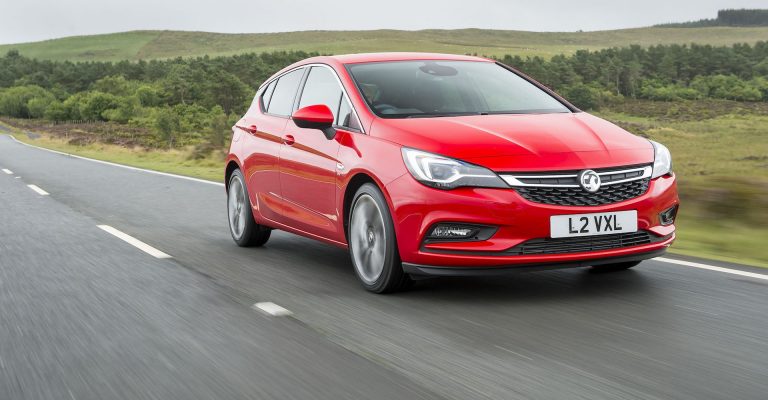
The current Vauxhall Astra is the seventh generation of a core British-built family hatch.
Key features
Efficient downsized engine, quality cabin, plenty of tech
Our view
The Vauxhall Astra remains a best-seller because it does everything it needs to highly competently, without exceeding in one area to the detriment of others.
It’s easy to live with, offers a quality interior, has enough performance while majoring on ride comfort, and boasts competitive levels of equipment.
The Vauxhall Astra is built in Britain.Similar cars
Ford Focus, Honda Civic, Toyota Auris.
Astra is the only Vauxhall car in the range that is truly British, built in Ellesmere Port on Merseyside.
Full review
Introduction
Vauxhall appears quite suddenly to have remembered its British roots – “British brand since 1903,” all the adverts now remind us. And the one Vauxhall car in today’s range that is truly British is the Astra, built in Ellesmere Port, on Merseyside.
The seventh-generation Astra was launched in 2015, a major step forward for the long-lasting model and an evolution that earned it the European Car of the Year award. The judges were impressed by a radical reworking that included a significant weight loss, upgraded interior and improved dynamics, and these have helped keep the car highly popular – sixth best-seller in the UK in 2017.
Vauxhall continues to evolve the Astra – only in May were two new, more efficient engines announced for it. However, The Car Expert’s test model focuses on the significant shift to petrol and the most up-to-date downsized versions, the 1.0 turbo.
More Astras are sold to British buyers than in any other European market – so is it as good as painted?
Buying and owning a Vauxhall Astra
The Vauxhall Astra has been around in its various generations for so long – Ellesmere Port has been building them for more than 40 years – that it is easy to forget it amongst perhaps newer and more curiosity-inducing models from the likes of Korean brands.
Both the Astra and its entire sector are now also under serious threat from the rise of the SUV – dealers will find visitors walking through the doors of the showroom turning increasingly to the Mokka and another SUV, the Nissan Qashqai, now vies with the Astra for the title of the biggest-selling British car.
So perhaps Vauxhall’s new ‘True Brit’ campaign is no real surprise, reminding us just how important this particular car has been to the UK, with such thought-provoking claims as one in four Brits has driven an Astra…
Of course, bold words are no good if the product does not match up. Fact is, there have been some pretty dull Astras in the past, which is perhaps part of the reason why the latest version, on UK roads in 2016, earned almost rave reviews.
Vauxhall’s design types took the famed clean-sheet approach when penning the latest Astra, which they had to as its closest rivals the Ford Focus and Volkswagen Golf had both just been renewed to wide acclaim.
The new car launched with a new, more purposeful shape, from its sharply styled front to the signature two-tone rear screen pillar. – this was the most aerodynamic five-door car yet produced by Vauxhall and sister brand Opel.
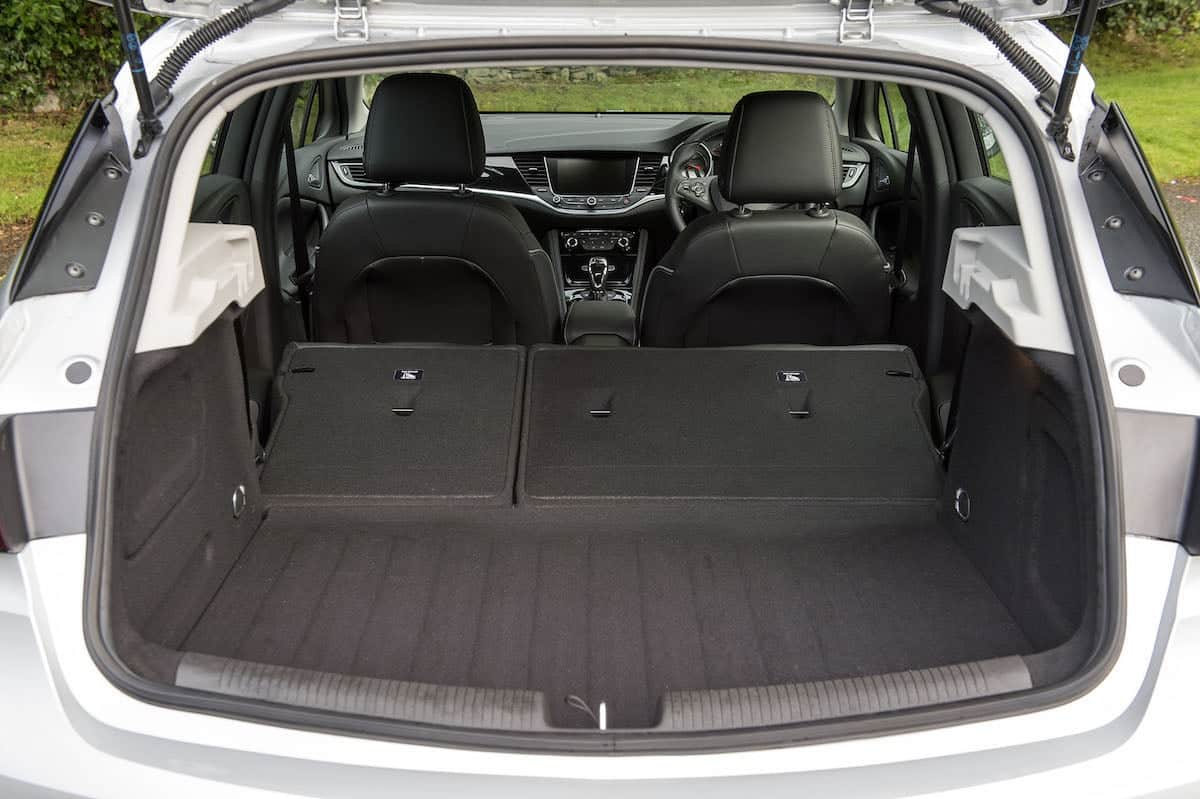
It was also a significantly lighter one too, by at least 130kg, making the most of the brand’s new modular platform. All of which was good news for economy and emissions, as well as on-the-road performance. And this all came in a car that was actually smaller than its predecessor – 5cm shorter, 2.5cm lower and even with a 2cm shorter wheelbase, but thanks to that modular construction, more interior space.
A prime consideration making the Astra attractive to buyers has been value for money. The new model saw the number of trim levels on offer simplified but today, including ‘sub-trims’ such as the Nav version of the SRI model, there are still nine different varieties to choose from. They start from the entry-level Design at £17,670 and range up to the Ultimate starting at £25,490.
Equipment levels are a positive aspect of the Astra – even entry-level Design models include air con, cruise control, daytime running lights and the Intellilink infotainment system. Operated through a seven-inch touchscreen on the centre console, this includes DAB radio, Bluetooth, and Apple CarPlay and Android Auto smartphone integration – meaning, of course, you don’t have to worry about paying for a satnav-equipped model as you can simply pipe the app on your phone through the screen.
Popular with many buyers is the SRI trim as worn by our test car and starting from £20,270. Notable among its features are the OnStar suite of connected services, including wi-fi and emergency crash response. But be warned that Vauxhall intends to shut down these services after the end of 2020.
The SRI also includes a front camera system with autonomous emergency braking, and Astra safety standards rate highly – the car earned a top five-star rating when crash-tested by EuroNCAP in 2015, and this was without the AEB taken into account as it was not standard equipment.
Inside the Vauxhall Astra
The interior of the Astra is where some of the greatest gains have been made – it is of higher quality, and with generally spacious surroundings, though the rising rear window design can make the back seats feel tighter than they really are.
In fact, the modular construction has liberated more space in a shorter car – there is for example 35mm more legroom in the back. Generally, the Astra competes with its direct rivals for space while not outclassing them.
A definite step forward is the dash layout. The redesign saw the important controls placed together in a more logical fashion – those dealing with vehicle functions are close by the gear lever, the climate control in the lower half of the centre console, and the infotainment on the top half.
Particularly noticeable is the infotainment touchscreen – its glass runs right to the edges of the console which looks much more attractive than a plastic surround. Commands are very responsive too, though the sat nav graphics can’t match some recent versions on rival cars from the likes of the VW Group.
The steering wheel falls naturally to hand and feels comfortable, though it is somewhat festooned with buttons. Again they are fairly logical to use, but just a little fiddly.
Driving the Vauxhall Astra
Engine choices for the Astra depend on model. You won’t currently find hybrids or anything electric-related in the line-up, though that is set to change within the next few years.
The most traditional unit is the entry-level 1.4-litre petrol engine of 100hp, the only Astra powerplant not boasting a turbocharger. Much more interesting is the 1.0-litre 105hp unit in our test car. It may be less powerful than its 1.4-litre sibling but it is quicker to 60mph by some two seconds (taking 10.5 seconds in manual form), and boasts fuel economy improved by around 12mpg, and CO2 emissions some 20g/km less.
Further petrol choices include 1.4-litre turbo units of 125 and 150hp, and the range-topping 1.6-litre of 200hp, which passes 60mph from rest in 6.6 seconds.
Diesel buyers currently get three versions of what Vauxhall describes as its ‘whisper-diesel’ with either 110, 136 or 160hp. Best-selling of the three is the middle one, on the basis of a nine-second 0-60mph time, plus 74mpg fuel economy and emissions dipping under (just) the 100g/km barrier.
Coming soon are replacements for both the 200hp turbo petrol and the 136hp diesel, both conforming to the new ‘real-world’ emission regulations.
Remember when a 105hp engine of only 1.0-litre capacity would have been sneered at? No longer. The turbo unit in the Astra is enthusiastic and picks up strongly, while remaining pleasingly refined, particularly for a three-cylinder unit. It combines well with the five-speed manual transmission.
On the road, the Astra offers everything one would expect of a family car – most importantly, it is a comfortable ride. Only the most damaged of surfaces (typical south-east roads for example) are seriously felt in the cabin, the response from the chassis somewhat firm.
The car cruises motorways for mile after mile in a relaxed manner, while point it at a series of corners and it will tackle them with confidence. The steering is perhaps just a little on the light side, but SRI versions do include a sport mode that firms up the response, though not to a degree that would challenge the acknowledged leader in handling prowess, Ford’s Focus.
Summary
Does the Vauxhall Astra deserve a Best-of-British title? It does, because while like its predecessors it doesn’t write any radical headlines, it does do everything required of it rather well, which some of those predecessors didn’t.
On offer here is a well-designed, well-built car that will fit so seamlessly into an owner’s everyday life that they will almost fail to think about it. This is not a criticism – so many car buyers want an easy-to-live with car, that makes the journey from A to B a non fatigue-inducing process – a willing and capable servant. In that role, the Astra ticks all the boxes.
Electric cars have seen huge growth in their first decade as a readily available mode of transport – but they’ve still not made it into the public consciousness as a viable vehicle for everyday life.
Try now to forget all your preconceived ideas about EVs. Forget the gimmicks and concept-like design, and instead imagine a performance Jaguar with enough practicality to suit your nuclear family.
Not only has Jaguar produced a car that looks as desirable as any other car from the marque, it’s apparently capable of travelling up to 298 miles on one charge, takes just 45 minutes to charge to 80% and it’ll be available from just under £60,000 with the government grant. You’re right, it sounds too good to be true.
What’s new?
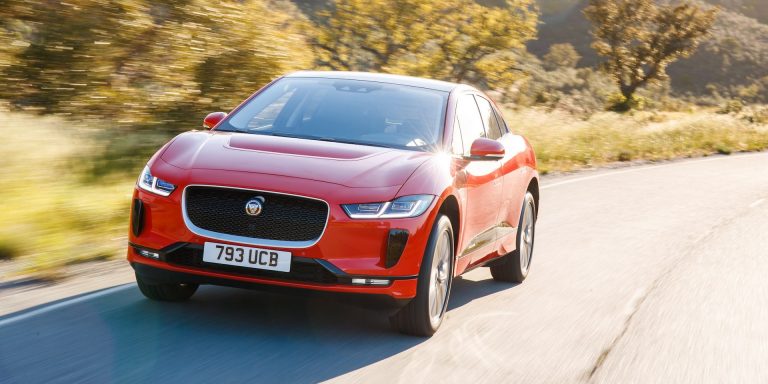
The I-Pace is a completely new car, designed from the ground up specifically for Jaguar. It’s the first electric car created by the brand – if we forget about the one-off electric E-Type – and follows on from the design language of the Big Cat’s existing SUV ‘Pace’ range.
That said, while it is recognisable as part of the family, this electric vehicle has a unique style as it’s been created with maximum range in mind.
There are some key style points that make the I-Pace stand out from other Jaguars. It might be billed as an SUV but it doesn’t really look like one. Designer Ian Callum explained that to accommodate the batteries the car had to be taller, which led to this profile, but at 1.5m the I-Pace still has a sleek, sporty look.
The wheels sit flush with the body of the car, giving it a stockier appearance but aiding with the aerodynamics too. It’s also got a cutaway in the bonnet for cooling that you might not even notice unless you’re standing next to the car.
What’s the spec like?
While the whole car might be new, you’ll recognise the infotainment as very JLR. In particular, the dual touchscreen on the centre console is from the Range Rover Velar.
You also get a third screen behind the wheel and can specify the car with a head-up display. These features all look the same, but for an EV there are some extra touches to make life simpler.
If you’re planning a route, the I-Pace can tell you how much battery will remain at each destination and this data will update as you drive. It also has other electric-specific features, such as a false futuristic noise you can have pumped around the cabin as you drive.
If you’d rather just enjoy the silence, though, you can turn this off, which acts as an exterior noise canceller too.
Next page:Step inside and take a drive
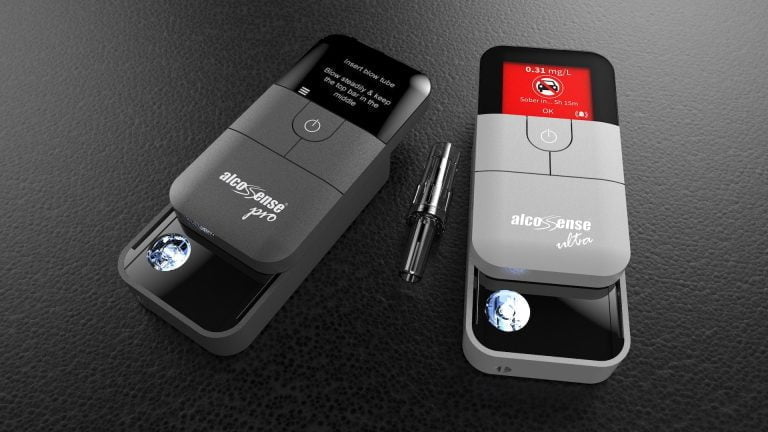
In recent years, the popularity of personal breathalyser units has grown enormously. Some countries, like France, insist that all drivers carry breathalysers (either a reusable unit or at least two disposable units) at all times. Advances in technology have meant that you can now buy a portable device that is basically as accurate as a police breathalyser unit for not a lot of money.
Berkshire-based AlcoSense was founded about 13 years ago, and has grown to become one of the world’s most respected breathalyser manufacturers. The company has won a swag of awards for its range of single-use and reusable breathalysers, both for performance and design. Overall, it’s a genuine British success story.
We’ve been trialling the top-of-the-range unit from AlcoSense, called the Ultra, over recent weeks. It’s priced at £250, which sounds expensive at first glance. But what are you getting for your money?
The AlcoSense Ultra uses exactly the same size and specification sensor (called a fuel cell) as the £2,000 hand-held breathalyser units used by police forces in the UK, Europe and America. It also includes 100 mouthpieces (£40 worth when you eventually need replacements), and can be plugged into a PC to record results. Fuel cell breathalysers are the most accurate of any type of breathalyser, which is why the police use them for both hand-held units carried by patrols and the larger units located at police stations.
That sounds like overkill for a personal breathalyser, and let’s face it – you probably don’t need to record your test results in a spreadsheet or table. But if you are an employer and want/need to test a large number of employees on a regular basis, and want/need to record those results to ensure adherence to your company policies, then it would be perfect. Or if you just want the reassurance that you’re buying the most accurate unit on the market, this one could be just the ticket.
The Ultra is the flagship of the AlcoSense breathalyser range, which also includes two cheaper fuel-cell units, the mid-spec AlcoSense Pro (£150) and the entry-level AlcoSense Excel (£100). Below that are a number of units that use different technology – cheaper to buy, but not as accurate. The company claims that the Ultra is slightly more accurate than the Pro, which is slightly more accurate than the Excel, but that all three are more than accurate enough for personal use requirements.
As well as the police-spec sensor, the Ultra comes with 100 one-way mouthpieces (about £40 worth), which reflects its workplace suitability, and a neat protective case (an extra £10 on the cheaper models). The Pro comes with five mouthpieces, while the Excel comes with five simple blow tubes rather than the more sophisticated mouthpieces. AlcoSense says that you can re-use the mouthpieces, but you must make sure that they are completely dry to prevent moisture getting into the electronics. Replacement mouthpieces come in a pack of 25 for £10. The blow tubes should really only be used once, and they are sold in a pack of 25 for £5.
It’s important to also remember that any breathalyser unit, regardless of make and model, needs to be re-calibrated annually to remain accurate. The AlcoSense units will give you an on-screen reminder, and you’ll have to send the unit back to the manufacturer every year for calibration at a cost of £25. The same will apply to other brands.
Auto Express conducted a group test including the Excel and Pro a few months ago, and found that both units were outstanding. The Pro was slightly more accurate but that the Excel was still very accurate and better value for money.
Putting the AlcoSense Ultra to the test
We had the chance to compare the Ultra side by side against a freshly-calibrated police unit made by Draeger, as used by many police forces around the world. The two units were tested multiple times using a pre-mixed solution of water and ethanol, and produced almost identical results.
Just to be sure, we also conducted a human trial here in The Car Expert office. Having each had a beer or two at lunchtime *for science*, three of us blew into the machines later in the afternoon (ideally, you shouldn’t take a reading within 90 minutes of drinking as the results could still be changing up or down quite rapidly). Once again, the results from the police unit and the AlcoSense Ultra were almost identical.
As an added bonus, the Ultra was easier to blow into, requiring a smaller lungful of air and less effort than the police unit. If you do blow over the legal limit, another handy feature is an estimate of how long it will take you to drop back below the limit and be able to drive.
Any breath test unit will lose accuracy over time, whether its a police unit or a personal device – hence the annual calibration requirement. The AlcoSense fuel cell units have a built-in system to ensure that the unit will not under-read, so that any variation will only over-read. In other words, the unit may tell you that your blood alcohol level is 0.09% (over the limit) when you’re actually at 0.07% (legal in England/Wales/NI), but never the other way round.
Why should you buy a personal breathalyser unit?
Official figures from the Department for Transport show that nearly 20% of all drink-drive incidents happen the morning after a night out. A lot of the time, drivers are surprised that they are still over the limit, especially if they don’t have a hangover. The message about not driving home if you’re out drinking has been rammed home for many years, but warnings about driving the next morning are less familiar.
While you may know what the legal limit for blood alcohol is, how well do you know your own body’s tolerance for alcohol? How confident are you that you’re not over the limit the morning after a big night out? A hangover is not a suitable indication that you’re still over the limit – you may have little to no alcohol in your system but still be quite dehydrated and feeling poorly. Conversely, you may feel fine but still be intoxicated.
How often have you got into a car the morning after the night before and not really known (or even thought about) whether you should really be driving?
The main benefit of a personal unit like those made by AlcoSense and others is the reassurance and peace of mind to know that you’re legal (or not) to drive, without having to guess. It’s certainly a lot easier than trying to remember how many drinks you had, and how many units of alcohol that equates to, and how long ago that was, and whether you had anything to eat, and so on, and then guessing whether you’re OK to get behind the wheel again.
Having never used a personal breathalyser the morning after a drinking session, I’ve spent the last few weeks doing a quick check on the AlcoSense Ultra in the morning if I’ve been out the night before and had a few drinks. While it appears that my life hasn’t been exciting enough to register a positive score on the unit, it has been surprisingly satisfying to know that I am well under the legal limit rather than just assuming I was OK.
Ultimately, it only takes one unplanned night out to potentially change your life for good. There are plenty of stories of people who have been caught driving under the influence of alcohol and seen their lives spiral downwards rapidly afterwards – even if they avoided an accident while driving drunk. Losing your licence can easily mean losing your job, and it can be a slippery slope from there to financial and other problems.
How much is your job worth, how much is your car worth, how much are your kids worth, how much is your marriage worth? Regardless of how sober you feel, is it really worth risking any or all of those things? A personal breathalyser unit might seem expensive at first glance, but it’s pocket change compared to what it could save you.
Score: 9.5/10
Good points: The best unit on the market, bar none.
Bad points: Ultra is probably overkill for personal use; Pro or Excel models are cheaper and still perfectly acceptable for personal use.
Mercedes-Benz has added a new top-end petrol and a new diesel engine to its E-Class range.
Top of the newcomers is the Mercedes-AMG E 53 4MATIC+. Replacing the previous E43 and costing from £62,835 as a coupé, £69,285 for the cabriolet, the car is powered by a 3.0-litre biturbo in-line six-cylinder petrol engine.
This uses Mercedes’ latest mild hybrid system, called EQ Boost, in the starter motor that can add 20hp and 350Nm of torque to the 435hp and 520Nm generated by the engine. It is combined with a nine-speed auto transmission and all-wheel drive.
The E 53 coupé hits 62mph from rest two-tenths quicker than the previous E 43, taking 4.4 seconds, with the cabriolet a single tenth slower. Both are limited to a 155mph top speed, though the options list includes an AMG Driver’s Package increasing the top speed to 168mph.
Coupé efficiency figures are 32.5 combined mpg and CO2 emissions of 203g/km, the drop-top returning 32.1mpg and 20 g/km.
The powertrain is also offered in the CLS 53 coupe saloon, which costs from £74,050 and sprints through 62mph in 4.5 seconds, returning 31.7mpg with CO2 emissions of 203g/km.
Also new is the E 400 d 4MATIC diesel, offered in both saloon and estate form at £52,685 and £54,685 respectively and replacing the previous 350 d engine.
The 3.0-litre straight-six turbodiesel puts out 340hp and 700Nm, compared to the 258hp and 620Nm of its predecessor and good for a 4.9-second 0-62mph time (5.1 sec for the estate). The saloon returns 48.7mpg and 154g/km, the estate 46.3mpg and 161g/km.
DS Automobiles is adding a new and more powerful petrol unit to the engine range of its DS 7 Crossback SUV.
The DS 7 Crossback went on sale in March with a 180hp petrol engine, plus 130hp and 180hp diesels. Now that range is being expanded with a 225hp four-cylinder petrol unit.
DS claims that with the new engine the DS 7 Crossback outperforms all its rivals, the unit offering gains in performance, fuel economy and efficiency. The 225hp is combined with 300Nm of torque and a 48.7mpg combined cycle fuel economy figure – the latter 6% better than the Citroën 210hp unit that the new engine replaces.
Technology advances include the adoption of a continuously variable valve lift system, multiple injection management, reduced friction and a redesigned turbo compressor.
Emissions have also been a priority, with a new petrol particle filter fitted and emissions reductions applied across the entire powertrain to achieve a CO2 figure of 135g/km.
The new engine is being combined in the DS 7 Crossback with the latest eight-speed automatic transmission produced by DS parent PSA Group. This also contributes to reduced fuel consumption, boasting an Eco mode that ‘free wheels’; at speeds between 12mph and 80mph, each time the driver lifts their foot off the accelerator, the engine returns to idle and disengages the gearbox.
DS Automobiles is making the 225hp unit available on Ultra Prestige, Prestige and Performance Line trim levels of the DS 7 Crossback, with prices starting from £34,990.
What is it?
The latest Ford Mustang is a revamp of the sports car with more technology, personalisation and improved safety.
Key features
Better safety package, 10-speed auto transmission, digital display.
Our view
The swift update of the latest Ford Mustang addresses viable safety concerns with a suite of now standard-fit electronic aids that go some way to meeting the criticisms levelled at it. Added to these are a number of technology updates that are generally positive, though true enthusiasts will likely prefer the directness of a six-speed manual shift over the clever but sometimes easily confused 10-speed auto.
The Mustang remains a car in which the bigger, thirstier V8 is actually the more attractive option, and an affordable way to enjoy such oh-so American eight-cylinder grunt.
Similar cars
Porsche 718 Cayman, BMW 2 Series Coupe, Audi TT
An appropriate venue to test the Mustang’s new “drag mode”
Full review
Introduction
It seems only yesterday that we were road testing the sixth-generation Ford Mustang, and the first version of the iconic American muscle car to be officially sold in Europe with a proper right-hand-drive version for us Brits.
In motor industry parlance, it was indeed only yesterday. That launch test was just two years ago, in April 2016. With more than 6,000 UK sales since, a third of them last year, why produce what amounts to a mid-life revamp quite so quickly?
Ford will point to the march in technology and the opportunity to add a swathe of it to the car and up its desirability. These amount to such advances as magnetic dampers to improve the ride and traction, a 10-speed auto gearbox and a ‘drag mode’ to produce the fastest-accelerating Mustangs around. There is also a slight power hike for the V8, conversely a reduction to the 2.3-litre but also a little more torque to increase its fun factor.
What Ford is not saying too loudly, however, is that quite a lot of this update addresses the unwanted headlines earned by the Mustang. Safety body Euro NCAP slammed the car’s crash test standards after giving it a two-star rating, the worst result in a decade for any car from a top-ten manufacturer.
Euro NCAP was scathing of Ford’s decision not to offer safety equipment on European and UK Mustangs that is included or available in American markets. So, unsurprisingly, the updated model gets a host of such tech, including autonomous emergency braking.
Visual changes, meanwhile, encompass a sleeker, lower nose, bigger front splitter, new wheel designs taking the options to four, and LED headlamps with the ‘tri-bar’ signature shape now forming a daytime running light – this we are told was the result of customer feedback.
Also new is a bright ‘Orange Fury’ exterior colour, taking the options to 11 as Ford seeks to evolve the personalisation possibilities – popular in the US where we are told virtually no two Mustangs look alike. They will in the UK as the orange has immediately become the most attractive colour on the new model, attracting one third of the pre-orders.
However, it is under the paintwork where the differences really count – how significant is this upgrade?
Buying and owning a Ford Mustang
The sixth-generation Mustang launched in both fastback and convertible versions, and the revamp has been applied equally across both.
Both remain available with a choice of petrol propulsion – a ‘sensible’ 2.3-litre four-cylinder EcoBoost unit or the 5.0-litre V8 which is, of course, the signature powerplant of the model. This gets an extra 38 ponies, taking it to 450hp. The torque figure remains the same at 529Nm, as does the thirst – between 20 and 23mpg depending on whether one shifts gears or lets the car do it.
Despite this, almost three-quarters of Mustang buyers will choose the V8 over the four-cylinder, especially as this has seen a power reduction – down from 316 to 290hp. However, it is combined with an extra 8Nm of torque helping to improve its usability.
Most significant drivetrain update is the arrival of a 10-speed auto transmission. Complete with steering-wheel paddles, this replaces the previous six-speed unit.
Buyers who want the fastest-accelerating Mustang will need to go the 10-speed route. Combined with a new (strictly for the track) ‘drag mode’ in the suite of driver settings, this makes for impressive getaways – Ford came up with a memorable way of demonstrating this to journalists on the launch event, as we will see shortly.
A significant addition to the options list is Magneride, adaptive suspension that tailors itself to the road conditions and the way the car is being driven. Available with both engines, it adds £1,600 to the cost.
Standard on the 5.0-litre only is an Active Exhaust. Working on the quadruple tailpipes, it allows four different sound formats, from the most ear-pummelling track mode to a ‘quiet’ mode that allows one to pull away from home early in the morning without waking the neighbours…
Ford personnel on the launch event described the stinging criticism of Mustang safety standards as a “sour point,” and argued that sports cars will always suffer in crash test results due to the restricted access to the back seats.
The new Mustang addresses the criticism with a suite of safety technology now standard on UK models. This includes autonomous emergency braking, pre-collision assist with pedestrian detection, adaptive cruise control, a lane-keeping aid and auto high-beam headlamps.
Such tech makes the new Mustang a significantly safer car than previously. However, we are told that only a three-star rating is expected when Euro NCAP next tests the car.
Inside the Ford Mustang
Generally, Ford was considered to have got it right with the interior of the latest Mustang and this is an area generally left alone by the revamp.
Slip behind the wheel and one still gets the impression of an American muscle car. An abundance of chrome is evident, most notably the horsey badge on the steering wheel boss – one badge you won’t find inside the car is ‘Ford’.
One major change is a digital instrument display – using a 12-inch screen and standard across all models. Its graphics change depending on the drive mode selected – the instrument panel graphics alter colour and shape, right up to a massive rev counter in drag mode.
The drive settings are selected from one of a row of chrome switches across the base of the centre console, and alter such aspects as steering, handling and throttle response. The now six options range across normal, wet/snow, sport, track, drag and a ‘my mode’ allowing the driver to personalise their settings – perhaps combining normal steering with sporty acceleration for example.
Other aspects of the interior include the chunky, immersive seats, and of course the availability of somewhat more cost accommodation in the rear. Yes, these seats are small, but not as small as in the handful of 2+2 rivals thanks to the Mustang’s generous wheelbase.
Driving the Ford Mustang
This is a big sports car – much more Mondeo-sized than Focus, and comes with such a history that the immediate question is, why would you choose the 2.3-litre version?
Of course we tried both, and there are some appealing factors to the baby model. Yes, it’s had some of its horses released into the wild, but still matches its predecessor’s 5.8-second 0-62mph time. That’s with the manual transmission – pair it with the 10-speed auto and it is actually three tenths faster.
However for generally satisfying motoring in the lower-powered ‘Stang, manual is definitely the way to go. Downshifting, in particular, the auto is not as swift as a slick human action, and with all those speeds available certain situations can confuse it.
The 2.3-litre is a flexible companion. It both rides and handles with more control than its predecessor thanks to some suspension upgrades, even if one does not choose the optional Magneride system.
What the four-cylinder model lacks, however, is an image that is part of Mustang folklore. Switch to the big engine, and immediately you notice the much more evocative, grunty audio from the exhaust pipes (yes we did try quiet mode, but not for long…).
Accelerating out of corners, there is much more sense of that V8 pushing you on, without the insistence on good behaviour apparently in the smaller engine’s DNA. And all this comes at the price of around 8mpg in fuel economy – not that much of a difference, and a pointer to why almost three-quarters of UK buyers want V8s.
If you are going to pay V8 money – only around £5,000 more – you should also invest in the Magneride. The system definitely improves the manners, poor road surfaces appear better smothered, while when cornering the car feels just a little more planted and predictable.
Ford reckons that the new auto transmission will be chosen by just over half of Mustang buyers, where previously it was just under half. We are less convinced by this one, it somewhat depends on what you want to use your Mustang for. But where it comes into its own is on the drag strip…
The ultimate demonstration of the 10-speed’s qualities saw journalists on the UK launch event let loose on the famed quarter-mile of Santa Pod drag strip. We also got to test the drag mode, which is a form of launch control also encompassing the line lock introduced with the previous model – warming up the rear tyres by basically shredding them without going anywhere…
Launching from Santa Pod’s Christmas tree starting lights and accelerating up the strip certainly shows the qualities of the 10-speed, as it slams each higher gear in swiftly and sharply, giving a noticeable kick in one’s rear but not enough of one to distract from pointing the car at the horizon.
It’s impressive and addictive… While totally irrelevant to this test, your correspondent feels duty bound to report that he set a 12.9 sec quarter-mile, less than a tenth behind his pro-driver instructor, and third quickest amongst the journos on the day. And he immediately wanted to go again…
Summary
The Ford Mustang is a car bought primarily for a reason – for what it is, and the image that surrounds it. Therefore a package of updates will likely not make a lot of difference to its desirability.
However, this is a worthy update. Firstly it addresses the major issue of safety standards. This is an area that will likely still be of concern when the car is next crash tested, but should not replicate the stinging criticism of previously.
The rest of the upgrades are generally positive – better tech that improves the car’s dynamics and its attractiveness in the market. The jury remains out on the 10-speed auto – those that really enjoy pitching the car against a challenging series of roads will also likely prefer the directness of a manual shift.
In these days of downsizing and a focus on economy, we should of course recommend the smaller, 2.3-litre model. But the smaller engine does not offer enough of an efficiency gain, or a cost saving, to ensure head wins over heart. And the Ford Mustang is very much a car for the heart…

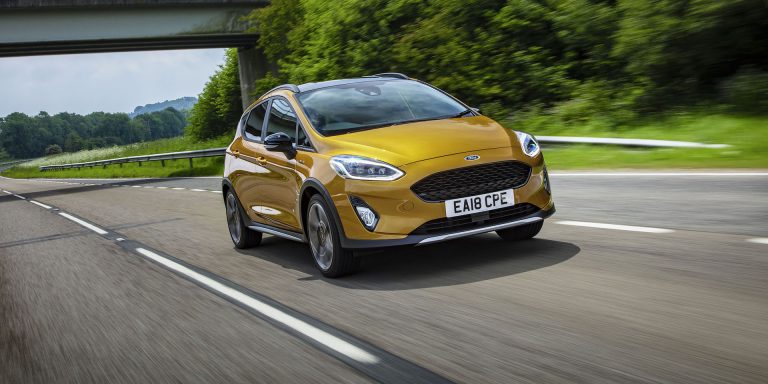


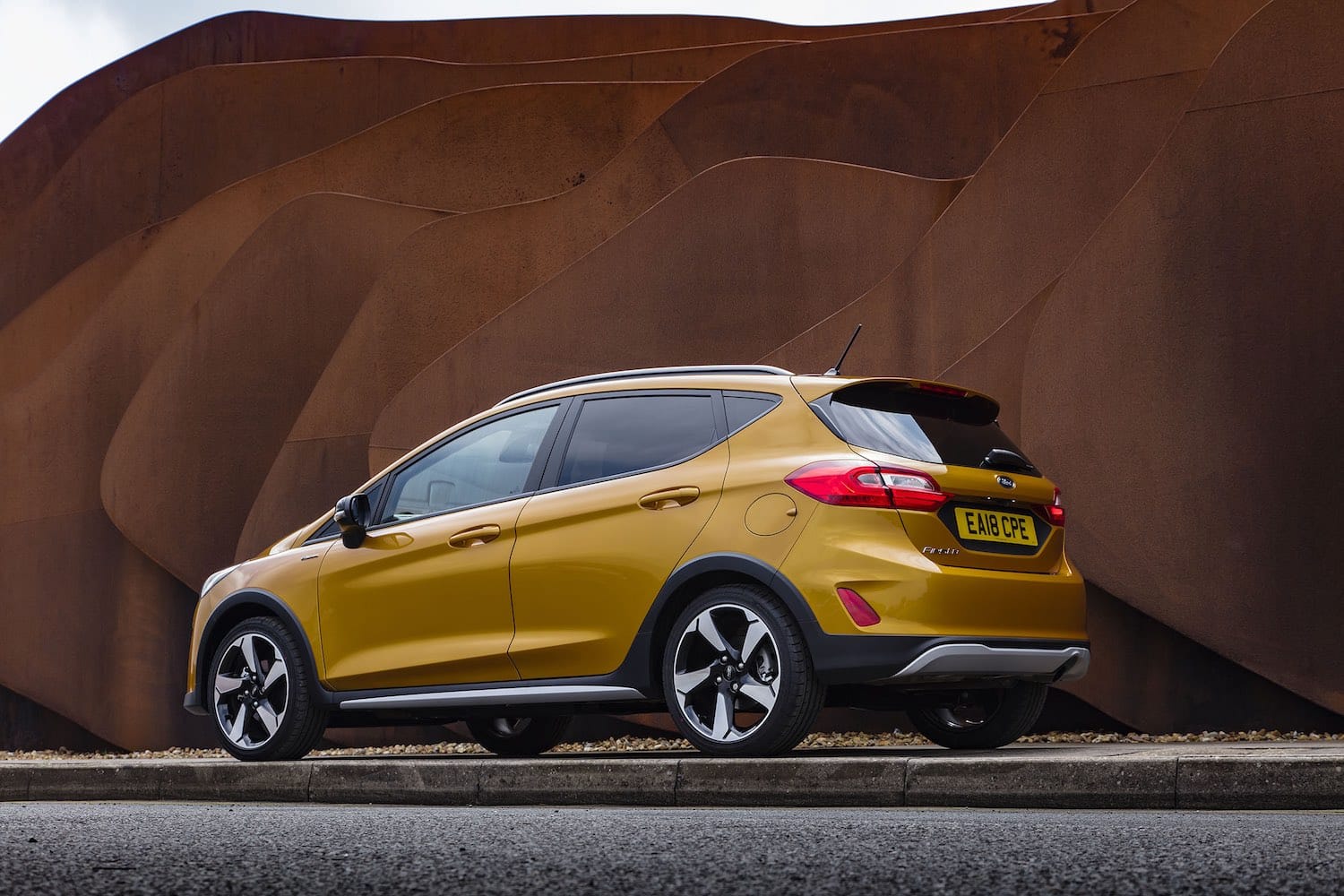
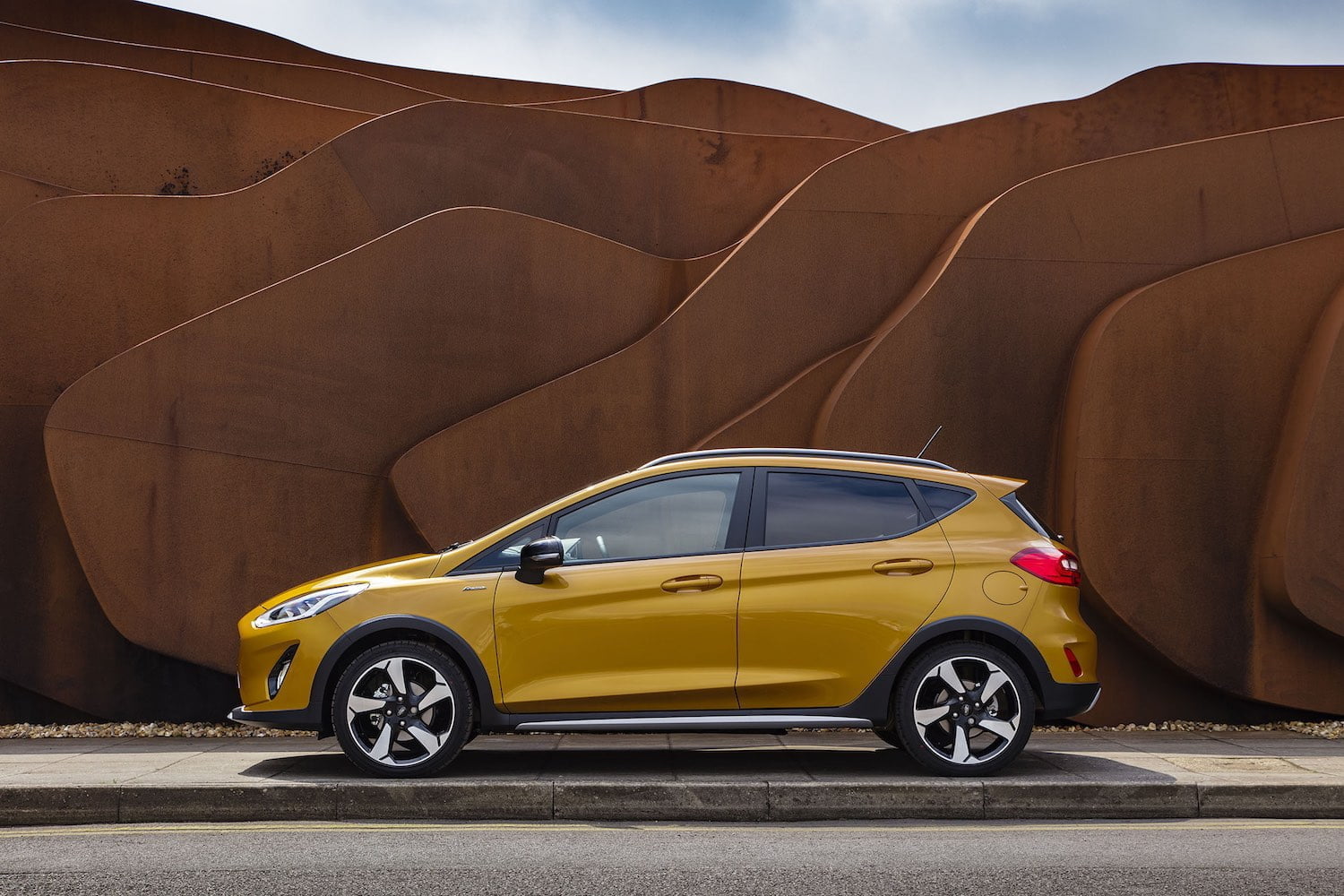

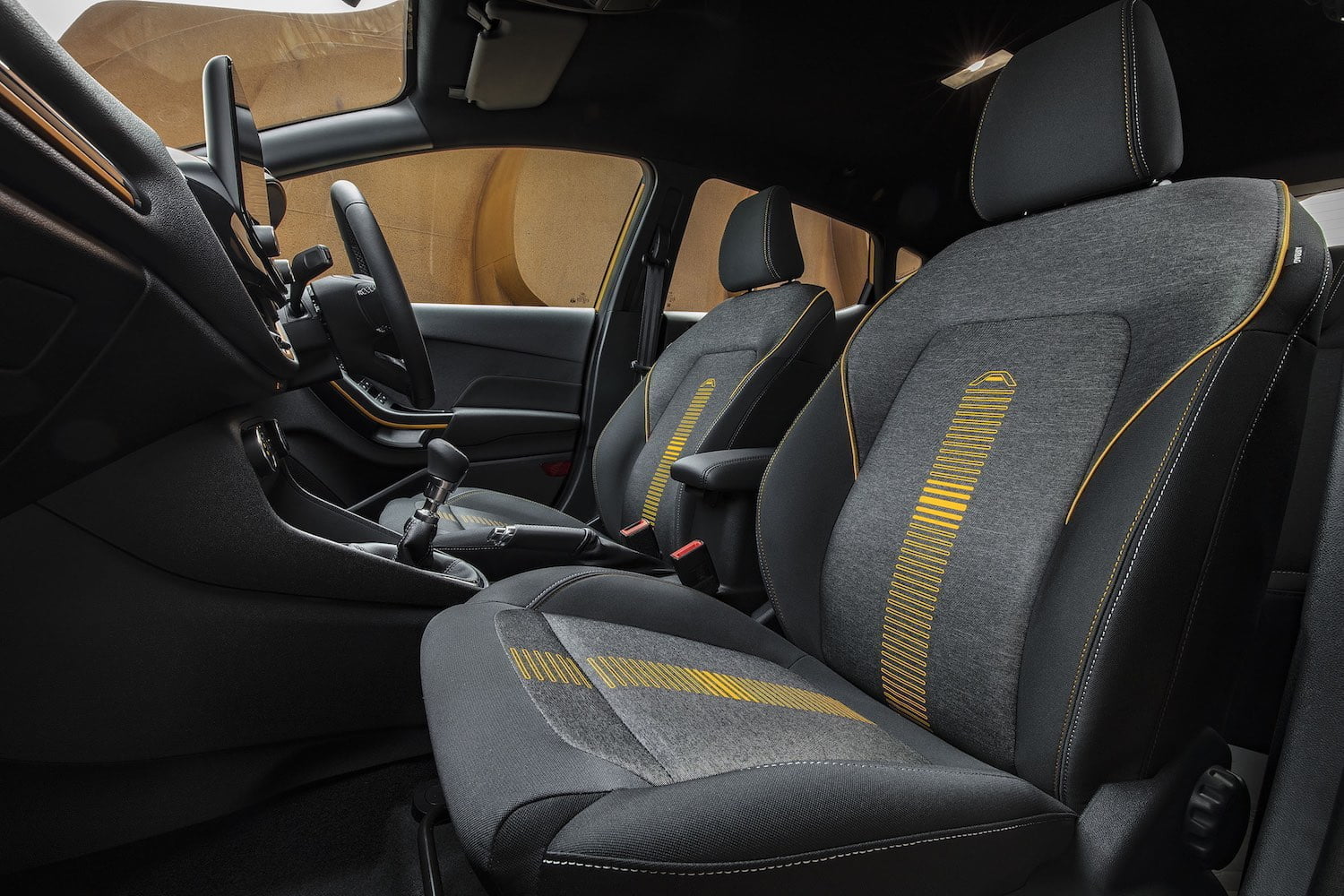
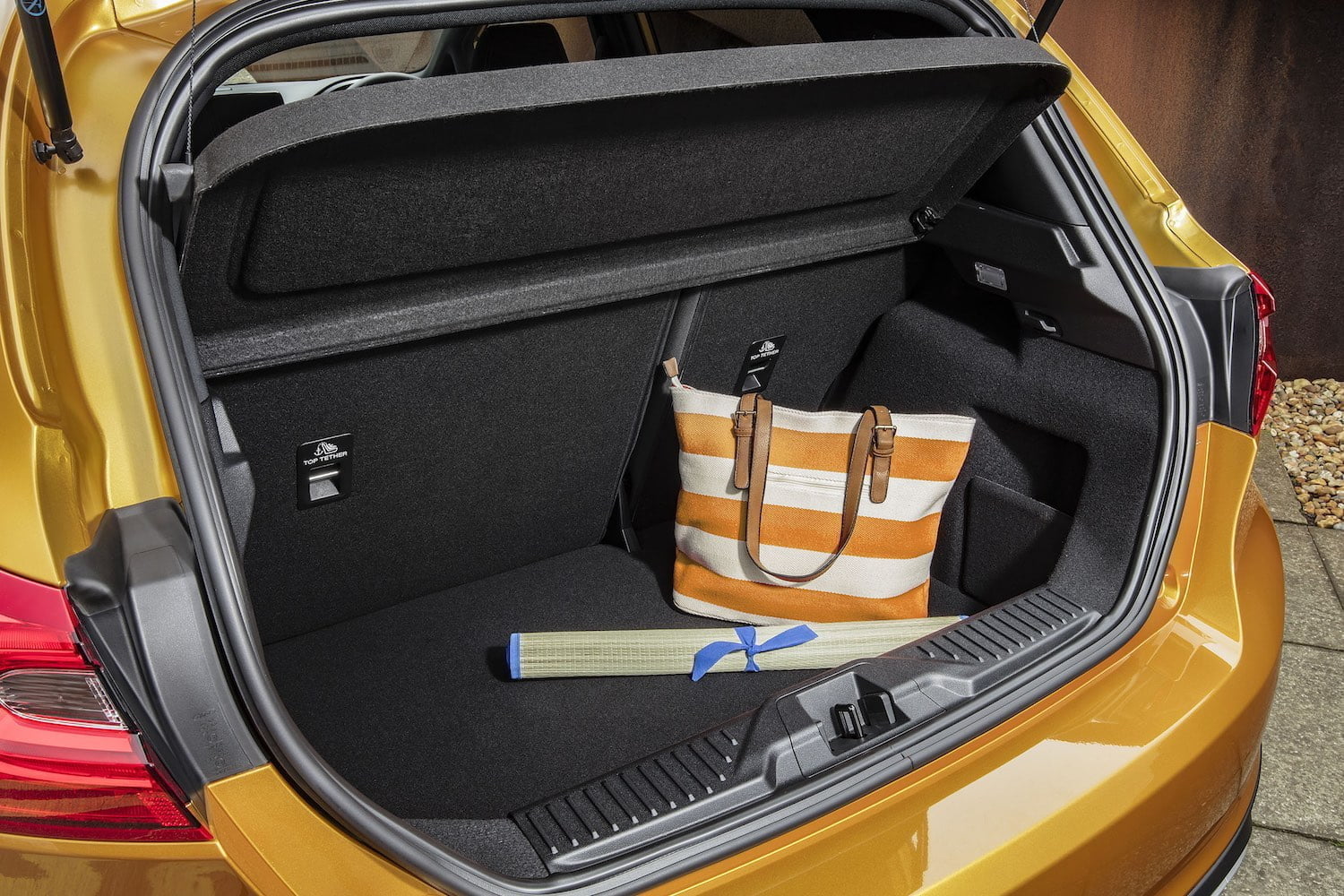
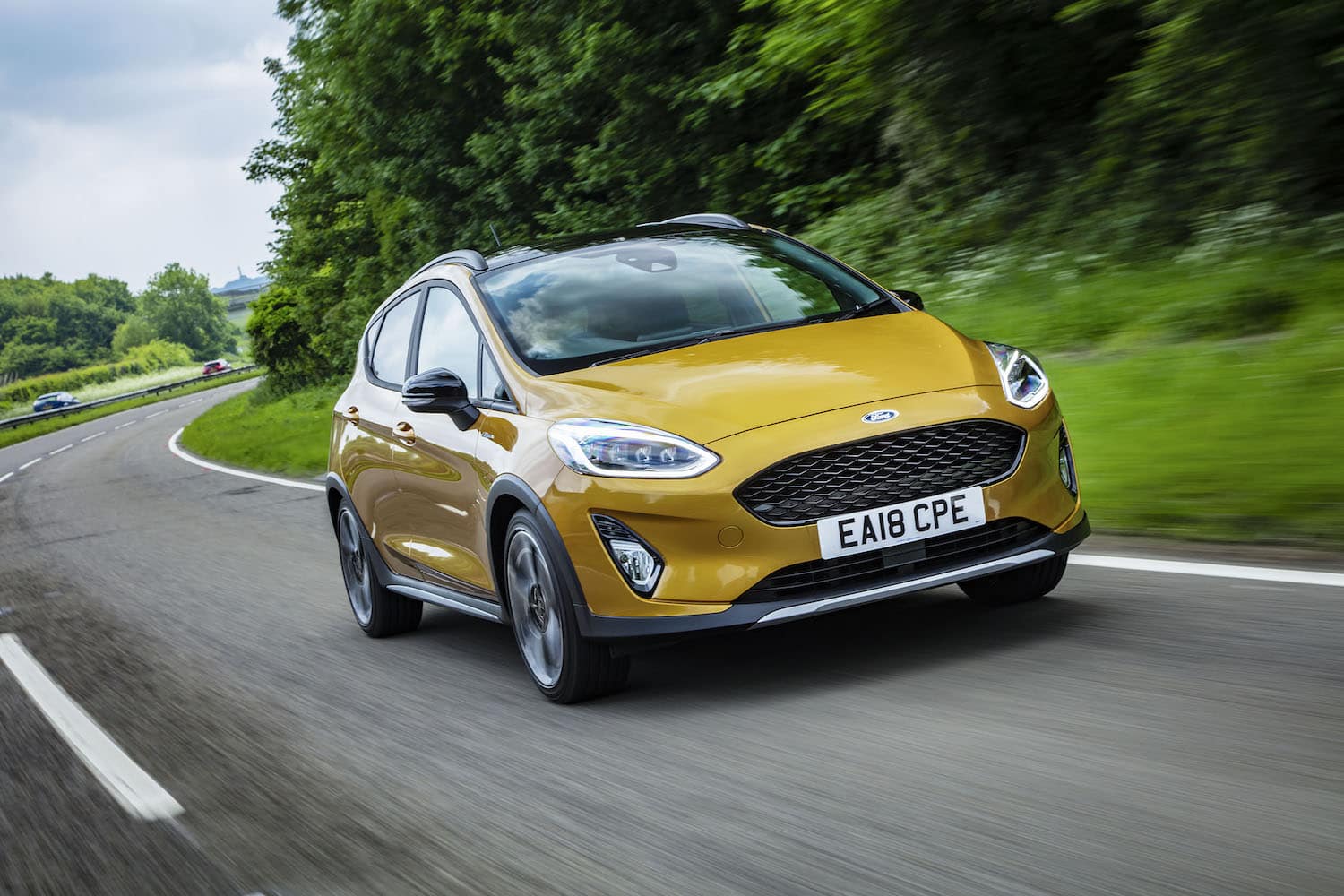

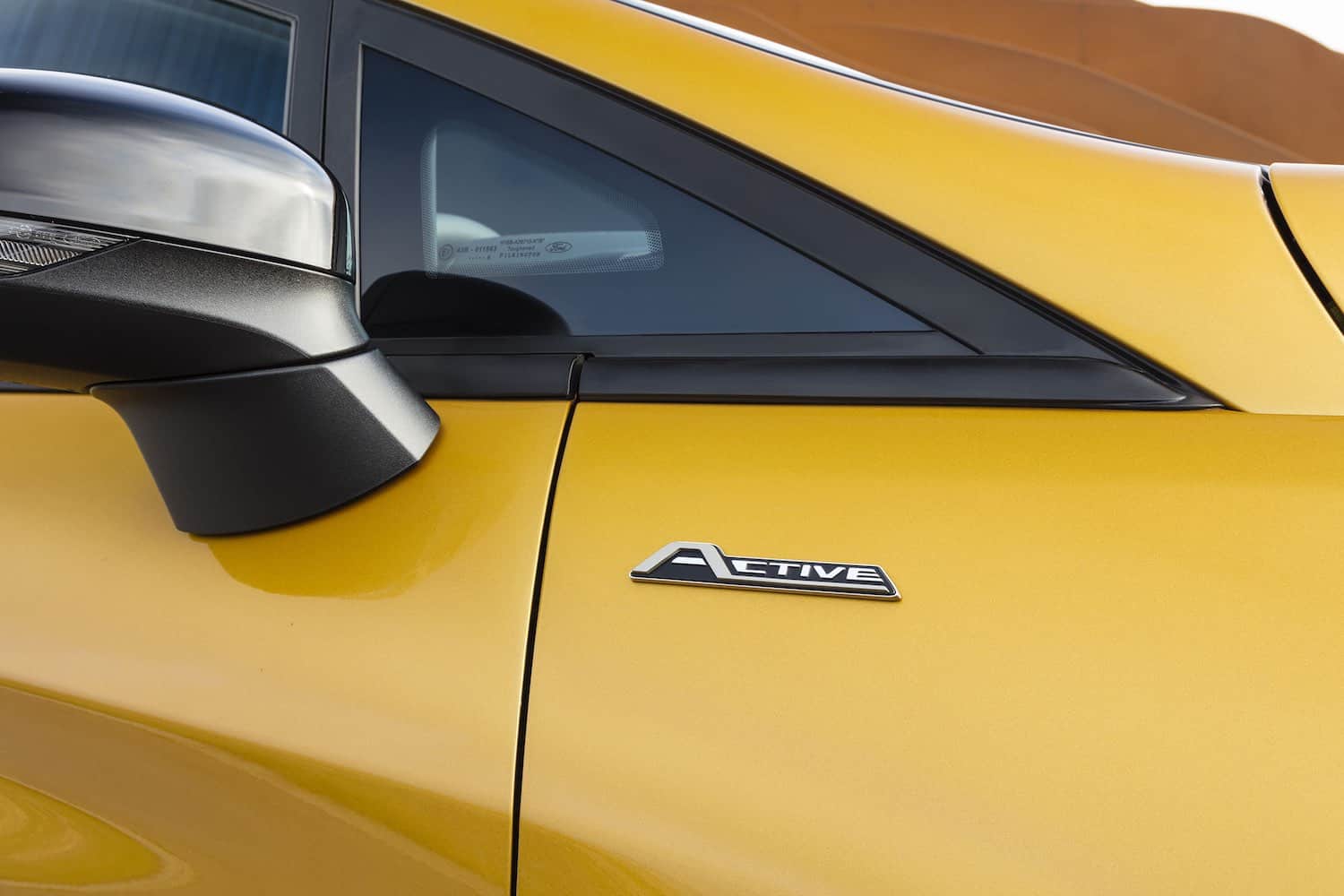


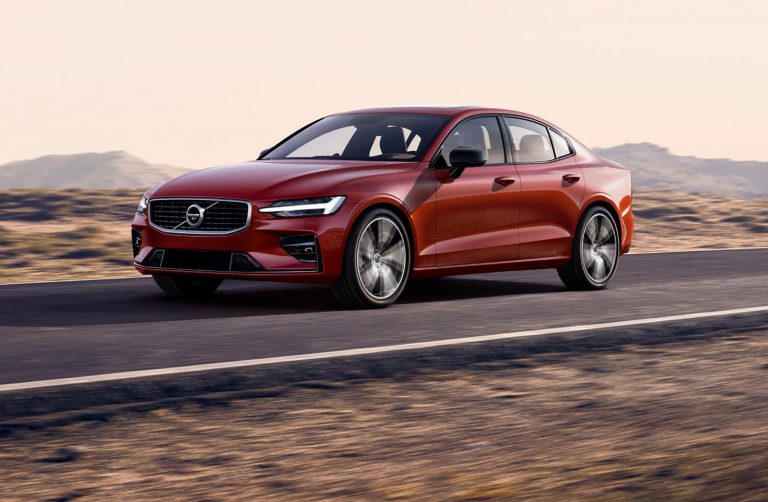
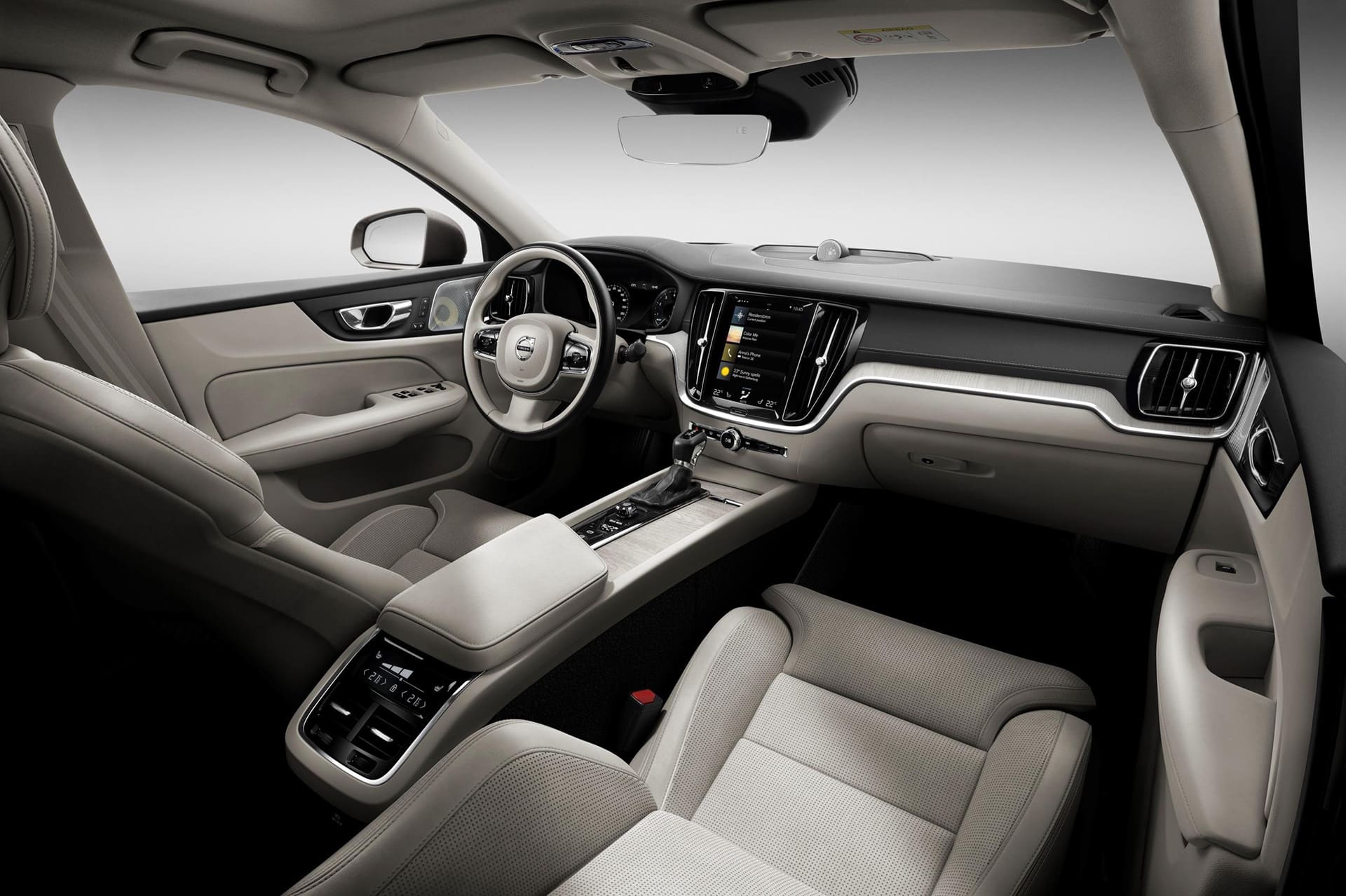


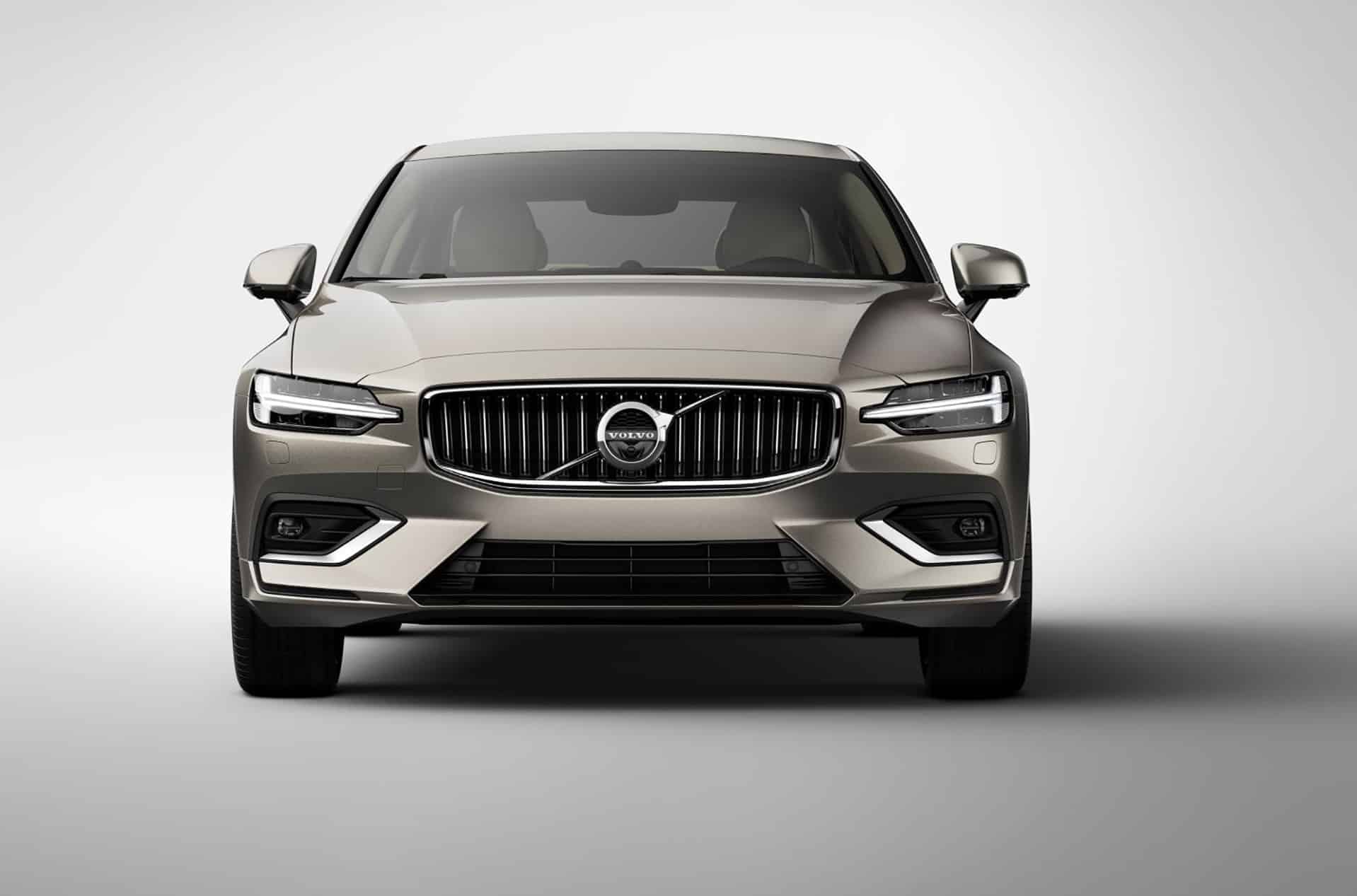


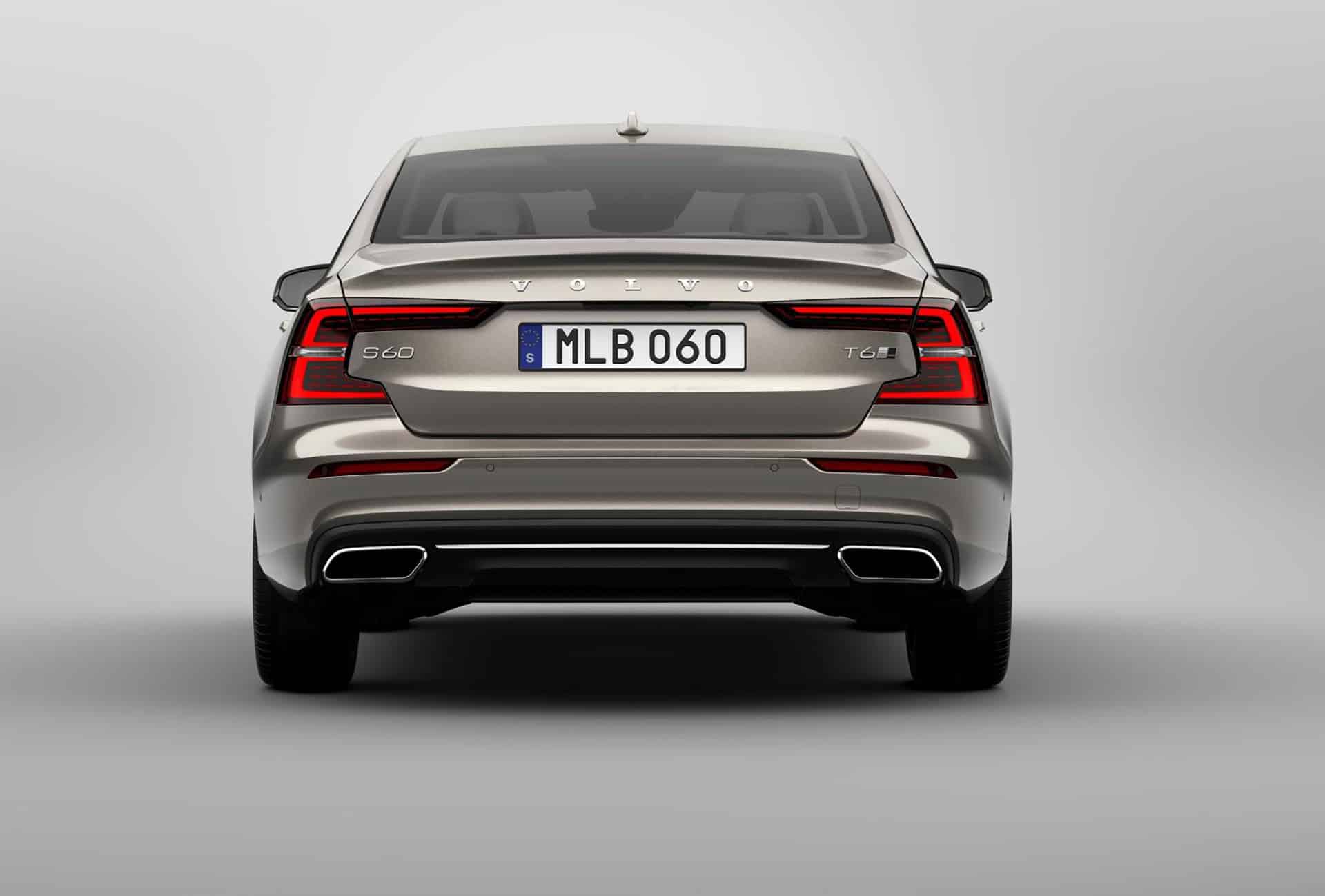
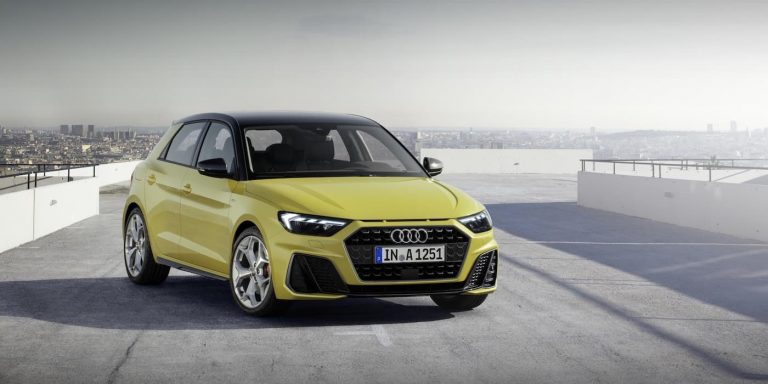

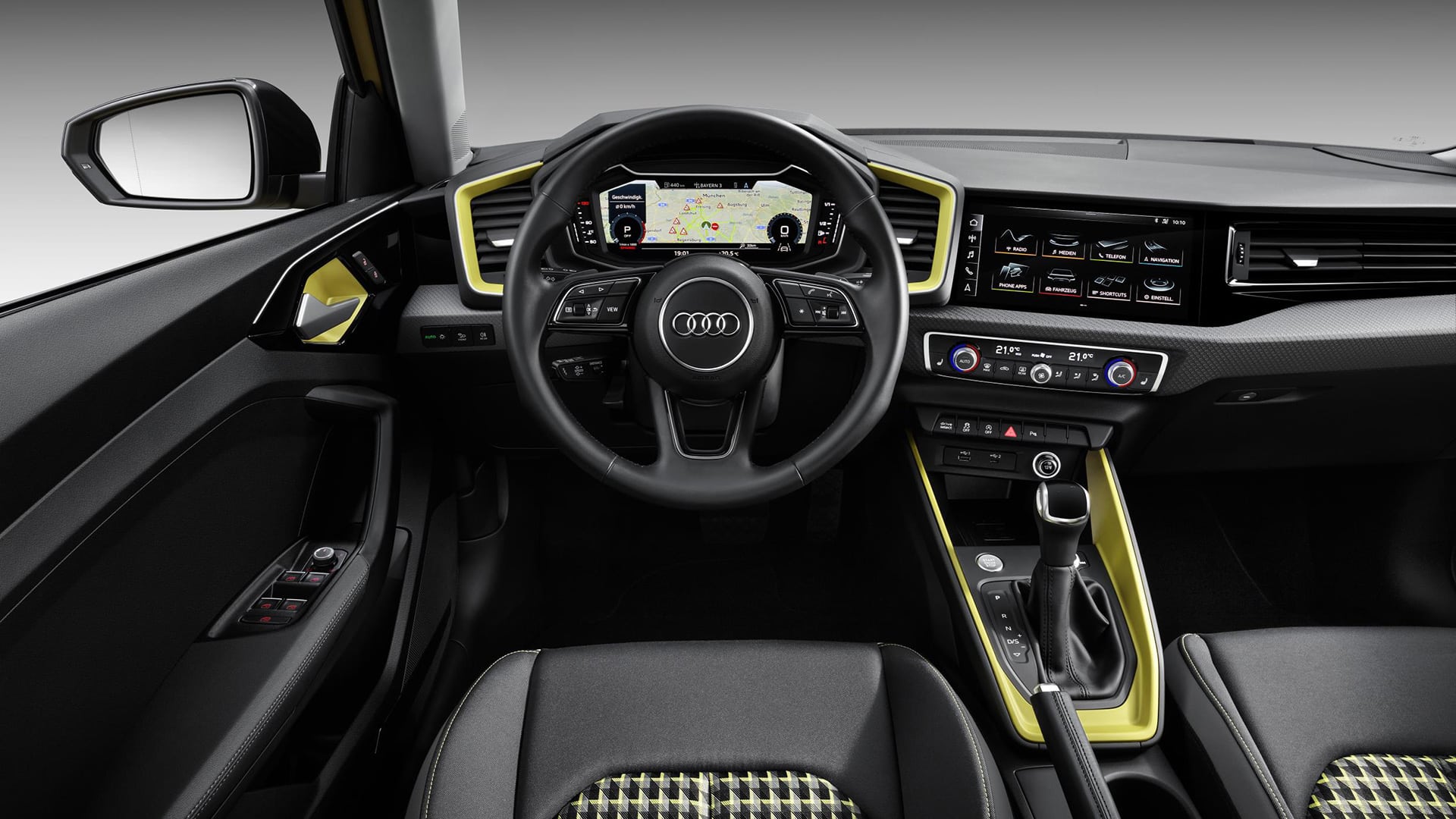


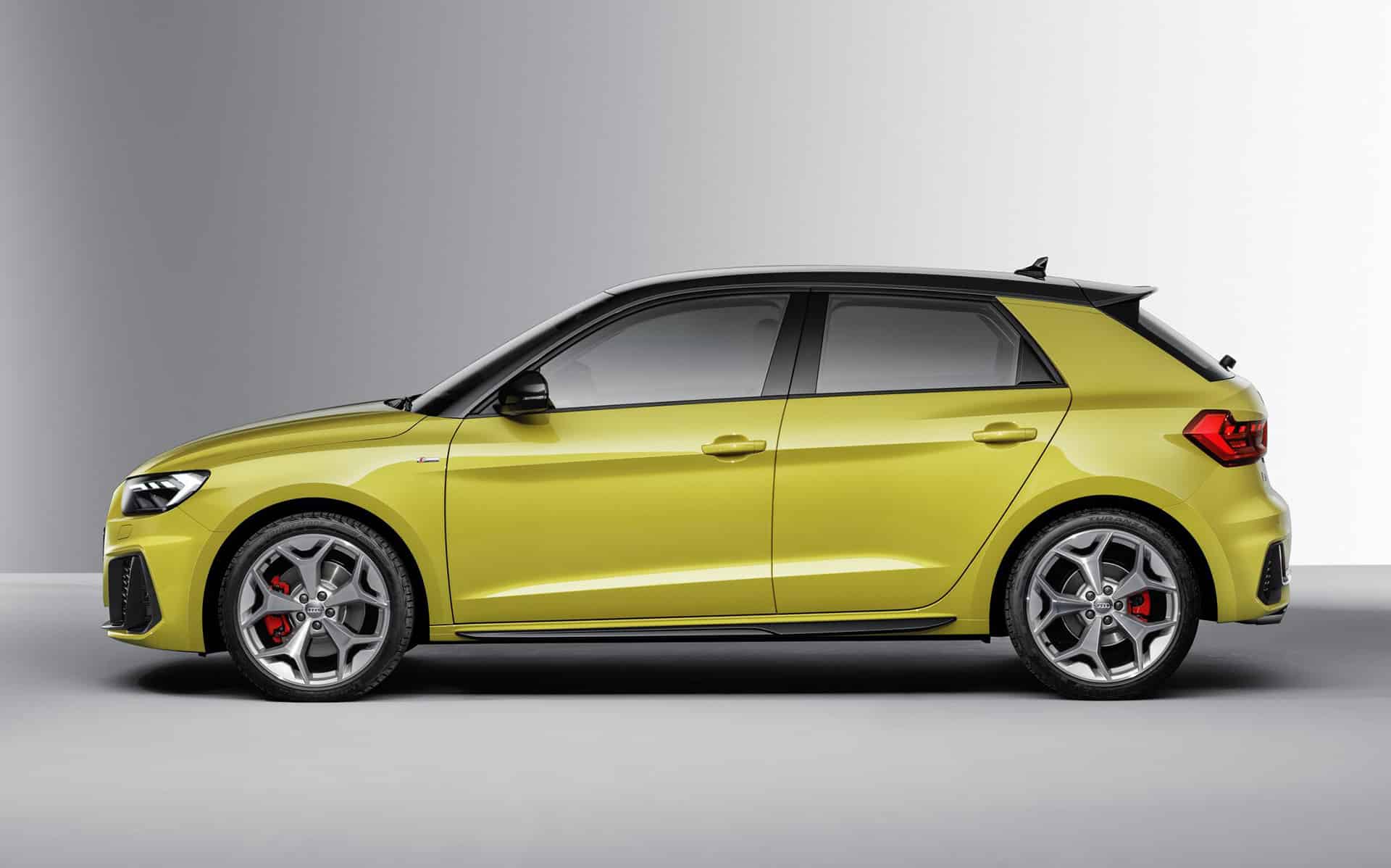

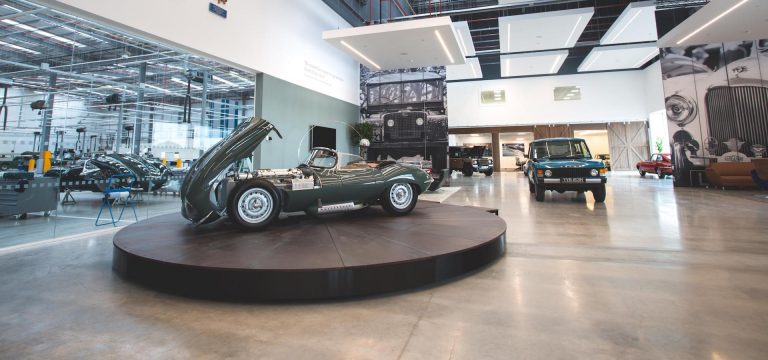


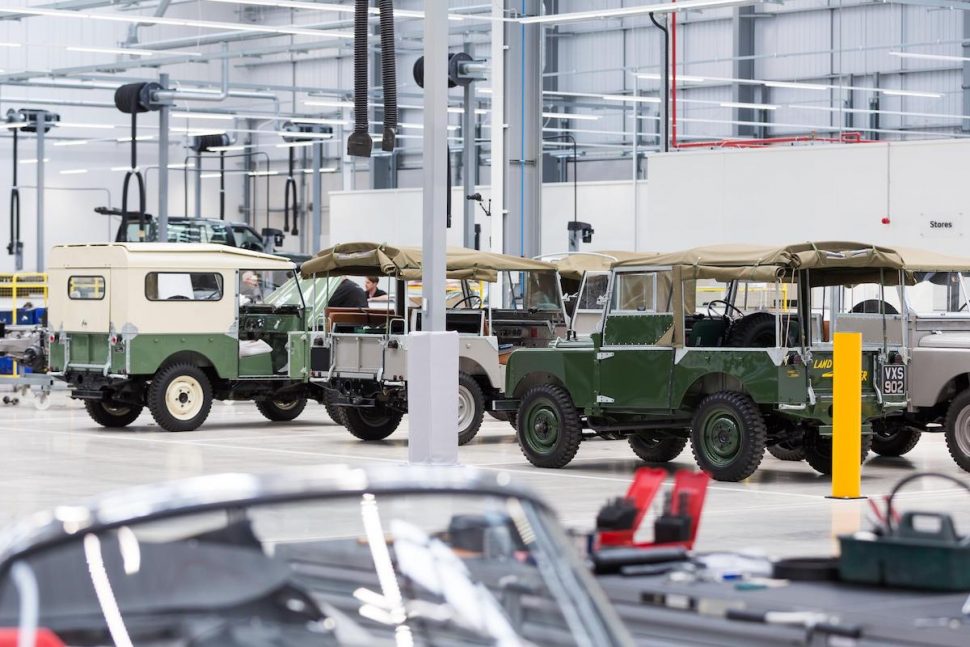


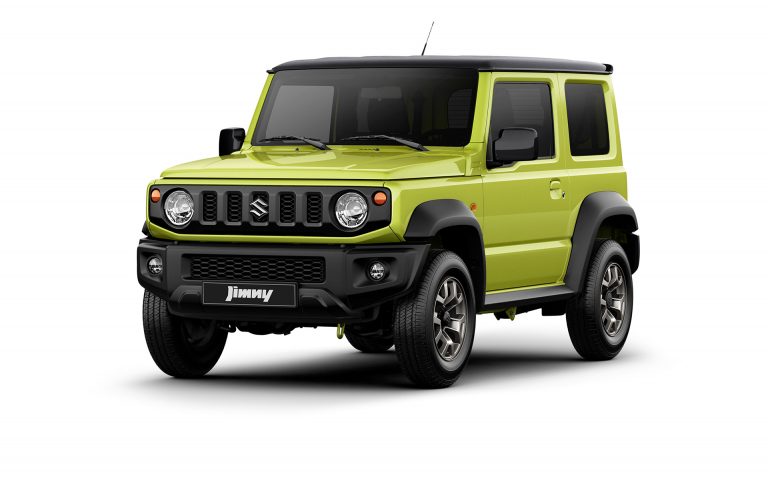
 Current trends to personalisation will be encouraged by a trio of two-tone exterior finishes alongside the five single colours.
Suzuki describes the interior as ‘straightforward, down-to-earth beauty’ but the image shows the brand’s signature centre console layout topped by its standard infotainment screen with satnav and smartphone compatibility for systems such as
Current trends to personalisation will be encouraged by a trio of two-tone exterior finishes alongside the five single colours.
Suzuki describes the interior as ‘straightforward, down-to-earth beauty’ but the image shows the brand’s signature centre console layout topped by its standard infotainment screen with satnav and smartphone compatibility for systems such as 
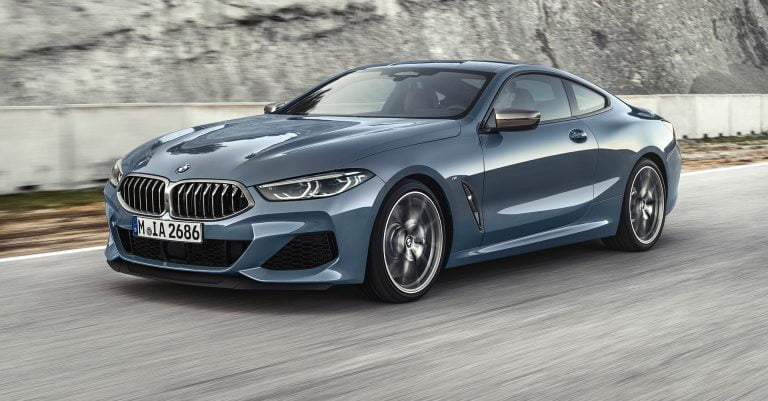
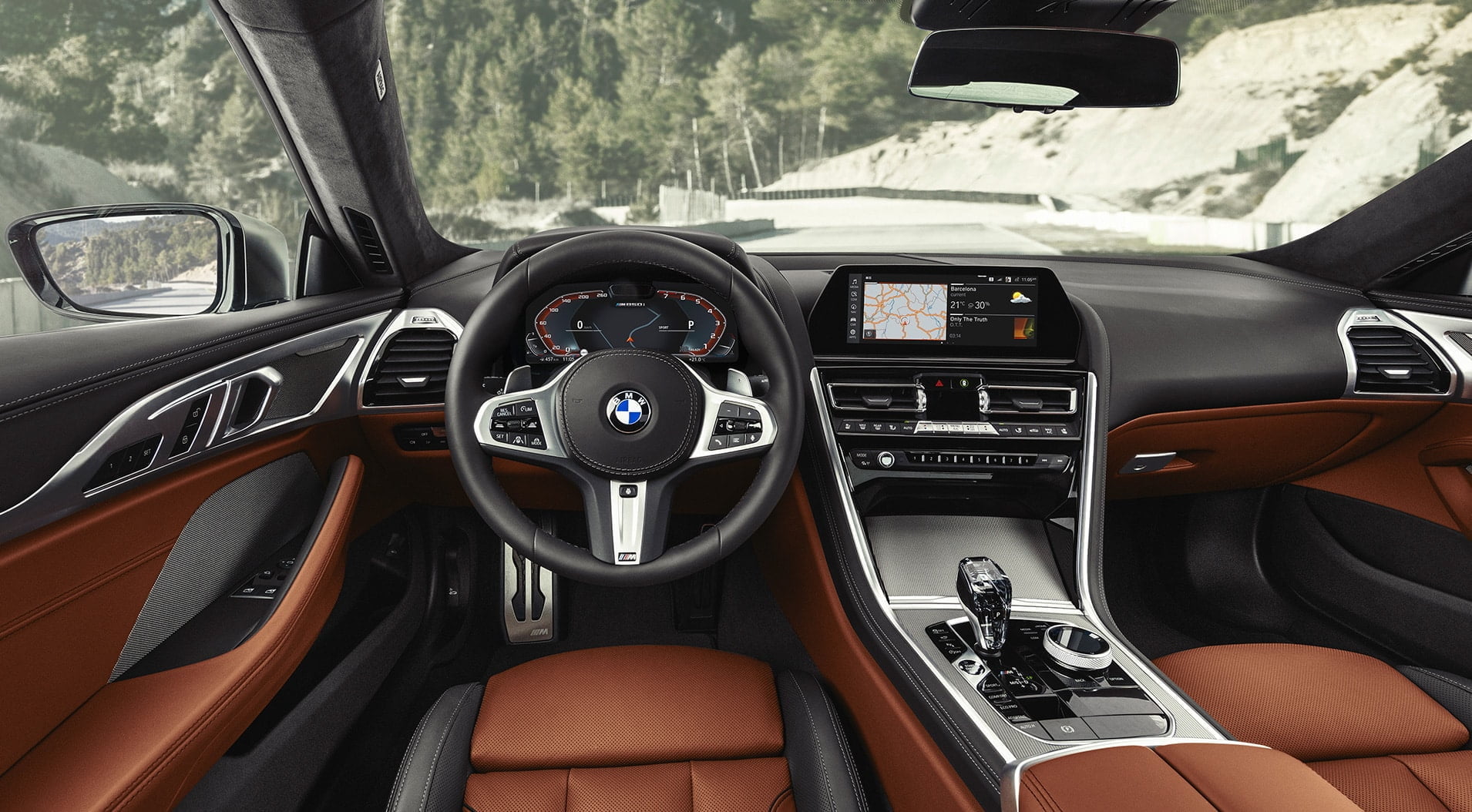 Both engines are matched to an eight-speed automatic transmission and all-wheel drive. The transmission has undergone several improvements including reduced weight, an updated electronic controller and revised ratios. This has helped efficiency by reducing engine speeds.
The transmission also boasts steering-wheel shift paddles for manual control and a launch-control function to enable the most potent acceleration from a standing start.
The all-wheel drive system is rear-biased, with all its torque directed to the rear wheels except when conditions demand more grip on the front axle.
Technology features heavily in the 8 Series – particularly in terms of safety and connectivity. A suite of driver assistance systems under the title of BMW Personal Co-Pilot includes camera, ultrasonic and radar detectors. Cruise control with autonomous braking is standard, as is collision and pedestrian warning, and a head-up display.
Connectivity services include a digital personal mobility assistant service, that integrates with smartphone compatibility extending across Apple and Android devices, as well as Alexa and Google smart devices. It even integrates with Microsoft Office software.
Both engines are matched to an eight-speed automatic transmission and all-wheel drive. The transmission has undergone several improvements including reduced weight, an updated electronic controller and revised ratios. This has helped efficiency by reducing engine speeds.
The transmission also boasts steering-wheel shift paddles for manual control and a launch-control function to enable the most potent acceleration from a standing start.
The all-wheel drive system is rear-biased, with all its torque directed to the rear wheels except when conditions demand more grip on the front axle.
Technology features heavily in the 8 Series – particularly in terms of safety and connectivity. A suite of driver assistance systems under the title of BMW Personal Co-Pilot includes camera, ultrasonic and radar detectors. Cruise control with autonomous braking is standard, as is collision and pedestrian warning, and a head-up display.
Connectivity services include a digital personal mobility assistant service, that integrates with smartphone compatibility extending across Apple and Android devices, as well as Alexa and Google smart devices. It even integrates with Microsoft Office software.
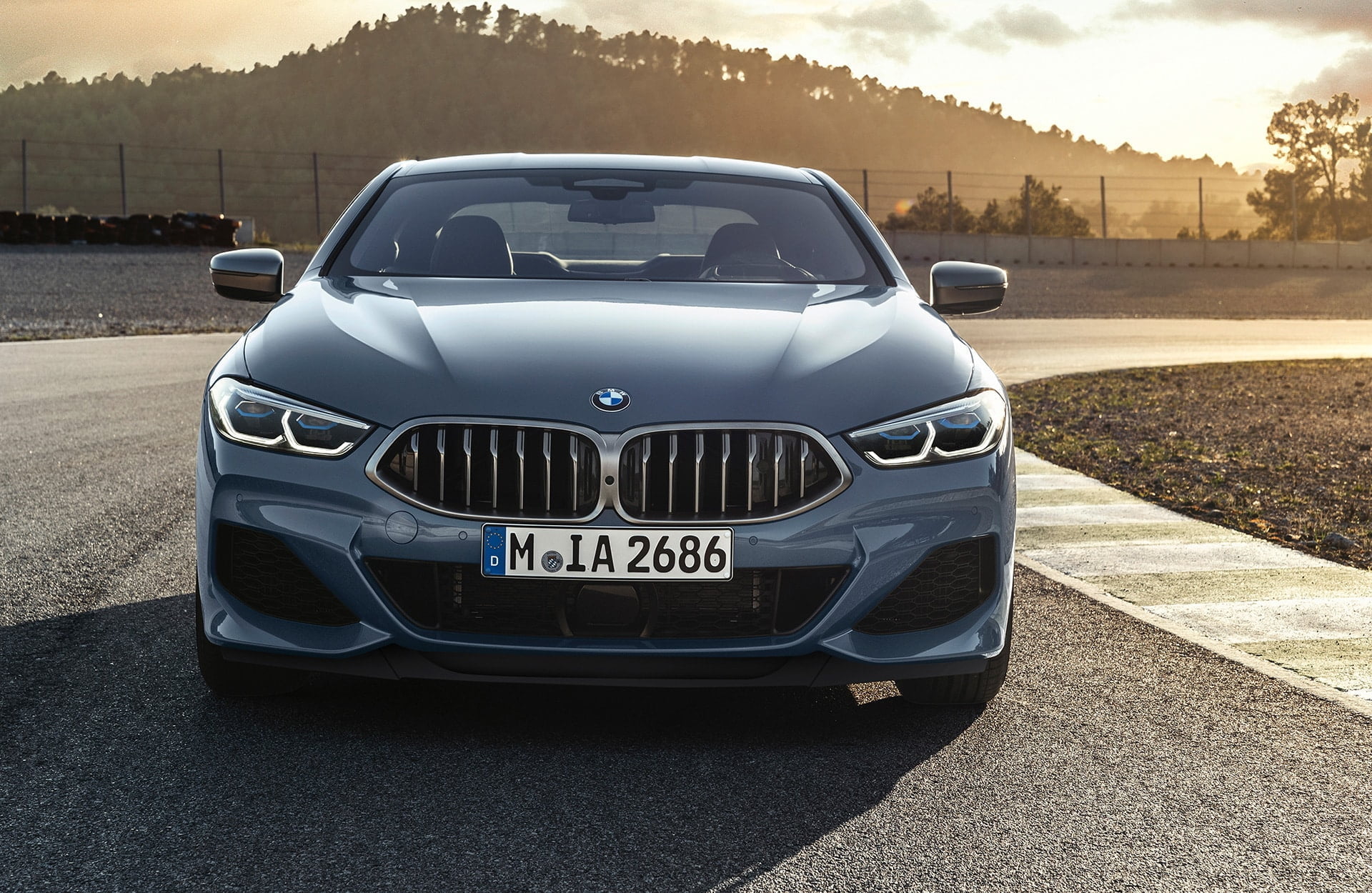
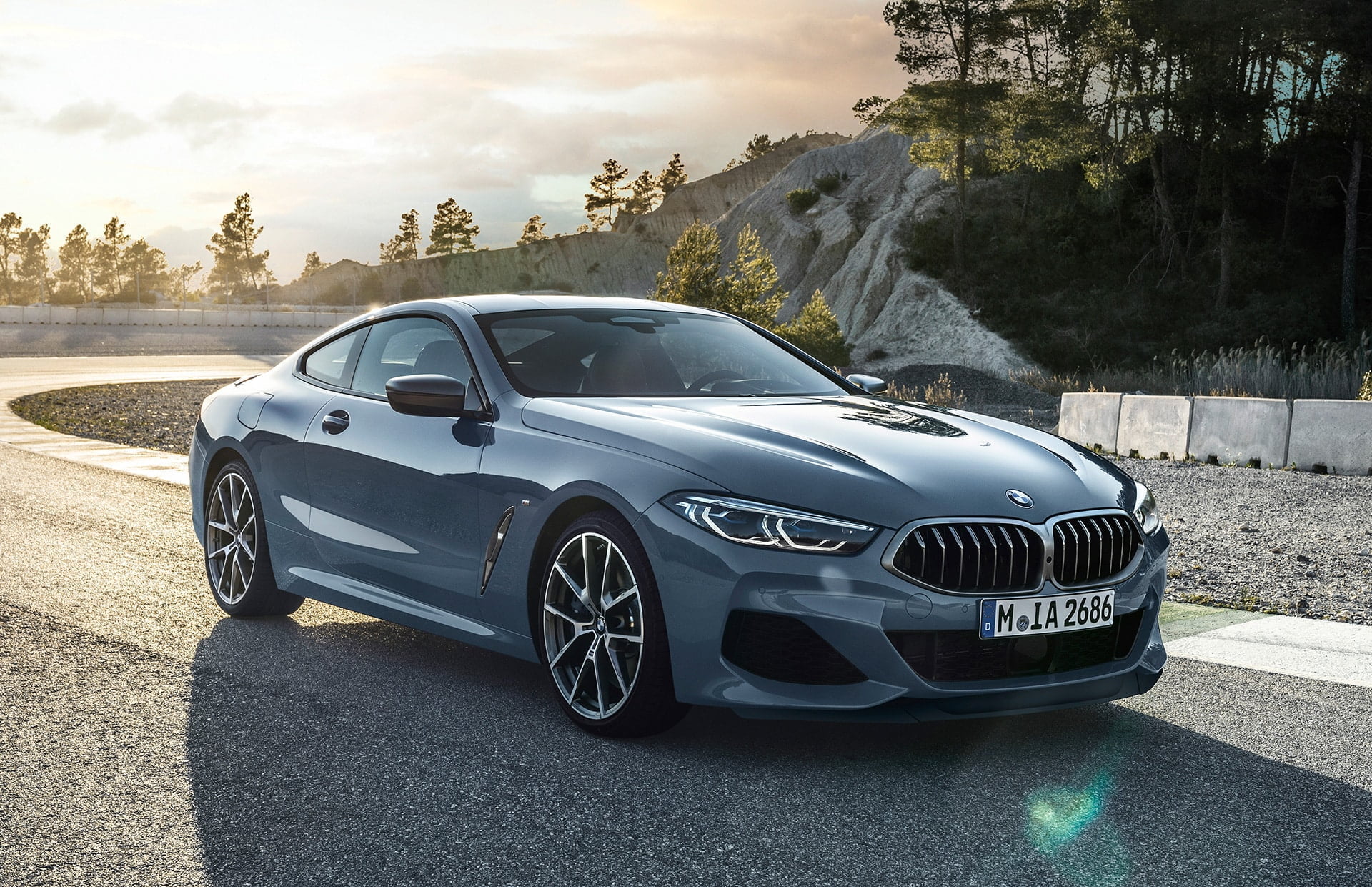
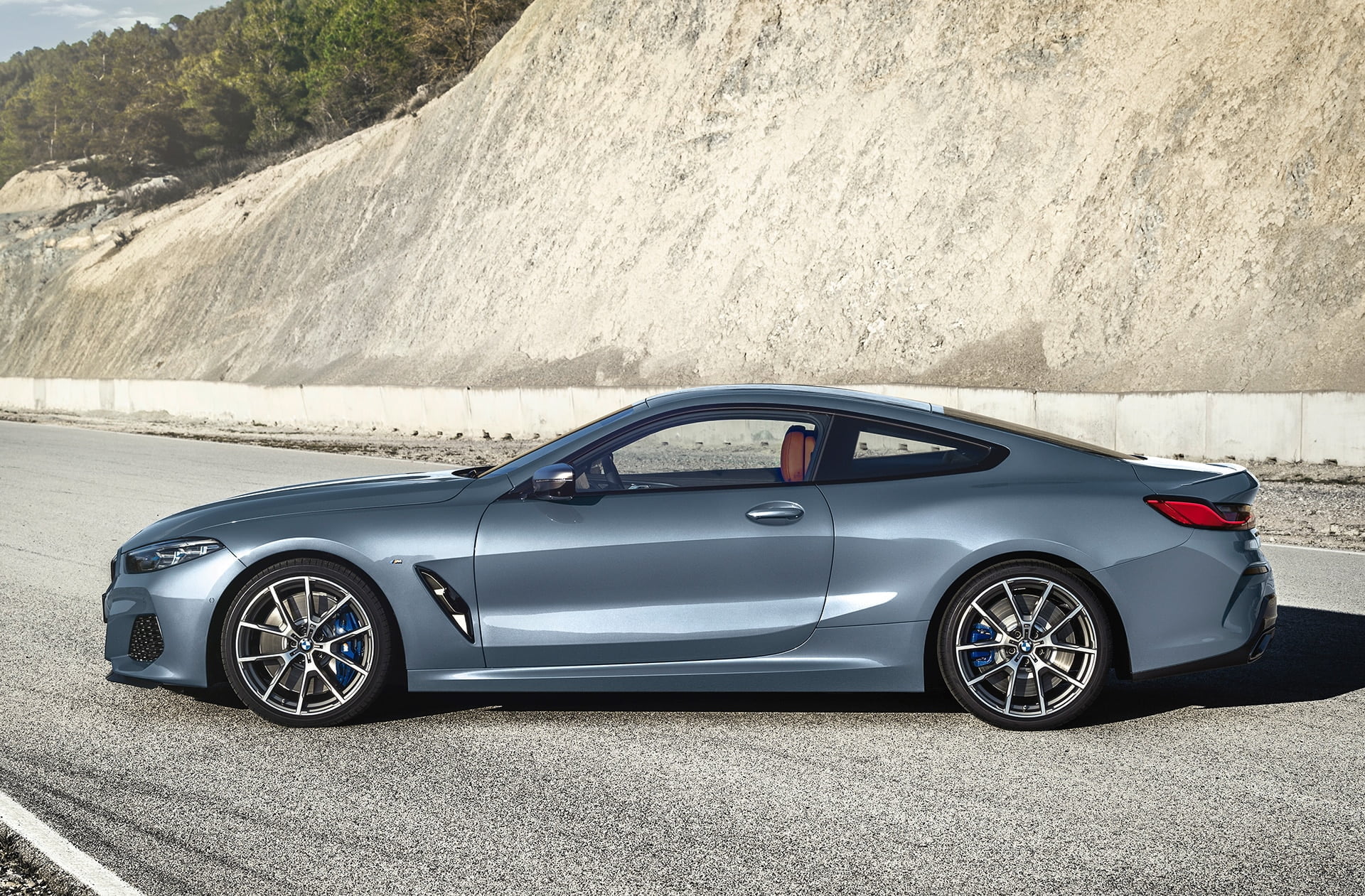
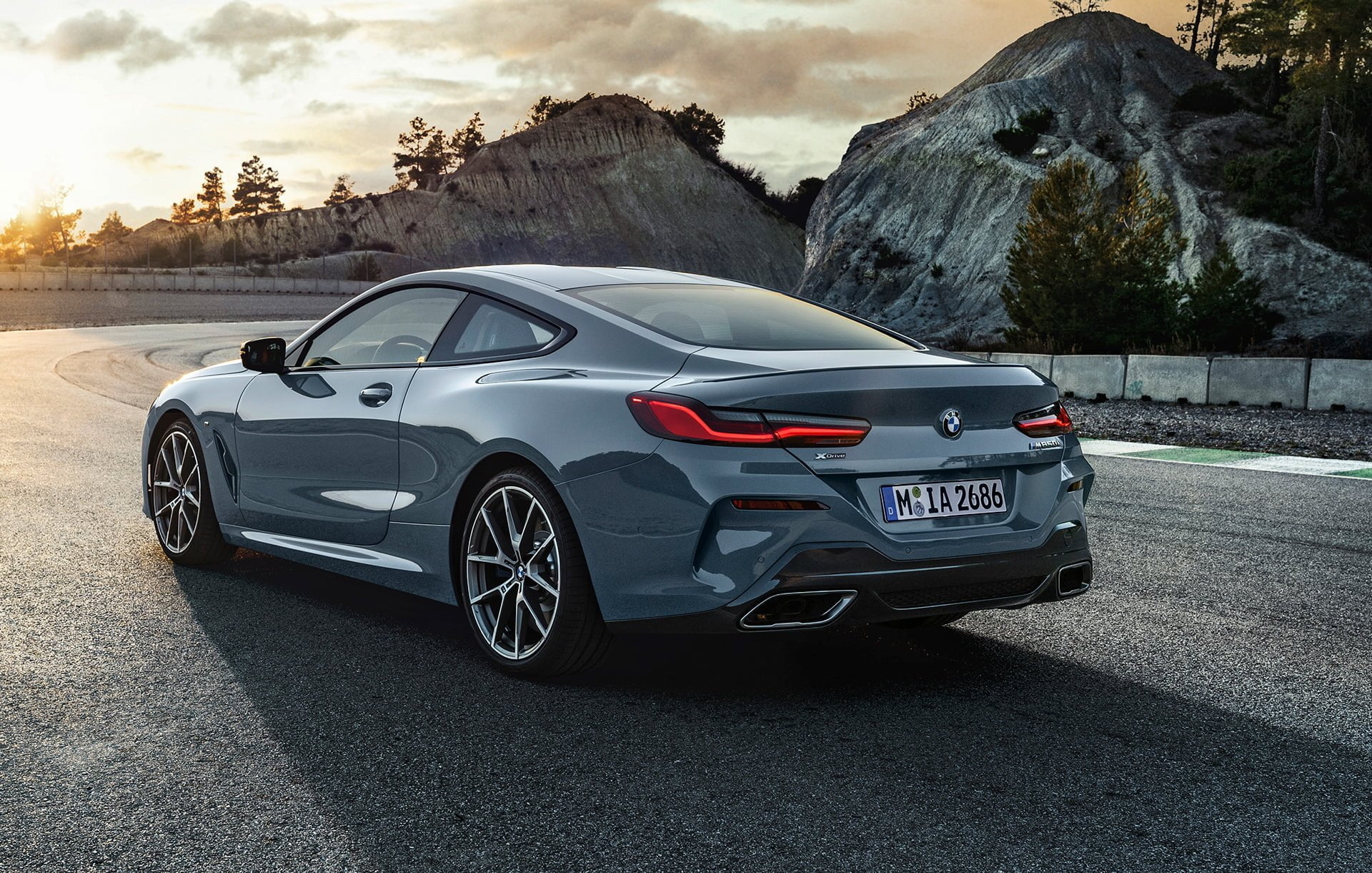
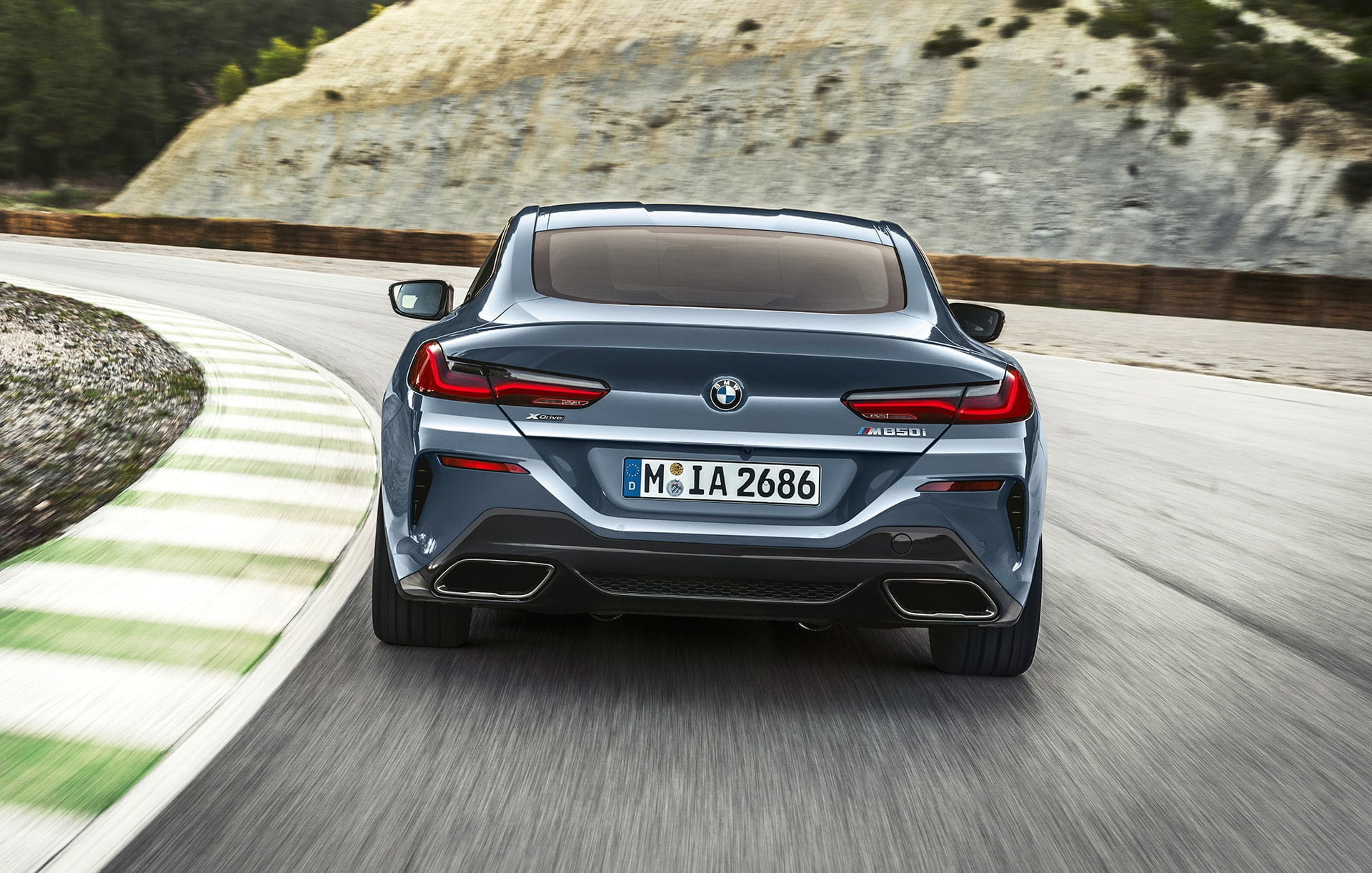
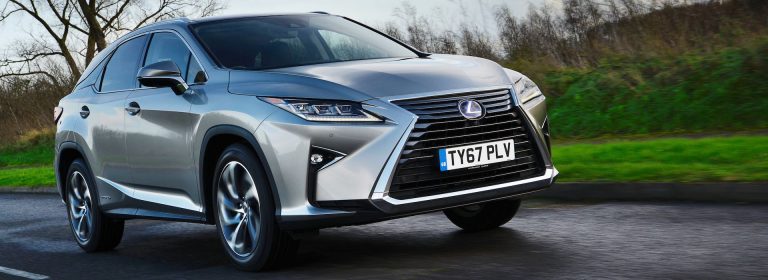
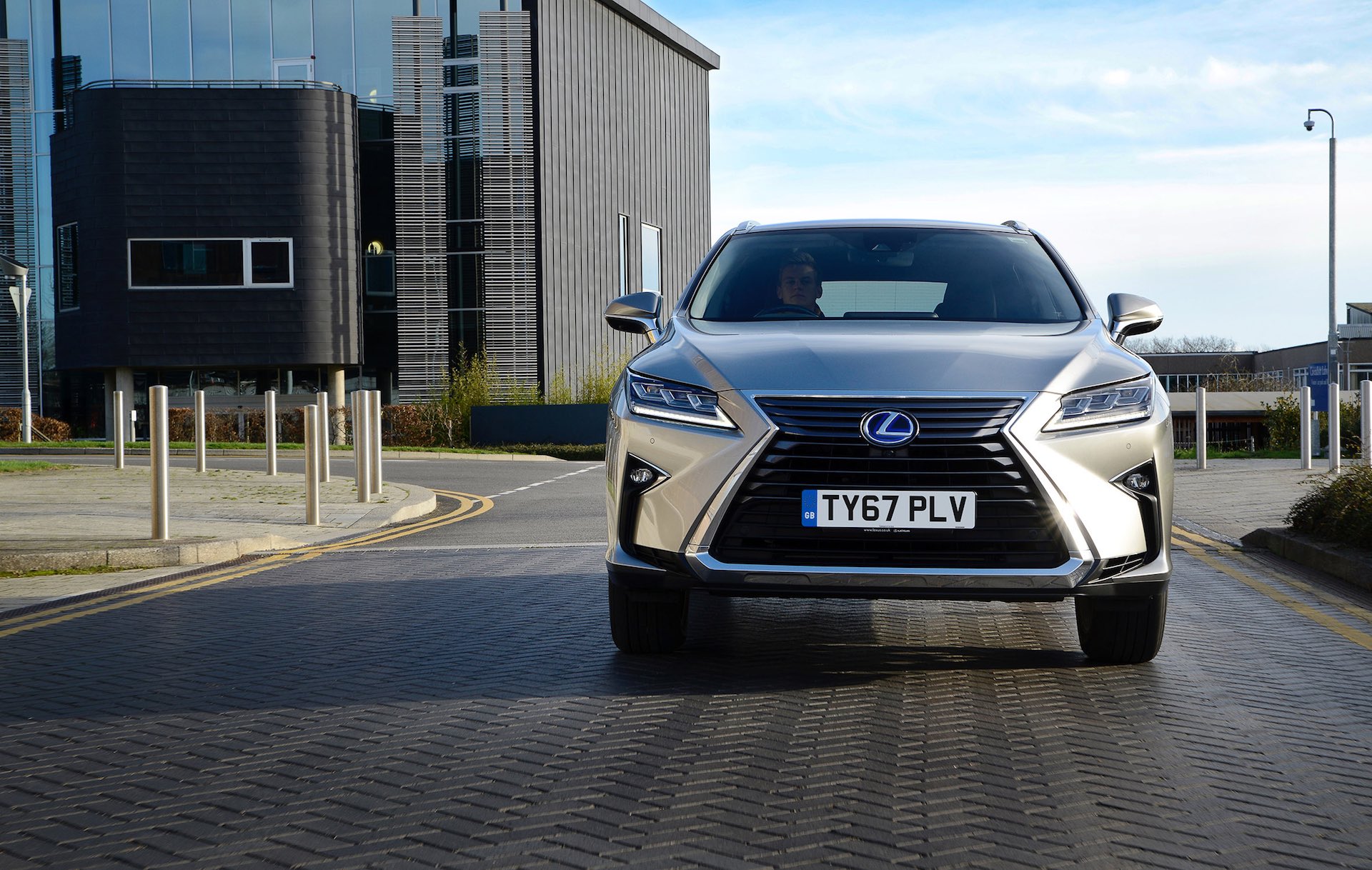
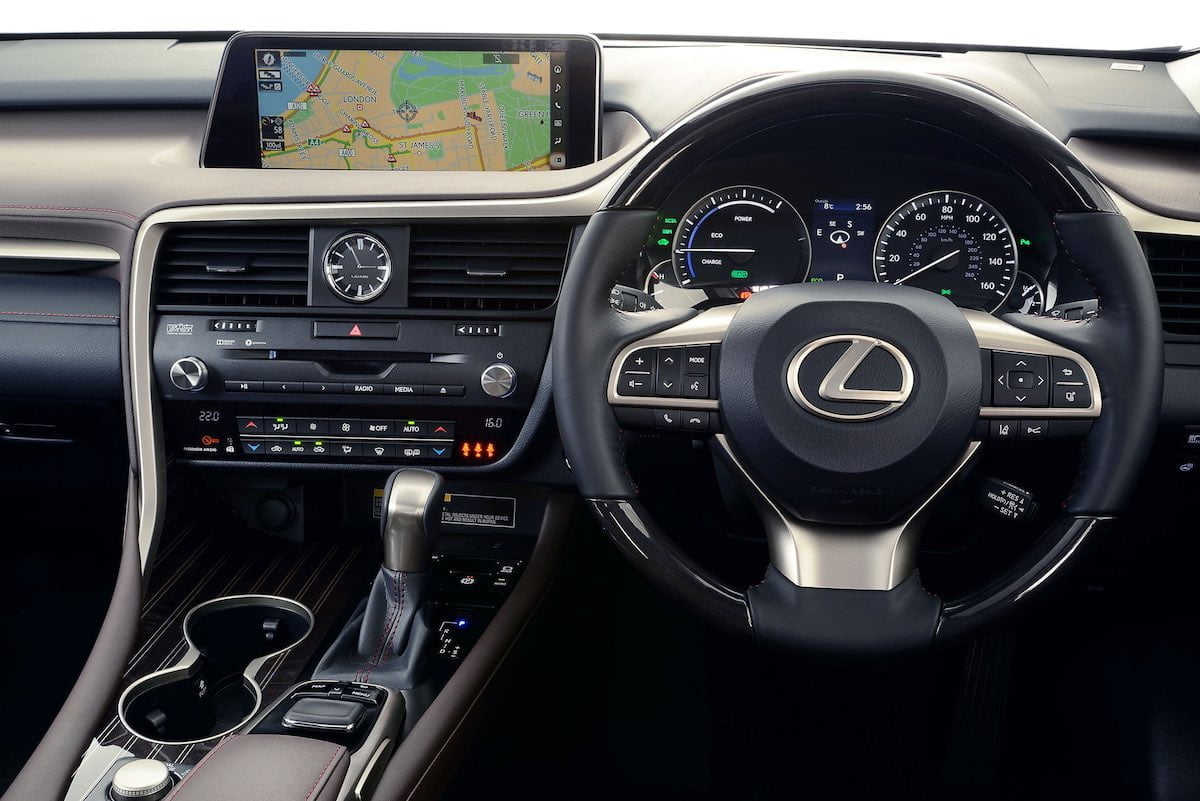

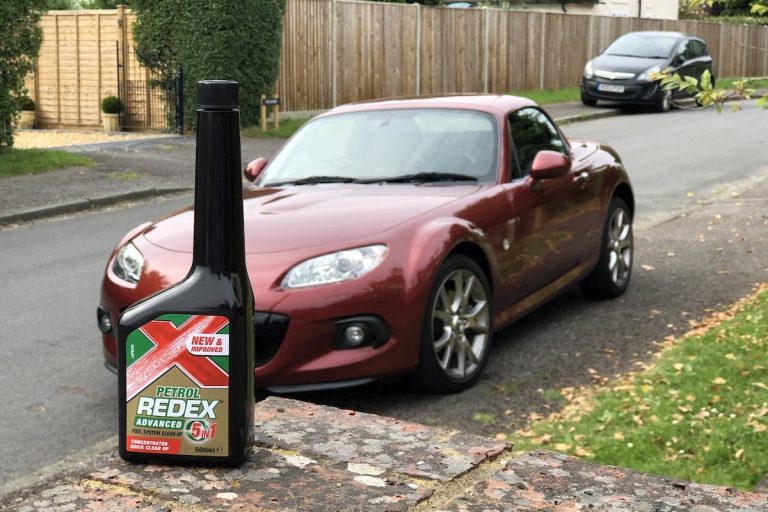


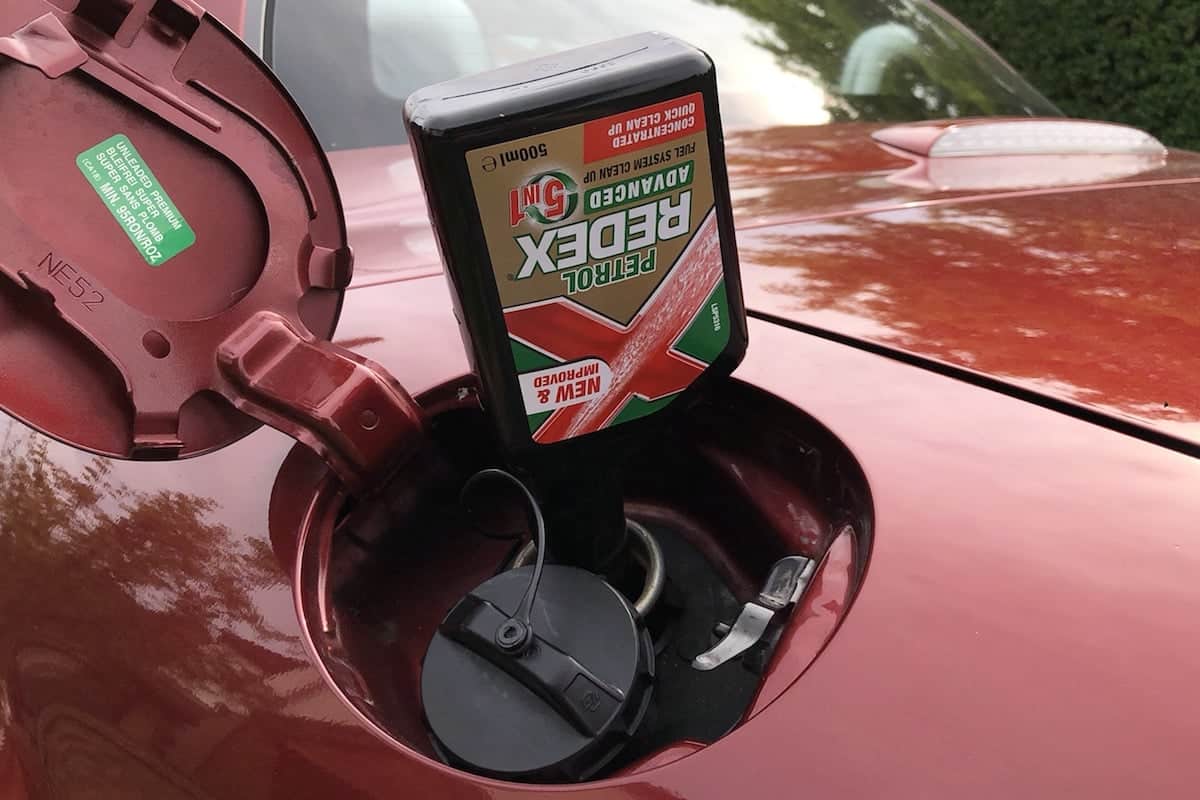

 New X5 variants will be offered with a choice of two diesel engines and a single petrol unit, all of three litres. Range-topper is the M50d, powered by a six-cylinder diesel with four turbochargers and producing 400hp along with 760Nm of torque and accelerating from 0-62mph in 5.2 seconds.
The diesel in the xDrive 30d produces 265hp and 620Nm of torque, returning a 6.5-second 0-62mph time, while the petrol engine in the xDrive40i offers 340hp and 450Nm, with a 0-62mph time of 5.5 seconds.
All engines will be combined with an eight-speed automatic transmission and the latest version of BMW’s xDrive all-wheel-drive system. On the road it biases towards the rear axle, but can split drive between the front and rear according to conditions and the surface.
The chassis has also seen major changes. options available now include an off-road package which has air suspension all round – previously it was on the rear axle only. Four-wheel steering can also now be specified.
Built in Spartanburg, South Carolina in the USA, the X5 has been a major success for BMW since the first version launched in 1999. Since then more than 2.2 million have been sold.
New X5 variants will be offered with a choice of two diesel engines and a single petrol unit, all of three litres. Range-topper is the M50d, powered by a six-cylinder diesel with four turbochargers and producing 400hp along with 760Nm of torque and accelerating from 0-62mph in 5.2 seconds.
The diesel in the xDrive 30d produces 265hp and 620Nm of torque, returning a 6.5-second 0-62mph time, while the petrol engine in the xDrive40i offers 340hp and 450Nm, with a 0-62mph time of 5.5 seconds.
All engines will be combined with an eight-speed automatic transmission and the latest version of BMW’s xDrive all-wheel-drive system. On the road it biases towards the rear axle, but can split drive between the front and rear according to conditions and the surface.
The chassis has also seen major changes. options available now include an off-road package which has air suspension all round – previously it was on the rear axle only. Four-wheel steering can also now be specified.
Built in Spartanburg, South Carolina in the USA, the X5 has been a major success for BMW since the first version launched in 1999. Since then more than 2.2 million have been sold.