Find an Expert Rating: 
Home Blog Page 151

Volvo to call time on diesel?

Volvo could be set to end development of diesel engine technology for its cars. As the environmental and political climate turns increasingly against diesel, Volvo CEO Hakan Samuelsson has told German media that the brand’s current generation of diesel engines, introduced in 2013, could well be the last. Samuelsson quotes the cost of making diesel engines more emissions friendly, particularly reducing their nitrogen oxide levels, as the reason for abandoning the technology. He told German newspaper Frankfurter Allgemeine Zeitung, “From today’s perspective, we will not develop any more new-generation diesel engines.”

Diesel has ‘crucial role’

However following the article appearing, Volvo issued a statement to the Reuters news agency in which Samuelsson states that he believes diesel will still play a crucial role in reducing emissions over the next few years. As the brand has only recently launched a new generation of petrol and diesel engines (the Drive-e range) a decision on developing new diesel engines is not required. Samuelsson says in the newspaper interview that the current diesel engine line-up will continue to be improved and this could go on until around 2023. Future investment, however, will be focused on hybrid and electric cars.
Samuelsson-Volvo
Volvo moved quickly to clarify CEO Samuelsson’s comments.
 

MINI minor updates across the range

MINI has announced a number of minor model-year updates to its lineup, with enhancements being made to design, functionality and infotainment. In a first for the brand, MINI Countryman and Clubman customers with Media Pack XL or Tech Pack will now have Apple CarPlay for wireless connection to compatible iPhone apps. The apps will be displayed on the MINI’s 8.8-inch central display and controlled by the MINI Touch Controller or touchscreen. Operation of driving modes has been tweaked for all models. Changing from the standard setting to sport or economy modes will now be done through a toggle underneath the air conditioning. There will also be modifications to the cockpit instrumentation to improve clarity. At night time, numbers and letters will appear in white rather than orange. This colour scheme will also apply to the head-up display. A new display on the right-hand side of the cockpit instrument will make it easier to read fuel level details. An alertness assistant will be introduced on the three-door hatch, five-door hatch and convertible models. The system analyses how the car is being driven and if the statistics suggest that the driver is losing concentration, encourages them to take a break via a graphic on the central display screen. All changes will come into effect from July. MINI minor updates for MY18  

Jeep unleashes limited edition Night Eagle

Jeep has added to its range of Wrangler 4×4 vehicles with the announcement of the limited edition Night Eagle. Unveiled at the Geneva motor show, only 66 examples are destined for the UK market. The Night Eagle is fitted with a 2.8-litre 200hp turbo diesel engine which is paired with a five-speed automatic gearbox. According to Jeep, this is capable of producing a 0-62mph time of 10.7 seconds and a top speed of 107mph. Customers can choose from three colours: Xtreme Purple, Alpine White and Solid Black. Model-specific decals on the bonnet and rear panels, 18-inch black wheels and a hard spare tyre cover complete the look. Inside, the Night Eagle has black leather seats and a leather-wrapped steering wheel with contrasting grey stitching. A nine-speaker audio system and Uconnect Navigation with CD, DVD, MP3, 6.5-inch touchscreen, AUX and USB ports are as standard. Pricing starts at £39,810 for the Night Eagle which goes on sale this week.

Dacia SE Summit range goes on sale

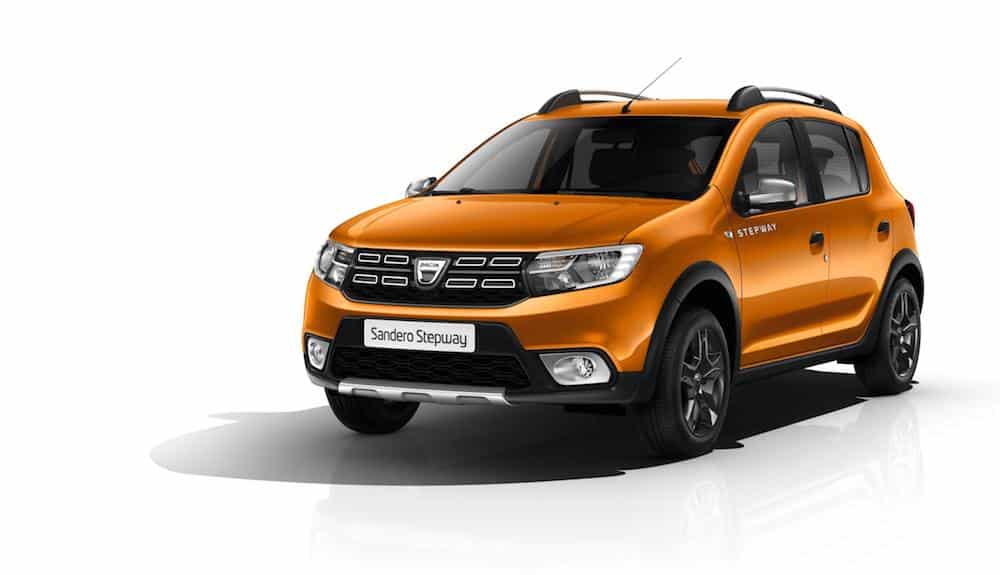
Dacia has announced details of UK pricing and specification for its special edition SE Summit range. The range, which includes the Duster, Sandero Stepway and Logan MCV Stepway, made its debut at the Geneva motor show in March. As previously reported, the SE Summit range is offered an exclusive Nordic Grey paint finish (Magma Orange also available for the Sandero Stepway SE Summit), and features Burnt Orange as a contrast colour inside the cabin. Based on the top trim level for each vehicle, DAB radio, rear parking sensors, air conditioning, Media Nav multimedia system and cruise control are as standard on all models. The Duster SE Summit is priced from £15,195, the Sandero Stepway SE Summit from £10,995 and the Logan MCV Stepway SE Summit from £12,295. The SE Summit range is now on sale in the UK and customers can expect to take delivery of their vehicles from June.
Dacia SE Summit range goes on sale (The Car Expert)
The Magma Orange finish is exclusive to the Summit Sandero Stepway.

PCP car finance debate highlights widespread media confusion

Looking through the huge number of media reports on the “car finance crisis” allegedly gripping the country, it’s amazing to see how many people fundamentally misunderstand how PCP (personal contract purchase) car finance works – and that includes reporters and editors at major media institutions.

With both the Bank of England and the Financial Conduct Authority (FCA) announcing investigations into the car finance sector, there has been plenty of reporting from both mainstream and specialist media.


You may also like:

Given the size of the car finance market in the UK (approx. £40 billion) and the number of private car buyers who take out a PCP to fund their purchase (up to 90%), it is astonishing how many errors are being made by major media outlets when trying to explain the situation. Here are some of the most common and important issues that have been misreported.

A PCP is a purchase, not a lease or a rental

Perhaps the biggest misconception about PCPs is the repeated assertion that you are leasing the vehicle rather than buying it. This has been widely reported and repeated, and is not helped by some finance companies and others who should know better referring to a PCP as a “personal contract plan“, rather than the correct “personal contract purchase“. Again, this has been widely repeated by the media without properly looking at the detail:

  • “Instead of buying a car outright, a PCP allows you to rent the car over a three-year period.” – BBC
  • “(A PCP) allows the buyer to lease a car…” The Times

The Guardian and others are also guilty of using the word ‘leasing’ repeatedly when describing the PCP marketplace. To be very clear, a PCP is not a lease. It is a form of hire purchase (i.e. – a mortgage) – it says so at the top of the contract. When you take out a PCP, you are borrowing the total value of the car minus your initial deposit. When you lease a car, you do not incur a debt and simply agree to pay a monthly fee for the use of someone else’s car.

The Times gets it wrong in glorious colour

Highlighting their own confusion, The Times ran a prominent example (shown below) of a PCP payment schedule – except they actually used a PCH (personal contract hire) schedule, which is a rental…

The Times gets it wrong when trying to explain how a PCP works
Please note: despite what this picture from The Times says, it is not a description of a PCP. It’s a lease deal, with added errors for good measure.

The Times got its numbers from an independent car leasing broker who specialises in contract hire leasing, mainly for business users. Surely it would have been more sensible to call a Mercedes-Benz dealer and ask for a PCP quote?

The above graphic also refers to an “implied guaranteed resale price”, which appears to be something that The Times made up on the spot. Car geeks will also note that they have used the wrong car in their illustration (the one shown would cost 15% more), but that’s the least of their crimes here…

A PCP loan includes the balloon payment/GFV

Even when media outlets do correctly report that a PCP is a purchase rather than a rental agreement, there are mistakes being reported. One common misconception is that a customer is borrowing less money on a PCP than on a hire purchase (HP) because they are not borrowing the balloon amount, as reported in the Telegraph:

  • “(on a PCP)… ‘buyers’ borrow the difference between the price now and what it’ll be worth in four years.” – The Telegraph
  • “PCP ‘buyers’ are not actually buying their car. They are merely servicing an interest-only loan to cover the cost of its depreciation over the length of their contract.” – The Times

This is not true. Customers are borrowing the same amount on a PCP as on an HP (i.e. – the entire amount of the vehicle, minus any deposit), and paying interest on that entire amount. The difference is the PCP provides the option not to repay the balloon and instead hand back the car at the end of the agreement (although terms and conditions apply).

Credit checks

Another misrepresentation is that credit checks are conducted by the staff at the dealership. Again, this has been reported on multiple occasions, such as these:

  • “Salesmen are incentivised by commission and are under no obligation to perform any tests other than credit checks to test whether customers can afford car financing.” – The Telegraph
  • “(The FCA) will also check whether sales staff are carrying out sufficient checks on customers…” The Sun

The staff at the dealership are acting as agents for the finance company, and simply gather all the required personal information to send off to the finance company. It is the responsibility of the finance company to assess the application, which includes conducting a credit check from the likes of Experian. Car dealers can also only go on what customers tell them they want to spend, and do not have access to customers’ private financial information.

The only real requirement of the salesman in the dealership is to make sure that the customer’s details are being recorded correctly, and not ‘massaged’ in any way to appear more favourable to the finance company.

The FCA is investigating how financial products – principally PCPs – are sold by car dealers, but this is likely to cover how staff are explaining and selling finance products. There is certainly concern over dealers who are trying to get customers approved by second-string lenders if the customer has been declined by their primary lender (eg – if you go to a Volkswagen dealer and are declined by Volkswagen Finance, the dealer may try and get you approved by a finance company that specialises in sub-prime customers – but at much higher rates).

Hooray for the FT

Perhaps unsurprisingly, The Financial Times has done best at explaining the issues without getting into a muddle. The FT also describes the current situation as a “toxic tangle of slick salesmanship, financial wizardry, and consumer incompetence”, which sounds about right.

The FT also neatly sums up the task facing the FCA and BoE: “The car market’s heady mix of prestige products and bewildering finance will resist efforts at reform. Yet we must try.”

For more confusion, ask the readers

If you need any more convincing that there is widespread confusion about PCPs and how they work, feel free to read through the comments sections of any of the articles listed above. There are several examples of long-winded arguments between readers, berating each other over the topic.

In many cases, both sides are completely wrong yet neither will admit any error and are steadfast in their (mis)beliefs. But to be fair to them, if the majority of the media can’t explain how a PCP works with armies of reporters, fact-checkers and editors, what hope does the public have?

Do you think you may have been mis-sold a PCP car finance contract? Let us know in the comments below.

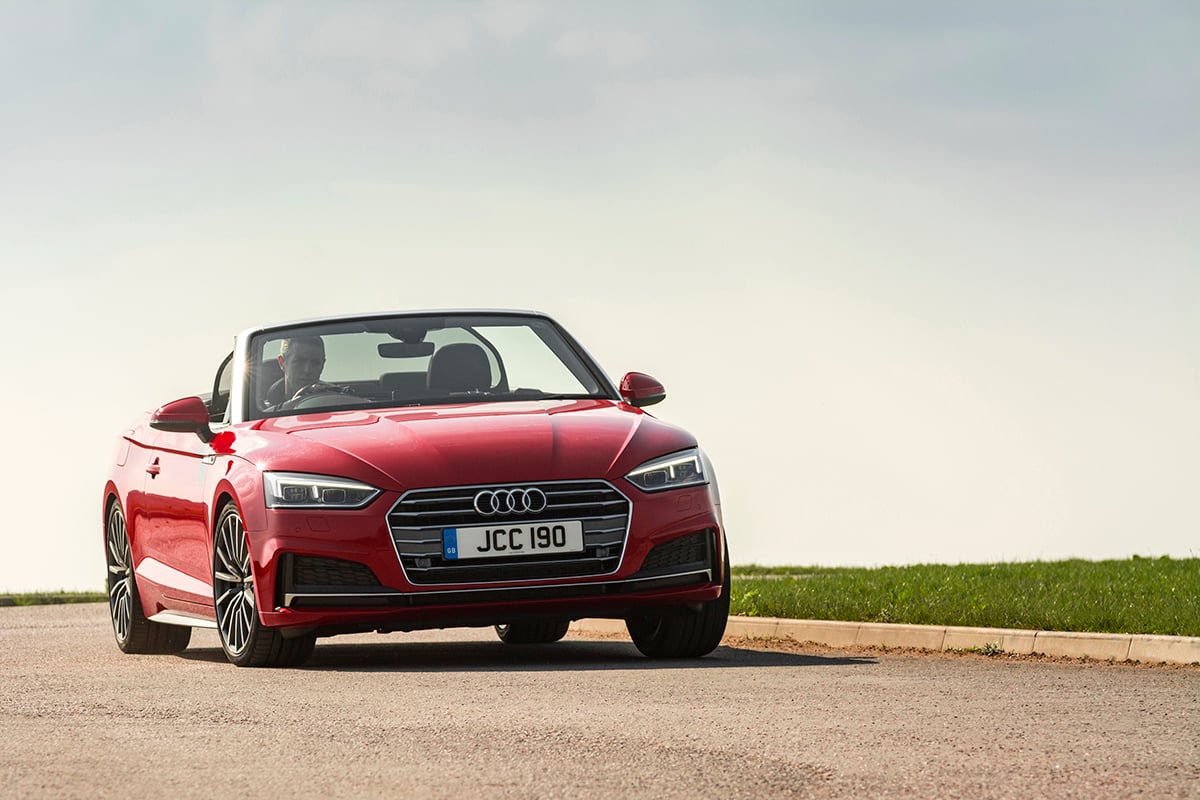
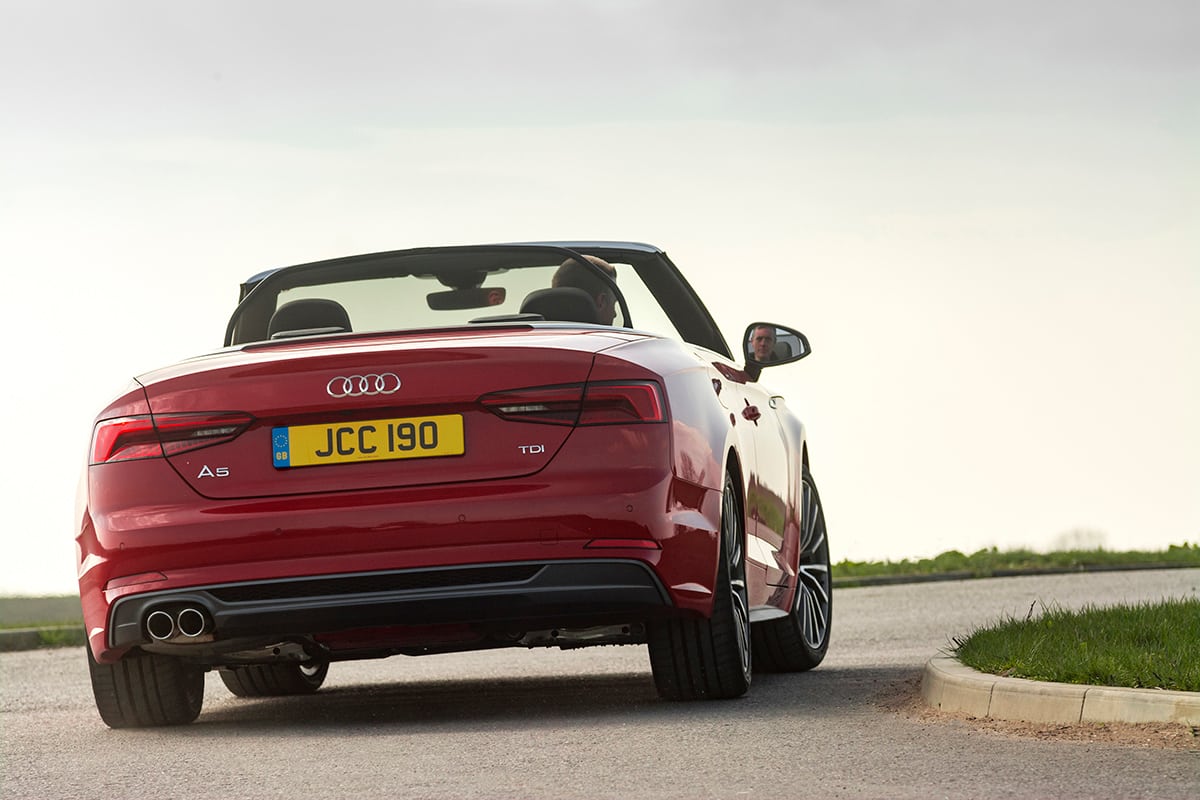
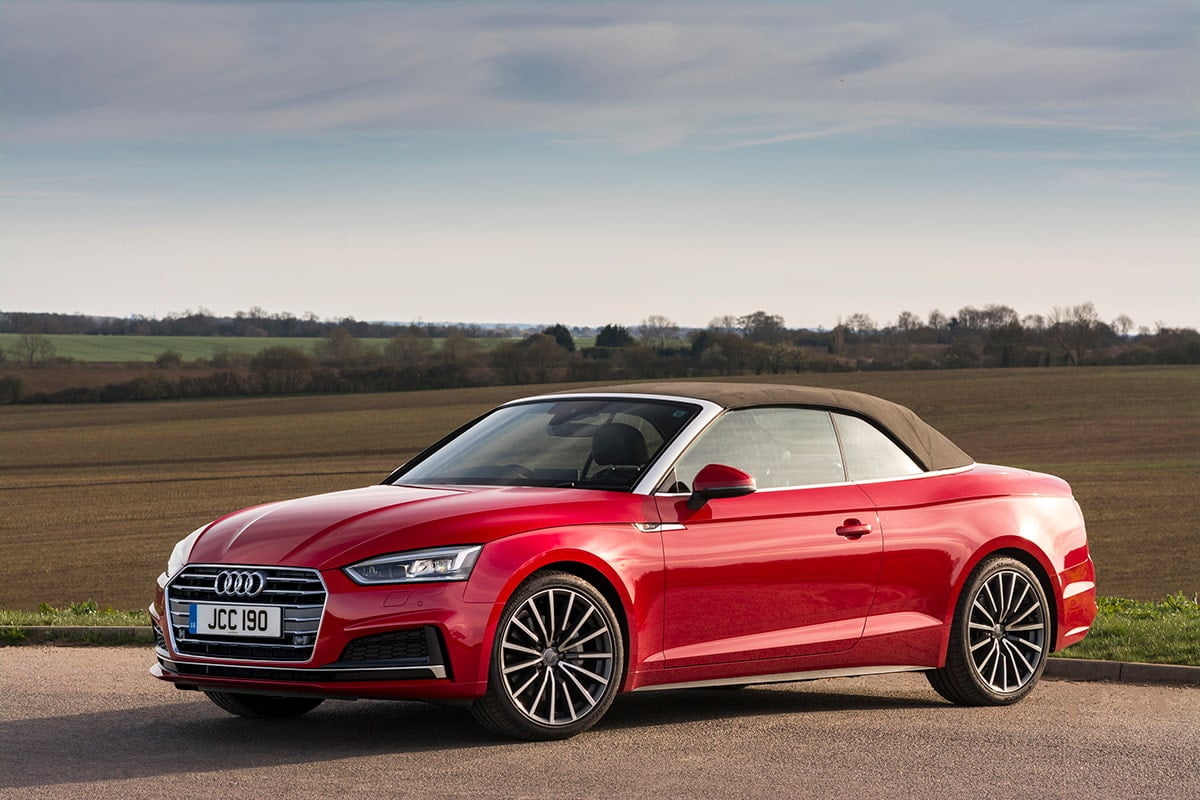
Audi A5 Cabriolet review

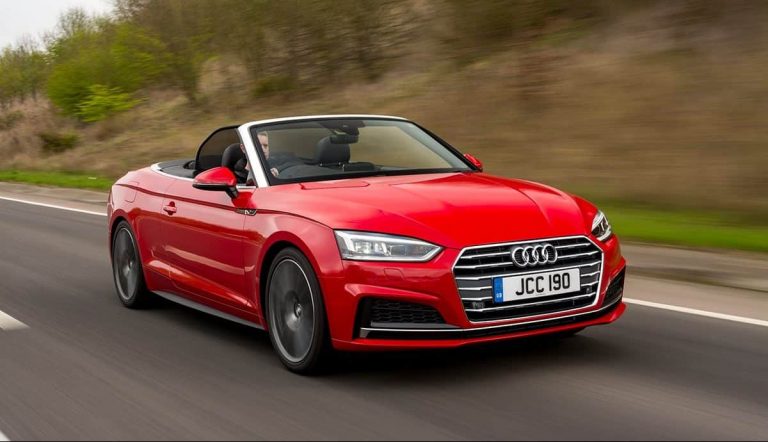
What is it? The Audi A5 Cabriolet is the second-generation version of the brand’s coupé drop-top.
Key features: More refined, better on the road, more tech.
Our view: Improved in all areas, the Audi A5 Cabriolet is a compelling proposition for those seeking an upmarket drop-top.
Type of review: Taster Test


The launch of the Audi A5 Cabriolet completes the renewal of a model line that began last year with the arrival of second-generation versions of the A5 Coupé and A5 Sportback variants. According to its creators, the new car is better in all areas; increasing its quality, performing better on the road and taking full benefit of the increasingly sophisticated technology available in Audi models.

Powertrain and styling

Three engines are available for mainstream versions of the new car. Petrol options range across a 2.0-litre petrol unit offering 190hp and matched to either six-speed manual or automatic transmissions, or a 252hp version with an automatic gearbox and quattro all-wheel-drive. For the more performance-hungry, Audi is also launching a new S5 Cabriolet, with a V6 petrol engine producing 354hp, quattro all-wheel drive and a 5.1-second 0-62mph time.

Our test car, however, is fitted with the 2.0-litre diesel, putting out 190hp, with the S tronic and front-wheel-drive – this car can also be had with quattro.

All are housed within a new shell, 47mm longer but 8mm narrower than its predecessor, and with a wheelbase increased by 14mm. Torsional rigidity, always a crucial factor in a convertible, is said to be up by 40 per cent, while the use of modern construction techniques including high-strength steel and aluminium enable weight savings of up to 40kg – all of which should mean a better on-road performance.

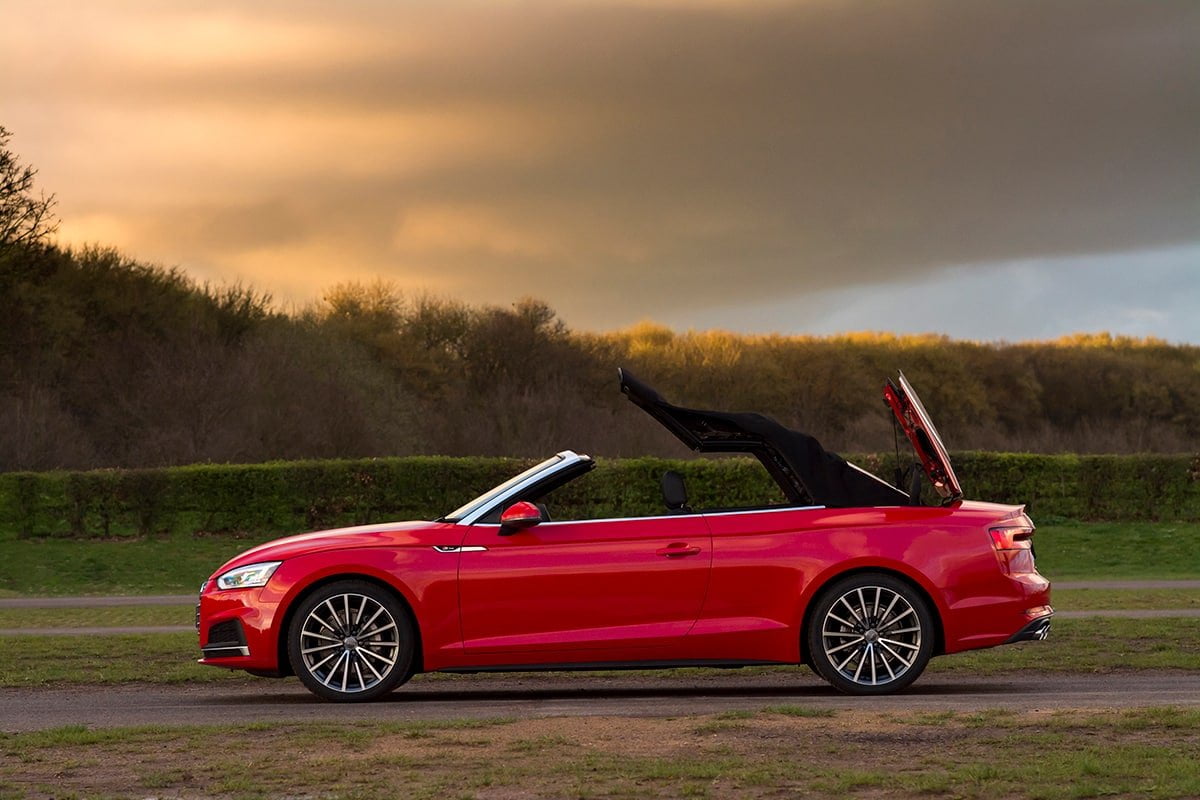
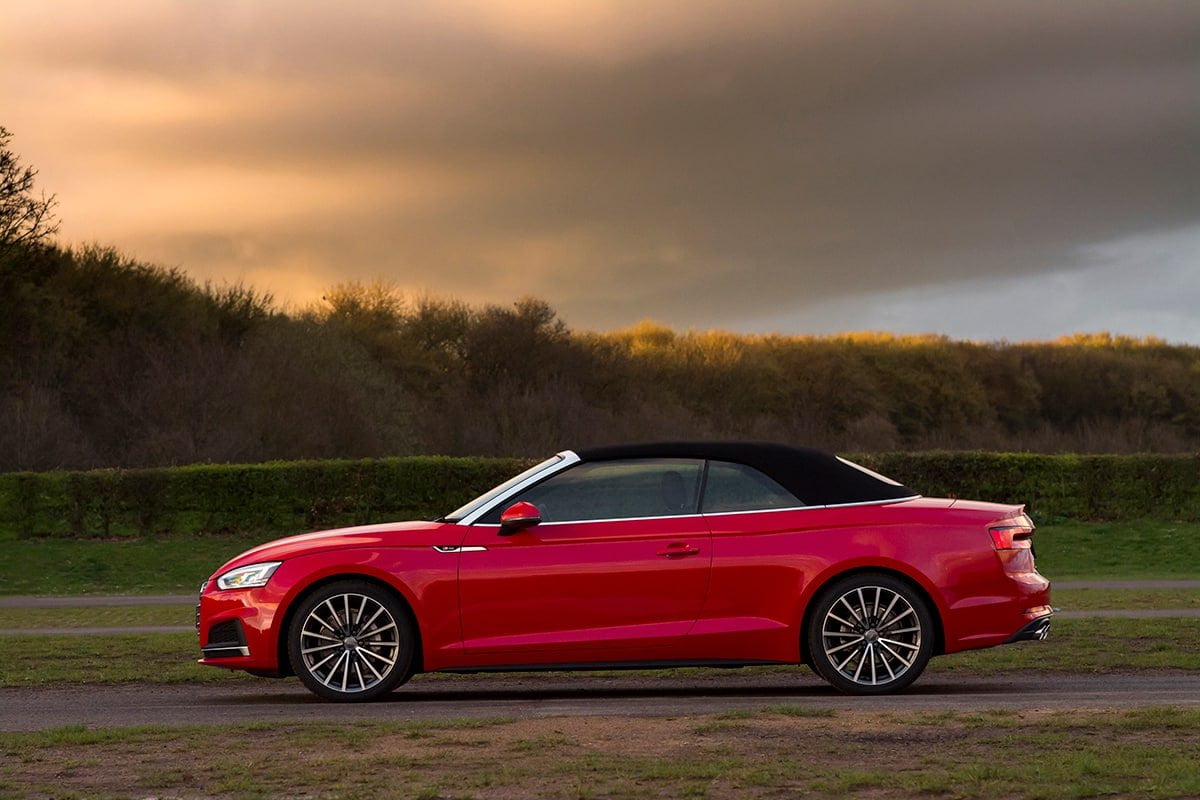
Audi has resisted any temptation to adopt a more solid but space-eating metal roof – the soft top boasts four layers and folds electrically in 15 seconds, at speeds up to 30mph. Once folded, it sits in a tray under the rear – this moves up when the hood closes to offer a total boot space of 380 litres.

Styling changes include a significantly wider, flatter grille and a rear screen that is also flatter. With a distinctive shoulder line the car certainly looks purposeful, particularly with the hood down.

On the road

Step inside the Cabriolet and the surroundings are familiar, not just to the A5 range but Audi’s current line-up. That’s not a bad thing – Audi interiors are the best in the business and the latest better yet, combining excellent build quality with top levels of practicality – the various controls fall naturally to hand and are both simple and refined to use. Of course, the fully digital ‘virtual cockpit’ is a must-have, well worth the £250 extra it costs.

The diesel in our test car maintains the level of refinement – it’s smooth in start-up, and any audio note virtually disappears once on the road. In fact the lack of stirring sound is almost misleading, as this engine is quite perky in its performance – 62mph dispatched in 8.3 seconds is plenty swift enough for most. And it is all achieved in such a confident manner that is matched by the car’s handling. The ride is comfortable on the motorway, and while it may not be quite as ‘point and grip’ in the bends as its coupé sister, it is still pretty assured.

Verdict

First impressions of the new A5 Cabriolet are highly positive – in diesel form at least (we have yet to try the petrol variant) it’s a complete package. The original model was accomplished, but the new one simply improves the breed.

Perhaps the one aspect to watch is the price – while our £42K base price virtually matches the car’s direct rivals, it’s very easy to add substantially to this dipping into the options list – our test car had more than £4,000 of extras, including a rear-view camera costing £1,050 alone…

Audi A5 Cabriolet – key specifications

Model tested: Audi A5 Cabriolet 2.0 TDI 190hp S line automatic
Price: £42,625 (Range starts £35,235)
On sale: First deliveries April 2017
Engine: 2.0-litre diesel, 190hp, 400Nm
0-62mph and max speed: 8.3 sec, 144mph
Economy and emissions: 60.1mpg (62.8*), 124g/km (118*)
Key rivals: BMW 420d Cabriolet, Mercedes-Benz C220d Cabriolet.
Test date: April 2017
* = with standard 17-inch wheels, test car fitted with 19-inch wheels.

The Car Expert Taster Tests are concise summaries of new models to the market, that we have driven for under 50 miles. They are often preludes to full road tests of the vehicle at a later date.

SEAT announces details of Ateca FR

SEAT has announced UK pricing and specification for the Ateca FR model, which was unveiled at the Barcelona motor show this week to join the rest of the Ateca range. The Ateca FR model is distinguishable by its 18-inch alloy wheels, body-colour wheel arch surrounds and tinted rear windows. Specification for the FR includes exterior and cabin LED lighting and SEAT’s Drive Profile, which enables drivers to adjust their vehicles’ performance. The FR’s infotainment system features navigation, smartphone integration with Mirror Link, Apple CarPlay and Google Android Auto and USB and AUX ports. Two petrol and two diesel engines are available for the Ateca FR. Dual-zone climate control, a rear-view camera and auto-folding door mirrors are also standard. Advance driving, convenience and winter packs, as well as a panoramic sunroof, are available at extra cost. The Ateca range earned a five-star Euro NCAP rating in 2016. Safety features on the FR include autonomous emergency braking, driver drowsiness detection and hill hold assist. The SEAT Ateca FR starts at £24,960 and will be available to order from 3rd July, before its arrival in UK showrooms this August.
SEAT announces details of Ateca FR -The Car Expert
SEAT Ateca FR

More details of updated BMW 4 Series

Further details of the updated BMW 4 Series have been released. As previously announced, the range gets styling updates inside and out, including 18 and 19-inch alloy wheels and two new exterior paint finishes, as well as a host of the latest technology. The digital cockpit features a new navigation system and is compatible with Apple CarPlay. Personalisation options now include a choice of three leathers and two interior trim finishes. Real-time traffic updates and LED fog, head and tail lights are now as standard. BMW has not updated the drivetrains on offer for the 4 Series, but either a six-speed manual or eight-speed automatic transmission can be specified depending on the model. Pricing starts from £33,555 – a £1,030 increase on the amount originally announced in January. Customers can place their orders for the 4 Series now.
Styling updates for BMW 4 Series (The Car Expert)
Sunset Orange is one of two new paint finishes for the BMW 4 Series.

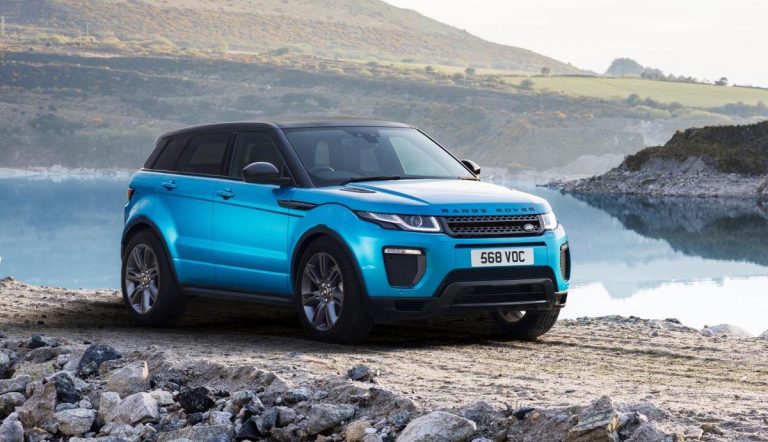
Land Rover announces Range Rover Evoque Landmark

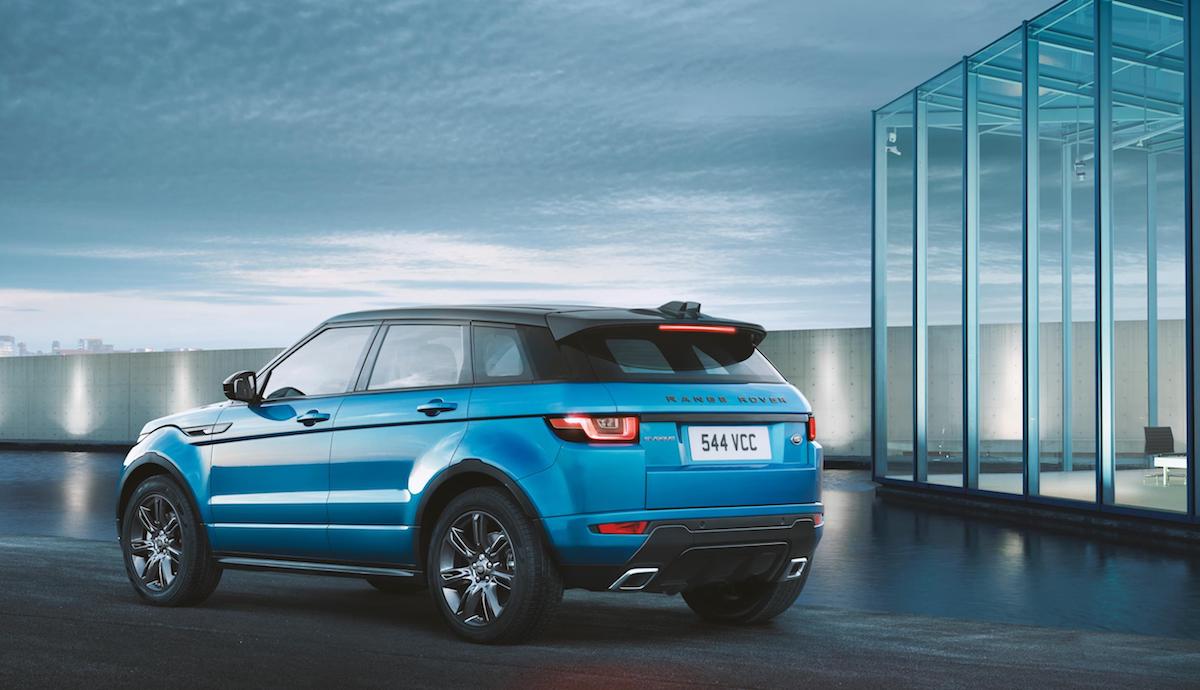
Six years after the model first went on sale, Land Rover has announced a special edition model of its popular SUV: the Range Rover Evoque Landmark.

March saw UK car manufacturing at a record high and, according to Land Rover, an Evoque rolls off the production line at their Halewood plant every 170 seconds. The site has produced 600,000 units of the Evoque since 2011, with the majority destined for export markets.

Based on the 180hp TD4 diesel Evoque, the Landmark is available in three colours: Yulong White, Corris Grey and Moraine Blue. Exterior design details include grey accents with the fixed panoramic glass roof and 19-inch alloy wheels.

Inside, the Evoque Landmark features leather seats with contrasting grey stitching, as well as keyless entry and automatic handsfree tailgate.

An array of optional technology includes a ten-inch touchscreen which provides a 4G Wi-Fi hotspot and is compatible with Spotify. Owners can use a dedicated app to check the fuel level and location of their vehicle and to pre-heat or cool the cabin. Those opting for Touch Pro Services get real-time traffic mapping and a sidebar featuring weather, news headlines and a flight tracker.

Pricing for the Range Rover Evoque Landmark starts from £39,000 for the manual model and £40,000 for the automatic. Land Rover will open its order books on 10th May when the Landmark appears at the Royal Windsor Horse Show.

Range Rover Evoque Landmark 02

230mph Toyota claims fastest SUV title

Toyota is claiming the title of the world’s fastest SUV after a specially-built Land Cruiser clocked up more than 230mph. The ‘Land Speed Cruiser’ was driven by former Toyota NASCAR driver Carl Edwards, smashing the previous record by 19mph during runs on the 2.5-mile runway at the Mojave air and space port in California, USA. The major modification to the Land Cruiser was to the 5.7-litre V8 engine offered in US versions of the SUV. While its 386hp is far in excess of the 177hp available in UK models, it was comprehensively uprated. Two enormous Garrett turbochargers were added, boosting peak power to more than 2000hp. Other modifications included the addition of a purpose-built racing transmission, while to accommodate purpose-designed suspension wider Michelin tyres the frame was narrowed by three inches. Aerodynamic improvements, meanwhile, improved dropping the entire car closer to the ground.

Supersonic runway

Development testing was carried out by Toyota test driver and championship road racer Craig Stanton at the brand’s Arizona Proving Ground, and he made the initial runs at Mojave, achieving 198mph. Edwards then took over for the record runs on the runway built for supersonic aircraft. His first run clocked 211mph, but he found himself running out of space to slow the Land Cruiser down. Dialling in more boost enabled the 230mph run and the NASCAR driver believed he could have gone faster with more runway available. “At 225 mph, the thing was wandering a little bit,” Edwards said. “All I could think was that Craig said, ‘No matter what, just keep your foot in it,’ and we got 230mph. It’s safe to say that this is the fastest SUV on the planet.”
Toyota Land Cruiser LSR
NASCAR driver Carl Edwards was impressed by the modified Land Cruiser

Honda prices up latest Civic Type R

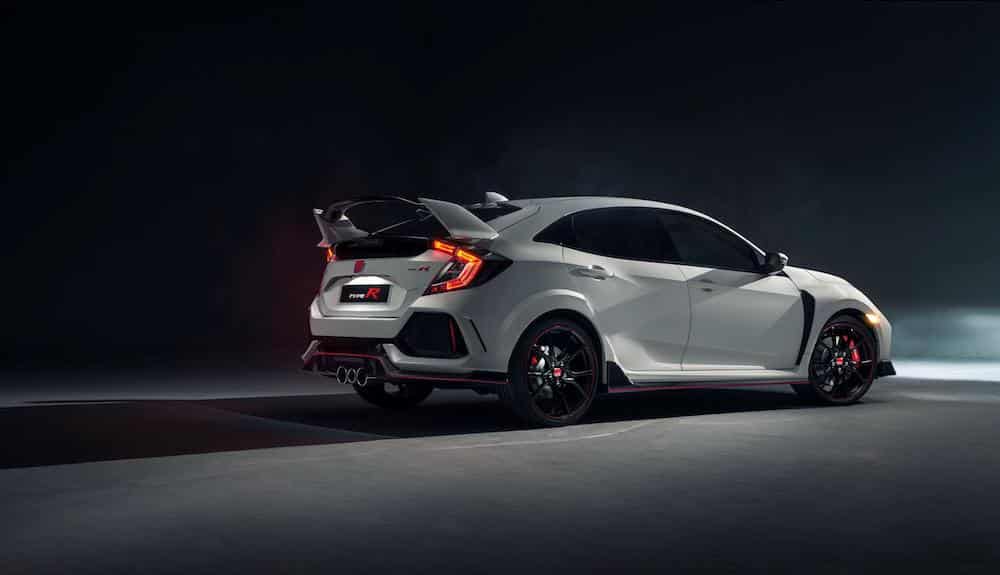
Honda has announced details of UK pricing and specification for the latest Civic Type R, which was unveiled at the Geneva motor show earlier this year. The latest Civic Type R has an optimised version of its predecessor’s 2.0-litre turbo engine which now produces 320hp and a maximum torque of 400Nm. This is paired with a six-speed manual transmission. The GT model boasts a number of additional features including blind spot information, dual-zone climate control, auto dimming rear view mirror, Honda’s infotainment system with Garmin Navigation, wireless charging, high power audio and LED front fog lights. The Civic Type R is due to hit UK showrooms in July with the entry-level model starting from £30,995 and the GT from £32,995.
Honda prices up latest Civic Type R (The Car Expert)
The Civic Type R is built at Honda’s UK manufacturing plant in Swindon.

Mercedes-Benz adds new entry-level SLC 180

Mercedes-Benz has extended its SLC range with a new entry-level petrol model called the SLC 180. At the same time, it has also discontinued the Sport specification for all SLC models in the UK, making AMG Line the only trim level for all engine variants. The 1.6-litre turbo petrol engine produces 156hp and peak torque of 250Nm. It has a top speed of 140mph and a 0-62mph time of 7.9 seconds. Mercedes-Benz claims that the petrol engine has a fuel economy of 48.7mpg. All engines in the SLC range are paired with a six-speed manual gearbox as standard. Customers can opt for a nine-speed automatic transmission at an additional £1,600. All models in the SLC 180 AMG Line come with 18-inch alloy wheels, Active Brake Assist, cruise control, air conditioning, sports suspension and a sports braking system as standard. On sale now from £32,039, the Mercedes-Benz SLC 180 is expected to arrive in showrooms by late summer. Mercedes-Benz adds petrol model to SLC range (The Car Expert)

SEAT brings Ibiza to UK this summer

SEAT has announced details of pricing and specification for its fifth-generation Ibiza, which premiered at the Geneva motor show. The updated supermini, launched exclusively as a five-door model, joins the redesigned Leon and SEAT’s first SUV, the Ateca. The new Ibiza features several new exterior colours, an eight-inch infotainment screen on selected models and is the first model to be built on the new A0 specification of the Volkswagen Group’s modular MQB platform. SEAT is offering the Ibiza with a choice of four engines, including a new 1.0-litre three-cylinder unit which produces 75hp. The Ibiza is available in five trim levels. The entry-level S includes air conditioning, electric front windows, automatic headlights, Bluetooth and Front Assist. The SE adds 15-inch alloy wheels, cornering front headlights, rain-sensing wipers, cruise control and SEAT’s multimedia package. The sporty FR features 17-inch alloys, dark-tinted rear glass, twin exhausts, sports suspension and rear disc brakes. The top-of-the-range Xcellence includes 16-inch alloy wheels, dual-zone climate control, keyless entry and go, front and rear parking sensors and a reversing camera. SEAT’s multimedia package consists of an eight-inch colour touchscreen, navigation with 3D map display, voice recognition, DAB radio and two USB ports. A Beats audio system is optional. With prices starting from £13,130, the fifth-generation Ibiza is available to order now ahead of its arrival in showrooms on 21st July.

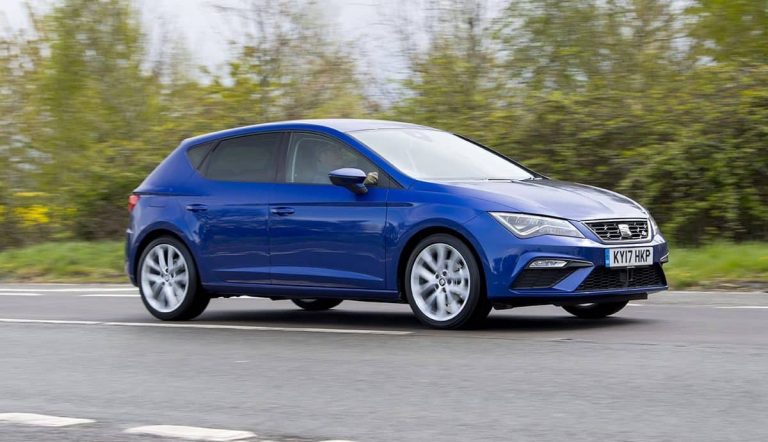
SEAT Leon five-door review

What is it?
The new SEAT Leon is a mid-life refresh for brand’s biggest-selling model.

Key features
Subtle styling changes, new engine option, updated tech.

Our view
The revamp to the SEAT Leon is all that is needed to keep a top-contending model competitive – it remains a must-try for any family hatch buyer.


When the SEAT Leon launched in 1999, it established the Spanish brand as a mainstream contender. It has since become SEAT’s best-selling model, in one of the most competitive sectors in the market where its rivals include top-ten fixture cars such as the Ford Focus and Vauxhall Astra.

The market is changing, however, with more and more buyers defecting from traditional family hatches to SUVs – SEAT is adding two more to the Ateca it launched in 2016. So the Leon needs to evolve to stay in the game.

And that is exactly what the latest package of changes, applied to the third-generation Leon launched in 2012, comprise. This mid-life refresh is not about major headlines but a host of upgrades, mostly making use of the new technology launched in more recent newcomers such as the Ateca. The biggest news is the availability of a 1.0-litre three-cylinder petrol engine previously only offered to continental buyers.

The new Leon arrived in showrooms in February, the revamp applied at the same time to all three versions – three-door SC, five-door hatch and ST estate, while also extending to the range-topping off-road pitched Leon X-perience. For the purpose of this review, however, we are focusing on the core five-door hatch.

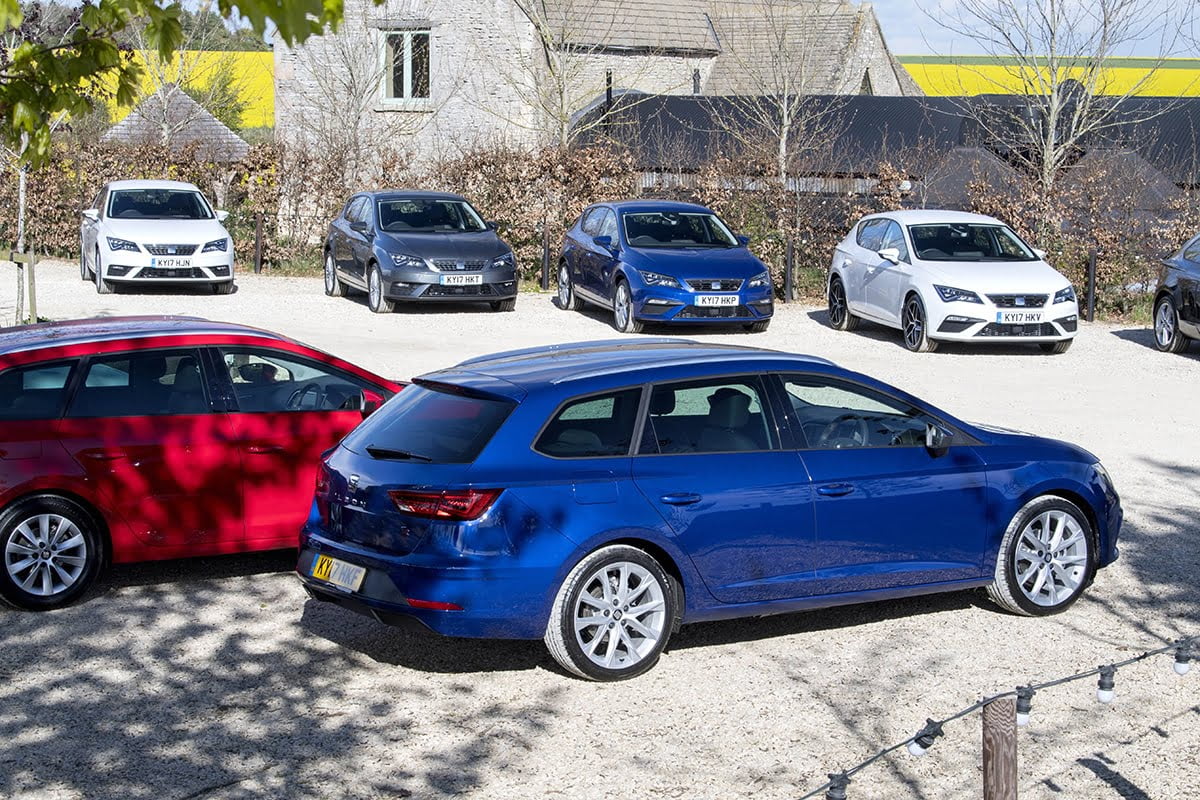
SEAT Leon ST in car park at press launch

Exterior and interior

SEAT describes the new exterior look as ‘subtle changes’, which is fine as the canvas the designers have to work with is so good anyway. The Leon has long been considered one of the best-looking family hatches on the market, with a purposeful profile based on sharp crease lines – notably on the bonnet and flanks.

The revamp seeks to add a little more sportiness to those looks. A slightly bolder front end gains a lower bonnet, wider grille and a redesigned bumper. The new technology is in the form of LEDs in the headlights, indicators and fog lights – yes we know the previous Leon had LED headlamps, but apparently the new ones offer triple the light intensity of their predecessors.

Equally, the Leon’s interior has been much praised for its cockpit-like feel, with the instruments grouped towards the driver and all placed close together, being very easy to use. Here again, it’s about subtle improvements, with new finishes and ambient lighting in a choice of eight colours which “occupants can adapt according to their mood.” Does one really get in a car and think “I’m not very happy this morning, so I’ll change the lighting from orange to blue”?

Seriously, however – it’s a very effective interior and does not require much in the way of improvement,  although the major update (replacing the manual handbrake with an electric one) does free up lots of between-the-seats space.

The Leon was one of the first new models launched on the VW Group’s flexible MQB platform and thus there is plenty of space for front and rear passengers and their luggage. At 380 litres the boot is some 64 bigger than in a Focus, and 10 more than the Astra. Drop the rear seats and it extends to a gargantuan 1,470 litres, though loading requires humping one’s luggage over a rather high rear sill.

Powertrains

Propulsion choices for the Leon remain plentiful, drawing on the many options in the VW Group engine catalogue. The five petrol units available range from 1.0 to 1.8 litres and 115 to 180hp, while there are three diesels, a 1.6-litre with 115hp and a pair of 2.0-litre units with either 150 or 184 horses.

Of this eight just two are changed over the previous model. The 1.6 diesel has had its power increased by five horses to 115hp, while improving economy and emissions, while there is a completely new-to-the-UK unit in the form of a 1.0-litre three-cylinder TSI. This is an impressive little engine, its sub 10-second 62mph sprint feeling enthusiastic while the combined cycle fuel economy is comparable to the diesels and the emissions figure of 102g/km best in the range.

SEAT expects, however, that the 1.4 petrol, with its clever ability to shut down two cylinders when cruising to save fuel, will remain the most popular choice amongst retail buyers. Fleet drivers meanwhile will go for the smallest diesel.

Six speeds are general across the transmission range, whether in manual or in the auto gearbox, though the 1.6-litre diesel has a five-speed manual ‘box and there are seven with the 1.4 EcoTSI engine and the auto-equipped 1.6 TDI.

On the road

Both of the most popular engines and the new 1.0-litre came under The Car Expert’s gaze during the launch event, and it is to little surprise that all behaved impeccably. They combine smooth, almost silent progress with eager pick up and smooth shifts whether through manual or DSG transmissions.

All testers of family hatches know that the Ford Focus offers the most effective chassis, but the Leon comes very close to bettering it, adding to the car’s generally sporty profile. A series of twisting bends is accomplished in fine style with precise turn-in and fine control through the apexes with plentiful grip. Equally, cruising at speed limits the Leon is assured, effectively smothering road surface imperfections.

Equipment

Five trim levels are on offer across the five-door range, including a new top-level XCellence grade. But perhaps most notable is the excellent safety package.

Standard safety features extend to multi-collision braking and a new tiredness recognition system, that reacts to changes in the inputs to the steering wheel and sounds a warning. DSG (automatic) models gain a host of extras including a lane-keeping function and even the ability to slow the car to a stop if the driver does not react after a certain period.

Other new technology options available with the Leon are headed by connectivity. These range up to a hub that maintains full functions of any smartphone through the car while wirelessly charging said phone at the same time.

Summary

The SEAT Leon has always been regarded very highly and the package of updates applied to the latest model simply enhance a quality package. It’s thoroughly practical while offering more personality than its perhaps more mainstream-regarded sister, the Volkswagen Golf. Buyers in the market for a family hatch should have the Leon high on their consideration list.

SEAT Leon five-door – key specification

Models tested: SEAT Leon Technology 1.0 TSI 115hp six-speed manual, 1.4 EcoTSI 150hp seven-speed auto, 1.6 TDI 115hp seven-speed auto.
On Sale: Feb 2017
Range price:
£18,470-£26,790
Insurance groups:12E-24E
Engines: Petrol 1.0, 1.2, 1.4 (2), 1.8. Diesel 1.6, 2.0 (2).
Power (hp):
115, 110, 125/150, 180. 115, 150/184.
Torque (Nm):
200, 175, 200/250, 250. 250, 340/380.
0-62mph (sec):
9.6, 9.9, 9.1/8.0, 7.5. 9.8, 8.4/7.5.
Top speed (mph): 123, 121, 126/140. 122, 134/142.
Fuel economy (combined, mpg): 64.2, 57.6, 54.3/57.6, 47.1. 70.6, 64.2/62.8.
CO2 emissions (g/km):
102, 114, 120/114,138. 105, 112/118.
Key rivals:
Ford Focus, Vauxhall Astra, Renault Megane.
Test Date: April 2017
All figures best results with manual gearbox where available.

Renault announces details of all-new Koleos

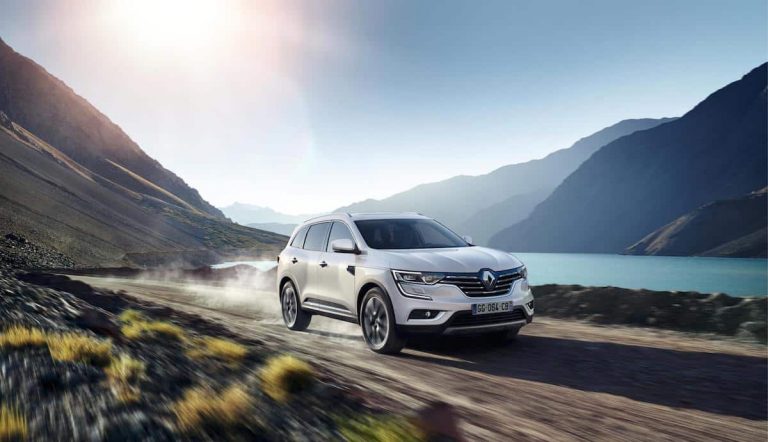
Renault has announced pricing and specification details for its all-new Koleos which debuted at the Paris motor show last year. The Koleos joins the Kadjar and Captur in the increasingly-crowded crossover segment. The six-version line up is available with a choice of two of Renault’s existing trim levels: Dynamique S Nav and Signature Nav. Options for the Koleos include hands-free parking, heated and ventilated front seats, powered automatic tailgate, easy-folding rear seats and opening panoramic sunroof. The Koleos’ infotainment system consists of thirteen speakers, 8.7-inch screen compatible with Android Auto and Apple CarPlay. The new Koleos is available with a host of advanced driver assistance systems including advanced emergency braking, blind spot warning, lane departure warning, over-speed prevention, traffic sign recognition and hill start assist. A rear parking camera and front and rear parking sensors are as standard on all models. Renault offers the Koleos with a 4-year/100,000-mile warranty, 3-year paint warranty, 12-year cover against corrosion and the Renault Assistance package. Priced from £27,500, the Koleos is available to order now with deliveries commencing later this summer. Renault announces details of all-new Koleos

Updated Peugeot 308 gets new safety tech

New styling and safety features are the order of the day for the facelifted Peugeot 308 hatch and estate models, including the performance GTi hatch. Modifications to the 308’s styling include a new bonnet, grille, front bumper and elliptical headlights. All models get LED daytime running lights as standard. The Peugeot 308 boasts greater connectivity with a touchscreen that uses Mirror Screen to display the user’s smartphone. It’s also compatible with MirrorLink, AndroidAuto and Apple CarPlay. The 3D satnav with voice control uses TomTom to provide realtime traffic updates. The current-shape 308 received a five-star Euro NCAP rating when tested back in 2013. Optional safety features now include Active Safety Brake, Active Lane Departure Warning, adaptive cruise control and Visiopark1 with 180° rear camera and Park Assist function. Customers can choose from a range of petrol and diesel engines. The new 308 is the first PSA Group model to get 1.5 BlueHDi 130 stop-start diesel engine, while the BlueHDi 180 stop-start diesel engine is exclusive to the 308 and can be paired with a new eight-speed automatic transmission. The updated Peugeot 308 is available for UK delivery from September onwards.

SsangYong revamps Korando SUV

SsangYong has updated its Korando SUV with a redesigned grille and headlights, intended to bring the Korando in line with its other models: the Tivoli, the Tivoli XLV and the recently-announced Rexton. The Korando gets new fog lights, a lower valance and bonnet, LED daytime running lights and a new steering wheel. The SUV can accommodate five people, has a 2-tonne towing capacity and a 1,312-litre boot. Driven by a 2.2-litre diesel engine, the Korando produces 180hp and has a maximum torque of 400Nm. The engine can be paired with either a six-speed manual or a six-speed automatic transmission. All models have electrically operated and heated door mirrors with puddle lamps, RDS radio, iPod and Bluetooth connectivity, air conditioning, tinted glass and roof rails as standard. The top-of-the-range ELX adds front and rear parking sensors, rear-view camera, seven-inch touchscreen, TomTom satnav, 18-inch wheels, leather seats, heated steering wheel and heated front and rear seats. The 2WD SE starts from £17,000, the 4×4 SW from £18,500, the 4×4 ELX from £22,000 and the ELX with automatic transmission from £23,500. The Korando SUV comes with SsangYong’s five-year unlimited mileage warranty and is on sale now.
SsangYong revamps Korando SUV (The Car Expert)
The Korando has a 2-tonne towing capacity suitable for a caravan, horsebox or boat trailer.

Is the sky really about to fall in for PCP car finance?

There have been a number of stories in the mainstream media recently about PCP (personal contract purchase) car finance driving a boom in car sales that will shortly become a bust, with massive knock-on effects for the car industry and the UK economy.

But what is driving those claims, and what are the implications for car buyers?

The Telegraph, the Sun, the Times and others have reported that the Bank of England is looking to regulate PCPs to prevent lenders charging excessively high interest rates to sub-prime customers. The Financial Conduct Authority (FCA) has also launched an investigation into how car finance is sold at dealerships, having stated a while back that it was watching the industry for evidence of mis-selling.

The tabloid papers have jumped a few steps forward and are predicting madness and mayhem if the number of PCP agreements falls, whether as result of Brexit, tougher selling rules or some other reason. With about 75% of personal car purchases from traders currently being made on a PCP agreement, a reduction in car finance approvals could lead to a significant downturn in sales. This has the potential to negatively affect the factories that build the cars, the dealers who sell them and most everyone else involved in the enormous automotive industry.

There are a few separate issues at play here, which inevitably have been mixed up – much like the Volkswagen Dieselgate scandal from 18 months ago that has catalysed an anti-diesel crusade around the world.

Interest rates are too high for sub-prime borrowers

As part of its evaluation of the broader credit market in the UK, the Bank of England is concerned that some car finance lenders are loaning money for PCP car finance to sub-prime (higher-risk) customers at excessively high interest rates. The Telegraph has reported that the Bank of England is contemplating tougher affordability tests, similar to those imposed in recent years on mortgage applications.

Should affordability tests be strengthened, more people might be declined finance, resulting in fewer customers. This would initially have an impact on new and used car sales at the cheaper end of the marketplace, as inevitably sub-prime loans tend to be for lower amounts than normal loans. But, there is the potential for a knock-on effect if cheaper cars become harder to sell, gradually pulling prices down across the board.

The Bank of England’s investigations are part of a broad look at how the finance markets operate. It is taking a big-picture approach, while the Financial Conduct Authority is separately looking at the issue of how PCPs are being presented and sold to customers.

PCP car finance agreements are being mis-sold

“Mis-selling” is a strong accusation in the financial world, usually with strong repercussions. So when the FCA announced that it had opened an investigation into the mis-selling of PCPs by car dealers, it generated headlines and provoked a strong response from car industry groups.

However, the FCA’s announcement, as reported in the Times, should not come as a surprise. The FCA said long ago that it was monitoring the situation and was considering an investigation – The Car Expert reported on it last July – and it had been discussed less formally for many months before that. Claims lawyers have also been priming themselves to launch action against dealers and finance companies who are guilty of mis-selling PCP car finance.

The FCA’s main concerns are that PCP products are not being adequately explained to customers, and are not being presented in an impartial manner.

In a speech at the Credit Summit conference in London in March 2017, Jonathan Davidson, Director of Supervision – retail and authorisations at the FCA, said: “Relevant here is not just the question of affordability, but also whether consumers are able to compare and choose effectively between financing options.

“The range of products available means that consumers’ choices are not always straightforward and they may have to take account of a number of variables in order to determine the most suitable product for their circumstances. These variables will depend on their attitude towards ownership of the vehicle at the end of the contract and the amount they want to pay on a monthly basis.”

Anyone selling car finance at a dealership must be accredited by the FCA to do so, but crucially they are only accredited in a ‘non-advisory’ capacity. This means that the salesperson is obliged to present you with all of the available finance options in a fair and transparent manner, highlighting the relevant points to consider, so that you can make an informed decision in your own time.

The reality is often very, very different for most customers. Salespeople in franchised dealerships are heavily financially incentivised to sell cars with PCP car finance packages, with monthly targets to hit and significant rewards or penalties based on their performance. Inevitably, this means that salespeople are pushing customers towards PCP offers instead of other alternatives – either consciously or subconsciously.

In some dealerships, salespeople are also measured on how much money each customer is financing, the idea being to push customers towards borrowing more money by purchasing a more expensive car and/or putting down a smaller deposit.

It is difficult to establish how prevalent this sort of selling behaviour is throughout the industry without active intervention and enforcement by the FCA. Indeed, this does not appear to be happening at anywhere near the levels required, especially when it comes to actively monitoring what is being said by sales staff to customers.

Sales staff are required to complete an online FCA quiz each year to maintain their accreditation, but this is easily cheated (for example, one employee can complete the quiz for all staff members) and it does not provide insight into what is actually going on at point of sale.

How can the system be improved?

Unsurprisingly, the car industry is happy with things as they are, and has no interested in reforming the system to make life better for customers.

However, the FCA has already introduced new regulations for selling GAP insurance which could provide a guide to how car finance sales could be improved. Since September 2015, car dealers are not allowed to sell GAP insurance as an add-on on the same day they sell a car. From the day GAP is first discussed, there must be specific written information provided to customers and then there must be two clear days until a buyer can actually purchase GAP insurance for their car. So if you are discussing GAP insurance for your new car on a Monday, the dealer cannot sell you GAP until Thursday.

The regulation of GAP insurance was implemented to stop widespread price gouging on by dealers all across the country, to a captive customer who often had never even heard of GAP. A similar principle could be applied to car finance.

There is no reason (apart from obvious resistance from the car industry) that a 48- or 72-hour period could not be mandated between providing a formal car finance offer and signing an agreement. Similar advice material could be provided to buyers, just as now happens with GAP insurance sales, allowing buyers to make a more informed decision about their purchasing plans.

An alternative option, which would encounter even more resistance, is mandating a proper cooling-off period that applies to both the finance agreement and the vehicle sale. A PCP car finance agreement, like any other finance agreement, has a 14-day cooling-off period whereby the borrower can cancel the contract without penalty. That’s all well and good in theory, but it’s not that simple.

Most car sales agreements do not have any cooling-off period, so cancelling your PCP simply means you then have to pay for the car in cash. Given that people tend to use a PCP because they don’t have the cash to pay for the car, the current cooling-off provision is meaningless. If buyers were able to cancel their PCP and return the car as well, dealers would be far more careful about how they sold the product in the first place…

But is the current media storm going to lead to a brighter future for car buyers, or will it simply blow over with no real improvements? And will the economy come crashing down if PCP car finance deals suffer?

So what will really happen to how PCPs are sold?

Contrary to the tabloids’ sensationalist headlines, there is unlikely to be any great crisis if there is a crackdown on PCP sales tactics. In fact, there are already some brands and dealers who are gradually starting to move away from PCPs.

What will happen is that finance companies will simply shift their efforts to other finance methods, like leasing, rather than PCP offers. Leasing is much less transparent, and conveniently avoids most of the legal obligations and consumer rights associated with purchase agreements like PCP and HP (hire purchase) finance. That’s great for dealers but even more disadvantageous to customers.

Other finance mechanisms, like peer-to-peer lending schemes, have been growing in the sub-prime market in recent years as well, so there will always be ways for people to finance cars. But, just like the crackdown on payday loans led to an increase in logbook loans, that doesn’t mean it will lead to a better outcome for consumers.

Additionally, the growth in online car sales is likely to weaken dealers’ hands in pressuring customers to take finance. As more manufacturers start offering buyers the option to conduct every aspect of their car purchase online, it becomes easier to ensure that the rules and regulations are actually being followed. Customers will have to click to download documents, and confirm that they have read and agree to the terms and conditions. If they choose not to read those documents, that’s not the seller’s problem.

Tougher car finance rules could well have a significant impact on the car market. But if a significant chunk of today’s car sales are being made on terms that are unfair to consumers, why should it be allowed to continue?

Consumer rights should always take priority over corporate profits, and the scare-mongering from the car industry is simply evidence that this is not currently the case.

New car registrations slump in April

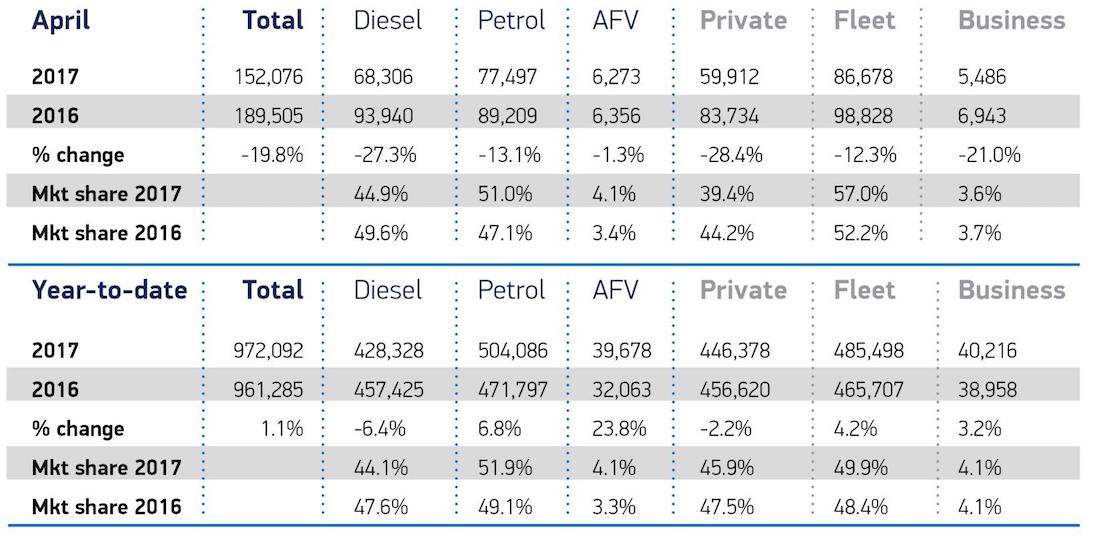
New car registrations slumped by 20% in April 2017 compared to last year, as the market was hit hard by changes to the cost of road tax. Figures released today by the Society of Motor Manufacturers and Traders (SMMT) show that registrations of new cars fell 19.8% to 152,076 units following March, the biggest month on record, which saw 562,337 cars registered. Despite the downturn in April, strong sales in March mean that 2017’s year-to-date performance remains at record levels. 972,092 were registered from January to April, up 1.1% on last year, although the next few months are not expected to maintain last year’s pace.
April sees demand for new cars fall (The Car Expert)
Sales of petrol, diesel and alternatively-fuelled vehicles declined in April.
The new vehicle excise duty (road tax) rates came into force on 1st April and have affected demand for new vehicles across the board. Registrations by private buyers, businesses and large fleets fell 28.4%, 21.0% and 12.3% respectively. Tax rises for hybrid and electric vehicles affected the alternatively fuelled vehicle market which saw a downturn of 1.3%, the first for 47 months. Mike Hawes, SMMT Chief Executive, remained optimistic however, stating that a downturn had been expected as a result of fewer selling days over Easter and changes to VED rates. The SMMT “expects demand to stabilise over the year as the turbulence created by the tax changes decreases.”
Table of bestselling UK cars April 2017 (The Car Expert)
The Ford Fiesta remains the UK’s best-selling car.

Petrol Maserati Levante S set for the UK

Maserati has announced the introduction of a petrol engine to its Levante SUV model in the UK, going back on its original claim that there was not enough demand for the model here. One of the criticisms levelled at Maserati since the Levante was unveiled at last year’s Geneva motor show has been that the model was only available in the UK with a diesel engine, while other markets were offered a petrol alternative. Maserati has now rectified this matter with the Levante S, powered by a 430hp 3.0-litre twin-turbo V6 petrol engine built by Ferrari. The Levante S has a top speed of 164mph and a 0-62mph time of 5.2 seconds. The petrol engine joins the V6 275hp 3.0-litre turbo diesel powertrain that was launched in the UK last year. The Levante S comes with active air suspension as standard and offers five varying ride heights. Intelligent Q4 AWD is included and a wide range of optional equipment is offered. The Levante S starts from £70,755 and will be available in the UK from September.

Mazda updates CX-3 range

Mazda has announced an updated CX-3 range and added a new GT Sport specification to the thirteen-model line-up, which arrives in UK showrooms this summer. The CX-3’s safety system and diesel engine have been upgraded, and G-Vectoring Control (GVC) introduced. GVC first appeared earlier this year on the Mazda3 and is standard across the CX-3 range. It optimises weight distribution on the wheels when cornering, which Mazda claims offers more precise handling whilst improving comfort. All CX-3 models from SE-L Nav trim upwards, feature Advanced Smart City Brake Support which has been upgraded to include pedestrian detection, using a forward facing camera to detect obstacles. A new steering wheel is standard across the range, as is extra sound insulation and heated electrically folding wing mirrors. Top-of-the-range Sport Nav models offer a heated steering wheel and colour head-up display. The CX-3 range is available with a choice of eight petrol and five diesel models. The revised Mazda CX-3 range starts from £18,495 and arrives in the UK this summer.

GT Sport

Alongside the updated CX-3 range, Mazda has introduced a new flagship special edition: the GT Sport. With a limited production run of 500, the GT Sport features the same equipment as the CX-3 Sport Nav models, but has a sportier look with a black rear roof spoiler and 19-inch silver alloy wheels. The GT Sport’s 120hp petrol engine can be paired with either manual or automatic transmission, the former costing from £22,895 and the latter from £24,095.

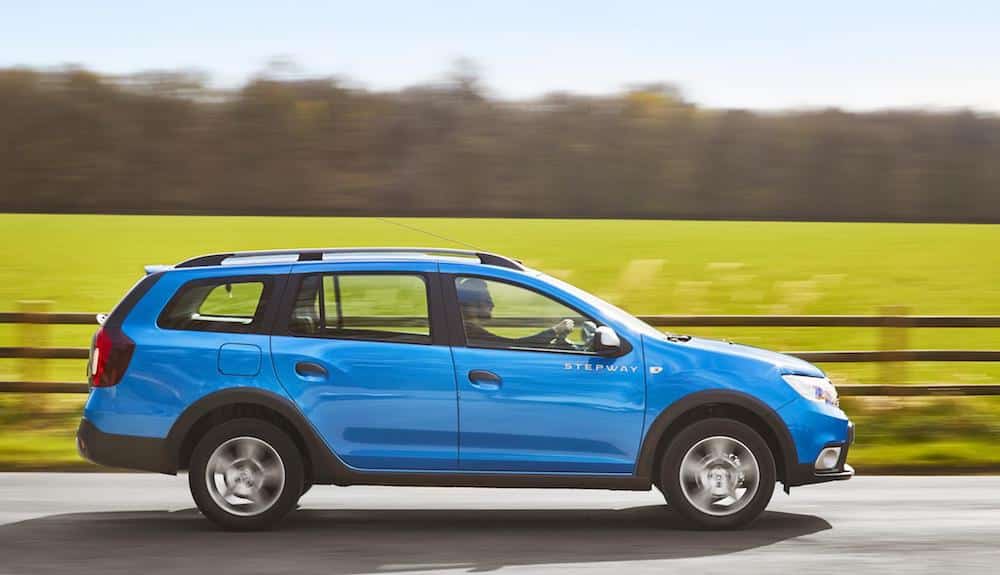
Dacia announces UK pricing for revised Logan MCV Stepway

Dacia has announced UK pricing and specification for its updated Logan MCV Stepway, which was unveiled at the Geneva motor show earlier this year.

The Logan MCV maintains its 573-litre boot space, while the Lauréate trim adds a two-tone bumper, satin-effect chrome skid plate, fog lights and LED daytime running lights. ‘Stepway’ decals feature on the front doors and dark metal is used for the wing mirrors and roof bars.

Customers can choose from nine different paint finishes, and the Logan’s overall look is completed by 16-inch wheels. Inside, the Logan includes upgrades that Dacia introduced across the board in 2016.

Standard specification for the Logan includes heated and electrically adjustable wing mirrors, rear parking sensors and a height-adjustable driver’s seat. The infotainment system features a seven-inch touchscreen, USB and AUX sockets, Bluetooth connectivity and satellite navigation.

The Logan is available with a choice of two engines: the TCe 90hp petrol or the dCi 90hp diesel. Both are paired with a five-speed manual transmission.

The Logan MCV Stepway is priced from £11,495 and is available to order now, with UK deliveries commencing from June.

Dacia announces details of new Logan MCV Stepway (The Car Expert)
The Logan MCV Stepway is available in nine different paint-finishes.

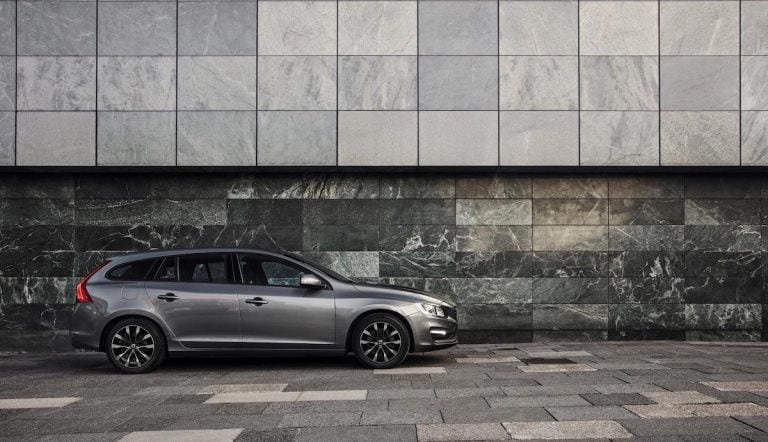
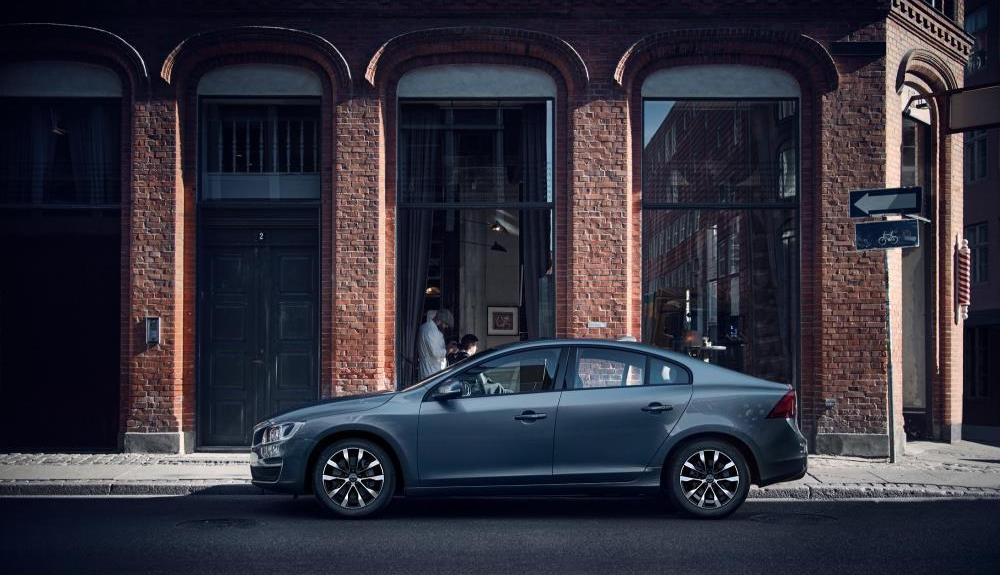
Lux upgrade for Volvo S60 and V60

Volvo has announced the extension of its Lux upgrade to the S60 and V60 Business Edition models as the current models head into their final months of production, with an all-new replacement due to arrive next year. The Lux upgrade is already available for the SE, R-Design and Cross Country. The Business Edition is a popular specification and in 2016 accounted for 29% of Volvo’s total S60 and V60 sales. Standard specification for the S60 and V60 includes autonomous emergency braking, satellite navigation, DAB radio, Bluetooth, dual-zone climate control, cruise control and LED daytime running lights. The Lux upgrade adds 17-inch alloy wheels, leather upholstery, an active information display and rear parking camera. The Volvo S60 Business Edition Lux starts from £24,545 and the V60 from £25,745. The D2 diesel versions of both have a benefit-in-kind tax rate of 22%. The upgraded S60 and V60 Business Editions are available to order now.
Lux upgrade for Volvo S60 Business Edition (The Car Expert)
The Volvo S60 Business Edition Lux features 17-inch alloy wheels, leather upholstery and a rear parking camera.

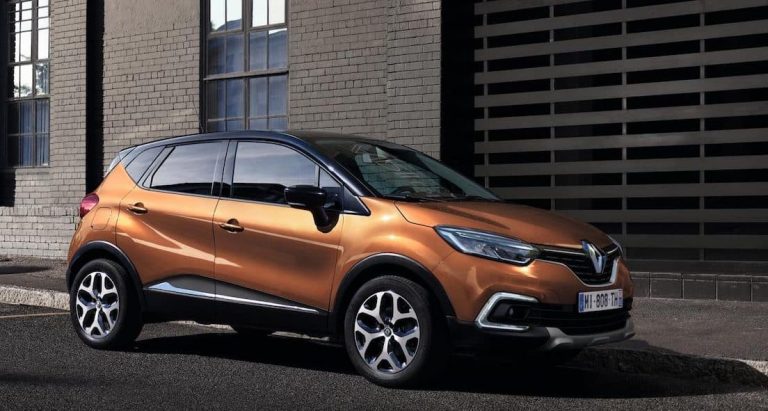
Renault announces UK pricing for new Captur

Renault has announced UK pricing and specification details for its new Captur, which was unveiled at the Geneva motor show earlier this year. The mid-life update of Europe’s best-selling crossover brings it closer in style to other models in the Renault range. The new Captur offers a number of personalisation options. Seven different interior customisation packs can be paired with one of the six exterior packs to give buyers far more choice in how their car looks. Five different trim levels are offered, in the normal progression of Renault model ranges: Expression+, Dynamique Nav, Dynamique S Nav, Signature X Nav and Signature S Nav. Three different multimedia systems are available according to trim level. R&GO transforms the user’s smartphone into a table connected via a universal cradle, while R-LINK’s seven-inch touchscreen incorporates navigation, 3G connectivity, Bluetooth and media playback. The Captur scored a five-star Euro NCAP safety rating when originally tested back in 2013, although the testing regime has become tougher since then. All models have cruise control, speed limiter, hill-start assist and roll movement intervention as standard. Blind spot warning, front parking sensors, a reverse parking camera and hands-free parking are available at additional cost. UK customers have a choice of two petrol engines; the 0.9-litre TCe 90hp and the 1.2-litre TCe 120hp, and two diesel engines; the 1.5-litre dCi 90hp and dCi 110hp. Manual versions feature a stop-start system to reduce fuel consumption and emissions. Prices for the new Captur start from £15,355 with UK ordering now open and deliveries expected to begin from July.
Rear view of Renault's new Captur (The Car Expert)
Customers can choose from a host of customisation options including seven interior and six exterior personalisation packs.

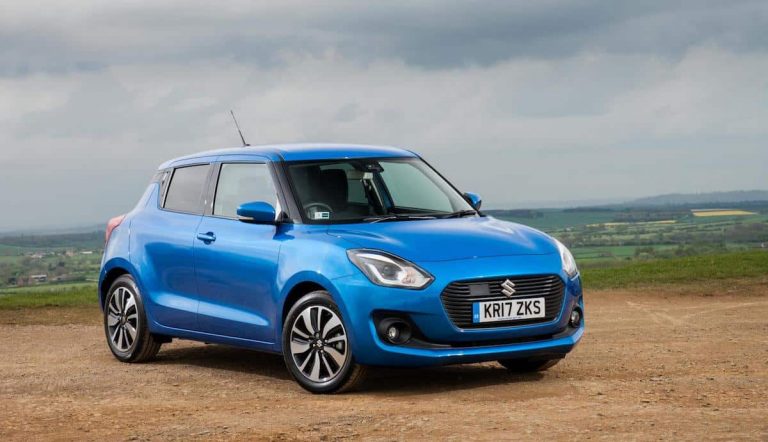
Suzuki announces details of third-generation Swift

Suzuki has announced pricing and specification details for its third-generation Swift, which goes on sale in June.

As standard, the five-model range comes with six airbags, air conditioning, DAB radio with Bluetooth, LED daytime running lights, 15-inch wheels and front electric windows.

The entry-level 1.2-litre SZ3 with Dualjet engine and manual transmission is priced at £10,999. The mid-range 1.0-litre SZ-T with Boosterjet engine and manual transmission adds a rear view camera, Smartphone link display audio, 16-inch alloy wheels and costs from £12,999. The top-of-the-range 1.0-litre SZ5 with Boosterjet engine and automatic transmission starts at £15,849 and features 16-inch polished alloy wheels, satellite navigation, keyless entry and rear electric windows.

Customers can choose metallic paint at £485 or dual-tone metallic paint at £650.

All models are covered by Suzuki’s three-year/60,000-mile vehicle warranty and come with one-year AA Suzuki Assistance offering 24-hour UK and European roadside assistance and recovery.

Interior of third-generation Swift (The Car Expert)
As standard the five-model Suzuki third-generation Swift comes with DAB radio, Bluetooth and four speakers.