Mini will launch its first plug-in hybrid in 2017, a version of the Countryman SUV.
The electric Mini forms part of the second-generation Countryman range, which will also be offered with conventional engine options. The new model is expected to be unveiled in the next few weeks.
Mini is not currently giving details of the plug-in hybrid powertrain, though it is expected to be based around the 1.5-litre three cylinder turbo engine. The engine will power the front wheels of the car, the electric motor the rears.
According to the car’s designers the car will be capable of up to 50mph in standard ‘AutoeDrive’ electric mode, and up to 78mph in a ‘AutoeMax’ mode – well beyond electric-only modes in typical hybrids.
With both combustion engine and electric motor working together, the hybrid is said to “demonstrate unparalleled acceleration performance when compared with its combustion-only siblings.” However no figures are being quoted at this point.
Part of the electric ability is due to a new high-voltage battery unit that is housed under the car’s rear seats, while the charging socket is discreetly hidden in the left scuttle.
The car also has a ‘Save Battery’ mode, which when pressed has the engine power the car while the battery can be recharged using a generator.
Few further details are yet being released concerning either the hybrid or the new Countryman range as a whole, though judging by prototypes seen testing the styling of the new model will not change radically over the current car.
Mitsubishi has launched a special edition of its big-selling Outlander PHEV called the Juro, as it celebrates a milestone in plug-in hybrid sales.
The Juro basically amounts to a free satnav unit on top of the mid-spec GX3h+ model, but is likely to further help sales of Mitsubishi’s successful hybrid SUV.
The company is reporting 25,000 UK sales of the Outlander PHEV range since it was launched just over two years ago. Mitsubishi points out that the entire plug-in hybrid sector achieved less than 1,000 registrations in 2013, the year before the Outlander PHEV was launched. Of course, there have been more than a dozen other plug-in hybrid launches over the same period, but the Mitsubishi commands about half of the market.
Over its first half-year in 2014, the Outlander PHEV achieved 5,354 registrations, followed by 11,681 registrations in 2015 and another 7,800 registrations to the end of September this year.
In fact, it has been so successful that electric charging point provider Ecotricity has blamed the Outlander for single-handedly increasing the cost of charging across its stations throughout the UK.
The special edition Juro is priced at £32,749 (on-road, including the government’s plug-in car grant). Based on the identically-priced GX3h, it gets a touchscreen infotainment unit with TomTom satellite navigation, DAB radio, CD/DVD player and smartphone integration.
Mechanically, the Juro is identical to the rest of the Outlander PHEV range, running a 2.0-litre petrol engine linked to an electric motor and battery. It is capable of running up to 32 miles in electric mode.
Finance and home charging offers to keep sales momentum up
Despite the growth in the plug-in hybrid market, the Outlander continues to dominate registrations. However, Mitsubishi is keen to maintain that momentum , and is currently offering finance offers and a free home charging unit on all new Outlander PHEVs as well.
The company is currently offering a three-year, zero deposit and interest-free hire purchase deal, or PCP offers with a deposit contribution of £2,500 (although interest and fees are still payable on PCP offers). Mitsubishi is also offering free supply and installation of a 3.6kW Chargemaster Homecharge unit to all Outlander PHEV buyers, which allows a 60% faster charge rate than a standard 13A wall socket.
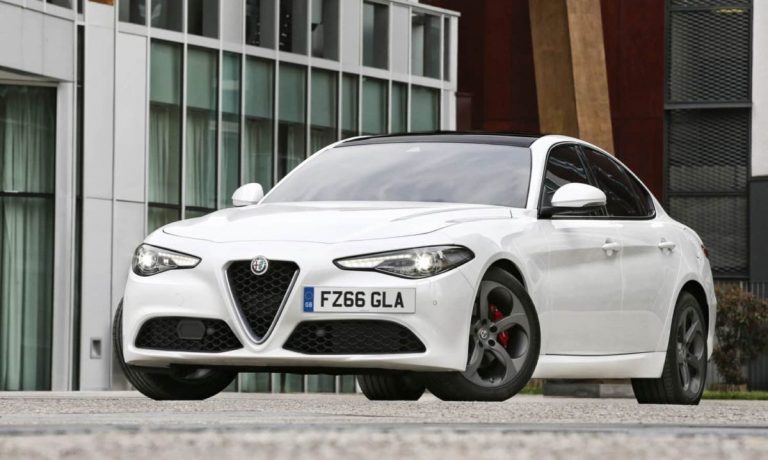
Alfa Romeo has started taking orders for its new Giulia sports saloon, the car the Italian brand hopes will challenge the BMW 3 Series.
Available in five trim levels and with four engines, the most powerful of which boasts a sub four-second 0-62mph time, the Giulia is expected to sell on a combination of its rear-wheel drivetrain and perfect 50/50 weight distribution.
Prices will start from £29,180, and the powertrain choice will be between a 2.0-litre turbo petrol unit of 200hp, a pair of 2.2 diesels with either 150 or 180hp, and the range-topping Quadrifoglio with its 3.0-litre V6 of 510hp.
The 2-litre petrol unit will only be available with a new eight-speed auto transmission with steering-wheel paddles –the two diesels are also set to be offered with six-speed manual units.
The five trim levels are dubbed Giulia, Super, Tecnica, Speciale and Quadrifoglio and all can be ordered now except for the Speciale, for which orders open later in October. Quadrifligio prices start from £59,000.
All Giulias are supplied with a wide suite of safety aids, which helped the car gain a EuroNCAP five-star safety rating with the highest 98% adult protection score yet recorded in a crash test.
Even entry-level Giulias include Forward Collision Warning (FCW) with Autonomous Emergency Brake (AEB) with pedestrian recognition, Integrated Brake System (IBS), and Lane Departure Warning (LDW) among their standard equipment.
Alfa Romeo UK country manager Damien Dally insists that the Giulia is a true driver’s car. “(It offers) beautiful Italian styling and stunning performance, and so we’re delighted to see strong early interest in the car,” he adds.
The first Giulia demonstrators are expected in dealer showrooms in November.
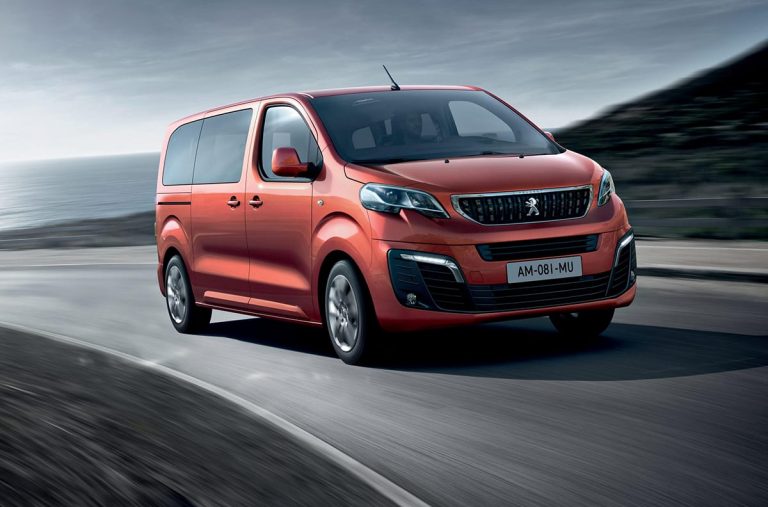
Peugeot launches its new MPV, based on the equally new Expert van, into the market clearly targeting VIP shuttle work. The new Traveller is built on the latest EMP2 (Efficient Modular Platform) architecture that allows a great deal of versatility.
As a result, the Traveller can be ordered in compact, standard and long options with 70cm between the shortest and longest. Peugeot describes the Compact version, measuring 4.6 metres long, as unique in the segment and also highlights the Traveller’s roof height, which at 1.9 metres will allow it to access most multi-storey car parks.
UK versions of the Traveller can be had with a four-strong range of engines, all being the brand’s latest Euro 6 compliant Blue HDi diesel units varying from 95 to 180hp. Depending on model they are matched to five or six-speed manual gearboxes or the ETG6 or EAT6 auto units.
Peugeot is offering the Traveller in two distinct ranges, for either private customers or the professional market, with an interior layout encompassing five, seven or eight seats. The range of options is wide, from a Business Plus version with a lounge seat cabin featuring four seats facing each other, to a variant designed to convey as many people as possible and their luggage – even the Compact will seat eight.
The middle seats slide and fold forward easily to allow access to the rear row, while with Peugeot targeting the shuttle sector plenty of upmarket technology and comfort features are available.
For the passengers these include hands-free sliding doors on both sides, a glass roof panel, tri-zone climate control and leather seats can all be specified, while the driver gets such niceties as a head-up display, road-sign recognition and Peugeot’s first use of its new voice-control connected navigation and real-time traffic information.
What do we think of it?
Our brief drive of a Traveller during an industry test day was in the standard length version and one is immediately taken by its compact height, not towering over other cars as is typical of such vehicles.
Sitting in the passenger cabin, however, proves there is no compromise in headroom, an advantage of the new modular EMP-2 platform. Luggage space is plentiful too though not very deep unless you remove the rear seats – it’s fine for piling suitcases on top of each other.
The 150hp engine of our test vehicle is the second most powerful in the range. While not exactly lightning fast, no surprise in such a large vehicle, it is highly flexible. – the maximum torque of 370Nm comes in from a low 2,000rpm making for excellent in-gear acceleration, which in turn translates to easy progress particularly in congested traffic.
The driving position is notably elevated, and with a large glasshouse the all-round view is impressive, further aiding progress.
Verdict
Initial impressions suggest that Peugeot has created a significant new contender for several areas of the MPV market, from carrying as many people as possible to luxury VIP transport. Private buyers in particular will find cheaper alternatives, partly because the Traveller is not offered in a real base entry-level specification. But equally it could offer savings against other potential rivals, particularly from German makers – potential buyers should certainly include it on their comparison lists.
Models tested:Peugeot Traveller Allure STD BlueHDi 150 Price: £36,985 on the road (range starts £27,920) On sale: September 2016 Engine: 2.0-litre diesel, 150hp, 370Nm (4 diesels in range) 0-62mph and max speed: 11.0sec, 106mph Economy and CO2 emissions: 53.3mpg, 139g/km Key Rivals:Volkswagen Caravelle Test date: September 2016
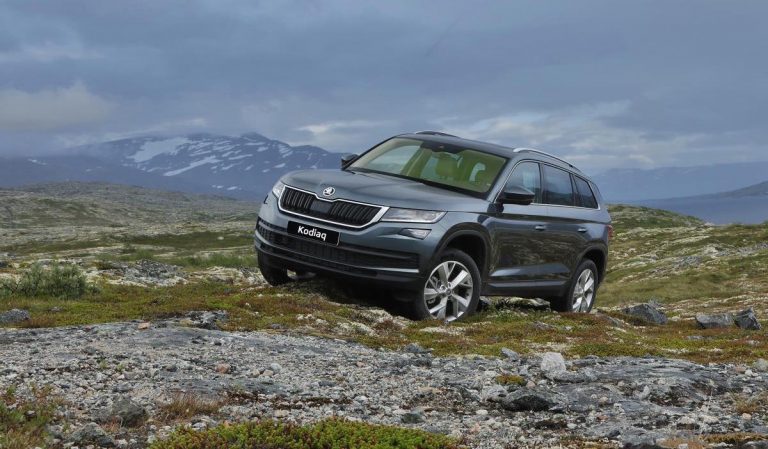
The Skoda Kodiaq SUV will cost from £21,495 when it arrives in UK showrooms in April 2017.
The price is highly competitive, significantly undercutting what are expected to be the Kodiaq’s major rivals such as the Nissan Qashqai.
Order books open in November for the car, Skoda’s first seven-seater SUV and regarded as the Czech manufacturer’s most important new model for some time.
Six engines will be available – the three petrol options ranging across a 1.4 TSI unit of 125hp in front-wheel-drive and six-speed manual gearbox, a 150hp manual version with a 4×4 gearbox or DSG six-speed auto in both FWD and 4WD, and a 2.0 TSI with 180hp and a seven-speed version of the DSG box with 4WD.
All three diesels are 2-litre units. Buyers will be able to choose from initially a 150hp with a six-speed manual gearbox and 4WD or the seven-speed DSG in both front and 4WD versions, and a range-topping 190hp version, with the DSG and 4WD.
Some months after launch an entry-level 115hp version of the 2.0 TDI will join the range, with FWD and a manual gearbox only. Skoda will offer 24 versions of the Kodiaq across the three familiar trim levels of S, SE and SE L, plus a new range-topping grade dubbed Edition.
Entry-level S models include as standard LED daytime running lights, 17-inch alloy wheels, a leather steering wheel with controls on it, manual air-conditioning. the Front Assist driver-aid, and a touchscreen infotainment system with DAB digital radio and the SmartLink smartphone connectivity.
SE models start from £22,945 – or £1,000 extra with seven seats. The alloy wheels grow to 18 inches, and tinted glass, cruise control and rear parking sensors are added, along with an eight-inch version of the infotainment system, dual-zone climate control, auto wipers and headlamps and auto-dimming rear-view mirrors.
Major additions to the SE L specification, costing from £28,595, include the seven seats as standard, 19-inch alloys, a power tailgate, a navigation system with WiFi, drive modes, Alcantara upholstery, heated front seats and LED headlamps.
Finally the new Edition grade, from £30,695, includes a bespoke 19-inch alloy design, metallic paint, chrome roof rails, wireless charging and a host of driver aids, among them Lane Assist, High Beam Assist and Blind spot detection.
Skoda has made no secret of regarding the Kodiaq as the spearhead of a crossover offensive – industry sources suggest the range will eventually grow to five separate models.
BMW has officially revealed its seventh-generation 5 series saloon today, mixing evolutionary design with technology borrowed from the flagship 7 Series range.
The company chose to wait until after this month’s Paris motor show to show its latest model, to ensure it gets plenty of exposure rather than competing with dozens of other vehicle launches and industry announcements. The vehicle is expected to make its public debut at the Los Angeles motor show in November.
BMW claims the latest model is more refined than ever before, significantly lighter, safer, and more fuel efficient. A newly-developed modular engine range contributes significantly largely to performance and economy gains, while lightweight materials have helped with reducing the kerb weight.
Inevitably, the latest model has grown longer and (fractionally) wider, and its external dimensions are slightly longer than its age-old rival, the Mercedes-Benz E-Class. Cabin pace is also improved, especially for rear passengers, and the boot has grown to 530 litres.
The new 5 Series features a host of driver assistance systems, including an evasion aid and steering assistance which form part of an optional Driving Assist Plus package. The steering and lane control assist system functions in a similar fashion to the Tesla Autopilot system, keeping the car within its lane and allowing hands-off driving at up to 130mph. The traffic sign recognition system can also detect if other vehicles have priority, and alert the driver accordingly.
Both exterior and interior design display a clear evolution of the previous 5 Series, as well as influence from the newer 3 Series and 7 Series models. The overall look is significantly sharper than the old model. BMW claims that the drag coefficient has been reduced by 10 per cent, with a class-leading figure of 0.22 for the entry-level eco model.
From launch, the new 5 Series will offer two petrol and two diesel engines, with another diesel option set to join the range shortly afterwards. The petrol models will be the 530i 2.0-litre four-cylinder, developing 252hp, and the 540i xDrive 3.0-litre six-cylinder 340hp all-wheel drive model. The diesel offerings will be the 520d 2.0-litre generating 190hp and the 530d 3.0-litre six-cylinder engine, producing 265hp and an enormous 620Nm of torque. Both diesel models are available in either rear-wheel drive or all-wheel drive format. An eco-version of the 520d will join the range soon after launch, with a similar power output to the regular 520d version but lower emissions and a more limited specification.
A plug-in hybrid model will also be added to the range in coming months. The BMW 530e iPerformance combines the petrol engine from the 530i model with an electric motor to deliver 252hp and a claimed electric range of 28 miles.
Full UK prices and specifications for the new 5 Series will be available in coming weeks, so stay tuned to The Car Expert for more details.
The latest example of car manufacturers working together could well be Toyota and Suzuki.
The two Japanese firms have announced that they “have agreed to start exploring ideas directed towards a business partnership.”
Such a potential tie-up would bring benefits to both sides. Suzuki is renowned for its expertise in producing small cars, notably 4x4s, while Toyota has the research and development muscle in advanced and future technologies that are fast becoming essential in the automotive market.
“The industry is required to work not only on conventional automobile research and development, but also on R&D for advanced and future technologies in fields such as the environment, safety and IT,” the two manufacturers say in a joint statement.
“In addition to the work conducted by individual companies, it is increasingly important to work together with other businesses in areas such as infrastructure development and the setting of new industrial standards.”
The statement adds that Suzuki feels “increasingly uncertain” in the face of the research that is going into future technologies in cars, such as in safety, infotainment and environmental awareness. Whereas Toyota feels that it may be behind rivals in partnering up with companies to make the most of its research.
“As the environment which surrounds the automobile industry has been changing drastically, we need to have the ability to respond to changes in order to survive,” says Toyota president Akio Toyoda.
The two add that they might be open to other manufacturers joining them in a collaboration. Toyota has better experience of such tie-ups – most recently for example it has undertaken a joint programme with BMW that will produce the next BMW Z5 and Toyota Supra as hybrid cars.
Suzuki, however, famously broke off a joint venture with Volkswagen in 2015, with recriminations on both sides and the Japanese brand buying back the one-fifth stake the German giant had taken in it.
No details are available yet on what kinds of cars the new potential tie-up might produce – these will likely emerge as discussions between the two continue.
Toyota’s President Akio Toyoda and Suzuki chairman Osamu Suzuki announce the potential tie-up.
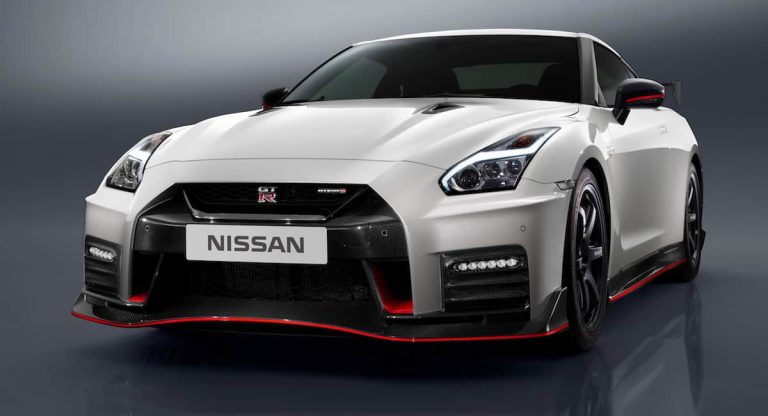
Nissan will start taking orders for its range-topping GT-R Nismo in November, at a UK price of £149,995.
The coupe’s creators describe the car as the pinnacle of the GT-R range, “a high-performance race car for the road which takes the very best of the super-coupe’s legendary Japanese heritage, then enhances the iconic design and state-of-the-art technology even further.”
The GT-R Nismo achieves this through a 600hp version of the 3.8-litre V6 twin turbo engine, a 30hp increase over the previous most powerful version. The high-flow large diameter turbochargers are sourced from the versions used in the brand’s GT3 international race cars.
A six-speed dual clutch gearbox with paddle shifts is fitted as standard, along with an all-wheel-drive transmission.
Other upgrades over the standard version of the latest GT-R include the formation of the front bumper entirely from carbon-fibre composite to save weight, while to aid cooling the grille is larger.
Revised body styling increases downforce and airflow around the wheels, Nissan stating that the GT-R NISMO produces more downforce than any other previous production model from the brand. Cornering performance is claimed to be two per cent better than other GT-Rs.
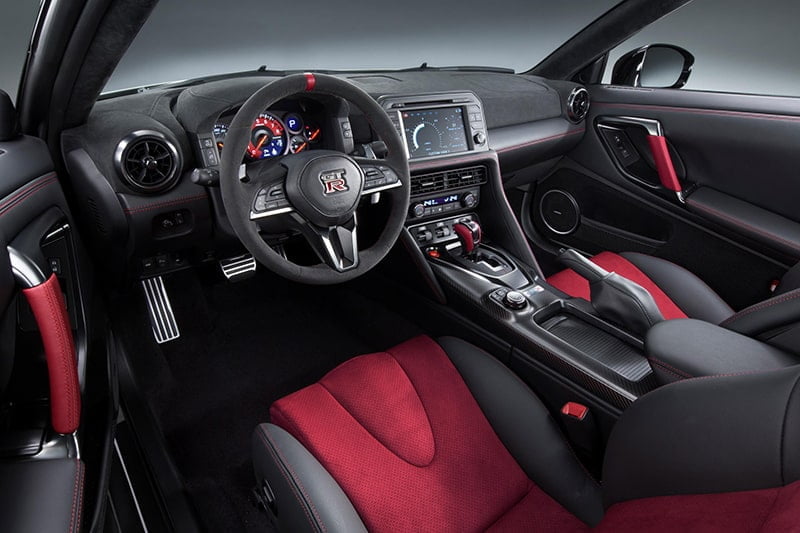
Inside the upgrades include Alcantara leather on the dash, steering wheel and centre armrest, and the fitting of bespoke Recaro bucket seats in carbon fibre, leather covered with red Alcantara inserts.
Mazda is to offer a version of its latest MX-5 with a retractable hard-top.
The MX-5 RF (Retractable Fastback) goes on sale in March 2017, at prices ranging from £22,195 to £28,995 – these £2,000 more than the fabric-roofed versions.
The much-anticipated move follows on from previous versions of the MX-5 which have also spawned hardtop variants. These became more popular than their fabric-roofed siblings, accounting for more than three quarters of sales in the UK.
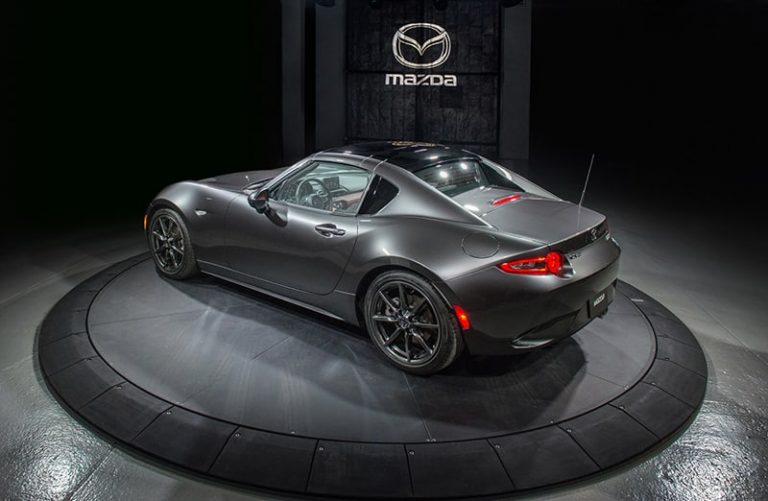
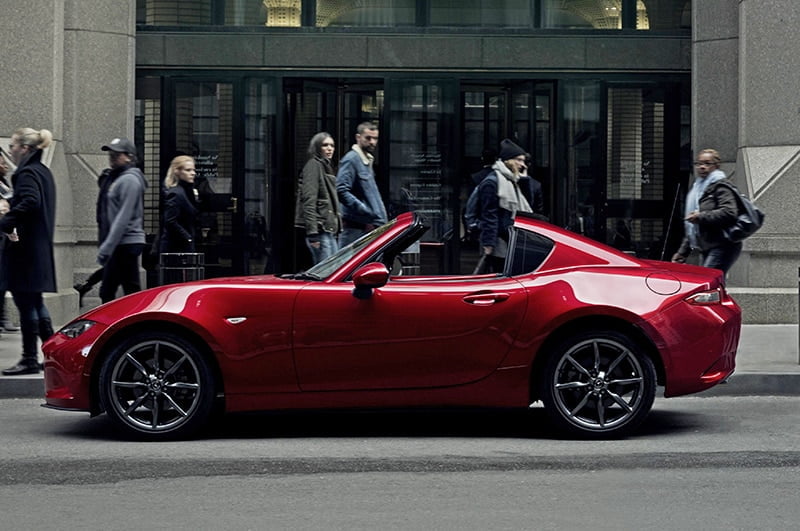
For the well-received Mk4 version of the roadster, Mazda has conceived a hard top in four pieces. When it is lowered the front and middle sections are stored together, the rear glass sits behind the seats and the rear roof section remains in place, which Mazda says creates a unique open-topped look.
RF models will include a 500-strong Launch Edition. Costing £28,995 and powered by the larger of the MX-5’s two engine options, the limited run will offer a bespoke twin-tone roof, BBS wheels, black door mirrors and a black rear spoiler. The interior gains Alcantara trim and Recaro seats.
The Launch Edition will be available with a choice of free-of-charge Soul Red or Machine Grey metallic paint, and includes a Safety Pack – comprising High Beam Control and Blind Spot Monitoring with Rear Cross Traffic Alert – as standard.
Order books for the MX-5 RF are open and Jeremy Thomson, Managing Director of Mazda Motors UK believes it will replicate the success of its predecessors; “It will add a unique and stylish model to our range, one that stands distinct from the MX-5 Convertible, yet retains all the award-winning driver appeal our sports car is famed for.”
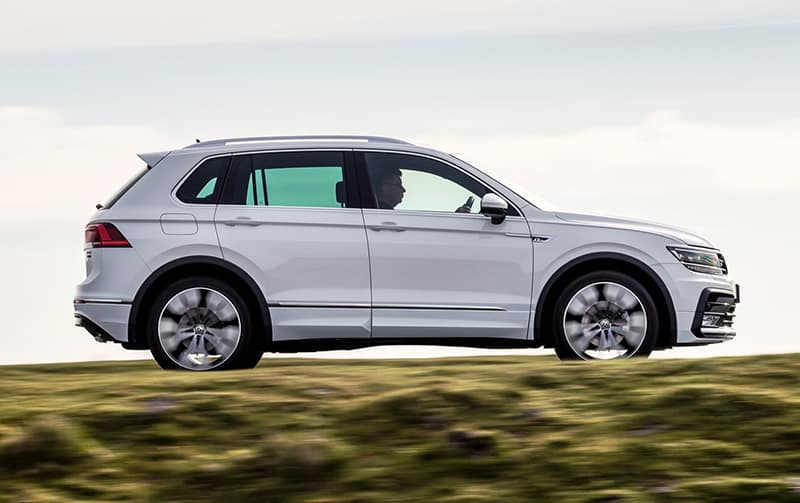
Volkswagen has boosted the engine range on its new Tiguan with a 240hp turbo diesel and a 180hp turbo petrol unit, which will be available exclusively on its top-level models.
The 2.0-litre BiTDI twin-turbo diesel engine is the same unit fitted in versions of the Passat. Available only with Volkswagen’s 4MOTION all-wheel drive system and driving through a seven-speed DSG double-clutch automatic gearbox, it is claimed to accelerate from rest to 62mph in 6.5 seconds.
The 2.0-litre TSI turbo petrol engine is already widely across various models in the wider Volkswagen Group. In the Tiguan, it is available with either a six-speed manual or seven-speed DSG automatic transmission. Both versions feature 4MOTION all-wheel drive and claim a 0-62mph time of 7.7 seconds.
The Tiguan is one of the safest mid-size crossovers on the market, scoring five stars in Euro NCAP crash tests earlier this year.
The new engine additions are only being offered in either SEL or R-Line specification. They are available to order now, with pricing ranging from £30,540 to £38,640 on-road.
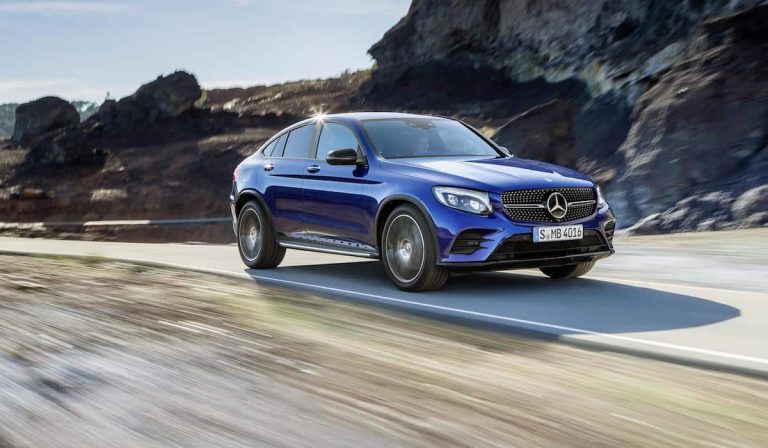
Mercedes-Benz is rolling out a wider range of engines for its E-Class estate and GLC Coupé crossover ranges, mirroring the offerings for the E-Class saloon and regular GLC ranges. Minor specification updates have also been made.
Of most interest to UK buyers will be the new diesel engine options, with the E-Class estate getting a new E200d version of the latest OM654 four-cylinder diesel engine. Rated at 150hp, it becomes the new entry-level model for the range and sits under the 195hp E220d version available from launch. Buyers will pay about £1,500 less for the lower-output version.
Both the E-Class estate and GLC Coupé are also now available to order with the familiar 260hp 350d 3.0-litre V6 diesel engine found in other Mercedes-Benz models.
All E-Class estate models are now available to order with Mercedes’ traditional rear-facing third-row seats in the boot. Only suitable for children under 115cm (3ft 9in) tall, the seats fold away into the boot floor when not in use.
A load securing kit is also optionally available for all E-Class estate models, using familiar rails and a telescopic bar to keep luggage in one place during your journeys.
The E220d estate is also now available with 4MATIC all-wheel drive, for a £1,500 premium over the rear-wheel drive version.
The E-Class saloon recently scored a five-star crash test rating from Euro NCAP, and the same safety features and systems are available on estate versions. The GLC SUV also scored five stars when tested last year, and again there is no reason to suggest the Coupé version would achieve a lesser result.
Mercedes-AMG versions added to the line-up
Both vehicles are now available with a 3.0-litre twin-turbo V6 petrol engine in the Mercedes-AMG E 43 estate and GLC 43 Coupé, both with 4MATIC all-wheel drive. The engine produces 400hp in the E-Class estate but is detuned to 367hp in the GLC version.
A carbon fibre package is also available for the E 43 estate and saloon models, although £1,755 for some carbon fibre mirror casings seems somewhat indulgent. At least the saloon version also comes with a carbon rear lip spoiler as well.
All models listed above are available to order now, with the first vehicles expected to arrive in December.
Nearly 470,000 new cars were registered last month, giving the UK its best September on record, according to figures published today by the Society of Motor Manufacturers and Traders (SMMT).
The September 2016 result of 469,696 new cars was an increase of 2% year-on-year. All of that growth came from registrations in England, which grew by , while registration numbers fell across Scotland, Wales and Northern Ireland.
Year-to-date, the new car market is running 3% above 2015 figures. September is often the busiest month of the year for new car dealers, with the biannual number plate change prompting a mini boom after what is often a flat August in showrooms.
Fleet sales drove most of the growth, with an increase of 7% on September 2015 results, while private and business registrations were both down. Diesel-powered cars made a bit of a comeback, with 3% more vehicles registered than for September last year. Petrol-powered cars still comfortably lead the market, despite a 1% fall compared to the same month last year.
Alternatively-fuelled vehicles continued their growth, up 33% on last year but still only making up 3% of the total vehicle market.
Mike Hawes, SMMT chief executive, said: “September is always one of the biggest months for Britain’s new car market. The new 66-plate, combined with a diverse range of exciting new models featuring the latest technology, has certainly helped draw buyers into showrooms and many are taking full advantage of the attractive deals and low interest financing options on offer.
“However business and consumers place September orders many months in advance, so the ability of the market to maintain this record level of demand will depend on the ability of government to overcome political uncertainty and safeguard the conditions that underpin consumer appetite.”
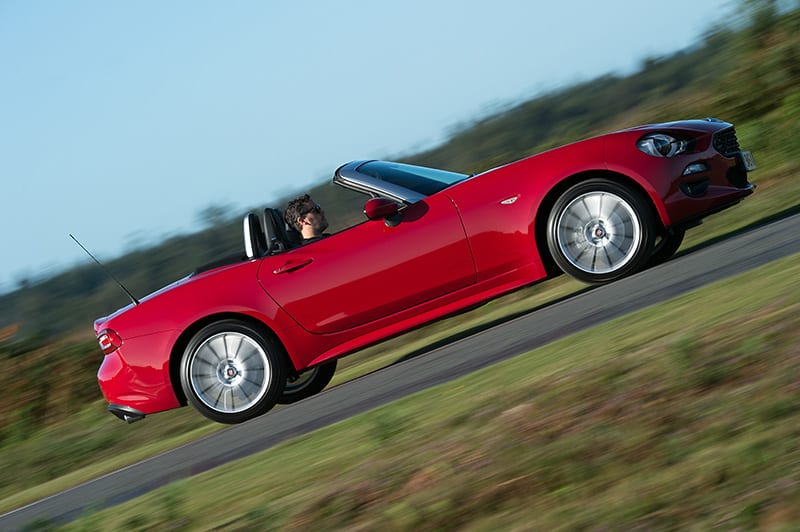
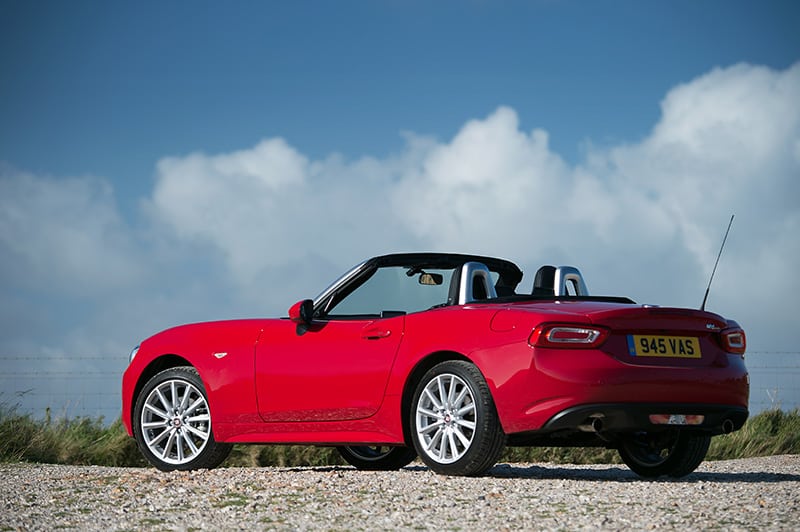
What is it? The new 124 Spider is a two-seat roadster, reviving an iconic Fiat nameplate. Key features: Mazda MX-5 underpinnings, turbo engine. Our View: Fiat has a big history in drop-top roadsters. But there has not been one in the Italian brand’s line-up since the demise of the Barchetta, back in 1995. And that was only made in left-hand-drive… Type of review: First UK drive
According to Pietro Carminati, in charge of selling Fiat’s new drop-top in the UK, one of the most regular questions that is coming from potential buyers is, “You are making it for us, in right-hand-drive, aren’t you?”
The 124 Spider is indeed being made as a UK car, as Fiat calls upon every element available to ensure that the revival of one of its most iconic roadsters hits the mark. The original 124 Spider, made between 1966 and 1980, is also the most fondly remembered drop-top. It was the most successful, with more than 600,000 made, of which in Europe alone more than 5,000 are still on the roads today. But equally importantly it changed people’s perception of Fiat – proved the brand could make cars that were all about fun.
So big shoes, and Fiat has gone about filling them in a highly practical way. The most successful roadster of the last 25 years, by miles, is the Mazda MX-5, and the most recent version launched in 2015 is the best since the first. So having signed an agreement with the Japanese brand to use the platform and chassis of the MX-5 for its new model should give Fiat some confidence…
There is a lot of insistence, however, that the 124 Spider is not merely a rebadged MX-5. “Yes our platform is shared with Mazda but we are very happy about it,” Carminati insists. “When you develop a proper lightweight roadster there’s nothing better than starting with the best in the market over the last 25 years, rather than as some brands do cutting the roof from a B segment platform and then trying to restore the rigidity, adding weight to make it stiff.”
The styling, he adds, is totally Italian, evolved directly from the lines of the original 1966 Spider. The car is larger than its Japanese relation and rival, 139mm longer and 5mm wider, and looks it. And the Fiat is more about curves than the distinct lines evident in the latest MX-5, but it turns heads in the right way – the looks we got on the launch route were admiring.
Slip behind the wheel and you immediately feel in quality surroundings – Carmanati insists that the aim was “an Italian touch and feel to the car, a more premium and grown-up feeling.” And it’s achieved by plenty of soft-touch plastic, some nice piano black and satin chrome detailing and leather on the steering wheel and gearknob, even on entry-level cars. Choose the top trim, as was our test car, and the seat becomes leather too, if not that substantial – it doesn’t feel quite as snug as perhaps it should in a car like this.
The big difference between Mazda and Fiat is in the powertrain. While MX-5 buyers have a choice of 1.5 or 2.0 litre normally-aspirated petrol engines, Fiat installs its 1.4-litre Multiair unit, complete with turbocharger.
At 140hp, it’s closer to the 1.5 Mazda’s 131hp than the 2.0-litre’s 160. But thanks to the turbo there’s a lot more torque on offer, 240Nm which is 90 more than the 1.5 MX-5 and 40 over the 2-litre. And the grunt comes in lower, from around 2,000rpm.
All of which means one drives the 124 Spider in a different way. Through a challenging set of twisty bends, the MX-5 is all about revving high and changing gear, whereas the Spider can be left in gear to flow through each twist, using the torque to best advantage.
So in a way it’s a more relaxing car, a different kind of fun. And one needs to remember that the majority of one’s time in the car will likely be spent in ‘normal’ driving, sitting in queues, on urban roads where traffic lights impede progress every few hundred yards, and in such situations it is very well behaved. “If you want to sit back and enjoy the view (you can) while knowing that the power is there when you need it,” says Carmanati.
Yet the Mazda does feel more connected to the road than the Fiat. There’s less feel through the steering wheel in the Spider, you don’t carve the turns in quite the same way as the MX-5, and so it’s a little less involving. This is interesting because while Fiat says it has specifically tuned the suspension and steering, everything about the car – apart from that engine – is still basically Mazda.
We almost forgot the roof – to be honest during the launch we hardly had it up, because this like the Mazda is a car designed to be driven wind in the hair. It’s a manual hood and works in just the same way as the Mazda, put up, and more importantly down, virtually one-handed far faster than any electric motors could manage.
This report has turned naturally into a comparison as these cars will inevitably be direct rivals, and the choice between the two will be made no easier by the fact that 124 Spider prices start at £19,545, which is directly between the two MX-5 variants.
Fiat has kept the Spider range very simple – apart from the choice of exterior and interior colours, the options list has just a single item on it, and that’s only on the entry-level Classica model, upgrading its infotainment system.
Aside from Classica, you can have your 124 Spider as a Lusso or a Lusso Plus – we’ll ignore the Anniversary launch edition (celebrating 50 years since the first 124 Spider appeared) as it sold out long before the first cars arrived in the UK.
Classica models get such niceties as four airbags, air conditioning, the leather, audio controls on the steering wheel, cruise control, keyless engine start and USB, AUX and Bluetooth connectivity on the infotainment. That one option upgrades to a seven-inch touchscreen version with DAB, wi-fi, two USB ports and a multimedia control knob, and costs £500 extra.
The seven-inch system is standard on Lusso versions, and adds satellite navigation and a rear parking camera. For the £22,295 price tag Lussos also gain 17-inch alloy wheels instead of 16-inch, heated leather upholstery, automatic climate control, front fog lamps, keyless entry, chrome exhaust tips and a silver finish on the windscreen frame and rollover bars.
Pay another £1,000 for the Lusso Plus and the specification also includes adaptive LED headlamps, LED daytime running lights, automatic lights and wipers and a nine-speaker Bose sound system, with stereo headrest speakers on both seats.
Fiat tells us that early 124 Spider sales are hugely encouraging, and that only 15 per cent of buyers are choosing the Classica version. We are not surprised – the car includes many factors that have made the MX-5 such a success, but adds a different appeal of its own, while also being very good value. Want a roadster? You can now have twice as much fun choosing one…
Model tested: Fiat 124 Spider Lusso Plus On sale: September 2016 Range price:£19,545-£23,295 Insurance groups:TBA. Engines: Petrol 1.4-litre turbo. Power (hp):140. Torque (Nm):240. 0-62mph (sec):7.5. Top speed (mph): 134. Fuel economy (combined, mpg): 44.1. CO2 emissions (g/km): 148. Keyrivals: Mazda MX-5 Test Date: September 2015
The Audi stand at the Paris motor show sees the launch of several new models and the reveal of a new motorsport programme.
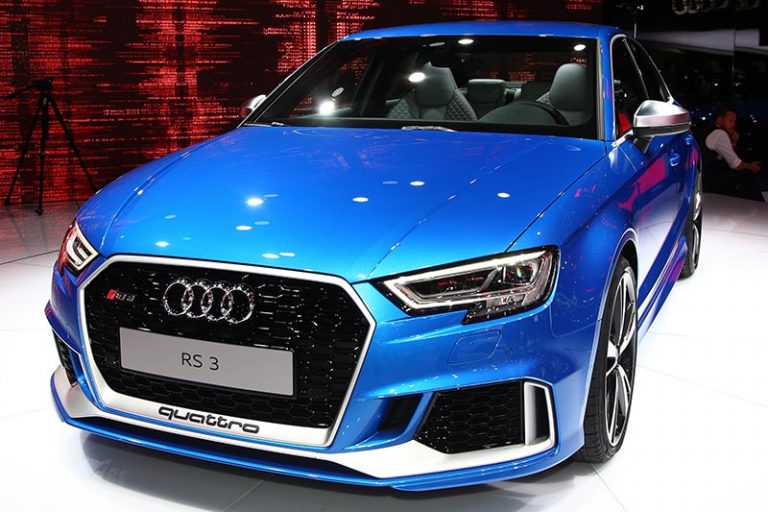
A new RS 3 model now takes as its basis the saloon A3, rather than the previous RS 3 Sportback hatch. As such, it could find fans in those who previously chose the booted rally-inspired cars such as the Impreza and Evo from Subaru and Mitsubishi.
Power comes from a 2.5-litre five-cylinder TFSI petrol engine, dubbed by Audi the most powerful five cylinder on the market with 400hp on tap (33hp more than its predecessor along with 480Nm of torque.
This potency is put through a seven-speed dual clutch transmission and the signature quattro all-wheel-drive powertrain, providing the RS 3 with a 0-62mph time of 4.1 seconds and a potential top speed of 174mph.
Visually the RS 3 bears all the signature design cues. Its track is 20mm wider than a standard A3, while the shell gains the distinctive front bumper of the previous RS 3 Sportback, flared-out wheelarches, a rear diffuser and oval twin exhaust tail pipes.
RS3 TCR racer will be for sale to customer teams.
The new RS 3 goes on sale in the summer of 2017, the first of eight new models from the renamed Audi Sport division. The division is also responsible for a new RS 3 Touring Car racer, the top model built to the rules of the new TCR formula that as well as boasting a globe-trotting International series is rapidly being adopted by national championships in a growing number of countries.
Audi expects to sell examples of the RS 3 racer to customer drivers and teams in Clubsport spec from around €99,000, and as a TCR car from €129,000.
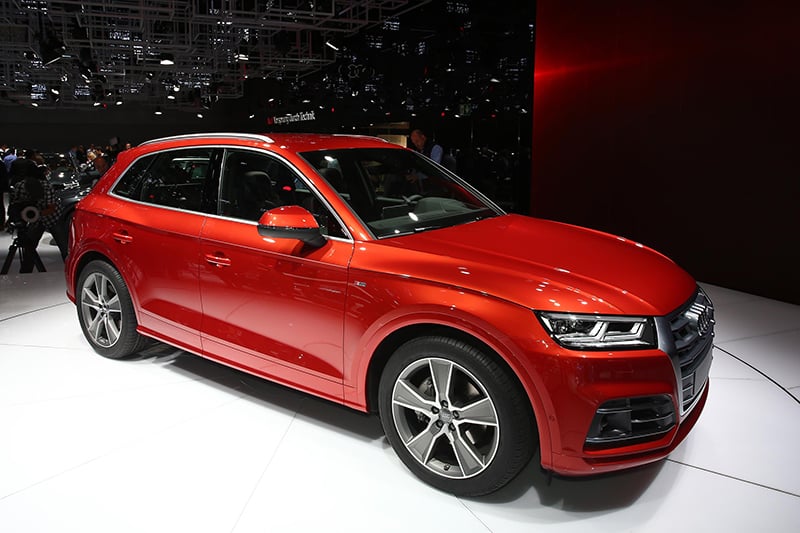
Also on the busy Audi stand in Paris is the second-generation Q5 SUV, on sale next year and targeting the likes of BMW’s X3 and the Mercedes-Benz GLC.
The new Q5 is up to 90kg lighter than its predecessor and described as one of the most aerodynamic models in its class. It will be offered with an engine line-up similar to that available with the A4 range.
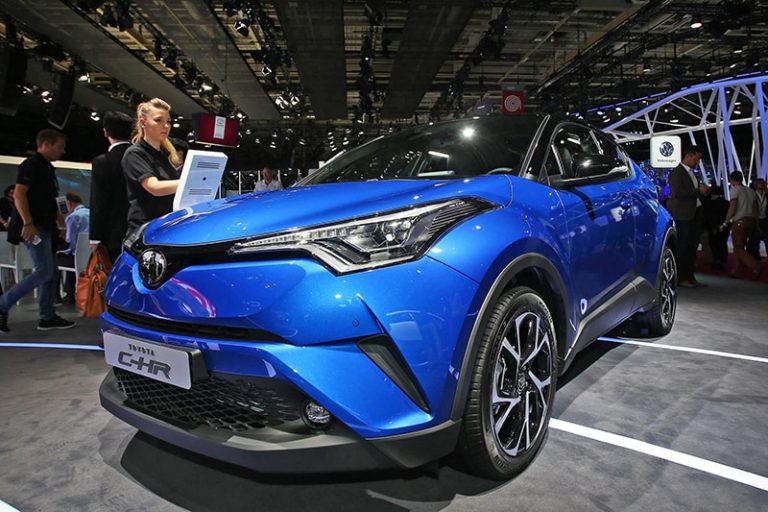
Toyota will increase its efforts in the crossover battlefield with the all-new C-HR, which debuts at the Paris motor show.
In production-ready form the C-HR (the initials stand for Coupe High-Rider) is close in looks to the concept version that debuted at the last Paris show in 2014. Its designers expect the car to stand out in the ever more congested mid-sized crossover market due to its coupe-like lines.
The car measures 4360mm long, 1795mm wide and 1550mm high, with a 2640mm wheelbase. The design, dubbed a ‘diamond-shape architectural theme’ features prominent projecting wheel arches at each corner and a raised ground clearance.
The interior is a new design for Toyota, notable elements including an instrument panel extending into the door trim and a focusing of the instruments around the driver. An eight-inch touchscreen controls the latest Toyota Touch 2 multimedia system, and stands proud , allowing the dash to be shallower and improve vision out of the car.
Highlight of the powertrain options will be a full-hybrid unit that matches a 1.8-litre petrol engine to the electric motor. Combined the two offer 122hp with combined cycle fuel consumption of 78.5mpg and CO2 emissions down to 82g/km. Updates to the unit include lighter and smaller components, lowering the car’s centre of gravity.
A 1.2-litre petrol engine with 115hp will also be available but UK buyers won’t get the 144hp 2-litre petrol unit offered in some markets.
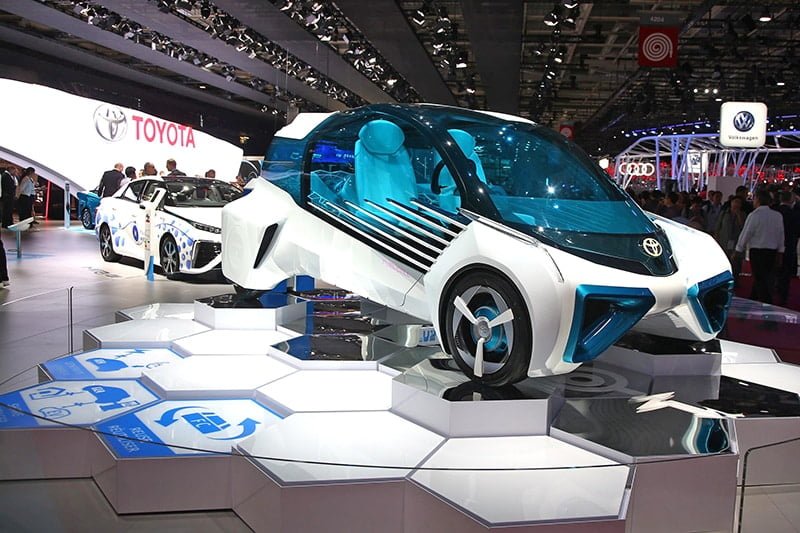
Toyota says that the CH-R will go on sale before the end of 2016 and meanwhile the Paris stand is also seeing the European debut of the FCV Plus hydrogen fuel cell concept car first seen at the Tokyo show earlier in 2016.
The FCV Plus uses four electric motors, one mounted in each wheel, fed by a fuel cell stack mounted between the front wheels and supplied by a hydrogen tank behind the rear wheels.
When not in use as a car, the FCV Plus doubles as a generator of electricity for the home and can also feed energy back into the national grid.
Aiding fuel efficiency are the aerodynamics, that also extend to the car’s underside. The rear wheels and front floor have wireless battery charging panels built in, and words and symbols can be displayed on the windscreen and rear window to help others recognise when the car is charging.
A production version of the FCV Plus is not expected to be launched for at least 15 years, by which time Toyota predicts the hydrogen powertrain will be only half the size of the current unit.
The FCV Plus is some years from production reality.
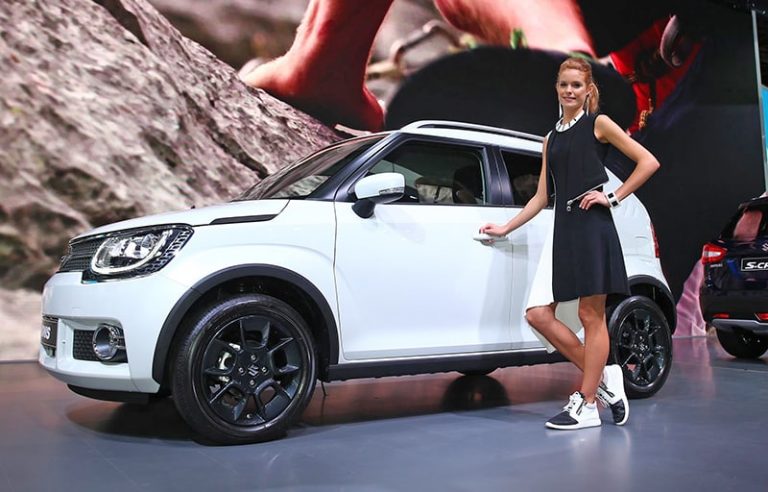
Suzuki’s UK range will expand early in 2017 with the arrival of the Ignis.
The new Ignis makes its European debut at the Paris motor show having been first seen at the Tokyo event in October 2015, and is a very different model to the previous car to use the name, last built in 2008.
Unlike its hatchback predecessor, the new Ignis is a high-roofed small crossover targeting the likes of the Fiat Panda. And in similar fashion to the Fiat, it is set to be offered with either front-wheel-drive or Suzuki’s well-known AllGrip all-wheel-drive system as used on the Vitara we reviewed earlier this year.
The Ignis will be powered by a 1.2-litre Dualjet engine, and this will be matched to a mild hybrid system, using an ISG (integrated starter generator) with an integrated power generator and electric motor, and a lithium-ion battery pack, to produce improved fuel economy.
New styling also debuts on the car, described by its creators as “a strong presence that skilfully blends a fresh new look with elements that remain true to its Suzuki heritage.”
The design principles were apparently “simple and iconic”, based around strong straight lines and curves. The shell is built with significant use of high-tensile steel to reduce weight while maintaining rigidity.
Suzuki is also highlighting the safety and technology offered with the Ignis, which includes stereo front-facing camera that control the brake support, lane departure and waving alert systems.
The interior touchscreen display includes connections for smartphones, accessing its apps through the car’s screen.
First deliveries of the Ignis to UK markets are expected in January 2017.
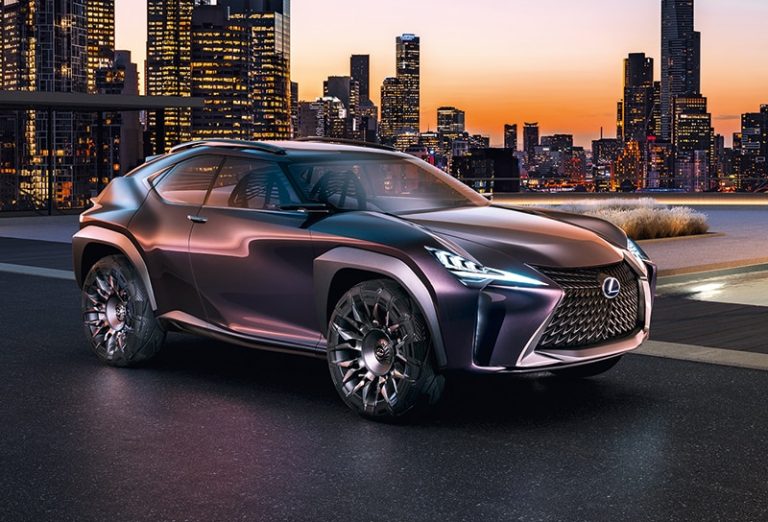
Lexus has unveiled a concept compact SUV at the Paris motor show, which is said to strongly predict the brand’s future direction.
Industry rumours suggest a production model evolved from the UX concept will replace the current CT 200h as Lexus reacts to the mushrooming appeal of crossovers.
Created by the Lexus design studio in France, the UX is described by the brand’s European CEO, Johan van Zyl, as a “vision of a premium urban crossover for the future.”
The model retains Lexus trademark styling signatures, such as the spindle grille, sharp body creases and L-shaped lights, but in what van Zyl dubs “An entirely new interpretation.”
The car is smaller than existing Lexus crossovers, adding weight to predictions that it will become a new model line, and its coupe-like body shell includes rear-hinged back doors.
The doors merge into the large wheelarches and a signature touch is the grouping of the door handles for front and rear next to each other. However whether such details as a see-through front windscreen pillar will make it to production remains to be seen.
Inside the UX is said to offer “imaginative technologies for an immersive driver experience”, alongside the high quality finishes for which the brand has become renowned.
The brand’s Kinetic Seat Technology is employed, while the instrumentation uses HMI technology to give a 3D impression.
Mechanical details of the car have not been revealed though it is bound to use a hybrid powertrain. In his speech unveiling the UX van Zyl reveals that a staggering 98% of all European Lexus sales are of hybrid cars.
“We offer the broadest range of premium hybrids in the industry with ten different models, and we sell more than any other manufacturer,” he says.
The range-topping LC is also making its debut on the Lexus stand in Paris. Using a new multi-stage hybrid system, the car is due on sale in January 2017.
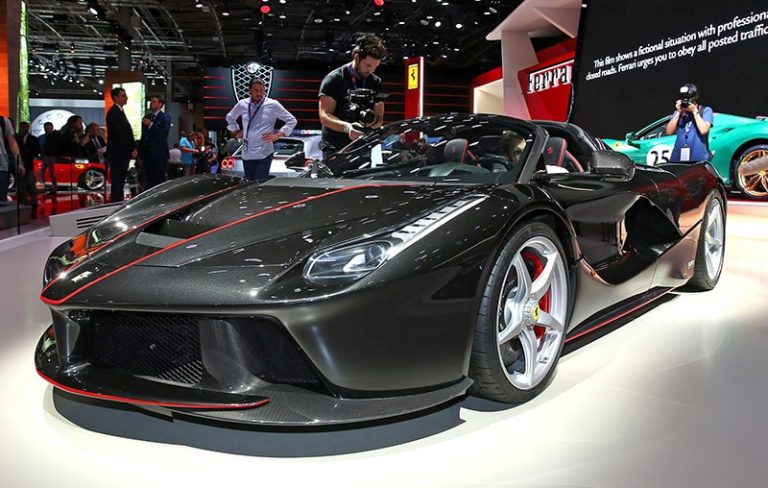
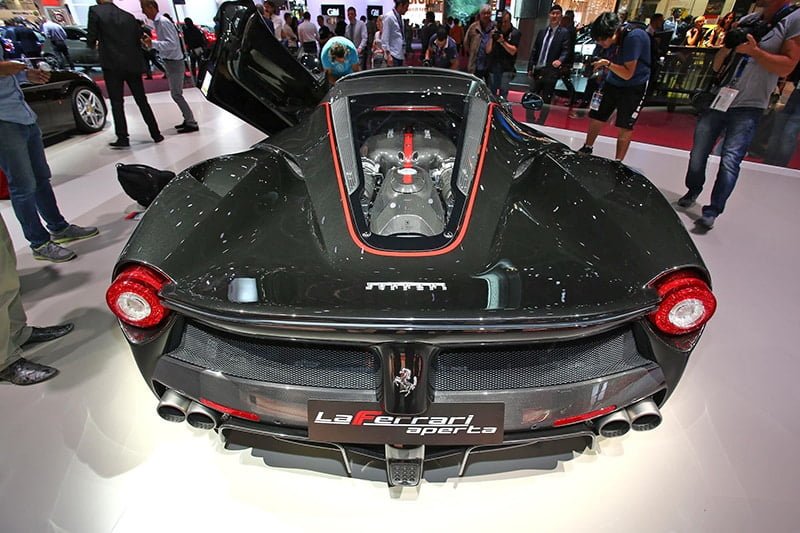
Ferrari has unveiled its convertible version of the LaFerrari at the Paris motor show, and given it the name Aperta.
The name has been used before, on very limited edition models from the prancing-horse marque.
The Aperta is effectively an open-top version of the exclusive and long sold-out LaFerrari Coupe, and is offered with either a soft top or an optional hard top in carbon-fibre. Ferrari has not revealed how many Apertas it plans to build – 500 coupes were eventually made.
It uses the same hybrid powertrain as the coupe, combining an 800hp 6.3-litre V12 engine with a 120kW electric motor for a total output of 963hp. Ferrari describes the car as the most high-performance and efficient it as ever built.
Power for the hybrid motor comes from 120 cells in eight modules, Ferrari says the output is the equivalent of 40 traditional batteries form a unit weighing only 60kg. The cells are charged from the energy generated under braking and when excessive torque is generated such as under cornering.
Ferrari says that the Aperta offers the same torsional rigidity and stiffness as the coupe, and delivers equally impressive performance. It will accelerate to close to 220mph, passing 62mph from rest in under three seconds and 124mph in seven seconds.
In creating the drop-top Ferrari’s engineers focused on aerodynamics and the chassis. In strengthening the chassis to compensate for the roof removal the butterfly door opening procedure was altered, including the insertion of a carbon-fibre section with an aerodynamic vent that has become one of the styling signatures of the car.
Changes in a bid to match the match the aero performance of the coupe have included altering the angle of the radiators and thus the airflow through them, directing it through the underbody, adding a duct to the bonnet and redesigning the front dam to increase ground effect.
There are also small L-shaped flaps on the upper corners of the windscreen to direct it upwards over the car an avoid creating a drag area behind the cabin.
Prices for the LaFerrari Aperta have not been revealed but they are of little consequence anyway as all available cars have already been sold. Industry rumours suggested one had been on offer for the equivalent of £2.8m – plus tax…
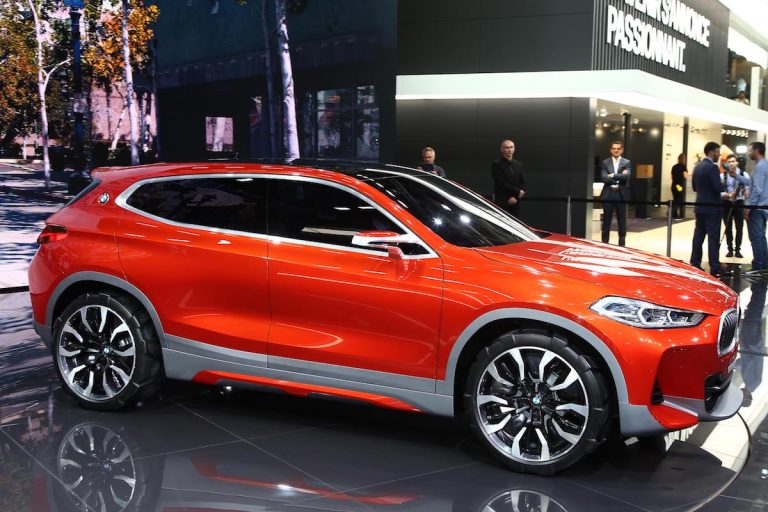
BMW has unveiled a near-production X2 concept at the Paris motor show, giving us a very clear indication of what the regular X2 model will look like when it arrives next year.
Although it won’t be on sale for about 18 months, the final version of the X2 crossover is expected to look similar to this concept version. It will be aimed squarely at similar sporting crossovers like the Range Rover Evoque and expected rivals from Audi and Mercedes-Benz.
The production X2 will share its platform with the X1 model and upcoming Mini Countryman. BMW has not provided any powertrain information for the concept, so it is possible that there is nothing whatsoever under the bonnet. Production models will probably share engines with the X1 and 2-Series models.
Like the Mercedes-Benz Generation EQ concept also unveiled today, the BMW Concept X2 has smoothed out its exterior surfacing, with less of the ‘flame surfacing’ than we have seen from BMW over the last 15 years. Door handles are hidden and panel gaps are minuscule, although the front and rear bumpers are far more conventional than the Mercedes.
Like most concept cars, the Concept X2 rides on oversized wheels, with a low ride height and heavily-tinted glass. All of these elements will need to be ditched for production. Other styling elements are expected to carry over to production, such as the nose design which site the headlights higher than the grille rather than alongside the double-kidney grille in BMW tradition. The narrow side windows are also expected to reflect the final production model.
No interior photos have been provided, suggesting that BMW plans to reveal more of the X2 in coming months, most likely at the Los Angeles Motors Show in November or Geneva in March 2017.
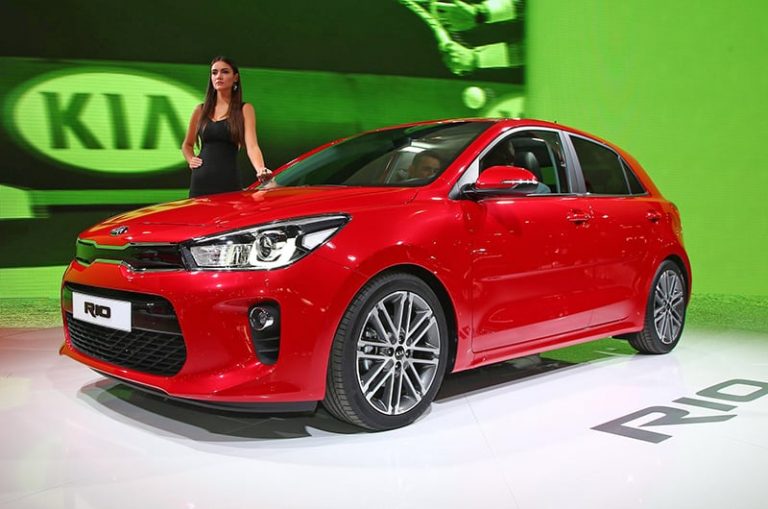
The all-new Kia Rio unveiled at the Paris motor show aims to build on the success of the current supermini, which globally is Kia’s best-selling model.
Kia hopes that the fourth-generation version will appeal to an even wider audience, its design the result of a joint programme between studios in the USA, Germany and Korea.
The exterior is distinctly different to the outgoing Rio, with straight lines and smooth surfaces dominating. Kia claims that the cabin offers more space and any rival, alongside a larger boot of 325 litres.
Highlight of the engine line-up will be Kia’s latest three-cylinder 1.0-litre direct-injection petrol unit. As well as bringing efficiency levels closer to those of diesel engines, the light weight of the unit is said to greatly aid front-end handling.
The new car is also claimed to be the most technologically-advanced version of the model yet, across safety, infotainment and connectivity. Both Android Auto and Apple CarPlay integration will be on offer while the Rio claims to be the first supermini to offer autonomous emergency braking with pedestrian recognition.
The Rio is expected on UK sale around the Spring of 2017. Kia is also showing updated versions of the Soul mini MPV on its Paris stand, including a new 120hp SX model, while exterior, interior and design updates to the Carens have also been unveiled.
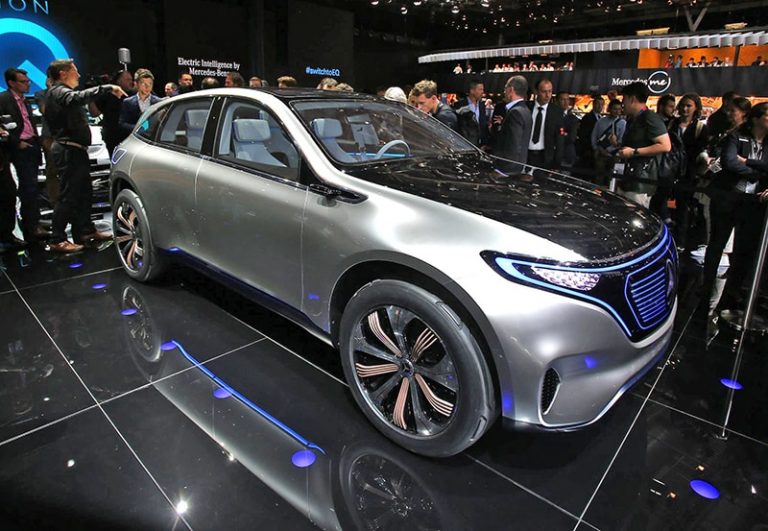
Mercedes-Benz has pulled the covers off a new battery-powered SUV crossover concept called Generation EQ at the Paris Motor Show, describing it as “close to production”.The Generation EQ previews a new scalable architecture for battery-electric vehicles across a range of future Mercedes-Benz models. The wheelbase and track width, as well as all other system components like batteries, are variable components in a modular building-block system. Daimler suggests that one single basic architecture could be suitable for SUVs, saloons, coupés, cabriolets and other body styles in a variety of sizes. Like the latest generation of Mercedes-Benz production models, the new platform uses a mix of steel, aluminium and carbon fibre in different roles to maximise strength and minimise weight.As well as being the name of the concept car, the EQ branding will be used for future battery-electric Mercedes-Benz models. EQ stands for ‘electric intelligence’. Daimler describes the principle as extending beyond the vehicles into broader issues of electric mobility, such as charging systems, home storage units and wallboxes.
1 of 4
The concept is powered by two electric motors – one for each of the front and rear axles, to deliver all-wheel-drive traction. The lithium-ion battery is built into the vehicle floor. Mercedes-Benz claims a total power output of 300kW (407hp), with 700Nm of torque. Range is claimed to be up to 500km (320 miles).The company describes the concept’s styling as ‘electro-look’, with an emphasis on stripping back the design to bare elements and minimising visual interference. Panel joins are scarcely visible, windscreen wipers and door handles have been concealed, and – like most contemporary concept cars – wing mirrors have been binned in favour of cameras. The end result is described as a monolithic look, and the intent is for much of the direction to filter down to future production vehicles. Internal design emphasises touch-sensitive controls and no physical buttons or switches apart from the electric seats. The driver faces a 24-inch widescreen display, which displays all necessary information across different stages of the screen and can be reconfigured to personal preference. The screen is controlled by touch-sensitive elements on the steering wheel rather than from the screen itself.
1 of 2
The centre console is a separate touchscreen for operating the climate control and infotainment systems. Even door handles and window lifters are touch-sensitive controls rather than physical levers or switches. The four individual seats have speakers integrated into each headrest. Rear passengers can watch screens integrated into the rear of the front seats.The exterior features LED lighting for not only head and tail lights, but also for illuminating the three-pointed-star logo. Strips of blue LED light also provide “a light show with exciting touches of colour”. The Generation EQ concept also previews autonomous and connected technologies, integrated into range and economy information to advise the driver of charging facilities and local attractions within range.
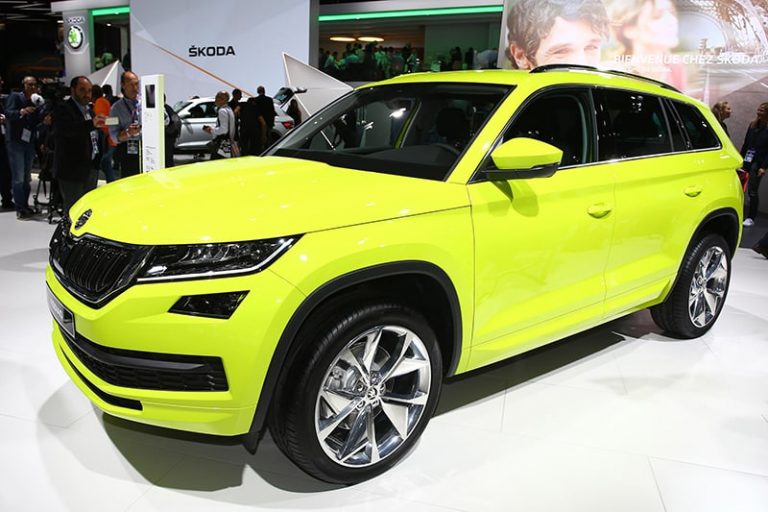
Skoda has unveiled its long-awaited Kodiaq SUV at the Paris motor show, starting a model rush that is expected to see the Czech brand grow to offer five crossovers.
Describing the launch of the Kodiaq as “the spearhead of our SUV offensive,” Skoda CEO Bernard Maier adds that the car is a “wonderful, powerful SUV,” its design language “shaping the identity of the entire brand.”
Despite the Kodiaq measuring up only 4cm longer than the Octavia saloon Skoda is claiming best-in-class interior space for the model, the only car in its class to offer a full third row of seats. It also claims a record boot space of 720 litres extendable up to 2065 litres with the rear seats folded.
Maier adds that the model will have all the best qualities for on and off-road performance – this will be achieved by a five-strong engine line-up, ranging across two 1.4 TSI petrol engines of 125 and 150hp, a 2.0 TSI with 180hp and a pair of 2.0 TDI diesels with 150 and 190hp. Depending on the model six-speed manual or seven-speed DSG auto transmissions will be available alongside front or all-wheel-drive transmissions.
Skoda’s much-vaunted ‘Simply Clever’ features are also being highlighted, the Kodiaq having more than 30 of them including the signature umbrella in the doors, while Maier adds that the Kodiaq will also offer the latest in connectivity.
“It will always be online,” he says, users able to make use of internet services such as Google Streetview, while a Skoda app will allow owners to stay connected to their car wherever they may be located.
The Kodiaq is expected on UK sale in April 2017. Industry sources suggest prices could start from £22,500 which would substantially undercut rivals such as the Nissan Qashqai.
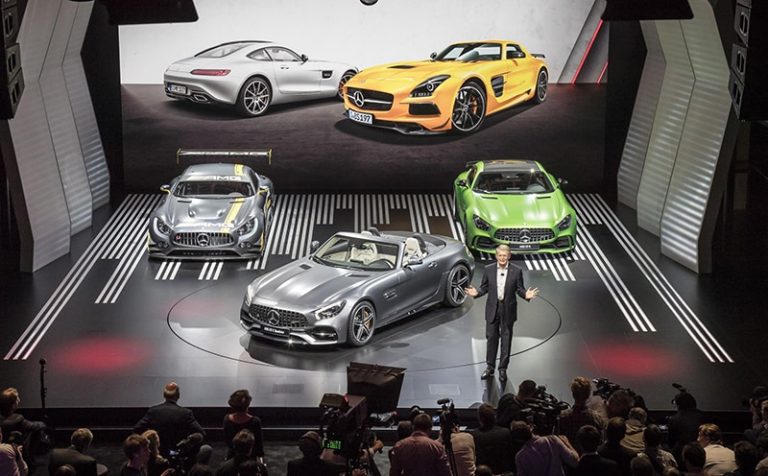
Mercedes-Benz has unveiled its AMG GT Roadster as the highlight of a swathe of announcements at the Paris motor show, and confirmed that the Mercedes-AMG brand is going on a model offensive.
According to CEO of Mercedes-AMG Tobias Moers, the performance sub brand is set to add at least ten new models. “Starting this year, we will offer the widest model range in the entire performance segment – a choice of no less than 48 different AMG performance cars,” he says.
The AMG GT Roadster will go on sale in February 2017 in two versions, a stock model with 476hp from its 4.0-litre V8 engine, and a GT C variant with 557hp on offer alongside 680Nm of torque. This sees it go from 0-62mph in 3.7 seconds and onto 196mph.
The uprated model also gains AMG Ride Control sports suspension with a wider rear track and bigger arches in which to house wider, 20-inch alloy wheels, active rear-axle steering and an electronically controlled rear differential lock, as well as a switchable performance exhaust.
Equipment on the GT C includes nappa leather upholstery, an AMG Performance steering wheel in nappa leather/Dinamica microfibre and an additional ‘race’ programme in the drive model selector.
Both cars make use of a fabric hood for light weight – this opens and closes in 11 seconds at speeds up to 30mph.
Mercedes insiders have also confirmed that the 557hp engine, together with the exterior upgrades, will also be extended to the Coupe version of the GT, though in what form such a model will be offered is yet to be revealed.
The GT roadsters are expected on sale at the end of 2016 at prices yet to be announced.
Meanwhile the model ramp-up will see Mercedes-AMG seeking to significantly increase its output, despite the fact that the almost 70,000 cars sold in 2015 represented a more than doubling of sales in just two years.
Main drivers were GT models, performance versions of the C-Class, compact cars and notably the new 43 series models being introduced across several ranges – the latest, the E 43 4Matic Estate, debuts in Paris.
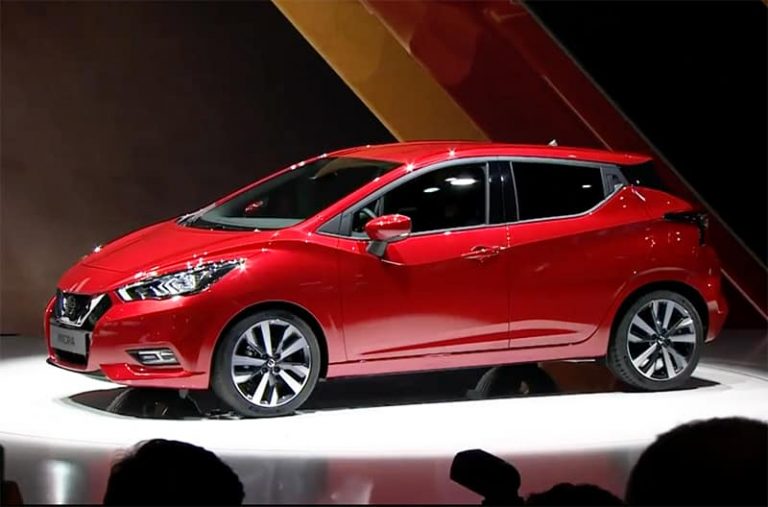
Nissan has unveiled an all-new Micra supermini at the Paris motor show, describing the car as a “complete redefinition” of the model.
The fifth-generation Micra is aimed directly at European buyers which form the world’s largest market for hatchbacks. It debuts a completely new body style, first seen on the Sway concept at the 2015 Geneva show. The body is lower, wider, longer and according to Nissan CEO Carlos Ghosn sleeker than both its predecessor and most competitors.
Power will come from new downsized turbo engines. At launch, a 0.9-litre turbocharged three-cylinder petrol unit and a 1.5-litre diesel will be available, both developing 90hp, with a 73hp 1.0-litre petrol engine following soon after.
Inside the Micra offers more space while the current trend to customisation is reflected in a total of 125 body and trim colour variations. Equipment includes the debut of a new six-speaker BOSE sound system with speakers in the driver’s headrest, while the seven-inch colour central display will access the audio system, satellite navigation, mobile phone, downloadable apps and Siri voice control via Apple CarPlay.
The new Micra will also debut the latest generation of Nissan’s Safety Shield safety technologies, Ghosn saying that the car will offer technologies more common on upper segment cars and be the first B segment model to be available with lane departure prevention.
Ghosn describes the unveiling of the Micra Gen5 as “an important milestone, redefining one of Nissan’s most iconic cars,” and emphasises the importance of returning production of the model to Europe – in a joint operation it will be built in the plant of sister brand Renault at Flins in France.
“It demonstrates Nissan’s ongoing commitment to manufacturing and delivering cars in Europe for Europe – (building it at the Renault plant is) a win for Nissan, Renault and our European customers,” Ghosn adds.
The new Micra is expected in showrooms in the Spring of 2017.
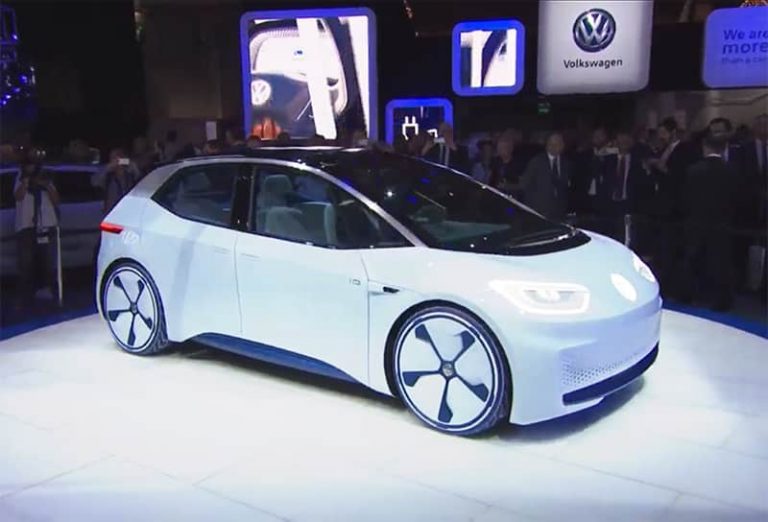
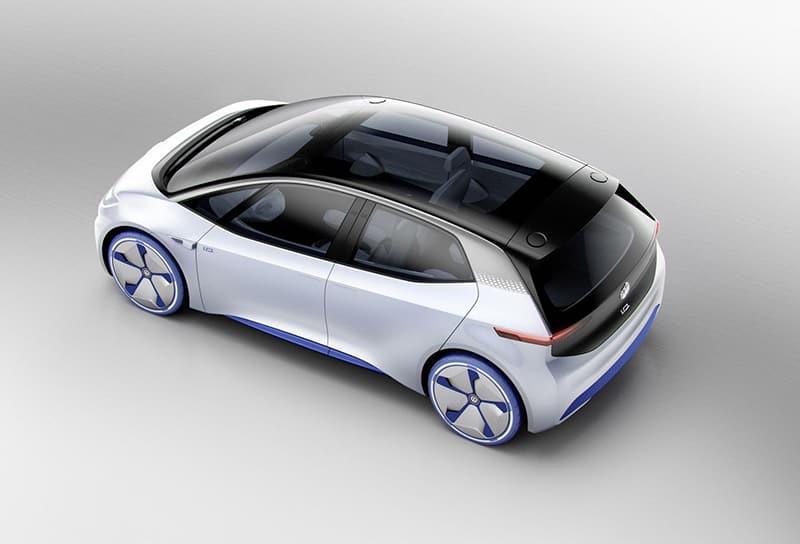
Volkswagen has unveiled the I.D. concept car at the Paris motor show and pledged the brand to an electric future.
The production version of the car will go on sale in 2020 as the first in a new range of Volkswagen electric cars, the brand’s board chairman Dr Herbert Diess telling the Paris show that VW aims to sell one million electric cars by 2025.
The I.D. is the first car to be built on an all-new modular electric platform with its batteries inside the floor. It will be powered by 125kW motor that Diess says promises driving pleasure, and have a range of up to 600km (370 miles).
Its batteries will be charged by wireless induction, and using the car’s park pilot function the process will be fully automated.
Inside the car uses the space vacated by the traditional internal combustion powertrain to increase room for occupants. The I.D. is the length of a Golf but according to Diess offers the internal space and comfort of a Passat, with luggage capacity to match.
The I.D. is also the first Volkswagen entirely designed to be ready for fully autonomous driving. It has a sensor system using 10 laser scanners, which form a central part of a safety package aiming at the brand’s ‘Vision Zero’ of fully accident-free driving.
The car’s cockpit lacks buttons or switches, instead being controlled by augmented reality displays projected on the windscreen and touchscreens in similar fashion to a mobile phone. These can be operated by voice and gesture control.
Diess also promises that each I.D. will be able to be fully individualised to the owner’s preferences; “It will be part of your digital lifestyle, and will become part of powerful community – electric is the new cool.”
And in potentially a major step forward for electric vehicles, Diess has told the show that the I.D. will cost the same as a VW Golf Diesel.
The unveiling comes as Volkswagen continues to suffer the fall-out from the ‘dieselgate’ emissions scandal but Diess insists the brand is recovering; “We are making good progress on getting the situation under control, getting back on track. We are dealing with the challenges and have a clear plan how to make Volkswagen more profitable, and more future proof.”
The electric programme is a central part of this strategy. “We are putting a much closer focus on a new world of mobility, Our future will be electric and connected – we will target new competitors like Tesla, Apple and others.
“We expect a breakthrough in electric mobility in 2020 and Volkswagen will be ready and well prepared by then. In a groundbreaking new approach starting in 2020 we will launch a new family of electric cars, all based on the new platform designed exclusively for electric – no combustion engines, no plug-in hybrids.
“Our goal is to become global market leader in electric cars – to make that happen we have started the greatest change process in VW’s history.”