Find an Expert Rating: 
Home Blog Page 171

Overtaking – how to do it safely

Spend time on single-lanes road in the UK, and you will inevitably come up behind a slower-moving vehicle.  Whether it’s a learner driver, a heavy lorry struggling up a hill, an elderly woman on her way to church in her ancient Rover, or a tractor chugging along at a snail’s pace, there comes a time when you need to pull out and pass the car in front.

What you will also notice, if you spend time on single-lane roads anywhere in the world, is that a lot of drivers are really poor at overtaking slower vehicles.  Most seem to put absolutely no forethought into what they are doing, and simply put their foot down as they reach for the indicator and pull across the road all at the same time – and then often change their mind and have to swerve back again.

So, how should you go about overtaking another vehicle in front of you?  Firstly, switch your brain on and think about what you’re trying to achieve, then follow this process.

1.  Do I really need to overtake this car?

How many times have you seen a driver go charging past a slower car, only to then hit the brakes and leave the road at the next junction or petrol station a minute later?  That driver has literally saved nothing but a few seconds off their trip time, but has increased the risk for themselves and other road users, wasted fuel, added some extra wear to their brake pads and tyres, and generally looked like a fool.  All to save a few seconds.

If you know that you are going to be leaving the road shortly, do everyone a favour and stay behind the car in front.

2.  Plan your overtaking move

A successful and safe overtaking maneouvre requires plenty of space for you to speed up, cross lanes, pass the car in front, cross back over and return to your normal speed.  So you need a fairly long stretch of straight road to do the job properly.  Trying to pass another car on a road with limited space and visibility is a potential disaster.

You also need to factor in your own car’s performance.  If you don’t have a very powerful motor, or you are loaded up with passengers and luggage, or the road is uphill or into a headwind, then you are going to need more space to get up to speed and overtake safely.

Look ahead of the car you intend to overtake – is there another car in front of it, and if so, is there enough room for you to safely pull back in between them?  You should never try to overtake two or more cars in one go, regardless of how good you think you might be!

Also make sure you look at the line markings – solid lines banning overtaking are always there for a reason, even if it’s not obvious.  There may well be a hidden danger you can’t see from a distance, such as a crest or hidden driveway, so the line markings must be respected at all times.  If you can’t complete the overtaking manouevre before the lines change, it’s not on.

3.  Getting ready to overtake

There is no point trying to overtake the car in front if you are jammed up behind it with no ability to accelerate to a speed faster than he/she is going before you pull out.  If you pull out now, you are sitting on the wrong side of the road and going no faster than the car in front.  You need to drop back to allow yourself plenty of space for your ‘run-up’ before pulling across to the opposite side of the road.

Keep an eye on your rear view mirrors – if a car behind sees you dropping back then they may try to pass you while you’re getting ready to pass the car in front, which could be disastrous.  As you drop back, start indicating so that anyone following you can see that you are about to start your overtaking move.  Don’t leave your indication until you’ve already started – remember “mirror, signal, manouevre” in that order.  Give the car behind you a clear idea of what you’re doing, rather than making them guess.  If the car in front of you is paying attention, they will also realise that you are about to come past and will hopefully be cooperative.

4.  Start your overtaking move

You’ve checked that the road is safe for overtaking, you’ve dropped back from the car in front and you’ve indicated that you’re changing lanes, so it’s time to get on with it.

Keep checking the road ahead as you go, as well as your rear view mirror.  If you spot an oncoming car, or there is someone behind you trying to overtake you as you go to overtake the car in front, you need to be able to bail out of your manouevre and get safely back onto the correct side of the road.

Be decisive and accelerate firmly while still in your lane.  There is no point trying to pass the car in front if you’re only doing 1mph more than him – the less time you spend on the opposite side of the road, the better.  Build up your speed and steer smoothly across to the opposite side of the road as you come up behind the car in front.  You should be travelling several mph faster than the car ahead to get past quickly and safely.

5.  Keep going well after you have passed the slower vehicle

Keep accelerating until you are well past the slower vehicle.  Too many people take their foot off the gas too early, slowing you down again before you have safely completed the manouevre and usually still on the wrong side of the road.  Now is not the time to have second thoughts about the speed limit or the price of the fuel that you are burning – keep going until you are well past the overtaken car and clear to move back across the road.

6.  Pulling back into your lane

Far too many drivers are absolutely rubbish at this important point in the overtaking process.  Having got their car a length ahead of the other vehicle, they chop back across into the lane and directly into the path of the overtaken vehicle.  Don’t be one of those idiots; complete the move properly.

As a general rule, don’t start to pull back across into your lane until you can see the entire overtaken car in your central rear view mirror (the inside one).  If you pull across right in front of them and then have to hit your brakes suddenly, they will have nowhere to go except right into the back of you.

Get well ahead of the slower car and then smoothly pull back across.  Don’t lift off the accelerator until AFTER you are safely back in your lane.  Ease back on the accelerator to return to your cruising speed.

Overtaking safely is an important driving skill

Being overtaken – be courteous and consistent

As inevitable as the slow-moving vehicle in front of you is the faster-moving vehicle behind you.  Regardless of how fast you’re driving, at some stage someone faster will loom large in your mirrors and be looking to overtake you.

When being overtaken, it’s important to co-operate with the car coming past – for your own safety as well as theirs and anyone else around. Don’t try and stop them overtaking, and don’t suddenly slow down.  It is important that you behave consistently so that the other car knows what you are doing.

If you see a car in your mirrors and it’s getting ready to overtake (or has already started), maintain your current speed.  Don’t speed up to try and keep them behind you, as it probably won’t change their decision and it will only make things more dangerous.  Don’t start slowing down either, because if they need to bail out during the overtaking process they might not be able to pull back in behind you.  If you have an impatient driver behind you and you want to let them past, you should reduce your speed before they start to make their move, not after they are already accelerating to pass.

Once the overtaking car has got ahead of you, you can ease off your accelerator and make sure they have plenty of space to pull back across, but not while they are still coming up behind or alongside your car.

Summary

This article specifically talks about single-lane roads, where the danger of oncoming traffic is an important factor.  However, overtaking on a dual carriageway or motorway follows basically the same process other than worrying about anyone coming at you head-on.

It’s hard to believe that an article about an everyday driving manouevre can be this long or have so many steps to remember, but then that’s the point.  Most drivers overtake without really thinking about what they’re doing, unless it starts going wrong – and by then, it’s often too late.

The key things to remember about overtaking are simple:
1) Do you really need to overtake?
2) Plan your move
3) Move decisively

Enjoy your driving, and stay safe out there :)
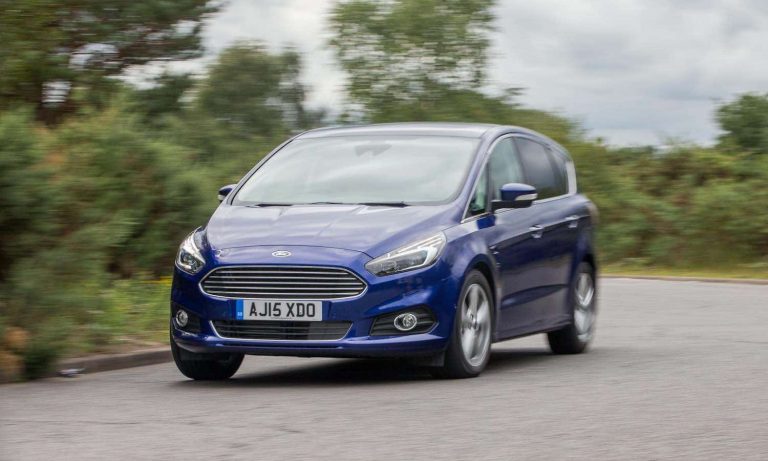
Ford S-Max review 2015

What is it? All-new version of very successful people-carrier.
Key features: More upmarket look, improved chassis, extra flexibility.
Our view: First impressions suggest the new Ford S-Max will more than maintain its dominant position in the market.


Ford S-Max review 02

The Ford S-Max has proven a major success over the last decade. It launched in 2006 as a seven-seat people-carrier which did not look like a box on wheels, won the European Car of the Year title that year and in the years since has sold a total of 82,000 in the UK, through three generations.

Now there is a fourth generation version, launching as part of a wholesale renewal by Ford of its people-carrier line-up – our first drive on a sunny morning in Spain came just 18 hours after trying the new version of its smaller sister, the C-Max.

Later this year, meanwhile, will see the arrival of the new Galaxy, a big sister to the S-Max and also effectively its major rival. Between the two models, Ford totally dominates the larger people carrier segment.

It is an all-new Ford S-Max, with the company telling us that the recipe was more flexibility, more technology, a more fun-to-drive package and what is described as “premium styling”.

It certainly looks the part. The exterior visuals of the S-Max have always been a major element of its appeal and the new car maintains the image under the application of the current ‘One Ford’ global family styling programme.

A large grille dominates the front end which also boasts the swept-forward ‘smiley’ look, chrome detailing predominates and a combination of moved-back A-pillars and muscular sides with distinct lines certainly provide the car with a suitably aerodynamic visual presence.

It’s also more slippery in the areas that are less visible – several flush panels improve underbody aerodynamics, along with such innovations as the Active Grille Shutter that smooths out the grille in suitable conditions to improve airflow.

The immediate impression on stepping inside is the quality of the fit and finish. Ford repeatedly uses the word premium in describing the S-Max and having only just exited the C-Max, the larger car’s interior is a definite step up, with lots of soft-touch surfaces and yet more chrome.

The driver’s environment has undergone major improvement, the instrument panel in particular, which is now a 10-inch digital display but with analogue-style insturments represented on it. All the essential switchgear falls much easier to hand, the whole cockpit feeling more focused around the driver. The centre console, meanwhile, is dominated by the tocuhscreen of Ford’s new infotainment system.

There are improvements further back too, in the five seats of the second and third rows. The middle-row seats tip and fold forward in one easy action to ease access to the rear, while all five can be folded flat in one move using buttons on a control panel. Other helpful touches include the availability of a hands-free tailgate, opened by waving one’s foot under it.

Ford offers six engine options for the S-Max, and two of them are petrol units despite the diesel taking 97 per cent of all sales. Both are Ecoboost units of 1.5-litre 157 or 2.0 236bhp, while the diesels are all 2.0-litre units with either 118, 148, 17 or 207bhp.

In terms of transmissions, a six-speed manual is standard on all bar the most powerful petrol and diesel units. The 136bhp petrol gets a six-speed auto, the 207bhp diesel Ford’s PowerShift auto-manual which is also an option on all the other diesels except the entry-level 118bhp unit. The 148 and 177bhp versions can also be specified with all-wheel-drive.

The 148 diesel is expected to account for 40 per cent of all S-Max sales, but not far behind on 37 per cent will be The Car Expert test car, powered by the 177bhp unit which we tried with manual transmission.

Most noticeable in the engine is its refinement, matching the step up in the rest of the car. It is very smooth and well behaved, though under acceleration you need to wait for the revs to build before serious pulling power kicks in, after which it proves quite punchy.

Ford has done a lot of work on the S-Max chassis, measures including a significant amount of lightweight component’s to reduce unsprung mass. And the S-Max road manners are very impressive, the quite large vehicle staying composed and upright when pushed into corners.

However a full appreciation of the car’s road manners should await a test of a UK-spec version on British roads, as our Euro test model included features reputedly not available to UK buyers such as the ‘Continuously Control Dampened Suspension’.

Ford S-Max prices in the UK will start from £24,545, buying the 1.5 petrol in Zetec trim – diesel prices range from £25,245. There is apparently no market for more entry-level trims in the range – Zetec buyers, around 30 per cent of customers, will find the specification now includes 17-inch instead of 16-inch alloys, Ford’s Sync 2 infotainment system with an eight-inch touchscreen, keyless start, power-folding mirrors and the MyKey younger driver monitoring system.

Around 40 per cent of buyers will opt for Titanium and its extras such as cruise control with an intelligent speed limiter and rain-sensing wipers and auto headlights. New to the trim is navigation with a DAB radio, traffic sign recognition and a lane-keeping aid.

Finally there is Titanium Sport, which enlarges the alloys by another inch, and adds a body styling kit and rear spoiler, sports suspension and heated front seats.

First impressions suggest the new S-Max will more than maintain its dominant position in the market – we look forward to trying a UK-spec version.

Ford S-Max – key specifications

Model Tested: Ford S-Max Titanium X 2.0 TDCi 180PS
On Sale: August 2015
Range price: £24,545-£32,260
Insurance group: TBA
Engines: Petrol 1.5, 2.0. Diesel 2.0 x 4.
Power (bhp): 157, 236. 118/148/177/207.
Torque (lb/ft): 177, 254. 229/258/295/332.
0-62mph (sec): 9.9, 8.4. 13.4/10.8/9.7/8.8.
Top speed (mph): 124, 140. 114/123/131/135.
Fuel economy (combined, mpg): 43.4, 35.7. 56.5/56.5/56.5/51.4.
CO2 emissions (g/km): 149, 180. 129/129/139/144.
Key rivals: Volkswagen Sharan, SEAT Alhambra.
Test Date: April 2015.
All figures best (manual, auto start-stop if fitted)
Land Rover adds Ingenium to Discovery Sport

The Land Rover Discovery Sport will be offered with the new British-built Ingenium diesel engine from September 2015.

Replacing the current diesel options, the 2.0-litre unit will significantly improve the economy and emissions of the compact SUV, which will offer combined cycle fuel consumption figures of up to 57.7mpg and CO2 emissions of 129g/km.

This will be alongside power and torque levels that Land Rover dubs class leading. The four-cylinder unit, constructed in the new Jaguar Land Rover (JLR) engine plant in Wolverhampton, will be available in 150hp and 180hp guises, with torque figures of 280 and 317lb/ft respectively.

The lower-power engine will be offered in the five-seat Discovery Sport, while the higher-powered variant will be fitted to the TD4 5+2 variant, matched to either a six-speed manual or JLR’s recently introduced nine-speed auto transmission.

In both cases, the more potent engine returns combined cycle fuel economy of 53.3mpg and CO2 emissions of 139g/km.

The new TD4 engine is a lightweight construction unit using mainly aluminium, with stiff cylinder blocks and decoupled injectors that ensures low levels of vibration and noise intrusion.

Recent technologies help reduce internal friction, improve refinement and enhance overall performance, while a Selective Catalytic Reduction feature and a new low-pressure exhaust gas recirculation system significantly reduce both CO2 and NOx emissions.

The 147bhp model is dubbed ‘E-Capability’ as Land Rover’s most efficient option. This is further aided by low rolling-resistance tyres and eco-pitched gearing and engine management.

Existing Discovery Sport prices remain unchanged though the new 150hp version drops the starting point for the manual five-seat SE trim variant to £30,695. Service intervals across the range are also increased from 16,000 to 21,000 miles.

Land Rover has also added an HSE Black trim level to UK models. It adds to the existing HSE specification with the Black Pack styling additions and privacy glass. The HSE Black Auto is priced at £41,250 on the road.

According to Land Rover’s programme director Murray Dietsch, the new family of Ingenium engines is truly class leading.

“By introducing it to the Discovery Sport, we can now offer enhanced fuel economy and reduced CO2 emissions, while improving overall performance,” he says.

“The Ingenium engine confirms Discovery Sport’s position as the most versatile and capable compact premium SUV in the world,” Dietsch adds.

Honda CR-V review 2015

What is it? Heavily revised version of Honda’s best-seller SUV.
Key features: 1.6 high-pressure diesel, nine-speed gearbox.
Our view: The Honda CR-V was an effective SUV to begin with, and the changes only make a good package better.


The Honda CR-V is a much more important car than many might realise.

In the UK the SUV is the brand’s joint best-seller, alongside the Jazz city car, and across the globe it is the third best-selling of all SUVs. UK CR-V sales totalled 16,500 in 2014 and the petrol version was the best selling amongst its rivals for the 13th year in a row.

It is also, for now, a British-built car – though that is set to change in 2017 to 2018 when the Swindon plant that produces the CR-V switches to becoming the global production hub for the next five-door Civic.

So a mid-life refresh of such a core model assumes great importance, and it is clear from driving the newly revamped CR-V, just arriving in showrooms, that the changes have been much more than cosmetic.

By far the biggest is the arrival of a new-to-the-range 1.6-litre diesel engine, replacing the previous 2.2 unit and bringing with it significant gains. One of Honda’s ‘Earth Dreams Technology’ series of engines, it’s a two-stage turbo unit of 157bhp, according to Honda offering 60 per cent more power than the 2.2 while returning fuel economy boosted by 15 per cent and emissions down 13 per cent to a minimum of 129bhp with all-wheel-drive and the six-speed manual gearbox.

Honda CR-V review 04

The five grams penalty of choosing an auto transmission might be seriously tempting, however, thnaks to the arrival of a new nine-speed auto gearbox. Replacing a previous five-speed unit, it features a very low first gear which helps with rapid pick up, while the high top gear contributes markedly to those economy and emissions improvements.

Further assistance comes from the weight, or lack of it. The transmission tips the scales 35kg lighter, while together with the new engine there are 65kg less to get on the move.

1504_Honda_CR-V_04

The revamped CR-V and the 1.6 diesel nine-speed auto combination variant are well matched, if you are looking for refinement. The engine is very quiet and smooth and the gearbox equally so – it’s many ratio changes are slick but precise, and it does not hunt between speeds.

However, it’s all rather sedate. Despite having extra power the engine does not feel particularly enthusiastic, and while the gearbox is not an instant-reacting twin-clutch unit, even in its sportiest mode the shifts take a disappointing time – they’re smooth, but slow…

It’s not the only engine on offer – there are two others, both now Euro 6 emissions compliant. The lower-powered 1.6 diesel of 118bhp is only available with a manual two-wheel-drive transmission, while the 2.0-litre petrol can be specified in 2WD, 4WD, manual or auto.

1504_Honda_CR-V_05

Significant work has also been carried out on the CR-V’s chassis. There are new dampers, front suspension bushes, revised geometry, a track extended by 15mm front and rear and a slight increase in camber angle, all aimed at achieving greater stability and less understeer in corners.

Generally it works – though only to a certain level. The CR-V’s ride is competent if somewhat bland, and very soft – this is not a car in which one goes searching for a series of challenging bends. On the motorway cruise, however, it’s a very comfortable environment to be in.

The new Honda CR-V has seen some stylng changes, most notably at the front where the redesigned grille and headlamps both emphasise the car’s width and add to its presence. The rear LED lamps are new too, as are the alloy wheel designs.

Inside the styling changes continue – notably the chrome-effect inlay running the width of the dashboard, while generally the surfaces appear to be of better quality than previously.

1504_Honda_CR-V_06

Honda says the dashboard has been redesigned to allow easy visibility and we would agree that it’s all very easy to use, and this extends to the new seven-inch touchscreen which houses Honda’s Connect infotainment system.

This is Android-based – apparently despite the fame of Apple’s iPhone four out of five phone operating systems sold across the globe are Android-based. It works well enough, though the sat nav graphics could be better, and the row of buttons down the right of the screen give the unit a curiously retro look.

1504_Honda_CR-V_07

Other changes include a sliding armrest (60 mm fore and aft) between the front seats and a neat one-action fold-down rear seat. With seats folded the CR-V’s load capacity jumps from 589 to 1648 litres of flat space (1669 litres if a space-saver spare wheel is specified). And with a load length of up to 1,570mm, the car will easily accommodate two mountain bikes or four sets of golf clubs.

Pricing of the new CR-V starts at £22,345 – cars with the new 1.6 engine will cost from £27,570, with the nine-speed auto ‘box £29,350. According to Honda UK managing director Phil Crossman the new prices are only around £100 more than previous models, with a whole lot more for one’s money. “If you are an existing customer with 2.2 diesel auto of three or four years old why would you not want to change it?” he says. “You will get nearly £1,000 work of enhancements for around £100 on price, and it’s a more efficient car.”

We’d agree – generally the CR-V was an effective SUV to begin with, and the changes only make a good package better.

Honda CR-V – key specifications

1504_Honda_CR-V_08

Model Tested: Honda CR-V 1.6 i-DTEC 160PS 4WD nine-speed automatic
On Sale: April 2015
Range price: £22,345 – £35,620
Insurance group: TBA
Engines: Petrol 2.0. Diesel 1.6 (2)
Power (bhp): 153. 118, 157
Torque (lb/ft): 142. 221, 258.
0-62mph (sec)*: 10.2 (10.2). 11.2, 9.6.
Top speed (mph)*: 118 (118). 113, 126.
Fuel economy (combined, mpg)*: 39.2 (38.2). 64.2, 57.6.
CO2 emissions (g/km)*: 168 (173). 115, 129.
Key rivals: Hyundai iX35, Mazda CX-5, Kia Sportage
Test Date: April 2015
* = all performance/efficiency figures with 17-inch wheels and manual gearbox where applicable
Figures in brackets 4WD

Ford C-Max review 2015

What is it? All-new version of the Ford C-Max mid-sized MPV
Key features: Interior upgrade, more tech, more efficient engines
Our view: Takes an effective product and improves it in all areas. Should continue to be a success, though rivals are getting stronger and more numerous.


It’s 12 years now since Ford jumped firmly into the compact-MPV market with its C-Max, and in that time the car has proven a major success.

Through three generations, the Ford C-Max has established itself as a leading player, selling almost 210,000 examples to UK buyers. In 2014, the C-Max rated second in its segment with 16,900 sales, a thousand ahead of its deadly rival the Vauxhall Zafira and only beaten by the Citroën Xsara Picasso. It’s also Ford’s third best-selling car after the Fiesta and Focus.

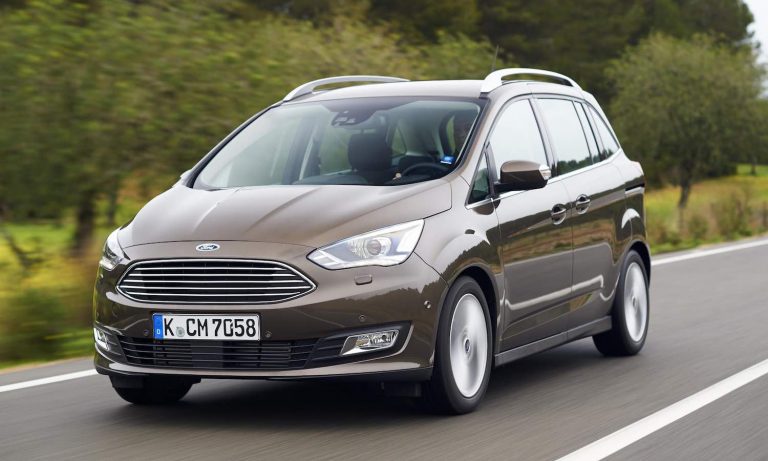
Now a new Ford C-Max, offered like its predecessor in both five-seat and Grand C-Max seven-seat variants, is on its way to the UK as part of Ford’s wholesale renewal of its people-carrier line-up – also at the Spanish launch of the car was its equally new larger sister the S-Max, which we’ll be reviewing at the end of April.

The new C-Max won’t turn that many heads from the outside. Styling changes are subtle, effectively adopting the latest ‘One Ford’ design language that gives the car a somewhat bolder, Mondeo-like front end. There is a gently reareards-tapering roof line while the arches are more pronunced and accompanied by a distinct body crease line.

Inside the differences are more obvious. Ford says that customer feedback determined the interior changes and there is a distinct upturn in quality, though perhaps not to the level of some other Fords including that one we can’t talk about yet.

Most notable is the dash, which has changed markedly. Customers wanted a simpler layout, Ford tells us, and the new console, clearly based closely on that in the most recent Focus, certainly meets the brief. There are fewer separate controls and it is all simpler to use.

There are a host of useful touches – more storage places in the car for example (Ford tells us there are 20), while owners can specify hands-free opening of the tailgate, a feature first seen on the Kuga.

The seats are clever too – in the five-seat C-Max the central rear seat can be lifted and moved rearwards allowing the outer seats to slide inwards and backwards for more leg and shoulder room.

In its seven-seat cousin, meanwhile, the centre seat can be flipped out of the way creating a useful walk-through for younger members of the family accessing the rear row through the sliding rear doors.

Another major area for improvement was technology and the new C-Max has certianly gained plenty of new aids to both driver and passengers.

Driver assistance technology uses a host of sensors, radars and cameras, working together to offer what we are told is 460-degree protection to the car, and such advances as Pre-Collision Assist and adaptive cruise control are both fitted for the first time on a C-Max.

Other aids, some standard, some optional, include Active Braking, Active City Stop, Blind-Spot Info, Cross-Traffic Alert for when pulling out of junctions, parking aids that even make it easier to reverse into spaces between parked cars… the list goes on.

Other occupants, meanwhile, get a DAB radio as standard on all variants, something The Car Expert is surprised has not become an industry standard. It’s part of the Ford Sync connectivity system, which on Titanium variants and above is upgraded to the voice-activated Sync 2 based aorund an eight-inch touchscreen.

Ford says that all the engines available for the C-Max have been revised, and all are now Euro 6 emissions compliant, claimed to be a first in the segment.

The line-up ranges across two versions of the much-publicised three-time ‘engine of the year’ the 1.0-litre Ecoboost petrol, in 99 and 123bhp varieties, a 1.6 petrol with 123bhp, and diesels in 1.5 118bhp and 2.0 148bhp variants.

The 1.6 petrol is fitted with a five-speed manual gearbox, all the others with six speeds while both diesels can be specified with the PowerShift six-speed auto-manual ‘box.

Ford believes the two big sellers will be the 123bhp petrol and 118bhp diesel, the latter taking almost three quarters (71%) of sales. Equally three quarters of sales will be of the five-seat C-Max.

The test car available to The Car Expert, however, was the range-topping 148bhp diesel, in Grand C-Max form, and it’s generally impressive.

It is easy to forget on the road that this is a seven-seater, it bowls along at good pace and in corners remains poised with some body roll but rather less than one might expect given its people-carrying abilities. The engine is not short of power or torque, though the revs do need to be kept in the higher end of the band for effective overtaking.

All of which leaves one having to consider whether the price of this particular diesel, £1,500 more than its equivalent 118bhp sibling, is worth paying, though it is worth noticing that the extra potency (1.5 seconds faster to 62mph) comes with hardly any economy and emissions drawbacks.

The top diesel is also not offered in the lowest of the three trim levels, Zetec – you have the choice of Titanium or Titanium X, Ford’s marketing head Anthony Ireson telling us that in this segment there is no demand for the real base trim levels that you get in, for example, the Focus or Mondeo.

The new Ford C-Max is very much a case of taking an effective product and improving it in all areas. As such it should continue to be a success, though its rivals are getting stronger and more numerous, with the new contenders now including the likes of BMW with its 2 Series Active Tourer.

Ford C-Max – key specifications

Model tested: Ford Grand C-Max 2.0 TDI 150PS
On sale: Summer 2015
Range price: £18,195 – £26,145 (Grand +£1,600)
Insurance group: TBA
Engines: Petrol 1.6, 1.0T (x2). Diesel 1.5, 2.0.
Power (bhp): 123, 99/123. 118, 148.
Torque (lb/ft): 117, 125/125. 199, 295.
0-62mph (sec): 15.9, 12.9/11.4 (13.7/12/3). 11.3* (12.3*), 9.5* (9.8*).
Top speed (mph): 102, 108/116.114* (111*), 125* (202*).
Fuel economy (combined, mpg): 44, 55/55. 69* (61*), 64 (61*).
CO2 emissions (g/km): 149, 117/117 (119/119). 110* (118*), 114* (124*).
Key rivals: Citroën C4 Picasso, Vauxhall Zafira Tourer, Peugeot 3008
Test Date: April 2015
Figures refer to C-Max, in brackets Grand-C-Max 
* = with manual gearbox

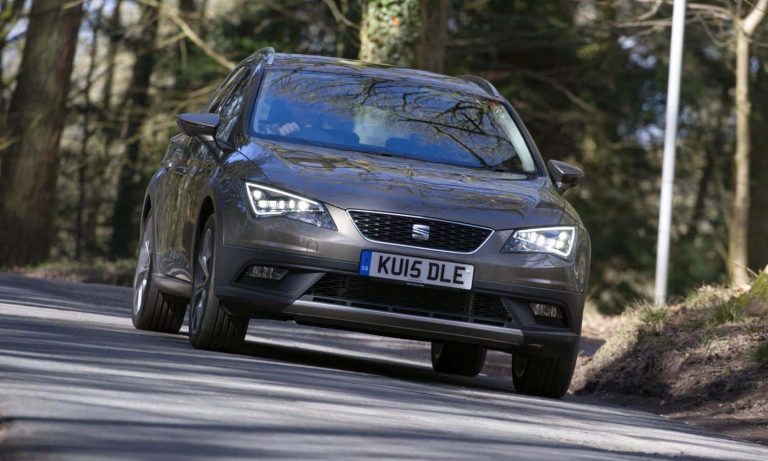
SEAT Leon X-Perience review

What is it?
The SEAT Leon X-Perience is an all-wheel-drive version of the Leon ST (estate).

Key features
All-wheel-drive powertrain, upmarket interior.

Our view
Sophisticated car, daft name


The SEAT Leon has in its latest incarnation attracted widely favourable comments, not least from The Car Expert.

Conceived as a family, the three and five-door Leon’s soon gained an estate sister, the ST. And with SEAT’s aspirations for growth targeting a wider selection of rivals, it is perhaps no surprise that the Leon ST range can now offer an all-wheel-drive model in the less-than-pleasingly named Leon X-Perience.

Dubbed by its makers “a lifestyle estate” and assuming the role of Leon range-topper alongside the Cupra performance model, the X-Perience offers a potentially attractive alternative to cars such as Skoda’s Octavia Scout and the Volvo V40 Cross Country. It might even appear on the radar of those who would previously have bought the Allroad from SEAT’s more upmarket sister brand Audi.

The Leon X-Perience also has another task, however. It introduces both SEAT’s dealers and the brand’s customer base to the concept of all-wheel-drive, ahead of the brand launching a ‘proper’ SUV, which will be unveiled at the Geneva Motor Show in March 2016.

From the outside the X-Perience is distinguishable from its ST sisters, firstly by means of its greater ground clearance, extended by 28mm over the stock Leon.

There are also the requisite ‘off-road’ styling touches of extra protective mouldings on the wheel arches and door sills, aluminium-look additions to the front and rear bumpers and twin tailpipes.

Inside the accent is centred on this being a range-topper, so the upgrades include leather and orange stitching while the door trims are bespoke.

The heart of this car is of course the all-wheel-drive transmission, which is combined with two powertrain options, both centring on the 2-litre diesel engine in either 148bhp and 181bhp outputs. The smaller one joins to a six-speed manual gearbox, the larger to a six-speed DSG auto.

Dubbed ‘Fourdrive’, the AWD is permanently on demand and electronically controlled, using a fifth generation of the Haldex clutch system to channel all the drive to the front wheels in normal driving, but to automatically divide propulsion between front and rear by up to half and half when conditions demand, such as in wet or icy weather, or on loose surfaces.

SEAT chose to demonstrate this on the launch drive with a couple of miles along Forestry Commission tracks, which heavy rain had made quite boggy in places. The Leon X-Perience is not and not intended to be an off-roader, but it copes well with difficult surfaces and will be appreciated particularly in winter by those living in rural environments, such as the author of this test.

That appeal is strengthened by the fact that the jacked-up ride height does not adversely affect the car’s progress where it will spend the vast majority of its time, on the road.

The X-Perience generally rides well – the extra weight, up by some 120kg, and the increased height is the more noticeable under heavy braking, cornering or over nasty bumps and potholes, but not to a degree that becomes uncomfortable. And despite all that extra mass to drag around, official fuel economy and CO2 emissions figures of plus-55mpg and 129g/km respectively are impressive.

It’s practical too, neat touches including the droppable boot floor, which extends the capacity available (with rear seats up) from 587 to 687 litres. Drop the seats flat, through a one-pull mechanism, and capacity mushrooms to 1,470 litres.

Getting the X-Perience will cost from £24,385, which buys the lower-powered version in SE trim. Standard equipment includes 17-inch alloy wheels, black roof rails, climate control and rear parking sensors.

Pay an extra £1,900 for the SE Technology version and according to SEAT the buyer gains more than £3,000 of extra equipment.

The wheels grow by an inch, electrically-folding mirrors are added as is Alcantara on the seats. The ‘Technology Pack’ of touchscreen-based DAB digital radio, navigation and LED headlights is fitted, along with the Convenience Pack of rain-sensing wipers, auto headlamps and auto-dimming rear view mirror.

Options include such niceties as a panoramic sunroof while a ‘Lux Pack’, costing £1,250, adds black leather upholstery, heated front seats with electric adjustment to the driver’s, chrome roof rails and a heated headlamp washer system.

The sat nav can also be upgraded to a ‘High’ version with a larger screen, an ‘off-road mode’, displaying compass views, angle of front wheels and such like, and an Eco trainer to help stretch the mileage.

All in all the Leon X-Perience is an impressive car, and perhaps the only serious black mark one can give it is the name. SEAT both aspires to and to a degree achieves an air of sophistication above the mainstream, but a name such as this does nothing to enhance that image…

SEAT Leon X-Perience – key specifications

Model tested: SEAT Leon X-Perience SE Technology 2.0 TDI 184 PS 6-speed DSG-auto
Range price: £24,385-£28,870
Insurance group: TBA
Engines: Diesel 2.0 x 2
Power (bhp): 148, 181
Torque (lb/ft): 250, 280
0-62mph (sec): 8.7, 7.1
Top speed (mph): 129, 139
Fuel economy (combined, mpg): 57.6, 57.6
CO2 emissions (g/km): 129, 129
Key rivals: Skoda Octavia Scout, Volvo V40 Cross-Country, Vauxhall Insignia Country Tourer
Test Date: March 2015

Audi TTS review

What is it? The Audi TTS is the performance-engined version of the distinctive TT coupé range.
Key features: Sub five-second acceleration, strong standard tech.
Our view: The Audi TTS is impressive, albeit expensive.


Around six months ago, The Car Expert first drove the all-new third incarnation of Audi’s uber-successful TT Coupe.

The new car maintained the best bits, such as the Bauhaus-inspired styling, of the first-generation car, credited by many with propelling Audi towards today’s premium success. And the Mk3 debuted a host of new tech, perhaps highlighted by the digital dashboard that has already spread into many other Audis.

When we carried out that first drive we were promised two further, and very distinct, versions of the latest TT. One was the drop-top Roadster, which The Car Expert has now driven and will report on shortly, and the other was the subject of this feature, a more performance-focused S model.

In terms of design, styling and such like, this Audi TTS is basicaly the stock model, though the TTS does add bespoke touches such as the quad chrome exhaust tailpipes.

Inside the already praiseworthy interior of the standard TT is enhanced. The seats are now body-hugging ‘super sports’ items in nappa leather, there is more leather around the cabin, and that digital dashboard gains extra toys including (for track use only we feel) a digital stopwatch.

The major focus on this newcomer, however, is the engine. Once upon a time seeking more performance would have required more litres, a big, heavy unit, but modern technology is rapidly consigning such large powerplants to the past.

Instead the recipe is a 2-litre, four-cylinder petrol unit with TFSi direct injection, matched to either a six-speed manual gearbox or the six-speed S tronic dual clutch auto/manual, and quattro all-wheel drive. While the stock TT has a maximum of 226bhp, this one pumps out 305 horses, along with 280lbft of torque, the latter over a wide rev band of 1,800 to 5,700rpm.

All of which means the TTS cuts the 0-62mph sprint time below the five second marker which is considered the border of true high performance territory. With the six-speed manual gearbox the TTS hits the mark in 4.9 seconds, choose the s tronic and the mark drops further to 4.6 sec – six tenths faster than the stock petrol TT.

And the TTS certainly suits the S tronic ‘box, especially when combined with the Audi drive select ‘adaptive dynamics system’ which tops a wide list of standard equipment driver aids.  Accelerating rapidly, from a standstill, or from slow speed produces a highly evocative bark as the ‘box shifts up its ratios, in no time at all moving the car into territory where one’s licence will be threatened.

The audio note is impressive but not wholly natural – the exhaust system boasts ‘sound flaps’, which open at high rpm to boost the noise produced, adding an extra layer of vibrancy.

The TTS is no coarse power packer, however. In traffic, or moving through a town centre, the car will cruise in as refined and well-behaved a manner as its less powerful sisters.

The car sits 10mm closer to the road than the stock TT and the magnetic ride adjustable damper suspension makes for a stiffer ride, but not achingly so, and the payback is the system working in conjunction with the quattro to produce levels of grip in corners that really shouldn’t be possible. This car has potency one can both live with and have a lot of fun with.

Such refinement is further demonstrated by the fact that alongside the auto and gear-holding, rear-axle favouring ‘dynamic’ modes, the drive select has an efficiency setting. With this engaged, the car will freewheel when the accelerator is eased off, saving fuel and boosting the combined cycle figure to 41.5mpg, along with CO2 emissions of 157g/km.

The TTS is impressive, perhaps the one serious question the price. While significantly less than suitably-engined versions of prime rivals the BMW Z4 and Mercedes-Benz SLK, the Audi’s £38,790 starting price is very close to the £39,694 of the highly-effective Porsche Cayman, and the Porsche will be a tempting alternative to many buyers, even though it can’t quite match the TTS for pace.

Quite a lot comes as standard on the TTS – magnetic ride, the drive select, the heated leather super sports seats among the highlights. But the options list is long too; our car had around £9,000 worth of options on it, such as the £945 matrix LED headlamps (that you don’t have to dip) and electric seats at £995, taking the price tag perilously close to £50,000 – expensive…

So the TTS assumes its place at the top of Audi’s TT line-up. But not, we hear, for long – an even more powerful TT RS variant is believed to be waiting in the wings…

Audi TTS – key specifications

Model tested: Audi TTS Coupe 2.0 TFSI quattro 310 PS S tronic
On Sale: April 2015
Range price: £38,790-£40,270
Insurance group: TBA
Engine: Petrol 2.0-litre
Power (bhp): 305 (5,800-6,200rpm)
Torque (lb/ft): 280 (1,800-5,700rpm)
0-62mph (sec): 4.9 (4.6*)
Top speed (mph): 155
Fuel economy (combined, mpg): 39.8 (41.5*)
CO2 emissions (g/km): 164 (157*)
Key rivals: BMW Z4 sDrive35i, Mercedes-Benz SLK 350 AMG, Porsche Cayman S
Test Date: March 2015
* = with S tronic gearbox

Postcard from Goodwood – 73rd Members’ Meeting

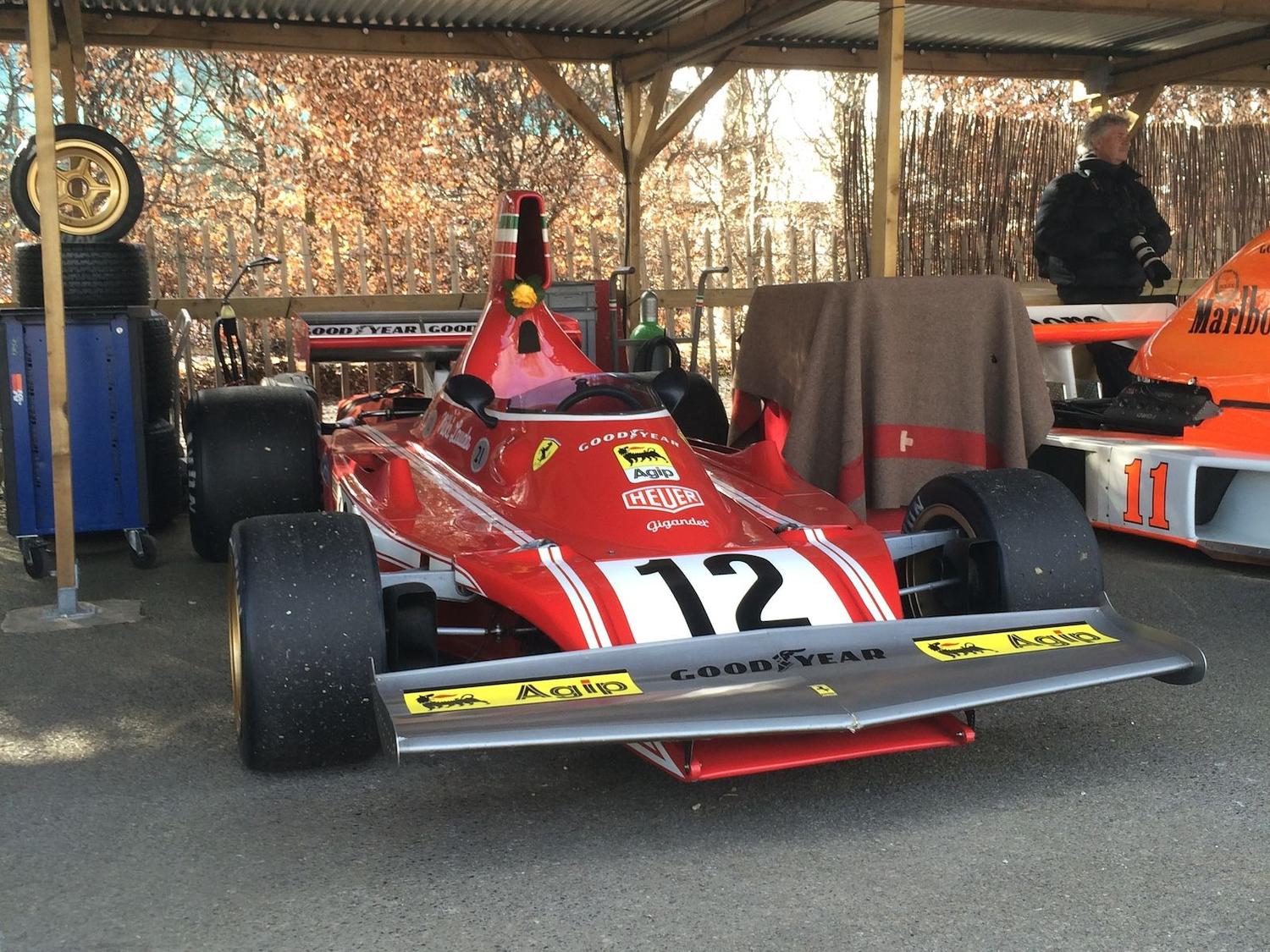
Goodwood is already famous for its two long-running motorsport events – the Goodwood Festival of Speed held every summer, and the Goodwood Revival held every September. And now there is a new event which deservedly takes its place alongside these two – the newly-revived Goodwood Members’ Meeting.

In the heyday of Goodwood’s operation as a contemporary motor racing circuit, from 1948 to 1966, a total of 71 BARC Members’ Meetings were held. These featured all sorts of events covering many different racing categories. Last year, Lord March revived the idea and the 72nd Members’ Meeting was held after an absence of about 48 years. It was a stunning success, and this year the 73rd Members’ Meeting built on the achievements of last year’s event. 

Tickets were far more strictly limited than for the Revival each September, so there was far more room to move around the circuit and paddock. For anyone who is used to a crushing crowd at either the Festival of Speed or Revival, this was a Goodwood event with a difference. The limited crowd size made the atmosphere more relaxed, and probably cut about an hour off the travel time each way…

Spectacular on-track action

A total of 12 races, plus practice and qualifying, were held over the two days of the event, along with some very special demonstration events. This year, the demonstration events were held for ‘high-airbox’ 1970s Formula One cars, Group C sports prototypes, and McLaren F1 GTRs. 

There was also a unique ‘race’ between an historic 1971 Mercedes-Benz 300SEL 6.8 racing saloon (nicknamed the ‘Red Pig’), a new Mercedes-AMG GT S production car and a 2013 Mercedes-AMG Formula One car.  Watching (and hearing) the contemporary F1 car charging around the classic Goodwood circuit in pursuit of its prey was awe-inspiring.

The highlights were too numerous to mention, both on and off the track. Despite some of the racing cars being 90 years old, there was absolutely no suggestion of the drivers taking things easy to preserve their precious machines. As you would expect, the touring cars provided plenty of biffo in their two races, but plenty of the more exotic machines were right on the ragged edge as well. 

More than a few cars went home with battle scars, and two priceless sports cars will each require six-figure repairs after a 1955 Mercedes SLS (being piloted by no less a driver than Jochen Mass) at full noise ploughed hard into the back of a 1959 Lister-Jaguar which was pulling off track into the pits. Thankfully no drivers were hurt, but the cars will require extensive repairs before they can turn a wheel again.

Spectacular off-track entertainment

As is always the case at Goodwood, the circuit and facilities were immaculately turned out. Many of the photos you can find of the event (including some of those here) show bright yellow daffodils all over the place – apparently one million of them were planted and all bloomed perfectly on time for the weekend.

The official programme was a work of art in itself, and the off-track activities and entertainment were plentiful. On Saturday night there was an enormous party, featuring a carousel, helter skelter, performers of all sorts and even a Wall of Death. The night was brought to a close with a huge fireworks display that was visible for miles.

Book early for next year’s 74th Members’ Meeting…

The only downside is that after two years of spectacular success, the secret is now well and truly out. You can be sure that there will be a rush to secure tickets for next year’s event after a sell-out this year, so you are going to have to move fast when tickets for the 74th Members’ Meeting go on sale at the end of this year. 

In the meantime, there’s always the Festival of Speed and Revival to look forward to in the next few months!

Kia Sorento review

What is it?
The third-generation Kia Sorento is the company’s flagship SUV.

Key features:
More premium, more efficient, more tech.

Our view:
Established as a viable rival to the likes of Ford and Vauxhall, Kia is now targeting the top end of the mainstream market.


When the original Kia Sorento was launched in 2002 it kicked off a new era for the Korean brand.

A very capable if traditional body-on-frame SUV, the Sorento assumed the role of flagship model for a growth strategy that saw Kia change beyond all recognition in the following years, from a ‘pile-em-high and sell loads’ budget brand to a mainstream volume player able to rival the major mainstream players.

The third-generation monocoque-shell Kia Sorento is very different to its grandparent but has a similar role, according to its makers beginning the second phase of Kia’s transformation. Following well over a decade of attractive new vehicles created under design head Peter Schreyer (now performing the role for both Kia and its sister brand Hyundai), the latest Sorento pioneers Kia’s new target, beating rivals in the crucial areas of engineering, technology, refinement and quality.

That’s not to say that design has been left behind. The new Sorento is pitched much more towards the on-road use that the vast majority of its buyers will put it to, rather than the ability to tackle off-road ‘black routes’, and so style assumes greater importance, along with space – Kia is very keen to snare executive buyers with this car.

The car certainly looks the part, immediately grabbing attention with its more swept-back stance and larger, more dominant grille. The new shell is 95mm longer than its predecessor and ever so slightly wider, by just 5mm, but also 15mm lower, which combined with the rising belt line (the effective line running along the base of the windows), gives it a more purposeful look.

Shell construction using more high-strength steel, increased from 28 per cent to 53 per cent, also boosts torsional rigidity, by 14 per cent, which should and does aid handling.

Perhaps the most vital measurement, the wheelbase, is extended by 80mm, to 2,780mm, which improves head and legroom in all three seat rows (the new Sorento retains its seven seats as standard) but also boosts bootspace by 90 litres, to 605 litres with the third-row seats folded. These disappear into the floor, while the second row also folds flat, extending cargo capacity to a cavernous 1,662 litres.

The doors are worthy of mention – they are slimmer and fit more snugly into their apertures, which Kia says not only allows them to open wider but also keeps dirt and moisture out of the sills. Evidence on the launch event suggests this works very well.

The Sorento is the first car to be produced under what Kia has dubbed its ‘Global Quality Strategy’ and much effort has been expended on creating a premium impression when in the car. Panel gaps are reduced, the surfaces are of good quality and well fitted into the cabin.

Sound insulation is markedly improved, the dash, for example gaining a 29 per cent thicker noise-absorbing panel. Kia says that on the move external noise is cut by six per cent and progress certainly feels hushed.

Just one engine option will be available to Sorento buyers, an updated variant of the familiar 2.2-litre diesel unit. And while this car may be road focused, it retains its all-wheel-drive, the intelligent system first seen in the smaller Sportage, and including a lock mode for those who want to indulge in some more serious off-tarmac progress.

The engine changes are significant, extending to reducing cylinder wall thickness by 1mm to say 5kg in weight. The unit offers 197bhp, three horsepower up on the previous version, and 325lbft of torque, an improvement of 14lbft and available from 1,750rpm.

Efficiency is of course improved – Euro-6 emissions compliant, the engine returns combined cycle fuel economy and CO2 emissions figures of 49.5mpg and 149g/km in the six-speed manual version – an alternative six-speed auto is also available. The launch vehicles driven by The Car Expert were fitted with the manual ‘box and it is both slick and precise.

With on-the-road performance a priority much effort has been expended on ride comfort and it shows. The car cruises in a straight line very comfortably indeed, and while cornering with enthusiasm does produce some body roll from what is a large shell, it’s all very controllable.

Steering is particularly impressive – Kia says that moving the power-steering motor module from halfway up the steering column onto the rack itself has made a major difference to the handling, sharpening response and feedback.

Up to three steering modes can be selected, changing the feel and response, though on choosing ‘Sport’ on our test car the steering became very stiff indeed – it is a mode we feel that would only be usefully employed in very specific high-speed conditions.

Potential buyers have the choice of four trim levels, dubbed KX-1 to KX-4, with prices ranging from £28,795-£40,995. Standard equipment highlights include alloy wheels, LED daytime running lights, de-icing front wipers, electric folding heated mirrors, cruise control and reversing sensors.

Safety aids feature heavily in the specification – all versions of the car include a range of electronics such as hill-start assist, trailer assist, ESC and Vehicle Stability Control.

Go up the trim levels and more tech appears, some not seen before on European Kias, such as adaptive smart cruise control, around view monitoring and parking assistance including a rear cross traffic alert and smart park assist for both reverse and parallel manouevres.

Inside one can add such extras as satellite navigation through either a seven or eight-inch touchscreen, a reversing camera, panoramic sunroof, self-levelling suspension and driver and front passenger seats that can be power adjusted 10 and eight ways respectively.

Kia does not expect enormous sales numbers from the Sorento, though management are not afraid to suggest that the predicted 3,500 sales per annum may be conservative.

The task the car has is more subtle, to lay a path for the forthcoming Optima large saloon, by showing that the Korean brand can be as effective at producing large cars as it is now renowned for smaller models.

Established as a viable rival to the likes of Ford and Vauxhall, Kia is now targeting the top end of the mainstream market, the area populated by brands such as Volkswagen and Volvo. If the Kia Sorento is evidence of what is coming, then rival manufacturers should be concerned….

Kia Sorento – key specifications

Model tested: Kia Sorento 2.2 manual KX-2, KX-4
On sale: April 2015
Range price: £28,795-£40,995
Insurance group: TBA
Engines: Diesel 2.2.
Power (bhp): 197
Torque (lb/ft): 325
0-62mph (sec): 9.0 (auto 9.6)
Top speed (mph): 124 (124)
Fuel economy (combined, mpg): 49.5* (46.3*)
CO2 emissions (g/km): 149* (177)
Key rivals: Volvo XC60, Nissan X-Trail, Volkswagen Touareg
Test Date: March 2015
*= with 17-inch wheels

How can I get more money for my part-exchange?

Last month, we looked at why your part-exchange valuation from the dealer was much lower than you expected (if you haven’t read it, follow the link above and have a look. Don’t worry, we’ll be right here when you get back). But the reality is that although people tend to be outraged by dealers allegedly swindling them on their car’s value, there’s usually a lot of things that they could have done which would have helped. 

Today, we’ll help you make sure you get the best price you possibly can when you sell your car, whether it’s a part-exchange or a private sale. Tick all of these boxes and you will maximise your car’s value. But even if you only manage some of these recommendations, you’ll be hundreds or even thousands of pounds better off. So it’s worth reading on…

Do your homework before trying to part-exchange your car

Whether buying or selling a car, the simplest rule is that the more homework you do, the better off you will be.

If we step backwards for a bit, it all starts the moment you take delivery of your new car. For the whole time you own the car, you should keep all of your maintenance records so that you can show a buyer everything that has been done to the car.

This includes MOT certificates, invoices for tyres and other consumables, and most importantly, service records. As well as being a warranty requirement that you have your car serviced on time, every time, it will significantly hurt your resale value if you don’t have proof of the car’s service history.

You will get a better price for your car if it has been serviced at an official service centre (ie – at the dealership), but then this will probably cost you more as well. Make sure you have the service books in the car when you have it serviced so that they get stamped, and make sure you check that this has been done before you drive away – every single time.

When I was working in the automotive retail industry, I saw dozens and dozens of cars with little or no documented service history, because “I don’t keep the books in the car” or “they forgot to stamp the book”.

Usually, it really meant “I haven’t had it serviced at all”, and that is exactly what a dealer (or any other buyer) will assume.

Get a quote from an online buying service

For many car buyers, part-exchanging your car will never get you as much money as selling it to a dedicated car buying service. Even if you do prefer the ease of handing your old car over and collecting your new car all in one go, you should absolutely make sure that you’re not losing hundreds or even thousands of pounds by selling it too cheaply as a part-exchange. We work with the following companies, all big names in the UK and highly respected, but other brands are also available.

Make sure your service book is stamped – every time

If you have had the car serviced, but for whatever reason you don’t have any official records, then go back to the dealer/service centre and get them to issue you with a duplicate invoice and stamp your book.

If you have moved too far away to visit them, at least call them and ask them to email or post an invoice. I have seen people post their service books to a dealer to stamp and send back, which is great – although it risks the service book getting lost altogether.

If you take one piece of advice from this article, it is to keep all of your service and maintenance records. Your car’s value will be penalised by hundreds of pounds (or even more, if it’s a performance or luxury car) if you can’t show evidence of servicing.

Have your log book and MOT records ready

V5C logbook, UK registration certificate

Your registration papers (V5C, known as the log book) is the proof that you are the keeper. Your MOT certificate is proof that your car is legal and roadworthy, although these are now done electronically rather than being printed.

If you don’t have your log book available, you can’t legally sell or part-exchange your car. The DVLA will charge you £25 for a replacement V5. Save yourself money and hassle by not losing it in the first place – which brings us to…

Make sure you have all your bits and pieces

Spare keys, owner’s books, seat headrests, towbar wiring, rear parcel shelves, floor mats, spare wheel, first-aid kit, warning triangle, and so on. If it can be removed from your car, someone will eventually lose it.

Make sure that all the bits that go with your car are on board when you present it to a dealer or private buyer for their part-exchange appraisal. Muttering “Oh yeah, I’ve got those bits somewhere in the garage” is usually interpreted as “I have no idea where those bits went and I am not going to be able to find them”, and your car’s price will be marked down accordingly.

This is especially important for car keys – on a modern car, a key can cost over £300 and may have to be ordered from the manufacturer’s HQ. Plus it’s a security issue, as it means that there is possibly another key to your car out there somewhere. Losing a key can cost you a fortune.

Turn your house upside down if you have to, but make sure you have all the keys in hand before you bring your car to a dealership.

Don’t try and sell your car just before a service or MOT is due

If your car is more than three years old, it has to have an MOT roadworthiness test every year. Most cars will also need servicing every year. Yes, these will both cost you money – especially if there is any additional work required.

Car dealers are generally not stupid – if you try to part-exchange your car just before either the service or MOT is due, then they will be very suspicious of your timing. Is there a major problem with the car that will require big spending that you are trying to avoid?

If you can schedule your car buying and selling for halfway through your MOT/service schedule, you won’t have wasted all the money you spent to have them done but won’t be penalised for selling just before they’re due.

Some dealers will now insist that your car has at least three months’ MOT remaining, and if it doesn’t then you will need to get it re-tested before you can part-exchange the car.

Should you tidy up any minor damage?

Many people will now take out some kind of minor damage insurance policy when they buy a car, which covers you for little dents/scuffs/scratches. I’m not going to argue for or against these policies, but if you have paid for one then make sure you are using it to your full entitlements.

If you are entitled to have your kerbed wheels fixed up, then get that done. If you are eligible for any work from your insurances, get it done. It won’t cost you anything (unless you have an excess, and that’s usually small) but will improve your car’s appearance – and therefore, its part-exchange value.

If you don’t have any minor damage cover, then you need to assess how much it would cost to have it repaired. If the repairs are inexpensive but make a noticeable difference, it’s probably worth getting them done – especially if you are selling the car privately.

With a part-exchange to a dealer, however, bear in mind that the dealer can probably get any repair work done cheaper than you can, so it may not be worth doing unless it looks horrendous.

An hour of cleaning could be worth hundreds of pounds

First impressions count in any situation, and valuing your car is no different. If you turn up to a dealership with a car that is filthy dirty, their assumption will be that you don’t care about your car – which means there are more likely to be hidden problems underneath that you haven’t bothered fixing, and your car will be valued lower.

If you turn up with a car that is clean both inside and out, with sparkling paintwork and a properly vacuumed interior (with all your rubbish taken out and put in a bin!), it gives the impression that you are fastidious about your car and a dealer will tend to assume that you have attended to any problems which have occurred.

It may not be remotely true, but they are valuing your car based on what they can see. Put yourself in the buyer’s shoes – would you pay more for a sparkling clean car than a filthy dirty one? Of course you would, because your assumptions are based on what you are presented with.

If you are haggling with a dealer to give you more money for your part-exchange, they are more likely to be receptive if they think the car is a low risk for hidden costs.

Cleaning your car also helps to remove odours, which could be worth a lot to you as well. Food and drink smells, baby vomit, that fertiliser you bought from the garden centre – you get the picture.

And no-one, not even dog lovers, likes a “wet dog” smell when they are buying a car. Clean and air out your car before taking it in to be appraised – and if you do carry pets around in your car a lot, you should be doing this frequently to stop doggy odours settling in.

Clear out your junk!

While you’re cleaning your car, take out all the stuff you carry around with you in your car. No-one else wants to see your collection of Barry Manilow CDs, or the various items of clothing that have accumulated on the back seat for the last six months.

Empty the boot as well. A dealer wants to be able to see the car, and not have to move all your stuff to find what’s hidden underneath. Again, if they can see that it’s a good clean car, they are more likely to pay more for it.

Dealers are used to people trying to hide huge stains or holes in upholstery by throwing some jumpers on the seat and hoping no-one looks.

It can be a pain if you use the car for business and it’s full of tools or equipment. But again, it’s still worth the time and effort to clear it out before taking the vehicle to show a dealer. Genuinely, it can make a few hundred pounds’ of difference if your car/van is presented in a clean and tidy state.

Basic warning lights

No-one likes to see a warning light come on when they start up a car, and a warning light is a warning sign for a potential buyer. So if you have any warning lights that can be easily attended to, go ahead and do it.

Top up your windscreen washer fluid, radiator coolant or engine oil if the light is on. Make sure your tyres are properly inflated if you get a tyre pressure light, and put enough fuel in the tank to make sure the fuel light’s not on. If you have a faulty light bulb, change it.

If the service light is on when it shouldn’t be because the dealer forgot to switch it off (it happens quite often), then go back and get it switched off.

Summary

All of the above is about showing a dealer how well you have looked after your car. Proof of service history is the most important thing here, but all of these tips add up to show a prospective buyer that your car is a safe bet rather than a big risk.

A dealer will know what they are looking for, but they are still usually only making an offer based on a 5-10 minute inspection. So do everything you can to make your car look as good as possible.

Have your records handy, make sure the car is presented well and attend to any basic warning lights, and you’re already in front of most people part-exchanging their cars. It’s not that difficult, is it?

* The Car Expert has commercial partnerships with Auto Trader, Carwow and Motorway. If you click through to their websites and/or sell your vehicle to any of them, we may receive a small commission. This does not affect the price you are quoted or receive for your car.

End of the line for Chrysler in UK

The Chrysler brand will disappear from the UK market in 2017.

The news, which has come as little surprise, has been confirmed today by Fiat Chrysler Automobiles UK management.

British sales of Chrysler models have been steadily declining in recent years – according to Society of Motor Manufacturers & Traders figures, the brand registered only 1,982 vehicles in 2014, down 21 per cent from the 2,515 of 2013 and the close to 3,500 figure recorded in 2012. When you take out the inevitable dealer demonstrators, press fleet, hospitality, sponsorship and other self-registered vehicles, it means that precious few Britons actually bought a new Chrysler in 2014.

Attractive and distinctive models such as the 300C saloon/estate and the Grand Voyager people carrier formerly brought success for Chrysler in the UK, but sales of these have been virtually killed off by increasingly stringent emissions regulations, high fuel prices and a move away from MPV-based vehicles.

Following the global brand’s rescue by Fiat in 2011 Chrysler launched two new models: the Ypsilon supermini – built on the same platform as the Fiat 500 – and the VW Golf-sized Delta, both of which were effectively Lancia models rebadged for the UK market.

However the slow-selling Delta was quietly dropped in 2014, leaving the Ypsilon as the only major model in the UK line-up.

The Car Expert understands that Fiat’s brand realignment will also see Lancia withdrawn from all European markets apart from Italy, where it still enjoys a viable share of the market.

In the UK, FCA will focus its American efforts on Chrysler’s sister brand Jeep. The iconic US badge is on the expansion trail in Britain, particularly with its newly-launched Renegade model.

Caterham Drift Champion drifting experience

0

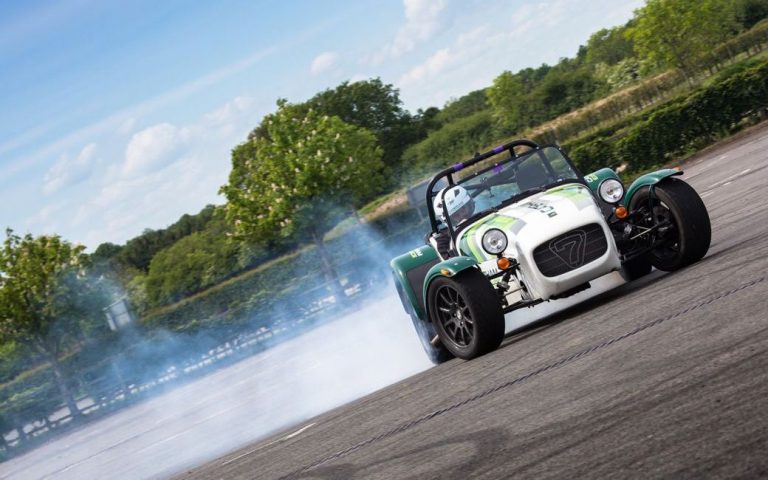
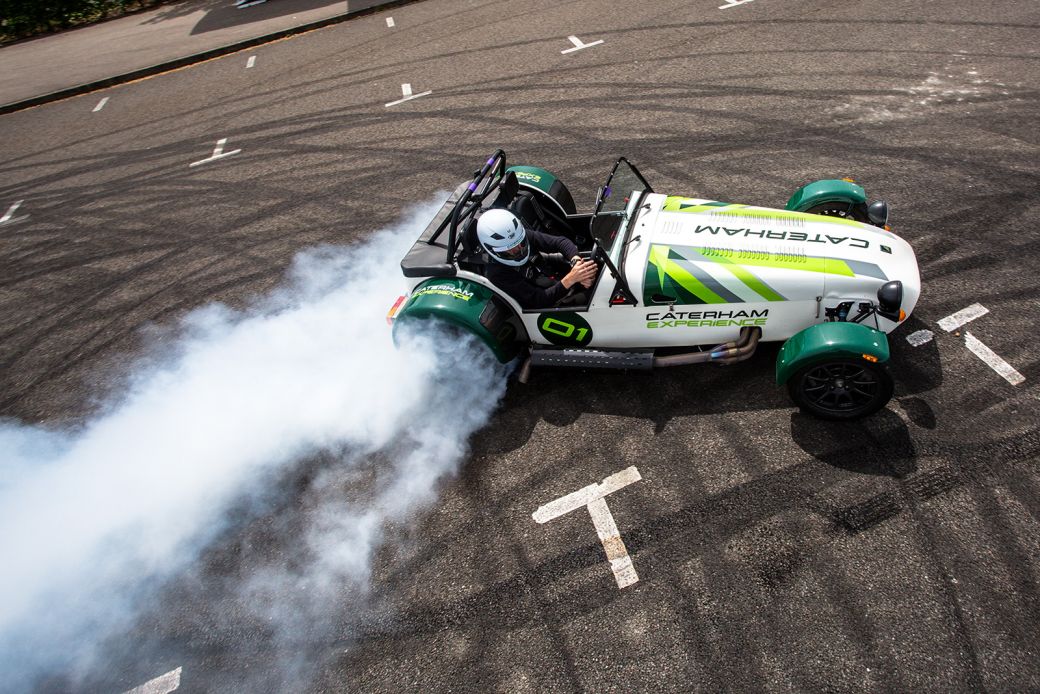
How much fun can you have in a car in a large and damp car park? Well if you are in a Caterham Roadsport 140 that’s been specially tuned for drifting and donuts, then then the answer is “an awful lot!”.

The problem with this idea is that most people don’t have either a Caterham or a suitable car park to play in. So Caterham have come to the rescue with their fantastic Drift Champion experience. You can spend an entire day up at Silverstone, learning how to perfect the art of drifting in a controlled environment under the expert guidance of Caterham’s instructors. And a couple of weeks ago, I was invited up to have a go.

We have covered driving experiences before here at The Car Expert, but the Caterham Experience program is a bit different for a couple of reasons. Firstly, the whole operation is owned and operated by the Caterham car company themselves rather than a third party, so the cars are all factory-prepped and liveried and the instructor team are hand-picked by the company. Secondly, you get loads of time behind the wheel. On my trip, we had four drivers sharing each car, so the ratio of driving time to standing-around-time was pretty good.

Caterham offers a choice of driving experiences – a circuit programme on the famous Silverstone track, and the Drift Champion experience. I was lined up to spend the day drifting.

What exactly is drifting?

Drifting is the art of sliding a car around a course, with the emphasis on style rather than speed. In fact, for the entire day of drifting, we never got out of first gear. But there is an enormous amount of fun to be had in first gear, performing giant slaloms and donuts. Professional drifting is judged on style and technical prowess, with speed a secondary factor. The sport has become immensely popular over the last decade, having its origins in Japan and spreading globally. Cars that are ideally suited for drifting are lightweight rear-wheel-drive vehicles – exactly like a Caterham, funnily enough.

So how do you drift a car?

The first thing to get your head around is that it’s possible to drift and slide the right car at remarkably low speeds with the right set-up – as I said, we never got beyond first gear all day long. That makes it quite accessible, and means we could use a car park at Silverstone for the drift experience rather than needing a proper race track.

Caterham drifting experience at Silverstone

The object is to throw the car off its natural balance, and then maintain its unbalanced state for as long as possible, sliding sideways rather than travelling straight ahead. To do this, you stab the brakes hard and steer sharply into a corner, which throws the car’s weight forwards and makes the rear end go light. Then you stab the throttle and the rear wheels will immediately start to spin. From there, you simply keep stabbing the throttle while holding the car in an elegant, drifting slide all the way around the bend. Sounds simple, right?  Well it’s anything but!

Deliberately throwing a car out of balance and then trying to keep it there goes against everything you are ever taught about driving on a road or track. Usually the idea is to keep the car very much under control and pointing in the direction you want to go. So changing that behaviour and forcing yourself to brake, steer and accelerate in a very different style requires plenty of practice to even start to get it right.

After a morning of practice and instruction, we were starting to get the hang of things. Although it was hardly perfect, our efforts at least started to make us look like drifters rather than panicked learner drivers. And then over lunch, it started raining…

Rain, of course, makes a road slippery. And for drifting, that can be a very good thing. Jumping back in the car after lunch, on what was now a greasy wet surface, I found it much easier to throw the car off balance and get the back end to slide. But it did mean that controlling the slide was trickier, as the car would spin around like a top much more easily than in the dry. Keeping the car balanced on the edge of sliding and spinning was difficult, and usually resulted in you facing back the way you came from.

I found that a slightly wet track produced best results, being easy to get the car to start sliding and not too tricky to keep it going. As the rain started to get quite serious and the circuit became very wet, I was spending less time drifting and more time spinning. And of course, a Caterham isn’t very weatherproof, so we all ended up very wet. But no-one was complaining as we were too busy enjoying ourselves to notice!

So how much fun is it really?

Quite simply, a hilarious amount of fun. And to get good results, very challenging too. The speeds are low and the whole event is carefully controlled (and only one car on track at a time), so it’s all quite safe. Caterham runs the events most weekends throughout the year (except when it’s simply too cold/snowing/icy at Silverstone over December and January), so get in touch and give it a go. You will absolutely love it!

Stuart attended the Caterham Drift Experience as a guest of Caterham Cars.  Photos (c) Caterham Cars.

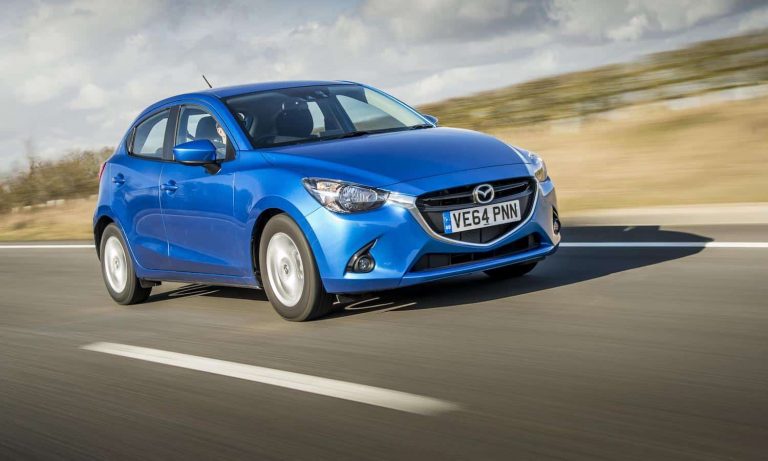
Mazda 2 review

What is it?
All-new version of the Mazda2 supermini best-seller.

Key features:
New look, upgraded quality, more tech.

Our view: The Mazda2 is very much a contender that supermini rivals, including Ford’s Fiesta, need to take notice of.


Mention the word Mazda and for most the immediate image coming to mind is an iconic two-seater roadster. If not the MX-5, perhaps the Mazda 6 that rivals the Ford Mondeo in the fleet market, more recently the sharply-styled CX-5 crossover.

In fact, they are all outsold by a perhaps all-too-easily dismissed supermini – the Mazda2. Look out for the car while on the road and you quickly realise just how many of them are around, and why the all-new Mazda2, arriving in showrooms in March, is so important to the brand’s UK performance.

The Mazda2 was once closely related to the Ford Fiesta, in the days that Ford had a major stake in the Japanese brand. That’s not the case these days, but the Fiesta, the UK’s best-selling car, remains the rival the Mazda has to beat.

This it aims to do by making full use of Mazda’s now familiar SkyActiv construction technology and ‘Kodo Soul in Motion’ styling language. The 2 is the last of the existing Mazda range to get this treatment, and it benefits greatly from it – the curvy visuals of the previous third-generation car are replaced by an exterior of distinctive creases that produce a good-looking whole.

Such positive first impressions are strengthened on slipping inside. Firstly there appears to be plenty of space, front and back.

The new Mazda2 is built using the SkyActiv modular platform and measures up 140mm longer and 20mm taller than its predecessor. Crucially the wheelbase is 80mm longer, which combined with such measures as thinner seat backs frees up more passenger space, as well as extending the boot capacity by 30 litres to 280 litres. This extends to 950 litres with the rear seats folded, but still falls short of the Fiesta’s capacity at 290/970 litres.

The second major impression on inspecting the Mazda’s interior is of quality. The brand really has stepped up in this area – the Sport Nav trim variants driven on the launch boasted soft-touch surfaces and a sensibly laid-out dash with high quality switchgear.

The seven-inch colour touchscreen, standard on SE-L models and above, looks a little ‘stuck-on’ to the top of the centre console, but the satellite navigation that is standard on Nav grades is one of the clearest and easy-to-follow units this reviewer has experienced.

At launch the Mazda2 offers four engine options, all SkyActiv units. Three of them are variants of a 1.5-litre petrol engine in 74, 89 and 113bhp power outputs, along with a 1.5 diesel of 103bhp.

The Car Expert tried the 89bhp petrol, likely to be the best seller, and the diesel unit. Some might like the extra power of the 113bhp unit, but we feel only the most cash-strapped will want the entry-level 74bhp engine. The 74bhp Mazda2 is £2,000 less to buy than an 89bhp version, but is also 2.7 miles per gallon less fuel efficient and with CO2 emissions 5g/km higher.

The 89bhp unit offers a good compromise between efficiency and performance. It pulls freely, though you need a few revs dialled in to get it going, and it is smooth in its delivery. A Mazda2 with this engine won’t write any performance headlines but it is every bit as competent as rivals in the class.

Supermini buyers don’t tend to favour diesels but Mazda considers it worthwhile offering one and the 1.5 deserves its billing, offering an excellent blend of performance and efficiency including an 89g/km CO2 emissions figure, the only Mazda2 in free road tax territory.

However said diesel is slower to 62mph than its 89bhp petrol sibling by more than 1.5 seconds, and costs £2,000 more to buy, so it would take quite a lot of driving to justify the 20mpg or so extra fuel economy and £20 saving in road tax.

The latest Mazda2’s body-shell weighs in seven per cent less than its predecessor, while the high-strength steel construction of the SkyActiv chassis gives it 22 per cent more torsional rigidity.

As a result one expects confident handling and the car does not disappoint. The steering is quite light but offers good feedback and well-placed cornering to the degree that it’s a degree of fun. Cruising in a straight line, meanwhile, it’s exceptionally well behaved.

Mazda offers the 2 in five trim levels, effectively SE, SE-L and Sport plus navigation variants of the latter two. Standard equipment is good, particularly in terms of safety with every car including Hill Hold Assist, a tyre pressure monitoring system, Dynamic Stability Control and traction control.

DAB radio is offered on all but entry-level SE models, as is Bluetooth, while move up the grades and the spec includes LED headlamps, auto wipers, parking sensors, along with quite a lot more.

A look at the options list, meanwhile, reveals technology not so long ago seen only on premium models and certainly not superminis, such as Lane Departure Warning, Smart City Brake Support, Blind Spot Monitoring, Rear Cross Traffic Alert and Active Driving Display – the last effectively a head-up display rising on a clear screen from the top of the steering column.

The ultimate question remains, is the Mazda2 better than Ford’s Fiesta? The answer is no, but it’s very much a contender that supermini rivals, including Ford, need to take notice of.

Mazda2 – key specifications

Model tested: Mazda2 1.5 90hp petrol, 1.5 105hp diesel
On sale: March 2015
Range price: £11,995-£17,395
Insurance group: 13E-19E
Engines: Petrol 1.5 x 3, Diesel 1.5
Power (bhp): 74/89/113, 103
Torque (lb/ft): 100/109/109, 162
0-62mph (sec): 12.1/9.4*/8.7, 10.1
Top speed (mph): 106/114*/124, 111
Fuel economy (combined, mpg): 60.1/62.8*/56.5, 83.1
CO2 emissions (g/km): 110/105*/117, 89
Key rivals: Ford Fiesta, Volkswagen Polo, Renault Clio
Test Date: March 2015
* = with manual gearbox

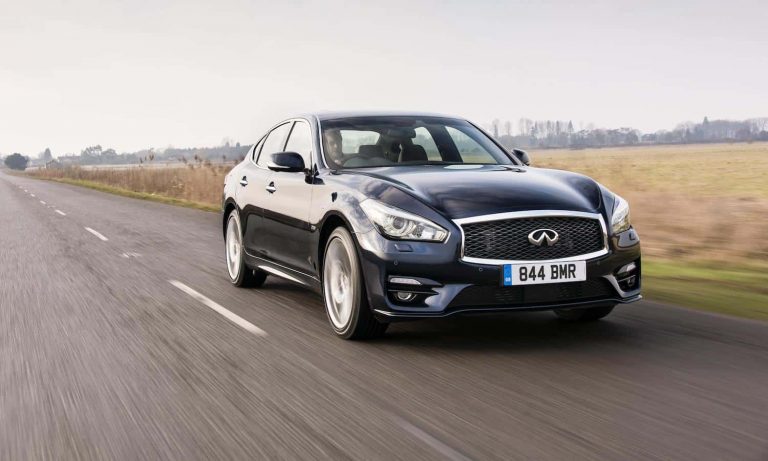
Infiniti Q70 review

What is it? The Infiniti Q70 is an updated and renamed replacement for the M30d saloon.
Key features: New diesel engine, more equipment.
Our view: The Infiniti Q70 has its shortcomings, but may suit a buyer who needs a premium high-mileage workhorse and doesn’t want to be one of the crowd.


The latest version of the Infiniti Q70 saloon launched onto the UK market at the start of 2015, bidding to challenge very strong opposition in the likes of the BMW 5 Series and the Mercedes E-Class.

However this is not really a ‘new’ Infiniti, but an updated, upgraded version of the M30d saloon which gained the Q70 badging to fit into the Japanese brand’s latest naming convention.

By far the most significant change on the 2015 version is the fitting of a Mercedes-Benz sourced 2.2-litre diesel engine. Replacing the previous 3.0-litre unit and installed within the The Car Expert test car, the new engine is far more fleet-friendly.

Infiniti expects the diesel to take the lion’s share of sales over the other two power options, a 3.7-litre, 315bhp and very thirsty petrol unit and the petrol-electric hybrid that puts out 358bhp. The hybrid engine is clearly pitched for its potency – it will hit 62mph in 5.3 seconds, more than 3.5sec faster than the diesel, but its 45.6mpg official combined cycle fuel economy is bettered by the diesel’s 57.6mpg.

Company executives looking for something more distinctive than the lines of familiar BMWs, Audis and Mercedes in the car park could certainly be drawn to the Infiniti. To begin with this is no small car – at 4,980mm it is some 73mm longer than a 5 Series BMW, though its 2,900mm wheelbase is 68mm shorter.

The Infiniti also boasts distinctive styling – some might say bulbous but others would argue that it is dominated by attractively muscular curves and a very large mesh grille that makes this car easy to spot.

The 2015 model update has added extra distinction, in particular to the more expensive of the two trims, Sport – the most notable extras are the enormous 20-inch diameter wheels. Other changes include front and rear bumpers with sharper creases, chrome detailing, particularly around that grille, and LED headlamps.

The cabin is spacious, as you would expect from such a large car, particularly in the rear seats, though the 450-litre luggage compartment is smaller than in rivals (note that in the hybrid model one loses 100 litres of this to accommodate the batteries).

The dash is very well put together, the way the centre console curves out towards the driver, putting the audio/climate/navigation controls in easy reach, a pleasing touch. However there are a lot of buttons scattered liberally around – no central rotary control here, and as such the layout feels a little behind-the-times compared to the recent advances from the likes of Audi. Once accustomed to it is all easy enough to use – just somewhat fussy.

Infiniti is placing great hopes in the 2.2 diesel engine. It will appeal to those who want smooth, unflustered progress, though it is a little noisy when first starting.

This unit won’t appeal, however, to those looking for swift progress. We’ve already stated that this is a large car and the new diesel is significantly smaller than the one originally installed in the Q70. From rest to 62mph takes 8.9 seconds, which is slow compared to rivals, while the 57.6mpg official combined cycle fuel economy also struggles to compete.

The seven-speed auto gearbox is smooth in operation, and rather swifter than in manual mode through either the gear lever or the slightly awkwardly placed steering column-mounted paddle shifts.

Attending the Geneva Motor Show required a motorway trawl from mid Wales to London Gatwick airport and back during the road-test period, and the motorway is certainly the Q70’s natural environment. It will glide along at the speed limit in relaxed fashion, and using the very effective radar-guided adaptive cruise control makes dispatching hundreds of miles a process without fatigue.

Come off the motorway, however, and it’s a different matter. While the car will crawl along traffic-choked urban routes without issue, it is less satisfying on flowing country A roads with lots of twists and turns, where it feels less assured. Inadequate feedback between steering and driver is accompanied by noticeable body roll from the softly-suspended chassis.

The Infiniti does score on its equipment. Every variant includes the LED headlights, a rear-view camera, front and rear parking sensors, navigation and leather seats with a ventilation feature.

Both the Premium and Sport grades can be upgraded to Tech variants which add significant extra equipment particularly where safety is concerned. Alongside the already mentioned radar cruise control, the spec includes lane departure warning and blind spot warning.

Creature comforts are improved by an upgraded Bose sound system with extra speakers in the front seats, while the rear parking camera makes way for Nissan group’s clever 360-degree ‘bird view’ version.

The new Infiniti Q70 has its shortcomings – but with the new diesel, it is far more of a competitive proposition to the German might that governs the fleet-dominated sector in which this car must compete. The competitive price and the extensive equipment could be the factors that convince a buyer who needs a reliable and possibly high-mileage workhorse, who wants a premium car, but doesn’t want to be one of the crowd.

Infiniti Q70 – key specifications

Model tested: Infiniti Q70 2.2d Sport Tech
On sale: January 2015
Price: £35,850 (Range £32,650-£46,600)
Insurance group: 35E
Engine: Diesel 2.2-litre (also 3.7 petrol, 3.5-litre hybrid)
Power (bhp): 167 (315/358)
Torque (lb/ft): 295 (266/403)
0-62mph (sec): 8.9 (6.2/5.3)
Top speed (mph): 137 (155/155)
Fuel economy (combined, mpg): 57.6 (27.7/45.6)
CO2 emissions (g/km): 129 (235/145)
Key rivals: BMW 5 Series, Audi A6, Mercedes-Benz E-Class
Test Date: March 2015

Postcard from the Geneva motor show

Every March, Geneva plays host to probably the best motor show in the world. Frankfurt might be bigger, but Geneva is almost universally regarded as the highlight of the year for professional showers.

This year, I was lucky enough to not just visit the show, but attend the two press days which precede the public opening of the show. So what was it like to go behind the scenes at the world’s most glamorous motor show?  Well, read on…

The main press day at the Geneva motor show is wall-to-wall with media types, along with some privileged insiders and their bratty kids who get to see all the cars before the commoners are allowed in on Thursday. They are all falling over one another to catch glimpses of tablecovers being whipped off cars that have (almost always) already been shown on the internet a week ago on various automotive websites.

The battle for media airtime means that there are very few real surprises unveiled at the shows anymore. If a car is important, its release will be handled via high-res images and carefully scripted releases in the lead up to the show, rather than cameraphone shots of the car surrounded by six million cameramen all trying to take close-up photos of tiny details.

But there is usually at least one new release that is kept secret until its unveiling at the show, and this year there were two:  the Bentley EXP 10 Speed 6 and the Aston Martin DBX.

A Bentley concept had been expected, but no details had been disclosed. The Aston, however, was a bigger surprise, and also the winner of the ‘Most Niches Covered By One Car’ award (which I just made up). It’s a GT! It’s a crossover! It’s an electric vehicle! It’s all wheel drive! It’s a bird! It’s a plane! It also looks like the result of a DB9 mating with a Nissan Juke, but Aston seemed pretty proud of it anyway.

Photos vs. reality

One thing that always strikes me about seeing new models is how different they can look in the metal compared to their official photos. The Nissan Sway, for example, looks really good when you see it for real, whereas the photos didn’t look anything special.

The exception to this rule is Audi. Their cars look just like they do in photos, which is to say, like an Audi. The new R8 looks like they simply took the old car, sharpened and flattened any curved parts, and then made it 10% faster with better wi-fi (note to self – those facts may need checking back at base).

The 2015 McLarenHonda F1 car also looks fantastic under lights, with a paint scheme that is quite spectacular. What looks like plain black paint in photos or on TV is actually a very complicated dark grey colour, full of silver specks and sparkles, really highlighting the car’s curves and overall shape. Unfortunately it still just looks like really boring plain black on TV, which is where everyone actually sees it.

By contrast, the 1988 McLaren-Honda on display in the TAG-Heuer hall was a perfect example of a simple livery working perfectly from any angle, the white and dayglo-red Marlboro colour scheme looking bold and brilliant (despite no Marlboro logos on the car, because McLaren seems determined to ignore the fact that they sponsored the team for many millions of pounds for many years).

Maserati the famous clothing company

Maserati pulled a neat trick to pad out its stand in the absence of any new cars to show. They simply devoted about a third of their floor area to selling clothing and other merchandise instead. Clearly this is the influence of master beancounter Sergio Marchionne, who presumably calculated that a sweet concept car would cost a couple of million Euros and not be saleable, but flog some polo shirts for a couple of weeks and the show pays for itself.

Across the aisle, sister brand Alfa Romeo obviously missed that memo, as they simply rehashed their usual trick of pulling an old car out of the museum and draping beautiful Italian girls over the same cars they showed last year.

The forgotten brands

While the world wide web is spinning with millions of people drooling over news of the latest McLaren, Ferrari and Koenigsegg releases, it’s not all front page coverage for some brands at Geneva. Brands like Lotus struggle to get much exposure, and most of the people standing on the Lotus stand were trying to get a good photo of the new McLaren.

And it seems a downright shame that the hardworking car mutilators at Mansory and Kahn, and wacky inventors at Rinspeed and Sbarro, get almost no coverage in the automotive media, despite literally every magazine and website being right there next to them.

The poor guys at Brabus looked balefully on as everybody waltzed straight past their latest carbon fibre-bewinged Mercedes models without so much as a second glance. Maybe they should offer coffee and snacks, which worked wonders for Volkswagen and caused many journos to pretend they were really interested in the latest Polo…

PR people running ragged

Day One of the press program is all about big manufacturer press conferences, which happen across the halls every fifteen minutes or so. A motor show news conference is like a military operation, conducted with perfect efficiency and precision timing.

Mr Big Wig steps up on cue, delivers the usual impassioned speech about how the car under the tablecloth will herald a new dawn, blah blah blah, music, lights and smoke, then he’s gone.

The photographers start firing, a platoon of Japanese ‘reporters’ descends on the new car to sit inside and explore its every detail (while taking copious notes in books that all appear to have been loaned to them by another manufacturer…), and then the marauding pack of media troops off to the next conference (although not before rifling through the canapés, of course).

All that’s left are two blokes with feather dusters and the haunted remains of what used to be the manufacturer’s PR team, totally spent after chasing their favoured journos around to reiterate the Big Wig’s message and offer exclusive/pointless trivia as appropriate.

Themes of the show – pulsing indicators and giant video walls

Two themes seemed to be gathering pace across the industry at Geneva this year. The first is that LED car lights are allowing manufacturers to play with car lighting like never before. Indicators consisting of dozens of LEDs no longer just flash on and off in unison; they sweep or pulse in directions, which sounds cheesy but actually gives a car quite an organic feel. Unfortunately it didn’t really show up on video very well, so I don’t have anything to show you here, but some manufacturers have really grasped the concept and everyone else will follow very quickly.

The second is not so much car-related but stand-related. Every stand had GIANT VIDEO WALLS. Everywhere. In fact, the whole back wall of the Opel stand was a giant video wall. Plus they had several huge video screens hanging from the ceiling as well. If you are an epileptic, it’s time to accept that you will never be able to visit a motor show again.

Press Day – the real highlight

Italdesign_Giugiaro_01

Among all of the new releases, one model really stood out at Geneva. It was the limited edition Italdesign Giugiaro… (drum roll)… choc ice. This was, without doubt, the most well-received model launch of the day, and it’s not hard to see why every journo, photographer and blogger wanted in on the action.

The Giugiaro choc ice is truly an ice cream like no other. Forget your paper wrapping, this choc ice comes packaged in its own bespoke black box, proudly bearing the Italdesign logo and graphics. Opening the lid, the choc ice practically glides out into your hand, revealing a smooth chocolate coating that is perfectly uniform in colour and depth all around the ice cream itself. This is clearly a premium product, virtually incomparable to the mass-produced choc ices you find in the freezer at Sainsbury’s.

Biting through the chocolate layer, one finds that the Giugiaro choc ice has a real depth of quality to match its sensual styling. The ice cream centre is rich and creamy, with real vanilla flavour only adding to the overall experience.

Even the stick, so often overlooked as simply the bit to hold on to by most confectioners, is gloriously tactile on the Italdesign choc ice, and suitably reflects the obsession to detail that “Designer of the Century” Giorgetto Giugiaro is renowned for. The great master himself was present on the Italdesign Giugiaro stand, beaming with pride as the press devoured his latest creation.

In fact, the only thing letting the occasion down was some poor set design; the convivial atmosphere being somewhat interrupted by a large black concept car rotating on a turntable right in the middle of the Italdesign ice cream parlour. Apparently it drives itself or something, so you would think it would have the decency to move out of the way.

Summary

The Geneva motor show is an amazing exhibition of all the latest cars from all the greatest manufacturers in the world. To visit during the heavily-restricted press days was a fantastic experience for a humble blogger. For more photos from the 2015 Geneva Motor Show, visit The Car Expert on Instagram.

Land Rover to build roofless Evoque

Land Rover’s big news at the Geneva Motor Show concerns a vehicle that is not on display – a Range Rover Evoque Convertible.

The UK brand has confirmed it is to build a drop-top version of its hugely successful Range Rover Evoque by releasing pictures and a video of the car testing – underground…

The Evoque is shown driving through the 26-mile network of tunnels being constructed underneath London for the Crossrail project.

According to Land Rover, such a test allowed the car to be driven with its roof down without attracting prying eyes.

Land Rover programme director Murray Dietsch says that the car had a number of obstacles to negotiate.

“The tunnels are still under construction, so we had a unique opportunity to explore the vehicle’s all-terrain ability in unchartered territory,” he adds.

The Evoque Convertible project has been under consideration at Land Rover for some time. A concept version was revealed at the Geneva motor show back in 2012. The huge sales success of the smallest Range Rover model, and the new customers it has brought to the brand, has given Land Rover the confidence to proceed with a new model which will be further away from its muddy roots than any car it has previously built.

Land Rover will announce further details about the Evoque Convertible later this year. It will be built alongside the five door and coupé Evoque models at Land Rover’s Halewood plant in the UK, and is expected to go on sale in 2016.

Suzuki Vitara review 2015

What is it?
The all-new Suzuki Vitara is the latest in a successful line of small SUVs

Key features
2WD/4WD, crossover styling, long spec

Our view
With sharp pricing and strong performance, Suzuki’s optimism for its new car seems very well founded.


The Suzuki Vitara is a model that is core to the very heritage of the Suzuki brand. Since it first appeared on the market in 1988, it has effectively shown off the brand’s prowess in all-wheel-drive powertrains, and in the process sold 2.87 million examples across the globe.

For the past few years, however, the only version of the car one has been able to buy on the UK market is the Grand Vitara, a big sister model that is a throwback to the previous fifth-generation Vitara series.

Now the Grand Vitara has come to the end of the line. It’s making way for a new Vitara, one that is crucial to Suzuki’s bold plans to build on the market growth achieved by what many consider one of the smaller Japanese brands. In three years Suzuki’s UK sales have jumped from 20,000 to more than 37,000 a year, boosting its market share from one to 1.5 per cent.

The other major factor guiding the new Vitara is its target market – the small crossover segment has mushroomed in both sales figures and competing makes in recent times. Every badge now wants to be part of this market and the new Suzuki arrives just as do two potential new rivals, the Jeep Renegade and the Fiat 500X we reviewed recently.

But if there is one market that Suzuki should be in, it’s this one – unlike most of its competitors, the brand has a very long heritage of making small, affordable 4x4s, stretching way before the Vitara to the initial Jimny of 1970.

While the predecessors were off-road pitched, the all-new Vitara is aimed squarely at the clientele buying all these crossovers – buying them mostly for the dominant road presence and which mostly has no intention of ever subjecting their car to an off-tarmac experience.

It’s a smaller car than its predecessor, sitting between its prime rivals the Nissan Juke and Skoda Yeti. But with a starting price firmly in the territory of the smaller car, the Suzuki offers a roomy option to a typical B-segment crossover, including a 375-litre boot. It does not feel significantly smaller than the car it replaces.

The body is new and scores on style – more than one observer on the launch event suggested it had elements of Land Rover’s much-vaunted Range Rover Evoque about it.

Similarly the interior is a new design and thoroughly practical – it makes no headlines, does nothing particularly different, but the surfaces are of higher quality than the pricing would suggest and the controls exactly where one needs to find them, nothing more, nothing less.

The Vitara powertrain line-up is simple – two engines, one petrol one diesel, both of 1.6 litres and both with 118bhp. The petrol version can be matched to a five-speed manual or six-speed auto gearbox, the diesel six-speed manual only, and both can be supplied with either front-wheel drive or Suzuki’s AllGrip all-wheel-drive system.

Suzuki expects most take-up of the Vitara to be with the petrol engine, despite the car offering far greater appeal than previously to fleet drivers – including residual value predictions of plus 40 per cent, which is high for the class.

The petrol engine is a competent unit, its 11.5-second 0-62mph time in front-wheel-drive form reasonable for the class. But that acceleration figure is matched by the diesel, which also has the advantage of a 236lbft torque figure more than double that of the petrol unit and from 1,750rpm, compared to 4,400rpm. The Car Expert liked the diesel engine fitted in our test vehicle, though it is a little noisy, and the £1,500 price premium will keep the sales advantage in petrol territory.

We were also able to test the car in all-wheel-drive format. Today’s crossover buyer almost invariably sticks with two-wheel-drive, the average 4WD take-up only around 10 per cent of the mix, and indeed some rivals don’t even offer the option.

Suzuki, however, believes as much as a quarter of Vitara buyers will go the 4WD route, based on the brand’s heritage and the effectiveness of the proven AllGrip system. This sits happily powering the front wheels and only spreads the torque around when needed. And as such, it doesn’t suffer from the fuel economy and emissions drawbacks one expects with 4WD.

Certainly, the system works seamlessly, and of course adds extra safety to boot – it is a worthwhile £1,800 investment over the 2WD version.

On the road the Vitara is firmly planted and well behaved – but this does not come as a surprise either, as the underpinnings are basically those of the S-Cross. The steering is light, but not overly so, and one never loses confidence in the car even when cornering enthusiastically.

While few will ever take a Suzuki Vitara off road, it will be able to cope with such conditions, unlike several rivals. The AllGrip has four modes, including ‘Snow’ for when the going gets very slippery, and a lock mode for extricating the car from bogged-down situations.

AllGrip cars also come with hill descent control, while every Vitara is fitted with a hill-hold system.

The two different potential Vitara audiences are exemplified in two optional styling packs available – ‘Urban’ and ‘Rugged’. The former includes chrome detailing and a spoiler, the latter protective skid plates and edge protectors. There are also plenty of options to personalise as appears to be the current trend.

More impressive perhaps is the car’s standard equipment. Every one of the three trim levels includes Bluetooth connectivity and DAB radio, all but the entry-level cars link audio functions to one’s smartphone and come with navigation. Go for the top SZ5 trim and highlights on the equipment list include adaptive cruise control, radar brake control and LED projector headlamps.

When one considers that the only Suzuki Vitara more expensive than £20,000 is a diesel-engined, all-wheel-drive full-spec SZ5 variant, Suzuki’s optimism for its new car seems very well founded.

Suzuki Vitara – key specifications

Model Tested: Suzuki Vitara 1.6 DDiS SZ5 AllGrip
On Sale: April 2015
Range price: £13,999-£21,299
Insurance group: TBA
Engines: Petrol 1.6. Diesel 1.6
Power (bhp): 118. 118
Torque (lb/ft): 115. 236
0-62mph (sec): 11.5/12.5*/12.0**/13.0***. 11.5/12.4**
Top speed (mph): 112 (all models)
Fuel economy (combined, mpg): 53.3/51.3*/50.4**/49.5***. 70.6/67.2**
CO2 emissions (g/km): 123/127*/130**/131***. 106/111**
Key rivals: Nissan Juke, Renault Captur, Fiat 500X
Test Date: February 2015
All performance figures 2WD with manual gearbox except
* = auto gearbox, ** = 4WD manual, *** = 4WD auto.

Mazda 6 review (2015 – 2017)

What is it?
A facelifted version of the Mazda 6 large family car that originally launched in 2013.

Key features:
More equipment, more tech, better cabin.

Our view: Competitive against the Ford Mondeo and starting at a lower price.


Do car manufacturers take much notice of the feedback given to their new models? The reviews in magazines and on sites such as The Car Expert, and the comments of those who drive the cars?

Well in Mazda’s case the answer would appear to be a solid yes. The 2015 Mazda 6 (styled by the company as the Mazda6) large family car is just arriving in UK showrooms, and while there are no mechanical changes, no new engines to promote, there are a host of changes that are directly the result, we are told, of criticisms of the car first launched in 2013.

Such differences are noticeable as soon as one slips inside the car. The interior has always been a prime area of concern for those analysing the Mazda against its rivals, criticised for its dull design, prolific buttons on the dash, and an impression that it doesn’t quite have the quality to challenge prime rivals such as the Ford Mondeo.

In the new Mazda 6 the instrument panel and centre console have been completely redesigned. The handbrake lever makes way for an electronic version to free up space on a more compact centre console.

Key to the new design is a seven-inch colour touchscreen, mounted atop said centre console and combining with the rotary ‘Multimedia Commander’ to both cut the number of buttons and make the whole thing easier to use. The MMC itself is more weighty and positive in use, the buttons around it – including a very sensibly placed audio volume control – falling more naturally to one’s fingers. It is definitely an improvement.

Among the new niceties to control are the MZD Connect infotainment system, allowing access to internet and social media services, and Mazda’s first DAB digital radio – the lack of which was another regular complaint with the previous car.

All this comes on all versions of the car. Choose the top Sport Nav option of the three trim levels available and you also gain full-leather upholstery, an integrated navigation system, eight-way powered adjustment on the driver’s seat and six ways on the front passenger’s, these seats both heated and more supportive than previously.

There’s a premium Bose surround sound system with some 11 speakers, and finally the ActiveDriving display – effectively a head-up display, projected on a clear plate at the base of the windscreen and offeirng information on speed, navigation commands and cruise control.

Crucially, it all feels rather more upmarket, an impression that is only heightened once one gets underway. Mazda has addressed another regular criticism, the amount of noise in its cars.

The improvement we are told is 25% or 2.4dB, achieved by extra sound-absorbing material in the arches, the inner roof and door linings, and improved sealing of shut points. Certainly, the difference is noticeable.

As far as actually driving the car is concerned, there is no difference to be felt, as the revisions have not extended to the powertrains or chassis. In either Saloon or Tourer form, is still offered with the same engine line-up – 2.0-litre petrol units of 143 and 162bhp, and a pair of diesels offering either 148 or 172bhp.

There are some visual exterior differences, but only if you choose the Sport Nav grade. This has been differentiated from its sister models by subtle changes mainly to the lighting.

The signature wing around the front grille is now emphasised, producing a more recognisable face to the car especially in the rear-view mirror at night, thanks to the LED headlamps. And there is a more distinctive rear-light signature too.

One other aspect that should be mentioned with this Mazda6 is on the options list – the Safety Pack, which covers a range of technologies.

Included are very clever adaptive headlights. They employ a series of LEDs and rather than dropping off main beam when the Mazda6 either comes up behind another car or has one come towards it, they simply turn off the LEDs that will directly blind the other vehicle’s occupants, retaining the wide scope of light.

There is a new blind-spot monitor that also incorporates a rear-vehicle monitor to anticipate potential issues when overtaking traffic, while the same system is used as a rearwards monitor looking for potential obstructions, such as pedestrians, when reversing out of a parking space.

It’s a busy time for Mazda – by the end of 2015 the oldest car in its range will be the Mazda3, launched in January 2014. The Mazda6 is a core part of the brand’s growth plans and overall this range of upgrades can be nothing but good news for the car.

Is it as good as the just-launched Ford Mondeo and Volkswagen Passat? The argument would be easier against the Ford than the VW, and as the Mazda’s pricing does start from a lower point than both rivals. No buyer is likely to be disappointed by the Mazda6 – it is certainly a prime contender in the market particularly for fleet users.

Mazda 6 – key specifications

Model tested: Mazda 6 2.2-litre diesel 175hp Sport Nav saloon
On sale: February 2015
Range price: £19,795-£28,795
Insurance group: 16E-23E
Engines: Petrol 2.0 (2). Diesel 2.2 (2).
Power (bhp): 143, 162. 148, 172.
Torque (lb/ft): 155, 155. 280, 310.
0-62mph (sec): 9.5/9.6*, 9.1/9.1*. 9.1/9.2*, 7.9/8.0*
Top speed (mph): 129/128*, 134/133*. 130/130*, 139/137*.
Fuel economy (combined, mpg): 51.4/50.4*, 47.9/47.9*. 68.9/64.2*, 62.8/61.4*
CO2 emissions (g/km): 129/131*, 135/136*. 107/110*, 119/121*
Key rivals: Ford Mondeo, Vauxhall Insignia
Test Date: February 2015
All performance figures with manual gearbox.
All figures with saloon except * = Tourer

Part-exchange prices: Why is my car’s value so low?

One of the biggest complaints from car buyers is that when they want to part-exchange (trade-in) their current car, the dealer offers them a pathetic amount of money.  But is this reality or perception? 

Many of the issues about a car’s part-exchange valuation come from a misunderstanding of how a dealer arrives at the number that they are offering you for your car. Read on to learn more, as well as some tips for understanding what your car is really worth before you set foot in a dealership.

The dealer is scamming me!

It’s a familiar story. You bought a shiny new car three years ago, have looked after it lovingly and spent a fortune on servicing and running costs, and now the sleazy car salesman across the desk is telling you it’s worth less than half what you paid for it not that long ago. Surely the dealer is scamming you for thousands of pounds on the part-exchange value?

Well to start with, it’s almost certain that the dealer really is offering you less than your car is worth. This is called lowballing, and dealers do it most of the time. And why not?

There’s no law which says they have to offer you a great price for your part-exchange. If you accept their offer, they’ve bought a car cheaply. If you say no, they can gradually negotiate back to what the car is really worth if they need to. So never accept a dealer’s first offer, regardless of whether you’re buying a Peugeot or a Porsche.

But let’s take it back a few steps, before you even set foot in that car showroom. There are a couple of good reasons you’re horrified by that part-exchange offer, and they’re both your own fault.

Firstly, you’re probably overestimating your car’s worth; and secondly, there’s probably a few things you can do (or should have been doing) to protect its value better.

Today we’re going to help you understand why your car’s part-exchange value is lower than you think, and next time we will give you some advice on how to get more money for your car at part-exchange time.

What is my part-exchange really worth?

If you simply guess at your car’s current value, you will almost certainly overestimate it.  Probably by quite a lot. If you have a cursory look at car ads to see what cars like yours are selling for, you’re still probably overestimating it.

If you look at your car with any kind of emotional attachment, especially if you have named it or have photos of it on your Facebook profile, you are definitely overestimating it.

To really know your car’s value accurately, you need to do a bit of homework. It’s not difficult, but it could be worth hundreds or even thousands of pounds in your negotiations.

The car dealer will assume you don’t really know your car’s value, while they have the advantage of plenty of industry data to know exactly how much to pay for it. You won’t fool them into paying too much for your car, but you can make sure they pay you a fair price.

Firstly, you must look at your car with complete emotional detachment. To you, it may have been a magnificent chariot that has ferried you comfortably around the countryside on your many adventures. But to a car dealer it’s simply another Ford Fiesta, which is probably slightly better or slightly worse than the last ten Ford Fiestas they looked at.  Which were all in the last week. And most of their owners loved them dearly as well. So it’s not “Ferdie the Fiesta”, it’s a 59-plate Ford Fiesta LXi 5-door petrol manual in blue with black cloth.

Secondly, now that you’ve taken off your rose-tinted glasses, have a really good look at your car. Those little scratches that you never really noticed or had forgotten about? There’s quite possibly a few hundred pounds (or maybe a lot more) of paintwork needed before a car dealer can sell that car now.

Same goes for your wheels. Crunched them against a kerb?  That’ll be £50-£100 per wheel to fix, and it may also need replacement tyres if you’ve damaged the sidewalls.

Have you had the car serviced by an official dealership, on time and every time? If not, the part-exchange valuation will be marked down heavily.

Did you pay a lot of money for expensive optional extras?  They’re probably worth absolutely nothing by now. Sorry to be the bearer of bad news, but most optional extras add virtually nothing to your part-exchange value.

Now that you’ve been a bit more objective about you car’s condition, have a look at some of the tools online that will help you estimate your car’s true value. A good place to start is an online buying service like our partner Motorway, or others. There’s plenty of them to choose from, and it will give you a reasonable starting point.

Industry data from CAP and/or Glass’s is also useful, but bear in mind that these companies don’t actually buy your car, so just because they say it should be worth a lot of money doesn’t mean that anyone will actually pay that much.

A dealer or online car buying service is actually making you an offer to buy your car, so their prices are genuine rather than theoretical. Looking at classified ads on Auto Trader or other sites can be misleading, as it tells you what price a seller is asking for, but it doesn’t tell you what the car ends up selling for or how long the seller has been trying to shift the car.

If you’re looking at dealer ads, you need to factor in a dealer’s profit margin and cost of business, which can be a few thousand pounds. As an indication, the dealership I last worked at had a rough difference of £3,000 between the price we would buy an absolutely immaculate car for and the price we would sell it for. That worked out at about £1,000 of profit and £2,000 of business costs. This was a prestige main dealership, so the costs were relatively high, but we weren’t trying to make a massive profit margin on the vehicles.

How does a dealer value my car?

If you’re judging your car’s value based on what dealers are selling similar cars for, then you need to be taking a number of things into account, all of which reduce the amount a dealer will pay for your car.

Firstly, a dealer will look a the exact make, model and specification of your car. There can be a massive difference in value between two similar-looking Volkswagen Golfs, for example. One could be a base model with small engine, manual gearbox, no desirable options and in an unpopular colour (blues and reds may look great but are usually less popular than other colours), while the other could be a top-spec car with a diesel engine, automatic gearbox and painted silver or black.

Aftermarket modifications will also usually hurt your vehicle’s value – it doesn’t matter how phat you think your oversize wheels and dark tinted windows are, there’s a high probability that future buyers won’t be so impressed, so dealers will mark you down accordingly.

Secondly, a dealer will look at the car’s age. Six months here or there may not seem significant to you, but there may have been a major model upgrade in that time which could make a car that’s only slightly older far less valuable at trade-in time.

Also, a car that’s just out of new car warranty will be worth less than a car that still has some warranty left, even if it’s only a few months. Buyers certainly prefer some kind of warranty, so dealers will value it accordingly.

Thirdly, a dealer will judge a car’s condition. This consists of all of the obvious and visible points, as well as a more detailed analysis of the things which are not immediately obvious but influence the car’s value significantly. Leaks, rust, tyre wear (including the spare), service history, MOT reports, and so on. A dealer is trying to decide how much money they are going to need to spend before the car is ready for sale. Every penny they have to spend preparing the car is a penny less that they will be giving you.

Fourthly, the dealer will look at your car’s mileage. Essentially, a car with low mileage for age will be valued slightly higher, but a car that has higher-than-average mileage will usually be marked down heavily.

Again, this is purely based on customer preferences, so dealers buy and sell accordingly. It doesn’t matter if the mileage is “all motorway mileage”, a customer will always prefer to buy a car with lower mileage than one with higher mileage. And you can’t prove where those miles took place anyway, so the old “motorway mileage” excuse is worthless.

Other considerations

Those four points are the big ones in determining your part-exchange value, but a dealer will also look at how many owners a car has had. One owner from new is desirable but not usually worth any more than a couple of owners, but a number of owners in a short period will be considered suspicious and valued downwards accordingly – regardless of whether or not there’s a valid reason.

There is also the simple equation of supply and demand, and individual bias. One dealer may have had good returns on selling Vauxhall Corsas, so may be prepared to pay a bit more for your nice Corsa. Another dealership might have struggled to shift the last three Corsas they had in stock, so may be less generous in what they offer for yours.

To arrive at the price they offer you for your car, a dealer will look at their likely selling price for your car, and then subtract their profit margin (they are a business, after all), subtract their costs of running the business, and then subtract anything they will need to spend on your car.

They will use industry data from CAP and/or Glass’s as a guide, and use all of that information to come up with a price of what they are prepared to pay for your car. However, going back to the start of this article, that doesn’t mean that they will offer you that much to start with…

Summary

The more time you spend getting to understand the real value of your car, the better position you will be in when it comes to buying your next car. You won’t be so shocked when dealers offer you what seems to be a pittance for your car, and you’ll be better placed to negotiate up to a fair figure.

And because you started your new car calculations with a more realistic figure in mind, you will be in a better position to look for cars that you will be able to afford.

Far too many people already have their heart set on a specific car, and their calculations get blown out of the water because they massively overestimated their part-exchange value. Unwilling to give up on their dream car, they end up paying far more than they can afford and end up in all sorts of trouble trying to keep up with their payments.

Suzuki Celerio review

What is it?
The Suzuki Celerio is a new small car which replaces two models in the Suzuki range

Key features
Best in class space, efficiency

Our view
Does not offer the appeal of some of its rivals, but if head rules over heart then the Suzuki Celerio is a serious contender.


Suzuki claims very firmly that it “knows small cars”. The brand sells 2.8 million of them across the world each year, remarkably almost a third of that total in India alone where it has 40% of the entire car market. Suzuki also tops Japan’s ‘K’ car market for small fuel-efficient vehicles.

In the UK that sales figure has so far been a rather more modest 17,500 per annum, split across two vehicles, 3,500 for the Splash and 14,000 for the long-lasting and very successful Alto. And between them they accounted for almost half of Suzuki’s record UK volume and 13 per cent growth in 2014.

Now however, both are in the past, replaced by one new city car, the Celerio. This is a model that Suzuki believes will sell on three pillars – best-in-class space, best-in-class efficiency and standard equipment levels rivals cannot match.

The Celerio looks larger than the average city car, which is misleading as its length of 3,600mm is around the same as rivals such as the Hyundai i10, but with a slightly longer wheelbase of 2,425mm. It certainly outstretches competitors on height, 1,540mm compared to say the i10’s 1,500, and while this gives the Suzuki a more boxy appearance, it does translate into lots of interior space.

Slip inside – this is a full five-door car, with wide-opening rear doors – and you certainly feel you are in something much bigger particularly in the back, where an adult can be comfortably if a little cosily accommodated in the central fifth seat. Boot space of 254 litres is also more than its direct competitors and can extend to 726 litres with the split-folding rear seats down.

The cockpit layout is sensible, the driver’s seat height adjustable on all versions. Surfaces are hard plastic but solid, which with chunky switchgear gives an impression of durability. Thanks to the tall roofline front-seat occupants sit quite upright which for the driver gives an excellent outside view.

At launch all Celerios are fitted with a three-cylinder 1.0-litre petrol engine of 67bhp, offering combined cycle fuel economy of 65.7mpg while the 99g/km CO2 emissions places the car amongst its rivals just inside free road tax territory.

This engine is adequate, especially around the Celerio’s natural urban environment. It feels a little underpowered out on the open road, though the 0-62mph time of 13.5 seconds is faster than its rivals by almost a second.

Such times are returned with the five-speed manual gearbox – from April 2015 Suzuki will also offer its ‘AGS’ (Auto Gear Shift) transmission which while significantly slower to 62mph (16.4 sec in auto mode, 15.2 in manual) promises automatic convenience without efficiency losses. Fuel consumption and CO2 emissions match its manual sibling. It also has a ‘creep’ function enabling the car to inch forward at 5mph in queueing traffic without using the accelerator, simply taking one’s foot off the brake.

Also launched in April will be the more interesting engine, a 1.0-litre version of Suzuki’s ‘dualjet’ unit already tested by The Car Expert in 1.2-litre form in the Swift. This uses two injectors per cylinder which improves the fuel mix and therefore efficiency.

While having the same 67bhp as the launch engine, the dualjet’s torque figure rises slightly, cutting half a second off the 0-62mph time, but crucially its official combined cycle fuel economy stretches past 78mpg and CO2 emissions plummet to 84g/km, which no rivals can match. Suzuki proudly dubs the dual jet Celerio; “the most efficient car you can buy for under £10,000”.

On the road the Celerio is easy to drive, particularly on urban streets where the light steering and tight turning circle of 9.4 metres come into their own. At higher speeds on open roads it is merely adequate – on twisting country roads one gets more satisfaction from the confidence-inducing steering of the likes of the Skoda Citigo. However, the Suzuki’s stability is impressive, even at motorway speed limits.

Suzuki does not expect from the Celerio anything like the volumes it enjoyed with the Alto and Splash – annual sales are predicted at 6,000 a year. The main reason for the previous higher figures was the bargain basement starting price of the Alto, £5,995, which was worth 11,000 sales a year.

The Suzuki Celerio is not bargain basement – prices start from £7,999, which is still £250-£400 cheaper than its predicted direct rivals. Suzuki sees the competition coming from the likes of Hyundai’s i10, the Kia Picanto and Skoda Citigo, and is happy to leave the perceived style-driven younger driver market to the Fiat 500 and the trio of city cars from Citroën, Peugeot and Toyota.

As well as the price and its extra space, the Suzuki will score on a host of standard equipment its rivals don’t have – alloy wheels, air conditioning, Bluetooth connectivity, even DAB digital radio.

All of this comes on the cheaper SZ3 versions which Suzuki expects almost three quarters of buyers to choose. The SZ4, £1,000 more expensive, adds only smarter alloy wheels, body coloured and chrome detailing, electric mirrors, front foglamps, two extra audio speakers, rear electric windows and a pocket on the back of the front seat.

The Suzuki Celerio does not offer the instant ‘cute’ appeal of some of its rivals in the city car class. But if head rules over heart, this car’s practicality makes it a very serious contender indeed.

Suzuki Celerio – key specifications

Model tested: Suzuki Celerio 1.0 SZ4
On Sale: February 2015
Range price: £7,999-£8,999 (at launch)
Insurance group: TBC
Engines: Petrol 1.0 (x2)
Power (bhp): 67/67
Torque (lb/ft): 66/69
0-62mph (sec): 13.5/13.0
Top speed (mph): 96/96
Fuel economy (combined, mpg): 65.7/78.4
CO2 emissions (g/km): 99/84
Key rivals: Hyundai i10, Kia Picanto, Skoda Citigo
Test Date: January 2015
* All performance figures with manual gearbox

Ford Focus ST review

What is it? Latest version of the Ford Focus ST hot hatch
Key features: Diesel engine option, hatch or estate body
Our view: For those who want a car that is exhilarating to drive yet well-behaved and comfortable, the Focus ST ticks a lot of boxes.


With the Focus ST and Golf GTI, Ford and Volkswagen take half of the performance hatch market between them – other rivals, such as the Renaultsport Megane, are mere observers to the battle between the two prime contenders.

Volkswagen launched an all-new GTI last year, evolved from the seventh-generation Golf. And now that the new Ford Focus has gone on sale, the ST version has followed close behind.

Some 13 years on from the first Ford Focus ST 170 of 2002, the fourth-generation car offers plenty of headlines. For starters, despite a smaller four cylinder 2.0-litre turbo engine displacing the previous model’s 2.5-litre five-cylinder unit, with 247bhp – 22 horses more than its predecessor – the petrol-engined car is the most powerful ST yet.

It will only be the most potent Focus for a while, however, as a new variant of the even more musclebound Focus RS is on the way, with more than 350bhp…

The downsizing of the petrol engine is in the search for more efficiency, and the 41.5mpg official combined cycle fuel economy and 159g/km CO2 emissions are efficient to a degree unheard of in such cars not so many years ago.

However there is now an even more efficient ST – the latest model can for the first time be specified with a 2.0-litre diesel engine, which when combined with the estate body shell available alonngside the hatch, puts the car for the first time on the radar of user-chooser fleet buyers.

Yet while the diesel boasts very un-performance car fuel economy figures of 67.3mpg and CO2 emissions of a mere 110g/km, it also has only 182bhp, a lot less than its petrol sibling. From rest the diesel hatch reaches 62mph in 8.1 seconds, a full 1.6 seconds slower than the petrol version, which will then go on to 154mph long after the diesel has topped out at 135mph. Surely a typical ST fan would be seriously disappointed by the diesel?

In a word, no. During the launch event, on very challenging roads around Barcelona in Spain, The Car Expert made the test as tough as possible by driving the diesel variant after the petrol, and in estate form, which is even slower, but it surprised with its effectiveness.

The clue is possibly in the torque, the pulling power, which in diesel form is 29lbft better than in the petrol. While acceleration and maximum speed figures make the deadlines, the most enjoyment from such a car comes from its cornering ability, and few can match the Focus in this respect.

At the wheel of the diesel through bends of ever-varying severity with plentiful hairpins thrown in, it was easy to forget that this was an estate, and difficult to seriously mark it down compared to the petrol version driven the day before.

Of course the entire Focus line has always been renowned for the quality of its chassis and in the ST, these qualities take a further step up, the addition of a raft of new chassis tech leading the car’s creators to describe it as “the most advanced ST yet”.

Chief amongst the tech is the ‘Enhanced Transitional Stability’ (ETS) system, an industry first according to Ford. Incorporated into the Electronic Stability Control, ETS monitors the car’s stability and the driving style to predict when a loss of control or skid might occur. It then intervenes to try and prevent such dramas by braking individual wheels – even in dramatic direction changes at speed such as suddenly going from one motorway lane to another.

The suspension is retuned with new springs and damper settings, the ESC has three settings (including one which turns most of it, and the ETS, off), and a host of other upgrades make this one of the most complex chassis setups Ford has yet produced.

The important aspect, however, is that it works, very well indeed. The Focus is a delight to drive with enthusiasm. Alongside the inch-perfect cornering and plentiful grip, the Torque Vectoring system provides all the traction needed, just when it is wanted.

Looks are important in this class and the ST will not be confused with a stock Focus – even if the in-your-face ‘Tangerine Scream’ paintwork is not selected (this very bright orange the least popular of the exterior shades, most owners choosing blue).

On the outside the ST gains a new and dominant mesh grille, bespoke bumpers and rear diffuser, rear spoiler and side skirts, and of course specific 19-inch alloy wheels with red brake callipers.

Inside there are Recaro seats, the flat-topped steering wheel with leather, chrome and aluminium liberally applied, and an evocative little additional instrument panel with turbo boost, oil pressure and oil temperature gauges atop the centre console. And all this is applied to the latest Focus instrument layout, much improved over its predecessor with fewer buttons.

It all goes together very well, but perhaps the one major area where the Ford Focus ST will surely score is in its price. At £22,195 (petrol or diesel, there being no price premium for the oil burner), the base model undercuts even a three-door Golf GTI by more than £4,000, and offers more power. The RenaultSport Megane has 15 horsepower over the Focus but again a less practical three doors, and costs £3,700 more.

The out-and-out performance fans will keep patient for now, and await the Focus RS. But for those who want a car that is exhilarating to drive, particularly through a challenging series of bends, yet which is also as well behaved and comfortable to run as a daily driver, the Ford Focus ST ticks a lot of boxes.

Ford Focus ST – key specifications

Model tested: Focus ST 2.0 EcoBoost hatch, 2.0 TDCi wagon
On sale: Jan 2015
Range price: £22,195-£27,095
Insurance group: TBC
Engines: Petrol 2.0. Diesel 2.0
Power (bhp): 246. 182
Torque (lb/ft): 266. 295
0-62mph (sec):
6.5. 8.1 (wagon 0.2 slower)
Top speed (mph): 154. 135
Fuel economy (combined, mpg)*: 41.5. 67.3
CO2 emissions (g/km)*: 159. 110
Key rivals: Volkswagen Golf GTI, Renaultsport Megane 265
Test Date: January 2015
* = with auto start-stop

Hyundai i20 review 2015

What is it? Second-generation version of Hyundai i20 supermini
Key features: More space, sharper style, more equipment
Our view: A definite step forward, and a lot of car for the money.


Since being introduced in 2009 the Hyundai i20 has become one of the brand’s big sellers, and a crucial player in the brand’s continued UK growth after being propelled to prominence by the recession-era Government scrappage scheme.

However compared to its smaller and larger sisters the i10 and i30, the supermini-sized i20 has written few headlines – which it really needs to do if it is to compete in a market where rivals include the much-praised Volkswagen Polo, the brand-new Vauxhall Corsa and Britain’s best-selling car, the Ford Fiesta. And in the ‘New Generation’ i20, Hyundai feels it has the answer.

First impressions are certainly positive. The looks of the second-generation i20 are sharper, more purposeful – and in appearance it feels less supermini, more hatch from the next sector up.

Such feelings are not entirely misplaced. The Hyundai i20 is built on an all-new platform – the car is longer, lower and wider than its predecessor and crucially has a wheelbase extended by 45mm to 2570mm. The resultant 1892mm of combined front and rear legroom enables Hyundai to claim best-in-class interior space, along with a 326-litre boot. This is 36 litres more than in the Fiesta, and 10 more than in the Focus – which is from the next class up…

Slipping inside the i20 it certainly feels roomy, in front or back. Ahead of the driver is a pretty traditional dash layout, and it’s here perhaps where the Hyundai lags behind its big-name rivals.

While the panel fit and surfacing is of good quality, it doesn’t feel as plush as the latest from the likes of Ford and Volkswagen. And in an era when touchscreen-based centre consoles are becoming the norm, the more traditional display of the i20 feels a little dated, the top-of-dash mounted smartphone holder enabling one to use its navigation app a somewhat basic alternative.

The new i20 launches with a five-way engine choice, all of which are existing Hyundai units, updated to meet the latest EU6 emissions regulations. They will be joined by a brand new 1.0-litre three-cylinder T-GDI turbocharged petrol engine of 118bhp, the first of a new family of power units, but this is still some months away.

There are three petrol units of 1.2-litre 74bhp, 1.2-litre 83bhp, and 1.4-litre 99bhp, plus 1.1-litre 74bhp and 1.4-litre 89bhp diesels. The Car Expert drove the more powerful of the 1.2-litre petrol units, and overall it’s a competent, refined engine, smoothly accelerating and bowling along happily at motorway speeds, with little noticeable noise.

The problem is it takes a while to get to such speeds – 13.1 seconds to 62mph is pedestrian compared to rivals who have the advantage of turbochargers on their engines. The Hyundai also suffers the moment it encounters a significant gradient, its mere 90lbft of torque causing one to hurriedly drop through the five-speed gearbox, which it should be said is very slick and precise in operation. The new engine could well be a major gain for the i20.

In terms of roadholding and handling – the Fiesta is better, but then just about everyone in the segment looks to the Ford for its benchmark. Hyundai has made great strides with its chassis – it’s comfortable in a straight line, with only the largest of potholes making themselves felt in the cabin, and it is equally competent and easy to place into corners, staying upright with confidence-inducing grip.

The new i20 is offered in five trim levels, and our test car was furnished in the second SE grade, with which by far the majority will be sold. The spec is impressive, including such niceties as daytime running lights, leather on the steering wheel and gear-knob, parking sensors and, surely fast becoming an essential accessory, Bluetooth connectivity for one’s phone – controlled either by steering wheel controls or voice recognition.

A comprehensive safety spec includes technology one doesn’t necessarily expect in volume superminis, such as Emergency Stop Signal and Lane departure warning, described by Hyundai as a segment first.

Similar highlights are on the options list, including a full-length panoramic sunroof.

When one factors in the price of our test car, £12,725, it becomes a serious contender. Fiesta and Vauxhall can both compete on price but with less equipment, the VW Polo is more expensive and again with less equipment, while no contender matches the Hyundai on space or its five-year warranty.

So the new Hyundai i20 is a definite step forward, and should keep many supermini buyers in a Hyundai – it’s a lot of car for the money.

Hyundai i20 – key specifications

Model tested: Hyundai i20 SE 1.2 84PS
On sale: January 2015
Price: £12,725
Insurance group: TBA
Engine: 1.2-litre petrol
Power (bhp): 83
Torque (lb/ft): 90
0-62mph (sec): 13.1
Top speed (mph): 106
Fuel economy (combined, mpg): 55.4
CO2 emissions (g/km): 119
Key rivals: Ford Fiesta, Vauxhall Corsa, Volkswagen Polo
Test Date: January 2015

Does black box insurance reduce young driver crashes?

0

One of the most significant and controversial developments in car insurance for many years has been the growth of ‘black box insurance’. You fit a black box recording unit to your car which monitors your driving behaviour and reports it back to the insurance company. 

If your driving is considered ‘safe’, then you may see reduced insurance premiums.  If your driving is considered ‘unsafe’, your insurance costs may start to go up. If your insurer thinks you’re really dangerous, they may even withdraw their cover completely. There is usually also the facility for the black box to provide the driver with feedback (via smartphone) to advise on how to improve your driving.

More and more car insurance companies are now applying black box telematics to their young driver policies, which is not surprising given that young drivers are at greatest risk of having car accidents.  In order to reduce their phenomenally high insurance costs, plenty of youngsters are accepting the box to save on their insurance premiums (so I guess they are choosing the money AND the box?  Don’t worry, I’ll see myself out…).

However it seems inevitable that the technology will start to spread to the rest of us soon enough. There have been plenty of concerns about privacy issues, as well as having ‘big brother’ looking over your shoulder to see how fast you’re going, but it’s a pretty safe bet that all insurance companies will want to push the technology onto us very soon.

So does a black box actually make a difference?

One of the pioneers of black box insurance has been ingenie, and they have now recorded enough information from their insured young drivers to produce a young drivers report, highlighting the effects of their black box technology in improving young driver behaviours. It makes for some interesting reading, although plenty more independent research needs to be done to assess the full benefits and drawbacks of the technology.

Financing your BMW company car

This article is brought to you by BMW UK. For decades, many jobs have had a company car as part of their salary package. This could either be because the job requires the use of a suitable car, or because it is advantageous for the employee’s tax purposes.  In the past, a company would purchase or lease a large number of vehicles and then simply allocate them to employees. Sometimes the employee would get some input as to the type of company car they wanted, sometimes not. Most companies no longer directly provide a vehicle for employees, but instead provide a ‘company car allowance’ as part of the employee’s salary package.  Sometimes the employer will impose restrictions on what sort of vehicle the employee can choose for their company car, but sometimes the employee is free to choose whatever they like. The net financial position for the employee is usually equivalent to simply being given a car, but they can now choose how to spend this allowance on a car of their own choice and which suits their needs best. As a result, manufacturers like BMW have tailored car finance packages specifically designed to appeal to company car drivers.

Company car finance options

For company car drivers, there are generally two main choices of car finance from BMW: Personal Contract Purchase (PCP) or Personal Contract Hire (PCH). The two products have many similarities but a few important differences. Here we will explore these differences and explain how they may affect how you choose to finance your company car.

Personal Contract Hire

Contract Hire is a lease, rather than a purchase product, so you are essentially renting your BMW for the period of the agreement. The monthly payment will depend on the price of the vehicle, any up-front payment you want to make, how long you want to run the finance for (usually two to four years) and your annual mileage.  Your annual road tax (if any) is also included, and you have the ability to include servicing and maintenance within your monthly payments. Contract Hire is very simple, and particularly good if your company car is predominantly or exclusively for business use. If you are able to claim any VAT on the car (talk to your accountant), then Contract Hire is usually the cheapest way to drive a new BMW. Because there is a VAT component, a Contract Hire agreement can only be taken on a VAT-qualifying vehicle (new car or something like a demonstrator, rather than a pre-owned car where the VAT has already been paid). At the end of the agreement, you simply give the car back to BMW Finance. You will be charged for any excess mileage or damage to the vehicle, or if you fail to follow the car’s service schedule.

BMW Select – Personal Contract Purchase

BMW Select is the name that BMW Finance gives to their PCP finance product.  We have discussed how a PCP works previously, and it remains the preferred choice for most company car drivers if the car is going to be for predominantly personal use. There is no VAT component, so you can choose BMW Select for new or Approved Used BMW. Once you have found a new or used BMW that you like, you choose how much you want to pay up front (including any part-exchange, if you want to trade in a car), how long you want to run the finance for (usually two to four years), and what annual mileage you expect to cover. You will see that the above is all very similar to a Contract Hire agreement, and that’s because they are both calculating the same thing – how much your car be worth at the end of the agreement, as this will determine the payments. BMW Select is a purchase product rather than a lease, so instead of paying monthly rental payments, you are paying off a chunk towards owning the car (in housing terms, it’s like a mortgage payment instead of a rent payment). Over the course of the agreement, you are paying off the car’s depreciation and at the end of the agreement you have a remaining amount outstanding. This amount is called the Guaranteed Minimum Future Value. You still owe this amount to the finance company, and you have three choices for how you settle this and end the agreement:
  1. Give the car back to BMW Finance. Essentially, this means that you have treated your PCP just like a Contract Hire. Similarly, you will be charged for excess mileage, damage or incomplete service history.
  2. Keep your car. You will have to pay the remaining finance outstanding (the GMFV), as you have only paid the depreciation. This is usually up to half the total value of the car.
  3. Part-exchange your car. You still owe the GMFV amount, but the car may well be worth more than this figure. If you part-exchange your car on another new or used car and it is worth more than the GMFV, the dealer will settle your GMFV and you can use whatever’s left towards your next car.

Summary

If you are not claiming VAT on your company car, then most drivers will tend to choose a PCP like BMW Select over Contract Hire. It offers more flexibility (used cars are eligible if you don’t want a new car), gives you more choices at the end of the agreement – including the option to buy the car outright – and is usually better if you want or need to change your car before the end of the agreement. A BMW Finance representative can discuss your needs and provide you with specific quotations for both BMW Select and Personal Contract Hire agreements on your chosen vehicle.

Disclaimer

Most car finance agreements in the UK are regulated by the Financial Conduct Authority, and anyone involved in the selling of car finance must be accredited by the FCA. You should always consider the terms and conditions of any agreement carefully before taking out any form of car finance, as you are making a substantial ongoing commitment and there may be significant costs if you change your mind or are unable to meet your commitments at a later date.

Ford Mondeo review 2015

What is it? All-new Ford Mondeo is the latest version of Ford’s fleet favourite.
Key features: Wide powertrain choice including a hybrid, more tech, improved chassis.
Our view: a solid and impressive vehicle, although doesn’t quite come up to the standard of the new Volkswagen Passat


The UK launch date for the latest Ford Mondeo has for some time been a subject of discussion amongst motoring media – while very much part of the blue oval’s global ‘One Ford’ strategy, the car is finally reaching UK showrooms more than three years after its US equivalent, the Fusion, went on sale.

The delays have been for several reasons, not least the relocation of the car’s European production facility, and a Ford technician on the launch event was keen to emphasise that the time between US and Euro Mondeos has not been wasted, particularly in tuning the new chassis to suit our roads.

The D segment of traditional large family cars may have shrunken in recent years but it still accounts for plenty of sales, the vast majority to fleet buyers and thus the Mondeo is an important car for Ford – 1.4 million over four generations have been sold to UK buyers since it first replaced the Sierra in 1993.

It doesn’t dominate its rivals like its smaller sisters the Focus and Fiesta, because the biggest sellers in this market wear the premium badges of Audi, BMW and Mercedes-Benz, but the Ford Mondeo is effectively the volume brand contender. As a comparison, BMW sold around 40,000 3 Series cars in the UK in 2014, the Mondeo 14,000. Ford says it is looking for first-year sales of 20,000 from the new model.

The new Ford Mondeo arrives like its predecessor in five-door hatch and estate styles, plus a single four-door offering this time, the first Mondeo hybrid. Ford says almost two thirds of buyers will choose the five-door, predicting estate sales of 35 per cent and three per cent for the hybrid, though according to sales head Andy Barratt early interest in the hybrid suggests that this figure may be conservative.

Slipping behind the wheel one can see that Ford has tried very hard to move the interior ambience upmarket. The spacious surroundings remain – you really can carry five adults long distances in reasonable comfort while retaining luggage capacity of 550 litres in the hatch. Fold the rear seats and load to the roof and you will get 1,466 litres in, but neither figure can beat Volkswagen’s four-door Passat.

Similarly while the trim and finish of the Mondeo is some of the best we’ve seen in a Ford, having the benefit of having tested the Passat only days before highlights the fact that the Mondeo still doesn’t come up to the standards of its Volkswagen rival – the plastics do not feel as expensive and they mark more easily.

The new Mondeo launches with two petrol, three diesel and the hybrid powertrain. The petrol units are of 1.5-litre 157bhp and 2.0 236bhp, but between them will account for just five per cent of sales. Similarly the official prediction for the 2.0 184bhp hybrid is three per cent, despite its 99g/km CO2 emissions figure.

No, it’s the three diesels that the mainly fleet user-chooser buyers will be interested in, and in particular the two 2-litre units of 148 and 177bhp – the latter seeing particularly strong test-drive demand.

The 1.6-litre 114bhp diesel will account for the remainder of sales until more engines arrive in the Spring, notably the 1-litre highly frugal three-cylinder unit that’s claimed a hat trick of engine-of-the-year titles. There will also be a third 2-litre diesel of 207bhp with a six-speed powershift transmission, and an all-wheel-drive Mondeo – the first time such a transmission has been fitted since the model’s earliest days, when it proved highly popular.

On the launch event The Car Expert drove Mondeo’ powered by the 148bhp diesel and the hybrid, both in Titanium trim. The petrol-electric drivetrain is of course highly frugal and tax friendly, but it’s not as refined as the diesel which is just eight grams of CO2 worse off in the emissions stakes – two tax bands maybe, but a more satisfying car to drive particularly with its six-speed manual gearbox. While its bigger sister is attracting all the attention, the lower-power 2-litre diesel has the grunt to move this not exactly small car along rapidly enough for most drivers.

Ford says that one of the major advantages in the delayed launch of the Mondeo was the opportunity to tune it completely to the less than perfect road conditions of Europe and particularly the UK, and it shows.

This car combines its traditional MacPherson strut front suspension with a new rear-end setup dubbed integral ink, and it’s very impressive. Ride quality is sublime whether on rutted B roads or high-speed motorways, but push on through corners and the chassis is well up to the task, helped greatly by the electric power steering and the adaptive dampers.

Ford’s other major card with the new Mondeo is the availability of a suite of new tech, notably the Sync 2 infotainment system, active park assist, adaptive LED headlamps, pre-collision warning systems that can detect pedestrians in the road – the list goes on.

For this writer, however, the most impressive of all the new tech was something deceptively simple, inflatable rear seatbelts. Effectively they are airbags for rear-seat passengers, giving them the level of protection those up front already enjoy should a collision happen. They are on the options list, but at a mere £175, and of course will include residual values if specified – something that seems a no-brainer…

Overall the new Ford Mondeo is a solid and impressive answer to the increased threat from recent rivals. This writer believes, having tested both cars close together, that the Ford doesn’t quite come up to the standard’s of VW’s Passat, but then again it’s significantly cheaper, prices starting from £20,795. The launch of the luxury version, the Vignale, later in 2015 may really give the VW a run for its money, but in the meantime the host of buyers who choose the Mondeo as their car are unlikely to be disappointed, even if most of them are spending their employer’s money…

Ford Mondeo – key specifications

Model tested: 2.0-litre
On Sale: Jan 2015
Range price: £20,795-£26,995
Insurance group: 17E-29E
Engines: Petrol 1.5, 2.0. Diesel 1.6, 2.0 (2). Hybrid 2.0
Power (bhp): 157, 236. 114, 148/177. 184
Torque (lb/ft): 177, 251. 199, 258/295. 128
0-62mph (sec): 9.2, 7.9. 12.1, 9.4/8.3. 9.2
Top speed (mph): 138, 149. 119, 134/140. 116.
Fuel economy (combined, mpg): 48.7, 38.7. 78.5, 68.9/64.2. 67.3.
CO2 emissions (g/km): 134, 169. 94, 107/115. 99.
Key rivals: Vauxhall Insignia, VW Passat, Peugeot 508
Test Date: January 2015
* Range price covers 4-dr, 5-dr, estate. All performance figures refer to 5-dr with manual gearbox where available, best combined mpg, lowest CO2