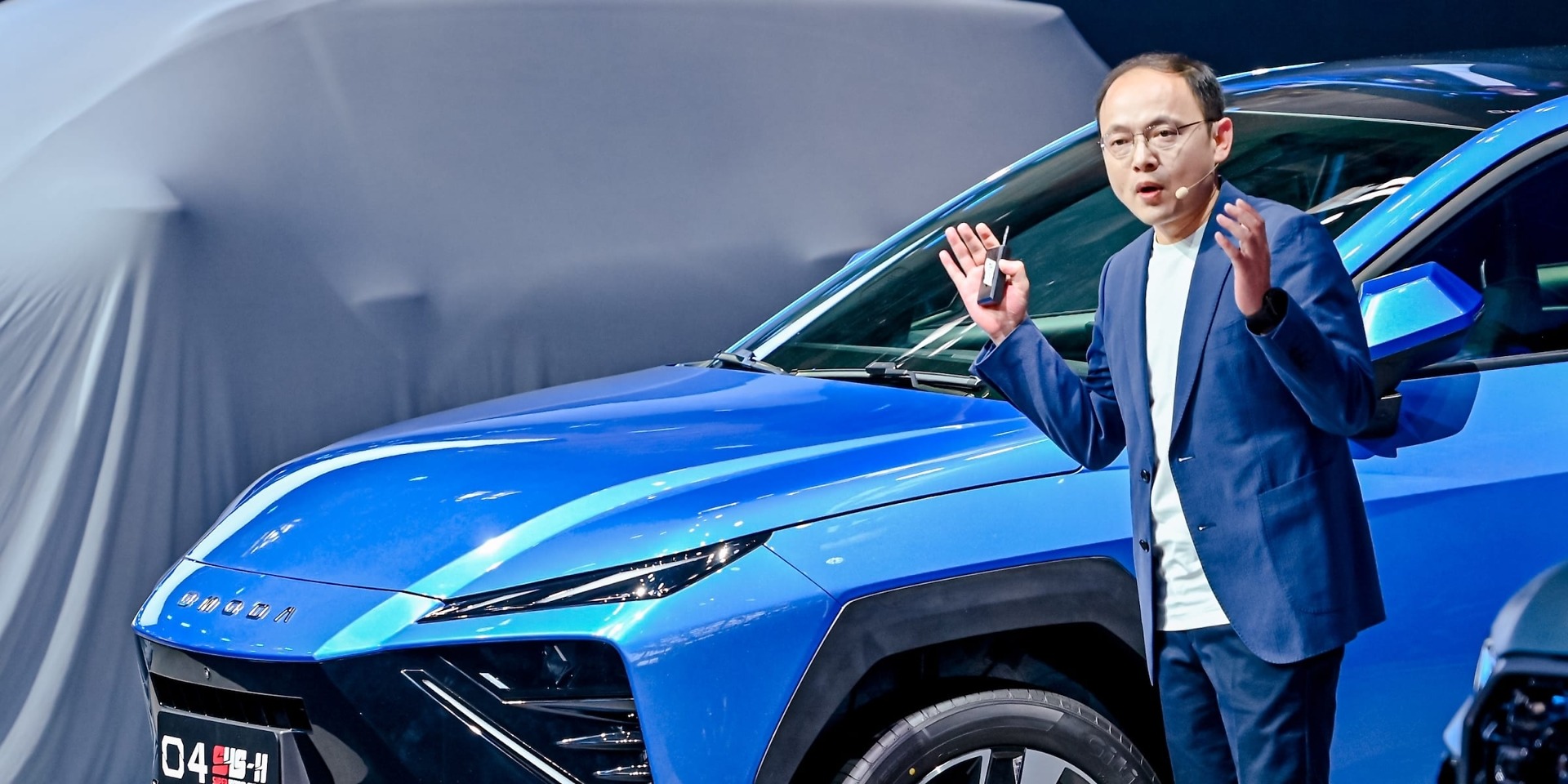







Chinese car brands are no longer something happening in the background of the UK new car market. They are becoming part of the mainstream very quickly, and a recent visit to the Beijing motor show made clear just how fast things are moving.
For plenty of UK buyers, Chinese cars are still viewed with a degree of suspicion – and that’s understandable. For years, the perception was that Chinese cars were cheap, poorly built copies of European models, often with unfamiliar badges and uncertain long-term prospects. Some of that reputation was earned, but it is also becoming increasingly out of date.
The biggest impression from Beijing was not simply that the Chinese car industry is huge, although it definitely is. It was how quickly the products are maturing. Compared with last year’s Shanghai motor show, the latest Chinese models looked calmer, more polished and more confident. There was less wacky styling, less obvious copying and a clearer sense that some brands are beginning to understand what they want to be.
Chinese cars are not suddenly perfect – far from it. But for UK buyers, the more useful question is whether they are now good enough in the areas that most people actually care about.
The old assumptions are starting to fail
The UK car market has already changed dramatically over the last two years. While MG has been selling Chinese-built cars here for years, the bigger recent shift has come from new names like BYD, Omoda and Jaecoo.
These brands have not taken decades to build momentum. They have arrived quickly, opened large dealer networks, offered strong value and started taking sales from established European brands.
This staggering pace has challenged one of the long-held assumptions about new car brands: that buyers take a long time to trust them. In the past, that was often true. Korean brands like Hyundai and Kia took decades to reach the position they hold today. Even Tesla, with its huge fan base, took years to achieve mainstream acceptance. Chinese brands are moving much faster, and it’s known within the car industry as ‘China speed’.
Part of that comes from scale. China is now comfortably the largest car-producing country in the world, building more than one in every three motor vehicles sold globally. Its manufacturers have enormous domestic competition, large production volumes and the ability to develop new products at a speed that many European companies are simply unable to match.
But scale alone does not guarantee success. What matters for UK buyers is whether that speed is turning into better cars. Increasingly, the answer appears to be yes.
Better design, fewer gimmicks
One of the clearest changes in Beijing was design maturity. Last year in Shanghai, there were still plenty of cars that looked like obvious copies of better-known Western models. Tesla was the most common influence, with several Chinese brands showing cars that looked like Model 3 and Model Y knock-offs. There was also quite a lot of overdone detailing: unusual lighting signatures, busy surfaces and styling features that seemed to shout for attention rather than create a coherent car.
This year, the overall impression was different. There were still influences from European brands, and some were more obvious than others. But across several Chinese groups, including Chery and Changan, there was a noticeable move towards cleaner surfaces, calmer proportions and a more consistent sense of identity.
Design has been one of the barriers for UK buyers. People may be prepared to try an unfamiliar badge if the car looks mature and well-judged. They are less likely to do so if it looks like a novelty product or an obvious imitation.
The latest models suggest that Chinese brands are becoming more confident. They do not all have strong identities yet, and some of the brand and model names still feel unfamiliar or sound awkward to Western ears, but the products are starting to look less like experiments and more like serious mainstream alternatives.
Value is still the big advantage
For most buyers, the strongest argument for Chinese cars is not design, but value. Brands like BYD, Omoda, Jaecoo and MG have made an obvious impact by offering high equipment levels, long warranties and electrified powertrains at prices that make many established rivals look expensive.
That doesn’t necessarily mean they are cheap in absolute terms. New cars are expensive across the board. But Chinese brands often include features as standard that many European brands still reserve for higher trim levels or expensive option packs.
Ventilated seats, panoramic roofs, large screens, wireless phone charging and long warranties all help create a strong showroom impression. For many buyers, that will be more persuasive than a badge with decades of history behind it.
Auto Express’s Jordan Katsianis recently wrote a thoughtful piece arguing that many Chinese cars still lack originality and authenticity, and that they will need both to become truly desirable. He makes a fair argument, particularly for people who care deeply about cars, brand character and driving feel.
But that’s not how most ordinary people choose their cars. For a lot of buyers, the questions are more practical. How much is it? What does it cost per month? What equipment do I get? How long is the warranty? Is there a dealer nearby? Will it be comfortable on the school run, commute or family holiday?
Within the European car industry, it’s a similar playbook to how Skoda rose from being a communist-era joke to one of the most admired car brands in the UK. Customers are less bothered with the nuances of steering wheel feedback, and are more interested in whether that steering wheel is heated.
Chinese cars don’t need to win over every enthusiast to become a major force in the UK. They need to win over ordinary buyers, and those customers tend to judge cars very differently.
Jaecoo’s success has not gone unnoticed
Jaecoo grabbed a lot of headlines here in the UK last month when it was revealed that the Jaecoo 7 had been the UK’s most popular new car in March, with a massive number of new registrations. At the Beijing show and throughout my week in China, the Chery Group presentations repeatedly referenced this result with pride.
At the show, I spoke to a UK-based PR manager for another Chinese brand already operating in Britain. He said Jaecoo’s huge March result had also drawn the attention of executives at several other Chinese manufacturers. It’s not hard to imagine how conversations are now playing out in those boardrooms – if Jaecoo can come from nowhere and top the UK sales charts within a year, why can’t our UK operations do the same?
Chery Group and BYD have already shown how quickly Chinese brands can build momentum here. Others have been more cautious so far, including Changan, Geely, GWM, Leapmotor, Skywell and Xpeng, but Jaecoo’s success may encourage them to push harder with dealers, marketing, pricing and product.
For UK buyers, that should mean more choice and potentially better value. For established European, Japanese and Korean brands, it means the pressure is likely to keep building.
Driving appeal is still a weak point
None of this means the enthusiast criticisms are wrong. Many Chinese cars still lag behind the best European models for driving dynamics. Steering feel, ride-and-handling balance and overall driving polish are often not as convincing as they should be. Some cars feel competent but uninvolving, while others still struggle to combine comfort and control in the way the best-in-class models manage.
For keen drivers, that remains a real issue. But for many buyers, it matters less than the motoring media often assumes. Most people are not looking for precise handling on the school run. They want a car that is quiet, comfortable, easy to drive, well-equipped and affordable to run.
This is not unique to Chinese cars. Years ago, when I worked in car sales, UK car magazines regularly criticised the harsh ride quality of Audi S line and BMW M Sport models, which rolled on big alloy wheels with lowered suspension. And they were right – those cars rode terribly. But customers bought them by the boatload anyway, because they liked the way they looked and were not judging them by the same criteria as road testers.
The same principle applies here. Chinese brands still have work to do if they want to win over enthusiasts, but they don’t need to do that to succeed with the wider market.
Touchscreens are a bigger problem
The obsession with touchscreens is a different issue, however, because it affects everyone. Most Chinese cars place far too many everyday controls inside huge central screens. Heating, ventilation, seat controls, drive modes and even basic functions can require too much tapping and swiping.
This appears to reflect a genuine cultural difference. At a presentation of yet another new Chery brand, Lepas, I asked the brand’s head of design, Ivan Dulanovic, about whether we will continue to see more reliance on touchscreens. His response – depressingly – was that “customers want touchscreens”.
That may well be true in China, where buyers appear more comfortable with screen-led interiors and smartphone-like controls, but it does not automatically follow that buyers in the rest of the world want the same thing. A huge screen might look impressive in a showroom, but it can become irritating very quickly when you are trying to adjust the cabin temperature or demist the windscreen on a wet winter’s morning in the UK.
European brands are not blameless here either, but Chinese brands seem particularly committed to the idea that almost every function belongs on a screen. If Chinese manufacturers are serious about adapting cars for the UK and Europe, this is one area where they may need to listen more carefully to local buyers.
EVs and plug-in hybrids are central to the strategy
Another major difference between Chinese and traditional European manufacturers is how naturally electrified cars fit into the product strategy.
At Beijing, pure petrol and diesel cars barely featured. Almost everything new was either fully electric or a plug-in hybrid of some form. While EVs remain a major focus, plug-in hybrids seem to have become the alternative for those customers not willing to go all-in on electric power.
And it’s the Chinese brands that are driving a major resurgence for plug-in hybrid models in the UK. Five years ago, sales of plug-in hybrids were disappearing as buyers either stuck with fossil-fuel power or jumped straight to EVs. The plug-in hybrid was seen as the worst of both worlds – a battery that was too small to do day-to-day driving, and a petrol engine that spent most of its time lugging around a dead battery.
Latest-generation plug-in hybrids have moved on in leaps and bounds, and are now doing what buyers always wanted them to do – allowing you to spend your weekday driving around town on electric power, but with the reassurance of a petrol engine for longer trips.
The Chinese brands are pragmatic about electrification. If a market wants EVs, Chinese brands offer some of the world’s best battery technology. If buyers want plug-in hybrids, they’re raising the bar for that technology as well. And if regulations change around EV mandates, they’re likely to adapt faster than European manufacturers.
What should UK buyers watch for?
The main point is not that UK buyers should rush out and buy a Chinese car. It is that they should no longer dismiss one because of the badge.
The products are improving quickly, the value proposition is strong and the dealer networks are growing. Long warranties also help reduce some of the perceived risk, particularly for buyers who usually change cars every three or four years anyway.
There are still sensible questions to ask. Insurance costs can vary significantly, especially for unfamiliar brands. Parts supply and repair times are still worth checking, especially for brands that are growing their sales faster than their service departments can keep up.
Residual values are not yet as predictable as they are for established brands. Dealer coverage is improving, but it is not equally strong everywhere. Buyers should also spend proper time testing the infotainment system, because living with a touchscreen-heavy car can be very different from being impressed by it in a showroom.
Driving dynamics are worth assessing honestly as well. If you enjoy driving and care about steering feel, ride quality and handling balance, some Chinese cars may still disappoint. If you mostly want comfort, equipment, warranty cover and low running costs, they may make far more sense.
The buyer verdict
Chinese cars are not simply better-value versions of European cars. They’re different products, shaped by different cultural attitudes, developed in a very different market and targeting different customer expectations. That has led to a different range of strengths and weaknesses to what we expect from European cars.
The strengths are what you’d expect from new challengers in an established marketplace: better value, lots of technology, comprehensive warranty cover and rapid improvement. The weaknesses are still there: patchy brand identity, limited driving appeal in some models, touchscreen-heavy interiors and unanswered questions around long-term ownership.
But the direction of travel is clear. Chinese cars are becoming more credible, more polished and more relevant to UK buyers very quickly. And with the pace of development, the weaknesses are being polished out while the strengths are becoming ever more compelling.
Many people mistakenly assumed Chinese brands would remain cheap outsiders trying to catch up for years to come. After visiting Beijing, that assumption feels even more outdated than it was a year ago. The better question now is not whether UK buyers should take Chinese cars seriously, but whether the rest of the market can respond before being squeezed out of business.