Find an Expert Rating: 
Home Blog Page 148

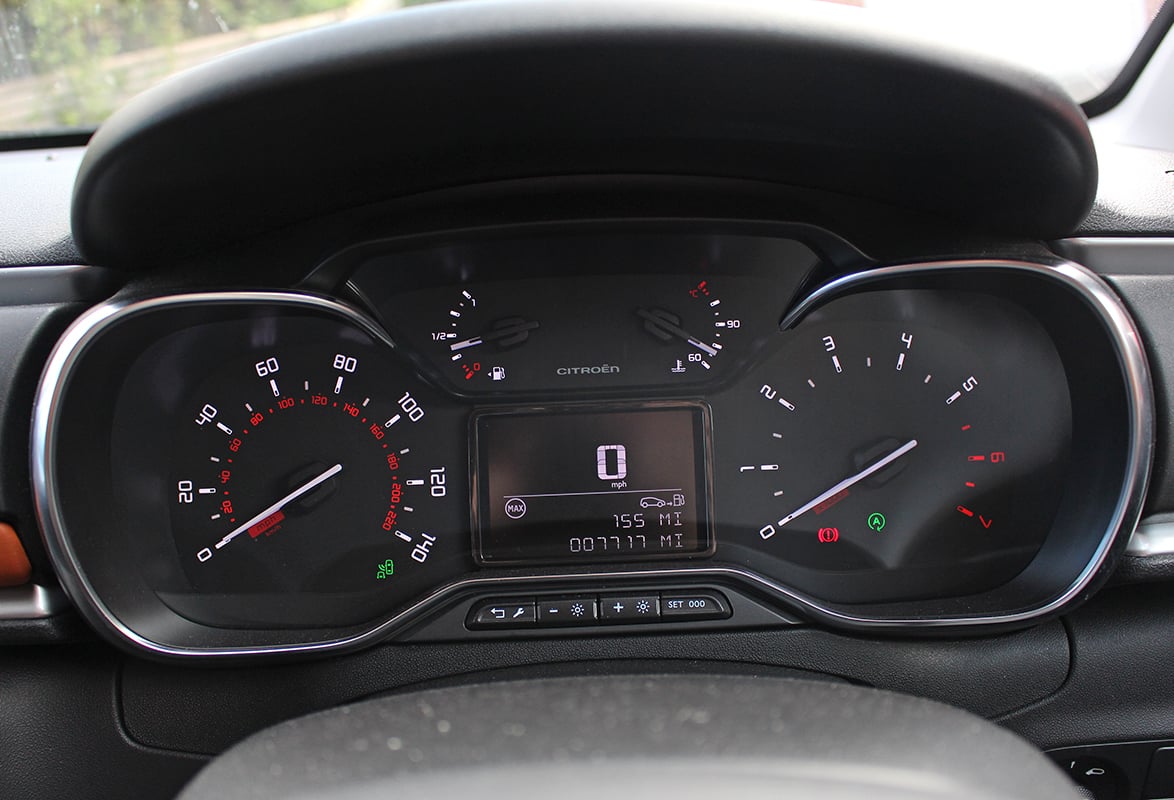
Citroën C3 review – road trip

The latest Citroën C3 is very different from its predecessor but how user-friendly is it as a daily driver? The traditional May break for the writer and his good lady, and a planned week on England’s Jurassic coast in Dorset, provided the perfect opportunity to find out what this car is all about.

We last drove the C3, the third generation of the model, at the UK launch event in 2016 and were impressed by its combination of style, performance and practicality. And on delivery of the top-grade C3 Flair PT 110 model to Charman Towers in mid Wales, the visual presence of the car is immediately obvious.

Bold look, outside and in

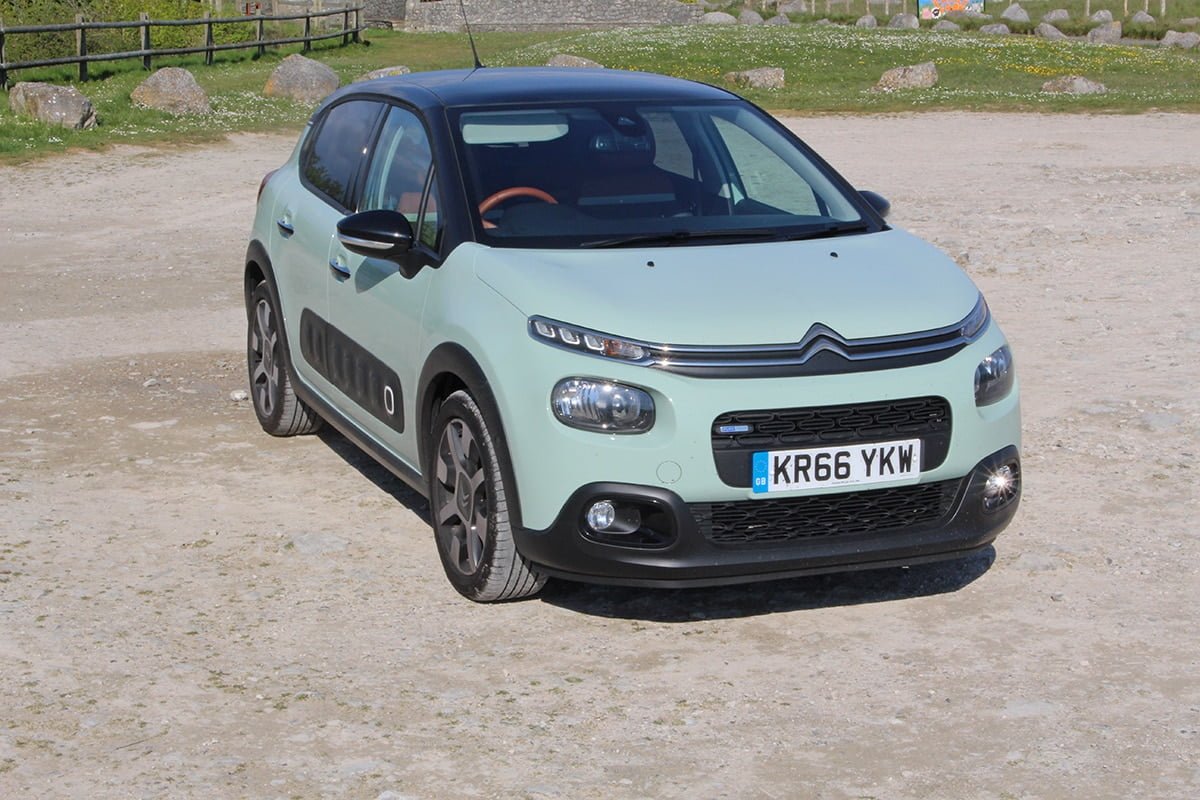
Leaving aside the duck-egg blue paint finish, a colour this writer has not experienced since painting it onto the bottom of Airfix model Spitfires as a child, the C3 certainly makes a statement with its two-tier front lights, the bold chrome stripes of the bonnet, and those air bumps on the side.

The more I get used to these plastic mouldings the more I’m coming to like them. One can order an entry-level C3 without the ‘bumps’ but I think that would make the doors seem unnecessarily bulbous, and they do offer some protection against car park dings.

Inside is a similar story. The latest Citroën interior treatment debuted with the C4 but is no less impressive in the C3. It feels like there is a lot of room inside, emphasised by the full-width dashboard, and it feels very upmarket with lots of neat touches – none more so than the ‘suitcase strap’ interior door handles.

Some of the plastic finishes are a little hard to the touch but not irritatingly so, while the dash layout is impressive – angled neatly towards the driver and with not too many buttons to confuse.
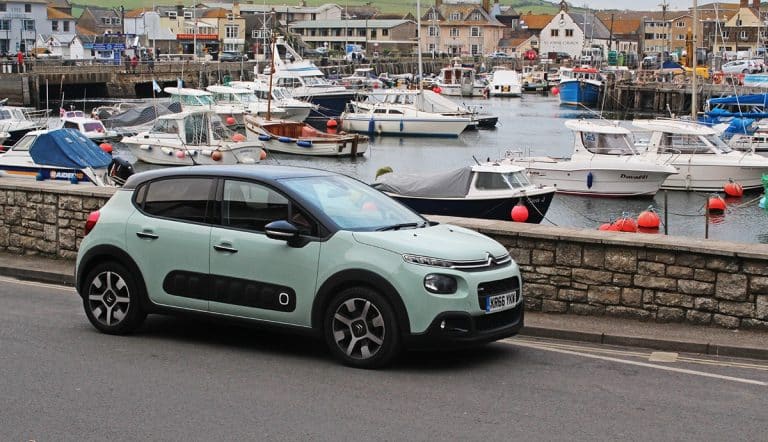
Briefly I’m concerned that rear seats will need to be used to accommodate luggage as the 300-litre boot only just accommodates the suitcases for a week away, and I speculate that with any of our offspring tagging along space could have been an issue. But then I realise that I am misinterpreting this car. Its boot is bigger than rivals the Ford Fiesta and Peugeot 208, because this is a supermini – it just doesn’t feel like one…

Citroën C3 boot
Just enough room in the boot, but it is generous for a supermini.

Getting to Dorset in good time to find our holiday cottage requires miles of motorway munching, and the C3 feels very assured. Admittedly we do have the current power range topper in a turbocharged version of the three-cylinder 1.2-litre petrol engine of 110hp, but the whole car offers refined progress at motorway speed limits – not the prime environment for a supermini. At least it does in terms of roadholding, bump smothering. Less impressive is the mildly intrusive engine note at speed limits – a six-speed gearbox would probably help matters.
Citroën C3 on road, rear

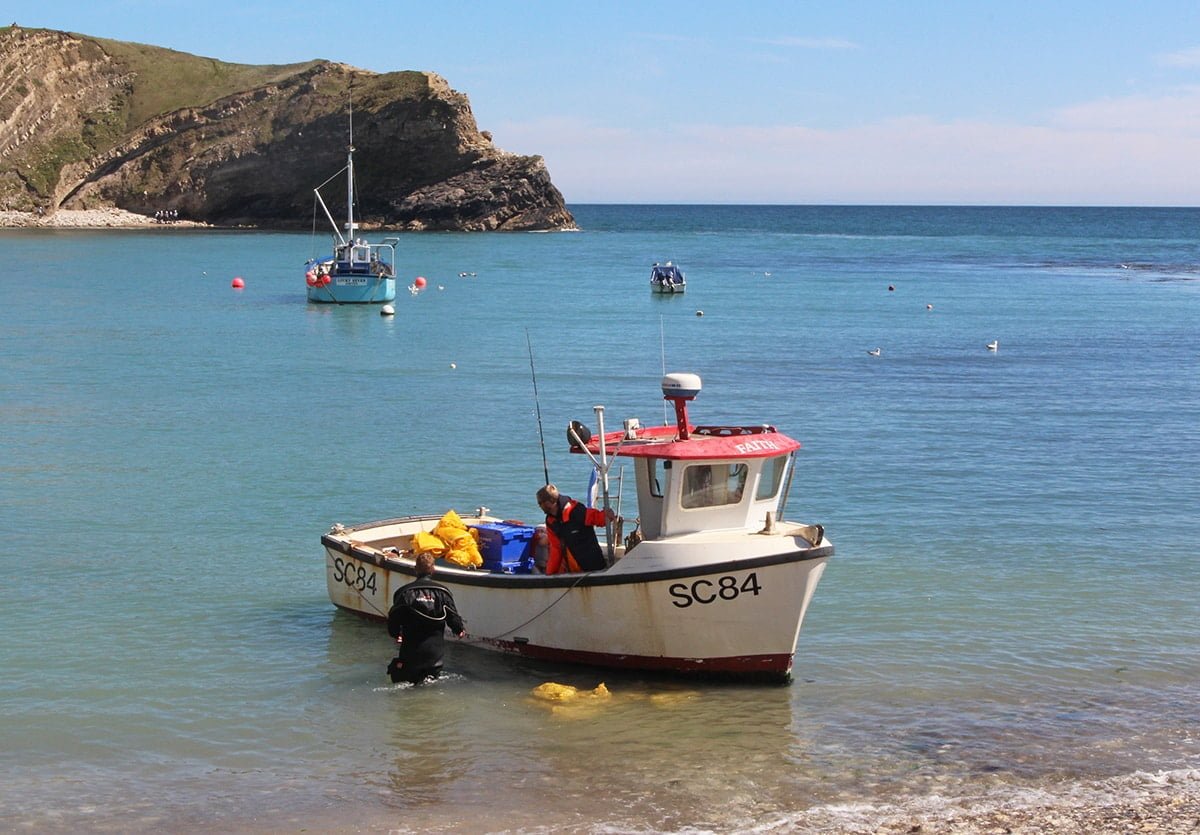
The Jurassic Coast stretches around 96 miles from Exmouth in East Devon to Studland Bay in Dorset, and gets its name from its rock – constant coastal erosion has exposed 185 million years’ worth of geology. It’s been a World Heritage Site since 2001, but the writer has not been here since the 1970s – and it is the most memorable piece of geology from those childhood holidays that we make for first.

Durdle Door is an enormous, rock arch jutting out to sea, the vertical strata highly visible as one looks down on it from the top of the cliff. To get to that point requires traversing rather more challenging roads than the motorway. These are twisty, with more indifferent surfaces, and sometimes not much wider than the car.
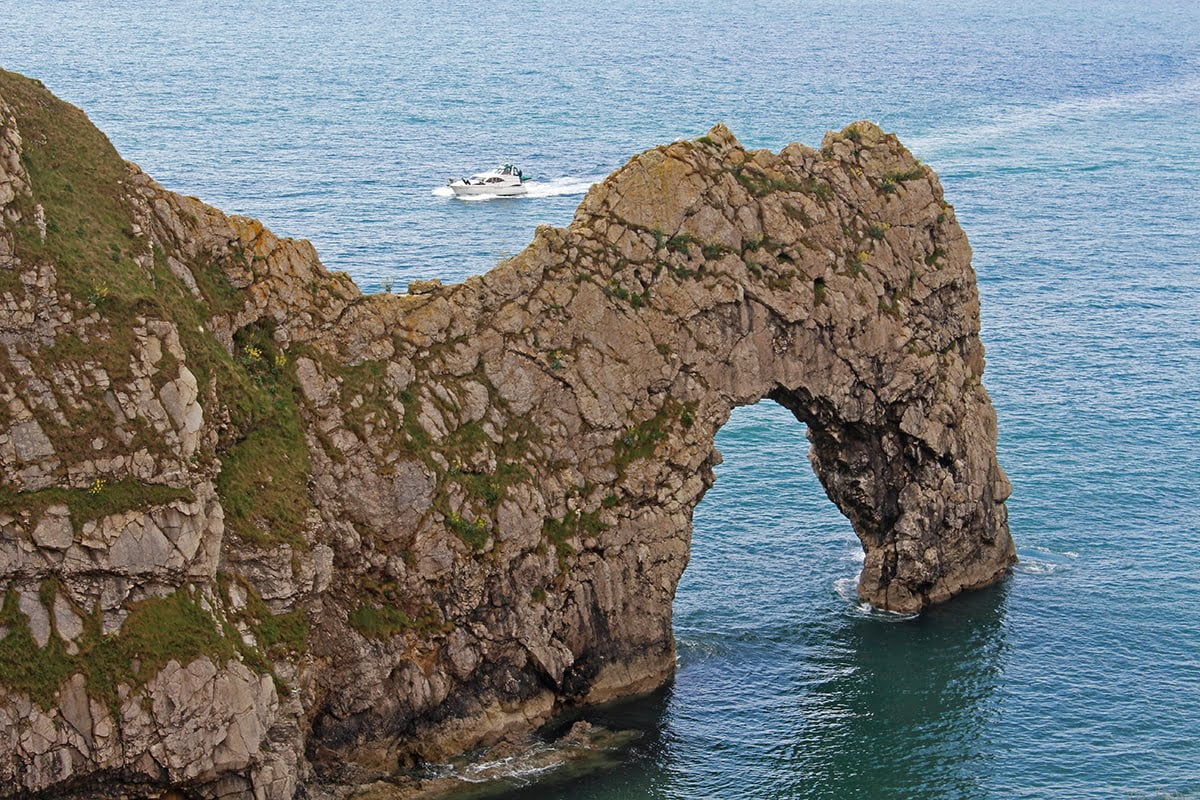
On such narrow routes discretion is, of course, called for, every inch of the C3’s generous visibility out front made use of. Reversing into parking spaces exposes somewhat less impressive rear vision, but the parking camera and sensors of the grade ease this issue.

When the roads widen out one can fully investigate the car’s handling prowess, which is, well okay. It is rather softly suspended, with quite a bit of body lean under enthusiastic cornering, and steering that is not quite as sharp as rivals. And while the engine is quite torquey, when one just need to exercise the gears the shift is rather woolly in operation.
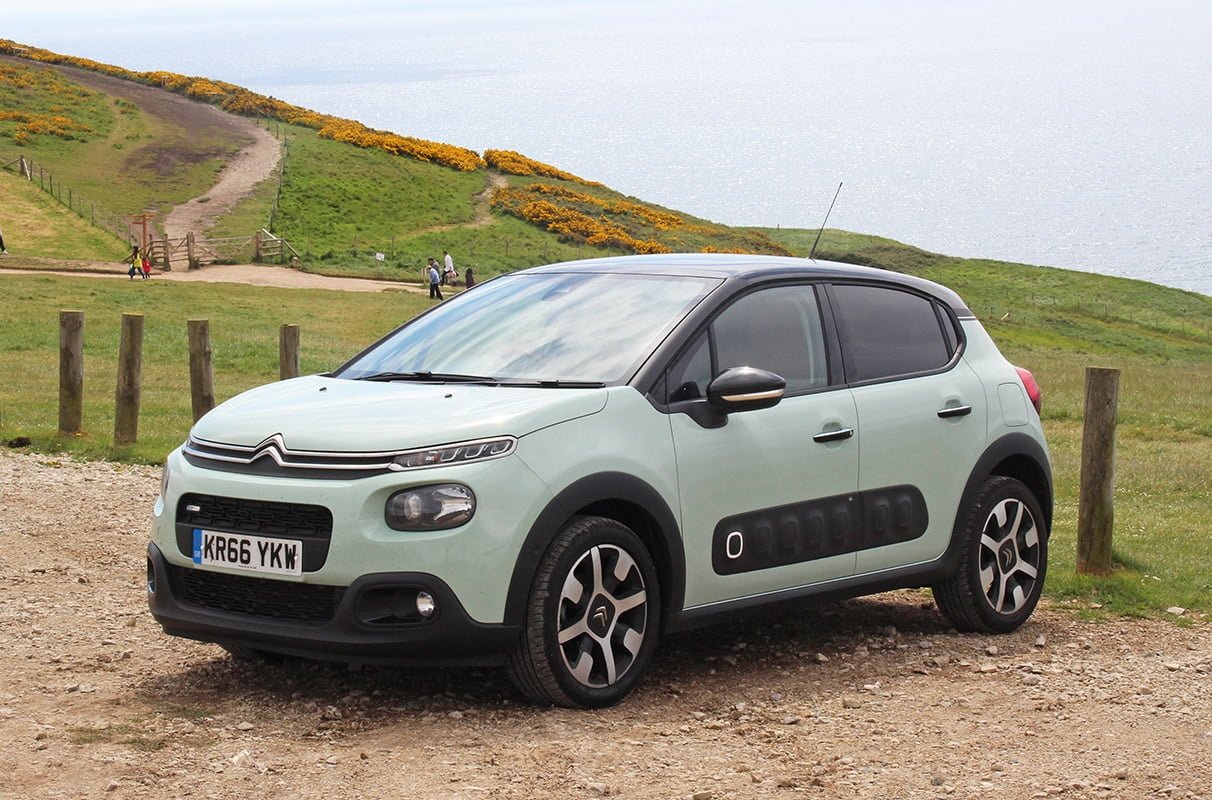
Citroën C3 Durdle Door
Parked at Durdle Door – the twisty roads to this coastal location show up some handling deficiencies.

Overall, however, the car remains refined, and this shows itself the following day. Heading out to the Isle of Portland we drive through the centre of the Port of Weymouth, and straight into a traffic jam caused by a police incident on the quayside. The C3 simmers quietly in the queue, effective air conditioning keeping things cool within.

Portland was once a naval base, and remains a centre of the limestone industry – St Paul’s Cathedral, Buckingham Palace and the Cenotaph are all built with Portland Stone. Much more recently the seas were the scene of great British success as the home of the maritime events in the 2012 Olympics.

Having easily crested the steep hills up to the top of the island one gains a superb view of the coast stretching away. Prominent is the remarkable Chesil Beach, seemingly cutting off a section of sea in a highly visual representation of a geological trait known as longshore drift.

Perhaps the most fascinating bit of geology, however, is found at a small coastal town that has recently found new fame. West Bay is now better known to TV viewers as Broadchurch, home of the ITV crime drama, and settling down with a cup of tea at a seafront kiosk one can constantly hear other tourists passing by with comments such as “There’s the police station,” and “Isn’t that mobile home where David Tennant lived?”

Citroën C3 Portland
Portland Bill – watchtower of the Jurassic Coast

From the quayside bench where Tennant’s DI Hardy and Olivia Colman’s DS Miller shared many of their scenes, one can see very clearly the looming and so distinctive sandstone cliffs above the beach. Sandstone is soft, rock falls are common, and it is distinctly unnerving a few weeks after our break to see pictures of a new and massive fall from the cliffs, completely obliterating the stretch where we had walked under those very same cliffs…

Getting to West Bay, and indeed all our chosen locations during our Jurassic week, reveals the one major frustration with the C3. The car has the most idiosyncratic satellite navigation system this writer has ever experienced. Its routing suggests that it has a ‘on holiday’ mode, the seven-inch touchscreen constantly suggesting one dives off main, and direct, routes onto slow, longer side roads – it makes no sense at all…

Citroën C3 sat nav
The C3’s satellite navigation is not its best aspect…

Overall, however, the C3 proves a highly agreeable companion for our Dorset tour, a relaxing car to drive and thus one less thing to worry about on our holiday. In fact, we end up so relaxed that we forget to use some of this top-level Flair model’s extras, such as the built-in dash cam on which one can both record video, or take photos and send to friends via a smartphone app.

Superminis are of course generally regarded as around town cars, their traditional environment being on the daily commute. These days especially, however, all cars have to offer extra versatility. In many ways, the Citroën C3 breaks the mould in supermini design, and on the evidence of our week in a geological history lesson, the car would suit many buyers as a good all-rounder.

Citroën C3 – key specifications

Model tested: Citroën C3 Flair 110 hp
Price: £16,425 (range starts £11,135)
Insurance group:
16E (range starts 8E)
Engine: Petrol three-cylinder 1.2-litre turbo.
Power (hp):
110 @ 5500rpm
Torque (Nm):
205 @1500rpm.
0-62mph (sec):
9.3.
Top speed (mph): 117.
Fuel economy (combined, mpg): 61.4.
CO2 emissions (g/km):
103.
Key 
rivals: Ford Fiesta, Vauxhall Corsa, Peugeot 208.
Test Date: May 2017

Citroën C3

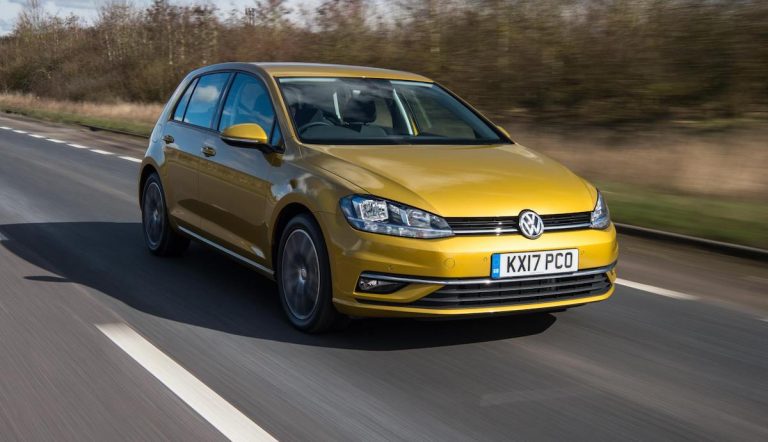
Volkswagen looks to keep Golf on top with new offer

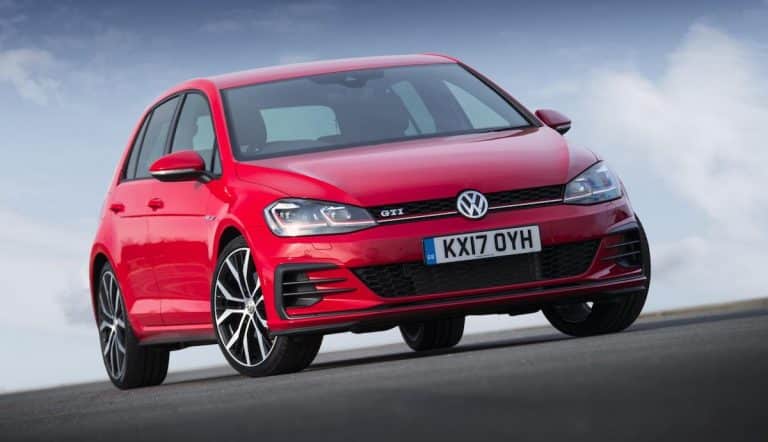
Volkswagen is hoping to keep the Golf at the top of the UK sales charts for another month or two with a new PCP finance offer from Volkswagen Finance.

The company is offering a £1,500 deposit contribution on any new Golf (excluding e-Golf and Golf SV models) sold with a personal contract purchase (PCP) from Volkswagen Finance. In addition, the first two scheduled services are included at no cost. The APR is 4.9% representative (see below), which is not bad – but not exactly amazing – in the current car finance market.

The featured example of the Volkswagen website is for a specific model, priced at £199/month for four years with a customer deposit of over £4,500. However, you can choose a deposit and term to suit your needs and don’t need to follow what the salesman wants.

Orders must be placed by 24 July and the cars delivered no later than 30 September. Bear in mind that number plates change in September, from the current “17” plates to the new “67” plates. The dealer will probably want you to take delivery of your car before then (August is a notoriously poor month for new car sales), but you are not obliged to do so if you’d rather wait a few weeks for the new number plates. The newer plates may also help your resale value if you’re not planning to keep the car for more than three years.

The Volkswagen Golf has just been updated, with improved safety technology like autonomous emergency braking across the range. A colour touchscreen infotainment system is also standard on all models, along with other upgrades and improvements. Be aware that there may still be some stock of the pre-facelift model about, so a dealer may be trying to sign you up for the old model rather than the new one. If that’s the case, you should be negotiating for a much better deal than the official offer.

The offer applies to nearly all models in the Golf range, including the GTI, GTD, GTE and R models. Only the e-Golf electric model and Golf SV are not invited to the party.

Volkswagen Golf GTE facelift 2017 (The Car Expert)

The Car Expert says… always check the fine print

The dealer will probably refer to the finance deal as a “Solutions” plan. That’s Volkswagen’s name for a personal contract purchase.

The deal is advertised with an APR of 4.9% representative. That means that the actual APR you are offered may not be 4.9%, depending on how much deposit you’re putting in, how much you’re borrowing and for how long. But it should be pretty close to that figure.

Excess mileage fees, if you underestimate your annual driving requirements, are likely to be about 10p/mile. That’s £100 for every 1,000 miles you go over your limit. The advertised examples are based on 10,000 miles per year, which is good – many brands are now using 6,000 miles per year to make the monthly payments lower, but that’s less than most drivers will cover in a year.

The finance deal only applies to new cars, which does not include dealer demonstrators or pre-registered cars. The finance offer is provided through Volkswagen dealers by Volkswagen Financial Services. If a dealer offers you a finance deal that does not match these details or from another lender, it is not part of this offer.

The free servicing offer covers the parts and labour on the first two scheduled services (as set out in the owner’s manual). Any work required over and above that will be at your own expense.

As with any car purchase, work out your budget before you visit the showroom and don’t be persuaded to go over it – regardless of what the smiling sales executive suggests. They don’t have your best interests at heart, but The Car Expert does!

Volkswagen Golf, best-selling car in the UK June 2017
The Volkswagen Golf knocked the Ford Fiesta off the top of the sales charts in June

‘Mass market’ Tesla Model 3 goes into production

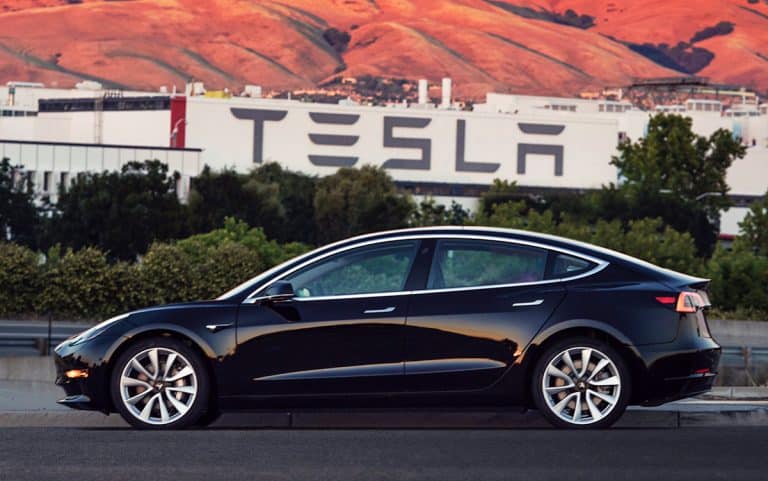
The Tesla Model 3 has gone into production as the electric car manufacturer gears up for the launch of its planned mass-seller.

Tesla CEO Elon Musk posted pictures on Twitter of the first production Model 3, which is apparently going to be his own.

The Model 3 is a four-door saloon – effectively a downsized version of the already on-sale Model S, to a size that can challenge the likes of the BMW 3 Series, Audi A4 and Mercedes-Benz C-Class.

Auto technology

It promises seating for five, a 0-60mph time of under six seconds and a range between charges of 215 miles. The car also comes ready fitted with the technology required for future autonomous driving.

In America the Model 3 has a starting price of around $35,000, equivalent to £28,000 – UK prices are yet to be announced but will no doubt make the car a viable rival to conventional executive saloons.

More details of the Model 3 are expected to be revealed on 28th July when the first 30 examples are presented to their owners at a ‘handover party’. First serious deliveries are expected to begin in September but many customers could be waiting a while. Tesla reports orders for the Model 3 of around 500,000, and industry reports suggest that its plant will be producing 20,000 examples per month by December.

Tesla Model 3, due in 2018

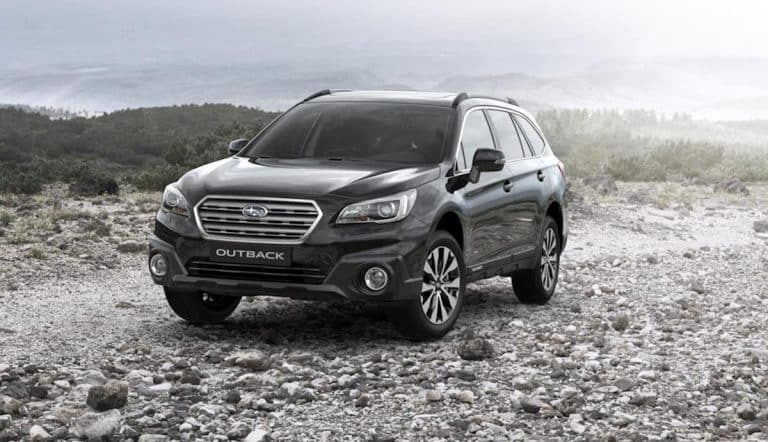
Special edition Black & Ivory Subaru Outback

Subaru has announced a limited run of 50 Black & Ivory Outbacks. The Outback crossover combines the space of an estate model with the off-road capabilities of an SUV.

The special edition Outback gets a Crystal Black Silica paint-finish, LED headlamps, 18-inch alloy wheels and a power tailgate to complete the exterior styling.

The ivory of the black and ivory colour scheme comes in the form of the leather upholstery used inside. Subaru’s Starlink infotainment system and navigation is as standard.

A recipient of a five-star Euro NCAP rating in 2014, the Outback was the first Subaru model to be equipped with the brand’s EyeSight advanced collision avoidance system.

Technology-wise, there’s Active Torque Vectoring, Vehicle Dynamics Control, rear view camera and Hill Descent Control. The petrol model has a start-stop system and Subaru Intelligent Drive, enabling drivers to select different engine modes according to the road conditions.

Available from 1st September, the Black & Ivory Outback is priced from £33,545 for the petrol and £35,545 for the diesel model.

Interior of Black & Ivory Subaru Outback
Ivory leather upholstery is paired with black trim giving the special edition its name

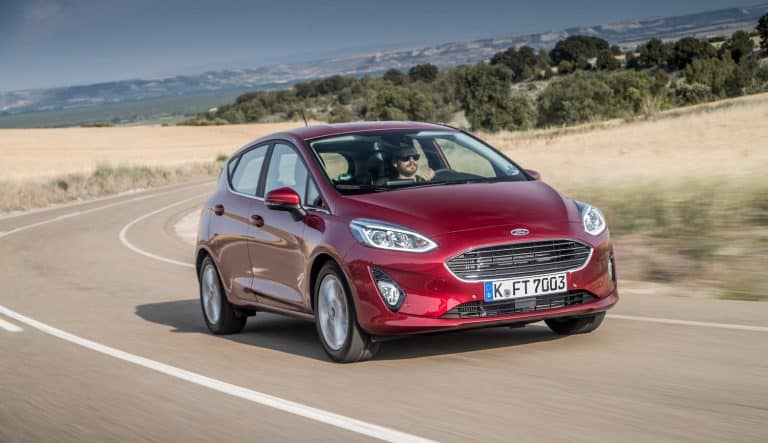
Ford Fiesta Titanium review

What is it: The latest generation of Britain’s best-selling car, the Ford Fiesta.
Key features: Improved quality and connectivity, excellent driving characteristics
Our view: The Ford Fiesta is the best-selling car in the UK for good reason, and the new model is a welcome improvement in most areas.
Review type: First drive


The Ford Fiesta has been the top-selling car in the United Kingdom for the last eight years, and for good reason. But the new car market is a constantly-changing environment, and even the best in the business need to keep improving.

The new Fiesta is considered an “all-new” model, which means that although there are many carry-over mechanical bits underneath, the car has been redesigned from scratch.

Not that you’d really notice at first glance. Unlike the first six generations of Ford Fiesta models, the exterior styling is a subtle evolution of the previous model. Inside, however, it’s a big jump forward. And that’s most welcome, because the dash layout and interior trim were two of the last Fiesta’s weaknesses.

We drove the new model on its launch in Spain, in both petrol and diesel forms. A more comprehensive review of the UK-spec car on UK roads is coming soon. So how does the Fiesta shape up against perennial rivals like the Vauxhall Corsa, Volkswagen Polo, SEAT Ibiza, Toyota Yaris, Honda Jazz and others?

Next page: Design

Ford Fiesta ST-Line, Vignale and Titanium models

Market electrifies Toyota hybrid sales

Toyota has revealed a 30% surge in sales of its hybrid cars, as the push towards electric vehicles gains momentum.

The jump in petrol-electric vehicle sales, which the Japanese manufacturer says is “unprecedented” comes just days after Swedish brand Volvo announced that all of its cars launched from 2019 will include an electric motor in some form.

Toyota sold 22,616 hybrid vehicles in the UK between January and June 2017, with the biggest increase being to fleets – 40.2% up on the same period in 2016. Of every 10 Toyota buyers in the UK four are choosing hybrid models, the largest percentage in the industry. In Europe the rise is even more marked, Toyota and Lexus hybrid sales up 44% – one in every two of the brand’s cars sold in Europe is now a hybrid.

C-HR leads way

The new C-HR crossover is leading the surge, more than 80% of its sales across Europe being the hybrid variant, while the electric motor-equipped model of the latest RAV4 SUV is also selling well.

Some observers believe the increasing negative publicity surrounding diesel engines is fuelling the shift to hybrid – UK diesel registrations are down almost 10% year to date and slipped almost 15% in June. However according to Toyota GB sales director Mark Roden, the growth is happening because the mystery surrounding hybrids has been replaced by customers recognising the benefits in fuel efficiency, environmental impact and refinement that the powertrains offer.

“Toyota has led the way for two decades in making hybrid technology available to everyone – we have proven technology, famous reliability and the most exciting range of hybrid cars we’ve ever offered. I’m delighted that more people than ever are enjoying the benefits of them,” Roden says.

Toyota Prius dash
More drivers than ever are seeing displays like this on their dash.

Hybrid Assist tech for Renault Scenic & Grand Scenic

Renault has introduced a new hybrid powertrain, the dCi 110 Hybrid Assist, to the latest versions of its Scenic and Grand Scenic models which launched last year.

This is Renault’s first foray into Hybrid Assist technology, with the brand claiming that the new powertrain improves the emissions, economy and performance of the dCi 110 engine.

Working in combination with the internal combustion engine, the Hybrid Assist’s 10kW electric motor is powered by a 48-volt 150Wh battery. According to Renault, this returns CO2 emissions of 94g/km and fuel economy of 81mpg.

20-inch alloy wheels and a nine-inch touchscreen are as standard. The usual three trim levels, Dynamique Nav, Dynamique Nav S and Signature Nav, are available.

The Scenic received a five-star Euro NCAP safety rating when tested in 2016 and has Emergency Brake Assist, ABS with Electronic Brake-force Distribution, Electronic Stability Control and Hill Start Assist as standard.

The Scenic range with dCi Hybrid Assist is available to order now from £25,055.

Hybrid Assist technology for Renault Scenic
The Renault Scenic received a five-star Euro NCAP safety rating when tested last year

Honda HR-V gets Black Edition treatment

The Honda HR-V is the latest of the brand’s models to get the Black Edition treatment. The compact crossover SUV was first launched in Europe in 2015.

The Black Edition comprises black running boards, skid plates, front grille, mirror caps and 18-inch alloy wheels. Inside, the special edition gets black leather and floor mats.

The HR-V Black Edition is due to hit forecourts in the next few weeks and costs from £25,000 for the 1.5-litre i-VTEC and from £26,820 for the Automatic CVT.

Extension for CR-V Black Edition

The HR-V joins the existing CR-V Black Edition which has had its limited production run extended to meet demand.

Available in 4WD, the CR-V Black Edition has black running boards, tailgate spoiler, front grille, skid plates and 19-inch alloy wheels. The full leather interior has contrasting stitching, an embossed Black Edition logo on the front and rear seats and carpet mats with a Black Edition logo.

On sale now, the CR-V 2.0-litre i-VTEC manual costs from £31,000 and the 1.6-litre i-DTEC automatic from £34,300.

Honda HR-V gets Black Edition
The Honda HR-V was first launch in 2015

SEAT Ibiza leads a field of five-star Euro NCAP ratings

It was good news for SEATAlfa Romeo, Hyundai, Vauxhall and Volkswagen in the latest Euro NCAP crash test results published today.

The SEAT Ibiza was singled out for praise by the UK’s Thatcham Research, with director of research Matthew Avery claiming that “SEAT has set a new benchmark in safety for the supermini price point category”.

The new Ibiza has autonomous emergency braking and pedestrian autonomous emergency braking both fitted as standard on all models.

Avery believes that with other supermini launches expected for later this year, “the safety game is now on for carmakers in this category”.

More top ratings

In addition to the SEAT Ibiza, the Alfa Romeo Stelvio, Volkswagen Arteon, Vauxhall Insignia and Hyundai i30 all received five-star safety ratings from Euro NCAP.

Despite having autonomous emergency braking as standard, the latest Honda Civic received a four-star Euro NCAP safety rating, missing out on a top rating due to a lower-than-expected child protection score.

Honda Civic wasn't awarded a five-star Euro NCAP safety rating
The Honda Civic received a four-star Euro NCAP safety rating

Second chance for Ford Mustang

After drawing heavy criticism early this year when it received a two-star rating – the worst for a top 10 car manufacturer in nearly a decade – Ford submitted its flagship Mustang sports car for retesting.

Thatcham Research believes that this “underlines the power of the Euro NCAP consumer testing programme”, with manufacturers hoping to appeal to safety-conscious buyers.

Ford hoped to improve its safety rating with the addition of standard fit pedestrian detection, forward collision warning, autonomous emergency braking and lane keeping aid. An issue with inadequate pressure in the driver’s airbag was also addressed.

This time the Ford Mustang was awarded a three-star safety rating, with Thatcham’s Matthew Avery advising that it is hardly a “cause for celebration”.

However, the Avery applauded what he described as Ford’s “rapid addition of a suite of standard-fit safety tech and its prompt updates”.

Ford Mustang wasn't awarded a five-star Euro NCAP safety rating
Despite the addition of more standard fit safety technology, the Ford Mustang received a three-star rating

More bad news for diesel in June sales results

Sales of new diesel cars have continued to fall, as highlighted by June’s official registration results released today by the Society of Motor Manufacturers and Traders (SMMT).

The overall market was down nearly 5% in June, a not-unexpected result in an election month and especially so given the uncertainty results from the election outcome. Private and business customers shied away from showrooms in greater numbers, with fleet sales also down slightly.

Good news for electric cars and hybrids

It was another month of good news for alternatively-fuelled vehicles (electric cars, hybrids, natural gas and others), with registrations up 29% on the same month last year. The AFV segment now solidly holds more than 4% of the overall market, and its growth is in stark contrast to the ongoing woe of diesel car sales.

June was another bad month for diesel registrations, down nearly 15% on last year. This follows year-on-year falls of 20% and 27% in the previous two months. Diesel’s market share fell even further than May’s low point, slipping to 42.5% of overall sales.

Ironically, given that Volkswagen’s Dieselgate crisis largely precipitated the rapid fall in diesel sales, it was a big month for the Volkswagen Golf, knocking the Ford Fiesta off the top spot for the first time in a long time (since December 2014, to be exact). However, the Fiesta is undergoing a model change and we expect to see it return to the top of the charts very soon as the new model arrives in showrooms.

It was a good month for Dacia, with 45% more registrations than the same month last year. Lotus, Aston Martin, Volkswagen and SEAT all recorded double-digit growth in June. Not so happy were Jeep (down 75%) and DS Automobiles (down 50%). Subaru, Maserati, Infiniti, Citroën, Renault, Mazda, Vauxhall, Fiat, Skoda, Lexus, Peugeot, Bentley and Ford all recorded double-digit falls compared to last year.

No end in sight for diesel dramas

At the halfway point of the year, diesel car sales are more than 67,000 units behind last year’s figures, with most of those falls coming in the last three months. Despite the industry’s protestations that modern Euro-6 diesel engines are cleaner than ever, customers are clearly unconvinced and are deserting diesel cars in their thousands.

There appears to be no end in sight for the slump in diesel sales, and manufacturers appear to be starting to prepare for a post-diesel future. Volvo has announced today that every new model it launches from 2019 will be partly or fully electric, and last month suggested that it was not planning any more development on diesel engine technology.

At the end of a tumultuous first six months of 2017, the overall British new car market is down by 1.3%. Fleet and business registrations are up on last year, but are cancelled out by a fall of nearly 5% in private registrations.

Manufacturers and dealers will be hoping for some stability from the new government and reasonable Brexit talks to keep customers in a buying mood for the second half of the year. Of course, that may be wishful thinking…

June 2017 best-selling cars

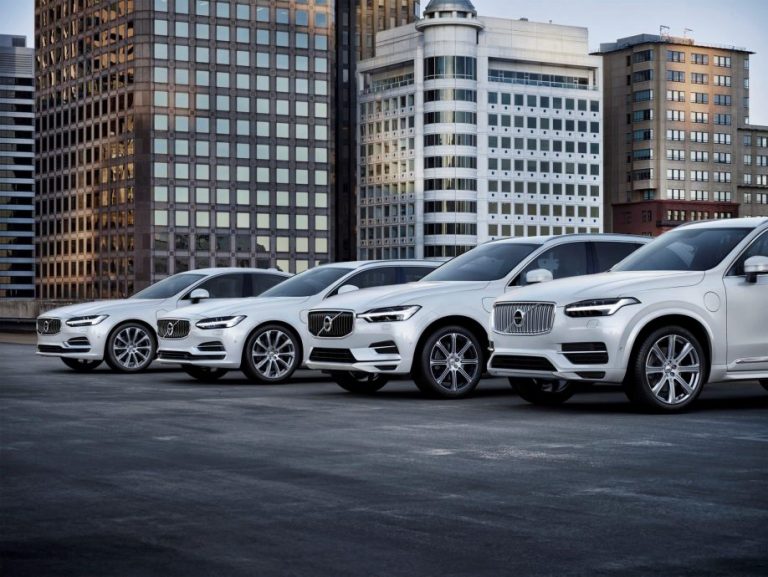
Volvo pledges to go fully electric

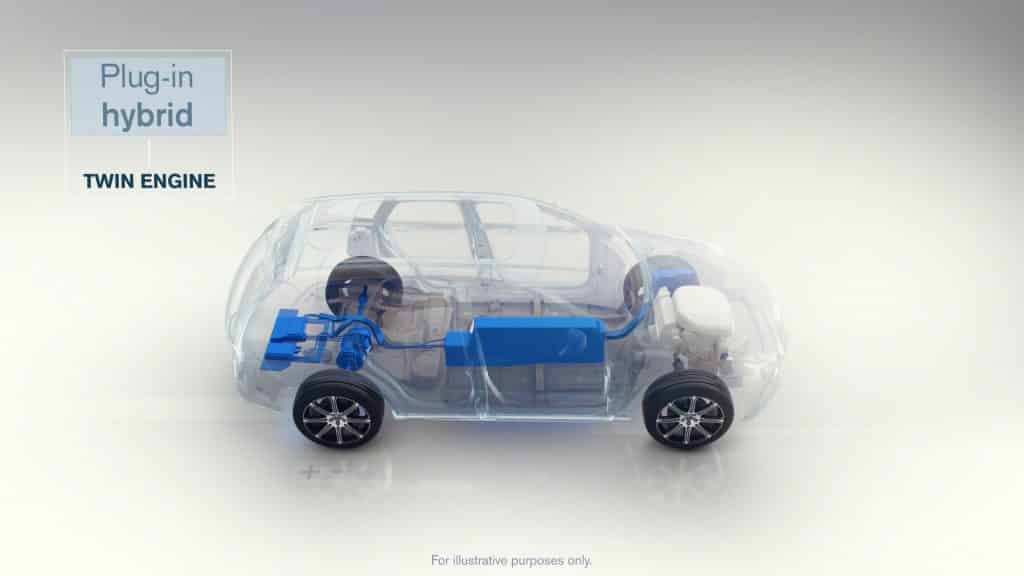
Volvo has announced that from 2019 every car it launches will have an electric motor. The move marks one of the most significant embraces of electrification by a car manufacturer to date.

Electrified vehicles will be introduced across the Volvo range, including fully electric, plug-in hybrids and mild-hybrid cars. Five fully electric cars will be launched between 2019 and 2021. Three of these will be Volvo models, whilst the other two will be from Polestar, Volvo’s performance car arm.

There will also be a range of petrol and diesel plug-in hybrid and mild-hybrid 48-volt options available for all models.

Håkan Samuelsson, president and chief executive of Volvo Cars, declared that “this announcement marks the end of the solely combustion engine-powered car.

“Volvo Cars has stated that it plans to have sold a total of one million electrified cars by 2025. When we said it we meant it. This is how we are going to do it.”

Volvo Cars also has a target of climate-neutral manufacturing operations by 2025. Full details of these electric vehicles will be released at a later date.

Volvo cars electric
Still from animation – Plug-in hybrid, Twin Engine

Plug-in hybrid completes Ioniq trio

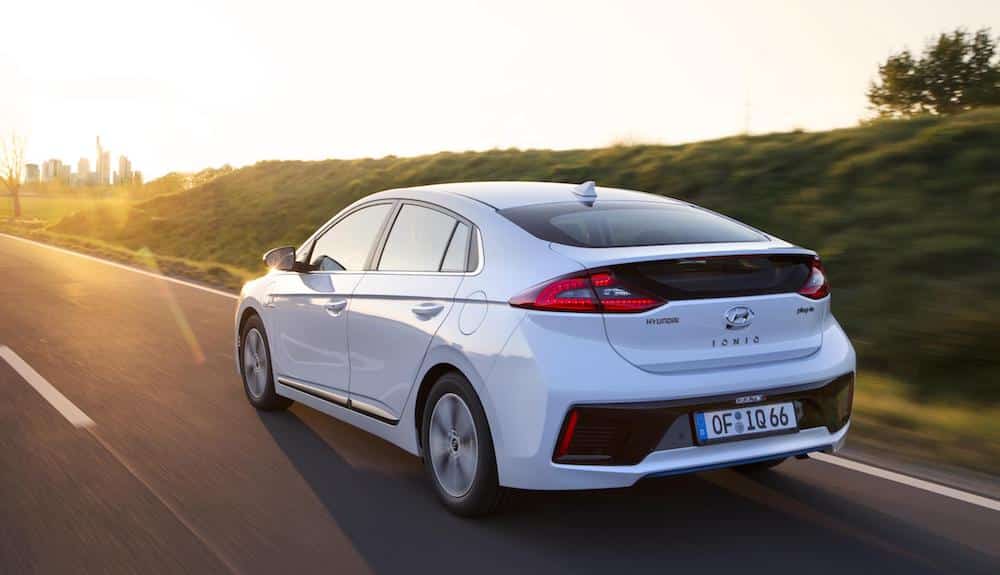
Hyundai has completed the line up of its Ioniq with a plug-in hybrid model.

The plug-in hybrid uses a 105hp 1.6-litre petrol engine in conjunction with a 61hp high-efficiency electric motor driven through a six-speed dual-clutch transmission. This produces a combined output of 141hp and CO2 emissions of 26g/km, thereby attracting a zero-rate Vehicle Excise Duty for the first year.

Hyundai claims that its new PHEV is capable of up to 39 miles of pure electric driving and a total range of 680 miles.

The Ioniq PHEV can be plugged into a domestic three-pin outlet when no dedicated charging points are available. For an additional £300, a 7kW charger and wall box can be supplied and installed at a customer’s home.

The standard paint finish is Polar White, though customers are able to specify from Phantom Black, Platinum Silver, Iron Grey, Demitasse Brown, Marina Blue and Phoenix Orange. Two trim levels, Premium and Premium SE, are available.

The Ioniq PHEV goes on sale this month with UK pricing starting from £24,995, including a £2,500 Plug-in Car Grant.

Hyundai Ioniq Plug-in Hybrid
Polar White is the standard paint finish for the new PHEV

Toyota hopes to x-cite with new colour scheme for Aygo

Toyota has updated its Aygo x-cite with a new colour scheme and more standard equipment.

The five-door hatchback has a 60hp three-cylinder 1.0-litre engine with a five-speed manual gearbox as standard, although an automated manual transmission can be specified.

The Red Pop bodywork is paired with contrasting black roof and door mirror casings, while the front pillars and rear bumper insert get gloss black treatment. 15-inch gloss black alloy wheels with red centre caps are as standard.

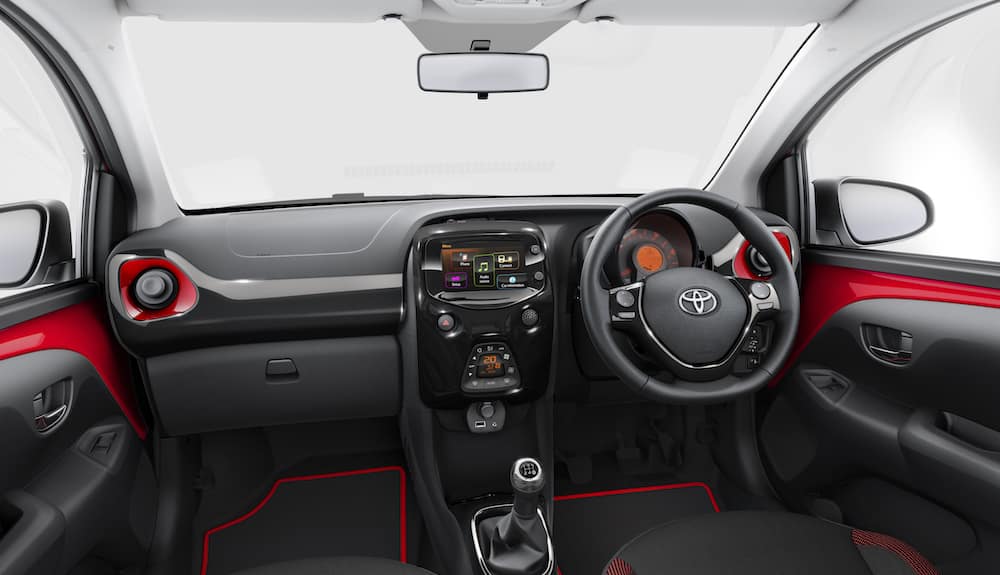
The black and red colour scheme is continued inside with new upholstery, upper door trims and air vent surrounds in Red Pop, a gloss black centre console and gear shift surround. The carpet mats are black with red edging.

Standard specification for the Aygo x-cite now includes automatic air conditioning and automatic headlights. The infotainment system with seven-inch touchscreen and reversing camera are joined by front fog lights and rear privacy glass.

This latest version of the Aygo x-cite is on sale now from £12,520 for the manual and £13,220 for the semi-automatic transmission.

Interior of Toyota Aygo x-cite
The red and black colour schemes continues to excite inside

Fiat grows Panda family with new City Cross

Fiat has announced an addition to its Panda range. Based on the Panda Cross, the City Cross now offers two-wheel-drive with off-road looks.

The new model is available with a 69hp 1.2-litre petrol engine.

Two new body colours are available: Minimal Grey and Electronica Blue. Body-coloured front and rear bumper inserts and side mouldings are paired with contrasting black door mirror caps, roof bars and door handles. The new model has the same 15-inch alloy wheels as the Panda Cross.

The optional City Cross Style pack adds roof bars, side mouldings and skid plate as well as body-coloured door mirrors. Inside, the pack upgrades the grey dashboard to copper and matches the panels and upholstery to the four-wheel-drive Panda Cross.

Order books for the Panda City Cross are now open, with UK pricing starting from £12,995.

Rear view of new Fiat Panda City Cross
The new exclusive colour: Electronica Blue

Shock – car dealers found to be dodgy!

There was shock and amazement today as a front-page story in a national newspaper accused car dealers of being less than honest with their customers. In other breaking news, the Pope is reported to be Catholic.

The Daily Mail, Britain’s paragon of balanced reporting and nuanced journalism, conducted a mystery shopping exercise (although it sounds better when you call it “undercover reporting”) at a number of car dealers across the UK.

They found that: “Ruthless salesmen are offering customers Audis, Vauxhalls, Suzukis and Fords worth up to £20,000 for no deposit – even if they admit they are unemployed, on low wages or have a poor credit rating.”

The newspaper has tried to link car dealers mis-selling finance products (usually personal contract purchases or PCPs) to a potential stock market crash, but it has added two and two together and ended up with about seventeen.

Shock – Daily Mail reporting is not honest!

Of course, the irony of a trashy tabloid accusing car dealers of making reckless, false and misleading statements to boost their sales is simply hilarious…

So, what actually happened? Firstly, the above quote from the Daily Mail is misleading. This is important because it conveys the wrong impression about how car finance is actually sold.

The average car sales executive cannot make finance offers; they can only try and sell you on the idea. A formal finance offer is made by the finance company, via an accredited person at the dealership (normally the business manager or possibly the sales manager), and only after a formal finance application has been made. So the process is:

  1. Sales executive convinces customer to buy a car, in the form of a signed contract to purchase the vehicle at a given price (nothing to do with finance).
  2. Business manager puts together a finance quote, based on information provided by customer, and submits a formal application for finance to the finance company.
  3. Finance company approves or rejects the application. There may be a conditional approval, based on additional or different requirements from the customer.
  4. Finance company makes an offer of finance to the customer in the form of a formal finance contract. The terms of this offer may or may not be the same as what was originally quoted by the sales executive or business manager.

Of the 22 car dealers visited by the Daily Mail, precisely zero finance applications were submitted and, correspondingly, zero offers were made to customers. No-one was “offered a £20,000 new car for no deposit” or anything else.

What clearly did happen was that a number of the car sales executives tried to lure the customers (sorry, “undercover reporters”) into buying a car through misleading information, outright lies and possibly even conspiracy to commit fraud. So there is definitely a newsworthy story here, but it’s not the one that the Daily Mail is trying to tell.

Shock – car salesmen are not honest! (nor are car saleswomen)

Dodgy sales tactics are nothing new – it’s one of the reasons this site exists. Sales executives are paid hefty commissions based on how many cars they sell, how many finance deals they sell, how many GAP insurance policies they sell, and so on. They also have pretty tough targets in terms of how many of these products they sell, so they are often desperate to get your business – especially if they’re struggling.

It’s very clear that some car dealers will bend the truth (or worse) to get a customer’s name on a contract. We’ve been banging on about it for years, and the Financial Conduct Authority (FCA) has opened an investigation into the way that car finance is being sold by car dealers.

It’s important to point out that there are many ethical car dealers and sales executives across the country who will do the best they can for their customers – like most industries, everyone gets tarred with the same brush. However, it’s probably also fair to say that car dealers have more bad apples in their barrels than most other industries…

According to the Daily Mail, their reporter was told by a Suzuki salesman in Staffordshire to lie about his employment history on the finance application to help his chances of being approved by the finance company. This is a serious accusation (the salesman is potentially assisting a customer to commit fraud), but it was only mentioned four pages into the report by the Mail’s “Investigations Unit”. The first three pages were all about why PCPs are terrible and how reckless selling of PCPs is going to crash the economy.

Dodgy car dealers are telling customers to lie about their financial status
“Good news! By doubling your declared salary, I got you approved for a car you can’t possibly afford to pay off!”

The car industry has created its own mis-selling mess

Buying a car on a PCP or other forms of dealer finance is a bit of a convoluted process. The dealership is usually an independent company that has a franchise licence to sell a car manufacturer’s vehicles. The dealer also acts as an agent for the finance company, which may be the manufacturer’s finance company but is still a completely separate business. So an employee from Company A is trying to sell you a car from Company B and finance from Company C (and usually extras from Companies D, E, F and G) – and make the whole thing look like an integrated and seamless package.

The car companies and the finance companies can swear blind that they are ethical organisations whose employees will always act with the highest possible morals, but their employees are not the ones who are selling these products to customers. The salesman in the showroom is not an employee of the manufacturer or the finance company, despite the logo on his name badge*. And there are hundreds of thousands of sales executives across the country, acting on behalf of these companies but not employed or actively monitored by the companies.

*Occasionally, some car manufacturers do own some of their dealerships via a subsidiary company. But it’s very much an exception rather than the rule.

Over a decade in car sales, I worked with some excellent, impeccable and hard-working individuals. And I also worked with some properly dodgy con artists who epitomise everything the public hates about car salespeople. The logo over the showroom door was no guide to the moral standing of the sales staff – some of the worst I met worked for some very posh brands.

As companies start to move into online selling, gradually taking traditional dealerships out of the equation, the situation may improve for new car sales. Used car sales will take much longer to change, as there is much less pressure from car manufacturers to conform to brand values.

Will car dealers PCP sales tactics cause a financial crash?

There is concern that the continued growth in car finance debt could adversely affect the most vulnerable in society. The Bank of England is investigating the car finance sector to determine whether lending rules need to be tightened to stop finance companies loaning ever-increasing amounts of money to people who are at high risk of not being able to pay it back (known as sub-prime lending).

But this is a big-picture analysis. The Bank of England isn’t interested in whether a Suzuki dealer in Stoke-on-Trent is misleading customers; it’s looking at the cumulative effect of millions of PCP agreements on the overall economy.

The Financial Conduct Authority, on the other hand, will be interested in the mis-selling allegations made by the Daily Mail. Its current investigation into the car finance market is aimed at precisely this sort of thing, and car dealers should be concerned about what may come next.

The car manufacturers and finance companies have had plenty of warning that the FCA is concerned about mis-selling of car finance, but they have clearly failed to manage the problem themselves. It can only be hoped that the FCA will come up with some concrete ways to clean up the car dealers.

To Infiniti – and up the Goodwood hill

Remember when Britain had an international motor show? Well it still has – except it’s no longer held in London, but at Goodwood in Sussex.

Standing surveying the manufacturer stands at this year’s Goodwood Festival of Speed, this writer’s thoughts strayed back to 2008, and the last British International Motor Show, at the Excel Centre in London’s docklands. It was a great new venue in the capital, but it was also to be proved the last show – okay there is a London show today, and yes it’s going back to Excel next year, but it’s all about dealers rather than manufacturers.

After that 2008 event, the car manufacturers said they couldn’t justify the cost of exhibiting at Britain’s show, especially as it was no longer in the premier league of motor shows such as the Geneva or Frankfurt events. This week I thought of that as I stood on the cricket green of Goodwood House, and looked at the enormous, multi-storey stands spread before me.

Showing out in Sussex

Today, car manufacturers are spending very big money to put themselves on show at Goodwood. Admittedly not every manufacturer was present, but there were plenty, and some of the stands have reached extreme proportions.

Once upon a time, this writer used to attend the Festival every year, and to be honest he got a bit bored by it – it seemed to be getting just too commercial, without the unique ’50s film set’ appeal of the Revival event in September. Then relocation from just up the road in Surrey to mid-Wales gave me an excuse not to go anymore, and I didn’t, for almost a decade.

Returning last year, I realised the Festival has changed. There was always plenty to interest this motorsport fan, but the now four-day extravaganza in Sussex has become as important to the road car industry as it is an essential fun weekend for those in motorsport.

The world’s most expensive traffic queue?

Where will one now see the new models for the first time? At the Festival, where the makers not only get to show their latest wares off and hopefully sell some through those enormous stands, but also to demonstrate their cars, driving them up the Goodwood Hill.

On the first day, known as ‘Moving Motor Show’ day, said cars are put in the hands of a few lucky potential customers, plus the occasional journalist, which is how at this year’s Festival I found myself lining up on the famed start line in the new Infiniti Q60.

We at The Car Expert will be bringing you an in-depth test of this model in a few weeks’ time, which is a good thing as I’m unable to tell you much about it yet – because I wasn’t really that focused on the car. With a proportion of the 200,000 or so that attend the Festival watching on from behind the straw bales, binning this brand-new model would have been a major embarrassment, so discretion was called for – especially as the ‘pro’ drivers told me the track had never been so slippery.

One slip from disaster

I didn’t bin it – though I can confirm the track was indeed treacherously slippery, and challenging. It has more turns on it than are apparent when watching from the side, and it is narrow – especially halfway up, where the flint wall seems to loom out at you, challenging you to bounce expensive metal off the side of it.

While after my run I really wanted, in vain, to go again, I also had a new appreciation for the racing drivers who throughout the weekend would reach quite astonishing speeds up what is still basically the driveway of a stately home. Formula One, NASCARs from America, sports cars that only two weeks earlier had been winning the Le Mans 24 Hours, and a riot of historic machinery each with its own story – the competition machinery gathered in this one place was jaw dropping.

But there also remained the First Glance and Supercar categories, road cars on prominent display. Okay after Thursday the more ordinary stuff, Dacia Sanderos, Renault Twingos and such were gone. Instead the focus was on the likes of BMW, showing off on the hill as it launched its Black Edition sub-brand in the stable yard of the house. The most powerful Jaguar yet built, the 200mph XE SV Project 8 with its 3.3-second 0-62mph time, was debuting, as were new models from McLaren, Mercedes-Benz, Ferrari, Porsche, Aston Martin, Rolls-Royce – the list goes on…

So now the Goodwood Festival of Speed is very much a manufacturer must-attend, particularly for any brand launching a vaguely sporty model. But I also came away from Sussex having enjoyed the event more than I used to. There is now so much to see that even the enormous attendance gets spread over the site, and the overall impression is of a great many people having a great deal of fun.

So yes, I will be back at Goodwood next year. And if any manufacturer wants me to drive their new supercar up the hill, well I know which way the track goes now and you know where to find me…

The Goodwood Festival of Speed – a special event… Photo: Rosemary Charman

New Subaru Impreza to debut in Frankfurt

Subaru has announced that the latest incarnation of its Impreza will launch at the Frankfurt motor show in September. Since its launch in 1992, 2.5 million Subaru Impreza models have been sold worldwide.

The fully redesigned Impreza is the second model in Europe to make use of Subaru’s new global platform.

The Impreza also features Subaru’s trademark “symmetrical” all-wheel drive system, which provides 50:50 front and rear drive distribution. Like most Subaru models, it will also have horizontally-opposed “boxer” engines.

The new Subaru Impreza will be unveiled on 12th September at the brand’s press conference at the 67th Frankfurt International Motor Show.

Rear view of new Subaru Impreza
The new Impreza features Subaru’s new global platform

Honda Civic Type R review

What is it? The Honda Civic Type R is the latest, most potent version of a performance icon.
Key features: New body and chassis, more power, more versatility.
Our view: The new Honda Civic Type R is a much more complete performance hatch than its predecessor, more potent, but also significantly more practical as a daily driver.


Honda Civic Type R – did we not review that quite recently? In fact, it was exactly two years ago. In June 2015, partly on a race track in Slovakia, we attended the launch of the last Civic Type R.

Just 24 months on and we are at staring at another race track, this time the awesome Lausitzring in what was once East Germany, as part of our first experience of an all-new Type R, which arrives in UK showrooms in July.

The reason is, of course, the fact that the mainstream Civic recently underwent its latest regeneration, going on sale in March. And it is a significant change for the model, adopting far more mainstream styling in a bid to increase its share of the market – especially as Honda’s UK plant at Swindon is now the global hub of Civic production.

So it is no surprise that a new Type R is in the mix. But appearing just four months after the mainstream car is almost indecently soon, and perhaps there is another reason. The 2015 Type R was extremely potent, but as an everyday car it could soon become hard work – race definitely ruled over road. With this one, Honda appears to have taken the opportunity to rectify matters, making it more user-friendly a major priority.

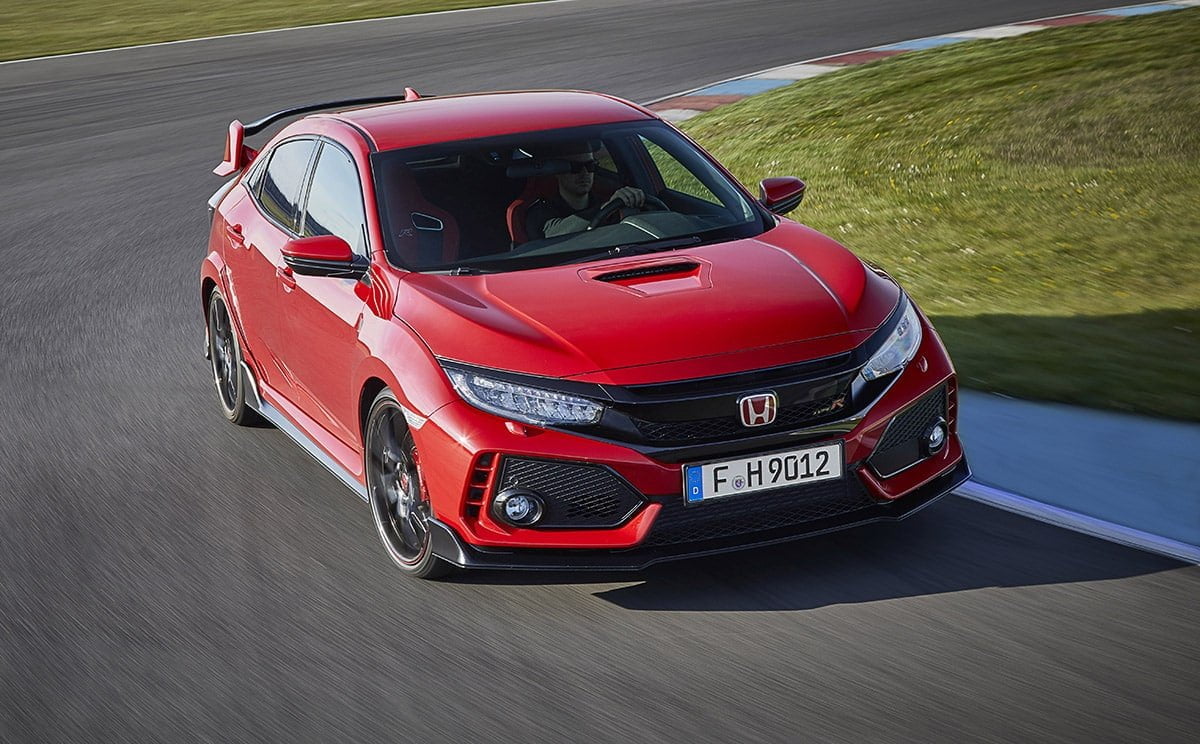
Do not think for a minute, however, that the new Type R is watered down. As I will discover in a test that encompasses a challenging race circuit and a legal 150mph on basically a dual carriageway, it’s the most powerful, best-handling version of the car yet.

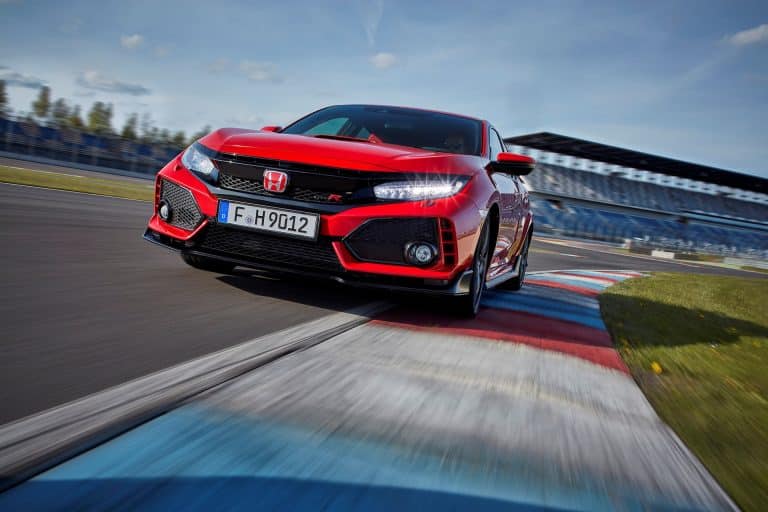
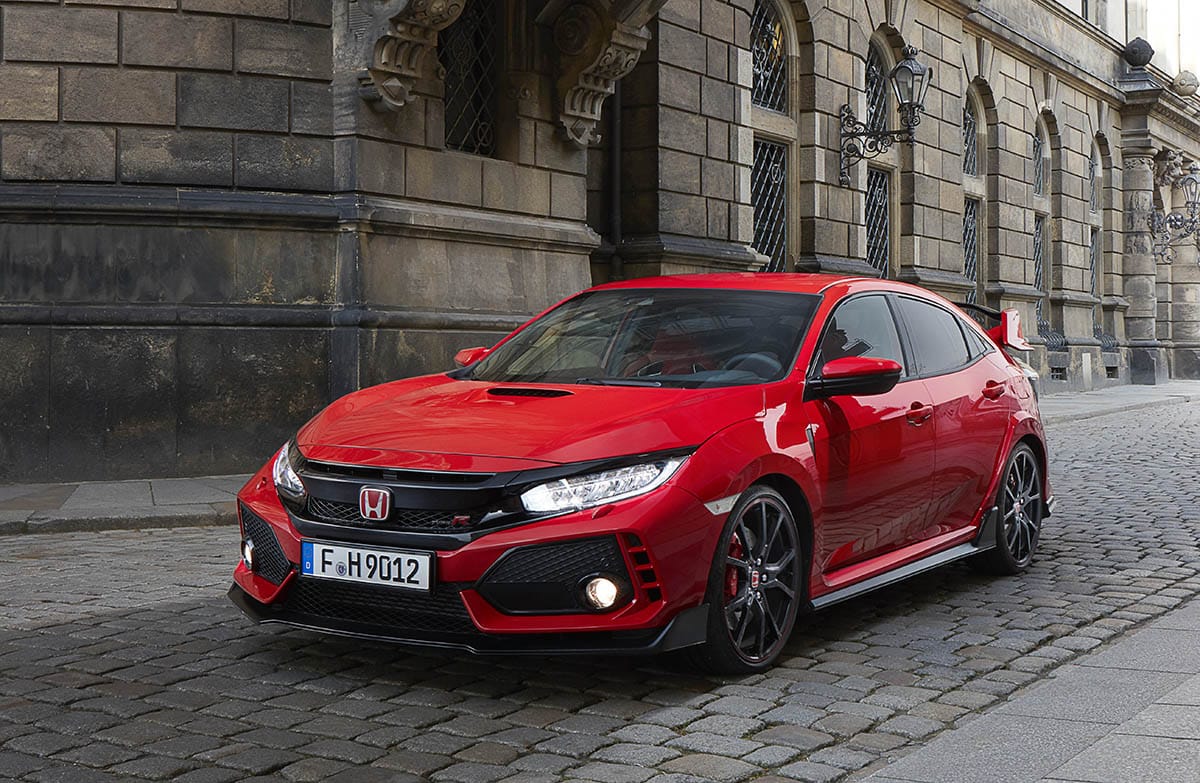
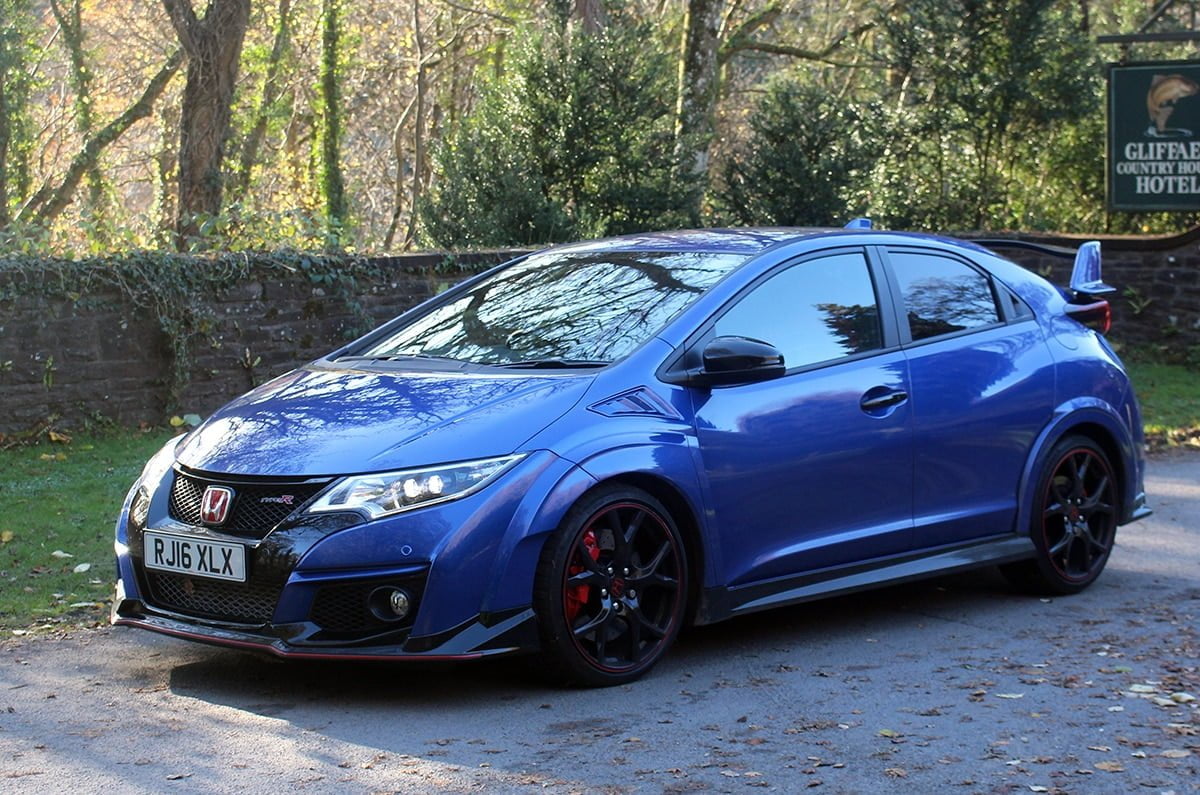
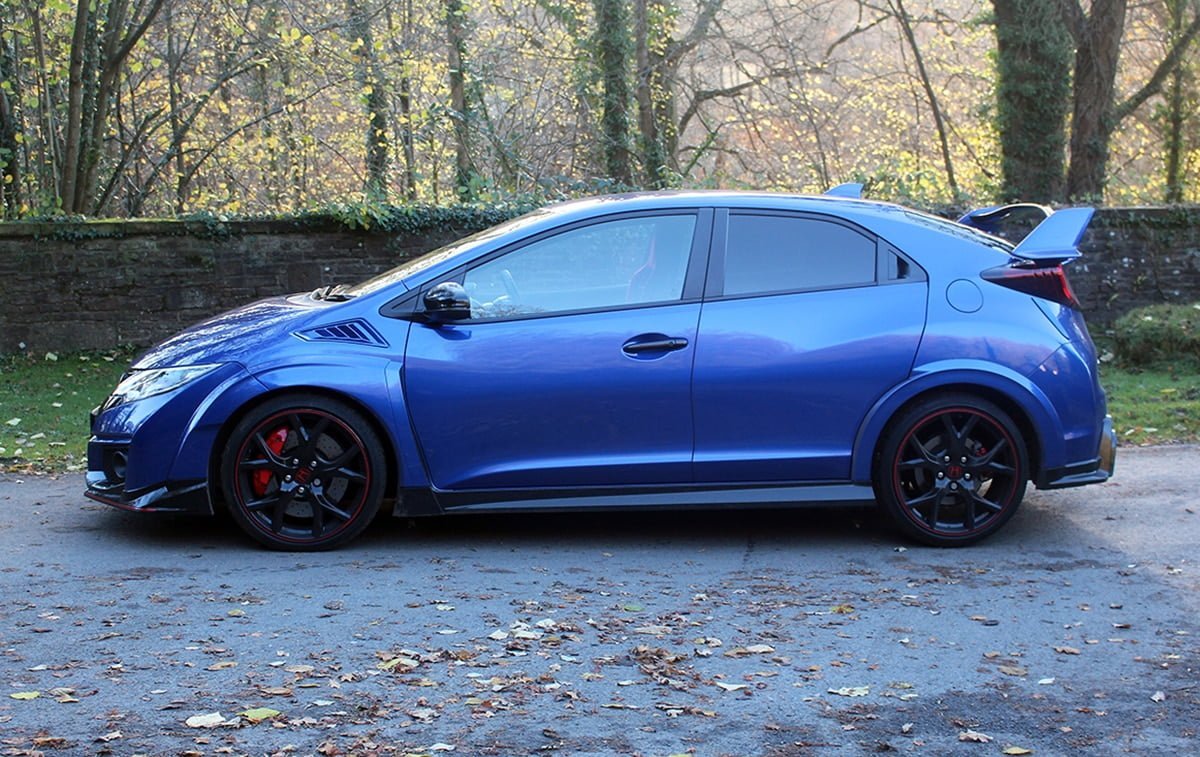
Honda Civic Type R looking menacing in red (The Car Expert)

Exterior and interior

According to Honda, the new Type R was developed alongside the standard Civic, demonstrating how important the model has become to the brand – those that make jokes about Hondas appealing to the ‘older’ set forget that company founder Soichiro Honda was first and foremost a racer.

The car is longer and lower than its predecessor, while its styling makes the car look wider even though it’s not. A lower centre of gravity helps too, and a driving position closer to the road. It sits on a new platform, which saves 16kg of weight while improving torsional stiffness by 37% – better for safety, much better for handling…

Aerodynamics have assumed their greatest importance yet on the new model. The underbody is smoother, while the specification includes phrases such as ‘air curtain’ and ‘vortex generators’ – the kind of thing you hear more often when talking about new race cars. We are promised such measures make the new car the most stable Type R at high speed yet, while other measures include the front splitter, sculpted air intakes, wheels enlarged to 20 inches, even a bonnet in aluminium because that saves 5kg over the steel version on the stock Civic.

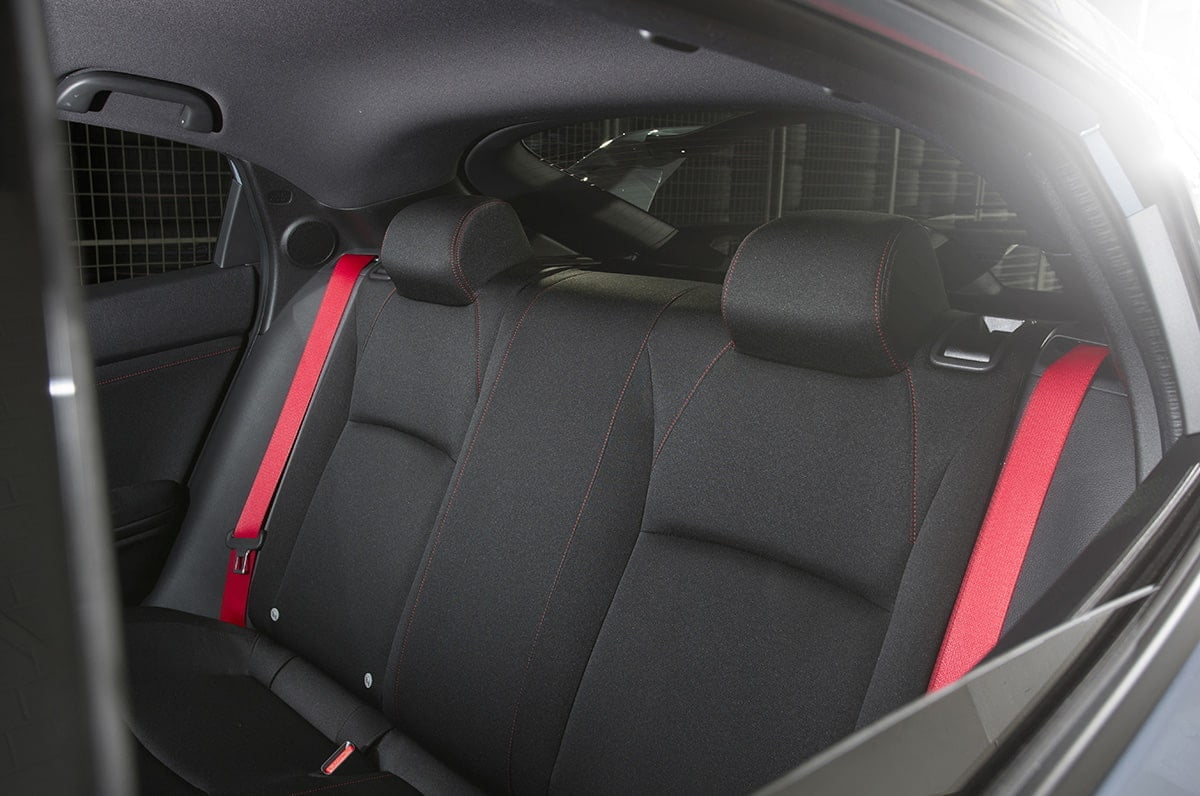
Inside is pure Type R, a riot of suede-effect fabric in the signature red and black. The seats might be the lightest ever fitted but they still hold you firmly yet comfortably, and make you feel like you are in a performance car.

The dash is a big improvement – the display is still digital, but no longer something akin to a science-fiction spaceship. It is also no longer in two pieces, the pod sitting atop the fascia has gone which is an excellent move. In the old car, one had to choose either to partially block the view of this pod or the main display with the steering wheel.

And of course this is still a Civic, so benefits from the increased interior room provided by the new design, both in front and rear. All of which helps justify the car as a purchase for daily driving – as a passenger, you no longer feel like the car really doesn’t want you there, as you did in the 2015 Type R.

Powertrain and chassis

Not a great deal is carried over from the previous Type R, but the engine, transmission and brakes are. Honda could not simply drop the old engine into the new car, however, so the 2.0-litre VTEC turbo unit has been ‘optimised and refined’. This means an extra 19 horses, now putting out 320hp with peak torque of 400Nm.

The six-speed manual transmission has been improved too – a switchable ‘rev’ match’ system added. As its name suggests this precisely aligns engine speed to transmission to ensure the most efficient shifts and no ‘shock’ through the gearbox. And the Brembo braking package boasts bigger discs.

Possibly the most visual aspect of the powertrain changes are the triple tailpipes of the exhaust, looking for all the world like some weapon pointing at following vehicles. Exhaust flow is improved by 10% while the smaller central pipe performs multiple functions, both improving efficiency and that essential element, the sound the car makes!

All of which contributes to a 5.7-second 0-62mph time and a 169mph top speed. The Civic Type R claims the title of fastest-accelerating car in its class. It also – currently – holds the title more manufacturers these days appear to be chasing, as the fastest front-wheel drive car ever around the daunting 14-mile Nürburgring Nordschleife track in Germany.

Honda also dubs the Type R’s chassis as the most sophisticated in the model’s history. Allied to the platform and rigidity improvements is the significantly revamped suspension. The front MacPherson struts use a lot of aluminium and a bespoke ‘dual-axis’ setup which cuts torque steer – the tendency of a powerful front-wheel-drive car to want to go sideways when the power is put down.

The rear suspension is completely new too, a multi-link system designed to improve stability under braking. But just as important are the revisions to the adaptive dampers, both improving performance at pace but adding ride comfort in normal use.

Red and white - Honda Civic Type R

On the road

It all sounds great, on paper, but how does it work in practice? It’s not often one comes to a new performance car with such recent memories of its predecessor, which in the case of the Type R was one heck of a hot hatch but in daily driver terms only for the slightly masochistic.

Honda’s launch event in Germany gave us the opportunity to test all aspects of the car, from driving through the traffic-choked streets of the city of Dresden, to letting it loose on an unrestricted autobahn, and then the highlight – laps of the challenging Lausitzring road course.

The answer to the vital question is yes – one really can use the new Type R as a daily driver. General comfort has been markedly improved over its predecessor, and there is now even a ‘Comfort’ setting alongside the now default ‘Sport’ and track-special ‘+R’ driving modes, setting dampers, steering, gear shift and throttle response accordingly.

As a result, uneven roads are no longer akin to a session from a sadistic masseur, the chassis smothering the bumps. Cruise along in the car and it’s a quiet, refined environment not far removed from any other Civic.

And then one gets out on the motorway – and in parts of Germany, they are rather different to in the UK. With no speed limit to worry about one can fully experience the Type R’s pace, and boy does it have some…

Said pace comes in much earlier – above 2,500rpm you feel the car dialling up, but in a much more smooth and refined manner compared to its predecessor thanks to improved throttle delivery and slick gear shifts.

I admit I wimped out at an indicated 242km/h, which equates to 150mph, on what was basically a dual carriageway. At such speeds the Type R felt very fast indeed, yet still refined and fully in control. Obviously, such an experience will be irrelevant to anyone who buys a Type R in the UK, but I would suggest membership of a track day club will be an essential option, so as to experience and enjoy the car’s full dynamic abilities.

Because on the track the Type R really comes to life. The German instructors at the Lausitzring had an interesting technique, simply telling us to follow them in their Type R, and then indulging in laps that had us pushing on hard merely to keep up.

And the car soaks it all up – accelerating crisply, braking with confidence, turning in with confidence and maintaining superb grip through the bends. It very quickly becomes a whole lot of fun…

The cost

Entry cost to Type R ownership starts at £30,995. Spend an extra £2,000 and one can have the GT model, which gains a raft of mostly technology.

The GT specification includes a cross-traffic monitor, dual zone climate control, auto-dimming rear-view mirror, Honda’s Connect assistant incorporated into the navigation, wireless phone charging, an 11-speaker high-power version of the audio system, and LED front fog lights.

Summary

Type R has come to mean something special to performance car fans. With the red badge, they know they will get the most potency available in the Civic, a truly hot hatch.

This is not a lot of good, however, if the car gets left in the garage because driving it on a regular basis is just too full-on. And in the last Civic Type R, the balance was shifted just a little too much in the direction of the track.

The new Civic Type R rectifies that but, remarkably, does this while also offering increased performance – more potency, and more ability on the most demanding of race circuits.

This is a complete package that one can live with happily all week on the slow commute to and from work. Just make sure you take it to the track of a weekend and let it off the leash…

Honda Civic Type R – key specifications

On Sale: July 2017
Range price: £30,995-£32,995.
Insurance groups: TBA
Engine: 2.0-litre VTEC turbo petrol

Power: 320 hp
Torque: 400 Nm
0-62mph: 5.7 seconds
Top speed: 169 mph

Fuel economy (combined, mpg): 36.7
CO2 emissions (g/km): 176
Key rivals: Ford Focus RS, Volkswagen Golf R, Renault Megane RS
Test Date: June 2017

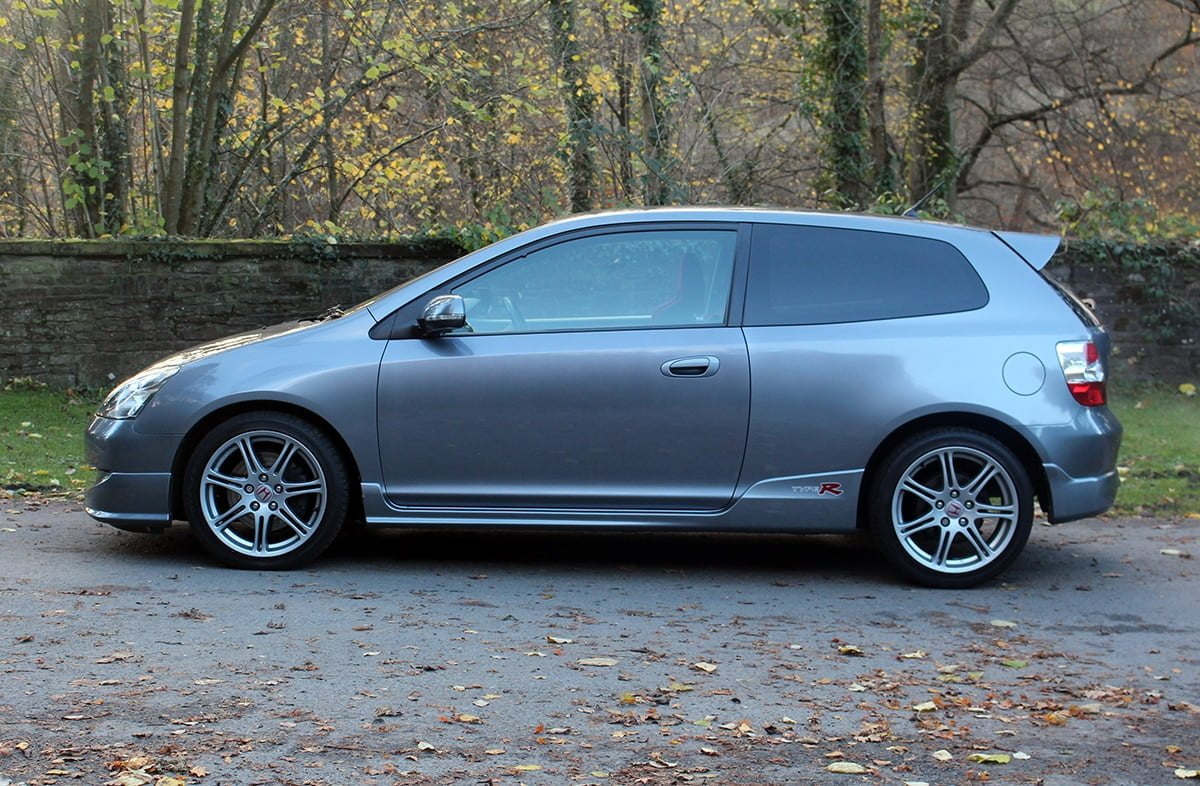
A short history of Honda Type R

Type R – a phrase that immediately excites petrolheads. Just as with the M of BMW, the AMG of Mercedes-Benz, performance fans know that Honda cars wearing the Type R badge will be potent machines, with not a little racing DNA.

Today, Type R is applied to the most performance-focused version of the Civic hatchback, and indeed a new one, the most potent yet, is about to arrive in UK showrooms. But the first Type R model was something very special indeed, and like all the early Type Rs only sold in Japan.

2017 marks the 25th anniversary of Type R. In the early 1990s Honda, a car manufacturer with a strong racing pedigree, conceived the idea of making top-performance models for sale in limited numbers, with the expectation that their owners would use them on the track.

Honda Civic Type-R history

Formula One heritage

Such cars were put on a serious diet, their suspension retuned and engines breathed upon to squeeze out more horsepower. They gained a new, red badge and ‘Championship White’ was always among the exterior paint options, reflecting Honda’s red and white racing colours worn by the company’s first Formula One winner in 1965.

Type R branding was first applied in 1992, to the Honda NSX. Launched in 1990, this was the brand’s first supercar – the first mass-produced car with an all-aluminium body, power from a 3.0-litre V6 engine of 280hp also all-aluminium and with the then revolutionary Variable Valve Timing (VTEC) technology. Its styling was inspired by an F-16 fighter jet cockpit and development of the car carried out by F1 champion Ayrton Senna.

Honda NSX
Andrew drove a Honda NSX for the first time in December 2016. More than 20 years old, it offered a bigger thrill than many a modern supercar – the Type R version must have been something truly special…

In Type R form, the NSX gained more radical suspension upgrades and lost some 120kg in weight, mainly by removing such superfluous items as the electric windows, the audio system and the air conditioning.

The NSX, its more radical NSX Type R successor (also known as the NSX-R), and the first Integra Type R, a 200hp coupe launched in 1995, all remained strictly Japanese-market cars. Then in 1997, the Integra Type R broke into America under Honda’s Acura badge. It was still primarily focused on track use – Honda, in fact, sold all the road versions at a loss, despite motoring journalists dubbing it the ‘best-handling front-wheel-drive car ever’.

By now the Type R badge had been applied to a version of the Civic hatchback, launched in 1997 and with some 185hp from its 1.6-litre engine – at the time unheard of from a non-turbo unit. Again this was only officially sold in Japan, but the Type R story was about to go global, starting with a second-generation Integra that at last officially came to Europe. It was followed by a Type R version of the larger Accord saloon.

Type R comes to Europe

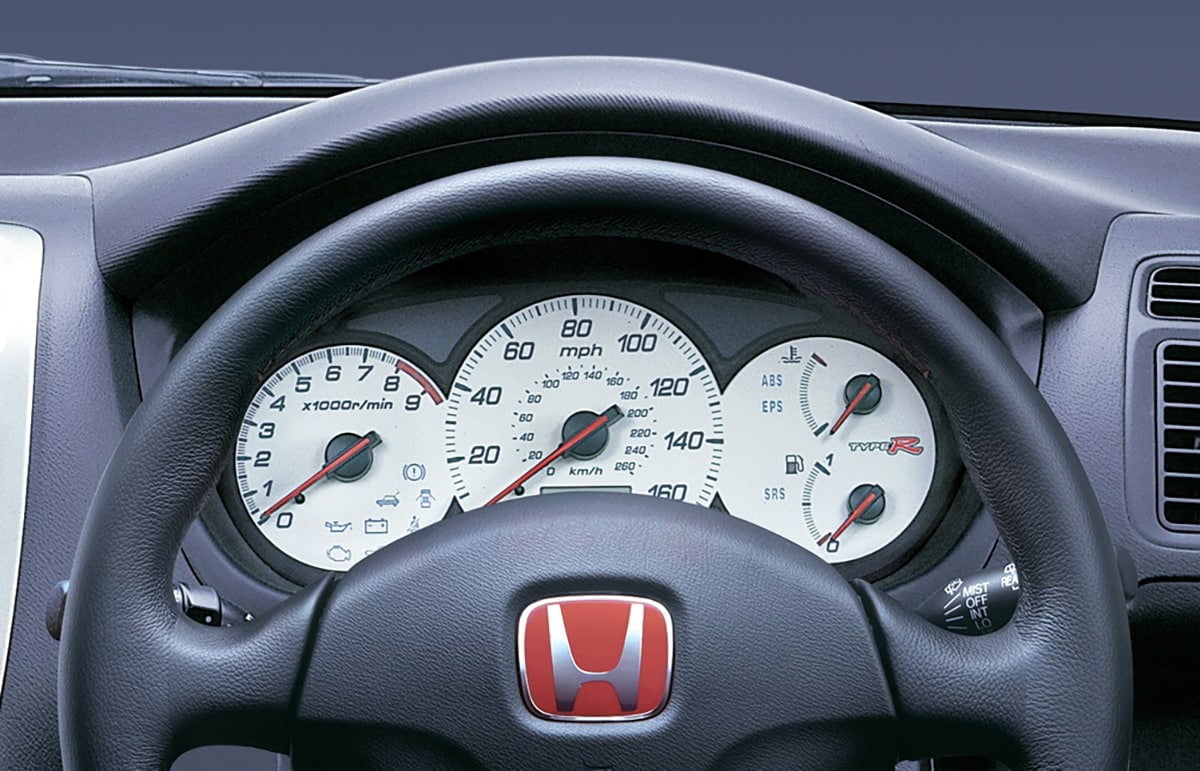
It is with the second-generation Civic where the Type R story really gains pace. This Civic Type R, launched in 2001, was based on the three-door car manufactured at Honda’s UK factory in Swindon – as would be all future Civic Type R models.

Officially the car celebrated Honda’s return to Formula One. Its 2.0-litre i-VTEC petrol engine pumped out 200hp. The chassis was seam welded just like race cars, it had a close-ratio six-speed transmission, significantly uprated suspension and brakes.

With a 0-60mph time of just over six seconds and a plus-140mph top speed, remarkably this car was not as radical an upgrade as a version sold by Honda in Japan, but motoring journalists loved it, the Civic Type R winning many ‘best hot hatch’ awards and selling in big numbers as a result.

Your writer remembers the press launch of the ’01 car, the first Type R he drove, very well. It was held on the Isle of Man, and the highlight was discovering just how potent the car was on the mountain section of the TT course, specially closed for the occasion by the Manx police…

Type R on the Goodwood hill

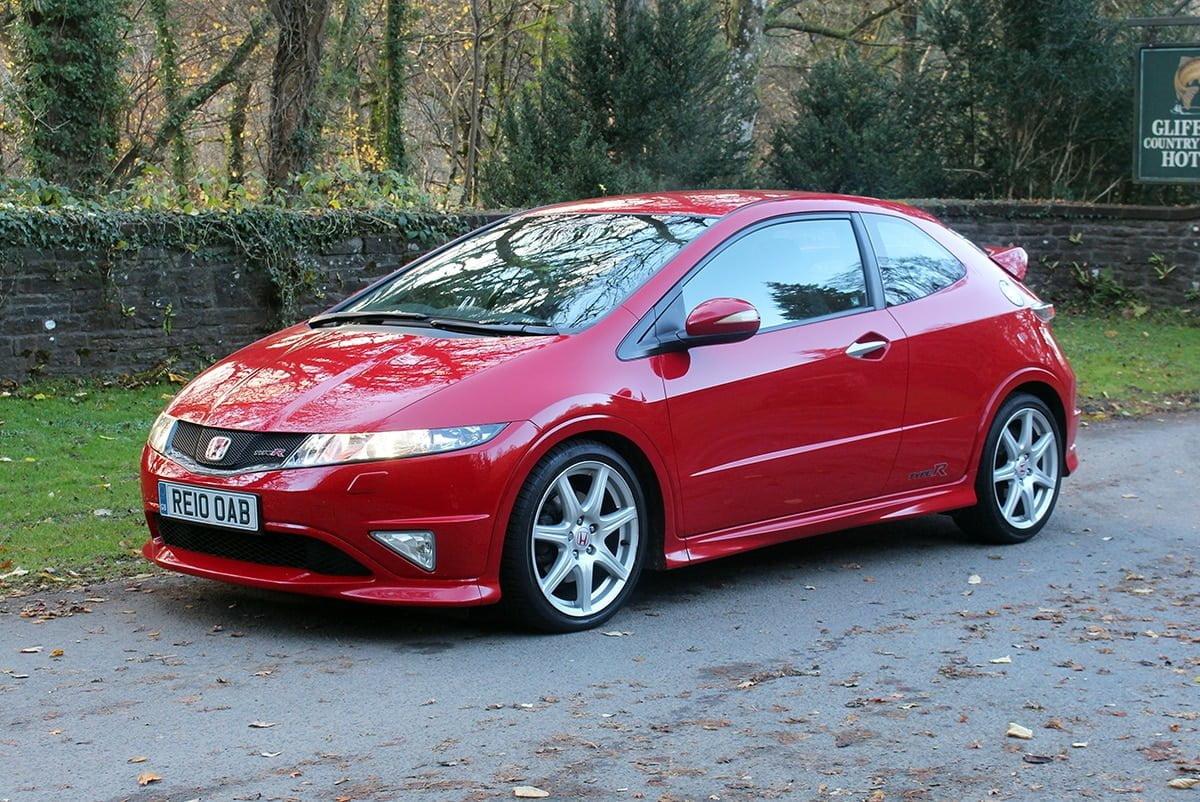
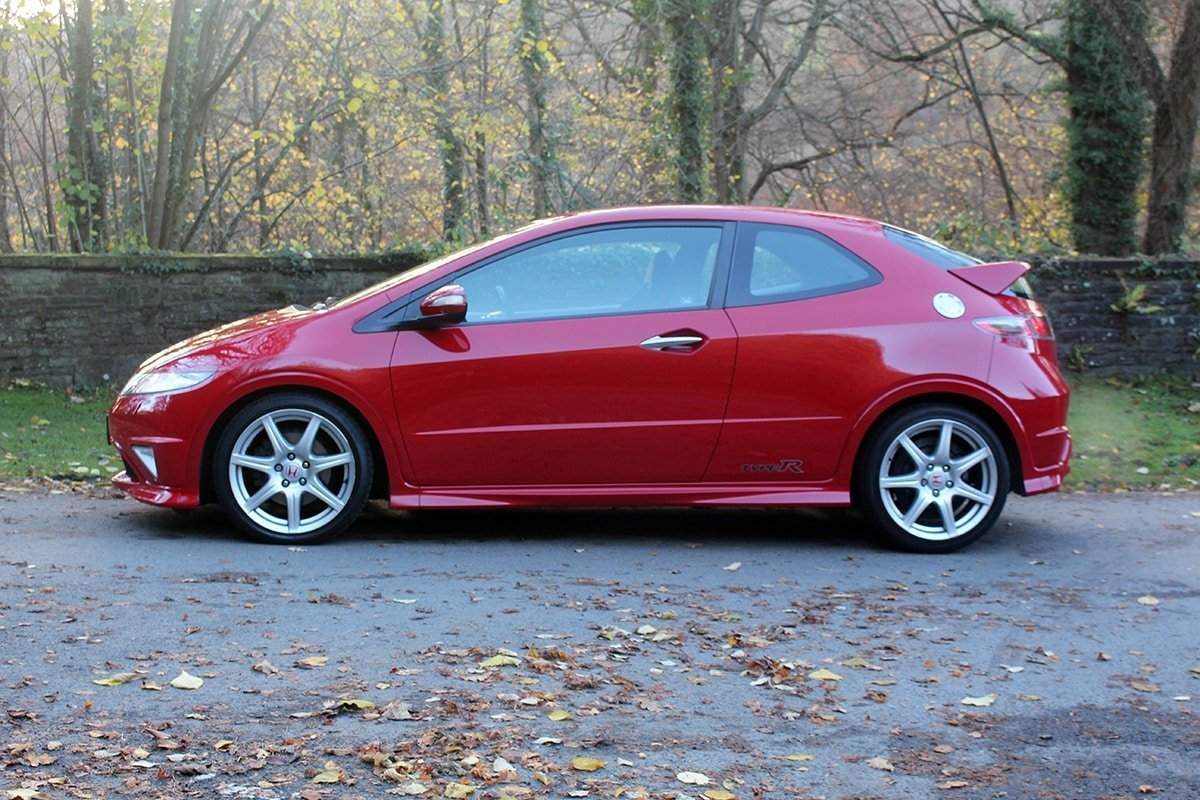
For the launch of the third-generation Civic Type R, in 2007, we were based in Sussex. This time exploring the potency involved tackling the hillclimb course used for the Goodwood Festival of Speed – evocative surroundings…

Again the European market version was based on the five-door Civic hatchback coming out of Honda’s Swindon plant. In Type R form it still employed a 2.0-litre VTEC petrol engine, just one horsepower more potent than its predecessor with 201hp at 7800rpm. In Japan, the recipe was a four-door saloon with a 225hp engine.

That model was sold for a mere three years, and then a wilderness period ensued. Not until 2015 did a new Type R appear, and this was a step change compared to its predecessors. With the Mk4, launched in 2015, Honda wanted to emphasise the ‘start of a new performance era’.

Race car for the road

The car boasted the most extreme powerplant yet. It was still a 2.0-litre petrol unit, with a surprisingly low red line of just 7,000rpm. But it boasted a 5.7-second 0-62mph time and a terminal speed of some 166mph. Bespoke adaptive damper suspension ensured it offered handling to match the power, as we journalist discovered on the launch, driving the cars around the same circuit in Slovakia that the World Touring Car Championship race versions would compete on just two weeks later.

Honda dubbed the 2015 Civic Type R ‘a race car for the road’, and indeed it was. But perhaps it was also a little too extreme to properly maintain the Type R’s established image, of matching huge performance potential to the ability to behave itself impeccably on a 30mph trip to the shops.

Now, just two years on, there is a fifth generation of Type R. It has evolved surprisingly quickly from the latest Civic, now manufactured in Swindon for sale across the whole world and boasting a more mainstream styling treatment.

The new Civic Type R is the most powerful version of the model yet. But as you will read in our first drive, it also returns the brand to a more versatile outlook, Honda wanting owners to be able to use it as an everyday car while enjoying it to the full on the track at weekends.

Yet while you may often see the new Civic Type R in the car park of Tesco, the original ethos of the brand has not been diluted. This is still significantly the most extreme version of the Civic you will be able to buy. And yes, it is seriously potent. The Type R legacy is in good hands…

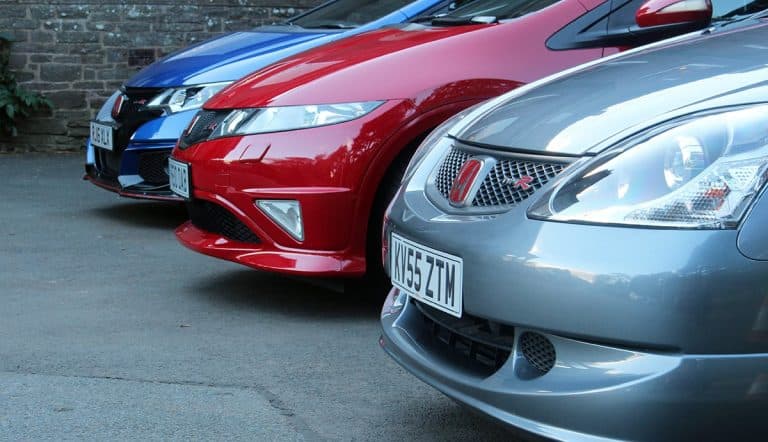
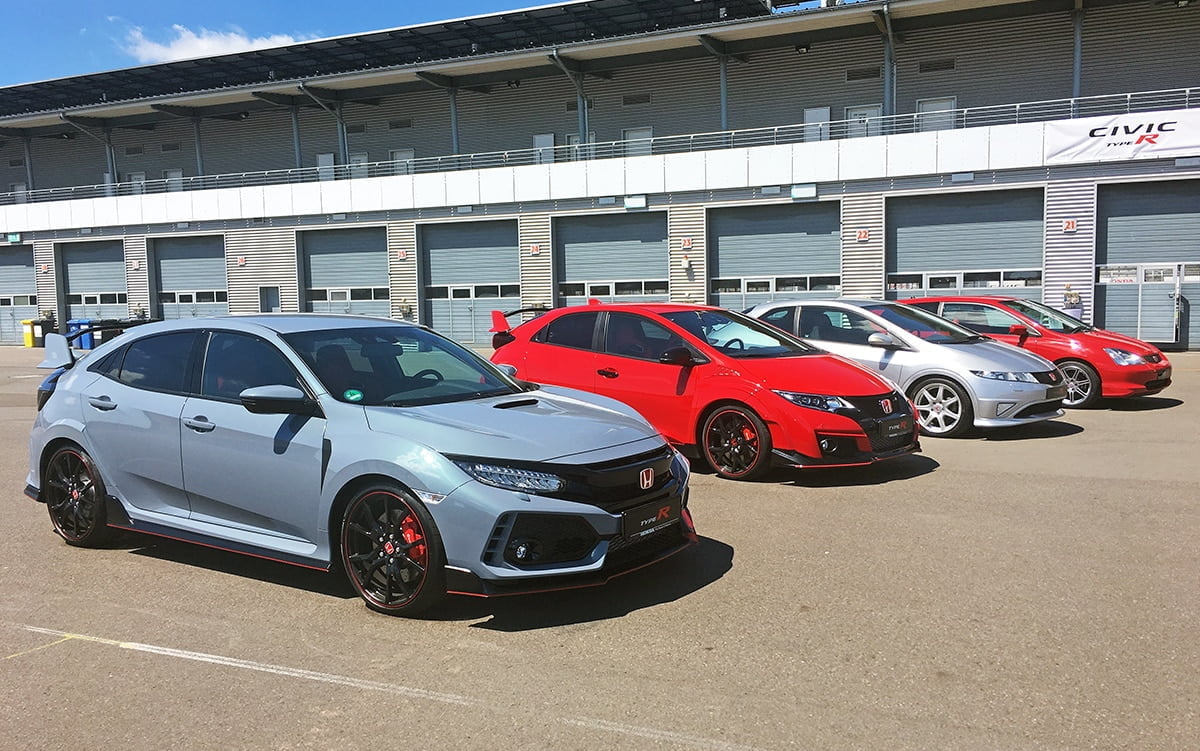
Honda Civic Type R 2017 with its predecessors
The next generation – the 2017 Honda Civic Type R with its three predecessors.

McLaren joins up as Dennis bows out

Major changes at McLaren are to see the separate sports car manufacturing and Formula One race team companies merged into a single entity.

The formation of the McLaren Group follows an agreement with Ron Dennis, the man credited with leading McLaren to its household-name status today, to sell his remaining shares in the business.

The move unites McLaren Automotive, which manufactures a renowned series of road cars and has just celebrated its fourth year of profit in just six years of sales, with McLaren Technology Group, which includes the iconic Formula One racing team and a high-tech arm, McLaren Applied Technologies. This works in a number of innovative areas, one of its many outlets being the electronics used in America’s leading single-seater race category the Verizon IndyCar Series.

End of an era

Dennis is selling his 11% stake in McLaren Automotive and 25% he owns of McLaren Technology Group. This brings to an end a 37-year association during which he transformed the F1 team, winning seven F1 constructors and eight drivers titles, and set up the road car manufacturer, creating a group today valued at £2.4 billion with an annual turnover of £898 million.

Ron Dennis made McLaren a world player and created the car manufacturer.

The current management team of Mike Flewitt, Zak Brown and Jonathan Neale will continue in their roles. Essa Al Khalifa will become Executive Chairman of the new group, and comments that as one Group, the three pillars of the business can support and enhance each other.

“McLaren is unique, due to its strong heritage and passion to be best in everything it does, but also because no other company in the world can claim a corporate structure that comprises automotive, motorsport and applied technologies,” he says.

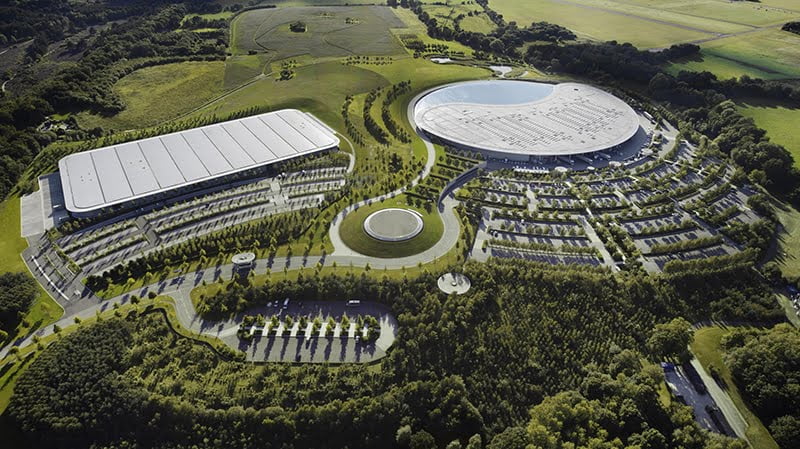
McLaren
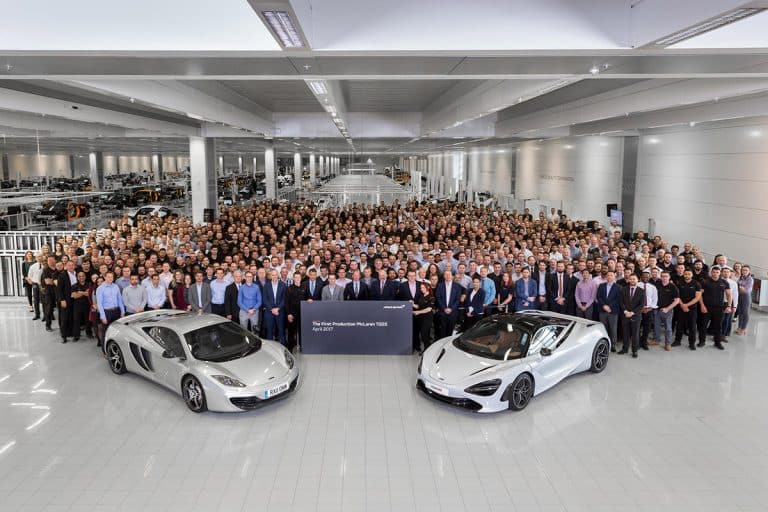
McLaren today employs 3200 people at Woking, England, the F1 and road car facilities alongside each other.

Two new editions for redesigned Skoda Citigo

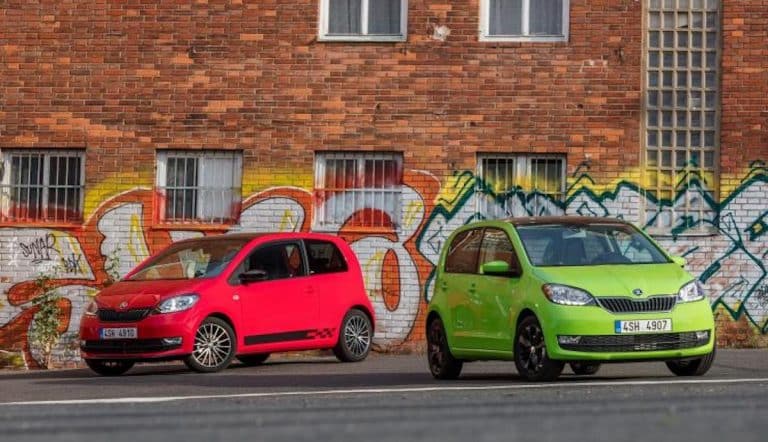
The Skoda Citigo has received a 2018 model year update, featuring a lightly redesigned exterior, updated interior and two new editions: Colour and Monte Carlo.

Updates to the exterior consist of a redesigned bonnet, bumpers, fog lights and radiator grille. LED daytime running lights and dark-tinted rear lights are as standard for SE and SE L trim levels, optional for the S. The Citigo is available with a range of alloy wheels.

The compact Citigo has a 251-litre boot which increases to 951 litres with the rear seats folded. A multifunction steering wheel with leather cover is standard for the top-of-the-range SE L. Two available infotainment systems are offered, with auxiliary and USB ports, an SD-card slot, colour display, speakers and Bluetooth connection.

The latest round of updates follow the Citigo’s win in the Safest Used First Car 2017 awards this week. The 2018 model has autonomous emergency braking and brake assist to prevent collisions. Four airbags, electronic stability control, traction control and Hill-Hold Control are as standard.

New Editions

With the 2018 model year updates the Citigo gets two new editions based on existing trim levels. The Monte Carlo has a rally-based design with a lower sports chassis, front and rear spoilers and tinted windows. The Colour Edition, based on the SE trim, is available as either three or five doors with 15-inch Crux alloy wheels in black or white.

UK pricing for the Citigo starts from £8,635 with all models now available to order.

Profile of green Skoda Citigo
The Skoda Citigo recently won the title of ‘Safest Used First Car 2017’.

Fiat celebrates 500’s 60th birthday

Fiat has created the 500 Anniversario, a special edition of its iconic 500 model which turns 60 this year.

Over two million Fiat 500s have been sold worldwide since the model’s introduction in 1957.

Available as either a hatchback or a convertible, the Anniversario is available in either Riviera Green or Sicilia Orange. The exterior gets chrome accents on the bonnet and door mirror caps, vintage Fiat logos, 16-inch vintage alloy wheels and an ‘Anniversario’ logo on the boot. 16-inch diamond-finish alloy wheels are available at no extra cost.

The vintage feel is continued inside, with the seats upholstered in horizontal striped fabric with contrasting piping matching the body colour. The body-coloured dashboard is joined by ‘Anniversario’ logo on the floormats.

There’s nothing vintage or dated about the Anniversario’s technology. Climate control, cruise control and rear parking sensors are all as standard. Customers can opt for the Tech Pack which adds a 7-inch instrument panel and Uconnect with HD Live radio, Apple CarPlay and Android Auto. Satellite navigation is available on request.

The Anniversario is available with a 1.2-litre 69hp petrol engine which, according to Fiat, is capable of producing a fuel economy of 60.1mpg.

The Fiat 500 Anniversario is due in showrooms in July but is available to order now, with UK pricing starting from £14,265.

Fiat 500 Anniversario
The special edition Fiat 500 Anniversario in Riviera Green

The safest used first cars for 2017

The safest used first cars have been announced this morning, as part of a targeted campaign that aims to reduce the accident rate for new drivers.

More than 40% of young drivers have been involved in a road accident, according to a study released by Co-op Insurance. In conjunction with independent road safety experts Thatcham Research, Co-op Insurance announced the UK’s five safest used first cars.

The same research also found that safety was well down the list of priorities for first-time car buyers. Price, insurance and other running costs, age and colour were all ranked as more important than the car’s safety features.

It is the second year of collaboration between Co-op Insurance and Thatcham Research to rate the country’s used cars. Last year, the focus was on used family cars, and the rankings have been updated for 2017 (separate article to follow). For this year, the partners chose to draw particular attention to young drivers and their first cars.

For most of us, our first car has traditionally been an older vehicle – not necessarily an old banger, but not usually a choice based on providing the best possible avoidance of (and protection in) an accident. The current campaign hopes to change those attitudes.

Choosing the safest used first cars

To determine the results of the safest first used car ratings, Thatcham and Co-op Insurance had some specific criteria. They concentrated on cars in the supermini class that had a five-star Euro NCAP rating, were available for no more than £5,000 on the second-hand market, and had a CO2 emissions rating of 120g/km or less.

So, without further ado, the top five cars were as follows:

WINNER – Skoda Citigo

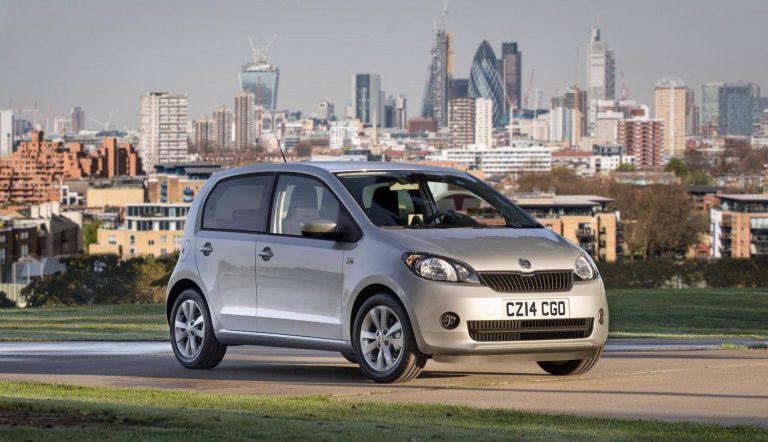
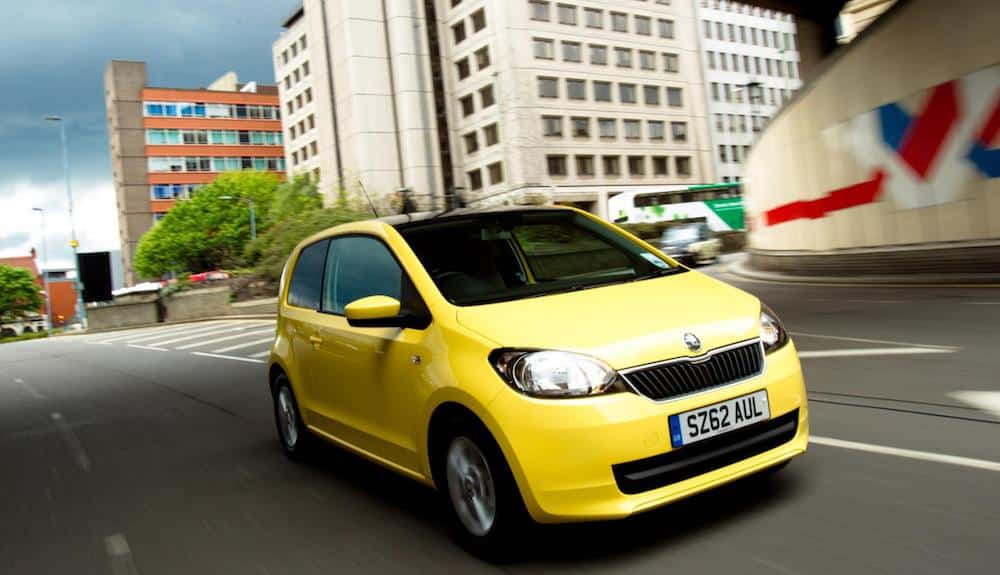
Skoda Citigo - winner, safest used first car 2017

Although the Skoda Citigo is essentially identical to the SEAT Mii and Volkswagen up!, the Skoda won out by virtue of having better availability than the SEAT, a lower market price than the Volkswagen, and better availability of autonomous emergency braking (AEB) technology.

AEB is optional on all of three models, but the judges found that there was better availability of this life-saving technology on the used Citigo models in the marketplace compared to the up! or Mii.

The Thatcham/Co-op ranking applies to any model in the Citigo range, as the car has only been on sale for a few years. It has a five-star rating from Euro NCAP (although the actual model tested was a Volkswagen up!).

Next page: The Skoda’s stablemates take podium places

UK car production continues to fall in May

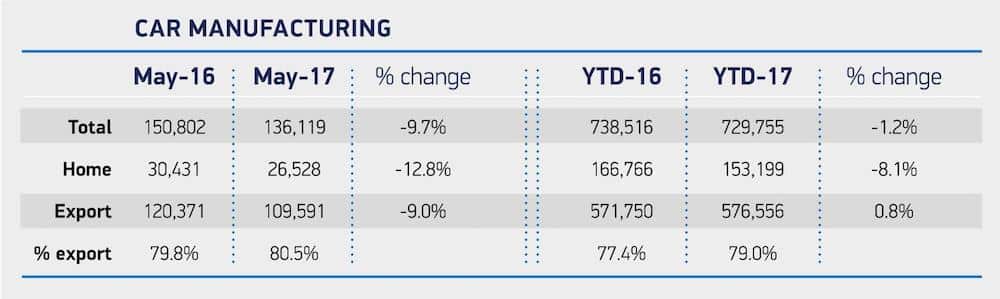
Figures released by the Society of Motor Manufacturers and Traders (SMMT) show that UK car manufacturing fell just under 10% in May. A total of 136,119 cars were produced, which was the second significant year-on-uyear decrease in a row after April saw production plummet compared to 2016.

Production for the domestic market fell 12.8% in May, continuing the overall trend for 2017, with year-to-date results down 8.1%. In total, 153,199 of the cars manufactured this year have found their way to UK showrooms.

Table showing overview of car manufacturing in May

Overseas demand has been driving UK car manufacturing in 2017. Since January, 576,556 new cars have been exported, representing a 0.8% year-on-year increase. However, May saw production for overseas markets fall 0.9%.

Mike Hawes, SMMT Chief Executive, noted: “After a record start to the year, car production in the UK has slowed, yet global demand is strong and exports remain the driving force for British car production volumes in the UK.”

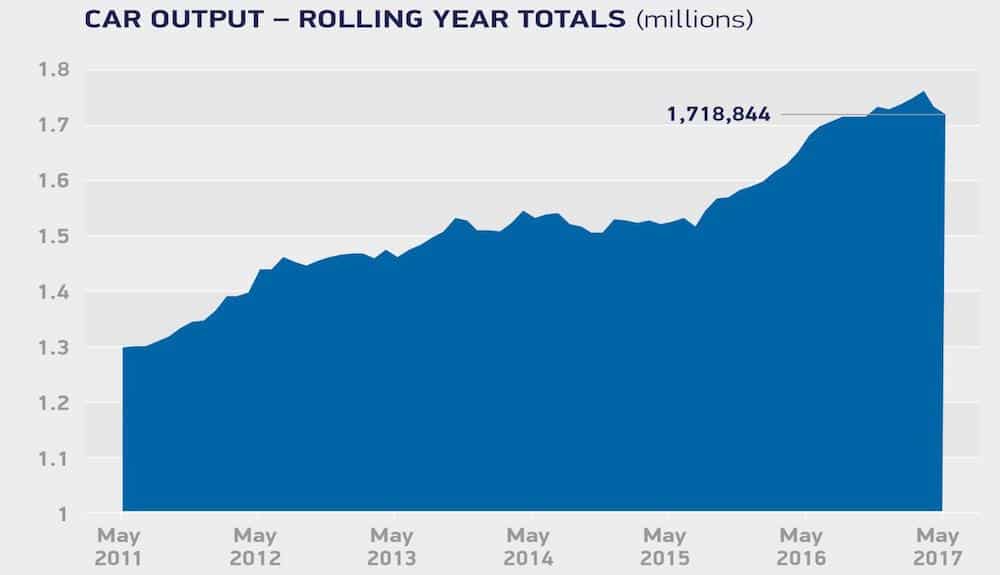
May 2017: graph of rolling year totals
Nearly 730,000 new cars have been made in Britain this year

Jaguar XE SV Project 8 blasts into Goodwood

The new Jaguar XE SV Project 8 is the second limited edition model from the marque’s Special Vehicle Operations (SVO) department.

Following on from the F-Type Project 7, which was unveiled in 2014, Project 8’s ambition is to deliver a four-door saloon delivering supercar performance. Unfortunately for British fans of a British car company, the most powerful Jaguar road car ever made will only be built in left-hand drive.

The XE SV Project 8 is powered by a 600hp version of JLR’s 5.0-litre supercharged V8 engine, producing a top speed of 200mph and a 0-60mph time of 3.3 seconds.

Customers can choose from two specifications: the standard four-seater model or an optional two-seater Track Pack edition with carbon fibre racing seats.

300 examples of the XE SV Project 8 will be built, and will be the first model to be assembled by at the new SVO Technical Centre in Coventry.

The Jaguar XE SV Project 8 is making its debut this weekend at the Goodwood Festival Speed, with UK pricing starting from £149,995.

Rear view of Jaguar XE SV Project 8
The Project 8 will be the lightest V8 sedan in the Jaguar range