




Electric vehicle technology is improving rapidly. New models generally offer longer driving ranges, faster public charging and more efficient batteries than their predecessors from just a few years ago.
As the technology develops, manufacturers are also finding new ways to use the large batteries fitted to electric cars. One of the most anticipated developments is bi-directional charging, which allows an EV’s battery to do much more than simply power the vehicle.
Instead of electricity only flowing into the battery when the car is charged, bi-directional charging allows energy to flow back out again. That means an electric car can potentially help power your home, run electrical equipment, charge another EV or even supply electricity back to the grid.
Think of it as turning your electric car into a large portable battery that can be used for more than just driving.
For many buyers, bi-directional charging won’t be a deciding factor today. But as the technology becomes more common, it could become an increasingly useful feature when choosing an electric car.
How does bi-directional charging work?
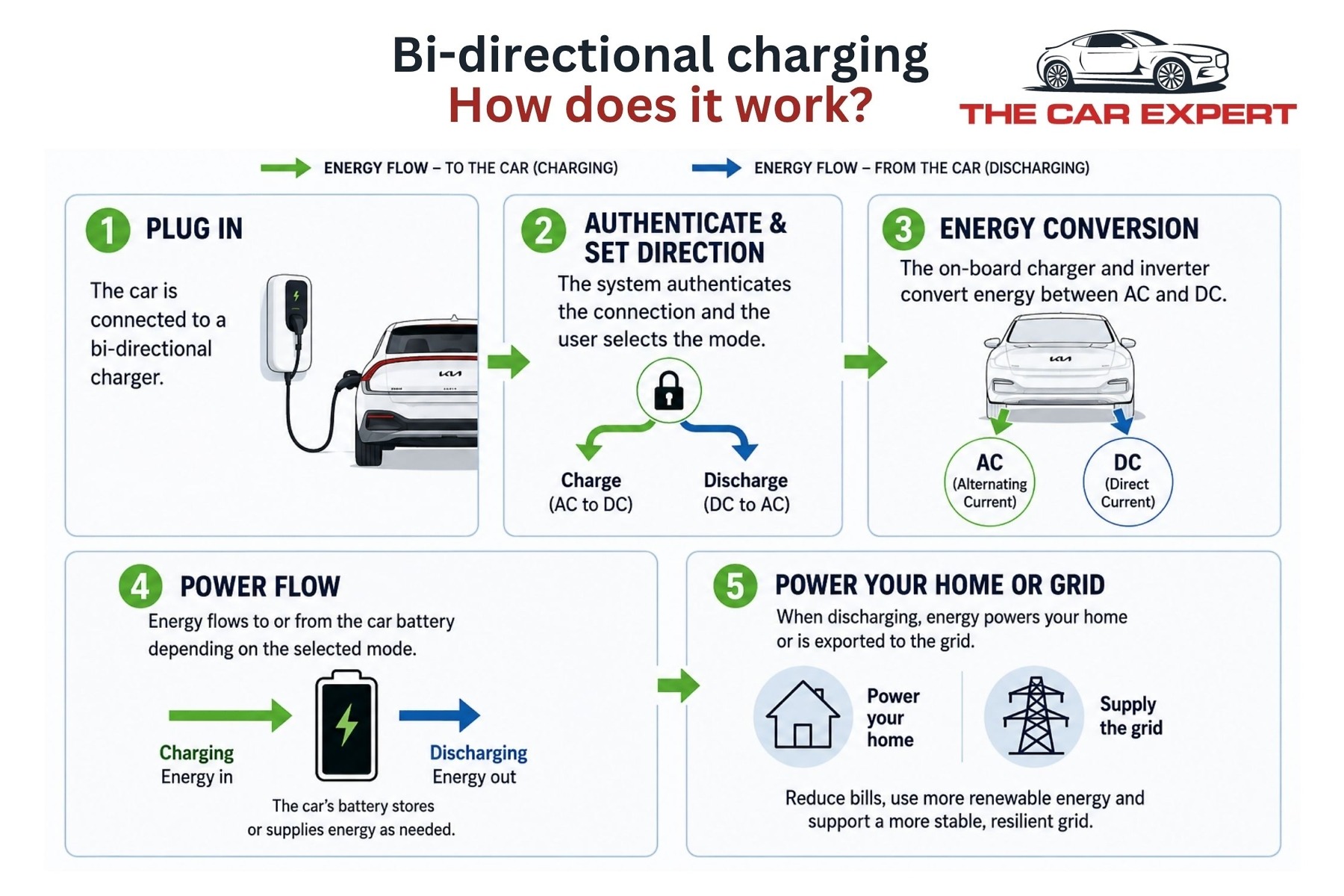
Normally, electricity flows one way – from the charging point to the battery in your electric car. You charge the battery and then use that stored energy to power the car.
Bi-directional charging changes that by allowing electricity to move in both directions. The energy stored in the battery can be used to supply power elsewhere when it’s needed, rather than sitting unused while the car is parked.
To make this possible, specialised equipment converts the vehicle’s direct current (DC) electricity into the alternating current (AC) used by homes and most electrical appliances. The reverse process happens when you charge the vehicle.
The result is that the battery can become a flexible source of power for a range of different uses, which we’ll explore below.
What can bi-directional charging be used for?
The collective name for these applications is V2X, which stands for Vehicle to Everything.
While that sounds technical, the concept is fairly straightforward. It simply describes the different ways electricity stored in an EV battery can be used outside the vehicle itself.
There are four main types of V2X charging.
Vehicle to Home (V2H)
Vehicle to Home allows electricity stored in your car’s battery to be used by your house.
For example, you could charge your car overnight when electricity prices are lower, then use some of that stored energy during more expensive peak periods. It could also provide a useful backup source of electricity during a power cut.
For some households, this could become one of the most valuable uses of bi-directional charging.
Vehicle to Load (V2L)
Vehicle to Load is currently the most common form of bi-directional charging fitted to new electric cars.
It allows the vehicle to power electrical equipment directly from the battery. That might be something as simple as a kettle, camping stove or portable lighting while you’re away from home.
It can also be useful for tradespeople and remote workers who need to power tools or equipment where a conventional electricity supply isn’t available.
For many owners, this is likely to be the V2X feature they use most often.
Vehicle to Grid (V2G)
Vehicle to Grid allows electricity stored in an EV battery to be sent back to the local electricity network.
This can help energy suppliers balance demand on the grid during busy periods, making better use of available electricity supplies.
Depending on the energy provider and tariff, owners may also be able to receive payment for returning electricity to the grid.
While the technology is still developing, many in the energy industry see V2G as one of the most important long-term uses for electric vehicle batteries.
Vehicle to Vehicle (V2V)
Vehicle to Vehicle charging allows one electric car to transfer electricity to another.
The idea is simple. If one vehicle is running low on charge, another compatible EV could provide enough electricity to help it continue its journey.
It’s similar in principle to using jump leads to help start a petrol or diesel car with a flat battery, although transferring energy between EVs takes considerably longer.
While V2V is not yet a common sight on British roads, it has the potential to make range anxiety less of a concern for some drivers.
Which cars offer bi-directional charging?
Bi-directional charging is still not available on every electric vehicle, but the number of compatible models is steadily increasing.
Examples include:
- BYD Atto 3
- BYD Seal
- Cupra Born
- Geely EX5
- Most Genesis models
- Hyundai Ioniq models
- Mitsubishi Outlander
- Nissan Leaf
- Volkswagen ID. models
Not every vehicle supports every type of V2X charging, so it’s worth checking the specification carefully if this feature is important to you. A dealer should be able to confirm exactly what a particular model can do.
Should you look for bi-directional charging?
That depends on how you plan to use your electric car. If you simply need an EV for everyday driving, bi-directional charging may not be high on your priority list. But if you’d like your car to power appliances, support your home during a power cut or potentially earn money by supplying electricity back to the grid, it could become a useful extra feature.
At the moment, bi-directional charging remains relatively uncommon. But as battery technology improves and more manufacturers introduce the capability, it’s likely to become a much more familiar part of electric vehicle ownership.
For now, it may be a nice bonus. In a few years’ time, it could be something many EV buyers expect as standard.
Read more: