Make and model: Nissan Micra
Description: Small electric hatchback
Price range: from £22,995
Summary: The new Nissan Micra is efficient, comfortable and easy to live with, but it struggles to give buyers a clear reason to choose it over the closely related Renault 5.
The new Nissan Micra is back, but not quite in the way you might expect. This is the sixth-generation Micra, and for the first time it’s only available as an electric car. Also for the first time, it’s basically a Renault – specifically the electric Renault 5 E-Tech, with Nissan adding its own front and rear styling, some software changes and a different cabin finish.
That’s not necessarily a problem, since the Renault 5 is proving very popular. The basic ingredients are good and it trades heavily on its retro-inspired styling that harks back to the original Renault 5 of the 1980s. The Micra carries over those basic ingredients, being small, efficient, comfortable and competitively priced, with enough real-world range to make longer trips less stressful than you might expect from a small EV.
But it also leaves the Micra with a slightly awkward identity problem. In isolation, it’s a good little electric car. Put it next to the Renault 5, however, and it’s harder to see why you’d choose the Nissan.
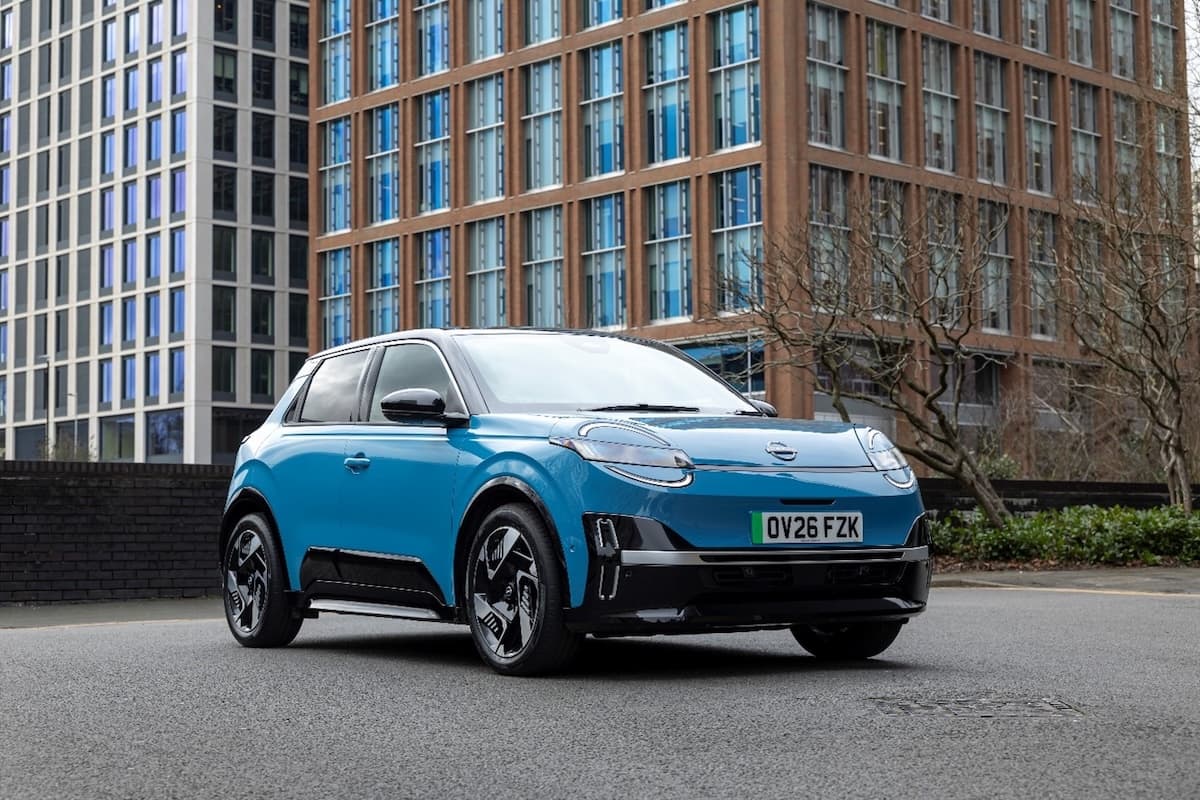
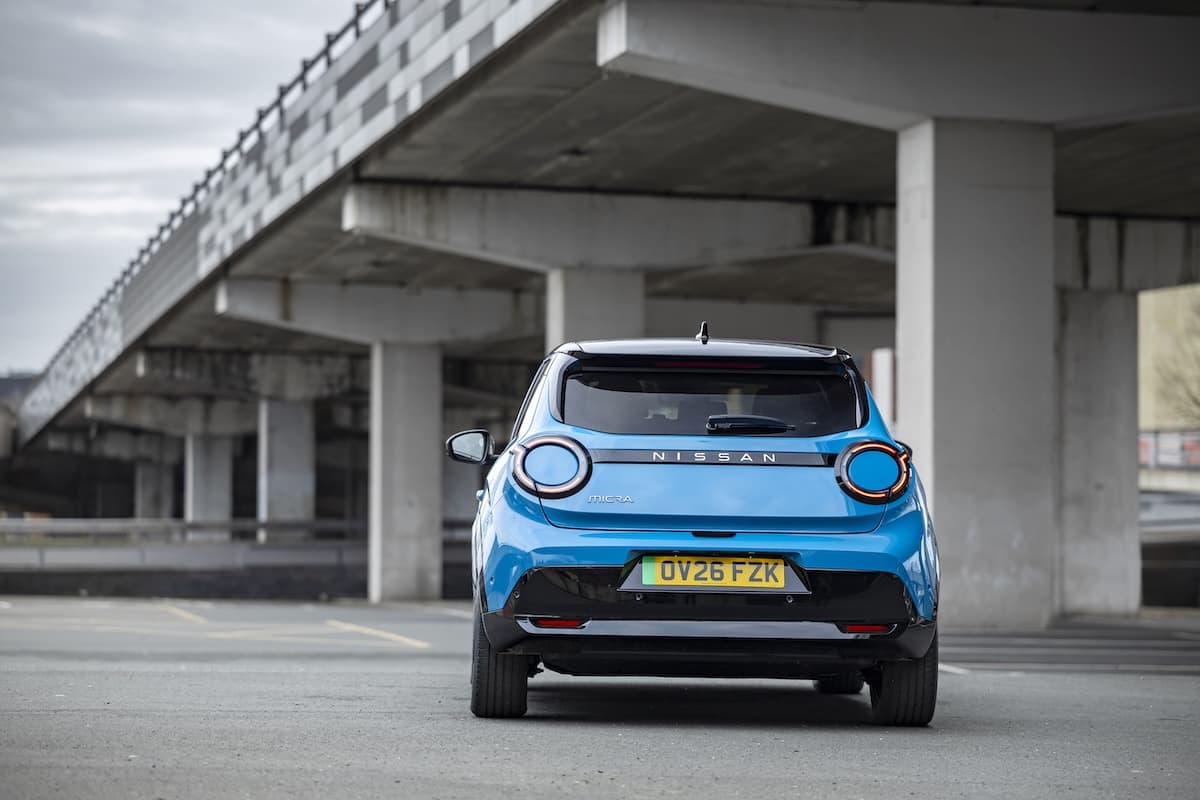
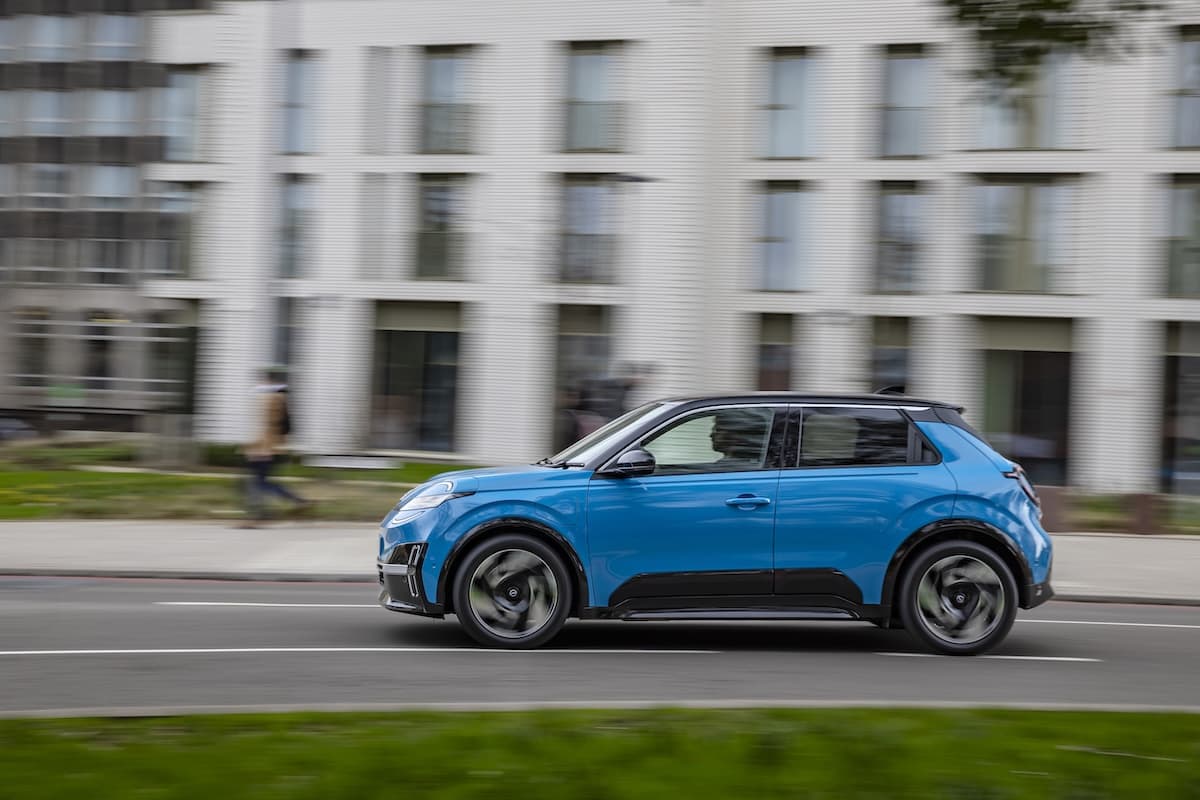
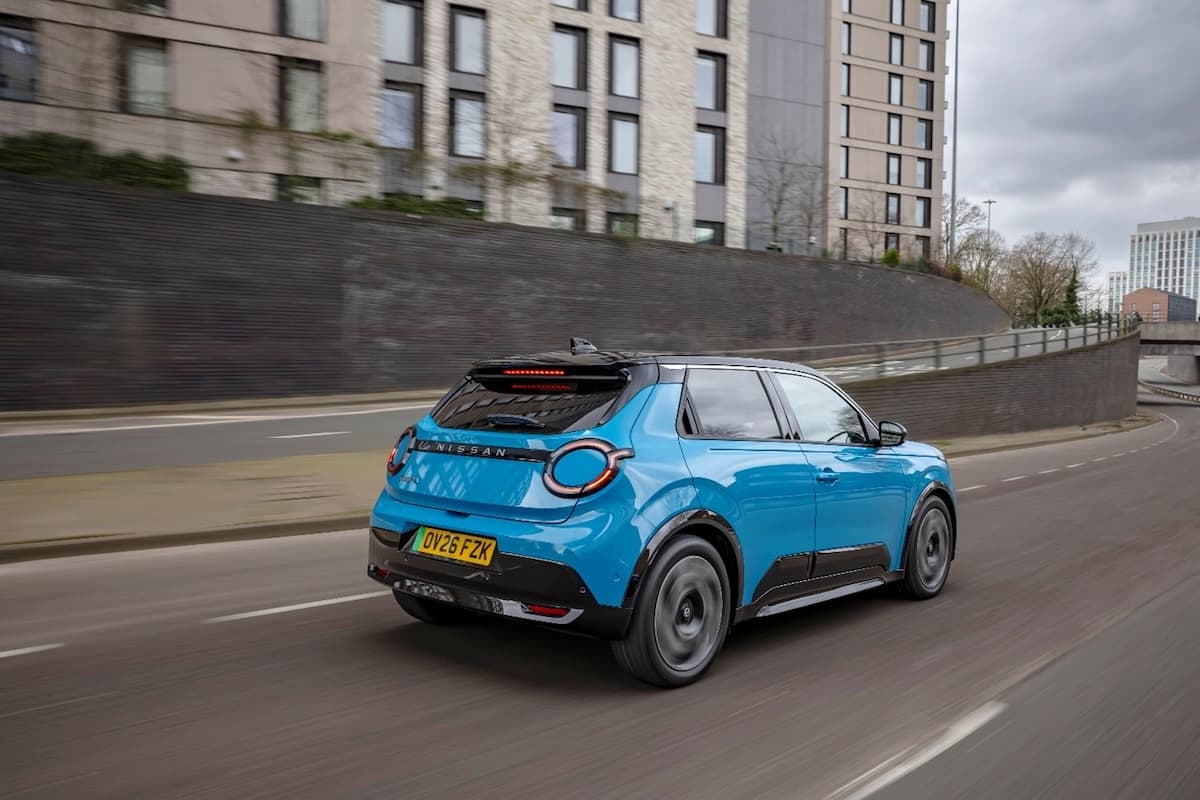
Our test car was the top-spec Nissan Micra Evolve with the 52kWh battery, finished in blue with a black roof. That means it had the longer-range battery, 150hp motor, Harman/Kardon sound system, heated front seats, heated steering wheel and Nissan’s more advanced assisted driving system.
Price and equipment
The Nissan Micra range starts with the 40kWh Engage, priced at £23K before the current EV grant, or £21.5K with the grant applied. That entry-level model gets 120hp, an official driving range of up to 196 miles and public charging at up to 80kW.
The 40kWh battery is also available in Advance trim, while the larger 52kWh battery is offered on Advance and Evolve versions. The 52kWh model has 150hp, an official driving range of up to 257 miles and public charging at up to 100kW. At the top of the range, the 52kWh Evolve is priced a little under £30K before the grant, just over £26K with the grant applied (it gets a larger £3,750 grant, compared to a £1,500 grant on the smaller-battery models).
Standard equipment across the range includes automatic climate control, a heat pump, wireless Apple CarPlay and Android Auto, remote services, keyless start and several safety systems. Advance adds the stronger technology package, including dual ten-inch displays, Google built-in, a rear-view camera, adaptive cruise control, blind spot monitoring, rear cross traffic alert, wireless phone charging and adjustable brake regeneration.
Evolve adds the nicer cabin finish, heated front seats and steering wheel, more advanced assisted driving, and the Harman/Kardon audio system. That was the version we tested, and the stereo is decent enough to feel like a worthwhile upgrade at this price point.
The pricing is competitive, especially with the current grant applied. But again, the problem for Nissan is that the Renault 5 is priced in the same territory and has the stronger retro appeal, so the Micra doesn’t really offer a compelling alternative.
Inside the car
The Micra looks bigger in the metal than it does in photos. It’s also taller than expected, which is not unusual for a small electric car because the battery sits under the floor and the occupants sit above it.
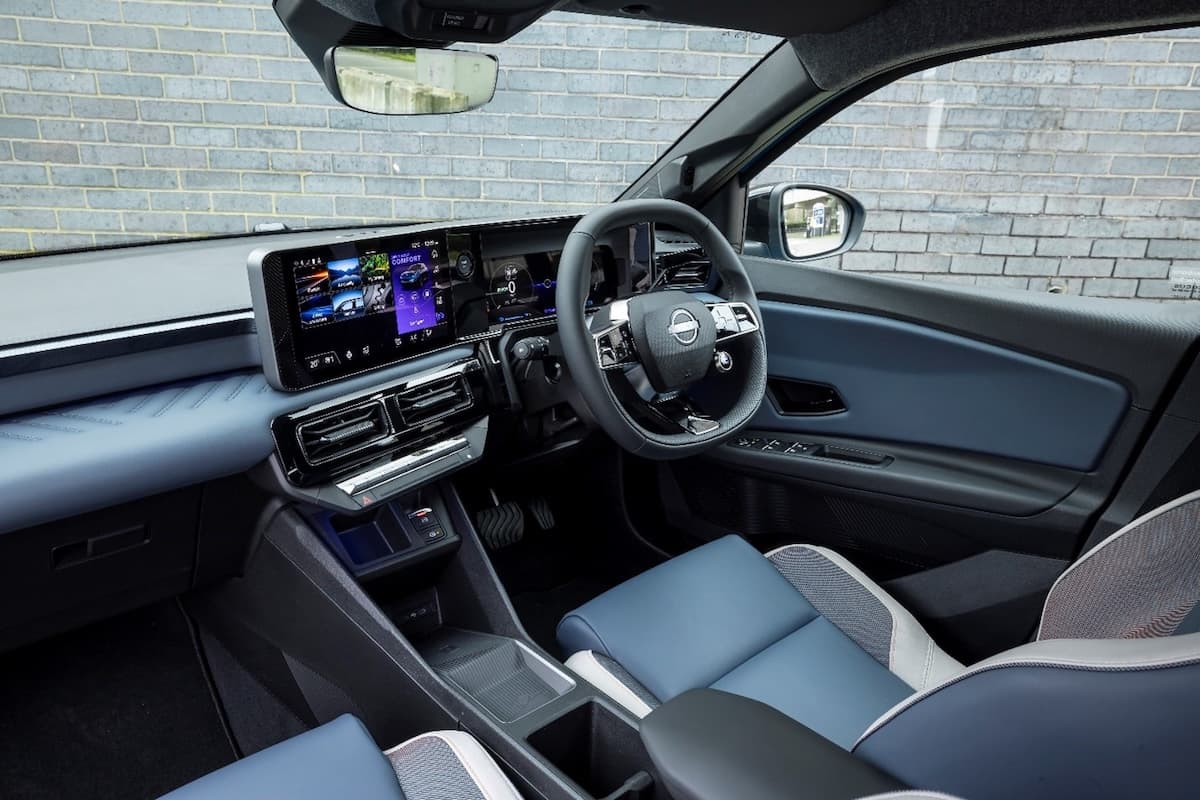
The cabin is nicely designed and has more colour than many small cars. Our test car mixed dark blue, light grey, dark grey and black, which made a welcome change from the usual monotone interiors. There was no sunroof, and the black headlining made it feel a little cave-like at times, but the overall impression was better than several other cars we’ve driven recently.
Cabin quality is good, too. The Micra doesn’t feel cheap inside, and the front seats are comfortable and supportive. We drove a 500-mile round trip from Surrey to Liverpool and back the next day, and the Micra remained perfectly comfortable throughout.
The rear seats are less impressive. Rear cabin space is surprisingly cramped for an EV, especially legroom. We carried two adults in the back for a short distance and had to move the driver’s seat uncomfortably far forward to make enough space behind. For a driver a little under six feet tall, that’s not ideal. It’s okay for the odd short journey, but wouldn’t be acceptable on a regular basis.
The boot is reasonable rather than exceptional. Nissan quotes 326 litres with the rear seats up and 1,106 litres with them folded, which is fine for a small hatchback but nothing more. There’s also no frunk (front trunk), so charging cables have to go in the main boot with your luggage.
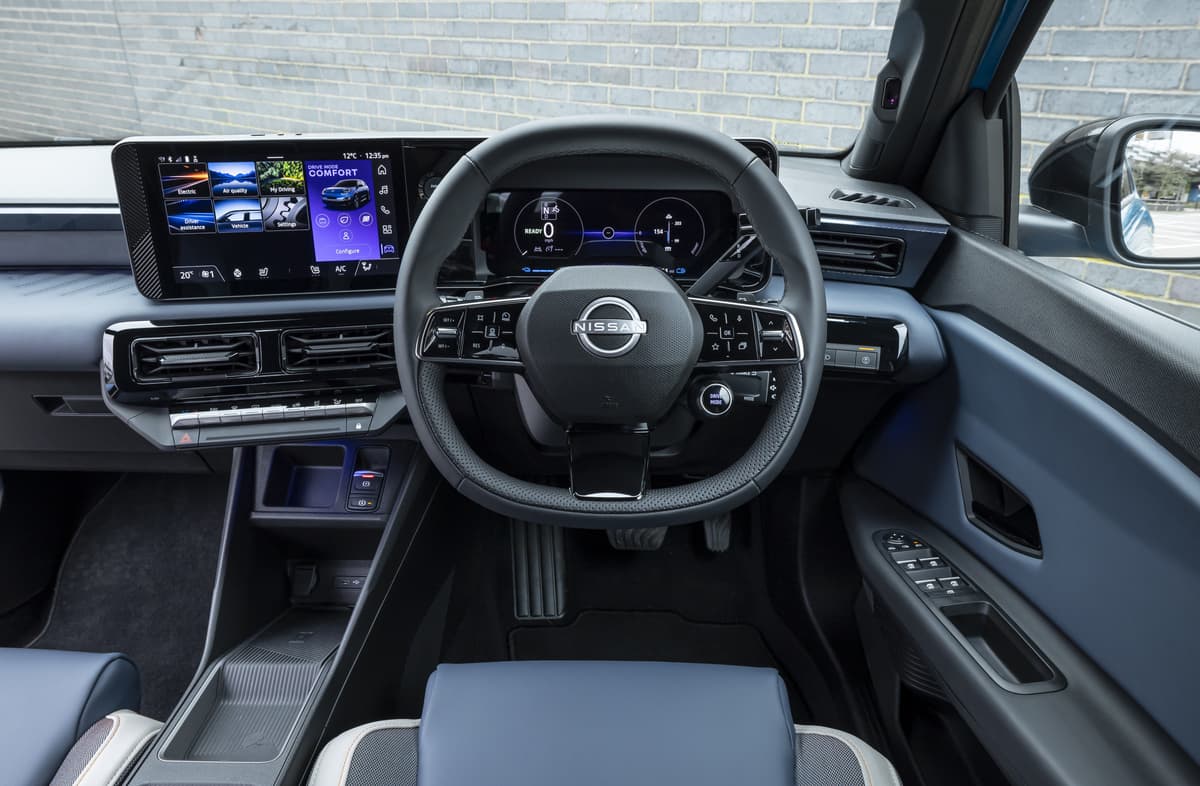
The screen layout is one of the better parts of the cabin. It’s easy enough to read, well positioned and within easy fingertip reach. It’s also quite refreshing not to have an oversized central screen that stretches halfway across the dashboard, as we’re now seeing in many new Chinese cars. Physical air-conditioning controls are also welcome, because basic heating and ventilation settings should not require touchscreen menus.
The main ergonomic problem is the column stalk layout. The Micra has four stalks, with three on the right-hand side for the gear selector, wipers and stereo controls, plus one on the left for indicators and lights. On several occasions we hit the wipers when trying to select drive or reverse. You’d get used to it eventually, but there’s no need for that kind of ridiculous clutter around the steering column. Inevitably, the Renault 5 has the same problem.
The steering wheel position is also a little odd. It feels too high, but lowering it can block part of the driver display. Between that and the overstuffed column stalk layout, driving ergonomics clearly aren’t a Renault/Nissan strong point.
Driving range and charging
The Micra is available with two batteries. The 40kWh model has an official driving range of up to 196 miles, while the 52kWh model increases that to up to 257 miles. Public charging is rated at up to 80kW for the smaller battery and up to 100kW for the larger one. Nissan quotes a 15-80% public charging time of about half an hour for both versions.
Our test car used the larger 52kWh battery. Over a week of driving, including about 500 miles of motorway use, it averaged 4.4 miles/kWh. That’s good, although it’s also fair to point out that the Micra is a small hatchback rather than an SUV, so it should be efficient.
Motorway range was better than expected. A Surrey-to-Liverpool journey of around 250 motorway miles was always likely to need a charging stop, but electrical consumption at 70mph and above was much better than in some other EVs we’ve driven.
The range display was also pleasingly accurate, tending towards pessimistic. Rather than watching the predicted range fall rapidly once we joined the motorway, we often saw it improve as the journey went on. That’s exactly what you want from an EV on a longer trip.
The built-in Google navigation is useful as well. It can plan charging stops along a route, update them if traffic forces a diversion, and suggest a later charging stop if your driving is proving more efficient than expected. For long EV journeys, that’s a strong reason to use the car’s factory navigation rather than defaulting to Apple Maps or Android Auto-based Google Maps.
There is a privacy problem, though. The Google-based system requires you to share personal data to use key functions, and trying to create a profile without doing so proved impossible. I repeatedly ended up in a permission loop that kept returning to the same consent screen, and I couldn’t even use Apple CarPlay without giving Google access to all my personal data (Apple famously not belonging to Google…). The only way to exit the loop was to switch the car off, lock it, walk away, then come back and start again. Eventually I gave up and just used the default profile that came with the press car, but if it had been my own car then I would not be happy.
That’s poor form. Built-in Google services can be useful in an EV, but it should not be dependent on handing over personal data that’s not necessary for the car to function properly.
On the road
The Micra feels nippy and well suited to urban driving. The 52kWh model has 150hp and a 0-62mph time of eight seconds, which is enough for a small electric hatchback. The 40kWh version is less powerful, with 120hp and a nine-second 0-62mph time, but should still be fine for normal town and suburban use.
Longer trips were more convincing than expected. The Micra felt settled and quiet on the motorway, with little road or wind noise and good seat comfort over several hours. Many small EVs still feel at their best around town, but the Micra coped well with faster roads and longer distances.
Ride quality was also good, especially given that our car had big 18-inch wheels. It coped well with typically rubbish UK roads, and felt more comfortable than expected for a small car on relatively large wheels.
While it’s no hot hatch, the Micra feels quite enjoyable to drive with few frustrations. Unsurprisingly, it drives exactly like a Renault 5. That probably won’t bother many potential buyers. If you’ve never sat in a Renault 5, or you’re not especially interested in the shared engineering, you may simply find the Micra easy, quiet and comfortable. That’s a perfectly valid outcome.
Ownership
The Nissan Micra currently holds an A-grade rating in our unique Expert Rating Index, with a New Car Expert Rating score of 78%. It scores particularly well for media reviews, efficiency and predicted running costs, although its warranty score is held back by Nissan’s ordinary three-year/60,000-mile new car warranty.
Euro NCAP awarded the Nissan Micra four stars when it tested the car in November 2025 – based, unsurprisingly, on the Renault 5 it had tested previously. Like the Renault, the Micra performed reasonably well overall, but fell short of a five-star result because its safety assistance score was not high enough.
Running costs should be one of the Micra’s strengths. It proved efficient over a week that included a lot of motorway driving, and our Expert Rating data also shows strong electrical efficiency and affordable predicted ownership costs. The accurate range prediction and good route-planning tools also make it easier to trust on longer journeys.
The bigger question is whether buyers see it as a Nissan or simply as the Renault 5’s less retro twin. The Renault’s styling and nostalgia are clearly helping it at the moment, while the Micra may appeal more to buyers who prefer a less obvious throwback design.
Verdict
The new Nissan Micra is a good small electric car with a few irritating flaws. It’s efficient, comfortable, quiet and pleasant inside, with a useful range display and excellent route-planning support from the built-in Google navigation.
It’s also better over longer journeys than we expected. A 500-mile motorway-heavy round trip is a tough test for a small EV, and the Micra handled it well. The front seats stayed comfortable, consumption was good and the predicted range behaved sensibly.
But there are some real frustrations. Rear-seat space is tight, the column stalk layout is poor, the steering wheel position is not quite right, and the Google privacy experience needs rethinking. None of those things ruin the car, but they do chip away at its appeal.
The bigger issue is the Renault 5. The Micra is closely related, similarly priced and shares many of its strongest qualities, but it does not give buyers a particularly strong reason to choose the Nissan instead. In isolation, it’s a very good small EV. Park it next to the Renault, and the decision becomes much less clear.
We like:
- Excellent efficiency
- Comfortable front seats, even over long journeys
- Quiet and settled motorway manners
- Useful route planning for charging stops
- Nicely finished cabin with some welcome colour
We don’t like:
- No clear reason to choose it over the Renault 5
- Google privacy and permissions are frustrating
- Tight rear-seat space
- Poor column stalk layout
- Steering wheel position can block the driver display
Similar cars
BYD Dolphin | Citroën ë-C3 | Dacia Spring | Fiat 500e | Geely EX2 | GWM Ora 03 | Leapmotor T03 | Mini Cooper Electric | Peugeot e-208 | Renault 5 E-Tech | Vauxhall Corsa Electric | Volkswagen ID. Polo
Key specifications
Model tested: Nissan Micra Evolve 52kWh
Price as tested: £29,865 (not including government EV grant)
Powertrain: 52kWh battery and front-mounted electric motor
Gearbox: single-speed automatic
Power: 150hp
Torque: 245Nm
Top speed: 93mph
0-62mph: 8.0 seconds
Battery range: 257 miles
CO2 emissions: 0g/km
Euro NCAP safety rating: Four stars (November 2025)
TCE Expert Rating: A, 78% (as of July 2026)