Looking for vans, pick-ups and light commercial vehicles? Visit our sister site, The Van Expert.


The RAC has launched a new personal loan offer aimed at winning used car buyers away from the ever-increasing popularity of personal contract purchase (PCP) car finance.
Called Flexiloan, the payment structure of the loan mimics that of a PCP agreement, with low monthly payments followed by a large balloon. The RAC hopes that the product will appeal to car buyers who like the low monthly payments of a PCP but want greater control and flexibility over managing their finances.
The Flexiloan product is aimed at used car buyers rather than new cars buyers, with customers having to choose a car that is at least two years old (and no more than four years old). This is different from a normal personal loan application, where you can essentially spend the money however you like. The RAC says that this is to make sure that borrowers are choosing a balloon value that is appropriate for the expected value of the car at that time. It also hopes that Flexiloan will be extended to cars only a year old later this year. Mind you, given that the customer can sell their car at any time or even buy a different car once the money is in their bank account, this seems a bit pointless.
Like any personal loan, the funds are provided to the borrower directly, and you then pay the seller yourself. The car can be bought from a dealer or a private seller.
Borrowers can choose to manipulate the monthly payments and final balloon amount to achieve a balance that they are happy with. Unlike a PCP, there is no option to give the car back to the finance company at the end of the agreement, so you have to pay off the balloon one way or another. However, there is more flexibility to do that with the Flexiloan than there is with a PCP, and you can re-finance the balloon with the RAC if you don’t have the cash to pay it off (although this will presumably be at a higher interest rate).
Being a personal loan, the Flexiloan is a form of unsecured finance. That means that the finance company lends you the money and you use it to buy a car. The car is yours from day one, unlike a PCP or hire purchase (HP), which are secured loans and therefore the car does not truly belong to you until the last penny has been paid off. However, it also means that Flexiloan does not come with voluntary termination rights, so you can’t give the car back once you have paid 50% of the total amount payable like you can with a PCP or HP.
If your circumstances change and you need/want to sell the car, you are free to do so. You still have to pay back the finance company what you owe (which you can do with the money you got by selling the car), but the loan is separate from the ownership of the car. With a PCP, it’s not your car to sell so it is much more difficult to manage the situation if you need to get rid of the car before the end of the agreement.
The other major difference between a personal loan product and a PCP is that there are no requirements regarding annual mileage, servicing or vehicle condition – once again, it’s your car so you can do as many miles as you like, service it wherever you want, and not worry about dents and scratches.
Based on what has been offered so far, and from the RAC’s explanation, Flexiloan looks like a fairly niche product at this stage. There are several restrictions and limitations that will exclude most buyers, and the impression is that the RAC is using Flexiloan to generate attention for its overall finance programme.
One of the keys to the RAC’s likely success or failure with Flexiloan is likely to be how competitive they can be on their interest rates. The advertised example on the RAC website is 12.9% APR, which is very high compared to other personal loan providers. The quote calculator uses an 8.9% APR to come up with its predicted numbers, which it claims is the representative rate (which means that at least half of customers can expect to be offered that rate).
Meanwhile, the RAC’s eternal rivals over at the AA are offering personal loans from only 3.1% APR for AA members. That means you will be paying hundreds, or even thousands, of pounds more in interest on a Flexiloan and not saving that much on your monthly payments (plus you have to pay off the balloon at the end). A representative from the RAC rather sniffily criticised lenders offering low interest rates, claiming that those lenders reject a very high number of applicants in order to preserve the advertised rates.
The RAC is clearly targeting dealer-provided finance, however, and used car PCPs tend to have interest rates that are comparable to those advertised examples for Flexiloan. Used car PCPs are usually offered at more than 10% APR, although you are normally able to negotiate the rate by a percentage point or two.

What is it?
The Alfa Romeo Giulia is the Italian brand’s latest mid-sized saloon, competing in the most competitive sector of the premium market.
Key features
Bold styling, rear-wheel-drive, all-wheel-drive top model
Our view
The Alfa Romeo Giulia maintains much of the reputation long held by the Italian brand, being a very stylish, sporty contender but with a host of minor irritations that take the edge off its appeal.
However, the car offers enough to make it worthy of consideration for those wanting something different to the mass-selling mostly German rivals such as the BMW 3 Series and Audi A4.
Its diesel engines, in particular, feel pacey but return impressive economy and emissions. On the road, it displays impressive ride quality, while still driving like a sporty car. And it offers a good selection of standard equipment with an impressive standard safety package.
Similar cars
Audi A4, BMW 3 Series, Mercedes-Benz C-Class
There is quite a lot riding on the success of the Alfa Romeo Giulia. The Italian brand has always considered itself a premium player, pitching itself against the might of the German badges of Audi, BMW and Mercedes-Benz.
Problem is, competing against these brands means taking on the all-conquering Audi A4, BMW 3 Series and Mercedes-Benz C-Class. And Alfa hasn’t been doing that since 2011, when the not exactly earth-shattering 159 was discontinued.
In that time not only have the Germans upped their game, but British pretender Jaguar has carved itself a place with the much-admired XE. The Alfa Romeo Giulia, reviving one of the Italian brand’s most classic badges not seen for close on four decades, faces pretty tough competition.
On paper, there is much to breed optimism. Firstly, the car looks the part. Built on the same brand-new platform as the Stelvio SUV, it offers sharp, purposeful proportions, with a very attractive version of the deep plunging vee-grille that really makes one wish that front registration plates were not mandatory in the UK. Its distinctive profile will certainly stand out amongst a sea of 3 Series and A4 clones.
That platform is also rear-wheel-drive, with an all-wheel-drive big-engined top model available too. This suggests that the Giulia should have the performance to go with the visual promise.

Potential buyers of the Alfa Romeo Giulia are not short of choice – the range includes five engine options from frugal to frantic, all of them we are told new units, and six trim levels.
The majority of customers are likely to be driving the Giulia as some form of company car, so two versions of a 2.2-litre turbodiesel form the core of the range, with either 150 or 180hp on tap.
With the increasing shift to petrol, Alfa Romeo will no doubt be glad that the Giulia range includes a 2.0-litre unit with 200hp, along with the 280hp 2.0-litre unit exclusively offered in the Veloce model.
The range-topping Quadrifoglio, meanwhile, is a serious performance machine. The Quadrifoglio employs a 2.9-litre V6 bi-turbo petrol engine of some 510hp, along with 600Nm of torque and all-wheel drive. Such potency propels the Giulia into the very exclusive climes of the sub-four second club, achieving 0-62mph in 3.9 seconds.
Sadly there is just one transmission available, an eight-speed dual-clutch automatic. While such gearboxes are normal in the executive market, the availability of a proper manual shift, particularly for the performance-pitched Quadrifoglio, would be desirable.
Giulia prices start from £29,875, which buys the entry-level 2.0-litre petrol car. An extra £1,700 gains the second level Super Trim, while the cheapest diesel, the 150hp variant in Super trim, costs £32,115.
At £33,315 the 180hp diesel Super is £1,200 more than its 150hp sibling. Both diesels are also available in Technica trim – which was formerly just £245 more than Super but since September 2017, weirdly, retails for £1,080 less! The 180hp version is also offered as a mainstream range-topping Speciale model at £35,515.
The Veloce sits above the rest of the range at prices from £38,260, while the Quadrifoglio, with its engine sourced from a little-known Alfa Romeo sister brand called Ferrari, has its own exalted status at prices starting from £61,595…
A definite highlight of the standard specification is the highly-awarded safety package. Autonomous emergency braking is included on all cars, as part of a forward collision warning system that also encompasses pedestrian recognition. Also standard on all cars is lane departure warning, resulting in the Giulia not only gaining a five-star Euro NCAP safety rating, but also the best–ever score at the time for adult passenger protection at 98%.
Despite DAB digital radio, parking sensors and cruise control all being standard on the entry-level trim, Super is a preferable choice if budgets allow. The alloy wheels are 17-inch instead of 16, the seats gain leather bits and notably, the centre console screen grows from six inches to almost nine, and includes navigation.
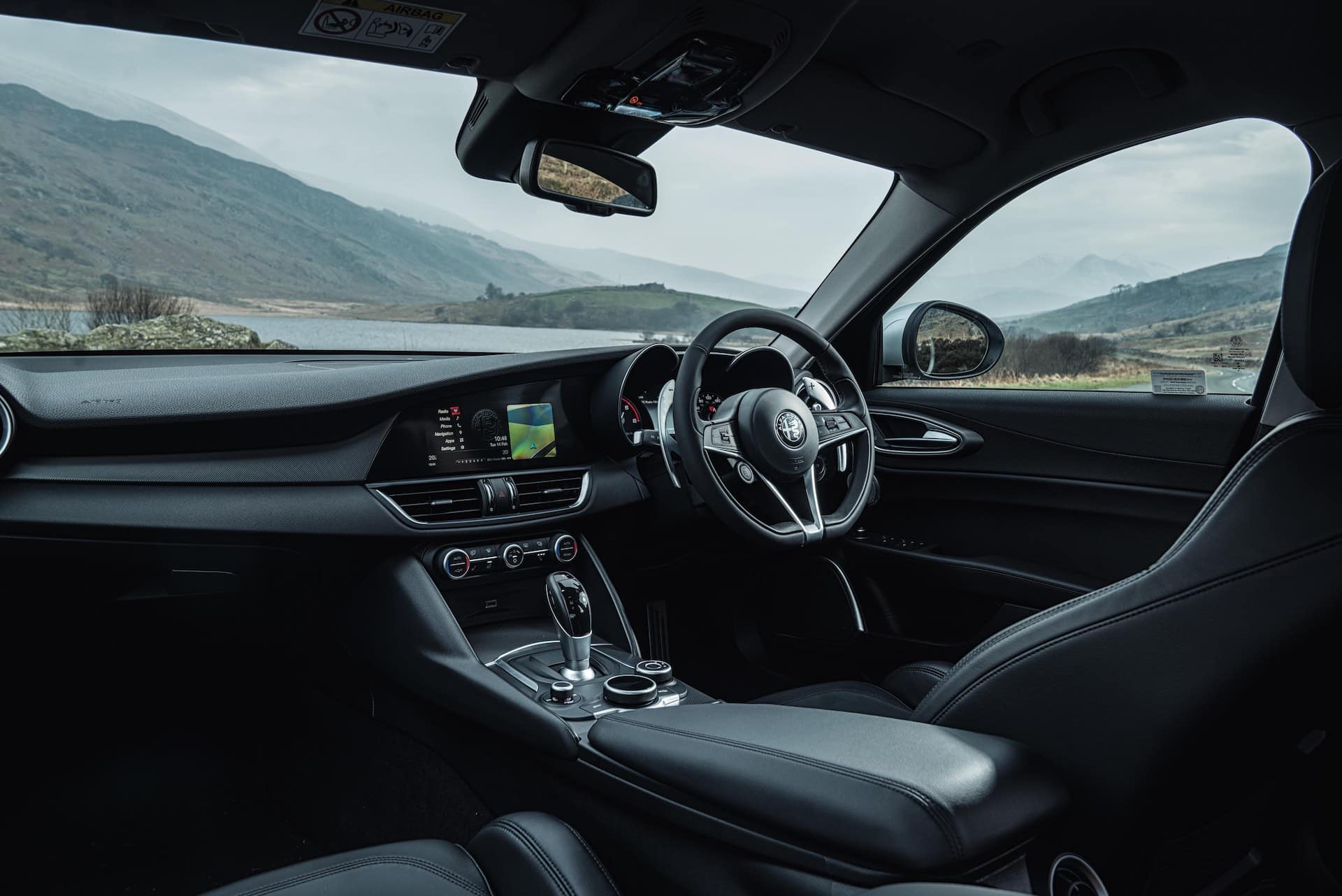
Generally, the Giulia is spacious inside with a good-sized boot, though it is much more a four-seater than five-seater. The slope of the rear roofline might also prove slightly uncomfortable for taller occupants in the back seats.
Alfa Romeo has always been known for style and the Giulia interior certainly meets the brief. For a start, it’s quite minimalist, with no host of buttons and switches complicating matters, just the controls one needs.
The dash and instrument panel look as though they have been crafted, with lots of pleasing swoops, deep-set binnacles for the instruments and the like, and all slightly angled towards the driver’s position. Particularly impressive is the infotainment screen, contained behind a big glass panel that makes it appear truly integrated with the car, much more so than those on German rivals.
The trouble is, while maybe not so stylish, the interior fit and finish on those German rivals feels more solid than does the Alfa’s. And the Italian contender irritates in lots of little ways. The switches and knobs do not quite feel as decisive in action, even though the big rotary dial that controls most of the infotainment functions is quite easy to use. And that screen might look good at rest, but is less impressive in action, the graphics, in particular, a bit ‘last generation’.

Our test car is diesel powered and the immediate question when choosing the oil burner is 150hp or 180hp? The only relevant factor is cost.
At 7.1 seconds the more powerful engine is 1.1 sec quicker to 62mph than its less potent sister – yet it quotes the same combined cycle fuel economy and CO2 emissions. Both of these are impressive at 67.3mpg and 109g/km respectively.
This efficiency by no means restricts the car’s performance appeal. Alfa Romeo has a reputation for pace and the diesel engines maintain it. While a little noisy at idle, the engine in our test car quickly evens out under acceleration and feels as swift as it is.
The lack of a manual gearbox is a shame, but the eight-speed auto is very efficient and smooth. And if you really must shift yourself, on all models above the entry-level Giulia the spec does include steering wheel paddles.
Playing its part to the full is the chassis. To succeed in this market the Giulia must take on the epitome of on-the-road excellence that is the BMW 3 Series, and it does a very good job of it. The chassis is slightly on the stiff side, but this does not transmit itself into the cabin, and miles of motorway progress will not leave occupants fatigued.
In corners, the Giulia’s power steering is rapid to the touch, perhaps too much so, which does lead to corrections when cornering enthusiastically. However, the body stays upright and never feels any less than totally stable.
In many ways the Giulia is a typical Alfa Romeo – it is chock full of the style that the Italian brand does so well, while also retaining many of the minor irritations that seem to be equally reminiscent of this badge.
However, the Giulia also offers enough to allow one to overlook its little foibles. Its diesel engines, in particular, feel pacey but return impressive economy and emissions. On the road, it displays impressive ride quality, while still driving like a sporty car.
The Alfa Romeo Giulia will never be as numerous in the company car park as the mass-selling German machines – and that could make it an appealing option, especially for the fleet driver looking for something just a little different.

What is it?
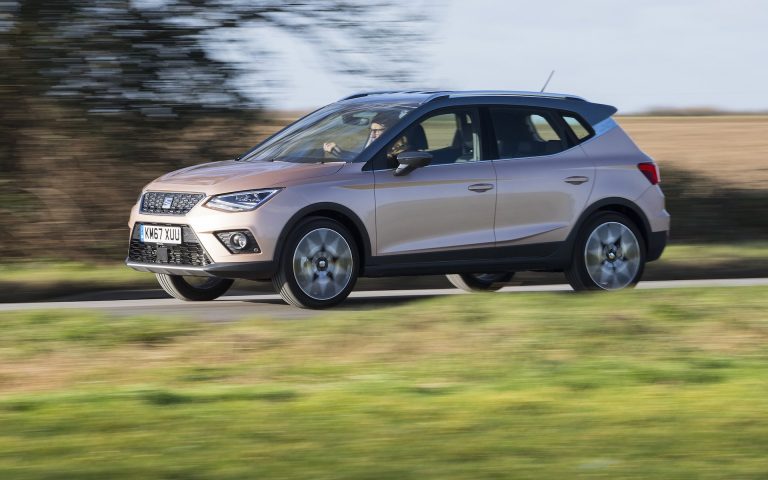
The SEAT Arona is the brand’s second and smallest SUV, competing in a mushrooming market.
Key features
Distinctive styling, competent on-road performance, extensive standard safety package
Our view
The SEAT Arona is a distinctive addition to a market of many similar vehicles. It matches the best of its rivals for practicality, quality and equipment, but it adds a quality driving performance that many of those rivals lack.
This is a highly accomplished small SUV and should become one of the biggest sellers in the sector.
Similar cars
Citroën C3 Aircross, Hyundai Kona, Nissan Juke
After a 2017 in which every second new car tested appeared to be a small SUV, 2018 starts in a similar fashion. Latest to enter this now so crowded market is the SEAT Arona, but the Spanish brand remains convinced it can take a slice of the action with only its second SUV.
The optimism is perhaps well founded. SEAT’s first SUV, the Ateca, launched in the autumn of 2016 and there has been a waiting list for them ever since.
Partly as a result, SEAT’s UK reputation is rocketing, sales up 18% in 2017, in a market that overall slipped more than 5%. And it is easy to see why everyone wants to launch into the small SUV market, when demand for such cars has blossomed by 30% in just two years.
SEAT appears to be the guinea pig for Volkswagen Group chassis – always the first of the four brands to launch a model on new underpinnings. So it is with the Arona, which uses the MQB O platform – this debuted under the latest SEAT Ibiza supermini launched in 2017. VW plans its own small SUV on the platform, the T-Cross, but we won’t see that until later in the year.
Why is MQB O important? Because it is versatile, and light, which all adds up to a more efficient car, and one able to offer a lot more space inside, particularly in the rear seats and the boot.
Being a SEAT, however, the new model has to maintain the brand’s reputation for more distinctive looks, and a dash of style is sorely needed in a market sector that is gaining many innocuous members not very distinguishable from each other.
The Arona is certainly not innocuous – its visual appeal doesn’t quite go as radical as, say, the Citroën C3 Aircross, but it is certainly purposeful. The exterior styling is clearly related to its larger sister the Ateca, with sharp lines and muscular creases giving the car more presence than several of its ever-growing numbers of rivals.

The SEAT Arona follows the modus operandi for the segment to the letter. It is a car compact on the outside and spacious within, with the high-up driving position that is one of the prime appeals to the growing numbers of small SUV buyers.
The car goes on sale with a five-strong engine line-up, that will be familiar to anyone that knows the Volkswagen group – the range is almost identical to that offered in the new VW Polo supermini that we tested only a week before the Arona.
Three petrol units are expected to command the vast majority of sales – particularly as almost three-quarters of Arona buyers will be paying for the car themselves rather than driving it as a company vehicle. The choices are a three-cylinder 1.0-litre unit with either 95 or 115hp, and a 1.5 of 150hp. Those who want diesel can choose between 1.6 engines with 95 or 115hp.
The 95hp units, petrol or diesel, are supplied with five-speed manual gearboxes, a six-speed version standard across the rest of the range, though the 115hp petrol unit can also be had with a seven-speed automatic transmission. And as is the norm in this market, this is an SUV with off-roader styling but no all-wheel-drive option – SEAT says there isn’t a market for it.
Where the Arona does depart radically from the norm is in its trim levels. We’ve all heard about the ‘trend to personalisation’ resulting in sometimes hundreds of equipment and colour combinations on offer. Well, SEAT says that its research suggests buyers are being overwhelmed by such choices.
So instead of a basic trim and a whole load of options on top, all of the Arona options have been grouped into six ‘Easy Trim’ packs, the idea being that you simply make three choices when buying the car – engine, colour and trim pack.
Effectively the extra specification that most customers choose is already loaded on – for example, all of the trim packs include metallic paint and a twin-colour roof. And this also affects the prices – while at first glance Arona prices might seem more expensive than rivals, they already include the extras that buyers of competing cars would have to add on top.
Particularly impressive is the Arona’s standard safety package. Autonomous emergency braking, with pedestrian recognition, is included on all cars, as is a speed limiter and hill hold, contributing to a top five-star Euro NCAP safety rating. Extra systems such as blind-spot detection and rear cross traffic alerts are offered further up the range.

The Arona is a spacious vehicle within, especially in the rear where the car comfortably outstretches recently launched rivals such as the Hyundai Kona.
While there are belts for three in the back, a trio of adults will be rather too cosy, but one should remember this is a supermini SUV – consider it a four-seater and it knocks virtually all rivals aside, both in legroom and especially headroom.
It’s not quite as versatile as some rivals – one can’t slide the rear seats, for example, to prioritise people or luggage space. But considering that as well as rear seat space the 400-litre boot is some 46 litres more than the segment-setting Nissan Juke, and 39 better than the equally-new Kona, the SEAT certainly impresses.
Once settled into a driving position that is not as high up as some rivals, the cockpit ahead will be familiar to anyone who has driven a SEAT Ibiza, being virtually the same. It’s practical, with quality controls, but the overall impression is dulled by an excess of cold, grey plastic.
The Easy Trim concept ensures that equipment levels are high, however. All cars, for example, come with a central touchscreen, and the five-inch version of the entry-level SE trim jumps to eight inches on every grade above.
Unless finance is scarce the SE, costing from £16,555 should be dismissed. The infotainment system on the second level, SE Technology, offers so much more for an extra £990, including navigation and Smartphone compatibility through the Apple CarPlay, Android Auto and Mirrorlink systems. Wireless smartphone charging and parking sensors are also included from this level.
Above SE Technology, the trims split dependent on whether one desires sporty (FR, FR Sport) or luxury (Xcellence, Xcellence Lux), the most expensive version being the Xcellence Lux with the 115hp diesel at £24,235.

At the launch event, The Car Expert drove the expected biggest-selling version of the Arona, the FR model with the 115hp petrol engine, and the more powerful 150hp TSI Evo variant.
The 115hp engine is well suited to its surroundings, and responds rapidly and smoothly. Its pulling power from low revs is impressive, almost diesel-like, and with no hint of coarseness unless worked very hard.
The larger unit is not surprisingly rather swifter, and turns the Arona into quite a performance SUV. But alongside the 1.0-litre, it seems an unnecessary extravagance.
One less impressive aspect of our cars was the manual gear shift – it felt surprisingly woolly for today’s market, encouraging a couple of mis-shifts.
A theme of all the recent small SUVs tested has been pretty uninspiring ride quality, but the Arona does rather better than most, at least the 1.0-litre version, which on the launch route was only unsettled by very uneven road surfaces.
The higher trims and bigger engine gain Dynamic Chassis Control, altering the suspension response, and the Drive Profile system, which switches the steering and throttle response between normal, eco, sport or individual modes. Alloy wheel sizes also increase from 17 to 18in, and all of this appears to combine very well.
The car’s cornering ability matches its ride comfort – it is well composed and precise, while not offering too much to excite an enthusiastic driver. However all things are relative, and again in its handling the Arona stands firmly above its rivals. It turns in as pointed, stays pleasingly upright and maintains high grip levels throughout a bend – definitely the most satisfying driving ability we’ve experienced on the recent crop of small SUVs.
SEAT came late to the compact SUV sector with the Ateca and immediately carved itself a sizable slice of the market. Now it looks set to do just the same in the smaller SUV market.
The SEAT Arona matches the best of its rivals in terms of space, quality and equipment. But in terms of its drivetrains and on-road performance it steps ahead of the competition – in a sector that is becoming known for practical vehicles that are only adequate on the road, it bucks the trend by delivering a satisfying drive.
The Arona is by no means the cheapest small SUV on the market, but it is one of the best, and will become a very significant model in the SEAT line up.



 The engine will be combined with an eight-speed ZF automatic transmission with a sport mode. A handling kit of beefed-up springs, dampers and roll bars will be added, and uprated brakes fitted behind 18-inch diamond-turned alloy wheels and 265/65 R18 all-terrain tyres.
The 70th Edition will be available in a choice of eight body colours, including a pair of satin finishes. Machined aluminium will also feature on the door handles, fuel filler cap and Defender bonnet lettering, along with bi-LED headlamps.
Inside the 70th Edition gains a full leather interior trim, applied to the dashboard, door panels, headlining and Recaro sports seats. A bespoke infotainment system from the Land Rover Classic department is also fitted.
Land Rover intends to offer the 70th Edition in both the 90 and 110 wheelbase lengths. All will be sold direct by Land Rover Classic, UK prices starting from £150,000 for a 90 version.
The engine will be combined with an eight-speed ZF automatic transmission with a sport mode. A handling kit of beefed-up springs, dampers and roll bars will be added, and uprated brakes fitted behind 18-inch diamond-turned alloy wheels and 265/65 R18 all-terrain tyres.
The 70th Edition will be available in a choice of eight body colours, including a pair of satin finishes. Machined aluminium will also feature on the door handles, fuel filler cap and Defender bonnet lettering, along with bi-LED headlamps.
Inside the 70th Edition gains a full leather interior trim, applied to the dashboard, door panels, headlining and Recaro sports seats. A bespoke infotainment system from the Land Rover Classic department is also fitted.
Land Rover intends to offer the 70th Edition in both the 90 and 110 wheelbase lengths. All will be sold direct by Land Rover Classic, UK prices starting from £150,000 for a 90 version.




What is it?
The new Volkswagen Polo is the sixth generation of the big-selling supermini.
Key features
More space, more efficiency, more technology
Our view
The new Volkswagen Polo is a thorough evolution of an already impressive package. The sixth-generation car does everything its predecessor did, but better.
Buyers of the new Polo will find more space, no less quality, enough technology and an exemplary safety package. And out on the road, the car performs in an effortless manner that makes it very easy to live with.
The Polo might not have quite the handling prowess of its direct rival, the best-selling Ford Fiesta. But the VW matches its rivals in many areas and exceeds them in many others.
Similar cars
Ford Fiesta, Vauxhall Corsa, Renault Clio
The Volkswagen Polo is a prime example of what the German brand does so well. Now entering its sixth generation, the supermini has steadily increased its sales on a basic recipe of reliability and safety.
While emissions scandals and their fallout over the past couple of years have turned VW into the badge that some love to hate, the fact remains that its cars still sell in great numbers – last year sales were up 0.7%, which doesn’t sound a lot until one considers the market as a whole slipped almost 6%. And almost unnoticed, VW’s 208,000-plus registrations moved the brand ahead of Vauxhall to become the UK’s second biggest car badge after Ford.
The Polo is a massive part of that. With close to 48,000 finding homes with UK buyers in 2017, it’s Volkswagen’s second-biggest seller, though some way behind the Golf. And the Polo holds seventh in the UK’s ten best-selling cars.
In terms of superminis, only the Ford Fiesta – Britain’s most popular car of all – and the Vauxhall Corsa beat the Volkswagen. When it first launched way back in 1975, the little Polo sat in the shadow of cars such as the Renault Clio and Peugeot 205, but it has steadily overtaken them, basically because it is so damned dependable…
So this latest version of the Polo was always going to be a case of evolution rather than reinvention. From the outside, it will immediately be recognisable as a Polo, though there has been a subtle styling makeover – the creases are more distinct, the proportions a little more muscular and LED lights are standard now. The big improvements, however, are in more practical areas.

The new Volkswagen Polo is built on the same platform, dubbed MQB 0, as the much-praised Ibiza from sister brand SEAT. These versatile underpinnings offer a whole host of practical improvements, producing a car that is longer and wider than its predecessor.
Shorter overhangs mean an extended wheelbase and therefore more interior space, while the roofline is slightly lower, yet with more headroom within. And like just about all of its rivals, the new Polo comes in five-door form only, Ford and Vauxhall the only major brands persisting with three-door superminis.
Following the example of its predecessors, the new Volkswagen Polo offers a wide choice of engines. The complete launch range stretches across five petrol options from 65 to 200hp, and a pair of diesels with 80 or 95hp. However, we won’t see the 200hp petrol engine, destined for the Polo GTI variant, until later in 2018.
Volkswagen expects more than nine out of ten Polos to be petrol powered, and most popular will be the 1.0-litre three-cylinder units, with the best seller of all predicted to be the 95hp version – 65 and 115hp choices are also available.
In terms of transmissions, five-speed manual gearboxes are standard. A six-speed version is available on the larger petrol engines, as is a six or seven-speed automatic depending on model.
Buyers will have much to choose from in terms of equipment too. Once the two GT variants join the range there will be some seven trim levels, ranging from the 1.0-litre 65hp S model at £13,855 up to the 2.0-litre automatic GTI+ at £22,640.
Common to all Polos is an improved safety package – with the result that not only did the new car gain a top five-star safety rating in its Euro NCAP safety tests, it was named the best in its class for 2017. Safety technology fitted to all new Polos includes autonomous emergency braking with pedestrian recognition, as well as more airbags including a front and rear curtain system.
This safety prowess has an effect in other areas too – the entry-level Polo can now attract basement Group one insurance, which is good news in particular for younger buyers.

On stepping inside the Polo the first impression is of a lot of space – a 9cm extension to the wheelbase means plenty of room in the back, and this is certainly one of the few superminis in which four adults can travel long distances in comfort.
Perhaps most impressive is the boot. Space is up by some 25%, to 351 litres. Not only is that a whole lot more than the Polo’s direct rivals, it’s 35 litres more than Britain’s best-selling car, the Ford Focus, from the next class up…
For years journalists have got away with describing Volkswagen interiors as “typical VW interiors” because they all looked the same. The brand is making more effort now, however. The practicality remains, extending to a major reworking of the centre console, moving the air vents downwards to place the infotainment touchscreen on the same axis as the driver’s instrument panel.
In a prime example of the march of technology, the ‘Active Info display’ – basically the digital dashboard that we were wowing over on upmarket Audis not so long ago, is now offered as an option. It costs £325 or £475 depending on model, on all but the entry-level S grade, and VW claims it as a first in the supermini segment.
As is increasingly the case in today’s market a host of connectivity and infotainment tech is also available. Entry-level cars get an eight-inch touchscreen system including DAB digital radio, Bluetooth and a CD player (how nostalgic…) while SE and above includes the ‘Car-Net App Connect’ system with full smartphone compatibility for Apple CarPlay and Android Auto.
The cockpit scores on practicality and mostly on quality. There is a little obvious plastic about, but not a lot, and whereas previous VW interiors have been renowned for their blackness, now you can brighten yours up with flashes of ‘Reef Blue’, ‘Energetic Orange’ or ‘Silver Silk’ – though only on certain models.

During the launch event, The Car Expert tried both the expected best-selling 95hp 1.0-litre petrol version with manual gearbox and its larger 115hp sister with the automatic transmission.
The Polo’s success has been built on being a very easy car to live with and this sixth generation is no different. It’s virtually effortless to drive, whether negotiating choked town centres or out on the motorway. Ride comfort is excellent throughout, with cabin occupants cosseted and enjoying relaxed progress.
By relaxed we don’t mean slow. The 95hp model reaches 62mph from rest in a little over 10 seconds, well up with its rivals, and does it with no hint of hurrying along. Cruising along at speed limits it remains highly refined.
Point the Polo at a challenging series of B-road bends and you perhaps won’t enjoy quite the satisfying performance of its Ford rival, but you will also feel totally in control and never flustered – basically, it does everything it needs to, very well indeed.
On the basis of the test drive, we see no reason why the average supermini buyer would need any more than the 95hp variant – it has a useful extra amount of go over the base-level 65hp version.
However there is something to be said for the 115hp model should one plan a lot of motorway driving – which with this supermini one really can. The extra power and the so-slick DSG automatic gearbox makes for rapid munching of motorway miles with ease.
The Volkswagen design team were clearly given a simple brief when creating the sixth-generation model – don’t muck it up. They have both succeeded and gone beyond the brief, as this new model does everything its predecessor did, but better. Anyone looking for a quality supermini that they want to get into, enjoy driving and not have to think about, should certainly check out the Volkswagen Polo.




What is it?
The Skoda Karoq replaces the previous Yeti model in the enormous compact SUV marketplace battle.
Key features
Spacious, practical, value for money
Our view
The all-new Skoda Karoq is more than just a replacement for the popular (at least in the UK) Yeti. In fact, it’s almost an anti-Yeti. Gone are the squared-off proportions, left-field styling and general feeling of character. In their place is an accomplished and far more mainstream model.
The Karoq feels like it has absorbed the good points from most of its rivals in the compact SUV marketplace and combined them into one package. The only problem (depending on how you look at such things) is that it’s almost entirely unmemorable in every way.
If you don’t actually like cars and just want something to get you from point A to point B with comfort and practicality, and without breaking the bank, it’s pretty much perfect.
Similar cars
Nissan Qashqai, Peugeot 3008, SEAT Ateca, very many others…
Another week, another compact SUV arrives in UK car showrooms. This week, it’s the Skoda Karoq joining the party. It replaces the Skoda Yeti, although it’s a very different sort of creature.
The compact SUV (or compact crossover, if you prefer) is the 21st-century version of the family hatchback. Two adults up front, two-and-a-bit kids in the back and enough boot space for a week’s worth of shopping or a weekend’s worth of luggage. Every manufacturer worth mentioning now has at least one of these vehicles in its line-up, and sometimes more if it’s trying to segment different demographics.
Skoda previously had the Yeti in this market. Although it wasn’t the first compact crossover in the shopping centre car park, it was certainly around a few years before most others jumped on the bandwagon. The Yeti’s identity befitted a new and unusual type of vehicle, a left-field choice compared to something like a regular Skoda Octavia hatch or estate. It was tall and square, with oddball headlights and a distinctive appeal. It wasn’t as wacky as the best-forgotten Skoda Roomster, but it certainly stood apart from the pack. And that summed up Skoda at the time – sharpening up its act but still drumming along to its own beat.

Now, however, things have moved on. The small-medium crossover market is no longer a niche; it’s the default choice for a family car. And Skoda is no longer a niche player, either. Over the last decade, the brand has gone from bargain bin to family favourite, and the decidedly different Yeti became rather out of step with the rest of the range. A mid-life facelift smoothed out the looks a bit, but it still had limited appeal in the fastest-growing market segment on the planet.
The Skoda Karoq, therefore, epitomises where the brand is right now. It’s a bit bigger than its predecessor, but that’s normal in the automotive market. What’s really changed is that the Karoq is a far more mainstream offering than the Yeti, which is one of the reasons it has picked up a new name. This is not a New Yeti; in fact, it’s almost an anti-Yeti. The styling is smooth and rather bland (although the front end, like all Skodas, is overly fussy), and dimensions are good to excellent in every direction compared to the class average.
Under the skin, the Karoq shares its platform and mechanical bits with the SEAT Ateca and Volkswagen Tiguan – plus a myriad of other vehicles based on the Volkswagen Golf underpinnings. On the surface, however, Skoda seems to have absorbed all the best bits from its very many rivals in this market and assembled them into a Karoq. Does that make it the best of its kind? Well, yes and no.

Like the rest of the Skoda family, the Karoq offers a lot of value for your money. The range consists of four trim levels, including one aimed specifically at fleet customers, plus two petrol and two diesel engines. In particular, the entry-level SE and mid-spec SE L models include a very competitive level of kit compared to similar vehicles from other manufacturers.
The top-spec Edition models include almost everything you could ever want in a family car, but the price is getting close to £30,000 for petrol models and beyond that for diesel models (although the diesel models do come with four-wheel drive, whereas the petrol models are only available as front-wheel drive).
The fleet-spec SE Technology won’t generally be available from dealerships for retail customers, although presumably they’ll pop up as used cars after a year or two. These models are probably the best value of all, as the price is the same as the regular SE but you get satnav, adaptive cruise control and front & rear parking sensors thrown in. Plus fleet buyers won’t pay anywhere near the retail price anyway, so company car drivers are getting the pick of the range and the best pricing.
Petrol engines consist of 1.0-litre and 1.5-litre options, producing 115 and 150hp respectively. Both are available with a six-speed manual or (for an extra £1,300) seven-speed automatic transmission. The petrol models are expected to be the bigger sellers of the Karoq range, especially with the current anti-diesel sentiment created by Skoda’s evil-empire parent company, Volkswagen. If you do want a diesel engine, there’s a choice of a 1.6-litre producing 115hp and a 2.0-litre with 150hp, with the same choice of gearboxes.
The diesel models might have identical power statistics to the petrol equivalents, but they produce more torque for carrying a full car-load of passengers and luggage, plus they have theoretically better fuel consumption and emissions. Of course, this is Volkswagen we are talking about so you can’t really trust their numbers…
If you want or need four-wheel drive, you need to have the 2.0-litre diesel engine. This makes it considerably the most expensive choice of Karoq.
Safety-wise, it’s good news all round. The Skoda Karoq comes fitted standard with autonomous emergency braking (which Skoda and other Volkswagen brands insist on calling Front Assist) to help reduce collisions, and it was awarded five stars from Euro NCAP for its safety systems and crash-test performance. Edition models get additional accident-avoidance safety tech that is optional on lower models, like lane-keeping assist and blind-spot monitoring.

If the outside of the Skoda Karoq is impeccably drawn, solidly-built yet largely bland, the interior is much the same story. Materials are of good quality, it’s all well screwed together and the layout looks thoroughly conventional. There’s none of the quasi-futuristic look of a Peugeot 3008, and thankfully none of the dodgy plastics of some of its lesser rivals.
Everything is laid out very well, following the current trend for eliminating as many buttons as possible and throwing everything into a large central touchscreen. Despite the fact that touchscreens are still not well suited to driving, everyone’s going that way and Skoda is no different. The base-level eight-inch screen is actually easier to use on the move than the higher-spec nine-inch unit found on the Edition model, as it has a proper volume knob (although placed on the wrong side of the screen, away from the driver) and better virtual button placement either side of the screen.
All models get Apple CarPlay and Android Auto compatibility as standard (note to BMW: stop charging nearly £300 for this!). The sound quality is decent from the regular system but definitely better if you cough up another £400 for the optional ten-speaker Canton sound system.
The seating position and level of adjustment in both the front seats and steering wheel is very good, visibility is much better than most cars since the Karoq is not pretending to be a sports car or private jet, rear-seat passengers have plenty of room and the boot is reasonably large and well-shaped for family kit-shifting requirements.

Our drive route on the Skoda Karoq launch went from Lincoln to Grimsby and back, so there wasn’t a lot in the way of hills and valleys. There was a good combination of motorway, A-road and windy, crumbly B-road driving, however, so we got to give the Karoq a good workout in varying conditions.
We drove the 1.5-litre 150hp petrol engine in both manual and automatic forms, and it is a great option for most family customers. It is zippy in city traffic and will hold its performance well with a load of passengers and cargo. If you don’t want a diesel but you still have to carry stuff around, it’s the best engine in the range.
The automatic transmission is smooth and efficient, happily working its way through all seven gears as needed to give you either performance or economy as needed. The manual gearbox is light and easy to use, and a lot more enjoyable than the auto if you’re not stuck in stop-start traffic every day. The steering is light and lifeless, like almost every car in this segment, but the Karoq responds well to your directions.
The ride is generally very good, but it’s actually the cheaper models (SE and SE Technology) that feel comfier due to their smaller wheels and taller tyres. If you want to sacrifice comfort for style with the 18-inch wheels and lower-profile tyres on the SE L and Edition models (and optional for the lower models), there’s not too much to worry about as the more blinged-up Karoq models still soak up most bumps, potholes and speed humps without trouble. Handling is not especially exciting, but the Karoq goes pretty much exactly where you want to with no fuss or bother.
The seats are both comfortable and supportive, so a three-hour first leg followed by another 90 minutes after lunch was no problem at all. Noise levels from the petrol engine were good – the diesel is likely to be a bit noisier, but if you have the stereo on or are chatting to your passengers, you probably wouldn’t notice.
All in all, it’s extremely competent without raising your pulse – perfect if that’s what you’re looking for.
In almost every objective way possible, the Skoda Karoq is a very good vehicle. It does exactly what it says on the tin, with no surprises (unless you live under a rock and haven’t seen a Skoda since about 1997). For a family with a couple of kids, it ticks all the boxes.
The only downside is that, within half an hour of driving the Karoq, nothing especially memorable comes to mind. It was very good at everything and bad at nothing. Actually, if you want to pick nits, the standard-spec cruise control buttons on the indicator stalk are fiddly to use. The optional (£300) adaptive cruise control gets its own stalk and it’s much easier to operate. But that’s really about it.
So if you’re simply looking for a comfortable, practical family car that offers good value for money, the Skoda Karoq should probably be at the top of your shopping list. If you want to enjoy throwing your smallish hatchback-based crossover down a B-road like a sports car, or if you want to stand out from the crowd, this is not that sort of vehicle. If you don’t really like cars and just want one that does the job of moving you and your loved ones from here to there, this is quite possibly it.

| Cars bought on finance by consumers through dealerships | ||||||
| New business | Nov 2017 | % change on prev. year | 3 months to Nov 2017 | % change on prev. year | 12 months to Nov 2017 | % change on prev. year |
| New cars | ||||||
| Value of advances (£m) | 1,385 | +2 | 5,627 | +1 | 18,413 | +2 |
| Number of cars | 69,287 | -8 | 284,432 | -9 | 974,049 | -7 |
| Used cars | ||||||
| Value of advances (£m) | 1,237 | +16 | 3,866 | +13 | 15,003 | +11 |
| Number of cars | 104,683 | +10 | 331,601 | +7 | 1,322,786 | +6 |


 It’s been around since 2012, but the current model Mercedes-Benz A-Class has continued to rise through the ranks each year. Strong residual values, along with competitive pricing and finance deals, have helped the A-Class knock its biggest rival, the Audi A3, out of the top ten best-selling cars list.
The A-Class has hit the top ten in what is likely to be its last full year before a replacement model comes along before the end of 2018. Interestingly, A-Class sales do not include the CLA saloon (it’s not a coupé, despite what Mercedes wants you to believe), whereas the next-generation model is likely to receive a saloon model (precisely like the Audi A3, in fact) and the CLA is likely to be killed off. So the A-Class may see increased sales numbers over the next year or two.
Next page: Moving up the alphabet
It’s been around since 2012, but the current model Mercedes-Benz A-Class has continued to rise through the ranks each year. Strong residual values, along with competitive pricing and finance deals, have helped the A-Class knock its biggest rival, the Audi A3, out of the top ten best-selling cars list.
The A-Class has hit the top ten in what is likely to be its last full year before a replacement model comes along before the end of 2018. Interestingly, A-Class sales do not include the CLA saloon (it’s not a coupé, despite what Mercedes wants you to believe), whereas the next-generation model is likely to receive a saloon model (precisely like the Audi A3, in fact) and the CLA is likely to be killed off. So the A-Class may see increased sales numbers over the next year or two.
Next page: Moving up the alphabet

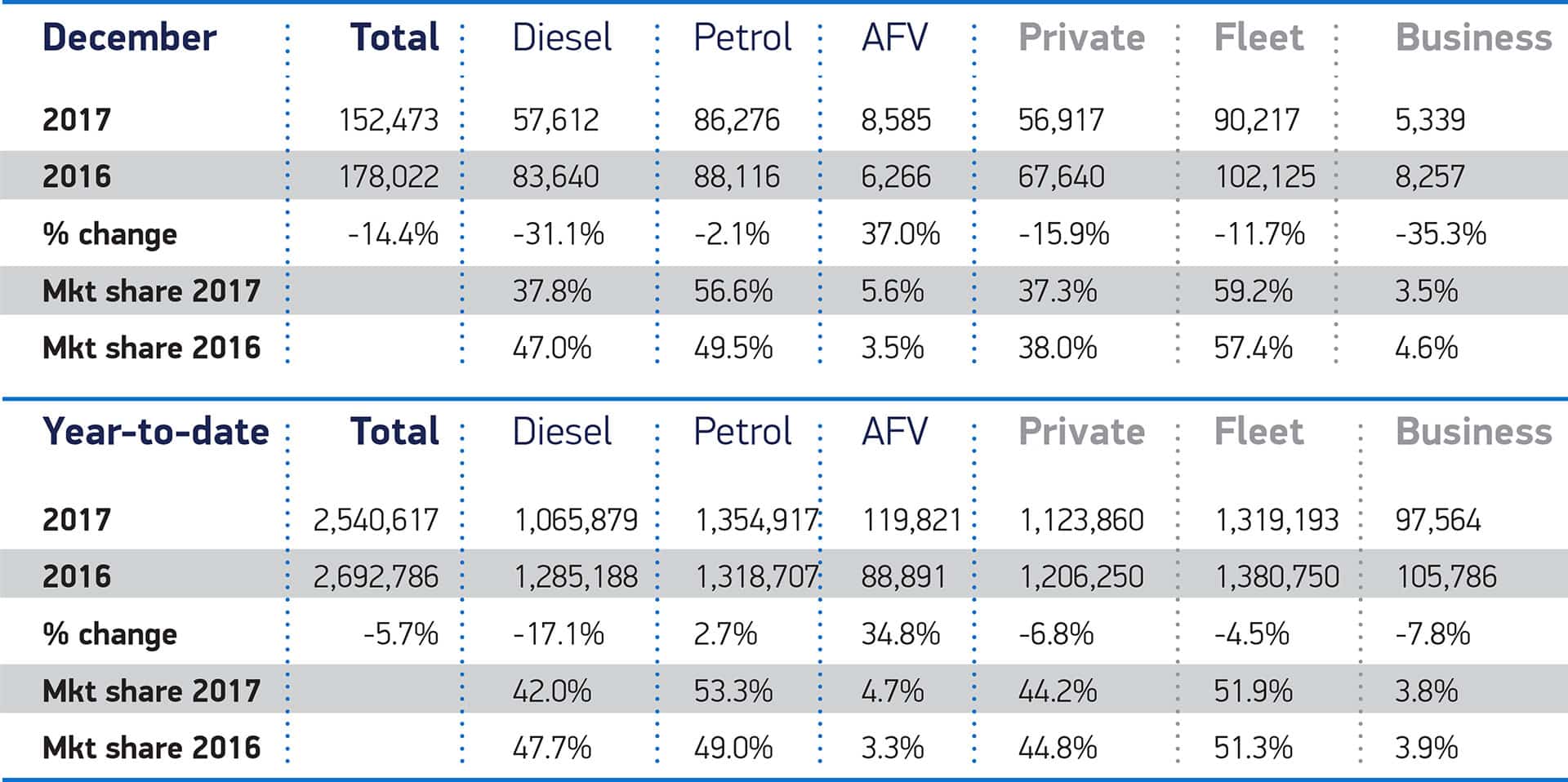 The SMMT blames anti-diesel rhetoric and the potential for tax hikes causing buyers to hesitate over buying. “However, these cars remain the right choice for many motorists – especially those who travel longer distances – with lower CO2, better fuel economy and, with these newer vehicles, dramatically reduced air quality emissions,” the industry body says, quoting its own figures suggesting that on average buyers of diesels save £132 a year on their costs.
Hawes is adding to growing calls for an industry-wide Government scrappage scheme to replace older, more polluting diesel cars. “Keeping older vehicles on the road will not only mean higher running costs but will hold back progress towards our environmental goals,” he said.
“Consumers should be encouraged to buy the right car for their lifestyle and driving needs irrespective of fuel type – whether that be petrol, electric, hybrid or diesel as it could save them money.”
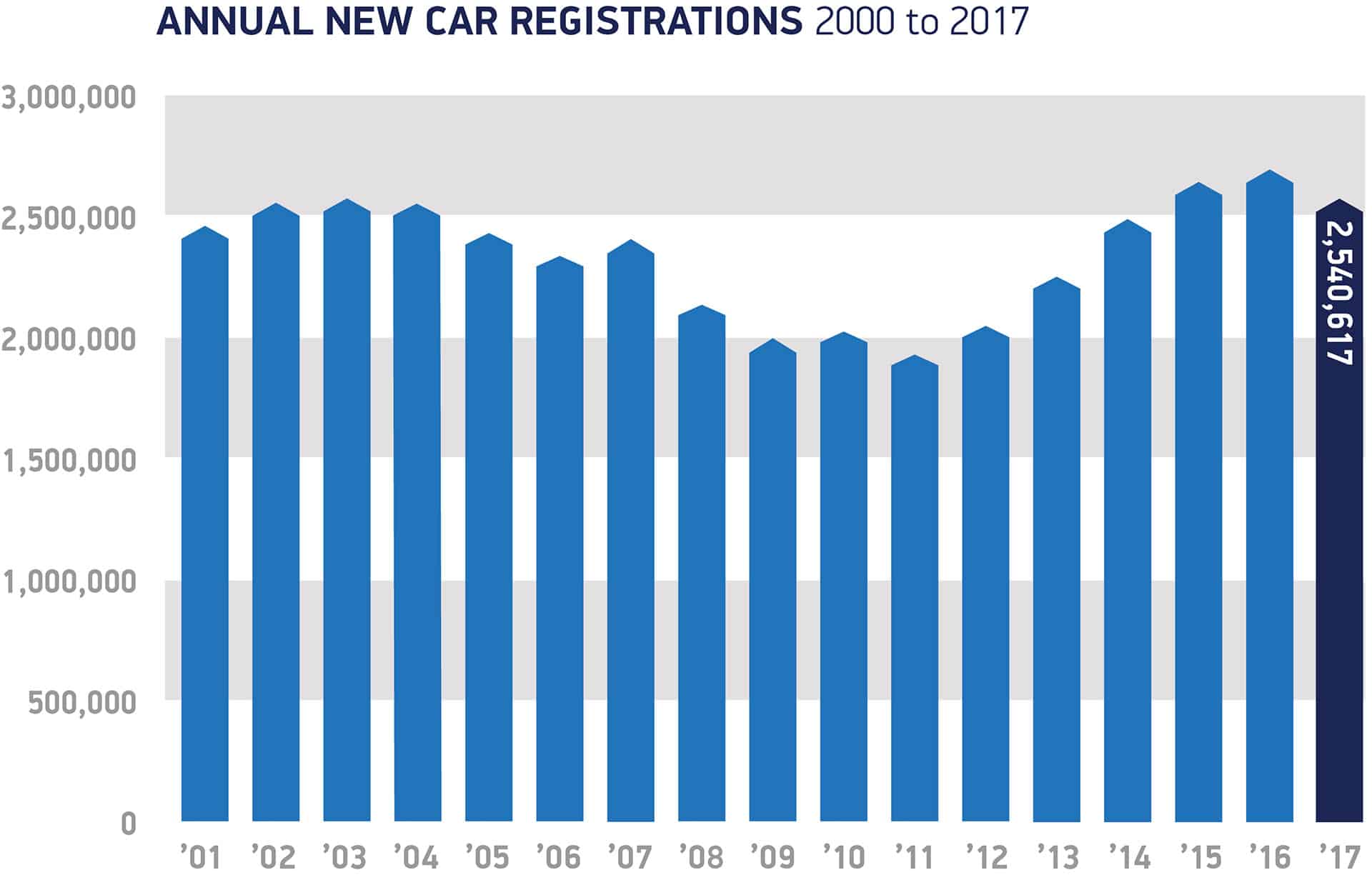
One upside to the latest figures is a surge in sales of ‘alternatively-fuelled’ vehicles, which includes electric and hybrid cars. These rose by 34.8%, 119,821 registered over the year. Such vehicles now enjoy their highest ever share of the market though it is still just 4.7%.
Hawes summed up 2017 as “undoubtedly a very volatile year” and added that lacklustre economic growth means that the industry expects a further weakening in the market for 2018. However he added that this could be good news for car buyers; “The upside for consumers is some very, very competitive deals.”
The SMMT blames anti-diesel rhetoric and the potential for tax hikes causing buyers to hesitate over buying. “However, these cars remain the right choice for many motorists – especially those who travel longer distances – with lower CO2, better fuel economy and, with these newer vehicles, dramatically reduced air quality emissions,” the industry body says, quoting its own figures suggesting that on average buyers of diesels save £132 a year on their costs.
Hawes is adding to growing calls for an industry-wide Government scrappage scheme to replace older, more polluting diesel cars. “Keeping older vehicles on the road will not only mean higher running costs but will hold back progress towards our environmental goals,” he said.
“Consumers should be encouraged to buy the right car for their lifestyle and driving needs irrespective of fuel type – whether that be petrol, electric, hybrid or diesel as it could save them money.”
One upside to the latest figures is a surge in sales of ‘alternatively-fuelled’ vehicles, which includes electric and hybrid cars. These rose by 34.8%, 119,821 registered over the year. Such vehicles now enjoy their highest ever share of the market though it is still just 4.7%.
Hawes summed up 2017 as “undoubtedly a very volatile year” and added that lacklustre economic growth means that the industry expects a further weakening in the market for 2018. However he added that this could be good news for car buyers; “The upside for consumers is some very, very competitive deals.”

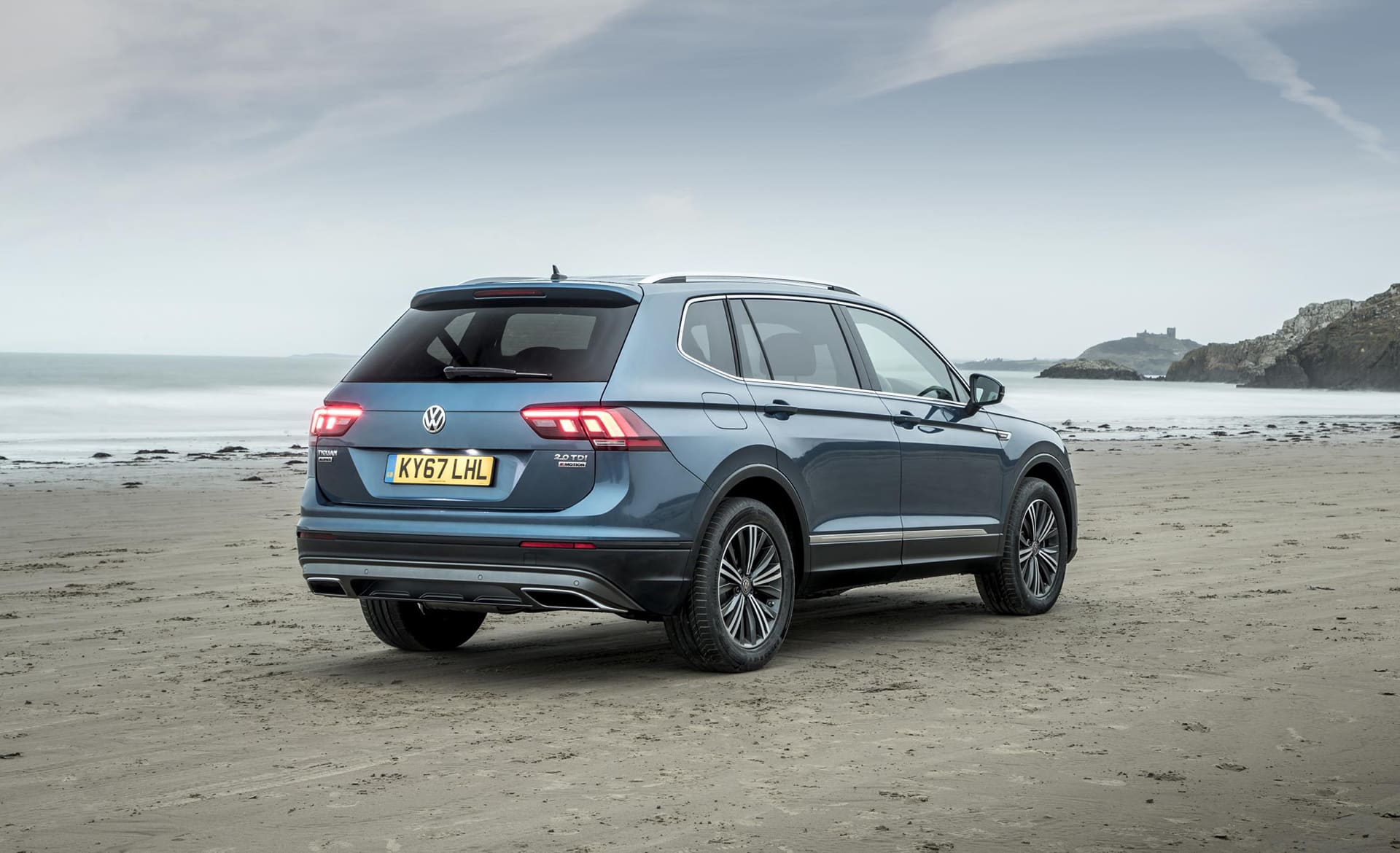
 The all-wheel-drive is part of a package intended to position the Tiguan Allspace as a ‘proper’ off-roader. The 4WD system includes ‘Onroad’, ‘Snow’, ‘Offroad’ and ‘Offroad individual’ driving modes, and an optional off-road pack is available with a front bumper increasing the approach angle from 16.9 degrees to 24 degrees, plus extra underbody protection and chrome door sill protectors.
The three diesel engines are all of two litres and turbocharged, with either 150, 190 or 240hp. The range-topping 240 unit, costing from £39,965, is like its petrol equivalent supplied exclusively with 4WD and the automatic transmission. The 150hp unit, meanwhile can be bought in front or four-wheel-drive, with six-speed manual or seven-speed automatic transmission.
From launch the Tiguan Allspace will be available in two trim levels, SE Navigation and SEL. A more sports-styled R-Line grade will be offered from late Spring 2018.
The all-wheel-drive is part of a package intended to position the Tiguan Allspace as a ‘proper’ off-roader. The 4WD system includes ‘Onroad’, ‘Snow’, ‘Offroad’ and ‘Offroad individual’ driving modes, and an optional off-road pack is available with a front bumper increasing the approach angle from 16.9 degrees to 24 degrees, plus extra underbody protection and chrome door sill protectors.
The three diesel engines are all of two litres and turbocharged, with either 150, 190 or 240hp. The range-topping 240 unit, costing from £39,965, is like its petrol equivalent supplied exclusively with 4WD and the automatic transmission. The 150hp unit, meanwhile can be bought in front or four-wheel-drive, with six-speed manual or seven-speed automatic transmission.
From launch the Tiguan Allspace will be available in two trim levels, SE Navigation and SEL. A more sports-styled R-Line grade will be offered from late Spring 2018.


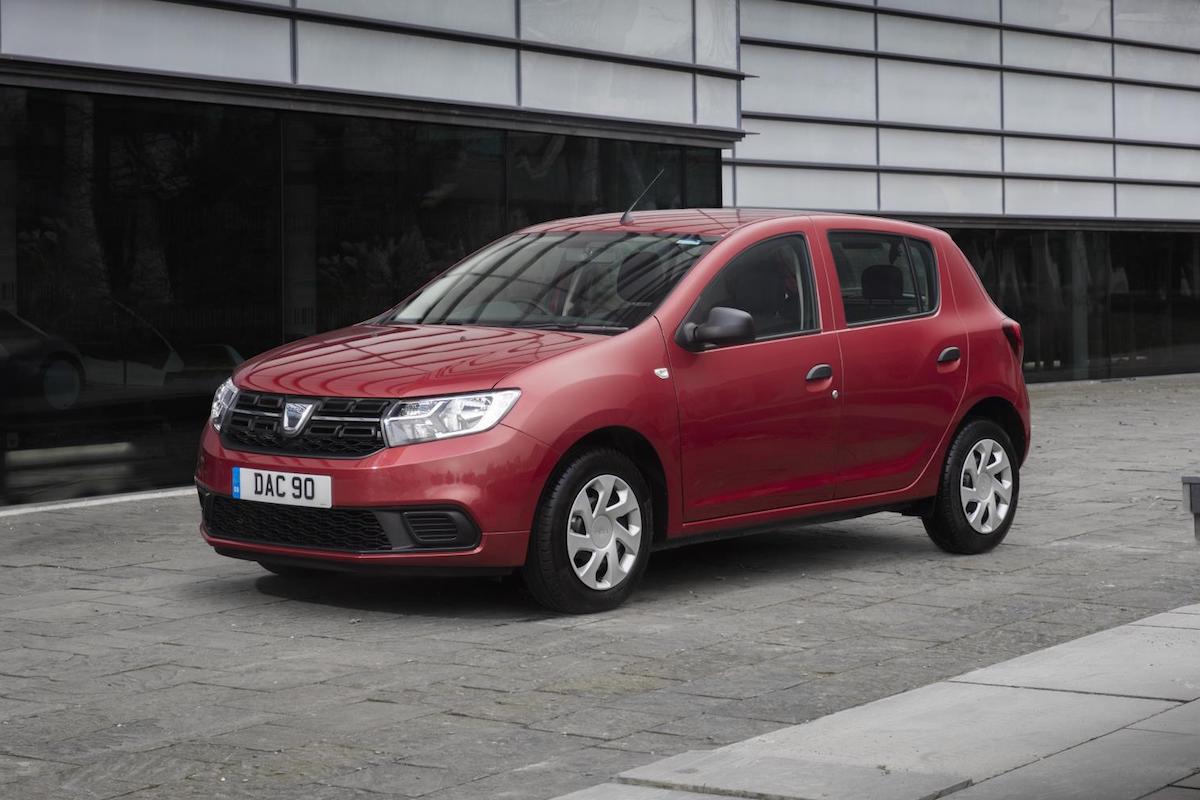

Order books are open for the revamped Citroën C4 Cactus, the car set to hit UK roads in April at prices from £17,265 – for a while.
While the revised model includes a number of updates, perhaps the most notable change is a move away from the bold styling that the Cactus launched with in 2014. Gone are the big ‘air bump’ side mouldings on the doors, replaced by much smaller, more discreet items at the base of the doors.. The car looks much more of a conventional large hatch, sitting above its C3 sister which has also donated its front-end styling.
The new Cactus will be offered with a revised powertrain choice ranging across 110 or 130hp petrol or 100hp diesel engines, and in two core trim levels, Feel and Flair. However the £17,265 price tag applies to a limited numbers launch model, dubbed Feel Edition and powered by an 82hp petrol engine.
Based on the Feel trim, the Feel Edition gets the Deep Red colour trim pack and Metropolitan Red interior trim. It also comes fitted with the brand’s ‘Advanced Comfort’ seats, but not the new Progressive Hydraulic Cushion suspension that is standard on Feel and Flair trim. Making its debut on a European Citroën, this system is said to offer ‘the ride of a magic carpet’ without affecting handling.
Citroën has also significantly upgraded the driver assistance systems offered on the Cactus, with up to 12 now available depending on trim level chosen. An Active Safety Brake autonomous emergency braking system and Lane Departure Warning are both standard on Flair models, while also available is the clever Grip Control that can produce four-wheel-drive like traction.
Connected navigation, connection to an emergency and assistance service and Mirror Screen phone compatibility are now also on offer to Cactus buyers.
Mainstream Feel versions of the new Cactus will start from £17,965, with the 110hp version of the petrol engine, and range up to £21,165 for a Flair model with the same engine but a six-speed auto transmission. The 130hp engines cost £800 more than the 110, and the diesels another £230.


What’s the most expensive item you’ve ever bought online? Maybe a laptop, an Xbox, 50-inch flat screen 4K TV or an iPhone? Or perhaps that holiday you took last summer?
Buying online is easy and could not be more convenient. The journey taken for any of these purchases follows a similar course involving price comparisons, checking availability and reading customer reviews before adding to a basket, heading for the checkout, tapping in your credit card details and pressing the buy button. Simple. After that, there’s that moment of anxiety knowing your hard-earned cash has gone into the ether and then savouring the thrill when the confirmation email pops into your inbox.
If it’s so easy and convenient, would you buy a car online? A number of car manufacturers are now offering online purchasing for new cars, and some dealers are launching online purchasing for both new and used cars, and it looks like 2018 could be a pivotal year for online car sales.
The same rules apply to buying a £1,000 smartphone as they do to purchasing a £20,000 car. You do your initial research online to shortlist the make, model and colour, hunt around for who is offering the best monthly price, visit a retailer to see it in the metal, just to be sure you like the look and feel, and then buy it.
Being able to buy a car online is not a new concept. Vauxhall launched a service a decade ago during the first flush of internet retailing, but it was ahead of its time and was quietly withdrawn.
Things have moved on since then with 2017 seeing an unprecedented rush of car brands tapping into this emergent market. They are targeting digital-savvy new car buyers who prefer the online route to thumbing through car magazines and trawling around the internet to draw up a shortlist, visiting showrooms to kick the tyres before uncomfortably haggling over the price.
Around 97% of car buyers use the internet when researching their new car and the number of dealer visits made before purchasing has dropped dramatically from four a decade ago to just 1.6 visits today. Adding a ‘buy’ button to online car adverts is a natural extension of this process and one that has been latched onto by car manufacturers and some dealers.
With this in mind, The Car Expert offers you a guide to what to consider if you’re thinking of making your next new car purchase from the comfort of your sofa.
Pretty soon it will be easier to say which car makes do not offer the option to buy a car online. BMW was first out of the blocks in late 2015 with its BMW Retail Online offering.
The service set the template for subsequent initiatives covering vehicle configuration, part-exchange values, finance options, test drives through dealerships and a live-chat with a product genius or guru (car maker shorthand for a non-commission driven product expert rather than pushy salesperson). And then onto the final purchase either online or through a dealer.
Since then Hyundai, smart, Peugeot and Mitsubishi have all joined the party. Expect more brands to reveal their online sales plans as competition in the digital marketplace grows.
There are six key features to BMW Retail Online. The online journey starts with the tool “Find your BMW”, leading into the vehicle configurator. With a click on the “Buy your BMW” button the customer selects a retailer, is shown cars in stock and selects their preferred finance method.
The customer can then finalise all steps of the purchase with their chosen retailer in the Retailer Online showroom. Buyers can also ask questions along the way through a live chat service manned by product specialists who are available for questions seven days a week from 8am to 7pm.

Customers using Hyundai’s Click to Buy service can choose a car, arrange a part-exchange, sort out finance and pay online. The process is claimed to take just five minutes to complete, with the handover taking place from the customer’s designated dealership or – in what Hyundai claimed as a market first – straight to their driveway.
Click to Buy is a natural progression of Hyundai’s fresh approach to car retailing which has seen the opening of digital stores at London’s Bluewater and Westfield Stratford shopping centres. Here customers can talk to a product specialist, configure a car, have a test drive, and then buy online in the store or from home.

Peugeot distanced its Order Online from other brands’ services because it said it provides more choice by allowing customers to configure and order a car to their requirements, rather than being restricted to buy dealer stock. Buyers can also track the progress of their order from placement to delivery.
The service includes guaranteed part-exchange valuations, various financing options and a dealer test drive. Delivery can be to a dealer or the customer’s home. Peugeot claims customers can choose and buy a car online within 30 minutes.

With its simple two-model car line-up – fortwo and forfour – and a choice of pre-configured models, Smart is able to offer a speedy service which it claims can take just 12 days from order to delivery. There are three payment packages enabling customers to choose from either a low monthly payment, a standard offer, or a lower deposit. Cars can be financed from just £119 a month.
Customers can choose to either collect their new smart from a local retailer or have it delivered to their home.

Meanwhile, Volvo has announced that its eagerly awaited Polestar performance sub-brand will only be available through online ordering when it goes on sale in 2019. Furthermore, cars will only be available to lease rather than purchase. Likewise, the forthcoming Lynk & Co brand will only be available through online ordering and on a subscription basis. There’s a connection here, as Volvo and Lynk & Co are both owned by the China-based Geely group.

No. While all the car maker services we list claim to be different, they are fundamentally similar. They all allow buyers to save their proposed purchase and completing the transaction face-to-face with a real human being in a dealership if that’s what you prefer.
No. There are moves afoot to add online car purchasing to dealer main websites which will give customers a greater choice of brands and models although cars being offered for sale are more likely to be used or what’s termed “nearly-new” cars with the latest registration plate and low mileages.
The first dealer group service to go live was a used car initiative quietly launched in 2017 by Vertu Motors, one of the UK’s largest car retailers, through its Bristol Street Motors branded showrooms in England.
The group was pleased with the take-up from its initial trial and will now roll the service out across its 120 showrooms, including those operated by Macklin Motors in Scotland.
More dealers are set to follow with the launch of a new back-end e-commerce trading platform by iVendi, the car retailing tech company, who have piloted an online buying service, which incorporates finance options. The system has been piloted by 500 dealers ahead of a national rollout in 2018.
If you buy a car online, you benefit from more legal protection than if you walk into a showroom and buy the exact same vehicle. You are covered by the Consumer Contracts (Information, Cancellation and Additional Charges) Regulations 2013, which covers “distance selling” where a product is not sold in person.
When buying online, you have the right to cancel from the moment an order is placed until 14 days after taking delivery of the car. If you are buying a car in person from a dealer, you do not have the same right. It doesn’t matter if it’s a new or used car, the law is the same.
The seller (and online sales for any manufacturer will be managed by a separate company, either a dealership or a company specifically set up for the purpose) must provide you with details of their returns/cancellation policy. They must also explain who pays for the cost of returning the car if you change your mind. Their policy may include charges for returning or collecting the vehicle, but they must provide you with this information up front. You are liable for any damage you cause to the car.
Technology and society are adopting internet shopping at a rapid rate, and it’s about to get an awful lot easier to buy a car online.
Would you be comfortable enough to buy a car online? Have you already bought a car online? Let us know your thoughts in the comments section below.

What is it?
The Mercedes-Benz X-Class is the brand’s first entry into the pick-up market and, it claims, the first such model in the premium market.
Key features
Off-road capable, upmarket design, targeted trim levels.
Our view
The launch of the Mercedes-Benz X-Class bring desirability of a level never before seen to the pick-up sector. The vehicle combines upmarket comfort, finishing and technology with proper off-road ability, but one pays a premium for the badge.
Similar cars
Nissan Navara, Ford Ranger, Toyota Hilux
‘Pick-up by Mercedes-Benz’ is not a phrase one might expect to hear, but it is now fact, as the Mercedes-Benz X-Class arrives on the market.
In launching what it describes as the first such vehicle offered by a premium manufacturer, Mercedes is hoping to attract two very different kinds of buyers, and is targeting versions of the X-Class specifically at the different markets.
The model is marketed by the brand’s commercial vehicle arm – indeed the entry-level X-Class will be hoping to appeal to those who need such a vehicle for their work, and like the idea of a badge with rather more kudos than, say, the Toyota Hilux or Nissan Navara.
The Mercedes is rather more closely related to the Nissan than one might think. Strip off the bespoke bodyshell, with looks that clearly follow the design language of Mercedes SUV models, and underneath is effectively the mechanical specification of the Navara, including its tough, ladder-frame chassis.
However, Mercedes expects the biggest sales for its new model to be of vehicles in the top of the three specification levels. There are plenty of buyers who are attracted to the pick-up as a lifestyle choice, and the hope is that the combination of Mercedes-Benz premium quality and tech in the pick-up format will be a winner.
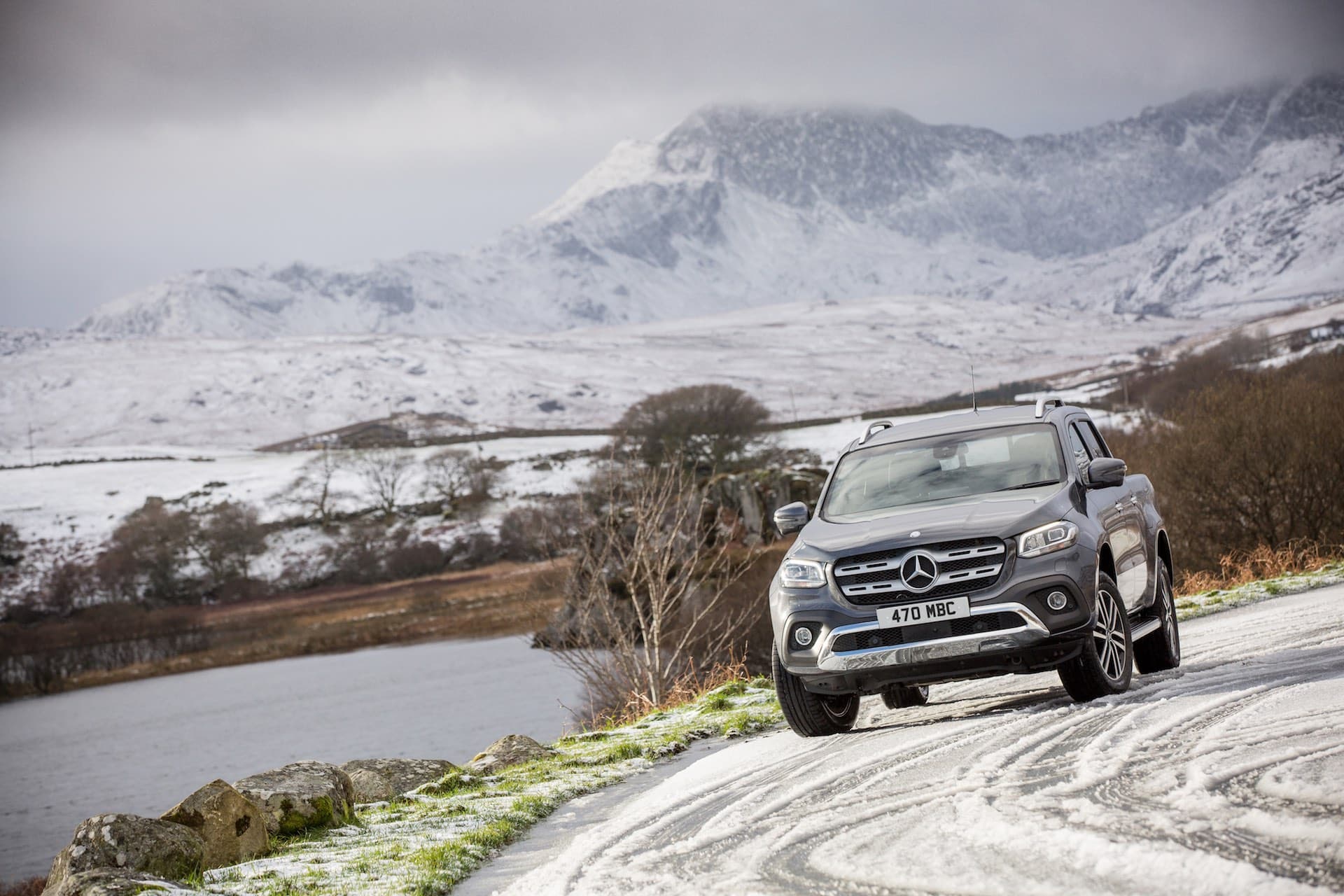
Mercedes-Benz will offer the X-Class with a three-way engine line-up, though the range-topping X 350 d with its 258hp and 550Nm of torque won’t be in showrooms until the middle of 2018. Currently, the choice is between the X 220 d, with a 2.3-litre turbo diesel engine of 163hp and 403Nm, and the X 250 d – this adds an extra turbo to the same powerplant, boosting horses to 190hp and torque to 450Nm.
Six-speed manual or seven-speed auto gearboxes are available depending on model, while unlike rivals there is no two-wheel-drive option – every X-Class comes with selectable 4WD, running with the rear wheels powered in normal use but including cockpit-selectable all-wheel-drive in both high and low range.
In fact, while this may be an upmarket pick-up, the makers are keen to emphasise it’s a proper pick-up, with the off-road ability one might expect and commercial users will require.
So the X-Class can wade through water up to 600mm deep, and it can tip sideways to a shade under 50 degrees. It also boasts a towing capacity of up to 3.5 tonnes, and can be supplied with a 221mm ground clearance which gives it an angle of approach of some 30 degrees and a 22-degree ramp angle.
Okay to get the big ground clearance (plus 20mm on standard) requires spending on the options list, but the capability to match more traditional pick-ups is certainly there. Also on that options list, for example, is a differential lock.
This target marketing is also evident in the trim levels. There are three; Pure, Progressive and Power, with the Pure costing from £27,310 (plus VAT) and aimed at commercial users. It includes steel wheels, black fabric upholstery and such like. Once one starts going up to Progressive or Power grades, less robust features such as alloy wheels, painted panels and silver trim come into play.
Progressive versions cost £1,200 (plus VAT) more than Pure variants, while Power is another £3,500 on top, and only offered with the more powerful 2.3-litre engine. Equipment includes LED headlamps, electric mirrors, electrically adjustable front seats, leather trim and controls on the steering wheel.
Being a Mercedes-Benz, the options list is extensive, and depending on the depth of the wallet one can specify everything from parking sensors and camera to heated seats and even heated windscreen washer jets.
Where the X-Class certainly scores is on its safety package. Euro NCAP has already tested the model and given it a top five-star rating, and the standard specification includes autonomous emergency braking, lane-keeping, traffic sign recognition and hill-start functions, as well as a reversing camera.

As mentioned the extent of the interior ‘ambience’ will depend on which level of X-Class one goes for, and not surprisingly our launch event test model is to top Power specification. But common to all is an elevated driving position which gives good vision except out of the rear, which has only a small window cut into the rear bulkhead of the passenger cabin.
Every X-Class is to double cab format, which means two rows of seats each with their own set of doors. The rear is usefully spacious too, with a bench seat offering enough width and height to easily accommodate three adults – the model benefits from being both longer and wider than the Nissan it is related to.
On the downside, there is not much space to store stuff, particularly considering pick-ups don’t come with boots. There is, of course, the load bed, which is 2.1 metres square.
The Mercedes is quite a lot more expensive that the Nissan, and a fair amount of this goes into providing the premium interior finish buyers of the three-pointed star badge expect. The surfaces are all soft touch and of high quality, as is the switchgear, and the layout is typical of the brand’s car output. There is some tough and scratchy plastic, but it’s down by the footwells where it’s most needed.
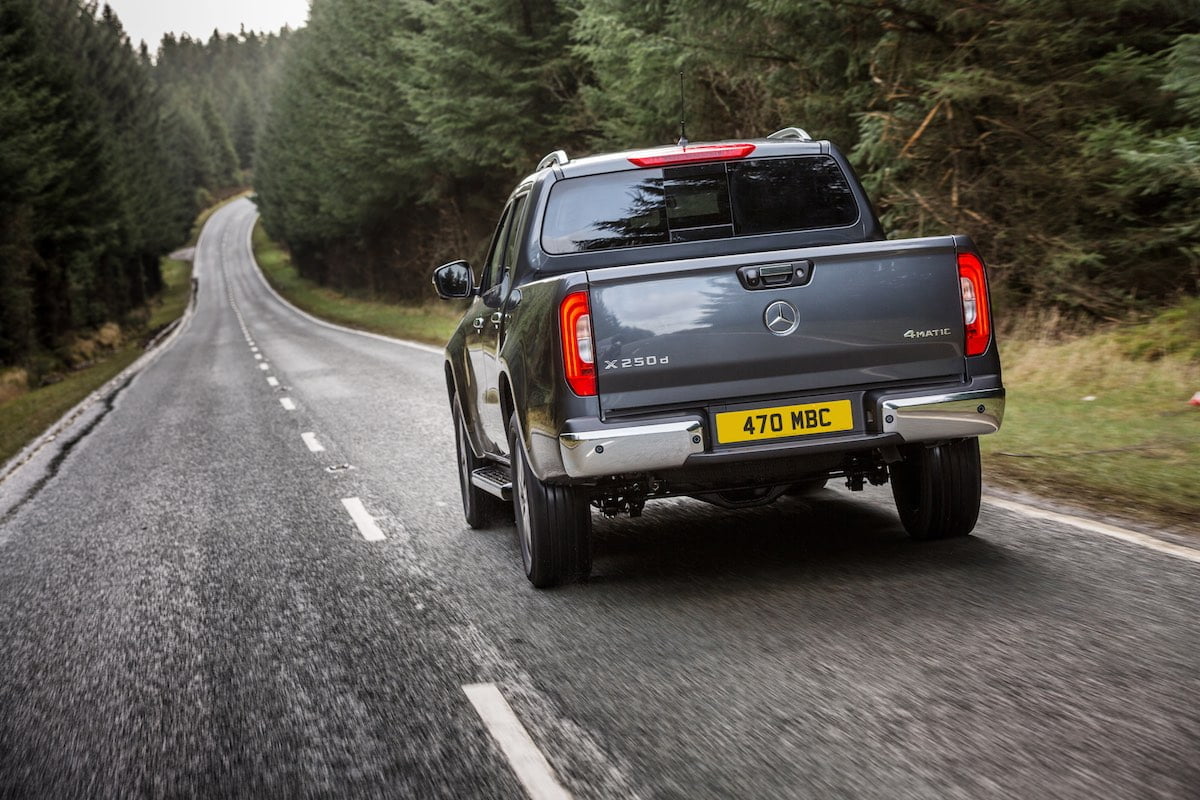
Does it feel like a pick-up to drive? Yes, but a very upmarket one. The powerplant is smooth in its power delivery and refined to boot. Motorway speeds are achieved with no fuss – rest to 60mph takes around 12 seconds. At such speeds the cabin is quiet to a degree that will impress those coming out of other pick-ups – especially the absence of wind noise.
The steering is well weighted, though the fact that this is a big, high-slung machine with a solid rear axle never lets one forget that one is driving a pick-up truck. There is a degree of hauling it through corners required and the effects of poor surfaces do find their way to the cabin.
At the end of the day, this is probably the most upmarket pick-up truck on the market, with a price to match. Successful business owners who like such vehicles could well be attracted to it, being able to drive a Mercedes-Benz while still claiming the tax benefits that comes with it being designated a commercial vehicle.
The Mercedes view that the best sales will be of the upper trim levels is probably pretty accurate. It’s difficult to imagine too many examples of the X-Class being used as workhorses on building sites, but bosses visiting those building sites, and the urban lifestyle crowd, will likely consider the desirability of a Mercedes to be worth paying the £6,000-odd price hike over an equivalent Nissan Navara.

Automotive Website of the Year


Automotive Website of the Year
Automotive Website of the Year