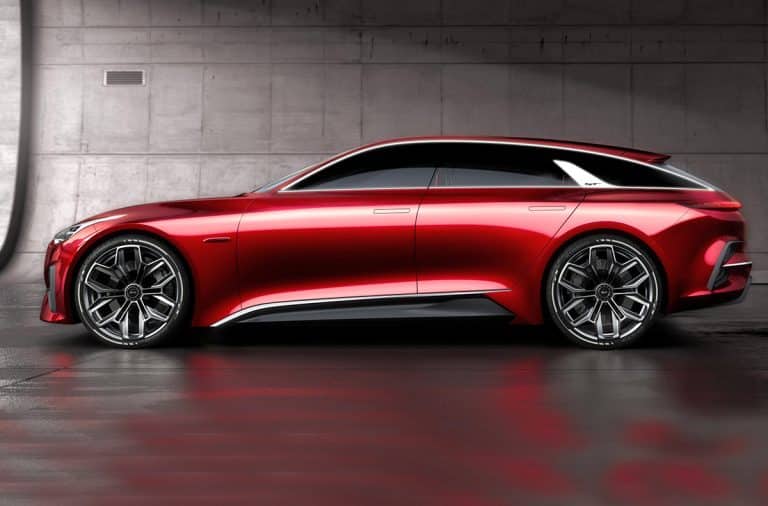
The Kia Proceed Concept, to be unveiled at the Frankfurt Motor Show next week, previews both the expected styling look of the next generation Cee’d range set to launch in 2018, and a possible new body style.
Designed at the Kia European design studio next door to the site of the Frankfurt show, the concept is described as an ‘extended hot hatch’, effectively a shooting brake. If it reaches production it will extend the Cee’d line-up, which currently runs across three and five-door hatchbacks and an estate.
Kia’s European chief designer officer, Gregory Guillaume, describes the concept as a potential different halo model for the Cee’d family, as many European drivers are now seeking performance alternatives to the three-door hot hatch. “The Proceed Concept represents a bold new vision of how the vibrant soul of the pro_cee’d could be reincarnated and revitalised for a new generation of performance-oriented drivers,” Guillaume says, which suggests that the current three-door will not be part of the next-generation Cee’d line-up.
Bold styling treatment
In line with this aim, the styling is more distinctive than the mainstream Cee’d, with a low stance, muscular bodywork and sharp detailing. The bodywork includes a bold ‘Sharkblade’ design element that also emphasises the lack of B-pillars (door pillars), and the car sits on 20-inch six-spoke aluminium wheels.
Other styling influences from the current Kia range are also incorporated, notably the ‘Tiger Nose’ grille, a bonnet shape designed by the Stinger model soon to go on sale, and a full-length glazed roof.
Should the Proceed reach production it will likely only appear after the next mainstream Cee’d range launches with the styling treatment displayed on the concept.
Jaguar has unveiled the Future-Type concept and announced that all Jaguar Land Rover cars will be electrified in some way by 2020.
Speaking at a technology event organised by JLR in London, company CEO Dr Ralf Speth announced that a “portfolio of electrified products” will be introduced across the model range, embracing fully electric, plug-in hybrid and mild hybrid vehicles. “Our first fully electric performance SUV, the Jaguar I-PACE, goes on sale next year,” Speth confirmed.
The Future-Type concept is a narrow-bodied fully autonomous vehicle with what is described as 2+1 ‘social’ seating – the idea being that if a user wishes to for example talk to their child while taking them to school, they can use the two seats and let the car take charge of the journey.
Live-at-home steering wheel
Technological highlight of the Future-Type is what JLR dubs the first intelligent and connected steering wheel, called Sayer after the designer of the iconic Jaguar E-Type. Designed to live in the home, the wheel boasts voice-activated artificial intelligence (AI) technology and can carry out a wide range of tasks from summoning the car, playing music, booking restaurant tables or even checking the contents of the owner’s fridge.
While relaxing in their living room owners will be able to tell Sayer where they need to be the following day and at what time. and the system will work out when a car needs to autonomously arrive at the door – based on the time the owner normally gets up – and will also advise which parts of the journey the owner might enjoy driving themselves.
As a sign of its commitment to electric cars, JLR also displayed an EV version of the 1960s E-Type, dubbed the E-Type Zero. The car, a restored Series 1.5 Roadster, is completely original apart from its 220kW electric powertrain. This uses a lithium-ion battery pack with the same dimensions, and similar weight, to the XK six-cylinder engine used in the original E-type, with the motor mounted behind and the whole in exactly the same location as the original’s engine and transmission.
A greater range, additional technology and revised styling to attract a wider customer base are all features of the latest Nissan LEAF electric car.
Images and information of the second-generation LEAF have been revealed ahead of its public debut at the Frankfurt Motor Show on 12th September. Built in Britain, the car is due on sale across Europe from January 2018, succeeding the current LEAF that has become the world’s best-selling electric car with more than 283,000 sold since 2010.
Nissan is quoting an official (New European Driving Cycle) range between charges of the new car of 235 miles. And also planned is a higher-power model which will also boast a longer range – some observers predict that the LEAF will gain a version in Nissan’s NISMO performance sub-brand in order to attract younger buyers.
The powertrain of the new LEAF has had its energy efficiency improved and both power and torque uprated, to 150hp and 320Nm respectively. Maximum speed will be 90mph but the 0-62mph time has not yet been stated.
Driving tech added
New technology in the LEAF includes the ProPilot driver assistance system which makes driving safer and easier on single-lane roads, and the ProPilot Park which will automatically control acceleration, steering and braking to park the car. Also included is an e-Pedal, allowing drivers to start, accelerate, decelerate and stop simply by the way they press the accelerator pedal. When the accelerator is fully released, regenerative and friction brakes are applied automatically, gradually bringing the car to a complete stop.
The car’s exterior styling follows that of the IDS Concept unveiled at the Tokyo Motor Show in 2015. The current V-motion grille family design is incorporated, detailed in blue to signify the car is electric. The interior has also been completely redesigned.
The Honda CR-V Hybrid Prototype will be displayed at the Frankfurt motor show later this month, and previews a production model in which the company’s popular mid-size SUV will go hybrid for the first time.
Due on sale in 2018, the next-generation Honda HR-V Hybrid is expected to signal the expansion of electrified drivetrains across the brand’s range. Its newly developed i-MMD (intelligent Multi Mode Drive) hybrid system combines a 2.0-litre petrol engine with two electric motors – one for propulsion and one generating energy for the batteries.
Gearing in the hybrid model is fixed, according to Honda creating ‘a direct connection between moving components, enabling a smooth transfer of torque within the system.’ Power and economy figures for the powertrain are yet to be revealed.
Styling evolves
The Honda CR-V Hybrid Prototype also reveals the look of a general CR-V styling facelift. This will debut in showrooms with the 1.5-litre petrol-engined version of the CR-V, which will go on sale before the production version of the hybrid. In the same week that figures reveal UK diesel sales have slid again, Honda has made a possibly highly significant move in no longer offering a diesel-engined CR-V to European customers.
While described as an ‘evolutionary design that is sophisticated and sporty’, the restyle of the CR-V is extensive, and the resultant car measures up slightly longer, wider and higher than the current model.
The A-pillars (windscreen pillars) are thinner, wheel arches wider, and both wheels and tyres increased in size. Both the bonnet and rear flanks gain sharper contours, and the nose reflects the brand’s latest family styling with bespoke headlamp signatures.
New car registrations fell by more than 6% in August compared to last year, with private buyers shying away from showrooms and diesel cars continuing to have a disastrous time, according to results released today by the Society of Motor Manufacturers and Traders (SMMT).
Private sales were 10% down on the same time last year, while fleet sales recorded a more moderate 3% drop (although this will include a lot of self-registered cars, as manufacturers and dealers tend to register more vehicles to themselves when demand drops). Business sales were down 14% but this is a much smaller sector, with less impact on the overall picture.
The woes for new diesel car sales continued in August, with registration numbers down more than 21% on last year. Diesel cars made up less than 40% of the market, an historic low, while petrol sales were up by just under 4%, to an overall 55% of the market, as buyers continue to switch from diesel to petrol power.
Hybrids and electric cars continue to show improvement, up 58% on last year. Almost 4,000 ‘alternatively-fuelled’ cars were registered in August, and the sector again accounted for more than 5% of the overall market.
Within the broader picture are other interesting details. SUVs continue to grow in popularity, with an 8% increase compared to the same month last year. Large family cars were also up marginally, which is something of a surprise, and executive cars also improved slightly. Hatchbacks, people movers and other types of car all decreased.
For SMMT bingo fans it was a disappointing month. There were no mentions of “Brexit” or “the single market” anywhere in the press release, nor any pleas for the government to do something to protect the automotive sector.
Good month for hybrids and electric cars, another bad month for diesels.
Volkswagen Golf is back on top
It was another good run for the Volkswagen Golf, returning to the top of the charts in August. The new Ford Fiesta improved to second place, and is generally expected to resume its traditional place at the top of the charts once supply of the all-new model is up to speed.
The Vauxhall Mokka X vaulted into the Top 10, ending up in third place, ahead of usual suspects like the Ford Focus, Volkswagen Polo, Vauxhall Corsa and so on. It was also a good month for the Ford Kuga, appearing in fifth place, while the Nissan Qashqai slipped from third back to tenth as supplies of the old model ran out and the new model started to arrive.
Hopes pinned on scrappage schemes and aggressive offers
August is always a slow month for new car sales, with private buyers, in particular, hanging back for the number plate change in September. With a number of manufacturers now offering aggressive scrappage schemes and other offers, the hope will be that they can claw back the losses from the middle of the year and salvage a decent yearly result by December.
Good month for the Volkswagen Golf and Vauxhall Mokka X, not so good for the Nissan Qashqai or the Mercedes A and C Classes
The Skoda Karoq will be unveiled at the Frankfurt motor show as the Czech brand ramps up its SUV offensive.
A smaller sister to the Kodiaq and effectively replacing the highly successful Skoda Yeti, the Karoq is 4382mm long, 1841mm wide and 1605mm high. The significantly long wheelbase of 2638mm promises plentiful interior room, while boot space is generous too, at 521 litres, growing to 1630 litres with the rear seats folded forward.
Alternatively, VarioFlex rear seats can be fitted as part of the brand’s ‘Simply Clever’ programme – these consist of three separate rear seats that can be individually adjusted or even removed, providing between 479 or 588 litres of space which can grow to 1810 litres.
Digital direction
Skoda is heavily promoting the Karoq as the most digitised model in its range. The highlight is the first fully digital instrument panel offered in a Skoda, which can be customised to the driver’s preferences. All the displays are also linked to the car’s infotainment system, while other technology includes a wi-fi hotspot.
The Karoq will go on sale with a five-strong engine lineup, two petrol and three diesel. Capacities available range through 1.0, 1.5, 1.6 and 2.0 litres and power outputs from 115 to 190hp and the 190hp 2.0 diesel comes as standard with all-wheel-drive and a seven-speed DSG auto gearbox. All other powertrains will be orderable with either the DSG or a six-speed manual ‘box.
More details of the Karoq will be revealed when the car is unveiled on 12th September at the Frankfurt show. UK sales are expected to start in January 2018.
Fiat Chrysler Automobiles (FCA) has announced its scrappage offers for its four UK brands – Fiat, Alfa Romeo, Abarth and Jeep.
Like most of the other schemes on offer, the FCA scrappage offers apply to for any part-exchange cars built to Euro 4 emissions standards or earlier, with either petrol or diesel engines. This means definitely cars first registered before 31 December 2009, although some vehicles had Euro 5 engines before that date.
The scrappage offers only run until 30 September, so cars must be ordered and delivered by the end of this month.
The allowance cannot be used in conjunction with any other offer from the dealer, manufacturer or finance company, such as Alfa Romeo’s “Test me” deposit contribution offer, so buyers will have to examine the offers available and decide which is best.
All vehicles part-exchanged under the programme will be scrapped.
Make and model
Series
Scrappage allowance
Fiat 500
Pop
Up to £2,125
Fiat 500X
All
£2,500
Fiat 500L
All
Up to £3,500
Fiat Panda
All (excl. Pop)
£2,000
Fiat Tipo
All
Up to £1,500
Fiat Punto
All
£3,500
Fiat 124 Spider
All
£3,000
Abarth Spider
All
Up to £3,000
Abarth 595
All
£1,095
Jeep Renegade
All
£3,500
Alfa Mito
All (excl. entry model)
£2,500
Alfa Giulietta
All (excl. entry model)
Up to £5,300
Alfa Giulia
All models (excl. entry version & Quadrifoglio)
£3,250
The Car Expert checks the fine print
This offer is a part-exchange allowance, for selected used cars part-exchanged against selected new cars.
Your current car can be from any brand, but must be built to Euro 4 emissions standard or earlier. This will definitely be cars first registered no later than 2009, although some cars had Euro 5 specification engines earlier than this.
You must be the owner of the part-exchange vehicle and the buyer of the new car (same name and registered address).
You must have owned the old car for at least 180 days (six months), to stop people buying an old banger for £200 and then getting a £2,000 part-exchange allowance for it.
You must order your new car and take delivery before 30 September 2017.
This offer cannot be used on top of any other offers from the dealer/manufacturer/finance company.
The offer is not dependent on you taking any finance package or other products.
What is it?
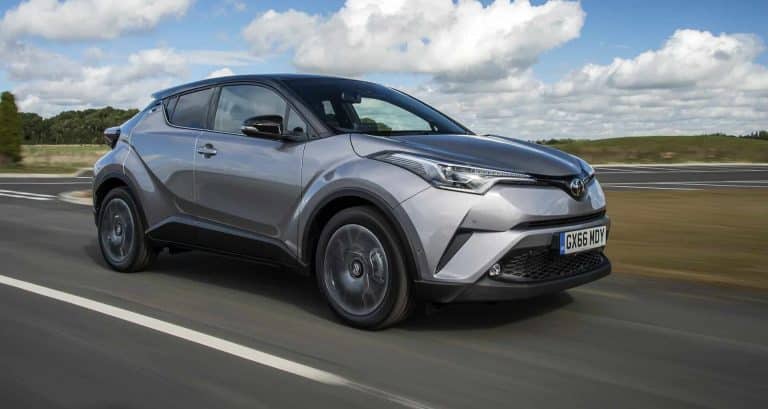
The Toyota C-HR is the brand’s distinctive entry into the booming compact crossover market.
Key features
Hybrid powertrain, bold styling.
Our view
It may be late to the compact crossover party, but the C-HR has certainly made a spectacular entrance. With its riot of angles and creases, the C-HR certainly makes a head-turning statement.
Toyota will have no worries about sliding diesel sales where its new crossover is concerned, because you can’t have a diesel in the C-HR. The choice is between the 1.2-litre turbo petrol engine or the 1.8-litre petrol-electric hybrid.
The C-HR comes in a choice of three specifications, all of which offer good levels of equipment. The cabin feels airy and spacious, thanks to a combination of excellent design and top-notch quality.
The C-HR handles very well and certainly belies its high-riding crossover stance. Ride comfort is exemplary, soaking up the bumps on poor condition surfaces and damping them out of the cabin. Officially the car returns 72mpg, but hovering close to 60mpg in real-world motoring is still impressive.
This is a crossover that exudes style amongst many more ordinary-looking rivals, and it also ticks the boxes of quality and (mostly) practicality.
There is absolutely no doubt that the Toyota C-HR instantly polarises people. Upon seeing it in a TV commercial, this tester’s offspring dubbed it the ugliest car she had ever seen. When the test version arrived for testing, she was forced to admit it looked better in the metal than on the screen. This car certainly breaks the mould of typical Toyota fare.
Over the last few years, the compact crossover segment has exploded in popularity around the globe. The Nissan Qashqai started the ball rolling a decade ago and now almost every manufacturer is trying to cash in, resulting in a very crowded marketplace. The C-HR is also up against quality opposition like the Renault Kadjar, SEAT Ateca, Peugeot 3008 and Volkswagen Tiguan.
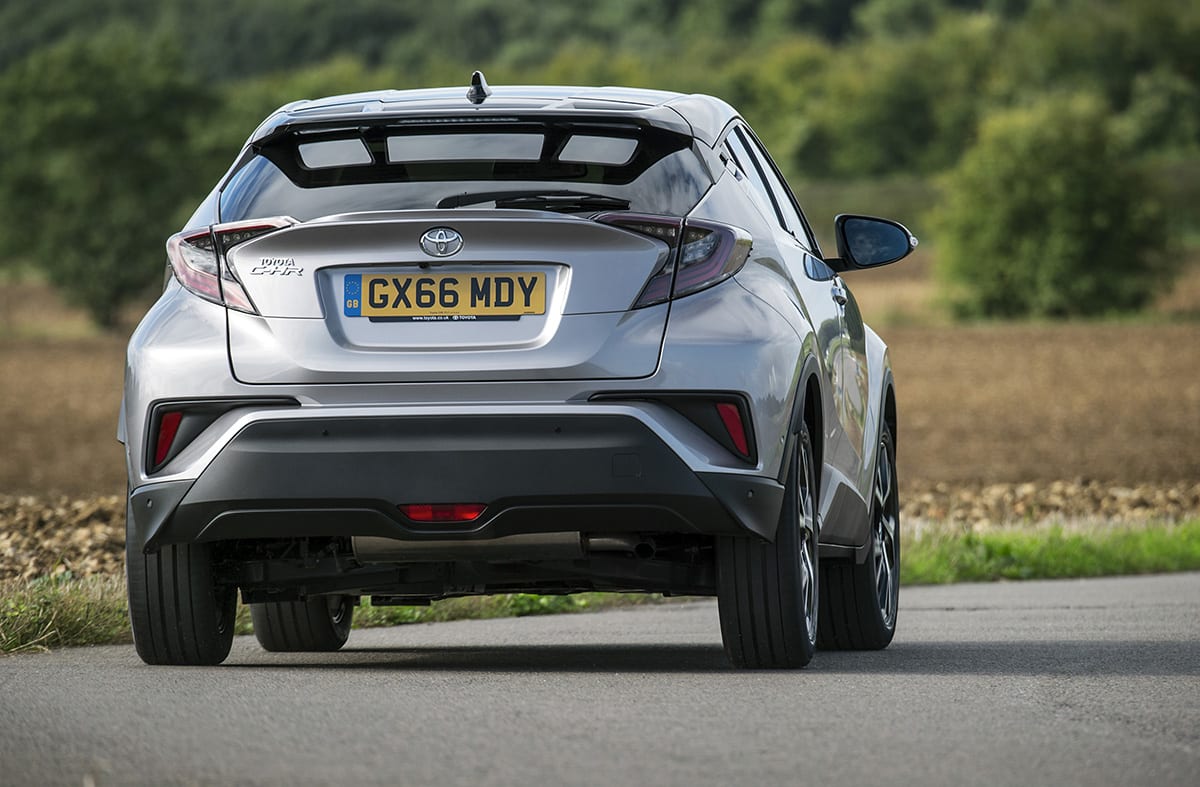
So it may be late to the party, but the C-HR has certainly made a spectacular entrance. According to Toyota, this is a car that illustrates the aim of head man Akio Toyota’s determination to take the shackles off his designers – “to allow greater stylistic freedom and promote creative engineering to deliver eye-catching designs and more driving pleasure.” The nose is dominated by a bold V shape sweeping to the centre point of the grille. The rear is no less distinctive, with a rear screen so raked it is almost horizontal. With its riot of angles and creases, the C-HR certainly makes a head-turning statement.
However, visuals are but one element of a successful model – once we start delving into the practicalities, how does the C-HR stack up against its ever more plentiful opposition? Pretty well, mostly…
The Toyota C-HR certainly stands out in a crowd
Buying and owning a Toyota C-HR
Toyota will have no worries about sliding diesel sales where its new crossover is concerned, because you can’t have a diesel in the C-HR. The choice is between the 1.2-litre turbo petrol engine of 114hp, or the hybrid. This combines a 1.8-litre petrol unit with an electric motor to produce a combined 120hp.
Toyota is, of course, an evangelist for such systems, and the one in the C-HR offers all the advantages of the brand’s many years’ experience with the technology. The battery is more dense in its energy storage, which means it can be reduced in size and will charge faster. The electric motors are smaller but more efficient. Even the petrol engine part of the equation has been significantly re-engineered to work better with the electric motor.
Every C-HR comes with Toyota’s comprehensive ‘Safety Sense’ package of active safety systems. Autonomous emergency braking and pedestrian recognition, Lane Departure Warning, Traffic Sign Recognition and Automatic High Beam headlight operation are all part of the package. Euro NCAP awarded the C-HR five stars earlier this year, with an outstanding set of scores.
The C-HR comes in a choice of three specifications, all of which offer good levels of equipment. The entry-level Icon spec starts at £23,685 for the hybrid model, and includes 17-inch alloy wheels, dual-zone air conditioning, touchscreen multimedia system and rain-sensing wipers.
Mid level is Excel, and the most popular. The seats are part-leather and the front ones are heated. Satnav, keyless entry and parking sensors with parking assistance are included, as are larger alloys and extra safety systems such as a blind-spot monitor and measures to stop one reversing into a passing car. Finally, the Dynamic grade gains metallic paint with a contrasting black roof, LED headlamps and bespoke alloy and upholstery designs, although the price tag is now up over £28,000.
Running costs are also very competitive, largely thanks to the hybrid system. Fuel economy is impressive, and road tax is cheaper than its petrol or diesel rivals. Insurance should be reasonable as well.
Inside the Toyota C-HR
Interior is a massive step up from previous Toyota models
Slip behind the driver’s seat and things are immediately impressive. The design is another new departure for Toyota, dubbed ‘Sensual Tech’, and designed to appeal for its fashionable look as much as its functionality. It feels airy and spacious, thanks to a combination of excellent design and top-notch quality.
The dash fascia sweeps around the driver, the infotainment screen flows vertically out of it, and there are lots of creditable details, from the family look of all the switchgear to the shape of the cupholders.
It also all feels premium – piano black finishes in abundance, soft-touch quality plastics, and on our admittedly top-spec model bespoke fabrics on the upholstery.
Look over your shoulder, however, and you realise that the rear windscreen is an example of form over function. It’s very small in the mirror and visibility out of the back is compromised as a result. Equally, the tiddly rear side windows make sitting in the back an overly cosy experience, although head and legroom are a little more generous than one might expect.
One other area where style has compromised practicality is the boot. The 377 litres, (extending to 1,160 with the rear seats folded) is adequate, but around 100 litres less than major rivals. And this can’t be blamed on the hybrid power system, which doesn’t intrude into the load space like on many other hybrid vehicles.
Driving the Toyota C-HR
The C-HR handles better than you would expect for a tall car.
The C-HR is the second model – after the Prius – to be constructed on Toyota’s latest modular platform, dubbed TNGA, Toyota New Global Architecture. This won’t mean much to many drivers until they actually take the car onto the road.
The C-HR handles very well indeed, and certainly belies its high-riding crossover stance. Toyota has worked hard to keep the centre of gravity as low as possible, and the result is a planted stance and a well-controlled, upright poise through corners. The steering is well weighted, providing plenty of confidence-inducing feedback, while the ride comfort is exemplary, relaxing on motorways, soaking up the bumps on poor condition surfaces and damping them out of the cabin.
Cruise around town, or gently along the motorway, and the car feels refined and a relaxing drive. Accelerate to overtake that slower car, however, and the petrol engine makes its presence audibly much felt, while the CVT gearbox feeds in loads of revs before changing up. All of which results in the interior ambience becoming thrashy and anything but refined.Not quite so impressive, sadly, is the powertrain. It almost bullies you in driving it as economically as possible, and even then very little of your progress will be in full-electric mode – the engine wakes up very soon after one depresses the accelerator pedal.
The answer is to treat everything gently, not to try to be sporty. In such form, the C-HR is an upmarket companion. The three drive modes include Eco and Sport settings alongside the Normal, but in truth, it’s that middle mode that offers the best balance between propulsion and thrash metal.
One other plus from the gentle touch – one gets the feelgood factor of seeing the impressive fuel economy figures on the infotainment screen. Officially the car returns 72mpg, but hovering close to 60mpg in real-world motoring is still impressive.
Summary
The Toyota C-HR has its minus points – some space restrictions and a performance that doesn’t quite match up to the sporty image of its coupé styling.
However, it also achieves the aim of its creators. This is a crossover that exudes style amongst many more ordinary-looking rivals, and it also ticks the boxes of quality and (mostly) practicality. Overall it’s an impressive contender.
Kia is the latest manufacturer to join the scrappage scheme frenzy for the new 67-plate registration season, with offers on the Picanto and Rio models.
Unlike other brands with several terms and conditions, Kia’s offer is comparatively simple. It will offer £2,000 for any part-exchange vehicle more than seven years old when traded in against a new Kia Picanto or Kia Rio.
There’s no requirement to have owned the part-exchange vehicle for a minimum length of time, so long as the name and address of the old car match those for the new car.
The scrappage offer cannot be used in conjunction with any other dealer, manufacturer or finance company offer.
The Car Expert checks the fine print
This offer is a part-exchange allowance, for selected used cars part-exchanged against selected new cars.
Your current car can be from any brand, but must be at least seven years old.
You must be the owner of the part-exchange vehicle and the buyer of the new car (same name and registered address).
The scrappage price is fixed at £2,000 for any car part-exchanged as part of the scheme, not an allowance on top of the car’s value. You are effectively getting nothing for your car, but a £2,000 discount on the new car (although it won’t be written that way on the contract).
You must order your new car and take delivery before the end of the year.
This offer cannot be used on top of any other offers from the dealer/manufacturer/finance company.
The offer is not dependent on you taking any finance package or other products.
Vauxhall has offered its own twist on the part-exchange allowance and scrappage scheme offers hitting the marketplace, with a pledge to beat the leading online car buying website.
The company is pledging to beat We Buy Any Car’s equivalent valuation for any part-exchange vehicle by at least £1,000 when customers trade the vehicle in on a new Vauxhall.
The programme applies to any new 67-plate Vauxhall ordered and delivered this month. This offer is separate to Vauxhall’s scrappage scheme, which has been extended. the £1,000 allowance can be used in addition to any other dealer or manufacturer offers.
Vauxhall has offered scrappage incentives at various points over the last couple of years, with its most recent programme originally due to end yesterday. However, it has now been extended until the end of September, albeit only on a few models in the Vauxhall range.
Vauxhall is offering a scrappage allowance of £2,000 on selected Astra, GTC, Meriva, Corsa Limited Edition models, as well as the Vivaro van. There are no emissions or other requirements, other than that you need to have owned the car for at least 90 days.
The Car Expert checks the fine print
These offers are part-exchange allowances, for selected used cars part-exchanged against selected new cars.
Your current car can be from any brand.
You must be the owner of the part-exchange vehicle and the buyer of the new car (same name and registered address).
You must have owned the old car for at least 90 days for the scrappage scheme, to stop people buying an old banger for £200 and then getting a £2,000 part-exchange allowance for it.
The scrappage price is fixed for any car part-exchanged as part of the scheme, not an allowance on top of the car’s value. You are effectively getting nothing for your car, but a discount on the new car (although it won’t be written that way on the contract).
The £1,000 allowance over We Buy Any Car’s valuation is based on a complete physical inspection and valuation of the vehicle by We Buy Any Car, not just an online guide price.
You must order your new car and take delivery by 30 September 2017 for both offers.
These offers can be used on top of any other offers from the dealer/manufacturer/finance company.
The offer is not dependent on you taking any finance package or other products.
Renault has joined the rush of manufacturers offering scrappage schemes to coincide with the new 67-plate registrations that commenced today.
Like most of the other offers already announced, Renault is offering a £2,000 allowance for any Euro 4 (or older) part-exchange vehicles against selected new Renault models.
The offer is available to any part-exchange vehicle, unlike some rivals which are only accepting diesel cars under their schemes. All of the vehicles part-exchanged under the Renault scrappage scheme will be scrapped rather than re-sold.
The £2,000 scrappage offer applies to Renault Clio, Captur, Megane, Scenic and Kadjar models. Vans are also included in the offer, which we are covering over at our sister site, The Van Expert. Twingo, Twizy, Zoe and Koleos models are not included in the scheme.
The scrappage allowance (which replaces a normal part-exchange valuation) is able to be used in conjunction with existing offers, meaning possible savings of over £5,000 on a new Kadjar, for example.
The Car Expert checks the fine print
This offer is a part-exchange allowance, for selected used cars part-exchanged against selected new cars.
Your current car can be from any brand, but must be built to Euro 4 emissions standard or earlier. This will definitely be cars built no later than 2010, although some cars had Euro 5 specification engines earlier than this.
You must be the owner of the part-exchange vehicle and the buyer of the new car (same name and registered address).
You must have owned the old car for at least 90 days, to stop people buying an old banger for £200 and then getting a £2,000 part-exchange allowance for it.
The scrappage price is fixed for any car part-exchanged as part of the scheme, not an allowance on top of the car’s value. You are effectively getting nothing for your car, but a discount on the new car (although it won’t be written that way on the contract).
Dates have not yet been issued by Renault, but most rival offers run until 31 December 2017. We will update this information as soon as we have it.
This offer can be used on top of any other offers from the dealer/manufacturer/finance company.
The offer is not dependent on you taking any finance package or other products.
Nissan has unveiled a part-exchange offer to compete with the scrappage schemes on offer from numerous other car manufacturers.
Unlike many of the other schemes recently announced, the Nissan offer is an additional allowance over and above the part-exchange valuation of your car. The part-exchange vehicles will not be scrapped unless it is the most economically-viable option.
Nissan is offering up to £2,000 part-exchange allowance on selected new cars, in addition to any other dealer/manufacturer/finance company offers. The offer only applies to certain grades of Nissan Micra, Juke, Qashqai and X-Trail models.
Nissan has gone a step beyond other manufacturers, however, and has a specific offer for approved used Leaf models (despite new Leaf models not being included in the programme). An additional £1,000 part-exchange allowance is available for used Leafs, and is also supported by a low-rate PCP finance offer.
Nissan’s offer is only valid for this month, which means you need to order and take delivery of your vehicle by 30 September. Most other brands’ offers are running until the end of this year.
This offer is an allowance over an above your car’s part-exchange value, for selected used cars part-exchanged against selected new cars.
Your current car can be from any brand, but the first registration date (shown on your V5C registration logbook) must be no later than 31 December 2009.
You must be the owner of the part-exchange vehicle and the buyer of the new car (same name and registered address).
You must have owned the old car for at least 90 days, to stop people buying an old banger for £200 and then getting a £2,000 part-exchange allowance for it.
You must order your new car and take delivery by 30 September 2017.
This offer can be used on top of most other offers from the dealer/manufacturer/finance company.
The offer is not dependent on you taking any finance package or other products.
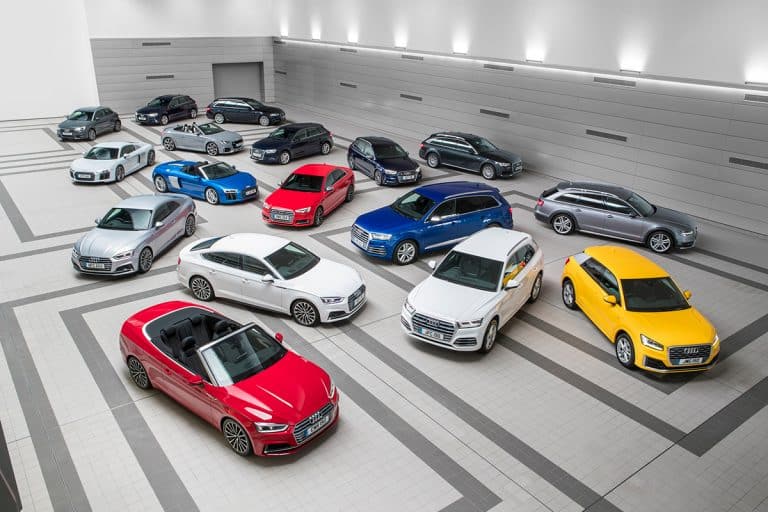
Another day another scrappage scheme – or in this case, four. VW Group brands Volkswagen, Audi, Skoda and SEAT are all launching incentives to replace older higher-polluting cars.
The four schemes are broadly similar. Owners trading in any diesel vehicle with a Euro 4 emissions standard engine or earlier, and registered before 2010, will be offered discounts against the majority of new cars from the four brands. All part-exchange vehicles traded in under the scheme will be scrapped rather than re-sold.
Volkswagen discounts range from £1,800 to £6,000, Audi £2,000 to £8,000, Skoda £1,500 to £4,000, and SEAT £1,500 to £3,500. The customer must have owned the car they are trading in for at least six months, and to qualify for the discount the new car must be ordered before the end of 2017.
Some of the highest discounts will be applied to customers choosing to buy plug-in hybrid models, and will be separate from the Government’s low-emissions vehicle (OLEV) grant. So, for example, a customer selecting a Volkswagen Golf GTE will receive a £5,000 scrappage discount plus the £2,500 OLEV grant, cutting a total of £7,500 off the price of the car.
Vauxhall started the latest scrappage offensive with a new version of a scheme the brand has run on previous occasions. BMW/MINI, Mercedes-Benz/smart, Ford, Hyundai and Toyota have all launched similar schemes in recent weeks.
The rush to scrappage comes on the back of sliding sales in the UK retail car industry. After a record start to the year registrations in July slumped 9%, with diesel sales particularly badly hit, plummeting 20%.
Plug-in models such as the Volkswagen Golf GTE will attract the biggest discounts.
The Car Expert checks the fine print
This offer is a part-exchange allowance, for selected used cars part-exchanged against selected new cars.
Your current car can be from any brand, but must be built to Euro 4 emissions standard or earlier. This will definitely be cars registered before 31 December 2009, although some cars had Euro 5 specification engines earlier than this.
You must be the owner of the part-exchange vehicle and the buyer of the new car (same name and registered address).
You must have owned the old car for at least six months, to stop people buying an old banger for £200 and then getting a £5,000 part-exchange allowance for it.
The scrappage price is fixed for any car part-exchanged as part of the scheme, not an allowance on top of the car’s value. You are effectively getting nothing for your car, but a discount on the new car (although it won’t be written that way on the contract).
You must order your new car by 31 December 2017 and take delivery by 31 March 2018.
This offer cannot be used on top of any other offers from the dealer/manufacturer/finance company, but can be used on top of the government plug-in car grant.
The offer is not dependent on you taking any finance package or other products.
Toyota has become the latest manufacturer to offer a scrappage scheme for customers part-exchanging an older car on a new vehicle.
Running from 1 September until the end of the year, the Toyota scrappage scheme offers between £1,000 and £4,000 off the price of a new Toyota. Every model in the Toyota passenger car and LCV range is included, although the offer is not available on some base specifications vehicles. The popular hybrid models are all included in the offer.
Toyota will accept any vehicle that is at least seven years old, for a fixed part-exchange price. There is no exclusion for Euro 5 vehicles, unlike schemes from other brands. The vehicles will be scrapped in accordance with best industry practice.
The allowance is not able to be used in conjunction with any other discount, unlike most other scrappage offers in the marketplace.
The offer will only be applicable if your part-exchange vehicle is worth less than the scrappage allowance – if you are part-exchanging a vehicle worth more than the scrappage offer, it will be handled as a normal part-exchange against a new car.
The allowances are as follows for each model in the Toyota range:
This offer is a part-exchange allowance, for selected used cars part-exchanged against selected new cars.
Your current car can be from any brand, but must be at least seven years old.
You must be the owner of the part-exchange vehicle and the buyer of the new car (same name and registered address).
You must have owned the old car for at least six months, to stop people buying an old banger for £200 and then getting a £2,000 part-exchange allowance for it.
The scrappage price is fixed for any car part-exchanged as part of the scheme, not an allowance on top of the car’s value. You are effectively getting nothing for your car, but a discount on the new car (although it won’t be written that way on the contract).
You must order your new car and take delivery before the end of the year.
This offer cannot be used on top of any other offers from the dealer/manufacturer/finance company.
The offer is not dependent on you taking any finance package or other products.
The Mini Electric Concept, to be unveiled at the Frankfurt motor show on the 20th anniversary of the brand’s debut under its BMW ownership, will preview a production model due on sale in 2019.
The brand produced an electric car 10 years ago, the Mini E, but it was a purely experimental model and only 600 were made. Earlier in 2017, a plug-in hybrid version of the Countryman SUV was launched, but the Electric Concept is considered a mainstay of the ‘Number One – Next’ strategy of Mini’s parent BMW Group.
No technical details of the Electric concept have yet been released, Mini only stating that the car ‘combines a drive system that is always quick off the mark with a precision-tuned suspension – the drivetrain and performance characteristics offer an enthralling drive on both city streets and country roads that is typical of the Mini product range.’
Future styling?
As a result, the exterior styling of the new car is being closely scrutinised – while Mini insists this is a concept and therefore not necessarily the look of a production model, industry observers believe it previews the future design direction of the Mini brand.
Overall the look is sharper, cleaner and more minimalist, and many believe this will be the next, fourth-generation Mini will take this route.
Several design elements reflect the electric drivetrain – the radiator grille and front air intakes are closed off as the motor does not require cooling. The body is smoothed out as much as possible to aid aerodynamics and increase the car’s range between charges. The exterior finish, with its yellow details, reflects the original Mini E.
The concept also makes use of 3D printing technology – aerodynamic inlays and the recessed louvred surfaces in the air intakes were produced using the technology. MINI says they illustrate the opportunities offered by 3D printing in terms of producing small-run or individually personalised parts.
Evolution rather than revolution is the theme of the second-generation Dacia Duster, that will be unveiled at the Frankfurt Motor Show on 12th September.
The new model will replace the SUV that was the standard bearer of the Romanian budget brand taken over by Renault in 1999. Since its launch in 2010, the original Duster has sold more than one million examples across the world.
Steeper screen
Therefore the redesign concentrates on improving an already successful product. Retaining its predecessor’s platform, the new Duster moves the windscreen 100mm further forward and rakes it at a steeper angle to improve interior space. The car also has a higher belt line – where the side panels meet the side windows, to give an impression of more strength, while aluminium roof bars are also fitted.
The exterior styling retains the muscular look, with distinctive elements from the first version including the squared-off wheel arches. Most obvious changes are at the front end – the headlamps at the very edges of the grille give the car a wider appearance, these lamps have a new signature with LED running lights, and the skid plate is larger with a scratch-resistant chrome finish.
According to Dacia, the interior of the Duster has been completely redesigned, with higher quality and more equipment, though details have not yet been released.
Similarly, no details have been revealed as to the new Duster’s powertrains, though they are expected to replicate the current line-up of 1.6 115hp and 1.5 125hp petrols, and 1.5 110hp diesels.
The BMW i3 has been facelifted three years after it first went on sale, with styling revisions, more equipment and a new sports-pitched model, the i3s.
This version produces 184hp with peak torque of 270Nm, which compares to 170hp and 250Nm from the i3. It will go from 0-62mph in 6.9 seconds and onto 99mph, while its official electric range is 174 miles, the real-world range 125mph.
Sports suspension is also fitted, with bespoke springs, dampers and anti-roll bars, that also drops the ride height by 10mm. A Sport drive mode is added, with more direct response to the accelerator and sharper steering, while a 40mm wider track is contained within black wheel arch extenders. The 20-inch alloy wheels are 20mm wider than previous versions.
More miles per charge
Across the i3 line-up improved range is promised from the 94Ah lithium-ion battery mounted in the floor. The Dynamic Stability Control traction system has been refined and responds faster, while a wheel speed limiter both aids stability and improves the energy regenerated under braking.
The restyling majors on a sportier look emphasising the i3’s width, with a black belt running from the bonnet over the roof, more black on the A-pillars and roof lines and a chrome strip across the rear flank. More exterior paint finishes are now available and LED headlamps are now standard, while the choice of driver-assistance systems available has been expanded.
Both the i3 and i3s can be ordered with a range-extender petrol engine. The two-cylinder unit offers 38hp to drive a generator and adds 93 miles to the everyday range.
Chery has revealed the first sketches of the SUV it intends to launch into Europe, including likely the UK.
The first vehicle in what the Chinese manufacturer describes as its all-new ‘global model line’, and which will focus on SUVs and crossovers, will be unveiled at the Frankfurt Motor Show on 12th September.
According to Chery’s research and development head Ray Bierzynski, the new model line will launch “within a few years”, and all models in the line-up will feature “characteristic styling, user-focused technology, electrified powertrains and advanced safety features.”
Water inspiration
The styling of the initial compact SUV follows the brand’s ‘Life in Motion’ design language, developed by chief designer James Hope. The concept focuses on ‘hydrodynamic surfacing’, aiming at reflecting the qualities of running water, while the front end is dominated by a chrome horizontal bar and LED headlamps.
So far no details have been released of the car’s technical specification or powertrains, though the car is understood to have been built on an all-new platform.
The brand, which has sold more than 1.2 million units overseas since it was founded in 1997 – more than any other Chinese carmaker – is currently planning its European expansion. Retail and fleet channels will be included in the evaluation, and European design and R&D facilities will be established.
There has been a flurry of new part-exchange “scrappage schemes” announced in the last few weeks, with manufacturers offering thousands of pounds for owners of older, higher-polluting cars to trade them in for shiny new vehicles.
All of the offers are based on owners part-exchanging a pre-2009 car for a new 2017 model. In all cases, the buyer of the new car must be the owner of the part-exchange vehicle, and must have been the owner for a sufficient time (to stop people buying an old banger for £200 then part-exchanging it for £2,000).
Strictly speaking, not all the of the offers involve scrapping your old car when buying a new one. The BMW/Mini offer is simply a part-exchange allowance for old diesel cars, while Mercedes/Smart and Hyundai are planning to scrap cars with Euro 1 to Euro 3 emissions levels (roughly pre-2005). Ford says it will scrap all part-exchanges handled under its offer.
Some of the offers are targeted at old diesel cars (BMW and Mercedes-Benz), while others are any pre-Euro 5 cars (Ford and Hyundai). And it’s expected that other manufacturers will start offering similar schemes very soon.
Meanwhile, Vauxhall has run a scrappage offer several times in the last few years, although in a slightly different way. Rather than offering £2,000 on top of your part-exchange value, it simply offers to give you a minimum of £2,000 for your car, regardless of its actual market value. There is also no link to emissions levels or fuel type.
To recap, here are the programmes currently available:
BMW/Mini – up to £2,000 part-exchange allowance for pre-Euro 5 diesel cars on selected BMW and MINI models (mainly diesels). No scrappage component to offer.
Mercedes-Benz/Smart – up to £2,000 part-exchange allowance on pre-Euro 5 diesel cars on selected diesel or hybrid Mercedes and smart models. Euro 1 to Euro 3 part-exchange cars will be scrapped, Euro 4 won’t.
Ford – up to £2,000 part-exchange allowance on pre-Euro 5 cars (petrol or diesel) on selected Ford cars and van models. All part-exchange cars will be scrapped.
Hyundai – up to £5,000 part-exchange allowance on pre-Euro 5 cars (petrol or diesel) on selected Hyundai models. Euro 1 to Euro 3 part-exchange cars will be scrapped, Euro 4 won’t.
Vauxhall – up to £2,000 part-exchange allowance on any vehicle (to bring the part-exchange value up to £2,000) on selected Vauxhall models. All part-exchange cars will be scrapped.
Can the new scrappage schemes repeat the success of the past?
The government scrappage scheme of 2009/2010 certainly brought a lot of customers into a new car who wouldn’t have previously considered one. Nearly 400,000 cars were scrapped under the scheme, according to official government numbers.
It’s also fair to say that the timing of the government scheme coincided with the surge in popularity of personal contract purchase (PCP) car finance. Exactly how much the scheme contributed to the rapid growth in PCPs needs far more research, but it certainly meant a whole new generation of car buyers were suddenly able to swap their old banger for a shiny new car on a very affordable monthly payment.
With nearly 90% of all private new car sales now funded by PCP car finance, there is less opportunity to repeat this spectacular result. To succeed, car dealers will need to convert potential used car buyers, maybe planning to pay cash or get a personal loan, into new car buyers on a PCP.
In 2009/10, the biggest winners of the government scrappage scheme were budget mainstream manufacturers, with Hyundai and Kia leading the way. It’s not hard to see why this would be – a guaranteed minimum part-exchange value of £2,000 and PCP finance on less than £10,000 of new car was very affordable for many people.
But that was a national programme, supported by £400 million of taxpayers’ money (although it was actually very profitable for the government, since the VAT on each new car was worth much more than the state’s contribution). The new programmes are limited to a handful of manufacturers, each with their own terms and conditions, and limited to specific vehicles.
Vauxhall claims to have scrapped more than 20,000 vehicles under repeated scrappage schemes since 2015, but these are not linked to emissions and have simply been a Vauxhall promotion on selected models. It’s evidently worked well enough for Vauxhall to run the offer at least once per year over the last three years.
Are these offers simply marketing or political stunts?
Mercedes-Benz and BMW were the first to announce their emissions-based schemes, yet neither of those manufacturers are exactly targeting the budget end of the market – even with low-rate finance options available. How many old banger drivers are really likely to be seriously considering a new BMW or Mercedes?
Both the BMW/Mini and Mercedes/Smart offers are targeted at owners of old diesel cars, and are only applicable to selected new models. Both offers are also primarily aimed at getting new diesel cars out the door (plus selected low-emissions petrol models at BMW), in an attempt to halt the tide of customers deserting new diesel cars in favour of new petrol cars or used vehicles.
For two manufacturers who are heavily reliant on diesel sales to hit their targets, it’s certainly a convenient picture to paint for the public. “It’s old diesel engines that are killing polar bears, not new ones, so let’s show the world we’re doing something about it.”
Of course, it would be more convincing if Mercedes wasn’t actively recalling most of its Euro 5 and Euro 6 diesel cars (ie – the “low emissions” ones) for a software update to ‘improve’ their emissions performance.
Is Mercedes-Benz really expecting many customers to take advantage of its scrappage offer?
Good value for lower-end new car buyers
For mainstream manufacturers like Ford, Hyundai and Vauxhall, scrappage schemes make a lot more sense. The jump from old car to new car is a realistic step for far more customers, although it is usually reliant on competitive finance offers to make it happen.
Offering a couple of thousand pounds over the market value of a part-exchange vehicle could make a significant difference to the affordability of a new Hyundai i10, Ford Fiesta or Vauxhall Adam. It’s less likely to make a BMW 3 Series or Mercedes-Benz E-Class achievable for most buyers.
Ford gets van buyers involved
Of all the scrappage schemes announced so far, only Ford is making an attempt to include commercial vehicles as well as passenger cars. Including other discounts available, Ford is offering up to £7,000 off the price of selected new Transit vans.
Given the number of pre-Euro 5 vans clogging up city streets around the UK, and the stop-start nature of urban delivery work, this is perhaps the most laudable of all the scrappage offers available.
What are the hidden costs of the scrappage schemes?
As with the 2009/10 government scrappage programme, there has been debate about the overall environment merits of the latest scrappage schemes.
While it’s great to get higher-polluting cars off the roads, it’s highly dubious as to whether the total environmental effect of scrapping perfectly roadworthy vehicles and replacing them with new vehicles is any better. There have been many arguments about this, and it’s fair to say that opinion is split.
The other elephant in the room is car finance. Although none of the scrappage schemes are reliant on customers taking out finance, the reality is that the target customers for these programmes are highly likely to need finance to afford their new car. So we reduce the number of higher-polluting cars on the road, but increase buyers’ debt levels to pay for the new lower-polluting ones.
With all the current discussion about growing car finance debt and the potential impact on the economy, it will be interesting to see if there is a corresponding jump in car finance levels from scrappage customers. We are potentially trying to solve one problem by making another one worse. Which, of course, is largely how we ended up with all these polluting diesel cars on city streets in the first place…
Hyundai has joined the ranks of manufacturers offering scrappage or part-exchange offers for older, higher-polluting vehicles, with between £1,500 and £5,000 on offer from September until the end of December.
The Korean company is the latest manufacturer to announce financial incentives for owners of cars with Euro 4 or earlier emissions ratings. BMW/Mini, Mercedes-Benz/smart and Ford have all launched similar schemes this month, while Vauxhall has run similar schemes on several occasions in the last three years.
The Hyundai scheme is broadly similar to others on offer, particularly the Ford scrappage scheme. Owners of any Euro 1 to Euro 4-rated vehicle, either petrol or diesel, can claim a part-exchange allowance on a range of new Hyundai models.
Any Euro 1 to Euro 3 part-exchange vehicles will be scrapped, while Euro 4 models (approximately 2005 to 2009) will be re-sold.
The allowances on offer range from £1,500 on the Hyundai i10 hatchback up to £5,000 on a Hyundai Santa Fe SUV.
Hyundai will also offer 2.9% APR finance plans to support the part-exchange offer, although details of these are yet to be announced. We will update you as soon as Hyundai publishes more information.
The Car Expert checks the fine print
This offer is a part-exchange allowance, for selected used cars part-exchanged against selected new cars.
Your current car can be from any brand, but must be built to Euro 4 emissions standard or earlier. This will definitely be cars registered before 31 December 2009, although some cars had Euro 5 specification engines earlier than this.
You must be the owner of the part-exchange vehicle and the buyer of the new car (same name and registered address).
You must have owned the old car for at least 90 days, to stop people buying an old banger for £200 and then getting a £5,000 part-exchange allowance for it.
You must order your new car and take delivery before the end of the year.
This offer can be used on top of any other offers from the dealer/manufacturer/finance company, including the government plug-in car grant
The offer is not dependent on you taking any finance package or other products.
The Maserati Ghibli has undergone a minor facelift after four years on sale.
On show at the Chengdu Motorshow in China, the new GranLusso variant sports minor visual changes, while also adding more and updated equipment. Its GranSport sister model will be similarly updated.
Maserati claims that the exterior restyling has contributed to a substantial improvement in the car’s aerodynamic efficiency, though figures have not been released. The car gains a new front bumper with chrome bars incorporated to reflect the design signature of more recently released Maserati models such as the Levante SUV, while the new rear bumper with its body-colour diffuser produces a sharper look to the back of the car.
Autonomous ready
Extra equipment now available includes adaptive full LED headlamps with Matrix high-beam lamps that will not cause glare to oncoming traffic, while Maserati is also introducing systems to the Ghibli that will enable autonomous driving in future. The existing interior layout is retained, having only recently been updated, principally gaining a new infotainment system.
Maserati has not yet released any powertrain details of the facelifted car but these are expected to remain unchanged as both the 3-litre V6 petrol and diesel engines recently gained power upgrades – the diesel now offers 275hp while the petrol can be bought with either 310 or 430hp.
Similarly the current prices, ranging between £50,000 and £66,000 are expected to see few changes when the revamped Maserati Ghibli goes on sale early in 2018 as a more exclusive rival to the BMW 5 Series and Mercedes-Benz E-Class.
A week after publishing disastrous results for used car sales from April to June, the Society of Motor Manufacturers and Traders (SMMT) has now published corrected numbers and decided that things aren’t so bad after all.
Having commissioned a hasty recount, the SMMT has now decided that used car sales did not fall by 13.5% during Q2, but only slipped by 0.7%. Instead of 1,832,400 cars changing hands over the three-month period, the SMMT has managed to find nearly 300,000 V5 registration papers down the back of the sofa, and now believes that 2,102,154 used cars found new homes.
The results certainly make more sense, as the Finance and Leasing Association (FLA) had posted finance results for the same period on the same day as the SMMT’s first attempt, and there was nothing unusual in the FLA’s finance numbers (more people are still taking out more finance on used cars).
As yet, there has been no statement from the SMMT as to where they found the extra numbers, but everyone in the automotive industry will be very pleased. We look forward to reading about how Brexit was the real cause of this whole saga and that the government must do something.
There is also apparently no truth to rumours that Theresa May has invited the SMMT to check the numbers on the recent General Election, as she’d quite like a disastrous June result improved as well.
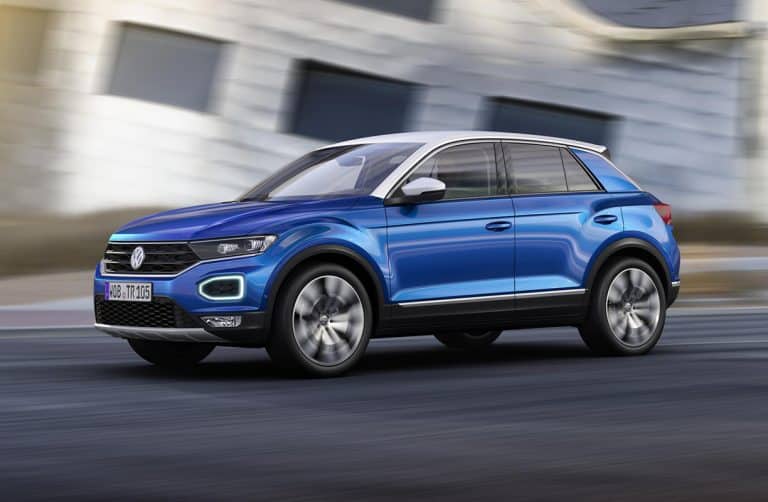
The Volkswagen T-Roc SUV has been unveiled during a presentation on the shores of Lake Como in Italy, setting off the brand’s new crossover offensive.
When it goes on sale in December the five-seater T-Roc will sit below the Tiguan as a more stylish, more compact sister model, and is expected to rival all the major players in the compact crossover segment – particularly the segment-leading Nissan Qashqai.
UK prices of the T-Roc have yet to be revealed but industry observers suggest that they will start from around £19,000. Three trim levels will be available, dubbed T-Roc, Sport and Style.
‘A car for all ages’
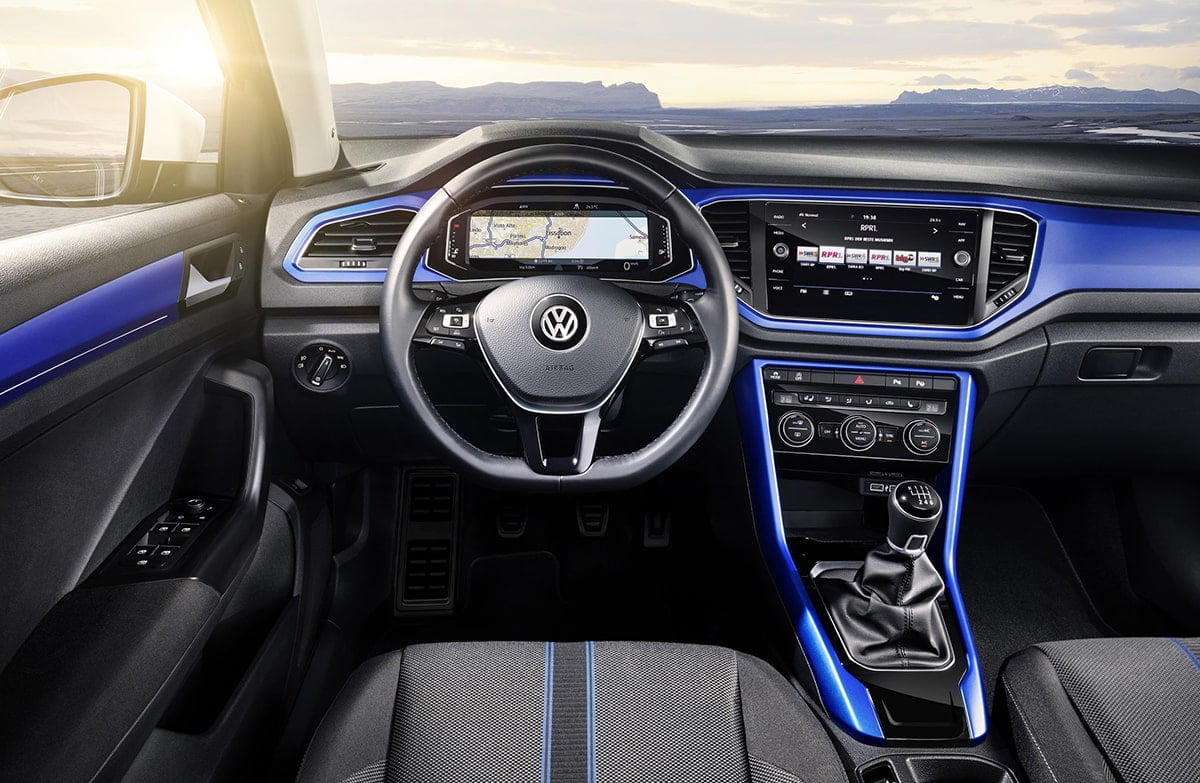
Volkswagen believes that its new model will appeal to all ages of buyers, expecting them to be down in by its personalisation options, digital technology, connectivity, driver assistance systems, engines and in particular what is dubbed a ‘modern, expressive design.’ “The T-Roc sets a new benchmark in the booming SUV segment,” says Volkswagen head Dr Herbert Diess.
The new SUV is built on the same Volkswagen Group MQB modular platform as the Tiguan and boasts a similar engine line-up. Three TSI petrol and three diesels will be on offer, and while most will use front-wheel-drive powertrains, unlike many rivals the T-Roc will offer an all-wheel-drive option using Volkswagen’s 4Motion transmission.
A host of driver-assistance systems will be fitted as standard on all models, including an automatic post-collision braking system, a lane keeping system and a front monitoring system including pedestrian monitoring and city emergency braking. A further 10 assistance features will be available as options, ranging from adaptive cruise control to rear parking cameras.
What is it?
The new Nissan Qashqai is a facelift package for the elder statesman of the crossover market.
Key features
Significant visual changes, better quality, more equipment.
Our view The upgrades to the Nissan Qashqai improve an already effective model and will keep it competitive against younger crossover rivals.
The interior upgrades have added an extra level of quality, though the layout feels slightly dated when compared to some rivals. But the Qashqai remains an accomplished all-round package and will no doubt continue to find many buyers.
Nissan Qashqai – the car that created the crossover segment, as its makers never fail to tell us. And today, as each manufacturer unveils yet another new crossover model in what is the UK’s fastest-growing sector, we always compare it first to the Qashqai.
A decade after its launch (we celebrated its birthday with a special feature), the Nissan Qashqai has at least 21 direct competitors, with more arriving all the time. And several of those have been launched since the current, second-generation version of the Nissan appeared in 2013.
So in order to keep adding to the 2.3 million sold so far, 4,500 in the UK claiming 10% of the entire segment, a facelift is necessary. The revamp follows the usual menu – styling changes, more equipment and better quality.
All this rates alongside one other factor that might sway some customers towards the Qashqai – it’s a British car, designed at Nissan’s studio in Paddington, engineered at Cranfield in Berkshire, and built, at a rate of around half a million a year, in the massive plant in Sunderland.
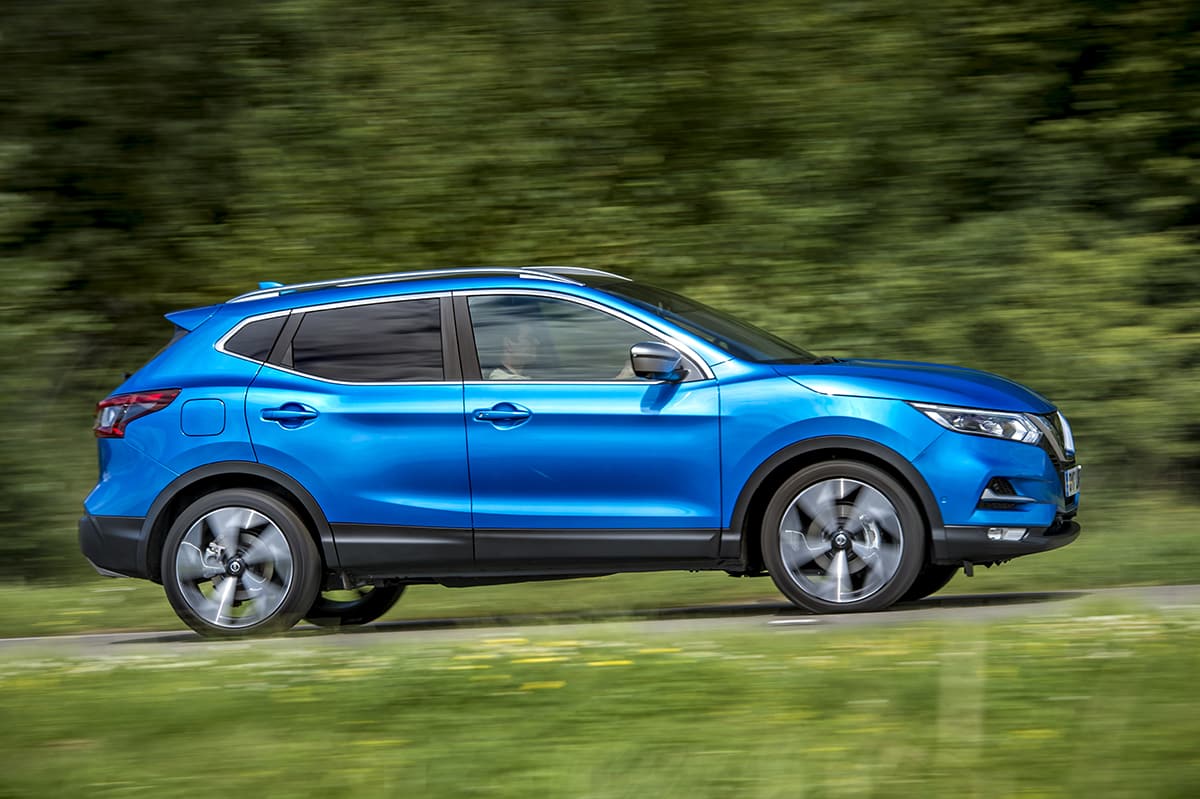
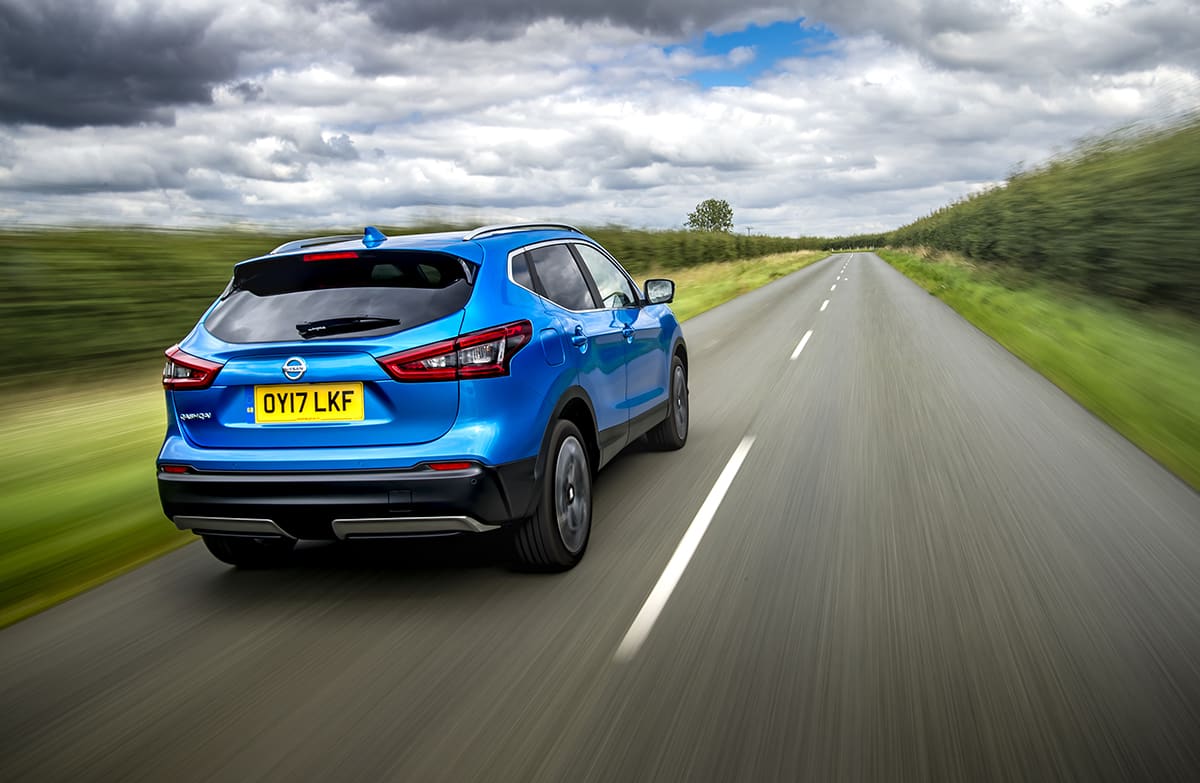
Minor visual update is most obvious from the front end
Exterior and interior
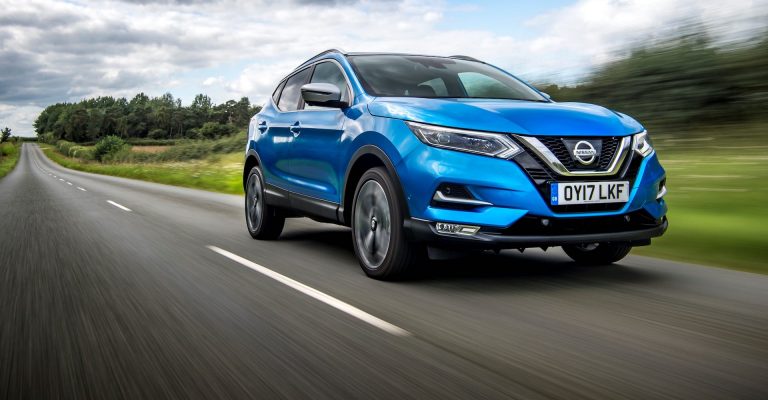
Visually, Qashqai connoisseurs will immediately notice one major difference in the new model – the front end. The latest Nissan ‘V-motion’ design style is applied, resulting in a much bolder, deeply plunging bumper arrangement, framed by slimmer LED headlamps.
The rear is not so bold, but notable elements include the more prominent diffuser and the silver-finish sump guard look on upper trim levels. Together with more body-coloured components, and wider use of gloss instead of matt black finishes, the result is a more distinctive overall profile for the car.
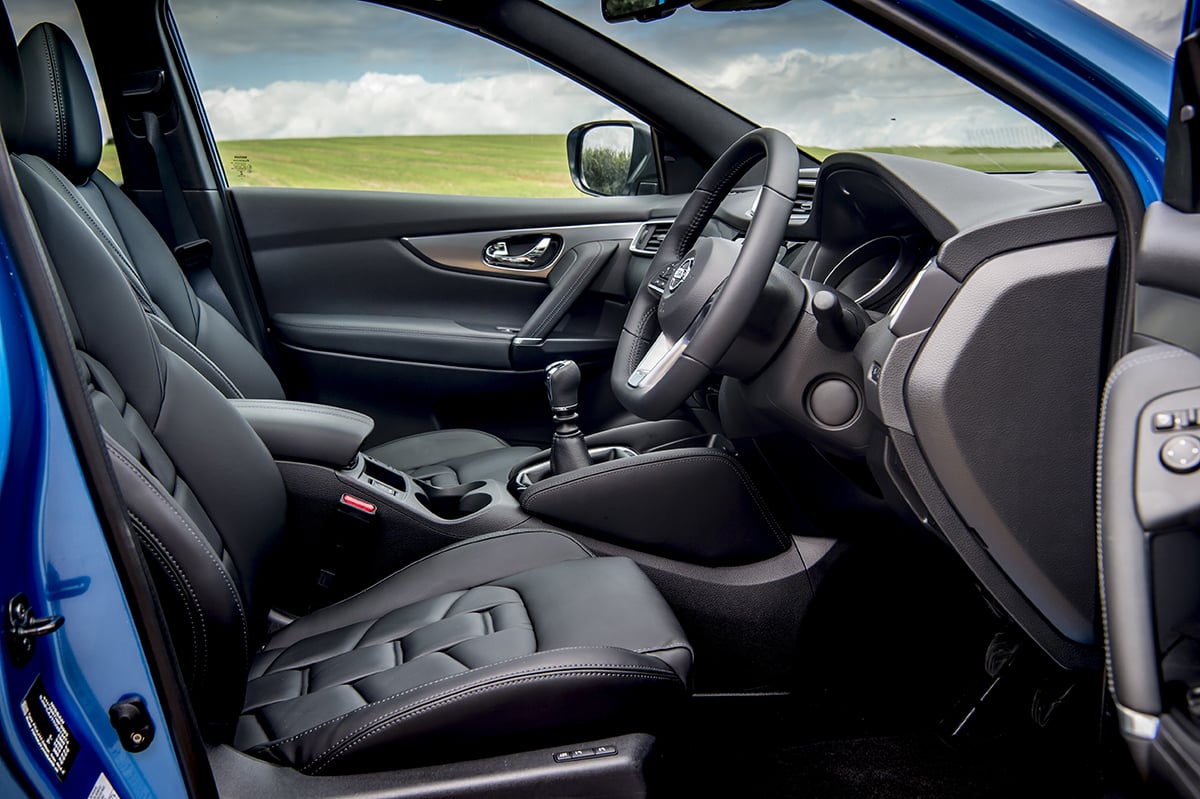
Inside has undergone lots of changes in a bid to appear more upmarket. The monoform seats look like one-piece units, and the steering wheel is now larger in diameter, thicker and D-shaped, which according to Nissan both offers improved steering and a better view of the instrument panel beyond.
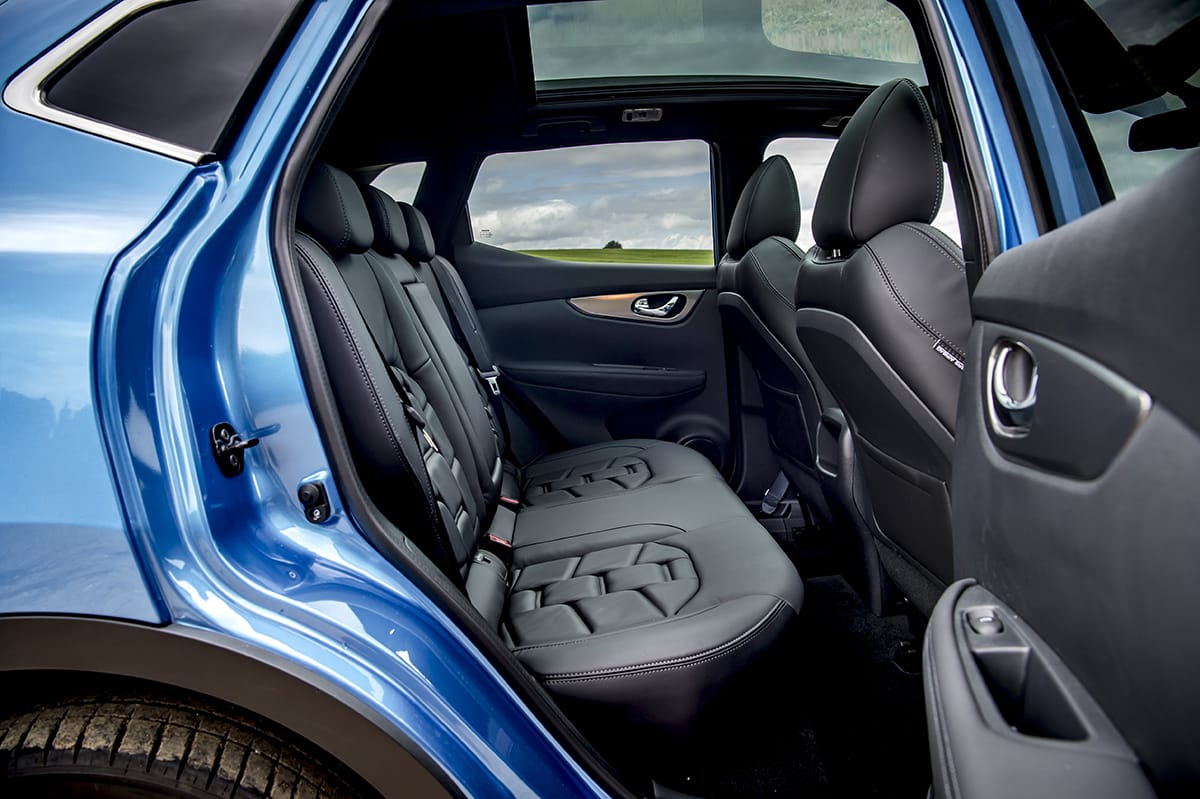
Spend out on the new range-topping Tekna+ model, and the seats certainly look premium, finished in nappa leather in a 3D quilted design. The driver’s seat includes pneumatic lumbar support, and memory settings.
Also new is an eight-speaker Bose premium sound system and smartphone compatibility through a unit called Nissan Connect EVO, while all models also get DAB digital radio. This is all controlled through the central screen, which is said to have more intuitive graphics but which also retains the layout and buttons of the previous version. The result is a bit cluttered compared to rivals, even including a CD slot – almost unknown on today’s new cars.
Dash layout is improved but still a bit cluttered
Tekna+ models get nappa leather
Optional panoramic roof brightens things up
Powertrains and chassis
One aspect that has not changed on the new Qashqai is the powertrain choice – between two petrol engines of 1.2 and 1.6 litres, and diesels of 1.5 and 1.6 litres. It’s a sign of the times that only the 1.6 130hp diesel is available with an all-wheel-drive transmission.
The smaller 1.5-litre diesel is expected to remain the most popular option – primarily because it has a CO2 emissions figure of only 99g/km. Aiding this is an underside smoothed out in the search for more efficient airflow.
Nissan has worked on the chassis. The dampers are softer, the roll bars stiffer. A new damper on the steering wheel improves response, while the electronic driver aids are refined too. Meanwhile, lots of extra insulation improves the interior ambience.
On the road
On the launch event we only had the chance to try out one engine option, but at least it was the most popular, the dCi 110, matched to a 2WD transmission and in N-Connecta trim.
The Qashqai is certainly refined on the road – riding within it is a calm experience even under heavy acceleration. The torquey engine dials in the power effectively without being exciting, and the on-the-road performance is similar. The car smothers bumps, rides in comfort, and corners effectively without being that invigorating.
The Qashqai is refined on the road
Torquey diesel engine is effective although not exciting
The Qashqai smothers bumps and rides comfortably
Equipment
Four trim levels of the previous Qashqai have become five. As in the previous car, Nissan expects by far the majority of customers to go for the upper-specification N-Connecta, Tekna and the new Tekna+ luxury grade. This includes such desirables as the Bose sound system, the quilted leather and a panoramic sunroof.
Standard equipment is good, with all models including LED daytime running lights, cruise control, front and rear parking sensors, heated mirrors and Bluetooth connectivity. You have to go up to N-Connecta before you gain the Nissan Connect seven-inch touchscreen satnav, with smartphone apps and a reversing camera, while choose Tekna and the leather seats are heated, and the neat ‘around-view monitor’ parking aid with self-parking included.
More is to come – from Spring 2018, the Qashqai will be available with the brand’s latest autonomous technology ProPilot, which offers an adaptive cruise control, lane keeping and traffic jam assistance.
Summary
The package of updates to the Nissan Qashqai improve what is already a highly effective package. The interior upgrades have added an extra level of quality, though the layout feels slightly dated when compared to some rivals. But the Qashqai remains an accomplished all-round package and will no doubt continue to find many buyers.
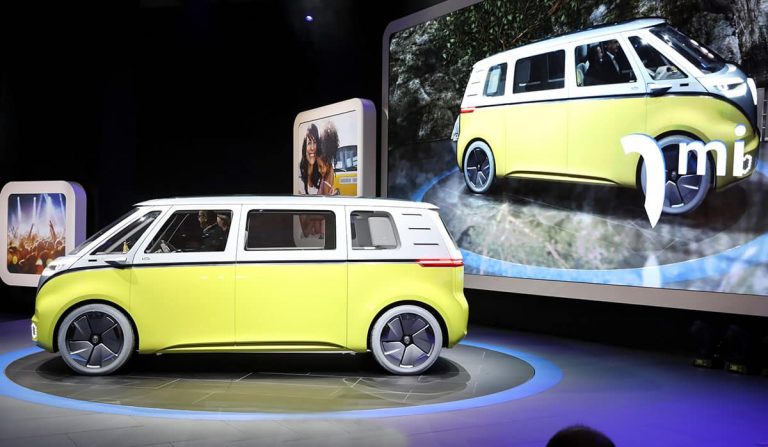
The iconic Volkswagen Kombi van is on the way back – as an electric people carrier based on the I.D. Buzz concept.
The German brand has announced that the concept, unveiled at the North American Auto Show in Detroit in January, is to be ‘further developed in preparation for its launch as a production vehicle.’
Revealing the plans at the Pebble Beach Concours D’Elegance in California, Volkswagen car and commercial vehicles brand heads, Dr Herbert Diess and Dr Eckhard Scholz, described the I.D. Buzz as an important pillar in VW’s electric vehicle strategy. They added that a production decision had been taken after a host of “please build this car” messages from visitors who saw the concept at Detroit and the Geneva show in March.
2022 launch date
The car is set to be the second member of the new VW electric family on sale, following the four-door I.D. into showrooms in 2022. Europe, North America and China are expected to be prime markets.
Few details of the production I.D. Buzz are currently being revealed, Volkswagen stating only that it will be based on the new all-electric architecture and incorporate many design ideas from the concept car. Variable seating, interactive connectivity and highly automated driving will all be part of the production model’s specification.
The Detroit concept offered seating for eight, and was capable of a range of 270 miles from a battery pack chargeable to 80 per cent in under 30 minutes.