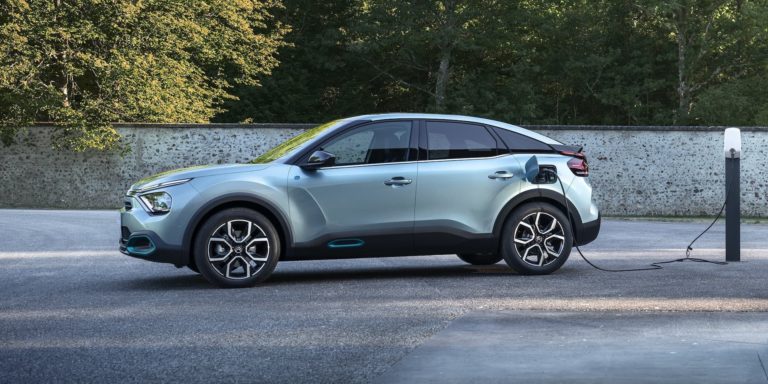
Citroën has revealed its latest-generation C4 range, bringing a fresh new look to the midsize hatchback as well as a new electric powertrain option called the ë-C4.
Having previously been teased in images released a couple of weeks ago, this is the first time that we’ve seen the new model in full and learned all the technical details.
The new Citroën C4 is essentially a replacement for the current C4 Cactus, which will continue on for a while but will not be replaced. The offbeat C4 Cactus garnered plenty of critical acclaim over the years, but this failed to translate into sustained sales volumes. A 2018 facelift toned down the original version’s styling, but this didn’t help sales.
Compared to the Cactus, the new C4 has been raised up crossover-style in line with the current obsession for SUV and crossover vehicles, further exaggerated by styling that blends hatchback and crossover elements. The overall look evolves Citroën’s current design language while also drawing inspiration from its 1970s GS and 1980s BX models. The exterior of the car debuts new V-shaped LED headlights and taillights, while the grille represents an evolution of the one fitted to the facelifted C4 Cactus.
The interior also follows the trend for minimalist layouts, digital dials and a large central touchscreen to control most functions. A special tablet holder has also been integrated into the dashboard ahead of the front passenger (presumably out of the way of the airbag…), allowing them to comfortably view their devices while on the move.
In terms of engine options, the new Citroën C4 will be offered with a selection of its existing PureTech petrol and BlueHDi diesel engines, with power outputs ranging from 100hp to 155hp. The UK line-up will be detailed closer to the model’s on-sale date in September.
A range of advanced assistance systems have been incorporated into the car’s design, with highway driver assist and a level two semi-autonomous driving system included as standard. The new C4 has not yet been crash tested by Euro NCAP, but we will provide results as soon as it happens.
Customisation has been given increased emphasis with the new C4, with customers able to choose 31 different combinations for the exterior alongside six different ‘ambiences’ for the interior.
Citroën’s focus on comfort over handling is reflected in the fitment of its unique hydraulic suspension to help to provide a supple ride, combined with the company’s advanced comfort seats to help make the C4 as comfortable as possible.
High hopes for electric ë-C4
Front and centre at the virtual C4 launch was the ë-C4 electric version. Citroën hopes that the ë-C4 will account for about 10% of sales from launch, increasing quickly to 20% as more consumers demand electric vehicles. The company is adamant that a fully-electric model is a better option for the market than a plug-in hybrid powertrain like the one it offers in the C5 Aircross.
The ë-C4 utilises a 50kWh battery, which Citroën claims will return up to 217 miles between charges.
Production of the new Citroën C4 and ë-C4 will commence after the summer, with deliveries across Europe expected after that. Order books are expected to open in September, with full UK pricing and specifications likely to be announced in coming months.
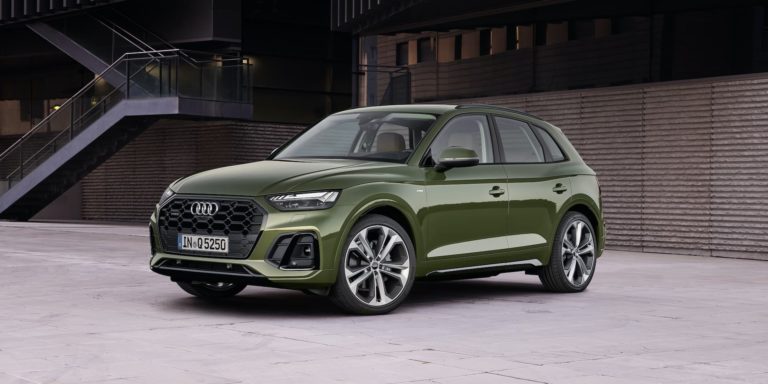
Audi has breathed fresh life into its Q5 mid-sized SUV range with a sharper look and new technological additions.
Set to arrive in the UK this autumn, the facelifted Q5 will initially be available in Sport, S line and Vorsprung specifications, while an Edition 1 trim line will be available for the first time as well.
Redesigned bumpers mean the new Q5 is officially a couple of centimetres longer than the car it replaces (although no important dimensions are altered) while the grille has been designed to look wider than before. Entry-level Sport edition cars boast LED headlamps – replacing the Xenon units available previously – while S line and Edition 1 cars get Matrix LED units fitted instead, a feature which only came as standard on Vorsprung model cars beforehand.
New Edition 1 cars boast 20-inch diamond-cut alloy wheels and a black exterior styling pack. It’s been introduced to offer the distinct exterior look of the Vorsprung but for a lower entry price.
Inside, the MMI display has been boosted in size, rising to ten inches against the seven- or eight-inch displays available previously. It’s also now a fully touch-controlled system, with the rotary controller removed entirely in favour of more storage. It features acoustic feedback – it’ll make a small ‘click’ noise when an icon is pressed – while voice control comes as standard on all models.
Amazon’s Alexa system has been incorporated into the car for the first time, allowing drivers to stream a playlist or control a smart device at home while on the move.
A full 12-inch driver display has also been made standard across the range having previously only come included with top-specification Vorsprung cars.
The range of engines remains the same as before, with a series of petrol, diesel and plug-in hybrid powertrains available.
Prices for the new Audi Q5 start from £42,950, with a more comprehensive price list likely to be announced closer to the car’s arrival in autumn.
A quick nip and tuck for one of the best in its class
The Audi Q5 has been popular with both the buying public and the media over the years. As of June 2020, our unique Expert Rating system shows that the current model holds an Expert Rating of 81% based on 25 UK reviews. That’s not quite the best in class (its closely-related cousing, the Porsche Macan, is a couple of points better), but it’s still a very strong score.
These upgrades are typical Audi mid-life facelift fare – an even bigger grille, a bigger (touch)screen display and LED headlights, but it will keep the Q5 competitive in both the showrooms and the magazines. Stuart Masson, Editor
Mandatory MOT tests for cars more than three years old will return from August, roads minister Baroness Vere has announced today.
Drivers had been granted a six-month exemption from MOT tests in March in an effort to help slow down the spread of coronavirus. However, with lockdown measures easing across the UK, MOT tests for cars, motorcycles and vans will once again be made mandatory in England, Scotland and Wales, bringing an end to the extension scheme.
Drivers with an MOT due date prior to 1 August will continue to receive a six-month exemption from the test, but their vehicle will still be required to be properly maintained and kept in a roadworthy condition. These people are still able to voluntarily get their cars MOT tested should they want to, however.
Roads Minister Baroness Vere said: “As people return to our roads, it is vital that motorists are able to keep their vehicles safe. That’s why as restrictions are eased, from 1 August MOT testing will again become mandatory.
“Garages across the country are open and I urge drivers who are due for their MOT to book a test as soon they can.”
Despite many garages closing during the coronavirus – with only a small number remaining open to cater for essential services – more than 90% are now open across the country, with capacity already reaching 70% of normal levels.
Even if drivers have been granted an automatic exemption, the Department for Transport (DfT) is asking drivers to still take their cars to be checked over by a professional mechanic if they notice something is wrong with their vehicle.
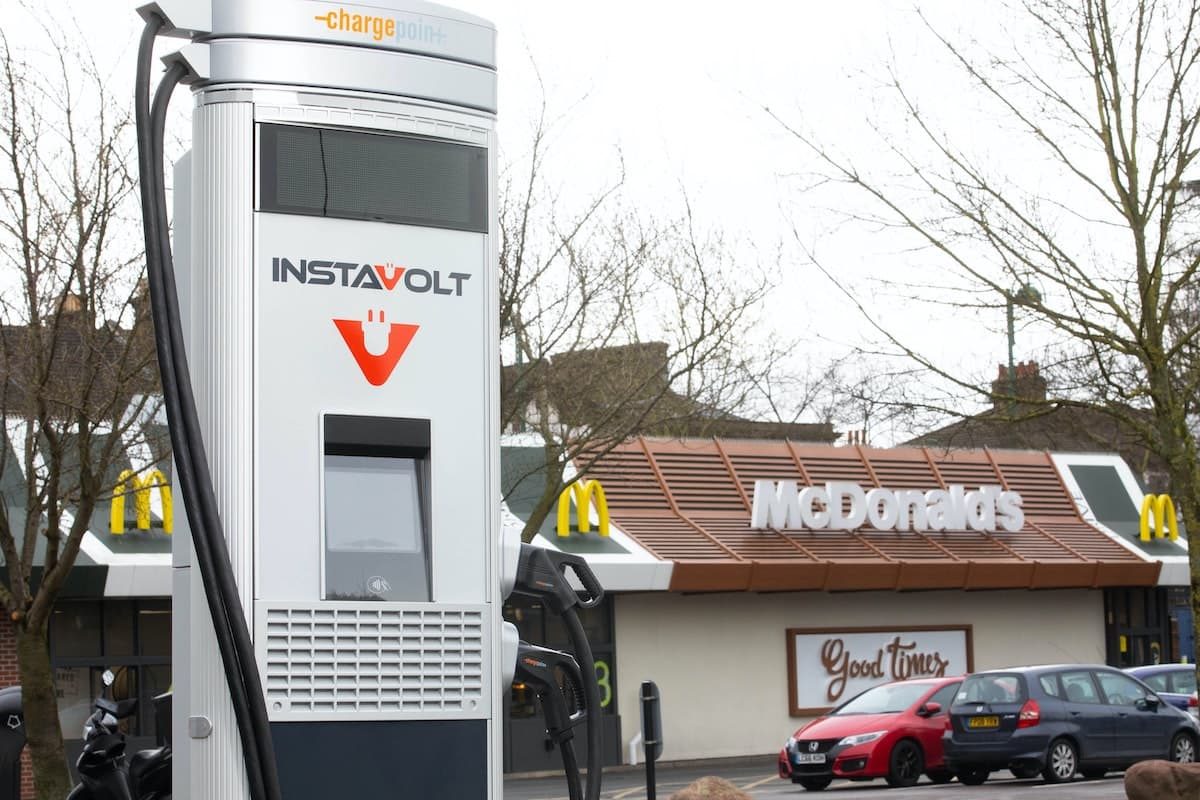
McDonald’s customers will be given the chance to power up their cars in restaurant car parks after the fast food giant announced plans to install hundreds of charging points at its UK sites.
While they munch on their fries, diners will be able to plug their cars in to the new ports, which can provide up to an 80% charge in under 20 minutes, McDonald’s said.
The project, which is a partnership with InstaVolt, will give drivers many more places to stop off when travelling up and down the country.
Hundreds of thousands of additional electric vehicle charging points will be needed to cover the UK if the Government is to hit its target to ban all new petrol and diesel cars from 2035.
In research commissioned by the fast food chain, more than half of people who do not own an electric car said that a lack of convenient charging points was a barrier to them switching.
Two thirds said they would reconsider if there was better coverage.
McDonald’s runs more than 1,300 sites up and down the UK, meaning the roll-out will reach many parts of the country.
The policy will also help its own staff, who are offered electric or hybrid vehicles if they are eligible for company cars.
“Appetite for electric vehicles, which will be a central part of the UK’s efforts to build back greener post Covid-19, is growing,” said McDonald’s UK and Ireland CEO Paul Pomroy.
“This partnership and ambition takes advantage of our scale, and is a real step forward for those already driving electric vehicles, as well as people considering making the switch.
“With over 1,300 restaurants our ambition would mean you would never be far from a charging point.”
He added: “Our ultimate ambition is to have more EV charging points on our premises than any other company in the UK and Ireland.”
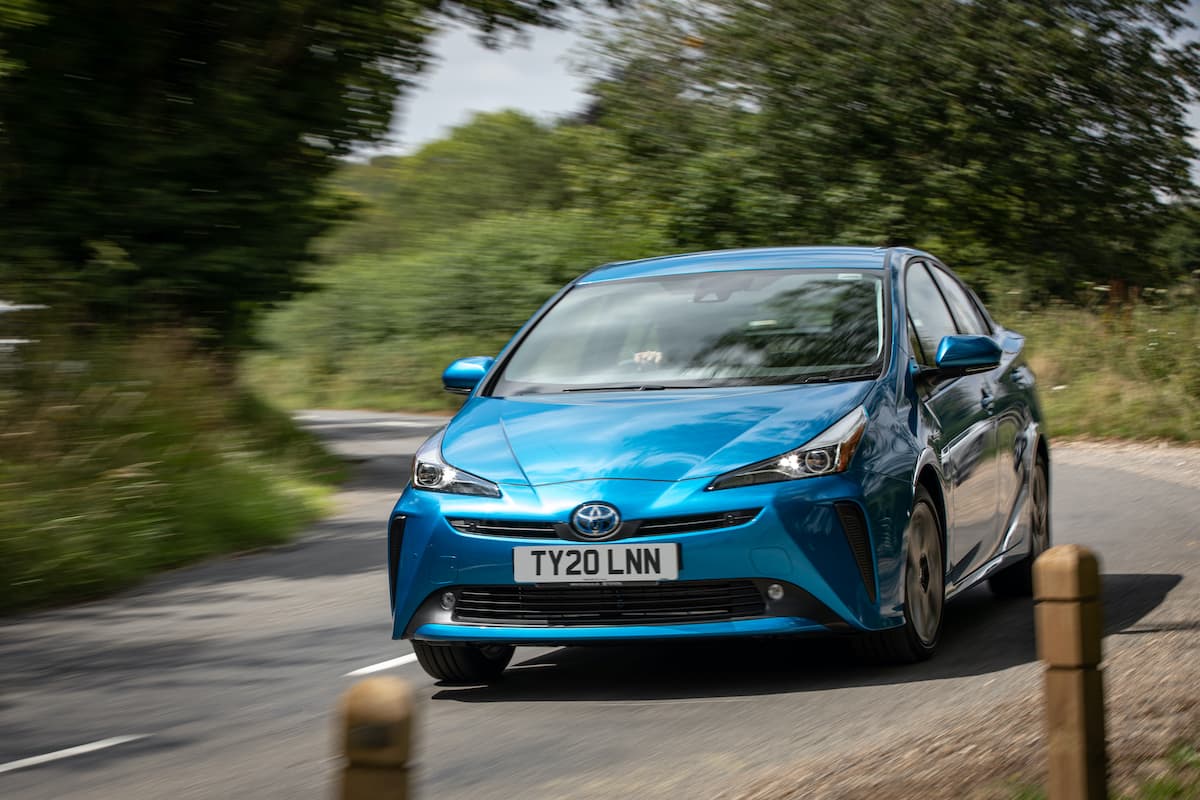
The Toyota Prius was a medium-sized saloon, powered by a petrol-electric hybrid powertrain. The Prius was famous for being the original hybrid car, with the original model first launched back in 1997 in Japan. This is the fourth generation, which went on sale in the UK in early 2016.
In addition to the standard Prius shown here, which was a regular hybrid model with very limited electric range, there was also a Prius Plug-in model that could be charged from an external charging point and offers considerably greater electric range. There was also the Prius+, which is a seven-seat model based on the last-generation Prius saloon.
As hybridisation has become more common across the car industry in recent years, the number of potential rivals for the Prius has increased dramatically. Just within the Toyota family, the Corolla hatch/saloon/estate and the C-HR crossover are built on the same platform and feature the same hybrid drivetrains as the Prius, plus there’s the larger Camry saloon as well.
The Toyota Prius has always been well-known for its environmental credentials, but the latest model was also a considerable improvement to drive. It was praised for its ride and handling, as well as low running costs in urban driving. However, the styling polarised opinion and the Prius was viewed by many people as a minicab rather than a family car.
No longer on sale, the Toyota Prius holds a Used CarExpert Rating of A with a score of 73%.
Body style: Mid-size saloon Engines: petrol-electric hybrid Price when new: From £24,355 on-road
Launched: Spring 2016 Last updated: Spring 2019 Discontinued: Spring 2022
Image gallery
Media reviews
Highlighted reviews and road tests from across the UK automotive media. Click any of the boxes to view.
Auto Express
Model reviewed: AWD Score: 7 / 10 “Its main selling point is its fuel economy and, as ever, in this area the Prius absolutely excels.” Read review
Model reviewed: Range overview Score: 8 / 10 “The latest Toyota Prius continues to pioneer hybrid tech, but it’s also a great family car” Read review
Auto Trader
Model reviewed: Range overview Score: 7.6 / 10 “The Toyota Prius is an intriguing alternative to diesel-engined family cars, being well built, comfortable, spacious and extremely tax-efficient. It’s also imaginatively styled, comes with loads of safety kit and, despite some cheap-looking plastics, feels like it is built to last forever and a day.” Read review
Car
Model reviewed: Range overview Score: 8 / 10 “Aside from impressive eco numbers that will make it a massive company car hit, the big news here is how much more appealing the new Toyota Prius is to those who don’t begrudge putting fuel in our cars or lie awake fretting about the melting ice caps.” Read review
Car Keys
Model reviewed: Range overview Score: 8 / 10 “The Toyota Prius definitely wins at low-cost motoring and is certainly a competitor in this ever-changing market. And if you can afford it, we recommend forking out for the plug-in version and can charge it regularly, do it – you’ll see savings in the long term. Read review
Carbuyer
Model reviewed: Range overview Score: 8.4 / 10 “Whether you love or loathe its styling, the latest Toyota Prius is a practical and technology-filled hybrid that costs very little to run” Read review
Carwow
Model reviewed: Range overview Score: 7 / 10 “Look past the Prius’ alien styling and it’s a reasonably roomy family car that’ll cost pennies to run. Unfortunately, some desirable options aren’t standard” Read review
Daily Mail
Model reviewed: Range overview “It’s still one of the most practical hybrids on the market, with a boot more than capable of coping with a fortnightly food shop. But the fact it is now so enjoyable to drive may come as a surprise – and it’s that crucial element which Toyota is hoping will win over a whole new generation of motorists.” Read review
Daily Mirror
Model reviewed: 1.8-litre petrol-electric hybrid automatic AWD-i Score: 6 / 10 “There is a point in a four-wheel-drive Toyota Prius if you live somewhere you need traction or it snows a lot – but otherwise it’s pointless.” Read review
Driving Electric
Model reviewed: Range overview Score: 9 / 10 “If it’s a non-plug-in hybrid car you’re after and practicality and efficiency are key, then we’d recommend a Toyota Prius ahead of all its rivals.” Read review
Evo
Model reviewed: Range overview Score: 6 / 10 “The Toyota Prius has always made economical driving a game, and the latest version is improved in other areas, too.” Read review
Green Car Guide
Model reviewed: Prius Excel T+G Plus Score: 9 / 10 “The new Toyota Prius is still the definitive hybrid. You don’t need to plug it in, and it rewards with high levels of efficiency – if driven carefully. It’s perfectly pleasant to drive, if you’re not expecting the characteristics of a driver’s car. It’s also practical, with five seats and a big boot.” Read review
Honest John
Model reviewed: Range overview Score: 8 / 10 “The latest incarnation of the Toyota Prius is still king of the hybrids, with impressive fuel economy, extremely relaxed driving dynamics, good build quality and a very comfortable cabin. If you want to glide around effortlessly without using too much fuel, there are few better ways to go about it.” Read review
Motors
Model reviewed: Range overview Score: 7 / 10 “The Toyota Prius is all about fuel economy and low emissions and, like it or not, that comes with a very singular image. This innately comes with a stigma, that people who buy the Prius aren’t interested in cars or driving and are instead green activist bores.” Read review
Parkers
Model reviewed: Range overview Score: 8.2 / 10 “Surprisingly good to drive, with excellent efficiency and plug-in option” Read review
The Sun
Model reviewed: Range overview “It’s still not quite a driver’s car but no electric vehicle ever will be, no matter what Tesla will have you believe. And for now, the Prius is still the best at what it does.” Read review
The Sunday Times
Score: 6 / 10 “Toyota was right on hybrids but Prius is still for eco-warriors” Read review
The Telegraph
Model reviewed: (range review) Score: 7 / 10 “Much improved over its predecessors, the latest Toyota Prius can deliver exceptional economy in town and brings low company car tax bills, whilst also being pretty spacious and decent to drive.” Read review
Top Gear
Model reviewed: Range overview Score: 7 / 10 “Much better to drive than its predecessor; much worse to look at, too.” Read review
Safety rating
Independent crash test and safety ratings from Euro NCAP
As of April 2025 (our most recent data point), the Toyota Prius family – including the Prius Plug-in – has a very good reliability score of 90%. This includes previous generations of the Prius as well as this model.
The Car Expert’s reliability information is provided exclusively to us using workshop and extended warranty data from our partner, MotorEasy.
Awards
Trophies, prizes and awards that the Toyota Prius has received
2022
Carbuyer Awards – Best Used Hybrid
2021
Carbuyer Awards – Best Used Hybrid
2020
Honest John Satisfaction Index – UK’s Most Reliable Car
2019
Auto Express Driver Power Awards – New Car of the Year + Best Compact Family Car
DrivingElectric Awards – Best Used Hybrid Car
2018
Auto Express Driver Power Awards – Best Compact Family Car
Honest John Satisfaction Index – Car of the Year
Professional Driver Awards – Private Hire Car of the Year
2017
UK Car of the Year Awards – Best Family Car
Carbuyer Awards – Most Economical Car + Best Small Hybrid Car
Car Dealer Awards – Best Used Electrified Car
2016
Auto Express Awards – Green Car of the Year
Carbuyer Awards – Most Economical Car
Telegraph Cars Awards – Best Eco Car
Women’s World Car of the Year Awards – Best Green Car
Similar cars
If you’re looking at the Toyota Prius, you might also be interested in these alternatives
Driving lessons will be allowed to resume in England from July 4, it has been announced by House of Commons leader Jacob Rees-Mogg.
The Driver and Vehicle Standards Agency (DVSA) will, according to Rees-Mogg, be writing to all approved driving instructors to set out plans on how to recommence driver testing and to ‘help them return to a life that is as close to normal as possible.’
“From 4 July, I am happy to say that people will be able to take driving lessons on a motorcycle, or in a car, lorry or bus,” said Mogg. “And there will be a phased approach to resuming practical testing, so learners have the opportunity to practice before taking a test.”
Rees-Mogg also stated that lessons would recommence ‘as quickly and as fairly as possible, in a way that avoids a second peak in infections’ as he spoke during Business Questions in the Commons today.
The announcement applies to all driving lessons in England, including those for motorcycles and heavy vehicles. Car driving tests will restart in England on Wednesday 22 July, in order to give learner drivers time to have refresher lessons and practice before taking their test.
There has been no date given for resumption of driving lessons in Scotland or Wales, with their devolved governments yet to make any announcements. Northern Ireland will gradually resume lessons and testing on a broadly similar timeframe to England.
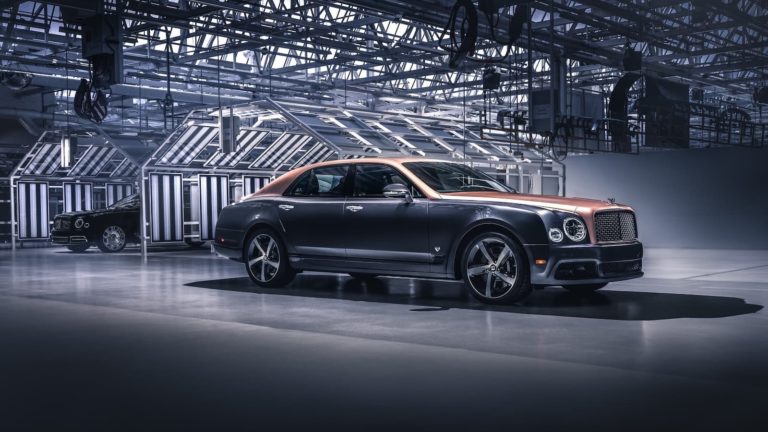
The final Bentley Mulsanne has been completed, bringing over a decade of production to a close.
More than 7,300 examples of the firm’s luxurious flagship have been produced during that period, and over 700 people have invested close to three million hours in crafting the vehicles.
Around 42 million spot welds have been made to create the bodywork, while more than a million hours have been dedicated to fitting the interiors. Close to 90,000 hours have been spent polishing the exteriors alone.
Adrian Hallmark, Bentley chairman and chief executive, said: “The Mulsanne is the culmination of all that we at Bentley have learnt during our first 100 years in producing the finest luxury cars in the world. As the flagship of our model range for over a decade, the Mulsanne has firmly solidified its place in the history of Bentley as nothing less than a true icon.
“I am immensely proud of the hundreds of designers, engineers and craftspeople that brought the Mulsanne to life over the last ten years. Now, as we begin Bentley’s journey to define the future of sustainable luxury mobility through our Beyond100 strategy, the role of Bentley flagship is passed to the new Flying Spur.”
Though Bentley has released images of the penultimate car – a Mulsanne Speed 6.75 Edition by Mulliner finished in rose gold – it is keeping its final Mulsanne behind closed doors for now, with the Crewe-base firm stating that ‘its future home remains a closely-guarded secret’.
Following a slow start, the Kuga SUV has been one of Ford’s best-selling models for a while now, with the industry’s love of big, practical SUVs mixing with the brand’s blue-collar appeal to make it a definite sales hit.
The latest generation is bigger than before with a whole new styling direction, and perhaps most importantly, a commitment to electrified powertrains from a brand that has lagged somewhat behind rivals in this department. The plug-in hybrid variant we’re testing here is a pretty big deal, then, thanks to lower running costs from a car that buyers already seem to love.
The big news is the plug-in hybrid powertrain, but we’ll go into more detail on that in the next segment. Instead, we’ll first look at the fact that the new Kuga has gone down a completely different styling direction than its predecessor, taking cues from the Ford Focus – in fact from some angles it’s easy to mistake it for Ford’s hatchback model.
Elsewhere, the interior has been brought up a notch, and there are new technologies both in the cabin and under the skin to improve the driving experience such as driver safety and assistance systems.
It sits on Ford’s new C2 vehicle architecture, which the company says has resulted in the new Kuga being lighter than its predecessor, more aerodynamic for better fuel economy, and with better crash safety.
How does it look?
While previous generations of the Kuga wore chunky “I’m an SUV” styling, the latest model ditches this in favour of a sleeker appearance. From a distance it looks like a family hatchback rather than an SUV, meaning it stands out less than rivals on the road but still offers the high driving position and practicality that has made this segment so popular.
Aside from the softer styling, some of this non-SUV look is achieved by having a more reclined windscreen and lower roof angle, which hides its height. Despite this appearance, it’s actually bigger than the outgoing model…
What’s the spec like?
There are five trim levels available for the Kuga: Zetec, Titanium, ST-Line, ST-Line X and Vignale. However, if it’s this plug-in hybrid powertrain you’re after, that excludes Zetec.
Prices start at £33,085 for the Titanium PHEV, and rise through the sporty-looking ST-Line models to the luxury-focused Vignale we’ve been testing. For this, prices start at £37,785 and equipment includes 19-inch alloy wheels, full LED headlights with automatic anti-glare full beam, premium leather seat trim with heated front seats and heated steering wheel, Vignale body kit, metallic paint, a fully digital 12-inch instrument cluster, automated park assist and a head-up display.
Traditionally, Ford’s Vignale trim levels have felt like an unnecessary expense over less expensive but still generously equipped trims. However, commanding only a few grand more than the ST-Line trims, the Vignale PHEV feels like good value for money, especially if you’re more focused on comfort than sporty looks.
What’s it like inside?
The cabin is one of the Kuga’s trump cards, because it feels exceptionally well made. Our top-spec Vignale model also comes incredibly well-specified, with high-quality materials used throughout and luxury extras such as a heated steering wheel and leather-wrapped instrument panel helping to improve the overall feel.
It’s very spacious too, making it ideal for families. Rear seat passengers, big and small, will have plenty of leg room, while boot space is decent at 411 litres, even if it is less spacious than non-hybrid versions.
If you’re not looking to stretch to the price of a top-spec model – or just don’t fancy putting premium leather at the mercy of the kids – the Kuga’s interior has all the practicality and build quality you could need in a family car, regardless of trim level.
What’s under the bonnet?
The hybrid powertrain uses a 2.5-litre petrol engine combined with an electric motor and generator that are powered by a 14.4kWh battery. This provides a decent, usable electric-only range of 35 miles, which means you could get away with rarely even using the petrol engine.
It makes a total of 225hp with a top speed of 125mph. Fuel economy figures are pretty wild at 202mpg, but only if you’re regularly topping up the batteries and only taking short trips is that a possibility, though we saw economy figures in the 60s during mixed driving. CO2 emissions are low, at just 32g/km.
It’s a rather hit and miss powertrain to use. At lower speeds where the electric motor is doing most of the work it’s brilliant, providing smooth but punchy response and silent operation. At motorway speeds with the engine on it’s still quiet enough, and even when the engine kicks in around town it’s not too intrusive. However, the CVT gearbox means that accelerating harder using the petrol engine is unrewarding with an unappealing soundtrack to boot.
What’s it like to drive?
There’s a lot to like about the Kuga, but the way it drives is its weak point. First, the positives. As we’ve come to expect from Ford products, it handles well, doing a good job of restraining its heft in corners, while also not being intimidating to drive around town thanks to the smooth and responsive electric motor.
However, there are quite a few negative aspects to the driving experience, such as the bizarre, rubbery self-centring of the steering wheel as you turn – something common to Fords but most prominent in the Kuga. Meanwhile, the brake pedal gives little feedback but is very sensitive, which makes slowing down smoothly difficult. We’re also not convinced by the ride, with it feeling very heavy over bumps.
Our verdict
The Ford Kuga PHEV is so close to being great. Its styling is sleek and unimposing, the interior is well made and spacious, and the electrified portion of its powertrain makes for a relaxing, effortless driving experience. What’s more, keep the batteries topped up and that useful electric range means running costs should be very low indeed.
However, it’s hard to get away from the fact it’s a bit of a letdown from behind the wheel. The inconsistent control weights make smooth driving a chore and detract from what should be a brilliant family SUV. A test drive is highly recommended, because if you can live with those negatives you’ve got yourself a handsome, practical SUV.
The new Kuga was launched in the UK just as the country went into lockdown, so we do not have many media reviews collected so far for our unique Expert Rating analysis. Those that have been published to date are all reviews of the Ford Kuga plug-in hybrid model (like this one).
We will add in more reviews as they are published, but it does mean that the Kuga’s current Expert Rating of 80% could change by a significant degree as the petrol and diesel models are tested by a larger number of websites.
Model as tested: Ford Kuga PHEV Vignale Price: £37,785 Engine: 2.5-litre petrol engine and electric motor Gearbox: continuously variable transmission (automatic) Power: 225 hp Top speed: 125 mph 0-60mph: 9.2 secs Fuel economy (combined): 202 mpg CO2 emissions: 32g/km Euro NCAP safety rating: Five stars (2019) TCE Expert Rating: 80% (May 2020)
Toyota and Lexus customers can now get up to £4,000 off the price of a new car through a new scrappage scheme.
To be eligible for the discount, buyers must trade in any passenger or commercial vehicle manufactured on or before 30 September 2012. They must have been the registered keeper for at least six months before placing the order for the new car, and both vehicles must be registered in the same name.
The discounts cannot be used in conjunction with any other special offers, but the same APR rates will be offered on personal contract purchase (PCP) agreements, including 0% APR on some Aygo, Yaris, Corolla, C-HR, RAV4 and Supra models.
The saving varies depending on the model. For Toyota, the maximum £4,000 is applied to the Supra and Hilux, while this discount applies to the Lexus ES saloon, NX, and the five- and seven-seat RX SUVs. The smallest saving is found on the Toyota Yaris, which gets a £1,500 discount.
The full list of eligible Toyota models is as follows:
Toyota says its previous scrappage schemes have resulted in 18,000 sales so far, as customers are encouraged out of more polluting older models and into its range of largely electrified vehicles.
The schemes are available through franchised Toyota and Lexus dealers until 30 September 2020, and the vehicle must be registered before 31 December 2020.
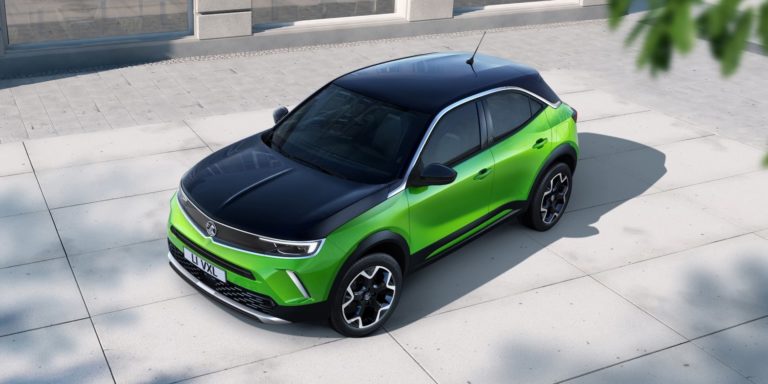
Vauxhall has revealed its revamped Mokka, which gets a striking new look and an electric version for the first time.
The second-generation model has a slightly longer wheelbase but is shorter overall, yet Vauxhall claims it has a similar boot capacity to the old version with 350 litres.
The new Mokka will be available with a range of internal combustion engines, but the big news is the introduction of an electric version, which will be available from launch. It will produce 135hp and 260Nm of torque, with a top speed of 93mph.
It has a charging capacity of 100kW as standard, which means it can be topped up to 80% within 30 minutes at a fast-charging location. The all-important range figure is 201 miles, which is decent given the size of this small crossover and on-par with rival models.
The new look front end is a sign of things to come from the brand, which says this will be the design of all future models. Dubbed “Vauxhall Vizor” (yes, really), the styling features LED headlights, the ‘wing’ design of the daytime running lights and Vauxhall’s famous badge.
Similarly, the updated ‘fully-digital cockpit’ will feature in future products from Vauxhall. The interior ushers in a new technological age for the brand, featuring a smart twin-screen setup that stretches from the instrument binnacle to the centre of the dashboard.
The infotainment screen is a seven-inch unit as standard but can be upgraded to ten inches, with both incorporated into the sweeping twin-screen unit.
The new Vauxhall Mokka goes on sale later this year with deliveries expected to begin in early 2021.
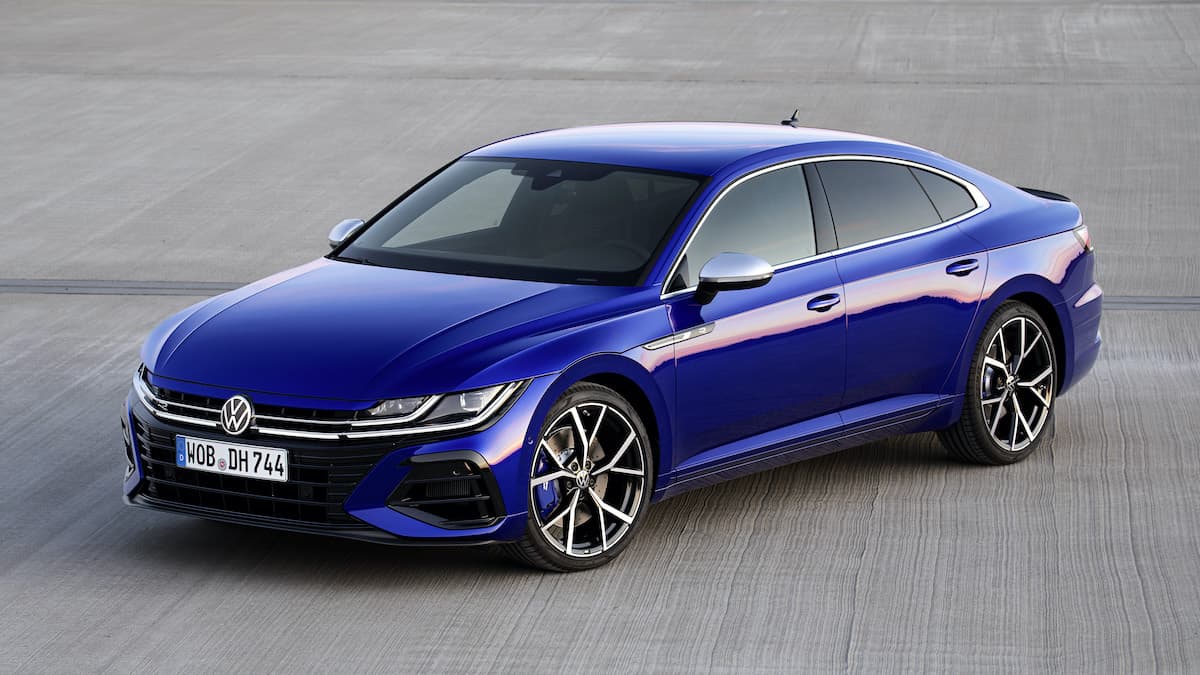
Volkswagen has unveiled its new Arteon Shooting Brake, an estate model that joins the liftback in the revamped Arteon range.
A plug-in hybrid powertrain and range-topping Arteon R model will be incorporated into the updated line-up. The new Arteon is expected to go on sale in the UK this autumn.
The Shooting Brake gives the Arteon a more practical layout, which is likely to be a big hit with those who liked the original fastback version but require the additional load space that an estate provides.
There’s a bit more headroom up front (only a centimetre) in the estate compared with the liftback, while a 590-litre boot is slightly larger too – and it can be increased to a healthy 1,632 litres by folding the rear seats flat.
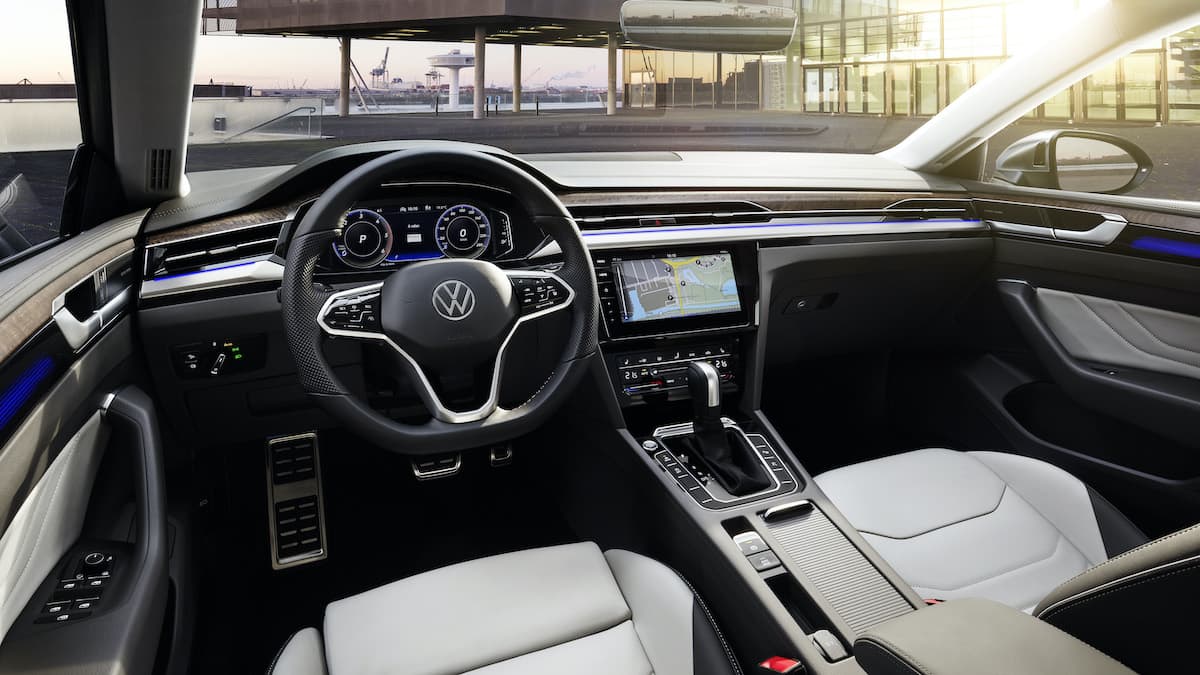
The overall Arteon range has been given plenty of tweaks as part of its mid-life update, with LED headlights and a revised front grille being the most visible changes. Inside, buyers will find a new touch-sensitive control system for the air conditioning system as well as a new multifunction steering wheel. All cars get a ten-inch digital instrument cluster, while the main infotainment system comes as standard in an eight-inch layout, but can be optionally increased to nine inches.
A performance-orientated R version will sit at the top of the range, utilising a 2.0-litre turbocharged four-cylinder engine with 320hp and 420Nm of torque, sending power to all four wheels. This engine will be available with both estate and hatchback variants. These models also benefit from chassis tweaks, with lowered suspension and adaptive dampers helping to keep the Arteon flat and composed in the bends.
Buyers will also have the option of a plug-in hybrid powertrain that combines a 1.4-litre turbocharged four-cylinder petrol engine, electric motor and a battery back. Volkswagen claims that it’ll be able to travel up to 34 miles in electric-only mode.
These new powertrains stand alongside the pre-existing engines, with a range of 2.0-litre turbocharged engines available. A six-speed manual or seven-speed automatic gearbox can be selected, too.
Chief among the changes is a new-look exterior that looks similar to the outgoing model but with sharper, more sporty lines. There’s also full LED headlights, fog lights and rear lights, dark trim pieces and a quad-exit exhaust.
The standard alloy wheels are 19-inch units in black or silver, with a copper choice available at extra cost, wrapped around 17-inch brake callipers. However, you can upgrade your stopping power with 18-inch Brembo performance brakes available at extra cost.
Much like the outgoing car, the new Cupra Ateca gets Alcantara-clad bucket seats, while the steering wheel gets a microsuede trim. The dashboard and door panels are both dark aluminium with copper stitching.
The instrument cluster is a ten-inch all-digital system, while infotainment comes from a nine-inch touchscreen, which includes a new voice recognition technology. There are also four USB-C ports in the cabin for fast smartphone connection.
Performance comes from a 2.0-litre turbocharged petrol engine making 300hp and 400Nm of torque, with all-wheel-drive contributing to a sub-five-second 0-60mph time, about three-tenths quicker than before.
The BMW X1 is a mid-sized SUV/crossover, that sits underneath the larger X3 in the BMW SUV range. This model is the second generation, which arrived in the UK in late 2015 and was replaced by the current generation X1 in Autumn 2022.
Unlike the original X1, which was based on the BMW 3 Series and primarily rear-wheel drive, the second-generation model actually shared its platform with the Mini Countryman and Clubman from the same era, as well as the latest BMW 1 Series, and was therefore a primarily front-wheel drive vehicle.
Originally available with petrol and diesel engines, the X1 was also available with a plug-in hybrid drivetrain. This version launched in the UK just before the nationwide lockdown due to the coronavirus pandemic.
The second-generation BMW X1 received generally good reviews from the UK motoring media, and was considered a substantial improvement over the previous model.
As of February 2026, the second-generation BMW X1 holds a Used Car Expert Rating of C, with a score of 62%. It scores top marks for its low average CO2 emissions (helped by the plug-in hybrid model) and its running costs are generally low, but its media review scores were only average and its reliability record is poor. Its Euro NCAP safety rating has also long since expired due to age.
Body style: Small SUV/crossover Engines: petrol, diesel, plug-in hybrid Price when new: From £30,555 on-road
Launched: Autumn 2015 Last updated: Spring 2020 Replaced: Autumn 2022
Image gallery
Media reviews
Highlighted reviews and road tests from across the UK automotive media. Click any of the boxes to view.
Auto Express
Model reviewed: Range overview Score: 6 / 10 “If you want a small premium SUV that’s practical and fun to drive, the BMW X1 is it” Read review
Model reviewed: 1.5-litre petrol/electric plug-in hybrid xDrive25e M Sport Score: 7 / 10 “The plug-in hybrid system of this xDrive25e not only delivers the strongest performance of the BMW X1 range, but also the best refinement, while maintaining decent ride and handling and (almost) all of the standard car’s practicality.” Read review
Auto Trader
Model reviewed: Range overview Score: 8 / 10 “The second-generation BMW X1 builds on the strengths of its predecessor and reduces the shortfalls to a point where they’re almost negligible. With grown-up driving manners and plenty of practicality, the X1 is worthy of a place on your shopping list.” Read review
Car
Model reviewed: 2.0-litre diesel automatic xDrive 25d Score: 8 / 10 “The original BMW X1 sold like particularly hot cakes, despite not actually being all that brilliant a car in the cold light of day. The all-new successor is actually a very decent vehicle, with fewer compromises on packaging, dynamics or style.” Read review
Car Keys
Model reviewed: Range overview Score: 8 / 10 “The BMW X1 is a really excellent crossover, even against such great competition. It drives well, has a spacious and excellent interior, and proves that premium quality doesn’t have to cost the earth to run.” Read review
Carbuyer
Model reviewed: Range overview Score: 8 / 10 “The BMW X1 is an economical, practical and good-to-drive compact SUV that’s better-looking than the model it replaced” Read review
Carwow
Model reviewed: Range overview Score: 9 / 10 “The BMW X1 is a fun-to-drive and well-built alternative to the likes of the Volvo XC40 and Audi Q3; just be ready to pay extra for plenty of desirable options.” Read review
Evo
Model reviewed: Range overview Score: 7 / 10 “The new BMW X1 is greatly improved over its predecessor and can be considered a serious contender against its rivals. As the premium and small crossover market continues to grow, BMW had to get its new X1 right second time around.” Read review
Heycar
Model reviewed: Range overview Score: 7 / 10 “The BMW X1 is a sporty small SUV that’s fun to drive, has a practical, spacious interior and a high-quality cabin. It’s a shame that some of its options are so expensive, but if you are willing to splash out, then you’ll end up with one of the very best cars in this class.” Author: Andrew Brady Read review
Honest John
Model reviewed: Range overview Score: 8 / 10 “There are dozens of crossovers to choose from these days, whether in the form of popular mainstream models like the Nissan Qashqai or more luxurious alternatives such as the Audi Q3. But even in the face of some very serious competition, the BMW X1 is a very impressive car indeed.” Read review
Model reviewed: 2.0-litre diesel automatic xDrive25d xLine “While the BMW X1 might be showing its age slightly, it’s still an extremely good alternative to the Audi Q3, Volvo XC40 and Range Rover Evoque.” Read review
Motoring Research
Model reviewed: Range overview Score: 8 / 10 “Not to be confused with the original and rather lacklustre BMW X1, the current car is one of the most desirable in its class.” Read review
Motors
Model reviewed: Range overview Score: 8 / 10 “For families, the BMW X1 is an expensive but good option to choose as there is a large amount of space, a good safety rating and ISOFIX points on the rear seats. Although other cheaper crossovers will do a similar job, the X1 can certainly be described as a good family car.” Read review
Parkers
Model reviewed: Range overview Score: 7.8 / 10 “Entry-level BMW SUV is great to drive and looks sharp.” Read review
The Sun
Model reviewed: 2.0-litre diesel automatic xDrive 20d “It’s a Beemer and THAT badge always guarantees a spot in your final five. I’m not sure about those X1 puddle lamps, though. Classy rivals include the Q3, Mercedes GLA and Range Rover Evoque. The Q3 is cheaper, but it has less standard kit. I’d also consider a fully loaded Kia Sportage.” Read review
The Sunday Times
Model reviewed: 2.0-litre diesel xDrive 25d Score: 4 / 10 “The beancounters’ gift to box‑haulers” (Jeremy Clarkson) Read review
Model reviewed: Range overview Score: 8 / 10 “Capable, covetable compact 4×4” Read review
Top Gear
Model reviewed: Range overview Score: 7 / 10 “By going transverse-engined, the BMW X1 has become technically less distinctive, but more useful in the real world.” Read review
Safety rating
Independent crash test and safety ratings from Euro NCAP
The BMW X1 was originally crash tested by Euro NCAP back in 2015 and awarded a five-star rating. However, this rating expired in January 2022 and is no longer valid as the car no longer meets the standards required for such a rating. This is normal practice, as Euro NCAP reviews its ratings on most cars annually with most ratings expiring after about six or seven years.
However, if you are comparing a used X1 to vehicles of similar age, whose ratings will have probably also expired, its safety rating score is still useful.
Eco rating
Independent economy and emissions ratings from Green NCAP
Model tested: 2.0-litre diesel automatic X1 18d 4×4
Clean Air Index: 6.9 / 10 Energy Efficiency Index: 4.7 / 10
The rating above is for the BMW X1 18d diesel automatic four-wheel-drive model. It does not imply similar ratings for other engine and gearbox combinations in the range.
Running cost rating
Monthly cost of ownership data provided exclusively for The Car Expert by Clear Vehicle Data
Fuel consumption
Average
Score
Petrol models
42 mpg
C
Diesel models
52 mpg
B
Plug-in hybrid models
157 mpg
A
CO₂ output
Average
Score
Variation
Score
Petrol models
152 g/km
C
Diesel models
142 g/km
C
Plug-in hybrid models
41 g/km
A
Battery range
Average
Score
Variation
Score
Plug-in hybrid models
31 miles
E
Insurance group
Average
Score
Variation
Score
All models
26
C
The second-generation BMW X1 is a relatively affordable car to own and run, according to whole-life cost numbers provided exclusively to The Car Expert by our data partner, Clear Vehicle Data.
Fuel consumption is poor for the petrol models, but good for the diesels and very good for the plug-in hybrid if you are able to regularly charge the battery. If the battery is flat and you’re relying on the petrol engine, fuel consumption will be worse than the regular petrol model.
Insurance costs should be better than average, which is good for a BMW. We don’t have servicing and maintenance costs due to this vehicle’s age. By now, average servicing costs will vary significantly from car to car depending on age, condition and mileage.
Reliability rating
Reliability data provided exclusively for The Car Expert by MotorEasy
Total claims: 227 Average repair cost: £741.52 Last updated: April 2025
As of April 2025 (our most recent data point), the BMW X1 has a poor reliability record, according to extended warranty data provided to The Car Expert by our commercial partner, MotorEasy.
The most common problems occur in the braking system, electrical system and the engine, although the good news is that these are relatively inexpensive repairs – particularly for the engine, where we would normally expect to see bills significantly higher than the £600 average repair cost shown here.
It’s worth watching out for gearbox issues. These are not uncommon and are eye-wateringly expensive with an average repair cost of close to £4,000.
Awards
Trophies, prizes and awards that the BMW X1 has received
2021
Business Motoring Awards – Best Small SUV
Business Car Awards – Best Premium Medium SUV
2020
Business Car Awards – Best Premium Medium SUV
2018
Company Car Today CCT100 Awards – Best Premium Crossover
Similar cars
If you’re looking at the BMW X1, you might also be interested in these alternatives
Drivers could be leaving a trove of sensitive data on their old cars by not wiping information held from connecting to a smartphone, according to a survey.
Synchronising a handset to vehicles via Bluetooth or USB allows people to do things such as play their own music, download contacts and messages, retrieve live traffic and navigation information, as well as making hands free calls or send messages.
However, failure to wipe that data from a car before selling it risks inadvertently giving away personal information to any future owners, including contact numbers, private messages, home addresses and even wifi details.
A study by Which? of more than 14,000 motorists who had sold their vehicle in the last two years found that just over half (54%) made use of such features via their phone.
The results suggest that half (51%) of drivers had not tried to unsync their phone before parting with the car, while almost a third (31%) said they took no action at all to remove their personal information.
Four out of five (79%) vehicle owners did not follow instructions in the car manual to remove data and return the car to its factory settings before they sold it, despite this being the best way to make sure no personal details are left on the operating system.
The consumer group is concerned that motorists are not being provided enough information about what is being collected when they sync their phones or download an app, and the importance of eradicating the data.
“If cars are not treated the same as a smartphone, tablet or other connected devices when it comes to data security, motorists risk giving away a treasure trove of information about themselves when they decide to sell their car,” said Harry Rose, editor of Which? magazine.
“Manufacturers must do much more to prioritise customers’ personal privacy so that drivers fully understand how much data their vehicle could be harbouring and how to delete this information in order to eradicate these risks.”
More than a million Nissan and Renault vehicles could be fitted with prohibited ‘defeat devices’, a law firm has claimed.
Lawyers from Harcus Paker allege they have seen independent test data indicating that as many as 1.3 million diesel vehicles manufactured by Nissan and Renault may also be fitted with devices designed to cheat emissions tests.
Unlike previous actions against car manufacturers regarding defeat devices that have concentrated on diesel models, this claim also targets petrol cars. The firm also said it has obtained documents which show the 1.2-litre petrol Nissan Qashqai can breach emissions limits by up to 15 times when driven on the road. It claims that up to 100,000 petrol Qashqais could have been fitted with a defeat device.
The Qashqai is the biggest-selling British-built car in the world. It is built in Nissan’s Sunderland factory.
Damon Parker, senior partner at Harcus Parker, which is launching legal action, said: “For the first time, we have seen evidence that car manufacturers may be cheating emissions tests of petrol, as well as diesel vehicles.
“We have written to Renault and Nissan to seek an explanation for these extraordinary results, but the data suggests to me that these vehicles, much like some Volkswagen and Mercedes cars, know when they are being tested and are on their best behaviour then and only then.
“These are vehicles which could and should meet European air quality limits in normal use, but rather than spend a little more on research and development, Renault and Nissan appear to have gone down the same path as VW and Mercedes and decided to cheat the tests.”
Harcus Parker claimed owners of affected cars are entitled to compensation worth around £5,000 each.
A Nissan spokesman said: “Nissan strongly refutes these claims. Nissan has not and does not employ defeat devices in any of the cars that we make, and all Nissan vehicles fully comply with applicable emissions legislation.
“The initial report from 2017, which looked at the variation between lab and real world conditions, showed variances for most brands involved. It also stated that the Nissan tested complied with all required regulatory limits.
“Emissions standards have evolved since 2017, and we have introduced a new range of powertrains to meet them.”
Renault said in a statement: “All Groupe Renault vehicles are, and always have been, type-approved in accordance with the laws and regulations for all the countries in which they are sold and are not fitted with ‘defeat devices’.”
The so-called ‘dieselgate‘ emissions scandal first surfaced against Volkswagen in September 2015.
The manufacturer admitted that 11 million of its diesel vehicles worldwide were affected, including almost 1.2 million in the UK, prompting a flurry of litigation.
In April, the High Court ruled that software installed by Volkswagen was a ‘defeat device’.
Ford has introduced a new mild hybrid powertrain to the Focus, among other updates, bringing an efficient new engine option to the range.
It makes use of a 1.0-litre turbocharged petrol engine linked with a 48-volt mild-hybrid setup to deliver 155hp with CO2 emissions of just 116g/km. Ford claims that this new setup brings a 17% fuel efficiency improvement over the outgoing equivalent of a 1.5-litre petrol engine linked to a six-speed manual gearbox.
The company also says that the new engine is capable of delivering more than twice the power density of a 2.0-litre powertrain available for the Focus ten years ago but with a 45% hike in fuel efficiency.
The location of the batteries under the front passenger seats has allowed the mild-hybrid model to retain the regular Focus’ boot space, too. The system works by replacing a standard engine’s alternator with a belt-driven integrated starter-generator which can then be used to recover energy lost during braking or coasting. This energy is then stored in the battery pack.
The energy can then be deployed to provide additional torque during normal driving or when accelerating, and it can be used to power functions such as the air conditioning and media functions. An on-board system is capable of monitoring how the vehicle is being used and will then choose how to charge the battery for optimal benefit.
Roelant de Waard, vice president, Marketing, Sales & Service, Ford of Europe, said: “Our electrified powertrains are designed not just to save drivers money on fuel, but also to boost the fun-to-drive character of our vehicles.
“The Focus EcoBoost Hybrid seamlessly integrates electric and petrol power for efficiency and performance that would have seemed the stuff of dreams just a few years ago.”
Ford has also introduced a new 12-inch LCD instrument cluster to the Focus, which enables drivers to tailor readouts to their liking. On hybrid models, the screen can also display information about electrical energy usage, as well as how much energy is being generated by the system.
A new Zetec trim level has also been added to the Focus, with standard equipment such as wireless smartphone charging, front and rear parking sensors and full satellite navigation making the specification a well-finished choice within the range.
2020 is the year of the mild hybrid
This year has seen mild hybrid upgrades to petrol engines from almost every manufacturer, and Ford is rolling them out as fast as anyone. A few weeks after announcing a mild hybrid boost for the Fiesta range comes a similar announcement for the larger Ford Focus.
The extra electrical power boost, along with a digital dashboard and other trim updates, should help freshed up the Focus to keep it competitive with its arch-rival – the all-new Volkswagen Golf has reached UK shores and the marketing onslaught is presumably about to start.
The Ford Focus currently holds an Expert Rating of 80%, based on 32 different UK reviews, according to our unique Expert Rating analyser. The Golf is currently at 85% based on its international launch reviews, although that could change as we get reviews on local roads in UK-spec cars. Stuart Masson, Editor
Welsh car dealerships have been given the green light to reopen this Monday – June 22.
The announcement was made by first minister Mark Drakeford as part of a series of measures which look to slowly unlock the country’s economy following the coronavirus pandemic and the resulting lockdown.
As of Monday, non-essential retail businesses – including car dealerships – will be allowed to trade once more as long as all reasonable measures to follow social distancing laws in Wales are followed, in news confirmed to Car Dealer magazine.
However, a legal requirement to remain local – members of the public are being asked to stay within a five-mile radius of home – has been kept in place.
Northern Ireland’s dealerships also reopened on June 8, meaning the entirety of the UK’s car retail trade will be back up and running by the end of the month.
Classic car owners are being warned about a new eco-friendly petrol that could damage their cars.
Under current regulations, ‘E5’ unleaded petrol can contain up to 5% bioethanol, which is created from crops and is therefore a renewable resource.
From 2021, E10 will become the new standard, which has up to 10% bioethanol in the mix.
Doing this helps to reduce vehicle CO2 emissions – by up to 750,000 tonnes per year, according to government estimates – but classic car insurance company Hagerty is warning that E10 can cause damage to older vehicles.
The RAC estimates up to 600,000 vehicles on UK roads are not compatible with E10. Although classic cars are the most at-risk vehicle type, it is also advised that owners of any vehicles made before 2002 do not use the new E10 fuel.
There are two key issues, with the first being that this fuel mix absorbs more water from the atmosphere, which can cause condensation in fuel tanks, fuel lines and carburettors, and cause corrosion.
The second problem is that ethanol is a solvent that can eat through rubber, plastic and fibreglass, with Department for Transport tests identifying that it can cause issues with fuel hoses and seals, blocked fuel filters and damaged fuel pumps to name a few.
Phil Monger, technical director of the Petrol Retailers Association (PRA) told Hagerty that changes won’t be made overnight, and believes that ‘many owners of old cars may have already made modifications since the introduction of E5 fuel’.
He added: “Vehicles that are very old will have materials that will not be compatible with E5 either. E10 will only hasten the day when it causes you some difficulty with those materials.”
Guy Lachlan, managing director of Classic Oils, has offered advice to prevent problems, saying: “You’ve either got to use fuel with no ethanol or change the materials that don’t like it.
“If you are in any doubt about your rubber fuel lines, change them. Get rid of your fibreglass petrol tank and install an aluminium one. The other thing ethanol really doesn’t like is solder. If you are running a soldered float in your carburettor, then think about carrying a spare – they’re generally quite easy to change.”
If classic car owners fill up with E10 by mistake, it shouldn’t be an issue if it’s a one-off, so just ensure the next top-up is with the correct fuel.
The PRA says there will be a six-month awareness campaign released ahead of the fuel being introduced to prepare drivers, while a new website will allow owners to check if their vehicle is compatible.
Car dealerships in Scotland can reopen on June 29 following the pandemic-enforced shutdown.
First minister Nicola Sturgeon announced today that non-essential retail businesses can reopen if they have outdoor entrances and exits and follow health and safety guidelines.
However, dealers have been disappointed at the delay in reopening, which will be almost a month after English dealers were given the green light.
Speaking to Car Dealer magazine, Scottish Motor Trade Association chairman Sandy Burgess said: “Firstly, it shows an extreme lack of understanding as to how the retail automotive sector operates and the impacts of late-in-the-day policy changes such as this.
“And secondly, it shows a total lack of respect for the industry at all levels, as they have not spoken to or communicated with any business in our sector before reaching this incomprehensible decision!”
The magazine also spoke to former British Touring Car Championship winner John Cleland, who owns the Clelands dealership in Galashiels. He said: “We, and Volvo, were anticipating opening tomorrow – June 19 – but we haven’t even been told that.
“We even have staff unfurloughed in readiness for reopening tomorrow.
“It’s madness that garden centres have already been allowed to reopen and yet car dealerships up to 800 square metres can’t – showrooms are more spacious than garden centres!
“We just need to get on with this. England has a one-month head start on us. I don’t understand the delay.”
Like English dealerships during lockdown, Scottish retailers have been allowed to provide click-and-collect services. Speaking today, Sturgeon said that customers should “exercise patience, stick to the measures that are in place for your safety, and at all times please respect retail staff who will be asking you to shop in a different way”.
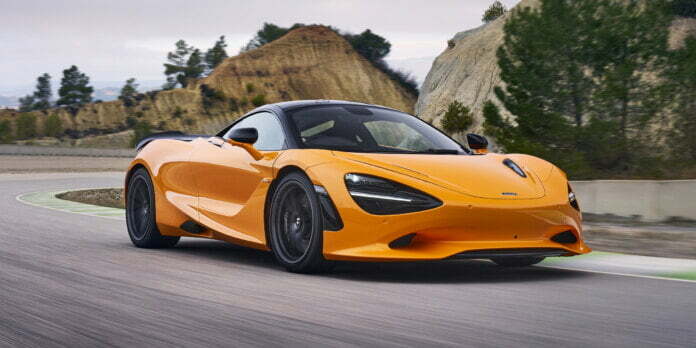
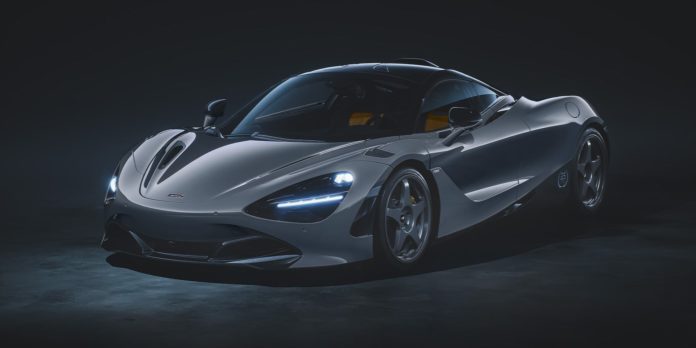
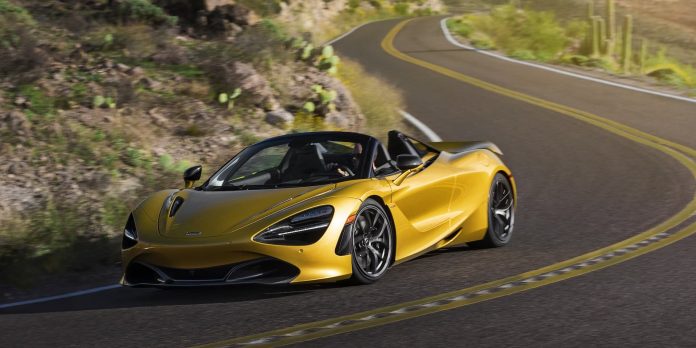
McLaren is celebrating the 25th anniversary of winning the 1995 Le Mans 24-hour race, on its first entry into the famous race, with a new special edition version of its 720S supercar.
Just 50 Le Mans editions will be built with 16 heading for Europe, and all will be coupe versions.
The car has been revealed 25 years to the day that the 1995 race started. McLaren F1 GTR #59, driven by JJ Lehto, Yannick Dalmas and Masanori Sekiya, would go on to win with three McLaren F1 GTRs finishing in the top five.
Each 720S Le Mans edition will get an authenticity plaque and each car’s VIN will begin with 298, marking the number of laps completed by the winning car.
On the outside there’s a choice of McLaren Orange or Sarthe Grey paint, Ueno grey lower body panels, gloss black roof scoop, carbon fibre louvred front fenders and unique five-spoke alloy wheels. Inside, there’s a McLaren Orange or Dove Grey Alcantara theme, carbon-fibre race seats, and ‘25th anniversary’ logos throughout.
Power comes from the standard 720S’s mid-mounted 4.0-litre V8 engine. The twin-turbocharged unit makes 720hp, helping propel the car from 0-60mph in 2.9 seconds and on to a top speed of 212mph.
The McLaren 720S Le Mans is on sale now with prices starting from £254,500 with first deliveries expected in September.
The McLaren 720S was a mid-engined supercar available as both a coupé and convertible (720S Spider). The 720S formed the ‘middle tier’ of the McLaren range, knows as the Super Series. The coupé model was launched at the 2017 Geneva motor show, with the Spider following in late 2018.
The 720S, like all McLaren models, was built at McLaren’s production facility in Woking, Surrey, in a new factory next door to the McLaren Formula One team’s base.
There is a higher-performance model called the 765LT, which is not covered here. We have a separate page for this model.
The McLaren 720S and 720S Spider received unanimously positive reviews from the UK motoring media (which is not all that surprising, really). There was plenty of praise for both its incredible performance and everyday usability.
No longer on sale, the McLaren 720S holds a Used Car Expert Rating of E, with a score of 5e%. Despite excellent review scores from motoring journalists, its overall rating is inevitably dragged down by high running costs and poor emissions levels.
Body style: coupe / convertible Engine: petrol Price when new: From £218,020
Launched: Spring 2017 Last updated: Summer 2020 Discontinued: 2022
Image gallery
Media reviews
Highlighted reviews and road tests from across the UK automotive media. Click any of the boxes to view.
Featured reviews
“The British-built McLaren 720S Spider is an ultra-focused and highly polished supercar that deserves a place among the greats from anywhere in the world.”
Model reviewed: 720S coupé Score: 10 / 10 “The McLaren 720S takes on the Ferrari 488 – with more power, greater performance and a dash of practicality.” Read review
Model reviewed: 720S Spider Score: 9 / 10 “There are few cars on the road that are as savagely quick as a McLaren 720S. The drop-top Spider version ups the excitement levels even further, and we loved it.” Read review
Auto Trader
Model reviewed: 720S coupé Score: 8.6 / 10 “Even when compared with other supercars, the McLaren 720S really is something special. Engaging, absorbing and thrilling, and for our money, it’s the best of the supercar breed.” Read review
Car
Model reviewed: 720S Spider Score: 10 / 10 “The amazing thing about the McLaren 720S Spider is its range of virtues. It goes as hard as any supercar with all the exhilaration and high-speed prowess, and yet it rides with astonishing suppleness.” Read review
Model reviewed: 720S Track Pack Score: 10 / 10 “If you’re all about hot laps, the track-optimised 600LT would be a better bet. And if you’ve decided it has to be the 720S, be clear about what you’ll use the car for. You may be better off going for a few options and put the saved money into financing some unforgettable pan-European road trips.” Read review
Model reviewed: 720S coupé Score: 10 / 10 “If you can get on with those headlights, and are rich enough not to flinch at paying more for the McLaren 720S than its rivals, the only real sticking point is the standard car’s too-quiet exhaust.” Read review
Carbuyer
Model reviewed: 720S coupé Score: 7.8 / 10 “The stunning McLaren 720S offers all you want in a supercar, and more.” Read review
Model reviewed: 720S Spider Score: 8 / 10 “Breathtaking performance combined with unadulterated engine noise makes the McLaren 720S Spider an even more visceral experience than the coupe.” Read review
Daily Mirror
Model reviewed: 720S Spider Score: 10 / 10 “The two-seat mid-engined McLaren 720S supercar is beyond brilliant. It’s incredible.” Read review
Evo
Model reviewed: 720S Spider Score: 9 / 10 “Top-down motoring to the list only increases the McLaren 720S’ appeal, however the compromises felt dynamically still makes the coupe our choice.” Author: Adam Towler Read review
Model reviewed: 720S coupé Score: 10 / 10 “The McLaren 720S is an improvement over its predecessor in every respect.” Read review
Heycar
Model reviewed: Range overview Score: 8 / 10 “McLaren keeps on re-defining what’s possible with its Super Series models, and the 720S does that, and more, making ridiculous performance accessible and useable, assuming, of course, you have the means to pay for it.” Read review
Parkers
Model reviewed: Coupe Score: 9 / 10 “Latest Brit bruiser one of the best yet” Read review
Model reviewed: 720S Spider “Aside from its monstrous capabilities, the McLaren 720S Spider is just as pleasing to the eye. You just want to drive it over the horizon and into the sunset.” Read review
The Sunday Times
Model reviewed: 720S coupé Score: 6 / 10 “It may look brilliant, but you cannot get around the fact that it simply doesn’t have the soul of a Ferrari. It’ll kick a Fezza’s arse in any race, anywhere, anytime, but you can’t help feeling it’s a car built after a meeting in a Travelodge with a flip chart.” (Jeremy Clarkson) Read review
The Telegraph
Model reviewed: 720S Spider Score: 8 / 10 “Better looking than the coupé with none of the drawbacks of a convertible in terms of chassis twisting and/or reduced performance; it also has minimal weight gain for a drophead.” Read review
Model reviewed: 720S Luxury coupé Score: 8 / 10 “Faster and more stable, the new McLaren 720S is a more dynamically competent than its predecessor, although whether it could be genuinely described as “all-new” is debatable.” Read review
Top Gear
Model reviewed: 720S Spider Score: 9 / 10 “All the best bits of the coupe, now with added fresh air.” Read review
Model reviewed: 720S coupé Score: 9 / 10 “Probably the single most accomplished supercar we’ve ever driven.” Read review
Safety rating
Independent crash test and safety ratings from Euro NCAP
No safety rating
The McLaren Super Series (720S and 765LT) was not tested by Euro NCAP during its production life.
Eco rating
Independent economy and emissions ratings from Green NCAP
No eco rating
The McLaren Super Series (720S and 765LT) was not lab tested by Green NCAP during its production life, so you’ll just have to imagine how eco-friendly a twin-turbocharged petrol V8 supercar is likely to be…
Reliability rating
Reliability data provided exclusively for The Car Expert by MotorEasy
No reliability rating
As of March 2026, we don’t have enough reliability data on the McLaren 720S to generate a reliability rating.
The Car Expert’s reliability information is provided exclusively to us using workshop and extended warranty data from our partner, MotorEasy, sourced from both official dealerships and independent workshops.
As soon as MotorEasy has sufficient data on the 720S, we’ll publish the results here.
Running cost rating
Monthly cost of ownership data provided exclusively for The Car Expert by Clear Vehicle Data
Fuel consumption
Average
Score
Petrol models
23 mpg
E
CO₂ output
Average
Score
Variation
Score
Petrol models
276 g/km
E
Insurance group
Average
Score
Variation
Score
All models
50
F
The McLaren 720S is a very expensive car to own and run, according to whole-life cost numbers provided exclusively to The Car Expert by our data partner, Clear Vehicle Data.
We don’t have servicing cost data at this time, but you can be confident that it will also be very expensive…
Awards
Trophies, prizes and awards that the McLaren 720S has received
2019
World Car Awards – World Performance Car
2018
Red Dot Design Awards – Best of the Best
2017
evo Awards – Car of the Year
Scottish Car of the Year Awards – Sportscar of the Year
Similar cars
If you’re looking at the McLaren 720S, you might also be interested in these alternatives
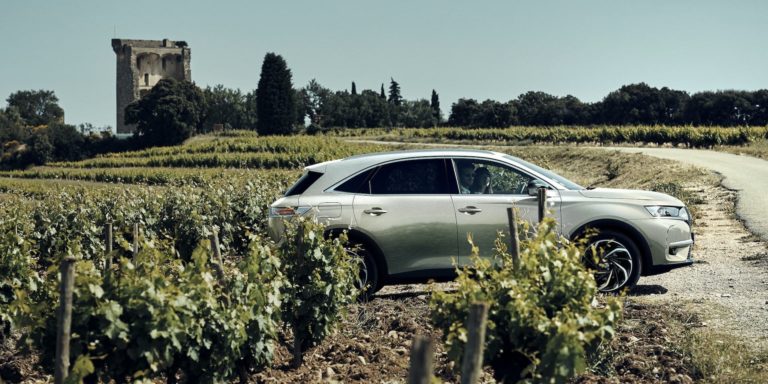
DS 7 Crossback buyers now have more electrification options available thanks to the addition of a second plug-in hybrid variant.
The new E-Tense 225 will sit below the existing E-Tense 4×4 in the DS 7 Crossback range. While both models use a petrol-electric powertrain, the new model is front-wheel drive and makes a combined 225hp, compared with the 300hp all-wheel-drive alternative.
The E-Tense 225 gets an eight-speed automatic gearbox, and can be driven on electric-only power at speeds of up to 84mph. Its 13.2kWh battery provides an electric range of up to 34 miles, or up to 45 miles if speeds are kept low.
Running costs should be low too, with official figures measuring CO2 emissions at 36g/km, while fuel economy is up to 202mpg.
The battery can be charged at wall sockets or public charge points, but also regenerates energy on the move through the engine and deceleration. DS has fitted an engine mode that will ensure a minimum of 12 miles of electric range is stored in the battery to provide zero-emission driving at the end of a journey.
The DS 7 Crossback E-Tense 225 gets the French firm’s active suspension system, which scans the road surface ahead and prepares the suspension for bumps, as well as night vision, parking assistance, advanced cruise control systems and LED lighting.
Equipment-wise, the new E-Tense 225 powertrain is available across all DS trim levels and gets 19-inch alloy wheels as standard.
Two options for plug-in plus petrol power
Not one, but two plug-in hybrid options is unique for pretty much any new car currently on sale in the UK. It could help DS Automobiles position the DS 7 Crossback as the perfect car to take advantage of consumers’ growing desire for electrified transport.
The DS 7 Crossback range has been praised for a comfortable ride by the UK media and the active suspension on the plug-in hybrid models should help keep things smooth. The driving experience hasn’t been rated as highly, however. According to our unique Expert Rating system, which has aggregated 17 UK reviews of the DS 7 Crossback, it has an overall Expert Rating of 66%. That puts it in the bottom half of the premium mid-size SUV field, a long way behind the class-leading Audi Q5 and Volvo XC60. Stuart Masson, Editor
Citroën has previewed an electric version of its all-new C4 hatchback ahead of the car’s full reveal at the end of this month.
The company hasn’t revealed many details about the new car, but says it will offer fully electric, petrol and diesel options – but no hybrids.
Further powertrain information will likely not be confirmed until the car’s full reveal on June 30, but expect the electric version to use a similar powertrain to the Peugeot e-208 supermini, which has a range of more than 200 miles between charges.
Both the new C4 and ë-C4 get chunky body work and a high window line giving the car a crossover-style appearance. The styling is inspired by Citroën’s SUV models (and also bears a resemblance to the incredibly unsuccessful Citroën/DS Automobiles DS 4 Crossback from a few years ago, which wasn’t mentioned in the press release…).
From what little Citroën is giving away, it appears comfort will be high on the agenda, with the firm’s Advanced Comfort seats and Progressive Hydraulic Cushion suspension technology being included.
It also claims to be spacious and practical inside, with ‘an innovation for the front passenger’ to be disclosed later.
The new Citroën C4 is expected to go on sale early in 2021, with prices increasing over the existing C4 Cactus’s £22,190 starting price on account of the technology improvements. The electric Citroën ë-C4 will likely be in the ballpark of £30,000 to compete on price with its rivals.
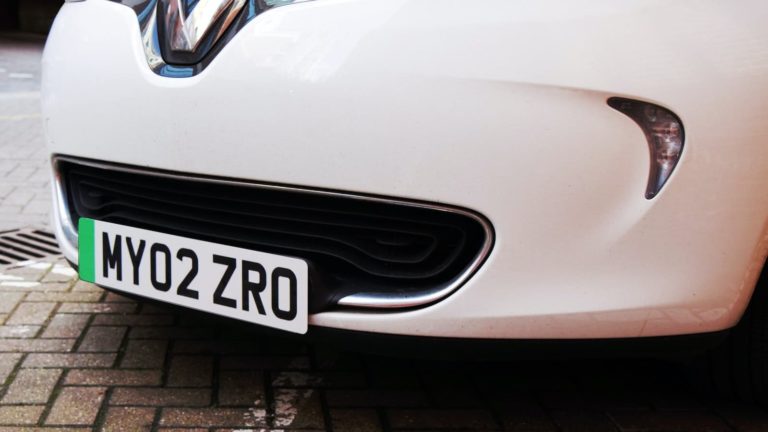
Drivers of zero-emission cars are to be given distinctive green number plates which could make them eligible to by-pass congestion zone charges or secure cheaper parking.
Transport secretary, Grant Shapps, said the decision to print a green ‘flash’ on the left-hand side of number plates on zero-emission cars from the autumn would help “show people that a greener transport future is within our grasp”. This green flash would go where UK number plates previously (optionally) showed a blue EU country identifier.
The move, which could allow motorists to tap into special incentives, is designed to make switching to electric vehicles more appealing, as the government looks to meet its target of achieving net zero emissions by 2050.
Mr Shapps said: “A green recovery is key to helping us achieve our net zero carbon commitments while also promoting economic growth.
“Green number plates could unlock a number of incentives for drivers and increase awareness of cleaner vehicles on our roads, showing people that a greener transport future is within our grasp.
“We’re supporting small businesses to develop the transport tech of the future through a multimillion pound investment, ensuring that UK businesses remain at the forefront of low-carbon innovation and research.”
A better commute for green-plates EVs?
The Department for Transport (DfT) said the green strip on number plates would make electric vehicles more easily identifiable to local authorities who want to offer schemes such as allowing drivers of such vehicles to use bus lanes, charging them less for parking or cost-free entry into zero-emission zones.
The announcement follows a consultation, started in October, with councils, industry and the public.
Special number plates have been trialled in Canada, where drivers of electric vehicles in Ontario were given free access to toll lanes and high-occupancy vehicle lanes. The city subsequently saw an increase in electric vehicle registrations.
Mr Shapps’ announcement follows reports last week claiming the prime minister was said to be considering plans to give drivers up to £6,000 to exchange their petrol or diesel car for an electric model.
The Daily Telegraph reported that, despite the government reducing the maximum grant available for electric car buyers under the Plug-In Car Grant, by £500 to £3,000, in March, Boris Johnson was being urged to help manufacturers hit hard by the coronavirus crisis, with sales of new cars down nearly 90% in May compared with the same month in 2019.
Edmund King, president of AA, said he welcomed the switch to partially green numbers plates and said that 37% of his organisation’s members had voiced support for the change.
“Having a green flash on the number plate may become a badge of honour for some drivers,” said Mr King. “We support this concept, which shows that the electric vehicle revolution is now moving from amber to green.”
But the RAC said it was not convinced the new plates would provide much incentive for motorists to opt for greener cars. Rod Dennis, a spokesman for the organisation, said: “While this is well-intentioned, we don’t believe green number plates on their own will do much to make people switch to an electric car.
“We’d much prefer the government looked at things like bringing in the right financial incentives.”
On top of giving green number plates the go-ahead, the DfT also announced that £12 million was being made available for further zero-emission vehicle research.
The funding, made through the Office for Low Emission Vehicles (OLEV) and delivered through Innovate UK, will see £10 million for a new zero-emission vehicle innovation competition.
The scheme will invite applicants to bid for project funding to support advancements in both battery electric and hydrogen vehicles, as well as charging infrastructure.
A further £2 million will be provided by OLEV to UK small and medium businesses to support their research into zero-emission vehicles in areas such as battery technology, which could be used by major vehicle manufacturers in future electric vehicle production, said DfT.
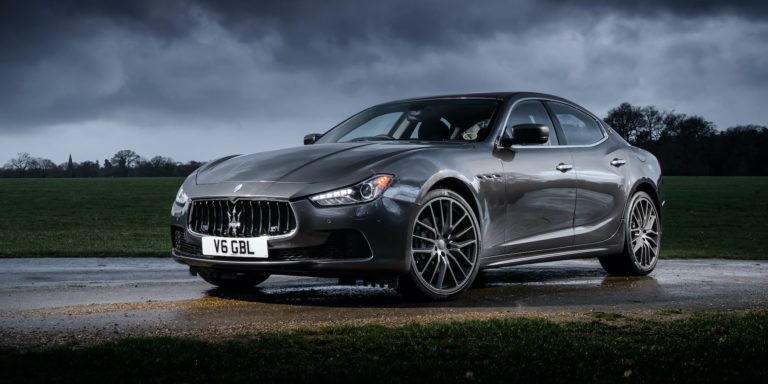
The Maserati Ghibli was a large executive saloon, which launched in 2013 and was substantially updated in late 2017. It finally ended production at the end of 2023, after more than ten years on sale.
Along with engines for other Maserati models, the Ghibli’s twin-turbo petrol V6 motors were built for Maserati by Ferrari in Maranello. This arrangement came to an end when the Ghibli finished production, as Ferrari and Maserati are no longer part of the same overarching Fiat Group. A diesel engine was initially offered but was dropped from the range along the way.
The Maserati Ghibli received fairly average reviews from the UK motoring media, although its worth pointing out that its cause was not helped by its rivals being some of the best cars on the market – the class-leading BMW 5 Series was considered to be the best car that BMW mad, while the Mercedes-Benz E-Class and Audi A6 were similary superior to most cars in their respective families. So the Ghibli was a good car in a field dominated by outstanding cars.
The Ghibli was praised for its style and image, as well as its Ferrari-sourced petrol V6 engine. However, it was criticised for not matching the level of comfort and quality that the best cars in its class displayed.
No longer on sale, the Maserati Ghibli holds a very poor Used Car Expert Rating of E, with a score of 38%.
Highlighted reviews and road tests from across the UK automotive media. Click any of the boxes to view.
Featured reviews
“Maserati is a bit of a hidden gem. The Ghibli serves up every bit as much luxury as perhaps better-known rivals, but with a diesel engine offering fuel consumption figures close to 50mpg it is also a surprisingly sensible purchase, especially in the corporate market.”
Model reviewed: 2.0-litre petrol (mild hybrid) automatic Ghibli Hybrid Gransport Score: 5 / 10 “On paper, the new Ghibli Hybrid seems like a great way to keep Maserati relevant yet desirable. In reality, it’s something of a disappointment, with uncompetitive hybrid technology failing to provide either the economy or the emissions it needs to keep pace, nor the driver appeal of its best rivals.” Read review
Model reviewed: Range overview Score: 6 / 10 “The Maserati Ghibli combines style and quality with sharp handling to rival the BMW 5 Series and Mercedes E-Class” Read review
Model reviewed: 3.0-litre petrol automatic Score: 8 / 10 “It’s not Maserati’s finest hour, but it’s a breath of fresh air in this often straight-laced market.” Read review
Auto Trader
Model reviewed: Range overview Score: 6 / 10 “The Maserati Ghibli offers an Italian alternative to the popular German premium saloons, albeit at a higher price. It struggles to match those rivals for quality and doesn’t drive as well either, but the engines are strong, the badge is a proper luxury draw and its exotic looks really make it pop.” Read review
Business Car
Model reviewed: Trofeo Score: 7 / 10 “Against rivals from BMW, Mercedes and Porsche, the Maserati feels charming but dated – with the powerful V8 engine being the highest point.” (Martyn Collins) Read review
Car
Model reviewed: Range overview Score: 8 / 10 “If you want an upmarket diesel saloon, it’s hard to make a case for the Maserati Ghibli as the competition is so well-rounded, and also much cheaper in some cases, with better interior quality. If you want a nutcase saloon to thrash through the mountains at the weekend and sit on the motorway during the week, it’s an intriguing option that does feel special to look at.” Read review
Model reviewed: 3.0-litre diesel automatic Score: 8 / 10 “The Maserati Ghibli remains pragmatically almost impossible to recommend, but easy to fall for. Buy one and you won’t have the cheapest, comfiest or most tech-laden car in your street, but you will be safe in the knowledge that you’ve got the most stylish and probably the most interesting.” Read review
Carbuyer
Model reviewed: Range overview Score: 6.8 / 10 “The Maserati Ghibli is hugely alluring in many ways, but it comes with a higher price tag and more compromises than other large executive saloons.” Read review
Carwow
Model reviewed: Range overview Score: 6 / 10 “The Maserati Ghibli is a sleek and sporty alternative to more mainstream executive cars from Audi, BMW and Mercedes, but it’s comparatively expensive to run.” Read review
Eurekar
Model reviewed: Ghibli Hybrid “Maserati has little choice but to venture down the hybrid technology route, but whether it will win over the die-hard V6 and V8 fans that have been such loyal followers, remains to be seen.” Read review
Evo
Model reviewed: 3.0-litre diesel automatic Score: 7 / 10 “Stylish and dripping with badge appeal, but off the pace of class best” Read review
Heycar
Model reviewed: Range overview Score: 5 / 10 “Traditionally, Maserati has been a brand associated with style, glamour and exclusivity. With the Ghibli, however, the Italian manufacturer looked to change things up a bit.” Author: Andrew Brady Read review
Parkers
Model reviewed: Range review Score: 7.6 / 10 “Stunning saloon is great to drive, but pricey” Read review
The Sun
Model reviewed: 3.0-litre diesel automatic “I loved driving this saloon. For all its faults, the Maserati Ghibli is a heart-rules-over-the-head buy. It’s the only car in this sector that can give its pin-stripe suitors a bit of passion.” Read review
The Sunday Times
Model reviewed: 3.0-litre petrol automatic Ghibli S Score: 6 / 10 “It’s comfortable and it’s practical and it’s quiet and, I have to say, it’s also a lovely place to sit. Apart from the beeping. And on top of all that, it’s a Maserati. Which means you can say to your husband, ‘Shall we take the Maserati tonight?’, which will make you feel extremely warm and fuzzy.” (Jeremy Clarkson) Read review
The Telegraph
Model reviewed: 2.0-litre petrol (mild hybrid) automatic Score: 4 / 10 “A great-looking car with an evocative name, and a surprisingly adept mild hybrid system, although it doesn’t seem to confer any substantial economy benefits. But the ride quality on UK roads is simply unacceptable and Maserati faces hugely competent rivals with full hybrid drivetrains.” Read review
Model reviewed: Range overview Score: 6 / 10 “The allure of this exotic Italian brand is undoubtedly strong, plus the Maserati Ghibli looks suitably special inside and out. However, its diesel engine and ride comfort are disappointing, while the BMW 5 Series and Jaguar XF are both more enjoyable to drive. As is so often the case with Maserati, it’s a case of whether you let your heart overrule your head.” Read review
Top Gear
Model reviewed: Range overview Score: 5 / 10 “Don’t fancy a German four-door? There’s an updated, eccentric Italian alternative… but you need to really want one.” Read review
Model reviewed: Range overview “If you’re overly familiar with its established foes (most of them German), and the Maserati Ghibli diesel is sitting on the company car list among them, it may prove difficult to resist its more superficial charms. Head further up the range, though, and it’s hard to escape that Alfa Romeo now makes a better fast four-door than Maserati.” Read review
Model reviewed: 3.0-litre diesel automatic Score: 7 / 10 “It boils down to one simple question: should you? In isolation, the Ghibli is convincingly seductive and perfectly credible. As it stands, the diesel emits 158g/km CO2 and sits in the 26 per cent company car tax band, so it’s there or thereabouts. But forget all that, and do me a favour when you get to the end of this paragraph: just say the last word out loud – Maserati.” Read review
Safety rating
Independent crash test and safety ratings from Euro NCAP
The Maserati Ghibli was tested by Euro NCAP in 2013 and was awarded a five-star rating. This rating expired in January 2020 and is no longer valid. This is normal practice, as Euro NCAP reviews its ratings on most cars annually with most ratings expiring after about six or seven years.
However, if you are comparing a used Ghibli to vehicles of similar age, whose ratings will have probably also expired, its safety rating score is still useful.
Eco rating
Independent economy and emissions ratings from Green NCAP
No eco rating
The Maserati Ghibli was not tested by Green NCAP during its production life.
Running cost rating
Monthly cost of ownership data provided exclusively for The Car Expert by Clear Vehicle Data
Fuel consumption
Average
Score
Petrol models
22 mpg
E
CO₂ output
Average
Score
Variation
Score
Petrol models
240 g/km
E
Insurance group
Average
Score
Variation
Score
All models
50
F
Service and maintenance
Cost
Score
Year 1
£596
E
Year 2
£1,472
E
Year 3
£2,192
E
Year 4
£2,625
E
Year 5
£3,495
E
Overall
£10,380
E
The Maserati Ghibli is a rather expensive car to own and run, according to whole-life cost numbers provided exclusively to The Car Expert by our data partner, Clear Vehicle Data.
Fuel economy is very poor, with an average score of E ranking it in the bottom 20% of all cars in our database. CO2 emissions are also poor.
Insurance costs are likely to be high as the Ghibli is categorised in the highest group 50, while servicing and maintenance over the first five years is also expensive.
Reliability rating
Reliability data provided exclusively for The Car Expert by MotorEasy
No reliability rating
As of March 2026, we don’t have enough reliability data on the Maserati Ghibli to generate a reliability rating.
The Car Expert’s reliability information is provided exclusively to us using extended warranty data from our partner, MotorEasy. As soon as we have sufficient data on the Ghibli, we’ll publish the score here.
Date: June 2024 Recall number: R/2024/206 Model types: All Build dates: 04/2021 to 08/2021 Number of vehicles affected: 6 Defect: On affected vehicles, the pressure/temperature sensor within the short fuel line may cause a possible fuel leakage in the engine bay. This may lead to a loss of power and, in the worst case, a potential fire. Remedy: Replacement of the short fuel line containing the pressure sensor.
Date: December 2021 Recall number: R/2021/441 Model types: All Build dates: 09/2021 Number of vehicles affected: 37 Defect: Wrong TVV (Type-Variant-Version) on statutory plate. Remedy: Replace label located on B-pillar
Date: June 2020 Recall number: R/2020/185 Model types: All Build dates: 01/2019 to 02/2019 Number of vehicles affected: 2 Defect: Engine code marked on diesel engine replaced in aftersales is different from the homologated and production code. Remedy: Documentation will be provided to the customer stating the Italian transport authority confirms this marking is an administration error.
Date: July 2019 Recall number: R/2019/239 Model types: All Build dates: 08/2017 to 02/2019 Number of vehicles affected: 320 Defect: Front headlamps full LED version headlamp vertical beam out of compliance. Remedy: Check adjustment of the front headlamp vertical beam.
Date: February 2019 Recall number: R/2019/042 Model types: All Build dates: 08/2017 to 12/2017 Number of vehicles affected: 126 Defect: There is a possibility that a leak may occur in the fuel line. Remedy: Replacement of the fuel delivery line.
Date: January 2018 Recall number: R/2018/022 Model types: All Build dates: 08/2017 to 12/2017 Number of vehicles affected: 53 Defect: Due to material imperfections, the fuel delivery line may leak at line unions. This is more likely after prolonged use. Remedy: On affected vehicles replace the fuel delivery line.
Date: July 2017 Recall number: R/2017/235 Model types: All Build dates: 02/2013 to 11/2016 Number of vehicles affected: 3,844 Defect: An incorrect driver seat wiring harness layout can cause the seat wiring harness to rub against metal points on the seat/seat frame assembly through normal seat adjustment operation. Over time this can lead to an inoperative seat adjustment system and, in rare cases, a potential risk of fire due to an electrical short to ground between the seat wiring harness and the seat adjustment motor assembly. Remedy: Replace 2 seat circuit breakers with 25-amp mini-fuses check harness apply protective barrier and reposition if undamaged. If damaged, replace harness and then ensure repositioned and protective barrier applied.
Date: March 2017 Recall number: R/2017/235 Model types: All Build dates: 07/2013 to 10/2014 Number of vehicles affected: 283 Defect: A leak may occur in the fuel delivery line. Prolonged use of the car could result in the possibility of a fuel leak at the engine end of the pipe where the quick-release connector is fitted. Remedy: Replace the complete fuel delivery line.
Date: February 2017 Recall number: R/2017/051 Model types: All Build dates: 11/2013 to 07/2014 Number of vehicles affected: 1,039 Defect: The gearshift lever resting position may mislead drivers into believing the vehicle’s transmission is in the park position when actually it is still in a drive gear. This could result in the vehicle moving off without the driver being in the vehicle. Remedy: Replace the driver’s door lock and update the software to introduce a drive-away inhibition strategy.
Date: December 2016 Recall number: R/2016/278 Model types: All Build dates: 09/2016 Number of vehicles affected: 30 Defect: The locking nut of the differential pinion may not have been tightened to the correct specification. This will be identified to the driver by noise generated from the differential and also possible vibration. Prolonged use in this condition could result in failure/locking of the differential and the subsequent loss of control of the vehicle. Remedy: Check the tightness of the locking nut on the differential pinion. If found to be incorrect, the differential will be replaced and possibly the driveshaft if projections or metal contaminates are found in the differential rear cover.
Date: October 2016 Recall number: R/2016/226 Model types: All Build dates: 04/2015 Number of vehicles affected: 5 Defect: Due to a manufacturing issue, the front wheel bearing can become noisy and vibrate. If the driver does not take notice of these warnings, the bearing could fail and cause loss of control of the vehicle. Remedy: Check and, if required, replace the front wheel bearing.
Date: June 2016 Recall number: R/2016/122 Model types: All Build dates: 12/2013 to 09/2015 Number of vehicles affected: 2,453 Defect: In extreme and hard driving conditions it is possible for the rear tie rod fixing bolt to become loose which can ultimately result in loss of vehicle control. Remedy: Replace both rear toe-in tie rod bolts and washers. Fixing points will be inspected and rear hub assembly replaced if unserviceable.
Date: March 2016 Recall number: R/2016/046 Model types: All Build dates: 04/2013 to 12/2015 Number of vehicles affected: 2,773 Defect: Throttle pedal may jam in any position. This can lead to a heightened risk of a collision. Remedy: Replace the throttle pedal cover carpet mats carpet mat fixings modify floor covering depending on VIN list and inspection.
As of September 2024 (our most recent data point), there have been 13 DVSA vehicle safety recalls on the Maserati Ghibli to address various issues.
Not all vehicles are affected by recalls. You can check to see if your car is included in any of the above recalls by visiting the DVLA website or contacting your local Maserati dealer.
If your car is affected by a recall, the vehicle must be repaired and you should not be charged for any work required. If you are buying a used Ghibli, you should insist that any outstanding recall work is completed before you take delivery of the vehicle.