BMW has announced a range of updates to its new iX3 electric SUV – before the first UK buyers even see their cars.
The iX3 was unveiled in July 2020 as BMW’s first electric SUV and a potential rival to the Jaguar i-Pace. It’s based on the conventional fossil-fuelled BMW X3 but employs a rear-mounted electric motor and 74kWh battery pack, giving an official driving range of up to 285 miles between charges.
In September BMW announced UK specifications for the model, which was due to cost from £58,850 and be with its first buyers in the “summer of 2021.”
Now that initial delivery date has been pushed back to December 2021, and at the same time a range of mainly subtle styling changes have been announced. According to BMW these create “a more visually striking appearance” and bring the car into line with its fellow electric models, the iX and i4.
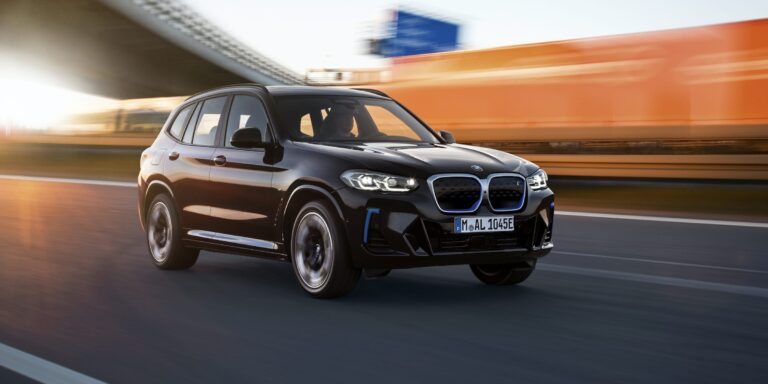
The major change is to the front end which has evolved into a far more complex structure, with an even larger version of the already prominent grille. This is now a single-piece frame and finished in a pearl-effect chrome with blue accents.
Which do you prefer – the new (left) or the one it replaced (right)?
Other styling tweaks include slimmer headlamps but a larger lower air intake, and blue-painted L-shaped ‘air curtains’ on the edges of the intake, along with various detail and colour changes along the flanks of the car.
The two specification levels originally announced for UK buyers, ‘Premier Edition’ and ‘Premier Edition Pro’ have also been dropped, BMW deciding instead to apply its widely used perofrmance-pitched styling treatment, M Sport, to its new EV.
Some things remain the same, including most of the specification. Both M Sport and M Sport Pro versions will be available in a choice of four exterior colours, but the trim detailing will be in a high gloss black as standard – previously brushed aluminium was also on offer. The standard-fit wheels have also shrunk, now 19 inches in diameter instead of the 20 originally announced.
Equipment levels do follow the original announcement with M Sport cars including an automatic tailgate, adaptive suspension, heated steering wheel and panoramic sunroof.
There remains a choice of four colours for the standard leather trim, while other standard equipment includes electric and heated front seats, wireless phone charging, and BMW’s latest assistance technology stretching to semi-autonomous driving, parking assistance and a digital cockpit.
BMW iX3 (2022 facelift)
iX3 M Sport Pro versions add a head-up display, surround sound audio, gesture control allowing controls to be changed without actually touching them, darkened headlights with an auto high-beam, and a ‘Comfort Access’ package providing extra seat adjustment.
BMW claims that the addition of the M Sport package has “further enhanced the already high specification,” of the iX3 and so it is perhaps no surprise that prices have risen too by almost £1,000 – the entry model now costs from £59,730 and the M Sport Pro £62,730.
The Mercedes-Benz S-Class dates back to 1972 and has long been the benchmark big executive saloon, debuting such innovations as anti-lock brakes and automotive double glazing. But deadly rival BMW has been trying very hard to catch up with and the most recent 7 Series has raised its technology game. So the seventh-generation S-Class, only reaching buyers in 2021, has to stay ahead.
Generally reviewers believe that it does, Auto Trader commenting that the new model “takes technology and interiors to a new level entirely and stretches the lead between the S-Class and its rivals.”
There is a wide choice of models – the range stretches across two body lengths, three trim levels, two diesel and one petrol engine with power outputs from 286 to 435hp and four-wheel-drive on one of the diesels. A plug-in hybrid version is also due on sale before the end of 2021.
This market is all about refinement, comfort and technology and testers reckon the S-Class meets the challenge. “Even the entry-level AMG Line model is well equipped,” says Parkers, “with 19-inch wheels, air suspension with self-levelling, keyless go with seamless door handles, intelligent LED headlights, a parking package with reversing camera and power-closing doors and bootlid.” The review adds that dip into the options list “and the sky’s the limit.”
The technology particularly impresses, Top Gear highlighting the autonomy that, among many features, can allow the car to both find a parking space and park itself.
Most of the minus marks are minor niggles, Top Gear again suggesting the exterior design may be too cautious and some of the materials used “a touch showy.” And Auto Express adds that a 3D augmented reality display in the cabin “is gimmicky.”
As of July 2025, the Mercedes-Benz S-Class holds a New Car Expert Rating of C, with a score of 61%. It scores top marks for its strong media reviews and low CO2 emissions (helped by the plug-in hybrid version), but the overall score is dragged down by very high running costs and poor reliability.
Body style: Large saloon Engines: petrol, diesel, plug-in hybrid Price: From £86,145 on-road
Launched: Autumn 2020 Last updated: Summer 2021 Replacement due: TBA
Image gallery
Media reviews
Highlighted reviews and road tests from across the UK automotive media. Click any of the boxes to view.
Featured reviews
“The Mercedes-Benz S-Class has some of the most impressive technology you’ll see in any car. It’s luxurious and comfortable too. Its exterior design could be a bit more exciting though.”
Model reviewed: 2.9-litre diesel automatic S 400 d Score: 9 / 10 “Once again, the Mercedes-Benz S-Class pushes boundaries with game-changing technology and an even greater focus on refinement. The 400d offers petrol-like performance and almost 40mpg, while the upcoming 580e PHEV leaves rivals scrambling for a charging cable.” Read review
Auto Trader
Model reviewed: Score: 10 / 10 “The Mercedes-Benz S-Class is the benchmark luxury saloon, but the all-new 2020 model takes technology and interiors to a new level entirely and stretches the lead between the S-Class and its rivals, BMW 7 Series and the Audi A8.” Read review
Business Car
Model reviewed: 2.9-litre diesel automatic S400d L AMG Line Premium Plus Score: 8 / 10 “The S-Class has one of the nicest interiors we’ve been in. Considering its weight, the way this Mercedes behaves is more like a smaller saloon with half its weight. The steering is responsive, the body control is excellent, and the head-up display has all the information you need – without having to take your eyes off the road.” Read review
Car
Model reviewed: 3.0-litre petrol/electric plug-in hybrid S580e L Score: 10 / 10 “While there’s a bewildering amount of technology on board, the Mercees-Benz S-Class remains a slick, stealthy and silent executive express. Wonky brake pedal aside, the ability to cruise in silence for a considerable duration is supremely impressive, making the PHEV the best version of this current generation of S-Class.” Author: Jake Groves Read review
Model reviewed: 3.0-litre petrol (mild hybrid) automatic S 500 4Matic Score: 10 / 10 “There’s no question that the Mercedes-Benz S-Class once again sets the benchmark in the luxury segment, with technology, comfort, driving ability and efficiency all posting sizeable gains over its excellent predecessor.” Read review
Carbuyer
Model reviewed: Range overview Score: 9 / 10 “The Mercedes-Benz S-Class fortifies its position at the top of the luxury class, becoming an even better place to spend time.” Read review
Daily Mail
Model reviewed: 3.0-litre petrol automatic S 500 L 4Matic “With a range priced from a shade under £80,000, this is definitely a car for grown-ups and can change its style to suit your mood – from a stately glide to a sporty ride.” Read review
Driving Electric
Model reviewed: 3.0-litre petrol/electric plug-in hybrid S 580e Score: 9 / 10 “A massive 62-mile electric range and a sumptuous, high-tech interior move the Mercedes S 580 e plug-in hybrid to the front of the low-emissions limousine pack.” (Stephen Errity) Read review
Evo
Model reviewed: Range overview Score: 9 / 10 It may be slipping out of fashion, but the institution that is Mercedes’ S-class is only getting stronger Read review
Heycar
Model reviewed: Range overview Score: 10 / 10 “The Mercedes-Benz S-Class has long set the benchmark for luxury saloons, despite strong competition from its noisy German neighbours. The popularity of luxury SUVs means even more pretenders to the crown. But the latest Mercedes-Benz S-Class shows exactly how its done. It remains unrivalled among its peers.” Read review
Honest John
Model reviewed: Range overview “Inside, the Mercedes-Benz designers have created a feel-good ambience with lounge character marked by elegance, high quality and lightness. The dashboard with its new architecture, modern surface design and ergonomic display arrangement is a particular highlight.” Read review
Motoring Research
Model reviewed: 3.0-litre petrol/electric plug-in hybrid S580e AMG Line Premium Plus Executive Score: 9 / 10 “The Mercedes-Benz S 580e plug-in hybrid combines cosseting luxury with a 510hp punch and 63 miles of electric range. It’s a superb luxury car, albeit with a small boot.” Read review
Motors
Model reviewed: Score: 9 / 10 “The Mercedes-Benz S-Class offers a luxurious and refined finish, lots of great tech, and is a well-balanced cruiser.”
Read review
Parkers
Model reviewed: Range overview Score: 9 / 10 “The Mercedes-Benz S-Class is loaded with tech, but feels less weighed down.” Read review
The Sunday Times
Model reviewed: S 400 d 4MATIC L AMG Line Premium Plus Executive Score: 8 / 10 “You can’t fail to be impressed by the performance, comfort and technology packed into the new S-Class, though a revised suspension system seems to be a small step backwards and the updated cabin, while unbelievably high tech, appears to have lost a little in the way of class.” Read review
Model reviewed: 3.0-litre petrol automatic S 500 “It’s like the designer went to Poundland, bought everything and fitted the lot.” (Jeremy Clarkson) Read review
The Telegraph
Model reviewed: 3.0-litre petrol/electric plug-in hybrid S 580e AMG Line Premium Plus Executive Score: 10 / 10 “The Mercedes-Benz S 580e succeeds, by and large, in every way a luxury limo should – it’s unendingly sumptuous, exceedingly smooth, lavishly spacious and bountifully equipped. This is not the most complete S-Class ever, but it’s still a very good one indeed.” (Alex Robbins) Read review
Model reviewed: S 350 d Score: 8 / 10 “Over-the-top tech aside, the Mercedes-Benz S-Class is still in the running for the best car in the world, then – just choose a different engine if you want to catch it at its best.” Read review
Model reviewed: Range overview Score: 10 / 10 “If there is a box marked ‘Best Car In The World’, the S-class ticks it. This is mass production as art, quite amazingly comfortable and refined, with a fit and finish to make other luxury cars look a bit shoddy. What a shame it will only be found idling quietly outside Government and EU buildings.” Read review
Top Gear
Model reviewed: Score: 9 / 10 “In the Mercedes-Benz S-Class, high technology and sumptuous luxury merge in spectacular fashion to deliver a car that lights the way forward.” Read review
Safety rating
Independent crash test and safety ratings from Euro NCAP
No safety rating
As of July 2025, the Mercedes-Benz S-Class has not been assessed by Euro NCAP. This is not unusual – previous generations of the S-Class were never tested, and neither are rivals like the BMW 7 Series or Audi A8. This is simply down to their higher prices and relatively low sales numbers.
Eco rating
Independent crash test and safety ratings from Euro NCAP
No eco rating
As of July 2025, the Mercedes-Benz S-Class has not been assessed by Green NCAP.
Reliability rating
Reliability data provided exclusively for The Car Expert by MotorEasy
Total claims: 253 Average repair cost: £829.19 Last updated: April 2025
As of April 2025 (our most recent data point), the Mercedes-Benz S-Class has a poor reliability rating of 17%, according to workshop and warranty data provided exclusively to The Car Expert by our commercial partner, MotorEasy. This score applies to both the current S-Class and also to previous generations, which is worth considering if you are considering a used Mercedes-Benz S-Class.
Based on more than 200 warranty claims, the average repair cost is just over £800 so a used car warranty is well worth considering if you own or are considering an S-Class. The largest number of claims concern the electrical system, with an average bill of abobut £400. Engine faults are unsurprisingly the most expensive problems – at about £2,100 – and are also relatively common in the S-Class.
If you own a Mercedes-Benz S-Class or are considering buying a used one, make sure that any used car warranty you purchase covers all of these problem areas.
Running cost rating
Monthly cost of ownership data provided exclusively for The Car Expert by Clear Vehicle Data
Fuel consumption
Average
Score
Petrol models
32 mpg
E
Diesel models
43 mpg
C
Plug-in hybrid models
364 mpg
A
CO₂ output
Average
Score
Variation
Score
Petrol models
199 g/km
D
Diesel models
172 g/km
C
Plug-in hybrid models
18 g/km
A
Battery range
Average
Score
Variation
Score
Plug-in hybrid models
64 miles
C
Insurance group
Average
Score
Variation
Score
All models
50
F
Service and maintenance
Cost
Score
Year 1
£502
D
Year 2
£1,186
D
Year 3
£1,862
D
Year 4
£2,232
D
Year 5
£2,927
D
Overall
£8,709
D
The Mercedes-Benz S-Class is a very expensive car to run, according to numbers provided exclusively to The Car Expert by our data partner, Clear Vehicle Data.
Fuel consumption is unsurprisingly very poor for both petrol and diesel models. The plug-in hybrid stats look good on paper, but this is largely a function of misleading EU/UK government lab tests that make every plug-in hybrid look amazing. There are no real-world situations where you’re going to get 403 miles out of a single gallon (4.5 litres) of fuel and a bit of electricity.
Battery range on the plug-in hybrid is quite good. If you are able to charge it every day, you may well be able to do all of your day-to-day driving purely on electrical power. On longer trips, you’ll still run out of charge fairly quickly.
Insurance and scheduled servicing costs for the S-Class are likely to be high, which is to be expected from a car this expensive and sophisticated.
Warranty rating
New car warranty information for the Mercedes-Benz S-Class
Overall rating
B
68%
Petrol or diesel models
C
41%
Hybrid or plug-in hybrid models
A
82%
New car warranty duration
3 years
New car warranty mileage
Unlimited miles
Battery warranty duration
8 years
Battery warranty mileage
100,000 miles
Mercedes-Benz’s new car warranty is only average, and not as attractive as some brands offer.
The duration is three years, with no limit on mileage – although, in reality, the mileage numbers are likely to be fairly irrelevant as most cars only cover about 10,000 miles each year. This may not be the case for chauffeur-driven cars, which is an important market for the S-Class, but you’ll need to check your warranty fine print to check if there are any exclusions for business use.
In addition to the standard new car warranty, the S-Class plug-in hybrid models have an eight-year/100,000-mile warranty for the battery components. The overall rating above is a mix of the different models.
Awards
Significant UK trophies and awards that the Mercedes-Benz S-Class has received
2022
Fleet World Awards – Best Luxury Car
2021
World Car Awards – World Luxury Car
Parkers New Car Awards – Best Luxury Car
Fleet World Awards – Best Luxury Car
Similar cars
If you’re looking at the Mercedes-Benz S-Class, you might also be interested in these alternatives
The long-lasting reputation of the Mercedes-Benz S-Class has also meant it has few real rivals, but technology upgrades to the BMW 7 Series have made the most recent versions more competitive alternatives to the Merc. The Audi A8 is also a rival but without the provenance of its fellow German heavyweights, while the likes of Range Rover also target the big Mercedes.
If a badge matters, then the Bentley Flying Spur or even the Rolls-Royce Ghost will be very tempting – at a cost.
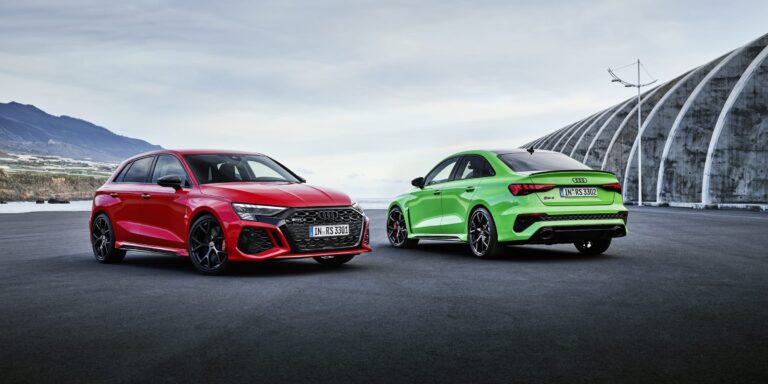
Audi has announced prices for the latest RS 3 performance models, which will be available in both Saloon and Sportback (hatchback) form.
The RS 3 Sportback will cost from £50,900 while the saloon will set you back an extra £1,000.
Both cars employ a five-cylinder 2.5-litre petrol engine – the unit, already nine times a winner of an International Engine of the Year award, has been further boosted for its latest application, now producing 400hp and 500Nm of torque.
Audi claims best-in-class acceleration and top speed figures for the RS 3, with a 0-62mph time of 3.8 seconds. While the standard versions of the car are electronically limited to a maximum speed of 155mph, the two top trim levels have the limiter removed to allow 174mph. An options package can further boost top speed to 180mph.
RS 3 models will be available in four trim levels dubbed RS 3, Carbon Black, Launch Edition and Vorsprung. Only 96 examples of the Launch Edition variant have been allocated for UK sale, at £6,000 more than the base model.
Standard equipment on all cars includes 19-inch alloy wheels, heated front sport seats in leather with embossed logos, dual-zone climate control, cruise control, and Audi’s Virtual cockpit with 12.3-inch and 10.1-inch screens.
The RS 3 is also the first Audi fitted as standard with a new RS Torque splitter, replacing the rear axle differential and the previous multiple disc clutch on the rear axle – individual multiple disc clutches are now mounted on each driveshaft.
In corners the torque splitter will increase the drive to the outer rear wheel that is under heavier load. As a result the car will be less likely to understeer, producing sharper, more precise cornering.
As the RS 3 is a performance model likely to be used off the public road at track days, Audi has included a mode in the torque splitter that will send all torque to just one rear wheel, making the sport of ‘drifting’ much easier to undertake.
The driving dynamics electronics also include a race track-specific RS Performance driving mode alongside the selectable comfort, auto, dynamic, RS Individual, and efficiency modes.
First deliveries of the Audi RS 3 are expected in November.
The police have heard them all before: “I was only sitting in the car”, “I didn’t realise how much alcohol was in my cocktail” and “I was just moving to a safer place”.
These are just some of the many excuses motorists come up with when they have been stopped by the traffic cops for suspected drinking and driving. Many of the explanations are just ways for drivers to get away with their tippling transgression, some are plain stupidity and yet more are simple myths that drivers really believed would make them immune to drink drive prosecution.
Every year around 55,000 people in England and Wales are convicted of drink-driving related offences, according to Department of Transport statistics. And with recent figures showing that each year on average 7,860 people are seriously injured and 280 are killed due to drink-driving, getting behind the wheel after drinking alcohol is a more serious offence than some might think. The courts don’t: the offence carries a minimum 12-month driving ban.
Now an expert motoring lawyer has shed some light on the top ten reasons why people are convicted of drink driving. And whether they are fact, fiction or just stupidity, they can all land the driver with a serious penalty.
Manjinder Kang, of Birmingham-based motoring specialists Kang & Co Solicitors, helps to bust some of the myths around the offence to raise awareness of why it should always be “none for the road”.
1. I only moved the car 10 metres
How far you drive the car is irrelevant. Being behind the wheel of a car while under the influence of alcohol is an offence.
When you have alcohol in your system, your reaction times and perceptions are impaired – which means that even moving your car a short distance to park it carries a risk.
2. I didn’t think I would still have alcohol in my system
This is one of the most common misconceptions. People think that once they have slept they won’t have alcohol in their system the next day.
It can take on average an hour for every unit of alcohol you drink to leave your system. However, there are no hard rules and it relies on many factors including metabolism, alcohol strength and body mass index.
3. I had a big meal so it should have sobered me up
Nothing but time will help to get rid of the alcohol in your system as your liver chemically breaks down the alcohol and eliminates it from your body.
So even if you have a coffee, a cold shower or eat your body weight in nachos it will not help sober you up any quicker.
4. I was only sitting in the car listening to music
It is an offence to be drunk in charge of a vehicle, ie in possession of the keys – even if you are not driving. So, sitting in the car without the engine on is not a defence.
5. I only had two drinks so I wasn’t drunk
The legal limit is 35mg of alcohol in breath and not related to the number of drinks you consume. There is no way of knowing how much alcohol you can drink and still be under the drink-drive limit.
There are many factors that influence how alcohol is absorbed in your body including; how much you drink, how fast you’re drinking, your body mass index, your metabolism, and the strength of alcohol in your drinks. A pint of shandy is not the same as a large glass of wine or a cocktail, but not drinking any alcohol while driving will always be the safest option.
6. It was only a quick drink to settle my nerves
Known as the ‘hip flask’ defence some drivers reach for the bottle to steady their nerves after a crash. They may not have been drinking when they had the accident but when the police turn up the driver is tested and over the limit.
If you are involved in an accident, never be tempted to try to steady your nerves with alcohol – you could find yourself in a much worse position.
7. I thought I would get points on my licence; why did I get a driving ban?
A drink-driving conviction carries a minimum 12-month driving ban and can go up to three years and result in a prison sentence – even for a first offence. If you are caught drink driving twice within a ten-year period, your second offence also carries a minimum three-year driving ban.
As a criminal conviction, any offence will also need to be declared to your employer and will show on future DBS checks for up to five years. A driving conviction will also need to be declared on your car insurance until it is spent and will probably increase your premiums.
8. If I refuse to be breathalysed they cannot prosecute me
If you are tempted to refuse to be breathalysed to avoid being caught, think again. Refusing to provide a specimen will be classed as obstructing a police officer and the penalty will automatically be harsher – whether you were actually over the limit or not.
9. They can’t ban me from driving if it is going to cause family hardship
There are cases where you can put forward an argument in court which is called ‘exceptional hardship’. If you can show a ban would cause increased hardship to your family by resulting in you losing your job, risk you losing your home or being unable to provide for your family, the courts can show leniency and revoke a ban.
This is not possible with a drink-driving offence. Regardless of the impact, the minimum driving ban for drink-driving is 12 months and you cannot argue ‘exceptional hardship’ to avoid or lower a ban.
10. I won’t get prosecuted as long as I’m under the limit
Even if you produce a specimen that shows that you are under the legal blood or in breath alcohol limit, you can still be prosecuted for being impaired through drink or drugs.
As alcohol affects everyone differently, many drivers can be significantly impaired below the legal limit of 80mg in 100ml of blood. Police will carry out a Field Impairment Test and if you are shown to be ‘impaired’ due to alcohol then you will still receive a year’s ban.
‘None for the road’ is always best
“The message is simple. If you are looking to get behind the wheel of a car no alcohol is always best,” says Manjinder Kang. “It is surprising how many people do not understand the law when it comes to drinking and driving, and the ongoing consequences you face if convicted.
“Alcohol impairs your judgement and carries substantial risk, which is why if you are driving it is always best to have none for the road.”
More information on the law and drink driving is available at: www.kangandco.co.uk
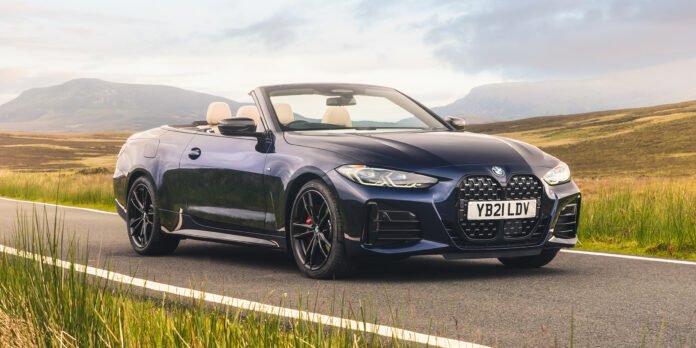
The BMW 4 Series joined the German upmarket brand’s range in 2013 – except that it didn’t really. Before then, the two-door version of the mass-selling 3 Series was called the 3 Series Coupé. Now it’s the 4 Series Coupé – and just to confuse matters there is also a four-door 4 Series called the Gran Coupé…
The current (2020 onwards) 4 Series Coupé has a lower roofline and more ‘planted’ stance than its 3 Series sister, but it’s the front end that divides opinions. Honest John begins its review with “if you can see past the enormous grille…” and Top Gear offers “Life’s pretty great inside the new 4, not just because you don’t have to look at it…”
Beyond that enormous grille, the BMW scores highly with both reviewers and buyers, already selling very well. “The 4 Series manages to seamlessly combine impressive performance, attractive economy and a driver-focused quality that is hard to beat,” says Auto Express.
Most of the several petrol and diesel engine options are four-cylinder units, with all-wheel drive available on selected versions. There are also more potent M versions, and Business Car states: “The engine line-up ranges from truly impressive to absolute cracker.”
The car maintains the BMW record for on-road prowess, while there’s also widespread praise for the interior quality, design and practicality. The Telegraph concludes: “You shouldn’t discount it as practical transport, with a good-sized boot and room enough for a couple of adults in the back.”
As of February 2026, the BMW 4 Series Coupé holds a New Car Expert Rating of B, with a score of 70%. It scores top marks for its excellent media reviews and safety rating, while CO2 emissions are also good, but as with most BMW models, the reliability record is only average and running costs are high.
“The BMW 4 Series is a sleek premium coupe with great tech and strong engines. It feels firm at low speeds, though, and not everybody will be convinced by those front-end looks.”
Model reviewed: 2.0-litre petrol automatic 420i Score: 9 / 10 “You’ll either love or loathe those looks, but there’s no arguing with what a brilliant all-rounder the latest BMW 4 Series proves to be. The criticisms we have of this entry-level 420i are so minor that they’re easy to forgive.” Read review
Model reviewed: M440i xDrive coupé Score: 9 / 10 “The BMW M440i xDrive is a consummate all-rounder, combining impressive refinement, strong performance and the luxurious trimmings you’d expect. It’s a performance coupe that also retains a real degree of civility, while four-wheel drive makes it a more versatile, but still entertaining car to drive.” Read review
Auto Trader
Model reviewed: Coupé range Score: 8 / 10 “The enormous grille on the new BMW 4 Series has been the cause of some controversy, but the car behind it is very much in keeping with brand traditions. This is BMW in its comfort zone, the 4 Series turning its 3 Series foundations into something much sportier.” Read review
Business Car
Model reviewed: 2.0-litre petrol automatic M Sport coupé Score: 9 / 10 “With engaging performance and dynamics, exceptional refinement and cabin quality, regardless of what detractors may make of the styling, it seems the BMW 4 Series is destined for stellar positioning in the compact executive coupé class.” Read review
Car
Model reviewed: 3.0-litre petrol automatic M440i xDrive coupé Score: 8 / 10 “Ignore the front end (like we clearly can’t) and you’ve got a hugely involving old-school drivers’ car in the M440i, and a dramatic-looking poser-mobile in less-powerful specifications.” Read review
Car Keys
Model reviewed: Range overview Score: 9 / 10 “BMW is on to yet another winner with the 4 Series. That styling is sure not going to appease everyone, but if you can see past that, or in fact don’t mind the way it looks, this is a brilliant sporty coupe.” Read review
Carbuyer
Model reviewed: Range overview Score: 8.4 / 10 “The BMW 4 Series is the best car to drive in its class, regardless of the rather contentious nose.” Read review
Company Car Today
Model reviewed: 2.0-litre diesel automatic 420d M Sport “It could be a challenge to get past the front-end styling, but if it’s not a deal-breaker then the BMW 4 Series is better and more appealing than ever.” Read review
Heycar
Model reviewed: Range overview Score: 9 / 10 “The BMW 4 Series Coupe is a car that makes a statement. It’s more than just a 3 Series with a rakish roofline and two fewer doors; it’s a stylish coupe that could almost be considered alongside a Porsche Cayman (albeit with an extra dose of practicality).” Read review
Honest John
Model reviewed: Range overview Score: 10 / 10 “Not everyone will like how the BMW 4 Series Coupe looks but, if you can see past that enormous grille, it’s a brilliant alternative to an Audi A5 or Mercedes-Benz C-Class Coupe. While it’s not a practical choice, the interior is superb and it’s better to drive than any of its peers. It feels a lot more special than a BMW 3 Series, too.” Read review
Parkers
Model reviewed: Range overview Score: 8.8 / 10 “Get beyond its challenging nose and there’s a great car ready and waiting” Read review
The Sunday Times
Score: 8 / 10 “The BMW 4 Series is a peach for commuting, grand touring or a sporty B-road blasts.” Read review
The Telegraph
Model reviewed: 2.0-litre petrol automatic 420i Score: 8 / 10 “Derivative in parts, this restyle is nevertheless pretty handsome and the way the BMW 4 Series drives and feels is top of the form. Ultra keen drivers might want to consider a bigger engine (or even the 420d turbodiesel), but you won’t want for much with this 2.0-litre petrol.” Read review
Top Gear
Model reviewed: Coupé range Score: 8 / 10 “An outstandingly sorted car, but something tells us you’ve already made your mind up about liking the 4 Series or not. Apparently, it’s a bit controversial-looking. Did you notice?” Read review
Safety rating
Independent crash test and safety ratings from Euro NCAP
The safety rating for the BMW 4 Series Coupé is based on the testing conducted on the 3 Series saloon in 2019. The car scored maximum points in several of the tests and Euro NCAP also highlighted the effectiveness of the active bonnet in helping to protect pedestrians.
Eco rating
Independent economy and emissions ratings from Green NCAP
No eco rating
As of February 2026, the BMW 4 Series has not been tested by Green NCAP.
Reliability rating
Reliability data provided exclusively for The Car Expert by MotorEasy
Total claims: 336 Average repair cost: £861.23 Last updated: April 2025
The BMW 4 Series family has an average reputation for reliability, according to workshop and warranty data provided exclusively to The Car Expert by our partners at MotorEasy. This score covers all versions of the current-generation 4 Series (Convertible, Coupé and Gran Coupé) as well as the original (pre-2020) models.
The average repair bill to date has been just under £850, which is obviously a lot more than a used car warranty – so bear that in mind if you already own a BMW 4 Series or are looking at buying a used 4 Series.
The most common faults with 4 Series models to date have been engine-related. These are also the most expensive to repair, with an average bill of £2,000. Gearbox repairs are even more expensive, averaging more than £2,600, but are thankfully not as common. Other faults – like suspension, fuel system, electrics and brakes – have much lower repair bills.
Awards
Trophies, prizes and awards that the BMW 4 Series has received
2021
Carbuyer Awards – Best Sports Car
Scottish Car of the Year Awards – Best Executive Car
Similar cars
If you’re looking at the BMW 4 Series, you might also be interested in these alternatives
Within the executive car market, there are several distinctly more practical alternatives to the 4 Series Coupe, not least its sister, the seminal 3 Series. Rivals, however, are getting fewer and further between. Mercedes-Benz offers its CLE in coupe form, but the Audi A5 coupé and Lexus RC have both been discontinued.
Choosing a GAP (guaranteed asset protection) insurance policy can feel overwhelming if you’re not familiar with the options out there and how they all work.
Return to Invoice, Vehicle Replacement and Finance Hire GAP are all policy types available to buyers who use a PCP (personal contract purchase).
Arguably, if you are a PCP buyer then you’re a highly suitable candidate for GAP insurance because the vehicle will lose value faster than you are paying off your debt to the finance company. There is a very good chance that, if your car is stolen or written off (called a Total Loss), the payout from your car insurance won’t be enough to cover your finance debt. That means you won’t have a car but you could still owe the finance company thousands of pounds.
GAP insurance is a solution to these concerns, as it bridges the difference between what your car insurance pays out and what you need to top up for. That exact amount you are eligible for will depend on the type of policy you’ve selected, so let’s take a closer look at what these policies do.
To help illustrate the difference between the different types of GAP insurance, we’re going to look at a car that was bought new a year ago and has now been written off. These are the details:
New car price: £20,000 Initial payment: £5,000 Insurance write-off value: £12,000 Outstanding finance debt: £17,000
Return to Invoice
A Return-to-Invoice policy is the original GAP insurance. This essentially puts you back in the position you would have been had you not bought the vehicle, based on the original price of the car. However, it doesn’t take your finance debt into account.
So in our scenario above: Your car cost £20,000 new a year ago, using £5,000 of your own money for a deposit and borrowing the rest. Now the insurance company is giving your £12,000 for it after it has been written off. Your Return to Invoice GAP policy would give you an extra £8,000 to cover the shortfall between your insurance payout and the original price of the car, so you end up with £20,000 again.
However, your finance debt is £17,000, so you have to pay that off from your combined insurance payments, leaving you with £3,000 in your pocket.
Because you spent £5K of your own money on a deposit for your car, you’re now £2K worse off than before you started, but that’s a lot better than without GAP, where you would have lost that original £5K plus you’d have had to find another £5K to clear your finance debt.
Finance GAP
These policies operate exactly the same as the policies used for contract hire and hire purchase, although some of the T&Cs may vary. In essence, they cover the money outstanding on the finance agreement over and above the insurance payout value if your car is a total loss.
In our hypothetical scenario above, you’ve received a car insurance cheque for £12,000 but you still owe the finance company £17,000. A Finance GAP policy would cover you for the £5,000 shortfall between your insurance payout and your finance debt, so you can now clear your debt.
You’re left with nothing afterwards, so that £5,000 deposit you put in originally is gone, but you’re not having to find money to clear your debt to the finance company.
In the example above, you get less GAP payout from Finance GAp than you would with Return to Invoice policy. However, Finance GAP cover is particularly valuable if your car is stolen or written off in the first few weeks or months of your ownership, which is where your debt position is greatest.
Because of the nature of how PCP finance works, with interest and fees all added into the mix, you could end up owing the finance company more than the original price of the car if you lose it in the first few months of ownership. Finance GAP makes sure that you’re protect against that, whereas a Return to Invoice policy might not cover all of your finance debt.
Vehicle Replacement
A vehicle replacement GAP policy goes above and beyond bringing you back to the original price of your car by covering the shortfall up to any increased price of that car today.
Once gain, the original price of the car was £20,000 and you’ve received a cheque for £12,000 from your car insurer. But in the time since you bought your car, the price has increased to £22,000 – an extra £2K from what it was a year ago.
A vehicle replacement GAP policy would pay you £10,000 to cover the difference between your £12K insurance payout and the new £22K price for a replacement car. That’s £2K more than you’d get from a Return to Invoice policy on the same car.
You still have to pay £17K to the finance company to clear your PCP debt, but you’ll be left with £5K in your pocket to put towards another car like the one you’ve just lost.
Since this kind of cover gives you more of a payout, it’s inevitably going to be more expensive.
What about a used car on PCP?
GAP policies can be purchased for either a new or a used car. GAP insurers will have certain T&Cs regarding age and mileage on a used car, but otherwise the policy works in the same way.
Combined policies
Many GAP policies are now ‘combined’ policies, which basically makes sure you get the highest figure from either the invoice price or your finance debt.
Usually this means that a Return to Invoice or Vehicle Replacement policy is combined with a Finance GAP policy to ensure you’re covered for either the price of a new car or your finance debt, whichever is higher.
So which is the best choice?
Inevitably, the ‘best’ policy will depend on your circumstances and the prices involved. The higher the level of cover and payout offered, the more the policy is likely to cost. So a vehicle replacement policy that includes finance cover is going to cost more than just a finance policy on its own, but you’ll get a larger payout if you need to make that claim.
Whichever type of policy you plump for, a GAP insurance product will almost cetainly save you a lot of money should the worst happen and your car is lost.
Ongoing shortages in the supply of electronic components has once again thrown a massive curveball into the new car market. July’s sales results show some very unexpected results, with market leaders going AWOL and some struggling brands enjoying a brief respite.
We published our report on the overall market earlier this week, which showed that the overall market was down by about 30% on the same month last year. However, within those results was an enormous variation in performance from different car manufacturers.
Of the major conglomerates, the Volkswagen Group seems to be coping best with supply issues so far, with all its volume brands (VW, Audi, SEAT and Skoda) out performing the overall market. Once again, VW and Audi were the top two brands in the UK for sales. Hyundai (which includes Kia) also seems to be managing well, as does Toyota (and Lexus).
On the other side, Ford has been struggling for a few months – the perennial market leader has fallen back to third since May. Renault is also having an atrocious time, with July 2021 registrations down 80% on the same month last year. The company has also warned that things are going to get worse before they get better.
The huge new Stellantis group is an interesting case, with the company’s former PSA volume brands (Peugeot, Citroën and Vauxhall) all struggling badly in July, while its former FCA brands (Fiat, Jeep, Abarth) tended to perform better than the market average – although Alfa Romeo was slightly below average.
Among the top ten best-sellers list, there was also significant movement. The headline news was the complete disappearance of the year’s best-selling car to date, the Vauxhall Corsa. Fortunately for Vauxhall, the Ford Fiesta had another poor month so the Corsa’s overall sales lead for the year was barely affected. But there were also a few other shifts, so let’s have a look in more detail.
The UK’s top-selling cars, July 2021
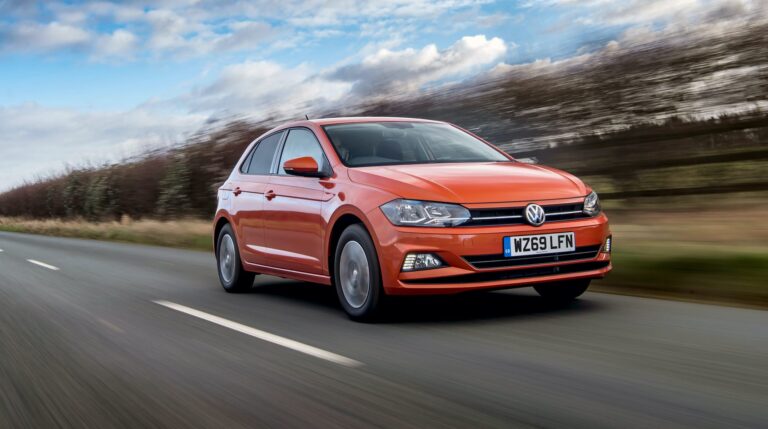
1. Volkswagen Polo
It was another new face at the top of the charts as the Volkswagen Polo took sales honours in July. We certainly can’t remember the last time the Polo was the country’s best-selling car, but if you can tell us when it last happened then do so in the comments below. There are zero prizes on offer other than our everlasting repect and admiration.
The Polo was helped by the vanishing Vauxhall Corsa and ongoing sales difficulties for the Ford Fiesta, and presumbly some runout deals from Volkswagen Finance to help shift stock of the current model ahead of the updated Polo’s arrival in time for the September sales rush.
We’ve just updated our Expert Rating algorithm, which we’ll be telling you all about in the next week, but it has generally pulled scored down for most cars. The Polo now holds an Expert Rating of 76%, which is down slightly from its previous score of 80%.
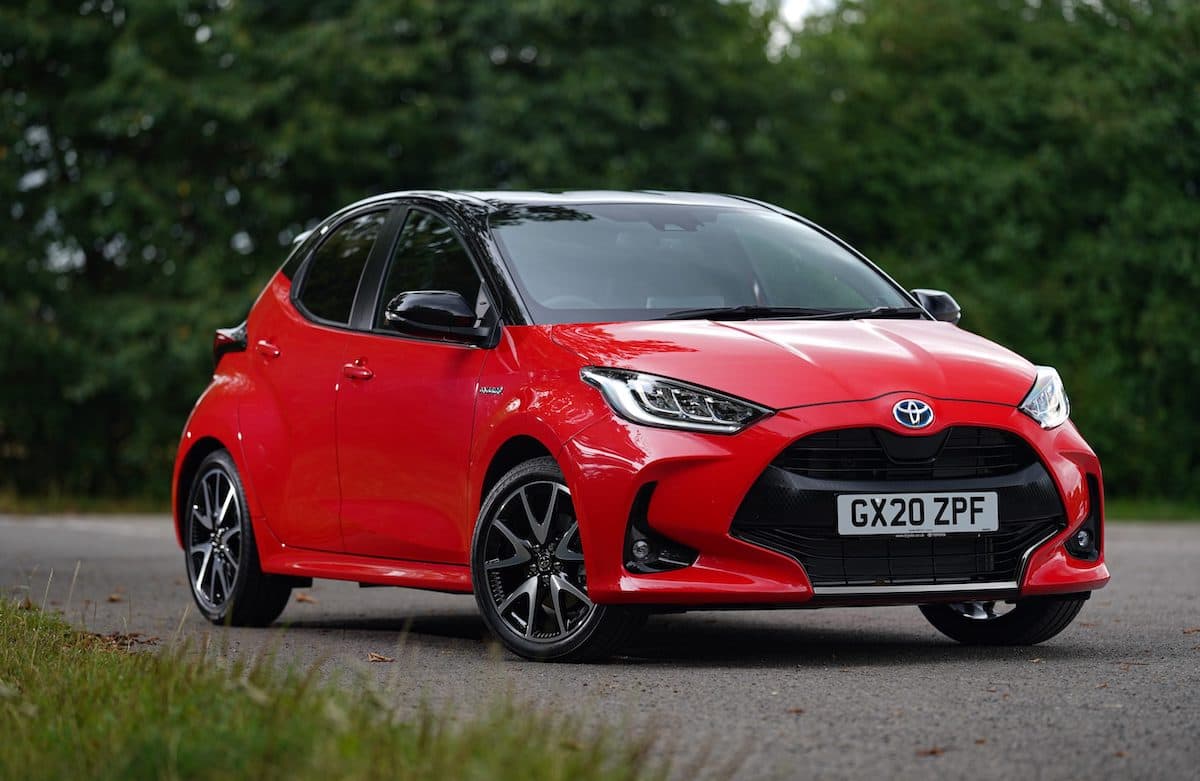
It was a great month for the Toyota Yaris in July, reaching the dizzying heights of second and only just shaded by the Polo for top spot. This also helped the Yaris leapfrog the BMW 3 Series and Nissan Qashqai in year-to-date sales, where it now sits eighth.
The Yaris currently holds an overall score of 67% on our Expert Rating index, which has dropped from its previous rating of 76% since we updated our top-secret algorithm. This is a bigger fall than affected the Polo or Fiesta, but still keeps it four points above the Corsa.
Another fantastic result for another car in run-out mode. The current Kia Sportage has been around since 2015, and is set to be replaced by an all-new model before the end of 2021. July’s strong sales also helped the Sportage jump the Nissan Qashqai for sixth place in year-to-date registrations. Whether it can sustain that position will depend on how many Sportages Kia has left before the new model arrives.
The Sportage currently holds an Expert Rating of 64% in our industry-leading Expert Ratings index, which has dropped three points from 67% as a result of our updated scoring system. That puts it firmly in the bottom half of the medium SUV sector, so Kia will hoping that its boldly styled replacment can improve on this score.
Once again, the top-selling Ford was the talented little Puma SUV, although it did slip from third place in June to fourth in July. On one hand, it’s good news for Ford to have another big-selling model in the family. But on the other hand, this is hurting sales of the Fiesta, which is looking less and less likely to catch the Vauxhall Corsa in sales by the end of the year.
Ford’s junior crossover has been popular with critics, currently holding a rating of 76% on our unique Expert Rating index. This has slipped a few points as a result of our algorithm update, but the Puma remains the highest-rated mainstream petrol small SUV, with only a couple of electric models and the more-expensive Volvo XC40 ranked higher.
Although it has slipped a couple of places since last month, the Volkswagen Golf was still the UK’s most popular family hatchback in July. It edged slightly further ahead of the Mercedes A-Class in year-to-date sales but it remains a close race.
The Golf’s Expert Rating of 74% has fallen by six points as a result of our new scoring calculations, which has also dropped it a point behind the Ford Focus. However, it remains a few points better than either the A-Class or the Audi A3.
Making a return to the top ten for the first time since May, it was a great month for the Audi A3 to place sixth ahead of the Mercedes A-Class.
It was another great month for Audi overall, maintaining its second place in overall manufacturer registrations behind its Volkswagen overlord. Not only was it considerably better than eternal rivals Mercedes-Benz and BMW, but more Audis were registered than Fords for the third month in a row.
The Audi A3 has received generally good reviews from the UK media since it was launched, although its Expert Rating has slipped from 78% to 70% as a result of our August update, which means it has dropped a point behind the A-Class and falls further behing the BMW 1 Series, which only dropped four points in the update.
The Mercedes-Benz A-Class bounced back into the top ten in July after falling out in June, presumably the result of production problems rather than any sudden unpopularity. Having ceded third place in year-to-date sales to the Golf last month, the A-Class was a couple of hundreds sales behind its VW rival in July but remains close.
The A-Class has an Expert Rating of 71% in The Car Expert’s unique aggregated Expert Rating index, which is a five-point drop as a result of our new calculations. It ranks highly for safety, winning awards from Euro NCAP and Thatcham over the years for its protective qualities.
Like the A-Class above it, July saw the reappearance of the Mini hatch after disappearing in June. Supplies of the once-again-facelifted Mini seem to be keeping up with demand at present, although it remains outside the top ten in year-to-date sales.
Despite being the oldest car in the top ten, the Mini hatch still holds a very solid score of 76% in our Expert Ratings index, which only dropped four points in our huge August algorithm update, and is one of the top scores in its class. The electric version doesn’t score so well, with a new Expert Rating of only 63% that has dropped by ten points in the latest update and sits close to the bottom of its class.
Another very poor month for the Ford Fiesta in July saw it end up in ninth place. The only good news for Ford was that the Vauxhall Corsa did even worse and fell out of the top ten altogether. However, that only allowed the Fiesta to pull back a couple of hundred sales on the Corsa, so it’s still 2,700 units behind with only five months of the year to go.
The Blue Oval brand’s dominance of the new car market has also slipped by its usual lofty standards. Once again, Ford was third in registrations for June, behind Volkswagen and Audi and more than 30% off VW’s registration results.
Despite its 2021 sales struggles, the Fiesta remains popular with the critics. Most of the nearly 300 cars in our index fell by at least five points as a result of new and improved algorithm, but the Fiesta only dropped by three points and remains just one point off the top of the class (a position still held by the SEAT Ibiza). It currently holds an Expert Rating of 78%, which is some 15 points better than the Vauxhall Corsa.
Rounding out the top ten for July is a new entry – the Hyundai Kona. As far as we can tell, the Kona has never made it into the top ten since it was launched back in 2017.
The Kona has recently received a facelift, easily detected by its smoother new nose. Both the petrol/hybrid version and the Kona Electric have been updated.
The Kona Electric has been highly praised by reviewers, and is considered to be significantly better than the petrol-powered Kona. After our new Expert Rating algorithm was applied, the Kona Electric’s rating of 79% puts it right at the top end of the sector, just one point behind the close-related Kia e-Niro. Meanwhile, the regular Hyundai Kona is a massive 20% behind its electric sibling, with its score of 59% score putting it firmly in the bottom half of the field.
When the Kia Stinger launched in the winter of 2017/18, it was something very different and distinctive from the Korean brand, described by its designers as a Grand Tourer for long-distance motoring and with an exterior shape apparently partially inspired by a Coca-Cola bottle.
Most reviewers praised the Stinger as evidence of how far Kia has progressed as a manufacturer. When first on sale in 2017, the Stinger was available with two petrol or a diesel engine. However as part of an update in 2020 only the 3.3-litre turbo petrol unit was retained, its 370hp put through an eight-speed auto-manual gearbox and Kia quoting a 4.9-second 0-62mph time.
Testers liked the potency of this engine. Carbuyer said it beat its sportiest rival in the Audi range for power and added; “We reckon the Kia is even more entertaining to drive than the four-wheel-drive Audi RS5 Sportback quattro, which is far more expensive.”
The Kia’s price became even more attractive when its specifications were taken into account; “It comes loaded with equipment,” said Carbuyer, pointing out the wireless phone charging, powered tailgate, 360-degree camera, sunroof and top-level sound system, as well as the Kia standard seven-year warranty.
That body shape did have some drawbacks, however. While rear seat headroom was better than one might expect, Motors.co.uk pointed out that the 406-litre boot “is a bit behind the rest of the class.”
Overall, however, the car’s distinctive looks and exclusivity won it fans, Top Gear concluding; “There’s more than enough to like here for the Kia Stinger to deserve its albeit small following.”
Kia announced in November 2022 that the Stinger had been permanently withdrawn from sale in the UK, although it remained available in other markets around the world for a while longer.
As of March 2026, the Kia Stinger holds a Used Car Expert Rating of D, with a score of 57%. It gets average grades for its safety rating, CO2 emissions and media review scores, while its running costs are very high.
Highlighted reviews and road tests from across the UK automotive media. Click any of the boxes to view.
Featured reviews
“Does the Kia Stinger deserve to stand alongside similar cars from Audi and BMW? Yes, definitely. It’s not perfect, but it’s more than a match for the German duo.”
Model reviewed: 2.0-litre petrol automatic Score: 7 / 10 “Despite the smaller engine and lower list price, Kia’s most affordable Stinger retains much of its charm.” Read review
Model reviewed: 2.2-litre diesel automatic GT-Line S Score: 8 / 10 “The Kia Stinger makes a decent fist of matching but not bettering key cars in this class in most areas, although it falls down in a significant one: efficiency. It’s a shame given this diesel variant is likely to be used as a business vehicle by many people.” Read review
Model reviewed: 3.3-litre petrol automatic GT-S Score: 8 / 10 “The new Kia Stinger GT-S is a great first attempt at a potent sports saloon from the brand and is a worthy alternative to its German rivals.” Read review
Auto Trader
Model reviewed: Range overview Score: 8 / 10 “A sleek and sporty alternative to premium German models like the Audi A5 Sportback or BMW 4 Series Gran Coupe, the Kia Stinger does an admirable job of pushing Kia into new premium territory. The Stinger is an excellent car with distinctive looks, loads of kit and real driver appeal.” Read review
Business Car
Model reviewed: 2.2-litre diesel automatic GT Line “The diesel may sound hoarse, but the eight-speed automatic gearbox is smooth right through the range, allowing for effortless overtaking when needed. It has still got plenty of bite when bouncing the rev counter though, allowing you to detour off the beaten track onto a B road if you fancy it.” Read review
Carbuyer
Model reviewed: Range overview Score: 7.6 / 10 “The Kia Stinger is a sporty four-door family car that looks like great value next to German rivals.” Read review
Carwow
Model reviewed: Range overview Score: 6 / 10 “The Kia Stinger is a smart-looking coupe that’s exciting to drive, comfortable and comes with a seven-year warranty – but it’s almost as expensive as more premium alternatives.” Read review
Company Car Today
Model reviewed: 2.2-litre diesel automatic GT-Line S Score: 8 / 10 “The Stinger certainly grabs attention, and should help change perceptions of Kia, but it’s tricky to recommend a car that’s more than 30g/km off the best rivals.” Read review
Evo
Model reviewed: Range overview Score: 8 / 10 “In its most powerful V6-powered form, the Stinger works as a real drivers’ car. While the four-cylinder models are also enjoyable.” Read review
Green Car Guide
Model reviewed: 2.2-litre diesel automatic GT-Line S Score: 9 / 10 “The Kia Stinger 2.2 CRDi GT-Line S combines a fantastic driving experience with comfort, space and good economy on long journeys.” Read review
Honest John
Model reviewed: Range overview Score: 8 / 10 “The Kia Stinger is not an obvious choice and might take a bit of explaining to people who don’t quite get what it’s all about. It’s an interesting alternative to premium German rivals, however, and its rarity means it turns heads in the way a BMW 4 Series never will.” Read review
Motors
Model reviewed: Range overview Score: 7 / 10 “The Kia Stinger is a rather hefty saloon, meaning there’s plenty of passenger room. Even in the rear, where one may assume the sloping roofline might cut into headroom, space is in fact quite generous.” Read review
Parkers
Model reviewed: Range overview Score: 7.8 / 10 “Kia’s flagship model doesn’t disappoint.” Read review
The Sun
Model reviewed: 3.3-litre petrol automatic GT S “Kia reckons it’ll sell about 2,000 a year of the Stinger in the UK. A bullish claim but why not when it’s the fastest and prettiest Kia ever. After our test drive, we think it might also be one of the best value cars on the market right now.” Read review
The Sunday Times
Model reviewed: 3.3-litre petrol automatic GT-S Score: 8 / 10 “In many ways better than a fast BMW, Merc or Audi, but you’ll never buy one” (Jeremy Clarkson) Read review
The Telegraph
Model reviewed: 2.0-litre petrol automatic S Premium Score: 8 / 10 “With a seven-year warranty and PCP finance deals that vie with the best, the Kia Stinger makes a good case for itself as a big, old-school, rear-drive GT. Little details let it down though – they are indicative of the next steps Kia needs to take to get on terms with premium car-makers.” Read review
Model reviewed: 3.3-litre petrol automatic GT S Score: 8 / 10 “The Stinger GT S is not going to be a volume model for Kia, and we’d check PCP prices carefully against what the premium brands can offer. However, those buyers who do take the plunge will be rewarded with a car that is fast, fun and brilliantly composed.” Read review
Top Gear
Model reviewed: Range overview Score: 6 / 10 “A credible first ever sports saloon from Kia. Interesting to look at, and huge value for money. Needs a better gearbox though.” Read review
Safety rating
Independent crash test and safety ratings from Euro NCAP
The Kia Stinger was originally crash tested by Euro NCAP back in 2017 and awarded a five-star rating. Testers praised the standard-fit autonomous emergency braking system, awarding it maximum points in one of the tests. However its rear passenger protection was criticised in one test simulating an impact with a full-width barrier.
However, this rating expired in January 2024 and is no longer valid as the car no longer meets the standards required for such a rating. This is normal practice, as Euro NCAP reviews its ratings on most cars annually with most ratings expiring after about six or seven years.
Although the rating has now expired, the score is still useful if you are comparing a used Stinger to vehicles of similar age – whose ratings will have probably also expired.
Eco rating
Independent economy and emissions ratings from Green NCAP
No eco rating
The Kia Sportage was not lab tested by Green NCAP during its production life. However, being a performance car powered a 3.3-litre petrol V6 engine, it didn’t win any environmental awards…
Reliability rating
Reliability data provided exclusively for The Car Expert by MotorEasy
No reliability rating
As of March 2026, we don’t have enough reliability data on the Kia Stinger to generate a reliability rating.
The Car Expert’s reliability information is provided exclusively to us using extended warranty data from our partner, MotorEasy. As soon as MotorEasy has sufficient data on the Stinger, we’ll publish the score here.
Awards
Trophies, prizes and awards that the Kia Stinger has received
2018
UK Car of the Year Awards – Best Performance Car
iF Design Awards – Product Design
Motor Trader Awards – New Car of the Year
Tow Car Awards – Best Petrol Tow Car
Similar cars
If you’re looking at the Kia Stinger, you might also be interested in these alternatives
Development of the Ineos Grenadier has moved into a new stage with the revealing of the interior of the new 4×4, expected on sale in mid 2022.
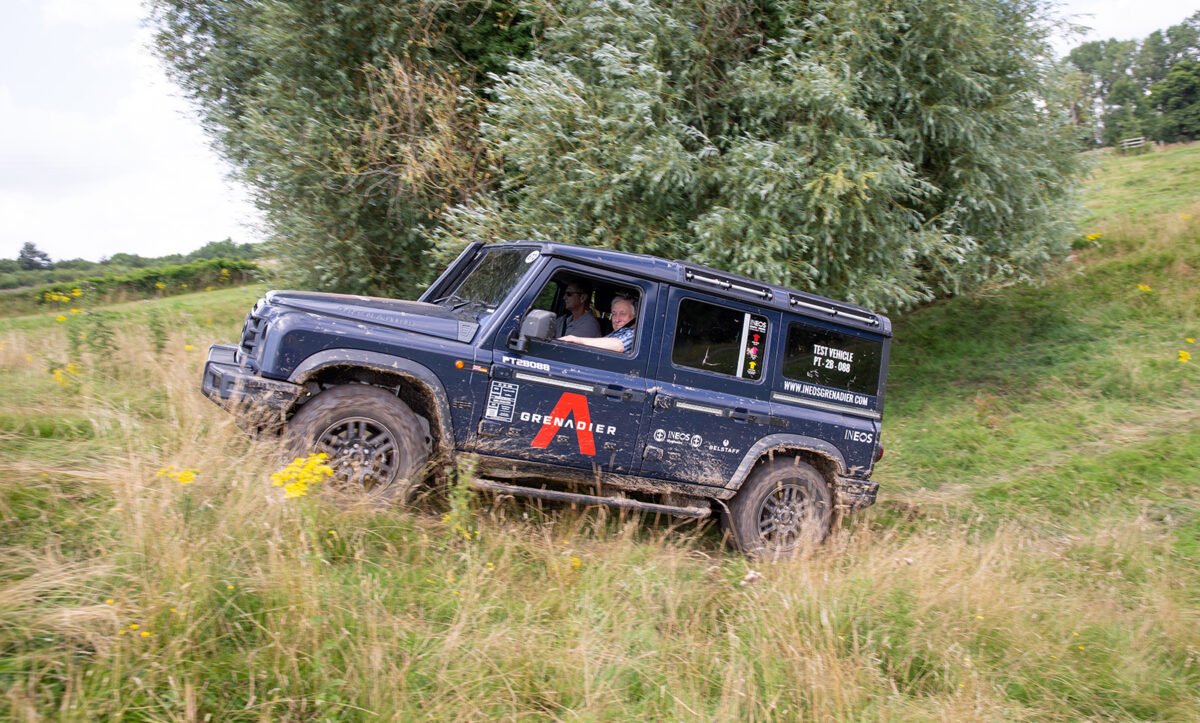
Potential buyers and media are being shown the latest stage in the new model’s gestation in a series of ride events across the UK, though with the car still under development no-one outside Ineos is yet being allowed to drive it.
The Grenadier project was born in 2016 following the demise of the Land Rover Defender, which Jim Ratcliffe, head of the multinational chemicals giant, was a fan of. Initially Ratcliffe approached Land Rover with a proposal to continue manufacturing the Defender, but then decided to start his own project.
The Grenadier will be targeted at users who need a robust, go-anywhere vehicle and who are not impressed with Land Rover’s new Defender, which launched in 2020. The Ineos project gained an element of notoriety when original plans to build the 4×4 in south Wales were dropped after a redundant Mercedes-Benz production line became available in France.
According to Ineos, the new 4×4 will not be a replica of the Defender but will reflect its philosophy, while offering a step change in terms of build quality and reliability based on consultation with Defender users.
The car’s global target market is said to include agriculture and forestry workers, explorers and adventurers and anyone who wants a full-blown off-roader. “Ineos is determined that its new vehicle will offer a real and pure alternative to the current crop of standardised ‘jelly-mould’ SUVs,” said Dirk Heilmann, CEO of Ineos Automotive.
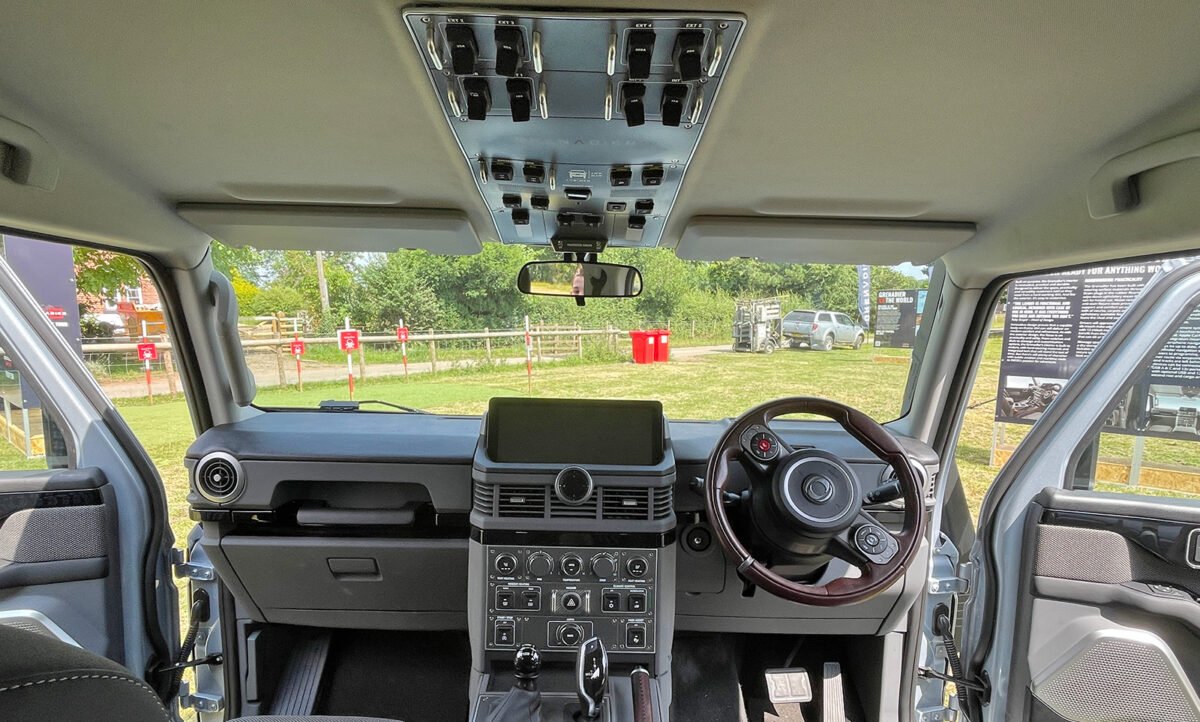
Customer feedback led to fitting of second panel on inside of roof.
The consultation with Defender drivers is indicative in the interior – according to Ineos user feedback has led to the separation of the centre console controls into two panels, one of them on the inside of the roof between the front-seat occupants.
While the Grenadier will have a touchscreen, all the essential controls are in the form of large knobs, primarily so they can be operated while wearing gloves. Controls are all separated into sub panels on the main console, so that if one fails the entire console does not have to be removed to replace the faulty part.
Individual panels on main console aid replacement of faulty parts without needing to remove the entire console.
Full technical details of the Grenadier are still to be released – we do know it will use BMW petrol and diesel engines of 3.0-litre capacity, while Ineos has also signed a memorandum of understanding with Hyundai to develop hydrogen fuel-cell powertrains.
A ride in a development vehicle suggested that the Grenadier will have all the off-road capabilities of the Defender – we will report its on-road performance once we carry out our first test drives, a date for which is still to be revealed.
Also not yet apparent is how Ineos will sell its new 4×4 – as a car manufacturer start-up it has no dealer network or aftersales operation. More details on sales are expected in September.
Our man enjoyed his ride – though frustrated at not being allowed to drive it yet…
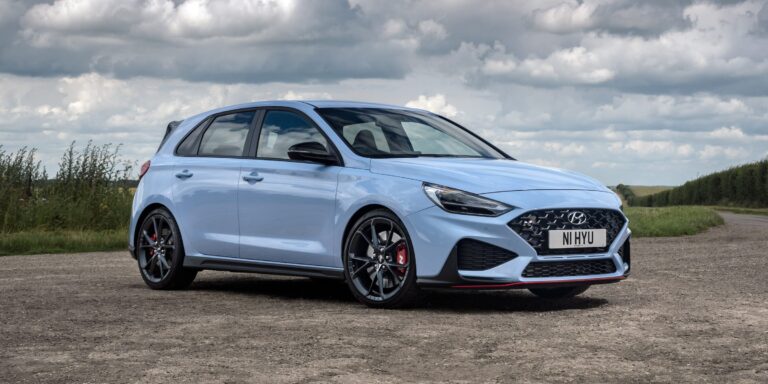
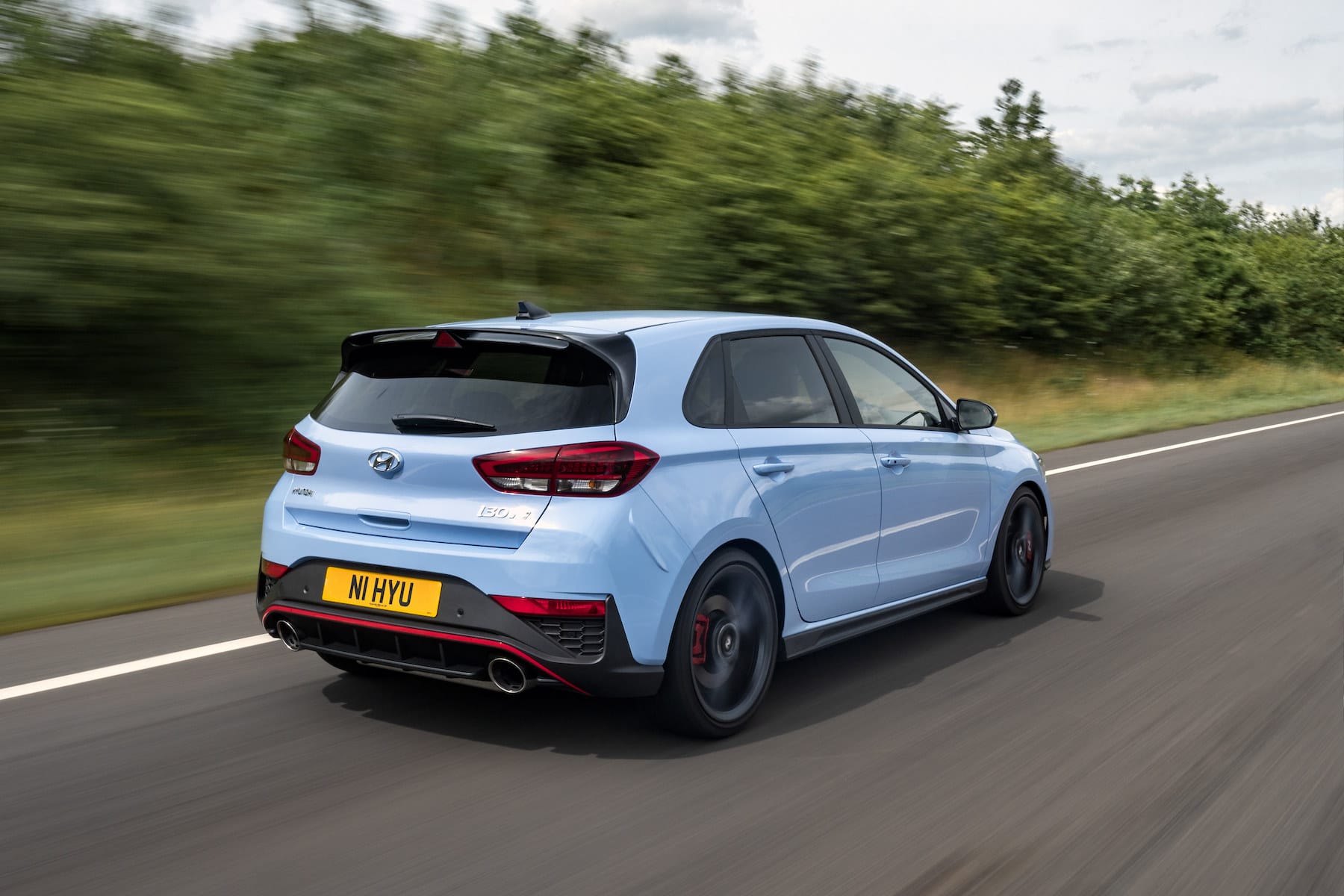
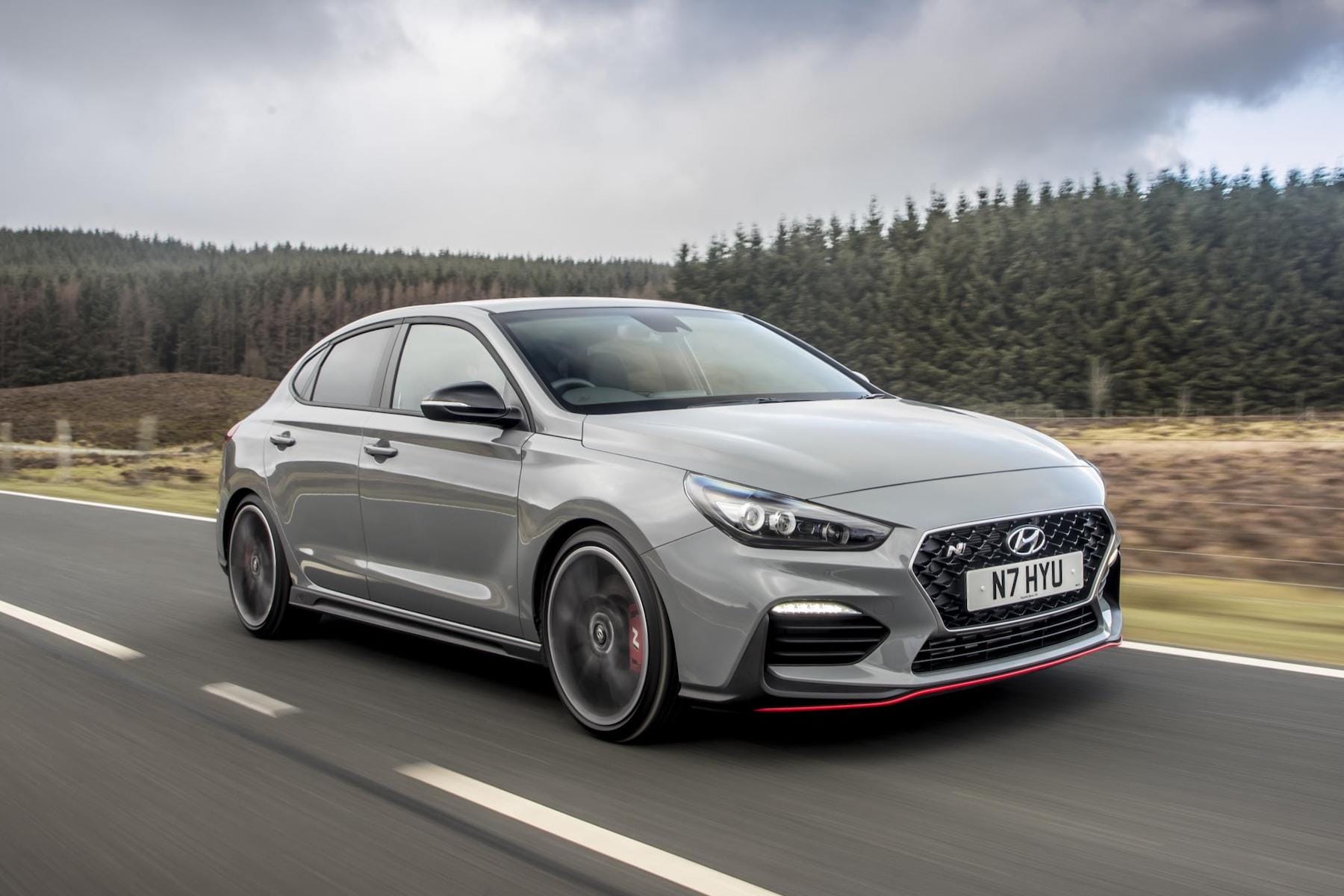
Hyundai had no performance reputation to speak of before it launched the i30 N hot hatch, which landed in the UK at the start of 2018. It was updated in 2020 and eventually discontinued in 2024.
With modest expectations, particularly as the N is based on the fairly uninspiring standard i30 hatchback range, reviewers were caught by surprise as to just how complete a package it was.
“This is a car that has been honed by bona-fide driving enthusiasts without yielding to marketing departments and the like,” enthused Top Gear.
The i30 N was powered by a 2.0-litre turbo engine driving through the front wheels, controlled as standard by a six-speed manual gearbox. Originally one could choose from two outputs but following an update in 2020 just the more powerful version was retained, now putting out 280hp and with the option of an eight-speed paddle shift transmission.
The i30 N was also available with a Fastback body style alongside the five-door hatch – reviewers pointed out that the way the car is totally docile when needed makes it a hot hatch that could also be an everyday family car.
One minor minus point of the first i30 N was its firm performance on UK road surfaces, but this was addressed in the update, and according to Auto Express “it does feel a little bit more capable on UK tarmac.”
The interior came in for mixed comments – reviewers were impressed by the user-friendly technology and such touches as the blue instrument illumination, less so by too much grey plastic. The Telegraph also highlighted a steering wheel that was “a little bit labyrinthine,” thanks to its several large buttons.
Generally, however, testers praised the i30 N’s recipe of potent performance in a practical package. “Hyundai’s first full-strength performance car and it’s nailed it,” concluded Top Gear, “few hot hatches are this fun to drive.”
As of March 2026, the Hyundai i30 N holds a New Car Expert Rating of C, with a score of 64%. It scores well in media reviews and the i30 range has an excellent reliability record, but running costs are high and the Euro NCAP safety rating has now expired due to age.
Model reviewed: Score: 9 / 10 “Hyundai has played a blinder with its first hot hatchback. Driving the Hyundai i30 N always feels like an event, as it marries a raucous engine with an engaging and adjustable chassis plus great steering.” Read review
Model reviewed: 2.0-litre petrol automatic N Performance hatchback Score: 8 / 10 “Offering an automatic transmission on the Hyundai i30 N has undoubtedly broadened the car’s appeal. The DCT-equipped model is feisty and fun, with a strong engine, lots of chassis tech and grippy handling. But a manual gearbox unlocks more of what’s on offer.” Read review
Model reviewed: 2.0-litre petrol automatic Fastback Score: 9 / 10 “The Hyundai i30 N was already a good, going on great, hot hatch. But the addition of an excellent (though still optional) eight-speed dual clutch gearbox has made it better still. As has a range of other small but significant improvements to the i30 N in general, both inside and out.” Read review
Model reviewed: Hatchback range Score: 9 / 10 “The Hyundai i30 N isn’t about to challenge a Honda Civic Type R for outright thrills, but it’s a fast, fun and practical option – made all the more appealing by a reasonably aggressive price, and suspension that’s now a little better suited to British roads.” Read review
Model reviewed: Fastback Score: 8 / 10 “On the road, it is essentially the same as the original i30 N hatchback, even if the Fastback’s ride is a touch smoother thanks to a range of small tweaks to the body stiffness and suspension.” Read review
Auto Trader
Model reviewed: Hatchback Score: 8.2 / 10 “The i30N is Hyundai’s first foray into the hot hatch world and it’s a very commendable effort. It’s not the most powerful, the most engaging, or the most thrilling car in the class, but dial in the right settings, and you know what, it’s not far off.” Read review
Model reviewed: Fastback Score: 8.2 / 10 “The Hyundai i30 Fastback N is a swoopier version of the i30 N hatch, with a slightly bigger boot and a bit less headroom for those in the back. It’s got the same engine and power as the hatch and it’s just as good to drive.” Read review
Car
Model reviewed: 2.0-litre petrol manual N Performance hatchback Score: 8 / 10 “The Hyundai i30 N is admirable in bringing a sense of humour to a market increasingly obsessed with soulless lap times, often at the expense of emotional enjoyment. Hyundai says this car has been designed to make your heart beat faster – essentially the opposite of a regular i30, then…” Read review
Model reviewed: Fastback Score: 8 / 10 “If you want something more grown up than the boy racer hatch, the Fastback N is well worth considering.” Read review
Carbuyer
Model reviewed: Hatchback range Score: 8.4 / 10 “The Hyundai i30 N is a truly special addition to the hot-hatchback class” Read review
Carwow
Model reviewed: Hatchback Score: 8 / 10 “The Hyundai i30 N is a great-to-drive, quick and practical family car, but you might hanker after alternatives’ more eye-catching looks and faster straight-line performance.” Read review
Model reviewed: Fastback Score: 8 / 10 “Agile around corners and easy to drive fast – the Hyundai i30 Fastback N has plenty going for it but it’s not the best for carrying passengers.” Read review
Daily Mirror
Model reviewed: 2.0-litre petrol automatic Fastback “I’d be more than happy with the Hyundai i30N hatchback, but if you want something a bit different and more distinctive, and the useful extra 55 litres of boot space, then this Fastback version will be a great choice.” Read review
Evo
Model reviewed: 2.0-litre petrol manual N Performance hatchback Score: 9 / 10 “Hyundai’s hot hatch is sharp, involving and copes very well when taken onto a circuit.” Read review
Honest John
Model reviewed: Hatchback range Score: 10 / 10 “Hyundai may never have designed a hot hatch, but it’s got everything right with the i30 N. This thing is an absolute revelation. It’s hugely enjoyable to drive, has all the performance you need and handles superbly. It even rides well.” Read review
Parkers
Model reviewed: 2.0-litre petrol manual Fastback Score: 8 / 10 “Hyundai’s Golf GTI rival in a sleeker body” Read review
The Sunday Times
Model reviewed: 2.0-litre petrol manual N Performance hatchback Score: 8 / 10 “On an ordinary day, on an ordinary road, it’s beautifully understated. It’s quiet and comfortable and there are many toys to keep you amused. My favourite was the button that makes the exhaust go all noisy.” (Jeremy Clarkson) Read review
The Telegraph
Model reviewed: Fastback Score: 8 / 10 “The i30 Fastback N is perhaps the most convincing of Hyundai’s hot hatch crop, with its larger boot and more refined ride making it a seriously tempting alternative to the wild Honda Civic Type R, even if it isn’t quite as visceral. The five-year warranty only adds to its appeal.” Read review
Top Gear
Model reviewed: Hatchback Score: 9 / 10 “Hyundai’s first full-strength performance car, and it’s nailed it. Few hot hatches are this fun to drive.” Read review
Safety rating
Independent crash test and safety ratings from Euro NCAP
The Hyundai i30 N shares its safety rating with the regular i30 model range, which was originally tested by Euro NCAP back in 2017 and awarded a five-star rating.
However, this rating expired in January 2024 and is no longer valid as the car no longer meets the standards required for such a rating. This is normal practice, as Euro NCAP reviews its ratings on most cars annually with most ratings expiring after about six or seven years.
However, if you are comparing a used i30 N to vehicles of similar age, whose ratings will have probably also expired, its safety rating score is still useful.
Eco rating
Independent economy and emissions ratings from Green NCAP
No eco rating
The Hyundai i30 N was not assessed by Green NCAP during its production life.
Reliability rating
Reliability data provided exclusively for The Car Expert by MotorEasy
Total claims: 68 Average repair cost: £248.97 Last updated: April 2025
The Hyundai i30 family, including the i30 N, has a very good reliability score of 89% as of April 2025 (our most recent data point), according to workshop and warranty data provided exclusively to The Car Expert by our partner, MotorEasy.
The i30 range has shown to have few problems to date. In addition, the average repair cost has been very low at less than £200. So far, the most common problem area is the braking system, but again repairs have been very inexpensive.
Awards
Trophies, prizes and awards that the Hyundai i30 N has received
2019
Business Car Awards – Driver’s Choice
2018
UK Car of the Year Awards – Best Hot Hatch
GQ Car Awards – Life and Seoul of the Party Award
2017
Carbuyer Awards – Best Hot Hatch + Best Cheap Sports Car
Similar cars
If you’re looking at the Hyundai i30 N, you might also be interested in these alternatives
The Hyundai i30 N holds its own in a small class of family hot hatches, competing against such signature models as the Volkswagen Golf GTI and Renaultsport Megane, and the Fastback version in particular seen as rivalling more extreme models such as the Honda Civic Type R and the Ford Focus ST. The Hyundai does not match some of these on pace, but on the fun-to-drive factor it beats some of the biggest names.
July 2021 was a frustrating month for the UK car industry. Easing of Covid-19 restrictions meant that all dealerships across the country were able to trade at close to maximum capacity – but they couldn’t get enough cars.
A shortage of semiconductors has been playing havoc across the global car industry in recent months. These tiny electronic components are critical to the computers that run every aspect of a modern car, and every bit as essential as a steering wheel.
The current shortage is a result of Covid production stoppages in the electronics supply chain, and is expected to continue for at least the rest of this year. Last week, BMW reported that it has about 10,000 cars that it can’t finish building while it awaits supply of semiconductors. Every car manufacturer is affected, although some worse than others as we will see below.
Fleet registrations down more than consumer sales
Year-on-year analysis of the monthly SMMT registration data is currently pretty pointless due to the mess of lockdowns, stoppages and now production shortages that have affected the world since the start of 2020. July last year was also a particularly strong month as the UK had recently re-opened after the first Covid lockdown last spring, which makes year-on-year data look worse.
Overall, the new car market was down nearly 30% on the same month last year. Although that number may not be particularly relevant, the breakdowns within the overall figure are interesting. Fleet registrations were hit harder than private registrations (down 33% and 25%, respectively), which is a reversal of the last few months were fleet sales have been much stronger.
Whether this is a temporary blip associated with supply problems or an indication that large fleets have now caught up with delayed orders from the last year remains to be seen.
Source: SMMT
Diesels down, electrics up
Yet again, diesel’s market share plumbed new depths in July, falling to less than 13%. Any hopes the industry had that diesel sales would level off seem long gone as the oily fuel continues its slide from being the dominant player in UK new car sales to a niche choice.
Electrified cars hit new highs (also yet again), as more and more electric and plug-in hybrid models go on sale. Regular hybrid sales are also continuing to grow, with a combination of existing models doing very well (Toyota Yaris) and a growing number of hybrid models now available.
Petrol cars remain by far the dominant choice, although their market share is also gradually falling against the growth of electrified vehicles.
Source: SMMT
Good month, bad month
So far, the Volkswagen Group seems to be riding out the semiconductor crisis better than most other car manufacturers. VW remains the biggest-selling brand, but only just ahead of premium sibling Audi, which again comfortably out-sold traditional market leader Ford. SEAT and Skoda also performed well ahead of the overall market.
Ford has had a rough ride over the last few months, and July was another struggle. Against an overall market that was down 30%, Ford sales were down by more than 54%. Vauxhall had been taking advantage of its traditional rival’s struggles, but in July its sales were also down 49% as the Corsa – 2021’s best-selling car to date – fell out of the top ten altogether (see below). Among other volume brands, Renault had a horrendous month (down 80%) and Peugeot was pretty awful as well (down 59%).
The Volkswagen Polo was the UK’s best-selling car in July, where the top ten reflected the supply difficulties that the industry is facing. This year’s top-selling car to date, the Vauxhall Corsa, disappeared from the top ten altogether.
The Polo and the Toyota Yaris seemed to be the main beneficiaries of poor months for the Corsa and the Ford Fiesta, while the Audi A3 improved as the Mercedes-Benz A-Class struggled. It was also a good month for the outgoing Kia Sportage, potentially taking sales from the Nissan Qashqai as supplies of the current Qashqai run out ahead of the all-new model’s upcoming launch.
We’ll have our usual analysis of the top ten in the next few days.
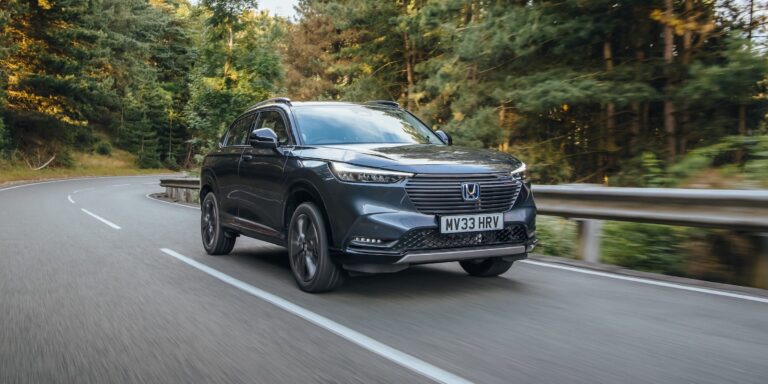
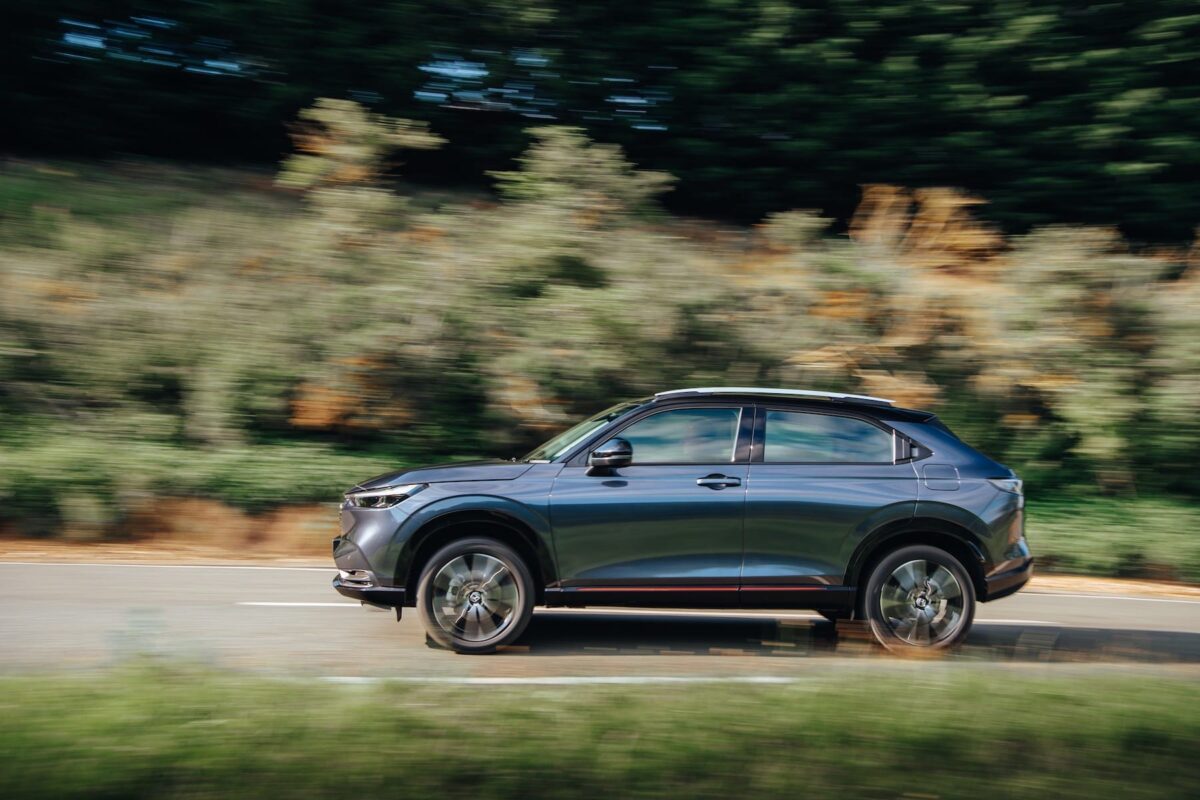
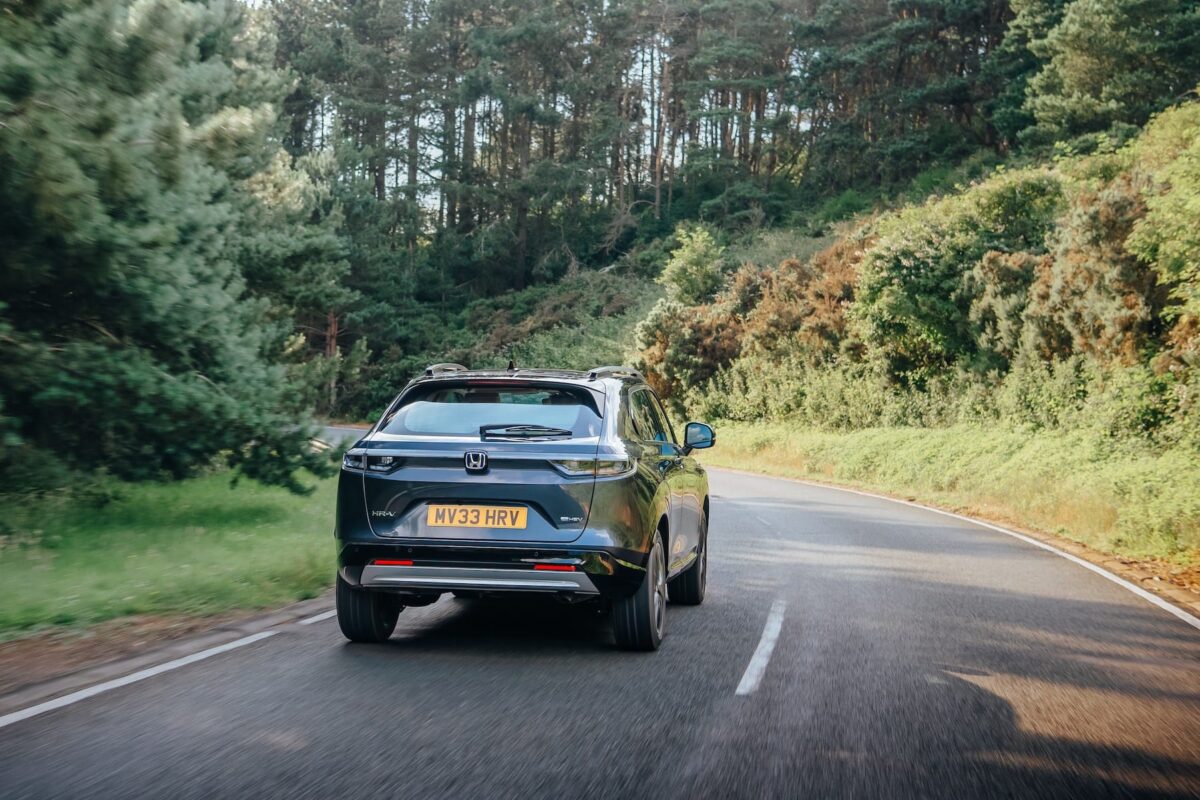
Honda has revealed prices for its all-new HR-V SUV, which will arrive in showrooms at the end of 2021.
The new third-generation car, regarded as a rival to the big-selling Nissan Juke, will cost from £26,960.
It will only be available with a hybrid drivetrain, based on the unit fitted to Honda’s Jazz supermini. The first hybrid to be fitted to the HR-V, it combines a 1.5-litre four-cylinder petrol engine with two electric motors, producing 131hp.
Honda claims CO2 emission levels of 122g/km and fuel economy of 52mpg for the new HR-V. The car can be driven in one of three modes, Eco, Normal and Sport.
These modes are automatically selected based on the driving conditions, but designed to have the electric motors providing the majority of the power – the petrol engine primarily acts as an electricity generator, propelling the car at higher consistent speeds such as on a motorway.
More up-to-date packaging of the electric system has allowed significant design improvements – while of similar size to its predecessor and a coupe-pitched body shape, with a 20mm lower roof, the new HR-V offers increased space in the back and a larger boot.
Three trim levels will be available, starting with Elegance. The standard equipment list includes LED headlamps, heated front seats, 18-inch alloy wheels and Apple CarPlay and Android Auto smartphone connectivity based on a nine-inch centre console touchscreen.
Advance trim, which adds a bit over £2,000 to the base spec, adds a powered tailgate with hands-free access, heated steering wheel and synthetic leather and fabric upholstery. Top of the range is Advance Style, upgrading the audio system and adding extra styling details on exterior and interior including a two-tone paint finish.
All HR-Vs also include Honda’s Sensing safety technologies and driver aids. New to these with the new model is Hill Descent Control.
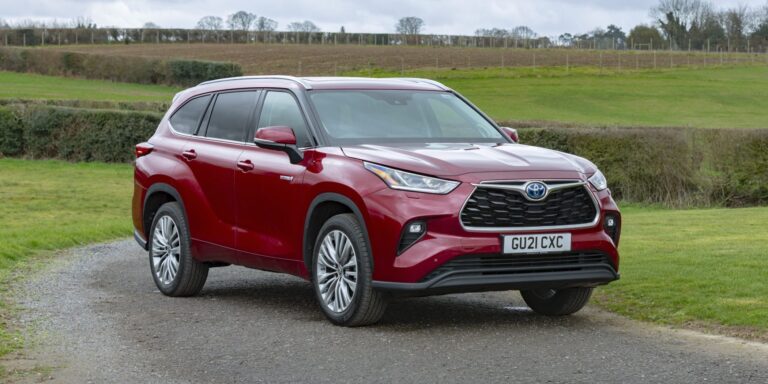
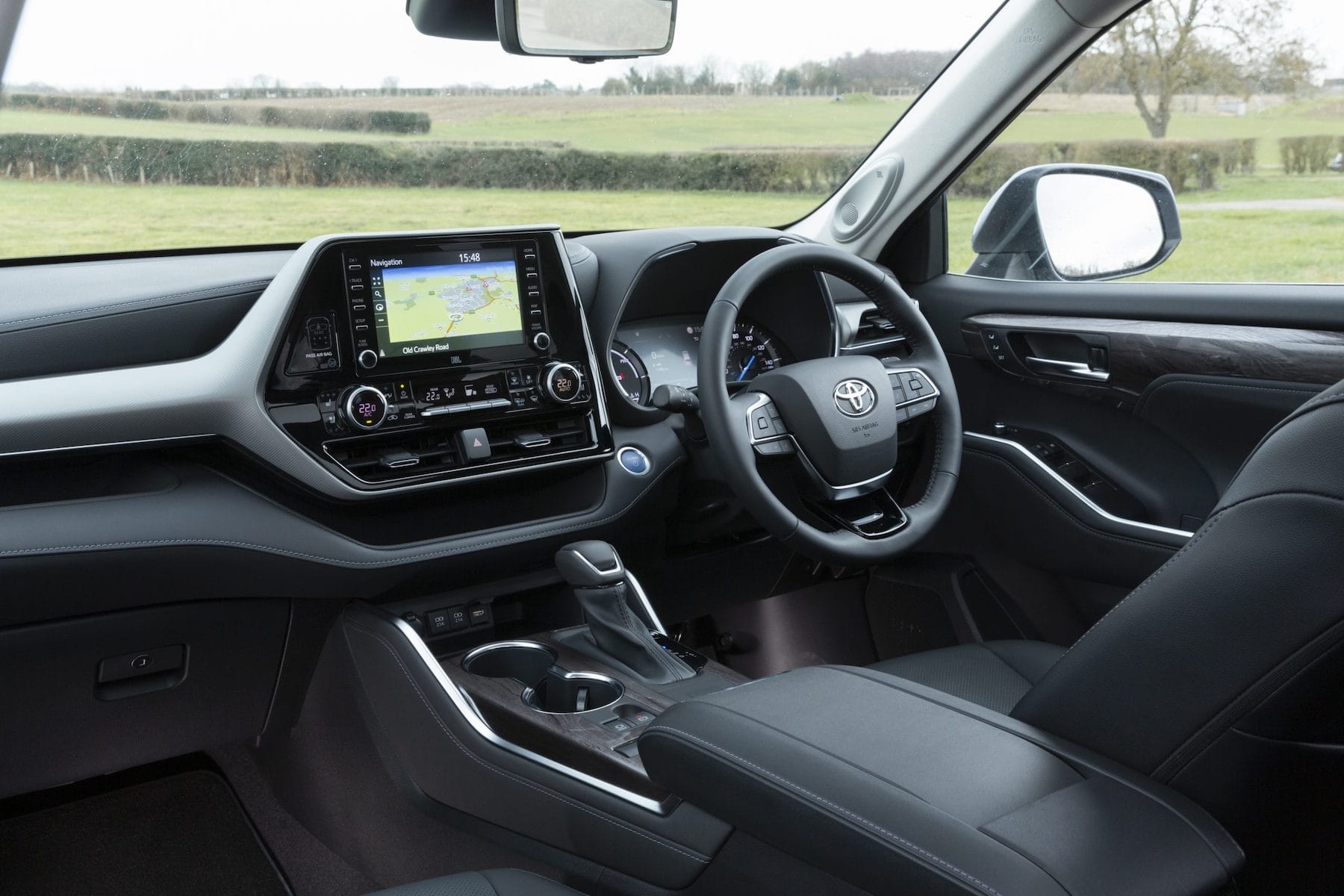
The Toyota Highlander was the Japanese brand’s largest SUV – bigger than the RAV4 and with its seven-seat capacity not as off-road pitched as the Land Cruiser.
On sale in other markets since 2019, the Highlander first arrived in the UK in 2021, and was only on sale for a short two-year stint, having been removed from Toyota’s range in the middle of 2023. A new generation of the Highlander is now on sale in the US, but there is currently no indication that this model will arrive in Britain.
Carbuyer called the Highlander “Toyota’s ultimate family vehicle” while The Sun commented; “It’s quiet, efficient, easy, super-comfy, spacious, swimming in kit and surprisingly easy to place on the road.”
Space and how it was used earned the most plus points amongst Highlander reviewers. As well as the useful rear row of seats, the middle row slid forwards and backwards by some 18cm. The flexibility, many storage spaces and lots of equipment also ticked the boxes, though Top Gear commented that the fit and finish “feels a couple of generations old, especially in terms of the graphics on the displays – not as slick or as pretty as the competition.”
The Highlander’s hybrid powertrain combined a 2.5-litre petrol engine with electric motors on both axles, so it was not short of power. The ride comfort was praised too, though you could feel its size when cornering.
Equipment levels were impressive, extending to panoramic sunroofs, multimedia displays and 11-speaker sound systems. But as reviewers pointed out, all the kit makes it a big, expensive SUV against favourites such as the Kia Sorento, while also bringing within range tempting premium badges from the likes of Audi and Volvo. And against some stylish opposition, the Highlander’s somewhat bland visual presence became all the more obvious.
Based on UK reviews and data supplied exclusively to The Car Expert, Toyota Highlander holds a Used Car Expert Rating of D with a score of 55% as of March 2026.
Body style: Large seven-seat SUV Engines: petrol-electric hybrid Price when new: From £50,110
Launched: Spring 2021 Last updated: N/A Discontinued: Summer 2023
Image gallery
Media reviews
Highlighted reviews and road tests from across the UK automotive media. Click any of the boxes to view.
Auto Express
Model reviewed: Score: 7 / 10 “The Toyota Highlander holds a strong hand when graded against some of the more everyday requirements of a full-size family SUV: versatility, practicality and very competitive running costs.” Read review
Auto Trader
Model reviewed: Score: 7 / 10 “The Highlander combines generous equipment levels with an attractive price and Toyota’s proven hybrid technology.” Read review
Car
Model reviewed: Score: 8 / 10 “The Toyota Highlander is spectacularly fit for purpose. It’s comfortable to drive, with remarkable refinement, impressive economy and plenty of space.” Read review
Car Keys
Model reviewed: 2.5-litre petrol/electric hybrid Score: 8 / 10 “The Toyota Highlander will no doubt go down a storm with in-market SUV buyers. It’s big, comfortable and practical and, as a result, will be a hit with families. The low running costs afforded by the hybrid powertrain will also prove appealing, either to private users or business owners, too.” Read review
Carbuyer
Model reviewed: Range overview Score: 8.4 / 10 “The Toyota Highlander offers families lots of space in a reliable package.” Read review
Company Car Today
Model reviewed: 2.5-litre petrol/electric hybrid Excel “Excellent emissions and running costs. It’s priced to compete with premium rivals but practicality and space are good.” Read review
Parkers
Model reviewed: Score: 8.2 / 10 “A capable and seriously practical family SUV with hybrid power as standard.” Read review
The Sun
Model reviewed: “The Toyota Highlander is efficient, easy, spacious and surprisingly easy to place on the road.” Read review
The Telegraph
Model reviewed: Score: 6 / 10 “Launching a large SUV seems crazy in the current climate, but this economical hybrid could turn out to be a very smart move for Toyota.” Read review
Top Gear
Model reviewed: Score: 5 / 10 “The Toyota Highlander suffers mainly from an excess of middle-of-the-road. It’s fine, but fine isn’t quite good enough.” Read review
Safety rating
Independent crash test and safety ratings from Euro NCAP
No safety rating
The Toyota Highlander was not assessed by Euro NCAP during its production life.
Eco rating
Independent economy and emissions ratings from Green NCAP
No eco rating
The Toyota Highlander was not assessed by Green NCAP during its production life.
Reliability rating
Reliability data provided exclusively for The Car Expert by MotorEasy
No reliability rating
As of March 2026, we don’t have enough reliability data on the Toyota Highlander to generate a reliability rating.
The Car Expert’s reliability information is provided exclusively to us using workshop and extended warranty data from our partner, MotorEasy. As soon as MotorEasy has sufficient data on the Highlander, we’ll publish the score here.
Similar cars
If you’re looking at the Toyota Highlander, you might also be interested in these alternatives
The Toyota Highlander takes on a great many rivals with big reputations. Reviewers conclude that against established favourites such as the Kia Sorento, Nissan X-Trail and Skoda Kodiaq, the big Toyota will struggle to establish itself. Its price also puts premium SUVs such as the Land Rover Discovery and Volvo XC90 into the same consideration pot, and their badges may tempt buyers away from the Toyota.
The latest sixth-generation Mercedes-Benz C-Class has gone on sale in the UK, with all of its four-strong engine range now in mild-hybrid form.
The 48-volt Integrated Starter Generator (ISG) mild hybrid system recovers energy and offers engine-off coasting to improve efficiency and emissions.
It also makes each engine more powerful, by 20hp and 200Nm and is combined with a standard-fit nine-speed auto transmission.
Entry to the new range is the C 200 in saloon and estate varieties starting at £38,785 and £40,420 respectively.
Both versions employ a 1.5-litre petrol engine of 204hp and 300Nm, with official fuel economy figures of 41 to 44mpg depending on specification (and 40 to 42mpg in the estate). CO2 figures are 146-154g/km (151 to 159 in the estate).
The C 300 is only available in saloon form from £43,500. Its 2.0-litre petrol engine produces 258hp and 400Nm. Fuel economy ranges between 40 and 42mpg, emissions between 152 and 159g/km.
Until now the best-selling variant, the diesel-powered C 220 d’s 2.0-litre engine puts out 200hp and 440Nm. Fuel economy ranges from 59 to 61mpg (56 to 60mpg in the estate) and emissions from 120-127g/m (124-131). Prices are from £40,785 for the saloon, £42,085 for the estate.
Range-topper is another diesel, the C 300 d at prices starting from £45,925 for the saloon and £47,225 for the estate. It has a 3.0-litre engine of 265hp and 550Nm, fuel economy of 53 to 55mpg (estate, 52-54) and emissions of 133-139g/km (136-143).
The new C-Class is yet to be crash-tested by Euro NCAP but a wide range of active safety measures are offered as standard across all four trim levels and Mercedes-Benz will be expecting a five-star safety rating.
However a suite of driver-assistance technology including the latest developments in distance, steering, traffic sign, lane-keeping, evasive steering, braking, emergency stop and blind spot assistance, is only available at a £1,695 option, and this only on top Premium Plus models.
Volkswagen is joining the current fad for coupé-styled SUVs with the Taigo, expected on UK roads early in 2022.
Already on sale for a year in South America, the Taigo is closely related to the T-Cross SUV and Polo supermini. It’s expected to take on the mass-selling Nissan Juke, which is almost the same size as the Volkswagen newcomer.
The Taigo follows the current coupé-SUV fashion with a sharply sloping rear body, which Volkswagen insists does not restrict rear-seat headroom. It offers a 438-litre boot capacity, which is comparable to its less aggressively styled sister the T-Cross.
While Volkswagen is yet to confirm full details of Taigo powertrains, it is expected to be totally petrol-powered, and with only front-wheel-drive variants on offer.
Initial cars on sale are set to offer engines with 95, 110 or 250hp power outputs. Five- and six-speed manual transmissionss, as well as a seven-speed automatic, are offered depending on engine choice.
Initially, at least, the new model will only be offered in higher-specification Style and R-Line trim levels. Standard equipment will include an all-digital cockpit and what Volkswagen describes as “latest-generation assistance systems guaranteeing optimum comfort and a high level of safety for all passengers.”
Every Taigo will include Front Assist with an emergency braking function, and the lane departure warning system Lane Assist as standard. Offered as an option and taken from VW’s electric car range will be ‘IQ.DRIVE Travel Assist’, which will allow semi-automated driving at up to 130mph.
Standard equipment will also include the latest version of VW’s entertainment systems. These are fitted with an online control unit and depending on the configuration will offer features such as access to streaming services, voice control and cloud-based personalisation.
Volkswagen has not yet revealed prices for the Taigo but they are expected to be more expensive than the T-Cross. Industry sources predict starting prices at around £25,000.
We have written extensively at The Car Expert about the benefits of buying a good used car warranty once you have found yourself a new, second-hand, vehicle.
These warranties – or mechanical breakdown insurance – are designed to protect you from the cost of your pride and joy suffering an unforeseen failure. Levels of cover can vary from policy to policy, but a quick check of the small print and you’ll soon discover what your intended policy covers. At the very least, it should be the most important mechanical parts.
Being covered by a used car warranty means you won’t be left alone to deal with the mess of a part failure or breakdown. And most policies don’t just take care of the cost of replacement parts – they can also cover labour and (depending on your level of cover) important extras such as car hire.
So, many motorists, particularly those who drive long distances, rely on their car heavily, or have spent good, hard-earned money on their new wheels, a warranty can prove a smart investment.
But only if you receive what you think you’re going to get, if (or perhaps when…) the time comes for your car to let you down.
That’s why it’s important to consider buying a fully insured warranty, not least because you can then be assured the company you’re dealing with is regulated by the Financial Conduct Authority (FCA).
For a start, an insured and regulated warranty provider must report to the FCA twice a year. This must include solvency to meet regulatory requirements for insurance firms and groups, covering financial resources, governance and accountability, risk assessment and management, supervision, reporting and public disclosure.
Additionally, a regulated warranty provider will pay a levy to the Financial Services Compensation Scheme (FSCS), which can pay compensation if the firm you’ve used has gone out of business and can’t pay your claim. It’s funded by the financial industry – banks, building societies, insurance companies and pension schemes – and providers of insured warranties will pay thousands of pounds into the FSCS coffers every year to enable it to operate.
And as a third safety net, buying an insured warranty means that if you are unhappy about the service you’ve received, or the policy terms or claim settlement, you can go to the Financial Ombudsman Service (FOS) for a binding decision. Whatever ruling the FOS makes, your insured warranty provider will have to obey. An unregulated provider does not have to do this.
It’s quite easy to spot an uninsured plan, if you know what to look for. They may be advertised as a ‘warranty’, but check the small print and you’ll see they are ‘discretionary’ schemes and firms will use that word frequently: “the amount of compensation made is at the discretion of the scheme administrator…”. In some cases, this can mean no pay-out at all.
And although they have to adhere to basic standards and codes of practice, these providers are not monitored in terms of the FCA mandatory regulations and so don’t have to answer to, or abide by, the regulated bodies and their rulings. In other words, they can offer a range of products, but they are not obliged to pay when a claim comes in.
An industry source confirmed that sellers of uninsured plans are free to advertise cover that ultimately they don’t have to pay out for.
So, like any insurance cover, you may or may not need to claim on it, but, after you have spent decent cash on your new car and bothered to find a warranty policy to cover it, how much of a risk you are prepared to take on the chances of getting the compensation you need if something goes wrong, is something worth giving some serious thought to.
Here at The Car Expert, we have some fantastic warranty offers for our readers provided by our commercial partners. If you’re interested in a used car warranty, you should check these out:
ALA Insurance provides used car warranties in conjunction with the RAC
MotorEasy offers warranties and many other types of cover for car owners
The Subaru Levorg was launched in 2015 as a replacement for the Japanese brand’s Legacy all-wheel-drive estate car, which enjoyed a small but loyal audience amongst mainly rural-based buyers.
Unfortunately for Subaru, the Levorg – the name created by combining ‘Legacy’, ‘Revolution’ and ‘Touring’ (“a bizarre combination” says Auto Express) struggled to find an audience in the UK and remains a rarity on the roads. Parkers called it “an oddity, difficult to pigeonhole,” and Car “maybe the oddest car you can currently buy” while Honest John said it has “a curious specification.”
This is because you could only buy the Levorg in one form. Initially, it was with a 1.6-litre flat-four turbo petrol engine, but in 2019 this was changed for a 2.0-litre non-turbo unit with slightly less power and torque. Regardless of engine, the drive is put to the road through a CVT automtic gearbox. “It certainly feels lethargic on the road – low-speed pickup is far from generous and if you let the CVT rev the engine hard, it’s thrashy and there’s little in the way of serious thrust,” Car commented.
The 2019 update also saw very subtle exterior styling changes and improvements to the interior trim and equipment – the breadth of specification does earn a plus point, with a seven-inch touchscreen sat nav, Android Auto and Apple CarPlay integration and a wide range of active safety.
Many reviewers saw the Levorg as appealing to a niche market of rural drivers who need something that will work in all weathers and all surfaces. In these situations it copes well and is generally well-built – Honest John commented on the interior space and while saying that the functional dash layout “lacks a feelgood factor,” highlighted the build quality; “everything feels like it will last for years.”
No longer on sale in the UK, the Subaru Levorg holds an Used CarExpert Rating of D with a score of 58%. That’s well off the pace of similar cars like the BMW 3 Series Touring, Skoda Octavia estate or Audi A4 Avant.
This first-generation Levorg has been replaced by a second-generation range, but this latest iteration is only on sale in Japan, Australia and New Zealand. There has been no indication of if or when that model will come to the UK.
Highlighted reviews and road tests from across the UK automotive media. Click any of the boxes to view.
Auto Express
Model reviewed: Range overview Score: 6 / 10 “The Subaru Levorg estate is an unusual, practical choice that lacks a little sophistication compared to its rivals.” Read review
Car
Model reviewed: Score: 6 / 10 “A weak powertrain is the Rolls Royce Wraith’s biggest drawback, especially when the chassis is so well sorted. But use it as intended – a functional, durable, low-stress estate car – and it will be just that – a useful, reliable car.” Read review
Car Keys
Model reviewed: Score: 6 / 10 “The Subaru Levorg is a small and sporty estate car, with four-wheel drive and an automatic gearbox as standard. It’s fun to drive, but it isn’t as cheap to run as rivals like the SEAT Leon ST.” Read review
Carbuyer
Model reviewed: Range overview Score: 6.8 / 10 “The Subaru Levorg is handsome, practical and refined, but its high purchase price and significant running costs mean it’ll be a niche choice at best.” Read review
Carwow
Model reviewed: Score: 5 / 10 “The Subaru Levorg offers grippy all-wheel-drive and lots of equipment for a sensible price. Its alternatives have more engine choice, more space and more quality, however.” Read review
Evo
Model reviewed: Score: 7 / 10 “With permanent 4WD and a turbocharged boxer engine, the Levorg sounds promising. But its CVT gearbox makes it hard to access its potential.” Read review
Heycar
Model reviewed: Range overview Score: 4 / 10 “The Levorg didn’t impress a great deal when it was launched in 2015, and Subaru’s changes in 2019 have actually made it worse. We’d avoid it and buy a Subaru Outback, or anything else, instead.” Read review
Honest John
Model reviewed: Score: 6 / 10 “The Rolls Royce Wraith offers excellent handling and impressive comfort.” Read review
Parkers
Model reviewed: Score: 7 / 10 “The Subaru Levorg Sport Tourer is a no-nonsense estate that handles well, feels nicely made, and is a pleasant place in which to spend time.” Read review
The Telegraph
Model reviewed: “The Subaru Levorg is a reassuring place to be.” Read review
Top Gear
Model reviewed: 1.6-litre petrol automatic “Subaru does the simple, driver-pleasing stuff very well, and those who ‘get’ the Levorg (around 500 a year, Subaru hopes) will likely be deeply satisfied, especially when they take some unsuspecting hot hatch scalps on a twisting B-road.” Read review
Safety rating
Independent crash test and safety ratings from Euro NCAP
The Subaru Levorg was tested by Euro NCAP in 2016 and gained a top-level five-star rating. Testers highlighted the performance of the autonomous emergency braking, that avoided impacts altogether in some tests and also recorded impressive results in a wide range of tests representing potential pedestrian impacts.
Eco rating
No eco rating
No longer on sale, the Subaru Levorg has not been lab tested by Green NCAP.
Reliability rating
As of March 2026, we don’t have enough reliability data on the Subaru Levorg to generate a reliability rating.
The Car Expert’s reliability information is provided exclusive from extended warranty data from our partner, MotorEasy. As soon as MotorEasy has sufficient data on the Levorg, we’ll publish the score here.
Similar cars
If you’re looking at the Subaru Levorg, you might also be interested in these alternatives
Adding to the weirdness surrounding the Levorg is that two potentially better rivals to it are produced by its own maker – the XV crossover and Outback all-wheel-drive estate. But its price also brings upmarket rivals such as the Audi A4 Avant and BMW 320xDrive Touring into the reckoning. More obvious rivals such as Skoda’s diesel-powered Octavia Scout are also considerably cheaper than the Subaru.
Buy a used Subaru Levorg
If you’re looking to buy a Subaru Levorg, The Car Expert’s partners can help you find the right car
You go through all the time, expense and drama of learning to drive, take a theory test and a practical examination and finally get your full licence. Then you throw it all away by losing it through disqualification less than two years later. Sounds unbelievable?
Not for nearly 8,000 people last year, it wasn’t.
Figures obtained by independent road safety charity group IAM Roadsmart has shown a worrying increase in the number of new drivers losing their licence within 24 months of passing their driving test.
The findings show that disqualifications have risen sharply among newly qualified drivers: 5,401 drivers lost their licences in 2018, increasing to 7,484 in 2019 and again to 7,975 last year.
Driving without insurance is one of the top reasons why new drivers are falling foul of the Road Traffic (New Drivers) Act. More than 12,000 have been caught driving without proper cover since 2018.
The New Drivers Act was introduced to give newly qualified motorists a probationary period of two years after passing their driving test. During this time, drivers will lose their licence if they commit offences leading to six or more points on their licence.
So two penalty charge notices (PCNs) for speeding would mean automatic disqualification. Once the newly qualified driver reaches six points they need to retake both their theory and practical driving tests again.
Speeding was the second highest reason for new drivers losing their licences, with more than 5,500 being convicted of this. Other reasons for the newly qualified to lose their licence within their probation period include not being control of the vehicle – often by using a mobile phone behind the wheel – and failing to provide information about who was driving a vehicle when an offence was committed.
“These figures paint a worrying picture,” says Neil Greig, IAM RoadSmart director of policy and research. “It is the responsibility of all drivers, whether they are newly qualified or more experienced behind the wheel, to drive safely and within the law at all times and to ensure the vehicle is roadworthy and insured for the purpose it is being used.
“Driver education is something that drivers should want to continue and develop as they gain experience behind the wheel. Post-test driver training such as an advanced course or driver training through employment allows the driver to continue to improve their confidence, skills and ability to drive safely on our roads.”
The growing electric crusade on the UK’s roads has received a boost after new research shows the number of motorists now considering an electric vehicle as their next purchase has risen by 32% in the last 12 months.
The new study, by automotive servicing and repair company Kwik Fit, reveals that 11% of drivers who are planning to change their car soon, expect its replacement to be fully electric. This compares with 8% of drivers a year ago.
When hybrid vehicles are included, the number of drivers anticipating opting for a low-emission model for their next vehicle rises to 37%, up from 33% over the last year.
In the past 12 months, hybrid or fully electric cars have overtaken petrol and diesel models as most drivers’ expected next vehicle. A year ago, Kwik Fit’s research showed that the 33% of drivers who expected their next car to be a low emission vehicle were outweighed by the 41% who said their next car would have a petrol or diesel engine.
This balance has now been reversed, with 37% now stating that their next vehicle would be low emissions, outstripping the 35% likely to opt for diesel or petrol. A quarter of drivers (28%) said they haven’t decided yet.
Regional divisions a challenge for policy makers
Of all the UK regions, drivers in London are the most likely to be considering switching to either a hybrid or fully electric car – 65% of drivers have said they are doing so. In Scotland, only 24% say they are opting for a low-emission engine in their next car.
The research indicates there is a challenge for policy makers looking to encourage drivers to switch to electric as soon as possible. The new research found that on average, drivers expect to change their vehicle in 21.6 months. Those expecting their next car to be electric plan to change their car in an average of 23.9 months, compared to 17.6 months for those opting for internal combustion models.
Although low-emission vehicles as a whole have overtaken diesel and petrol models as planned purchases, the number planning to go fully electric (11%) is still quite low, with several reasons given as potential hurdles.
The lack of fast charging points is the biggest factor, cited by 38% of drivers not yet considering swapping to fully electric. In the North East, South West, South East and Scotland, the increased cost over an equivalent petrol or diesel model is the greatest barrier. For drivers in the West Midlands and the East of England, their biggest concern is the perceived restrictions on range of electric cars.
“This research shows that over the last 12 months car buyers appear to have passed a tipping point in the switch to electric cars,” says Roger Griggs, communications director at Kwik Fit.
“However, although consideration of low emission models has overtaken that for petrol and diesel there is clearly still a lot to do to convince some drivers. Some barriers to consideration can be put down to misperception or a lack of up to date knowledge and the industry must work together to address those areas.
“But it is also vital that there is visible investment made in the charging infrastructure to ensure that drivers have the confidence to make the switch.”
Reasons drivers are not currently considering an electric car
Reason
% not considering
Lack of fast charging points in the areas I commonly drive
38
Increased cost over an equivalent petrol, diesel or hybrid car
36
Restrictions on range / Inability to travel long distance on a single charge
35
I would not be able to charge it at home
33
I am worried that the batteries won’t last very long and need replacing
26
I prefer traditional petrol or diesel engines
16
I want to know more people who have one before I commit
16
I don’t believe that they are more environmentally friendly than existing cars
12
I don’t like the style of electric cars available
8
There isn’t an electric car which provides the power I need
Renault has started taking orders for its Arkana, the first of its SUV range with liftback ‘coupé-inspired’ styling.
Based on the Renault Captur small SUV but stretched by 30cm, the Renault Arkana carries a sleeker profile than its more upright Captur and Kadjar SUV siblings. But its makers insist that the car is still practical, with generous rear seat space and a 513-litre boot.
Two powertrains are on offer, both electrified. The E-Tech hybrid 145 Auto combines a 1.6-litre petrol engine with two electric motors powered from a 1.2kWh lithium-ion battery pack.
Like most hybrid drivetrains, start-up and low-speed travel is done in electric mode, making the car particularly suitable for urban stop-start driving. Renault quotes fuel economy of about 59mpg and CO2 emissions of 108g/km, adding that the car will cover the 0-62mph sprint in just under 11 seconds.
A new design of automatic transmission promises seamless switching between electric and petrol power. The car offers three driving modes, the default ‘My Sense’, Eco and Sport.
Regenerative braking feeding power back into the battery is also part of the package and able to be increased in effectiveness by selecting a function on the dash.
The second version of the Renault Arkana uses a 1.3-litre petrol engine of 140hp, combined with a mild hybrid unit using the starter motor as a generator. This offers some reduction in emissions, but it can’t be driven under electric power alone so the petrol engine will always be driving the wheels.
Gear changes are through a dual-clutch auto unit and the 140hp also includes a ‘Sailing Stop’ function that allows the car to coast during declaration to add to the emissions reduction. It returns economy and emissions figures of 48.7mpg and 131g/km, and is faster accelerating than its sister with a 0-62mph time of just under ten seconds.
The Arkana has already earned a five-star safety rating from Euro NCAP (based on the Captur’s results, as the two are structurally almost identical). It offers a host of active systems fitted as standard, including autonomous emergency braking with pedestrian and cyclist detection, traffic sign recognition, a lane departure warning system and steering assistance to stay in your lane.
Prices for the Renault Arkana start at £25,300 and cars with both engines are available in three trim levels. The first cars are expected on UK roads in late August.
The second-generation Audi A5 first appeared in 2016 as basically a coupé version of the volume-selling A4 saloon. Shortly afterwards, it was joined by a cabriolet and the A5 Sportback – this tried to retain the coupé look while adding some extra practicality with another pair of doors and a liftback rear.
The A5 family received an update in late 2019, and was produced until early 2024 when it was discontinued as an all-new Audi A5 range was readied for production. According to the company’s new naming structure, the next-generation A5 will replace the previous Audi A4 range, so the next A5s will be saloons and estates rather than coupés, convertibles and liftbacks.
Reviewers generally liked the thinking behind this car, Motors dubbing it “one of the best-looking models in Audi’s range.” Other testers also considered the A5 Sportback to be a success, retaining the sharp looks of the A5 coupé despite creating a 580-litre boot. Auto Express highlighted the frameless windows and low roof line that ensured the car was not confused with the A4.
The interior earned plus marks too – “material quality is superb and all the minor controls are easy to make sense of,” said Honest John, while adding that the exterior visuals came at the cost of extensive rear-seat space.
Three petrol and two diesel engines were offered for the A5 Sportback, with the top versions of each also including all-wheel-drive (branded as quattro in Audi-speak). There were also two potent models – the S5, which had a 341hp diesel engine, and the RS 5 with 450hp of petrol power.
Reviewers generally favoured the diesels for their smoothness and economy, but accepted that ever more stringent tax laws steered most buyers to the petrols. “All the engines are smooth, quiet and powerful enough to feel luxurious,” said Carbuyer.
The on-the-road performance produced fewer plaudits – The Telegraph commented that the A5 Sportback was “very competent” but “still not a car that delivers the kind of exciting handling that makes a BMW 4 Series Gran Coupe so compelling.”
As of January 2025, the Audi A5 Sportback holds a Used Car Expert Rating score of E, with a score of 55%. It got good grades for its low CO2 emissions and media review scores, but the A5 range overall has a poor reliability record. It’s also not cheap to run, while its Euro NCAP safety rating has now expired.
Highlighted reviews and road tests from across the UK automotive media. Click any of the boxes to view.
The Car Expert
+
Score: 8.2 / 10 “Five-door hatchback practicality with the visual appeal of the two-door A5 Coupe, improved engines and plenty of technology make the A5 Sportback an attractive choice.” Read review
Auto Express
+
Model reviewed: Sportback range Score: 8 / 10 “If you’re in the market for a premium-badged coupe but still need a degree of practicality, then the Audi A5 Sportback is well worth a look. It’s better than ever.” Read review
Model reviewed: 3.0-litre diesel automatic S5 Score: 8 / 10 “Styling changes and tech upgrades are integrated well with a huge change for the Audi S5 Sportback’s powertrain. It’s a fast, relaxed and well-equipped premium model with quality at its heart, but also balances performance from its engine with rationality in terms of its efficiency.” Read review
Auto Trader
+
Model reviewed: Sportback range Score: 8 / 10 “The Audi A5 Sportback is a fine all-rounder: relaxed as a long-distance cruiser, but still capable of putting a smile on your face away from the main road.” Read review
Business Car
+
Model reviewed: 2.0-litre petrol automatic 40 TFSI S line Score: 7 / 10 “There’s no question the Audi A5 Sportback offers a lot to drivers who want to stand out in the office car park. This is especially true of S Line spec, where those big wheels, along with a bodykit package including more aggressive bumpers and side skirts.” Read review
Car
+
Model reviewed: 3.0-litre petrol automatic S5 Sportback Score: 6 / 10 “The Audi S5 Sportback is sufficiently quick enough to out-accelerate what’s arguably its main rival – the BMW 440i Gran Coupe – while being impressively refined. However, the refined but unexciting driving experience means the S5 can’t help but feel a little underwhelming.” Read review
Car Keys
+
Model reviewed: 2.0-litre diesel automatic Score: 7 / 10 “Although Audi models may not be everyone’s cup of tea, they still perform to a high standard. The A5 Sportback is no exception and although its rivals may have a lower starting price, it competes thanks to its excellent equipment, more-than-liveable driving feel and rather economic diesel units.” Read review
Model reviewed: 2.0-litre diesel automatic Score: 8 / 10 “If you are concerned about the A5 Coupe’s limited rear practicality, then the Sportback’s extra doors are handy but the space at the back may not be quite as much as you’d hoped.” Read review
Model reviewed: 3.0-litre petrol automatic S5 Sportback Score: 9 / 10 “If you want a gentle and reasonably practical premium coupe but also a feisty speed machine at the same time, then the Audi S5 Sportback can play either role in a convincing manner. It’s luxurious, the drive is sharp and the V6 is a lot of fun.” Read review
Carbuyer
+
Model reviewed: Sportback range Score: 8.4 / 10 “Contemporary looks, the latest technology and great practicality make the Audi A5 Sportback an interesting alternative to top executive saloons.” Read review
Carwow
+
Model reviewed: Range overview Score: 8 / 10 “The Audi A5 Sportback combines coupe curves with a dose of practicality. It won’t accommodate five adults in comfort, though, and there’s more fun to be had driving alternatives.” Read review
Heycar
+
Model reviewed: Sportback range Score: 7 / 10 “The A5 Sportback is perfect for people looking for a stylish family car with an upmarket interior, low running costs and space for four adults on board. With its frameless windows, a sleek design that tapers towards the rear end and exclusive image, it feels even more premium than the excellent A4 saloon on which it’s based.” Read review
Honest John
+
Model reviewed: Sportback range Score: 8 / 10 “The Audi A5 Sportback combines the stylish looks of the A5 Coupe with extra practicality, thanks to its rear doors and more practical hatchback tailgate. The engine range is strong, with punchy performance and good economy, plus build quality is impeccable.” Read review
Motoring Research
+
Model reviewed: Range overview (coupé, cabriolet, Sportback) Score: 8 / 10 “If you’re prepared to sacrifice a little practicality in return for improved styling – and a higher price – the Audi A5 is one of the best looking cars in its class.” Read review
Motors
+
Model reviewed: Sportback range Score: 9 / 10 “The Audi A5 Sportback is a car to appeal to those who want something more stylish than an A4, but not without compromising on practicality or luxury. If comfort and refinement are your key priorities behind the wheel, the A5 would make an excellent choice.” Read review
The Telegraph
+
Model reviewed: Sportback range Score: 8 / 10 “It might be no more fun to drive than its coupe equivalent, but the Audi A5 Sportback brings a lot of extra space without compromising on the sleek styling. Its engines are brilliant, the interior classy and it is a fine car in which to cover long distances.” Read review
Top Gear
+
Model reviewed: Range overview Score: 7 / 10 “The Audi A5 Sportback is beautifully built and beautiful to look at. But the A4 is 98 per cent as good, cheaper and less pretentious.” Read review
Safety rating
Independent crash test and safety ratings from Euro NCAP
The Audi A5 was originally assessed by Euro NCAP back in 2016 and awarded a five-star rating. The Audi A5 Coupé and A5 Sportback share their safety rating with the Audi A4 range. The A5 Cabriolet does not have a safety rating as a result of the significant differences in its structure.
However, this rating expired in January 2022 and is no longer valid as the car no longer meets the standards required for such a rating. This is normal practice, as Euro NCAP reviews its ratings on most cars annually with most ratings expiring after about six or seven years.
However, if you are comparing a used A5 Sportback to vehicles of similar age, whose ratings will have probably also expired, its safety rating score is still useful.
Eco rating
Independent economy and emissions ratings from Green NCAP
No eco rating
The Audi A5 Sportback was not tested by Green NCAP during its production life.
Reliability rating
Reliability data provided exclusively for The Car Expert by MotorEasy
Total claims: 555 Average repair cost: £950.84 Last updated: October 2024
The Audi A5 family has a poor reliability score of just 30%, according to workshop data provided by our commercial partner, MotorEasy. This applies to all versions of the Audi A5 (cabriolet, coupé, Sportback) and to both generations (2007–2016 and 2017 onwards).
The big thing to look for is suspension trouble. As the MotorEasy data above shows, this is the most common issue found on Audi A5 models, costing around £440 to correct on average. Engine issues are almost as common and a lot more expensive, with the average repair cost clocking in at more than £1,200.
Gearbox problems have also been known to crop up and are by far the most expensive faults, costing around the £3,000 mark. Bear all of this in mind if you’re looking at a used Audi A5.
Running cost rating
Monthly cost of ownership data provided exclusively for The Car Expert by Clear Vehicle Data
Fuel consumption
Average
Score
Variation
Score
Petrol models
40 mpg
D
29 – 45 mpg
C – E
Diesel models
49 mpg
C
39 – 58 mpg
B – D
CO₂ output
Average
Score
Variation
Score
Petrol models
163 g/km
C
143 – 222 g/km
B – D
Diesel models
153 g/km
B
127 – 191 g/km
A – C
Insurance group
Average
Score
Variation
Score
All models
34
C
28 – 50
B – F
Service and maintenance
Cost
Score
Year 1
£283
C
Year 2
£743
C
Year 3
£1,235
C
Year 4
£1,513
C
Year 5
£2,041
C
Overall
£5,815
C
The Audi A5 Sportback has fairly high running costs, according to data exclusively provided by our commercial partner Clear Vehicle Data.
Petrol models offer 40 mpg on average, – the petrol-powered A5 Coupé is more efficient, but the Sportback is on par with rivals like the BMW 4 Series Gran Coupé. As you might expect, diesel models are the more fuel-efficient choice. Insurance premiums and maintenance costs are pretty average compared to its liftback rivals.
Date: February 2022 Recall number: R/2022/036 Model types: All Build dates: 11/2019 to 02/2021 Number of vehicles affected: 5,327 Defect: Following a previous campaign, the toe and/or camber values on the rear axle may, in certain circumstances, incorrectly be changed without this being noticed. Remedy: The wheel alignment must be checked and, if necessary, the suspension must be serviced on the affected vehicles.
Date: June 2021 Recall number: R/2021/236 Model types: All Build dates: 11/2019 to 02/2021 Number of vehicles affected: 10,089 Defect: One or more nuts which do not meet the specifications may have been fitted on the rear axle suspension links. Remedy: The affected nuts on the rear axle will be replaced on affected vehicles.
Date: June 2021 Recall number: R/2021/204 Model types: All Build dates: 12/2015 to 12/2018 Number of vehicles affected: 263 Defect: Vehicles may have been fitted with a hinged towing bracket on which the locking mechanism in the hinge module could be faulty. Remedy: The hinge module for the towing bracket must be checked and, where necessary, replaced on the vehicles affected.
Date: October 2020 Recall number: R/2020/302 Model types: All Build dates: 07/2020 Number of vehicles affected: 8 Defect: The seat frame may not have been bolted correctly to the seat rail on the driver and/or front passenger side. Remedy: Check the affected seat frame connection and replace the frame if required.
Date: June 2020 Recall number: R/2020/138 Model types: All Build dates: 06/2017 to 03/2020 Number of vehicles affected: 34,982 Defect: It is possible that moisture may enter the belt-driven starter-alternator. Remedy: The starter-alternator must be replaced on the affected vehicles.
Date: June 2019 Recall number: R/2019/175 Model types: All Build dates: 12/2015 to 12/2018 Number of vehicles affected: 135 Defect: Hinged towing bracket on which the locking mechanism in the hinge module could be faulty. Remedy: The hinge module for the towing bracket must be checked and replaced if required.
Date: May 2019 Recall number: R/2019/149 Model types: All Build dates: 02/2019 to 03/2019 Number of vehicles affected: 85 Defect: An error in the casting process may affect the rigidity of the shock absorber fork. Remedy: The corresponding shock absorber forks must be replaced on the affected vehicles.
Date: December 2018 Recall number: R/2018/365 Model types: All Build dates: 02/2017 to 07/2017 Number of vehicles affected: 8 Defect: Airbag securing bolts may not be to the correct torque. Remedy: Check and replace bolts as required.
Date: February 2017 Recall number: R/2017/078 Model types: All Build dates: 05/2016 to 10/2016 Number of vehicles affected: 2,622 Defect: Due to an error in the manufacturing process, the airbag and/or seat belt pretensioner may not trigger in the event of a collision. Remedy: On affected vehicles, replace airbag assembly and seat belt pretensioner where necessary.
As of September 2024, there have been nine DVSA vehicle safety recalls on the Audi A5 range covering various different issues.
Not all vehicles are affected by recalls. You can check to see if your car is included in any of the above recalls by visiting the DVLA website or contacting your local Audi dealer.
If your car is affected by a recall, the vehicle must be repaired and you should not be charged for any work required. If you are buying a used A5, you should insist that any outstanding recall work is completed before you take delivery of the vehicle.
Similar cars
If you’re looking at the Audi A5 Sportback , you might also be interested in these alternatives
The junior executive premium liftback market is a bit of a niche, even by Audi and BMW standards, for those who want the practicality and brand cachet of a premium German badge but wanting something just a bit sleeker than the regular Audi A4 or BMW 3 Series. The Kia Stinger offers a good-value option that is also distinctive.
Mazda intends to continue making petrol and diesel engines for its future cars – even after countries start banning their sale.
The Japanese manufacturer has reiterated its belief in the future of more efficient internal combustion (i/c) engines, as other makes, such as Audi, announce the dates when they will completely stop making them and switch entirely to electric propulsion.
And Mazda is also throwing its weight behind developments in more environmentally-friendly synthetic and renewable fuels.
The brand has for some years been taking a different route to other manufacturers in reducing emissions, targeting technology gains rather than the industry standard of downsizing existing internal-combustion engines and rushing to electric. Mazda’s first production full battery-electric vehicle (BEV), the MX-30, was only launched earlier this year.
However the new technology, dubbed Skyactiv and stretching across engines, transmissions and chassis, has been preparing the ground for electricity. Innovations have included idling stop-start systems and regenerative braking, along with designs that allow multiple models to be built on one production line, with efficiency gains and emissions savings.
Mazda UK boss Jeremy Thomson – taking a different path towards carbon reduction.
“The aim for our products of the next generation, along with the ongoing development of the i/c engine, is to improve the platforms in line with advancing electrification, in other words creating architecture capable of offering multiple solutions,” Mazda UK managing director Jeremy Thomson told The Car Expert.
More electrics
The brand has recently changed its electrification plans, however. A ‘Sustainability 2030 Zoom Zoom road map” released in 2017 aimed to reduce CO2 emissions by 50% over 2010 levels by 2030, and by 90% by 2050, and that BEVs would make up 5% of the Mazda model line-up by 2035.
This has now been evolved, according to Thomson “reflecting the direction of travel globally”, and now the aim is for 25% BEV sales by 2030. “The remaining 75% will have some form of electrification on top of the highly efficient i/c engine,” Thomson says, adding that Mazda also intends to make its entire business carbon neutral in all areas, including its offices and suppliers, by 2050.
Calling these “ambitious objectives”, Thomson emphasises that Mazda is not “giving up” on petrol and diesel engines. “They will still power the majority of our cars through the world in 2030 and in order to reduce CO2 we have to continue to develop and improve the efficiency of the i/c engine as the globe slowly transitions to electrification.
“We remain committed to creating the ideal combustion engine, and our e-Skyactiv-x engine technology is evolving to get us closer to the perfect engine in terms of emissions and efficiency.”
Mazda launched its first battery-electric production model, the MX-30, only this year.
Future plans include mild hybrids, plug-in hybrids, full BEVs and hybrids using a rotary engine as a generator, but also four and six-cylinder petrol and diesel engines.
“Globally between 2022 and 2025, we will launch five hybrids, five plug-in hybrids and three BEVs from our scaleable architecture,” Thomson said, though he would not specify which of these models would be sold in the UK.
Could fuel be the key?
Developments in fuels are crucial to the future of the internal combustion engine. In Japan, Mazda is part of a collaboration of academics, industry and Government looking at algae-based, renewable fuels.
In Europe, the brand has joined the E-fuel alliance, promoting the development use of fuels made by synthesising atmospheric carbon and hydrogen to create synthetic petrol and diesel.
Mazda has joined the e-Fuel Alliance developing renewable and synthetic fuels.
“A synthetic or renewable carbon-neutral liquid fuel that can replace the current carbon-based fuel infrastructure is the most efficient way to reduce CO2 for cars on the roads today and i/c engines to come,” Thomson says.
“Through renewable fuels we would be able to decarbonise the transport fleet across the globe quickly and efficiently with little disruption to commerce and people’s lives. It would enable those who continue to drive with internal combustion engines to contribute to CO2 reduction without the cost of changing to electric.”
Few cars excite at the mention of their name but the Volkswagen Golf GTI does – launched in 1976 as the first recognised hot hatch, the eighth generation version arrived in 2019 and is still much desired by performance enthusiasts.
Today’s Golf GTI is powered by a 2.0-litre petrol engine – at launch it produced 245hp, which was boosted to 265 when the model was updated in 2024 – while there is also a Clubsport model with 300hp targeting more hardcore rivals such as the Honda Civic Type R.
Testers rate the GTI highly – Carbuyer dubs the car “the closest thing hot hatch fans have to the Porsche 911,” and adds that it is almost a segment in its own right, prioritising an exemplary chassis over prodigious power.
Several reviews highlight the Golf GTI’s versatility – while it offers plenty of performance, it can be docile when needed, a hot hatch equally at home on the morning school run.
Minus points? Only a precious few. The Telegraph points out that while it’s the best-looking Mk8 Golf, the GTI does not visually impress, and the interior is unexciting, with its touchscreen controls being less than user-friendly.
Some reviewers add that the car has been getting steadily more expensive and can no longer claim to be an affordable hot hatch. It is also no longer a viable choice as a company car, excluded by emissions-based tax regulations.
The more potent Clubsport, meanwhile, is considered even more desirable, but too expensive for many to justify.
But these are considered minor gripes among testers who universally rate the Golf GTI and particularly its special editions – the Clubsport 45 model is according to Auto Express “one of the best cars ever to wear the GTI badge.”
As of October 2025, the Volkswagen Golf GTI holds a New Car Expert Rating of B, with a score of 68%. It scores top marks for its excellent safety rating, while media review scores are also good. However, ownership costs drag the overall score down from an even better ranking, while Volkswagen’s new car warranty coverage is poor compared to some other brands.
Model reviewed: GTI Clubsport Score: 8 / 10 “The new Volkswagen Golf GTI Clubsport offers an impressive list of upgrades that will appeal to driving enthusiasts, and for not that much more money than the regular GTI. However, it’s not nearly as engaging or exciting to drive as the Honda Civic Type R, and the interior doesn’t feel special in any way.” Author: Ellis Hyde Read review
Model reviewed: New Volkswagen Golf GTI Clubsport 45 2021 Score: 9 / 10 “On the surface the Volkswagen Golf GTI Clubsport 45 looks much like any other special edition model, but in reality it’s a strong and compelling way to celebrate 45 years of the Golf GTI. It might also be one of the last petrol-powered cars to wear the magic badge, so it’s a good job it’s also one of the best.” Read review
Business Car
Model reviewed: 2.0-litre petrol automatic Score: 8 / 10 “The Volkswagen Golf GTI feels agile and willing to turn in, stays flat and nicely balanced through the bend, and gives the driver plenty of confidence to get on the power again on exit, with the electronic diff and computer systems eliminating understeer.” Read review
Car Keys
Score: 9 / 10 “Despite a firmer ride, the Golf GTi remains a seriously likeable hot hatch that continues to be one of the best in the business.” Read review
Carbuyer
Model reviewed: Range overview Score: 8.4 / 10 “Favouring precision over power, the Volkswagen Golf GTI is a sophisticated hot hatch” Author: Charlie Harvey, Alex Ingram Read review
Evo
Model reviewed: Clubsport 2021 Score: 8 / 10 “The Volkswagen Golf GTi Clubsport is feels genuinely fast, and its dynamics are very impressive.” Read review
Honest John
Model reviewed: Range overview “The eighth-generation Golf GTI brings with it a comprehensive standard equipment package, including styling upgrades, new convenience features and the latest driver assistance systems.” Read review
Motoring Research
Model reviewed: 2024 facelift Score: 8 / 10 “A mid-life update has fixed some of the Mk8 Volkswagen Golf GTI’s problems, restoring its status as the benchmark hot hatch. As a sporty and relatively affordable car you could drive every day, it still presents a strong case.” Author: Tim Pitt Read review
Model reviewed: Standard model (pre-facelift) “The latest Volkswagen Golf GTI looks sportier, goes faster and feels more focused. Many will consider that an improvement, and the Golf remains a softer, more ‘everyday’ option than several cars in this class. If you can live with the frustrating tech – and you can – there’s still much to enjoy here.” Read review
Parkers
Model reviewed: Range overview Score: 8 / 10 “Hot hatch for grown-ups is still a brilliant all-rounder” Read review
The Sun
“Volkswagen Golf GTI is an all-round legend and all the car you’ll ever need.” Read review
The Telegraph
Model reviewed: Score: 8 / 10 “The Golf GTI is harder than ever to justify. It doesn’t quite have the edge or the pace of its rivals – though it comes close – yet it costs as much to buy. And while it’s just as practical as it always was, its infotainment system and finicky touch-sensitive controls mean it’s less user-friendly than before.” Read review
Safety rating
Independent crash test and safety ratings from Euro NCAP
The Volkswagen Golf GTI shares its Euro NCAP safety rating with the mainstream Golf range. It was initially awarded a five-star rating back in 2019, then re-tested in October 2025, retaining its rating.
Eco rating
Independent economy and emissions ratings from Green NCAP
No eco rating
As of October 2025, the Volkswagen Golf GTI has not yet been lab tested by Green NCAP. It’s unlikely to be a priority for the organisation, but if it is tested then we’ll post the results here.
Running cost rating
Monthly cost of ownership data provided exclusively for The Car Expert by Clear Vehicle Data
Fuel consumption
Average
Score
Petrol models
38 mpg
D
CO₂ output
Average
Score
Variation
Score
Petrol models
167 g/km
D
Insurance group
Average
Score
Variation
Score
All models
31
C
Service and maintenance
Cost
Score
Year 1
£213
C
Year 2
£550
C
Year 3
£909
C
Year 4
£1,186
C
Year 5
£1,644
C
Overall
£4,502
C
The Volkswagen Golf GTI is a relatively expensive car to own and run, according to whole-life cost numbers provided exclusively to The Car Expert by our data partner, Clear Vehicle Data.
Fuel consumption is poor compared to lower-end Golfs, which is no surprise, while service and maintenance costs over the course of five years of ownership are average – as are insurance premiums, which is not bad for a hot hatch of this price.
Reliability rating
Reliability data provided exclusively for The Car Expert by MotorEasy
Total claims: 1262 Average repair cost: £570.50 Last updated: April 2025
As of April 2025 (our most recent data point), the Volkswagen Golf family has middling overall reliability score, according to exclusive extended warranty data provided by our partners at MotorEasy. However, this applies to all Golf models in MotorEasy’s database, so will be a combination of the current Mk8 and the previous Mk7 (pre-2020).
The average repair cost of £570 is fairly average – but much more than the cost of a used car warranty, which is certainly worth bearing in mind.
The majority of problems with the Golf relate to the engine or suspension, and although engine repairs usually cost around £900, suspension issues fortunately tend not to be too expensive with an average repair cost of about £240. Gearbox problems are expensive, at more than £1,300, but the good news is that these are relatively rare.
If you’re looking at a used Volkswagen Golf of any kind, make sure any extended warranty cover you purchase covers all of these potential problem areas.
Warranty rating
New car warranty information for the Volkswagen Golf GTI
Overall rating
E
15%
New car warranty duration
3 years
New car warranty mileage
60,000 miles
Battery warranty duration
0 years
Battery warranty mileage
0 miles
Volkswagen’s new car warranty is pretty much the bare minimum offered by car manufacturers in the UK, and worse than rival brands in a similar price bracket as the Golf GTI. The duration is three years, with a limit of 60,000 miles, which is pretty basic. Some rivals offer up to seven years of cover.
Warranty on a used Volkswagen Golf GTI
If you are buying an ‘Approved Used’ Volkswagen Golf GTI from an official Volkswagen dealership, you will get a minimum 12-month warranty included.
If you are buying a used Volkswagen Golf GTI from an independent dealership, any warranty offered will vary and will probably be managed by a third-party warranty company.
If you are buying a used Volkswagen Golf GTI from a private seller, there are no warranty protections beyond any remaining portion of the original new car warranty.
If you’re looking to buy any used car that is approaching the end of its warranty period, a used car warranty is usually a worthwhile investment. Check out The Car Expert’s guide to the best used car warranty providers, which will probably be cheaper than a warranty sold by a dealer.estment. Check out The Car Expert’s guide to the best used car warranty providers, which will probably be cheaper than a warranty sold by a dealer.
Recalls
Official DVSA safety recalls that have been issued for the Volkswagen Golf GTI
2024
2022
2021
2020
Date: January 2024 Recall number: R/2024/014 Model types: All Build dates: 03/2020 to 08/2022 Number of vehicles affected: 26,721 Defect: On certain vehicles with electromechanical brake servo and DSG (Direct Shift Gearbox) of a limited production period, there is a possibility that a heat protection mat was incorrectly fitted. In individual cases, the brake fluid reservoir can melt and cause a brake fluid leak into the engine compartment. Remedy: A check of the installation of the heat protection mat on affected vehicles will be conducted. If necessary, the correct heat shield condition will be restored, and in a damage case, the damaged components will be replaced.
Date: April 2022 Recall number: R/2022/086 Model types: All Build dates: 01/2019 to 02/2022 Number of vehicles affected: 1,868 Defect: The fuse in the high-voltage system of plug-in hybrid vehicles was, in some cases, produced with too little so-called fire sand. Remedy: An additional protective insulating mat is to be fitted to the switching unit for the high-voltage battery.
Date: March 2022 Recall number: R/2022/074 Model types: All Build dates: 09/2020 to 02/2022 Number of vehicles affected: 7,579 Defect: Engine compartment covers were fitted that, regardless of use (very sporty driving style or poor road condition) and operating period, could come loose from their attachment. Remedy: On all affected vehicles, the engine compartment cover has to be removed.
Date: September 2021 Recall number: R/2021/320 Model types: All Build dates: 01/2019 to 05/2021 Number of vehicles affected: 145 Defect: The bolted connection of the pull rod between the electromechanical brake servo and brake pedal may come loose, resulting in a loss of all service braking ability. Remedy: Vehicles are not to be driven, and the bolted connection of the input rod between the electromechanical brake servo and brake pedal must be checked and, if necessary, retightened.
Date: February 2021 Recall number: R/2021/320 Model types: All Build dates: 09/2020 Number of vehicles affected: 124 Defect: Faulty crash sensors for airbag and restraint systems may have been fitted in the front doors. Remedy: The crash sensors in the front doors are to be checked and, if necessary, replaced.
Date: June 2020 Recall number: R/2020/176 Model types: All Build dates: 03/2020 to 05/2020 Number of vehicles affected: 4,630 Defect: The e-call service may not function. Remedy: Update the Online Control Unit software on affected vehicles.
As of September 2024 (our most recent data point), there have been six DVSA vehicle safety recalls on this generation of the Volkswagen Golf range to address different issues.
Not all vehicles are affected by recalls. You can check to see if your car is included in any of the above recalls by visiting the DVLA website or contacting your local Volkswagen dealer.
If your car is affected by a recall, the vehicle must be repaired and you should not be charged for any work required. If you are buying a used Golf GTI, you should insist that any outstanding recall work is completed before you take delivery of the vehicle.
A wide range of performance cars stack up against the Volkswagen Golf GTI. Some are better but the VW still scores, well, because it is the Golf GTI. Prime rivals include the Ford Focus ST and Cupra Leon, while the Clubsport GTI competes against more hardcore alternatives such as the Honda Civic Type R and Hyundai i30 N.
The Porsche Cayman first appeared in 2005, effectively as a hard-top version of the second-generation Boxster cabriolet. The current model launched in 2016, when both the Cayman coupé and Boxster convertible gained the 718 moniker, recalling a 1950s Porsche sports car. More pertinently, it also switched from naturally-aspirated versions of Porsche’s signature flat-six engine to mostly turbocharged flat-four units.
Mid-engined and cheaper than other models propelled from the rear, the Cayman is sometimes derided as a “poor man’s 911.” Reviewers are generally positive about it, though disappointed at the emissions-led change in engines.
Four power outputs are on offer, ranging from 300hp of the regular Cayman to the 420hp of the hardcore GT4 model.
This and the GTS were launched after other Cayman variants, and saw a return to six-cylinder power. “They’re expensive,” says The Telegraph, but “these are the sort of cars about which you’ll remember the driving quality long after you’ve forgotten the price.”
Testers praise the excellent handling of the Cayman, so much so that the more recently introduced lightweight T model is not considered different enough to justify its price – “the standard Cayman is such a find-handling car that 90% of drivers would never sufficiently exploit the T’s chassis to notice the extra benefits it brings,” says Auto Express.
Some reviewers point out that the interior does not include the modern touchscreens of other Porsches, but others consider this a good thing. And it is regarded as a minor issue in a car with prodigious potency and exemplary handling – Top Gear describes the Cayman as “a fantastic sports car with a real breadth of ability.”
As of March 2026, the Porsche 718 Cayman holds a New Car Expert Rating of D, with a score of 57%. Although it’s an excellent sports car and media reviews are full of praise for its driving dynamics, the ownership data drags the Cayman’s score down. Its CO2 emissions are poor, as is its reliability record, while running costs are extremely high.
Highlighted reviews and road tests from across the UK automotive media. Click any of the boxes to view.
Featured reviews
“The Porsche 718 Cayman departs Porsche’s line-up as one of the best all-round sports cars it’s ever had in its offering. The years under the platform’s wheels (its bones date all the way back to 2012) have left none in doubt of its status as a standard-bearing sports car, right to the end.”
“It may not look any different, but this new Porsche 718 Cayman GTS is a transformation – and the pick of the range. At face value, it may seem pricey compared with a regular Cayman S, but the extra cash is worth it for the new naturally-aspirated 4.0-litre engine alone.”
Model reviewed: GTS “The Porsche 718 Cayman GTS is a bit of cracker. It’s sharp, nimble and brilliantly suited to the UK’s roads – and it gets better the harder you drive it.” Author: Jack Evans Read review
Auto Express
Model reviewed: GT4 Score: 10 / 10 “The new Porsche Cayman GT4 is one of the best performance car bargains of the last decade.” Read review
Model reviewed: Cayman T 2.0-litre petrol automatic Score: 8 / 10 “However you specify it, the Porsche 718 Cayman is a fantastic sports car that can hold a torch to models costing twice the price.” Read review
Auto Trader
Model reviewed: Range overview Score: 8 / 10 “The Porsche 718 Cayman looks a million dollars and, when it comes to handling and driving fun, sits right at the top of the pile. What’s more, its sublime steering, superb control weights and exceptional ride quality make it a brilliant long-distance GT.” Read review
Car
Model reviewed: T Score: 8 / 10 “Yes, it’s a four-cylinder 2.0-litre turbo and we’ll get this out of the way now: it doesn’t sound like naturally-aspirated flat-six – because it’s not.” Read review
Model reviewed: 718 Cayman GT4 Score: 10 / 10 “The latest Porsche 718 Cayman GT4 remains one of the most impressive and enjoyable road cars to drive on a circuit, especially if you subscribe to the theory that less equals more, and value the way a car makes you feel rather than its outright speed.” Read review
Model reviewed: 718 Cayman GTS Score: 8 / 10 “The GTS polarises. It is expensive, it does not have a clear edge on performance, and the engine is no more refined than the lesser engines. On the other hand, it looks sexier, has a potentially higher resale value and when everything falls into place the 360bhp Cayman easily matches the 444bhp 911 in grins-per-mile.” Read review
Model reviewed: 718 Cayman S Score: 10 / 10 “We love the Porsche 718 Cayman. It’s a bit like Usain Bolt. Still brilliant and best in class – we just rue the passing of that super six-cylinder from yesteryear. We remember how much more sizzling Bolt was back at Beijing and London; but he was still at the top of the podium in Rio too.” Read review
Carbuyer
Model reviewed: (range review) Score: 8.6 / 10 “The Porsche 718 Cayman is a joy to drive, a pleasure to sit in and great to look at. It’s just a shame the turbo engines are more sensible than they are characterful.” Read review
Evo
Model reviewed: 718 Cayman GT4 Score: 10 / 10 “For a combination of pure driver appeal and value, the Porsche 718 Cayman GT4 has no rivals. An instant modern classic, if ever there was one.” Read review
Model reviewed: 718 Cayman GTS Score: 9 / 10 “Even with lots of suspension and drivetrain trickery, you can’t quite ignore the noise from the 718’s unlovable engine.” Read review
Model reviewed: (range review) Score: 8 / 10 “Whether it’s the base Cayman or the GTS, the 718’s fine handling outshines its disappointing engine.” Read review
Model reviewed: S Score: 9 / 10 “Turbo engine is a step back, but Cayman S still a gem.” Read review
Honest John
Model reviewed: (range review) “Styling changes are minimal, with the Porsche 718 Cayman basically a very thoroughly facelifted version of the outgoing car. The interior architecture remains, albeit now including the latest version of Porsche’s multimedia interface.” Read review
Parkers
Model reviewed: Range review Score: 9.2 / 10 “A sublime sports car: Porsche’s cheapest coupe may also be its best” Read review
The Sunday Times
Model reviewed: 718 Cayman GTS Score: 6 / 10 “The previous generation Porsche Cayman GTS was sublime. This one isn’t.” Read review
The Telegraph
Model reviewed: 4.0-litre petrol manual GTS Score: 10 / 10 “While we’ve become used to the instant low-rev torque of turbo engines and electric motors, there is something immensely satisfying about a large capacity, naturally-aspirated engine and few do it as well as Porsche.” Read review
Model reviewed: 718 Cayman T Score: 10 / 10 “Simple but highly effective changes make the already-great Porsche 718 Cayman into that little-bit-greater-still 718 Cayman T. Blinding chassis, strong drivetrain, appealing character – this is a first-class sports car.” Read review
Top Gear
Model reviewed: Range overview Score: 8 / 10 “The base engines are gruff, but the handling is as sweet as ever. Very few sports cars are this complete.” Read review
Safety rating
Independent crash test and safety ratings from Euro NCAP
No safety rating
As of March 2026, the Porsche 718 Cayman has not been crash tested by Euro NCAP.
Eco rating
Independent economy and emissions ratings from Green NCAP
No eco rating
As of March 2026, the Porsche 718 Cayman has not been lab tested by Green NCAP.
Given that the Cayman is a high-performance, petrol-engined sports car that prioritises performance over economy, it’s unlikely to win any environmental awards…
Reliability rating
Reliability data provided exclusively for The Car Expert by MotorEasy
Total claims: 31 Average repair cost: £1427.37 Last updated: April 2025
The Porsche 718 Cayman has a reliability score that’s below average, according to workshop and warranty data provided exclusively to The Car Expert by our partners at MotorEasy.
According to the warranty claim data, the average repair costs are very high, thanks to very expensive engine repairs which average more than £4,900 to fix.
If you’re looking at a used Porsche 718 Cayman, make sure any extended warranty cover you purchase covers all of the potential problem areas shown above.
Awards
Trophies, prizes and awards that the Porsche 718 Cayman has received
2022
Top Gear Awards – Best Performance Car (GT4 RS)
2017
World Car Awards – World Performance Car
Similar cars
If you’re looking at the Porsche 718 Cayman, you might also be interested in these alternatives
Electric vehicle owners queueing to use charging points at motorway service areas may in future not have to gaze longingly at rows of unused Tesla Superchargers.
Tesla CEO Elon Musk has said that he intends to open up the brand’s Supercharger charging network to other types of electric vehicles.
Tesla has established a major network across the globe of DC fast-chargers – now numbering more than 25,000. But these use a specific plug to ensure only the brand’s cars can use them. While in some countries adaptors are marketed to suit Tesla chargers, generally these points have not been available to other makes of EV.
In the UK, rows of Tesla Superchargers are a familiar sight in motorway service areas, usually greatly outnumbering charge points for other electric vehicles.
Musk revealed his plans to open up the network in a reply to a tweet on his Twitter feed, and said it would happen later in 2021.
He did not specify which cars would be able to use Tesla points or where charge points would be opened up but, according to reports in the US, discussions have been underway in Germany, Sweden and Norway.
Despite this view, Tesla supercharger networks at motorway services are seldom completely full-up.
Tesla has previously sold its cars on the basis of drivers having access to an exclusive fast-charging network and not having to sign up to a range of subscriptions in order to recharge their cars. But the US reports suggest that freeing up the network would enable Tesla to tap into a range of government funding.
How quickly any such expansion might come to the UK, and what cars would be compatible with the chargers, remains open to question. Some sources suggest that Tesla has previously made such an offer but under such onerous terms that all other car manufacturers rejected them.
However other reports claim that Tesla is even considering modifying its connectors on future models, to adopt similar designs to other EVs.
Any opening up of the Tesla network would certainly be welcome at motorway service areas planning how to cope with the expansion of EV use. Speaking in 2019, hydrogen fuel-cell proponent Hugo Spowers claimed that to provide EV charging facilities equivalent to the throughput a single petrol pump at a motorway services sees in one hour, would require electrical infrastructure sufficient to power a village of 38,000 homes.