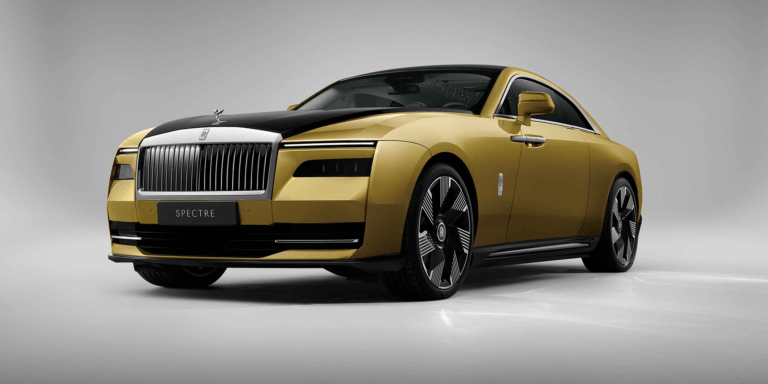
The new Rolls-Royce Spectre is now available to order in the UK, which the manufacturer says heralds in “the beginning of an all-electric era” for the luxury Rolls-Royce brand.
While it is available to order now on the brand’s website, the manufacturer says that orders of the four-seat electrified coupé will start to be delivered in the UK at the end of next year.
The Spectre is expected to replace the ageing Wraith coupé and Dawn convertible in the Rolls-Royce range. While pricing has not been announced, Rolls-Royce says that the coupé will be positioned between Cullinan SUV and Phantom saloon, and therefore the motoring media expects a price tag around the £300k mark.
The new coupé is nearly 20cm longer ands sits 10cm wider than the outgoing Wraith, with a smooth silhouette that the manufacturer says makes the Spectre the most aerodynamically efficient Rolls-Royce ever made. The brand also comments that this new coupé is the first Rolls-Royce production car to sit on 23-inch alloy wheels in nearly 100 years.
The Spectre displays design traits synonymous with the Rolls-Royce brand, a wide front grille finished in chrome flanked by slim LED headlights, a sloping fastback rear end and rear-hinged doors.
Rolls-Royce has not yet released many finalised performance figures as of yet as the Spectre is still being tested. However, the brand says that the 585hp coupé can complete a 0-60mph sprint in 4.4 seconds, and predicts that it will have a maximum battery range of 320 miles on a single charge.
The Spectre has a kerb weight of nearly 3,000kg, which makes it heavier than some luxury electric SUVs. Much of this weight can be attributed to the car’s battery pack, which sits under the flat cabin floor. The manufacturer says that this new design makes the Spectre’s body structure 30% stiffer than the build of its combustion-powered siblings.
A flat cabin floor means that there is more legroom in the car’s luxurious cabin, which is illuminated by ‘Starlight’ ambient lighting on the headliner and dashboard panel. For an optional fee this night sky-inspired ambient lighting can be extended to the door panels too.
The Spectre is equipped with Rolls-Royce’s new ‘Spirit’ infotainment operating system, which allows the driver to monitor live vehicle data and navigation information. The operating system can also be connected to a smartphone app called ‘Whispers’, which allows the car’s owner to control several of the car’s functions remotely.
That sums up what we know about the Rolls-Royce Spectre so far – more details will follow next year as we get closer to the car’s official UK launch.
The cost of living crisis has led to many drivers using their car less. For drivers worried about the amount they have to spend keeping their car running, there are plenty of changes to make that can help their car run more efficiently and save fuel and money.
The way that you drive and the condition of your car will play a huge role in the amount of fuel you use on a daily basis, and these unnecessary costs can really add up over time.
Earlier this year, the RAC called it a ‘dark day’ when the average cost to fill a family car went over the £100 mark. At those prices, if you are doing this once a week, your annual fuel bill will be around £5,200 a year.
There are many ways you can save on ever-more expensive petrol or diesel bills, as our top ten tips below show.
1.Engine: Keep your car well maintained by making sure the recommended service schedule is followed either by taking it to a reputable garage, or servicing it yourself. A well-tuned engine with fresh, clean oil and new air filters will run more efficiently than an engine that has been neglected.
2.Tyres: Tyres are important for saving fuel as a tyre which is under-inflated by 10% can reduce fuel economy as it increases rolling resistance. As well as helping you to save fuel, correctly inflated tyres are much safer and last longer, as if they are either under or over inflated they become more susceptible to failing.
3.Windows: When you have your windows open it increases aerodynamic drag, causing you to put your foot down harder and using more fuel to maintain the same speed. Air-conditioning also uses fuel to operate, so limit this use as much as possible to save fuel.
4. Petrol station: Many drivers spend hours shopping around to find the best deal at the pumps, checking pump prices on-line such as at petrolprices.com. But make sure you weigh up the cheaper fuel prices to any distance you need to travel to the petrol station.
5.Gears: When driving use as high a gear as possible. The higher the gear, the lower the engine speed, which can improve fuel efficiency, so change up a gear whenever you can without labouring the engine. Using cruise control on major roads will help you to stay at a consistent speed which will help to improve fuel consumption as well.
6.Smooth driving: Aggressive driving can use as much as a third more fuel than smooth driving. Avoid accelerating or braking too hard, and also keep your steering as smooth as possible. Keep looking ahead for traffic lights and slower traffic, and coast up to them rather than accelerating and then braking to a stop.
7.Excess weight: It’s amazing how many people carry around huge amounts of unnecessary stuff in the boot or on the back seat of their cars, or have roof racks mounted despite never using them. Lose the deck chairs, picnic table and tool box until you really need them and you will definitely save fuel.
8.Bulbs: Having the correct bulbs fitted to your vehicle can help save emissions and money. Philips EcoVision bulbs, for example, have been specifically designed to produce 20% less energy than a standard car lamp and also give four times the lifetime. They are the world’s most environmentally-friendly bulb and can save you an average of 14 litres of fuel per pair of headlight bulbs.
9.Following lorries: Following (but not too closely) a lorry on the motorway can help to improve fuel consumption even up to 200 metres behind them. A lorry will create less air resistance for your vehicle because they have already passed through the air creating a tunnel or ‘slipstream’ behind it.
10.Don’t drive in neutral: For most modern cars leaving your car in neutral when coasting downhill or up to a red light can actually waste fuel. If you are coasting, your engine is idling and actually still using fuel. Leave it in a high gear or use lower gears for engine braking and you will save your brake pads as well as fuel.
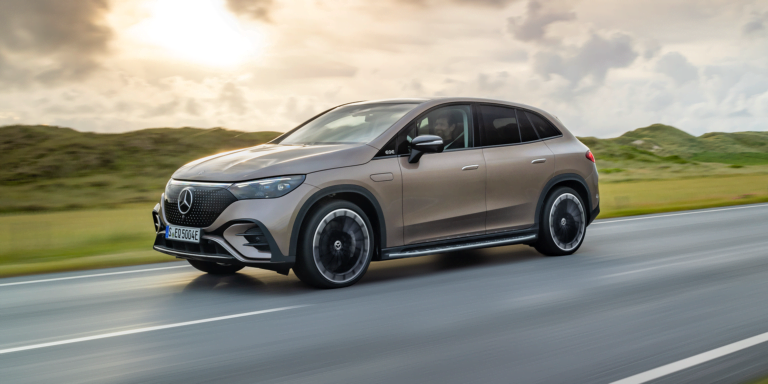
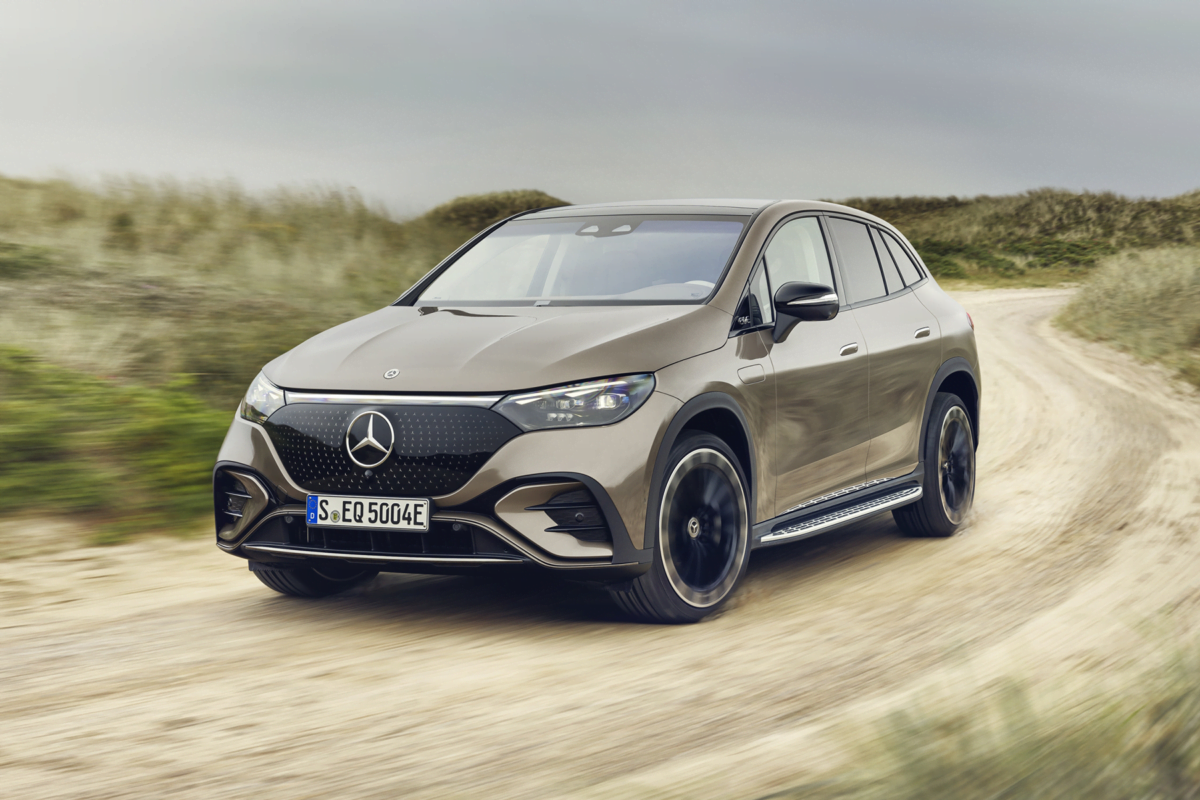
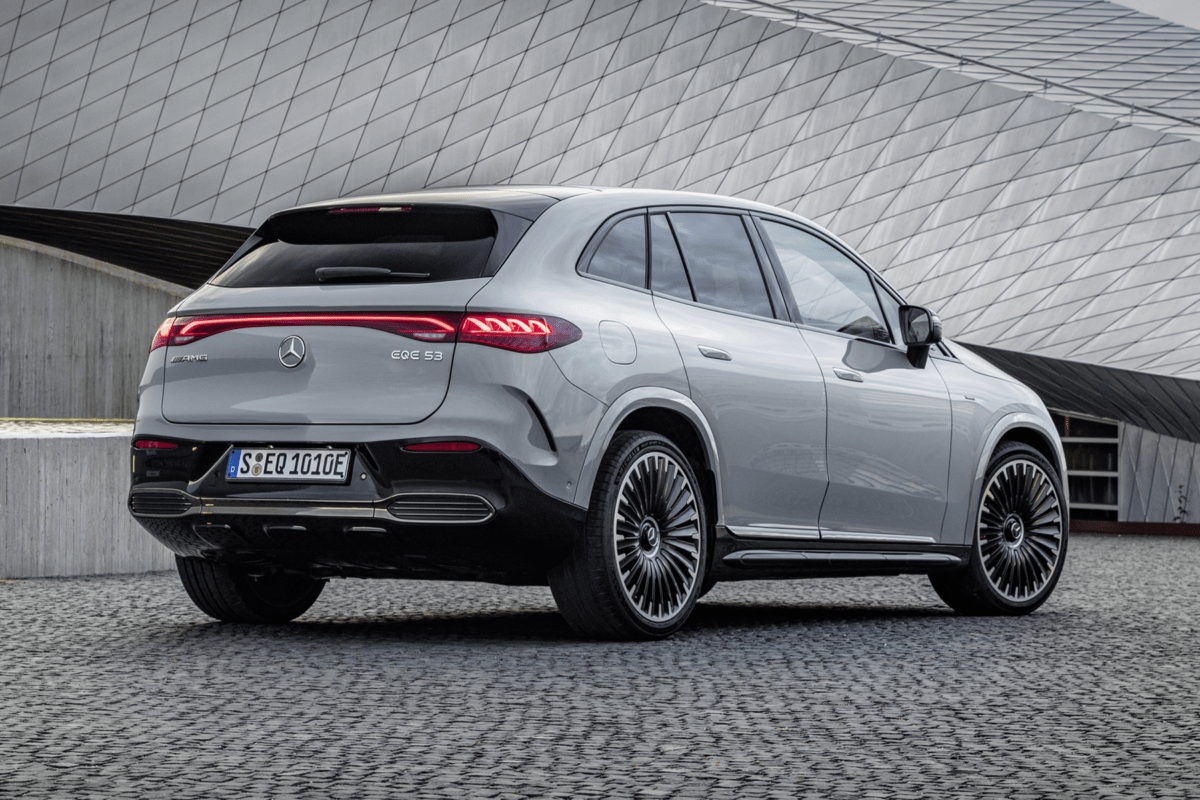
Mercedes-Benz has unveiled its large EQE SUV, not to be confused with the EQE saloon that the new SUV is based on.
Soon joining Mercedes-Benz all-electric EQ family as one of the largest SUVs in the range (below the incoming EQS SUV), the manufacturer says that the EQE SUV is slightly more compact than its saloon counterpart, which launched at the end of last year.
Sporting similar design traits to the smaller EQB and EQC SUVs that are already on sale in the UK, the manufacturer says that aerodynamic efficiency has played a central role in the exterior design new EQE, which has a smooth curvy silhouette and subtle bodywork contours and indents.
The SUV sits on 19-inch alloy wheels as standard, with alloy wheel sizes up to 22 inches also available.
The standard ‘EQE 350+’ all-electric powertrain pairs the same 90kWh battery found in the entry-level EQE saloon with a rear-mounted electric motor for a total output of 292hp and a maximum battery range of 367 miles on a single charge – 17 miles less than Mercedes-Benz says its saloon sibling can muster.
The more expensive ‘EQE 350 4MATIC’ model has the same power output, but is all-wheel drive, making use of a dual-motor setup which produces more torque but a shorter maximum battery range of 347 miles. A more powerful all-wheel drive ‘EQE 500 4MATIC’ will also be available from launch, which ups the SUV’s output to 408hp but also decreases the car’s battery range to a maximum of 340 miles.
The entry-level rear-wheel drive model will be able to tow up to 750kg of trailer weight, while the all-wheel drive models will have a towing capacity of 1,800kg. All models support charging at rates of up to 170kW.
Stepping inside, the EQE SUV comes with the same upmarket interior styling and tech that also features on the EQE and flagship EQS saloons.
Two different infotainment setups will be available. Mercedes-Benz has not revealed much about the standard infotainment option, but says that the brand’s ‘Hyperscreen’ layout is an optional extra (seen below), combining a digital instrument cluster, central infotainment screen and passenger multimedia screen together in one panel that stretches across the whole dashboard.
This continuous screen can be controlled using voice assistant software and allows the driver to customise the car’s engine soundtrack, with four artificial ‘soundscapes’ to choose from. The EQE SUV is compatible with over-the-air updates, which means that it can download future updates and new features remotely while sitting on the driveway.
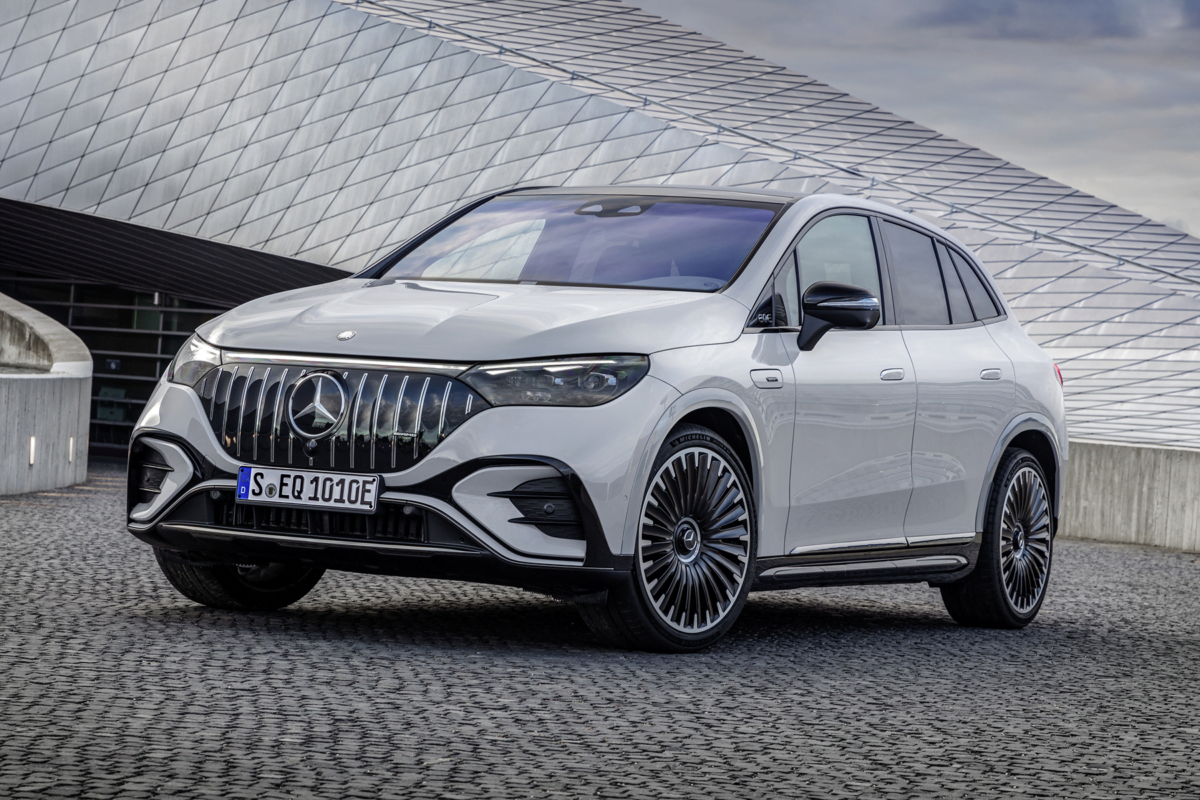
Performance-focused AMG variants have also been unveiled alongside this new SUV range. The 687hp Mercedes-AMG EQE SUV will be the third all-electric AMG model to join the performance’s sub-brand’s current range, after the Mercedes-AMG EQE and EQS saloons – this performance-enhanced variant able to complete a 0-62mph sprint time of 4.3 seconds.
The performance-enhanced Mercedes-AMG EQE SUV
This range-topping AMG line-up consists of two all-wheel drive models – the ‘EQE 43 4MATIC’ and ‘EQE 53 4MATIC+’, the latter of which comes with a ‘Boost’ function that further increases the SUV’s acceleration off the line. Both models come with upgraded suspension and brakes to compensate for the car’s improved pace and acceleration, and Mercedes-AMG says that these models have a maximum battery range of 292 miles.
Mercedes-Benz hasn’t yet announced exactly when its EQE SUV range will go on sale in the UK and hasn’t announced the pricing of the line-up either – these details will be revealed in the coming months. The SUV will soon go into production alongside the EQS saloon at Mercedes-Benz’s factory in Alabama, USA.
Jeep has given us a first look at its new compact all-electric electric Avenger SUV at the Paris motor show, which is set to become the new entry-level model in the brand’s range as it gradually moves towards electrification.
Set to arrive in the UK next year, the new Avenger will be Jeep’s first ever all-electric model, and is set to challenge the likes of Peugeot e-2008 and Vauxhall Mokka-e. The Jeep Avenger is the first of four fully-electric models that the American brand plans to launch in Europe by 2025.
An example of Jeep’s design ethos for its electrified models moving forward, the Avenger is powered by a 54kWh battery with a 156hp electric motor. Jeeps says that this powertrain combo provides a maximum battery range of 249 miles on a single charge. The SUV’s battery will be able to charge from 20% to 80% in 24 minutes using a 100kW charging cable.
From launch, the Avenger will only be offered as a front-wheel drive SUV, but the manufacturer says that the car will still be capable off-road, as it comes equipped with the brand’s ‘SelecTerrain’ technology, which allows the driver to adjust the car’s traction to suit different road conditions and minimise wheelspin when off-roading in mud, sand or snow.
Jeep’s ‘Hill Descent Control’ feature is also included, which uses the car’s traction control system to automatically handle the car’s hill descent when activated – keeping the car’s speed constant and providing the tyres with added traction.
All-wheel drive 4×4 Avenger models are not currently in Jeep’s production plans, but the brand did unveil an Avenger 4×4 Concept vehicle alongside the standard version at the Paris motor show. It sports wider tyres, tow hooks, a roof rack, more muscular body cladding and has a higher ground clearance.
Time will tell whether Jeep moves forward with this 4×4 concept. For now, interested customers can now register with Jeep online as part of its pre-booking initiative for the Avenger Launch Edition model (this initiative ends on November 30th). A turbocharged petrol version of the Avenger is also in production, but only for sale in Italy and Spain.
The Avenger launch edition sits on 18-inch alloy wheels and makes use of LED lights in the front and rear. This limited run model comes with privacy glass in the rear, a electronically-powered boot lid, a heated windscreen, a height-adjustable boot floor and ambient lighting in the cabin.
Matching the SUV’s exterior colour scheme, the dashboard and the car’s heated seats feature yellow design accents. A ten-inch central infotainment screen sits alongside a ten-inch digital infotainment cluster on the dashboard. A wireless charging pad also comes as standard.
The Avenger Launch Edition package also includes a long list of driving assistance and safety technology, including parking sensors in the front and rear, a rear view parking camera, heated wing mirrors, an auto-dimming rear view mirror, adaptive cruise control with lane keeping assistance, blind spot monitoring, and a ‘Traffic Jam Assist’ feature that can drive the car on its own when in heavy traffic.
That sums up our first look at the Jeep Avenger – further details, such as UK pricing, will be announced in the coming months. While customers can now register their interest in the new SUV, the Avenger’s official UK launch will be in January next year.
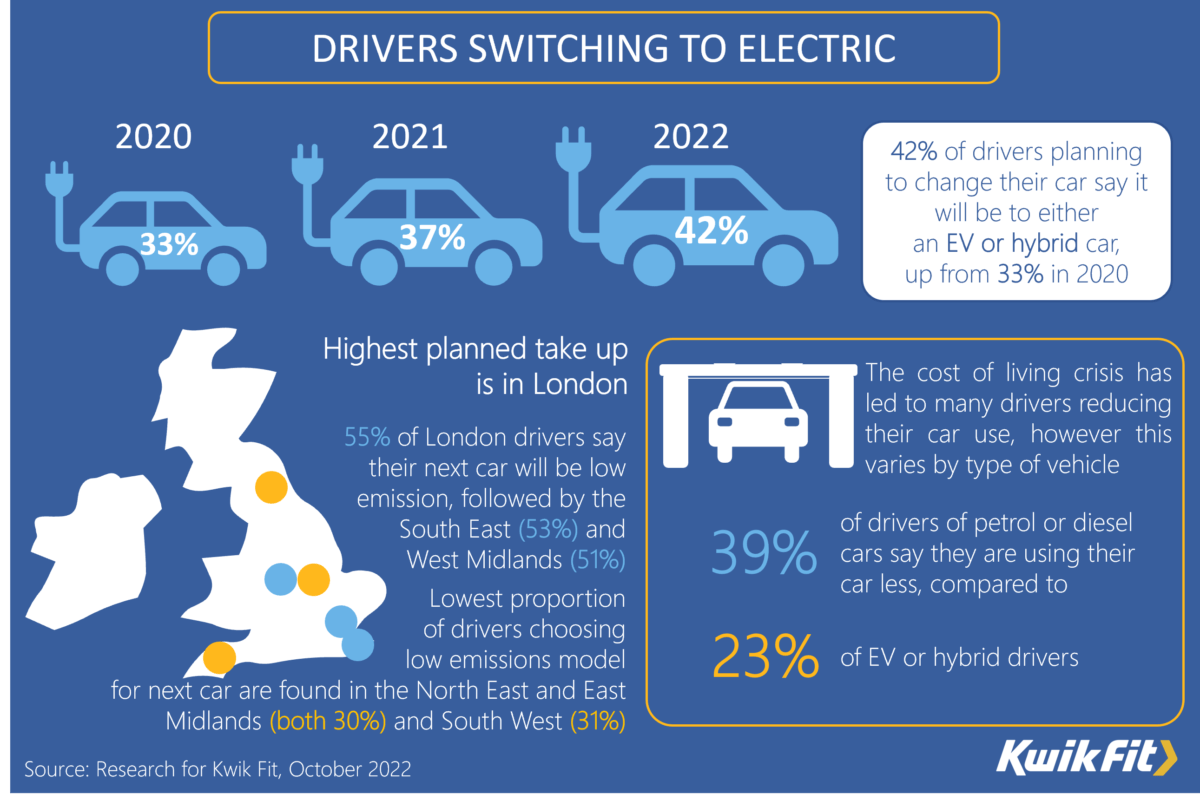
The number of drivers planning to make the switch to electric has jumped in the last year, new research has shown.
The figures reveal that 42% of drivers planning to change their car expect their next vehicle to be a low emission model – either hybrid or fully electric vehicle (EV). It’s a significant increase on a year ago, when 37% said they planned to make the switch to a battery-powered vehicle of some description (it was 33% in 2020).
Petrol or diesel cars are still on the minds of a good number of drivers however – 34% of those planning to change their car said they will opt for an internal combustion engine (ICE) vehicle next time, with 24% saying they haven’t decided yet.
But the figures, from automotive servicing company Kwik Fit, conclude that in the last year approximately 800,000 additional drivers have decided that they will opt for a low emissions vehicle for their next car.
Increased electricity costs putting buyers off
As EV registrations continue to show an upward curve the factors putting people off going electric have also been revealed. The main reason against is the rise in electricity costs, cited by 39% of those who are not considering switching to full electric for their next car.
After the rising cost of electricity, the reasons given most often by car owners for not switching to a full EV are the purchase cost compared with equivalent petrol and diesel alternatives, concerns over range on a single charge (range anxiety) and the lack of fast charging points in the areas they most commonly drive.
Younger drivers are more likely to opt for low emissions – more than half (51%) of drivers aged 18-34 say their next car will either be a hybrid or EV, compared with 34% of those over 55. Fewer female drivers (38%) say they will opt for a low emission vehicle next compared with male motorists (45%).
And London drivers are most likely to say their next car will be a low emission model, with 55% planning to switch to either electric or hybrid compared with 30% of those in the East Midlands.
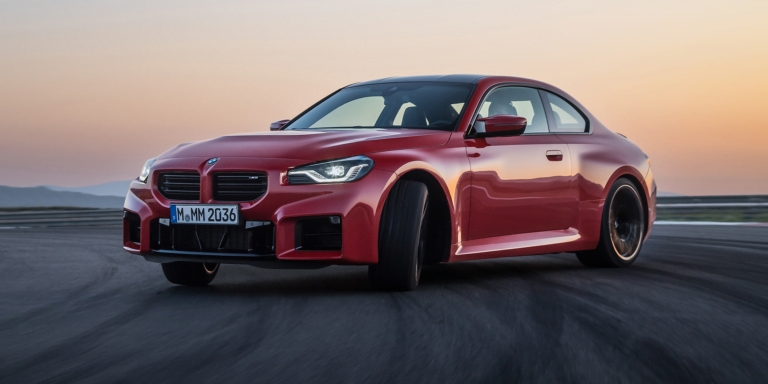
The second-generation BMW M2 coupé is now available to order in the UK, with the first orders expected to be delivered in May next year.
A performance-focused variant of the latest iteration of the BMW 2 Series Coupé, the new M2 distinguishes itself from standard models thanks to its protruding wheel arches, more muscular front and rear bumpers, larger kidney grilles and air intakes, and a quad-pipe exhaust system.
Compared to the outgoing model, the M2 has grown in size as it moves into its second generation. The coupé is now 11cm longer and a centimetre wider than before, and is also a centrimetre lower to the ground.
BMW’s M division has looked to reduce the car’s weight by fitting a lightweight roof made of carbon-fibre-reinforced plastic, and the coupé can also be specced with lighter carbon fibre bucket seats for an extra fee. The M2 is equipped with 19-inch alloys in the front and 20-inch alloys in the rear, all alloys finished in black as standard to match the colour scheme of roof, lower front bumper and rear diffuser. Five bodywork colours will be available from launch.
The new BMW M2 is powered by a re-tuned version of the 3.0-litre six-cylinder petrol engine used in the larger four-door M3. While this re-tuned powertrain doesn’t make this new coupé quite as powerful as the M3, it does increase the M2’s output by 90hp when compared to its predecessor – 460hp in total.
BMW says that its new M2 can complete a 0-62mph spint time in 4.1 seconds, and that its top speed is capped at 155mph. Opting for the optional ‘M Race Track Package’ increases the car’s top speed to 177mph. The standard model makes use of an eight-speed automatic gearbox, but customers can also select a six-speed manual transmission which makes the coupé slightly slower to accelerate in a straight line.
Inside, the car’s dashboard features a curved display that combines a 12-inch digital instrument cluster and a 15-inch infotainment display which is compatible with Apple CarPlay and Android Auto, and comes with the brand’s cloud-based navigation and voice assistant software as standard. A head-up display is also included as standard, while a wireless phone charging pad is available as an optional extra.
Below the infotainment screen sits the drive selector and ‘M Mode’ button. This feature allows the driver to put the coupé into ‘Sport’ mode, which scales back the car’s driver assistance systems, or ‘Track’ mode, which fully deactivates these assistance systems. To aid on-track fun, the M2 also comes with a lap timer and ‘drift anaylser’ feature.
Prices for the new BMW M2 start at just under £64k. Manual models are slightly more expensive, and the ‘M Race Track Package’ adds a further £6k to the price tag. The coupé is available to order now on BMW’s website, and the brand expects second-generation M2 deliveries to arrive in the UK in May 2023.
Polestar has unveiled its first SUV model, the Polestar 3, which delivers 489hp and an all-electric range of 379 miles.
This is only the third model that Volvo’s all-electric luxury spin-off brand has unveiled since it started making production cars in 2018. Set to challenge the popularity of the Tesla Model Y, the Polestar 3 is now available to order in the UK, with the first customer deliveries expected towards the end of 2023.
The new SUV is Polestar’s first attempt at building a car from the ground up without using Volvo’s concept designs, and features several of the brand’s hallmark design features, such as dual-blade headlights and a ‘Smartzone’ panel which contains various sensors used by the car’s on-board tech.
Polestar says that it has focused on optimising the aerodynamics of the SUV where possible. In addition to its sleek silhouette, the Polestar 3 also has pronounced bonnet contours, a winged rear spoiler and blade-like bodywork fixtures below its tail lights, all installed to make the car’s powertrain slightly more efficient.
Speaking of the powertrain, the SUV is powered by a 111kWh battery pack, which works in tandem with two electric motors to provide 489hp and a 0-62mph sprint time of five seconds. Opting for the additional performance pack will up the car’s power output to 517hp and shave three tenths of a second off the car’s 0-62mph sprint time.
Polestar promises that its next SUV can muster a maximum of 379 miles on a single charge, which is nearly 50 miles more than the Tesla Model Y and over a 100 miles more than the BMW iX can handle. However, the Polestar 3’s class-leading battery range is matched by its expensive pricing.
Launching with a price tag just shy of £80k, the Polestar 3 is £22k more expensive than the Tesla Model Y Long Range. Opting for the optional performance pack adds over £5k to the final bill.
Likely due to its large battery pack, this new SUV weighs in at over two and a half tonnes. To improve the car’s cornering ability and comfort, the manufacturer has installed adaptive air suspension which can electronically adjust itself every two milliseconds.
The car has a ‘decoupling’ function, which instructs the powertrain to only use the front motor in energy saving scenarios, and the SUV also comes with a one-pedal driving mode too.
Stepping inside, the Polestar 3 features a 15-inch portrait-oriented infotainment screen which sits above the centre console. This infotainment runs the brand’s new ‘Snapdragon’ Android-based operating system and is compatible with future over-the-air updates.
All launch models are available with a panoramic glass roof as standard, as well as LED lights, 21-inch alloy wheels, and retractable door handles that can sense when you are near the car. The car’s rather steep price also includes Polestar’s ‘Plus’ and ‘Pilot’ packages, which include a 25-speaker 3D surround sound system with Dolby Atmos, soft-closing doors, a heads-up display and safety features like adaptive cruise control, lane keeping assistance, and parking assistance software.
That just about sums up our first look at the new Polestar 3 – the new SUV is set to be manufactured at Volvo’s factory in Chengdu, China.
With the current cost-of-living crisis, any savings in running your car will be welcome. Tyres may be essential but they are also expensive to replace, so is buying much cheaper, part-worn or even retreaded tyres a good idea? Or does such a move represent a big risk to one of the most safety-critical parts of the car?
When you think abou it, thousands of part-worn tyres are sold every day – anyone that buys a used car is usually also buying used tyres – but going for such rubber as a replacement for your existing tyres when they wear out is often condemned as a safety risk.
According to UK charity TyreSafe, more than 5 million used tyres are sold in the UK each year. Many of these are sourced from Europe, where the rules on tread depth are stricter than they are here.
What are the rules on tyre tread in the UK?
In the UK when tread depth drops below 1.6mm our tyres become illegal – drivers who fail to comply with the regulations face a fine of up to £2,500 and three penalty points for each illegal tyre. Yes – drive a car with four over-worn tyres and you could be in danger of losing even a completely clean licence.
But in Germany, for example, the legal minimum tread depth of a tyre is 3mm – almost double that of the UK. Even in such cases the tread can be worn by more than 50% at this point, as a brand-new tyre can have treads on it as deep as 8mm.
Yet it would appear perfectly feasible to put a tyre replaced in Germany on a car in the UK, and still comply with the law. In fact many of the tyres sold by the ‘part-worn’ industry in the UK are sourced from such places as the German market – just don’t buy such tyres if you are planning to take your car abroad…
There are far more serious concerns about going part-worn, however.
Laws for the sale of used tyres in the UK
Strict rules govern the sale of used tyres here in the UK, such as:
tyres must have at least 2mm of tread depth across the entirety of their ‘contact patch’
tyres must have no damage
tyres must be clearly marked with the words ‘part-worn’ on their side walls in letters at least 4mm high.
But evidence suggests these rules are being routinely flouted right across the industry.
The UK tyre industry set up TyreSafe as a registered charity in 2006, aiming to reduce the number of tyre-related incidents on Britain’s roads by raising awareness of correct tyre maintenance and the dangers of defective and illegal tyres.
As part of this work, TyreSafe conducted a survey that revealed some scary goings-on in the UK part-worn market. Of 50 used tyres that TyreSafe purchased, a third had damage that rendered them unsafe, including sub-standard repairs and exposed cords (the woven metal structure) – one even had a piece of metal protruding through the tread by 5cm. And only one was correctly marked with the legally-required ‘part-worn’ insignia.
Now being an industry body, it’s perhaps not surprising that TyreSafe constantly and strongly recommends buying new tyres rather than part-worn or ‘used’ tyres which it says “can have devastating consequences”. But Trading Standards officers also mounted an investigation to better understand the part-worn market and they concluded that more than 93% of the tyres they bought were not compliant with the law, and between a third and half had defects that rendered them unsafe.
So if you do go the part-worn route you must make careful checks, partly to ensure you are buying tyres with enough tread left on them to justify the price, even if they are substantially cheaper.
You also need to factor in that even good part-worn tyres will last a lot less than new tyres – even legal ones can have a tread only 0.5mm over the limit so they’ll quickly wear out and you’ll be repeating the whole process again sooner than you think.
The most crucial checks, however will be to keep you and those you carry in your car safe. At the end of the day if you are driving on a new tyre with a deeper tread, the safer on the road you will be. That deeper tread may not make a difference until an extreme situation occurs – having to make an emergency stop for example in torrential rain – but we can never know when such situations may occur…
Recycling – a reason to retread?
When this reporter was a child and his dad went to replace car tyres he was routinely asked “new or remoulds?”. Retreading car tyres to create what in those days were dubbed remoulds was a familiar part of the retail motor industry with many consumers saving money by buying retreaded rubber.
Today, however, retreaded car tyres are much harder to find, the market having been almost killed off in the noughties by the availability of budget-priced new tyres manufactured in the Far East, especially China.
The single-use nature of modern tyres creates major problems. They are bulky and not at all environmentally-friendly, being notoriously notoriously difficult to recycle. Not can you dump them at the local tip because they’ve been banned from landfill sites since 2006.
According to the British Tyre Manufacturers Association (BTMA), just 15% of UK tyres are re-used by means of retreading. Another 25% go to make rubber crumb, which is used for soft surfaces in such places as children’s playgrounds and in the manufacture of moulded rubber components.
Another 15% of waste tyres are incinerated in the UK as part of the manufacture of cement, while the biggest proportion, 35% are exported to be incinerated elsewhere. Environmental concerns over such exports are rising, both here in the UK and in the countries we export our waste tyres to. So cutting the numbers of waste tyres would be a green move, and retreading could be one answer.
Retreading of car tyres is often lumped with the part-worn industry as something you really shouldn’t do for safety reasons. In some countries – though not the UK – it’s even illegal to retread a car tyre. This image has led to various myths growing up around retreaded tyres.
Retread providers claim, with justification, that the scare stories – such as that retreaded tyres are impossible to balance and more likely to burst – are simply not true and that retreaded tyres need be no less safe than brand-new ones. But some insurers, for example, will use the presence of retreaded tyres to invalidate policies, so if you are going to buy such tyres you need to check your insurance allows you to fit them.
Retreading is normal for truck tyres
In fact, using part-worn or retreaded tyres are completely different prospects, starkly illustrated by the fact that retreading is a norm for vehicles on which you would think the tyre would be under greater stress. In the commercial vehicle market, many heavy lorries and buses run on retreaded tyres, as do aircraft and even racing cars. Which leads to the question, should retreading be an option for regular passenger cars as a means of extending the life of each car tyre?
By now you are asking, what is retreading? It’s not, as some might think, simply cutting a new tread in the rubber that is left behind when the original tread has worn down – that would certainly be a major safety concern as tyre manufacturers only mould as much rubber onto a new tyre as is needed so there’s little waste margin once the tyre has worn.
Instead, retreading sees the rubber band with the worn tread on it removed, to be replaced by a completely new band in which the new tread has already been moulded. This is bonded to the existing tyre casing, known as the carcass. Such a process requires only a new rubber strip and not the woven steel structure that is built into brand-new tyres, as it’s already present – this is where the cost savings over new tyres are made.
Tyre retreading is properly regulated
So retreading can be very cost-effective, but it’s also safe. For a start, the compliance monitoring is much better than in the part-worn industry. Anyone can open a shack by the side of a road and sell part-worn tyres but setting up a retreading manufacturing facility takes serious investment, all of which is closely monitored by the authorities.
All UK retreading operators and their processes are certified by the Vehicle Certification Agency (VCA). Since 2004, all retreaded tyres sold in the UK have had to meet a United Nations EU compliance document – there are different ones for passenger car and commercial retreaded tyres. Retreaded tyres also all carry identification numbers showing exactly which facility they have come from.
Only certain tyres are suitable for retreading – a tyre must have a speed rating of at least 84mph (135km/h) but it tends to be higher. Apart from a few specialist examples, such as off-road or winter tyres, all retreaded passenger tyres are speed rated to at least 112mph (200km/h).
Stringent checks through the retreading process ensure there are no potential safety issues, with any sign of damage and such leading to immediate rejection of the tyre which is sent for recycling instead.
Perhaps the clearest sign that retreading is not a dangerous option is that in the commercial market many original tyre manufacturers, big names such as Michelin and Goodyear, do their own retreading – in fact, earlier this year Hankook Tyres proudly showed off its rebuilt and doubled-in-size retreading plant in Hammelburg, Germany that has taken this one site’s retreading capacity to 100,000 tyres per year.
Mind you, according to the BTMA even commercial retreading is under threat – the Association is campaigning for more recognition of the industry which it says extends the life of each tyre by some three times and means four times fewer tyres are used up each year.
Enormous environmental savings
The BTMA states that in a retread of a truck or bus tyre, 85% of the original tyre is re-used. The process saves 30kg of rubber (30% of a typical truck or bus tyre is natural rubber, classified as an EU critical raw material with future demand likely to outstrip supply), up to 20kg of steel and 60kg of CO2 emissions, while giving the tyre a potential total life of more than 375,000 miles – 15 times around the globe.
Equate such figures to the billions of car tyres in use around the world and the potential environmental savings of using retreaded tyres are massive, while producing tyres that are much safer than diving into the murky world of the part-worn industry.
So in a nutshell? The best option when replacing your tyres is of course to buy brand new, but retreaded tyres are a credible alternative with an environmental advantage, if you can find them. Just don’t go part-worn – they are not worth the money, or the risk…
Total car finance debt has rocketed from £11 billion to nearly £40 billion* since 2009, an increase of 253%
The sheer scale of car finance debt a “growing concern” for motorists as the cost of living crisis escalates, says Stuart Masson at The Car Expert
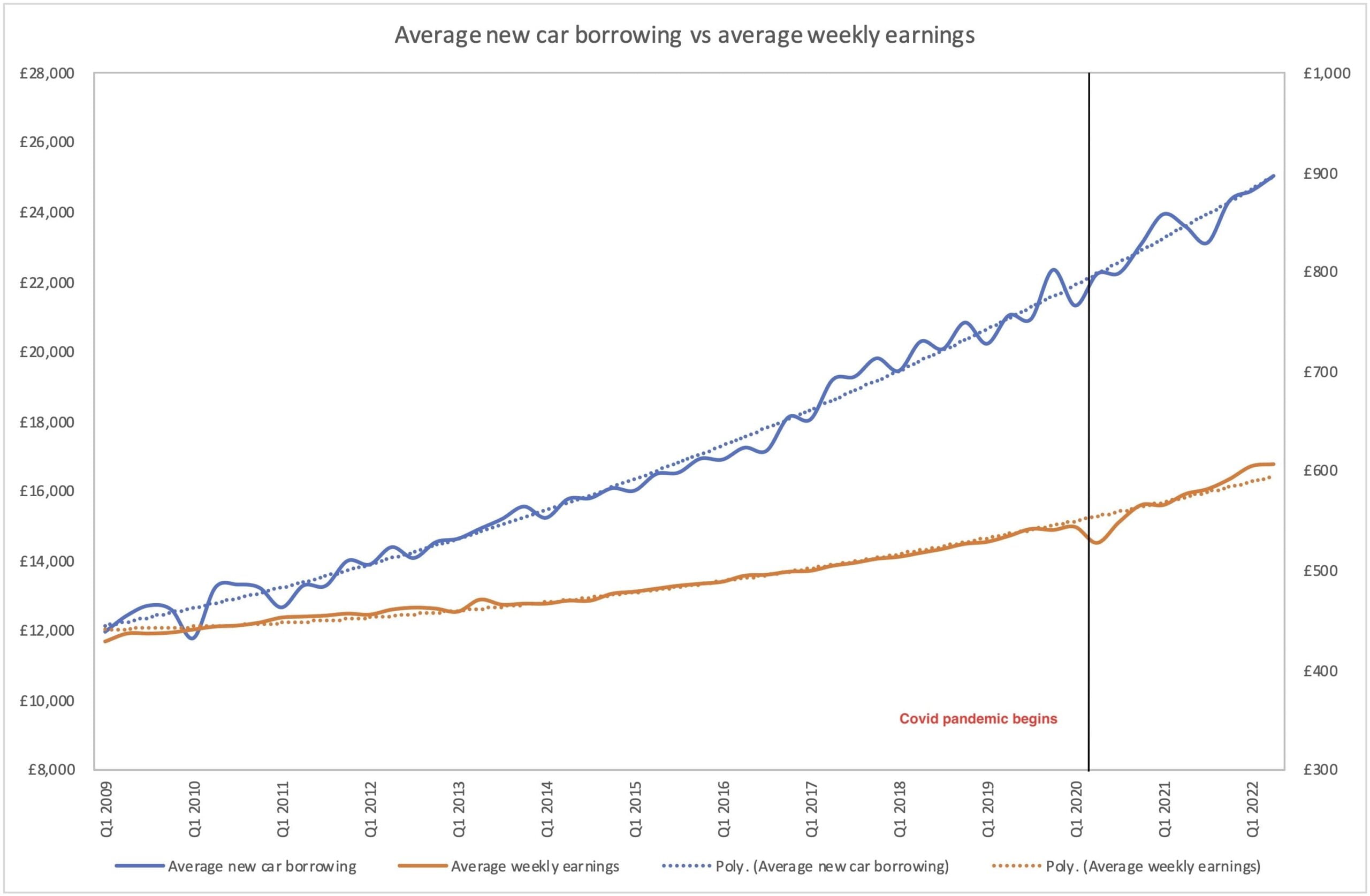
The average amount financed for each new car has risen sharply from less than £12,000 in 2009 to more than £25,000 this year
Increasing popularity of personal contract purchase (PCP) car finance over the last decade means borrowing has ballooned
New car finance debt totals £17.5 billion in the last 12 months while used car finance adds a further £22.2 billion**
The scale of the UK’s car finance debt burden has been revealed after an investigation by The Car Expert found that new and used car borrowing has risen by 253% since 2009.
With the UK now facing a serious and potentially long-lasting cost of living crisis, debt on new and used cars now is near £40 billion a year, up by nearly £29 billion since 2009.
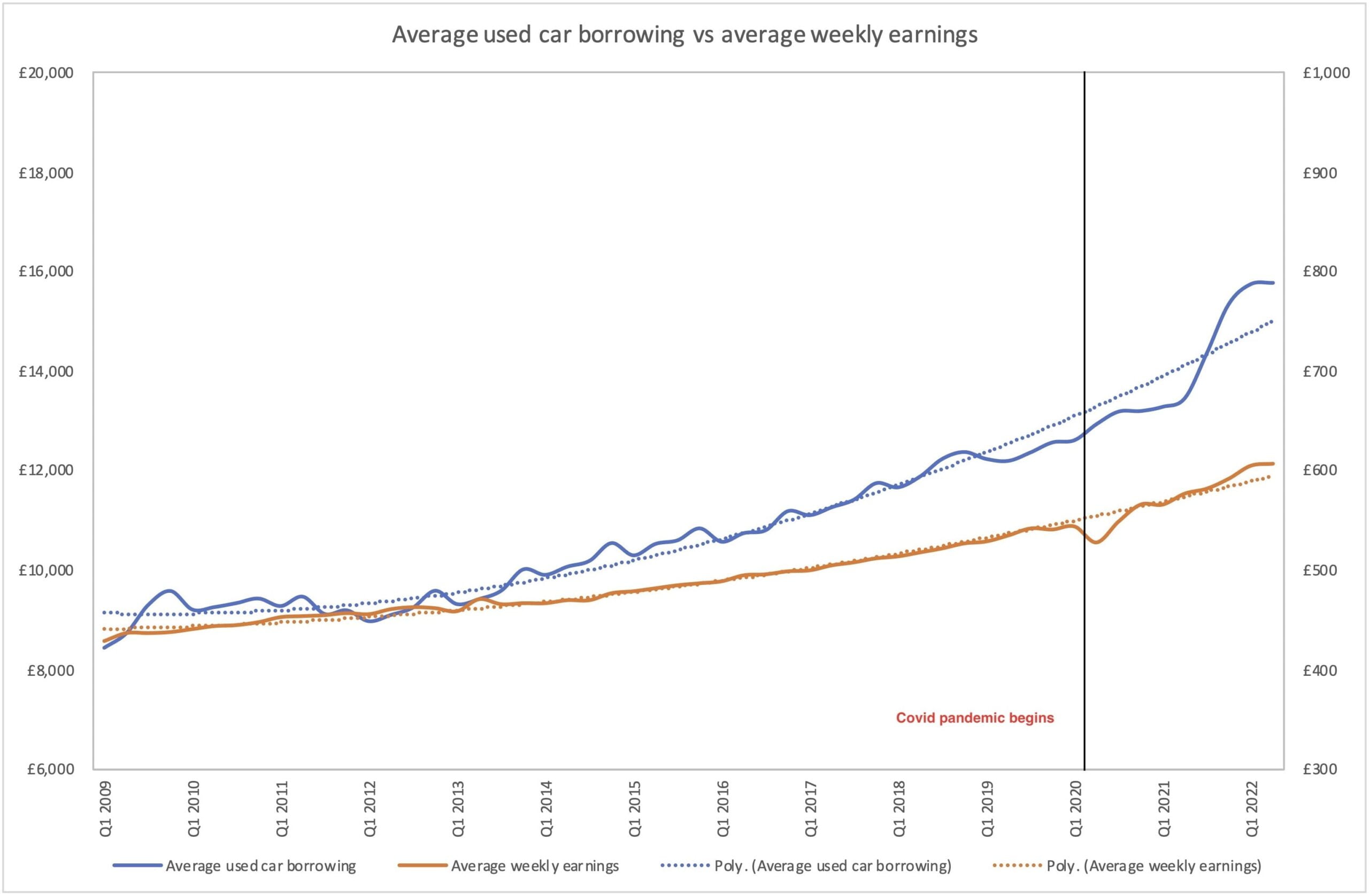
The average amount financed per new car has more than doubled, drastically increasing from just under £12,000 at the start of 2009 to over £25,000 by the end of June 2022. Similarly, the average amount financed per used car has also significantly risen, escalating from slightly under £9,000 to over £15,500 in the same time period.
The analysis conducted by The Car Expert, the UK’s most comprehensive automotive consumer advice site for impartial guidance on car buying, has put a spotlight on the issue as the mounting cost of living crisis adds pressure on household budgets.
Stuart Masson, Editorial Director at The Car Expert, said: “Over the last decade, average wages have not kept pace with the growing level of debt. Whereas wages have increased by 33%*** since 2009, the debt borrowed on new cars has more than doubled, while average used car finance debt has significantly increased by 87% over the same period.
“If the UK continues to experience spiralling inflation, we may have to brace for a significant proportion of borrowers defaulting on their debts, leading to their vehicles being repossessed and possible bankruptcy.”
He continued: “Compounding the problem, electric cars are even more expensive than petrol or diesel cars, meaning even greater debt burdens for consumers trying to go green. And as energy costs drive ever upwards, the promise of lower running costs to offset that increased borrowing is not forthcoming.”
The increasing popularity of personal contract purchase (PCP) car finance over the last decade is partly responsible for the inflated debt burden. These deals can be mistaken for a leasing or rental agreement, when in fact they are purchase agreements; consumers borrow the total value of the car minus the initial deposit. In order to keep the car, a final “balloon payment” (the projected future value of the vehicle) must be paid at the end of the loan. This is typically a significant sum of money that many do not thoroughly consider when signing the agreement. Often consumers find that at the end of the loan their financial situation has changed and they are unable to pay the final amount owed.
“The industry needs be more transparent about what these PCP deals entail. Manufacturers, dealers and the media should be clear that these are purchase agreements and that the balloon payment is part of the total amount borrowed” said Stuart Masson.
“The car industry is utterly reliant on people buying cars they don’t need with money they don’t have. The problem, of course, is that if people no longer have the means to borrow, the car industry will collapse. It was a genuine concern during the Covid shutdowns and remains a risk today as costs of living spiral.”
While borrowing on new cars has swelled to £17.5 billion in the last 12 months, the used car market represents an even larger proportion of the UK vehicle finance debt burden, adding a further £22.2 billion of new borrowing in the last 12 months. Although used car prices are currently strong, the future value of older vehicles is harder to predict, meaning that consumers need to be careful about committing to finance agreements that do not guarantee the future value of the vehicle.
“Our analysis of the Finance & Leasing Association’s (FLA) figures shows a truly worrying level of debt as the nation faces a lot of uncertainty. Political upheaval and the cost of living crisis has brought the UK’s reliance on car finance into sharp focus. We are potentially looking at thousands of households finding themselves in serious trouble in the coming months,” said Stuart Masson.
For further analysis of the UK’s car finance position and for data tables, please get in touch.
The Car Expert provides independent and impartial advice on every aspect of buying, financing, owning, and selling new or used vehicles. For more information, please visit: https://www.thecarexpert.co.uk/
ENDS
Notes for editors
* Overall new and used car finance data from January 2009 – June 2022 recorded by Finance & Leasing Association ** New and used car finance data from July 2021 – June 2022 recorded by Finance & Leasing Association *** Average weekly earnings annual data from 2009 – 2022 recorded by Office for National Statistics
The Car Expert
Founded in 2011, The Car Expert is the UK’s most comprehensive automotive consumer advice site. With an audience of over two million readers a year, The Car Expert provides independent and impartial advice on every aspect of buying, financing, owning, and selling new or used vehicles.
The Rotten Tomatoes equivalent for the automotive world, The Car Expert consolidates reviews from 30 of the UK’s top automotive websites to create the Expert Rating Index. Bringing together science and data analysis, the index calculates a weighted average to give an aggregated score – Expert Rating – that is comparable across different brands and models.
The Expert Rating Index factors in the age of each review, so that newer reviews carry more weight than older reviews. It also breaks down the complex web of different scoring systems that various websites use in their reviews.
The Car Expert has logged over 12,000 reviews covering more than 400 cars and over 50 manufacturers, with its Expert Rating Index now trusted as the gold standard for rating and ranking new cars in the UK.
For media enquiries, please contact Performance Communications:
The sheer scale of the UK’s car finance debt is a growing concern as the country’s cost of living crisis puts household budgets under unprecedented pressure.
Car finance debt has been accelerating far beyond wage increases for the last 13 years, according to extensive analysis of publicly available data conducted by The Car Expert, as car manufacturers and dealers have encouraged buyers to borrow more and more money using PCP car finance.
From 2009 until the middle of 2022, the average amount of money borrowed on a new car has more than doubled, from £11,964 to £25,039[1]. The total amount borrowed on new cars in the UK is almost £17.5 billion a year – and it was pushing £20 billion a year before the Covid-19 pandemic[2].
Similarly, the average amount borrowed on a used car has increased by 87% over the same period, from £8,444 to £15,771[3]. The total amount borrowed on used cars in the UK over the last 12 months (July 2021 to June 2022) is more than £22 billion, with year-on-year growth increasing every month[4].
In comparison, average weekly earnings have only increased by 33% over the same period[5], and growth in real-world disposable incomes have been even less.
We have detailed tables and charts at the end of this article that look at all these numbers in more detail.
With household budgets under unprecedented pressure from the current cost of living crisis, there is a real risk that a lot of people could simply find themselves in serious financial trouble if they can no longer afford to make their monthly car finance payments. If your household bills have gone up by hundreds of pounds a month, finding several hundred to service your car finance debt and pay your car’s running costs (fuel, insurance, road tax) each month is getting even harder.
Why is car finance so important?
The car industry is entirely reliant on customers buying cars they don’t need with money they don’t have. If we only bought the cars we could afford with the savings we had available, there wouldn’t be a massive global automotive industry and cars would remain playthings for the very wealthy.
The current risk is that car finance debt has grown so much over the last decade that increasing financial pressures on a large number of borrowers could lead to widespread defaulting, which could collapse the whole house of cards. It may sound unlikely, but there appears to be no desire by anyone to slow the accelerating growth in car finance debt.
The Covid pandemic provided a warning to lenders that many of their customers were overloaded with debt, but the last year has seen average borrowing accelerate even more compared to pre-pandemic levels, so that lesson has clearly been ignored.
Why has car finance debt increased so dramatically?
There has been a sea change in how buyers finance new and used cars over the last decade and a half.
Back in 2009, only about 40% of privately-purchased new cars were financed at point of sale[6], using finance brokered by the car dealership. Most borrowing was obtained from other sources, like personal loans from your bank.
Dealer-sourced finance from dedicated car finance companies has grown to about 93% of all private new car sales in 2022[7], meaning that nearly every consumer new car purchased is tied into a finance contract arranged by the dealership.
Used cars have seen similar growth[8], although dealer finance is a much smaller segment of overall used car sales (used car sales cover everything from £100 junk vehicles to near-new vehicles like demonstrators or pre-registered cars).
Car finance brokered by the dealership is usually in the form of a personal contract purchase (PCP), which is far and away the most dominant type of finance agreement now used by consumers to buy a new or used car.
With a PCP, car buyers are able to borrow much more money for a given monthly payment. We explain this in much more detail here.
The concern is that the monthly repayments don’t go anywhere near paying off the full value of the debt, so that if a customer can no longer afford the monthly payments, the amount of car finance debt they are carrying is much higher. Even if they can sell the car (which is not always an option), chances are that it won’t go anywhere near paying off the outstanding debt, leaving the customer with thousands of pounds still to pay off and no way of paying it.
Unless there’s another sea change, this growth in car finance debt will only accelerate as we transition from petrol and diesel cars to electric vehicles. EVs are typically a lot more expensive than their fossil-fuel equivalents, which means borrowing even more money for a comparable car.
But what about the Guaranteed Future Value?
One of the key features of PCP car finance is that the finance company guarantees the value of the car will be worth at least the final balloon payment at the end of the agreement, which is called the guaranteed (minimum) future value (GFV or GMFV). This allows you to give the car back to the finance company at the end of the agreement with nothing further to pay.
However, the GFV only kicks in at the end of the agreement. So if you’re only two years into a four-year agreement, you will almost certainly have a large amount of negative equity, meaning your debt is much greater than your car is worth, and there’s nothing to protect you.
But what about voluntary termination?
Voluntary termination (VT) is one of the most misunderstood aspects of PCP car finance, and in reality it doesn’t offer you all that much protection. It’s more useful if you have an old-fashioned hire purchase (HP) or a conditional sale, but both of these are pretty rare today.
With a voluntary termination, you have the right to terminate the agreement by giving the car back to the finance company after paying back half of the Total Amount Payable.
There’s a lot of specific information contained within that one sentence. The Total Amount Payable is a very specific number, which includes your up-front deposit, all your monthly payments, the balloon amount and any additional fees. On a £20k car, the Total Amount Payable could easily be £24k or more.
If you have already paid half the Total Amount Payable, you can simply give the car back with nothing further to pay. If you haven’t reached it (because you’re still too early into your agreement), you can still VT but you have to pay whatever is still needed to reach the halfway point.
The problem is that, if your PCP agreement runs through its normal course, you won’t reach the VT point until right near the end of the agreement when you’d be able to hand it back anyway. So, at best, it offers some protection in the last few months of your agreement. For the majority of the three-to-four years of your contract, you’re not really protected at all.
What happens if I can’t afford my car finance payments?
If you default on your car finance, things can turn ugly very quickly. So the best course of action is to engage with your car finance provider (not the dealer where you bought the car) as soon as you’re starting to struggle. Doing nothing and waiting for collections agents to turn up on your doorstep will only make things much worse.
Finance companies are obliged to act with consideration for financial hardship, but that doesn’t mean they’re just going to cancel your loan and allow you to walk away. It’s all about helping you work through your financial obligations to pay off your debts rather than cancelling them.
Depending on your situation, you may be offered an extension to your agreement with lower monthly payments, a reduction in interest charged on the borrowing, a payment holiday, or other options to help you out.
What happens if millions of people can’t afford their finance payments?
If large numbers of consumers can’t afford to service their car finance debt, the car finance companies and potentially even the car manufacturers (who own a lot of the finance companies) will be at risk.
During the early days of the Covid-19 pandemic, the Financial Conduct Authority was forced to rush through new rules for lenders to protect borrowers. There was genuine concern that millions of customers could suddenly default on their car finance agreements, which could have brought down the entire sector and crippled the car industry.
While it’s certainly unlikely that we’re likely to see large car companies collapsing over car finance defaults like we did with banks during the mortgage crisis of more than a decade ago, it could materially affect their financial positions, which would impact how much money they can invest in new vehicles and new technologies.
The car industry is currently spending huge amounts of money on new electric vehicles that they will want us all to buy in coming years, so it’s crucial for them that we can all continue to afford to buy their ever-more expensive cars.
How can we improve this?
As much as no-one in the car industry wants to hear it, it’s probably long past time to start introducing tougher limits on how much consumers can borrow for a car, rather than prioritising monthly payments.
Instead of the main focus being on whether a customer can afford their monthly payments right now, there should be much greater scrutiny on overall car finance debt since that’s a critical factor if things go wrong during an agreement.
PCP finance is sold on the basis that it makes a given car more affordable by reducing monthly payments. Yet it’s actually used to increase debt levels for the same monthly payments, so it’s simply being used to bring more expensive cars into reach for more people – which works fine as long as the world continues to run smoothly.
A typical car finance agreement now runs for about four years, and a lot can happen in that time. Since 2018, the UK has endured three prime ministers, a Brexit process that has not gone smoothly, a devastating global pandemic, ongoing industrial and economic fallout from said pandemic, and now a global economy severely impacted by Russia invading Ukraine, with inflation and the cost of living skyrocketing. All of these things have impacted on household finances – what will happen in the next four years?
The other problem is that cars are getting more and more expensive, especially as we move from fossil fuel vehicles to electric vehicles. Limiting overall borrowing could block customers from being able to buy electric cars just as the government and the car industry are trying to encourage us all to do so. Current finance products may not be fit for purpose for EVs, so we may need to look for alternatives to PCP finance.
Having just about survived Covid, will the latest cost-of-living crisis finally burst the car finance bubble that has been propping up the car industry for the last decade?
Appendix 1: Private new car sales and financing, 2009 to 2022
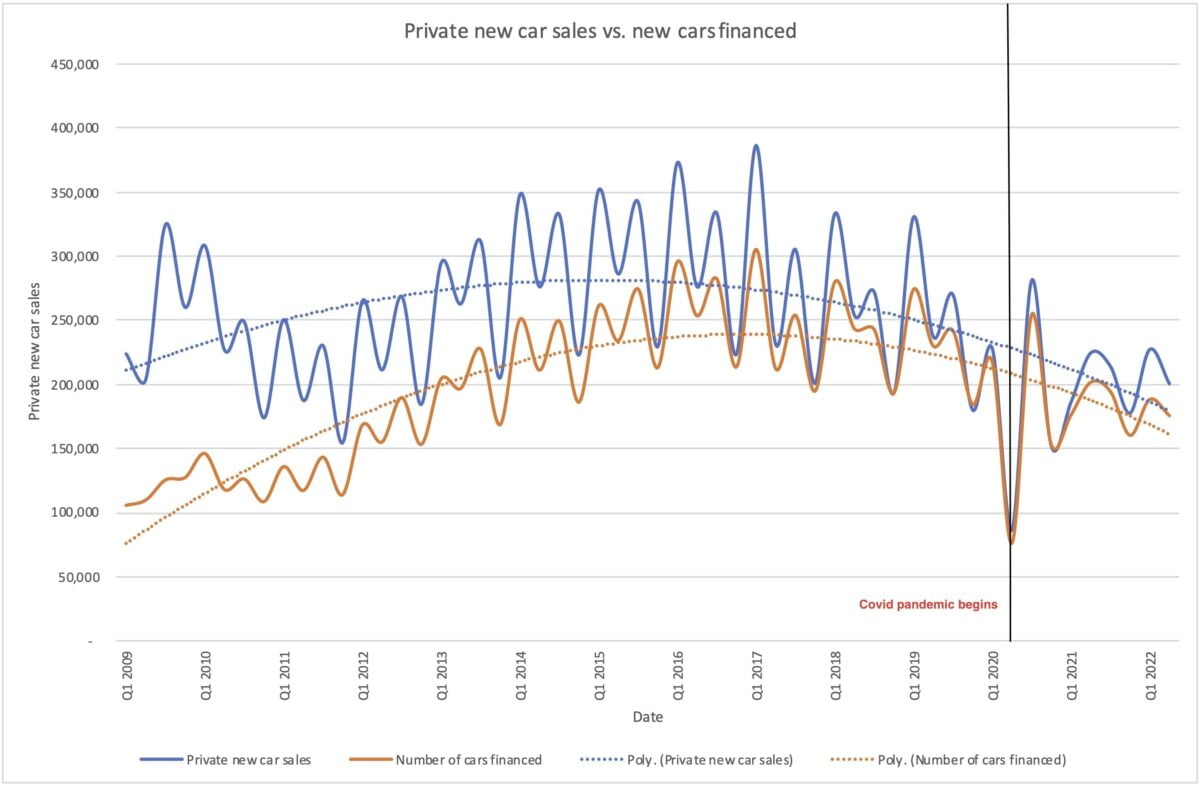
The table above shows the change in private (consumer) new car sales from January 2009 to June 2022, the number of new cars being financed, the total amount borrowed on new cars and the average amount borrowed per new car.
The first chart illustrates the number of cars sold vs the number of new car finance agreements. Back in 2009, only about 40% of new cars were financed through the dealership. Today, that figure is more than 90%. Although sales fluctuate up and down each quarter based on the biannual number plate changes, the proportion of cars financed via dealer-sourced finance increases steadily over the decade.
As you can see, private new car sales peaked in 2015/2016[9], and have been declining ever since. Obviously, Covid-19 made a huge impact in 2020 with knock-on effects that are still being felt today, but sales had already been declining for three years before that.
Borrowing, on the other hand, has increased steadily each year. At the start of 2009, which is as far back as the publicly published data goes, average new car borrowing was less than £12,000. By June 2022, it stood at more than £25,000.
The second chart illustrates this clearly, showing how the growth in average borrowing on new cars has streaked away from increases in average earnings.
Appendix 2: Private used car sales and financing, 2009 to 2022
Looking at used car data, we can see that that although many more used cars than new cars are sold each year, a much lower percentage of them is financed. This is not surprising, as millions of used cars change hands for low values – a few hundred to a few thousand pounds – that are not usually viable options for car financing.
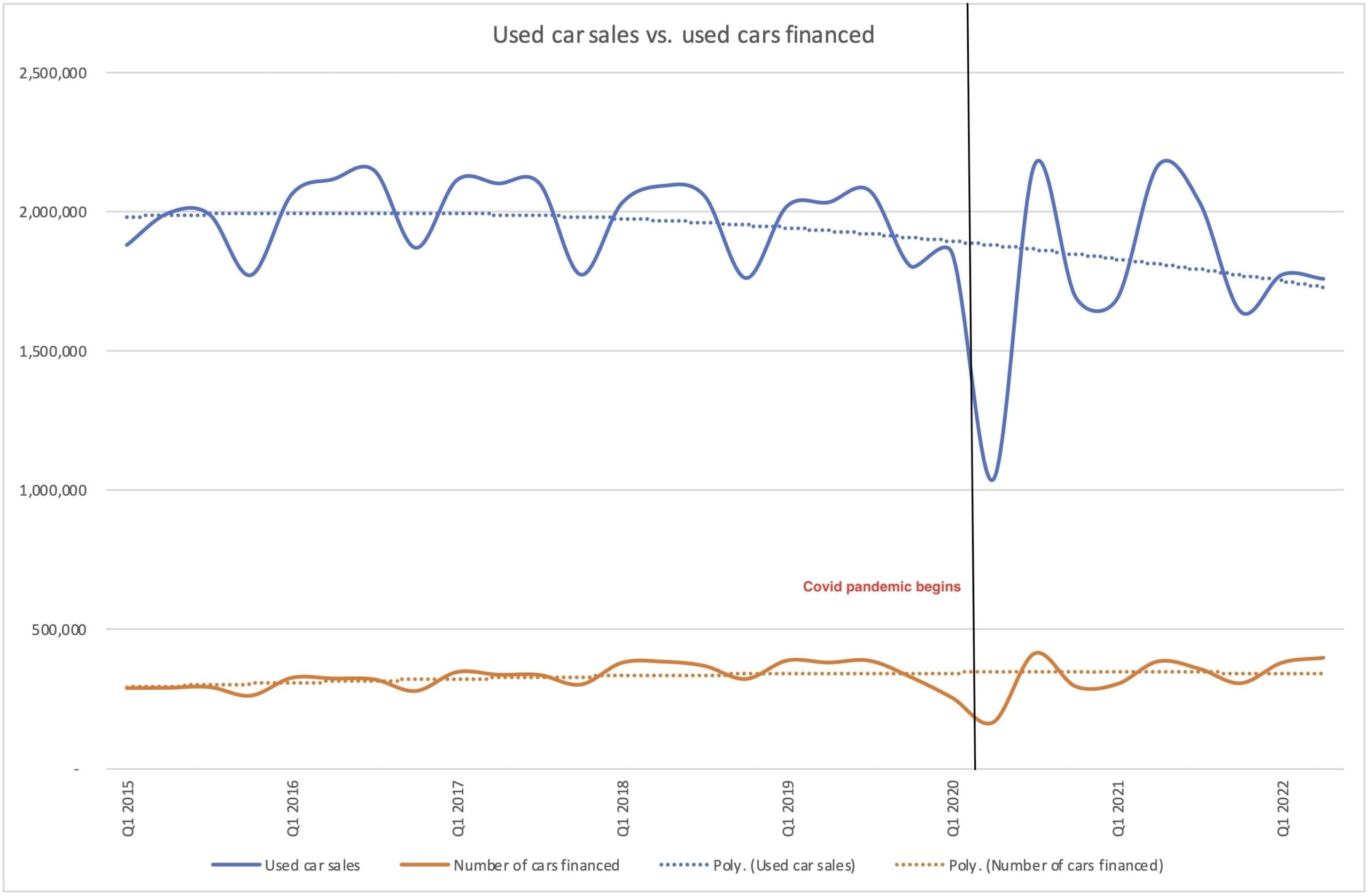
The first chart illustrates the number of used cars sold vs the nuber of private used car finance agreements. Unfortunately, the scale of the chart means it’s difficult to see the levels of change going on. We also only have used car sales data back to 2015[10], rather than 2009, as that’s how long the SMMT has been publishing quarterly used car sales reports.
You can see that sales still fluctuate throughout the year, roughly in line with the new car market but with far less variation. Post-Covid data shows enormous fluctuations in sales numbers throughout 2020 and 2021 as a result of multiple lockdowns across the UK.
What is still evident, however, is the steady growth of average car finance debt since 2009. This has accelerated since the Covid pandemic and especially since late 2021, largely thanks to severe shortages in new car stock forcing would-be new car buyers to look for used car options instead.
It’s also important to remember that used car finance agreements usually charge a lot more interest than new car finance agreements, so a larger component of a customer’s car finance debt is interest rather than capital. This increases the precariousness of their financial position if circumstances turn against them and they find themselves in financial hardship, as even if they can sell their car (which is not a given), it almost certainly won’t cover the debt still owed.
Since 2009, average used car borrowing has increased by 87% from about £8,400 to almost £15,800.
Finally, we have average weekly earnings from January 2009 to June 2022. These have increased steadily over the last 13 years, but at a much lower rate than borrowing has grown. And when you take into account inflation and increased costs of living over the same time, disposable income has hardly increased at all.
Since 2009, average weekly earnings have increased by about 33%, from £429 to £607. By comparison, average new car borrowing has increased by more than 100% and used car borrowing has increased by 87%.
The Renault Clio is asmall, supermini-class hatchback. The latest fifth-generation model was unveiled at the 2019 Geneva motor show before arriving on UK streets in late 2019.
Like the last model, the new Clio is only available as a five-door hatchback. A high-performance Clio RS version is not expected, while a hybrid model joined the range in late 2020.
A facelifted range launched in Summer 2023, which only includes the hybrid ‘E-Tech’ powertrain as petrol and diesel engines have now been discontinued.
Reviews for the new Renault Clio have been broadly positive, with particular praise for its refinement and high-quality interior. However, it is not considered as good to drive as the now-discontinued Ford Fiesta.
As of December 2025, the Renault Clio has a New Car Expert Rating of B, with a score of 69%. It scores top marks for its low running costs and CO2 emissions, as well as its excellent reliability. However, its safety rating and media review scores are now only average.
Body style: Five-door hatch Engines: hybrid (petrol and diesel models now discontinued) Price: From £18,395 on-road
Launched: Spring 2019 Last updated: Summer 2023 Replacement due: TBA
Image gallery
Media reviews
Highlighted reviews and road tests from across the UK automotive media. Click any of the boxes to view.
Featured reviews
“Renault hasn’t made any broad sweeping changes to its compact Clio, but then again it didn’t need to. This latest iteration of the small hatchback builds on the strengths of its predecessors, now offering even more value-for-money and one of the best driving experiences in the small car class.”
“The Renault Clio is a small hatchback with a plush-feeling cabin and a very practical boot, but it’s not as comfortable to drive as some alternatives.”
Model reviewed: Hybrid Esprit Alpine Score: 9 / 10 “The Renault Clio remains a front-runner in the supermini sector, despite this facelift not really bringing many changes. The firm’s use of Alpine as a sporty trim level is an interesting move.” (Alistair Crooks) Read review
Model reviewed: Range overview Score: 9 / 10 “The Renault Clio is a star of the supermini class – well-built, good to drive and packed with tech.” Read review
Model reviewed: 1.6-litre petrol/electric hybrid E-Tech S Edition Score: 9 / 10 “The Renault Clio is already a big hit and the addition of clever hybrid technology only strengthens the supermini’s position as one of the very best in its class. Being able to achieve upwards of 60mpg in the real world, without needing to make any major compromise, is truly impressive.” Read review
Model reviewed: TCe 100 Score: 9 / 10 “There’s a lot to like about the new Renault Clio.” Read review
Auto Trader
Model reviewed: 2023 facelift range Score: 9 / 10 “Updated with fresh looks and with a slick hybrid option, the Renault Clio is a small car that goes big on ability.” (Dan Trent) Read review
Car
Model reviewed: 1.6-litre petrol-electric hybrid automatic (2023 facelift) Score: 6 / 10 “The changes to the Renault Clio are pretty minimal, but that isn’t much of a criticism. The new version is just the same likeable little hatchback we’re used to, but now it has a bit more tech and an updated exterior. A big boot, stylish design and a choice of efficient powertrains will continue to work in its favour, so it remains among the best small hatchbacks out there.” (James Fossdyke) Read review
Model reviewed: 1.0-litre petrol manual Score: 8 / 10 “This is a significantly better package than the previous Clio, which was quite rightly a popular choice.” Read review
Car Keys
Model reviewed: 1.3-litre petrol automatic RS Line Score: 9 / 10 “This expensive range-topping engine with its automatic gearbox isn’t the finest in the Renault Clio range, but go a bit further down the trim level list and you’ll have one of the finest superminis on sale today.” Read review
Carbuyer
Model reviewed: Range overview Score: 8.8 / 10 “A splendid interior, mild-hybrid technology and extra space makes the Renault Clio a real contender in the supermini class.” Read review
Company Car Today
Model reviewed: E-Tech hybrid 140 Iconic “A good low-emission, although not cheap, option for fleets not ready or able to move to plug-ins, the Clio is a well-packaged and efficient.” Read review
Model reviewed: 1.3-litre petrol automatic RS Line Score: 7.9 / 10 “Renault has pushed the Clio back up the table after sliding out of favour. The excellent whole-life costs and big boot combine with a decent drive and good looks.” Read review
Model reviewed: Range review “Renault has delivered an excellent package with the new Clio. The quality of the materials in the cabin are particularly good and aside from some road noise intrusion, the driving experience is close to the best in the supermini sector.” Read review
Daily Mirror
Model reviewed: 1.0-litre petrol manual Iconic Score: 8 / 10 “There has been a revolution with the new Renault Clio, but you’ll have to step inside to see it.” Read review
Fleetworld
Model reviewed: 1.3-litre petrol automatic R.S Line Score: 6 / 10 “With its neat looks, the premium feel to the interior, keen drive and affordable pricing, even in R.S Line trim, the Renault Clio looks like a serious contender in the supermini sector. Although we’d prefer a manual option and more affordable Clio trims such ‘Iconic’ might be a better fit for fleet.” Read review
Green Car Guide
Model reviewed: 1.0-litre petrol manual 100hp Iconic Score: 6 / 10 “The new Renault Clio offers cheap and cheerful motoring, but we’d recommend opting for the all-electric Renault Zoe.” Read review
Honest John
Model reviewed: Range review Score: 8 / 10 “Much improved interior and desirable looks.” Read review
Model reviewed: Range review Score: 8 / 10 “The fifth-generation Renault Clio boasts one of the largest boots in its class, with 391 litres available with the rear seats in place.” Read review
Model reviewed: Range review “The new Renault Clio is well built, has a unique sense of style and remains the most fashionable car in its class.” Read review
Parkers
Model reviewed: Range review Score: 9 / 10 “Best-selling small hatchback now has other talents to back-up good looks” Read review
The Sun
Model reviewed: E-Tech “The Clio E-Tech is not only an appealing addition to the best-selling little French car’s line-up but an essential one which bundles standard driver assistance systems. It even drives rather nicely too.” Read review
Model reviewed: Range review “In any other world, this would be the best car of its size and price but the Ford Fiesta still edges it with its sparkling chassis.” Read review
The Sunday Times
Model reviewed: Range review Score: 7 / 10 “New Renault Clio feels posher and is more practical than ever.” Read review
The Telegraph
Model reviewed: 1.6-litre petrol-electric hybrid E-Tech Iconic Score: 8 / 10 “This hybrid model is now the Clio to have. It does away with the lumpy power delivery and high-speed breathlessness of the conventional petrol, and the noise of the diesel alternative.” Read review
Model reviewed: 1.0-litre petrol manual Score: 8 / 10 “Whether this successful makeover will catapult the Renault Clio to the top of the supermini class remains to be seen, but when coupled with a decent ride, fine drivetrains and the prospect of new tech, it’s a highly attractive small car once again.” Read review
Top Gear
Score: 6 / 10 “This hybrid Renault Clio Hybrid is the sort of car you’ll buy with your sensible hat on.” Read review
Model reviewed: Range overview Score: 6 / 10 “Neither revolutionary in style nor the most exciting to drive, but a very mature car.” Read review
Safety rating
Independent crash test and safety ratings from Euro NCAP
Clean Air Index: 4.6 / 10 Energy Efficiency Index: 6.9 / 10
The current-generation Renault Clio was tested by Green NCAP in 2020, and was commended by the assessing body for its “very creditable three-star rating”, which is above average by petrol car standards.
The rating above only applies to a Clio which is powered by a 100hp 1.0-litre petrol engine and fitted with a manual gearbox. It does not apply to any other engine/gearbox combination.
Running cost rating
Monthly cost of ownership data provided exclusively for The Car Expert by Clear Vehicle Data
Fuel consumption
Average
Score
Petrol models
54 mpg
B
Diesel models
65 mpg
A
Hybrid models
66 mpg
A
CO₂ output
Average
Score
Variation
Score
Petrol models
119 g/km
B
Diesel models
110 g/km
A
Hybrid models
97 g/km
A
Insurance group
Average
Score
Variation
Score
All models
13
A
Service and maintenance
Cost
Score
Year 1
£168
B
Year 2
£477
B
Year 3
£761
B
Year 4
£947
B
Year 5
£1,329
B
Overall
£3,682
B
The Renault Clio is a very affordable car to own and run, according to whole-life cost numbers provided exclusively to The Car Expert by our data partner, Clear Vehicle Data.
Your servicing and insurance bills should be very inexpensive compared to most cars on the road, while the engines are economical and efficient, so your fuel bills should be better than most other cars.
Reliability rating
Reliability data provided exclusively for The Car Expert by MotorEasy
Total claims: 175 Average repair cost: £283.04 Last updated: April 2025
The Renault Clio has a very good reliability score of 87%, according to workshop and warranty data provided exclusively to The Car Expert by our partner, MotorEasy. This score applies to both the current model (2019 onwards) as well as previous models.
As well as being generally reliable, the average repair bill to fix a Clio when it goes wrong is also low, at less than £300. However, watch out for gearbox faults, which cost an average of more than £1,200 to repair.
If you own a Renault Clio, or you’re thinking about buying a used Clio, make sure that any used car warranty you purchase covers all of the potential problem areas shown above.
Warranty rating
New car warranty information for the Renault Clio
Overall rating
D
28%
Petrol or diesel models
E
15%
Electric or hybrid models
C
50%
New car warranty duration
3 years
New car warranty mileage
60,000 miles
Battery warranty duration
8 years
Battery warranty mileage
100,000 miles
Renault’s new car warranty is pretty much the bare minimum, and falls short of many rivals. The duration is three years with a limit of 60,000 miles, while some other brands offer up to seven years.
In addition to the standard new car warranty, the Clio hybrid models have an eight-year/100,000-mile warranty for the battery components.
Warranty on a used Renault Clio
If you are buying an ‘Approved Used’ Renault Clio from an official Renault dealership, you will get a minimum 12-month warranty included.
If you are buying a used Renault Clio from an independent dealership, any warranty offered will vary and will probably be managed by a third-party warranty company.
If you are buying a used Renault Clio from a private seller, there are no warranty protections beyond any remaining portion of the original new car warranty.
If you’re looking to buy any used car that is approaching the end of its warranty period, a used car warranty is usually a worthwhile investment. Check out The Car Expert’s guide to the best used car warranty providers, which will probably be cheaper than a warranty sold by a dealer.
Date: February 2020 Recall number: R/2020/023 Model types: All Build dates: 06/2019 to 10/2019 Number of vehicles affected: 72 Defect: The message ‘power steering failure’ displayed on the vehicle’s dashboard and a downgrading of the power steering assistance. Remedy: The steering column will be replaced.
As of September 2024 (our most recent data point), there has been one DVSA vehicle safety recall on this generation of Renault Clio, which only affected a handful of cars.
Not all vehicles are affected by recalls. You can check if your car is included in any of the above recalls by visiting the DVLA website or contacting your local Renault dealer.
If your car is affected by a recall, the vehicle must be repaired and you should not be charged for any work required. If you are buying a used Clio, you should insist that any outstanding recall work is completed before you take delivery of the vehicle.
Using our unique Expert Rating Index, The Car Expert consistently highlights the most impressive, efficient and affordable cars available in the UK, to help readers find the best new cars to meet their needs. But what about the cars you should avoid?
By aggregating more than 13,500 new car reviews from 30 different media titles, our award-winning Expert Rating Index now includes nearly 450 different cars across an automotive industry that is constantly trying to evolve and innovate with the times.
It’s inevitable that some new cars will struggle to compete, whether they’re older models that have fallen behind the curve, or models that were simply substandard from the start. Using the Expert Rating Index, we have listed the ten worst new cars on sale in the UK, as judged by the country’s top motoring websites.
All of these cars are (or have been) available for sale in 2022, although several will be withdrawn or replaced before the end of the year. The good news is that you can pick most of these cars for a relative bargain – either brand new or second-hand – which makes them a lot more attractive.
Last year, the bottom three cars were all from Mitsubishi, which has now departed the UK car market altogether. Six of the cars below have carried over their inclusion in this undistinguished list from last year, however,
With comprehensive review data backing the rankings below, you can be confident that this is the definitive guide to the worst new cars in the UK.
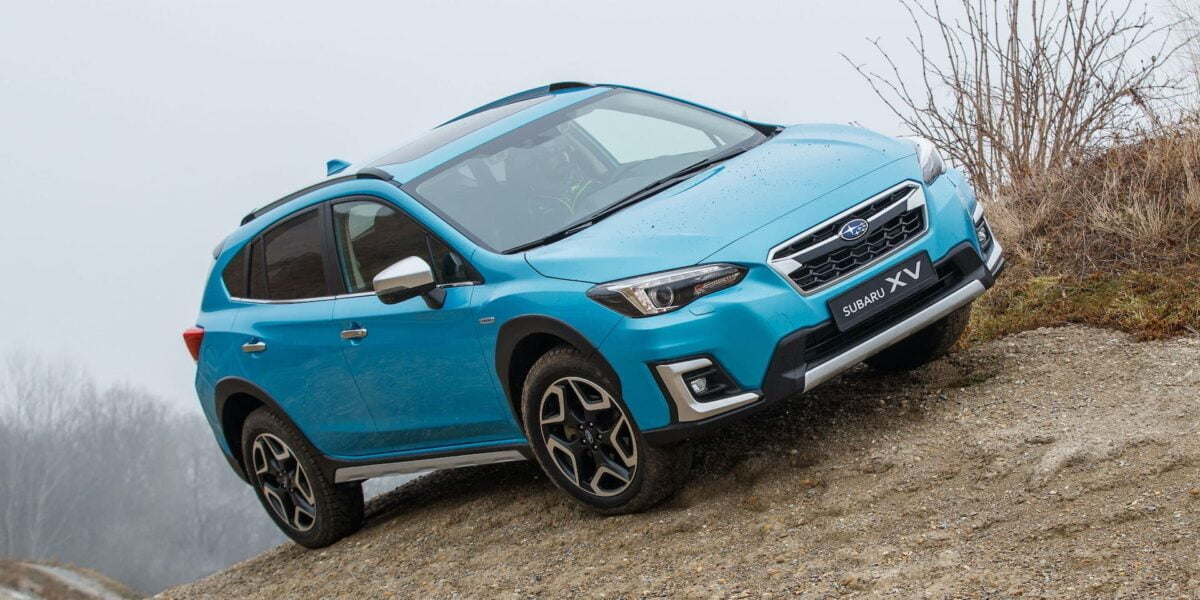
10th place: Subaru XV (51%)
On sale since 2017, the second-generation Subaru XV SUV has not had much love from the UK media. Journalists generally conclude that the XV is a competent car in isolation, and a capable off-roader. But alternatives are more practical, and cost less to buy and run.
Now available as an ‘e-Boxer’ mild hybrid as standard, the XV has become slightly more appealing to UK buyers in recent years, but its partial electrification is not enough to make it stand out in a very competitive medium SUV class.
The Maserati Ghibli is an upmarket saloon that’s often been described as alluring and compromised in the same sentence. Beyond the attractive exterior styling, strong performance and brand image, the Ghibli has the highest fuel consumption of any car on this list and has been criticised for its comparatively high price tag.
The Ghibli’s biggest issue, however, is the strength of its executive saloon rivals. The Audi A6, BMW 5 Series and Mercedes-Benz E-Class offer superior interior refinement and ride comfort for a much lower price. Essentially, the Ghibli is a decent car in a field dominated by outstanding cars.
The quirky Abarth 695 hot hatch is the range-topping model in the brand’s performance-focused range, and its punchy performance, sporty styling and exclusive limited-run model releases offers a unique driving and ownership experience.
Considering this, it’s rather unfortunate that the hot hatch has been widely described as both outdated and expensive. The three-door car is certainly not the most practical hot hatch on the market, and some reviewers argue that you can have just as much fun in the more comfortable Ford Fiesta ST for thousands of pounds less.
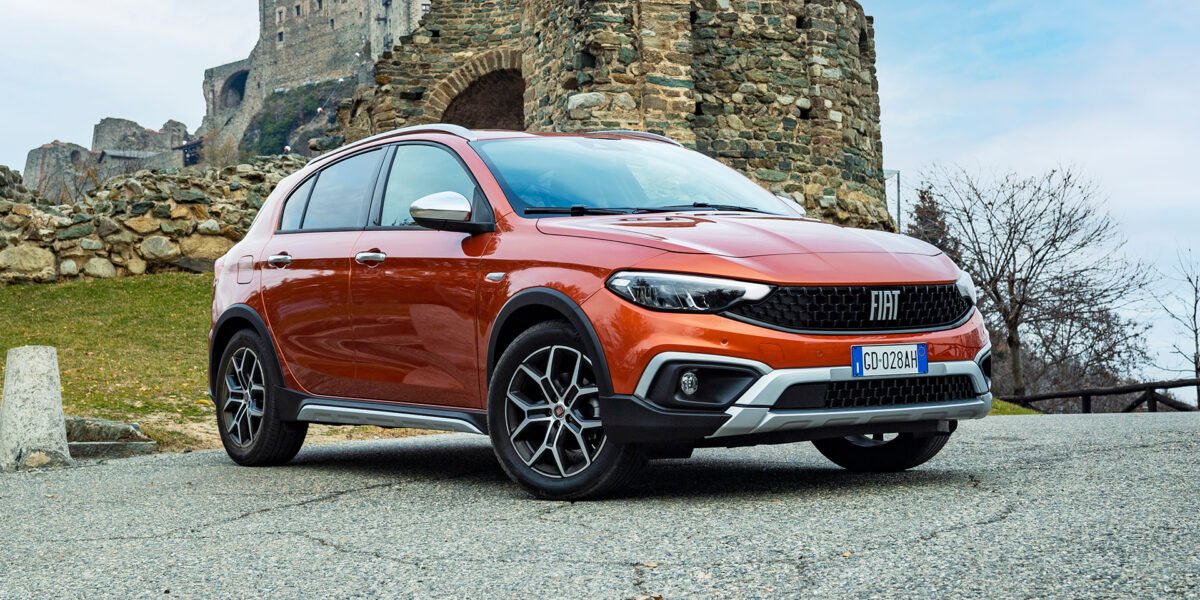
The Fiat Tipo is the Italian brand’s competitor in the budget end of the crowded family hatchback class – praised for its keen pricing, spacious cabin and good standard equipment levels.
However, the car’s cheap price tag has caused compromises in other areas. The Tipo is widely regarded as dull to drive and cheap inside, and its engine is not as efficient to run as other budget alternatives, which raises running costs in the long term.
The Tipo also has a questionable three-star Euro NCAP safety rating, and when you look to sell it on, its resale values won’t be very strong either.
MG has made large strides recently with its latest models – like the highly praised MG 4 electric family hatch – but the ageing MG 3 is a relic from previous generations. Originally launched in 2014 and facelifted in 2019, it has received fairly negative reviews throughout its lifespan.
The MG 3 has been frequently commended for its affordability and extensive warranty, and did show some promise as the budget alternative in the supermini class. But that was before the arrival of the latest Dacia Sandero, which is a better car in every aspect for a slightly cheaper price.
Reviewers generally conclude that the MG 3 makes for a very uninspiring driving experience – a wheezy and under-powered engine, cheap interior trim, and lack of basic safety features and infotainment gadgets culminating in what is a very underwhelming car.
MG has been a sales success over the last few years, with the petrol-powered MG ZS leading that charge, but media reviewers haven’t been as kind as customers. The petrol ZS languishes with an Expert Rating score of just 45% – although the electric ZS EV version does markedly better, with a score of 63%.
One of the unique positives of the MG ZS is its seven-year new car warranty, and this budget SUV does offer great value for money, offering a starting price far lower than its rivals. However, MG has been outclassed again by Dacia, as the Dacia Duster is a better package than the MG ZS in every category, and all for a cheaper price.
Much like the MG 3 supermini, the MG ZS has received criticism from the UK media for its cheap build quality, poor safety rating and its inferior engine quality. In summary, it’s good value but not really a good car.
Designed to be the ultimate budget city car, the latest refresh of the Smart Fortwo coincided with the brand’s bold decision to make its range electric only back in 2019. Unfortunately, this has not improved the UK reviews of this pint-sized urban car.
The EQ Fortwo has often been described as fun to drive, and its size means that it is very agile in urban scenarios and quite easy to park.
However, the short battery range makes longer trips outside the city impossible. Add to this that there are cheaper combustion-powered city car alternatives with more storage space, rear seats and better infotainment, and you can see why the EQ Fortwo is simply not a viable option for most car buyers.
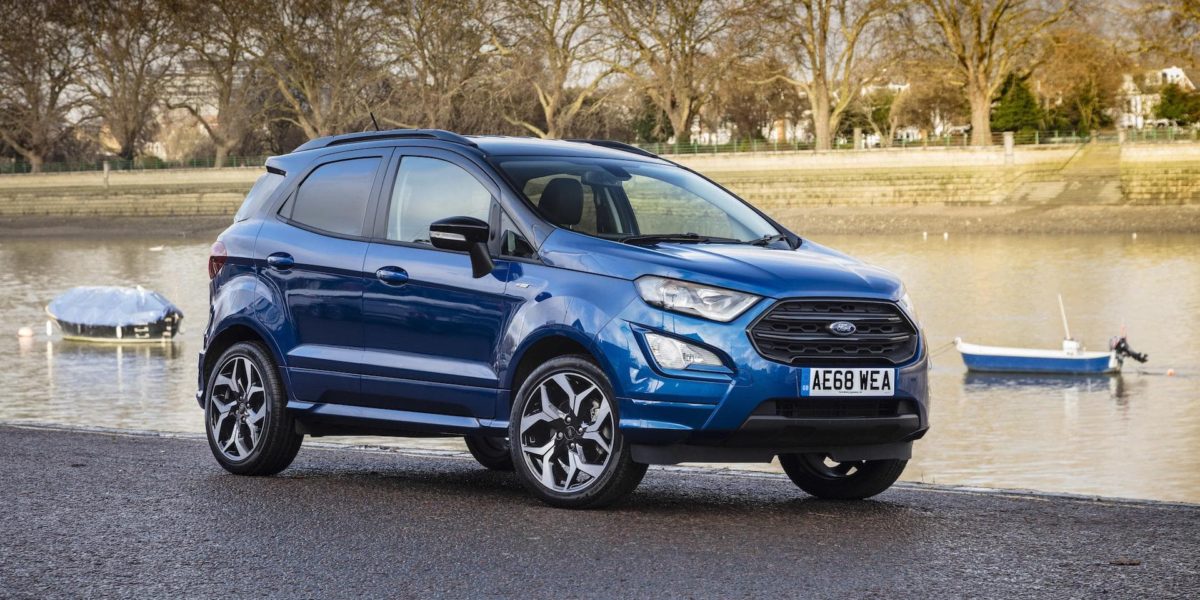
Launched in the UK in 2013, it is fair to say that the Ford EcoSport did not get off to a great start, being poorly received across the entire of the UK motoring media for being a sub-standard package in pretty much every area.
The EcoSport was markedly improved by its 2017 facelift, which greatly improved its interior trim, exterior design, and tech feature line-up, but it still faces very tough competition from SUV alternatives with more value for money, more practical features, and better performance.
The Ford EcoSport even has competitors within the Ford family – the 2020 arrival of the energetic yet sensible Ford Puma suggesting the EcoSport’s days are numbered. We thought it may have finally bitten the dust when pricing was removed from the Ford UK website last year, but it is now available to order once again, not that we expect Ford to sell many when the Puma and larger Kuga are proving to be far more popular.
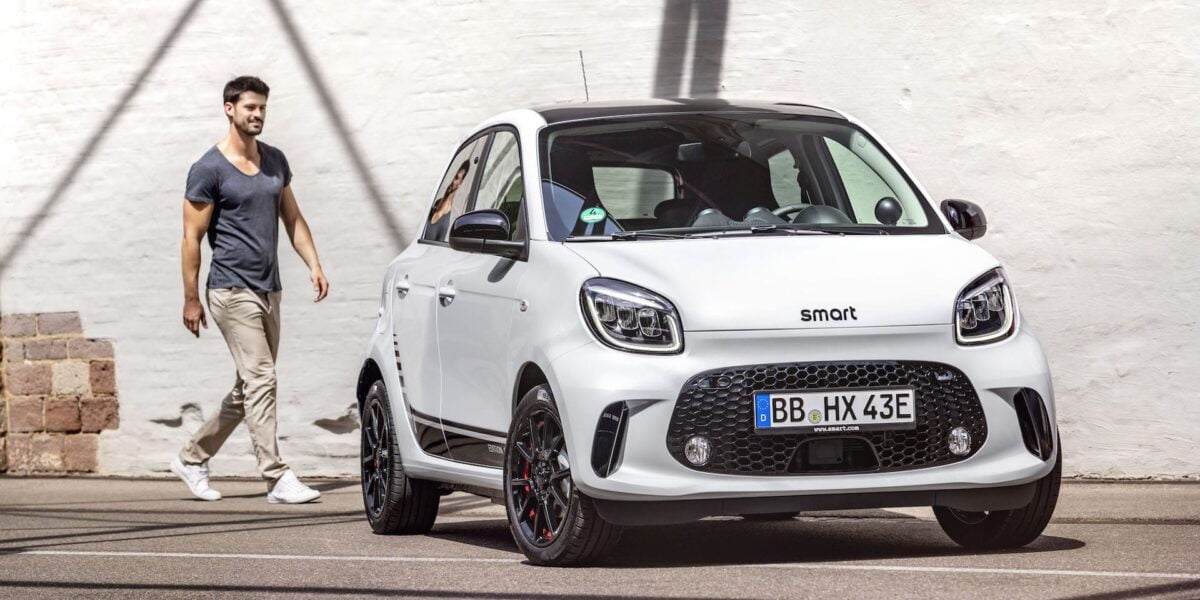
The second Smart entrant on this list with an Expert Rating of 41%, the EQ Forfour is currently the lowest-ranked new small car in our Expert Rating Index. Er, congratulations?
The EQ Forfour suffers from a lot of the same ailments as its sister model the Fortwo; it has only a little boot space and a poor battery range, and simply does not stand up very well to other (admittedly petrol-powered) city car options like the Hyundai i10 or Volkswagen Up.
There’s obviously more cabin room than in the smaller EQ Fortwo, and it’s very nimble in tight urban areas, but from a value for money perspective, it is the lowest-rated compact EV you can buy today. Having received largely negative reviews across the board in recent times, it is clear to see why Smart has only sold just over 1,000 vehicles in the UK so far this year.
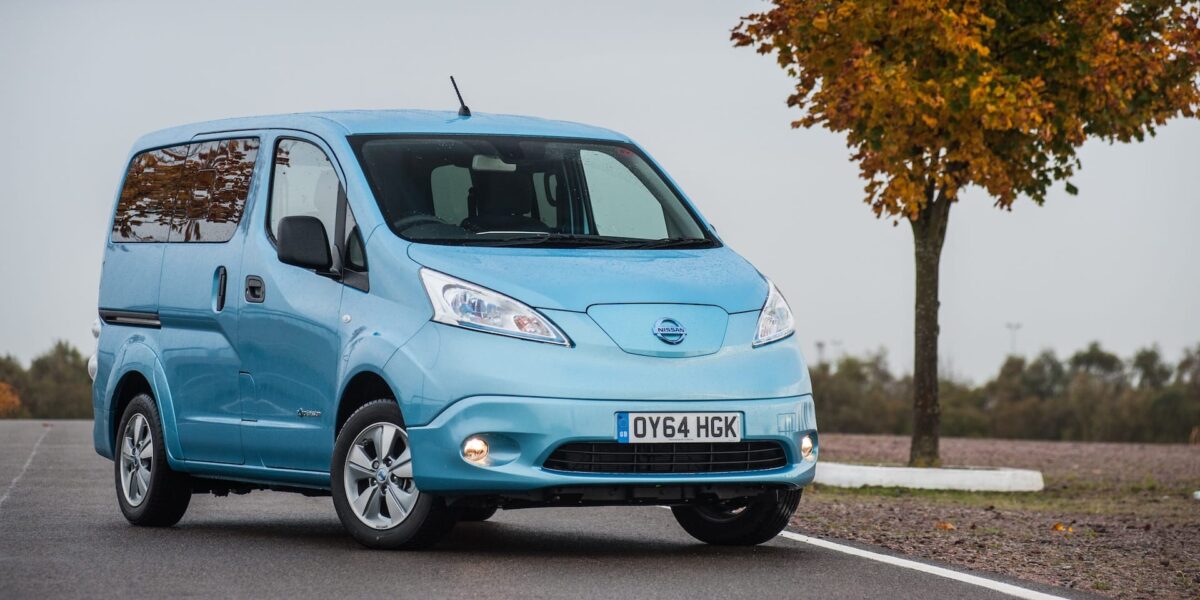
An all-electric seven-seat people carrier that’s essentially a modified delivery van, the Nissan e-NV200 Combi is certainly not one of the most comfortable passenger vehicles you can buy, and is currently the lowest ranked car still on sale in our entire Expert Rating Index.
The e-NV200 Combi has been around since 2014 and spent most of its production life in a category of its own. That changed this year with the arrival of the Vauxhall Combo-e Life/Peugeot e-Rifter/Citroën ë-Berlingo triplets, which are all far more refined. The Nissan will soon be put out of its misery, to be replaced by an all-new model called the Townstar before the end of the year.
Devoid of industry awards, the e-NV200 Combi does have one unwanted accolade to its name; it received the lowest score ever given in an Auto Express review. Particular criticism is directed at the e-NV200 Combi’s poor safety standards and so-so battery range.
Nonetheless, the Nissan e-NV200 Combi does have low running costs on its side, along with a roomy interior. Production has now ended but there may still be new or near-new vehicles available at Nissan dealers. Maybe you can snag a bargain to make it worthwhile?
For the definitive rankings of the worst new cars on sale in 2022, we’ve used The Car Expert’s award-winning Expert Rating index. The index analyses new car reviews from 30 of the top UK motoring websites, using an advanced algorithm that we have developed specifically to compare review scores.
It constantly recalculates and updates the Expert Rating score for every single car every time a new review is added to our database to make sure you’re getting the most accurate and reliable ratings for every new car. The Expert Rating Index is now the definitive ranking for every new car on sale in the UK.
Driving in London isn’t exactly a stress-free experience to start with, but on top of the traffic there are also fees associated with driving in the city that you need to be aware of.
The London Congestion Charge Zone (CCZ) and the Ultra Low Emission Zone (ULEZ) are two separate areas where fees apply to most vehicles travelling in the city. Confusingly, they also operate at different times of day, and different days of the week. You may have to pay either one or both of these charges when you drive into certain areas of London.
The ULEZ currently covers the area inside the North Circular (A406) and South Circular (A205) roads. A separate Low Emission Zone (LEZ) expands out to Greater London. ULEZ charges apply all day, every day, apart from Christmas Day (25th December).
The ULEZ is charged at a standard daily fee of £12.50, which you have to pay each day that you travel in the zone. It’s important to note, the day runs from midnight to midnight so if you are travelling late at night you might have to pay for two days.
A guide to the London Ultra Low Emission Zone (ULEZ)
The Ultra Low Emission Zone is a government initiative introduced in 2019 to reduce emissions and harmful pollutants in the capital. To improve air quality, the initiative charges those with heavily polluting vehicles to travel into and with London.
When it first launched in 2019, the ULEZ covered the same area as the congestion charge zone. It expanded out in 2021 to its current size, covering everywhere inside (but not including) the North Circular and South Circular roads.
The ULEZ is expanding in 2023 to cover the entire area currently covered by the LEZ, which includes all of Greater London. This covers most of the area inside the M25 orbital motorway.
What are the ULEZ rules and what will they be in 2023?
The ULEZ applies to all vehicles travelling within the designated zone, with any charges depending on their emissions ratings. In comparison, LEZ charges only apply to commercial vehicles. When the ULEZ expands in 2023 this will affect all vehicles in all of Greater London.
If you live within the ULEZ, you have to pay the daily charge to drive any vehicle that does not comply with the emissions standards set out by the scheme (see below), even if you’re just popping down to the shops.
If your vehicle is parked in the ULEZ zone, you will not be charged if the car doesn’t move within that chargeable day.
What vehicles have to pay ULEZ?
Vehicles liable for the ULEZ charge are deemed to be too polluting and don’t meet current or EU emissions regulations (which are still used by the UK post-Brexit). The minimum requirements to avoid fees in the ULEZ are as follows:
Euro 3 for motorcycles, mopeds, motorised tricycles and quadricycles
Euro 4 for petrol cars, vans, minibuses and other specialist vehicles
Euro 6 for diesel cars, vans and minibuses and other specialist vehicles
Euro 6 became standard in the UK for all new cars registered from September 2015 onwards. There are many cars that were registered before this date that also comply with Euro 6 standards, but any diesel cars registered after September 2015 will be exempt from ULEZ charges.
Euro 4 was introduced some 16 years ago back in 2006, so most petrol cars will be compliant as the average life span for cars in the UK is 14 years. Cars made before Euro 4 standards have to pay the ULEZ charge as they are more likely to be bigger polluters – the rules are baed on the overall legal standards rather than specific emissions levels of individual vehicles.
Euro 3 for motorcycles (styled as Euro III to distinguish them from cars) came into effect in 2006, so again most motorcyles and scooters will be compliant and therefore won’t need to pay the charge.
The daily charge for all vehicles that do not meet the above emissions standards is £12.50. This is payable by midnight on the third day after travel.
In summary, if you have a petrol car first registered before 2006 or a diesel car first registered before September 2015, you will probably have to pay the ULEZ charge. If you have a petrol car registered in 2006 or later, or a diesel car registered in September 2015 or later (65-plate or later), you won’t have to pay the ULEZ charge.
How do I know if my car or bike is ULEZ-compliant?
Log on to Transport for London’s ‘Check Your Vehicle’ web page and you will be asked for your number plate. The system will then tell you whether your vehicle meets the ULEZ standards.
If your vehicle is compliant, there is nothing else you need to do (although you may still need to pay the congestion charge). If your vehicle does not comply, you can then click through to the ULEZ payment section.
How to pay ULEZ charges
ULEZ fees are mainly paid online now, but you can still pay via post if you prefer.
To pay online, log onto the ‘Pay to drive in London’ Transport for London website then enter your number plate and day of travel. After confirming that you definitely do need to pay the ULEZ charge, the system will proceed to the payment section.
If you regularly travel in the ULEZ and your car does not meet the requirements, you can set up automatic payments. This means every time you travel into the ULEZ, you will be automatically charged as long as the number plate of the vehicle you are driving matches the number plate you registered.
An annual £10 fee is charged to register each car for automatic payments. There’s also fleet auto pay for businesses that have more than five vehicles that will be travelling in central London. Again, this will charge automatically for the vehicles that have been registered.
Do I have to pay ULEZ on top of Congestion Charge?
Whilst the payments are processed on the same gov.uk portal, the ULEZ and congestion charge are separate fees with separate rules. If your vehicle is not ULEZ exempt, this needs to be paid in addition to congestion charge.
Will I be fined for not paying ULEZ?
ULEZ charges have to be paid by midnight on the third day after travel. If you fail to pay on time, pay for the wrong vehicle or incorrect day of travel, you will be fined if your vehicle is not exempt.
The fine is £160, but is reduced to £80 if paid within 14 days. As the zone operates from midnight to midnight you could be sent two separate fines for two days if you travelled around this time of night.
Will any vehicles be banned under new ULEZ guidance?
Current rules and the proposals for the 2023 expansion of ULEZ do not ban any vehicles from driving in the zone.
It is inevitable that the emissions thresholds for ULEZ will change over time (eg – the Euro 4 minimum requirement for petrol cars will eventually change to Euro 5), but so far there have been no announcements.
ULEZ discounts and exemptions
Disabled discounts
If Blue Badge holders travel in a vehicle that is registered in the ‘disabled’ or ‘disabled passenger vehicle’ tax class they do not have to pay ULEZ charges. This exemption is currently valid until October 2025, after which, vehicles in these tax classes that do not meet ULEZ emission standards will be required to pay the daily charge. If the vehicle is registered in these tax classes there is no requirement to register the vehicle on the government website to qualify for ULEZ exemption.
Local Businesses
Not-for-profit organisations can benefit from a 100% discount until October 2023 by registering on the government website. This applies to vehicles like minibuses that are used for community transport. After October 2023 vehicles will be required to meet emissions standards or pay the daily ULEZ charge.
Taxis
Taxis licensed in London are exempt from ULEZ but have a 15 year age limit. All new taxis must be Zero Emission Capable (ZEC).
Historic vehicles
Vehicles that benefit from ‘historic vehicle’ tax, cars that are over 40 years old, are exempt from ULEZ charges. However, this excludes classic vehicles that are used commercially.
What other cities in the UK have LEZ/ULEZ schemes?
Elsewhere in the UK there are Clean Air Zones (CAZ) that have similar rules to the LEZ and ULEZ. Cities with CAZs are as follows:
Bath
Birmingham
Bradford
Bristol (charging starts on 28 November 2022)
Greater Manchester (under review)
Portsmouth
Sheffield (charging starts in early 2023)
Tyneside – Newcastle and Gateshead (charging starts in winter: late 2022 to early 2023)
Not all cities listed currently apply to passenger cars, some operate mainly to reduce emissions from commercial vehicles and buses. However, more cities are introducing similar schemes. Glasgow also has a LEZ scheme that will include passenger cars from 2023. Oxford is currently running a Zero Emission Zone (ZEZ) pilot scheme for all vehicles that operates from 7am to 7pm, seven days a week.
The Mercedes-Benz A-Class and B-Class have both received minor mid-life updates, including some cosmetic tweaks, on-board software additionsand the introduction of mild-hybrid engine technology.
Both the A-Class and B-Class have been given a very mild visual facelift moving into 2023. The design of the headlights and rear diffuser have been tweaked, and Mercedes-Benz adds that it has updated the range of bodywork colours available, including both regular and metallic finishes.
There are no changes to the body styles previously on offer – the A-Class is available as either a hatchback or saloon, while the B-Class is only available as a larger hatchback.
Under the bonnet, all A-Class and B-Class models will be fitted with 48-volts of mild-hybrid assistance after the update, apart from the performance-focused Mercedes-AMG A 45 hot hatch. Plug-in hybrid models have been given a small horsepower boost, and will now accept an 11kW AC charger, as opposed to the old 7kW maximum (22kW DC charging still available).
Stepping inside, the latest iterations of the A-Class and B-Class come with an updated steering wheel wrapped in nappa leather, an additional USB-C port and a rear-view parking camera as standard.
A fingerprint sensor that can identify the driver is also said to be included from early next year. The infotainment system now runs the latest version of the brand’s ‘MBUX’ software, which allows the driver to customise the display design and colour of their infotainment screen.
Mercedes-Benz is yet to announce exactly when these updated model ranges will become available to order in the UK, and hasn’t announced their pricing yet either. These details will be revealed in the coming months.
The A-Class and B-Class both hold Expert Ratings of 71% – praised for their well-equipped and high-tech interiors, as well as their stylish exterior looks.
Consumer new car sales were down by about 4% compared to the same month last year in a disappointing September result for the car industry, although fleet sales have finally shown some signs of life.
The monthly new car registration figures published this morning by the Society of Motor Manufacturers and Traders (SMMT) reflect the ongoing chaos within the new car market, with nothing to really suggest we’re going to finish 2022 on a high.
Overall numbers were up by just under 5% compared to the same month last year. But, then again, last September was the worst September result in nearly 25 years, so being slightly better than the worst result in a quarter of a century isn’t a massive step forward.
The growth was largely due to increased fleet registrations, which were up 12% on last year (but then last year was down 43% on the year before…). Meanwhile, private new car sales were down 4% on last year, which in turn was down 25% on the year before.
Source: SMMT
EVs continue to grow, plug-in hybrids continue to tank
The SMMT release was unhelpfully misleading with a headline boasting that the UK had hit a ‘one million EV milestone’. However, this actually includes plug-in hybrids, which are rapidly becoming the kind of car that no-one wants.
Plug-in hybrids used to outsell proper EVs as car buyers were reluctant to completely cut the cord with fossil fuels and commit to an all-electric car. But with the latest generation of EVs offering more than than enough battery range for most household needs, the plug-in hybrid has fallen massively out of favour.
After the first nine months of the year, plug-in hybrid sales are down 15%, while full EV sales are up 40% and standard hybrids (that can’t be plugged in) are up 18%.
Meanwhile, diesel sales continue to fall but that’s not exactly news, since they’ve been doing that almost every month since about 2016.
Source: SMMT
Good month, bad month
Ford powered its way back to the top of the overall sales charts with a strong month as supply improved for its best-selling models (Fiesta, Kuga, Puma). Volkswagen also did well, placing second in the overall sales charts despite Golf still underachieving. Toyota was third, ahead of Kia, Nissan and BMW. Nissan’s strong month was largely thanks to an enormous result for the Qashqai (see below).
Across the industry, it was another month of very mixed fortunes. A few brands did very well, while many more were significantly below par.
The Nissan Qashqai, built in Sunderland, topped the new car sales charts in September with a remarkable performance. More than 9,300 Qashqais were registered for the month, which was 1,000 more than another stunning performance from the second-placed Tesla Model Y.
Tesla has form over the last couple of years of co-ordinating its new car deliveries to top the charts in key months, and 8,300+ Model Ys should have done the same in September – for reference, last year’s best seller in September was the Tesla Model 3, which logged fewer than 7,000 registrations.
In contrast, the Vauxhall Corsa fell out of the top ten altogether. Combined with the enormous result for the Qashqai, the 2022 new car sales race has suddenly been thrown wide open.
Source: SMMT
Literally one month ago, I wrote: “With four months to go, the Corsa holds a much larger lead than it did at this time last year. So unless Vauxhall has some kind of end-of-year sales meltdown, the Corsa looks set to retain its crown.”
Well, the Corsa didn’t quote have a meltdown (it still sold about 3,400 cars, which is well down on the same month last year but hardly a catastrophe), but the combination of a poor month plus the Qashqai’s barnstorming month means that the two cars are separated by only eight sales after nine months.
Could we see the Qashqai take the 2022 sales crown and become the first British-built car to top the sales charts in a very long time (I don’t actually even know how long, but certainly well over a decade)?
We’ll have our usual top-ten analysis in the next day or so.
Ssangyong has announced that the Rexton ‘Ultimate Plus’ is available to order in the UK “with immediate effect” – an additional range-topping trim that features more interior refinements and a sunroof.
Sitting above the standard ‘Ventura’ and the previously top-spec ‘Ultimate’ trim grades, the ‘Ultimate Plus’ builds on the latter package by increasing the SUV’s alloy wheels from 18 inches to 20 inches, and installing an electronically-powered sunroof.
The trim also adds self-dimming wing mirrors, which adjust to light intensity to give the driver improved visibility, and sunblinds for the rear windows.
An upholstery upgrade is included, which sees the seats trimmed in quilted nappa leather and suede. The ‘Ultimate Plus’ also comes with an air conditioning function exclusively for the third row of seats, wireless phone charging and a 360-degree parking camera.
Pricing for the new range-topping Rexton trim starts at just under £45k – £4k more than the ‘Ultimate’ trim grade its based on. Ssangyong says that the ‘Ultimate Plus’ can now be ordered from UK dealerships, though the trim has not been added to the brand’s website as of yet.
The Ssangyong Rexton currently holds an Expert Rating of 50% – a reflection of its modest set of review scores. Commended for its towing ability and off-road performance, the Rexton has also been criticised for its comfort and interior quality.
New car sales increase by 4.6% compared to last September but still 34% behind 2019
British built Nissan Qashqai tops the sales charts in joint most important month for the industry
Tesla sales bounce back with Model Y second highest seller in September, boosting EV sales results
September, the joint most important month of the year for new car sales, saw a slight increase of 4.6% compared to last year, masking an otherwise lacklustre result which lags behind 2019’s pre-pandemic sales by 34%, says The Car Expert.
Despite the economic and political turbulence, the British built Nissan Qashqai topped the sales charts for the month of September, with the crossover SUV securing 9,311 deliveries – more than doubling its result from last year. The Tesla Model Y took second spot, with its 8,315 sales helping to boost overall electric car sales to 38,000 for the month.
Consumer sales were down by 4% compared to September last year, while fleet deliveries grew by 12%. The outwardly positive data disguises an underlying reticence amongst buyers as the ongoing cost of living crisis stalls consumer confidence and points to a challenging final quarter of the year for the sector.
Stuart Masson, Editorial Director at The Car Expert, the UK’s most comprehensive automotive consumer advice site, said: “September is an incredibly important month for the sector as a whole. Any rise in sales should be welcomed given our political and economic circumstances, however we are way behind pre-pandemic sales levels. This isn’t necessarily a bad thing as it gives the industry an opportunity to create a more sustainable approach with a more balanced supply and demand position.
“Singling out individual models, the Nissan Qashqai’s success this year is a real boon for the brand, and for Britain too. The fact it is built here should be a source of pride and it could end up as the UK’s best-selling car of 2022 if Nissan can contain its current momentum,” continued Stuart Masson.
“It is interesting to see Tesla sales bounce back. It operates differently to other brands; its sales fluctuate dramatically but this month it is right back up there with the Model Y, which has become the country’s most popular electric car.”
Sales of electric vehicles grew by 16.5% compared to September last year as buyers increasingly turn to fully electric cars instead of plug-in hybrid vehicles, with demand slumping by nearly 12% compared to last year and continuing a year-long decline.
The Car Expert provides independent and impartial advice on every aspect of buying, financing, owning, and selling new or used vehicles. For more information, please visit: https://www.thecarexpert.co.uk/
ENDS
The Car Expert
Founded in 2011, The Car Expert is the UK’s most comprehensive automotive consumer advice site. With an audience of over two million readers a year, The Car Expert provides independent and impartial advice on every aspect of buying, financing, owning, and selling new or used vehicles.
The Rotten Tomatoes equivalent for the automotive world, The Car Expert consolidates reviews from 30 of the UK’s top automotive websites to create the Expert Rating Index. Bringing together science and data analysis, the index calculates a weighted average to give an aggregated score – Expert Rating – that is comparable across different brands and models.
The Expert Rating Index factors in the age of each review, so that newer reviews carry more weight than older reviews. It also breaks down the complex web of different scoring systems that various websites use in their reviews.
The Car Expert has logged over 13,000 reviews covering more than 400 cars and over 50 manufacturers, with its Expert Rating Index now trusted as the gold standard for rating and ranking new cars in the UK.
For media enquiries, please contact Performance Communications:
Maserati has given us a first look at its second-generation GranTurismo luxury coupé range, which includes 490hp and 550hp petrol V6 models, and a range-topping 760hp all-electric version.
The previous GranTurismo 2+2 coupé ended production in 2019. While the first-generation’s V8 engines have been swapped for a smaller V6 and an electric alternative, Maserati says this new model is more powerful than ever before.
The company says that three different GranTurismo models will be available with different powertrain setups. The range begins with the ‘Modena’, which is powered by a 3.0-litre twin-turbocharged V6 petrol engine which produces an output of 490hp.
The more expensive ‘Trofeo’ model uses the same V6 engine, but with a number of tweaks and upgrades to increase the car’s output to 550hp. With a 0-62mph sprint time of 3.5 seconds, these V6 GranTurismo models are set to challenge rivals like the Aston Martin Vantage, Ferrari Roma and Mercedes-AMG GT coupé.
Sitting at the top of the range will be the all-electric GranTurismo ‘Folgore’, which Maserati is hoping will be able to pose a strong challenge at the top end of the luxury electric market against established rivals like the Audi e-tron GT, Porsche Taycan and Tesla Model S.
Powered by a 93kWh battery which feeds three electric motors (two in the back and one on the front axle), the Folgore can be driven in rear-wheel or all-wheel drive configurations, and is the fastest model in the range. Producing 760hp, Maserati claims that it can complete a 0-62mph sprint in 2.7 seconds – that is two tenths of a second quicker than the brand’s current sports car flagship, the MC20.
The exterior styling of the new GranTurismo is fairly consistent across the model range, with subtle front bumper and exhaust pipe tweaks being the only noted differences between V6 and electric variants. As well as being much heavier, the Folgore also has a smaller boot than its petrol-powered siblings – to accommodate its chunky battery pack.
Speaking of the interior, the manufacturer adds that the GranTurismo will be equipped with the brand’s latest infotainment system with voice assistance as standard. A heads-up display, which projects driving information onto the windscreen, will be an optional extra. Folgore electric models will also have an articifical soundtrack pumped through the speaker system.
More information, including UK pricing, will be released closer to the coupé’s UK launch. Petrol models are expected to arrive in Spring next year, and the electric ‘Folgore’ in the second half of 2023, but nothing is confirmed as of yet.
The new second-generation Mercedes-Benz GLC SUV is now on sale in the UK, ahead of the first customer orders arriving at the start of next year.
In contrast to the outgoing GLC range, this new line-up consists only of partially-electrified models. One petrol and two diesel engines fitted with 48V of mild-hybrid assistance are on offer, as well as a range-topping petrol plug-in hybrid variant. The latter pairs a 2.0-litre turbocharged petrol engine with a 100kW electric motor for a combined output of 313hp. Mercedes-Benz adds that a more powerful 335hp diesel-powered plug-in hybrid option will be added to the range soon.
While the car’s engine range has seen plenty of change, the design of the new GLC is pretty familiar. The latest iteration of the SUV has a nearly identical silhouette to the previous generation, but the manufacturer says that it has refreshed the GLC’s front end with a headlight redesign and the introduction of a new-look radiator grille.
Customers can choose between three different trim levels, the entry-level ‘AMG Line’, the mid-range ‘AMG Line Premium’ and top-spec ‘AMG Line Premium Plus’. Please note that these are not performance-enhanced Mercedes-AMG models, just sporty AMG-inspired trims.
All models come with suspension upgrades in the front and rear that Mercedes-Benz says improve ride comfort, handling and driving enjoyment. The new GLC also comes with a ‘transparent bonnet’ camera feature that gives you a top-down view of the road ahead and the terrain underneath the front of the car on the infotainment screen, to assist off-road driving.
Speaking of the infotainment, the GLC comes with a 12-inch digital instrument cluster behind the steering wheel, and a 12-inch portrait-oriented central screen. Those who opt for the top-spec ‘AMG Line Premium Plus’ package gain a heads-up display that projects driving information onto the windscreen when on the road.
The upholstery of standard ‘AMG Line’ and mid-range ‘AMG Line Premium’ models are trimmed in synthetic ‘Artico’ leather, while range-topping ‘AMG Line Premium Plus’ variants are instead trimmed in real leather.
Prices for the new GLC range start at under £52k for the diesel-powered ‘220 d’, rising to just over £72k for the ‘300 e’ plug-in hybrid. Mercedes-Benz is now taking orders for the new SUV range, and plans to deliver the first UK customer orders in January next year.
Kia has expanded its Soul EV UK range by introducing a less powerful lead-in trim grade that is now available to order.
Called the Soul EV ‘Urban’, this entry-level model is powered by a 39kWh battery and 100kW electric motor pairing, which offers a promised all-electric range of 171 miles.
While this is the first time that the Soul EV has been offered in this configuration in the UK, it is not exactly new. This smaller battery and electric motor combo was on display at the electric car’s launch at the Geneva motor show in 2019, when it was called the ‘Standard Range’.
Prior to this range update, the Soul EV had been offered with a single powertrain option – featuring a bigger 64kWh battery and more powerful 150kW electric motor. Offering up to 280 miles of travel on a single charge, this powertrain is still available as part of the range-topping ‘Explore’ trim.
Key trim level features
Entry-level ‘Urban’ (£32,795)
17-inch alloy wheels
LED headlights
Eight-inch touchscreen infotainment with Android Auto and Apple CarPlay
Seven-inch digital instrument cluster
Electrically folding, adjustable and heated door mirrors with LED indicators
Reversing camera system
Engine ‘Start/Stop’ button and keyless entry
Automatic air conditioning
Lane-keeping assistance
Adaptive cruise control
Cloth upholstery
Top-spec ‘Explore’ (£38,995)
Ten-inch touchscreen infotainment with Android Auto, Apple CarPlay and navigation software
Auto-dimming rear-view mirror
Rear parking sensors
Black leather upholstery
Heated front seats and steering wheel
Leather steering wheel
Privacy glass
Rain sensing front wipers
Roof rails
Blind spot monitoring
The introduction of the ‘Urban’ trim reduces the entry-level price of the Soul EV to under £33k, which is over £4k cheaper than the car’s 2020 launch price.
However, in addition to its less powerful engine, the ‘Urban’ does come with less on-board equipment and interior refinements than the ‘Explore’, which was the previous standard.
While entry-level models do come with the same seven-inch digital instrument cluster behind the steering wheel, they also come equipped with a smaller eight-inch infotainment screen. Keyless entry and adaptive cruise control are included as standard, but you will need to upgrade to the ‘Explore’ trim to get rear parking sensors and blind spot monitoring.
Before the update, all Soul EV models came with black leather upholstery, but now this feature is reserved for ‘Explore’ models. The seating in ‘Urban’ variants is instead trimmed in cloth.
Praised for its nippy performance, low running costs and its class-leading battery range, the Kia Soul EV currently holds an Expert Rating of 77% – a score hindered by the car’s rather divisive exterior styling.
The Citroën ë-Berlingo is an electric van-based people carrier that first arrived on UK roads in 2021. It is the EV version of the regular Berlingo people carrier that has recently been discontinued, and is nearly identical to the likes of the Peugeot e-Rifter and Vauxhall Combo-e Life.
As part of parent company Stellantis’ EV strategy, all of the company’s passenger vans are now electric-only (although petrol and diesel are still available for regular commercial vans).
The ë-Berlingo has been widely praised for its practicality and relaxing driving experience, but frequently criticised for its rather short battery range.
Darren Wilson of Auto Express argues that the ë-Berlingo is the “ideal car for a family with a small business”, as its more spacious inside than similarly priced SUVs and estate cars, and it is both cheap and quiet to run. The Telegraph‘s Alex Robbins adds that this electric people carrier’s price is “reasonable, albeit not an outright bargain”.
Being based on a van, many of the interior fittings and trims are not as slick as some car-based rivals. And within the Stellantis family, the Vauxhall Combo Life probably provides better value for money overall – although that depends on the final price you’re paying for the vehicle.
An updated ë-Berlingo arrived in the UK in Spring 2024. This features a minor styling update, improved battery range, enhanced interior comfort and better infotainment technology. However, it’s still the same basic vehicle, so key dimensions and overall attributes will remain the same.
As of August 2025, the Citroën ë-Berlingo holds a New Car Expert Rating of B, with a score of 67%. It gets top marks for its low running costs and zero tailpipe emissions, although its new car warranty is average while its safety rating and media review scores are poor.
Model reviewed: Range overview Score: 8 / 10 “It’s extremely practical, with loads of room, simple folding seats and three Isofix points. It’s cheap to run and ideal for shorter daily journeys around town.” Read review
Business Car
Model reviewed: Range overview “The ë-Berlingo still feels beefy on the road due to its sheer size, but the instant torque and quiet operation of its electric powertrain certainly helps mask its van DNA – and overall, it is quite lovely to drive.” Read review
Carwow
Model reviewed: Range overview “Citroen’s all-electric MPV is big and incredibly practical, but suffers from a short range and is far from exciting to drive.” Read review
Discover EV
Model reviewed: Feel XL 50kWh Score: 7 / 10 “If you want spaciousness, modularity, comfort and an easy drive experience, the Citroën ë-Berlingo is perfect. But – and it is a big but – the modest range limits its effectiveness as practical family transport. It’s fine as a second car, but where the combustion-engined Berlingo was popular for long family holidays and road trips, this electric version doesn’t cut it with the infrastructure as it stands.” Read review
Driving Electric
Model reviewed: Range overview Score: 7 / 10 “The Citroen e-Berlingo is a spacious, practical electric family car, but doesn’t do much to distinguish its cabin from the van it’s based on.” Author: Tom Jervis Read review
Green Car Guide
Model reviewed: Range overview Score: 8 / 10 “The Citroen e-Berlingo is to be welcomed because it offers another choice for people wanting an electric vehicle, and it’s one of the more affordable EVs. It can seat five or seven, and it offers lots of luggage space, so it’s practical. Because it’s electric, it’s much better to drive than an equivalent petrol or diesel vehicle.” Read review
Heycar
Model reviewed: Range overview Score: 7 / 10 “The Citroen e-Berlingo is one of the most practical family cars you can buy. It’s essentially a van with some extra seats and windows added in, along with a dab of style and about a million different places to store things. If you’ve got an active family that needs to be kept occupied, then it’s a great option, although longer trips will require planning due to the relatively small battery range.” Author: Ivan Aistrop Read review
Motoring Research
Model reviewed: Range overview Score: 8 / 10 “Put simply, no car at this end of the market is so very useful. Well, apart from the platform-sharing Peugeot Rifter and Vauxhall Combo Life. Which have also gone all-electric…” Read review
Parkers
Model reviewed: Range overview Score: 8 / 10 “If you can appreciate function over form, the e-Berlingo makes a terrific family car. It’s not terribly expensive by electric car standards yet offers an exceedingly practical interior with enough room for four or more adults.” Read review
The Telegraph
Model reviewed: M Flair XTR Score: 8 / 10 “It doesn’t come cheap, this electric Berlingo, and you’d want this top-spec version, otherwise it just feels a bit too bare-bones. But when compared to its rivals, its price is reasonable, albeit not an outright bargain, given they tend to offer more in the way of range.” Read review
Top Gear
Model reviewed: Range overview “If ever there was a car – indeed, one with such an emphasis on practicality – that needed a long range for families to do big trips then this is it. It’s a real shame as I feel it’s going to hold this car back.” Read review
Safety rating
Independent crash test and safety ratings from Euro NCAP
The Citroën ë-Berlingo has not specifically been tested by Euro NCAP, but the combustion-powered Berlingo people carrier it’s based on has. Euro NCAP decided in September 2022 to extend the Berlingo’s four-star safety rating to the ë-Berlingo, as both models are structurally identical.
Notes on safety rating
The Citroën ë-Berlingo’s safety rating expired in January 2025 and is no longer valid as the car no longer meets the standards required for such a rating. This is normal practice, as Euro NCAP reviews its ratings on most cars annually with most ratings expiring after about six or seven years.
Although the rating has now expired, the score is still useful if you are comparing a used ë-Berlingo to vehicles of similar age, whose ratings will have probably also expired.
Eco rating
Independent economy and emissions ratings from Green NCAP
No eco rating
As of August 2025, the Citroën ë-Berlingo has not been tested by Green NCAP.
The Green NCAP programme measures exhaust pollution (which is zero for an electric car) and energy efficiency. Electric cars are much more energy-efficient than combustion cars, so the ë-Berlingo is likely to score very highly in Green NCAP testing if and when it takes place. Check back again soon.
Running cost rating
Monthly cost of ownership data provided exclusively for The Car Expert by Clear Vehicle Data
Battery range
Average
Score
Variation
Score
EV models
209 miles
C
Electrical efficiency
Average
Score
Variation
Score
EV models
3.4 m/KWh
E
Insurance group
Average
Score
Variation
Score
All models
22
B
Service and maintenance
Cost
Score
Year 1
£86
A
Year 2
£271
A
Year 3
£403
A
Year 4
£556
A
Year 5
£776
A
Overall
£2,092
A
The Citroën ë-Berlingo should be a very affordable car to own and run, according to whole-life cost data provided exclusively to The Car Expert by our technical partner, Clear Vehicle Data.
Electrical efficiency (the EV equivalent of miles per gallon for petrol and diesel cars) isn’t good, which means you don’t get as much range out of the battery as a more efficient vehicle would.
However, other costs are excellent. The insurance group is low, which will help to keep your annual premium down, while servicing and maintenance costs for the first five years are also excellent compared to most cars on sale today.
Reliability rating
Reliability data provided exclusively for The Car Expert by MotorEasy
No reliability rating
As of August 2025, we don’t have enough reliability data on the Citroën ë-Berlingo to generate a reliability rating.
The Car Expert’s reliability information is provided exclusively to us using workshop and extended warranty data from our partner, MotorEasy, sourced from both official dealerships and independent workshops.
As soon as MotorEasy has sufficient data on the ë-Berlingo, we’ll publish the results here.
Warranty rating
New car warranty information for the Citroën ë-Berlingo
Overall rating
C
56%
New car warranty duration
3 years
New car warranty mileage
60,000 miles
Battery warranty duration
8 years
Battery warranty mileage
100,000 miles
Citroën’s new car warranty is pretty much the bare minimum offered in the UK, with a duration of three years and a limit of 60,000 miles. Other rivals in the price bracket do better (and in some cases, much better).
In addition to the standard new car warranty, the ë-Berlingo has an eight-year/100,000-mile warranty for the battery components.
Citroën does offer a conditional warranty extension programme for up to five years beyond the end of the original new car warranty, with an overall limit of 100,000 miles (including mileage already accumulated in the first three years). However, this requires the car to be serviced by an official Citroën dealership every year, whereas your new car warranty is not restricted. Other restrictions also apply, so check with your Citroën dealer for full terms and conditions.
If you are purchasing an ‘Approved Used’ Citroën ë-Berlingo from an official Citroën dealership, you will get a minimum six-month warranty included. If you are buying a used ë-Berlingo from an independent dealership, any warranty offered will vary and will probably be managed by a third-party warranty company. If you are buying a used ë-Berlingo from a private seller, there are no warranty protections beyond anything that may be left on the original new car warranty.
If you’re looking to buy a used car that is approaching the end of its warranty period, a used car warranty is usually a worthwhile investment. Check out The Car Expert’s guide to the best used car warranty providers, which will probably be cheaper than a warranty sold by a dealer.
Similar cars
If you’re looking at the Citroën ë-Berlingo, you might also be interested in these alternatives
The Citroën ë-Berlingo is basically the same car as the Peugeot e-Rifter, Toyota Proace City Electric and Vauxhall Combo Life Electric. They are all built by Stellantis at its Ellesmere Port in the UK, apart from the Toyota which is built at a different Stellantis factory in Europe.
The UK will ban the sale of new petrol or diesel cars from 2030 and plug-in hybrids from 2035. Sales of new electric cars continue to grow, which will accelerate over the next seven-and-a-bit years until we hit the 2030 deadline.
Even then, the law will only ban the sale of new petrol or diesel cars, not the sale of used vehicles. On average, cars are 14 years old when they are scrapped – millions of motorists will require fossil fuels long after the 2030 ban on new petrol and diesel cars. The UK government has an overall goal of eliminating all CO2 emissions by 2050, although there are no plans yet in place to scrap existing petrol or diesel cars to help achieve this.
Last year (2021) more than 190,000 new electric cars and 114,000 plug-in hybrids joined Britain’s roads, the best year on record for both. However, although their sales are declining, more than 960,000 cars powered by petrol alone (including mild hybrids) were still registered, almost 235,000 diesels (and diesel mild hybrids) and just over 147,000 petrol-electric hybrids. So there’s still a long way to go to eliminate petrol and diesel from new car sales, let alone removing them from our roads altogether.
By the time the axe falls on any kind of petrol-assisted cars in 2035, there will still be tens of millions of petrol and diesel vehicles on UK roads, which will all still need fuel. That’s aside from the demand from road freight, maritime and aviation sectors. So sales of petrol and diesel fuels will continue for the foreseeable future, although there are some important developments that will change the nature of those fuels.
Biofuels and synthetic fuels
Fossil fuels, of course, contribute to global CO2 emissions. So far there is no end date for their availability but oil companies and carmakers are working on substitutes which are carbon-neutral from production to the exhaust pipe.
You may have heard of the terms synthetic fuels (or e-fuels) and biofuels. These have the advantage of using the same infrastructure (transportation, storage and pumps) as their fossil fuel equivalents. Car engines also run in exactly the same way on these fuels, with no side effects. They are sometimes called ‘drop-in’ fuels.
Biofuels are produced from a renewable energy source, for example biomass (such as wood or crop waste), oil extracted from plants, or from previously used materials such as used cooking oil, or animal fats.
The idea of biofuels is not new – King Charles has been championing them for decades, and runs some of his vehicles on biofuels based on waste from white wine and cheese production – but scaling up production has been a challenge.
Now being sold at 20 sites in South-East England as a pilot scheme, Esso Supreme 25% Renewable Diesel is made with a minimum of 25% premium renewable content – hydrotreated vegetable oil (HVO).
That’s to say used cooking oil refined into a high quality fuel component and blended with conventional diesel. Esso claims Renewable Diesel has 15% lower life cycle greenhouse gas (GHG) emissions than its regular diesel. The only stated downside is that it is more expensive because it costs more to produce.
And no, it doesn’t make your car smell like a chip shop.
King Charles’ Aston Martin DB6 runs on biofuels from the Duchy of Cornwall estateBiofuel production facility in the Czech Republic
E-fuels are synthetically produced CO2-neutral liquid fuels based on hydrogen and CO2 which, like biofuels, meet fossil-fuel quality standards and can be blended with regular fuels. This raw material differentiates them from biofuels. The cost of e-fuels is currently high, but they are already being welcomed by classic car owners and for motorsport.
The downsides to e-fuels are their cost and their need for large amounts of electricity in their production. So for them to be genuinely carbon-neutral, they have to be produced using renewable energy (solar or wind power, for example) or decarbonised electricity.
Porsche has invested heavily in a plant in Chile producing e-fuels from hydrogen and CO2 using wind energy. It claims these electricity-based synthetic fuels allow combustion engines to be operated in a potentially almost CO2-neutral manner. Porsche initially plans to use the e-fuel from Chile in motorsport and says it’s conceivable that the first tank of fuel from its petrol and diesel cars leaving its factories will be of e-fuel.
Porsche is currently building a new e-fuel production facility in Chile
The technology and investment into these alternatives to fossil fuels has been slow in coming, largely because crude oil has always been very cheap and replacements to fossil fuels have been seen as a problem for future generations. However, with more urgent global imperatives to reduce global warming, there has been significant investment into synthetic fuels in recent years.
The future of filling stations
There are about 8,000 petrol stations in the UK, a figure that has been in decline in the 2000s. Can we expect fewer petrol pumps in the future as they give way to electric charging points? It’s still a developing picture but oil companies are forging ahead with public electric charging in the UK: Shell owns the Ubitricity company and BP’s equivalent is BP Pulse.
In January 2022 Shell opened its first EV charging hub in the UK in Fulham, London, where petrol and diesel pumps at an existing fuel station have been replaced with ultra-rapid charge points. A global pilot, this was the first time the company had converted one of its existing sites to cater solely for electric vehicles.
We asked Esso, Shell and BP what their future UK plans were for the petrol and diesel pumps (and biofuels and e-fuels), and whether there would be fewer of them. Sadly, none replied.
However, many filling stations aren’t owned by oil companies but by independent business who often sell well-known brands of fuel. For them fuel sales are becoming even more of a sideline to the far more profitable provision of shopping, car washes and services such as Amazon Hub collection points. Greggs, Aldi and Lidl are all expanding into independent filling stations.
“It’s not so much petrol stations than ‘food retailers which also sell fuel’,” says Gordon Balmer, executive director of the Petrol Retailers Association (PRA) which represents independent fuel retailers who now account for 65% of all UK forecourts.
“Fuel sales have declined 10% since the pandemic and owners of filling stations have been moving to add in ‘non-food sales’ as there is now a lot more local shopping from convenience stores.”
There’s been an increase in valeting and car wash machinery, in response to non-compliant hand washes (‘slave labour’ and not meeting environmental standards) since Brexit and Covid-19.
Some independent garages have put in charge points but they face an issue of needing a safe space away from fuel pumps and access to a high voltage power supply – they have to be near an electricity substation.
“A lot are adopting a ‘wait and see’ approach,” Balmer says. “Because some invested in 50kWh charging points but people are now demanding 100kWh for faster charging so the amount of time they stop can approach a fuel fill.”
There’s reassurance from the Motor Fuel Group (MFG), the UK’s largest independent forecourt operator with more than 900 sites with brands such as Shell, Esso, Texaco, JET and Murco. It says that given the slow churn of the car parc, millions of motorists will require fossil fuels long after the 2030 ban on new petrol and diesel cars.
It says it is committed to supporting these motorists by providing the necessary fossil fuel infrastructure, while enabling their transition to clean fuels with a major rollout of EV charging hubs.
Fewer sites as petrol becomes a niche product?
If we fast forward a decade to 2032, the vast majority of new cars in the UK are likely to be electric cars powered by batteries – essentially, improved versions of what you can already buy today. For the few car users who can’t get by on a battery-powered car, there will still be the availability of plug-in hybrids until 2035. These are likely to only be for niche sectors as batteries and charging infrastructure will have both improved to the point where almost anyone will be able to get by with an EV.
Hydrogen fuel cell electric vehicles will probably still exist, but are also likely to be niche compared to battery-powered EVs as there doesn’t appear to be any global imperative to develop them or commit to building the necessary infrastructure to support them.
As new cars transition to being mostly electric over the rest of this decade, used cars will start to follow along behind. The UK’s used car market will still be full of petrol and diesel cars in a decade’s time, although it will certainly be declining for garden-variety family cars.
Sports cars are likely to remain available with petrol power right up until the 2030 deadline, so there will still be plenty of used petrol performance vehicles on the roads for many years after that. And there will still be some people who simply prefer a petrol or diesel vehicle so will stick with them for as long as possible.
What we’re likely to see over the next decade is significant growth of premium synthetic fuels, with suitably premium prices, for owners of sports and classic cars who tend to only use them for occasional enjoyment rather than daily commuting.
Ordinary petrol and diesel will still be available, although prices are likely to keep increasing as governments around the world keep ratcheting up taxes to ‘encourage’ owners to switch to EVs. Chances are that you may have to drive further to find a petrol station, and that you’ll be paying a lot more for each litre.
The compact all-electric Peugeot e-208 supermini will be offered with a 11% longer battery range and 15% more power from next year.
Following the e-208’s 2022 update that increased the supermini’s all-electric range to 225 miles, Peugeot has announced that its smallest battery-powered model will be able to muster a class-leading distance of 248 miles from full charge as of next year.
This upgrade is thanks to the introduction of a more efficient battery, and a more powerful electric motor that will be used to power the bigger e-308 hatchback that will also arrive in 2023.
The Peugeot already offers the one of the longest battery ranges in the electric supermini class, surpassing the maximum range of rivals like the Honda e, Mini Electric and Vauxhall Corsa-e. The longest battery range in the small car class is currently offered by the Kia Soul EV, which can travel up to 280 miles on a single charge according to its manufacturer.
The update also ups the hatchback’s power output from 138hp to 158hp, and Peugeot adds that the 2023 e-208 will be able to charge from 0% to 80% in 25 minutes using a 100kW charger – 5 minutes faster than the figure quoted for the current model.
There are no exterior or interior styling changes planned as part of this minor refresh, nor will there be any changes to the car’s trim grades or on-board safety and driving assistance features.
Peugeot has not yet announced exactly when this updated version will be available in 2023, and has not said whether the powertrain upgrade will increase the electric supermini’s UK pricing, which currently starts at just over £30k.
Praised for its design inside and out, as well as its low running costs, the Peugeot e-208 currently holds an Expert Rating of 76%.
The Ford Focus ST hot hatch is now available with a ‘Track Pack’ option, featuring performance-focused hardware upgrades, weight reduction measures and exterior styling tweaks.
Available only on six-speed manual hatchback variants, this new optional pack costs an additional £3k over the Focus ST’s base price of £36k, and enables drivers to “fine-tune responsiveness for track driving”, starting with a suspension upgrade jointly developed with motorsport specialists KW Automotive.
The dampers of this suspension system are manually adjustable, and 50% stiffer than the regular suspension. The driver can also manually adjust the ride height – opting for the Track Pack means that the Focus ST is a centimetre lower to the ground as standard, and can be lowered a further centimetre and a half to help reduce body roll in high speed corners.
Braking performance has also been improved, with larger front discs and red Brembo brake callipers included in the pack. Ford says that these upgrades mean that the braking system can dissipate heat faster during prolonged track sessions.
Additionally, the optional bundle slightly reduces the weight of the 19-inch alloy wheels, which are wrapped in Pirelli track tyres, to improve the hot hatch’s tyre grip.
That sums up the pack’s performance enhancements – there are no changes to the Focus ST’s 280hp 2.3-litre petrol engine, which can complete a 0-62mph sprint in 5.7 seconds. Like the standard model, speed is capped at 155mph.
The Track Pack also adds a few exterior styling alterations – the roof, door mirrors, rear diffuser and the air intakes on the front bumper are all finished in black, as are the alloy wheels and front grille.
The Focus ST Track Pack is available to order now – Ford says that it expects to deliver the first Track Pack-equipped cars in November.
On sale since 2019, the Ford Focus ST has been commended by the UK media for its potent performance and agile handling, though some reviewers have concluded that the hot hatch is pricey, and its rivals come equipped with more on-board tech as standard. It currently holds an Expert Rating of 76%.
As of September 2022, the Ford UK website says that new factory orders of the Focus range are currently unavailable, due to supply chain disruption issues that the manufacturer is currently facing.
BMW has decided to give its Z4 convertible a mild refresh, consisting of a subtle front grille redesign, more standard equipment, and an expanded range of exterior colours.
To start, the facelifted Z4 now comes with the previously optional ‘M Sport’ as standard, which installs sporter bumpers in the front and rear, more pronounced side skirts, and 18-inch alloy wheels. Inside, the ‘M Sport’ package adds a leather steering wheel, sports seats, and ambient lighting. The dashboard is trimmed in ‘Sensatec’ synthetic leather.
The front grille has had some minor revisions – now detailed with a honeycomb pattern which is finished in matte black. BMW adds that it has made the air intakes on either side of the front bumper slightly larger too.
Matching the matte black grille, customers can opt for darkened “M Shadowline” headlights, which can be specced as an optional extra with or without adaptive LED headlight technology.
Matte black 19-inch alloy wheels are also available for an extra fee, and three additional exterior colours have been added to the options list.
That sums up this minor facelift – pricing begins at just under £44k for the Z4 ’20i M Sport’, rising to over £55k for the more powerful ‘M40i’ model. The updated range is now available to order online and at UK BMW dealerships.
Praised for its comfort, build quality and improved handling compared to its predecessor, the third-generation BMW Z4 currently holds an Expert Rating of 69% – a score hindered by the convertible’s polarising exterior design.