Find an Expert Rating: 
Home Blog Page 52

Controlling the cost of car rental

If you’ve had to book a rental car at home or abroad in the past year, you’ll notice that the cost has soared. The shortage of new cars caused by the pandemic and then the semiconductor shortage meant manufacturers no longer farmed out excess stock to car rental firms and diverted supply to dealerships.

Here’s our guide on how to keep your car rental costs under control.

Where to get a quote

The company you use for car hire will be dictated by price but also by location. You may have to settle for the firm with an office nearest to you and one which opens and closes at times you’ll want to collect the car then drop it back (many close Sundays or don’t open early). You can get your car delivered to home, but this costs extra.

There can also be extra charges for hiring from an airport or city centre location. Book with a BVRLA member, which adheres to a professional code of conduct.

As an alternative to going direct to big name firms, car hire brokers are third party online sites which will give you a comparison list. In a recent survey of six car hire brokers, Which? recommended Zest for its high customer satisfaction rating. It provides quotes from big name brands in the UK and abroad, and includes important extras.

What you do and don’t get in every car rental

Most companies only provide a basic online drive-away quote that will not include additional extras, such as child seats, sat-navs, paperwork for taking the vehicle abroad or additional drivers.

You choose the type of car you want by size, but don’t expect to get exactly the model used in the illustration. The phrase ‘or similar’ means you’ll get a car of roughly the same type and size. If you’re lucky you may end up with a slightly bigger model, depending on what’s available on the day.

All renters get the ability to use the car for an unlimited mileage in the period of time they rent it for. It should be fully cleaned and ready to go with a full tank of fuel. You top it up on return unless you’ve bought a pre-arranged package, otherwise the rental company charges for fuel and time – and they will certainly charge you more than the going rate at the local petrol station.

To give an example of a basic hire cost (although it’s hard to compare like-for-like) we got an online quote for a Ford Focus (“or similar”) for a long weekend rental in February 2023 from a greater London branch starting at 3pm Friday and ending 10am Monday.

It’s worth noting that you can’t have a half day hire, so make the most of a 24-hour period, i.e., if you rent on a Friday from 3pm, you won’t save any money returning the car at 10am Monday and will still be paying for up to 3pm Monday.

With Europcar, the starter online price for this weekend was £257, compared to Enterprise at £173 and Hertz (for a Vauxhall Astra) at £196. Rental companies like to have upfront payments rather than at the desk, so if you paid at the location these quotes became £281, £191 and £235 respectively.

The insurance racket

You will be insured to drive the car dependent on your age. Generally, UK and European car hire agreements will automatically include CDW (Collision Damage Waiver), theft and third-party liability. This means that if you end up damaging the vehicle, or causing damage to something else, you only need to pay out up to the excess limit, and the car hire company’s own insurance will cover the remainder.

However, that excess can still amount to thousands of pounds. This is where the hire car companies try to extract more money from you to reduce this excess to zero or a nominal sum.

It’s up to you, but many of us have experienced pushy up-selling of extra insurance products at the desk when we were about to get the keys. Taking our weekend sample quote to reduce the excess to zero, Hertz wanted £87 extra.

Insurance excess policies

You don’t have to have excess insurance from the hire car company. Which? is plain on this: ‘insurance from car hire companies is overpriced and poor quality when compared with the policies offered by third parties.’

The alternative to insurance add-ons from the car hire companies is to buy an excess reimbursement policy independent of your rental. The policy is provided by a third party, has no connection to your rental company and does not eliminate your agreed excess.

You reman liable for this amount, which is usually held as a deposit on your credit card. In the event of damage or theft of the vehicle, you pay the excess to the rental company and make a claim on the excess reimbursement policy. You just need to be sure that your credit card limit can comfortably absorb the excess.

Buying an excess reimbursement policy is extra chore but the savings can be remarkable. For example, Insurance4carhire at Swinton provides UK and foreign excess cover by the day or for annual multi-trip policies. Its quoted price to cover an individual for the exact period of our sample hire was £12.79.

Another provider Reduce My Excess, which is backed by insurer AIG, quoted £10.80. Car hire broker Zest includes excess reimbursement insurance as standard and a free second driver at some locations. 

Ten tips for a stress-free rental

  1. Book early. This especially applies to holiday hire cars and for peak times in the UK such as Easter, Christmas and bank holidays.
  2. Book online and pay upfront but be aware that you can’t cancel less than 48 hours before the rental.
  3. Get the size of car right at the outset – the cost difference to the next size up is usually not that high.
  4. If you need an additional driver, add it onto your quote. It costs more if you suddenly decide at the desk.
  5. Buy excess insurance at the same time as you hire online, but only if you have a high limit on your credit card to pay any charges upfront then claim them back.
  6. Bring your own sat nav. If the data allowance on your mobile phone will stand it, use maps and buy a holder to stick it to the windscreen or dash.
  7. Bring your own child seat or booster cushion. This can save you about £40 on our sample three-day hire.
  8. Allow enough time at collection to agree any existing damage with the staff. Take pictures.
  9. Bring it back full or you will be charged both for the fuel and for the time taken to refill. Work out where the nearest filling station is to the rental location and allow enough time to top up.
  10. Allow enough time at drop off to walk round the car with staff and confirm there is no extra damage. If there is, agree it and take pictures.

Alternatives to traditional rental

If you’re likely to want to frequently hire a car for short periods (even by the hour), then joining a car club might be a much better option than a traditional rental, with much better flexibility, as we explain in our car clubs feature.

Full insurance is usually included and the excess is often much lower. You don’t have to wait until an office is open to collect or return your car and you might be able to find a car club car just around the corner from your home.

The UK’s best-selling electric cars of 2022

As 2023 begins, things are looking up for the electric car market. More zero-emission options are available than ever before, electric vehicle (EV) demand is on the rise, and Tesla is fast becoming one of the most popular car brands in the UK.

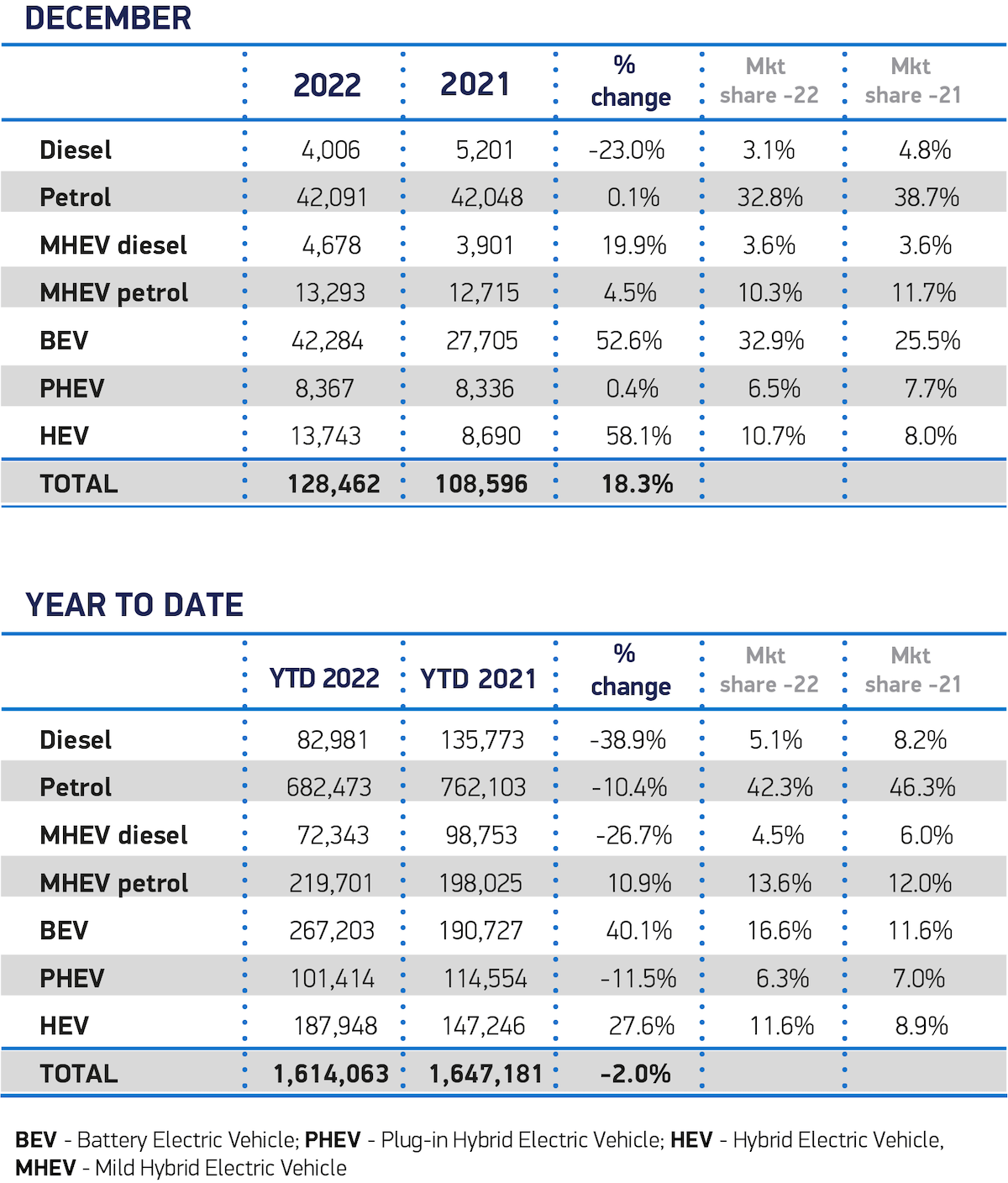
Despite persistent supply issues and growing cost of living concerns, close to 270,000 electric cars were sold in Britain last year, according to data published by the Society of Motor Manufacturers and Traders (SMMT). After a harsh decline in diesel sales, battery power is now only second to petrol, which still accounts for 42% of all new registrations.

EV sales rose by 40% in 2022 – a sales surge led by fleet owners and business buyers who bought two-thirds of these new cars. Their model of choice? The Tesla Model Y, which outsold all other EVs on the market by a considerable margin, with another 15,000 more registrations than 2021’s best-selling electric car, the Tesla Model 3.

Tesla continues to be the brand that the majority of UK buyers turn to when they are interested in making the all-electric switch, but other manufacturers from across the industry also recorded impressive EV sales figures last year as they continue to introduce more innovative and affordable electric cars to the market.

Highlighted for their value-for-money, the recently-retired Kia e-Niro and increasingly popular MG 5 made the annual top ten, as did the British-built Mini Electric and the ageing but capable Nissan Leaf. The Volkswagen ID.3 was the best-selling EV from a European brand, and in the premium sector, the Polestar 2, BMW i4 and Audi Q4 e-tron also sold well in the UK.

The SMMT says it is encouraged by this all-electric sales success, but adds that there is plenty more to be done to increase consumer confidence and convenience – ensuring that EV demand remains high and growth continues as the 2030 electric-only regulations edge ever closer.

The government’s EV infrastructure plan estimates that Britain will require between 300,000 and 720,000 charge points by 2030. To meet even the lower target, the SMMT claims that more than 100 new chargers will have to be installed every single day. At the moment, around 23 new charging stations are being installed nationwide on a daily basis.

Sales results for each car manufacturer (and even for each model range) continued to be defined by supply factors, as car companies battle component shortages – a hangover of the Covid situation from the last two years and supply problems resulting from the Russian invasion of Ukraine.

Things have been improving in recent months, so hopefully that will carry forward into 2023. Mind you, with China facing a fresh Covid meltdown, the rollercoaster may well carry on for a while yet…

Looking for a new electric car? The best new electric cars for every budget 2022

Top ten best all-electric sellers, 2022

1Tesla Model Y35,551
2Tesla Model 319,701
3Kia e-Niro11,197
4Volkswagen ID.39,832
5Nissan Leaf9,178
6Mini Electric7,425
7Polestar 27,345
8MG 57,030
9BMW i46,699
10Audi Q4 e-tron6,594
Source: SMMT
Tesla Model Y – UK's best-selling electric car in 2022
Tesla Model Y

Britain’s best-selling cars of 2022

1. Tesla Model Y

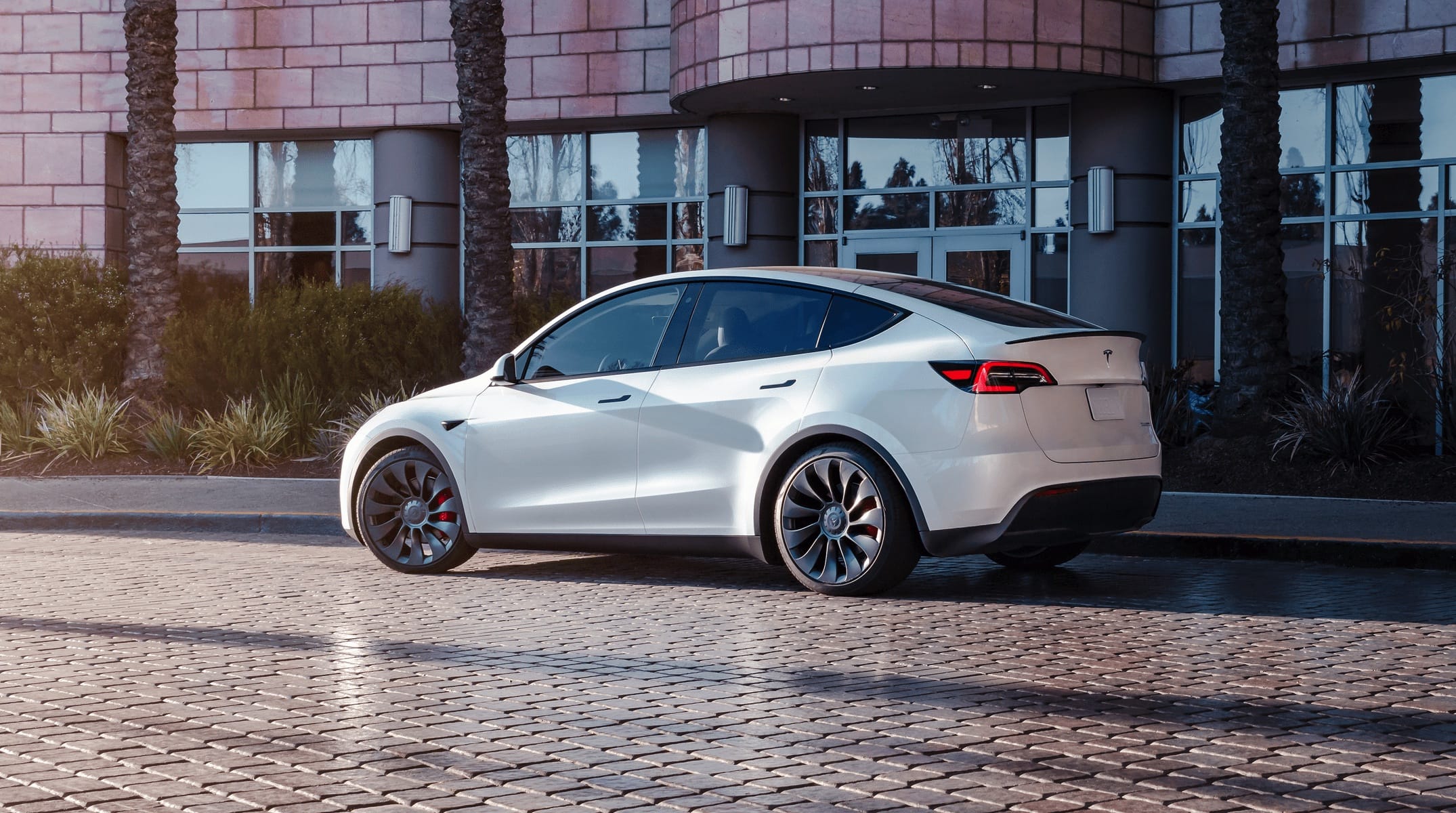
The Tesla Model Y was Britain’s best-selling electric car in 2022, as well as finishing third in the overall sales charts. With over 35,000 models sold throughout last year, almost half of its registrations were made in the last two months of the year, with 10,000 units shifted in December alone.

The Model Y has received a positive media reception here in the UK, commended for its innovative on-board tech and punchy performance. The SUV holds a solid Expert Rating of 79%.

2. Tesla Model 3

Tesla Model 3

The UK’s best-selling EV in 2021, has had to take a backseat to its newer and more popular Model Y sibling in 2022, but still sold in impressive numbers, out-selling the third place Kia e-Niro by over 8,000 models.

The Model 3 holds an impressive Expert Rating of 86%, a score helped by its performance, driving dynamics and minimalist style, but hindered by its rather rigid ride comfort, steep price tag, and questionable long term reliability.

3. Kia e-Niro

The Kia e-Niro was only on sale for three years, but was very popular with both reviewers and consumers. Now put out to pasture, making way for the new Kia Niro EV that arrived last Summer, this model still managed to rack up over 11,000 sales, taking third in the 2022 list of EV best-sellers.

Praised for its comfort and practicality, the e-Niro holds an Expert Rating of 85%, which is better than its all-new replacement.

4. Volkswagen ID.3

A serial award winner, the ID.3 hatchback is unanimously considered to be one of the leading examples of the emerging electric car era. The best-selling all-electric hatchback on this list, the ID.3 is regarded as one of the safest and most comfortable models in its class.

Despite receiving consistent criticism for its confusing and fiddly infotainment system, the Volkswagen ID.3 holds an Expert Rating of 75% – a score that is also aided by the car’s strong resale values and low running costs.

5. Nissan Leaf

Nissan Leaf (2018) front view | The Car Expert

The Nissan Leaf continues to be one of the most popular electric cars around the world and, considering its value-for-money, it’s not that hard to see why.

The Nissan Leaf holds an Expert Rating of 68%, with reviewers commending its leisurely driving experience and low running costs. That said, although the Leaf certainly gives you a lot of car for your money, its battery range is less than many newer EV alternatives.

6. Mini Electric

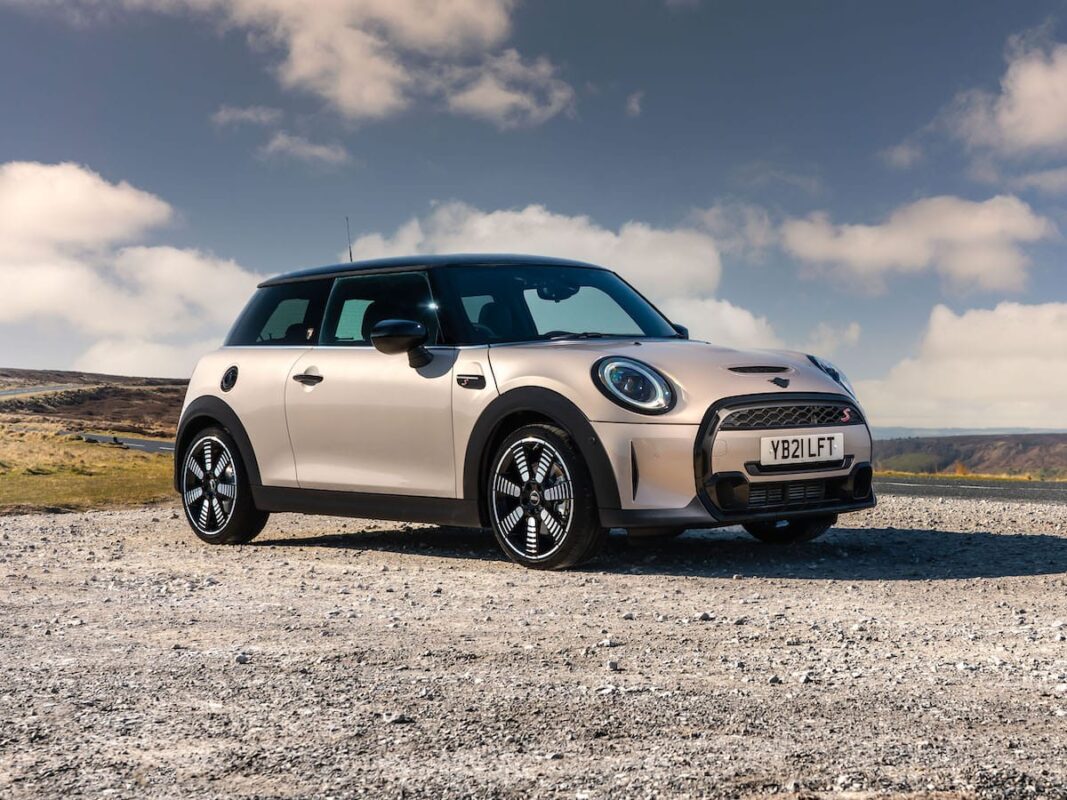
The electric version of the current Mini three-door hatch, the Mini Electric has been selling in consistent numbers ever since its arrival in 2020, and was the best-selling British-built electric car last year.

However, the Mini isn’t quite as popular with motoring media. Holding an Expert Rating of 63%, the hatchback has been criticised by reviewers for its relatively poor range compared to similarly-priced electric cars. That said, it has been praised for its fun driving experience and well-built interior.

7. Polestar 2

Premium brand Polestar only sells one model, but it is certainly a sales success. The Polestar 2 may not have been able to match the sales numbers of the class-leading Tesla Model 3, but still mustered a strong sales performance that trumped EV rivals like the BMW i4 and Kia EV6.

The Polestar holds an Expert Rating of 75%, praised for its upmarket design inside and out, its solid build quality and competitive battery range. However, if you are interested in this car, keep in mind that may have to keep explaining what a Polestar is…

8. MG 5

British manufacturer MG has been on a roll in recent years, undercutting rivals by offering affordable and capable cars that are cheap to run on the daily. Its foray into the electric market has been just as successful.

One of the only all-electric estate cars on the market, the MG 5 holds an Expert Rating of 63%, and is known as a great value-for-money package with a respectable battery range. Its rivals do have a higher interior quality though, and reviewers comment that it’s not that engaging to drive either.

9. BMW i4

BMW’s answer to the Tesla Model 3, the i4 is the all-electric equivalent of the 4 Series Gran Coupe – praised for its intuitive on-board tech, its competitive battery range and its agile driving dynamics.

That said, some outlets conclude that this all-electric saloon is not as enjoyable to drive as its combustion-powered equivalent, and rivals offer more cabin space in the rear too. The i4 holds an Expert Rating of 84%.

10. Audi Q4 e-tron

Audi Q4 e-tron Sportback (2021 onwards) - front view

Roomy and practical, the Audi Q4 e-tron takes the final spot in this top ten best-sellers list, outselling key rivals like the Volkswagen ID.4 and Skoda Enyaq.

The Q4 holds an Expert Rating of 74% – commended for its high levels of build quality, as well as its comfortable roomy cabin. On the other hand, some reviewers argue that it is rather bland to drive, and while entry-level models are competitively priced, they come with a comparatively short battery range.

What documents do I need for car finance?

When applying for finance on a new or used car, youll need to provide various information, documents and proofs of identification to the finance company so they can assess your application. In addition, they will access information held about you by third parties and check any employment references you provide.

What information does the finance company want? Well, they first need some basic information so that they can consider your application. Once the application has been approved, they will need some formal identification documents, and possibly proof of income, before the final contract is signed off.

If you can’t provide acceptable documents to back up the information you have provided, your finance application will be declined.

You also need to provide several pieces of personal information as part of your finance application. This is in addition to the specific details of the car you are buying, plus the exact deposit and monthly payments you are planning to make (every finance application is very specific to a particular car and payment profile; it’s not a general application for car finance).


You may also like:

Personal details

You will need to provide your full name (and previous name if you have changed it), date of birth, marital status, residential status (own your home, renting, living with parents, etc.) and your full address history for at least the last three years.

Employment details and history

You will need to provide name and address of all of your employers for at least the last three years (potentially longer if you have changed jobs a lot or have gaps in your employment history). This includes full addresses with postcodes, so make sure you have all of those details.

You will need to provide your job title and salary (current and potentially for the last three years). If you are self-employed, you will need to provide accounts or other documents as proof of income, since this information can’t be easily checked by the finance company. If you run your own limited company, they will at least be able to check some of the details with Companies House.

Bank details

You need to provide the bank account details for the account you will be using for your monthly payments. You will need the branch’s address and sort code as well as your account number.

The account usually needs to be in your name (or jointly in your name). Again, if you have less than three years with your current bank, you will probably need to provide previous bank details.

What if I don’t have three years’ history for my application?

It’s a common problem that, for several reasons, you may not be able to provide three years’ history for all of your application. You may have only recently moved to the UK and therefore not have three years of residential or banking history here. You may have only entered employment in the last year or so. This is not necessarily a problem, but the finance company will need to know as much as you can tell them.

If you are applying for finance over at least three years (which most car finance is), but you can’t tell them where you were and what you were doing for the last three years, it doesn’t make you look like a safe bet for their money. It may adversely affect your application, depending on your circumstances, so speak to the dealer about what other information you can provide.

Some finance companies will make overseas checks, so they can verify your previous address in other countries. Other companies may be less accepting of applicants with less history, but it varies across the industry. Young adults applying for finance are often asked for a guarantor if they don’t have a lot of employment or credit history, but again it varies.

Once you have provided this information to the finance company, usually via the business manager at the dealership where you are buying the car, they can process an application for you. All going well, your application will be provisionally approved by the finance company, subject to you providing some required documents to confirm that you are who you say you are.

In some cases, you will also need to provide proof of income (usually for self-employed people).

UK identification documents if you can't find your photo drivers licence

Identification documents required for car finance

Driver’s licence

It is expected that if you are applying for car finance, you have a driver’s licence to be able to drive the car you are trying to buy.

Most finance companies will automatically reject a finance application if you don’t have a driver’s licence, as it would almost always be considered an accommodation deal (ie – you are taking out finance for someone else, which is not allowed).

What if I can’t find my licence?

If you can’t find your driver’s licence, or have sent it back to the DVLA for penalties to be added, etc, then you will need to provide additional personal identification. This is usually a passport or a similar ID document, and the dealer will be able to tell you what their finance company requires.

The finance company will also contact the DVLA to confirm that you do actually have a driver’s licence.

Proof of address

Most finance companies will ask for up to two proofs of address, to prove you live where you say you do. These are usually utility bills (eg – gas, electricity, council tax, etc.) and you have to be named on the bill (joint names is fine, as long as you are on there).

You can often also provide bank statements (although some forms of bank statement are not accepted). You are allowed to block out any payment information you like – such as expenditure or income – for proof of address identification, so you don’t have to worry about people seeing sensitive financial information on your personal documents.

These proofs of address usually need to be dated within the last 90 days (three months), so make sure you don’t take in bills which are older than that or they will be rejected.

Proof of income

Depending on your employment details and history, you may be asked to provide proof of income. If you use an accountant for your bookkeeping, it is usually easiest to get the dealership to call the accountant (or vice versa) to provide whatever documentation they require.

If you keep your own financial records (which many sole traders do), you may need to provide bank statements dating back for a certain period to show your income. If most of your income is cash and doesn’t show up in your bank statements, you will need to show other information to back up your income claims (such as tax return information).

Essentially, you need to show clear evidence of your income to the finance company if you want them to lend you the money. If you can’t show this, your application will be rejected.

Finance companies are very cautious about getting caught up in money laundering and tax evasion activities. These have traditionally been big problems for the car industry, so lenders will always be suspicious of cash-based income declarations.

Summary

Copies of all your documentation, along with the signed vehicle contract and signed finance contract, are sent off to the finance company’s head office by the dealership (usually by fax). If everything is in order, the contract is activated and the finance company pays the dealership for your car.

If there are any problems with your documentation, the finance company will usually request more information from the dealership and you (not uncommon), or reject the application outright despite originally accepting it (much less common, and usually as a result of something in your documents directly contradicting information provided in your original application).

A rejection from the finance company is usually pretty final, so it is important that you have the correct documents ready to present. Check out The Car Expert’s list of things to check before applying for car finance.

Make sure you can verify any information you provide in your application with proper documentation. Providing information which you know to be untrue (even if it seems unimportant) is fraud, and any little white lie – usually it’s about how much money you claim to be earning – could see you end up in a lot of hot water. Even if you escape prosecution, you may be disqualified from getting finance again for a long time.

Here at The Car Expert, we are building commercial partnerships with companies who can offer you competitive car finance deals on either a new or used car. Check these out before signing any finance agreement with a car dealer:

  • We Finance Any Car can arrange PCP or HP finance at competitive rates
  • Motorly can find you a great car finance deal, even if you have a poor credit rating
  • Blue Motor Finance offers loans to a broad range of customers with fast decisions
  • FairSquare can find and finance either a new or used car, and deliver it to your door

This article was originally published in June 2015, and was most recently updated in January 2023.

What is GAP insurance and should you have it?

If you’ve ever bought a car from a car dealership, you will have almost certainly heard about GAP insurance.
GAP insurance is offered by nearly every main car dealership in the country, yet it’s not well understood by car buyers. In most cases, the first time it rears its head is in the dealership when a salesperson is trying to add it to your new car order. 

How well do you actually understand what GAP insurance is and when you can actually benefit from it? Do you know what GAP stands for? Do you know what type of GAP insurance you have (there are many different variations) and exactly what you are covered for? 

In this guide, we’ll explain how GAP works, the different types of cover available, and what to look for in a GAP policy.

Special offer: ALA Insurance offers a special 10% discount on GAP insurance for readers of The Car Expert

What is GAP insurance?

GAP stands for Guaranteed Asset Protection. GAP insurance is an additional insurance product for your vehicle, over and above your regular car insurance policy. It’s aimed at providing extra cover in the event of your car being declared a Total Loss (which means it has either been written off after an accident or stolen and not recovered).

GAP insurance is not a replacement for your car insurance. In fact, you must have a valid comprehensive car insurance in place to be able to make a claim on your GAP cover.

GAP insurance vs comprehensive car insurance

Your regular comprehensive car insurance will generally cover you for the market value of your car if it is stolen or written off. However, this will probably be a lot less than what you originally paid for the car, as it will start depreciating as soon as you drive away from the showroom. This is normal; your car insurance is designed to cover you for what your car is worth today, not what you paid for it originally.

If you bought a brand new car, it is quite possible that it could have lost half its value in little more than two years. So if you bought a car in 2021 for £30,000, and now in 2023 someone has crashed into you and the damage is so great that your insurance company has declared your car a write-off, you might be lucky to get a cheque for £15,000. 

Ouch.

In theory, car insurers expect this to be sufficient for you to go out and buy a similar two-year-old car. In reality, you’re probably feeling completely shafted. Especially if you have bought the vehicle on a PCP and still owe the finance company more than the value of your write-off cheque.

Two-year-old car GAP insurance cover
Your two-year-old car might be worth a lot less than you think

Types of GAP insurance

There are several different types of GAP insurance, but the most popular offerings for consumers are designed to cover you for one of two things:

  1. Return to Invoice: The difference (or the ‘gap’) between what your car insurance has paid you and what you originally paid for the car* (the Invoice Price**)
  2. Finance GAP: The difference between what your car insurance has paid you and what you owe the finance company to settle your finance agreement*

* Subject to a limit
** Invoice Price is the price of the car, not including registration, road tax or any other extras

Using the same example as before, your car is written off and your car insurer has given you £15,000. Depending on the type of GAP insurance you have, it would cover you for either an additional £15,000 (to bring you back to the invoice price) or the balance of your finance settlement if that was greater than the invoice price (which it usually is if you have a PCP or similar). There may be exclusions that you will not be covered for, or limitations on the policy. Check your documentation and ask questions before signing up.

There are specific GAP policies for leased vehicles, which effectively do the same thing as Finance GAP, in that your lease payments and fees are all cleared.

When does GAP insurance cover me?

Only in the event of a Total Loss, which means your car has been stolen and not recovered, or written off in an accident. 

Your insurance company pays you according to your policy (usually the market value of the vehicle according to a particular guide), and then your GAP insurance pays you over and above that amount.

When does GAP not cover me?

If your car is not a Total Loss, your GAP won’t pay out. If your insurer decides to repair your car rather than write it off, it is not a Total Loss.

If, for any reason, your car insurance refuses to pay out on a claim, your GAP insurance will also not pay out. This usually means you have voided your car insurance policy somehow – for example; you were drunk, your car was not taxed, you didn’t have a valid MOT, or any other reason. If your car insurance does not pay out, neither does your GAP insurance.

Should I take out GAP insurance?

Like any insurance policy, it is up to you to decide what level of risk you are comfortable with and how much you want to pay to reduce your financial exposure.

The chances of your car being written off or stolen in the next three years (most GAP policies are for three years) may be quite small in the greater scheme of things, but the potential cost if it does happen is very high.

If you feel that GAP insurance is right for you, DON’T simply accept the dealership’s offer. A car dealership is about the most expensive place on the planet to buy GAP, largely because most buyers haven’t got a clue what it would cost elsewhere because they’ve never looked.

A ten-minute search on Google will show you that you can almost always buy the same level of GAP cheaper from a dedicated GAP insurance provider. Here at The Car Expert, we are partnered with ALA Insurance and MotorEasy, two of the top providers of GAP insurance in the UK. Obviously, that’s who we recommend, but you should always shop around to find the best policy to suit your needs.

Special offer: ALA Insurance offers a special 10% discount on GAP insurance for readers of The Car Expert

What should I look for in a GAP insurance policy?

The obvious thing is the price. Online GAP providers are almost always much cheaper than a car dealer, so shop around.

The second thing is the cover; what are you getting for your money? Most GAP policies will have a payout limit, so make sure that the level of cover you are taking out is enough for your needs based on the price of your car.

Finally, always read the terms and conditions carefully to make sure the policy is suitable for you and your driving circumstances.

GAP insurance is usually cheaper online that at the car dealership
“Look darling, this GAP insurance is half the price of what that car salesman quoted us.”

Why is GAP insurance from car dealers so expensive?

Often the dealer’s price is more than double the price of an equivalent policy sold online. How do they get away with this? Because customers have often never heard of GAP insurance, or simply don’t take the time to shop around. 

By the time they get around to talking about GAP insurance, you’ve generally already bought the car and are now being manipulated into paying for numerous extras.

The Financial Conduct Authority (FCA) introduced new laws in 2015 to prevent dealers from selling you GAP insurance on the same day that you buy their car, but plenty of people still don’t take the mandated two-day waiting period to explore other providers.

If you are considering buying GAP insurance from the dealership, remember that – like everything they sell – the price is always negotiable. Don’t pay full price, as you could possibly save a couple of hundred quid. Get a quote online before you buy the car and see if they can match it. Chances are they won’t be able to.

Special offer: ALA Insurance offers a special 10% discount on GAP insurance for readers of The Car Expert

More GAP insurance information

The UK’s best GAP insurance providers

The UK’s best GAP insurance providers

Can you buy GAP insurance in 2024?

Can you buy GAP insurance in 2024?

Are you paying too much for GAP insurance?

Why you should consider car lease GAP insurance

Why you should consider car lease GAP insurance

GAP insurance terminology

This article was originally published in March 2017 and was most recently updated in January 2023.

Toyota Aygo X now available in gold

0

Toyota has announced that its Toyota Aygo X ‘Air Edition’ is now available to order exclusively online with a two-tone gold and black exterior colour scheme.

The ‘Air Edition’, which was added to the new Aygo X range back in November, distinguishes itself from the standard model thanks to its full-length retractable roof and large matte black 18-inch alloy wheels, both of which are available as optional extras for lower trim levels.

This new metallic paint job joins the four other colour options already available with the ‘Air Edition’. The bodywork and inserts on the alloy wheel spokes are finished in brass gold, while the front grille, wheel arches, windscreen pillars, wing mirrors and rear end are finished in black.

The same colour scheme extends inside, with gold inserts on the door panels, air vent surrounds and centre console, in contrast with the dashboard and upholstery that are trimmed in black fabric.

The Toyota Aygo X has been highlighted by the British motoring media as a well-equipped value-for-money package with low running costs and a decent amount of safety features by city car standards, but its small engine is said to struggle at higher speeds. The city car currently holds an Expert Rating of 56%.

Looking for a Toyota Aygo X? The Car Expert’s partners can help

Carwow logo 600x300

Discover great deals available on both new and used cars. Find out more

Auto Trader logo 600x300

Search for your next new or used car with Auto Trader. Find out more

Moneyshake logo 600x300

Personal contract hire deals from Moneyshake. Find out more

LeaseLoco logo 600x300

Personal contract hire deals from LeaseLoco. Find out more

Ready2Lease logo

Personal contract hire deals from Ready2Lease. Find out more

Rivervale Leasing logo 2022

Personal contract hire deals from Rivervale Leasing. Find out more

Revised Honda Jazz range gains ‘Advanced Sport’ trim

0

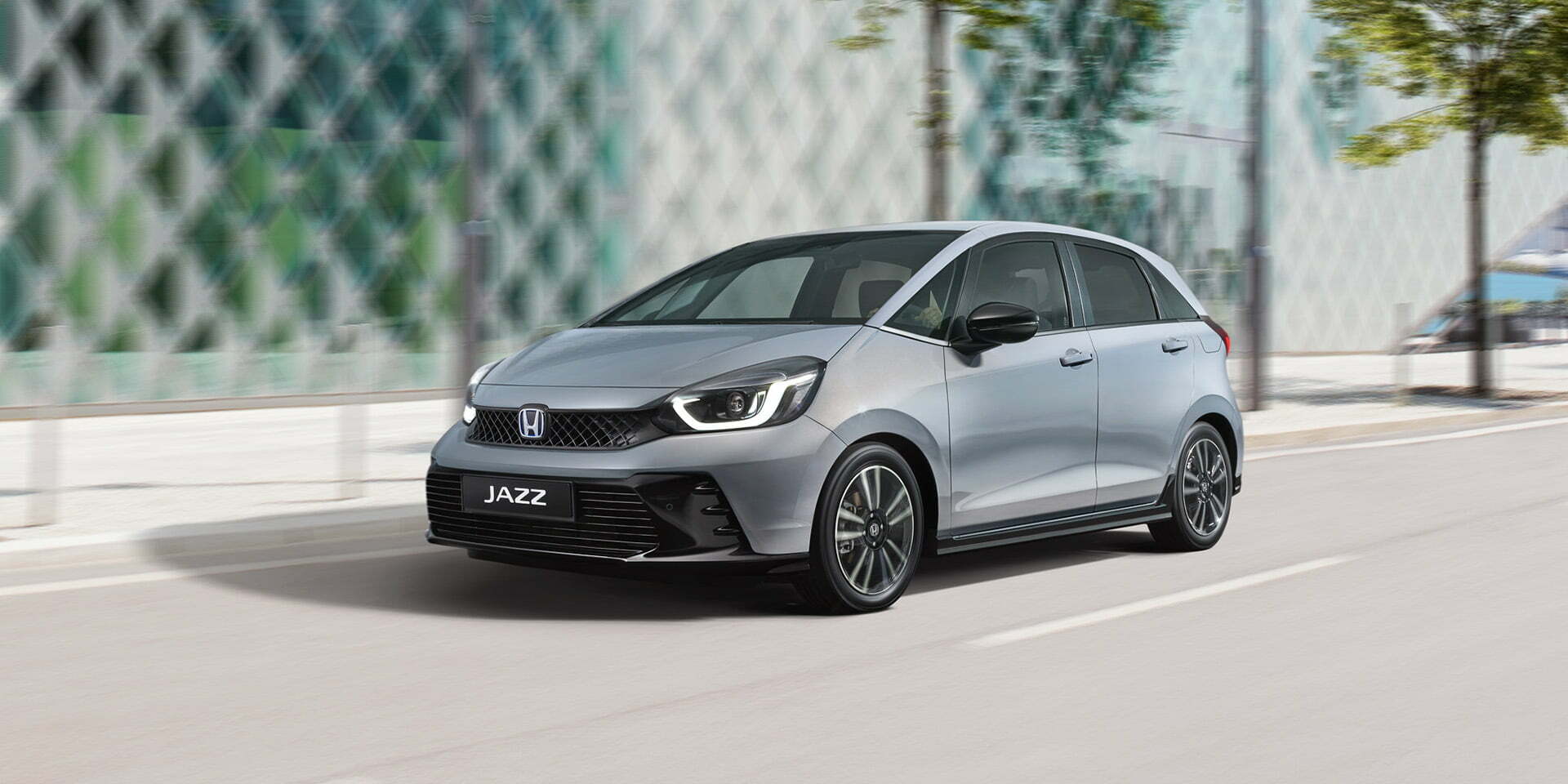
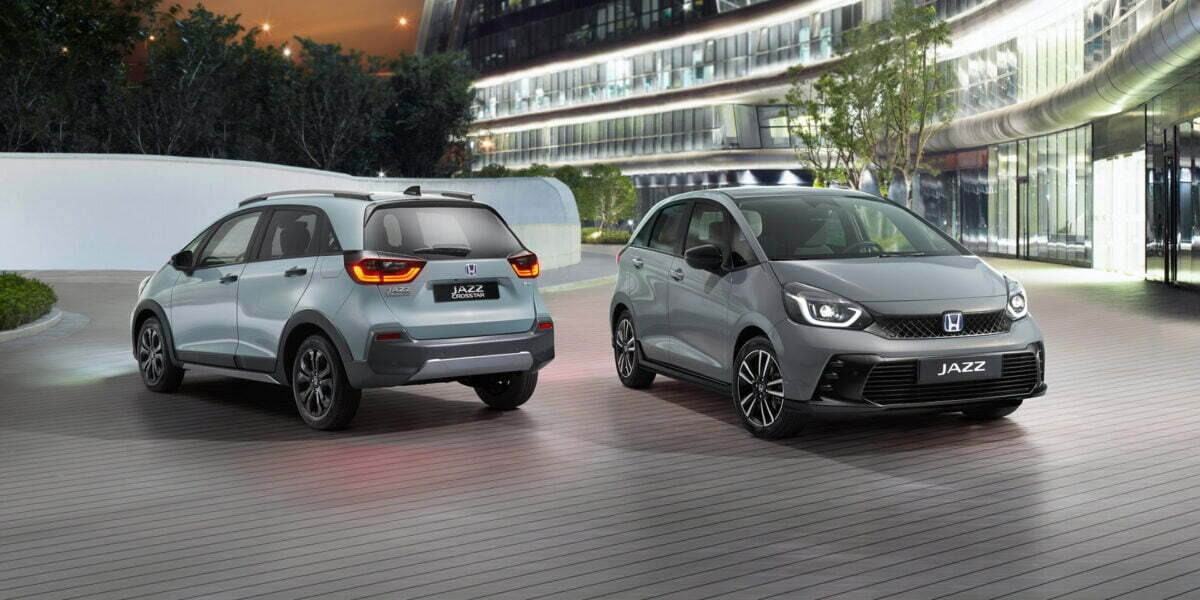
Honda has given its Jazz range a mild update that will soon be available to order in the UK, including a refreshed interior and exterior design, a performance boost for the hybrid’s engine, and the introduction of an ‘Advanced Sport’ trim level.

Starting with the car’s hybrid powertrain, Honda has increased the output of the 1.5-litre petrol engine and both electric motors, which work in tandem to produce 122hp – an increase of 25hp over the Jazz model currently on sale.

The manufacturer adds that it has revised the car’s automatic gearbox to make the hatchback’s gear shifting smoother, and says that it has improved the acceleration response to make the car more engaging to drive.

The 2023 Jazz range will also include a towbar option for the first time – an addition that Honda says was made due to customer feedback. The hatchback will reportedly be able to tow weights of up to 500kg.

Moving on to exterior looks, all models across the range have been given a new-look front end, with darker headlight inserts, and revised grille and front bumper designs. The range-topping Jazz Crosstar gains a honeycomb grille design, as well as silver bodywork inserts on the lower front bumper and side skirts. This top-spec trim will also be available in a new ‘Fjord Mist blue’ exterior colour.

2023 Honda Jazz Crosstar (left) and Jazz Advanced Sport (right)

Stepping inside, Honda has also added several extra colour and material choices to the Jazz options list to increase the cabin customization, while the updated Crosstar will come with a revised interior upholstery and dashboard trim.

The hatchback’s ‘Traffic Jam Assist’ safety function has also been tweaked as part of the facelift, which will now assist the car’s steering when moving off from a standstill.

Finally, the Jazz ‘Advanced Sport’ trim will soon be available to order, which features several unique design alterations inside and out, as well as some mechanical tweaks for enhanced performance.

Distinguishing itself from the standard model, the ‘Advanced Sport’ is the only Jazz variant available in ‘Urban Grey’, and features a ‘sporty’ lattice grille design, gloss black wing mirrors and larger 16-inch alloy wheels. The car’s seats are trimmed in a black suede and grey synthetic leather, while the three-spoke steering wheel, central armrest and door inserts come with yellow stitching.

The ‘Advanced Sport’ uses the same automatic gearbox as the standard Jazz, but with minor adjustments that are said to increase throttle response and power, while the suspension has been stiffened to increase traction and speed in the corners.

Honda has not yet announced exactly when this updated range will go on sale, but says it will launch sometime in early 2023. More details, including UK pricing, will be announced in the coming months.

The Honda Jazz has been consistently praised by the UK media for its practicality and economical engine, although some reviewers comment that it is not all that fun to drive. It currently holds an Expert Rating of 64%.

Looking for a Honda Jazz? The Car Expert’s partners can help

Carwow logo 600x300

Discover great deals available on both new and used cars. Find out more

Auto Trader logo 600x300

Search for your next new or used car with Auto Trader. Find out more

Cazoo 600x300

Buy a car online from your sofa. We’ll deliver it. Find out more

Motors 600x300

Search less, live more. We make finding the right car simple. Find out more

Moneyshake logo 600x300

Personal contract hire deals from Moneyshake. Find out more

Rivervale Leasing logo 2022

Personal contract hire deals from Rivervale Leasing. Find out more

LeaseLoco logo 600x300

Personal contract hire deals from LeaseLoco. Find out more

Ready2Lease logo

Personal contract hire deals from Ready2Lease. Find out more

Dacia adds hybrid engine to Jogger range

0

Dacia has revealed an electrified version of its biggest seven-seat model, called the Jogger Hybrid 140, which is now available to order in the UK.

This new hybrid variant makes use of a 1.6-litre petrol engine, paired with two electric motors and an additional small 1.2kWh battery to produce 140hp. By comparison, the Jogger was previously only offered with a smaller 110hp 1.0-litre petrol engine.

The introduction of the Hybrid 140 is a significant milestone for the Dacia brand, as this is the first electrified model the manufacturer has ever produced. Plans for this hybrid variant have been in the works for some time – Dacia announced that the Jogger would be its first electrified model at the people carrier’s unveiling back in September 2021.

Besides the slight performance boost, Dacia says that the hybrid’s key strength is its efficiency. Thanks to regenerative braking and other energy recovery methods, the electrified people carrier offers a fuel efficiency of 57mpg.

Dacia says that the hybrid can be driven around in ‘full-electric’ mode often on urban commutes, and that this model is 40% more fuel efficient than the cheaper petrol model.

As you would expect, the car’s gearbox is automatic, and the seven-inch infotainment screen on the people carrier’s dashboard displays additional information about the hybrid drivetrain, including how much electric range you have.

The Jogger Hybrid 140 model is not available with the standard ‘Essential’ trim, and is instead reserved for the more expensive ‘Expression’ and ‘Extreme SE’ grades. The hybrid comes with an 3-year/60,000-mile warranty as standard, as well as an 8-year/100,000-mile warranty for the car’s battery.

While prices for the ICE-powered Jogger start at £17k, the Hybrid 140 is now available to order from close to £23k.

Despite its rather abysmal Euro NCAP safety rating, the Dacia Jogger holds an Expert Rating of 72%, and has been highly-regarded by motoring journalists since its 2022 arrival, thanks to its very competitive pricing, spacious cabin and easy driving experience. Since March last year, Dacia says it has taken around 83,000 Jogger orders, and hopes this hybrid model will build on that success.

Looking for a Dacia Jogger? The Car Expert’s partners can help

Carwow logo 600x300

Discover great deals available on both new and used cars. Find out more

Auto Trader logo 600x300

Search for your next new or used car with Auto Trader. Find out more

Cazoo 600x300

Buy a car online from your sofa. We’ll deliver it. Find out more

Motors 600x300

Search less, live more. We make finding the right car simple. Find out more

Moneyshake logo 600x300

Personal contract hire deals from Moneyshake. Find out more

LeaseLoco logo 600x300

Personal contract hire deals from LeaseLoco. Find out more

Ready2Lease logo

Personal contract hire deals from Ready2Lease. Find out more

Rivervale Leasing logo 2022

Personal contract hire deals from Rivervale Leasing. Find out more

Five easy driving safety tips to start your 2023

0

Road safety campaigners are urging drivers to put road safety to the top of their ‘New Year’s Resolution’ lists this year in a renewed bid to reduce mounting death and injury statistics on UK streets.

Around five people die every day on the road in the UK, while 84 suffer serious injury. Now road safety and breakdown organisation GEM Motoring is asking drivers to think again about preventing accidents and inviting them to put safety to the top of their 2023 travel agenda.

And they say that having a New Year resolve to playing your part in reducing death and injury on the roads is a great way to start the next 12 months.

Thinking about road safety makes particularly good sense in January, says the safety group, adding that this is the end of the holidays, the start of a new school term, with long winter nights and the threat of bad weather to consider.

“If we all commit to a few minor changes in the way we use the roads, the benefits for everyone will be significant, and we will all be doing our bit for road safety,” says GEM chief executive Neil Worth.

“It could be as simple as leaving five minutes early to keep stress levels down on journeys, refreshing your knowledge of the Highway Code or making a commitment to banish distractions on journeys. These can all be achieved with little effort, but the effect they can have on a safer road environment is massive.

“As road users, let’s help each other and work together to create a safer environment for everyone, all year round.”

Here are GEM’s five simple tips to help drivers make worthwhile motoring resolutions in 2023:

1. Before a journey

Take a few minutes to plan and check your route before you set off. This will help ensure you don’t get lost, and by leaving five minutes early you won’t end up rushing and making risky decisions.

2. Pay attention

Give the road your full attention. Don’t be distracted by passengers, mobile phones or deep thoughts.

3. Hold back

Make a pledge that you won’t react to the actions of other drivers. Nobody’s perfect, so don’t waste time and increase risk by trying to rebuke another road user. Focus on holding back and staying safe.

4. Choose your speeds wisely

The speeds you use are entirely your own choice, so ensure you make wise decisions to keep your speed both legal and appropriate for the conditions. Time and space are two commodities you can never have enough of when driving.

5. Be alert

Don’t drive tired. Around 25% of all fatal or serious injury crashes are sleep related, so if you feel exhausted, or become tired on a long drive, then stop and rest.

Read more:

Mercedes-AMG GLB 35

Summary

The Mercedes-AMG GLB 35 is a compact performance SUV which sits above the regular GLB range in the Mercedes-Benz line-up.

A four-wheel drive model powered by 2.0-litre petrol engine paired with an eight-speed automatic gearbox, the GLB 35 stands out from the rest of the growing compact performance SUV pack thanks to its standard seven-seat configuration. However, reviewers frequently comment that the extra third row of seats is anything but spacious.

“It’s surprisingly cramped”, says Sean Carson of Auto Express, so it is “best thought of as a five-seat hot SUV with occasional seven-seat capability.”

Several outlets criticise the car’s driver appeal too, explaining that while the GLB 35 is nice to look at and fast off the line, it can be rather subdued on the road.

The Carwow team comments that the SUV’s “high seating position dulls your sense of speed”, while Top Gear instead recommends practical but sporty estate cars like the BMW 330d Touring or Volkswagen Golf R Estate, as they are “much more satisfying to drive”.

As of March 2026, the Mercedes-AMG GLB 35 holds a New Car Expert Rating of D, with a score of 54%. Although its safety score is good, its CO2 emissions are only average while its running costs are very high. And, for a performance model, its media reviews are surprisingly poor.

GLB 35 highlights

  • Stylish exterior styling
  • Well-built and luxurious cabin
  • Impressive straight-line pace

GLB 35 lowlights

  • Rivals are more fun to drive
  • Rear seating is rather cramped
  • Alternatives have more boot space

Key specifications

Body style: Mid-sized SUV/crossover
Engines:
petrol
Price:
From £53,295 on-road

Launched: Winter 2019/20
Last updated: N/A
Replacement due: TBA

Media reviews

Reviews, road tests and comparisons from across the UK automotive media. Click any of the boxes to view.

Featured reviews

More reviews

Auto Express

Evo

Honest John

The Telegraph

Top Gear

Safety rating

Independent crash test and safety ratings from Euro NCAP

Overall score: 5 stars
Date tested: November 2019
Read the full Euro NCAP review

Adult protection: 92%
Child protection: 88%
Vulnerable road users: 78%
Safety assist: 74%

The Mercedes-AMG GLB 35 has not specifically been tested by Euro NCAP, but it shares its safety rating with the overall GLB range that scored five stars when it was tested in 2019.

Available as standard on the GLB 35 are automatic emergency braking, lane-keeping assistance, driver attention monitoring and a rear-view parking camera.

Eco rating

Independent economy and emissions ratings from Green NCAP

No eco rating

As of March 2026, the Mercedes-AMG GLB 35 has not been assessed by Green NCAP.

Reliability rating

Reliability data provided exclusively for The Car Expert by MotorEasy

No reliability rating

As of March 2026, we don’t have enough reliability data on the Mercedes-AMG GLB 35 to generate a reliability rating.

The Car Expert’s reliability information is provided exclusively to us using workshop and extended warranty data from our partner, MotorEasy, sourced from both official dealerships and independent workshops. 

As soon as MotorEasy has sufficient data on the GLB 35, we’ll publish the results here.

Running cost rating

Clear Vehicle Data logo close crop

Monthly cost of ownership data provided exclusively for The Car Expert by Clear Vehicle Data

Fuel consumptionAverageScore
Petrol models31 mpgD
CO₂ outputAverageScoreVariationScore
Petrol models207 g/kmD
Insurance groupAverageScoreVariationScore
All models41D
Service and maintenanceCostScore
Year 1£377D
Year 2£903D
Year 3£1,622E
Year 4£1,893E
Year 5£2,473E
Overall£7,268E

The Mercedes-AMG GLB 35 is an expensive car to own and run, according to whole-life cost numbers provided exclusively to The Car Expert by our data partner, Clear Vehicle Data.

Its fuel consumption is very poor, while servicing and insurance costs are also high.

Similar cars

If you’re looking at the Mercedes-AMG GLB 35, you might also be interested in these alternatives.

Alfa Romeo Tonale | Audi RS Q3BMW X2 M35i | Cupra Ateca | Jaguar E-Pace | Mini Countryman John Cooper Works | Mercedes-AMG GLA 45 | Porsche Macan S | Volkswagen T-Roc R | Volkswagen Tiguan R

More news, reviews and information about the Mercedes-AMG at The Car Expert

Plug-in hybrid cars – what’s on sale and what’s coming in 2025?

Plug-in hybrid cars – what’s on sale and what’s coming in 2025?

Mercedes-AMG GT

Mercedes-AMG GT

The best new cars of this year are set to be revealed…

The best new cars of this year are set to be revealed…

Mercedes-AMG CLA 35

Mercedes-AMG CLA 35

Everything you need to know about Mercedes-AMG

Everything you need to know about Mercedes-AMG

New Mercedes-AMG 5 53 to go on sale this year

New Mercedes-AMG 5 53 to go on sale this year

Mercedes-AMG EQE 53 saloon

Mercedes-AMG EQE 53 saloon

Plug-in hybrid cars – what’s on sale and what’s coming in 2024?

Plug-in hybrid cars – what’s on sale and what’s coming in 2024?

Mercedes-AMG A 45 ‘Limited Edition’ now on sale

Mercedes-AMG A 45 ‘Limited Edition’ now on sale

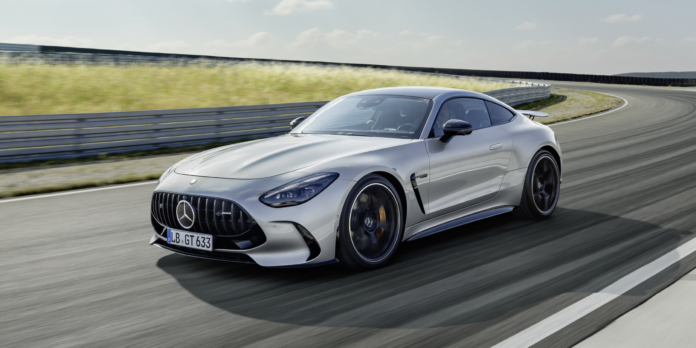
New Mercedes-AMG GT Coupé now available to order

New Mercedes-AMG GT Coupé now available to order

High-power Mercedes-AMG CLE Coupé unveiled

High-power Mercedes-AMG CLE Coupé unveiled

Mercedes-AMG GLA receives minor cosmetic refresh

Mercedes-AMG GLA receives minor cosmetic refresh

Buy a Mercedes-AMG GLB 35

If you’re looking to buy a new or used Mercedes-AMG GLB 35, The Car Expert’s partners can help you find the right car.

Motors 600x300

Find your next used car with Motors. Find out more

Auto Trader logo 600x300

Find your next new or used car with Auto Trader. Find out more

Carwow logo 600x300

Find your next new or used car with Carwow. Find out more

Lease a Mercedes-AMG GLB 35

If you’re looking to lease a new Mercedes-AMG GLB 35, The Car Expert’s partners can help you find a competitive deal.

Leasing-com logo

Personal contract hire deals from Leasing.com. Find out more

Carwow logo 600x300

Personal contract hire deals from Carwow. Find out more

Select Car Leasing logo

Personal contract hire deals from Select Car Leasing. Find out more

Subscribe to a Mercedes-AMG GLB 35

If you’re interested in a car subscription, The Car Expert’s partners can help. (PS: What’s a car subscription?)

Cocoon Vehicles logo 600x300

Car subscriptions from Cocoon.
Find out more

Just Vehicle Solutions logo 600x300

Car subscriptions from Just Vehicle Solutions.
Find out more

Flexible Vehicle Contracts logo 600x300px

Car subscriptions from Flexible Vehicle Contracts.
Find out more

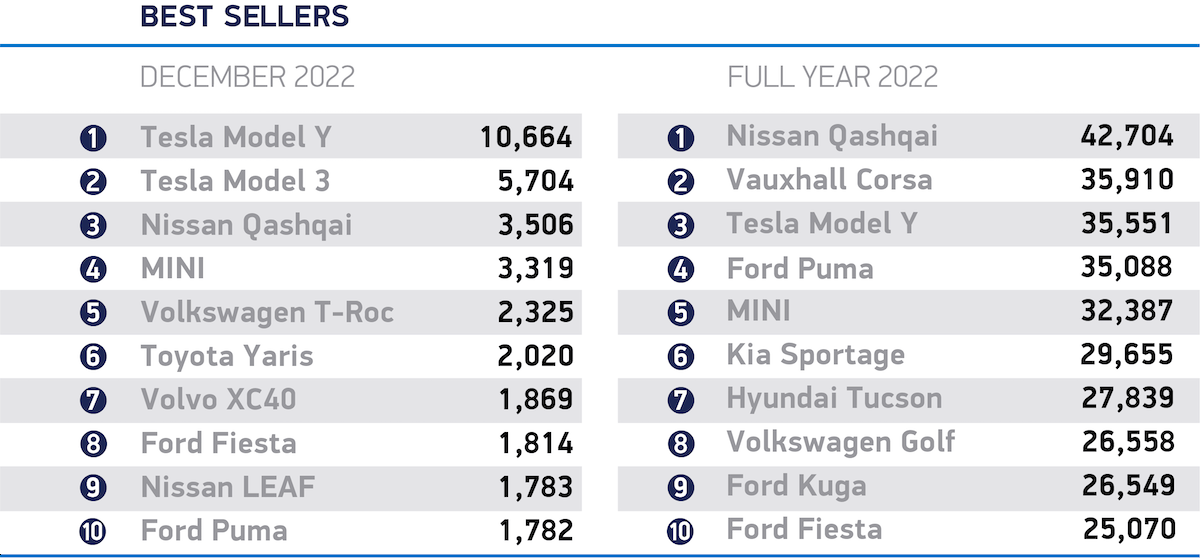
Britain’s best-selling cars of 2022

After two months at the top, the British-built Nissan Qashqai has been crowned the UK’s best-selling car for 2022, ahead of the Vauxhall Corsa and Tesla Model Y.

Despite growing cost of living concerns, December marked the fifth month of consecutive new car market growth, according to the latest data published by the Society of Motor Manufacturers and Traders (SMMT).

Over the whole year, just over 1.6 million new cars were sold in the UK in 2022, which was broadly similar to new car registrations in both 2021 and 2020, although still down on previous years. However, as the new car market shifts towards electrification and we stare at another year of squeezed household budgets, we may never see pre-pandemic sales numbers returning to the new car market.

The big news for 2022 new car sales was that the country’s most popular new car was one actually built here in the UK. It’s been a household name for family motoring for about 15 years, but the Nissan Qashqai – designed in London, developed in the Midlands and built in Sunderland – finally topped the sales charts in 2022.

The Qashqai’s charge to victory gathered pace in the second half of the year, recording stunning sales figures in September and then remaining strong over the last quarter.

Meanwhile, last year’s top seller went in the opposite direction. The Vauxhall Corsa started the year strongly, and over the summer looked to be comfortably on course to retain its sales crown. However, sales nosedived in recent months – presumably as a result of supply isues that Vauxhall had previously managed to avoid over the previous 12 months. It still ended the year in second place, but only just…

As in 2021, the buggest disruptor of the year was Tesla. Operating completely differently to every other car manufacturer, registrations of the company’s two models fluctuated wildly throughout the year. Ultimately, the Tesla Model Y was the third best-selling new car in the UK, with nearly a third of its registrations coming in the last month of the year – nearly 11,000 registrations in a single month is a record result, as far as we can tell.

The last month of 2022 saw something of a mixed-up top ten, with five unexpected models popping up in the best-sellers’ list. The Tesla Model 3, Volkswagen T-Roc, Toyota Yaris and Volvo XC40 have all appeared previously but are not regulars, while Nissan Leaf made its first top ten appearance (that we can find), in a further piece of good news for Nissan’s Sunderland workforce.

In terms of full-year sales, four of this year’s top ten are new or returning models. From last year’s top ten, the Tesla Model 3, Mercedes-Benz A-Class, Volkswagen Polo and Toyota Yaris all fell out this year, to be replaced by the Tesla Model Y, Hyundai Tucson, Ford Kuga and Ford Fiesta.

Sales results for each car manufacturer (and even for each model range) continued to defined by supply factors, as car companies battle component shortages – a hangover of the Covid situation from the last two years and supply problems resulting from the Russian invasion of Ukraine.

Things have been improving in recent months, so hopefully that will carry forward into 2023. Mind you, with China facing a fresh Covid meltdown, the rollercoaster may well carry on for a while yet…

Read our monthly report: Tesla charges to top place in December new car sales

Top ten best sellers, December 2022

1Tesla Model Y10,664
2Tesla Model 35,704
3Nissan Qashqai3,506
4Mini hatch3,319
5Volkswagen T-Roc2,325
6Toyota Yaris2,020
7Volvo XC401,869
8Ford Fiesta1,814
9Nissan Leaf1,783
10Ford Puma1,782
Source: SMMT
Tesla Model Y

Britain’s best-selling cars of 2022

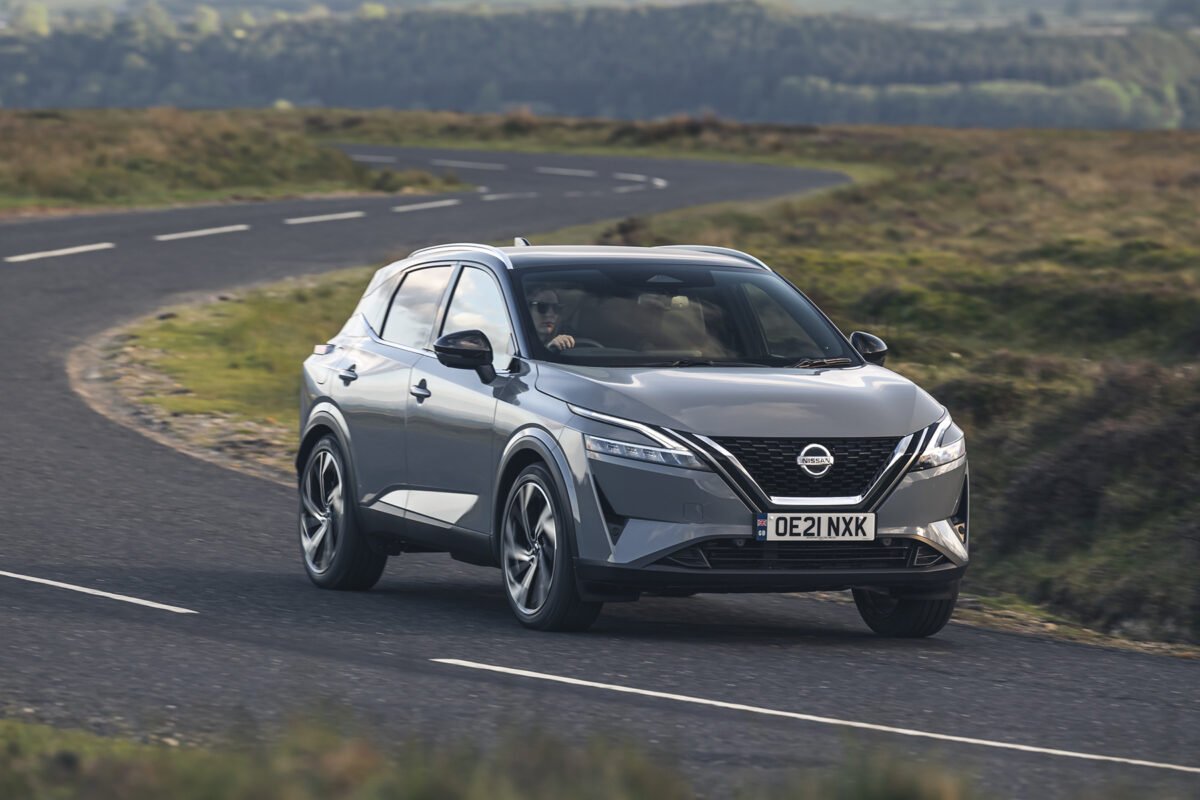
1. Nissan Qashqai

2021 Nissan Qashqai front view | Expert Rating

The current jewel in the crown of the British car manufacturing industry, the Nissan Qashqai has been selling up a storm in recent months. After snatching first in the annual rankings from the faltering Corsa in October, the Qashqai has held on to take the title to the UK’s best-selling car for 2022.

On sale since Autumn last year, the current-generation Nissan Qashqai holds an Expert Rating of 69%, which is reasonable for a medium SUV but nothing to really shout about.

2. Vauxhall Corsa

Best-selling cars of 2022 – Vauxhall Corsa

The Vauxhall Corsa had a strong start to 2022, and had built a substantial sales lead by the summer. However, things slowed down substantially in recent months, just as the Nissan Qashqai was hitting its stride. In the end, the Corsa just managed to hold off the Tesla Model Y for second place.

Despite its continued sales success, the Corsa has received average reviews from the motoring media, with an Expert Rating of just 61% on our Expert Rating Index – with the electric Corsa-e two points higher.

3. Tesla Model Y

The Tesla Model Y ended up third in the sales charts, although it did make almost half of its registrations in the last two months of the year, including a staggering 10,664 units shifted in December alone.

The Model Y has received a positive media reception here in the UK, and currently holds a solid Expert Rating of 79%.

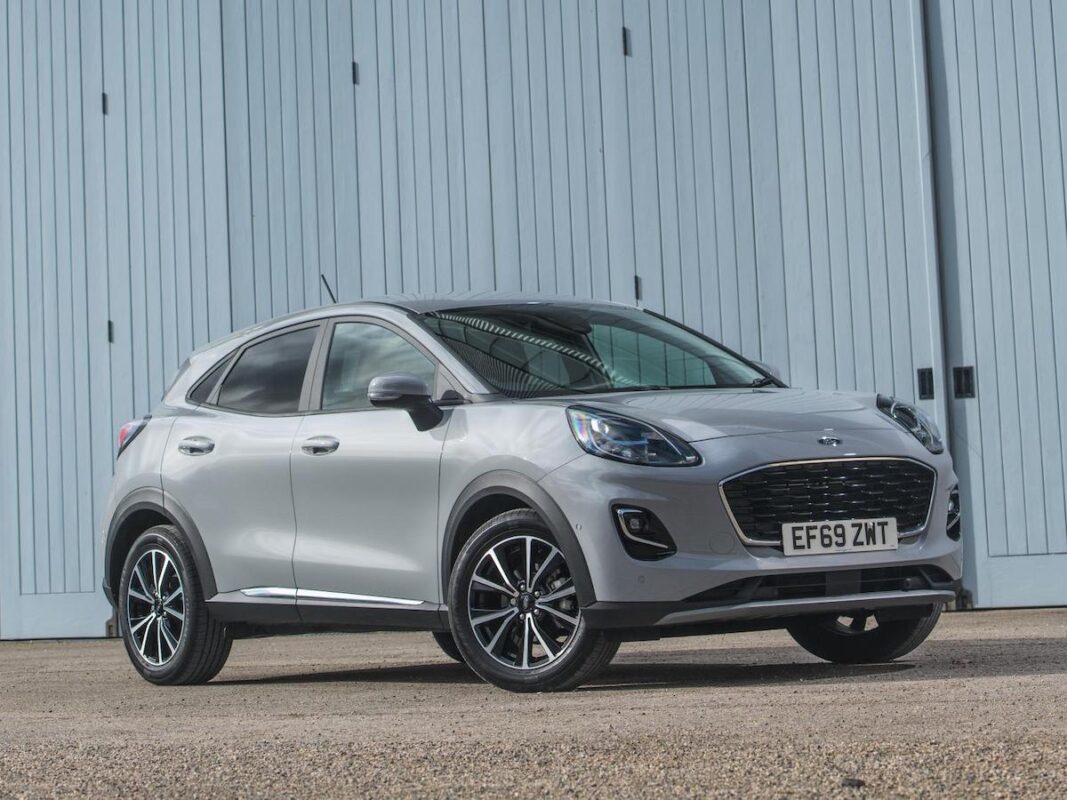
4. Ford Puma

Best selling cars of 2022 – Ford Puma

The Ford Puma continues to sell in consistent numbers, finishing tenth in the monthly charts in December. Pipped for third by the late-charging Tesla Model Y, the Puma finished fourth for the year, almost 3,000 sales ahead of the Mini hatch.

The Puma has received plenty of praise from the UK motoring media, and currently holds an Expert Rating of 76% on our unique Expert Rating Index. That puts it top of the charts for supermini-based SUVs.

5. Mini hatch

Best-selling cars of 2022 – Mini hatch

Despite being one of the oldest new car models still on sale, the Mini hatch has been a consistent consumer favourite throughout 2022. The hatchback lost the battle for best-selling British-built to the Nissan Qashqai back in October, but still showed strong sales form as the year came to a close, taking fifth in the annual rankings.

The Mini has received positive reviews, with an Expert Rating of 74% on our Expert Rating Index. The electric model doesn’t do so well, with a score of just 63%.

6. Kia Sportage

Best-selling new cars of 2022 – Kia Sportage

Usually a consistent performer, the new-for-2022 Kia Sportage was missing from the top ten best-sellers list for the last three months of 2022. Nevertheless, the SUV has finished sixth in the annual charts, dropping one place but outselling the closely-related Hyundai Tucson by nearly 2,000 units.

The new Kia Sportage currently holds an Expert Rating of 70% on our award-winning Expert Rating Index, which is a substantial improvement on the previous model.

7. Hyundai Tucson

Best-selling cars of 2022 – Hyundai Tucson

Another car that started strongly but faded later, Hyundai Tucson sales dropped off in the final months of 2022 after it had established itself as one of the UK’s most popular SUVs in the first half of this year. Despite its December absence, the Tucson holds on to seventh in the annual sales list.

The new Tucson has received positive reviews from the motoring media, with a solid Expert Rating of 75% on our industry-leading Expert Rating Index.

8. Volkswagen Golf

The Volkswagen Golf has recorded some healthy sales numbers in the last few months – though it was absent from the monthly top ten in December. Finishing eighth in the 2022 table, the just managed to edge out the Ford Kuga – the two were separated by a mere nine sales at the end of the year.

On sale since 2020, the Golf currently holds an Expert Rating of 75%, with good scores from most UK media sources.

9. Ford Kuga

With the increasing popularity of the Nissan Qashqai, other family-sized SUVs are beginning to suffer – including the Ford Kuga. Absent from the monthly top ten for two months running, the Kuga slides to ninth in the annual rankings.

Its Expert Rating of 69% places it firmly in the middle of a very competitive family SUV market.

10. Ford Fiesta

Ford Fiesta (2021 - present) front view | Expert Rating

It’s been a torrid two years for Britain’s almost perennially favourite car. However, despite being temporarily removed from sale for a few months earlier this year, the Ford Fiesta managed to creep back into the top ten best-sellers chart in the final month of the year.

The Fiesta currently holds an Expert Rating of 76%, with good scores from most UK media sources. If you want a new Fiesta, you’ll have to move quickly. It will be gone for good next summer.

Last year’s best-sellers race is over, but the competition for 2023’s best-selling car is already underway. We will have the sales results for January in the first week of February – check back soon!

Additional reporting by Stuart Masson

Nissan Qashqai is first British-built car to top annual sales charts since 1998

5 January 2023

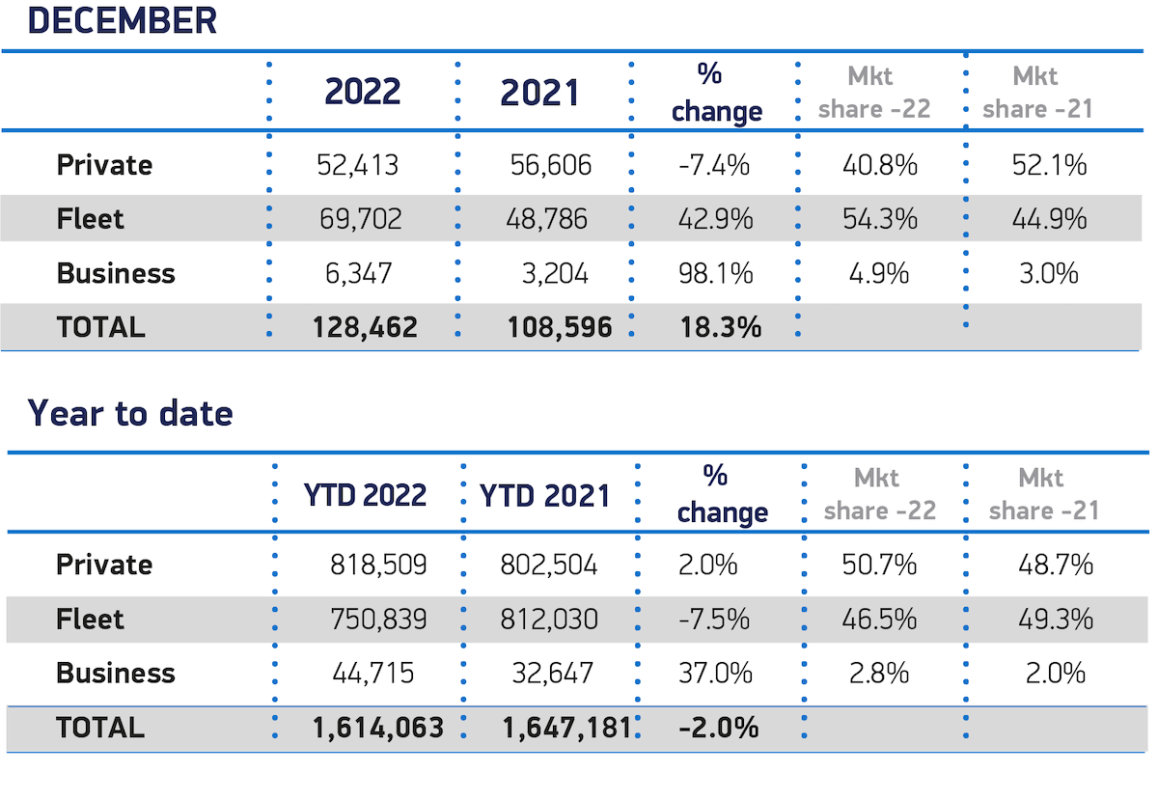
  • December sales growth year-on-year (up 18%) dominated by fleet purchases which grew by 43% as opposed to a 7% drop in private sales
  • Buoyant electric car sales delivered impressive 33% market share in December resulting in nearly 17% of the market for 2022
  • Tesla Model Y and Model 3 were the best-selling cars in December
  • After the Qashqai, the Vauxhall Corsa, Tesla Model Y, Ford Puma and Mini rounded off the top-5 bestselling cars of 2022
  • Private new car sales have gradually declined over the last six months, potentially due to the squeeze on household budgets
  • Budget brands MG and Dacia sales up by 67% and 55% respectively for the full year
  • Results suggest improvements to supply resulting in reduced waiting times, better new car deals and eventually lower used prices later in 2023

The Nissan Qashqai is the first British built car to top the annual sales charts since 1998 in boost for domestic car manufacturing, according to The Car Expert.

Sales of the hugely popular SUV and demand for electric cars – especially the Tesla Model Y and Model 3 – saw December sales rise by 18% year-on-year, with fleet and business purchases growing by 43% and private retail sales slowing by 7%.

The full year results in which various market forces and global economic headwinds provided challenging circumstances saw the market contract by 2%.

Electric car sales, which faltered for a few months due to supply chain issues, bounced back in December with a 33% share of the market, contrasting with sales of diesel cars which managed just 3%.

While the Qashqai topped the sales charts, the Vauxhall Corsa, Tesla Model Y, Ford Puma and Mini rounded off the top-5 bestselling cars of 2022.

Private new car sales have gradually declined over the last six months, potentially due to the cost-of-living crisis and the resulting squeeze on household budgets as well as the rising prices of new cars.

However, budget brands MG and Dacia sales were up by 67% and 55% respectively for the full year compared to 2021. The Spanish brand Cupra also saw sales climb, beating its 2021 results by 90%.  

Stuart Masson, Editorial Director at The Car Expert, said: “It is a shot in the arm for British car manufacturing to see the Nissan Qashqai topping the tables for 2022 – it is the first British built car to do so for 24 years. While there are challenges for the sector here in the UK, with two cars built domestically among the top-10 best sellers, there’s a lot to be encouraged by too.

“December saw a very impressive result for electric vehicle sales. We have seen some commentators speculating that demand for EVs could be falling but with November and December sales rocketing, that is clearly not the case. Tesla dominated the sales results in December and its Model Y was the third best seller overall in 2022. Combined with the growing popularity of many other EVs, 2023 is likely to be another bumper year for fully electric vehicles.”

“While the sales results overall paint a fairly positive picture in the face of some very challenging circumstances, it is a point of caution that private retail sales actually fell during the last six months of 2022, no doubt due to the impact of the rising cost of living, triggered by higher interest rates and inflation.”

“The results do, however, suggest that there are some improvements in the supply of new vehicles. As car manufacturers generally prioritise private retail sales due to better margins, the growth of fleet sales suggests that the pressures are starting to ease. This should mean reduced waiting times, better new car deals and eventually lower used car prices later in 2023.”

For expert and impartial advice relating to car finance or tips for purchasing a used vehicle, please visit: www.thecarexpert.co.uk/

ENDS

The Car Expert

Founded in 2011, The Car Expert is the UK’s most comprehensive automotive consumer advice site. With an audience of over two million readers a year, The Car Expert provides independent and impartial advice on every aspect of buying, financing, owning, and selling new or used vehicles.

The Rotten Tomatoes equivalent for the automotive world, The Car Expert consolidates reviews from 30 of the UK’s top automotive websites to create the Expert Rating Index. Bringing together science and data analysis, the index calculates a weighted average to give an aggregated score – Expert Rating – that is comparable across different brands and models.

The Expert Rating Index factors in the age of each review, so that newer reviews carry more weight than older reviews. It also breaks down the complex web of different scoring systems that various websites use in their reviews.

The Car Expert has logged over 14,000 reviews covering more than 400 cars and over 50 manufacturers, with its Expert Rating Index now trusted as the gold standard for rating and ranking new cars in the UK.

For media enquiries, please contact Performance Communications

Melissa Lodge: melissa@performancecomms.com | 07855 467 274
Richard Tanner: richard@performancecomms.com | 07876 762 345

Tesla charges to top place in December new car sales

New car sales finished the year on a higher note, thanks to strong fleet registrations. For consumer new car sales, it was a relatively poor month – albeit with a few bright spots.

According to the December and full-year data published this morning by the Society of Motor Manufacturers and Traders (SMMT), private new car sales were down 7% on the same month last year. This is a continuation of an overall sales slowdown for consumer new car sales over the last six months.

By comparison, fleet registrations were up 43% compared to last December, continuing a very strong performance over the last half of the year.

Looking at the full year’s results, the overall market ended up down slightly on last year at just over 1.6 million cars registered. Somewhat surprisingly, the annual numbers have been pretty flat for the last three years despite wild fluctations on an almost monthly basis since the Covid pandemic begain in early 2020.

Source: SMMT

Tesla again skews EV data with another massive month

A couple of months ago, several media analysts were moaning that electric car sales had ‘stalled’ and suggested there was a crisis brewing after a relatively poor month in October. Today’s data shows EV sales at an all-time high in December and a record market share of one-in-three new cars. In reality, both the peaks and troughs are misleading thanks to the fact that the UK’s largest EV brand, Tesla, operates completely differently from every other car company.

Tesla registered more than 16,000 new cars in December, which made it comfortably the best-selling car brand for the month. Yet in October, it only registered 11 cars. No, that’s not a typo. This enormous fluctuation from the EV market leader means that EV market share swings wildly on a month-by-month basis.

Looking at the 2022 full-year results, it was a record year for new EV sales. Electric vehicles made up 17% of the new car market, up from 12% in 2021 and 7% in 2020. Plug-in hybrid sales have slid backwards compared to 2021, as we’ve been reporting all year, with customers appearing to have abandoned the halfway-house idea in favour of either switching to a fully-electric car or sticking with a petrol one.

Diesel now makes up less than 10% of the new car market – and would be even less if there were better options available for large posh SUVs – while petrol is still the largest fuel source but slightly down on last year.

Source: SMMT

Good month, bad month

As mentioned, Tesla topped the charts in December despite only having two models available. Volkswagen was second for December but ended up on top for the full year, while BMW beat Audi to third place in December but the positions were reversed for the full year.

Relative to the overall market’s result for December, it was a good month for Alpine, BMW, Cupra, Ford, Genesis, Jeep, Lexus, Mazda, MG, Polestar, Porsche, Renault, SEAT, Tesla and Volkswagen. All of these brands outperformed the overall market by at least 10%.

Meanwhile, things were not so rosy for Abarth, Alfa Romeo, Bentley, Citroën, Dacia, DS Automobiles, Fiat, Honda, Hyundai, Jaguar, Land Rover, Maserati, Mercedes-Benz, Mini, Peugeot, Smart, SsangYong, Subaru and Vauxhall. All of these brands underperformed against the overall market by at least 10%.

Big month for Tesla but Nissan Qashqai takes the crown

As with last year, Tesla topped the charts in the last month of the year with a record-breaking month for the Model Y – more than 10,000 registrations in a single month is unheard of – while the Model 3 was runner-up.

For the overall year, though, the Nissan Qashqai has taken the crown as the UK’s best-selling new car. It’s the first time since 1998, some 24 years ago, that a British-built car has been the country’s most popular new vehicle.

In a bonus for both Nissan and its Sunderland workforce, the Leaf electric vehicle also made a surprising appearance in the top ten for December.

The Vauxhall Corsa clung on to second place in the 2022 sales race, despite tanking in the last few months as Vauxhall presumably struggled with supply problems, to edge out the Tesla Model Y which sold almost a third of its annual vehicles in December alone!

Small vehicles had a good result in December, with the Mini hatch, Toyota Yaris and Ford Fiesta all featuring in the top ten, while smallish SUVs like the Volvo XC40 and Ford Puma also did well.

Source: SMMT

We’ll have a full round-up of the UK’s best-selling cars in coming days, as well as a more detailed analysis of the 2022 results for each brand.

Hyundai Santa Fe review

There’s no shortage of large SUVs on the market, but with so much choice, where do you start? The Hyundai Santa Fe ticks a lot of boxes straight off the bat. It’s a seven seater, there’s a range of economical engines and it’s got a five-star Euro NCAP safety rating.  

Compared to the Audi Q7 and Land Rover Discovery, the Santa Fe is a much more affordable choice that still provides a good level of luxury. There’s also the benefit of Hyundai’s unlimited mileage five year warranty.

What’s new about the Hyundai Santa Fe?

The current generation was introduced in 2018, with engine options limited to a 2.2-litre diesel. In 2021, petrol mild hybrid and plug-in hybrid engines were introduced, making the Santa Fe more economical and quieter.

Inside the interior has been redesigned with a considerable amount of buttons in the centre console and a touchscreen on the dash. It’s still available in two trim levels, both of which are well equipped.

How does it look?

Bright LED headlights and a redesigned grille give the Santa Fe a contemporary feel. To accommodate seven seats, it’s quite a big car but it’s not boxy or unattractive. The high SUV ride height makes it easy to get in and out of and means you don’t have to bend over to help children in and out of the rear seats.

Depending on what specification you go for there’s 17- or 19-inch alloy wheels that look suitably big enough and don’t drum up too much road noise. The Santa Fe is based on the same platform as the Kia Sorento, so they’re very similar in size.

What’s the spec like?

The spec line up is simple, there’s entry-level Premium or top of the range Ultimate. Premium has a good level of tech as standard including heated front seats, reversing camera and Apple CarPlay and Android Auto compatibility.

Safety features like lane departure warning are included with the Premium spec and there’s seat belt reminders on all three rows. The electric tailgate makes it easy to access the boot with your hands full and there’s roof rails on both specs if you want to add a roof box.

Ultimate adds cooled front seats, heated rear seats and rear door blinds. There’s also a panoramic sunroof, 360-degree camera and head-up display that shows speed and sat nav directions

What’s it like inside?

Whilst most manufacturers are minimising the number of buttons in a car, Hyundai didn’t seem to get the memo. The centre console is filled with buttons for gear selection, driving modes, climate control and shortcuts for the infotainment screen. 

When the rear seats are down it feels like a normal five seater so there’s plenty of boot space. The rear seats fold up individually so the configuration is flexible if you only need one extra seat.

The middle row can fit three adults comfortably and the floor is flat so the middle passenger gets decent leg room. The middle seats also slide forwards to give passengers behind more room and the seat backs recline. All seats fold down at the touch of a button offering a large load space if you need to carry anything other than passengers.

What’s under the bonnet?

Both petrol-based models come with a 1.6-litre engine and a six-speed automatic gearbox as standard. The mild hybrid comes with either two-wheel or four-wheel drive while the plug-in hybrid is only available with four-wheel drive. There’s also a 2.2-litre diesel engine that has an eight-speed automatic gearbox. 

All offer good fuel economy and the plug-in hybrid is the most efficient as long as the battery is regularly charged.

What’s it like to drive?

The automatic gearbox changes smoothly between gears and there’s good all round visibility. Lane keep assist is helpful on the motorway but on local roads it’s easier to turn it off, thankfully there’s a button next to the steering wheel for this.

On the plug-in hybrid model we tested, the car prompts you to coast if you’re travelling down hill so the battery can charge. The dial on the dash also shows how much charge the battery has and when it’s charging. The driver display shows useful information like tyre pressure and distance travelled or it can be simplified to just show the vehicle’s speed.

Steering can feel quite light but at different speeds it feels like it firms up, so when you’re parking it’s easy to make corrections. All versions come with self levelling suspension that helps to keep the car stable, this is especially useful when towing.

Verdict

The Santa Fe is a hugely practical car, once you get used to all the buttons on the centre console it’s simple to operate and the rear view camera is a handy addition. It definitely a family-focused car, even reminding you to check the rear seats when you turn the engine off in case you forget your children.

There’s a good range of economical engines and the entry-level trim has lots of safety features and creature comforts. Compared to other seven-seaters the Santa Fe starts out with some reasonably priced choices but can get pricey if you go for the top spec.

Similar cars

Audi Q7 | Kia Sorento | Land Rover Discovery | Lexus RX L | Nissan X-Trail | Peugeot 5008 | SEAT Tarraco | Skoda Kodiaq | SsangYong Rexton | Toyota Highlander | Volkswagen Touareg | Volvo XC90

Key specifications

Model as tested: Ultimate plug-in hybrid
Price as tested: £49,910
Engine: 1.6-litre petrol plus electric motor
Transmission: Six-speed automatic

Power: 265 hp
Torque: 350 Nm
Top speed: 116 mph
0-62 mph: 8.8 seconds

Fuel economy (combined): 174 mpg
CO2 emissions: 37 g/km
Euro NCAP: 5 stars (2020)
TCE Expert Rating: 64% (as of January 2023)

New Citroën ë-C4 X now on sale

0

Citroën has starting taking UK orders for its new all-electric ë-C4 X saloon, powered by a 100kW powertrain that can travel a reported 222 miles from full charge.

Marketed as Citroën’s first ever electric-only range to go on sale in the UK, this new saloon line-up is now available to order with three trim levels to choose from.

All models sit on 18-inch alloy wheels, and come with the brand’s ‘advanced comfort’ seats, which are designed with more padding and lumbar support for ‘optimal driving comfort’. Keyless entry is also standard, as is a 10-inch infotainment screen that is compatible with Android Auto and Apple CarPlay.

Upgrading to the mid-range ‘Shine’ package gives this infotainment system voice command functionality, and also adds a head-up display that projects driving information onto the windscreen. This trim level includes a rear view parking camera, as well as a heated steering wheel.

Heated front seats are reserved for the range-topping ‘Shine Plus’ grade, which is trimmed in alcantara leather. Building on the safety assistance features of cheaper models, the ‘Shine Plus’ also comes with adaptive cruise control.

Key trim level features

Lead-in ‘Sense’ (from £31,995)

  • 18-inch alloy wheels
  • ‘Advanced comfort’ seats
  • Keyless entry
  • 10-inch infotainment screen
  • Driver attention alert
  • Lane-keeping assistance

Mid-range ‘Shine’ (from £34,495)

  • All ‘Sense’ features not replaced
  • Infotainment voice control
  • Head-up display
  • Rear view parking camera
  • Heated steering wheel
  • Traffic sign recognition

Top-spec ‘Shine Plus’ (from £35,495)

  • All ‘Sense’ and ‘Shine’ features not replaced
  • Alcantara leather upholstery
  • Heated front heats
  • Adaptive cruise control

All versions of the ë-C4 X saloon are fitted with a 50kWh battery which feeds a 100kW motor, providing a reported 222 miles of electric range. Charging this battery using a 7kW wallbox at home is said to take around seven and a half hours, and the manufacturer adds that it takes 30 minutes to charge the car from 0% to 80% using a 100kW rapid charging point.

At close to five metres long, the ë-C4 X offers 510 litres of boot space – over a 100 litres more than the closely-related ë-C4 provides.

Citroën says that it expects to deliver the first orders of this new saloon in the UK in the first few months of 2023. Pricing from the range starts at £32k, rising to over £35k for the range-topping model.

Kia Stonic ‘Quantum’ now on sale

0

Kia has added an additional trim with a two-tone colour scheme to its Stonic crossover range, which is now available to order in the UK.

The Kia Stonic ‘Quantum’ now sits in the middle of the crossover range, above entry-level ‘2’ trim, but below the range-topping ‘3’ and ‘GT-Line S’ trim grades.

The ‘Quantum’ shares its pricing with the mid-range ‘GT-Line’ specification. It doesn’t come with the option of an automatic gearbox, LED headlights as standard, or the ‘GT-Line’ branded alloy wheels offered with that trim, but does come with some unique styling touches of its own.

This additional trim comes with a two-tone exterior colour scheme that paints the roof, wing mirrors and front pillars a bright yellow, which is mirrored by the yellow inserts that feature on the leather interior upholstery. A roof-coloured rear spoiler completes the list of styling alterations.

This grade also includes heated front seats, a heated steering wheel, keyless entry and rain-sensing front wipers – features formerly reserved for more expensive models.

Powered by the same turbocharged 1.0-litre petrol engine as the entry-level model (no mild hybrid assistance), the ‘Quantum’ is only available with a six-speed manual gearbox. Front fog lights are included, as well as a suite of safety features that includes lane keeping assistance and a driver attention warning system.

While prices for the Stonic range start at just north of £20k, customers can now order a ‘Quantum’ model for around £22k. Kia expects to deliver the first of these orders in the UK in the first few months of 2023.

Currently holding an Expert Rating of 55%, the Kia Stonic has picked up praise for its driving dynamics and Kia’s standard seven-year warranty, but reviewers often comment that the crossover has a small boot, and that the Rio hatchback it is based on is still the better package overall.

Looking for a Kia Stonic? The Car Expert’s partners can help

Carwow logo 600x300

Discover great deals available on both new and used cars. Find out more

Auto Trader logo 600x300

Search for your next new or used car with Auto Trader. Find out more

Cazoo 600x300

Buy a car online from your sofa. We’ll deliver it. Find out more

Motors 600x300

Search less, live more. We make finding the right car simple. Find out more

Carparison 600x300

Personal contract hire deals from Carparison Leasing. Find out more

Hippo Leasing 600x300

Personal contract hire deals from Hippo Leasing. Find out more

Moneyshake logo 600x300

Personal contract hire deals from Moneyshake. Find out more

Rivervale Leasing logo 2022

Personal contract hire deals from Rivervale Leasing. Find out more

LeaseLoco logo 600x300

Personal contract hire deals from LeaseLoco. Find out more

Ready2Lease logo

Personal contract hire deals from Ready2Lease. Find out more

Should you buy a used car imported from Japan?

A used car which was only sold on the Japanese market can be an interesting choice in the UK, and some European makes are now shipped from Japan. What are the pros and cons?

They’re different

Scour the ads on sites such as eBay Motors for ‘Japanese Import’ and you’ll most likely get a slew of people carriers with unfamiliar names such as the Nissan Elgrand, Toyota Alphard hybrid, Toyota Estima and the Honda Stepwagon.

Once learnt, some are unforgettable such as the Mazda Bongo Friendee which has a cult following in its camper van guise, or the 1990s Nissan Figaro, a tiny pastel-coloured convertible which looks like a 1950s car (and has a thriving club and a number of specialists). It belongs to a Japanese car class called ‘Kei Cars’ which had to be very small to get city parking. Other tiny cult classics are the Honda Beat and Mazda AZ-1, but these are very much collector cars.

The people carriers are the most popular imports and several dealers specialise in them. Many buyers like the space and versatility they offer with seven or eight seats and a lofty height but not too wide (Japanese width restrictions). The Nissan Elgrand is particularly luxurious and has leather seats and a six-cylinder petrol engine (albeit thirsty) with an automatic gearbox.

The Mazda Eunos sports car will be more familiar it is essentially the same as the first version of the Mazda MX-5, except that unlike the European car it could be had as an automatic. There are plenty of Eunos MX-5s for sale in the UK. The Mitsubishi FTO (1994-2002) was a Japan-only coupé which was a once a popular UK import but numbers for sale in working order are few.

The Nissan Silvia was made until 2002 and is a major cult car (especially for ‘drifters’, and several generations of the Nissan GT-R have been sold in the UK since 2007 and there are also a number of imports, called the Skyline GT-R from Japan.

Nissan Figaro
The Nissan Figaro has become a cult classic

Some say they are better cared for

Apart from getting something unique, Japan is one of the few world markets other than the UK that drives on the left, so the steering wheel is on the same side as ours, on the right.

It is said that Japanese people treat their possessions with more care than other culture and this extends to cars, sticking to the service schedules and driving fewer miles as public transport is of a high standard. They can become quite fond of their cars as they get older.

The majority of European MPVs of the 1990s have long since been scrapped or the survivors will be disintegrating as they go, but there are plenty of imported Japanese MPVs from the early 2000s still in good condition.

The Japanese equivalent of the MOT test is called the Shaken. Three years from first registration comes the first safety and emissions test then every two years a further Shaken test.

It’s not that the test is so tough compared to our MOT but that the older the car is, the more expensive it gets. The year five test generally costs around 100,000 to 150,000 yen (currently about £600 – £900). So, some people sell their cars before the test to save the money and spend it on a new one even if the old car has been well cared for.

Cars over 13 years are subject to an automobile tax and weight tax. The automobile tax is about 15%, and the weight tax is about 30% higher, and it will go up further after 18 years.

These higher costs provide a ready market for imports of cars up to 20 years old to the UK and currently the weak value of the yen to the pound also plays a factor.

Japanese imports are often advertised as ‘rust free’ and to a certain extent they are less likely to be rusty because Japan don’t use salt on the roads in winter apart from the coldest parts of the country. The flipside is that corrosion protection is for Japan-only cars is not to the same standard as Europe so owners are advised to check for extra rustproofing before winter.

Buying and running a Japanese import

Do your homework, because there are downsides. Many of the Japanese cars have Facebook groups and clubs you can join. If you buy from a dealer, find a well-reviewed specialist which sells lots of the same type of Japanese import.

Importing yourself can be done but requires work. Many businesses advertising in the UK will import you a car to order. There are huge internet auctions of used Japanese cars and these firms will bid on your behalf.

They then put them through the required import paperwork, checking them over and converting them to British specification. Now, with the healthy demand for any used car, European cars are returning from Japan – especially BMWs and Audis. It can be hard to spot these from the outside, but they will generally have a higher specification.

According to advice from My Car Import, if a personal import  is under three years old you’ll need a Individual Vehicle Approval (IVA) test. Basic IVA applies to personal imports and involves a visual inspection and other tests to make sure the vehicle meets the necessary standards.

If it is under ten years old but older than three years old, you’ll need an IVA test and an MOT test. If it is ten years or older it will only need an MOT test. Speedometers will need to be changed to read in MPH not KPH.

Some insurance companies won’t insure imports, as Japan-only models will not have been analysed for repair costs and been given an insurance group.

The Association of British Insurers (ABI)-funded Thatcham Research takes the basic details only that are available from the DVSA/ DVLA documentation, assign an ABI code, and then add to the data file made available to insurers. The vehicle itself, based on the DVLA records, will have an indicator that it is an import vehicle. The insurers will then make decisions on how to rate those vehicles.

However, there are a number of insurance companies who specialise in Japanese imports and Quote Searcher is a UK broker which will provide quotes for imported cars.

Moneysupermarket.com also provides insurance quotes for imported cars but it does caution that ‘car insurance policies for imported cars tend to be higher in price than policies for conventional UK-bought cars, usually because it can be harder and more expensive to source spare parts, making these vehicles more costly to repair’ and that ‘imported cars are often built to a higher specification than conventional cars. Because they can be driven faster, the likelihood of accidents is higher.’

The spare parts market is well served for the cult Japanese sports cars but for more everyday Japanese cars which were not sold here, many parts will be unique. These can be ordered by a specialist. “Servicing an imported vehicle is usually approximately the same cost as servicing a UK spec car,” says Jamie Willis, Autodata’s technical support manager, providing technical vehicle repair advice and instruction to both independent and franchised garages.

”The majority of the parts are the same as their UK variant unless they have an engine which is specific to, for example, Japan. Only then do the issues occur and supply and demand rule comes in, plus a repair will take longer and cost more.

“The main issues around imported vehicles is usually identifying them. They are not always very easy to identify and there can be problems cross referencing these cars to a variant in UK licensed repair data that service and maintenance companies use.”

Although a 20-year old Japanese import will be better kept than a UK-market car of the same age, there won’t be much in the way of service history during its Japanese life – or at least if there is paperwork it’ll be in Japanese.

Look for bills spent in the UK and that important replacement such as drive belts (see our service history feature) have been replaced. Lastly, they won’t take the current E10 petrol but will run happily on premium unleaded.

Read more:

Car battery failures on the rise as cold snap continues

0

With the weather turning brutally cold and icy, it’s important that your car is working efficiently to keep you – and other road users – safe when you’re out on the roads this winter.

Automotive repair and servicing company Kwik Fit says it has seen a 275% rise in demand for new car batteries in the last two weeks – almost three times more than the same period last year. The company also says its fitters have seen a rise in demand for new tyres – up 25% compared with 2021.

Kwik Fit is urging motorists to ensure their cars can tackle the cold spell with a winter inspection, or what the company is calling an ‘Arctic BLAST’ check. It has highlighted the key components on a car that can be vulnerable to cold weather but are vital to ensure it can be relied on in winter.

The checks spell out the word BLAST and are easy to remember when facing icy arctic weather. You can do most of these checks at home, or get them profefssionally checked if you’re not confident in doing them yourself.

B – Battery

Batteries have to work harder to start a car in cold temperatures with problems sometimes only becoming apparent when it’s too late. If your battery has been struggling to start your car in warmer weather, a cold snap may place too big a demand on it.

L – Lights

The importance of working lights is obvious during the shorter hours of daylight, not only to see but to be seen.

A – Anti-freeze/coolant

Anti-freeze protects your car’s engine at low temperatures, but only at the correct level and concentration, so the condition of the liquid in the reservoir and system should be checked.

S – Screen

Visibility can be poor in winter weather, so drivers should make sure their windscreen condition does not comprise it further. Check screen wash level and wiper blade condition, as well as the glass for any chips or cracks. 

T – Tyres

As the only point of contact with the road, your tyres are even more important when surfaces are slippery. That means it’s crucial to make sure your tyres are good condition. Check tread depth, pressures and also sidewall condition. You should also ensure that your spare tyre or emergency sealant kit is ready to use, if it’s needed.

“The first cold spell of a year always reveals problems with cars which are a surprise to their owners,” says Roger Griggs, communications director at Kwik Fit. 

“The most common of these is battery failure which can happen with little or no warning. An engine which was starting during warmer autumn months may simply be too much for an old or worn battery when the temperature drops.

“In the case of tyres, drivers may not have noticed excessive or uneven wear until they need maximum grip in slippery conditions – and at that point it may be too late. As is always the case in motoring checks and maintenance, prevention is much better than cure, so we urge drivers to carry out winter BLAST checks in advance of any journeys they need to make.”

Read more:

The Car Expert has a commercial partnership with Kwik Fit. If you click on the links to their site, we may receive a small commission. This does not affect the price you pay for any of Kwik Fit’s services.

Vauxhall Mokka Electric gets battery upgrade

0

Following the price reductions that were rolled out across the Mokka range earlier this year, Vauxhall has now announced that the all-electric version of the Mokka will soon get a battery upgrade that increases the car’s range and performance.

This update comes as Vauxhall tries to keep the Mokka competitive with newer all-electric SUVs like the award-winning Kia Niro EV that arrived this year.

Available on new models from March 2023 onwards, this new 54kWh battery pack replaces the current 50kWh unit, increasing the SUV’s maximum battery range by 20% to a reported 252 miles.

This tech upgrade also ups the car’s power output by 20hp – 156hp in total. This allows the updated Mokka Electric to accelerate from 0-62mph in under 10 seconds. Top speed is electronically limited to 93mph.

Despite the bigger battery, Vauxhall assures UK buyers that the SUV is as spacious inside as it was before the update.

The Vauxhall Mokka and Mokka Electric are currently the highest scoring Vauxhall models in our Expert Rating Index. Both models are commended for their bold styling, though there are more practical alternatives available on the market. The Mokka holds an Expert Rating of 66%, while the Mokka Electric holds an Expert Rating of 69%.

Best hot hatches of 2022

The hot hatch is a UK institution, with generations of pocket rockets that cram genuine sports car performance into a shopping trolley hatchback body.

It’s also a category of cars that has so far resisted the shift to electrification much longer than other categories. Which probably makes this year’s award somewhat controversial…

The hot hatch market has changed dramatically over the decades, with fewer budget hotches providing cheap thrills and minimal frills. Instead, we have a growing number of more expensive, more outlandish, more *everything* models from premium brands.

But if the basic premise of a hot hatch is a go-faster, better-driving version of a regular family taxi, then this year’s category winner certainly fits the bill. The Cupra Born is a quicker, better-handling and generally more interesting version of the Volkswagen ID.3, which is everything we expect from a hot hatch.

Our awards recognise both the best new models to have been launched over the last 12 months, but also the best overall cars in each category – because newer doesn’t always mean better.

Best new hot hatch: Cupra Born (77%)

We fully realise that plenty of people won’t consider the Cupra Born to be a hot hatch, and not just because it’s electric. It lacks the raw, entertaining edge of an old-school Peugeot 205 GTi or modern Ford Fiesta ST – or the warp-speed performance of a Meredes-AMG A 45 or Audi RS 3. But maybe it’s perceptions of what a hot hatch should be that need to change.

As an electric vehicle, the Born can’t expect to generate the aural buzz of a snarling four-cylinder petrol engine. But it takes the regular Volkswagen ID.3 underpinnings and elevates them to a higher level of performance and driving enjoyment. It’s no coincidence that the Born was originally intended to be a SEAT model, but was transferred to the Spanish brand’s performance offshoot instead as it was a more appropriate home for an electric hot hatch.

With an Expert Rating of 77%, the Cupra Born is the first of a new breed, with more EV rivals set to follow suit in coming years. And if you’re still not happy with the idea of an EV hot hatch, well, the good news for you is that there’s an all-new Honda Civic Type R arriving in the UK next year…

Class champion, petrol/diesel: Ford Fiesta ST (86%)

Ford Fiesta ST (2022 onwards) | Expert Rating

For many driving enthusiasts, the saddest part of the Ford Fiesta’s imminent demise is that we’ll also lose the Fiesta ST hot hatch version as well.

The Fiesta ST has long been a favourite for motoring journalists and car buyers, and the current model is a fitting final generation.

An outstanding Expert Rating of 86% shows just how highly the Fiesta ST is regarded, and it will be a sad day next summer when it all comes to an end.

The best new cars of 2022

Notes on eligibility

To be eligible for our Best New Model or Class Champion titles, there are a couple of requirements in addition to having a top Expert Rating score.

Firstly, the Best New Model must have been launched in the UK between 1 December 2021 and 1 December 2022. That means cars registered and on the road, not just available to order for deliveries starting sometime in 2023.

Secondly, a car must have a current Euro NCAP safety rating of either four or five stars. If a car scores three stars or less, we can’t in good conscience give it an award for being best in class. If a new model has not been tested by Euro NCAP by 1 December 2022, it will not be eligible but we will consider it next year if it has been tested.

Best performance cars of 2022

This is a specialist niche in the new car market, with driving experience taking priority over pretty much everything else. 

We’re looking at high-performance versions of ordinary cars, rather than dedicated sports cars that are almost never put through Euro NCAP safety testing.

This is a category that looks set to be transformed in coming years, from today’s petrol-dominated market to a new generation of electric performance cars. We see the first signs of this in our award winners below, with a lot more to come for 2022 and beyond.

Our awards recognise both the best new models to have been launched over the last 12 months, but also the best overall cars in each category – because newer doesn’t always mean better, as you can see below.

Best new performance car: BMW 2 Series Coupé (77%)

Since first splitting away from the 1 Series hatchback on which it’s based, the BMW 2 Series Coupé has become a firm favourite with journalists and driving enthusiasts. It doesn’t pack the knockout punch of the M2 version that will land next year, but the regular 2 Series model shows that you can have a thoroughly enjoyable driving experience at legal speeds.

With impressive performance and high-quality interior design, the BMW 2 Series Coupé is a worthy winner of our Best New Performance Car award with an Expert Rating of 77%. Its smooth and responsive eight-speed automatic gearbox has been frequently praised, while the handling is notably agile. On top of this, you have a well-designed dashboard layout, intuitive infotainment system and even a decent-sized boot.

And while it’s certainly no oil painting, it is slightly less ugly than most models in the BMW range…

Class champion, petrol: Alfa Romeo Giulia Quadrifoglio (89%)

Alfa Romeo Giulia Quadrifoglio (2016 onwards) – Expert Rating

It’s six years since the Alfa Romeo Giulia Quadrifoglio blazed its way onto the world’s roads, and it still rates more highly than pretty much anything with a price tag under £100K. Developed by a team of Alfa and Ferrari engineers, the twin-turbo, 500hp Giulia QV (Quadrifolgio Verde, or green four-leaf clover) has the sort of performance that can shame plenty of supercars – and the sort of syle that makes you wish BMW could draw cars like this.

With a stellar Expert Rating of 89%, the Ferrari-engined Giulia represents the last of its kind for one of the world’s oldest and most storied car companies. Get one soon before they’re gone forever.

Class champion, electric: Porsche Taycan (88%)

Best large cars 2021 – Porsche Taycan

Even in its most basic form, the Porsche Taycan qualifies as a performance car. But in top-spec Turbo S spec, it offers 760hp – a number that puts it into genuine supercar territory.

Car enthusiasts have long feared that EVs will mean the death of sports cars, super saloons and hot hatches. But the Taycan, along with its closely related cousin, the Audi e-tron GT, have shown that this doesn’t have to be the case. Sure, things will certainly be different. But the future is much brighter than the doomsdayers would have you believe.

The Taycan offers superb driving dynamics for enthusiasts, combined with comfort and practicality for more mundane tasks like urban commuting. Plus you get the choice of liftback or estate body styles. Obviously this is a £100K+ machine, but the lessons Porsche has been learning with the Taycan will benefit the next generation of Volkswagen Golf GTI and other more-reasonably-priced vehicles.

The best new cars of 2022

Notes on eligibility

To be eligible for our Best New Model or Class Champion titles, there are a couple of requirements in addition to having a top Expert Rating score.

Firstly, the Best New Model must have been launched in the UK between 1 December 2021 and 1 December 2022. That means cars registered and on the road, not just available to order for deliveries starting sometime in 2023.

Secondly, a car must have a current Euro NCAP safety rating of either four or five stars. If a car scores three stars or less, we can’t in good conscience give it an award for being best in class. If a new model has not been tested by Euro NCAP by 1 December 2022, it will not be eligible but we will consider it next year if it has been tested.

Best performance SUVs of 2022

0

More and more manufacturers have started offering performance-focused variants of their most popular SUVs. Combining interior practicality with straight-line pace, these ‘hot SUVs’ are proving to be a powerful proposition for adrenaline-hungry buyers.

The first modern performance SUV that set the blueprint for what has become a popular segment of the new car market was the original Porsche Cayenne, launched about 20 years ago. Now it seems that every premium manufacturer not only has range full of SUVs, but models or specifications that specifically prioritise performance over practicality.

This is a new awards category for 2022 with just the winner. We expect this category to expand next year.

Best new performance SUV + Class champion: Range Rover Sport (82%)

Range Rover Sport – Winner, Best Performance SUV | The Car Expert Awards 2022

Launched a few months after the new flagship Range Rover, the third-generation Range Rover Sport has received a very warm welcome from the UK media, with several publications pointing out that it offers many of the larger Range Rover’s qualities for a cheaper price.

Customers can choose between a wide range of engine options that offer strong performance, including a range-topping V8 petrol option. This sporty SUV currently holds an Expert Rating of 82% – considerably higher than the 73% score held by its predecessor. Land Rover will be also be hoping that the new model is more reliable than the first two generations…

The best new cars of 2022

Notes on eligibility

To be eligible for our Best New Model or Class Champion titles, there are a couple of requirements in addition to having a top Expert Rating score.

Firstly, the Best New Model must have been launched in the UK between 1 December 2021 and 1 December 2022. That means cars registered and on the road, not just available to order for deliveries starting sometime in 2023.

Secondly, a car must have a current Euro NCAP safety rating of either four or five stars. If a car scores three stars or less, we can’t in good conscience give it an award for being best in class. If a new model has not been tested by Euro NCAP by 1 December 2022, it will not be eligible but we will consider it next year if it has been tested.

Best large cars of 2022

The large car sector covers an enormous range of price tags – you’ll see a £30K Skoda Superb mixing with a £300K Rolls-Royce Phantom.

Alongside traditional saloons and estates, there are also sleeker liftbacks and ‘four-door coupé’ models trying to grab buyers’ interests as well.

Over the years, the sector has shifted more and more towards luxury car territory, as the famed ‘Mondeo Man’ of the 1990s has largely shifted to an SUV or a smaller but more premium saloon.

As with every other segment of the new car market, electrification is growing ever stronger. That’s not just with fully-electric models, but also plug-in hybrids, which have a greater presence among larger vehicles than in their smaller siblings.

Our awards recognise both the best new models to have been launched over the last 12 months, but also the best overall cars in each category – because newer doesn’t always mean better, as you can see below.

Best new large car: Citroën C5 X

The Citroën C5 X has been hailed by many reviewers as the brand’s best model in years. There’s been much praise for its refined cabin and spacious interior, while the distinctive exterior styling provides a refreshing alternative to the hordes of lookalike SUV/crossovers.

A starting price of £27K also means the Citroën C5 X is great value for money. With an Expert Rating of 73% as of December 2021, it’s a worthy winner of this year’s Best Large Car award.

Class champion, electric: Mercedes-Benz EQS (88%)

The Car Expert Car of the Year 2021 – Mercedes-Benz EQS

Last year’s Car of the Year is still the best large car on the market in 2022. In fact, the Mercedes-Benz EQS has improved its rating this year to edge past the Porsche Taycan as our overall large car class champion.

The EQS arrived is a technological tour de force. Similar in size and price to the company’s traditional S-Class flagship, it shows just how suited an EV can be to luxury motoring.

The Mercedes-Benz EQS prioritises comfort over performance, unlike other large electric saloons from Porsche, Audi and Tesla, and is a fine benchmark for the rest of the car industry to chase over the next few years.

Class champion, petrol/diesel: BMW 5 Series (86%)

BMW 5 Series (2020 onwards) – Expert Rating

The BMW 5 Series has been the benchmark for executive saloons for generations, and the current model continues to uphold that high standard. For a conventional petrol/diesel/plug-in hybrid saloon with a relatively normal price tag, its Expert Rating score of 86% is outstanding.

Regarded as an accomplished all-rounder, the 5 Series is enjoyable to drive when you’re in the mood and comfortable when you’re merely commuting. The saloon is spacious for passengers, while the Touring estate version adds a large boot for practicality that is leagues ahead of most SUVs.

The best new cars of 2022

Notes on eligibility

To be eligible for our Best New Model or Class Champion titles, there are a couple of requirements in addition to having a top Expert Rating score.

Firstly, the Best New Model must have been launched in the UK between 1 December 2021 and 1 December 2022. That means cars registered and on the road, not just available to order for deliveries starting sometime in 2023.

Secondly, a car must have a current Euro NCAP safety rating of either four or five stars. If a car scores three stars or less, we can’t in good conscience give it an award for being best in class. If a new model has not been tested by Euro NCAP by 1 December 2022, it will not be eligible but we will consider it next year if it has been tested.

Best large SUVs of 2022

The large SUV segment is moving more slowly than the rest of the new car market in the shift to electrifiation. Plug-in hybrids are growing in number, but fully electric models remain a rarity – for now.

This year, we’ve seen a combination of new and updated models arriving in new car showrooms, but with one stand-out performer dominating headlines – the all-new Range Rover. Every generation has delighted motoring journalists and breakdown providers in equal measure, although Land Rover will be hoping that the new Range Rover will finally be the one that improves its abysmal reliability record.

Our awards recognise both the best new models to have been launched over the last 12 months, but also the best overall cars in each category – because newest doesn’t always mean best.

Best new Large SUV + Class champion, petrol/diesel: Range Rover (86%)

The Range Rover has been the flagship model in the Land Rover line-up for over 50 years now, and British reviewers agree that this latest fifth-generation model continues this decorated nameplate with aplomb.

Regarded as one of the most luxurious SUVs on the market, the new Range Rover has been praised for its alluring exterior styling and its go-anywhere ability. It is more spacious than its predecessor, but it is also much more expensive too. If the previous Range Rover was aimed at taking on luxury saloons as well as other SUVs, the new model pushes even further in that direction, going head-to-head with the likes of Bentley and Rolls-Royce as muh as Mercedes and BMW.

Launched in the Summer, this upmarket SUV is currently the undisputed class-leader of the large SUV class. Its Expert Rating of 86% is considerably higher than the 80% score currently held by last year’s class champion, the Land Rover Defender.

Class champion, electric: BMW iX (76%)

BMW iX (2021 onwards) – Expert Rating

Last year’s winner of the Best New Large SUV title, the BMW iX continues to score strongly and retains its title as the electric class champion in this category. Right now, it does’t have a lot of opposition, but more is on the way in 2023.

While it certainly hasn’t received many plaudits for its styling, reviewers agree that the iX is a lot better when you don’t actually have to stand looking at it. Critics have praised the quality of engineering beneath that curiously shaped bodywork, awarding it high marks for the way it drives and the quality of its interior.

As well as being good to drive, the BMW iX has plenty of battery range to quell any range anxiety. As of December 2022, it holds an Expert Rating of 76%.

The best new cars of 2022

Notes on eligibility

To be eligible for our Best New Model or Class Champion titles, there are a couple of requirements in addition to having a top Expert Rating score.

Firstly, the Best New Model must have been launched in the UK between 1 December 2021 and 1 December 2022. That means cars registered and on the road, not just available to order for deliveries starting sometime in 2023.

Secondly, a car must have a current Euro NCAP safety rating of either four or five stars. If a car scores three stars or less, we can’t in good conscience give it an award for being best in class. If a new model has not been tested by Euro NCAP by 1 December 2022, it will not be eligible but we will consider it next year if it has been tested.

Best medium cars of 2022

The variety of medium-sized cars remains huge and, despite the growing popularity of SUVs, this class is more complex than ever.

Several brands have more than one vehicle in this segment, with a variety of body styles like saloons, hatchbacks, estates and liftbacks. There is also plenty of choice when it comes to power, with petrol, diesel, hybrid and electric vehicles all available.

Electric power is starting to take over in terms of our Expert Rating Index rankings for this segment, with EVs dominating the top ranks of the best medium cars on sale. The distinction between car, crossover and SUV is also blurring, which will lead us to re-think our categorisations for 2023.

Our awards recognise both the best new models to have been launched over the last 12 months, but also the best overall cars in each category – because newer doesn’t always mean better, as you can see below.

Best new medium car + Class champion, electric: Kia EV6 (87%)

As well as being our overall Car of the Year, the Kia EV6 tops the medium car category as well. Although it was launched in 2021, it didn’t get its Euro NCAP safety rating until May this year.

Not only is the EV6 the best-ranked eligible car for 2022, it has edged ahead of its sibling (and last year’s best medium car), the Hyundai Ioniq 5, in our overall medium car rankings.

Despite being no longer than the average medium-sized petrol car, the Kia EV6 has more space thanks to the electric motor and battery taking up a lot less room than a petrol engine, gearbox, fuel tank and other mechanical bits. That sloping roofline makes headroom a bit tight for taller rear-seat passengers, though.

Class champion, petrol/diesel: BMW 3 Series (84%)

The BMW 3 Series has long been the dynamic benchmark for small-to-medium saloons, and the latest edition adds additional refinement to match. it was the petrol/diesel class champion last year, and comfortably retains that title this year.

The 3 Series holds an Expert Rating of 84% as of December 2022, although it has fallen behind the electric BMW i4 over the last 12 months and the electric Kia/Hyundai twins have edged further in front. Its score covers petrol, diesel and plug-in hybrid versions in both saloon and Touring (estate) body styles, but doesn’t include the M3 super saloon.

The best new cars of 2022

Notes on eligibility

To be eligible for our Best New Model or Class Champion titles, there are a couple of requirements in addition to having a top Expert Rating score.

Firstly, the Best New Model must have been launched in the UK between 1 December 2021 and 1 December 2022. That means cars registered and on the road, not just available to order for deliveries starting sometime in 2023.

Secondly, a car must have a current Euro NCAP safety rating of either four or five stars. If a car scores three stars or less, we can’t in good conscience give it an award for being best in class. If a new model has not been tested by Euro NCAP by 1 December 2022, it will not be eligible but we will consider it next year if it has been tested.

Best medium SUVs of 2022

Welcome to the new family car category. Saloons and estates are out, SUVs and crossovers are in and the medium SUV market is comfortably the largest of the categories we track in our industry-leading Expert Rating Index.

It’s also a sector that is constantly growing, with 13 new medium SUVs added to our Expert Rating Index in 2022 – most of which were EVs.

As each new model launches, the differentiation between car, crossover and SUV gets more and more blurred. The vehicles in this category might be called SUVs, but that mostly just means that they sit higher than a regular car.

You probably wouldn’t want to attempt any kind of serious off-roading in most of the medium SUVs listed in our Expert Rating Index, as you’d be likely to puncture a tyre before you’ve even lost sight of the tarmac. But as the modern take on the traditional family wagon, they’re great.

Our awards recognise both the best new models to have been launched over the last 12 months, but also the best overall cars in each category – because newest doesn’t always mean best, as you can see below.

Best new medium SUV: Nissan Ariya (75%)

Nissan Ariya – Best Medium SUV | The Car Expert Awards 2022

The long-awaited Nissan Ariya is the deserving winner of our Best New Medium SUV award with a truly impressive driving range of up to 329 miles. Its distinctive exterior design offers something a little different to car buyers looking for an EV, while on the inside the Ariya boasts a spacious cabin and impressively refined interior.

With an Expert Rating of 75%, this is an electric vehicle that’s not just easy to live with, but enjoyable to live with.

Class champion, electric: Jaguar I-Pace (84%)

Jaguar I-Pace (2018 onwards) Expert Rating

The medium SUV category of our Expert Rating Index is now dominated with electric family cars battling for your attention, and the highest-ranked of all is the Jaguar I-Pace. It’s been on sale since 2018 and till maintains an excellent Expert Rating of 84%.

While it’s one of the most expensive models in this sector, the I-Pace has been highlighted for its blend of interior practicality and sports car performance, as well as its excellent safety features that contributed to its five-star Euro NCAP safety rating.

Class champion, petrol/diesel: Porsche Macan (76%)

Porsche Macan (2014 onwards) Expert Rating

Even older than the Jaguar I-Pace is the Porsche Macan, which has been on sale since 2014 with a couple of facelifts along the way. Despite its age, it still holds a commendable Expert Rating of 76%.

The Macan has been continually highlighted by UK motoring outlets as a class-leader, thanks to its refined and comfortable cabin, punchy performance and sleek exterior styling.

Interested in a petrol-powered Porsche that is capable of ferrying the family from A to B in style? You might have to act quickly, as the next-generation Macan will be an electric vehicle and we expect to see it revealed next year.

The best new cars of 2022

Notes on eligibility

To be eligible for our Best New Model or Class Champion titles, there are a couple of requirements in addition to having a top Expert Rating score.

Firstly, the Best New Model must have been launched in the UK between 1 December 2021 and 1 December 2022. That means cars registered and on the road, not just available to order for deliveries starting sometime in 2023.

Secondly, a car must have a current Euro NCAP safety rating of either four or five stars. If a car scores three stars or less, we can’t in good conscience give it an award for being best in class. If a new model has not been tested by Euro NCAP by 1 December 2022, it will not be eligible but we will consider it next year if it has been tested.