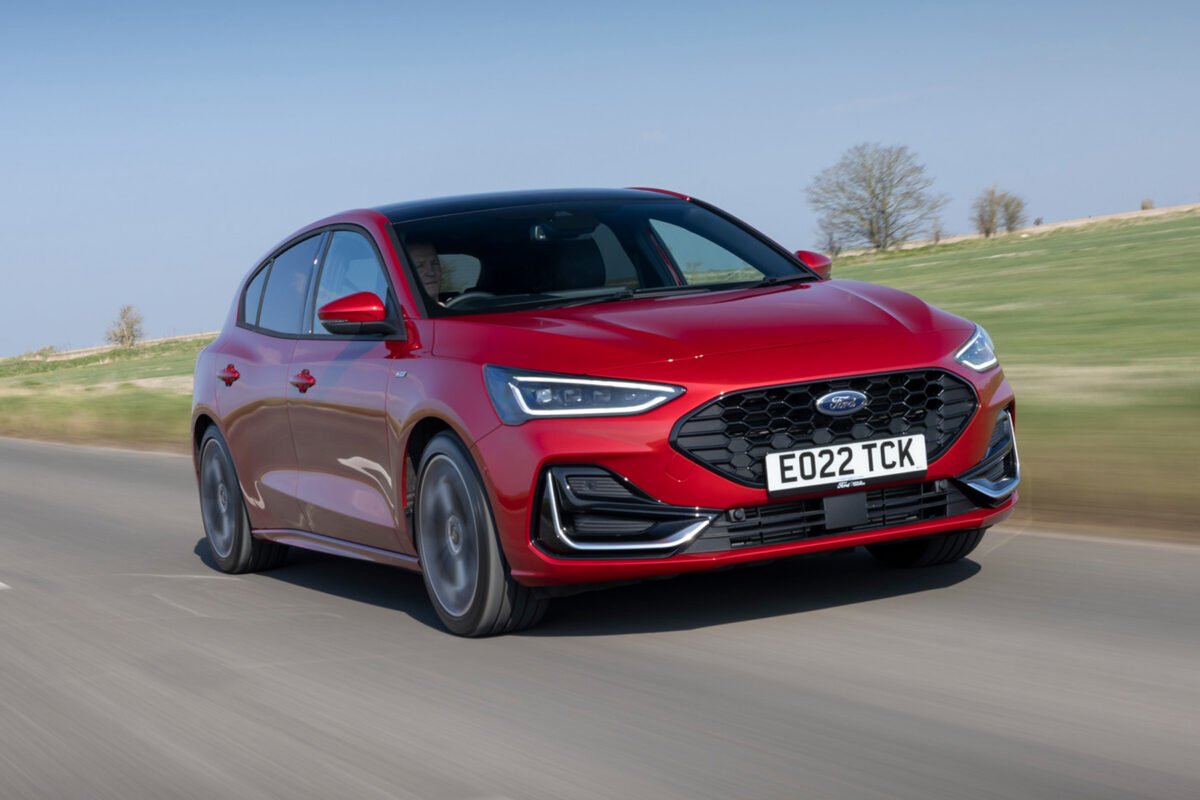
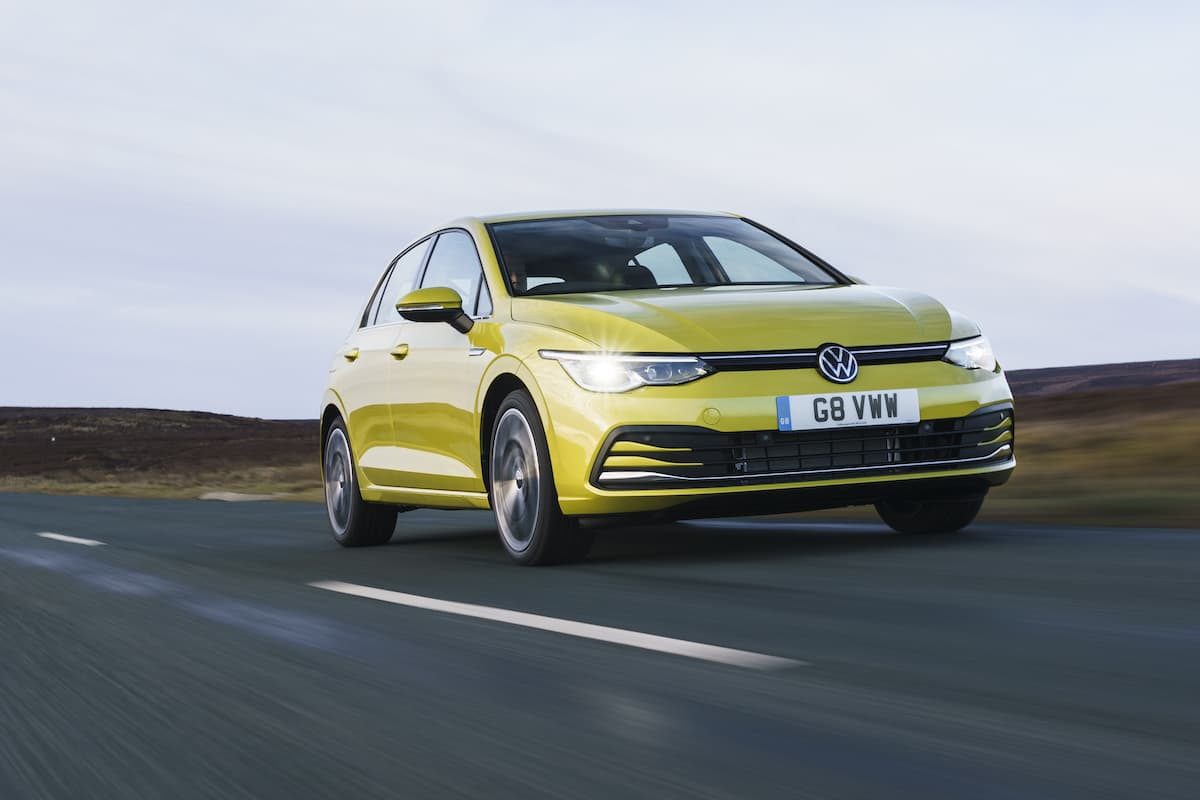
Despite the growing popularity of SUVs and crossovers, UK car buyers still choose more small hatchbacks than any other type of car.
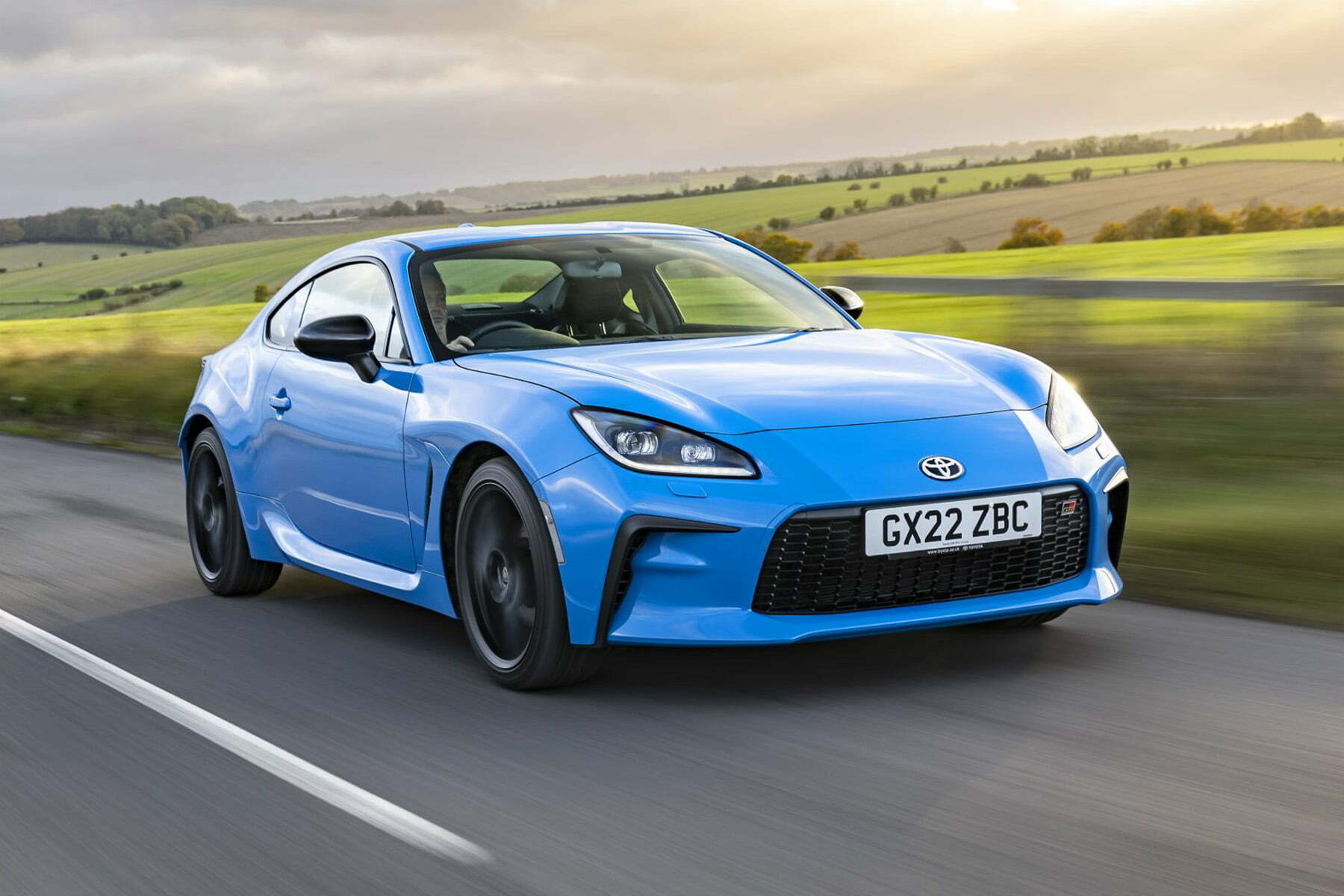
However, small cars are getting ever-larger. The smallest, known as city cars, are becoming an endangered species in the transition to electrification. In fact, the only car of this size launched in 2022 was the Toyota Aygo X.
Next up are superminis, which are larger and are usually five-door models instead of three-door hatchbacks like city cars. These are the most popular category of new car in the UK – although maybe not for much longer, as best shown by Ford deciding to kill off the UK’s most popular model of the last 40-off years, the Fiesta. Meanwhile, no new models arrived this year.
Above that we have more family-sized hatchbacks, which vary in size a bite more. The smallest of these, like the Cupra Born and Renault Megane E-Tech, are barely any longer than the larger superminis but offer better interior space.
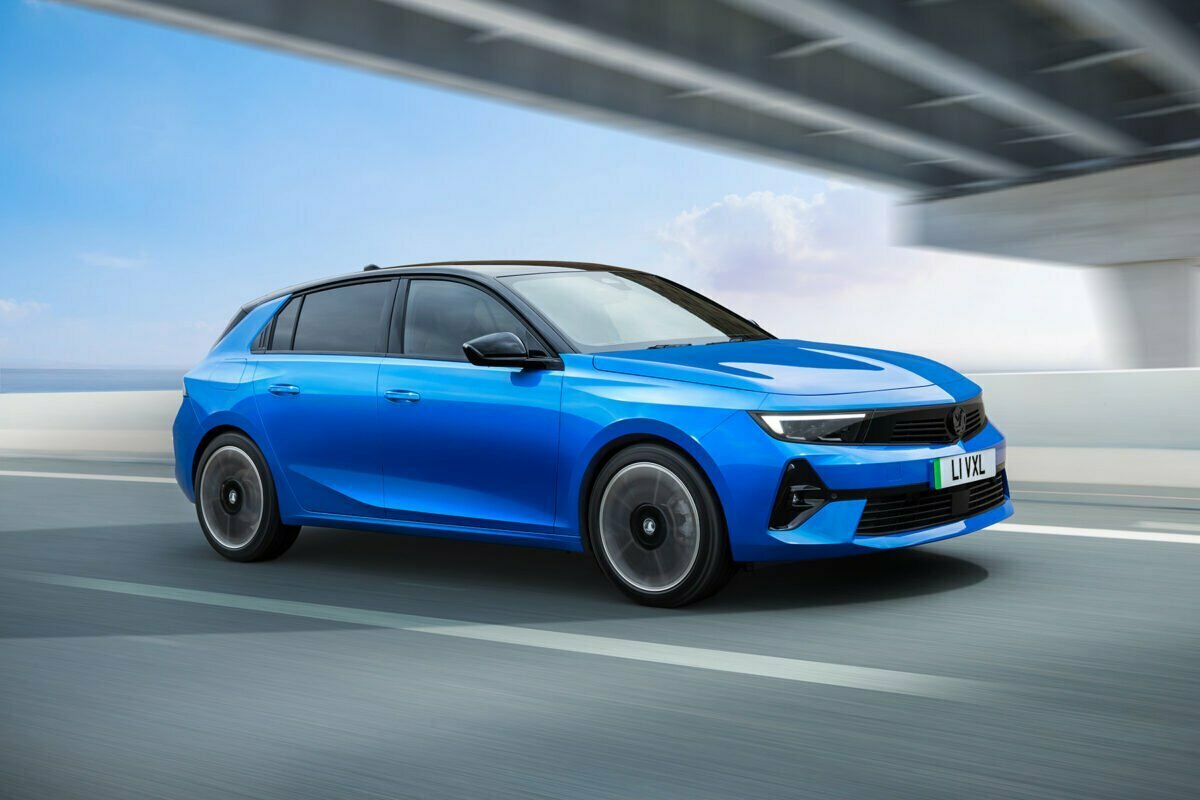
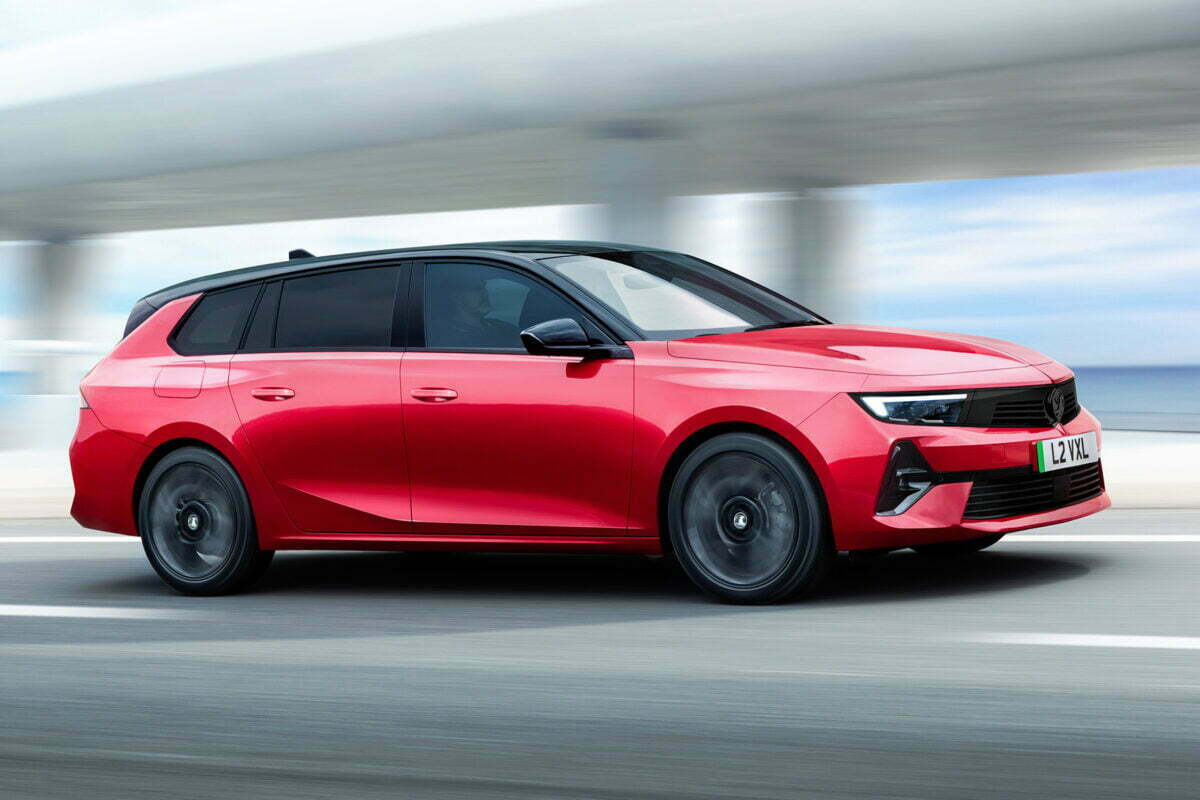
This year saw no new superminis, although the smaller family hatch marketplace was quite busy. Hitting UK roads this year were the Cupra Born, Peugeot 308, Renault Megane E-tech and Vauxhall Astra.
Electrification is starting to really take off in this sector, with several EV choices now available. However, you’ll find relatively few hybrid models plug-in hybrids. The majority are still powered by familiar petrol engines, although some have mild hybrid assistance. Diesels have almost completely vanished and only make up a fraction of sales.
Our awards recognise both the best new models to have been launched over the last 12 months, but also the best overall cars in each category – because newest doesn’t always mean best, as you can see below.
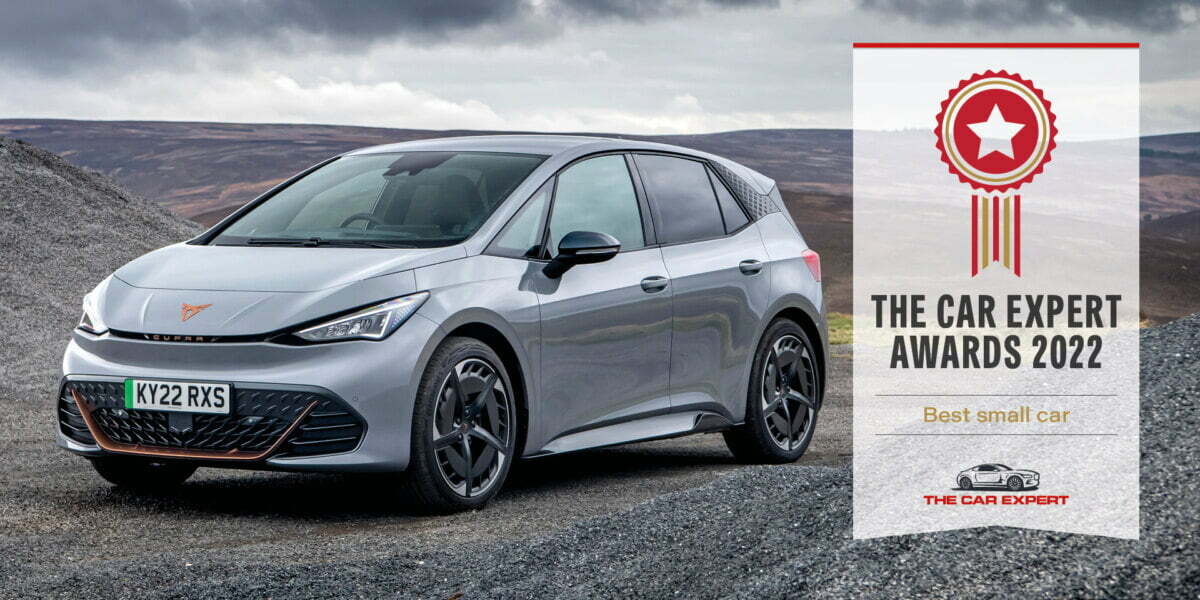
Best new small car + Class champion, electric: Cupra Born (76%)
The Cupra Born is a Spanish version of the Volkswagen ID.3 electric hatch, but adds a bit more flair and improved driving dynamics. It’s the top-ranked new model to join the small car ranks this year with an Expert Rating of 76%. It also goes straight to the top of the small EV class – at least for eligible models.
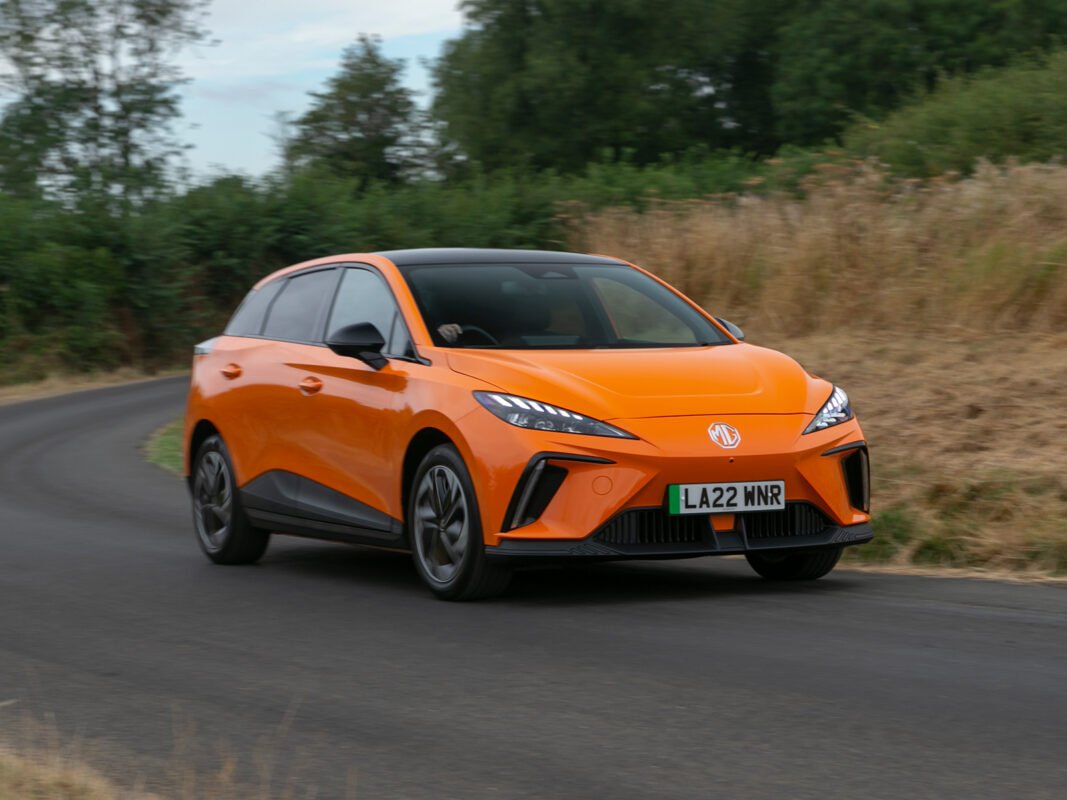
The new MG 4 has a higher Expert Rating, but was ineligible for this year’s awards because it did not have a Euro NCAP rating by our cut-off date. It did get a five-star rating in December, so it will be eligible next year.
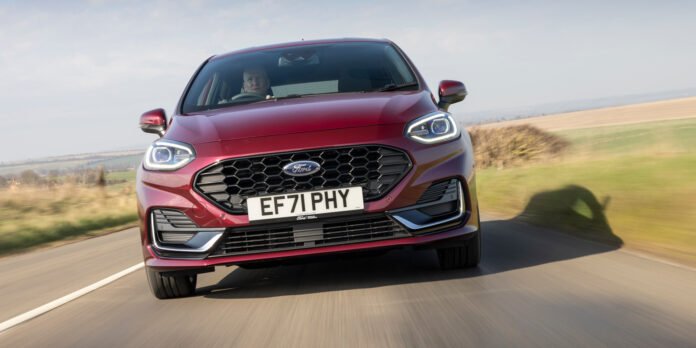
Ford may have decided to kill off the UK’s favourite car from the last half-century, but the Fiesta is going out at the top of its game, with an Expert Rating of 77% that pips last year’s best new car and class champion, the Skoda Fabia.
Diesel models and the three-door body style have fallen by the wayside due to falling sales, but the (freshly facelifted) five-door petrol versions of the Fiesta are still outstanding small cars. Unfortunately, there are no hybrid or electric choices in the Fiesta family, which has been hurting its sales performance over the last few years – especially with the Vauxhall Corsa available as an EV.
To be eligible for our Best New Model or Class Champion titles, there are a couple of requirements in addition to having a top Expert Rating score.
Firstly, the Best New Model must have been launched in the UK between 1 December 2021 and 1 December 2022. That means cars registered and on the road, not just available to order for deliveries starting sometime in 2023.
Secondly, a car must have a current Euro NCAP safety rating of either four or five stars. If a car scores three stars or less, we can’t in good conscience give it an award for being best in class. If a new model has not been tested by Euro NCAP by 1 December 2022, it will not be eligible but we will consider it next year if it has been tested.
Our Euro NCAP requirement meant that the new MG 4 was ineligible for this year’s awards. It has subsequently achieved a five-star safety rating, which means it will be eligible next year.
The small SUV/crossover segment is one of the fastest-growing areas of the new car market, and is taking sales from both small and medium cars.
Like the small car segment, SUVs and crossovers are growing ever-larger, which is great for rear passengers but not so good for trying to park in congested urban centres. An ever-increasing number of the are electric or plug-in hybrid models as well, although petrol power still dominates. Diesel models, as in most segments, are almost non-existent now.
Our awards recognise both the best new models to have been launched over the last 12 months, but also the best overall cars in each category – because newest doesn’t always mean best.
Best new small SUV + Class champion, electric: Kia Niro EV (76%)
The new Kia Niro EV has proven to be a brilliant evolution of its highly regarded predecessor, the e-Niro, which has earned it this year’s award for Best New Small SUV. With an Expert Rating of 77%, the Niro’s improved boot capacity, generous levels of equipment, and intuitive infotainment system are the real standout features for reviewers.
In addition, the competitive 285-mile driving range with a competitive 210hp of performance puts the Niro EV at the top of the small SUV segment. The price has jumped over the old e-Niro, but the quality of the Niro EV has improved by just as much.
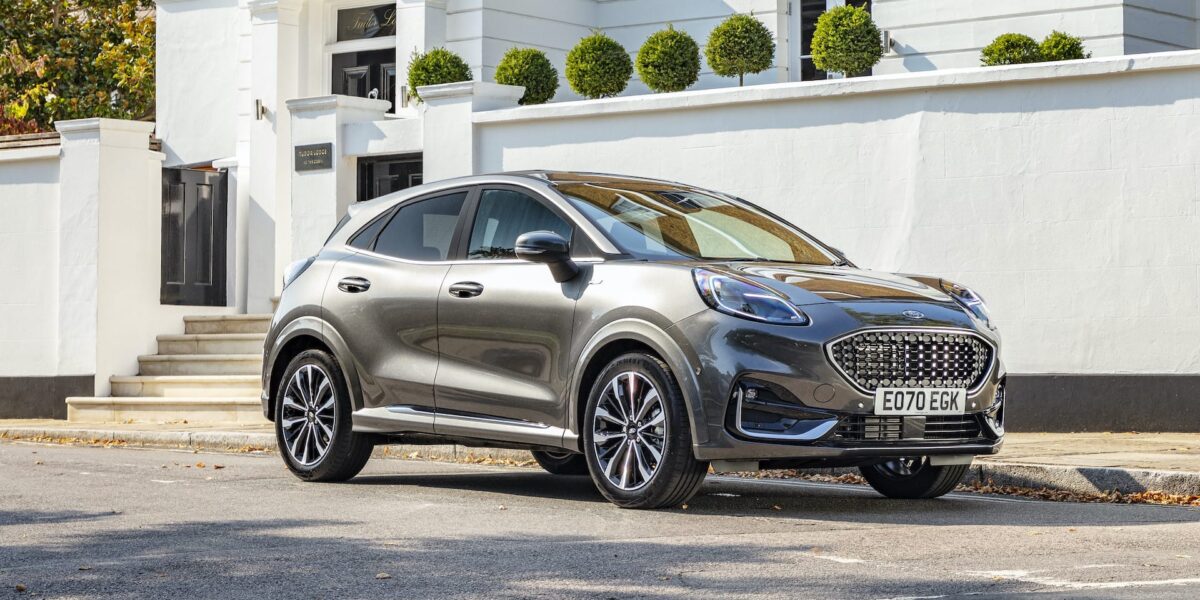
One of the best-selling SUVs throughout 2022, the Ford Puma has proved to be a popular choice for British buyers this year, and has received plenty of praise from UK reviewers since it first arrived on UK roads in 2020. Commended for its outstanding driving experience and surprising practicality, this petrol mild-hybrid SUV currently holds an Expert Rating of 76%.
The Puma has also played a part in killing off the very car upon which it’s based, the Ford Fiesta, with Ford very much prioritising the small SUV over its long-standing supermini.
As part of its last batch of 2022 assessments, Euro NCAP reassessed the Ford Puma, downgrading it to a four-star safety rating from its previous five-star score.
To be eligible for our Best New Model or Class Champion titles, there are a couple of requirements in addition to having a top Expert Rating score.
Firstly, the Best New Model must have been launched in the UK between 1 December 2021 and 1 December 2022. That means cars registered and on the road, not just available to order for deliveries starting sometime in 2023.
Secondly, a car must have a current Euro NCAP safety rating of either four or five stars. If a car scores three stars or less, we can’t in good conscience give it an award for being best in class. If a new model has not been tested by Euro NCAP by 1 December 2022, it will not be eligible but we will consider it next year if it has been tested.
It’s been yet another crazy year for the car industry, with the knock-on impacts of Covid-19 being compounded by Russia’s invasion of Ukraine, rapidly rising inflation and now increasing interest rates to combat the inflation.
But through all that, there have still been some fine new cars launched in 2022, as well as several cars from 2021 that were ineligible for last year’s awards but have become eligible this year.
What is noticeable is that there were fewer new cars launched this year, and in particular, far fewer petrol and diesel new cars. This is one of those kock-on effects of Covid – car companies were shut down for lengthy periods during 2020 and were therefore unable to work on developing new cars, resulting in fewer new models being released this year (and probably next year as well).
The transition to electric vehicles is also a reason for fewer new petrol models being released. With the UK’s 2030 deadline for the end of new petrol and diesel car sales looming large, and similar deadlines appearing all over Europe, car manufacturers have reached the point where it’s no longer viable to develop and launch a new fossil-fuel model as it won’t be on sale for long enough to recover the investment.
This has been particularly noticeable for convertibles, where we had no new models at all launched this year and therefore no award. There were also fewer small cars launched, with almost a total absence of new city cars and superminis in 2022.
The flip side to this, of course, is that there’s an ever-increasing number of electric models hitting new car showrooms and this year’s awards reflect this change.
Our eligibility rules
Our awards have two specific conditions for eligibility that make them different to many other Car of the Year awards.
Firstly, a car must be available to view and buy in the UK by the time entries close – not available to order, sight unseen, for delivery in several months’ time.
Secondly, a car must have a valid four-star or five-star Euro NCAP safety rating. If a car has not been tested by Euro NCAP, it won’t be considered but will be eligible next year if it subsequently gets a suitable safety rating. And that has happened in this year’s results.
And the winner is…
Our Expert Rating Index, based on reviews from 30 of the UK’s top motoring websites, shows that electric vehicles are continuing to achieve better review scores than their petrol and diesel equivalents. This was evident last year, and has strengthened further this year.
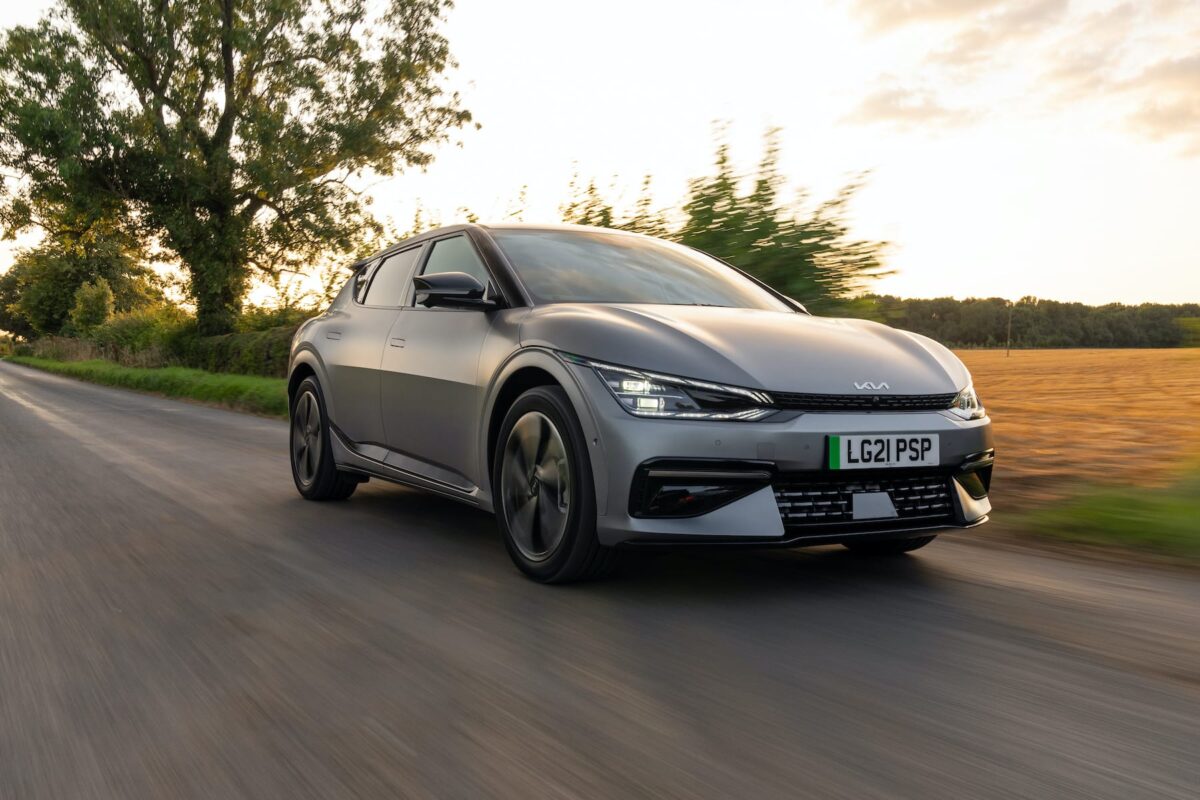
Based on all of the car reviews published by the UK motoring media over the last year, the highest-rated new car of 2022 is the Kia EV6.
The Car Expert’s Car of the Year 2022: Kia EV6
The Kia EV6 wasn’t launched in 2022, but was ineligible last year as it hadn’t received its Euro NCAP stamp of approval. However, it was awarded a five-star safety rating in May this year so became eligible for this year’s awards.
As well as taking the major prize for Car of the Year 2022, the Kia EV6 is also our Best New Medium Car.
The EV6 is the start of a new dawn for Kia, giving the company an EV that is genuinely desirable. Kia also makes the excellent Niro EV (which replaced the equally excellent previous-generation e-Niro) and the Soul EV, but it’s fair to say that these are worthy cars rather than exciting ones.
Together with its sister vehicles, the Hyundai Ioniq 5 and Genesis GV60, the Kia EV6 is propelling the Hyundai Group to being a market leader for electric cars, rather than its historical position of being a value-for-money alternative to European models.
The EV6 has been showered with awards over the last 12 months, including the prestigious European Car of the Year, and ours are merely the latest accolades to go its way. It’s inevitably fairly similar to the Hyundai Ioniq 5, although the Kia’s sleeker styling may well age better than the ’80s-inspired, retro-futuristic Hyundai.
Inside, the Kia looks and feels as premium as anything from Mercedes or BMW. Being an electric vehicle, the interior is more spacious than you’d expect – although rear headroom isn’t as generous as its Hyundai sibling.
On the road, the EV6 has been praised for being a more enjoyable car to drive than the Hyundai. Acceleration is also sharp, which is typical for an EV, while the battery range is an impressive 300+ miles to make range anxiety a thing of the past for most households.
Like most EVs, the Kia EV6 isn’t cheap. Bu you do get a lot of car for the money – something Kia’s always been good at delivering. As of December 2022, it holds an outstanding Expert Rating of 87%, which puts it in very exalted company and indicates outstanding scores from all 29 reviews we currently have on file.
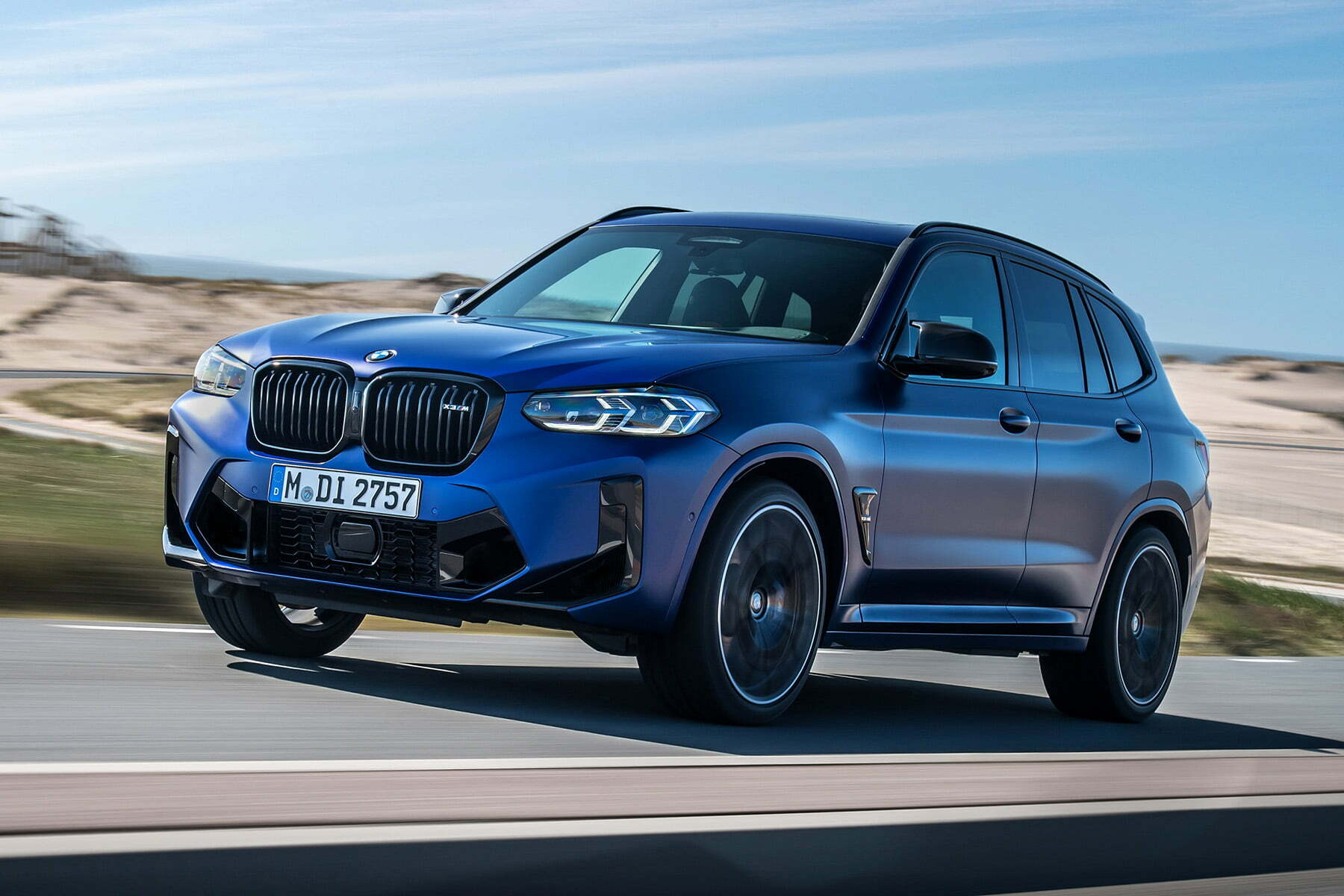
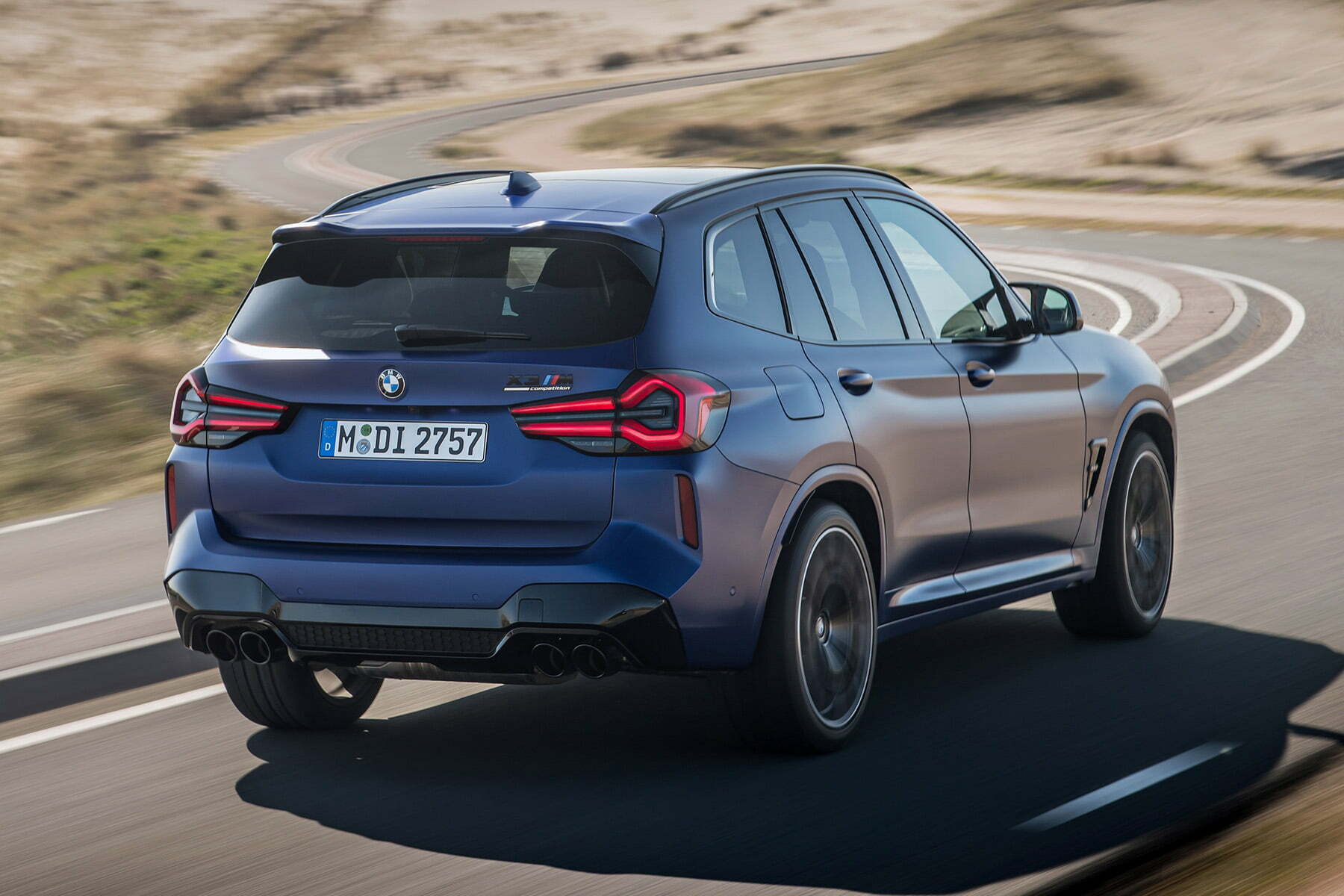
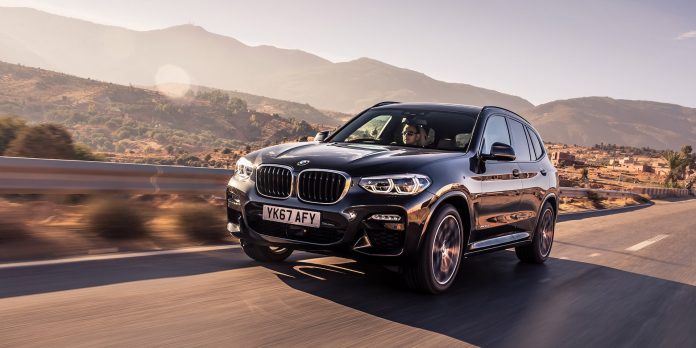
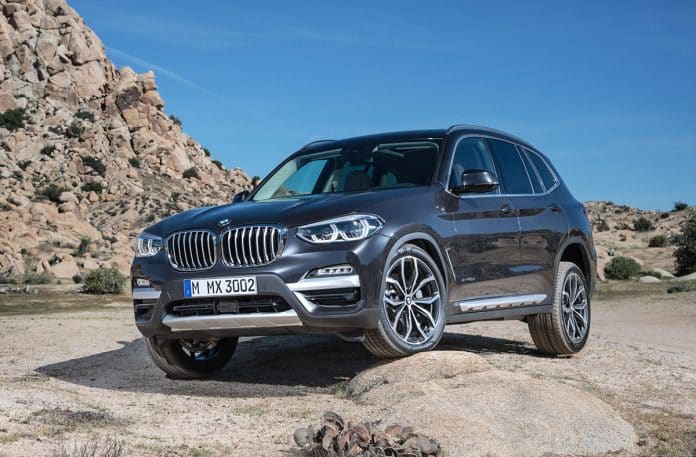
The BMW X3 M was a mid-size SUV/crossover and the performance-enhanced version of the regular third-generation X3SUV.
First arriving on UK roads in 2019, the X3 M received a facelift in 2021 alongside the rest of the X3 family. It ended production in 2024, and there are apparently no plans for an M version of the latest X3.
The sporty SUV range consisted of three models – the petrol-powered 360hp ‘M40i’ and diesel-engined 340hp ‘M40d’, and the range-topping 510hp ‘M Competition’ trim grade.
Before its 2021 facelift, the Top Gear team concluded that the X3 M was “devastatingly easy to drive stupidly fast”, but called its ride comfort “appalling”, said that its driving dynamics and engine note “lacked character”, and commented that it was too expensive.
The majority of reviewers largely agreed with this sentiment before 2021, but the X3 M’s review scores markedly improved after the facelift, Carwow asserting that the post-facelift X3 M was one of the most loud and agile options in the ‘hot SUV’ class.
As of February 2026, the BMW X3 M holds a Used Car Expert Rating of E, with a score of 46%. Its best scores – for reliability and safety ratings – are only average, while it scores poorly for running costs and CO2 emissions, while motoring journalists have also scored it badly.
Reviews, road tests and comparisons from across the UK automotive media. Click any of the boxes to view.
Auto Express
Model reviewed: Score: 7 / 10 “The steering is like any other contemporary M-badged BMW – it’s accurate, sensitive and sensible, but lacks the ultimate heft of old M cars.” Read review
Car
Model reviewed: Score: 8 / 10 “As a driver’s car, the X3 M is up there with the Macan – the Porsche offering a more raw, engaging drive; the BMW more stable, confidence-inspiring and ultimately satisfying if you’re chasing after fast lap times.” Read review
Carbuyer
Model reviewed: Score: 7.2 / 10 “The BMW X3 M Competition is a fast, practical SUV with a great engine but the ride is firm.” Read review
Carwow
Model reviewed: Score: 8 / 10 “If you’re after a sports SUV, they don’t come much louder and more agile than the BMW X3 M Competition.” Read review
Evo
Model reviewed: Facelift range Score: 8 / 10 “It’s still likely to be a little too rough for the kids and Labrador on the day-to-day, and as a whole the X3 M Competition still makes absolutely no sense, but it doesn’t stop me from quietly admiring it.” Read review
Model reviewed: Pre-facelift range Score: 4 / 10 “The BMW X3 M is fast and the interior feels well constructed, but has an excruciating ride quality, numb handling, dull powertrain.”
Parkers
Model reviewed: Score: 6.8 / 10 “The BMW X3 M is spacious, dynamic SUV for drivers who rarely venture off-road.” Read review
The Telegraph
Model reviewed: Score: 6 / 10 “The X3 M Competition is a blisteringly quick entry into this market from BMW, then, and with such sharp, malleable handling, it has the potential to outpace most of its rivals on smooth tarmac.” Read review
Top Gear
Score: 4 / 10 “Far from M Division’s finest hour. Flashy and fast, but you couldn’t live with this ride.” Read review
Safety rating
Independent crash test and safety ratings from Euro NCAP
The BMW X3 was originally crash tested by Euro NCAP back in 2017 and awarded a five-star rating. The X3 M shares this safety score as it’s structurally identical to the regular X3 range.
However, the X3’s rating expired in January 2024 and is no longer valid as the car no longer meets the standards required for such a rating. This is normal practice, as Euro NCAP reviews its ratings on most cars annually with most ratings expiring after about six or seven years.
However, if you are comparing a used X3 of any flavour to vehicles of similar age, whose ratings will have probably also expired, its safety rating score is still useful.
Eco rating
Independent economy and emissions ratings from Green NCAP
No eco rating
The BMW X3 M was not assessed by Green NCAP during its production life.
Reliability rating
Reliability data provided exclusively for The Car Expert by MotorEasy
Total claims: 358 Average repair cost: £478.50 Last updated: April 2025
The BMW X3 – including the X3 M – has an average reliability score of 70% as of December 2024, according to workshop and warranty data provided by our partner, MotorEasy. This score applies to both this generation and previous models.
The good news is that the average repair cost is less than £500, which is much better than most vehicles – regardless of price point.
When the X3 does have problems, they tend to be relatively inexpensive. Even big-ticket items like engine and gearbox repairs have cost less than on many other cars – an average of £800-£900, compared to £1,500+ on many similar cars from other manufacturers.
Similar cars
If you’re looking at the BMW X3 M, you might also be interested in these alternatives
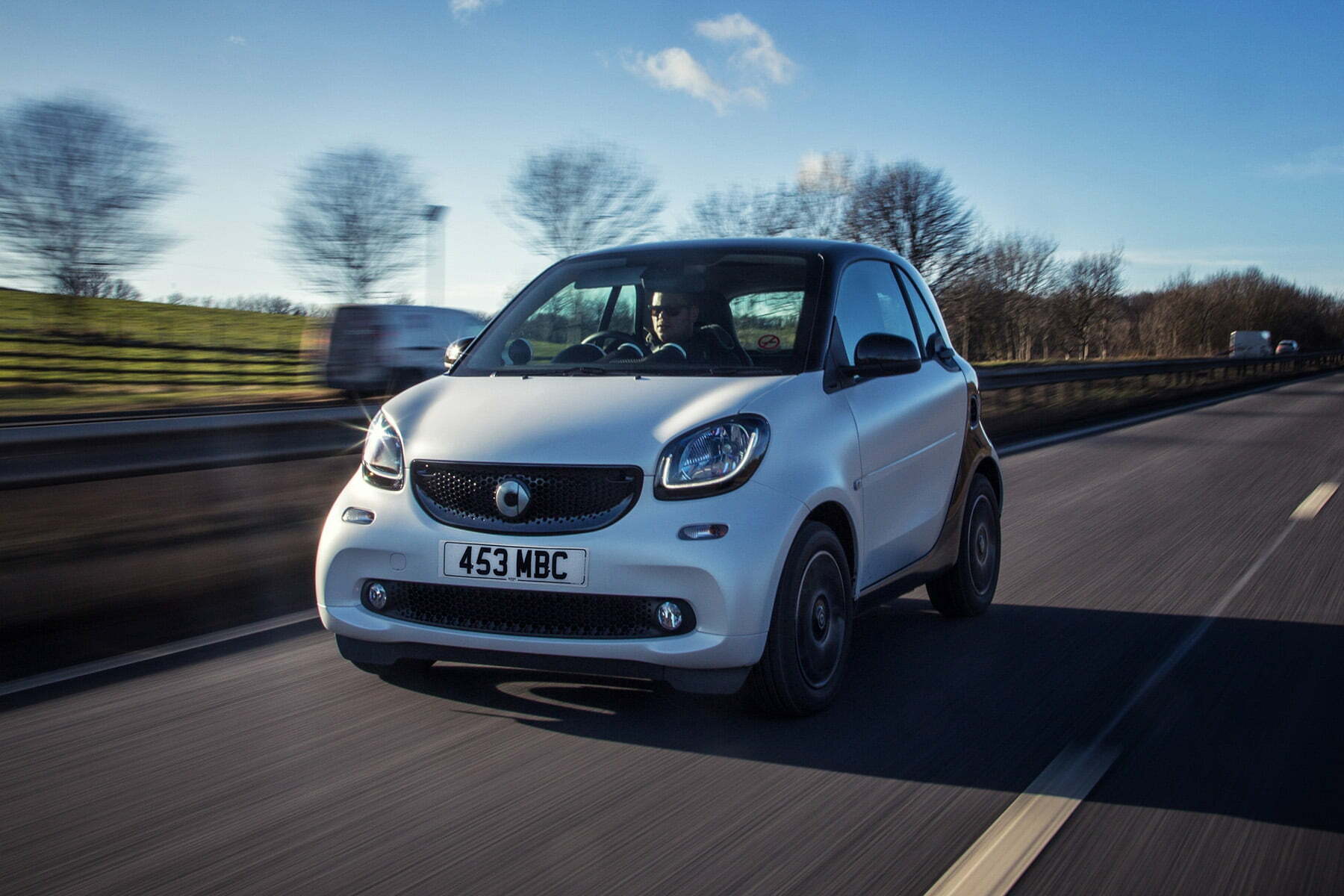
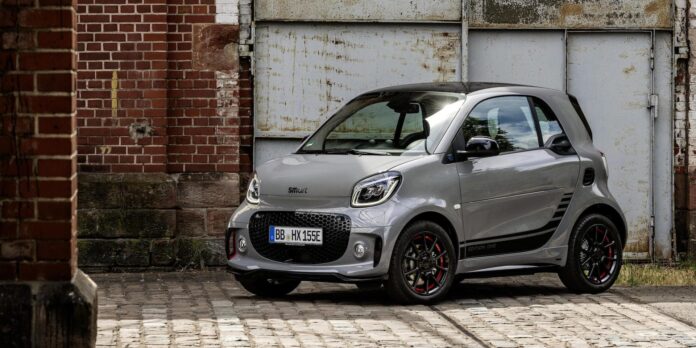
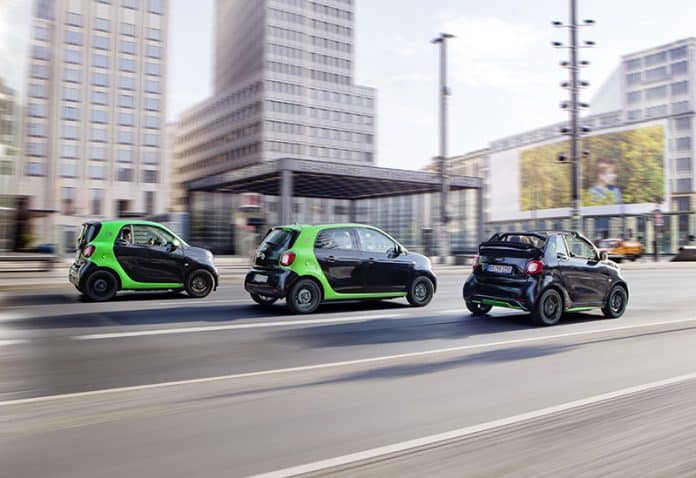
The Smart Fortwo was a small three-door city car that was available in hatchback and cabriolet body styles. This model is the third and final generation of the petrol-powered Fortwo, which was discontinued after the Smart brand became electric-only in 2018.
This page covers both the Fortwo coupé (actually a hatchback) and cabriolet, powered by a 1.0-litre petrol engine. We have a separate page for the EQ Fortwo, which is the electric equivalent and now the only version of the Fortwo still on sale.
The Fortwo received mixed reviews from the UK motoring media during its time on sale, with scores ranging from poor to great. It received praise for its suitability for urban driving, being agile and easy to park, but reviewers generally agreed that it wasn’t all that comfortable to drive, and that it struggled on longer journeys outside the city limits.
Which? commented that the Fortwo did provide quite a fun driving experience around town, but that it was also “uncomfortable, loud, unstable at motorway speeds, and sparsely equipped for the price.”
Auto Trader‘s Jon Quirk agreed that the Smart Fortwo was quite expensive when compared to more practical city car rivals like the Volkswagen Up, while James Dennison of Parkers asserted that the larger Smart Forfour was the better value-for-money package.
No longer on sale, the petrol-powered Smart Fortwo holds a Used Car Expert Rating of A with a score of 69%.
Body style: Small three-door hatch and cabriolet Engines:petrol Price when new:From £9,875 on-road
Launched: Autumn 2014 Last updated: Spring 2017 Discontinued: Spring 2018
Image gallery
Media reviews
Highlighted reviews and road tests from across the UK automotive media. Click any of the boxes to view.
Auto Express
Model reviewed: (2017) Score: 6 / 10 “The Smart ForTwo Mk3 is part of a tie-up with Renault, but delivers the same premium quality of its predecessors.” Read review
Model reviewed: Brabus Score: 6 / 10 “Adding a little more power to one of the smallest cars on sale today could have proved disastrous, but it seems like Smart has got it right.” Read review
Model reviewed: Cabrio Score: 6 / 10 “The latest Smart ForTwo Cabrio brings roof-down fun to Smart’s unique city car.” Read review
Model reviewed: Score: 6 / 10 “This turbocharged ForTwo is the one to go for if you ever venture out of town. It retains the standard car’s manoeuvrability and incredible turning circle, but adds that extra bit of oomph, which you’ll find invaluable on the motorway.” Read review
Model reviewed: (2014) Score: 6 / 10 “Covering long distances is more bearable than before but still a chore due the rather rowdy engine at higher speeds plus excessive amounts of wind noise.” Read review
Auto Trader
Model reviewed: Score: 7 / 10 “The Smart Fortwo is quite expensive for what it is, especially when compared with other city cars, but its tiny proportions do mean that it can do a few things that very few rivals can.” Read review
Model reviewed: Convertible (2016) Score: 6.2 / 10 “The Smart ForTwo Cabrio is quite expensive for what it is, but it does give genuine wind-in-the-hair fun, and nothing at else at this price can do that as effectively.” Read review
Business Car
Model reviewed: Score: 5 / 10 “The Smart Fortwo is unique, but it can’t be recommended beyond its image.” Read review
Car
Model reviewed: 1.0 (2015) Score: 6 / 10 “As good as it is, with Smart positioning itself as a pre-eminent brand in this sort of thing, the Smart ForFour is a product for city car badge snobs. Does such a person exist?” Read review
Carbuyer
Model reviewed: (2014-19) Score: 5.8 / 10 “This Smart ForTwo looks very different to the original, but it’s still a very compact city car that’s affordable to run and easy to park.” Read review
Carwow
Model reviewed: Cabrio Score: 5 / 10 “The Smart ForTwo Cabrio is one of the best city runabouts and the addition of a folding roof makes it pretty unique. It’s not very spacious, though, or particularly good to drive.” Read review
Model reviewed: ForTwo coupé Score: 6 / 10 “If you live in a city then before you look at any other car you should consider the new Smart ForTwo.” Read review
Evo
Model reviewed: Brabus Score: 7 / 10 “The Smart Fortwo Brabus is cheeky and surprisingly agile.” Read review
Model reviewed: Brabus Score: 7 / 10 “Far more capable and fun than we could have expected, but it’s hard to ignore that price tag.” Read review
Model reviewed: (2015) Score: 6 / 10 “New Smart Fortwo is a huge step over its predecessor, but still entertains through its character rather than its handling and performance.” Read review
Score: 6 / 10 “New Fortwo is a huge step over its predecessor, but still entertains through its character rather than its handling and performance.” Read review
Green Car Guide
Model reviewed: Score: 7 / 10 “We applaud Smart on finally fitting a manual gearbox and on making the ForTwo wider without increasing overall length.” Read review
Model reviewed: 1.0-litre 71hp petrol manual Edition 1 Score: 7 / 10 “In combination with the incredible turning circle, an airy, fun, and well-finished interior, great visibility and in context a surprisingly big and very usable boot, it is perfectly suited to urban use. However, the 71hp engine struggles with big hills and requires overtaking to be planned in military detail.” Read review
Heycar
Model reviewed: Score: 6 / 10 “The Smart Fortwo is one of the most unusual cars ever to reach production, and even the story of its birth is hardly straightforward.” Read review
Model reviewed: Score: 6 / 10 “”If you have a very specific and narrow idea of what you want from a car – good in the city, unbelievably tiny and with a convertible roof – then the Fortwo Cabriolet will tick all of your boxes.” Read review
Honest John
Model reviewed: (2016-19) Score: 6 / 10 “The Smart ForTwo is great around town. Folding fabric roof can be operated at any speed. Easy to drive.” Read review
Score: 8 / 10 “There’s plenty to like about the Smart Fortwo. It’s characterful, cheap to run and perfect for urban environments – but it is also quite expensive. The cheapest model costs almost £11,000, which would get you a very well-equipped Volkswagen Up.” Read review
Motoring Research
Model reviewed: 1.0 71 “Smart at last; the most distinctive of all city cars has been transformed.” Read review
Parkers
Model reviewed: Score: 7 / 10 “Compact two-seater city Smart Fortwo is quirky, but niche.” Read review
Model reviewed: Cabriolet (2016-19) Score: 7 / 10 “The UK’s smallest convertible gets more appealing.” Read review
The Sunday Times
Score: 6 / 10 “One doesn’t like to state the obvious, but at this kind of money you could buy a real car. Indeed you could acquire a very handsomely appointed Volkswagen Polo, with proper seats and a proper boot, and even with better economy and emissions figures.” Read review
Model reviewed: Passion (2015) Score: 8 / 10 “The great Smart ForTwo city car grows up.” Read review
The Telegraph
Model reviewed: Score: 6 / 10 “If you want a city-friendly convertible and can live with two seats, there’s nothing quite like the Smart ForTwo Cabrio. However, the Fiat 500C is roughly the same price, and while it isn’t quite as manoeuvrable, it does have four seats, as well as similarly fashionable styling.” Read review
Model reviewed: Score: 6 / 10 “This is the best Smart yet, and a hoot to drive around town, but it is impossible to ignore that more competent rivals are available for significantly less money.” Read review
Top Gear
Score: 6 / 10 “No, we’re not sure what happened to the front end styling either. Be thankful the rest of it is better.” Read review
Model reviewed: Brabus “The fastest version of Mercedes’ smallest car – the Smart ForTwo Brabus. It’s a mixed bag.” Read review
Model reviewed: Coupe 1.0 Passion 2dr Score: 6 / 10 “The new Smart ForTwo is very, very much better at impersonating a car than its predecessors ever managed.” Read review
Safety rating
Independent crash test and safety ratings from Euro NCAP
The Smart Fortwo was originally crash tested by Euro NCAP back in 2014 and awarded a five-star rating. However, this rating expired in January 2021 and is no longer valid as the car no longer meets the standards required for such a rating. This is normal practice, as Euro NCAP reviews its ratings on most cars annually with most ratings expiring after about six or seven years.
However, if you are comparing a used Smart Fortwo to vehicles of similar age, whose ratings will have probably also expired, its safety rating score is still useful.
Eco rating
Independent economy and emissions ratings from Green NCAP
No eco rating
No longer on sale, the Smart Fortwo has not been lab tested by Green NCAP.
Reliability rating
Reliability data provided exclusively for The Car Expert by MotorEasy
Total claims: 51 Average repair cost: £391.02 Last updated: April 2025
The Smart Fortwo has a lower-than-average reliability score, according to exclusive extended warranty data provided by our partners at MotorEasy. This score covers both this third-generation model, as well as the previous petrol-powered Fortwo versions, however it is currently based on a small number of vehicles.
If you’re looking at a used Smart Fortwo, make sure any extended warranty cover you purchase covers all of the areas shown above.
Awards
Trophies, prizes and awards that the Smart Fortwo has received.
2015
Red Dot Design Award
Similar cars
If you’re looking at the Smart Fortwo, you might also be interested in these alternatives.
UK buyers can now configure the Hyundai Ioniq 6 saloon on the brand’s website, with two drivetrains and two trim options to choose from.
Set to challenge the likes of the BMW i4, Polestar 2 and Tesla Model 3, the new Hyundai Ioniq 6 is already proving to be quite popular in Europe – its manufacturer reporting that all limited-run First Edition variants were reserved within 24 hours of the trims unveiling back in October.
Following this sales success, Hyundai has now released the UK pricing and specifications list for the upcoming saloon range, with prices starting south of £47k. By comparison, pricing for the First Edition models started at £55k.
228hp rear-wheel drive drivetrain
325hp all-wheel drive drivetrain
Premium trim
£46,745
£50,245
Ultimate trim
£50,245
£53,745
The manufacturer reported earlier this year that the Ioniq 6 will be offered with either an entry-level 58kWh or a more powerful 77kWh battery, like the Ioniq 5 hatchback currently on sale. However, Hyundai now says that all saloon models will use the larger 77kWh option.
There are two drivetrain configurations to choose from – a 228hp rear-wheel drive layout, and a more expensive 325hp all-wheel drive version. Either configuration can be selected with the two trim levels on offer – the entry-level ‘Premium’ and range-topping ‘Ultimate’ trim.
Key trim level features
‘Premium’ trim (from £46,745)
Gear paddle shifters
20-inch alloy wheels
Rear spoiler
Leather heated steering wheel
Electronically-adjustable heated front seats
Heated rear seats
Cloth upholstery
Dual-zone climate control
Automatic windscreen wipers
Auto dimming rear view mirror
Rear view camera
Electronically-adjustable heated door mirrors
Keyless entry
12-inch infotainment screen
12-inch digital instrument cluster
Wireless smartphone charging pad
Smart cruise control
Blind spot collision warning
Lane keeping assistance
‘Ultimate’ trim (from £50,245)
All ‘Premium’ trim features that are not replaced
Massage function for front seats
Leather upholstery
Electronically-adjustable sunroof
Blind spot camera
360-degree parking camera
Head-up display
Parking assistance technology
Premium Bose speaker system
All models come with a 12-inch infotainment console and 12-inch digital instrument cluster on the dashboard, as well as keyless entry, dual-zone climate control, cloth interior trim and 20-inch alloy wheels. Standard on-board tech features include cruise control, a blind spot collision warning and lane keeping assistance.
The ‘Ultimate’ trim grade adds a sunroof and a head-up display that projects driving information onto the windscreen. This trim also swaps out the interior cloth for leather, and replaces the standard rear view parking camera with a 360-degree surround view system that also allows you to view blind spots.
The optional digital side mirrors package, which replaces the traditional wing mirrors with cameras and fits mirror display monitors on either side of the dashboard, is available for an extra £1k. 11 different exterior colour choices are available, including pearl, metallic and matte finishes, and the interior can be specced in either black or white.
Safety body Euro NCAP has crash tested another 14 new cars including new models from MG, Mercedes-Benz, Volkswagen and Ford, with many of these achieving top marks.
In what is surely the last batch of Euro NCAP results this year, eleven models, including several that have either just arrived in the UK or are set to go on sale, have been awarded full five-star ratings as several manufacturers continue to up the industry standards for accident safety and assistance technology.
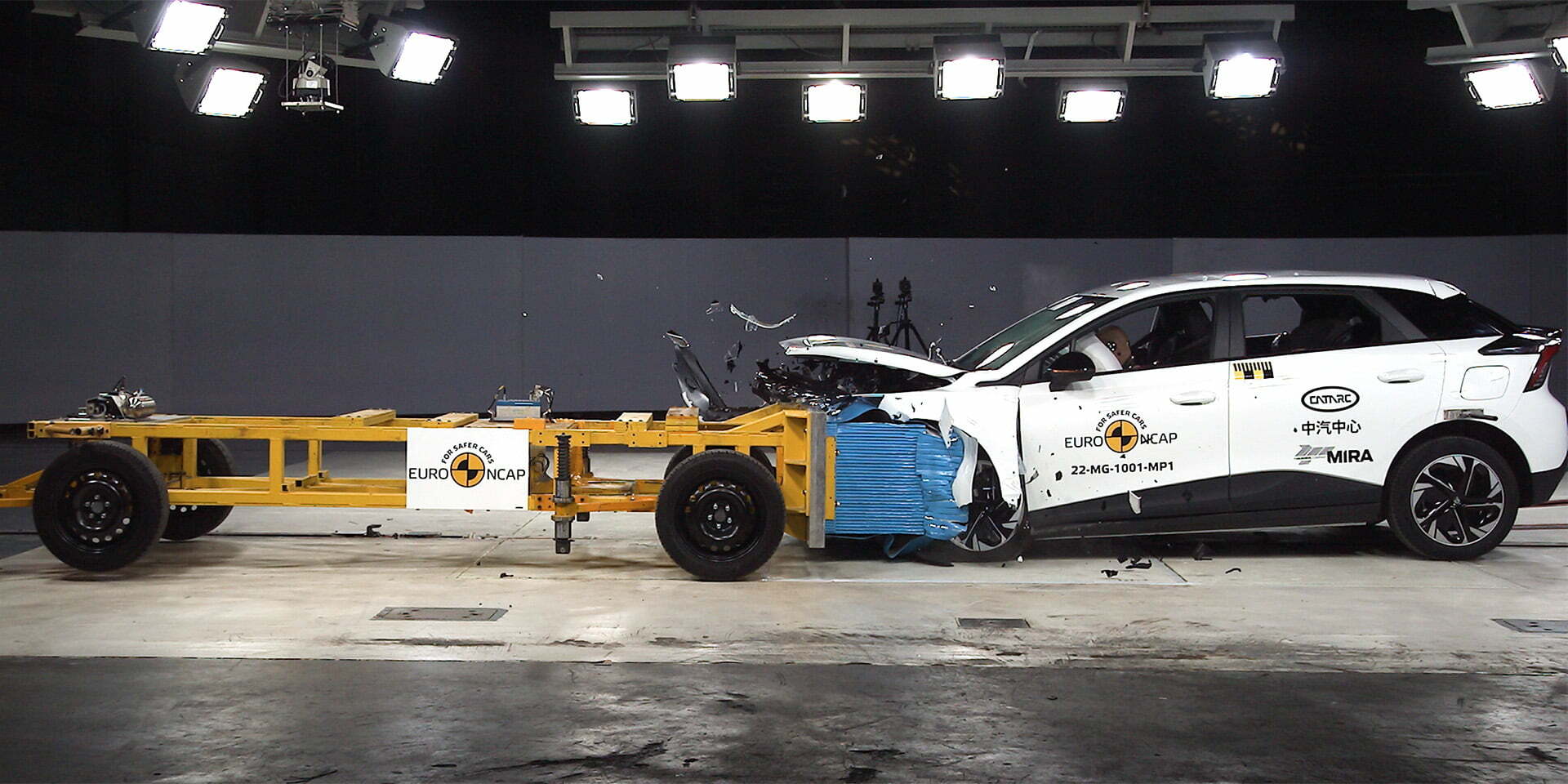
Perhaps the most interesting result for UK buyers published in this round of tests, the new all-electric MG 4 has received a full-five star rating from Euro NCAP – the first five-star rating budget brand MG has been awarded since 2019.
While the hatchback’s scores are not class-leading, it received respectable scores in each category, the highest being its adult occupant crash safety score of 83%.
Euro NCAP has also managed to get its hands on the next-generation Mercedes-Benz GLC before it has arrived on UK roads. The SUV also received top marks, with impressive scores for its adult (92%) and child occupant safety (90%) in the event of a crash.
MG 4Mercedes-Benz GLC (2022 onwards)
The brand-new Lexus RX was also crash tested – its 91% safety assistance technology score being the highlight of its five-star rating.
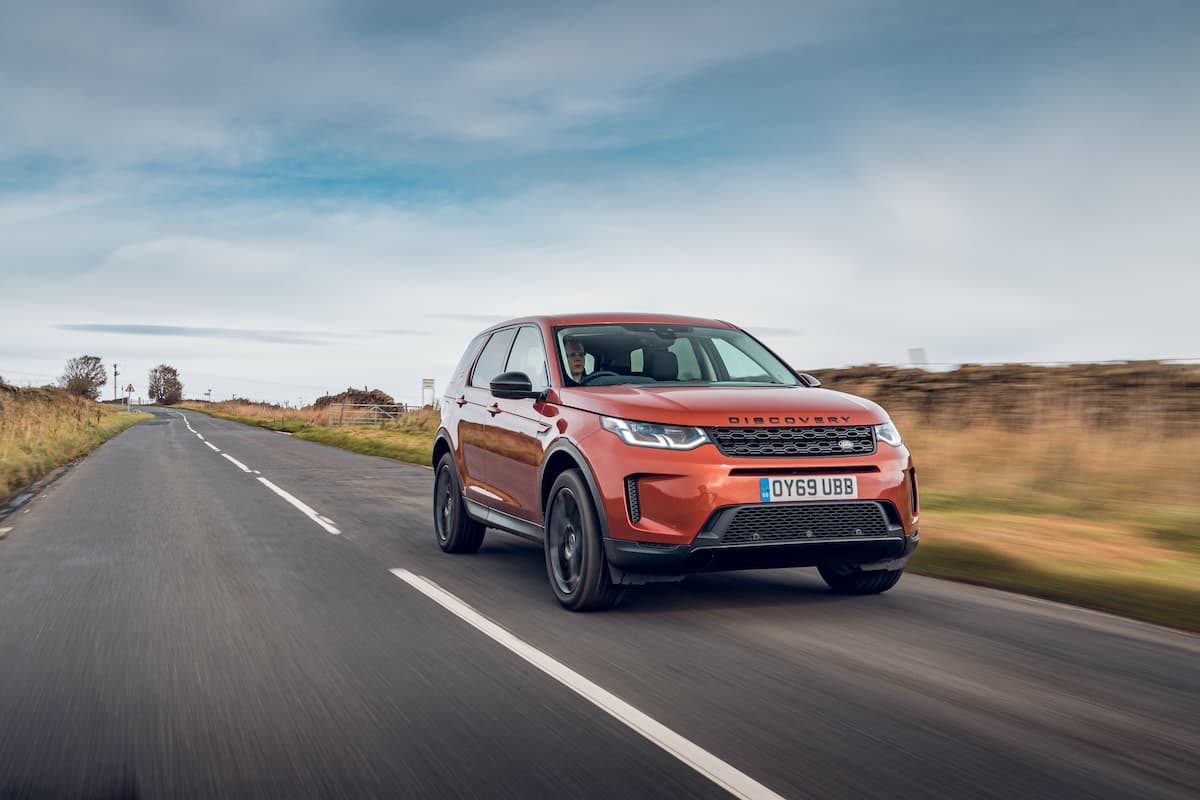
After Euro NCAP put the new Range Rover through its paces last month, the safety body picked the Discovery Sport out of the Land Rover catalogue to test in this latest safety assessment batch. First tested around the time of its first release back in 2015, the safety body has renewed the Land Rover’s five-star rating, its highest individual score being its child occupant safety score of 89%.
Lexus RXLand Rover Discovery Sport
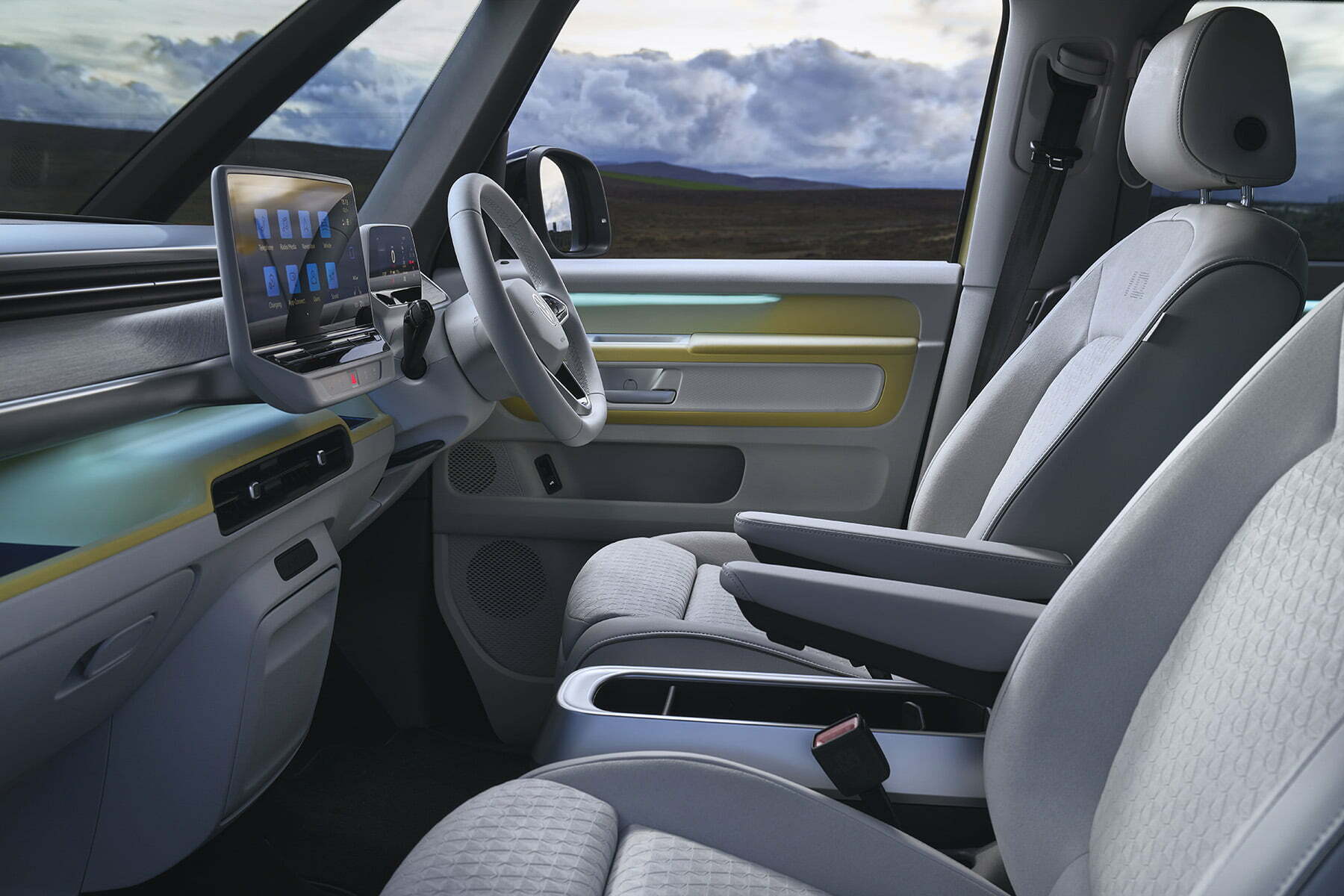
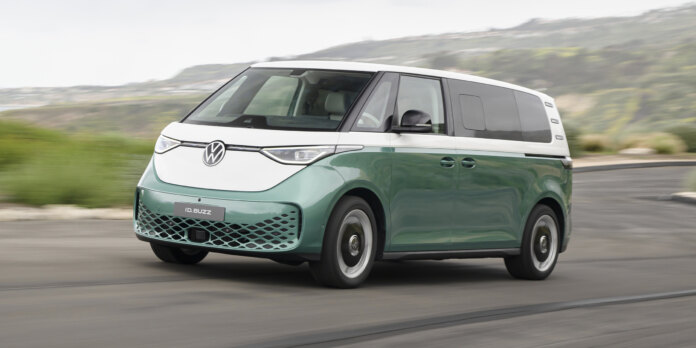
This batch of tests includes several people carrier models, including the new all-electric Volkswagen ID. Buzz, which is highlighted for its stand-out occupant safety and safety assistance technology scores.
That said, its vulnerable road users protection score of 60% was not all that impressive, Euro NCAP commenting that some areas of the car’s front end offered poor protection for pedestrians and cyclists in the event of a road accident. The Volkswagen Touran people carrier was also retested, and has been downgraded to a four-star rating.
An upcoming leftfield alternative to the ID. Buzz, the electric Maxus MIFA 9 was also awarded top marks after its assessment, with equally impressive individual scores.
Volkswagen ID. BuzzMaxus MIFA 9
Now on to the off-roaders – the closely-related Ford Ranger and Volkswagen Amarok pickups were awarded identical five-star ratings. Both received high occupant safety and safety assistance tech scores, with pedestrian and cyclist protection described as “adequate”.
Ford RangerVolkswagen Amarok
On sale for two years now, the Ford Puma has been tested once again. It’s clear that Euro NCAP’s assessments have gotten tougher since its last test, as the small SUV has been downgraded to a four-star rating.
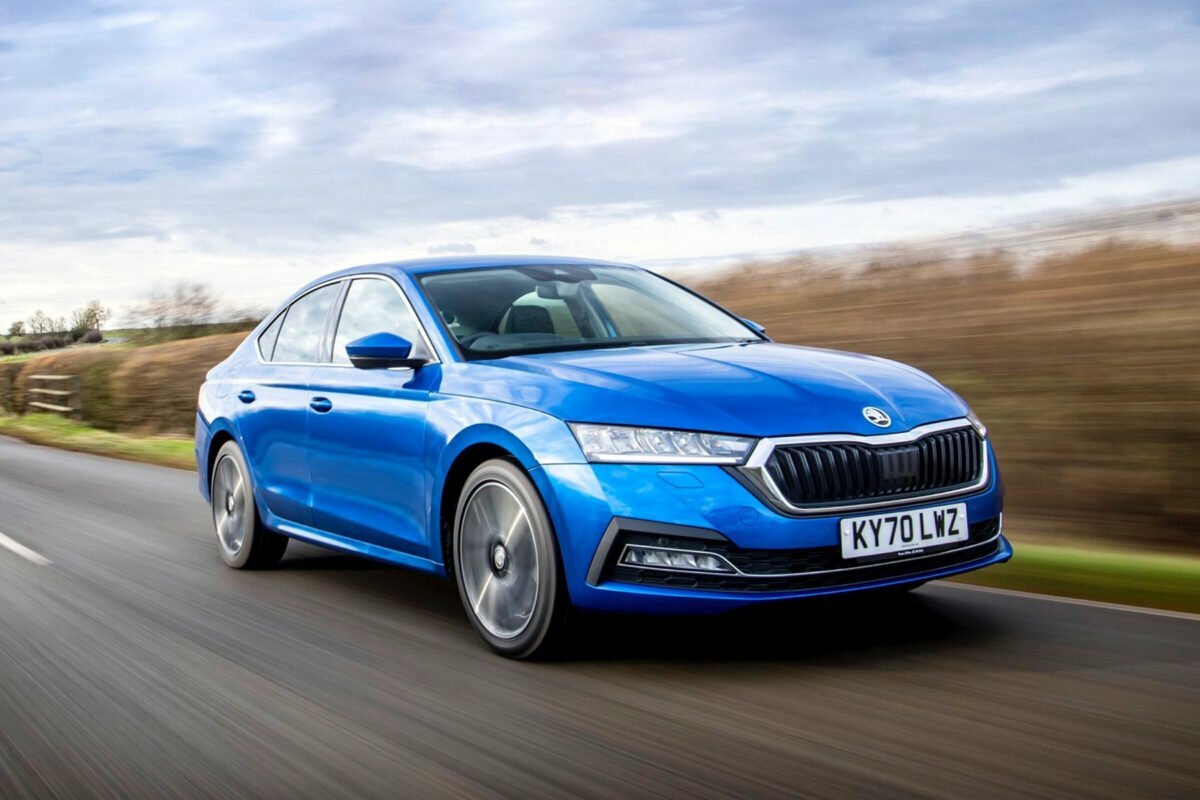
The Skoda Octavia was also retested, and although some of its individual scores have dropped, it retains its five-star rating.
Ford PumaSkoda Octavia
The new Peugeot 408 also missed out on full marks, achieving a four-star rating, and Euro NCAP has announced that Citroën C4‘s four-star assessment that was conducted in May last year now also stands for the newer C4 X.
Finally, this batch of tests also included models from two lesser-known brands in the UK. The electric Lucid Air saloon – expected to challenge the likes of the Tesla Model S if and when it arrives in the UK – achieved an impressive five-star rating. The Chery OMODA5 SUV was awarded top marks, but is not expected to arrive in the UK anytime soon.
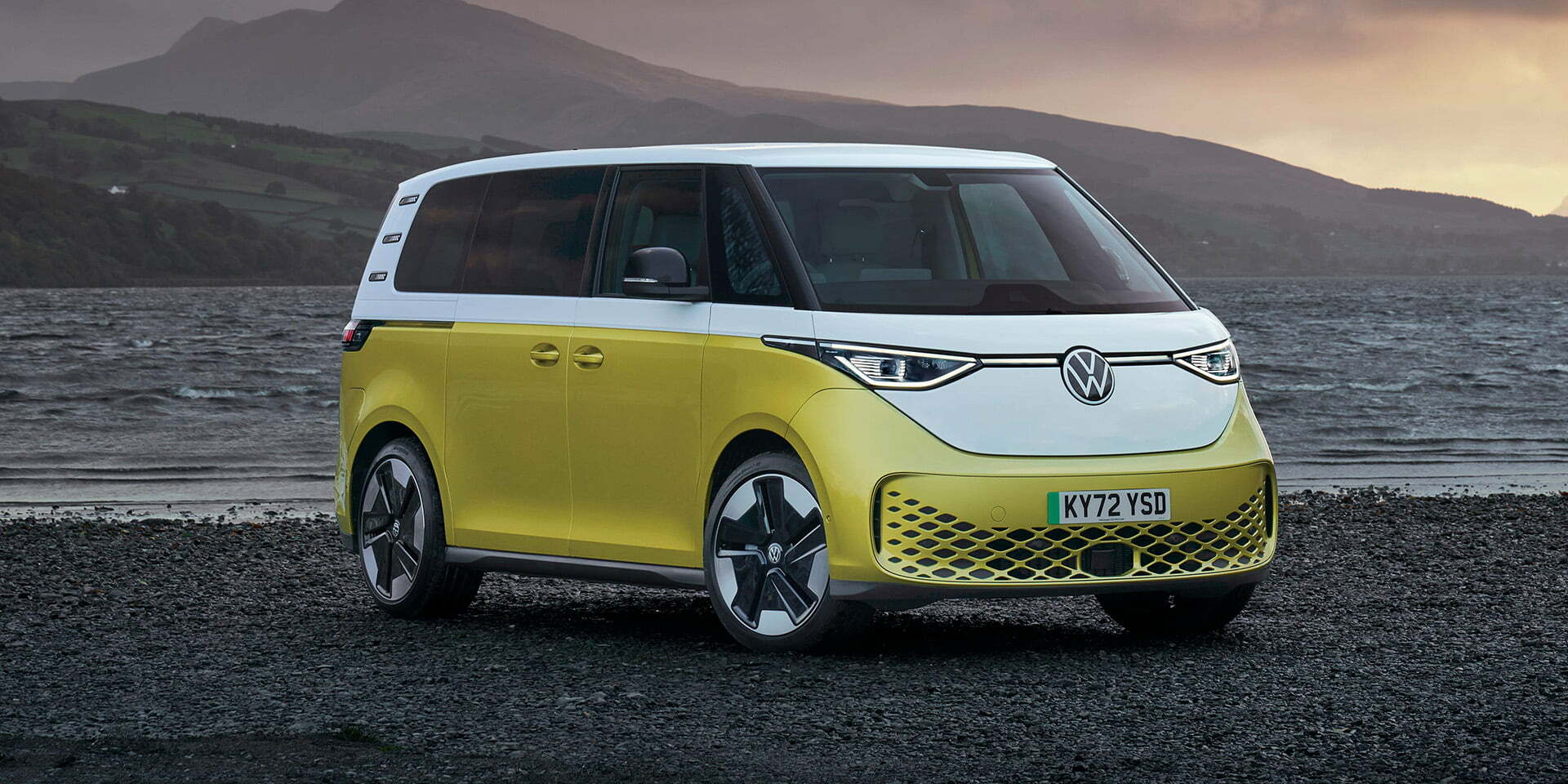
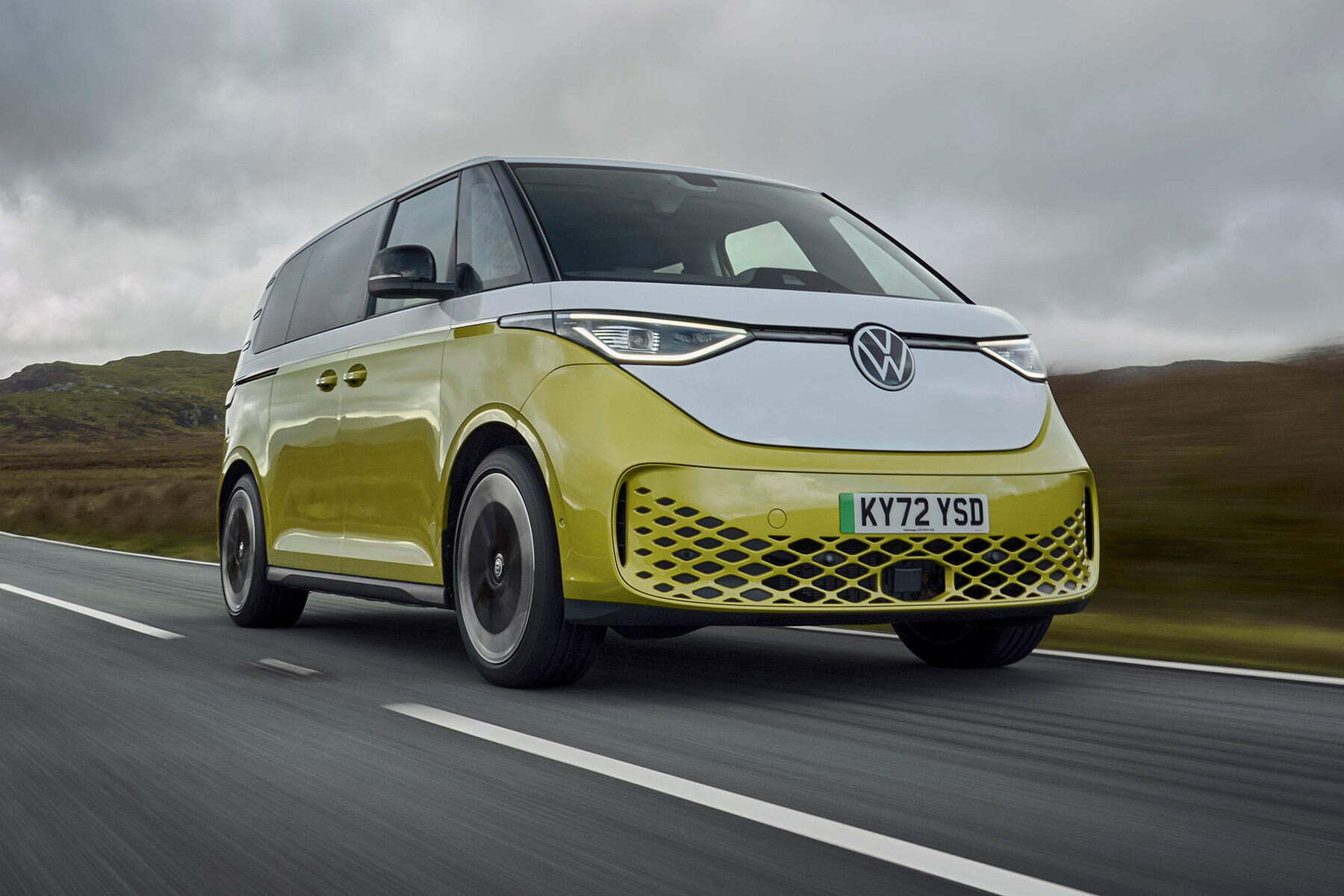
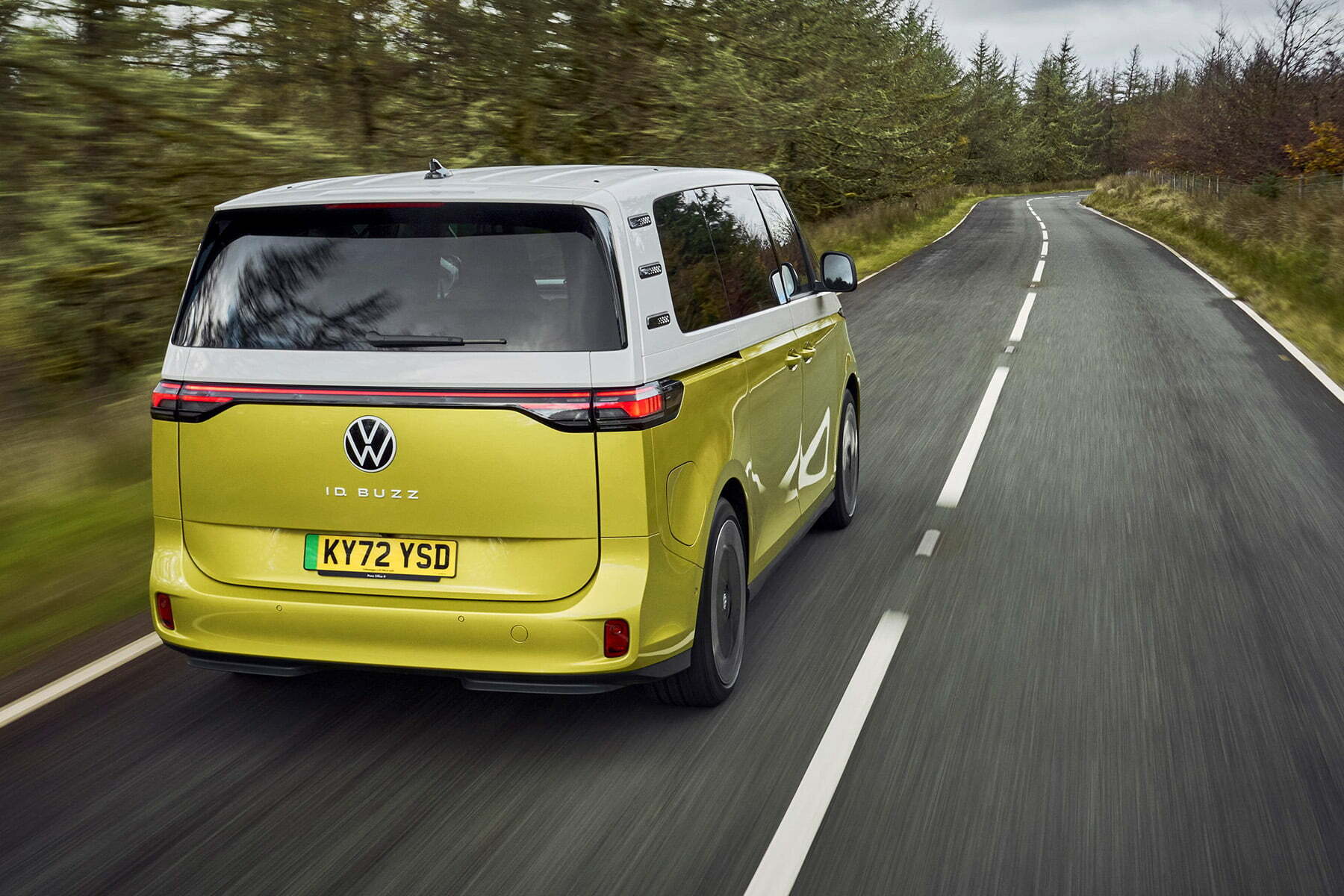
The Volkswagen ID. Buzz is an upmarket people carrier and the largest model in the all-electric ID. family, which arrived in the UK in the second half of 2022.
With exterior styling that harks back to the original Type 2 Microbus of the 1960s, the ID. Buzz has been widely praised for its unique looks, which stand out from its people carrier rivals.
Parker’s Tom Webster argues that the Volkswagen “has some much-needed character in a class that is so often devoid of it.”
“The Volkswagen ID. Buzz is a funky, practical, 250-mile nostalgia trip”, Carbuyer’s Tom Jervis explains. “Unfortunately, nostalgia costs money.” The car’s pricing starts at around the £60k mark – which is considerably more expensive than mainstream van-based rivals like the Peugeot e-Traveller and Vauxhall Vivaro-e Life, but cheaper than luxury rivals like the Mercedes-Benz EQV.
Auto Trader‘s Dan Trent adds that the ID. Buzz is not as practical as the slightly more spacious Volkswagen Multivan. However, “it trumps the myriad SUVs it competes with when it comes to space and family-friendly features”, says Richard Ingram of Auto Express. “Beneath the retro styling and functional cabin, there’s a really capable, compelling EV.”
A longer, seven-seat, version joined the family in the autumn of 2024, along with higher-performance GTX models.
As of October 2025, the Volkswagen ID. Buzz holds an Expert Rating of A, with a score of 76%. It achieves top marks for its media review scores, safety rating and zero tailpipe emissions, while its running costs are also good. However, Volkswagen’s new car warranty coverage is only average, and well behind some of its rivals’ cover.
Body style: People carrier Engines:electric, battery-powered Price:From £59,035 on-road
Launched: Summer 2022 Last updated: Autumn 2024 Replacement due: TBA
Image gallery
Media reviews
Highlighted reviews and road tests from across the UK automotive media. Click any of the boxes to view.
Featured reviews
“There’s substance to go with the obvious style of the Volkswagen ID. Buzz. It’s a practical electric family MPV that just so happens to emulate the original Type 2 microbus in terms of looks, while its large dimensions mean there’s lots of room inside, especially in long-wheelbase form. If you can stomach the high asking price, then it’s a characterful family car that will have buyers thinking twice about choosing an SUV to fit the same brief.”
Model reviewed: Dual electric motors, 79kWh battery GTX Score: 6 / 10 “A new top end to an already expensive model range, the Volkswagen ID. Buzz GTX only really makes sense if you need four-wheel drive, or plan on towing with it. The standard ID. Buzz – especially with the power upgrade coming later this year – is fast enough for a big and tall vehicle, and apart from being quicker in a straight line, the GTX upgrades are cosmetic.” Author: Paul Barker Read review
Model reviewed: LWB Score: 8 / 10 “This is the car the Volkswagen ID. Buzz should always have been; more practicality, a host of small but useful improvements, and a little bit more range make the long-wheelbase model the obvious choice. And that’s before you factor in the tiny price premium over the regular car that absolutely seals the deal. Unless a LWB genuinely won’t fit where you park, it’s significantly better in almost every way.” Author: Paul Barker Read review
Score: 9 / 10 “It’s frankly hard to see how any vehicle could live up to this much hype, but we’re pleased to report that the Volkswagen ID. Buzz has indeed been worth the wait. It’s not quite as practical as its van-based rivals, admittedly, but it trumps the myriad SUVs it competes with when it comes to space and family-friendly features. It’ll sell on image alone, but beneath the retro styling and functional cabin, there’s a really capable, compelling EV. Only the high price counts against it.” Author: Richard Ingram Read review
Auto Trader
Model reviewed: Range overview Score: 8 / 10 “The Volkswagen ID. Buzz is not cheap, nor is it as practical as the more spacious and hybrid-powered Multivan. Neither is it big enough to count as a true van and operate as an electrified alternative to the Transporter Kombis beloved of lifestyling outdoors types. But, for fashion-conscious families, it’s still a compelling alternative to an SUV.” Author: Dan Trent Read review
Business Car
Model reviewed: Style 77kWh Pro Score: 8 / 10 “The Volkswagen ID. Buzz is the best ID. model yet. It looks great, with a ‘want’ factor that perhaps hasn’t been there for EV models in the past.” Author: Martyn Collins Read review
Model reviewed: Score: 8 / 10 “Retro electric Volkswagen ID. Buzz brings heaps of style and practicality.” Author: Sean Keywood Read review
Car
Model reviewed: Range overview Score: 8 / 10 “The Volkswagen ID. Buzz is a unique offering which fuses clever packaging, spot-on looks, up-to-date electric propulsion and a truckload of emotional brownie points at a relatively affordable tariff.” Author: Georg Kacher Read review
Carbuyer
Model reviewed: Range overview Score: 8.2 / 10 “The Volkswagen ID. Buzz is a funky, practical, 250-mile nostalgia trip… unfortunately, nostalgia costs money.” Author: Tom Jervis, Charlie Harvey Read review
Driving Electric
Model reviewed: Range overview Score: 9 / 10 “The Volkswagen ID. Buzz combines funky styling, a functional cabin and refinement to create a unique electric family car – and a particularly pricey one at that.” Author: Ellis Hyde Read review
Electrifying.com
Model reviewed: Range overview Score: 9 / 10 “If you look at the Volkswagen ID. Buzz’s figures on paper, it doesn’t make a lot of sense. It’s big, not particularly efficient and in terms of cost, way more thank the equivalent ID.4 or Skoda Enyaq. But this isn’t a car you buy based on the numbers. The ID. Buzz is huge fun and I’m not surprised that it already has a huge waiting list.” Author: Nicki Shields Read review
Green Car Guide
Model reviewed: GTX 4Motion 7-seat LWB Score: 10 / 10 “The Volkswagen ID. Buzz GTX 4Motion seven-seater delivers space, pace, and all-wheel drive grip allowing you to explore more of the great outdoors than the standard rear-wheel drive model, making this an extremely capable all-round EV for family adventures.” Author: Paul Clarke Read review
Model reviewed: LWB Style Pro Score: 9 / 10 “The Volkswagen ID. Buzz LWB with seven seats is the vehicle that it should have been when it was originally launched. The seven-seat layout makes the most of the space inside the Buzz, and the exterior still retains its iconic styling.” Author: Paul Clarke Read review
Model reviewed: Range overview Score: 10 / 10 “The Volkswagen ID. Buzz has iconic design, it offers lots of space, and the driving experience has all the normal benefits of an EV including refinement and instant torque. Fun is back.” Author: Paul Clarke Read review
Heycar
Model reviewed: Range overview Score: 9 / 10 “A modern take on the iconic hippy bus, the Volkswagen ID.Buzz is an electric people carrier that’s so much more desirable than yet another family SUV. You’ll pay a premium for 2023’s must-have electric car while the ID.Buzz isn’t quite as versatile as you might expect, but its charm and charisma make it a very desirable choice.” Author: Andy Brady Read review
Honest John
Model reviewed: Range overview Score: 8 / 10 “The Volkswagen ID.Buzz is the reborn retro icon everyone’s been waiting for, just modernised for the electric age. With a car-like driving experience, a bright and airy cabin, plenty of tech and a decent electric range it’ll hold broad appeal, although it’s only a five-seater for now.” Read review
Motoring Research
Score: 7 / 10 “The ID. Buzz channels the spirit of the classic Volkswagen Microbus into a modern, fully electric MPV. Oozing retro charm, especially with optional two-tone paintwork, the ID. Buzz generates an incredible amount of attention and goodwill on the road. Even with the limitations of this launch version, Volkswagen will have no problem finding customers, such is the strength of feeling towards it. In a head-versus-heart battle, nostalgia is always likely to win, especially after such a long wait.” Author: John Redfern Read review
Parkers
Model reviewed: Range overview Score: 7 / 10 “It attracts attention like almost nothing else – people will come and talk to you when you park up in one of these, and you will smile when you look back at it. It has some much-needed character in a class that is so often devoid of it.” Author: CJ Hubbard Read review
The Sunday Times
Model reviewed: Range overview Score: 9 / 10 “The looks, spaciousness and electric-only powertrain make this one of the few large cars that appears to be wholly socially acceptable — a perfect alternative to SUVs, which add height and weight without any extra carrying capacity.” Author: Dave Humphreys Read review
The Telegraph
Model reviewed: Range overview Score: 10 / 10 “As a family troop carrier, the Volkswagen ID. Buzz probably needs more seats, it’s very expensive and the MPV market is fast disappearing in the UK. Yet somehow the charm, the care that’s been lavished and the long-legged comfort of this born-again Type 2 are irresistible. It’s nicer than the rest of VW’s electric offerings put together and a deeply desirable machine in its own right. Welcome back Bulli.” Author: Andrew English Read review
Top Gear
Model reviewed: Range overview Score: 9 / 10 “A convincing vision of a family car done better. We love it because it’s different, because it’s a new anti-SUV template, because it’s fun to be in and around.” Read review
Which EV?
Score: 7.5 / 10 “There’s a lot to like about the Volkswagen ID. Buzz, and it certainly receives a positive reaction from passersby. It has great family features, including lots of rear passenger space and a class leading amount of room for luggage in the rear. It’s also surprisingly pleasant to drive, even if it’s not that quick for an EV. But it’s hugely expensive, which means most buyers will sacrifice on space for a more affordable electric SUV instead.” Author: James Morris Read review
Safety rating
Independent crash test and safety ratings from Euro NCAP
The Volkswagen ID. Buzz was originally assessed by Euro NCAP back in 2022 and awarded a five-star rating. It was reassessed in September 2025 under tougher new protocol tests, where it retained its five-star score.
Eco rating
Independent economy and emissions ratings from Green NCAP
No eco rating
As of October 2025, the Volkswagen ID. Buzz has not been lab tested by Green NCAP.
The Green NCAP programme measures exhaust pollution (which is zero for an electric car) and energy efficiency. Electric cars are much more energy-efficient than combustion cars, so the ID. Buzz is likely to score very highly in Green NCAP testing whenever it ever takes place. Check back again soon.
Running cost rating
Monthly cost of ownership data provided exclusively for The Car Expert by Clear Vehicle Data
Battery range
Average
Score
Variation
Score
EV models
282 miles
B
Electrical efficiency
Average
Score
Variation
Score
EV models
3.4 m/KWh
E
Insurance group
Average
Score
Variation
Score
All models
40
D
Service and maintenance
Cost
Score
Year 1
£290
D
Year 2
£591
C
Year 3
£900
C
Year 4
£1,175
C
Year 5
£1,476
C
Overall
£4,432
C
The Volkswagen ID. Buzz is not the most electrically efficient EV on sale (electrical efficiency is the EV equivalent of miles per gallon for petrol and diesel cars) and is less efficient than other ID models in the Volkswagen family. This means that battery range is not as good as it otherwise could be.
Insurance costs are average, which is not surprising given that the ID. Buzz is a £60K electric vehicle. The good news is that scheduled servicing and maintenance costs over the first five years are ikely to be excellent.
Reliability rating
Reliability data provided exclusively for The Car Expert by MotorEasy
No reliability rating
As of October 2025, we don’t have enough reliability data on the Volkswagen ID. Buzz to generate a reliability rating.
The Car Expert’s reliability information is provided exclusively for us using warranty data from our partner, MotorEasy. As soon as MotorEasy has sufficient data on the ID. Buzz, we’ll publish the score here.
Warranty rating
New car warranty information for the Volkswagen ID. Buzz
Overall rating
C
50%
New car warranty duration
3 years
New car warranty mileage
60,000 miles
Battery warranty duration
8 years
Battery warranty mileage
100,000 miles
Volkswagen’s new car warranty is pretty much the bare minimum offered in the UK, with a duration of three years and a limit of 60,000 miles. Other rivals in the price bracket do better (and in some cases, much better).
In addition to the standard new car warranty, the ID. Buzz has an eight-year/100,000-mile warranty for the battery components.
Warranty on a used Volkswagen ID. Buzz
If you are purchasing an ‘Approved Used’ ID. Buzz from an official Volkswagen dealership, you will get a minimum 12-month warranty included.
If you are buying a used ID. Buzz from an independent dealership, any warranty offered will vary and will probably be managed by a third-party warranty company.
If you are buying a used ID. Buzz from a private seller, there are no warranty protections beyond any remaining portion of the original new car warranty.
If you’re looking to buy a used car that is approaching the end of its warranty period, a used car warranty is usually a worthwhile investment. Check out The Car Expert’s guide to the best used car warranty providers, which will probably be cheaper than a warranty sold by a dealer.
Recalls
Official DVSA safety recalls that have been issued for the Volkswagen ID. Buzz
As of October 2025, we are not aware of any DVSA vehicle safety recalls affecting the Volkswagen ID. Buzz. However, recall information is updated very regularly, so this may have changed.
You can check to see if your car has any outstanding recalls by visiting the DVLA website or contacting your local Volkswagen dealer.
Car warranty provider Warrantywise has named the UK’s least reliable car companies, and the published data suggests that expensive premium cars have the highest repair frequency and repair costs.
Warrantywise, which is also one of The Car Expert’s commercial partners, collected the data from 131,000 UK warranty repair claims on vehicles up to ten years old – excluding very low volume models. This is unlike many consumer reliability reports, which use owner-reported information from incentivised surveys and can be far less reliable.
The data is then used to generate a reliability score for each brand, and the brands are then ranked in the Warrantywise reliability index. These rankings name Porsche as the least reliable car brand for UK motorists, followed by Tata-owned sister brands Land Rover and Jaguar.
Italian marque Alfa Romeo also scored poorly, followed by the upmarket German brands Audi, BMW and Mercedes-Benz, despite the perception of their high build quality. Vauxhall and Volvo also feature in this unfavourable top ten, followed by Mitsubishi, which has now pulled out of the UK market after several years of abysmal review scores and declining sales.
These unreliability rankings are not all that surprising. Land Rover, in particular, has long been known for the questionable reliability of their cars, and this news follows the Warrantywise car reliability rankings released earlier this year, which awarded the last-generation Range Rover the unflattering title of most unreliable used car in the UK.
This Warrantywise report correlates with other reliability surveys and reports conducted over the years, as well as The Car Expert’s own data provided for our Expert Rating Index by MotorEasy, which reinforces the findings in this report.
When on the lookout for their next car, Warrantywise CEO Lawrence Whittaker advises consumers to keep in mind that “premium prices really do make for premium costs.”
“With more technology in high-end cars than ever before, we suppose it’s only natural that they require a bit more TLC than normal.”
*Warrantywise is a commercial partner of The Car Expert. If you click through to its website and/or proceed to purchase a used car warranty, we may receive a small commission. This does not affect the price you pay.
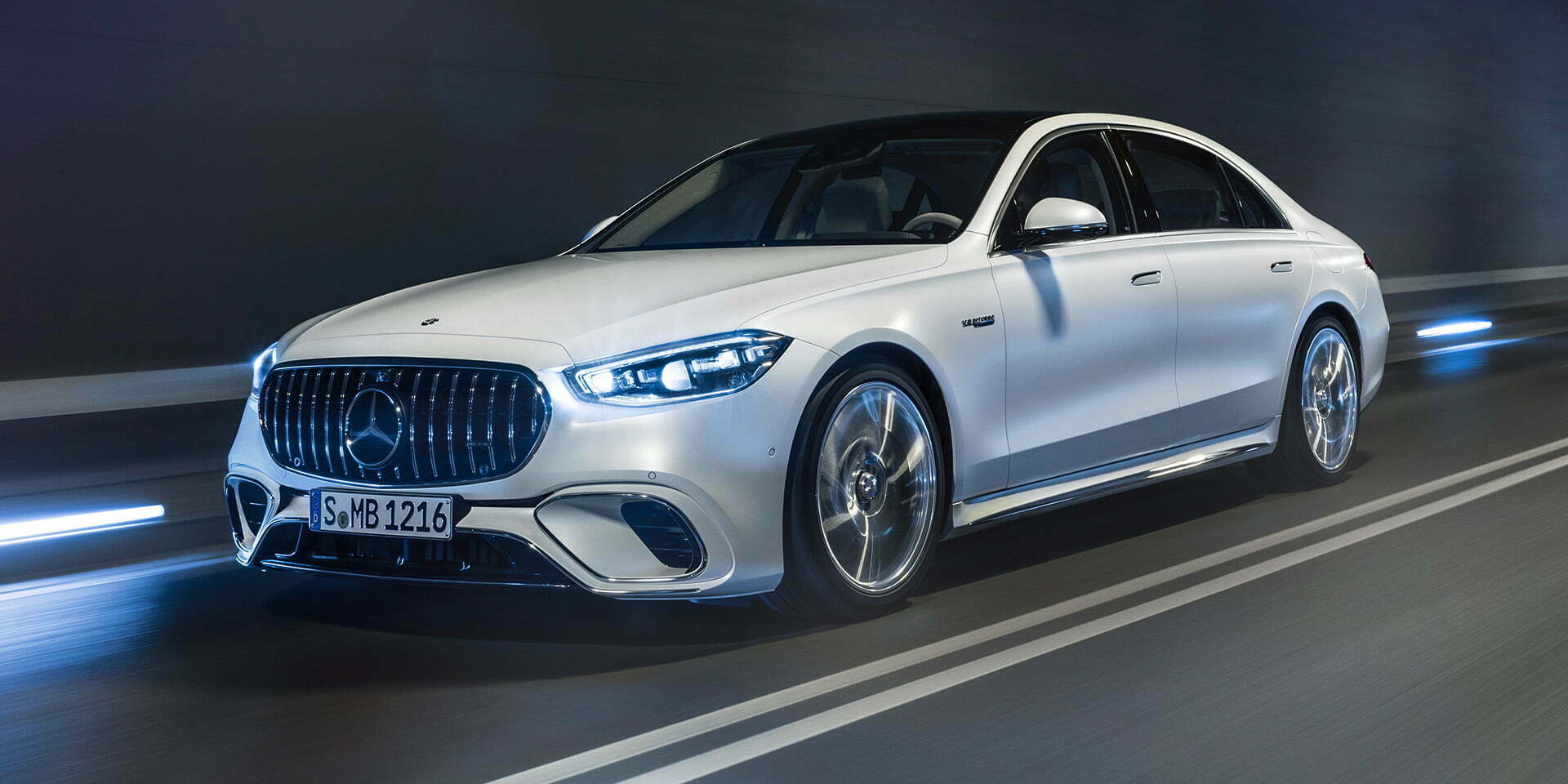
Mercedes-AMG has given us a first look at the new S 63 E-Performance plug-in hybrid (PHEV) – the most powerful S-Class saloon ever made.
This performance-enhanced executive saloon is powered by a twin-turbocharged 4.0-litre V8 petrol engine paired with a rear-mounted electric motor, providing 802hp and 1430Nm of torque.
Mercedes-AMG engineers claim that the new S 63 can complete a 0-62mph sprint in 3.3 seconds, which is only four fractions of a second slower than the range-topping Mercedes-AMG GT S E-Performance saloon that uses the same engine.
The car’s 13kWh battery pack offers an all-electric range of 21 miles, which falls considerably short of the standard S-Class PHEV’s 65-mile range, but Mercedes-AMG admits that the electrified components of this saloon have been installed with added performance in mind, not battery range.
Top speed has been limited to 155mph, but customers who opt for the additional ‘AMG Driver’s Package’ will see this upped to 180mph.
To distinguish the S 63 from the normal S-Class, this new model features an alternative AMG-specific grille with vertical stripes in the front, as well as a redesigned lower front bumper. Twin tailpipes are installed either side of the protruding rear diffuser, and the saloon sits on large 21-inch alloy wheels.
All-wheel drive as standard, the S 63’s engine makes use of a nine-speed automatic transmission. There is a dual-speed gearbox for the electric motor on the rear axle too, that automatically shifts into the higher gear when the car reaches 87mph to improve efficiency.
The saloon comes with seven different drive modes, ranging from ‘Electric’ for quiet driving on urban errands, to ‘Sport+’ for optimum performance.
Besides the standard ‘Comfort’ configuration, other drive settings include ‘Slippery’, which reduces power output to prioritise road traction, and ‘Individual’, which allows the driver to customise the car’s suspension, steering and exhaust system. The driver can choose from four energy regeneration settings, which tops up the car’s battery when the brakes are applied.
At speeds up to 62mph, the rear wheels turn in the opposite direction to the front wheels to produce more agile turning circles. Over 62mph, the front and rear wheels steer in the same direction to make the car more stable at high speeds.
Mercedes-AMG has also fitted chassis and suspension upgrades, and at high speed the car’s ride height also drops by a centimetre to improve cornering performance.
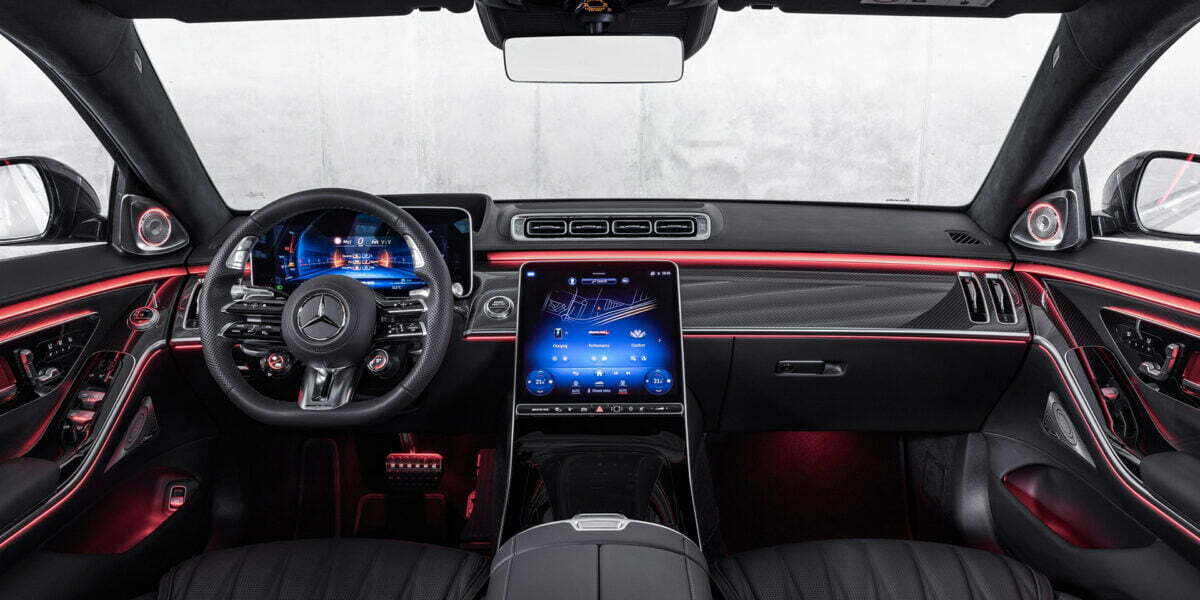
The interior design of the S 63 is very similar to that of the S-Class – the notable difference being the AMG-branded nappa leather upholstery. The infotainment, digital instrument cluster and head-up display tech from the standard S-Class remains, but with some sporty software additions, such as the ‘Race’ and ‘Supersport’ display styles, and the ‘AMG Track Pace’ menu that displays a range of telemetric data.
That sums up what we know about the new S 63 E-Performance so far – more details, including UK pricing, will be announced in the coming months.
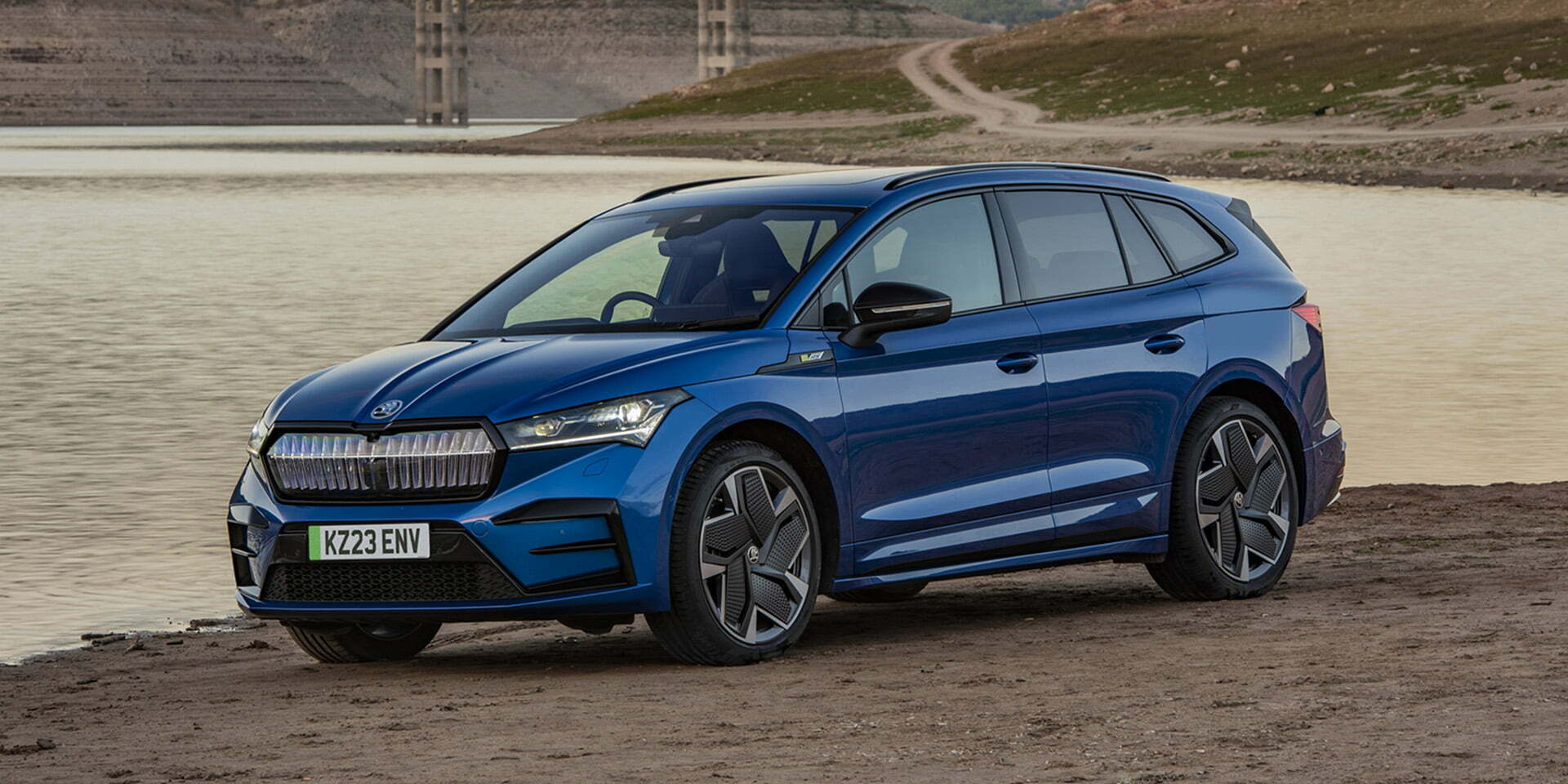
Following the launch of the Enyaq iV CoupévRS back in Spring this year, Skoda has now announced that a performance-enhanced ‘vRS’ version of the regular SUV will be available to order from early next year.
This mirrors what is already available in the Volkswagen range – the closely-related Volkswagen ID.4 GTX SUV and ID.5 GTX coupé-SUV became available to order in the UK earlier this year.
The Skoda Enyaq iV vRS is powered by the same 82kWh battery and 299hp dual-motor configuration as its coupé-SUV sibling, which the manufacturer says provides a 0-62 sprint time of 6.5 seconds.
The only notable difference between the two models is the rear end. The SUV body style offers more boot space and rear headroom, and is also reportedly more energy efficient. While the Coupé vRS with its sloping roofline can muster 309 miles on a single charge, Skoda claims that this new uprated SUV has an electric range of 321 miles.
Skoda Enyaq iV vRS SUV (left) and Skoda Enyaq iV Coupé vRS coupé-SUV (right)
The SUV is compatible with DC rapid charging through a 150kW charger, allowing it to regain 80% of battery capacity in less than 40 minutes. A full at-home charge using a standard 7kW wall box takes up to 13 hours.
Compared to the standard Enyaq, the ride height has been lowered and the steering system revised to provide improved cornering performance. An upgraded ‘sports suspension’ system also comes as standard.
Styling changes include deeper front and rear bumpers, along with extensive black detailing, Matrix LED headlights, an illuminated ‘Crystal Face’ front grille and the vRS signature element of a full-width red reflector on the rear bumper.
The car sits on 20-inch black alloy wheels as standard, while 21-inch versions are available on the options list. The car features lighter plastic rims, which are said to boost the car’s electric range.
Opening the electronically-powered tailgate reveals 585 litres of boot space, which grows to 1,710 litres with the rear seats folded.
The interior features perforated leather seats and a matching leather-effect dashboard both with contrasting stitching, more leather on the steering wheel and carbon-effect and aluminium inserts.
A 13-inch infotainment screen juts out of the centre of the dashboard, alongside a five-inch digital instrument cluster behind the steering wheel. Safety features include adaptive cruise control, lane-keeping assistance and roadworks detection, with parking assistance tech available for an extra fee.
The optional extras list also includes a panoramic sunroof, a tow bar, a head-up display that projects driving information onto the windscreen, and a premium 12-speaker sound system.
Available to order from January next year, the Skoda Enyaq iV vRS will be priced at £53k – around £2k cheaper than the coupé-SUV version.
Regarded as one of the best all-electric SUV options on the market at the moment, the Skoda Enyaq currently holds an Expert Rating of 83% – praised for its competitive battery range and easy driving experience.
November new cars sales data reveals positive results for fleet and private buyers, rising by over 45% and nearly 3% respectively
Data suggests that the industry is closer to meeting demand for new cars, however, most of the growth came from a small cluster of manufacturers
Electric cars represented 1 in 5 sales in November – one of the strongest months for EVs on record
British-built Nissan Qashqai on course to top the sales charts in 2022
Consumers still opting for smaller, cheaper and greener options as the cost of living increases may be steering vehicle choices
Improving supply should result in reduced waiting times, better new car deals and eventually lower used prices in 2023
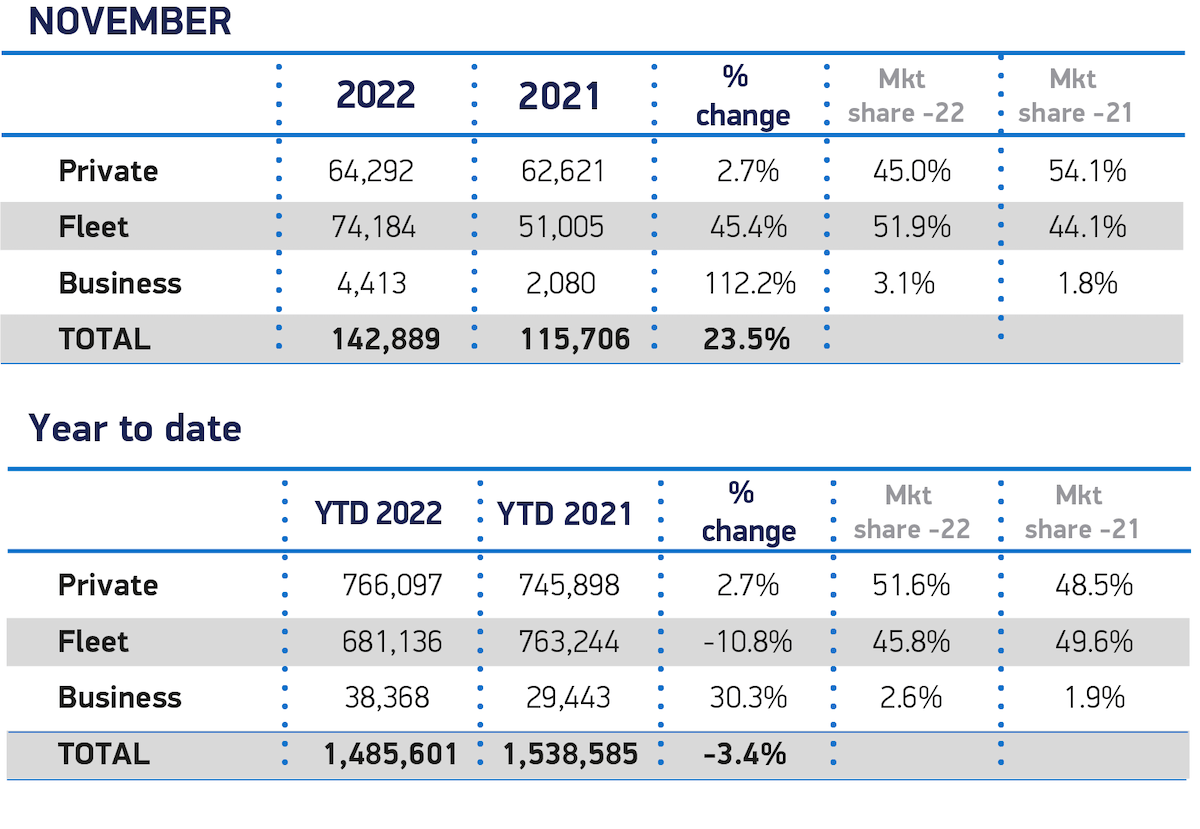
Supply issues are easing after new car registrations grew by nearly a quarter (23.5%) in November, with fleet and private registrations rising by 45% and 3% respectively, according to The Car Expert.
The results indicate that the industry is better able to meet demand for new cars after a torrid three-year period during which Brexit concerns, semiconductor shortages and the knock-on effects of Covid stifled vehicle production globally.
While the increase compared to last November is significant, most of the growth – around 23,000 of the 27,000 increase – came from the Volkswagen Group (VW, Audi, Skoda), Ford, Nissan and Tesla, meaning that across the board there were more losers than winners among the car brands.
The data released by the SMMT also shows that electric vehicle sales remain buoyant, with one in five sales attributed to fully electric powertrains – among the best months on record for EVs and over 35% higher than November 2021.
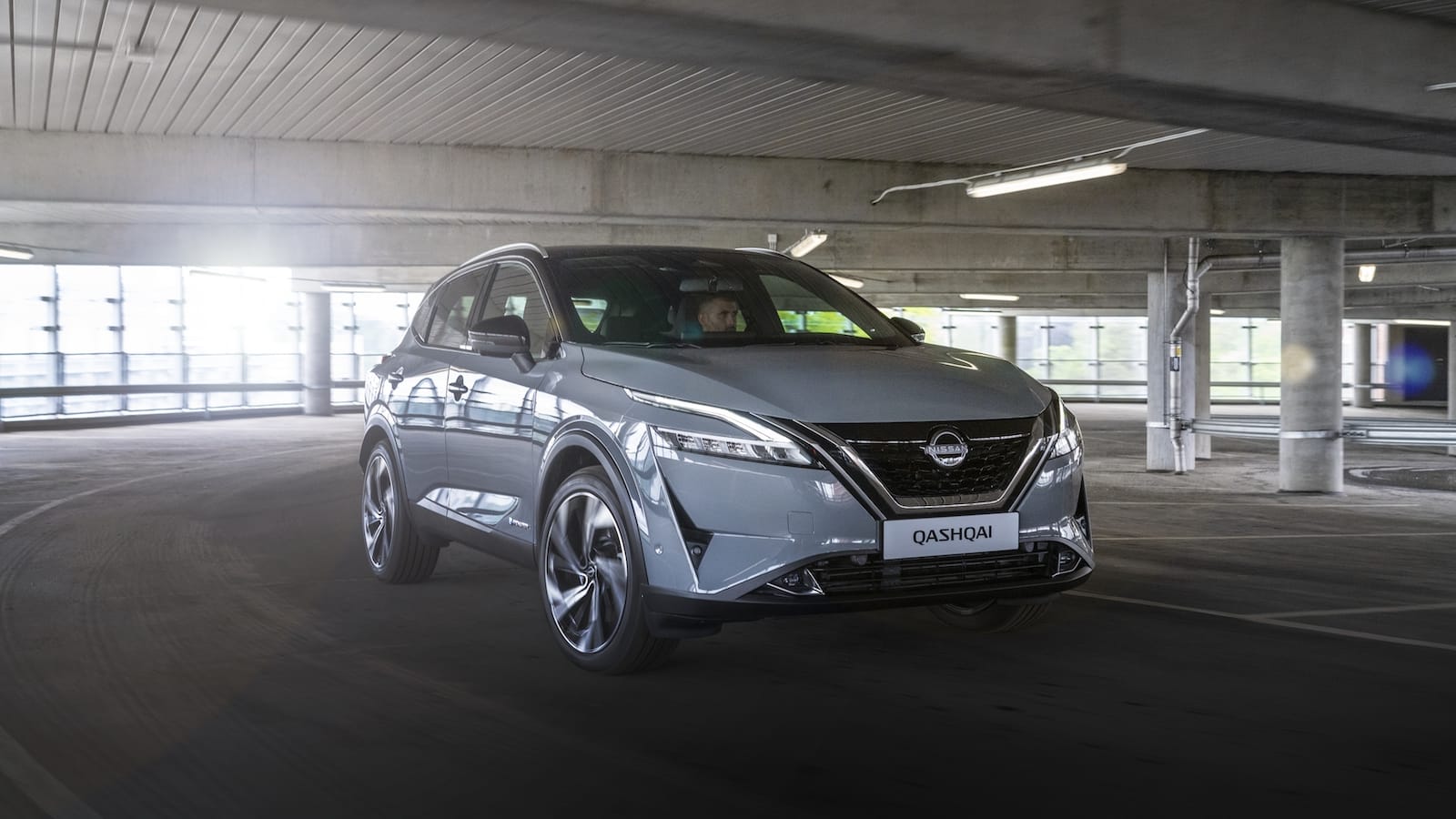
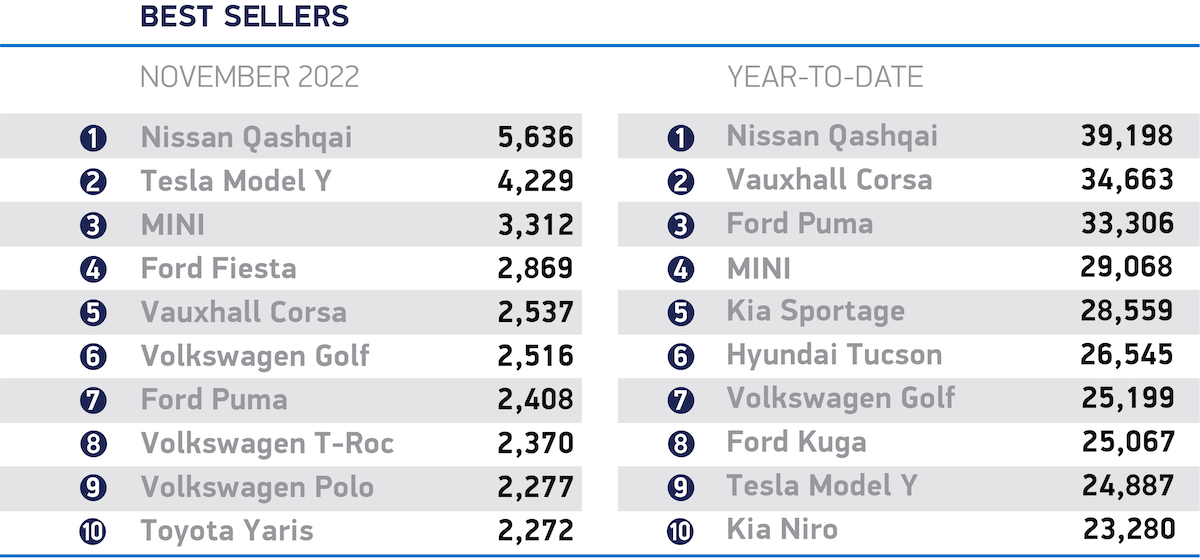
The British-bult Nissan Qashqai topped the sales charts once again, securing top spot in November ahead of the Tesla Model Y. The compact SUV is all but certain to be the UK’s best-selling car of 2022 with a healthy lead over the Vauxhall Corsa and Ford Puma.
Consumers are continuing to opt for smaller, greener and cheaper cars as superminis like the Ford Fiesta, Vauxhall Corsa and MINI dominate the sales charts in November alongside other compact vehicles like the Volkswagen T-Roc.
While the year-to-date figure is still down by 3% compared to 2021, the final quarter of 2022 is showing signs of a return to normality, which is expected to result in shorter delivery times, better new car deals and lower used car prices.
Stuart Masson, Editorial Director at The Car Expert, said: “After years of production issues, private buyers and fleets are now often able to get their hands on the cars they want. Waiting times should start to ease, and we may even see better deals available – we wouldn’t say it is a buyer’s market just yet, but it is moving in the right direction.
“However, if we scratch beneath the surface of the results, the increase this month is dominated by a handful of brands, so it is very much a mixed bag with some manufacturers producing – and selling – a lot of cars while others continue to struggle.
“The position is improving but if you are not in a rush to buy or your finance deal has a few months to run, the new year may be a better time to buy. With supply and demand of new cars now more in sync, this may also have an impact on the used market where we should see prices start to decrease in the first or second quarter of 2023.
“November also saw a huge result for electric vehicle sales. Some commentators were speculating that demand for EVs could be tailing off, but with a fifth of sales attributed to electric cars, last month showed that the public are still embracing battery-powered vehicles.”
For expert and impartial advice relating to car finance or tips for purchasing a used vehicle, please visit: www.thecarexpert.co.uk/
ENDS
The Car Expert
Founded in 2011, The Car Expert is the UK’s most comprehensive automotive consumer advice site. With an audience of over two million readers a year, The Car Expert provides independent and impartial advice on every aspect of buying, financing, owning, and selling new or used vehicles.
The Rotten Tomatoes equivalent for the automotive world, The Car Expert consolidates reviews from 30 of the UK’s top automotive websites to create the Expert Rating Index. Bringing together science and data analysis, the index calculates a weighted average to give an aggregated score – Expert Rating – that is comparable across different brands and models.
The Expert Rating Index factors in the age of each review, so that newer reviews carry more weight than older reviews. It also breaks down the complex web of different scoring systems that various websites use in their reviews.
The Car Expert has logged over 14,000 reviews covering more than 400 cars and over 50 manufacturers, with its Expert Rating Index now trusted as the gold standard for rating and ranking new cars in the UK.
For media enquiries, please contact Performance Communications
New car registions showed strong growth in November – albeit compared to a difficult month last year – as supply from several manufacturers improved.
According to data published by the Society of Motor Manufacturers and Traders (SMMT) this morning, overall new car registrations were up by more than 23% in November compared to the same month last year. This was largely thanks to a massive improvement in fleet registrations, which were up by 45% compared to a terrible month last November.
Private new car sales were up by a more modest 3%, although this was just as significant as it represented growth against what was a strong month for consumer sales last November. It follows a similarly solid month in October and bodes well for continued improvements into 2023.
Assuming new car production levels continue to improve, we can expect to see waiting times coming down across the industry, which will have welcome knock-on benefits for new car pricing as supply improves and then for used car pricing as well. This could take several months to really be noticeable, however, so don’t expect immediate results.
Source: SMMT
EV sales are doing just fine, thanks for asking
There was a lot of noise in the media last month about electric car sales stalling, which was a lot of nonsense but very convenient for the car industry, which is endlessly lobbying more more government funding. This month’s numbers showed that the move to EVs is continuing and that last month’s lack of growth was really just a blip.
One in five new cars registered in November was an electric vehicle, which was the strongest result this year and one of the strongest on record. it also suggests broad growth across multiple car manufacturers, rather than relying on Tesla.
Tesla, which is the largest seller of electric cars and which doesn’t operate like any other car company, has an outsized impact on overall EV sales numbers as it can swing from selling thousands of cars one month to almost none the next month. This heavily skews maket data, especially when looking at month-by-month sales results.
The most noticeable aspect of the November EV sales data was that Tesla’s growth (it doubled it sales from last November) accounted for less than half of the total growth in EV registrations, showing that other car manufacturers are seeing significant new sales from their latest electric models.
There are still headwinds to broader EV adoption, however. Mostly, this revolves around cost – an electric car is still considerably more expensive than an equivalent petrol model. Charging infrastructure remains an issue, particularly in the uneven rollout of chaarging points across the country.
Source: SMMT
Good month, bad month
While it was a good month overall for new car registrations, the majority of that growth came from a few key sources – namely the Volkswagen Group (VW, Audi, Skoda), Ford, Nissan and Tesla. These brands accounted for about 23,000 units of the 27,000 total number of increased sales for November.
Volkswagen topped the sales charts overall – helped by having three of the ten best-selling models in November – ahead of Ford, Audi, BMW and Nissan.
Across the board, there were more losers than winners, using our traditional metric of looking at which brands achieved registrations that were significantly better or worse than the overall new car market.
It’s been a stunning second half of the year for the pride of Sunderland, the Nissan Qashqai. With only one month to go – and barring any more seismic shocks to the marketplace – it looks certain to finish the year as the best-selling new car of 2022.
We’re still checking the records, but if this comes to pass it will be the first time in a very long time that Britain’s best-selling new car is actually one that’s built in Britain.
The Tesla Model Y had another strong month to take second place ahead of the (also British-built) Mini hatch. Five of the ten best sellers were small hatchbacks, reinforcing the year’s new car sales theme of ‘smaller, greener, cheaper’. We’ll have our usual analysis of the top ten in coming days.
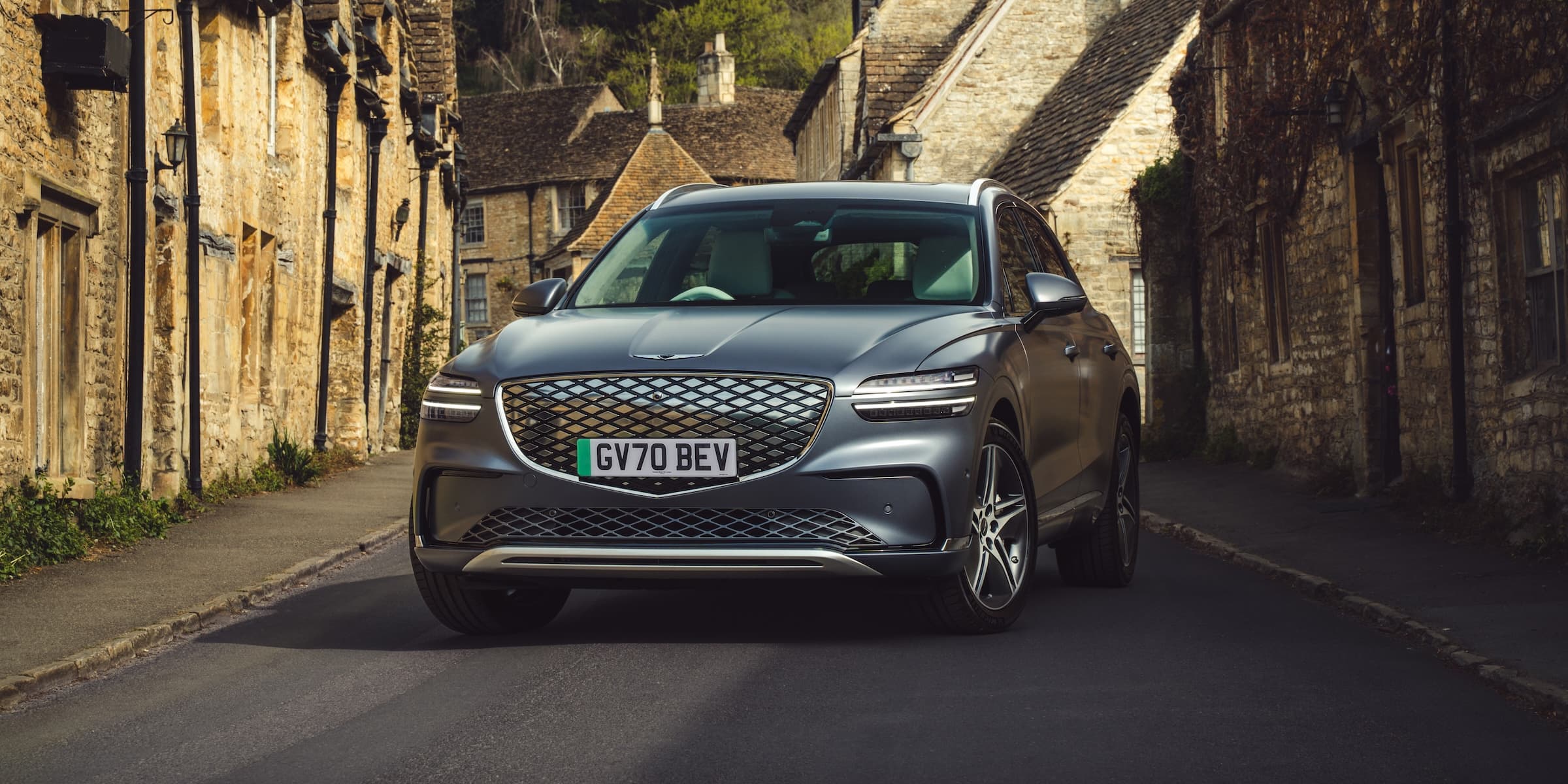
Plenty of car buyers likely still do not know what Genesis is all about, less than two years after the Korean premium badge launched onto the UK market, but the G60 is expected to change all that and speed Genesis on the path to recognition as an upmarket sister to Hyundai, just like Lexus is to Toyota.
The GV60 is the first Genesis model designed from the ground up as an electric car, as opposed to the electrified versions of petrol powertrains the brand has offered us so far. It’s closely related to the Kia EV6 and Hyundai Ioniq 5, though pitched to attract buyers who might normally be looking at the products of Audi, BMW or Mercedes-Benz.
As of December 2022 and after about six months on sale, the GV60 holds an excellent Expert Rating of 80% on The Car Expert’s award-winning Expert Rating Index. However, that’s 4% below that of its effective sister car, the Kia EV6.
The GV60 is more than just the first purpose-built EV from Genesis; it represents the direction in design and technology the brand plans. The first Genesis cars were petrol- and diesel-powered, and with not much distinction from other premium fare – you get the feeling that they were mere aperitifs ahead of the GV60’s arrival as the main course of the brand’s future intentions.
The ‘GV’ designation marks the car out as an SUV, though it doesn’t really look like one, more a sportily-styled crossover rather closer to a traditional car than is a typical boxy SUV. The GV60 sits on a brand-new electric platform specifically developed for it and its sisters from Hyundai and Kia, and which we expect will also underpin a whole load of future models coming from the three brands. On offer in this newcomer are a range of power options from potent to very potent, rear and all-wheel-drive and a huge amount of tech.
So the recipe seems to be to take the bang up-to-date mechanics of the Ioniq and EV6, and then add the kind of upmarket luxury one gets in the likes of an Audi, BMW or Jaguar.
First impressions
If the launch models from Genesis struggled for distinction, the GV60 certainly addresses that. It looks like a hot hatch on steroids – while we tend to treat with some scepticism the names manufacturers give to their various design languages, one can accept that the car’s sleek profile, accentuated by the pronounced slope downwards to the rear combined with the window line flicking up to meet it, conforms to what Genesis describes as “athletic elegance…”
Genesis insists it is a luxury, not a performance brand, but the long wheelbase and short overhangs of the G60, that body shape and the standard-fit 19-inch alloy wheels result in a car that one could easily picture as a competition machine – and we haven’t started talking about the powertrains yet… The front end styling is particularly striking, the headlights split by a strong crease which also does a good job of solving an issue several EV makers are struggling with, how to replace the radiator grille you no longer need with something that doesn’t look blunt and dull.
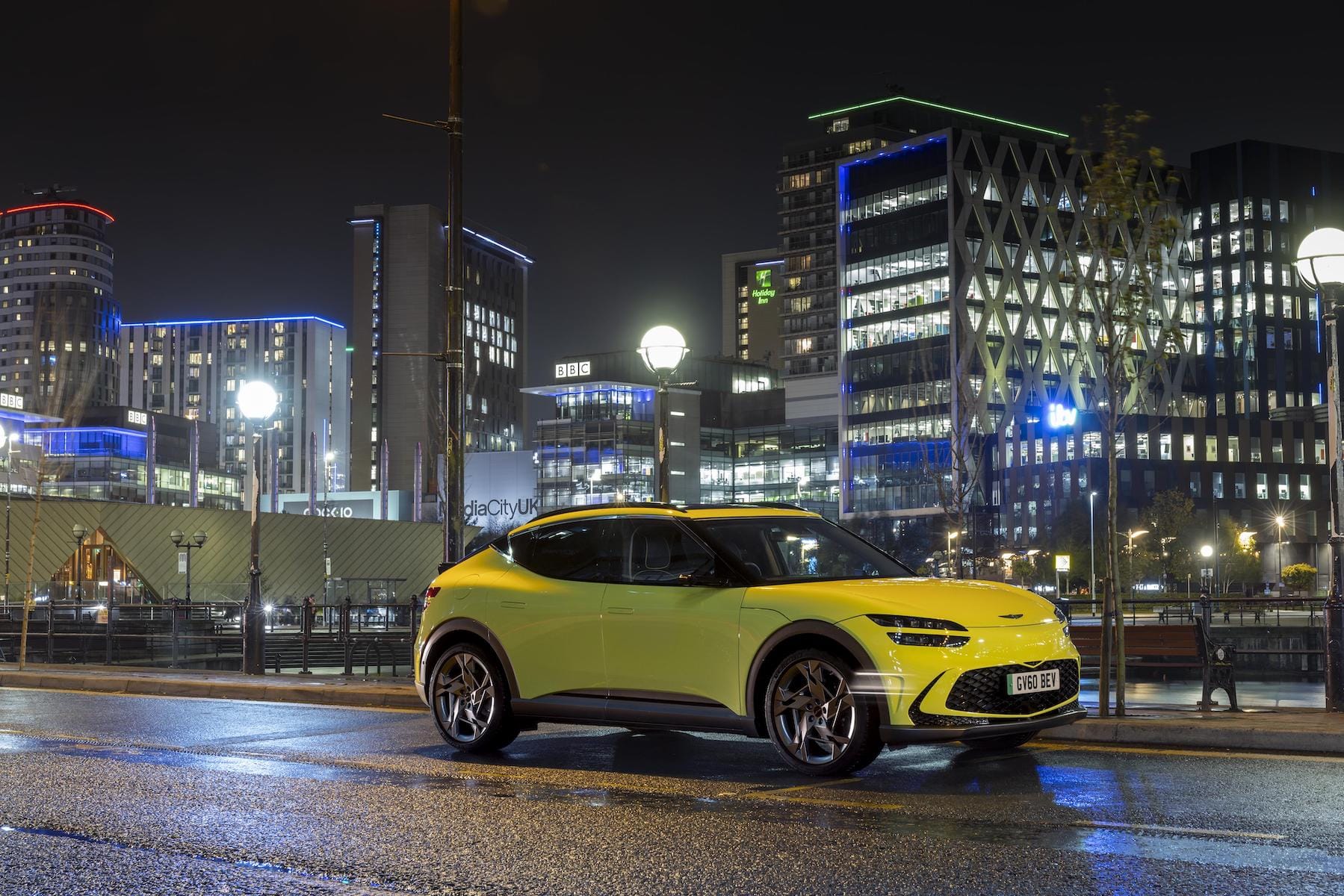
The GV60 paint palette includes a shade called ‘Sao Paulo lime’ which we think ought to come with a pair of sunglasses, but even if you go for one of the more ‘normal’ colours you’ll certainly attract a lot of interest in the car park – this is a distinctive-looking car but in a positive way.
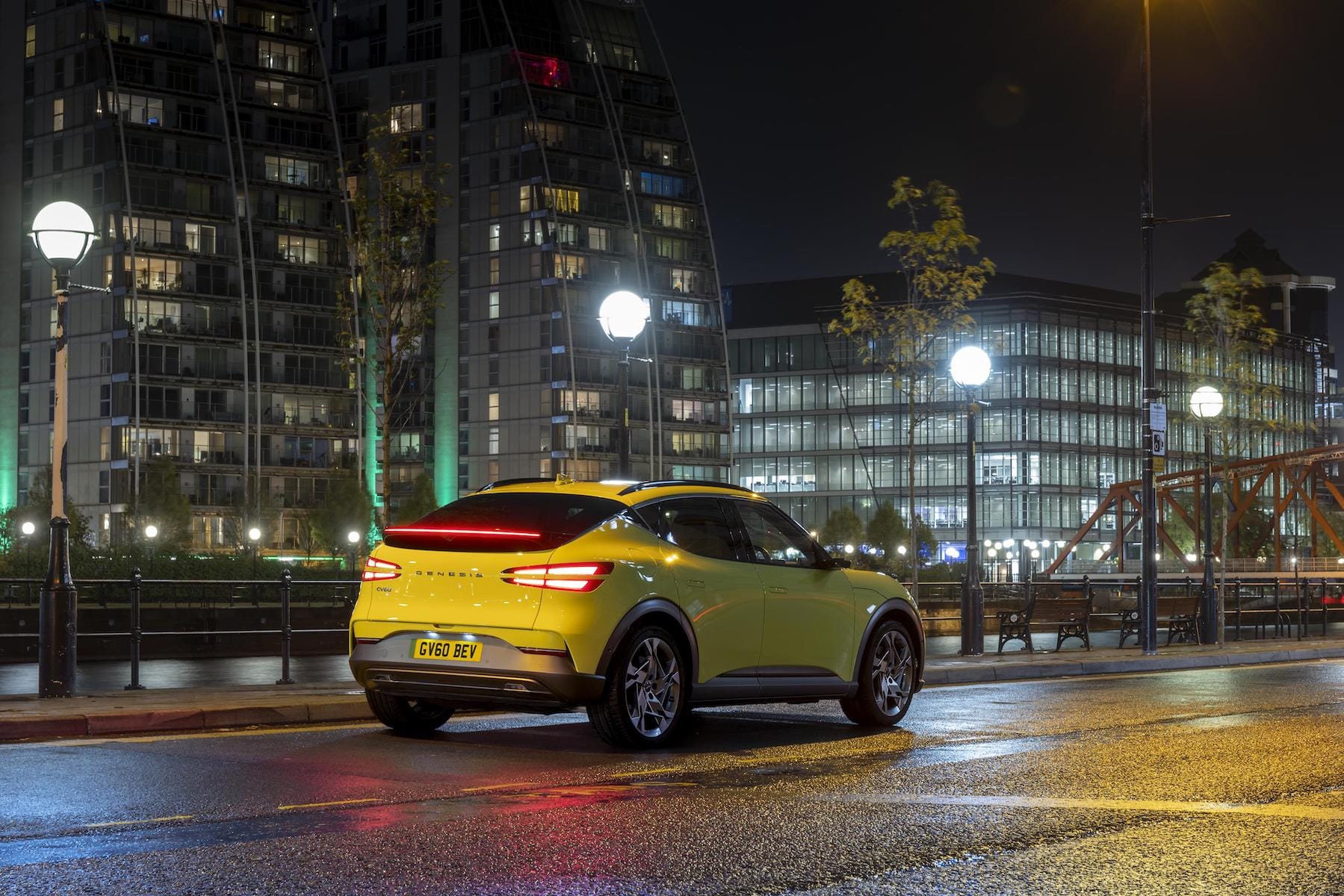
Slip inside and the first impressions are mixed – the surroundings are certainly both plush and very 21st century EV, but you also notice a whole load of buttons to go with the whole load of tech (more on which shortly). Meanwhile a glance in the rear-view mirror shows that the roof spoiler makes it very hard to see what’s behind the car – but Genesis has an option to answer that too, as we shall see…
We like: Purposeful looks, even without gaudy paint finish We don’t like: Spoiler on steeply sloped rear screen greatly cuts vision out the back
What do you get for your money?
One of the more controversial aspects of the GV60 is its price – yes it’s pitched as a premium car, so you’d expect it to be pricier than its Hyundai and Kia cousins, but some have baulked at the cheapest version starting at £47K, though to be honest this is not that much more than its siblings. Mind you things change markedly when you factor in the extensive choice of options available – the range-topper we tested carries a £65K+ price tag, and that’s before the almost £10K of options ours was fitted with.
The GV60 model range is very simple indeed – there are three models to choose from, Premium with a single rear-drive motor, Sport with motors on both the front and rear wheels and then the range-topping Sport Plus which also has two motors but with more power – quite a lot more power…
Standard equipment on all models does include what you’d expect, such as dual-zone air-conditioning, front and rear parking sensors with a rear-view camera on the 12-inch central infotainment system, plus some you might not, including electric tailgate opening and wireless phone charging.
Going for the upper two levels doesn’t add much apart from the powertrain. You get 20-inch wheels on the £53.6K Sport, and 21-inch versions on the Sport Plus, which also gains an electronic limited slip differential, electronically controlled suspension and more interior plushness.
The safety package is good and the car has earned a five-star Euro NCAP rating – standard equipment includes adaptive cruise control with stop and start, autonomous emergency braking of course with various collision-avoidance features for pedestrians, cyclists, at junctions, even in one’s blind spot.
If you are considering buying one of these cars, however, be aware you could soon balloon your budget by a glance at the options list. The obvious upgrades include a Bang & Olufsen sound system, but even this offers such delights as ‘Active Road Noice Canceling’ – the system emits a tone that reacts with road noise to make both sounds impossible to hear and produce an interior of pure silent calm.
Then there is an ‘Innovation Pack’ with 11 extra safety and assistance systems (including a head-up display, collision avoidance when parking and the ability to remote park), and even such things as digital side mirrors – these replace the side mirror pods with much smaller cameras which cuts drag and aids range, and while the view screens are not that well integrated into the door panels, the view they provide is far superior to a normal mirror. Alternatively one can have an digital rear-view central camera which solves that vision out the back issue.
And it doesn’t stop there – after an hour at the wheel in our test car, the seat suddenly started quite significantly massaging the driver’s lower back, to remove that pain one gets when’s staggering out of the car after a long drive…
Some of the options also verge on the far too practical for the premium market, such as the exterior plug so you can power such things as camping equipment from the car’s battery.
We like: Good safety package, simple trim structure We don’t like: Amount of money one can easily spend on options
What’s the Genesis GV60 like inside?
Genesis has already built a reputation for the quality of its interiors and that of the GV60 certainly does not disappoint. There’s a lot of leather effect (leatherette in entry-level versions, proper Nappa in the more expensive models) and it’s all extremely well put together. The plastics are of the soft-touch variety and generally when slipping into the GV60 one immediately feels in upmarket surroundings.
A rapid spot is on the flat console between the front seats – behind the rotary dial for the infotainment screen, and where you’d expect the transmission controls to be, is a large, crystal-finish sphere. But press the car’s start button and this immediately rotates through 180 degrees to reveal the familiar Drive, Neutral, Reverse and Park controls. Neat design or distraction? Genesis says it’s a safety feature, as it provides an instant indication as to whether the car’s switched on, not so easy in an EV…
The driver’s digital display is matched by the 12-inch infotainment display screen atop the centre console, and all is very clear and easy to see. Mind you as we’ve already stated, there’s a lot of tech available for the GV60 and that is reflected in the number of mostly touchscreen controls one is faced with. Merely getting in and driving the car you feel as if you are not getting the most from it, and that you need a long time with the manual, or with a Genesis expert, to understand it all – Genesis even provides a ‘Top Ten cheat sheet’ to help… Having said that, once you do get used to everything it’s quite intuitive to use, sensibly thought out.
In terms of more basic matters, such as interior space, the GV60 does reasonably well, making good use of the freedom that not having to fit in combustion engine hardware allows. We reckon rear-seat passengers are slightly cosier than in the EV6, but they do get reclining seats, which is a nice touch. Boot space is slightly constrained by the electric hardware underneath though, being wide rather than deep. A capacity of 432 litres with the parcel shelf in place – rising to 1,550 litres with the rear seats folded – is merely adequate compared to rivals.
We like: Bright, spacious and very up-to-date high quality environment We don’t like: Many controls for a lot of tech – confusing
What’s under the bonnet?
Like most EVs, there’s not really a lot under the bonnet because all the important electrical hardware is spread throughout the chassis – the 77kWh lithium battery pack, for example, sits under the floor, keeping its weight low down for the best handling.
Premium versions of the GV60 come with a rear-mounted motor producing the equivalent of 229hp and 350Nm of torque. They will do the 0-62mph sprint in just under eight seconds and offer an official driving range of up to 321 miles before you need to plug them in. The Sport variant combines a 218hp rear motor and a second one of 100hp between the front wheels – you can crest 62mph in 5.5 seconds but will need to recharge after 290 miles.
Finally there’s the range-topping Sport Plus, which has two identical motors producing a combined 435hp plus 700Nm of torque. But… this model includes a ‘Boost’ button which when pressed pumps power up to 490hp for a maximum of ten seconds – hitting 62mph takes only four seconds with a quoted range of 289 miles.
Battery charging options range up to 350kW, which means an 80% charge takes a less than minutes – hardly time for a coffee, though you will struggle to find a 350kW charger as they’re not a common thing in the UK at present… Charging to 80% using a 50 kW DC charger takes 73 minutes, on a three-pin domestic AC socket to 100% seven hours 30 minutes, so basically overnight.
What’s the Genesis GV60 like to drive?
Driving the GV60 is a relaxing experience if you want it to be. The acceleration is seamless and silent, again if you want it to be, and the car doesn’t wimp out at higher speeds either, pouring on seemingly endless reserves of propulsion. Even the single-motor versions have impressive 50-70mph characteristics, while in the dual-motor models high-speed overtaking is grin-inducing…
Of course – as we were reminded earlier – this car is supposed to be about luxury, not performance, and driving in everyday traffic in a GV60 is an unfussy experience. Three drive modes are on offer, dubbed Eco, Comfort (basically the default) and Sport, and cycling through them shows up significant differences. Comfort mode seems to be very biased to its description, with the response time a little slow if you accelerate hard. For everyday driving you could easily leave the car on Eco, making the most of such areas as the regenerative braking – paddle controls on the steering wheel let you choose the severity of the regeneration when coasting, and as with most EVs driving almost entirely on one pedal is feasible.
Yet you can’t completely get away from that power – remember the innocuous-looking Boost button on the steering wheel of the GV60 Sport Plus? Start accelerating, press the button and the dash goes flame red and counts down from 10 seconds, while you get a kick in the back that reminded the writer of modified cars fitted with nitrous injection years ago… The effect is completed by some electronic ‘performance noise’ which sounds like it’s come straight out of Star Wars… Don’t like this noise? There are other options for you to choose…
Oh yes, the Sport Plus electronics also include a ‘Drift Mode’ which makes it easier for the driver, we are reminded “in the controlled environment of a closed road or race track”, to slide the car through corners Top Gear style. Yes, Genesis, of course it’s all about luxury and not performance…
Ride quality is generally excellent, even in the sportiest version with its big wheels, progress a refined experience with little intrusion from extraneous noises or the crashes of poor surfaces. And in the twisty bits? The GV60 handles pretty well – others perhaps have slightly sharper steering but the Genesis does nothing to unsettle with the entry-level rear-drive models having a slight advantage in turns of turn-in precision over the all-wheel-drive versions, but the latter responding as one would expect with better grip.
We like: Comfortable progress that can turn instantly sporty if desired We don’t like: Throttle response in Comfort mode could be quicker
Verdict
If the GV60 is the first real example of what Genesis is all about, then we look forward to future cars from this newcomer brand. This is a distinctive car, but in all the right ways, with good looks making the most of the design opportunities offered by the EV format, a real sense of luxury combined with prodigious technology that suits the market it’s pitched at, plus levels of performance that add a real extra level to its promoted DNA.
On the surface it is an expensive newcomer – you can get much of what the car offers for less money amongst even its siblings, but for not that much less money, while the upper-range models compare well with rivals of similar performance. Think of the GV60 as offering all the good bits of the EV6 or Ioniq 5 (and the range of around 300 miles between charges is a particular plus when choosing an EV) but with a whole lot more exclusivity – by choosing either sibling or several of those rivals you won’t be driving a car that is as good to drive and simply be in as it is to look at.
Trying to select the best new car of the year is a debate that causes endless arguments among motoring journalists. Every magazine and/or website has its own ideas about how such a title should be awarded.
Every reviewer is a human being with their own ideas and preferences. Every car review is one person’s (or one group of people’s) opinion of how good or bad a car is. If you’re only relying on one source, you’re not getting the full picture.
Our approach at The Car Expert is simple. We have tracked new car reviews from 30 of the top motoring websites over the last 12 months and compiled all of the scores awarded to each new model. And we’ve used that data to put together our list of the very best new cars of 2022.
We’ll be revealing the winners, including our overall Car of the Year title, at 9am on Tuesday 13 December.
Best new cars and class champions
Shiny new cars certainly grab all of the attention in the motoring media, but that doesn’t necessarily mean that they’re better than what’s already available.
In each of our award categories, we’ve recognised not just the best model launched in the last 12 months but also the top-ranked cars overall. In some cases, a new model has jumped straight to the top of the pile while, in others, an existing car is still top dog.
To help our readers appreciate the relative quality of the best newcomers, we’ve come up with Best New Models and Class Champions for each category. And, recognising the rapid growth of electric cars against the decline of petrol and diesel versions, we have separate class champion recignition for the very best electric and internal combustion cars.
Eligibility
There are a couple of conditions attached to our awards. A new model is a car that has arrived in the UK in the last 12 months – which means cars on the road and registered, not just announced or available to order. You should be able to pop down to your local dealer and see any of our award winners in the metal – and buy on one the spot, if you like (and if the dealer actually has any stock available, obviously!).
The second condition is that we will only award cars that have a current, valid Euro NCAP safety rating of at least four stars. That might not go down too well with some manufacturers, particularly if a newly-launched model hasn’t yet been tested by Euro NCAP, but it’s a point we’re committing to.
However, if a car was launched in 2021 but has since received a complying Euro NCAP score in 2022, it will be eligible for inclusion in this year’s awards. This applies to several cars – see the list below.
We reject any arguments from car makers who say that Euro NCAP results are not relevant, especially when those same brands have been happy to trumpet their previous good results.
The class of 2022
Here, in alphabetical order, are the cars that are eligible for The Car Expert Awards 2022. As asterisk denotes a car that was launched in 2021 but only received a Euro NCAP score in 2022.
The following cars were also launched in 2022 but don’t, as yet, have a complying Euro NCAP score of either four or five stars. If they subsequently receive such a score, they will be included in our awards next year.
*Update, 7 December: Euro NCAP today published its latest round of safety testing results, which confirmed that the MG 4 and Volkswagen ID. Buzz both scored five-star ratings. Unfortunately, this came too late for us to consider them for this year’s awards.
The awards will be announced at 9am on Tuesday 13 December, so check back for all the winners!
Undoubtedly one of the hottest new cars of 2022 has been the Tesla Model Y. It has taken the mantle of Tesla’s best-selling car from its saloon sister, the Model 3, thanks to its extra practicality and SUV-style driving position.
Now, the UK’s top automotive consumer advice site, The Car Expert, and the UK’s top car subscription provider, Mycardirect, are giving you the chance to win the use of a Tesla Model Y for three months!
That’s right. One lucky subscriber to The Car Expert’s weekly newsletter will win a three-month subscription for a Tesla Model Y thanks to Mycardirect. You could be spending next spring behind the wheel of the UK’s most popular electric car, enjoying the performance and silent luxury as the rest of the country watches with envy.
What’s a car subscription?
If you’re thinking about making the switch to an electric vehicle but not really sure whether it’s the right move for you, a car subscription can be the perfect ‘try before you buy’ option. There’s no hefty deposit to pay up-front, and you’re not locked in for the next three or four years. It’s simply a rolling 30-day contract, so you can stop anytime you like.
You can live with an electric car – whether its the Model Y or any other EV in stock – for a few weeks or a few months to make sure you’re comfortable with it before making a longer-term commitment.
A car subscription also offers you much more flexibility than a regular lease or car finance agreement. Maybe you’d like an EV for most of the year, but would prefer to swap it for a month or two over winter for a 4×4? Maybe you need a van for some summer seasonal work but don’t want to have to be paying for it all year round? Maybe you just like changing your car more often than a conventional lease allows?
Tell me more about the Tesla Model Y
The Tesla Model Y has been praised by motoring journalists for its practicality and excellent battery range – not to mention access to Tesla’s world-class Supercharger recharging network, an exclusive feature that no other car manufacturer offers.
According to The Car Expert’s award-winning Expert Rating Index, the Model Y has an excellent Expert Rating of 79%, making it one of the top mid-sized SUV/crossovers on sale in the UK.
The competition will run until 11.59pm on 28 February 2023. Obviously, the competition has certain terms and conditions that you need to comply with to be eligible, so make sure you read those. Good luck!
WANT AN EXTRA ENTRY? If you sign up to The Van Expert’s monthly newsletter, you will get an extra chance at winning this fantastic prize. Plus you’ll get our expert news and advice, specially tailored for businesses who run a van or pick-up.
Vauxhall has announced that its new Astra Hatchback and Astra Sports Tourer estate car will be available with an all-electric powertrain from next year, as part of the brand’s goal to be an electric-only manufacturer from 2028.
Bolstering the current Astra range with includes petrol, diesel and plug-in hybrid options, these Vauxhall Astra Electric hatchback and estate models will be powered by a 54kWh battery and a 156hp electric motor pairing, which the manufacturers says can muster a maximum electric range of 258 miles on a single charge, and a top speed of 105mph.
By comparison, the smaller Corsa Electric hatchback makes use of a lighter 50kWh battery, and can travel a maximum of 222 miles from full charge.
Like its Corsa sibling, the Astra Electric is capable of supporting up to 100kW DC rapid charging, and you will reportedly be able to charge the battery from 0% to 80% charge in 30 minutes.
Vauxhall Astra ElectricVauxhall Astra Sports Tourer Electric
The exterior styling of the Astra Electric range is almost identical to the entry-level petrol model, apart from the absence of exhaust pipes in the rear, and the larger 18-inch alloy wheels that come as standard.
Stepping inside, there are no notable differences between petrol and electric models either, apart from the lack of a gear selector on the centre console that is. The car makes use of a single-speed automatic gearbox.
The Astra Electric comes with the same 10-inch infotainment and digital instrument cluster screens on the dashboard as ICE-powered models, and Vauxhall adds that this new electric variant is just as spacious as plug-in hybrid models, despite housing a much larger battery.
That just about sums up what we know about the Astra Electric range so far – Vauxhall plans to start taking hatchback orders early next year, and estimates that the first orders will arrive in the UK in Summer 2023.
More details, including UK pricing and specifications, will follow in the coming months.
This latest eighth-generation Vauxhall Astra range has been on sale in the UK for a few months now, and has received a largely positive set of review scores from the British motoring media – highlighted for its stylish exterior and generous standard equipment. However, reviewers generally comment that some of its key rivals offer more interior space and performance. The Astra currently holds an Expert Rating of 65%.
The BMW 8 Series Gran Coupé is a luxurious and powerful grand tourer, and the four-door version of the 8 Series Coupé.
The 8 Series Gran Coupé is available with a choice of two petrol engines – a 3.0-litre six-cylinder unit and a 4.4-litre V8. There is also an even-higher-performance version called the M8 Gran Coupé, but that’s not covered here. We have a separate page for the M8 version coming soon, so keep checking back for the latest information.
On sale since the second half of 2019, the BMW 8 Series Gran Coupé has received a warm welcome from the British motoring media, mostly thanks to its sporty exterior styling that Top Gear says makes it “probably the most handsome car in BMW’s current range.”
Reviewers generally agree that the saloon offers a balanced blend of pacy performance and interior luxury, but that it doesn’t exactly stand out in either area. A common theme is that the Porsche Panamera offers sharper driving dynamics, while the Audi A7 is a more practical and comfort-oriented option in the class.
Motoring Research also takes issue with the Gran Coupé’s “eye-watering prices”, while Carbuyer adds that it is quite expensive to run in the long term too.
As of February 2026, the BMW 8 Series Gran Coupé holds a New Car Expert Rating of D, with a score of 54%. Media review scores are only average, as are CO2 emissions, while running costs are very high. We don’t currently have safety or reliability data for the 8 Series family, so check back again soon.
Body style: Large saloon Engines:petrol, diesel Price:From £81,405 on-road
Launched: Autumn 2019 Last updated: Spring 2022 Replacement due: TBA
Image gallery
Media reviews
Reviews, road tests and comparisons from across the UK automotive media. Click any of the boxes to view.
Auto Express
Model reviewed: M850i xDrive Score: 7 / 10 “The M850i does its best to transform the Gran Coupe into a long-legged and relaxing GT car, and mostly succeeds. Although, therein lies the problem: the entry-level 840i does an equally impressive job in this respect for almost £30,000 less.” Read review
Model reviewed: Range overview Score: 8 / 10 “All in all, the Gran Coupe – even in its most affordable, rear-wheel-drive 840i guise – feels like a serious effort by BMW to produce a driving experience that is genuinely different from anything else out there at the moment.” Read review
Car
Model reviewed: 840i sDrive Score: 8 / 10 “At the end of a long day on rough roads, empty highways and one of the world’s best race circuit, the quintessential impression was that of quantifiably enhanced involvement.” Read review
Car Keys
Model reviewed: 3.0-litre petrol automatic 840i Score: 9 / 10 “BMW has nailed its Gran Coupe models in the past and the same applies with this latest 8 Series version through a superb mix of luxury, refinement and beauty. By adding additional rear seat room to the 8 Series, it opens this flagship model up to more buyers.” Read review
Carbuyer
Model reviewed: Range overview Score: 7.8 / 10 “The BMW 8 Series Gran Coupe has two extra doors and more passenger space than the standard 8 Series but it retains the same performance and character.” Read review
Carwow
Model reviewed: Range overview “It isn’t often the case, but this four-door Gran Coupe version of the BMW 8 Series might be even better looking than the two-door. It’s certainly every bit as luxurious inside.” (Mat Watson) Read review
Evo
Model reviewed: Range overview Score: 8 / 10 “The new BMW 8 Series Gran Coupe adds more doors to the formula, but adding a bit of key practicality to the range.” Read review
Heycar
Model reviewed: Range overview Score: 8 / 10 “Transforming the BMW 8 Series into a four-door Gran Coupe adds extra space, but still preserves the best bits of the sports car driving experience.” Read review
Honest John
Model reviewed: Range overview Score: 8 / 10 “BMW is aware that while many people would like to drive a beautiful two-door coupe, real life dictates they need a four-seat saloon instead. The 8 Series Gran Coupe is aimed at combining the best of both worlds into a flagship model.” Read review
Motoring Research
Model reviewed: Range overview (coupé, convertible, Gran Coupé) Score: 8 / 10 “As a flagship coupe or convertible, the BMW 8 Series ticks many boxes. It’s loaded with technology, features a luxurious cabin and has proper presence on the road. It’s let down by a lack of handling sharpness, cramped rear seats and eye-watering prices.” Read review
The Telegraph
Model reviewed: 3.0-litre petrol automatic 840i sDrive Score: 8 / 10 “The biggest problem with the BMW 8 Series Gran Coupe is its price. It’s quite hard to justify unless you really want its dynamic driving experience when there are rivals out there that are more practical, more comfortable, just as luxurious and significantly cheaper.” Read review
Top Gear
Model reviewed: Range overview Score: 7 / 10 “The 8 Series Gran Coupe is probably the most handsome car in BMW’s current range – not a huge achievement, the crueller reader might argue – and it’s also among the most comfortable in its skin.” Read review
Safety rating
Independent crash test and safety ratings from Euro NCAP
No safety rating
As of February 2026, the BMW 8 Series has not been tested by Euro NCAP. This is not surprising, given its high price tag and limited production numbers.
Eco rating
Independent economy and emissions ratings from Green NCAP
No eco rating
As of February 2026, the BMW 8 Series has not been tested by Green NCAP.
Reliability rating
Reliability data provided exclusively for The Car Expert by MotorEasy
Total claims: 14 Average repair cost: £1087.62 Last updated: April 2025
As of April 2025 (our most recent data point), the BMW 8 Series family has a poor reliability score of 41%, according to workshop and extended warranty data provided by our partner, MotorEasy.
However, it must be noted that this score is currently based on a relatively small number of vehicle records, so this score may fluctuate more than normal as more data becomes available.
Running cost rating
Monthly cost of ownership data provided exclusively for The Car Expert by Clear Vehicle Data
Fuel consumption
Average
Score
Petrol models
30 mpg
D
Diesel models
42 mpg
C
CO₂ output
Average
Score
Variation
Score
Petrol models
221 g/km
D
Diesel models
177 g/km
D
Insurance group
Average
Score
Variation
Score
All models
47
E
Service and maintenance
Cost
Score
Year 1
£507
E
Year 2
£1,046
E
Year 3
£1,610
E
Year 4
£1,986
E
Year 5
£2,627
E
Overall
£7,776
E
The BMW 8 Series is an expensive car to live with, according to running cost data provided exclusively to The Car Expert by our technical partner, Clear Vehicle Data.
CO2 emissions from the diesel models are average, with the petrol models being poor. Fuel economy is also very poor for both engine types.
Unsurprisingly, given its performance, luxury and sophistication, the 8 Series Gran Coupé is expensive to insure and to service.
Awards
Trophies, prizes and awards that the BMW 8 Series Gran Coupé has received.
2020
iF Design Award
Similar cars
If you’re looking at the BMW 8 Series Gran Coupé, you might also be interested in these alternatives.
The Ford Focus is a medium-sized five-door hatchback and estate. This model is the third-generation version, which first arrived in the UK back in 2011. It was facelifted in 2014 and remained on sale until being replaced by the current Focus in 2018.
There are hot-hatch performance models called the Focus ST and the Focus RS. We don’t currently have pages for these versions so check back soon.
The Focus received consistently positive review scores both before and after its 2014 facelift. Parker‘s Mike Humble described the family car as a “joy to drive”, while Auto Trader‘s Ivan Aistrop added that the Focus line-up included “a range of cracking engines” and “an attractive and useable interior”.
“The Ford Focus is a decent car”, said Alex Robbins of the Telegraph, also conceding that “the Volkswagen Golf is classier and more comfortable; the Nissan Qashqai has a better reliability record; and Skoda’s Octavia offers a lot more space.”
As of February 2026, the third-generation Ford Focus holds a Used Car Expert Rating of D, with a score of 59%. Its running costs are low, but its reliability record and media reviews are only average, while its safety rating has long expired.
Highlighted reviews and road tests from across the UK automotive media. Click any of the boxes to view.
Featured reviews
“One of the best all-rounders in the competitive family hatchback sector, the Ford Focus is also brilliant to drive. Its fabulous mix of quality, comfort and handling – not to mention some very keen used prices – make the Focus a terrific used buy.”
Model reviewed: Estate range overview Score: 6 / 10 “The Ford Focus Estate shares its technology with the standard hatch, but while it delivers better carrying capacity and rear headroom, the Estate’s load-lugging capacity is significantly less than that of rivals such as the Skoda Octavia Estate and Peugeot 308 SW.” Read review
Model reviewed: 1.0-litre petrol manual ST-Line hatchback Score: 6 / 10 “If you value style above all else, then the Ford Focus ST-Line will tick lots of boxes. With this entry-level EcoBoost engine it’ll be cheap to run, but the sporty add-ons come at the expense of necessities like parking sensors, automatic lights and climate control.” Read review
Model reviewed: 1.5-litre petrol manual EcoBoost Score: 8 / 10 “1.5-litre EcoBoost version of new Ford Focus hatch is both punchy and efficient.” Read review
Model reviewed: Facelift hatchback range Score: 8 / 10 “Refreshed Ford Focus hatchback is now more refined, and a serious rival to class leaders.” Read review
Model reviewed: Pre-facelift diesel hatchback models Score: 8 / 10 “You can’t go too far wrong with a Ford Focus diesel, as all are comfortable and good to drive.” (Dean Gibson) Read review
Model reviewed: 1.0-litre petrol manual hatchback Score: 8 / 10 “This 1.0-litre EcoBoost is more capable than a three-cylinder engine has any right to be. Not only does it make the Ford Focus feel grown-up, it helps it perform as well in town as on motorways.” Read review
Model reviewed: Pre-facelift hatchback range Score: 10 / 10 “All new for 2011, the latest Focus promises the very best in comfort, technology and drivability.” Read review
Auto Trader
Model reviewed: Hatchback range overview Score: 7.2 / 10 “The Ford Focus is better than it’s ever been before, with a range of cracking engines, an attractive and useable interior and a driving experience that’s a match for anything else in the class.” Read review
Model reviewed: Pre-facelift estate range Score: 7.4 / 10 “The Ford Focus Estate is a good-looking addition to the line-up of Britain’s best-selling car. It’s also more practical and packed with equipment.” Read review
Model reviewed: Pre-facelift hatchback range Score: 7.8 / 10 “The third-generation Ford Focus is more refined, efficient and safer than ever before, although it lacks the sharp-edged driving thrills of previous models.” Read review
Business Car
Model reviewed: 1.5-litre diesel manual hatchback Zetec Score: 9 / 10 “Array of little improvements makes the Ford Focus a stronger competitor.” Read review
Car Keys
Model reviewed: 1.5-litre petrol manual ST-Line hatchback Score: 8 / 10 “The car you buy if you like the idea of a Focus RS or ST but can’t quite justify a full-bore performance car, the Ford Focus ST-Line certainly looks the part.” Read review
Model reviewed: Hatchback range overview Score: 8 / 10 “There’s always been a good reason that the Ford Focus has been the most popular car in its class for many years, but with its latest update it’s now even better and every bit as refined as it looks.” Read review
Model reviewed: Pre-facelift hatchback range overview “Overall, the new Ford Focus is a very impressive piece of kit. The interior is exceptional, the kit levels and technology similarly strong and the trade-off between ride comfort and handling is well balanced for the needs of buyers.” Read review
Carbuyer
Model reviewed: Range overview Score: 7.2 / 10 “The Ford Focus is a comfortable, fun-to-drive and well-equipped family car that makes a great used buy.” Read review
Model reviewed: Pre-facelift hatchback range overview Score: 8.8 / 10 “The Ford Focus is great to drive, full of technology and very refined, but a small boot means it’s not the most practical five-door around.” Read review
Evo
Model reviewed: 8 Score: 8 / 10 “The Ford Focus Ecoboost delivers punchy performance and a thrummy soundtrack.” Read review
Model reviewed: Pre-facelift hatchback range Score: 8 / 10 “The steering is very light, but it’s also accurate so you can always feel how hard you’re working the front tyres, and there is a really nice balance to the chassis so, although you won’t find any wild lift-off oversteer, you can adjust the Ford Focus subtly in a way that makes it very easy and rewarding to flow through corners.” Read review
Fleetworld
Model reviewed: 1.0-litre petrol manual EcoBoost hatchback “The Ford Focus 1.0 EcoBoost has the potential to spearhead a petrol revival by offering diesel-like running costs without the additional cost of fuel and the car itself.” Read review
Green Car Guide
Model reviewed: 1.0-litre petrol manual 125hp EcoBoost hatchback Score: 9 / 10 “The Ford Focus 1-litre EcoBoost is a 5-door hatchback powered by a 1-litre, three-cylinder petrol engine, which sounds like a recipe for disaster, but the car actually has excellent performance and it’s almost as quiet as an electric car.” Read review
Heycar
Model reviewed: Facelift range Score: 8 / 10 “Combining the practicality and comfort that family buyers are looking for with a strong driving experience, it benefited from a number of key updates from the 2011 Ford Focus and is all the better for it. Choosing the right spec is important, but do so and you’ll have a car that will serve you well.” Read review
Honest John
Model reviewed: Score: 8 / 10 “This Ford Focus may not have been brand new but nonetheless it’s good to drive, fairly practical and it feels well made. Factor in the improved cabin and high-tech features and the Focus is a great choice.” Read review
Model reviewed: Score: 6 / 10 “The Ford Focus has a refined and upmarket feel to the cabin and is comfortable and quiet on the move.” Read review
Motoring Research
Model reviewed: ST-Line (2016) “The new Ford Focus ST-Line combines sporty styling with low running costs.” Read review
Parkers
Model reviewed: Hatchback range overview Score: 8 / 10 “The Ford Focus is joy to drive and a great used car bargain if you find a good one.” (Mike Humble) Read review
The Sunday Times
Model reviewed: Facelift hatchback range Score: 8 / 10 “More grown up and better in all areas but still not as classy as a Golf.” Read review
Model reviewed: 1.6 Ecoboost Score: 6 / 10 “The Ford Focus is a looker, it’s loaded with gadgets and EcoBoost engine has grunt.” (Jeremy Clarkson) Read review
The Telegraph
Model reviewed: Range overview Score: 7 / 10 “The Ford Focus is a decent car, and still sets the standard for driver enjoyment, so if a fun-to-drive family motor is what you’re after, it’s the one to have. However, a VW Golf is classier and more comfortable; the Nissan Qashqai has a better reliability record; and Skoda’s Octavia offers a lot more space.” Read review
Model reviewed: Facelift hatchback range Score: 8 / 10 “Much needed tidy-up for the body, a couple of new capacities for existing engines and a talking dashboard.” Read review
Safety rating
Independent crash test and safety ratings from Euro NCAP
The third-generation Ford Focus was originally tested by Euro NCAP back in 2011 and awarded a five-star rating. However, this rating expired in January 2019 and is no longer valid as the car no longer meets the standards required for such a rating. This is normal practice, as Euro NCAP reviews its ratings on most cars annually with most ratings expiring after about six or seven years.
However, if you are comparing a used Ford Focus to vehicles of similar age, whose ratings will have probably also expired, its safety rating score is still useful.
Eco rating
Independent economy and emissions ratings from Green NCAP
No eco rating
The Ford Focus was not assessed by Green NCAP during its production cycle as it pre-dated Green NCAP’s formation.
Reliability rating
Reliability data provided exclusively for The Car Expert by MotorEasy
Total claims: 991 Average repair cost: £651.22 Last updated: April 2025
As of April 2025 (our most recent data point), the Ford Focus is about average for reliability with a score of 62%, according to exclusive data provided by our commercial partner, MotorEasy. This covers all Focus models, rather than just this particular generation, which is worth bearing in mind if you’re looking at a used car.
The average repair bill for Ford Focus problems is about £650, which is fairly high for this class of car. Unfortunately, the most common problem on the Focus is also one of the most expensive – the engine, with an average repair bill of more than £1,100. Gearbox repairs are even more expensive, averaging about £1,200.
If you’re looking at a used Ford Focus, make sure any extended warranty cover you purchase covers all the potential problem areas shown above.
Awards
Trophies, prizes and awards that the Ford Focus has received.
2016
BusinessCar Awards – Best Lower Medium Car
2015
Fleet News Awards – Best Lower Medium Car
2013
BusinessCar Awards – Best Lower Medium Car
2012
BusinessCar Awards – Best Company Car
Car of the Year Awards – Family Car of the Year
Fleet News Awards – Best Medium Car
Road & Travel Magazine Awards – International Compact Car of the Year
Similar cars
If you’re looking at the Ford Focus, you might also be interested in these alternatives.
Audi is set to replace the current RS 6 estate and RS 7 saloon models with an upgraded ‘Performance’ range, which adds a touch more pace and power, as well as extra equipment.
These new ‘Performance’ variants are powered by the same 4.0-litre V8 petrol engine as the outgoing RS 6 and 7 models, but with larger turbochargers that increase the saloon and estate’s power output by 30hp – 630hp in total.
This performance boost makes both the RS 6 and RS 7 slightly quicker in a straight line. Audi says that these ‘Performance’ versions can complete a 0-62mph sprint in 3.4 seconds – that’s two tenths of a second quicker than the current models.
Audi has also changed the electronic speed limiter settings, so that both models now have a top speed of 174mph – up from 155mph. Opting for the additional ‘RS Dynamics Package Plus’ bundle ups this top speed to 189mph, which also comes with a weight reduction and a ceramic braking system.
The manufacturer has also removed some of the sound insulation material between the engine compartment and the interior, to make the engine soundtrack louder in the cabin. Both models sit on ‘matte grey’ 22-inch alloy wheels as standard, fitted with ‘high-performance’ Continental tyres.
The wing mirrors, front spoiler, front side flaps, side sill inserts, roof rails, window surrounds and rear diffuser are also finished in grey as standard. The mid-range ‘Performance Carbon Black’ trim grade changes the colour of the wheels, roof rails and window surrounds to matte black.
Inside, the interior stitching is available in red, grey and (for the first time) blue, in contrast with the black trim of the Alcantara leather steering wheel. All models come with a premium audio setup with 3D sound capabilities, as well as parking assistance technology, a head-up display and 360-degree parking camera.
The 12-inch digital instrument cluster behind the steering wheel has received a small software update, and now features a ‘blinking shift indicator’ that flashes at the optimum time to change gear.
The Audi RS 6 and RS 7 ‘Performance’ model lines will be available to order from December 8th, with prices starting at around £113k for the RS 6 Performance, and £116k for the RS 7 Performance. This is a significant price increase of more than £10k for both models.
Opting for the ‘Carbon Black’ trim adds a further £9k to the price tag, while the range-topping ‘Carbon Vorsprung’ trims both cost over £130k.
The Audi RS 6 and RS 7 have received largely positive reviews from the UK media, both highlighted for their impressive performance and interior refinement. The RS 6 currently holds an Expert Rating of 82%, and is regarded as one of the most practical options in the performance car class, while the RS 7 holds an Expert Rating of 69%.
This new ‘Performance’ range is unlikely to improve these Expert Rating scores – the RS 6 and RS 7 were already said to have steep pricing, and now their price will significantly increase once again.
The Toyota GR86 was a compact sports car, only available as a 2+2 coupé. Arriving on UK roads in 2022, it replaced the similar GT86 coupé. It only had a short life, being discontinued in 2024 as it did not comply with European safety legislation.
Sitting below the more upmarket GR Supra in the Toyota family, the GR86 was the fruit of a collaboration with Subaru that also spawned the essentially identical Subaru BRZ (which was not sold in the UK, unlike the previous generation). The coupé was powered by a 2.0-litre four-cylinder petrol engine that produces 228hp – 28hp more than the previous car. Both manual and automatic models were available.
The Toyota GR86 was well-received by motoring journalists, with British reviewers agreeing that it was a definite improvement over its GT86 predecessor – a highly-regarded model in its own right.
“It improves on the old car without losing any of the original’s charm”, Carwow concluded, while Evo said that “the GR86 just feels planted, potent, pliant and pure of purpose” when compared to “the rather crude and binary nature of the GT86”.
Car added that the GR86 was also a rather “well-rounded and usable” model for day-to-day travel too, even if the rear seating area was quite tight and the interior trim included some cheap plastics. The competing Mazda MX-5 RF range offered more interior quality and customisation options to customers, though Auto Trader said that the GR86 was the “more focused and serious” driver’s package.
A large majority of reviewers also agreed that the Toyota GR86 was competitively priced – a sports car that Top Gear said delivered “real-world giggles at an affordable price”.
“The GR86 is perhaps the best affordable sports car you can buy”, Carbuyer agreed, “if you can get hold of one, that is”. Availability was certainly an issue throughout the car’s short life.
As of March 2026, the Toyota GR86 holds a Used CarExpert Rating of D with a score of 56%. Although it received many glowing press reviews, its ownership costs drag down the overall score.
Body style: Coupé Engines:petrol Price when new:From £32,495
Launched: Summer 2022 Discontinued: Summer 2024
Image gallery
Media reviews
Highlighted reviews and road tests from across the UK automotive media. Click any of the boxes to view.
Auto Express
Model reviewed: Score: 10 / 10 “The Toyota GR86 is a bargain sports car that’s both usable and thrilling.” Read review
Model reviewed: Range overview Score: 10 / 10 “In the GR86, Toyota has all but perfected the already very good sports car that was the GT86, while keeping true to that car’s values. The only trouble? Getting one is easier said than done, and it’ll soon disappear.” Read review
Auto Trader
Model reviewed: Range overview Score: 8 / 10 “If not as fast as a hot hatch, the GR86 instead delivers the feedback and rear-wheel drive balance keen drivers crave in a package more focused and serious than the Mazda MX-5 you might also consider for this money.” Read review
Car
Model reviewed: Range overview Score: 10 / 10 “This is a great sports car, period. And apart from making the 86 a greater entertainer, the evolution into the GR has made it more well-rounded and usable, too. A long journey in the GT86 could leave you drained but thanks to the stiffer structure and liquid-filled engine mounts, refinement has improved greatly.” Read review
Carbuyer
Model reviewed: Range overview Score: 8.6 / 10 “The GR86 is perhaps the best affordable sports car you can buy… That is, if you can get hold of one.” Read review
Carwow
Model reviewed: Range overview Score: 8 / 10 “If you ironed out a Toyota GT86, you’d get the GR86. It improves on the old car without losing any of the original’s charm.” Read review
Evo
Model reviewed: Range overview Score: 10 / 10 “To drive, some of the GT86’s strong character and charm have been sacrificed. That said, measured by any metric you care to choose, the Toyota GR86 is a faster, fitter and more roundly rewarding steer, hence its second-place finish in evo Car of the Year 2022, coming out ahead of the incredible Ferrari 296 GTB and McLaren Artura as one of the finest performance cars on sale today.” (David Vivian) Read review
Honest John
Model reviewed: Range overview “2.4-litre engine provides more power than GT86 predecessor.” Read review
Parkers
Model reviewed: Range overview Score: 8 / 10 “The Toyota GR86 is a great sports car. It’s a refreshing blast from the past – a reminder that as well as electrifying our everyday future, manufacturers should still serve the needs of those wanting a fun plaything for weekends. The GR86 offers beautifully judged performance without being profligate.” Read review
The Telegraph
Model reviewed: Score: 10 / 10 “The Toyota GR86 is a driver’s car that’s much harder to find fault with than its predecessor – especially for the price. It’s hard not to drive it with a grin on your face. The fact that it acquits itself pretty well in other areas, and should be reliable too, is simply the cherry on top.” (Alex Robbins) Read review
Model reviewed: Range overview Score: 8 / 10 “As a driving machine it’s without rival at the price and also at the relatively low speeds at which you can enjoy it.” Read review
Top Gear
Model reviewed: Range overview Score: 9 / 10 “The Toyota GR86 is one of 2022’s very best cars. The antidote to overpowered, overweight, overcomplicated so-called sports cars, it’s like a sanitised, weatherproof Caterham. Able to deliver real-world giggles at an affordable price, but improved in key areas over the GT86 – the torque, the looks, the on-the-limit handling.” Read review
Safety rating
Independent crash test and safety ratings from Euro NCAP
No safety rating
The Toyota GR86 was not assessed by Euro NCAP during its production life.
Eco rating
Independent economy and emissions ratings from Green NCAP
No eco rating
The Toyota GR86 was not assessed by Green NCAP during its production life.
Reliability rating
Reliability data provided exclusively for The Car Expert by MotorEasy
No reliability rating
As of March 2026, we don’t have enough reliability data on the Toyota GR86 to generate a reliability rating.
The Car Expert’s reliability information is provided exclusively from workshop and extended warranty data from our partner, MotorEasy. As soon as MotorEasy has sufficient data on the GR86, we’ll publish the score here.
Running cost rating
Monthly cost of ownership data provided exclusively for The Car Expert by Clear Vehicle Data
Fuel consumption
Average
Score
Petrol models
32 mpg
D
CO₂ output
Average
Score
Variation
Score
Petrol models
200 g/km
D
Insurance group
Average
Score
Variation
Score
All models
42
E
The Toyota GR86 might be one of the most affordable sports cars you can buy, but it’s not going to be all that cheap to run according to whole-life cost information provided exclusively to The Car Expert by our data partner, Clear Vehicle Data.
Fuel consumption is very poor – especially considering the GR86 is a fairly small and light car. Insurance is also hefty, however we don’t currently have servicing cost data.
Awards
Significant UK trophies and awards that the Toyota GR86 has received
2023
UK Car of the Year Awards – Best Coupé
Auto Express Awards – Best Coupé
2022
Top Gear Awards – Best Sports Car
Similar cars
If you’re looking at the Toyota GR86, you might also be interested in these alternatives
The Porsche Taycan was launched in 2019 as the first production full electric vehicle from the upmarket German brand, and to great acclaim – many reviewers dubbed it a true threat to the standard-bearing performance EVs from Tesla and it sold 20,000 in its first year.
The Taycan was initially offered as a four-door saloon, offered in several versions all focused on high performance – the slowest version passes 62mph from rest in just 5.4 seconds, the fastest in under three seconds. Two estate versions, called the Cross Turismo and Sport Turismo, joined the range in early 2022.
Entry-level is a rear-wheel-drive model with 326hp or 380hp depending on whether the standard 79kWh or larger 93kWh battery is fitted. The 4S adds a second electric motor to the front axle and comes in 435hp and 490hp versions, while the Turbo and Turbo S variants get the larger battery and more power – both offer 625hp but the Turbo S enjoys the greatest uprate, to 761hp, from an overboost function available on all models.
The Taycan has received overwhelmingly positive reviews from the automotive media. Top Gear dubbed the car “a proper Porsche – massively fast, great to drive and practical enough to use every day,” while Auto Express said it “could well be the finest and most complete electric car we’ve ever driven.”
While most reviewers highlight the Taycan’s performance, it also earns praise for ride quality and interior space. It scores highly on practicality too, larger-battery versions of the entry-level model going close to 300 miles between charges and even the Turbo S achieving over 200 miles. And it’s fitted with 270kW charging capacity which when plugged into a suitable charger can replenish 80% capacity in around 20 minutes.
As of March 2026, the Porsche Taycan holds a New Car Expert Rating of A, with a score of 71%. It earns top marks for its media reviews and zero tailpipe emissions, although its safety rating is now only average and its running costs are high. Also note that we don’t currently have reliability data on the Taycan, so check back again soon.
Highlighted reviews and road tests from across the UK automotive media. Click any of the boxes to view.
Featured reviews
“The Porsche Taycan GTS Sport Turismo is all the electric Porsche you could reasonably ask for and renders the Pro-Maxed Turbo S superfluous in the real world. In fact, the GTS could for many be surplus to requirements over say, a bog-standard rear-driven Taycan. All told, it feels like the most honest expression of what the Taycan wants to be.”
Model reviewed: Turbo S (2024 facelift model) Score: 8 / 10 “There’s little else on four wheels that accelerates as fast as the revised Porsche Taycan Turbo S. That it goes even faster than before while improving its efficiency (and therefore range) is an equally impressive feat. However, despite its accomplished chassis, we’d like even more feedback and poise. Taycan fans should save a heap of cash and go for the brilliant entry-level model.” Author: Alex Ingram Read review
Model reviewed: 4S 2021 Score: 9 / 10 “This 4S is the most affordable version of the Porsche Taycan EV – and it’s the best yet. That’s because it still offers superb performance and genuinely engaging handling, yet it mixes this with a great blend of ride comfort and refinement.” Read review
Model reviewed: 4WD Score: 9 / 10 “The rear-drive Taycan’s lower price makes it even more appealing than the more expensive editions, since it never feels anything but plenty quick enough for British roads anyway, and the beautiful cabin quality remains.” Read review
Model reviewed: 4S Score: 9 / 10 “It’s rare to drive a car that feels truly revolutionary, but that is exactly what the Porsche Taycan is – a vehicle that shows how much fun a plug-in future can be.” Read review
Model reviewed: Turbo S Score: 9 / 10 “The new Porsche Taycan could well be the finest and most complete electric cars we’ve ever driven.” Read review
Auto Trader
Model reviewed: Sport Turismo estate range Score: 9 / 10 “The Sport Turismo estate is perhaps the best version of the Porsche Taycan yet, with sleek looks, all the performance of the saloon and a tad more practicality.” (Dan Trent) Read review
Model reviewed: Range overview Score: 9 / 10 “Rather than electrify an existing SUV, saloon or coupe the Porsche Taycan is something new in its own right – a four-door, all-electric sports car that radically reinterprets Porsche’s values for the electric age. Stylish, fast, fabulous to drive and hugely desirable, it’s the EV to be seen in.” Read review
Car
Model reviewed: Taycan Turbo S Score: 10 / 10 “The Porsche Taycan Turbo S is an incredible technical achievement. It does the things we all enjoy about driving – accelerating, braking, going around corners – with supreme alacrity, and features a massive well of capability largely untapped by normal driving.” Read review
Model reviewed: Taycan Sport Turismo Score: 10 / 10 “We’ve already heaped praise on the Porsche Taycan, and the Sport Turismo delivers everything the four-door does plus a little more. Despite looking as good if not better, the boost in practicality is much more than just a slight bump in boot space.” Read review
Model reviewed: Range overview Score: 10 / 10 “Much more than merely a great electric car or even a great car, the Taycan 4S is a great Porsche. And the Tesla Model S might claim to drive itself, but even the entry-level Porsche Taycan instead entices you to drive it. There’s always adaptive cruise for the boring roads.” (Ben Miller) Read review
Carbuyer
Model reviewed: Range review Score: 8.6 / 10 “The Porsche Taycan is a fully electric four-seater saloon that’s great to drive, has a smart interior and supports ultra-fast charging.” Read review
Carwow
Model reviewed: Taycan Sport Turismo Score: 9 / 10 “With plenty of performance through all the models, the mid-level GTS is the sweet spot of the Sport Turismo line-up.” (Mat Watson) Read review
Daily Mirror
Model reviewed: Four-door saloon Score: 10 / 10 “This least expensive Porsche Taycan is the best one to drive.” Read review
Discover EV
Model reviewed: Turbo Score: 8 / 10 “The Porsche Taycan sets a new benchmark for electric vehicles in terms of the level of driver interaction it offers; it’s also stylish, fast and hugely desirable – the EV to be seen in if you’re a keeping up with the Joneses type.” Read review
Driving Electric
Model reviewed: Range overview Score: 9 / 10 “With a long range, savage performance and arguably the best handling of any four-door coupe – electric or otherwise – the Porsche Taycan is a landmark car.” (Richard Ingram) Read review
Model reviewed: Taycan Sport Turismo Score: 9 / 10 “The third Taycan bodystyle does away with the off-road pretensions of the Cross Turismo and is available with the full range of the model’s powertrains.” Read review
Evo
Score: 9 / 10 “The Porsche Taycan is one of the most broadly talented EVs you can buy, with class leading performance, range and genuine Porsche DNA in the way it drives.” Author: Yousug Ashraf Read review
Score: 7 / 10 “The promise of adding rear-drive thrills to the Taycan’s already formidable dynamic repertoire falls rather flat in reality.” Read review
Green Car Guide
Model reviewed: Base model Score: 10 / 10 “The Porsche Taycan has been updated, with changes including a longer driving range and even faster ultra-rapid charging; it remains one of the most rewarding electric car driving experiences.” Author: Paul Clarke Read review
Honest John
Score: 8 / 10 “The Porsche Taycan is creating shockwaves in the electric car world. It’s phenomenally good to drive, has a superb interior and is practical enough to use as your main family car.” Read review
Parkers
Model reviewed: Taycan Sport Turismo Score: 9 / 10 “Whichever Taycan you pick, you’ll have a high-quality interior with easy-to-use infotainment and rapid charging capabilities. Its range isn’t as great as some rivals such as the Tesla Model S and Ford Mustang Mach-E, but the optional higher capacity battery will give most versions a range of over 300 miles after a range of updates in early 2022.” Read review
The Telegraph
Model reviewed: RWD Score: 10 / 10 “The Porsche Taycan RWD has a purity that will appeal to keen drivers.” Read review
Top Gear
Model reviewed: Taycan Sport Turismo Score: 8 / 10 “The Taycan Sport Turismo handles as beautifully as it looks, but we’re not convinced it sufficiently outperforms the Cross Turismo.” Read review
Model reviewed: Range overview Score: 8 / 10 “Stuttgart’s first EV is a proper Porsche – massively fast, great to drive, quick to charge and practical enough to use every day.” Read review
Model reviewed: 4S “And the brakes are terrific, even though you’re actually seldom using the discs because this car summons so much force from regeneration alone.” Read review
Safety rating
Independent crash test and safety ratings from Euro NCAP
Notes on safety The Porsche Taycan gained a top five-star rating when tested by Euro NCAP in 2019. It scored maximum points in the side-barrier impact test and its standard-fit autonomous emergency braking performed well in low-speed situations which cause many whiplash injuries. However, it did not receive points for this as the front seats showed marginal whiplash protection in a rear-end collision.
Eco rating
Independent economy and emissions ratings from Green NCAP
No eco rating
As of March 2026, the Porsche Taycan has not been lab tested by Green NCAP.
The Green NCAP programme measures exhaust pollution (which is zero for an electric car) and energy efficiency. Electric cars are much more energy-efficient than combustion cars, so the Taycan is likely to score very highly in Green NCAP testing whenever it ever takes place. Check back again soon.
Reliability rating
Reliability data provided exclusively for The Car Expert by MotorEasy
No reliability rating
As of March 2026, we don’t have enough reliability data on the Porsche Taycan to generate a reliability rating.
The Car Expert’s reliability information is provided exclusively to us using workshop and extended warranty data from our partner, MotorEasy, sourced from both official dealerships and independent workshops.
As soon as MotorEasy has sufficient data on the Taycan, we’ll publish the results here.
Running cost rating
Monthly cost of ownership data provided exclusively for The Car Expert by Clear Vehicle Data
Battery range
Average
Score
Variation
Score
EV models
272 miles
B
Electrical efficiency
Average
Score
Variation
Score
EV models
2.9 m/KWh
E
Insurance group
Average
Score
Variation
Score
All models
50
F
We don’t have a complete data set of running costs for the Porsche Taycan, but the information we do have suggests that the Porsche Taycan will be one of the more expensive cars to run. This is unlikely to be a surprise to anyone who is in a position to afford to buy or lease a Taycan.
Electrical efficiency (the EV equivalent of miles per gallon for petrol and diesel cars) is poor, while insurance groups are high. Combined with what will presumably be eye-watering service bills from your local Porsche garage, it adds up to a pricey car to run – although it’s still likely to be quite a bit cheaper than a petrol-powered Porsche.
Awards
Trophies, prizes and awards that the Porsche Taycan has received
2023
EcoCar Electrified Top 50 – Best Electric Sports Car
The Genesis Electrified GV70 is the all-electric version of the mid-sized five-door GV70 SUV, pitched as an alternative to the likes of the Audi Q4 e-tron, BMW iX3 and Mercedes-Benz EQC in the high-end electrified SUV market.
Genesis is a premium car brand owned by Hyundai, and the Electrified GV70 – alongside the GV60 SUV and Electrifed G80 saloon – is part of its first batch of all-electric models released on the European automotive market after successes in Asia and the USA.
You won’t be able to buy a Genesis at a traditional dealership; orders are delivered to the customer, and cars are collected from the owner for servicing over a standard five-year care plan, as the brand looks to provide an attractive premium ownership experience.
“The petrol GV70 was the most compelling Genesis when the company launched in 2021”, Car‘s Tom Webster explains, “but the Genesis Electrified GV70 is that bit quieter, more efficient and the electric element just seems to suit a newly launched modern SUV more so than a slightly thirsty petrol engine does.”
Only dual-motor models are available, which makes the Electrified GV70 more expensive than many capable alternatives, including the highly-regarded Kia EV6.
Its battery range is competitive, but trumped by the popular Tesla Model Y, and the BMW iX3 does come with more tech features as standard.
As of February 2026, the Genesis Electrified GV70 holds a New Car Expert Rating of A, with a score of 72%. It earns top marks for its zero tailpipe emissions and new car warranty offer, while its safety rating and media review scores are also good. However, running costs are poor thanks to high insurance ratings.
“The Genesis Electrified GV70 isn’t the most complete EV, but it is one of the most distinctive and interesting, which means a lot in our new-age electric era.”
Model reviewed: Sport Score: 8.1 / 10 “The Genesis Electrified GV70 succeeds in adding a new level of attractiveness to a model that already ticked the most boxes among the brand’s range. It takes the attractive visuals, comfortable interior and extensive tech of the combustion-engined version and replaces the one iffy bit of refinement – the powertrains – with something a whole lot better.” Author: Andrew Charman Read review
Auto Express
Model reviewed: Range overview Score: 8 / 10 “It’s on the pricey side, but the Electrified GV70 shows how far Genesis has come as a brand in a relatively short period of time in Europe. The GV70’s range, performance and charging tech are towards the top of the class, while material and build quality, plus practicality and infotainment are all fundamentally sound.” (Sean Carson) Read review
Auto Trader
Score: 7 / 10 “For those looking to stand out from the crowd, while benefiting from the big-brand reliability and comfort that parent company Hyundai offers, the Genesis Electrified GV70 should be on the shortlist.” Author: Erin Baker Read review
Model reviewed: Pre-facelift (2022 – 2024) range Score: 8 / 10 “What it lacks in that last degree of style and image, the Genesis Electrified GV70 seemingly makes up for in the power, effectiveness and efficiency of its powertrain compared with these established German rivals. Combine that with the attractive, one-on-one customer care model and the much-hyped ‘Genesis difference’ looks more convincing than before.” Author: Dan Trent Read review
Business Car
Model reviewed: Sport 77kWh Score: 8 / 10 “It might have the power, but we’re not sure the rest of this Genesis’s package is worthy of its Sport badge. The only time it feels more dynamic is when Boost mode is activated – but it’s a shame the handling and steering lack precision. Ignore the Sport badge and overcomplicated name, and the Electrified GV70 is another great Genesis EV, with decent range, practicality, and tech.” Author: Martyn Collins Read review
Model reviewed: Sport Innovation Pack Score: 8 / 10 “The Electrified GV70 is another great Genesis EV, offering impressive range, performance, and tech. However, we feel it’s expensive and could be better to drive.” (Martyn Collins) Read review
Car
Model reviewed: Score: 8 / 10 “We thought that the petrol GV70 was the most compelling Genesis when the company launched in 2021, but the Genesis Electrified GV70 makes a whole lot more sense again. It’s that bit quieter, more efficient and the electric element just seems to suit a newly launched modern SUV more so than a slightly thirsty petrol engine does.” (Tom Webster) Read review
Carbuyer
Model reviewed: Range overview Score: 8.4 / 10 “The Genesis Electrified GV70 is a practical and luxurious SUV with plenty of driving range and excellent rapid charging capability.” Author: Tom Jervis, Sam Naylor Read review
Driving Electric
Model reviewed: Range overview Score: 8 / 10 “The fully electric Genesis GV70 SUV quickly asserts itself as one of the best cars in its class.” Author: Richard Ingram Read review
Green Car Guide
Model reviewed: Score: 9 / 10 “The Genesis Electrified GV70 is an excellent car to drive. It offers comfort, performance, grip, refinement and space. Although it’s a heavy electric SUV, it’s more rewarding to drive than many rivals. The dashboard works well in terms of style and substance, and it can ultra-rapid charge.” (Paul Clarke) Read review
Heycar
Model reviewed: Range overview Score: 8 / 10 “The Genesis Electrified GV70 is a well-equipped, premium SUV with a simple one-trim, one-powertrain configuration which takes the hassle out of deciding what to go for. Quiet, comfortable and with enough poke when needed, it’s a fabulous alternative to the established players in the luxury SUV market.” Author: John McCann Read review
Honest John
Model reviewed: Range overview Score: 8 / 10 “Don’t be put off by its rubbish name: the Genesis Electrified GV70 is a really interesting alternative to generic electric premium SUVs. We like how comfortable it is, while the technology on offer is impressive, but it’s a shame you can’t buy a more affordable model with a trifle less power.” Read review
Parkers
Model reviewed: Range overview Score: 6.8 / 10 “It’s not cheap, and the comfort levels could be a bit better, but it is attractive, has a high quality interior with some excellent technology and is superbly refined with the noise cancellation system and impressive without.” Author: Tom Webster Read review
The Telegraph
Model reviewed: Sport Score: 8 / 10 “The Genesis GV70 Electrified is pretty compelling. It isn’t quite as sharp as the best electric SUVs – but if you’re content not to drive around as though you’ve just heard there’s a Korean fried chicken restaurant opening in the next town, then it hits the mark convincingly.” (Alex Robbins) Read review
Top Gear
Model reviewed: Range overview Score: 7 / 10 “Whether you can get on with the looks remains subjective, but the GV70 feels far better suited to electric drive than the alternative petrol or diesel engines available, with the attractive ownership proposition the icing on the cake.” Author: Peter Rawlins Read review
Which EV?
Model reviewed: Score: 7.5 / 10 “Genesis knows how to do luxury in a stylish and modern way. The GV70 is blisteringly quick and comfortable, with plenty of excellent technology features. Although the base price is reasonable in this class, adding features can make this car expensive. But it’s still a strong contender if you’re after a larger, high-performance electric SUV.” Author: Tim Barnes-Clay Read review
Safety rating
Independent crash test and safety ratings from Euro NCAP
Independent economy and emissions ratings from Green NCAP
No eco rating
As of February 2026, the Genesis Electrified GV70 has not been lab tested by Green NCAP.
The Green NCAP programme measures exhaust pollution (which is zero for an electric car) and energy efficiency. Electric cars are much more energy-efficient than combustion cars, so the Electrified GV70 is likely to score very highly in Green NCAP testing, if and when it is tested.
Reliability rating
Reliability data provided exclusively for The Car Expert by MotorEasy
No reliability rating
As of February 2026, we don’t have enough reliability data on the Genesis Electrified GV70 to generate a reliability rating.
The Car Expert’s reliability information is provided exclusively to us using workshop and extended warranty data from our partner, MotorEasy, sourced from both official dealerships and independent workshops.
As soon as MotorEasy has sufficient data on the Electrified GV70, we’ll publish the results here.
Running cost rating
Monthly cost of ownership data provided exclusively for The Car Expert by Clear Vehicle Data
Battery range
Average
Score
Variation
Score
EV models
283 miles
B
Electrical efficiency
Average
Score
Variation
Score
EV models
3.7 m/KWh
D
Insurance group
Average
Score
Variation
Score
All models
50
F
Running costs for the Genesis Electrified GV70 range are a rather mixed bag, according to data provided exclusively to The Car Expert by our commercial partner, Clear Vehicle Data.
Its powertrain can muster 283 miles of travel on a single charge, which is competitive with other electric models of this size, but its insurance premiums are in the most expensive bracket.
Awards
Trophies, prizes and awards that the Genesis Electrified GV70 has received.
Find your next new or used car with Auto Trader. Find out more
Find your next new or used car with Carwow. Find out more
Lease a Genesis Electrified GV70
If you’re looking to lease a new Genesis Electrified GV70, The Car Expert’s partners can help you find a competitive deal.
Personal contract hire deals from Leasing.com. Find out more
Personal contract hire deals from Carwow. Find out more
Personal contract hire deals from Select Car Leasing. Find out more
Subscribe to a Genesis Electrified GV70
Subscriptions are becoming a very popular way for consumers to try an electric car for a few weeks or months to help decide whether it’s a suitable alternative to a petrol car. If you’re interested in a car subscription, The Car Expert’s partners can help. (PS: What’s a car subscription?)
An extinction-level event is on the horizon – one that will, in just seven years’ time, wipe out all new petrol-powered cars in the UK. For internal combustion engines, these really are the last days of the dinosaurs.
This extinction-level event has already started. Most new diesel cars are already gone, apart from lumbering SUVs or fleet cars that regularly cover long distances. Meanwhile, the number of purely petrol-powered cars is starting to dwindle as car companies switch their investments to new electrified vehicles. In fact, there are unlikely to be any major new purely petrol cars released in the UK ever again, as the car industry shifts to hybrid and fully-electric models.
But the ultimate drop-dead date for new petrol cars is still seven years away, so there’s still time to enjoy a new petrol car. If you’re looking for a new or near-new vehicle today and you’re not ready to switch to an electric or plug-in hybrid model, there are still a number of excellent petrol-powered cars available to buy.
In the second of a four-part series celebrating the finest of petrol power, we’re looking at the best new and near-new petrol cars on the market that you can buy for £50K.
Whether you’re in the market for a family-sized hatchback, a lavish SUV, or something a bit sportier, this list has you covered. All of our recommendations are backed by our award-winning Expert Rating Index, which tracks and ranks more than 450 different cars from 51 manufacturers, based on more than 14,000 reviews from 30 of the UK’s top motoring titles.
All fuel consumption and gearbox information relate to the cheapest trim and engine combination on offer. All Expert Rating scores are correct as of November 2022.
Family hatchbacks
Ford Focus
Available brand-new for less than £50K
Fun to drive and dependable, the current Ford Focus has been a popular choice for UK buyers since its launch in 2018. With consistently favourable review scores before and after its recent facelift, the hatchback is as comfortable and spacious as it is engaging. Its demise is already on the horizon, however, following its smaller sibling, the Fiesta, into extinction by 2025 at the latest.
With prices starting at £27k, the Ford Focus comfortably slides under our £50K threshold and currently holds an Expert Rating of 75%.
The eighth-generation Volkswagen Golf is another desirable family car option in the UK, praised for its efficient engines, comfortable cabin and excellent safety standards. The current model was launched in 2020, so it’s likely to survive almost right up to the petrol deadline of 31 December 2029.
Alternatives are more spacious however, and its fiddly infotainment is sure to annoy you on a regular basis. The last petrol-powered generation in the Golf’s lineage, the Golf Mk 8 currently holds an Expert Rating of 75%.
The BMW 3 Series is a fine car, but a bit common. If you’re looking for something more distincitive, BMW has an alternative. Retaining most of the practicality of its saloon sibling with sleeker styling, the BMW 4 Series Gran Coupé has been highlighted by journalists for its refinement, comfort and agile driving dynamics.
That said, the oversized kidney grilles certainly split opinion and, if you’re tall, the rear seats might be a bit cramped. As of November 2022, the 4 Series Gran Coupé holds an Expert Rating of 76%.
Volvo’s current line-up is full of spacious and stylish cars, and the V60 is no exception. The estate has received widespread praise for its design, both inside and out, as well as its overall comfort.
While it is practical, well-built and spacious, the V60 isn’t the best choice if you are looking for driving thrills. Several outlets report that alternatives are more rewarding to drive, particularly rivals from the BMW range. The V60 currently holds an Expert Rating of 75%.
The seven-generation BMW 5 Series has been considered the benchmark model in the combustion-powered executive saloon class since its UK arrival in 2017. An accomplished all-rounder with tidy handling, a luxurious interior and class-leading infotainment, this BMW currently holds an outstanding Expert Rating of 86%.
While both saloon and Touring (estate) models are available new for under £50k, some features on the options list should really be included as standard, and no manual gearbox models are available.
Skoda took a rather risky decision when it named its flagship family car the ‘Superb’, but that is actually the perfect descriptor for this impressive saloon and estate. The Superb has received considerable praise for its practicality, design and value for money.
This Skoda is genuinely hard to criticise. That said, its rather bland exterior styling won’t be for everyone. It currently holds a ‘superb’ Expert Rating of 82%.
The smallest model in Land Rover’s line-up, the Range Rover Evoque is a capable off-roader that is regarded as one of the most luxurious small SUVs on the market. Its handling is surprisingly nimble too, and it comes with plenty of on-board safety tech as standard.
However, its Expert Rating of 74% is hindered by its rather cramped rear seating, and – like all Land Rovers – its long-term reliability is questionable.
2018’s World Car of the Year, the Volvo XC60 has received plenty of acclaim – widely commended for its exterior and interior design, as well as its class-leading safety tech. Like the V60 estate however, the XC60 is not exactly known for its performance – alternatives are more fun on the road.
Despite coming with mild hybrid assistance as standard, the SUV’s entry-level model also has a rather thirsty petrol-powered engine. The XC60 currently holds an Expert Rating of 75%.
If you’re on the lookout for the ultimate hot hatch, the compact Toyota GR Yaris needs to be on your shortlist. Originally developed for Toyota’s world rally team, this serial award-winner uses the world’s most powerful three-cylinder engine. Combined with sharp four-wheel drive handling, it offers up a seriously fun driving experience.
Available new for comfortably under £50k, the GR Yaris currently holds an outstanding Expert Rating of 90%. The only problem is that UK supply is incredibly scarce…
Highlighted for its impressive driving dynamics, performance and comfort, the fifth-generation Honda Civic Type R was considered to be a class-leader in the hot hatch class. Its dramatic styling also means that you’re unlikely to lose it in the car park either.
Honda no longer sells this generation of the Type R, with an all-new model set to arrive in the UK in 2023. However, there are plenty of nearly-new models on the used market listed for much less than £50k. It currently holds an Expert Rating of 87%.
When it comes to brute-force power and straight-line speed, no hot hatch can match the Mercedes-AMG A 45. Currently holding an Expert Rating of 82%, the A 45 is also one of the most practical performance-enhanced options on the market, although the steep pricing will rule out plenty of people.
You won’t be able to pick up a new A 45 on a £50k budget, but there are several vehicles available under that threshold on the near-new market.
Renault’s performance-focused sub-brand Alpine only sells one model, but it’s a corker. Currently holding an excellent Expert Rating of 87%, the A110 coupé has been unanimously praised for its driving dynamics, with only mild criticisms concerning its obvious lack of practicality and the questionable quality of some interior fixtures.
At the time of writing, this sports car just sneaks in under our £50k budget, with £10 spare to spend on your way home from the dealership.
Consisting of the Boxster (convertible) and Cayman (coupé) models, the Porsche 718 twins have been highly praised by UK reviewers for their classic style, bank-vault build quality and potent performance.
That said, owners regularly have to deal with mechanical reliability issues, and the standard specification is underdone for the money. Both Porsche 718 models currently hold an Expert Rating of 86%.
For the definitive rankings of the best new cars, check out The Car Expert’s industry-leading Expert Rating Index. The index analyses new car reviews from 30 of the top UK motoring websites, using an advanced algorithm that we have developed specifically to compare review scores.
Car warranty provider Warrantywise has named the UK’s most reliable car companies, and Japanese brands dominate the rankings.
Warrantywise, which is also one of The Car Expert’s commercial partners, collected the data from 131,000 UK warranty repair claims on vehicles up to ten years old – excluding very low volume models. This is unlike many consumer reliability reports, which use owner-reported information from incentivised surveys and can be far less reliable.
The data is then used to generate a reliability score for each brand, and the brands are then ranked in the Warrantywise reliability index. These rankings name Honda as the most reliable car brand for UK motorists, followed by Toyota and Suzuki, completing an all-Japanese top three.
Korean brands Kia and Hyundai also scored highly to round out the top five. Confounding typical stereotypes, the most reliable European car brand was Fiat, which ranked sixth ahead of French brands Citroën and Renault. Mazda and Ford complete the top ten most reliable car companies.
Notably, not a single German car company made the top ten, despite their perception of build quality. Cheaper budget brands like Dacia and MG also failed to reach the top ten most reliable car companies.
This news follows the Warrantywise car reliability rankings released earlier this year, which named the Honda Jazz as the UK’s most reliable used car, and the last-generation Range Rover the most unreliable.
This reliability ranking correlates with other reliability surveys and reports conducted over the years, as well as The Car Expert’s own data provided for our Expert Rating Index by MotorEasy, which reinforces the findings in this report.
The ten best manufacturers in Warrantywise’s index are all ‘mainstream’ brands rather than premium or luxury names (or budget names, for that matter).
The company will release a list of the ten least reliable brands in coming weeks.
*Warrantywise is a commercial partner of The Car Expert. If you click through to its website and/or proceed to purchase a used car warranty, we may receive a small commission. This does not affect the price you pay.