Find an Expert Rating: 
Home Blog Page 80

Increase in new drivers losing their licences

0

You go through all the time, expense and drama of learning to drive, take a theory test and a practical examination and finally get your full licence. Then you throw it all away by losing it through disqualification less than two years later. Sounds unbelievable?

Not for nearly 8,000 people last year, it wasn’t.

Figures obtained by independent road safety charity group IAM Roadsmart has shown a worrying increase in the number of new drivers losing their licence within 24 months of passing their driving test.

The findings show that disqualifications have risen sharply among newly qualified drivers: 5,401 drivers lost their licences in 2018, increasing to 7,484 in 2019 and again to 7,975 last year.

Driving without insurance is one of the top reasons why new drivers are falling foul of the Road Traffic (New Drivers) Act. More than 12,000 have been caught driving without proper cover since 2018.

The New Drivers Act was introduced to give newly qualified motorists a probationary period of two years after passing their driving test.  During this time, drivers will lose their licence if they commit offences leading to six or more points on their licence. 

So two penalty charge notices (PCNs) for speeding would mean automatic disqualification. Once the newly qualified driver reaches six points they need to retake both their theory and practical driving tests again.

Speeding was the second highest reason for new drivers losing their licences, with more than 5,500 being convicted of this. Other reasons for the newly qualified to lose their licence within their probation period include not being control of the vehicle – often by using a mobile phone behind the wheel – and failing to provide information about who was driving a vehicle when an offence was committed.

“These figures paint a worrying picture,” says Neil Greig, IAM RoadSmart director of policy and research. “It is the responsibility of all drivers, whether they are newly qualified or more experienced behind the wheel, to drive safely and within the law at all times and to ensure the vehicle is roadworthy and insured for the purpose it is being used.

“Driver education is something that drivers should want to continue and develop as they gain experience behind the wheel. Post-test driver training such as an advanced course or driver training through employment allows the driver to continue to improve their confidence, skills and ability to drive safely on our roads.”

Drivers in growing charge for electric cars

The growing electric crusade on the UK’s roads has received a boost after new research shows the number of motorists now considering an electric vehicle as their next purchase has risen by 32% in the last 12 months. 

The new study, by automotive servicing and repair company Kwik Fit, reveals that 11% of drivers who are planning to change their car soon, expect its replacement to be fully electric. This compares with 8% of drivers a year ago. 

When hybrid vehicles are included, the number of drivers anticipating opting for a low-emission model for their next vehicle rises to 37%, up from 33% over the last year.

In the past 12 months, hybrid or fully electric cars have overtaken petrol and diesel models as most drivers’ expected next vehicle.  A year ago, Kwik Fit’s research showed that the 33% of drivers who expected their next car to be a low emission vehicle were outweighed by the 41% who said their next car would have a petrol or diesel engine. 

This balance has now been reversed, with 37% now stating that their next vehicle would be low emissions, outstripping the 35% likely to opt for diesel or petrol. A quarter of drivers (28%) said they haven’t decided yet.

Regional divisions a challenge for policy makers

Of all the UK regions, drivers in London are the most likely to be considering switching to either a hybrid or fully electric car – 65% of drivers have said they are doing so. In Scotland, only 24% say they are opting for a low-emission engine in their next car.

The research indicates there is a challenge for policy makers looking to encourage drivers to switch to electric as soon as possible. The new research found that on average, drivers expect to change their vehicle in 21.6 months. Those expecting their next car to be electric plan to change their car in an average of 23.9 months, compared to 17.6 months for those opting for internal combustion models.

Although low-emission vehicles as a whole have overtaken diesel and petrol models as planned purchases, the number planning to go fully electric (11%) is still quite low, with several reasons given as potential hurdles.

The lack of fast charging points is the biggest factor, cited by 38% of drivers not yet considering swapping to fully electric.  In the North East, South West, South East and Scotland, the increased cost over an equivalent petrol or diesel model is the greatest barrier. For drivers in the West Midlands and the East of England, their biggest concern is the perceived restrictions on range of electric cars.

“This research shows that over the last 12 months car buyers appear to have passed a tipping point in the switch to electric cars,” says Roger Griggs, communications director at Kwik Fit. 

“However, although consideration of low emission models has overtaken that for petrol and diesel there is clearly still a lot to do to convince some drivers.  Some barriers to consideration can be put down to misperception or a lack of up to date knowledge and the industry must work together to address those areas. 

“But it is also vital that there is visible investment made in the charging infrastructure to ensure that drivers have the confidence to make the switch.”

Reasons drivers are not currently considering an electric car

Reason% not considering
Lack of fast charging points in the areas I commonly drive38
Increased cost over an equivalent petrol, diesel or hybrid car36
Restrictions on range / Inability to travel long distance on a single charge35
I would not be able to charge it at home33
I am worried that the batteries won’t last very long and need replacing26
I prefer traditional petrol or diesel engines16
I want to know more people who have one before I commit16
I don’t believe that they are more environmentally friendly than existing cars12
I don’t like the style of electric cars available8
There isn’t an electric car which provides the power I need8
Source: Kwik Fit

Renault Arkana SUV hybrid swoops in

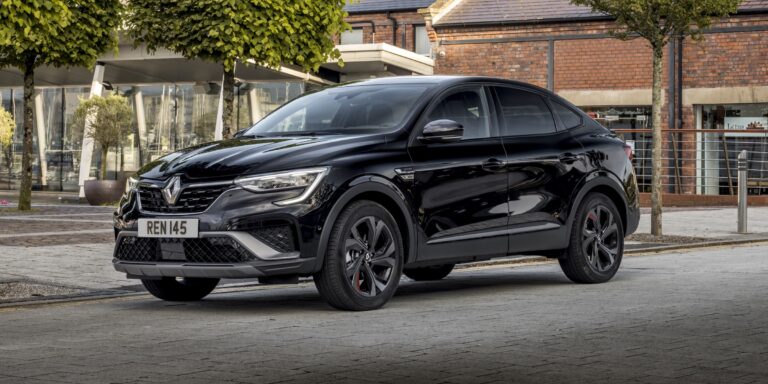
Renault has started taking orders for its Arkana, the first of its SUV range with liftback ‘coupé-inspired’ styling.

Based on the Renault Captur small SUV but stretched by 30cm, the Renault Arkana carries a sleeker profile than its more upright Captur and Kadjar SUV siblings. But its makers insist that the car is still practical, with generous rear seat space and a 513-litre boot.

Two powertrains are on offer, both electrified. The E-Tech hybrid 145 Auto combines a 1.6-litre petrol engine with two electric motors powered from a 1.2kWh lithium-ion battery pack.

Like most hybrid drivetrains, start-up and low-speed travel is done in electric mode, making the car particularly suitable for urban stop-start driving. Renault quotes fuel economy of about 59mpg and CO2 emissions of 108g/km, adding that the car will cover the 0-62mph sprint in just under 11 seconds.

A new design of automatic transmission promises seamless switching between electric and petrol power. The car offers three driving modes, the default ‘My Sense’, Eco and Sport.

Regenerative braking feeding power back into the battery is also part of the package and able to be increased in effectiveness by selecting a function on the dash.

The second version of the Renault Arkana uses a 1.3-litre petrol engine of 140hp, combined with a mild hybrid unit using the starter motor as a generator. This offers some reduction in emissions, but it can’t be driven under electric power alone so the petrol engine will always be driving the wheels.

Gear changes are through a dual-clutch auto unit and the 140hp also includes a ‘Sailing Stop’ function that allows the car to coast during declaration to add to the emissions reduction. It returns economy and emissions figures of 48.7mpg and 131g/km, and is faster accelerating than its sister with a 0-62mph time of just under ten seconds.

The Arkana has already earned a five-star safety rating from Euro NCAP (based on the Captur’s results, as the two are structurally almost identical). It offers a host of active systems fitted as standard, including autonomous emergency braking with pedestrian and cyclist detection, traffic sign recognition, a lane departure warning system and steering assistance to stay in your lane.

Prices for the Renault Arkana start at £25,300 and cars with both engines are available in three trim levels. The first cars are expected on UK roads in late August.

Audi A5 Sportback (2017 to 2024)

Summary

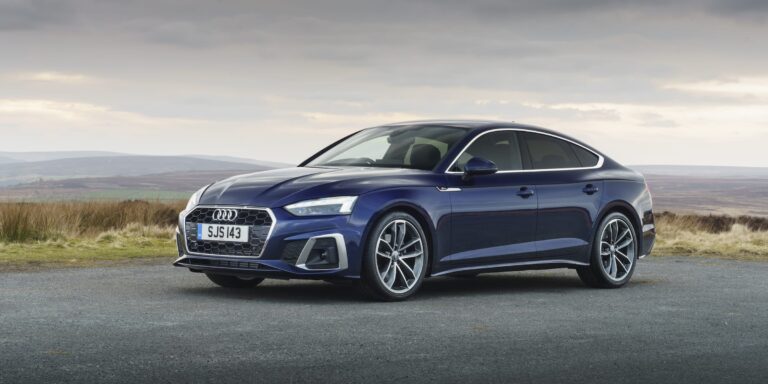
The second-generation Audi A5 first appeared in 2016 as basically a coupé version of the volume-selling A4 saloon. Shortly afterwards, it was joined by a cabriolet and the A5 Sportback – this tried to retain the coupé look while adding some extra practicality with another pair of doors and a liftback rear.

The A5 family received an update in late 2019, and was produced until early 2024 when it was discontinued as an all-new Audi A5 range was readied for production. According to the company’s new naming structure, the next-generation A5 will replace the previous Audi A4 range, so the next A5s will be saloons and estates rather than coupés, convertibles and liftbacks.

Reviewers generally liked the thinking behind this car, Motors dubbing it “one of the best-looking models in Audi’s range.” Other testers also considered the A5 Sportback to be a success, retaining the sharp looks of the A5 coupé despite creating a 580-litre boot. Auto Express highlighted the frameless windows and low roof line that ensured the car was not confused with the A4.

The interior earned plus marks too – “material quality is superb and all the minor controls are easy to make sense of,” said Honest John, while adding that the exterior visuals came at the cost of extensive rear-seat space.

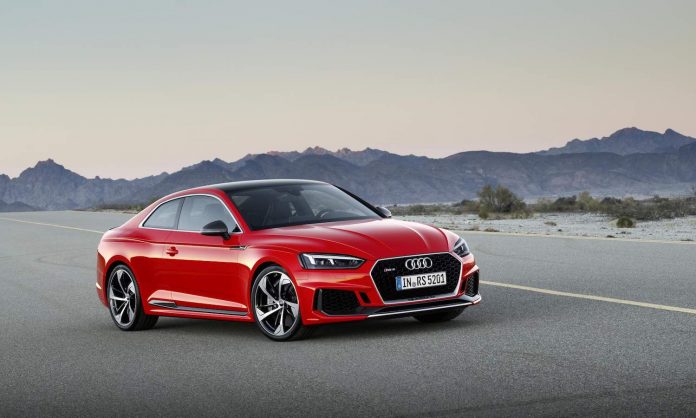
Three petrol and two diesel engines were offered for the A5 Sportback, with the top versions of each also including all-wheel-drive (branded as quattro in Audi-speak). There were also two potent models – the S5, which had a 341hp diesel engine, and the RS 5 with 450hp of petrol power.  

Reviewers generally favoured the diesels for their smoothness and economy, but accepted that ever more stringent tax laws steered most buyers to the petrols. “All the engines are smooth, quiet and powerful enough to feel luxurious,” said Carbuyer.

The on-the-road performance produced fewer plaudits – The Telegraph commented that the A5 Sportback was “very competent” but “still not a car that delivers the kind of exciting handling that makes a BMW 4 Series Gran Coupe so compelling.”

As of January 2025, the Audi A5 Sportback holds a Used Car Expert Rating score of E, with a score of 55%. It got good grades for its low CO2 emissions and media review scores, but the A5 range overall has a poor reliability record. It’s also not cheap to run, while its Euro NCAP safety rating has now expired.

Audi A5 Sportback highlights

  • Wide powertrain choice
  • Sharper to look at than an A4 saloon
  • Practical with a big boot
  • Comfortable to travel in
  • Quality interior with luxury trim

Audi A5 Sportback lowlights

  • Rear seats a bit cramped
  • Not as fun to drive as some
  • Quite pricey for what it is

Key specifications

Body style: Five-door liftback
Engines: petrol, diesel
Price when new: From £44,010 on-road

Launched: Winter 2016/17
Last updated: Autumn 2019
Ended production: Spring 2024

Media reviews

Highlighted reviews and road tests from across the UK automotive media. Click any of the boxes to view.

The Car Expert

+

Auto Express

+

Auto Trader

+

Business Car

+

Car

+

Car Keys

+

Carbuyer

+

Carwow

+

Heycar

+

Honest John

+

Motoring Research

+

Motors

+

The Telegraph

+

Top Gear

+

Safety rating

Independent crash test and safety ratings from Euro NCAP

Overall score: 5 stars
Date tested: November 2016
Date expired: January 2022
Read the full Euro NCAP review

Adult protection: 89%
Child protection: 87%
Vulnerable road users: 75%
Safety assist: 75%

Notes on safety rating

The Audi A5 was originally assessed by Euro NCAP back in 2016 and awarded a five-star rating. The Audi A5 Coupé and A5 Sportback share their safety rating with the Audi A4 range. The A5 Cabriolet does not have a safety rating as a result of the significant differences in its structure.

However, this rating expired in January 2022 and is no longer valid as the car no longer meets the standards required for such a rating. This is normal practice, as Euro NCAP reviews its ratings on most cars annually with most ratings expiring after about six or seven years.

However, if you are comparing a used A5 Sportback to vehicles of similar age, whose ratings will have probably also expired, its safety rating score is still useful.

Eco rating

Independent economy and emissions ratings from Green NCAP

No eco rating

The Audi A5 Sportback was not tested by Green NCAP during its production life.

Reliability rating

MotorEasy logo 600x167

Reliability data provided exclusively for The Car Expert by MotorEasy

All data based on MotorEasy average workshop costs for extended car warranty claims

The Audi A5 family has a poor reliability score of just 30%, according to workshop data provided by our commercial partner, MotorEasy. This applies to all versions of the Audi A5 (cabriolet, coupé, Sportback) and to both generations (2007–2016 and 2017 onwards).

The big thing to look for is suspension trouble. As the MotorEasy data above shows, this is the most common issue found on Audi A5 models, costing around £440 to correct on average. Engine issues are almost as common and a lot more expensive, with the average repair cost clocking in at more than £1,200.

Gearbox problems have also been known to crop up and are by far the most expensive faults, costing around the £3,000 mark. Bear all of this in mind if you’re looking at a used Audi A5.

Running cost rating

Clear Vehicle Data logo close crop

Monthly cost of ownership data provided exclusively for The Car Expert by Clear Vehicle Data

Fuel consumptionAverageScoreVariationScore
Petrol models40 mpgD29 – 45 mpgC – E
Diesel models49 mpgC39 – 58 mpgB – D
CO₂ outputAverageScoreVariationScore
Petrol models163 g/kmC143 – 222 g/kmB – D
Diesel models153 g/kmB127 – 191 g/kmA – C
Insurance groupAverageScoreVariationScore
All models34C28 – 50B – F
Service and maintenanceCostScore
Year 1£283C
Year 2£743C
Year 3£1,235C
Year 4£1,513C
Year 5£2,041C
Overall£5,815C

The Audi A5 Sportback has fairly high running costs, according to data exclusively provided by our commercial partner Clear Vehicle Data.

Petrol models offer 40 mpg on average, – the petrol-powered A5 Coupé is more efficient, but the Sportback is on par with rivals like the BMW 4 Series Gran Coupé. As you might expect, diesel models are the more fuel-efficient choice. Insurance premiums and maintenance costs are pretty average compared to its liftback rivals.

Recalls

Official DVSA safety recalls that have been issued for the Audi A5 range

Date: February 2022
Recall number: R/2022/036
Model types: All
Build dates: 11/2019 to 02/2021
Number of vehicles affected: 5,327
Defect: Following a previous campaign, the toe and/or camber values on the rear axle may, in certain circumstances, incorrectly be changed without this being noticed.
Remedy: The wheel alignment must be checked and, if necessary, the suspension must be serviced on the affected vehicles.

Date: June 2021
Recall number: R/2021/236
Model types: All
Build dates: 11/2019 to 02/2021
Number of vehicles affected: 10,089
Defect: One or more nuts which do not meet the specifications may have been fitted on the rear axle suspension links.
Remedy: The affected nuts on the rear axle will be replaced on affected vehicles.

Date: June 2021
Recall number: R/2021/204
Model types: All
Build dates: 12/2015 to 12/2018
Number of vehicles affected: 263
Defect: Vehicles may have been fitted with a hinged towing bracket on which the locking mechanism in the hinge module could be faulty.
Remedy: The hinge module for the towing bracket must be checked and, where necessary, replaced on the vehicles affected.

Date: October 2020
Recall number: R/2020/302
Model types: All
Build dates: 07/2020
Number of vehicles affected: 8
Defect: The seat frame may not have been bolted correctly to the seat rail on the driver and/or front passenger side.
Remedy: Check the affected seat frame connection and replace the frame if required.

Date: June 2020
Recall number: R/2020/138
Model types: All
Build dates: 06/2017 to 03/2020
Number of vehicles affected: 34,982
Defect: It is possible that moisture may enter the belt-driven starter-alternator.
Remedy: The starter-alternator must be replaced on the affected vehicles.

Date: June 2019
Recall number: R/2019/175
Model types: All
Build dates: 12/2015 to 12/2018
Number of vehicles affected: 135
Defect: Hinged towing bracket on which the locking mechanism in the hinge module could be faulty.
Remedy: The hinge module for the towing bracket must be checked and replaced if required.

Date: May 2019
Recall number: R/2019/149
Model types: All
Build dates: 02/2019 to 03/2019
Number of vehicles affected: 85
Defect: An error in the casting process may affect the rigidity of the shock absorber fork.
Remedy: The corresponding shock absorber forks must be replaced on the affected vehicles.

Date: December 2018
Recall number: R/2018/365
Model types: All
Build dates: 02/2017 to 07/2017
Number of vehicles affected: 8
Defect: Airbag securing bolts may not be to the correct torque.
Remedy: Check and replace bolts as required.

Date: February 2017
Recall number: R/2017/078
Model types: All
Build dates: 05/2016 to 10/2016
Number of vehicles affected: 2,622
Defect: Due to an error in the manufacturing process, the airbag and/or seat belt pretensioner may not trigger in the event of a collision.
Remedy: On affected vehicles, replace airbag assembly and seat belt pretensioner where necessary.

As of September 2024, there have been nine DVSA vehicle safety recalls on the Audi A5 range covering various different issues.

Not all vehicles are affected by recalls. You can check to see if your car is included in any of the above recalls by visiting the DVLA website or contacting your local Audi dealer.

If your car is affected by a recall, the vehicle must be repaired and you should not be charged for any work required. If you are buying a used A5, you should insist that any outstanding recall work is completed before you take delivery of the vehicle.

Similar cars

If you’re looking at the Audi A5 Sportback , you might also be interested in these alternatives

Alfa Romeo Giulia | Audi A4 | Audi A5 Coupé | BMW 4 Series Gran Coupé | Kia Stinger | Mercedes-Benz CLA | Peugeot 508 | Volkswagen Arteon

The junior executive premium liftback market is a bit of a niche, even by Audi and BMW standards, for those who want the practicality and brand cachet of a premium German badge but wanting something just a bit sleeker than the regular Audi A4 or BMW 3 Series. The Kia Stinger offers a good-value option that is also distinctive.

More news, reviews and information about the Audi A5 range at The Car Expert

Audi RS 5 Coupe launched: V6 twin-turbo replaces V8

Audi RS 5 Coupe launched: V6 twin-turbo replaces V8

Everything you need to know about Audi

Everything you need to know about Audi

Audi RS 5 (2019 to 2025)

Audi RS 5 (2019 to 2025)

Audi A5

Audi A5

Audi A5 range expanded with new plug-in hybrid

Audi A5 range expanded with new plug-in hybrid

Audi A5 Coupé (2016 to 2024)

Audi A5 Coupé (2016 to 2024)

New Audi A5 pricing confirmed

New Audi A5 pricing confirmed

New Audi A5 to replace current A4 range

New Audi A5 to replace current A4 range

Audi revises trim line-up for many models in its range

Audi revises trim line-up for many models in its range

Audi A5 Cabriolet review

Audi A5 Cabriolet review

Audi A5 Sportback review

Audi A5 Sportback review

Audi A5 Coupe review

Audi A5 Coupe review

Buy an Audi A5 Sportback

If you’re looking to buy a new or used Audi A5, The Car Expert’s partners can help you find the right car

Motors 600x300

Search less, live more. We make finding the right car simple. Find out more

Carwow logo 600x300

Find your next new or used car with Carwow. Find out more

Auto Trader logo 600x300

Find your next new or used car with Auto Trader. Find out more

Lease an Audi A5 Sportback

If you’re looking to lease a new Audi A5, The Car Expert’s partners can help you find a competitive deal

Leasing-com logo

Personal contract hire deals from Leasing.com. Find out more

Carparison 600x300

Personal contract hire deals from Carparison Leasing. Find out more

Rivervale Leasing logo 2022

Personal contract hire deals from Rivervale Leasing. Find out more

Subscribe to an Audi A5 Sportback

If you’re interested in a car subscription, The Car Expert’s partners can help (PS: What’s a car subscription?)

Drive Fuze logo 600x300

Car subscriptions from DriveFuze.
Find out more

Wagonex logo 2023 600x300

Car subscriptions from Wagonex.
Find out more

Cocoon Vehicles logo 600x300

Car subscriptions from Cocoon.
Find out more

Still a place for petrol engines, says Mazda

Mazda intends to continue making petrol and diesel engines for its future cars – even after countries start banning their sale.

The Japanese manufacturer has reiterated its belief in the future of more efficient internal combustion (i/c) engines, as other makes, such as Audi, announce the dates when they will completely stop making them and switch entirely to electric propulsion.

And Mazda is also throwing its weight behind developments in more environmentally-friendly synthetic and renewable fuels.

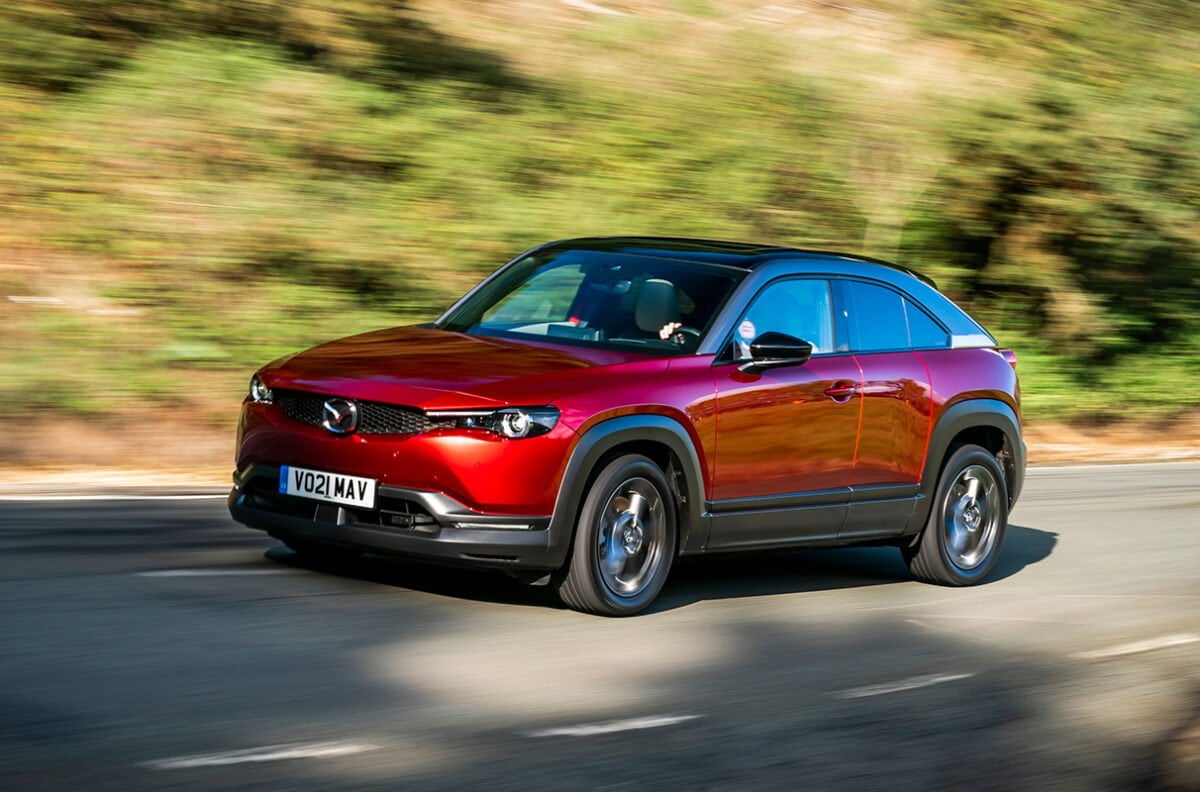
The brand has for some years been taking a different route to other manufacturers in reducing emissions, targeting technology gains rather than the industry standard of downsizing existing internal-combustion engines and rushing to electric. Mazda’s first production full battery-electric vehicle (BEV), the MX-30, was only launched earlier this year.

However the new technology, dubbed Skyactiv and stretching across engines, transmissions and chassis, has been preparing the ground for electricity. Innovations have included idling stop-start systems and regenerative braking, along with designs that allow multiple models to be built on one production line, with efficiency gains and emissions savings.

2107 Mazda Jeremy Thomson
Mazda UK boss Jeremy Thomson – taking a different path towards carbon reduction.

“The aim for our products of the next generation, along with the ongoing development of the i/c engine, is to improve the platforms in line with advancing electrification, in other words creating architecture capable of offering multiple solutions,” Mazda UK managing director Jeremy Thomson told The Car Expert.

More electrics

The brand has recently changed its electrification plans, however. A ‘Sustainability 2030 Zoom Zoom road map” released in 2017 aimed to reduce CO2 emissions by 50% over 2010 levels by 2030, and by 90% by 2050, and that BEVs would make up 5% of the Mazda model line-up by 2035. 

This has now been evolved, according to Thomson “reflecting the direction of travel globally”, and now the aim is for 25% BEV sales by 2030. “The remaining 75% will have some form of electrification on top of the highly efficient i/c engine,” Thomson says, adding that Mazda also intends to make its entire business carbon neutral in all areas, including its offices and suppliers, by 2050.

Calling these “ambitious objectives”, Thomson emphasises that Mazda is not “giving up” on petrol and diesel engines. “They will still power the majority of our cars through the world in 2030 and in order to reduce CO2 we have to continue to develop and improve the efficiency of the i/c engine as the globe slowly transitions to electrification.

“We remain committed to creating the ideal combustion engine, and our e-Skyactiv-x engine technology is evolving to get us closer to the perfect engine in terms of emissions and efficiency.”

Mazda MX-30 (2021) side action
Mazda launched its first battery-electric production model, the MX-30, only this year.

Future plans include mild hybrids, plug-in hybrids, full BEVs and hybrids using a rotary engine as a generator, but also four and six-cylinder petrol and diesel engines. 

“Globally between 2022 and 2025, we will launch five hybrids, five plug-in hybrids and three BEVs from our scaleable architecture,” Thomson said, though he would not specify which of these models would be sold in the UK.

Could fuel be the key?

Developments in fuels are crucial to the future of the internal combustion engine. In Japan, Mazda is part of a collaboration of academics, industry and Government looking at algae-based, renewable fuels.

In Europe, the brand has joined the E-fuel alliance, promoting the development use of fuels made by synthesising atmospheric carbon and hydrogen to create synthetic petrol and diesel.

2107 Mazda e-fuel alliance
Mazda has joined the e-Fuel Alliance developing renewable and synthetic fuels.

“A synthetic or renewable carbon-neutral liquid fuel that can replace the current carbon-based fuel infrastructure is the most efficient way to reduce CO2 for cars on the roads today and i/c engines to come,” Thomson says.

“Through renewable fuels we would be able to decarbonise the transport fleet across the globe quickly and efficiently with little disruption to commerce and people’s lives. It would enable those who continue to drive with internal combustion engines to contribute to CO2 reduction without the cost of changing to electric.” 

Volkswagen Golf GTI

Summary

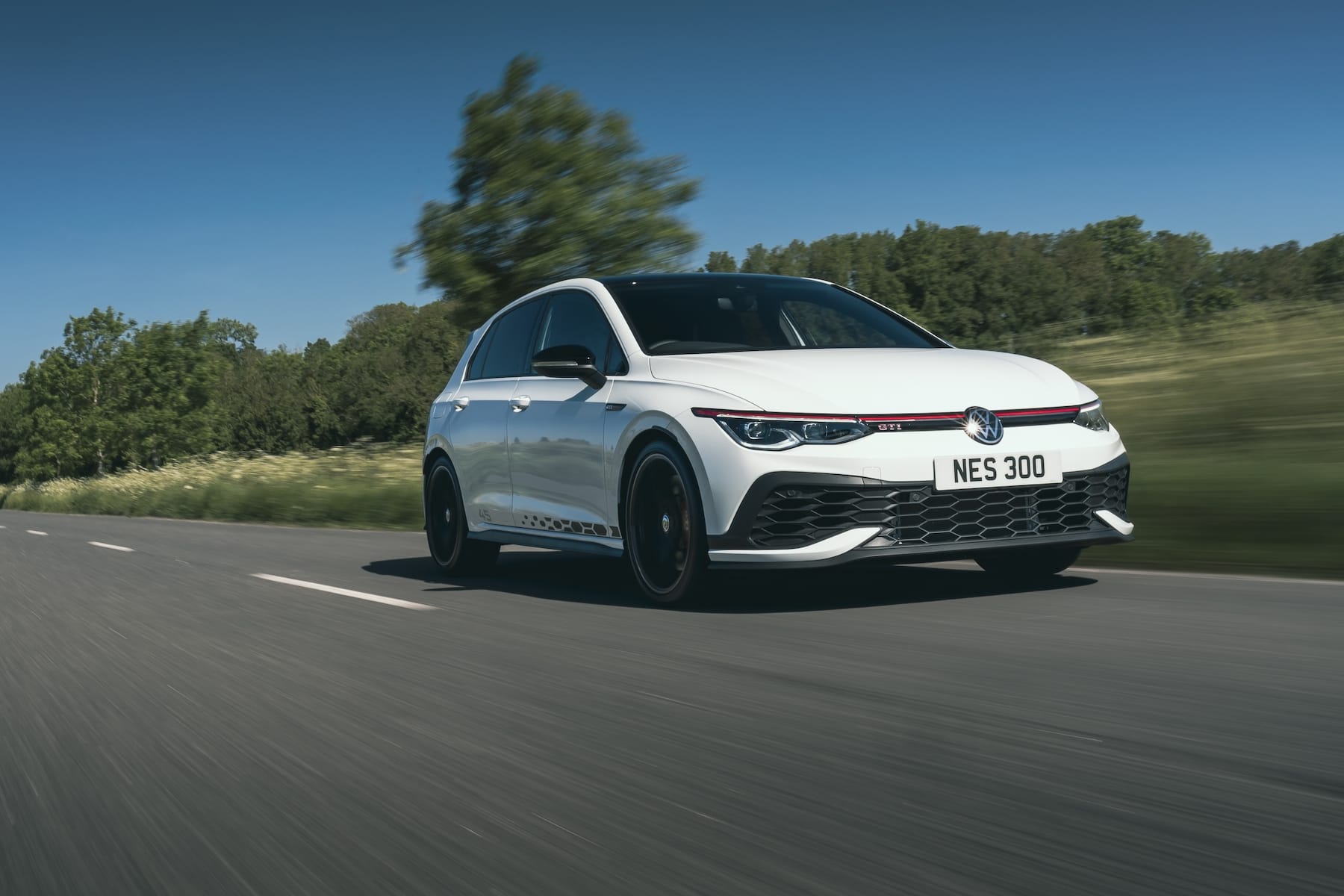
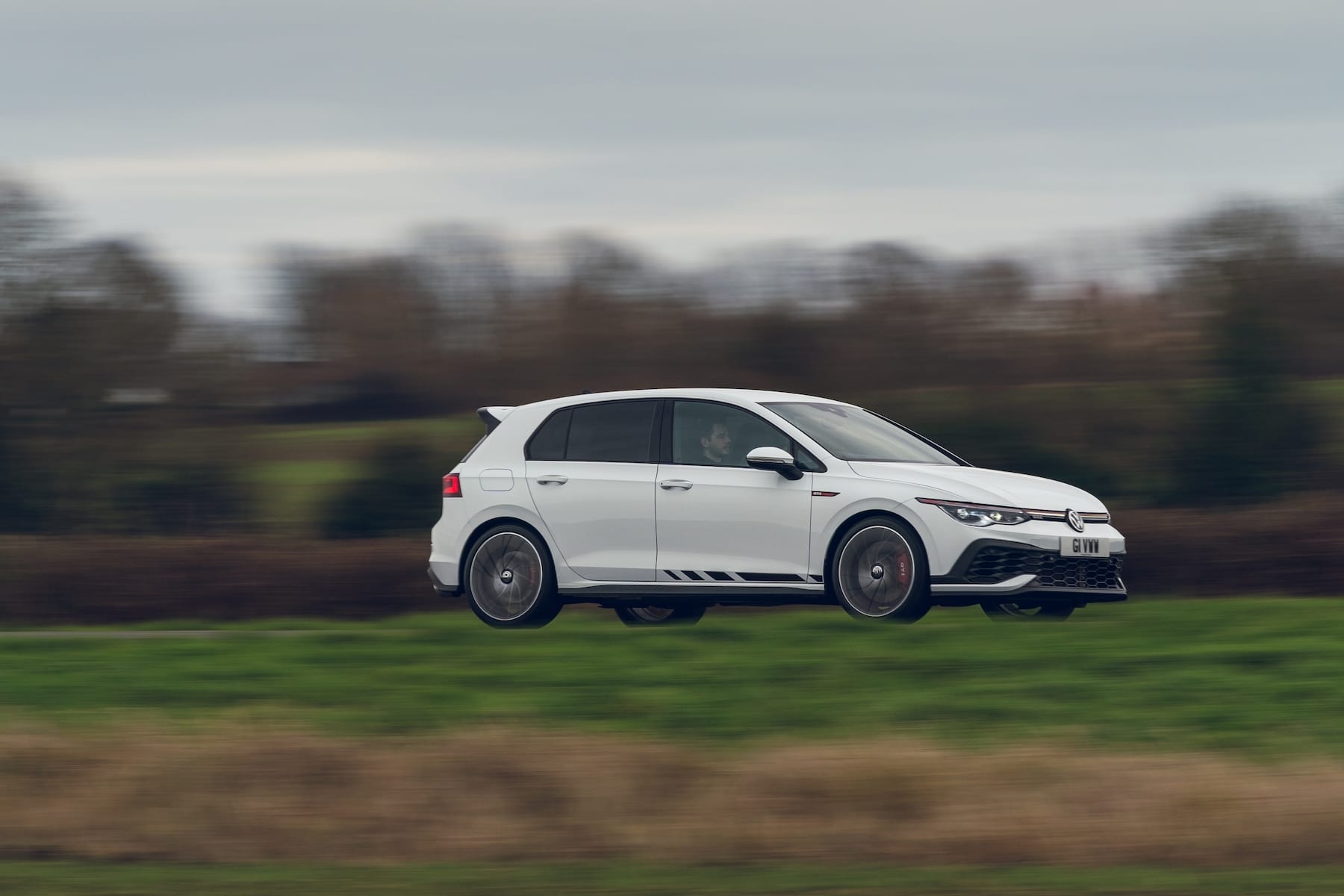
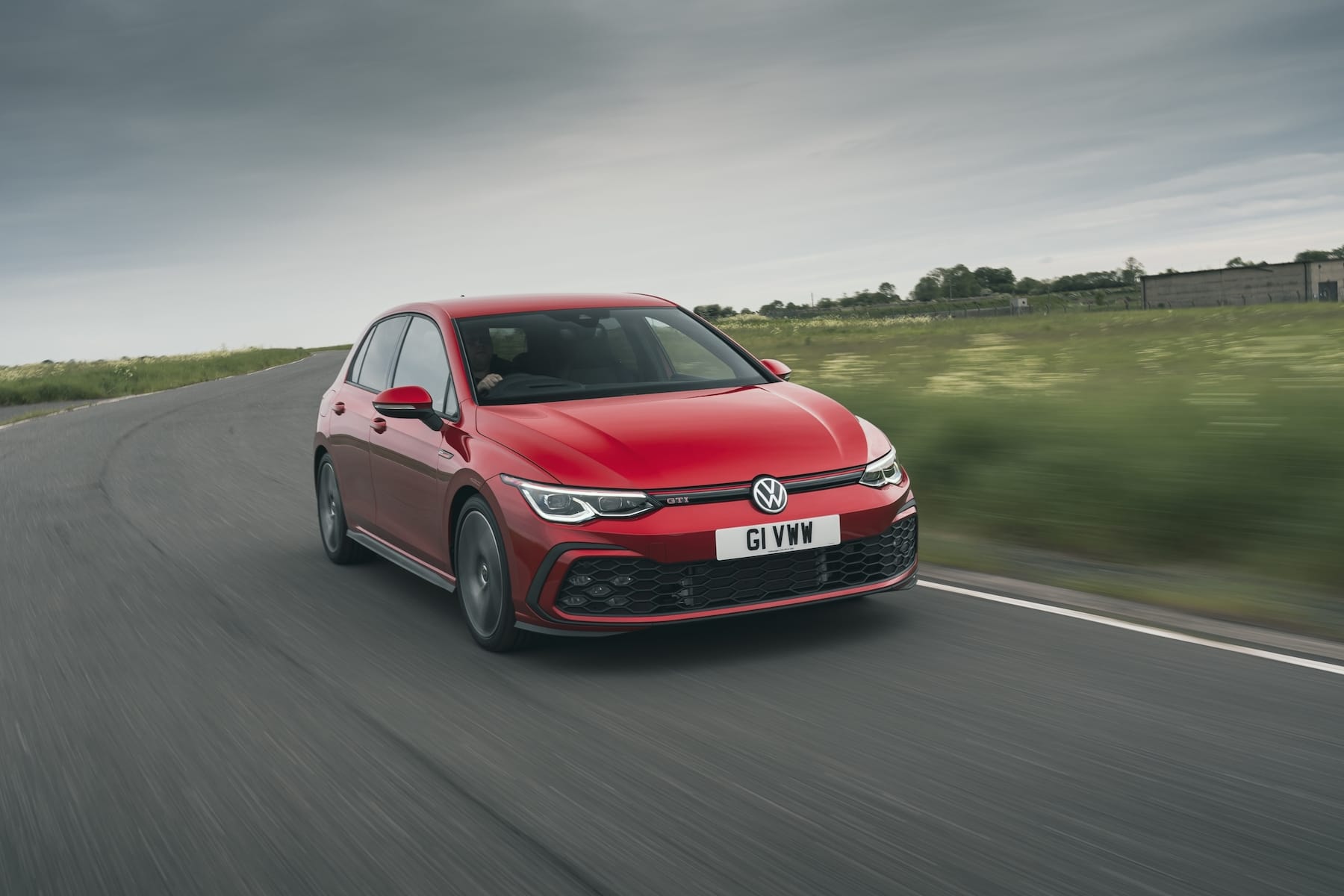
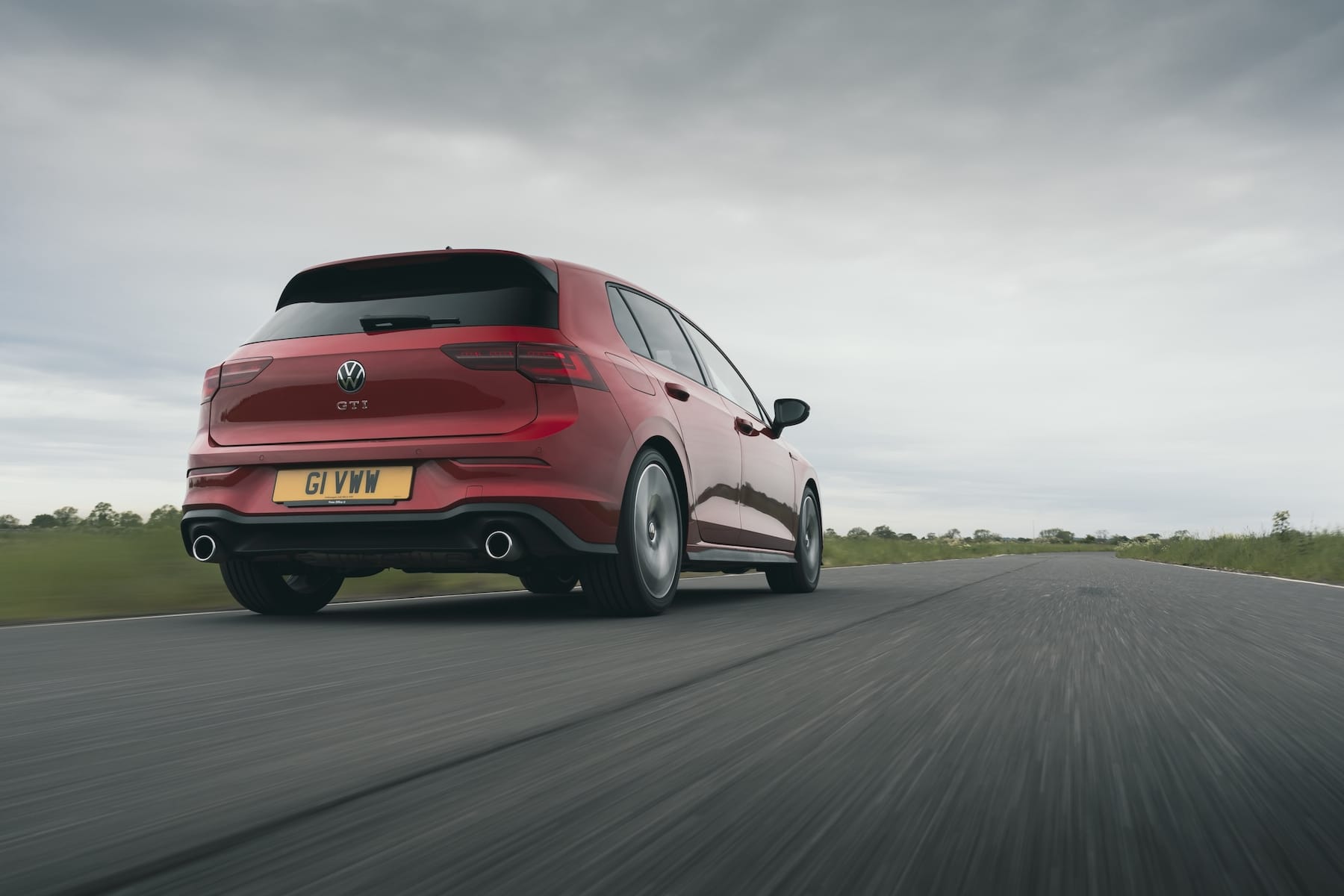
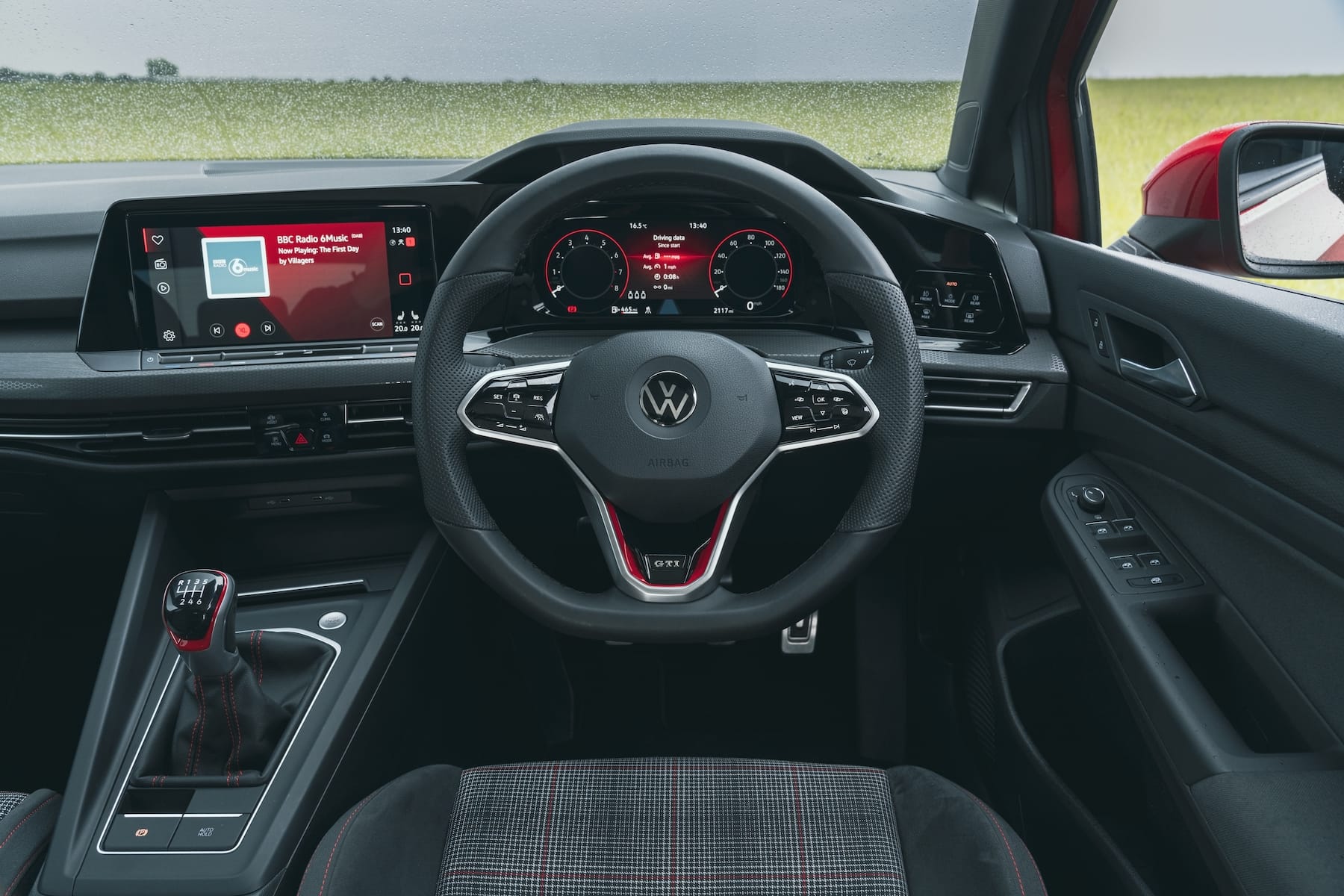
Few cars excite at the mention of their name but the Volkswagen Golf GTI does – launched in 1976 as the first recognised hot hatch, the eighth generation version arrived in 2019 and is still much desired by performance enthusiasts.

Today’s Golf GTI is powered by a 2.0-litre petrol engine – at launch it produced 245hp, which was boosted to 265 when the model was updated in 2024 – while there is also a Clubsport model with 300hp targeting more hardcore rivals such as the Honda Civic Type R.

Testers rate the GTI highly – Carbuyer dubs the car “the closest thing hot hatch fans have to the Porsche 911,” and adds that it is almost a segment in its own right, prioritising an exemplary chassis over prodigious power.

Several reviews highlight the Golf GTI’s versatility – while it offers plenty of performance, it can be docile when needed, a hot hatch equally at home on the morning school run.

Minus points? Only a precious few. The Telegraph points out that while it’s the best-looking Mk8 Golf, the GTI does not visually impress, and the interior is unexciting, with its touchscreen controls being less than user-friendly.

Some reviewers add that the car has been getting steadily more expensive and can no longer claim to be an affordable hot hatch. It is also no longer a viable choice as a company car, excluded by emissions-based tax regulations.

The more potent Clubsport, meanwhile, is considered even more desirable, but too expensive for many to justify.

But these are considered minor gripes among testers who universally rate the Golf GTI and particularly its special editions – the Clubsport 45 model is according to Auto Express “one of the best cars ever to wear the GTI badge.”

As of October 2025, the Volkswagen Golf GTI holds a New Car Expert Rating of B, with a score of 68%. It scores top marks for its excellent safety rating, while media review scores are also good. However, ownership costs drag the overall score down from an even better ranking, while Volkswagen’s new car warranty coverage is poor compared to some other brands.

Golf GTI highlights

  • Iconic name
  • Fine-handling chassis
  • Hot hatch you can use every day
  • Uprated Clubsport model highly desirable
  • Strong resale value

Golf GTI lowlights

  • Can’t compete with some rivals
  • Exhaust note not exciting
  • Interior not special
  • Not as affordable as it once was
  • No longer a company car option

Key specifications

Body style: Medium hatchback
Engines: petrol
Price: From £39,815 on-road

Launched: Winter 2020/21
Last updated: Spring 2021
Replacement due: TBA

Media reviews

Highlighted reviews and road tests from across the UK automotive media. Click any of the boxes to view.

Featured reviews

More reviews

Auto Express

Business Car

Car Keys

Carbuyer

Evo

Honest John

Motoring Research

Parkers

The Sun

The Telegraph

Safety rating

Independent crash test and safety ratings from Euro NCAP

Overall score: 5 stars
Date tested: October 2025
Read the full Euro NCAP review

Adult protection: 80%
Child protection: 86%
Vulnerable road users: 85%
Safety assist: 79%

The Volkswagen Golf GTI shares its Euro NCAP safety rating with the mainstream Golf range. It was initially awarded a five-star rating back in 2019, then re-tested in October 2025, retaining its rating.

Eco rating

Independent economy and emissions ratings from Green NCAP

No eco rating

As of October 2025, the Volkswagen Golf GTI has not yet been lab tested by Green NCAP. It’s unlikely to be a priority for the organisation, but if it is tested then we’ll post the results here.

Running cost rating

Clear Vehicle Data logo close crop

Monthly cost of ownership data provided exclusively for The Car Expert by Clear Vehicle Data

Fuel consumptionAverageScore
Petrol models38 mpgD
CO₂ outputAverageScoreVariationScore
Petrol models167 g/kmD
Insurance groupAverageScoreVariationScore
All models31C
Service and maintenanceCostScore
Year 1£213C
Year 2£550C
Year 3£909C
Year 4£1,186C
Year 5£1,644C
Overall£4,502C

The Volkswagen Golf GTI is a relatively expensive car to own and run, according to whole-life cost numbers provided exclusively to The Car Expert by our data partner, Clear Vehicle Data.

Fuel consumption is poor compared to lower-end Golfs, which is no surprise, while service and maintenance costs over the course of five years of ownership are average – as are insurance premiums, which is not bad for a hot hatch of this price.

Reliability rating

MotorEasy logo 600x167

Reliability data provided exclusively for The Car Expert by MotorEasy

All data based on MotorEasy average workshop costs for extended car warranty claims

As of April 2025 (our most recent data point), the Volkswagen Golf family has middling overall reliability score, according to exclusive extended warranty data provided by our partners at MotorEasy. However, this applies to all Golf models in MotorEasy’s database, so will be a combination of the current Mk8 and the previous Mk7 (pre-2020).

The average repair cost of £570 is fairly average – but much more than the cost of a used car warranty, which is certainly worth bearing in mind.

The majority of problems with the Golf relate to the engine or suspension, and although engine repairs usually cost around £900, suspension issues fortunately tend not to be too expensive with an average repair cost of about £240. Gearbox problems are expensive, at more than £1,300, but the good news is that these are relatively rare.

If you’re looking at a used Volkswagen Golf of any kind, make sure any extended warranty cover you purchase covers all of these potential problem areas.

Warranty rating

New car warranty information for the Volkswagen Golf GTI

Overall ratingE15%
New car warranty duration3 years
New car warranty mileage60,000 miles
Battery warranty duration0 years
Battery warranty mileage0 miles

Volkswagen’s new car warranty is pretty much the bare minimum offered by car manufacturers in the UK, and worse than rival brands in a similar price bracket as the Golf GTI. The duration is three years, with a limit of 60,000 miles, which is pretty basic. Some rivals offer up to seven years of cover.

Warranty on a used Volkswagen Golf GTI

  • If you are buying an ‘Approved Used’ Volkswagen Golf GTI from an official Volkswagen dealership, you will get a minimum 12-month warranty included.
  • If you are buying a used Volkswagen Golf GTI from an independent dealership, any warranty offered will vary and will probably be managed by a third-party warranty company.
  • If you are buying a used Volkswagen Golf GTI from a private seller, there are no warranty protections beyond any remaining portion of the original new car warranty.

If you’re looking to buy any used car that is approaching the end of its warranty period, a used car warranty is usually a worthwhile investment. Check out The Car Expert’s guide to the best used car warranty providers, which will probably be cheaper than a warranty sold by a dealer.estment. Check out The Car Expert’s guide to the best used car warranty providers, which will probably be cheaper than a warranty sold by a dealer.

Recalls

Official DVSA safety recalls that have been issued for the Volkswagen Golf GTI

Date: January 2024
Recall number: R/2024/014
Model types: All
Build dates: 03/2020 to 08/2022
Number of vehicles affected: 26,721
Defect: On certain vehicles with electromechanical brake servo and DSG (Direct Shift Gearbox) of a limited production period, there is a possibility that a heat protection mat was incorrectly fitted. In individual cases, the brake fluid reservoir can melt and cause a brake fluid leak into the engine compartment.
Remedy: A check of the installation of the heat protection mat on affected vehicles will be conducted. If necessary, the correct heat shield condition will be restored, and in a damage case, the damaged components will be replaced.

Date: April 2022
Recall number: R/2022/086
Model types: All
Build dates: 01/2019 to 02/2022
Number of vehicles affected: 1,868
Defect: The fuse in the high-voltage system of plug-in hybrid vehicles was, in some cases, produced with too little so-called fire sand.
Remedy: An additional protective insulating mat is to be fitted to the switching unit for the high-voltage battery.

Date: March 2022
Recall number: R/2022/074
Model types: All
Build dates: 09/2020 to 02/2022
Number of vehicles affected: 7,579
Defect: Engine compartment covers were fitted that, regardless of use (very sporty driving style or poor road condition) and operating period, could come loose from their attachment.
Remedy: On all affected vehicles, the engine compartment cover has to be removed.

Date: September 2021
Recall number: R/2021/320
Model types: All
Build dates: 01/2019 to 05/2021
Number of vehicles affected: 145
Defect: The bolted connection of the pull rod between the electromechanical brake servo and brake pedal may come loose, resulting in a loss of all service braking ability.
Remedy: Vehicles are not to be driven, and the bolted connection of the input rod between the electromechanical brake servo and brake pedal must be checked and, if necessary, retightened.

Date: February 2021
Recall number: R/2021/320
Model types: All
Build dates: 09/2020
Number of vehicles affected: 124
Defect: Faulty crash sensors for airbag and restraint systems may have been fitted in the front doors.
Remedy: The crash sensors in the front doors are to be checked and, if necessary, replaced.

Date: June 2020
Recall number: R/2020/176
Model types: All
Build dates: 03/2020 to 05/2020
Number of vehicles affected: 4,630
Defect: The e-call service may not function.
Remedy: Update the Online Control Unit software on affected vehicles.

As of September 2024 (our most recent data point), there have been six DVSA vehicle safety recalls on this generation of the Volkswagen Golf range to address different issues.

Not all vehicles are affected by recalls. You can check to see if your car is included in any of the above recalls by visiting the DVLA website or contacting your local Volkswagen dealer.

If your car is affected by a recall, the vehicle must be repaired and you should not be charged for any work required. If you are buying a used Golf GTI, you should insist that any outstanding recall work is completed before you take delivery of the vehicle.

Awards

Trophies, prizes and awards that the Volkswagen Golf GTI has received

2024

  • Carbuyer Awards – Best Hot Hatch

Similar cars

If you’re looking at the Volkswagen Golf GTI, you might also be interested in these alternatives

Audi RS 3 | BMW M140i | Cupra Leon | Ford Focus ST | Honda Civic Type R | Hyundai i30 N | Mercedes-AMG A 35 | Mini Countryman John Cooper Works | Renault Megane RS | Skoda Octavia vRS | Toyota GR Yaris

A wide range of performance cars stack up against the Volkswagen Golf GTI. Some are better but the VW still scores, well, because it is the Golf GTI. Prime rivals include the Ford Focus ST and Cupra Leon, while the Clubsport GTI competes against more hardcore alternatives such as the Honda Civic Type R and Hyundai i30 N. 

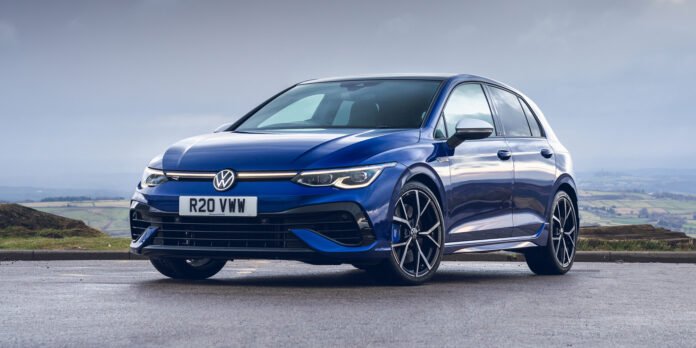
More news, reviews and information about the Volkswagen Golf GTI and Golf R at The Car Expert

Everything you need to know about Volkswagen

Everything you need to know about Volkswagen

Limited-run Volkswagen Golf GTI Edition 50 now on sale

Limited-run Volkswagen Golf GTI Edition 50 now on sale

Volkswagen Golf R

Volkswagen Golf R

Revised high-performance Volkswagen Golf R debuts

Revised high-performance Volkswagen Golf R debuts

New Volkswagen Golf GTI Clubsport debuts

New Volkswagen Golf GTI Clubsport debuts

Buy a Volkswagen Golf GTI

If you’re looking to buy a new or used Volkswagen Golf GTI, The Car Expert’s partners can help you find the right car

Motors 600x300

Find your next used car with Motors. Find out more

Auto Trader logo 600x300

Find your next new or used car with Auto Trader. Find out more

Carwow logo 600x300

Find your next new or used car with Carwow. Find out more

Lease a Volkswagen Golf GTI

If you’re looking to lease a new Volkswagen Golf GTI, The Car Expert’s partners can help you find a competitive deal

Leasing-com logo

Personal contract hire deals from Leasing.com. Find out more

Carwow logo 600x300

Personal contract hire deals from Carwow. Find out more

Select Car Leasing logo

Personal contract hire deals from Select Car Leasing. Find out more

Car subscriptions

If you’re interested in a car subscription, The Car Expert’s partners can help (PS: What’s a car subscription?)

SelfDrive UK logo

Car subscriptions from SelfDrive.
Find out more

Cocoon Vehicles logo 600x300

Car subscriptions from Cocoon.
Find out more

Just Vehicle Solutions logo 600x300

Car subscriptions from Just Vehicle Solutions.
Find out more

Porsche 718 Cayman

Summary

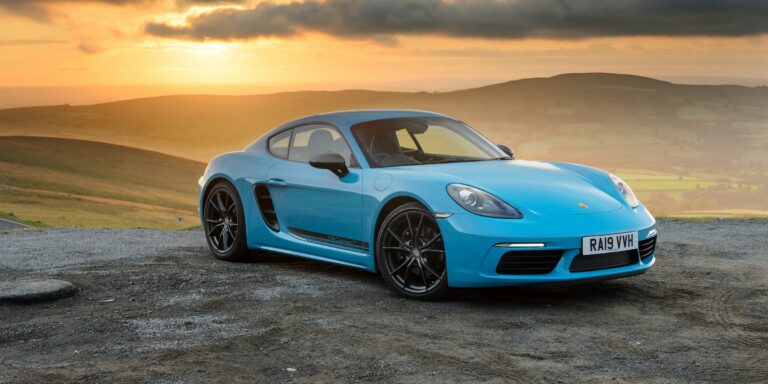
The Porsche Cayman first appeared in 2005, effectively as a hard-top version of the second-generation Boxster cabriolet. The current model launched in 2016, when both the Cayman coupé and Boxster convertible gained the 718 moniker, recalling a 1950s Porsche sports car. More pertinently, it also switched from naturally-aspirated versions of Porsche’s signature flat-six engine to mostly turbocharged flat-four units.

Mid-engined and cheaper than other models propelled from the rear, the Cayman is sometimes derided as a “poor man’s 911.” Reviewers are generally positive about it, though disappointed at the emissions-led change in engines.

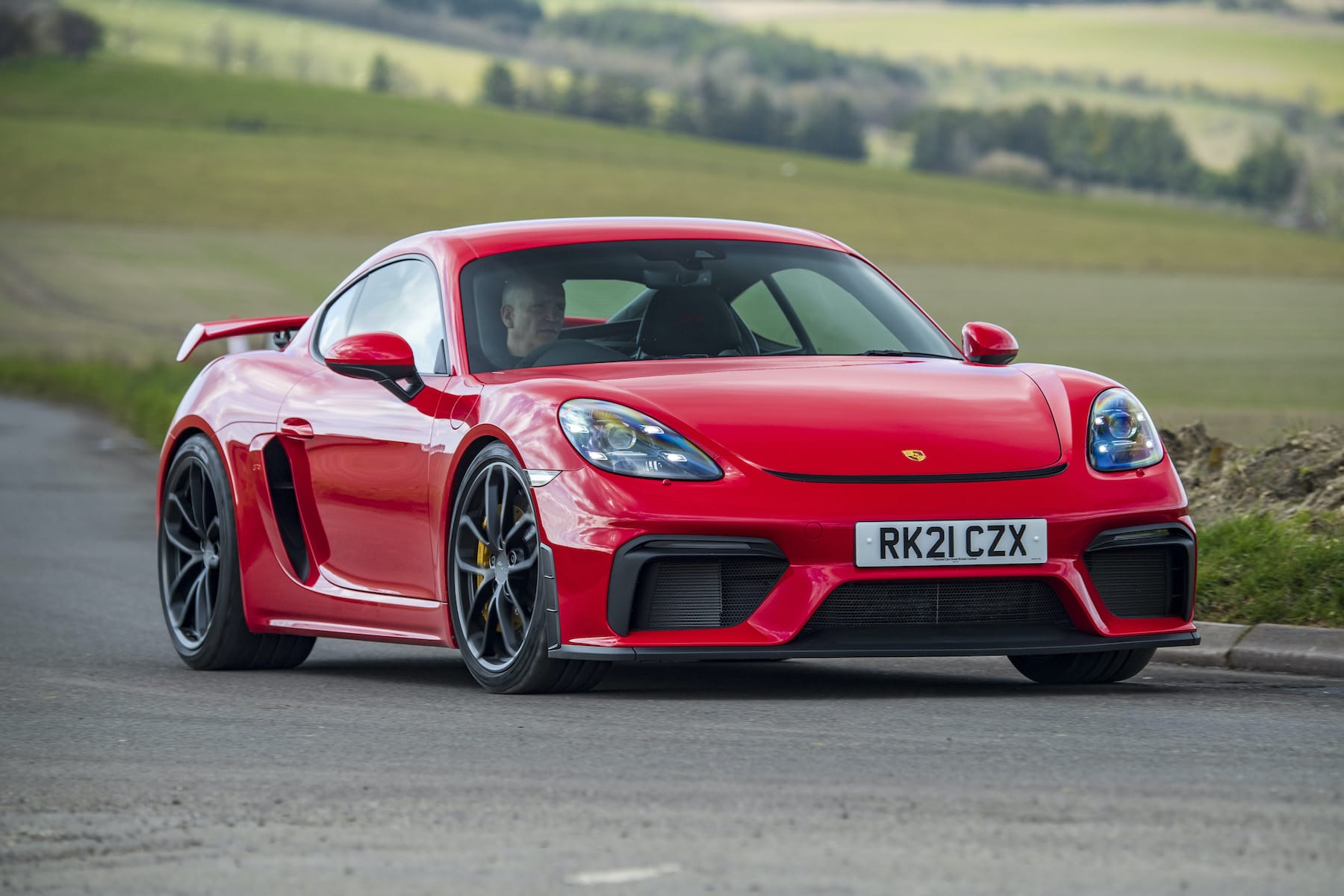
Four power outputs are on offer, ranging from 300hp of the regular Cayman to the 420hp of the hardcore GT4 model.

This and the GTS were launched after other Cayman variants, and saw a return to six-cylinder power. “They’re expensive,” says The Telegraph, but “these are the sort of cars about which you’ll remember the driving quality long after you’ve forgotten the price.”  

Testers praise the excellent handling of the Cayman, so much so that the more recently introduced lightweight T model is not considered different enough to justify its price – “the standard Cayman is such a find-handling car that 90% of drivers would never sufficiently exploit the T’s chassis to notice the extra benefits it brings,” says Auto Express.

Some reviewers point out that the interior does not include the modern touchscreens of other Porsches, but others consider this a good thing. And it is regarded as a minor issue in a car with prodigious potency and exemplary handling – Top Gear describes the Cayman as “a fantastic sports car with a real breadth of ability.”     

As of March 2026, the Porsche 718 Cayman holds a New Car Expert Rating of D, with a score of 57%. Although it’s an excellent sports car and media reviews are full of praise for its driving dynamics, the ownership data drags the Cayman’s score down. Its CO2 emissions are poor, as is its reliability record, while running costs are extremely high.

Cayenne highlights

  • Good-looking sports car
  • Excellent handling
  • Comfortable ride for sports car
  • Quality interior

Cayenne lowlights

  • Small engines for a Porsche
  • Interior tech not as current as other Porsches
  • T model not different enough to justify price
  • Reports of many reliability problems

Key specifications

Body style: Two-door coupé
Powertrain: petrol
Price: From £51,800 on-road

Launched: Autumn 2016
Last updated: Summer 2020
Update due: TBA

Media reviews

Highlighted reviews and road tests from across the UK automotive media. Click any of the boxes to view.

Featured reviews

More reviews

The Car Expert

Auto Express

Auto Trader

Car

Carbuyer

Evo

Honest John

Parkers

The Sunday Times

The Telegraph

Top Gear

Safety rating

Independent crash test and safety ratings from Euro NCAP

No safety rating

As of March 2026, the Porsche 718 Cayman has not been crash tested by Euro NCAP.

Eco rating

Independent economy and emissions ratings from Green NCAP

No eco rating

As of March 2026, the Porsche 718 Cayman has not been lab tested by Green NCAP.

Given that the Cayman is a high-performance, petrol-engined sports car that prioritises performance over economy, it’s unlikely to win any environmental awards…

Reliability rating

Reliability data provided exclusively for The Car Expert by MotorEasy

All data based on MotorEasy average workshop costs for extended car warranty claims

The Porsche 718 Cayman has a reliability score that’s below average, according to workshop and warranty data provided exclusively to The Car Expert by our partners at MotorEasy.

According to the warranty claim data, the average repair costs are very high, thanks to very expensive engine repairs which average more than £4,900 to fix.

If you’re looking at a used Porsche 718 Cayman, make sure any extended warranty cover you purchase covers all of the potential problem areas shown above.

Awards

Trophies, prizes and awards that the Porsche 718 Cayman has received

2022

  • Top Gear Awards – Best Performance Car (GT4 RS)

2017

  • World Car Awards – World Performance Car

Similar cars

If you’re looking at the Porsche 718 Cayman, you might also be interested in these alternatives

Alpine A110 | Audi TT | BMW Z4 | Jaguar F-Type | Lotus Elise | Porsche 718 Boxster | Toyota GR Supra

More news, reviews and information about the Porsche 718 Cayman at The Car Expert

Everything you need to know about Porsche

Everything you need to know about Porsche

Best Coupé 2025

Best Coupé 2025

Porsche 718 Cayman and Boxster GTS 4.0 revealed with six-cylinder engine

Porsche 718 Cayman and Boxster GTS 4.0 revealed with six-cylinder engine

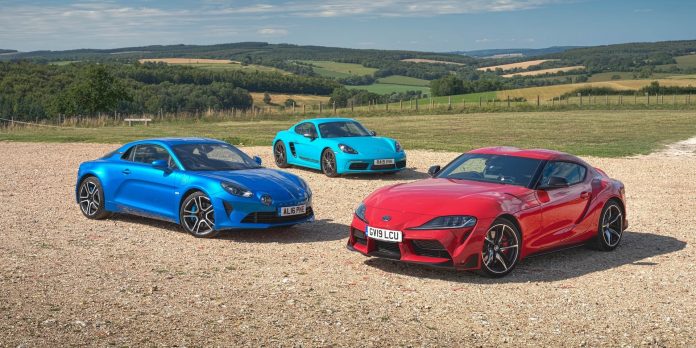
Triple Test: Toyota Supra vs Porsche 718 Cayman T vs Alpine A110

Triple Test: Toyota Supra vs Porsche 718 Cayman T vs Alpine A110

Porsche Cayman T & Boxster T launch with handling upgrades

Porsche Cayman T & Boxster T launch with handling upgrades

Porsche 718 Cayman GTS test drive

Porsche 718 Cayman GTS test drive

Buy a Porsche 718 Cayman

If you’re looking to buy a new or used Porsche 718 Cayman, The Car Expert’s partners can help you find the right car.

Motors 600x300

Find your next used car with Motors. Find out more

Auto Trader logo 600x300

Find your next new or used car with Auto Trader. Find out more

Carwow logo 600x300

Find your next new or used car with Carwow. Find out more

Lease a Porsche 718 Cayman

If you’re looking to lease a new Porsche 718 Cayman, The Car Expert’s partners can help you find a competitive deal.

Leasing-com logo

Personal contract hire deals from Leasing.com. Find out more

Carwow logo 600x300

Personal contract hire deals from Carwow. Find out more

Select Car Leasing logo

Personal contract hire deals from Select Car Leasing. Find out more

Subscribe to a Porsche 718 Cayman

If you’re interested in a car subscription, The Car Expert’s partners can help. (PS: What’s a car subscription?)

Cocoon Vehicles logo 600x300

Car subscriptions from Cocoon.
Find out more

Just Vehicle Solutions logo 600x300

Car subscriptions from Just Vehicle Solutions.
Find out more

Flexible Vehicle Contracts logo 600x300px

Car subscriptions from Flexible Vehicle Contracts.
Find out more

EV market to plug into Tesla chargers?

Electric vehicle owners queueing to use charging points at motorway service areas may in future not have to gaze longingly at rows of unused Tesla Superchargers.

Tesla CEO Elon Musk has said that he intends to open up the brand’s Supercharger charging network to other types of electric vehicles.

Tesla has established a major network across the globe of DC fast-chargers – now numbering more than 25,000. But these use a specific plug to ensure only the brand’s cars can use them. While in some countries adaptors are marketed to suit Tesla chargers, generally these points have not been available to other makes of EV.

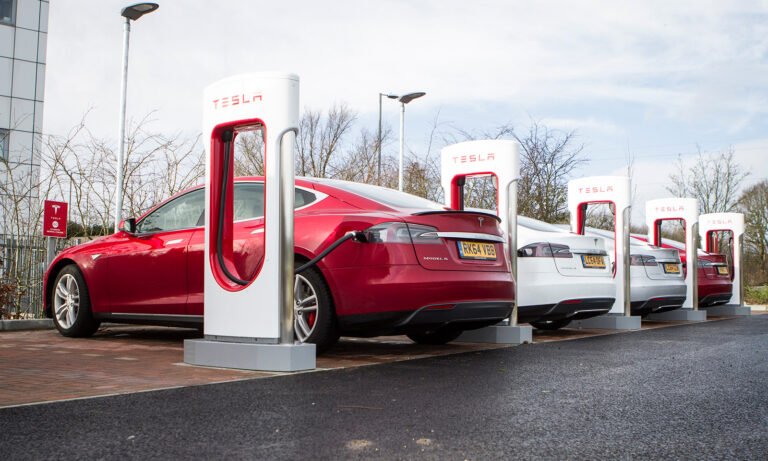
In the UK, rows of Tesla Superchargers are a familiar sight in motorway service areas, usually greatly outnumbering charge points for other electric vehicles.

Musk revealed his plans to open up the network in a reply to a tweet on his Twitter feed, and said it would happen later in 2021.

He did not specify which cars would be able to use Tesla points or where charge points would be opened up but, according to reports in the US, discussions have been underway in Germany, Sweden and Norway.

Tesla supercharger at services
Despite this view, Tesla supercharger networks at motorway services are seldom completely full-up.

Tesla has previously sold its cars on the basis of drivers having access to an exclusive fast-charging network and not having to sign up to a range of subscriptions in order to recharge their cars. But the US reports suggest that freeing up the network would enable Tesla to tap into a range of government funding.

How quickly any such expansion might come to the UK, and what cars would be compatible with the chargers, remains open to question. Some sources suggest that Tesla has previously made such an offer but under such onerous terms that all other car manufacturers rejected them.

However other reports claim that Tesla is even considering modifying its connectors on future models, to adopt similar designs to other EVs.

Any opening up of the Tesla network would certainly be welcome at motorway service areas planning how to cope with the expansion of EV use. Speaking in 2019, hydrogen fuel-cell proponent Hugo Spowers claimed that to provide EV charging facilities equivalent to the throughput a single petrol pump at a motorway services sees in one hour, would require electrical infrastructure sufficient to power a village of 38,000 homes.

The future of GAP insurance

0

As more of us lease and finance cars, rather than buying them outright, will the future of GAP insurance become more or less relevant?

We spoke to ALA Insurance (one of The Car Expert’s commercial partners) to find out more about what changes are currently going on in the specialist insurance market and what we can expect from the future of GAP insurance.

GAP insurance is one of the UK’s most misunderstood insurance products. For most people, the first time they hear about GAP is at the car dealership as they’re buying a car. In the words of ALA Insurance CEO, Simon England, dealerships have treated this type of insurance “like a profit centre, doing the industry a fair bit of reputational damage”.

In simplest terms, GAP insurance provides additional cover over and above what your standard car insurance will pay out in the event that your car is declared a total loss (which basically means stolen or written-off). The exact amount that you receive depends on the type of GAP policy you have taken out, which is something car dealers are not too hot at explaining.

Undoing the damage

So what is the reputation damage that Simon England mentioned? Until legislation was introduced to protect consumers, most GAP sales took place where dealers pressured buyers to buy a policy on the spot – at a vastly inflated price – when they were buying a car. The typical method was to instil fear into the buyer that they could lose all the money they were in the process of spending, and that a GAP policy from the dealer was the only way to protect that investment.

Nowadays, the Financial Conduct Authority (FCA) limits dealers’ commissions on GAP to no more than 50%, which automatically limits how much a dealer can mark-up a policy price. Dealers also need to hold off 48 hours before selling a customer a GAP insurance policy after first introducing it, to give buyers time to research and make a more informed choice.

This has resulted in many smaller, more independent dealers no longer offering GAP insurance policies, as it’s no longer as lucrative. Some of the larger networks, however, are known to continue applying less ethical practices. This may involve outsourcing potential buyers to third-party telemarketers, calling new car owners with a 30-day guarantee.

England argues “People don’t need to be sold to like that. This creates so many issues, not least with the use of data.”

Indeed, many consumers rely on government regulations to trust their data is being secured appropriately, but there will always be leaks – and the more people who have access to your personal information, the more potential there is for your details to be compromised. Even within the last year, dealership network Sandicliffe Motor Group was the victim of a targeted cyber attack, in which hundreds of customers’ bank account details and medical histories may have been compromised.

England argues that there’s a better way to do business and that figures from the pandemic support such a claim. He says “We’ve seen a 30% growth in policy numbers in the pandemic. Where before 80% of policies were sold through dealers, the pandemic has encouraged car buyers online to do more research”

This has also sparked change in the marketplace as well. Where 70% of GAP policies have traditionally been taken out on new vehicles, ALA Insurance says the split between new and used cars is now more like 50/50.

There’s also a remarkable difference in those considering GAP insurance. “There’s a misconception that GAP is only required for cars bought on finance,” England explains.

“Understanding the complete loss of a vehicle, leaving you with a burdensome debt is perhaps much easier to cognitively appreciate than a chunky loss of your savings and your vehicle if you’re a cash buyer. Yet, in either scenario, the vehicle owner is left in the same position; no car, no way to replace like-for-like.”

So what does the future of GAP insurance look like?

Looking at the way the insurance landscape is changing, the increasing use of technology and more hyperflexible policies – even enabling customers to be covered for a few hours in someone else’s vehicle – England acknowledges there are areas ripe for change in this sector.

Increased trustworthiness

It seems internet misinformation campaigns aren’t limited to the political arena, and trustworthiness is imperative for the credibility of any insurance policy.

Internet-savvy shoppers will usually get the best deals, since they’re already comfortable with buying online and rely on customer reviews – from providers like Trustpilot or Reevoo – to determine the trustworthiness of a company. England says that ALA’s telephone operators are not commission-based, so their only job is to assist you rather than sell you a policy.

Integration of advanced technology

The ‘own fault’ designation accounts for almost 35% of claims. (Somewhat surprisingly, the data shows that there are more accidents in better weather, suggesting drivers are more careful when the road conditions are poorer.) With the growth and normalisation of advanced driver assistance systems, which in the future will include more driver health monitoring, there’ll likely be fewer accidents through loss of control.

Insurance companies are already seeing an increase in the use of dashcams to determine liability in claims. It’s resulting in less fraud and a 30% increase in split liability, according to dashcam manufacturer Nextbase, and more tracker devices are being installed to mitigate against theft, which accounts for almost 25% of claims.

All of this means calculating the value of policies and the damage sustained in accidents will be much more accurate and that should, in theory at least, result in more competitive policy pricing.

Shift in car ownership

England cites changes in car ownership as one of the biggest factors for the GAP insurance market. The shift to personal contract purchase (PCP) finance, leasing and subscription-based acquisition models (for both new and used vehicles) suggests a growing need for specialised GAP products that cover finance liability as well as the original vehicle price. This is largely because your financial liability in a total loss situation is likely to be more

Freak weather

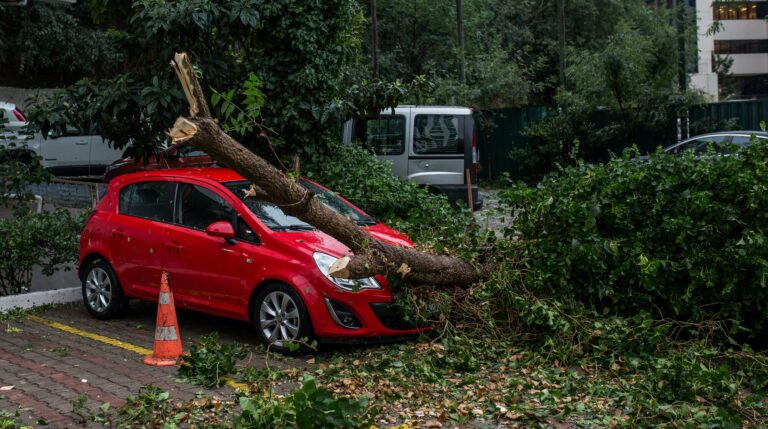
In recent years, the climate change conversation has grown. Though ALA’s statistics show flooding and tree damage only accounts for 4% of total claims, the unpredictability of weather patterns means GAP insurance may be even more suitable.

For example, the risk of your car being written off is higher if you live in a high-risk flood area, which can alter the risk-to-benefit ratio of taking out a GAP insurance policy. Flood damage can easily lead to a car being declared a total loss, as the complicated electronics in all modern cars are really not designed to be submerged in water.

In closing…

The GAP insurance sector, like other specialist insurances, has room to grow and improve to become a better-understood product. With car dealers no longer allowed to sell GAP on the spot, opportunities have opened up for online providers to disrupt the markte and provide much better value for customers.

Here at The Car Expert, we’ve seen enormous demand for all the GAP insurance content that we’ve produced over the last six months or so, as car buyers seek out more information on exactly what GAP is and whether it’s right for them.

Climbing back from a perception of oversold policies is no mean feat, but the future of GAP insurance seems bright. Simon England remains confident that the right GAP policy can suit anyone driving a car less than 12 years old and is certain that “if you buy it right, [GAP insurance] is affordable.”

More GAP insurance information

The UK’s best GAP insurance providers

The UK’s best GAP insurance providers

Are you paying too much for GAP insurance?

Car finance jargon confuses UK drivers

Car finance jargon confuses UK drivers

Can you buy GAP insurance in 2024?

Can you buy GAP insurance in 2024?

What is GAP insurance and should you have it?

What is GAP insurance and should you have it?

New battery extends range of MG5 EV

The all-electric MG5 family estate car has gained a new model option extending its potential range by more than 35 miles.

A 61.1kWh battery pack sees the car’s official WLTP-certified range between charges rise from 214 miles to 250 miles. MG adds that the potential range grows to 334 miles if the car is used solely for urban driving with lots of speed changes, with resultant energy recovery from regenerative braking.

The new battery pack can be recharged to 80% capacity in 61 minutes using a 50kW rapid charger – this time drops to 40 minutes using a 100kW charger. A full overnight charge on a domestic home charger takes around 9.5 hours.

Propulsion is provided by a 115kW electric motor, equivalent to 156hp. This gives the car a 7.3-second 0-60mph time and a top speed where permitted of 115mph.

MG’s Pilot driver assistance system, which debuted on the ZS SUV, extends to the MG5 with the new model. It comprises a suite of active safety technologies including autonomous emergency braking, adaptive cruise control and lane-keeping, traffic-jam, high-beam and speed limit assistance.

MG5 EV interior

MG also offers the ZS EV and the HS plug-in hybrid, claiming that the electric percentage of its model range is four times the average among other brands.

The MG5 claimed the title of first estate EV in Europe when it launched in October 2020. The car’s makers expect it to particularly appeal to fleet buyers trying to improve their green credentials, due to the large boot that offers up to 578 litres of spaces extending to 1456 with the rear seats folded.

Already on sale, the longer-range MG5 is priced at £26,495 after the Government’s plug-in grant is included. For the present it will be sold alongside the existing MG5 EV. It also carries MG’s standard seven-year/80,000-mile warranty.

MG ZS EV

Summary

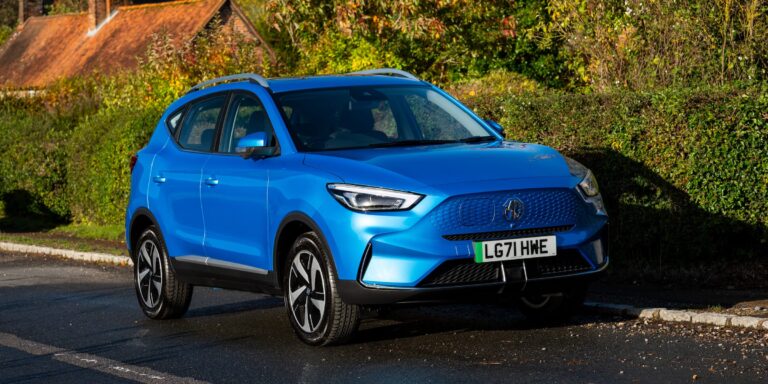
The MG ZS EV was a compact electric SUV, launched in the UK in 2019 and discontinued in early 2025 when it was replaced by the all-new MG S5 EV.

MG’s rebirth under Chinese ownership has been massively successful, with the brand now a genuinely major player in the UK car market. Much of this success has come from its electric models, like the MG ZS EV seen here.

The MG ZS EV was a small electric SUV, which found more praise than might be expected from seasoned road testers in the UK media. Auto Express said it has “… real appeal – as a second car, company car or an affordable route into a pure electric vehicle.”

As the name suggests, this was a battery-electric version of the contemporary petrol-powered MG ZS small SUV, which was produced from 2017 to 2024. Replacing the petrol engine with a 105kW electric motor and 45kwh battery, the ZS EV became a significantly better vehicle.

The electric motor was much quieter and smoother than the petrol engine in the regular ZS, which made it a far nicer place to spend time. And like every model in the MG family, you got a lot of car for your money. The ZS EV undercut other small electric SUVs by thousands of pounds, making it a very affordable way to make the switch to an electric car.

In addition to its price advantage, the MG ZS EV offered plenty of practicality. It was surprisingly roomy inside, and in our own The Car Expert review we highlighted substantially more boot space than non-EV rivals such as the Ford Kuga and Mazda CX-3.

Interior finish was nothing to get excited about but, as several reviews pointed out, for its price some hard plastics in evidence was hardly surprising. The review in the Daily Mirror also found that the driving experience was nothing to be sneezed at, as the MG’s “… low-down centre of gravity, due to the batteries, gives a secure feel and the ride quality is better than in many crossovers.”

The ZS EV was updated in late 2021. Crucially, this update saw a larger battery provided, which increased driving range from 163 miles to a far more usable 273 miles. That alone made the later ZS EV a far more viable option for many households.

As of June 2025, the MG ZS EV holds a Used Car Expert Rating of A with a score of 71%, which is significantly better than the petrol version. The facelifted model scored significantly better than the original model, which is worth bearing in mind if you’re shopping for a used ZS EV.

ZS EV highlights

  • Affordable route into EV driving
  • Practical
  • Big boot
  • Comfortable ride
  • Comes with long warranty

ZS EV lowlights

  • Dull to drive
  • Cheap plastics inside
  • Rivals go further on a charge
  • Not so modern infotainment

Key specifications

Body style: Small SUV/crossover
Powertrain: electric motor, battery-powered
Price: From £30,495 on-road

Launched: Winter 2019/20
Last updated: Autumn 2021
Update due: TBA

Media reviews

Highlighted reviews and road tests from across the UK automotive media. Click any of the boxes to view.

Featured reviews

More reviews

Auto Express

Business Car

Car

Car Keys

Carbuyer

Carwow

Company Car Today

Daily Mirror

Driving Electric

Electrifying.com

Eurekar

Green Car Guide

Heycar

Honest John

Parkers

The Sunday Times

The Telegraph

Top Gear

Safety rating

Independent crash test and safety ratings from Euro NCAP

Overall score: 5 stars
Date tested: December 2019
Read the full Euro NCAP review

Adult protection: 90%
Child protection: 85%
Vulnerable road users: 64%
Safety assist: 70%

Despite its budget price tag, the MG ZS EV scored a top five-star safety rating from Euro NCAP when it was launched in 2019. This score was better than several more expensive vehicles.

Eco rating

Independent economy and emissions ratings from Green NCAP

No eco rating

The MG ZS EV was not assessed by Green NCAP during its production life.

The Green NCAP programme measures exhaust pollution (which is zero for an electric car) and energy efficiency. Electric cars are much more energy-efficient than combustion cars, so the ZS EV would likely have scored very highly in Green NCAP testing if it had taken place.

Reliability rating

MotorEasy logo 600x167

Reliability data provided exclusively for The Car Expert by MotorEasy

No reliability rating

As of June 2025, we don’t have enough reliability data on the MG ZS EV to generate a reliability rating.

The Car Expert’s reliability information is provided exclusively for us using warranty data from our partner, MotorEasy. As soon as MotorEasy has sufficient data on the ZS EV, we’ll publish the score here.

Running cost rating

Clear Vehicle Data logo close crop

Monthly cost of ownership data provided exclusively for The Car Expert by Clear Vehicle Data

Battery rangeAverageScoreVariationScore
EV models207 milesB163 – 273 milesB – C
Electrical efficiencyAverageScoreVariationScore
EV models3.8 m/KWhC3.6 – 3.9 m/KWhC – D
Insurance groupAverageScoreVariationScore
All models25B21 – 28A – B
Service and maintenanceCostScore
Year 1£141A
Year 2£354A
Year 3£585A
Year 4£715A
Year 5£989A
Overall£2,784A

In addition to the MG ZS EV’s rather affordable price tag, the SUV is also very cheap to run. It’s electrical efficiency (the EV equivalent of miles per gallon for a petrol or diesel car) is decent, while insurance premiums should be good compared to other cars as well. But the even better news is that scheduled servicing costs for the ZS EV are excellent.

In addition, an official battery range of 235 miles (which varies from 163 miles to 273 miles, depending on which model you choose) is just above average. So you shouldn’t need to worry about running out of charge in normal day-to-day driving.

Awards

Trophies, prizes and awards that the MG ZS EV has received

2022

  • Carbuyer Awards – Best Family Electric Car

2020

  • Company Car & Van Awards – Best Medium EV
  • Southern Group of Motoring Writers Awards – Dark Horse of the Year

Similar cars

If you’re looking at the MG ZS EV, you might also be interested in these alternatives

Citroën ë-C4 | DS 3 Crossback E-Tense | Hyundai Kona Electric | Kia e-Niro | Kia Soul EV | Mazda MX-30 | Mini Countryman plug-in hybridNissan Leaf | Peugeot e-2008 | Vauxhall Mokka-e | Volkswagen ID.4 | Volvo XC40 Recharge

The MG ZS EV launched against a small number of direct rivals but, by the time it ended production, the segment had exploded in choice and quality. The ZS EV’s key advantage throughout its life was its very keen pricing, which undercut most rivals by thousands of pounds.

Buy an MG ZS EV

If you’re looking to buy a used MG ZS EV, The Car Expert’s partners can help you find the right car

Motors 600x300

Find your next used car with Motors. Find out more

Auto Trader logo 600x300

Find your next new or used car with Auto Trader. Find out more

Carwow logo 600x300

Find your next new or used car with Carwow. Find out more

Subscribe to an MG ZS EV

Subscriptions are becoming a very popular way for consumers to try an electric car for a few weeks or months to help decide whether it’s a suitable alternative to a petrol car. If you’re interested in a car subscription, The Car Expert’s partners can help. (PS: What’s a car subscription?)

Drive Fuze logo 600x300

Car subscriptions from DriveFuze.
Find out more

Wagonex logo 2023 600x300

Car subscriptions from Wagonex.
Find out more

Cocoon Vehicles logo 600x300

Car subscriptions from Cocoon.
Find out more

Covid car sales not as bad as first thought

The negative effect of the Covid-19 pandemic on the new and used car markets was not as bad as first thought, new research has shown.

The fresh findings, from automotive servicing and repair company Kwik Fit, suggest that 3.8 million drivers have potentially put off a planned car purchase because of Covid. But this was largely offset by the fact that up to 3.2 million drivers were prompted by the impact of the pandemic to buy a new or used vehicle.

The majority of these car purchases were made by younger drivers: 16% of motorists aged 18-34 (2 million motorists) said the coronavirus issue prompted them to look for some new wheels. A further 1.2 million drivers (4%) aged 35 or over, bought a new car.

Kwik Fit’s research examined the reasons behind the pandemic purchases and found that a third (33%) of buyers said they were able to get a better car than they otherwise would have done because the price was lower than expected. 

Three in ten (30%) prompted by the pandemic into a car purchase said they had a new job which required more travelling, so they bought a better car. 

Another reason given for buying a new car is a potentially worrying sign for rush hour traffic levels: a quarter (24%) of respondents said Covid had prompted them to get a better model as they will be using it more for commuting to avoid public transport. 

Holiday or weekend travel was in the minds of other drivers, with 7% saying that as a result of the pandemic they bought a car more suitable for going on domestic holidays rather than flying abroad.

The last 15 months have placed a huge burden on many people’s budgets.  Kwik Fit found that while nearly a fifth (18%) of drivers who bought a new car because of the pandemic say they thought they could get a good deal as prices were reduced, the same proportion said they opted for a cheaper car because of the financial pressure caused by Covid.

And 30% of those who said they bought a new or used car because of the pandemic chose a hybrid or fully electric model, far outstripping low emission vehicles’ percentage share of all new and used car purchases.

“Like so many sectors, the automotive industry has been going through a very tough time during the pandemic,” says Roger Griggs, Kwik Fit communications director. “Our research shows that some drivers were badly impacted by Covid while, for a variety of reasons, other drivers were prompted by the pandemic to buy a new vehicle. 

“As we come to the point where restrictions are almost fully removed, people will be settling into new travel patterns or re-establishing old ones and we expect to see even more drivers assessing whether their current car is the right one for their ongoing needs.”

Giving way to emergency vehicles

0

Having an emergency vehicle come rushing up behind you on the road can cause panic in lots of drivers. The noise of the sirens and glare of the flashing lights add to the pressure of trying to get out of the way so the vehicle can attend to its emergency.

Or maybe you’re sitting in heavy traffic and an ambulance is trying to get through the gridlock. What are you supposed to do? Should you cross into an intersection or mount a kerb to get out of the way?

Stay calm, stay alert

Often you will hear the siren of an emergency vehicle before you see the flashing lights (unless you are one of those delightful individuals who has the music turned all the way up and would be unable to hear a nuclear explosion right next to you).

Work out where the sound is coming from and look for opportunities to move over to the side of the road. There’s no rush; far better to take a few moments to make sure there are no cyclists in your blind spot or other cars also trying to dive out of the way.

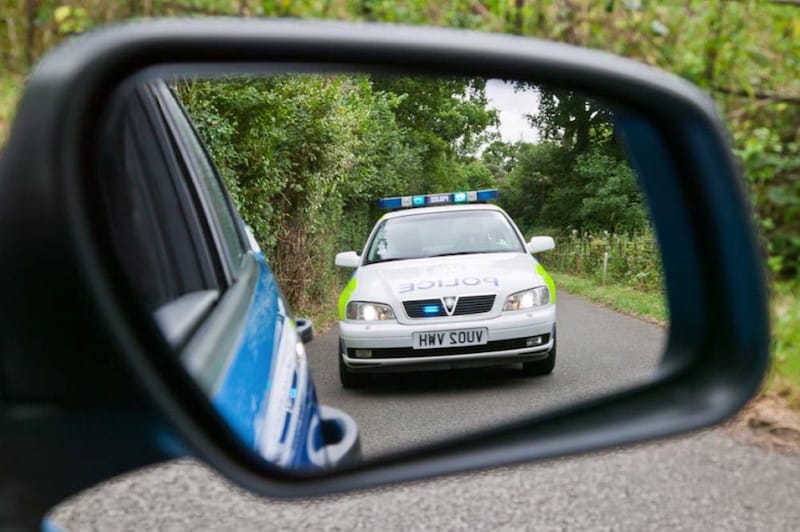
Even if an emergency vehicle suddenly appears in your mirrors with lights flashing and siren blaring, the same thing applies. Keep calm and follow your normal ‘mirror, signal, manoeuvre’ routine. The few seconds that it takes may avoid an accident by ensuring that you don’t move over on another road user, and the emergency vehicle can understand exactly what you’re doing rather than trying to guess.

Emergency vehicle in mirror
(c) DVSA

Panicking and swerving wildly or hitting the brakes is only likely to lead to an accident and require more emergency vehicles.

Police, ambulance, fire and other emergency drivers are trained to deal with negotiating traffic, and they are allowed to break traffic laws if they are in an emergency situation (lights and sirens going). What they need you to do is be calm, courteous, safe and predictable so they can get past quickly and safely.

What the Highway Code says

Rule 219 of the UK Highway Code covers emergency vehicles:

“Emergency and Incident Support vehicles. You should look and listen for ambulances, fire engines, police, doctors or other emergency vehicles using flashing blue, red or green lights and sirens or flashing headlights, or traffic officer and incident support vehicles using flashing amber lights. When one approaches, do not panic. Consider the route of such a vehicle and take appropriate action to let it pass, while complying with all traffic signs. If necessary, pull to the side of the road and stop, but try to avoid stopping before the brow of a hill, a bend or narrow section of road. Do not endanger yourself, other road users or pedestrians and avoid mounting the kerb. Do not brake harshly on approach to a junction or roundabout, as a following vehicle may not have the same view as you.”

The key phrase here is “… take appropriate action to let is pass, while complying with all traffic signs.” In other words, don’t ignore traffic signs (including traffic lights).

Although the above rule is probably not very well written and does not state it clearly, there is nothing in the Highway Code which says you can break the law to assist an emergency vehicle.

Don’t break the law unless instructed to by police

City streets can be a navigational nightmare for emergency vehicles, as they try to thread their way through a gridlock of cars, buses and vans. When traffic is at a standstill, drivers will often try to help by moving into an intersection, roundabout or bus lane to get out of the way. However, as much as you are trying to do the right thing, this is usually the wrong move.

If an emergency vehicle driver can see there is no clear path through stationary traffic, like a set of traffic lights, they will often switch off the lights and sirens and wait for an opportunity to move again (like the lights changing).

Official advice from police departments across the country is not to break the law to assist an emergency vehicle unless a police officer instructs you to do so. There are a number of reasons for this, but largely it is a bigger-picture approach to road safety. If you move against a red light into an intersection, you may move into the path of a vehicle coming from another direction that has not seen the emergency vehicle. You may be putting yourself and other road users in danger.

But I’m trying to help!

It often seems like the right thing to do, to pull across into a bus lane or ignore a red light and edge into an intersection to let an emergency vehicle through. However, it may not be helping at all.

Emergency vehicles will often use bus lanes to bypass lots of stationary or slow-moving cars, so pulling over into the bus lane might simply put you in the way and make life harder for the ambulance or police car trying to get wherever it’s going.

Can I be fined for breaking the law to assist an emergency vehicle?

Yes, you can. Councils and local authorities are heartless bureaucracies at the best of times, but in this case they do have the law on their side. There is nothing in the Highway Code which says you can break the law if you are trying to get out of the way of an emergency vehicle.

The internet is full of stories of drivers who are upset because they have been fined by automated camera systems for entering bus lanes or intersections to try and make way for an emergency vehicle to get past.

There are also plenty of stories and old wives’ tales about how you can write to the relevant authority and explain how you were trying to assist an emergency vehicle, but there are no legal provisions to get you out of a traffic penalty. Sometimes these fines are withdrawn if the driver appeals and there is supporting evidence, but certainly not always.

Finally, remember there may be more than one vehicle

If you have pulled over or moved out of the way of an emergency vehicle, don’t blindly pull back out again once it has passed.

There are often multiple police cars, ambulances or fire appliances heading towards the same incident, so you may have let one vehicle past and then pulled straight back into the path of another one following behind.

Also, there will be other vehicles who have taken avoiding action who are also looking to continue their journey, so be aware that other road users around you are all trying to re-enter the road space at the same time.

metropolitan-police-car-london

This article was originally written in September 2016 and most recently updated in July 2021.

Britain’s best-selling new cars, June 2021

The positive tone of April and May continued through into June as new car sales continue to return to normality – although still well short of pre-pandemic levels.

However, the picture was complicated by several manufacturers running into severe parts shortages brought on by pandemic shutdowns. The big-selling Mercedes-Benz A-Class, which had been third in the year’s sales charts, disappeared out of the top ten in June.

Porsche and Land Rover also seemed to suffer more than most, with their sales numbers well down. On the other hand, some car companies did very well – as we’ll see below. It was a tight battle for best-selling supermini this month, with small hatchbacks filling fourth to eighth places with some very small margins between them.

We’ve covered the detail of the monthly registration results already this week, so let’s look at the top-selling cars of the month.

Report: Supply issues complicate new car sales results in June


The UK’s top-selling cars, June 2021

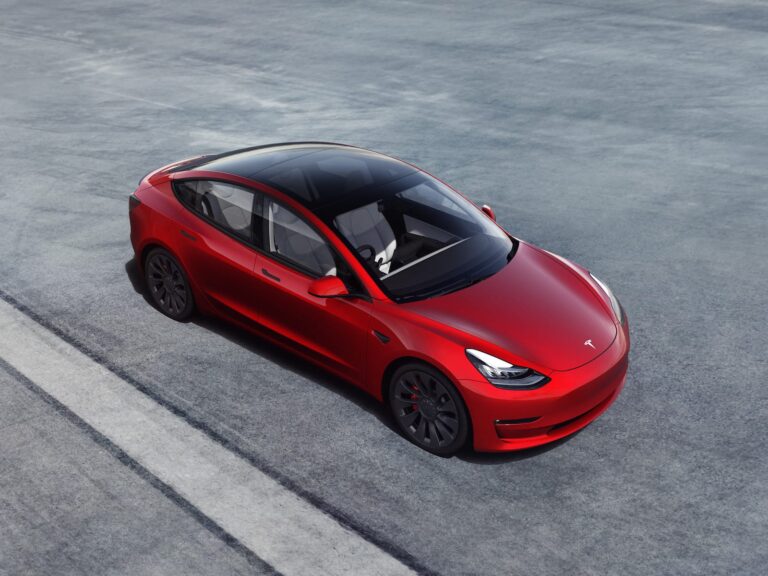
1. Tesla Model 3

Tesla Model 3 (2019) new car ratings and reviews | The Car Expert

The Tesla Model 3 wasn’t just the country’s best-selling electric car, it was the best-selling car of all. The American company has certainly found the magic recipe to lure thousands of petrol and diesel car owners over to its popular electric saloon, which will have long-standing manufacturers scratching their heads as to why their own electric models are not selling up a storm in the same way.

The Tesla Model 3 currently holds an Expert Rating of 86% according to our industry-leading Expert Rating index, which is much higher than an Audi A4 or Mercedes C-Class, and just behind the BMW 3 Series.

2. Volkswagen Golf

Volkswagen Golf – Britain's best-selling cars of 2020

Another great month for the Volkswagen Golf, after it topped the charts in May, means that it has overtaken the Mercedes-Benz A-Class in year-to-date sales to sit third at the year’s halfway point. After a slow start to the year, the Golf is now delivering consistently strong sales for Volkswagen – helped by surging fleet registrations.

As more local reviews of different UK-spec Golf models have been published in the media, the Golf’s initial stellar Expert Rating slipped from a high of 85% to its current level of 80%. The much-vaunted ‘all-digital’ interior has drawn criticism from reviewers, who have found it inferior to the more conventional cabin of the previous-generation model.

3. Ford Puma

Ford Puma (2020 onwards) Expert Rating

The top-selling Ford this month was once again the talented little Puma SUV, which reached new heights to sit in third place. On the one hand, it’s good news for Ford to have another big-selling model in the family. But on the other hand, this is hurting sales of the Fiesta, which is falling further behind the Vauxhall Corsa in year-to-date sales.

June’s strong result has also lifted the Puma above the Nissan Qashqai to sit fifth in year-to-date registrations at the halfway mark of 2021.

Ford’s junior crossover has been popular with critics, currently holding a rating of 82% on our unique Expert Rating index. This remains a best-in-class score for supermini SUVs, but it has slipped a few points in the last few months as we’ve added some new reviews and other sources have revised their initial opinions.

4. Vauxhall Corsa

Vauxhall Corsa Ultimate

Despite slipping back to fourth place in June, the Vauxhall Corsa extended its lead at the top of the charts over the Ford Fiesta. That means that the Vauxhall now holds a sales lead of almost 3,000 units at the halfway mark for the year, and it looks increasingly likely that the Corsa will finally wrest the best-selling car crown away from its arch rival after about a decade on top for the Fiesta.

The petrol and diesel versions of the new Corsa currently hold an Expert Rating of 72% on our industry-leading Expert Rating index, suggesting that journalists are not as excited about the Corsa as customers. That score puts it in the bottom half of the supermini class, although the all-electric Corsa-e does score slightly better with an Expert Rating of 74%.

5. Ford Fiesta

Ford Fiesta – Britain's best-selling car 2020

The year is not really getting any better for the Fiesta, although June was at least an improvement on May. At half-time in the 2021 sales race, the Fiesta is nearly 3,000 registrations behind the Vauxhall Corsa and there doesn’t seem to be any indication that it is going to close the gap, let alone overhaul its rival.

The Blue Oval brand’s dominance of the new car market is also slipping compared to its usual lofty standards. Overall, Ford was third in registrations for June, a long way behind Volkswagen and only fractionally ahead of BMW.

The Fiesta’s struggle becomes starker when you compare pre-pandemic results. Compared to 2019, the new car market is down about 28% at the end of June. However, the Fiesta is down by more than 50% for the same period, so Ford is literally shifting half the number of Fiestas it was two years ago. By comparison, the Corsa is down by less than 19%, so its net gain on the Fiesta has been enormous.

The Fiesta currently holds an Expert Rating of 81% in The Car Expert’s unique Expert Rating index, which aggregates reviews from 25 of the UK’s top motoring websites. That’s some 9% better than the Corsa, so the motoring media still clearly prefers the Ford even if customers currently say otherwise.

6. Volkswagen Polo

Volkswagen Polo (2018 onwards) Expert Rating

It was a bit of a fall for the Polo, dropping from third in May to sixth in June, although it was in the middle of a close battle with the Fiesta just ahead of it and the Toyota Yaris and Mini hatch just behind it.

A second strong month in a row also lifted the Polo from tenth to eighth in year-to-date registrations as the year hit the halfway mark, deposing the BMW 3 Series and Volvo XC40. The success of the Polo and Golf in June also helped Volkswagen to comfortably retain top spot in the charts for best-selling manufacturers, with sister brand Audi holding second place and eternal market leader Ford just edging out BMW for third.

The Polo holds an Expert Rating of 80% in The Car Expert’s New Car Ratings calculator, which is good but still a few points behind its Spanish cousin, the SEAT Ibiza. A facelifted model has just been announced, which is expected to arrive here in the UK in the next month or two.

7. Toyota Yaris

2020 Toyota Yaris review - front

It was another step forward for the Toyota Yaris in June, improving from in eighth place in May up to seventh – and only six registrations behind the Polo in sixth place. This also helped lift it into the top ten cars in year-to-date sales.

The Yaris currently holds an overall score of 76% on our Expert Rating index, which is several points behind the Ford Fiesta and Volkswagen Polo, although about four points ahead of the Vauxhall Corsa. It has received a number of awards in recent months, including European Car of the Year 2021, so it may be that the Yaris is going to become a far more regular sight in the top ten than its unloved predecessor.

8. Mini hatch

Mini hatch (2014 onwards) – Expert Rating

Another facelift for the ageing Mini hatch has helped keep sales ticking over as it continues to occupy space in the bottom half of the top ten. Eighth this month was one step better than ninth in May, although not enough for the Mini to break into the top ten for year-to-date sales.

Despite being the oldest car in the top ten, the Mini hatch still holds a very solid score of 80% in our Expert Ratings aggregator, which is better than most cars in its class. The new Mini Electric model dosn’t score so well, with an Expert Rating of only 73% – although this may change by a few points (either up or down) once the facelifted version is reviewed.

9. BMW 3 Series

BMW 3 Series (2019 onwards) – Expert Rating

The BMW 3 Series returned to the top ten for the first time since March. With its ninth place in the top ten this month, it holds the same position in year-to-date sales. Strong fleet registrations over the second quarter of the year will have certainly helped that, as the 3 Series has always been a popular company car.

The 3 Series currently rates one point better than the electric Tesla Model 3 in our Expert Rating index, and a long way ahead of other petrol/diesel/plug-in rivals from Audi, Mercedes and others. As of July 2021, it has an overall score of 87%, which is exceptionally high.

10. Kia Sportage

Kia Sportage (2018) ratings and reviews | The Car Expert

The current Kia Sportage is very much in run-out mode, with an all-new model unveiled in the last month that will arrive in the UK before the end of this year. Depending on how much stock of the current model Kia has available, that could mean either some very good deals to clear the decks or sales slowing down to a trickle as stocks are exhausted ahead of the new model’s arrival.

The Sportage currently holds an Expert Rating of 72% in our aggregated Expert Ratings index, which is midfield for medium SUVs but a couple of points behind the also-about-to-be-replaced Nissan Qashqai and quite a margin behind the top cars in the mid-size SUV segment. The new Sportage certainly has a much bolder and more distinctive look than the current model, and will be interesting to see whether buyers flock to it or look elsewhere.

Mercedes-Benz B-Class

Summary

The original Mercedes-Benz B-Class was first launched in 2005 as a small MPV. However, the current third-generation version of 2019 is now, more or less, a bigger variant of the A-class hatchback. Even the Mercedes-Benz website refers to it as a hatchback rather than an MPV.

As Carbuyer states: “The B-Class aims to blend the quality, refinement and high-tech interior of the A-Class with greater space and practicality.”

There’s plenty of powertrain choice in the Mercedes-Benz B-Class, with a selection of petrol, diesel and plug-in hybrid options on offer. On the road, testers generally describe it as comfortable to travel in but dull behind the wheel, though Car concludes: “It’s far from rubbish to drive.”

Interior space also scores with reviewers, although it further shows how Mercedes has abandoned any attempt to position the B-Class as an MPV – it’s lacking the usual seven-seat capability and the boot is not as big as you might expect. “There’s plenty of headroom front and rear, and legroom is acceptable,” says Company Car Today.

The interior finish comes in for more praise, Parkers describing it as “a vast improvement over the previous generation car” and highlighting the high-tech environment that has replaced previous dated buttons, especially the touchscreens which are dubbed best-in-class.

All this tech comes at a price, however, and several testers dub the B-Class an expensive option. “It’s fully loaded, although that’s going to cost you,” says The Telegraph and Company Car Today points out that some of the desirable tech is bundled into expensive options packs.

A facelifted B-Class arrived in the UK in late 2022 with minor updates to engines and trims. A plug-in hybrid version was previously offered but is no longer available. The B-Class is expected to end production at some point in 2025 and is not likely to be replaced.

As of July 2025, the Mercedes-Benz B-Class holds a New Car Expert Rating of B, with a score of 68%. It scores top marks for low CO2 emissions, while its safety rating and running costs are also good. However, its reliability record and media review scores are only average.

B-Class highlights

  • Lots of space
  • Comfortable on the road
  • Stylish visuals
  • Quality finish
  • Lots of tech

B-Class lowlights

  • Dull driving experience
  • Expensive for what it is
  • Not a true MPV like previous models
  • Boot could be bigger

Key specifications

Body style: Five-door hatch
Engines: petrol, diesel
Price: From £35,965 on-road

Launched: Spring 2019
Last updated: Winter 2022/23
End of production: Late 2025?

Media reviews

Highlighted reviews and road tests from across the UK automotive media. Click any of the boxes to view.

Featured reviews

More reviews

Auto Express

Auto Trader

Car

Car Keys

Carbuyer

Company Car Today

Eurekar

Heycar

Honest John

Parkers

The Telegraph

Top Gear

Safety rating

Independent crash test and safety ratings from Euro NCAP

Overall score: 5 stars
Date tested: July 2019
Read the full Euro NCAP review

Adult protection: 96%
Child protection: 90%
Vulnerable road users: 78%
Safety assist: 75%

More safety recognition

The current Mercedes-Benz B-Class was assessed by Euro NCAP in 2019 and scored a maximum five-star rating – the standard-fit autonomous emergency braking was praised, and the active safety systems scored maximum points for detection of cyclists.

Eco rating

Independent economy and emissions ratings from Green NCAP

No eco rating

As of July 2025, the Mercedes-Benz B-Class has not been assessed by Green NCAP.

Reliability rating

MotorEasy logo 600x167

Reliability data provided exclusively for The Car Expert by MotorEasy

All data based on MotorEasy average workshop costs for extended car warranty claims

As of April 2025, the Mercedes-Benz B-Class is only average when it comes to reliability with a score of 55%, according to workshop and warranty data provided by our commercial partner, MotorEasy. This covers both the current model (2019 onwards) as well as earlier generations.

The average repair cost is also reasonably high at about £650. That’s obviously a lot more than the cost of a used car warranty, which is certainly worth considering if you own a B-Class or are thinking about buying one.

The most common problems reported for the B-Class are electrical system and suspension. Engine problems are not uncommon, and it’s worth noting that the average repair bill for engine problems is more than £1,400.

Make sure that any used car warranty you are purchasing covers all of these potential problem areas.

Running cost rating

Clear Vehicle Data logo close crop

Monthly cost of ownership data provided exclusively for The Car Expert by Clear Vehicle Data

Fuel consumptionAverageScore
Petrol models44 mpgC
Diesel models53 mpgB
Plug-in hybrid models245 mpgA
CO₂ outputAverageScoreVariationScore
Petrol models145 g/kmB
Diesel models140 g/kmB
Plug-in hybrid models26 g/kmA
Battery rangeAverageScoreVariationScore
Plug-in hybrid models41 milesD
Insurance groupAverageScoreVariationScore
All models23A
Service and maintenanceCostScore
Year 1£248B
Year 2£620B
Year 3£1,120C
Year 4£1,299B
Year 5£1,741B
Overall£5,028B

Running costs for the Mercedes-Benz B-Class are reasonably good, according to numbers provided exclusively for The Car Expert by our data partner, Clear Vehicle Data.

Fuel consumption is average for petrol models but better for diesel versions. The plug-in hybrid looks amazing on paper, but this is misleading because of the way that the EU/UK government lab tests are conducted. There’s no way you’re going to drive for 245 miles on a single gallon (4.5 litres) of petrol and some electricity in the real world.

When running on its electric motor, the B-Class plug-in hybrid is quite efficient – although on any plug-in hybrid, the battery range is very limiting. You’ll need to keep it charged every day if you want to get the best economy out of it.

Insurance and servicing costs are better than average, which will help prevent your wallet from emptying itself at annual service time.

Warranty rating

New car warranty information for the Mercedes-Benz B-Class

Overall ratingB68%
Petrol or diesel modelsC41%
Hybrid or plug-in hybrid modelsA82%
New car warranty duration3 years
New car warranty mileageUnlimited miles
Battery warranty duration8 years
Battery warranty mileage100,000 miles

Mercedes-Benz’s new car warranty is only average, and not as attractive as some other cars in a similar price bracket as the B-Class.

The duration is three years, with no limit on mileage – although, in reality, the mileage numbers are likely to be fairly irrelevant as most cars only cover about 10,000 miles each year.

In addition to the standard new car warranty, the B-Class plug-in hybrid models have an eight-year/100,000-mile warranty for the battery components. The overall rating above is a mix of the different models.

Recalls

Official DVSA safety recalls that have been issued for the Mercedes-Benz B-Class

Date: May 2024
Recall number: R/2024/166
Model types: All
Build dates: 07/2018 to 01/2024
Number of vehicles affected: 10,590
Defect: On affected vehicles, the backup function of the steering software might not meet specifications. As a result, the steering power support might be impaired and a loss of steerability cannot be ruled out.
Remedy: Update the software of the electric steering on the affected vehicles.

Date: March 2021
Recall number: R/2021/082
Model types: All
Build dates: 05/2016 to 07/2020
Number of vehicles affected: 24
Defect: The communication module may be deactivated.
Remedy: Carry out a check of the configuration of the communication module on affected vehicles and if necessary activate the communication module.

Date: October 2020
Recall number: R/2020/277
Model types: All
Build dates: 12/2019 to 01/2020
Number of vehicles affected: 37
Defect: An electrical contacting inside the engine control unit might not meet the specification.
Remedy: Replace the engine control unit on the affected vehicles.

Date: October 2020
Recall number: R/2020/262
Model types: All
Build dates: 10/2019 to 06/2020
Number of vehicles affected: 1,074
Defect: The oil supply line of the turbocharger might leak.
Remedy: Check the oil supply line of the turbocharger on the affected vehicles and replace it if necessary.

Date: September 2019
Recall number: R/2019/269
Model types: All
Build dates: 02/2017 to 07/2019
Number of vehicles affected: 294
Defect: The software of the radar control unit might not meet the specification.
Remedy: Update the software of the radar sensor control unit on the affected vehicles.

As of September 2024 (our most recent data point), there have been five DVSA vehicle safety recalls on the Mercedes-Benz B-Class to address different issues.

Not all vehicles are affected by recalls. You can check to see if your car is included in any of the above recalls by visiting the DVLA website or contacting your local Mercedes-Benz dealer.

If your car is affected by a recall, the vehicle must be repaired and you should not be charged for any work required. If you are buying a used B-Class, you should insist that any outstanding recall work is completed before you take delivery of the vehicle.

Similar cars

If you’re looking at the Mercedes-Benz B-Class, you might also be interested in these alternatives

BMW 2 Series Active Tourer | Volkswagen Touran

More news, reviews and information about the Mercedes-Benz B-Class at The Car Expert

Everything you need to know about Mercedes-Benz

Everything you need to know about Mercedes-Benz

Mercedes-Benz reveals A-Class and B-Class facelift

Mercedes-Benz reveals A-Class and B-Class facelift

Mercedes-Benz B-Class plug-in hybrid announced

Mercedes-Benz B-Class plug-in hybrid announced

Buy a Mercedes-Benz B-Class

If you’re looking to buy a new or used Mercedes-Benz B-Class, The Car Expert’s partners can help you find the right car.

Motors 600x300

Find your next used car with Motors. Find out more

Auto Trader logo 600x300

Find your next new or used car with Auto Trader. Find out more

Carwow logo 600x300

Find your next new or used car with Carwow. Find out more

Lease a Mercedes-Benz B-Class

If you’re looking to lease a new Mercedes-Benz B-Class, The Car Expert’s partners can help you find a competitive deal.

Leasing-com logo

Personal contract hire deals from Leasing.com. Find out more

Carwow logo 600x300

Personal contract hire deals from Carwow. Find out more

Select Car Leasing logo

Personal contract hire deals from Select Car Leasing. Find out more

Subscribe to a Mercedes-Benz B-Class

If you’re interested in a car subscription, The Car Expert’s partners can help. (PS: What’s a car subscription?)

SelfDrive UK logo

Car subscriptions from SelfDrive.
Find out more

Drive Fuze logo 600x300

Car subscriptions from DriveFuze.
Find out more

Cocoon Vehicles logo 600x300

Car subscriptions from Cocoon.
Find out more

Kia ProCeed (2019 to 2024)

Summary

The Kia ProCeed is a sleek estate version of the Kia Ceed family hatch. This model was the third-generation version, which was launched in 2019 and discontinued in late 2024.

Kia described the ProCeed as a ‘shooting brake’, but this is misleading, as a shooting brake is an estate version of a coupé (Mercedes does the same thing). The ProCeed was simply a sleeker version of the normal Ceed Sportswagon estate that prioritised style over load capability. It certainly looked the part but was still reasonably practical. The Telegraph commented that, despite the sloping roof, the boot was only fractionally smaller than the ‘proper’ Ceed estate and bigger than several traditional estate rivals.

Engine choices were simple – standard was the 160hp 1.5-litre petrol, while GT versions got a 1.6-litre unit of 205hp. There were initially diesels and hybrids available, but these were discontinued as part of the model’s mid-life update in 2022. Entry-level GT-Line versions were fitted with a six-speed manual gearbox but most used a seven-speed automatic transmission.

Testers liked the efficient engines and the ProCeed’s general road manners, though Top Gear noted “it’s heavier than a normal Ceed and not the sporty, driver-pleasing solution Kia might have you believe.”

Equipment levels were extensive, as is usual with Kia, though one minus point was that pedestrian and cyclist detection on the autonomous braking only came as standard with the one manual model or the top GT-Line S – otherwise it was an option and such cars only got a four-star Euro NCAP safety rating as a result.

As of July 2025, the Kia ProCeed holds a Used Car Expert Rating of A, with a score of 70%. It scores top marks for its low running costs and Kia’s seven-year new car warranty, while its CO2 emissions are also lower than those for most vehicles. However, its media review scores and safety rating are only average.

ProCeed highlights

  • Stylish looks
  • Surprisingly spacious
  • Good ride quality
  • Quality interior
  • Economic price and running costs

ProCeed lowlights

  • Full active safety not on all models
  • Steering a little lifeless
  • Petrol engines only
  • Manual gearbox only on entry model

Key specifications

Body style: Medium estate
Engines: petrol, diesel
Price when new: From £26,590

Launched: Spring 2019
Discontinued: Autumn 2024

Media reviews

Highlighted reviews and road tests from across the UK automotive media. Click any of the boxes to view.

Featured reviews

More reviews

Auto Express

Auto Trader

Car

Carbuyer

Evo

Fleetworld

Honest John

Motors

Parkers

The Sun

The Sunday Times

The Telegraph

Top Gear

Safety rating

Independent crash test and safety ratings from Euro NCAP

Overall score: 4 stars
Date tested: July 2019
Read the full Euro NCAP review

Adult protection: 88%
Child protection: 85%
Vulnerable road users: 52%
Safety assist: 68%

Note on safety

The Kia Ceed family, including the ProCeed and XCeed models, has two separate Euro NCAP safety ratings depending on the level of equipment fitted to your car.

Lower-specification ProCeed GT-Line models do not get as much safety equipment as standard, so they get a four-star rating as shown above. Higher-specification GT-Line S models get an additional Advanced Driving Assistance Pack (available on lower-spec ProCeeds at additional cost), which earns them a five-star rating. This also bumps up the Vulnerable Road Users rating from 52% to 68%, and the Safety Assist Rating from 68% to 73%.

Eco rating

Independent economy and emissions ratings from Green NCAP

No eco rating

The Kia ProCeed was not assessed by Green NCAP during its production life.

Reliability rating

Reliability data provided exclusively for The Car Expert by MotorEasy

No reliability rating

As of July 2025, we don’t have enough reliability data on the Kia ProCeed to generate a reliability rating.

The Car Expert’s reliability information is provided exclusively to us using workshop and extended warranty data from our partner, MotorEasy, sourced from both official dealerships and independent workshops. 

As soon as MotorEasy has sufficient data on the ProCeed, we’ll publish the results here.

Running cost rating

Clear Vehicle Data logo close crop

Monthly cost of ownership data provided exclusively for The Car Expert by Clear Vehicle Data

Fuel consumptionAverageScore
Petrol models47 mpgC
Diesel models55 mpgB
CO₂ outputAverageScoreVariationScore
Petrol models137 g/kmB
Diesel models134 g/kmA
Insurance groupAverageScoreVariationScore
All models13A
Service and maintenanceCostScore
Year 1£180A
Year 2£452A
Year 3£727A
Year 4£902A
Year 5£1,207A
Overall£3,468A

The Kia ProCeed is an affordable car to own and run, according to whole-life cost numbers provided exclusively to The Car Expert by our data partner, Clear Vehicle Data.

Fuel economy is only average for petrol models but good for (now discontinued) diesel-engined versions, although CO2 emissions are better.

Servicing and maintenance costs are very good for the car’s first five years, while insurance premiums should be very good as well.

Warranty rating

New car warranty information for the Kia ProCeed

Overall ratingA85%
New car warranty duration7 years
New car warranty mileage100,000 miles

Kia’s new car warranty is one of the best in the new car market, and better than pretty much any rival brands in a similar price bracket to the ProCeed.

The duration is seven years, with a limit of 100,000 miles. This is good news for both new and used car buyers, as it helps the residual value of the ProCeed for new car buyers when they come to sell the car, and it gives near-new car buyers confidence that they are covered for years to come.

If you’re looking to buy a used car that is approaching the end of its warranty period, a used car warranty is usually a worthwhile investment. Check out The Car Expert’s guide to the best used car warranty providers, which will probably be cheaper than a warranty sold by a dealer.

Awards

Significant UK trophies and awards that the Kia ProCeed has received

2019

  • Scottish Car of the Year Awards – Best Estate Car
  • Red Dot Design Award

Similar cars

If you’re looking at the Kia ProCeed, you might also be interested in these alternatives

Ford Focus Estate | Hyundai i30 Estate | Kia Ceed Sportswagon | Mercedes-Benz CLA Shooting Brake | Peugeot 308 SW | SEAT Leon Estate | Suzuki Swace | Toyota Corolla Touring Sports | Vauxhall Astra Sports Tourer | Volkswagen Golf Estate

The Kia ProCeed’s low-slung estate body style means it has hardly any direct rivals, with Kia pitching it as a budget option to the Mercedes-Benz CLA Shooting Brake. However its practicality makes the car a viable contender to traditional estate versions of family cars, such as the Ford Focus and Volkswagen Golf. 

More news, reviews and information about the Kia Ceed family at The Car Expert

Everything you need to know about Kia

Everything you need to know about Kia

Kia ProCeed review

Kia ProCeed review

Pricing and specs announced for trio of sporty new Kia models

Pricing and specs announced for trio of sporty new Kia models

Paris show round-up – more of the new cars

Paris show round-up – more of the new cars

Kia Ceed gains shooting brake version

Kia Ceed gains shooting brake version

Buy a Kia ProCeed

If you’re looking to buy a used Kia ProCeed, The Car Expert’s partners can help you find the right car

Motors 600x300

Find your next used car with Motors. Find out more

Auto Trader logo 600x300

Find your next new or used car with Auto Trader. Find out more

Carwow logo 600x300

Find your next new or used car with Carwow. Find out more

Lease a Kia ProCeed

If you’re looking to lease a Kia ProCeed, The Car Expert’s partners can help you find a competitive deal

Leasing-com logo

Personal contract hire deals from Leasing.com. Find out more

Carparison 600x300

Personal contract hire deals from Carparison Leasing. Find out more

Select Car Leasing logo

Personal contract hire deals from Select Car Leasing. Find out more

Subscribe to a Kia ProCeed

If you’re interested in a car subscription, The Car Expert’s partners can help (PS: What’s a car subscription?)

SelfDrive UK logo

Car subscriptions from SelfDrive.
Find out more

Drive Fuze logo 600x300

Car subscriptions from DriveFuze.
Find out more

Cocoon Vehicles logo 600x300

Car subscriptions from Cocoon.
Find out more

Ford Focus ST (2019 to 2025)

Summary

The Ford Focus ST was the performance version of the fourth-generation Ford Focus. It was introduced in 2019 and discontinued in 2025 when Ford ended production of the Focus range.

Available with a 2.3-litre petrol engine producing 280hp, and briefly with a diesel option, the Ford Focus ST combined strong straight-line performance with chassis upgrades aimed at delivering sharper handling than the standard model.

UK media reviews were consistently positive, praising its balance, steering response and everyday usability. It was widely regarded as one of the more complete hot hatch options of its time.

However, ownership considerations were less favourable. Running costs were relatively high, particularly for fuel and insurance, and reliability data has been only average. Environmental performance was also unremarkable for the class, and warranty cover was limited when new.

Now available only on the used market, the Ford Focus ST presents a mixed proposition. It remains engaging to drive, but its long-term ownership record is less convincing than its media reputation suggests.

The Ford Focus ST currently holds a Used Car Expert Rating of C, with a score of 62%. Strong media review scores are offset by high running costs, average reliability, average safety performance and limited warranty cover.

Focus ST highlights

  • Sharp and engaging handling
  • Strong turbocharged petrol performance
  • Practical five-door hatchback and estate options
  • Comfortable enough for everyday use
  • Strong media review consensus

Focus ST lowlights

  • Running costs higher than many rivals
  • Reliability only average
  • Environmental performance unremarkable
  • Dashboard technology now feels dated
  • Original warranty cover was short

Key specifications

Body style: Five-door hatch and estate
Engines: petrol, diesel
Price when new: From £37,650 on-road

Launched: Summer 2019
Last updated: Spring 2022
Discontinued: Autumn 2025

Media reviews

Highlighted reviews and road tests from across the UK automotive media. Click any of the boxes to view.

Featured reviews

More reviews

Auto Express

Business Car

Car

Car Keys

Carbuyer

Carwow

Company Car Today

Daily Mirror

Evo

Honest John

Parkers

The Scotsman

The Sun

The Telegraph

Top Gear

Safety rating

Independent crash test and safety ratings from Euro NCAP

Overall score: 5 stars
Date tested: September 2019
Date expired: January 2026
Read the full Euro NCAP review

Adult protection: 96%
Child protection: 87%
Vulnerable road users: 72%
Safety assist: 75%

Notes on safety rating

The Ford Focus ST shares its safety score with the regular Focus, which was tested by Euro NCAP back in 2019 and awarded a five-star rating. However, this rating expired in January 2026 and is no longer valid as the car no longer meets the standards required for such a rating. This is normal practice, as Euro NCAP reviews its ratings on most cars annually with most ratings expiring after about six or seven years.

Although the rating has now expired, the score is still useful if you are comparing a used Focus ST to vehicles of similar age – whose ratings will have probably also expired.

Eco rating

Independent economy and emissions ratings from Green NCAP

No eco rating

The Ford Focus ST was not assessed by Green NCAP during its production life.

Running cost rating

Clear Vehicle Data logo close crop

Monthly cost of ownership data provided exclusively for The Car Expert by Clear Vehicle Data

Fuel consumptionAverageScore
Petrol models34 mpgD
Diesel models58 mpgB
CO₂ outputAverageScoreVariationScore
Petrol models183 g/kmD
Diesel models126 g/kmB
Insurance groupAverageScoreVariationScore
All models27C
Service and maintenanceCostScore
Year 1£310D
Year 2£758D
Year 3£1,179D
Year 4£1,391D
Year 5£1,897D
Overall£5,535D

The Ford Focus ST is a relatively expensive car to own and run, according to whole-life cost numbers provided exclusively to The Car Expert by our data partner, Clear Vehicle Data.

Fuel economy for petrol models is poor, while diesel models are notably better. This is mirrored in CO2 emissions, unsurprisingly. Insurance premiums are comparatively low, but service and maintenance costs over the course of five years of ownership should be only middling – these have increased notably over the last 12 months, so Ford has clearly been bumping up its servicing prices…

Reliability rating

MotorEasy logo 600x167

Reliability data provided exclusively for The Car Expert by MotorEasy

All data based on MotorEasy average workshop costs for extended car warranty claims

The Ford Focus range, including the ST model, has a reasonable reliability score of 62%, according to workshop and warranty data provided exclusively to The Car Expert by our commercial partner, MotorEasy. This covers not just the current-model Focus, but previous models as well and all the powertrain options from entry-level diesels to top-spec ST and RS models, which is worth bearing in mind if you’re looking at a used car.

Of most concern is that engine problems are both the most common type of fault and also the most expensive, with an average repair bill of more than £1,100. Gearbox problems are also expensive and not uncommon.

The good is that other problems tend to be relatively inexpensive to repair. However, if you’re looking at a used Ford Focus ST then you should make sure any extended warranty cover you purchase covers all of these potential problem areas.

Warranty rating

New car warranty information for the Ford Focus ST

Overall ratingE15%
New car warranty duration3 years
New car warranty mileage60,000 miles
Battery warranty duration0 years
Battery warranty mileage0 miles

Ford’s new car warranty is pretty much the bare minimum offered in the UK, with a duration of three years and a limit of 60,000 miles. Other rivals in the price bracket do better (and in some cases, much better).

Warranty on a used Ford Focus ST

  • If you are buying an ‘Approved Used’ Ford Focus ST from an official Ford Direct dealership, you will get a minimum two-year, unlimited-mileage warranty included.
  • If you are buying a used Ford Focus ST from an independent dealership, any warranty offered will vary and will probably be managed by a third-party warranty company.
  • If you are buying a used Ford Focus ST from a private seller, there are no warranty protections beyond any remaining portion of the original new car warranty.

If you’re looking to buy any used car that is approaching the end of its warranty period, a used car warranty is usually a worthwhile investment. Check out The Car Expert’s guide to the best used car warranty providers, which will probably be cheaper than a warranty sold by a dealer.de to the best used car warranty providers, which will probably be cheaper than a warranty sold by a dealer.

Recalls

Official DVSA safety recalls that have been issued for the Ford Focus

As of September 2024 (our most recent data point), there have been 20 DVSA vehicle safety recalls on the fourth-generation Ford Focus to address different issues. However, not all of these recalls necessarily applied to the Focus ST.

Not all vehicles are affected by recalls. You can check to see if your car is included in any of the above recalls by visiting the DVLA website or contacting your local Ford dealer.

If your car is affected by a recall, the vehicle must be repaired and you should not be charged for any work required. If you are buying a used Focus ST, you should insist that any outstanding recall work is completed before you take delivery of the vehicle.

Awards

Significant UK trophies and awards that the Ford Focus ST has received

2020

  • DieselCar & EcoCar Awards – Best Hot Hatch

2019

  • Top Gear Awards – Best Hot Hatch
  • Scottish Car of the Year Awards – Best Hot Hatch

Similar cars

If you’re looking at the Ford Focus ST, you might also be interested in these alternatives

Audi RS 3 | BMW M135i | Cupra Leon | Honda Civic Type R | Hyundai i30 N | Mercedes-AMG A 35 | Mini Countryman John Cooper Works | Renault Megane RS | Skoda Octavia vRS | Toyota GR Yaris | Volkswagen Golf GTI

There are so many hot hatch rivals to the Focus ST, challenging it on both aggressive performance and equally aggressive visuals. The most popular include the Honda Civic Type R, the Hyundai i30 N and the Renault Megane RS. Premium brands also get in the act, with the BMW M135i, the Mercedes-AMG A 35 and Audi S3 to choose from.

Buy a Ford Focus ST

If you’re looking to buy a new or used Ford Focus ST, The Car Expert’s partners can help you find the right car

Motors 600x300

Find your next used car with Motors. Find out more

Auto Trader logo 600x300

Find your next new or used car with Auto Trader. Find out more

Carwow logo 600x300

Find your next new or used car with Carwow. Find out more

Supply issues complicate new car sales results

New car registration results for June were another step forward for the car industry as the UK reopens following repeated coronavirus shutdowns over the last 18 months.

More than 186,000 new cars were registered in June – nearly 20% on May’s figures, which were 11% up on April. While this will be a relief for car companies and dealerships, it’s still well down on June results from the last decade pre-pandemic.

Complicating matters was a serious supply shortfall for many manufacturers on some or all of their models. This has been caused by a global shortage of semiconductor computer chips that are crucial for the running of modern cars, causing many production lines to be slowed or even stopped as car companies wait for supplies. This is, unsurprisingly, a hangover of supplier shutdowns across the globe.

There were slightly more fleet buyers than private customers in June, which all looked fairly normal and was about what we used to expect before the pandemic craziness took hold. The overall numbers were (inevitably) less than the industry would like, but broadly in line with what we’ve been saying for ages – there’s been a steady decrease in new car registrations year-on-year since 2016, and if you ignore the outlier of last year, that trend is pretty steady.

Diesels hit new low – again

It does sound like a broken record, but diesel’s market share fell to its lowest-ever level in June, with just over 14% of the market (which includes mild hybrid diesel cars). That means that diesels were outsold by plug-in cars (full-electric and plug-in hybrid) for the first time. This was helped by a boatload of Teslas, which we’ll come to in a minute.

Petrol’s market share fell just below 60% as the market share of electrified cars (electric, plug-in hybrids and regular hybrids) accounted for a quarter of all registrations – another new record. This will be an inevitable trajectory for the foreseeable future, so we promise not mention it again until at least next month.

Good month, bad month

Volkswagen dominated the market again in June, with Audi once again taking second place ahead of a very close race for third place – Ford pipped BMW by just seven units. Mercedes-Benz slumped to eighth, behind Toyota, Vauxhall and Kia, thanks largely to a lack of A-Class stock.

Our usual analysis of which brands have outperformed the market and which have fallen behind is again rather pointless this month, with enormous variation across all the car companies.

Porsche and Land Rover took a big hit, with sales well down in an overall market that was up 28% on the same month last year. On a happier note, Subaru and Mazda both recorded big improvements on their results from the same time last year, which will keep the dealerships happy.

Tesla rocks the boat as the A-Class sinks without trace

The Tesla Model 3 topped the charts quite comfortably in June, ahead of the Volkswagen Golf and ever-improving Ford Puma. Meanwhile, the Mercedes-Benz A-Class vanished from the top ten along with the Nissan Qashqai – although Nissan at least has the excuse that it’s in the middle of switching over to an all-new model, which always affects both demand and supply as the old car makes way for the new.

That has meant a bit of leapfrogging in year-to-date registrations, with the Golf passing the A-Class to re-take third place as 2021 reaches its halfway point. The Ford Puma also overtook the Nissan Qashqai for fifth place, and the Volkswagen Polo also jumped the BMW 3 Series and the Volvo XC40, which is another car struggling for sales compared to a few months ago.

We’ll have a our usual look at the top ten later this week.

Dacia Sandero Stepway

Summary

The Dacia Sandero Stepway first appeared in 2017 as a rugged, off-road themed variant of the Sandero supermini, dubbed Europe’s best-selling retail car. All-new versions of both models were launched in 2021.

The Stepway takes most Sandero sales in the UK and the reason it sells so well is because it is a cheap car, with prices starting from less than £16,000 in 2025. However, the budget focus earned the Stepway the wrong sort of headlines in 2021 – Euro NCAP awarded it an almost basement two-star crash-test rating due to its very basic active safety system.

Sandero Stepway models are available only with petrol engines. There’s a 1.0-litre of 90hp or a 100hp version that can also run on liquified petroleum gas (LPG), a rarity in today’s market. There’s also the option to replace the six-speed manual gearbox with an automatic.

Testers have generally liked the Sandero family, praising it for the interior space and equipment you get for a bargain price, and the same goes for the Stepway. Those basics include a good, adjustable driving position, lots of interior space with a bigger boot than most superminis, and the availability of such niceties as air conditioning, touchscreen navigation and Apple CarPlay and Android Auto connectivity.

The Daily Telegraph comments that the Sandero Stepway is “a bargain basement hatchback with a tiny engine and an automatic gearbox that you might actually want to own,” but adds that “we find it hard to recommend a budget option if it means cutting a corner on safety”. Likewise, Which? has slapped the Sandero Stepway with a ‘Don’t Buy’ tag due its poor safety score.

As of February 2026, the Dacia Sandero Stepway holds a New Car Expert Rating of D with a score of 59%.

Sandero Stepway highlights

  • Great value
  • Lots of room
  • Big boot
  • Plentiful equipment

Sandero Stepway lowlights

  • Poor safety rating
  • Slow
  • Uninspiring ride and handling
  • Hard plastic interior

Key specifications

Body style: Five-door hatchback
Engines: petrol, petrol/LPG dual-fuel
Price: From £15,700 on-road

Launched: Winter 2020/21
Last updated: N/A
Replacement due: TBA

Media reviews

Highlighted reviews and road tests from across the UK automotive media. Click any of the boxes to view.

Auto Express

Auto Trader

Business Car

Car

Carbuyer

Carwow

Heycar

Parkers

Regit

The Sun

The Telegraph

Top Gear

Safety rating

Independent crash test and safety ratings from Euro NCAP

Overall score: 2 stars
Date tested: April 2021
Read the full Euro NCAP review

Adult protection: 70%
Child protection: 72%
Vulnerable road users: 41%
Safety assist: 42%

Notes on safety rating

The Dacia Sandero family (including the Sandero Stepway) scored a very poor two-star rating from Euro NCAP, which generated headlines in the motoring media and was a very disappointing result. However, a better understanding of why the Sandero was only rated two stars is important.

The Sandero scored reasonably well in terms of occupant protection for both adults and children in crash tests. It’s still short of the best small cars, but certainly adequate. If the overall rating was just based on crash performance, it would probably have been awarded four stars rather than two.

Where the Sandero really fell down was in its crash avoidance technology, which has become increasingly important in determining overall ratings – after all, it’s far better to avoid an accident altogether than to survive one. Compared to other small cars, the Dacia’s autonomous emergency braking system is more basic and unable to properly detect pedestrians or cyclists. It does better at avoiding other vehicles, but is still not as good as other small cars.

Given that many of the Sandero Stepway’s rivals are actually used cars from other brands based on older technology and older Euro NCAP standards, the overall two-star rating is not as bad as it sounds – although it’s still not good enough for a brand new car in 2023. In summary, the Sandero Stepway does an adequate job of protecting you in a crash but doesn’t do enough to actually avoid one in the first place.

Eco rating

Independent economy and emissions ratings from Green NCAP

Model tested: 1.0-litre petrol manual 90hp

Overall score: 2.5 stars
Date tested: June 2023
Read the full Green NCAP review

Clean Air Index: 6.1 / 10
Energy Efficiency Index: 4.8 / 10
Greenhouse Gas Index: 3.3 / 10

Notes on eco rating

Green NCAP tested the 90hp, 1.0-litre petrol manual version of the Dacia Sandero Stepway in June 2023. This rating does not apply to any other engine or gearbox.

Green NCAP said: “The car comes with a state-of-the-art exhaust aftertreatment system and scores an above-average 6.1/10 in the Clean Air Index. The petrol consumption is as can be expected for this type of vehicle and powertrain… enough for an Energy Efficiency Index of 4.8/10.

“Due to the unspectacular consumption figures and the addition of the upstream greenhouse gas emissions for the supply of the fuel, the Greenhouse Gas Index receives only 3.3 points out of 10 and the car misses the qualification for the additional robustness tests.”

Reliability rating

Reliability data provided exclusively for The Car Expert by MotorEasy

All data based on MotorEasy average workshop costs for extended car warranty claims

The Dacia Sandero range (including the Stepway) is a very creditable 94%, according to extended warranty data from our commercial partner MotorEasy, which puts it well above average. The only caveat to this score is that it currently comes from a small number of data points, so could shift significantly as more claims are added to MotorEasy’s database.

This score applies to both the current (2020 onwards) and previous generations of the Sandero family, which is good news if you are considering a used Sandero of any kind.

The average repair cost to date is just over £420, which is dragged up by an average engine repair bill of nearly £1,900. Other repair costs (electrics, brakes, fuel system) are all quite low.

Running cost rating

Monthly cost of ownership data provided exclusively for The Car Expert by Clear Vehicle Data

Fuel consumptionAverageScore
Petrol models50 mpgC
CO₂ outputAverageScoreVariationScore
Petrol models129 g/kmB
Insurance groupAverageScoreVariationScore
All models13A
Service and maintenanceCostScore
Year 1£157A
Year 2£440A
Year 3£684A
Year 4£871A
Year 5£1,233A
Overall£3,385A

Data provided by our partner Clear Vehicle Data backs up the Sandero Stepway’s reputation for long-term affordability.

Only available with petrol drivetrains, the crossover has an average fuel consumption, with low CO₂ emissions. Service and maintenance costs over a five-year period are very affordable too when compared to the market as a whole.

Awards

Trophies, prizes and awards that the Dacia Sandero Stepway has received

2023

  • Auto Trader Awards – Best Value New Car

2021

  • Scottish Car of the Year Awards – Best Small SUV/Crossover

Similar cars

If you’re looking at the Dacia Sandero Stepway, you might also be interested in these alternatives

Dacia Duster | Fiat Panda 4×4 | Ford Fiesta Active | MG ZS | Nissan Juke | SsangYong TivoliSuzuki Ignis | Vauxhall Crossland

There are few direct rivals to the Sandero Stepway’s combination of rugged looks and value, but one of the closest is the Suzuki Ignis, a mini SUV with lots of character, more economy but less space.

Ford offers a beefed-up ‘Active’ version of its mass-selling Fiesta – it’s a much better car than the Dacia but a whole lot more money. The MG ZS is also a traditional SUV of similar size to the Sandero stepway, but while budget it’s still not as cheap as the Dacia.   

Buy a Dacia Sandero Stepway

If you’re looking to buy a Dacia Sandero, The Car Expert’s partners can help you find the right car

Motors 600x300

Find your next used car with Motors. Find out more

Auto Trader logo 600x300

Find your next new or used car with Auto Trader. Find out more

Carwow logo 600x300

Find your next new or used car with Carwow. Find out more

Lease a Dacia Sandero Stepway

If you’re looking to lease a new Dacia Sandero, The Car Expert’s partners can help you find a competitive deal

Leasing-com logo

Personal contract hire deals from Leasing.com. Find out more

Carwow logo 600x300

Personal contract hire deals from Carwow. Find out more

Select Car Leasing logo

Personal contract hire deals from Select Car Leasing. Find out more

Subscribe to a Dacia Sandero Stepway

If you’re interested in a car subscription, The Car Expert’s partners can help (PS: What’s a car subscription?)

Cocoon Vehicles logo 600x300

Car subscriptions from Cocoon.
Find out more

Just Vehicle Solutions logo 600x300

Car subscriptions from Just Vehicle Solutions.
Find out more

Flexible Vehicle Contracts logo 600x300px

Car subscriptions from Flexible Vehicle Contracts.
Find out more

BMW 7 Series (2015 to 2022)

Summary

The BMW 7 Series has been the German brand’s flagship saloon since the 1970s. This model was launched in 2015, with a mid-life facelift in 2019. It ended production in 2022, replaced by an all-new model in 2023.

The 7 Series was available in standard and long-wheelbase versions. Powertrain options were many and varied over its production life, with up to 12 cylinders and 585hp. These comprise three petrol units, a pair of diesels and a plug-in hybrid. All apart from the base petrol model were available with all-wheel drive (known as xDrive in BMW-speak).

On the road, air suspension soaked up poor surfaces but several reviewers pointed out that unusually light steering took the edge off the overall driving experience.

Technology has always been leading-edge in this class and the BMW had plenty – the central ‘iDrive’ stick that controlled many functions was clever but, as Company Car Today pointed out, “as the sheer quantity of connected functions increases, it becomes ever harder to keep up with where to find and operate everything.”

Overall, the 2019 facelift brought the BMW closer to its long-time rival, the Mercedes-Benz S-Class. According to Autocar at the time, “choosing between them will largely fall down to which seat you plan on using most”.

As of February 2026, the BMW 7 Series holds a Used Car Expert Rating of E, with a score of 49%. This is largely thanks to its very high running costs and poor reliability record.

7 Series highlights

  • Plenty of powertrain choice
  • Efficient plug-in hybrid
  • Good road manners

7 Series lowlights

  • Marmite styling
  • iDrive controller complicated
  • Poor reliability record
  • Huge running costs

Key specifications

Body style: Large saloon
Engines: petrol, diesel, plug-in hybrid
Price when new: From £73,305 on-road

Launched: Autumn 2015
Last updated: Summer 2019
Ended production: Late 2022

Media reviews

Highlighted reviews and road tests from across the UK automotive media. Click any of the boxes to view.

Auto Express

Auto Trader

Car

Car Keys

Carbuyer

Carwow

Company Car Today

Daily Mail

Evo

Heycar

Honest John

Motoring Research

Motors

Parkers

The Sunday Times

The Telegraph

Top Gear

Safety rating

Independent crash test and safety ratings from Euro NCAP

No safety rating

The BMW 7 Series was not tested by Euro NCAP during its production life.

Eco rating

Independent economy and emissions ratings from Green NCAP

No eco rating

The BMW 7 Series was not tested by Green NCAP during its production life.

Reliability rating

MotorEasy logo 600x167

Reliability data provided exclusively for The Car Expert by MotorEasy

All data based on MotorEasy average workshop costs for extended car warranty claims

The BMW 7 Series has a very poor reliability rating, according to extended warranty data provided to us by our commercial partner MotorEasy. This data covers this generation (2015 to 2022) as well as older 7 Series models.

Engine and gearbox problems are the most expensive to fix, with average repair bills of about £1,300 and £1,700 respectively. Suspension problems are the most common source of faults, with an unusually high average repair cost of £1,000 thanks to the car’s complex air suspension system.

If you own a BMW 7 Series, or you’re looking at buying a used 7 Series, make sure that any used car warranty you purchase covers all of the potential problem areas shown above.

Awards

Trophies, prizes and awards that the BMW 7 Series has received

2016

  • Professional Driver Awards – Car of the Year + Chauffeur Car of the Year

Similar cars

If you’re looking at the BMW 7 Series, you might also be interested in these alternatives

Audi A8 | Bentley Flying Spur | Lexus LS | Maserati Quattroporte | Mercedes-Benz S-Class | Rolls-Royce Ghost | Rolls-Royce Wraith

The traditional rivals to the BMW 7 Series have always been the Mercedes-Benz S-Class and the Audi A8.  Also lining up against it is the Lexus LS, Jaguar’s XJ having now passed into history, while for those looking for even more luxury the Bentley Flying Spur and Maserati Quattroporte are also in the running.

More news, reviews and information about the BMW 7 Series at The Car Expert

BMW 7 Series gets major Neue Klasse update

BMW 7 Series gets major Neue Klasse update

BMW 7 Series test drive

BMW 7 Series test drive

Revised BMW iX SUV unveiled

Revised BMW iX SUV unveiled

Everything you need to know about BMW

Everything you need to know about BMW

BMW 7 Series

BMW 7 Series

BMW i7

BMW i7

Electric i7 leads new BMW 7 Series line-up

Electric i7 leads new BMW 7 Series line-up

BMW 7 Series plug-in hybrid joins the range

BMW 7 Series plug-in hybrid joins the range

New engines and more tech for BMW 7 Series

New engines and more tech for BMW 7 Series

Buy a BMW 7 Series

If you’re looking to buy a used BMW 7 Series, The Car Expert’s partners can help you find the right car

Motors 600x300

Search less, live more. We make finding the right car simple. Find out more

Auto Trader logo 600x300

Search for your next new or used car with Auto Trader. Find out more

Carwow logo 600x300

Discover great deals available on both new and used cars. Find out more

Can I get car finance if I’m unemployed?

One of the most common questions we get asked is how people can get approved for car finance if they are unemployed.

For a lot of people, having a car is essential for being able to get to work or generally get around. It’s true that many people are able to get by in a place like London by relying purely on tubes, trains and taxis. But if you live and work in places that are not as well served by public transport, it can be almost impossible.

But what if you don’t have a job? Can you get approved for car finance if you are unemployed?

The short answer is that it’s possible but often very difficult. Obviously, the finance company wants to know that you can afford to make your regular monthly finance payment every single month, and if you can’t show income then they will justifiably assume that you won’t be able to make payments.

If you have a regular source of income that isn’t necessarily a job, such as rental income from a property, that will be helpful as long as you can show that it is reliable income and is declared on your tax return. Plenty of people have unconventional income streams, but the point is that it has to be verifiable.

Odd jobs here and there, or handouts from mum and dad, are unlikely to be enough to convince a finance company to lend you money for a car.

The reality is that many lenders will simply refuse you a loan if you are unemployed, regardless of any mitigating circumstances. Lenders that are prepared to offer you a loan will almost certainly do so on poorer terms than you would be offered if you have a job.

But I’ve always had a job – this is just temporary

This is a very common situation – you can show that you’ve been happily employed for years, and that your future employment prospects are excellent. But you dont have a job right now.

If you have a solid employment history, it will certainly help in getting approved for car finance. But the reality is that some lenders will still simply say “no”. Others will say “yes”, but they will hit you with a higher interest rate and/or fees, or limit how much they are prepared to lend you.

The finance approval process is all about assessing risk. While obviously there’s no guarantee that having a job today will mean that you won’t suddenly be unemployed in three month’s time, it’s still a better bet than someone who doesn’t have a job now and can’t guarantee when they may start a new job.

It may sound unfair if you’ve had an unblemished employment history up until now, but the finance companies know the odds based on years and years of data, and it inevitably shows that people without jobs are more likely to run into financial trouble than people with jobs.

But I have enough money in my account to keep me going for months

Even if you’ve been a diligent saver and ensured you have a decent buffer to keep you going while you search for a new job, the finance company will still consider it a significant risk if you don’t have reliable and regular income.

For years it’s been a commonly repeated phrase that most people are only a couple of pay cheques from homelessness, and it’s still a pretty accurate situation. The coronavirus pandemic has certainly not helped this at all, and it could take years for the market to recover.

But my partner has a good job

This is very common, and may or may not be helpful. Most finance companies won’t allow joint applications for a car loan, but they may consider household income if you are married. If you’re not married, it’s usually not that helpful – that’s not banks making social judgments, it’s just looking at data that shows that married couples tend to have more stable finances than unmarried couples.

It may be that your partner/spouse can be a guarantor for your finance application, but this is less common than it is for parents to be able to act as a guarantor for their kids’ loans.

Is age a factor?

Yes, age will inevitably come into it, although it’s not necessarily a deciding factor. If you’re 22 years old and unemployed, you are likely to be seen as a higher risk than someone who’s 42 and unemployed because you’re unlikely to be able to show a stable employment history and a stable financial position.

When you’re younger, your financial position tends to be in a greater state of flux than when you’re older and have “settled down”. Over the term of the finance agreement (usually three to five years), your financial circumstances are likely to change more drastically than someone already in middle age.

Your income is more likely to increase over that time, but your expenses usually increase significantly as well. You’re also more likely to change jobs more often at a younger age (either by your own choice or against your will) compared to older people.

All of this adds risk for a lender, so if you are unemployed now then it very much works against you. Again, the finance companies base decisions on their data, and they have statistics that inform them of the relative risks.

Play the long game

The simple reality is that not having a job will drastically reduce your options for financing a car. Most people will find lenders who will provide them with a loan, but the terms are likely to be unfavourable.

Consider your options carefully, and be prepared to lower your expectations considerably. If you are genuinely convinced that you’re only in a short-term bind, then look for short-term solutions rather than tying yourself into a bad loan over a long period.

By short-term solutions, I don’t mean payday loans unless you are seriously desperate right now and extremely confident you can clear the debt in very short order – payday lenders thrive from borrowers who can’t clear their debts and get sucked into a downwards spiral of neverending problems.

Can you get by on public transport or taxis for a couple of months? If you’d normally be spending a few hundred pounds a month on a car loan and associated costs (insurance, fuel, servicing, road tax, etc.), that could cover a lot of bus tickets or taxi fares.

Riding your bike, car pooling with workmates or friends, renting a car on the occasions when you absolutely need it – there are usually options around (even if they’re not very good) that can keep you going in the short term so that you are in a much stronger position to make a loan application in the future.

Looking for an alternative to dealer finance? Here at The Car Expert, we are building commercial partnerships with companies who can offer you competitive car finance deals on either a new or used car. Check these out before signing any finance agreement with a car dealer:

  • We Finance Any Car can arrange PCP or HP finance at competitive rates
  • FairSquare can find and finance either a new or used car, and deliver it to your door

Audi Q8

Summary

The Audi Q8 is the German brand’s SUV flagship, and is basically a coupe version of the big-selling Q7. Confusingly, it’s unrelated to the similarly named Audi Q8 e-tron, which is an electric SUV.

The Q8 was launched back in 2018, with a facelifted model range arriving in the second half of 2023. This consisted of a few cosmetic changes and some on-board tech updates.

When The Car Expert tested the Q8, we described it as “a car for buyers who want the elegance of a luxury coupé and the convenience of a large SUV” while wondering just how many buyers would actually want such a vehicle.

While based on the Audi Q7, the Q8 is shorter, lower and wider, offering five seats instead of seven. The car demonstrates its sporty appeal with much bolder visuals particularly on the front end – styling according to Auto Trader that can be “as divisive as it is distinctive.”

Despite the sculpted looks and sloping roof the Q8 is surprisingly practical with lots of space in the rear. Being an Audi the fit and finish interior is to excellent standards and the technology both extensive and bang up to date. But to get all the bells and whistles that are available you have to dip deeply into the options list which can add serious extra cost – Top Gear points out the high-spec Vorsprung model is priced at around £18,000 more than the S-Line, which itself is well specified.

Power options range across a 3.0-litre petrol of 340hp and a 286hp 3.0-litre diesel, along with a couple of plug-in hybrid units. There is also a high-performance version, the SQ8, with a 4.0-litre V8 petrol engine pumping out 507hp and even an RS Q8 version with 600hp and a sub 4-second 0-62mph time.

On the road the Q8 is confident and lives up to its sporty billing – according to Auto Express it “offers good road manners and superb refinement, as well as a plush ride – if you avoid Dynamic mode.”

As of February 2026, the Audi Q8 holds an Expert Rating of E with a score of 54%. It’s best score is only average (safety), while its other scores are all below average to poor.

Audi Q8 highlights

  • Surprisingly practical
  • Powerful performance
  • Lots of tech
  • Strong standard safety spec

Audi Q8 lowlights

  • Styling can be divisive
  • Options add lots of expense
  • Lots of safety kit on options list
  • Super potent S and RS versions seem a bit pointless

Key specifications

Body style: Large SUV/crossover
Engines: petrol, diesel, plug-in hybrid
Price: From £76,410 on-road

Launched: Summer 2018
Last updated: Autumn 2023
Replacement due: TBA

Media reviews

Highlighted reviews and road tests from across the UK automotive media. Click any of the boxes to view.

The Car Expert

Auto Express

Auto Trader

Business Car

Car

Car Keys

Carbuyer

Carwow

Evo

Heycar

Motoring Research

Parkers

The Sun

The Telegraph

Top Gear

Safety rating

Independent crash test and safety ratings from Euro NCAP

Overall score: 5 stars
Date tested: December 2019
Date expired: January 2026
Read the full Euro NCAP review

Adult protection: 93%
Child protection: 87%
Vulnerable road users: 71%
Safety assist: 73%

The current Audi Q8 was tested in 2019 and gained a five-star rating. Testers highlighted the effectiveness of the standard-fit autonomous emergency braking and the car scored maximum points in several of the impact tests. Audi offers a wide range of active safety systems but many are expensive options.

Eco rating

Independent economy and emissions ratings from Green NCAP

No eco rating

As of February 2026, the Audi Q8 has not been assessed by Green NCAP.

If the Q8 is put through the Green NCAP lab testing programme, we will publish the results here.

Reliability rating

MotorEasy logo 600x167

Reliability data provided exclusively for The Car Expert by MotorEasy

No reliability rating

As of February 2026, we don’t have enough reliability data on the Audi Q8 to generate a reliability rating.

The Car Expert’s reliability information is provided exclusively for us using extended warranty data from our partner, MotorEasy. As soon as MotorEasy has sufficient data on the Q8, we’ll publish the score here.

Running cost rating

Clear Vehicle Data logo close crop

Monthly cost of ownership data provided exclusively for The Car Expert by Clear Vehicle Data

Fuel consumptionAverageScore
Petrol models26 mpgE
Diesel models34 mpgD
Plug-in hybrid models199 mpgA
CO₂ outputAverageScoreVariationScore
Petrol models251 g/kmE
Diesel models218 g/kmD
Plug-in hybrid models32 g/kmA
Battery rangeAverageScoreVariationScore
Plug-in hybrid models49 milesD
Insurance groupAverageScoreVariationScore
All models50F
Service and maintenanceCostScore
Year 1£469E
Year 2£1,101E
Year 3£1,836E
Year 4£2,232E
Year 5£2,810E
Overall£8,448E

Running costs for the Audi Q8 range are very high, according to data provided exclusively to The Car Expert by our commercial partner, Clear Vehicle Data.

Fuel economy is poor for petrol models but a bit better for diesel-engined versions, though still rather disappointing. The plug-in hybrid models look amazing on paper, but this is largely thanks to ridiculous EU/UK government lab tests that are completely inadequate for plug-in hybrids. There is no way you will ever travel for 103 miles on a single gallon (4.5 litres) of fuel and some electricity…

The battery range of the plug-in hybrid model is weak when compared to class-leading rivals, with around 29 miles of real-world electric-only driving. It means that most households could do some of their weekly driving without using any petrol, but not all without consistently recharging.

Compared to the rest of the large SUV sector, the car’s service and maintenance costs are a bit higher than average. Insurance premiums are likely to be expensive too, based on data from the UK’s insurance group assessor, Thatcham Research.

Recalls

Official DVSA safety recalls that have been issued for the Audi Q8

Date: January 2024
Recall number: R/2024/018
Model types: All
Build dates: 08/2023 to 10/2023
Number of vehicles affected: 187
Defect: The function of the side airbag may be restricted due to the airbag not being sufficiently secured to the front left seat frame.
Remedy: Conduct a check of the airbag to ensure it is secured correctly; if necessary the side airbag is to be correctly hooked in position and resecured.

Date: November 2023
Recall number: R/2023/331
Model types: All
Build dates: 06/2023
Number of vehicles affected: 13
Defect: A weld seam on the outer backrest frame of the front seats may not have been made correctly.
Remedy: Check the front seats and if required to replace the affected backrest.

Date: February 2022
Recall number: R/2022/036
Model types: All
Build dates: 11/2019 to 02/2021
Number of vehicles affected: 5,327
Defect: Following a previous campaign the toe and/or camber values on the rear axle may in certain circumstances incorrectly be changed without this being noticed.
Remedy: The wheel alignment must be checked and if necessary the suspension must be serviced on the affected vehicles.

Date: June 2021
Recall number: R/2021/236
Model types: All
Build dates: 11/2019 to 02/2021
Number of vehicles affected: 10,089
Defect: One or more nuts which do not meet the specifications may have been fitted on the rear axle suspension links.
Remedy: The affected nuts on the rear axle will be replaced on affected vehicles.

Date: May 2020
Recall number: R/2020/135
Model types: All
Build dates: 09/2019 to 12/2019
Number of vehicles affected: 1,568
Defect: It is possible that gear oil may escape due to a faulty welded joint on the gearbox oil line.
Remedy: The production date of the gear oil line must be checked first on the vehicles affected and the gear oil line must be replaced if necessary.

Date: March 2020
Recall number: R/2020/075
Model types: All
Build dates: 06/2015 to 02/2019
Number of vehicles affected: 114
Defect: The bolted connection between the steering shaft and the steering rack may not have been tightened to the required torque.
Remedy: The bolted connection between the steering shaft and the steering rack will be checked and if necessary replaced.

Date: February 2019
Recall number: R/2019/065
Model types: All
Build dates: 11/2018 to 12/2018
Number of vehicles affected: 31
Defect: A casting process error may affect the rigidity of the front shock absorber fork.
Remedy: Replace the affected shock absorber forks.

As of September 2024 (our most recent data point), there have been seven DVSA vehicle safety recalls on the Audi Q8 addressing various different issues.

Not all vehicles are affected by recalls. You can check to see if your car is included in any of the above recalls by visiting the DVLA website or contacting your local Audi dealer.

If your car is affected by a recall, the vehicle must be repaired and you should not be charged for any work required. If you are buying a used Q8, you should insist that any outstanding recall work is completed before you take delivery of the vehicle.

Similar cars

If you’re looking at the Audi Q8, you might also be interested in these alternatives

BMW X6 | Maserati Levante | Mercedes-Benz GLE | Porsche Cayenne | Range Rover Sport

The BMW X6 is regarded as the key rival to the Audi Q8, and offers a better driving performance. The Mercedes-Benz GLE also goes up against it, while the Audi’s sporty styling might also tempt buyers of the Porsche Cayenne and Range Rover Sport, though both these are more practical.

More news, reviews and information about the Audi Q8 at The Car Expert

Everything you need to know about Audi

Everything you need to know about Audi

Audi RS Q8

Audi RS Q8

Improved battery range for Audi Q7 and Q8 plug-in hybrids

Improved battery range for Audi Q7 and Q8 plug-in hybrids

Audi Q8 set for mid-life facelift

Audi Q8 set for mid-life facelift

Audi revises trim line-up for many models in its range

Audi revises trim line-up for many models in its range

Audi Q8 test drive

Audi Q8 test drive

Audi prices up facelifted Q8 e-tron SUV

Audi prices up facelifted Q8 e-tron SUV

Audi confirms new Q8 and Q4 models for production

Audi confirms new Q8 and Q4 models for production

Audi Q8 concept heading for Detroit

Audi electrics & SUVs head bold launch plans

Audi electrics & SUVs head bold launch plans

New Audi Q8 set to rival Range Rover Sport

New Audi Q8 set to rival Range Rover Sport

Detroit show: Audi Q8 targets Range Rover

Detroit show: Audi Q8 targets Range Rover

Buy an Audi Q8

If you’re looking to buy a new or used Q8, The Car Expert’s partners can help you find the right car

Motors 600x300

Find your next used car with Motors. Find out more

Auto Trader logo 600x300

Find your next new or used car with Auto Trader. Find out more

Carwow logo 600x300

Find your next new or used car with Carwow. Find out more

Lease an Audi Q8

If you’re looking to lease a new Audi Q8, The Car Expert’s partners can help you find a competitive deal

Leasing dot com 600x300

Personal contract hire deals from Leasing.com. Find out more

Carparison 600x300

Personal contract hire deals from Carparison Leasing. Find out more

Rivervale Leasing logo 2022

Personal contract hire deals from Rivervale Leasing. Find out more

Alfa Romeo Stelvio Quadrifoglio

Summary

The Alfa Romeo Stelvio Quadrifoglio is the high-performance version of the Stelvio SUV, launched in 2018 with a 2.9-litre twin-turbo V6 petrol engine producing over 500hp. It was developed to deliver sports car levels of performance in a practical family SUV body.

UK media reviews have consistently praised the Alfa Romeo Stelvio Quadrifoglio for its sharp steering, strong grip and impressive engine response. Even several years after launch, it remains one of the more engaging performance SUVs to drive. Ride comfort is generally well judged for such a powerful model, and everyday practicality has not been sacrificed.

However, interior quality and infotainment technology lag behind newer premium rivals, even after updates in 2020. Running costs are very high, particularly for fuel and insurance, and CO2 emissions are substantial. The model’s original five-star Euro NCAP safety rating has now expired due to age.

As of February 2026, the Alfa Romeo Stelvio Quadrifoglio holds a New Car Expert Rating of E, with a score of 51%. While media review scores remain strong, high running costs, high emissions, average reliability data, average warranty cover and an expired safety rating significantly reduce its overall ownership score.

Stelvio Quadrifoglio highlights

  • Exceptional performance for an SUV
  • Engaging handling and sharp steering
  • Powerful and characterful V6 engine
  • Comfortable, supportive seats
  • Practical cabin for a high-performance model

Stelvio Quadrifoglio lowlights

  • Very high running costs
  • High CO2 emissions
  • Interior quality below key premium rivals
  • Touchscreen and media system now feel dated
  • Euro NCAP safety rating expired

Key specifications

Body style: Medium SUV/crossover
Engines: petrol
Price: From £95,890 on-road

Launched: Spring 2018
Last updated: Summer 2023
Replacement due: TBA

Media reviews

Highlighted reviews and road tests from across the UK automotive media. Click any of the boxes to view.

Featured reviews

More reviews

The Car Expert

Auto Express

Auto Trader

Car

Car Keys

Carbuyer

Daily Mail

Evo

Honest John

The Sunday Times

The Telegraph

Top Gear

Safety rating

Independent crash test and safety ratings from Euro NCAP

Overall score: 5 stars
Date tested: July 2017
Date expired: January 2024
Read the full Euro NCAP review

Adult protection: 97%
Child protection: 84%
Vulnerable road users: 71%
Safety assist: 60%

Notes on safety rating

The Alfa Romeo Stelvio was originally tested by Euro NCAP back in 2017 and awarded a five-star rating. However, this rating expired in January 2024 and is no longer valid as the car no longer meets the standards required for such a rating. This is normal practice, as Euro NCAP reviews its ratings on most cars annually with most ratings expiring after about six or seven years.

However, if you are comparing a used Stelvio Quadrifoglio to vehicles of similar age, whose ratings will have probably also expired, its safety rating score is still useful.

Eco rating

Independent economy and emissions ratings from Green NCAP

No eco rating

As of February 2026, the Alfa Romeo Stelvio Quadrifoglio has not been assessed by Green NCAP.

If the Stelvio Quadrifoglio is put through the Green NCAP lab testing programme, we will publish the results here. However, don’t be expecting an outstanding set of results from a 500hp petrol V6-powered sports SUV…

Running cost rating

Clear Vehicle Data logo close crop

Monthly cost of ownership data provided exclusively for The Car Expert by Clear Vehicle Data

Fuel consumptionAverageScore
Petrol models24 mpgE
CO₂ outputAverageScoreVariationScore
Petrol models267 g/kmE
Insurance groupAverageScoreVariationScore
All models47E
Service and maintenanceCostScore
Year 1£624E
Year 2£1,514E
Year 3£2,380E
Year 4£2,648E
Year 5£3,650E
Overall£10,816E

The Alfa Romeo Stelvio Quadrifoglio is more expensive to live with than the standard Stevlio SUV range, according to data provided exclusively to The Car Expert by our technical partner, Clear Vehicle Data.

Fuel consumption for the twin-turbo V6 engine is inevitably poor, which is closely related to the CO2 score. The Stelvio’s impressive performance also means it earns the very highest insurance group rating, so you’ll pay quite a lot for your annual car insurance premium.

Reliability rating

MotorEasy logo 600x167

Reliability data provided exclusively for The Car Expert by MotorEasy

All data based on MotorEasy average workshop costs for extended car warranty claims

The Alfa Romeo Stelvio family has a middling reliability score, according to workshop and extended warranty data provided exclusively to The Car Expert by our partner, MotorEasy. However, it’s worth noting that this score is based on very few cars to date, so it could change for better or worse over time.

Warranty rating

New car warranty information for the Alfa Romeo Stelvio Quadrifoglio

Overall ratingC51%
New car warranty duration5 years
New car warranty mileage75,000 miles
Battery warranty duration0 years
Battery warranty mileage0 miles

Alfa Romeo’s new car warranty is better than average, and more generous than several premium brands in a similar price bracket as the Stelvio Quadrifoglio.

The duration is five years, with a limit of 75,000 miles.

Warranty on a used Alfa Romeo Stelvio Quadrifoglio

  • If you are buying an ‘Alfa Romeo Certified’ Stelvio Quadrifoglio from an official Alfa Romeo dealership, you will get a minimum 12-month warranty included.
  • If you are buying a used Alfa Romeo Stelvio Quadrifoglio from an independent dealership, any warranty offered will vary and will probably be managed by a third-party warranty company.
  • If you are buying a used Alfa Romeo Stelvio Quadrifoglio from a private seller, there are no warranty protections beyond any remaining portion of the original new car warranty.

If you’re looking to buy any used car that is approaching the end of its warranty period, a used car warranty is usually a worthwhile investment. Check out The Car Expert’s guide to the best used car warranty providers, which will probably be cheaper than a warranty sold by a dealer.

Recalls

Official DVSA safety recalls that have been issued for the Alfa Romeo Stelvio

Date: July 2023
Model types: Stelvio Quadrifoglio and Giulia Quadrifoglio
Build dates: 09/2017 to 11/2020
Number of vehicles affected: 100
Defect: Affected vehicles equipped with the option BRM (carbon ceramic matrix brakes) may face a braking management issue due to unexpected control unit signals. This may lead to a carbon ceramic disc rupture with a resultant risk of loss or degradation of braking performance.
Remedy: Re-program the BSM (braking system module) with updated software.

Date: September 2022
Model types: All Stelvio and Giulia
Build dates: 11/2020 to 05/2022
Number of vehicles affected: 973
Defect: The automatic headlight position sensors may not have been calibrated and therefore the function does not comply with the requirements of ECE R48.
Remedy: Recalibration of the automatic headlight position sensors and alignment of the headlights.

Date: January 2022
Model types: All Stelvio and Giulia
Build dates: 09/2020 to 06/2021
Number of vehicles affected: 157
Defect: Due to a production nonconformity there may be the possibility of a fuel leak from the fuel pressure and temperature sensor.
Remedy: Replace the front fuel supply pipe and sensor.

Date: September 2021
Model types: All Stelvio and Giulia
Build dates: 06/2021
Number of vehicles affected: 37
Defect: The vehicle may not comply with ECE Regulation 16 Amendment 07 where all seats must be equipped with a safety belt reminder function with visual and audible indication of seat belt status.
Remedy: Conduct a software update to ensure the seat belt indication is available for all occupied seats.

Date: March 2021
Model types: Stelvio Quadrifoglio and Giulia Quadrifoglio
Build dates: 03/2020 to 08/2020
Number of vehicles affected: 7
Defect: There is a possibility of the rear brake discs having micro-cracks.
Remedy: Replace the rear brake discs.

Date: January 2020
Model types: All Stelvio and Giulia
Build dates: 11/2018 to 09/2019
Number of vehicles affected: 57
Defect: The seats may not lock in the correct position.
Remedy: Check and replace the seat frame if necessary.

Date: September 2019
Model types: All Stelvio and Giulia
Build dates: 03/2016 to 08/2019
Number of vehicles affected: 2,402
Defect: More fuel than actually present in the tank could be displayed on the instrument panel.
Remedy: Update the software of the control module which governs fuel level management.

Date: July 2019
Model types: All Stelvio and Giulia
Build dates: 03/2016 to 06/2019
Number of vehicles affected: 493
Defect: Undesired acceleration of the vehicle may occur whilst active cruise control is operational.
Remedy: Update the software in the brake system module.

Date: May 2018
Model types: All Stelvio
Build dates: 12/2016 to 04/2018
Number of vehicles affected: 1,451
Defect: Due to a potential nonconformity, some electric-electronic components may malfunction as a result of water infiltrations and their performance may be compromised. The vehicle may not function as the driver expects it to during use including unintended activation and opening of the rear liftgate door at vehicle speeds up to 3.1 MPH. An unintended activation and opening of the rear liftgate door may result in a loss of unrestrained cargo. Lost cargo may create a road hazard and could cause a following vehicle to crash without prior warning.
Remedy: Sealing and/or application of sealants in specific places will ensure full parts conformity is restored.

Date: March 2018
Model types: All Stelvio and Giulia
Build dates: 11/2017 to 12/2017
Number of vehicles affected: 11
Defect: The brake/clutch system components may be damaged and system performance may decay as a result of the potential presence of mineral oil in the brake-clutch fluid because the components are not compatible with mineral oil. As a result brake/clutch system performance may deteriorate.
Remedy: Replace the components in the brake-clutch system.

As of September 2024 (our most recent data point), there have been eight DVSA vehicle safety recalls on the Alfa Romeo Stelvio, seven of which are shared with its Giulia saloon sibling. These cover headlights, fuel system, seats, software and brake issues.

Not all vehicles are affected by recalls. You can check to see if your car is included in any of the above recalls by visiting the DVLA website or contacting your local Alfa Romeo dealer.

If your car is affected by a recall, the vehicle must be repaired and you should not be charged for any work required. If you are buying a used Stelvio, you should insist that any outstanding recall work is completed before you take delivery of the vehicle.

Awards

Trophies, prizes and awards that the Alfa Romeo Stelvio Quadrifoglio has received

2020

  • 4×4 Magazine Awards – Best Performance SUV

2018

  • Carwow Awards – Driver’s Award

Similar cars

If you’re looking at the Alfa Romeo Stelvio Quadrifoglio, you might also be interested in these alternatives

BMW X3 M | BMW X4 M | Jaguar F-Pace SVR | Mercedes-AMG GLC 63 | Porsche Macan Turbo

There are not many hugely potent SUVs and so the Alfa Romeo Stelvio Quadrifoglio has few direct rivals. The Porsche Macan Turbo comes at a similar price but with less equipment, and the BMW X3M is significantly more expensive than the Alfa.   

More information

More news, reviews and information about the Alfa Romeo Stelvio at The Car Expert

Alfa Romeo Stelvio

Alfa Romeo Stelvio

Alfa Romeo unveils limited-run Quadrifoglio models

Alfa Romeo unveils limited-run Quadrifoglio models

Everything you need to know about Alfa Romeo

Everything you need to know about Alfa Romeo

Alfa Romeo ‘Tributo Italiano’ models now available

Alfa Romeo ‘Tributo Italiano’ models now available

Last days of the dinosaurs: the best petrol cars under £75K

Last days of the dinosaurs: the best petrol cars under £75K

Alfa Romeo Stelvio First Edition announced

Alfa Romeo Stelvio First Edition announced

Alfa Romeo updates Giulia and Stelvio

Alfa Romeo updates Giulia and Stelvio

Los Angeles 2016: Stelvio is sporting Alfa Romeo SUV

Los Angeles 2016: Stelvio is sporting Alfa Romeo SUV

SEAT Ibiza leads a field of five-star Euro NCAP ratings

SEAT Ibiza leads a field of five-star Euro NCAP ratings

Alfa Romeo adds new trim to Giulia and Stelvio line-ups

Alfa Romeo adds new trim to Giulia and Stelvio line-ups

Alfa Romeo updates Giulia and Stelvio Quadrifoglio

Alfa Romeo updates Giulia and Stelvio Quadrifoglio

Alfa Romeo Stelvio review

Alfa Romeo Stelvio review

Buy an Alfa Romeo Stelvio Quadrifoglio

If you’re looking to buy a new or used Alfa Romeo Stelvio Quadrifoglio, The Car Expert’s partners can help you find the right car

Motors 600x300

Find your next used car with Motors. Find out more

Auto Trader logo 600x300

Find your next new or used car with Auto Trader. Find out more

Carwow logo 600x300

Find your next new or used car with Carwow. Find out more

Lease an Alfa Romeo Stelvio Quadrifoglio

If you’re looking to lease a new Alfa Romeo Stelvio Quadrifoglio, The Car Expert’s partners can help you find a competitive deal

Leasing-com logo

Personal contract hire deals from Leasing.com. Find out more

Carparison 600x300

Personal contract hire deals from Carparison Leasing. Find out more

Rivervale Leasing logo 2022

Personal contract hire deals from Rivervale Leasing. Find out more

Leasing-com logo

Personal contract hire deals from Leasing.com. Find out more

Carwow logo 600x300

Personal contract hire deals from Carwow. Find out more

Select Car Leasing logo

Personal contract hire deals from Select Car Leasing. Find out more

Subscribe to an Alfa Romeo Stelvio Quadrifoglio

If you’re interested in a car subscription, The Car Expert’s partners can help (PS: What’s a car subscription?)

SelfDrive UK logo

Car subscriptions from SelfDrive.
Find out more

Cocoon Vehicles logo 600x300

Car subscriptions from Cocoon.
Find out more

Just Vehicle Solutions logo 600x300

Car subscriptions from Just Vehicle Solutions.
Find out more

Is it worth checking car history in the UK?

This article is brought to you by

Carvertical large logo 2023

When you buy a used vehicle, one of the most important things to do is to check the car’s history. It should be at the top of your to-do list.

The good news is that getting a car history check in the modern information age we live in is extremely simple. All you’ll need is the vehicle’s VIN or registration number – both details should be readily available from the seller. If they’re keeping that information quiet, take it as a significant red flag.

Recent worrying statistics from the RAC reveal that more than half (52%) of vehicles on the UK used car market have a hidden past – something the seller wants to hide from you. Almost unbelievably, this means that, without a car history check, you’re more likely to end up with a car that’ll cause you a problem than not!

27.5% of cars they checked had an issue with a number plate change, with 17.6% of vehicles having outstanding debt attached to them. The RAC also found that 14.2% were deemed to be insurance write-offs, 1.4% had been repainted a different colour, 0.2% were listed as stolen and 0.1% scrapped.

These statistics highlight the genuine need for a used vehicle history lookup before you send any money anywhere. In this article, we’ll be using carVertical as an example. Founded in the summer of 2018, it’s one of the most popular and trustworthy car history platforms out there, with access to a vast database of information.

Recent tendencies of the UK used car market

Up until the first quarter of 2020, the UK used car market held reasonably steady, with around 8 million vehicles changing hands in 2019. Q4 in 2019 saw just over 1.8 million car transactions take place. However, with the arrival of Covid-19, economies around the world slumped to virtually a standstill. The UK used car market fared much the same way.

Q1 of 2020 also saw approximately 1.8 million cars change hands, although it was down more than 8% on Q1 of 2019. Steady growth in the first two months was obliterated by the first lockdown in March, with sales dropping by more than 30%. Q2 saw almost a 50% decline on 2019 and, although things began to pick up again in Q3 with the reopening of showrooms (4% growth compared to 2019), the second national lockdown meant that sales again dropped 6% in Q4.

Overall, these figures represented a total of about 6.7 million used cars being sold in 2020 – a 15% decline on 2019. It was a challenging year, for sure.

2021 hasn’t started much better. With the country still in strict national lockdown for most of the quarter, sales dropped 9% compared to Q1 2020. However, as March began to see the signs of lockdown lifting, sales figures rose by 32% compared with the previous year (although March 2020 was the month we first went into lockdown).

So, amidst all this chaos, which cars are selling well?

The top ten used cars sold in Q1 2021 are:

These cars are relatively representative of the last year, too.

Throughout lockdown, it’s also been very encouraging to see a continual rise in the sales of electric cars. BEV (Battery), PHEV (Plug-In Hybrid) and HEV (Hybrid) sales rose about 48%, 32% and 17%, respectively. However, plug-in vehicles still only make up 1% of the used car market.

For more information on used car sales data, check out SMMT by following this link.

4 most common hidden dangers when buying a used car

It’s crucial to check a car’s history. Not doing so could lead to inordinate costs down the road that would make the vehicle a financial burden and nothing more.

Here are four of the most common hidden dangers when buying a used car.

Mileage fraud

Rolling back the odometer is a scarily common trick that corrupt car dealers use to make the car appear “less run” than it is. It’s illegal and intentionally difficult to get into the system, but some salespeople often find a way in anyway.

Mileage fraud is dangerous when you buy a used car. For example, let’s say the odometer reading has been halved from 120,000 miles to 60,000 miles. At 120,000 miles, you would need to make sure that large, vital components such as the clutch, gearbox, engine and chassis are in good condition. At that kind of age, things go wrong. However, at 60,000 miles, you wouldn’t usually expect these things to go wrong.

One of the many things carVertical’s used vehicle history check offers is a scan of mileage records. If the odometer has been fiddled with, it will flag this up for you, so you know to avoid the car at all costs.

Undisclosed accidents

If the previous owner (or even the owner(s) before them) have had an accident in the car, they’ll often choose to cover it up rather than fix it. It’s expensive, after all.

For example, dodgy car dealers often cover tyres in tyre blackener to cover up their conditions. They might also spray the car’s underside so you can’t see rust or welds or use “botch-job” quick fixes such as holding the car’s suspension drop-link on with string (yes, you can sometimes do that).

A used vehicle history lookup means that you can check for these kinds of accidents. The report offered by carVertical will also tell you the specific area affected by the accident so you can look for evidence of it in photos or in person.

When you physically inspect the car, check for excessive tyre wear, mismatched panels (whether in colour or placement), and strange rust spots.

Previous usage

Some vehicles – such as those used in the emergency services or as taxis or rentals – aren’t generally worth as much as the average used car. That’s because they’ve been driven more than most cars and are therefore likely to be in worse condition.

(That’s not always the case – for example, buying cars from the police or ambulance service in the UK is often desirable, as you can trust that the vehicles have been meticulously looked after.)

Getting a car history check will mean that you can see what it has been used as in its previous life. If all you need is a cheap car for parts or as a cost-effective runaround, it won’t matter too much to you. Despite this, you should always check that you aren’t getting ripped off.

Theft

According to Rivervale Leasing, which submitted a freedom of information request to the DVLA, 74,769 vehicles were stolen in the UK last year (2020). According to official government data, there were 32,697,400 vehicles registered across the country in 2020, including those “between owners”. These figures show approximately 0.23% of cars in the UK were stolen – a percentage frighteningly similar to the RAC’s findings.

Although 0.2% might seem pretty small, it means that 1 in 500 used car transactions could be a stolen car.

According to the DVLA’s information, the most commonly stolen cars in the UK are the Ford Fiesta, Range Rover, Volkswagen Golf, Ford Focus and BMW 3 Series.

The danger of buying a used car that turns out to be stolen is that, legally, you have to return it to the original owner even if you purchased it in good faith. Getting your money back? Well, that kind of falls onto your own shoulders. Your insurance or bank may or may not cover the costs, and it’s often complicated unless the thieves themselves are prosecuted.

What is a VIN?

A VIN is a vehicle identification number. All cars have one, and they are unique to every one that comes off the production line.

You’ll often find them inside the doorframe – either near the footplate or door catch – or at the top of the bonnet. The numbers are written on a plate and are always 17 digits long (provided the vehicle was made after 1981). It can contain both letters and numbers (alphanumeric).

The VIN is one of the most challenging things to forge. Thieves often scratch the numbers off, so you should always beware of that.

Before you buy a used car, ask to see both the VIN and the registration plate. When you put these details into a car history check platform, ensure that they match up.

How do I check a car’s history?

There are several different platforms you can use to check a car’s history, including carVertical.

The process is straightforward. Whichever company you choose to help you with the used car history check, you simply go to the website and enter either the VIN or the number plate. That’s all.

Vehicle history checks aren’t free, as we’ll discuss in a moment. Still, they provide a whole lot of information, all of which will be useful to you as a prospective buyer.

What information does a car history report provide?

All used vehicle history lookup platforms are slightly different from each other. Let’s use carVertical’s as an example.

After you’ve put in the car’s information – either the VIN or number plate – it will show you a summary screen. This summary screen shows a quick overview of the report, including any records of mileage fraud, theft, previous accidents or taxi usage.

Scrolling down, you’ll find a chronological record of all the available information from the many databases carVertical gathers information from. The data will include dates along with:

  • MOT results,
  • manufacturing dates,
  • registration dates,
  • when the ownership changed,
  • times of any reported accidents,
  • when it was on sale,
  • when it was inspected
  • etc.

The report then explains whether or not there are any records that the vehicle has been used as anything in the past, including a taxi, driving school vehicle, police vehicle, rental car, delivery vehicle, and many more.

You’ll also be able to see any records of imports and exports, seizures, whether it was scrapped or has any outstanding finance, and so on.

The rest of the history check goes into the details of what databases were searched in what countries and specifics as to any of the categories as mentioned above. So, for example, if the car has been involved in a collision, the carVertical report will show you exactly which area was affected (if known).

After this, you’ll also come across a price analysis so you can make sure that you purchase the vehicle for a reasonable fee. It’ll then show you any photos of the car it finds online and, lastly, a list of common faults specific to the model you’re buying. Check all of these before you commit to the sale.

With all the information a used car history check provides, you can be assured that the car you purchase is worth your time and money. If the report throws any red flags at you – which, often, they do – you should consider looking elsewhere.

Why isn’t it free to check a car’s history?

Checking a used car’s history costs money because it takes a dedicated team to put a huge database together.

The platform also needs to be continuously updated and maintained, ensuring the information is as accurate as possible.

All of this takes up both time and money. Therefore, whatever car history platform you choose to work with, you should expect to pay a little.

Is a car history check worth it in the UK?

Absolutely. A car history check could save you thousands of pounds in the future. Since so many used cars have potential problems with them (see the RAC research mentioned earlier!), getting one is more than justifiable from a financial point of view.

Here’s expert opinion from the carVertical head of communications, Matas Buzelis:

“A used car is usually the second largest investment following real estate property. That means people with no car buying experience or deep knowledge can lose a significant amount of money during the used car transaction. The unknown state of a car or even some secrets may pave a direct path to big regrets.

For instance, a vehicle may be written off, clocked, severely damaged in the past, or even stolen. Additionally, all UK-based car history reports perform MOT information that may reveal some secrets, too. There are cases when even car sellers are not familiar with the history of a car they’re trying to sell.

If a buyer spotted facts about big damage or failed MOT tests in the report, it may be a great guide to inspect the exact parts of a car at a specialist workshop. Without this information available via an online history report, it may be more difficult to check poorly repaired parts of the vehicle.

Moreover, any black spots in the car history report may reveal that the vehicle is overpriced. Typically, a shady history provides two options: car buyers either choose to skip the deal and look for a better choice or negotiate for a better bargain.” 

Conclusion

It’s always worth performing a car history check on any used vehicle bought or sold in the UK.

Overall, you should always beware of potential scams – sadly, the used car market is full of them. So be vigilant and don’t be afraid to take your time – that’ll give you the highest likelihood of a legitimate and safe transaction.

Should I buy a Cat S or Cat N used car?

Now and then you’ll find a used car for sale with a cryptic description next to it: Cat S or Cat N. What does it mean and what do you need to know before buying a car with one of these two designations?

A Cat S or Cat N designation means that a car has been written off by an insurance company, usually after an accident, and then either repaired or left as it is with minor damage. It’s perfectly legal for a car with either of these designations to be sold, but they are usually a fair bit cheaper than the equivalent car that hasn’t been written off.

Here we look at what the letters mean and how to weigh up the savings.

What the categories mean

There are four categories for accident damaged vehicles (last updated in November 2019 when they replaced the old A,B,C and D ratings), conforming to a code of practice produced by and supported by the Association of British Insurers (ABI) & Lloyd’s Market Association (LMA).

This code sets best practice for the supporting organisations when disposing of motor vehicle salvage to ensure that damaged vehicles are correctly categorised. The ABI states that ‘the purpose of the Code is to protect the public, detect and deter insurance fraud and other criminal activities.’

If an insurer has written off a car, ownership passes to them, the owner is paid out and the car is given a Category which is entered into the Motor Insurance Anti-Fraud Theft Register (MIAFTR).

The code requires all motor vehicles salvaged in this way to be categorised as one of the following Codes:

Category A: Scrap

A Cat A car is so badly damaged that it is not suitable to be repaired in any way, and must be crushed without any parts being removed and re-used.

This is applied to the most badly damaged of cars, such as those that have suffered a major fire or where emergency workers have had to cut away large sections of the vehicle to rescue people trapped inside. The extent of the damage means that it is not considered safe for any single part of the vehicle to be used again.

Category B: Break

Cat B means that the level of damage makes a car unsuitable for repair. However, after inspection by a qualified person, certain usable parts can be recycled and re-used on another vehicle.

This category often applies to cars that have suffered heavy damage in one area but are untouched elsewhere. A common example is a head-on collision, where the front half of the car may have been extensively damaged but the rear half is largely intact.

Category S: Repairable Structural

A Cat S car has sustained some structural damage, but is not beyond repair. It has been inspected and judged as a repairable vehicle, which has sustained damage to any part of the structural frame or chassis. Whilst it can be repaired safely, it’s likely to take quite a bit of work.

The insurer (or self-insured owner) has decided not to repair the vehicle because the cost of the repair is likely to exceed the market value of the vehicle, however it is perfectly legal for someone to buy the damaged vehicle and repair it to a safe and legal standard.

Category N: Repairable Non-Structural

This category denotes a repairable vehicle that has not sustained damage to the structural frame or chassis. In other words, damage to external panels or components that can easily be replaced, although the cost of doing so means that the insurer orself-insured owner has decided not to repair the vehicle.

There may be some safety-critical items that need replacement (such as steering or suspension parts), but the underlying structure of the car is undamaged.

Which cars can be repaired and sold?

Cat A and Cat B cars should never re-appear on the road and must be destroyed, but Cat S and Cat N can be repaired. You must tell the Driver and Vehicle Licencing Agency (DVLA) if your vehicle has been written off by your insurance company or face a fine.

You may also like: What is an insurance write-off?

A Category N rating can be applied even if a car has only quite minor damage. For example, the price of a door panel, complete bumper or even an electric mirror or headlamp assembly plus fitting and painting can be decisive in making the cost of repair uneconomical on a car that’s not worth that much money anyway.

Older cars which have been put into Category N are sometimes bought back by their owners after the insurer settles and sold as an easy repair job for a buyer who is prepared to fit second-hand parts, or that buyer can simply choose to live with cosmetic damage which doesn’t affect its MOT certificate. However, remember that Category N cars can still be classed as such when the steering or brakes may have been affected by an accident.

Sadly, flooding has become more common in the UK in recent years, with many parked cars becoming waterlogged. It doesn’t automatically lead to the car being written off, but if that happens it generally falls into N. Some private sellers could neglect to mention this, as once a car has been dried out and professionally cleaned, flood damage can be very hard to spot. However, items like brakes, starter motors and catalytic converters can be affected by water damage and could fail at any point.

Warning signs for a car that may have been flood damaged may include a damp or musty interior or lots of air freshener, damp carpet in the footwells or more condensation on the inside of the windows than you’d expect.

Buying a Cat S or Cat N car

There are no set used car values for Category S or N cars. In fact, cap hpi, the UK’s leading vehicle history checking company, which also provides used car valuations, for the trade and public, doesn’t give values for Cat S or N cars, so they become literally what any buyer is prepared to pay for them.

The savings are often tempting. Taking a random example, in June 2021 we found a Cat N 2018 BMW 118d with lower-than-average mileage advertised by an independent dealer at £10,495. The valuation for a dealer price for a regular equivalent with the higher average miles started at £2,000 more.

 “We recommend that buyers considering a used bargain conduct a thorough hpi check to reveal if the car has been declared an insurance write-off and importantly, what Category write-off it is,” says Steve Wren, head of product for cap hpi.

“Not all written-off cars need to be avoided, but we strongly recommend you approach any potential purchase with your eyes open and all the facts. Category S (formerly Cat C) and N (formerly Cat D) write-offs that have been professionally repaired and declared roadworthy can sometimes present a real bargain, but you need to assure yourself that the car is a safe and roadworthy purchase.

“The hpi check will help you uncover if the car has such a history. Finally, we recommend that you get an independent, professional assessment of any written off vehicle to ensure it has been repaired to an appropriate standard.”

Used car dealers are obliged to declare that the car is a Cat S or Cat N. It must also be clearly stated in any advertisement. Furthermore, as a vehicle history check will flag up whether the car is an insurance write-off, most dealers will publish the results of that search (however that shouldn’t stop you doing your own research).

Category S cars will need to have been repaired with professional equipment (for example, replacing the ‘crush boxes’ front and rear which are destroyed in a moderate impact, then re-aligning the attachments points for the steering, panels etc). However, there is no legal requirement for the repairs to be inspected before the car returns to the road, so you have no guarantee that the repairs have been conducted to a suitable standard. If you’re about to invest thousands on a Cat S vehicle, a professional inspection is essential.

The extra costs may not end there either. According to Money Supermarket, some insurers won’t cover Category cars, so a check with your own provider or an insurance comparison site may be wise. Cat N will be less of a problem than a Cat S.