Kia has simplified its Sorento SUV line-up, effectively dropping the entry- and mid-level specifications from the range in favour of a single top-end trim level.
The Sorento, Kia’s flagship large SUV, is now only available in ‘Edition’ guise, which has replaced the previous ‘2’, ‘3’ and ‘4’ trim grades. However, you can still choose between regular hybrid, plug-in hybrid or diesel power as before.
With the cheaper lead-in models no longer available, UK buyers will find the Sorento’s starting price has jumped nearly £10K. Available new for just over £40k last month, Kia’s largest car now costs just shy of £50k cheapest, which is a few thousand pounds less than upmarket alternatives like the Audi Q7 and Land Rover Discovery, but still a higher starting price than you’d typically expect from a Kia.
The new ‘Edition’ trim has the same equipment list as the old range-topping ‘4’ trim, including power-adjustable heated front seats trimmed in nappa leather, a 12-speaker Bose sound system, a customizable head-up display, a panoramic sunroof, wireless phone charging, a electrically powered tailgate and a 360-degree parking camera system.
Available in either black, white or grey, the exterior design of the Sorento ‘Edition’ includes black accents on the front grille, mirror caps, roof rails and window surrounds. Hybrid models get 19-inch alloy wheels, while diesel variants are fitted with bigger 20-inch alloys.
Kia says that the revised Sorento will be available to order from the middle of July, and estimates that prices will start at £49,495, though the company says it hasn’t decided on final UK pricing as of yet.
The winner of several industry awards in recent years, the Kia Sorento currently holds an Expert Rating of 72% – praised for its interior space and quality, but criticised by some for its rather stiff suspension.
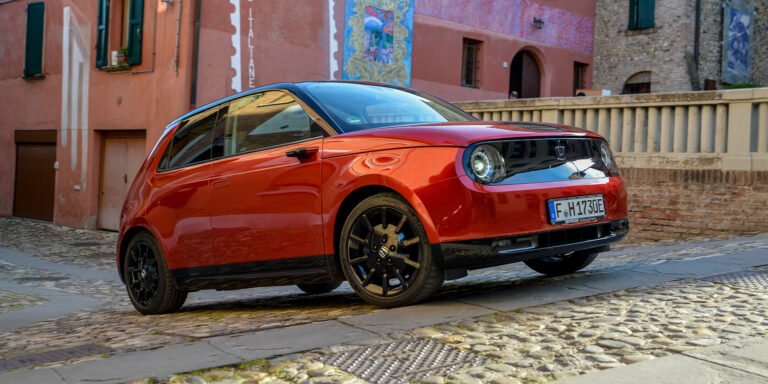
Honda has launched a limited run version of its ‘e’ electric hatchback, featuring a few exterior alterations which change the hatchback’s colour scheme.
Based on the ‘Advance’ trim grade (the most expensive of two trim levels available), the Honda e Limited Edition is available in a ‘crystal red’ exterior colour, not available on standard models.
The Honda branding is finished in black, as well as the 17-inch alloy wheels, to match the jet black colour of the car’s roof and the rounded rectangle fascia that houses the headlights in the front and the tail lights in the rear.
Other than these styling tweaks, the model is identical to the Honda e Advance, which is priced at £36,920. However, Honda has priced this Limited Edition model, with its minor styling revisions, at £38,120. This rather sharp price increase is likely due to the model’s exclusivity – only 50 Honda e Limited Edition cars will be sold across the entirety of Europe.
Earmarked by the motoring media for its retro styling that caught the eye when it first arrived in 2020, the Honda e currently holds an Expert Rating of 67%. It has received universally high praise for its technology and driving dynamics too, but reviewers have also pointed out that the Honda has a limited battery range of not much more than 100 miles in real-world conditions.
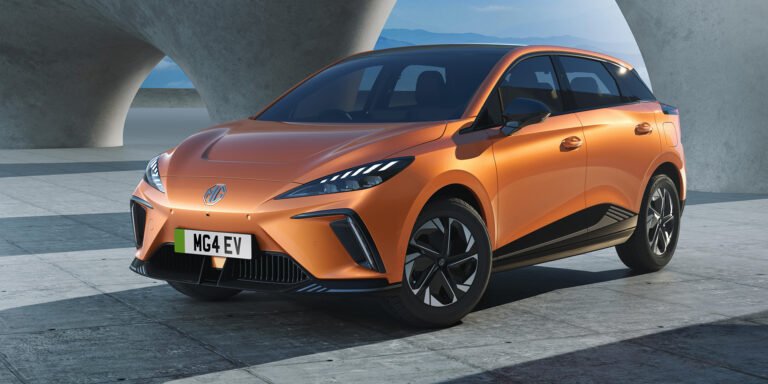
MG Motors has teased its all-new MG 4 electric hatchback which the brand will hold a launch event for in September, reportedly capable of travelling 280 miles on a full battery.
Positioned as a cheaper leftfield alternative to the likes of the Nissan Leaf and Volkswagen ID.3, the new MG 4 will be the third fully-electric model to join the MG Motors line-up, after the MG ZS SUV and MG 5 estate car.
The manufacturer says that there will be two different powertrain options for customers to choose from – an entry-level 51kWh battery pack and a more powerful 64kWh unit, which MG says have a range of 218 and 281 miles respectively. Both models use a single electric motor to power the front wheels, and the car’s top speed is capped at 99mph.
Designed on a new platform, the MG 4 looks like nothing else in MG’s current arsenal, and marks a turning point for the brand’s design ethos. Like the MG 5’s recent exterior refresh, designers have opted to give the MG 4 a pointy grille-less front end, the brand logo flanked by large wing-shaped LED headlights and protruding air intakes on either side of the bumper.
The car’s lower portion has plenty of SUV-style bumper cladding, while the rear features a full-width LED tail light bar sitting below a rear spoiler design that is split in two.
The hatchback’s interior design is a first for the brand, too. With the battery stored under the car’s floor, MG has taken the opportunity to improve cabin space and ergonomics, starting with the floating centre console that juts out below the dashboard but no further.
A frameless infotainment console, which is wider than the centre console below, is joined by a smaller digital instrument cluster screen on the dashboard. The car’s interior also features a new-look steering wheel, which gives the impression of being split in two at the bottom – mirroring the design of the rear spoiler.
That is all that has been released about the MG 4 so far, with more details, including UK specifications and pricing, on the way in the coming months.
The UK pricing and specifications for the all-electric Nissan Ariya SUV have been confirmed as the new range is set to go on sale in the UK.
As the brand’s new range-topper, the Ariya is the latest electric family-friendly EV to line up against the likes of the Kia EV6, Skoda Enyaq and Volkswagen ID.4.
As The Car Expert reported back in December, the Ariya range will include two battery capacities. The entry-level 63kWh version is powered by a 160kW electric motor powering the front wheels, producing a promised battery range of 250 miles. The mid-range 87kWh variant uses a 178kW motor – Nissan claiming that it can travel a maximum of 329 miles from full charge.
While these front-wheel drive models have their top speed capped at 100mph, the top-spec all-wheel drive ‘e-4ORCE’ powertrain can manage 124mph by using two motors, one in the front and another in the rear. With 65kW more power than the lead-in model, this range-topping variant is almost two seconds faster in a 0-62mph sprint than any other Ariya model.
Single-motor models come with 465 litres of boot space, which is not all that impressive when compared to the 585 litres offered by the class-leading Skoda Enyaq. The all-wheel drive version needs a bit more room in the rear to house the second electric motor, and thus boot space is reduced to 408 litres.
Once you have picked your powertrain preference, there are two trim levels to choose from – the standard ‘Advance’ trim or the more expensive ‘Evolve’ trim.
The ‘Advance’ trim offers a generous amount of equipment from the get go, including a 12-inch infotainment console on the dashboard with a voice control function operated through Nissan’s personal assistant, sitting next to a 12-inch digital instrument cluster behind the steering wheel.
The entry-level version also comes with dual climate control and an air purifier in the cabin, as well as a heated front windscreen with rain-sensing wipers and auto-folding wing mirrors. The front seats are heated and electrically-adjustable, and the boot lid in the rear offers hands-free access, as it is powered by a motor.
Key trim levelfeatures
Lead-in ‘Advance’ (starting from £43,845)
LED headlights, tail lights and daytime running lights
Heated front windscreen
Heated & auto-folding mirrors
Electronically-powered tailgate
19-inch alloy wheels
Dual zone climate control
Air purification system
Electrically-adjustable and heated front seats
LED ambient lighting
Rain-sensing wipers
12-inch infotainment console with Nissan’s personal assistant and Apple CarPlay/Android Auto
12-inch digital instrument cluster
Wireless phone charging
Front and rear parking sensors and 360-degree camera
‘ProPilot’ advanced cruise control with lane guidance
Blind spot monitoring and intervention
Traffic sign recognition
Top-spec ‘Evolve’ (starting from £47,840)
All ‘Advance’ features
Heads-up display on windscreen
Ten-speaker Bose stereo system
Ventilated front seats (heating and cooling)
Electric panoramic sunroof
Adjustable motorised centre console
‘ProPilot’ Parking assistance features
‘Memory functions’ feature that remembers personalised settings when key fob is near
The new Nissan Ariya comes equipped with a number of safety features as standard, including front and rear parking sensors with a 360-degree parking camera, a blind spot monitoring system that can intervene when it predicts an accident may occur, traffic sign recognition and Nissan’s ‘ProPilot’ advanced cruise control package that also includes lane-keeping assistance software for motorway journeys.
To get the brand’s ‘ProPilot’ parking package, which is advanced automated parking system that can perform a variety of parking manoeuvres at a touch of a button, you will have to upgrade to the ‘Evolve’ trim, which also includes a stereo system upgrade, an electric panoramic sunroof, a heads-up display that projects information on to the windscreen, and an adjustable centre console which can move backwards and forwards at the driver’s discretion.
This extensive equipment list means that the Ariya’s pricing is a little steeper than some of its key rivals. The lead-in ‘Advance’ model equipped with the smaller 63kWh powertrain costs just under £44k, which is nearly £3k more expensive than the cheapest Skoda Enyaq configuration.
The top-of-the-range Ariya ‘Evolve’ with all-wheel drive and the larger 87kWh battery is as expensive as the range gets, costing just over £56k, though customers can also spend a extra £2k on an additional ‘Sport’ pack that includes 20-inch alloy wheels and Nappa leather seating upholstery.
UK pricing
Trim and powertrain
Price
‘Advance’ with 63kWh battery
£43,845
‘Evolve’ with 63kWh battery
£47,840
‘Advance’ with 87kWh battery
£49,595
‘Advance’ with 87kWh battery and ‘e-40RCE’ all-wheel drive
£52,295
‘Evolve’ with 87kWh battery
£53,590
‘Evolve’ with 87kWh battery and ‘e-40RCE’ all-wheel drive
£56,290
The Nissan Ariya will be available to order in the UK from the 5th of July. With the new SUV now in the hands of the British motoring media, be on the lookout for the Ariya’s entry in our Expert Rating Index, coming soon.
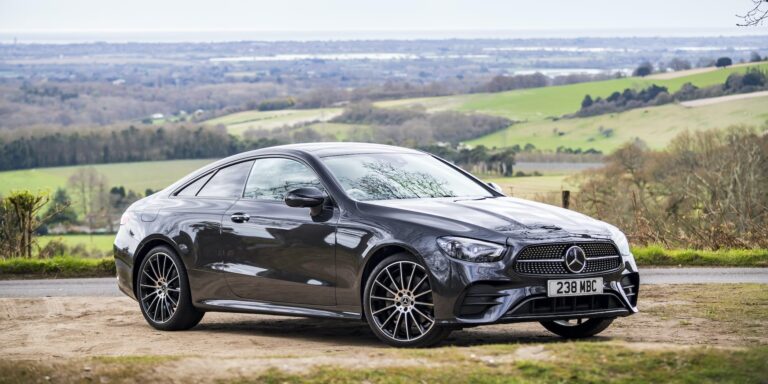
The Mercedes-Benz E-Class Coupé was the two-door version of the E-Class executive saloon of the same era. This model was launched in early 2017 and facelifted in the second half of 2020. It was discontinued in late 2023, replaced by an all-new model called the CLE.
Available with either a petrol or diesel engine, the E-Class Coupé was well-received by the British motoring media, praised by Parkers for its “sumptuous yet modern interior”.
Heycar added that the coupé “offers a surprising amount of practicality”, while Top Gear described the car’s engine options as “reasonably cost-effective”.
However, the E-Class Coupé was not as highly-regarded as its saloon sibling in the eyes of reviewers, as it was not as focused on driving enjoyment as some of its rivals. Even so, Carbuyer argued that the E-Class Coupé had the “classy, visual prestige” to attract customers away from rivals like the Audi A5 and BMW 4 Series Coupé.
As of March 2026, the Mercedes-Benz E-Class Coupé holds a Used Car Expert Rating of E, with a score of 54%. It received good review scores from motoring journalists, but its emissions are only average and it’s expensive to run.
Model reviewed: 3.0-litre diesel automatic E 400d AMG Line Night Edition Premium Plus Score: 8 / 10 “These revisions add improved tech and the potential for lower fuel bills to a package that was already very hard to fault. Of course, this six-cylinder diesel is a big jump in price over the four-cylinder option, which is equally luxurious and comfortable to drive.” Read review
Model reviewed: Range overview Score: 8 / 10 “Mercedes’ latest E-Class Coupe is luxurious, but not as sporty as it looks.” Read review
Carbuyer
Model reviewed: Range overview Score: 8 / 10 “The latest Mercedes E-Class Coupe is more stylish – and more practical – than ever” Read review
Evo
Model reviewed: Range overview Score: 7 / 10 “The E 300 proves hugely disappointing. At a cruise it’s subdued enough, but under acceleration the rough, gravelly note sounds more like a diesel, only one without the easy-going pace you’d get from even the E 220d. If you’re buying on style alone, the diesel is the pick of the four-cylinder models and the petrol should ideally be ignored.” Read review
Heycar
Model reviewed: Range overview Score: 8 / 10 “A refined and luxurious premium coupe, the Mercedes-Benz E-Class Coupe offers a surprising amount of practicality – with the space to carry four adults inside.” Read review
Model reviewed: Range overview Score: 8 / 10 “A refined and luxurious premium coupe, the E-Class offers a surprising amount of practicality – with the space to carry four adults inside.” Read review
Honest John
Model reviewed: Range overview Score: 8 / 10 “The Mercedes-Benz E-Class Coupe is a rare proposition, offering a combination of two-door style with the bonus of extra practicality.” Read review
Parkers
Model reviewed: Range overview Score: 8 / 10 “The Mercedes-Benz E-Class Coupe is an extremely appealing coupe with genuine space for four in its sumptuous yet modern interior. There are strong engines and a relaxed driving experience, but it’s very easy to spend a small fortune adding desirable extras on.” Read review
The Sun
Model reviewed: E 400 4Matic “Turning down the BMW 6 Series and buying the Mercedes E-Class Coupe instead is like turning down Uma Thurman for the woman at the post office. Because she’s so good at ironing.” (Jeremy Clarkson) Read review
Top Gear
Model reviewed: Range overview Score: 7 / 10 “Looks good, lowers the heart rate and comes with some reasonably cost-effective engines. A winning combination.” Read review
Safety rating
Independent crash test and safety ratings from Euro NCAP
Notes on safety rating
The Mercedes-Benz E-Class Coupé was not crash tested by Euro NCAP during its production life.
Although the E-Class Coupé was based on the saloon of the same name, there were significant structural differences between the two models. As such, the coupé did not inherit the saloon’s safety rating.
The Coupé was well equipped with standard safety technology shared with the E-Class saloon, such as autonomous emergency braking and emergency steering assistance.
Eco rating
Independent economy and emissions ratings from Green NCAP
No eco rating
The Mercedes-Benz E-Class Coupé was not lab tested by Green NCAP during its production life.
Reliability rating
Reliability data provided exclusively for The Car Expert by MotorEasy
Total claims: 821 Average repair cost: £715.40 Last updated: April 2025
As of April 2025 (our most recent data point), the Mercedes-Benz E-Class has a below-average reliability rating of 63%, according to warranty data provided exclusively to us by our commercial partner, MotorEasy. This score applies to both this generation of E-Class and also to previous models, which is worth considering if you are considering a used Mercedes-Benz E-Class.
Based on more than 900 warranty claims, the average repair cost is just over £700 so a used car warranty is well worth considering if you own or are considering an E-Class. More than 35% of claims concern the electrical system, with an average bill of more than £500. Engine and gearbox faults are unsurprisingly the most expensive problems, and are not uncommon in the E-Class.
Make sure that any used car warranty you purchase covers all of these problem areas.
Running cost rating
Monthly cost of ownership data provided exclusively for The Car Expert by Clear Vehicle Data
Fuel consumption
Average
Score
Petrol models
35 mpg
D
Diesel models
46 mpg
C
CO₂ output
Average
Score
Variation
Score
Petrol models
182 g/km
D
Diesel models
162 g/km
C
Insurance group
Average
Score
Variation
Score
All models
40
D
Service and maintenance
Cost
Score
Year 1
£348
D
Year 2
£820
D
Year 3
£1,338
D
Year 4
£1,595
D
Year 5
£2,060
D
Overall
£6,161
D
The Mercedes-Benz E-Class Coupé is pretty much middle of the road when it comes to ownership and running costs, according to whole-life numbers provided exclusively to The Car Expert by our data partner, Clear Vehicle Data.
Fuel consumption is relatively poor for the petrol engines, and average for the diesel models. Servicing and insurance costs are very much average as well.
Similar cars
If you’re looking at the Mercedes-Benz E-Class Coupé, you might also be interested in these alternatives
Hyundai has released the first details and pictures of its upcoming electric Ioniq 6 saloon, which is set to challenge the likes of the BMW i4, Polestar 2 and Tesla Model 3 when it arrives in the UK in 2023.
Following a similar retro-futuristic styling brief, Hyundai will be hoping that it has another all-electric hit on its hands with the Ioniq 6 after the success of the Hyundai Ioniq 5 hatchback, which received an overwhelmingly positive range of reviews from the UK media after its arrival in 2021, and continues to be one of the highest-rated electric models in our unique Expert Rating Index.
Whether the new Ioniq 6 will match its hatchback sibling’s sales figures remains to be seen – it’s unlikely to be a big seller in the UK where large saloons are currently out of fashion. It is likely to be quite an important model for Hyundai in the bigger Chinese market however, and gives us an idea of what the next generation of Hyundai EVs will look like, including the Ioniq 7 SUV that is currently still in development.
The Hyundai Ioniq 6 has a streamlined, aerodynamic silhouette – another indication, like the Mercedes-Benz EQS and Volkswagen ID. models, that car manufacturers are pursuing a sleek and smooth look for their new electric models compared to the chunkier, squared-off styling that we’re used to.
This body shape actually makes the Ioniq 6 the most aerodynamic car in Hyundai’s line-up. The brand has not yet revealed with the new saloon’s specifications, but it’s thought that it will be offered with 58kWh and 77kWh battery pack options like the Ioniq 5, and will likely have a slightly better battery range than the Ioniq 5 (315 miles), as the saloon’s smooth exterior styling is more efficient at cutting through wind resistance on the road.
Displaying that it is part of the Ioniq family, the new saloon features plenty of pixel-style LED lights which feature in the design of the headlights and the tail lights that stretch across the boot lid, sitting below a ducktail spoiler in a rear fascia design that is reminiscent of a 1980s Porsche 911.
The LED pixels feature in the cabin too – most prominently on the car’s steering wheel. These four lights indicate how much charge is left in the saloon’s battery.
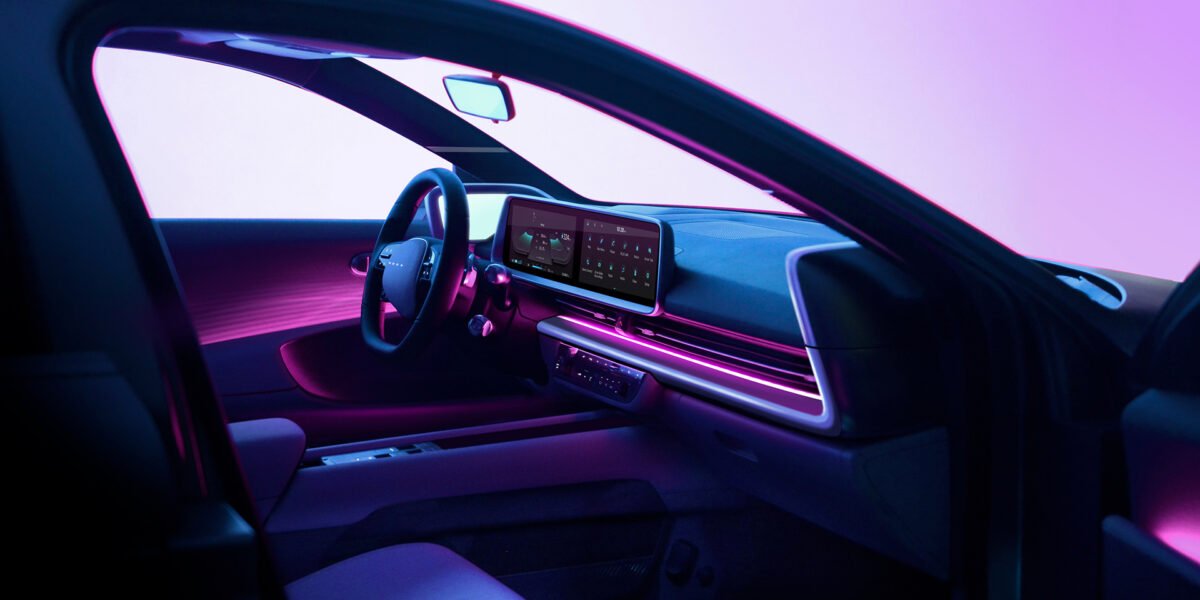
The dashboard is fitted with a pair of 12-inch displays, one for the infotainment console and the other for the driver’s instrument cluster, which feature together on one connected display. Unlike the Ioniq 5, Hyundai has decided to fit a full centre console between the two front seats in this larger model.
As is becoming more common on new models, Hyundai says that the new Ioniq 6’s interior is constructed using more sustainable materials. In this case, we find artificial leather, recycled PET plastics, vegetable oil-based paints and recycled fishing nets.
Beyond this first look, we will get more information about specifications at the car’s proper world premiere in the coming month, while UK pricing is likely to be released closer to the saloon’s arrival on our roads early next year.
It’s great being young, but not if you want to insure a car. All the stats show that as a group, teenagers carry the highest risk for motor insurers. Even though some are good and careful drivers, others are a complete danger.
Drivers aged 17-24 only make up 7% of UK licence holders and drive fewer miles than the average but are involved in 24% of all fatal collisions, according to the Association of British Insurers (ABI).
Even the cost of insuring a modest small car is high. For an example, looking at data provided to us by Compare The Market between June 2021 and May 2022, an 18 year-old who lives in the North West of England and obtained a full UK licence in the last year was looking at an average annual £1,402 for an entry-level Fiat 500.
The only way to get a good insurance record is to keep driving safely and over time build up a no-claims discount, but while the early years will be the most costly there are ways to lower the bill.
The starting point is choosing a low power, low value, (but still safe) car in a low insurance group. Then apply any of the price-reducing factors for anyone insuring a car: park off street if you can; lower the mileage and specify a higher excess.
Who’s driving?
It can be tempting for a parent or older person to pretend that they are the main user of a teenager’s car to save money on insurance premiums, and then add them as a named driver. But if the younger person is actually driving it on a regular basis this is illegal. Insurers call it ‘fronting’. If an insurer discovers that a person is guilty of fronting, their policy could be declared invalid and they could be forced to pay any costs that arise as a result of an accident. It can also lead to criminal convictions.
Conversely, if the young driver can insure their own car, adding an older, named driver onto the policy can reduce the premium, because the risk is being spread. To return to the example of the 18-year-old in the Fiat 500, the average premium with a parent added as a named driver reduces the average £1,402 to £1,297.
Black boxes
It’s agreed that the best way young drivers can lower their insurance is with telematics motor insurance policies, often known as ‘pay how you drive’ or ‘black box’ insurance. Telematics policies primarily use GPS technology to measure how a vehicle is being driven. Insurers then use this information to make decisions about risk based on driving performance. This information is considered together with other traditional risk factors, such as a driver’s age and where they live, to set premiums. ‘Safe’ drivers will usually benefit from lower premiums than ‘less safe’ drivers.
Many young people aren’t keen, as they feel as if they’re being spied upon, but if they are careful behind the wheel, black box insurance will the best option. According to analysis by compathemarket.com in May 2022, more than three quarters (78%) of drivers aged between 17 and 20 could save an average of £1,137 by choosing a telematics policy instead of a regular car insurance policy.
There are specialist insurers who cater for young drivers. One of the longest-established, Marmalade, offers a specific named-young-driver-insurance. It has a telematics policy for driving a parent’s or grandparents’ car (a tag and an app know who’s driving), it also offers a telematics policy for young drivers in their own car as the main driver.
Temporary insurance
For many young drivers an annual insurance policy may not be needed, and here’s where the growing market for temporary, or pay-by-the mile car insurance comes in. For example, many young people may only want the use of a car when they are home from college or university.
Again, Marmalade uses a black box for its Pay as You Go Insurance policy on a parent’s car. You start with 500 miles and arrange auto top up of 100 to 500 miles when there’s 50 miles left. Unused miles are valid for a year. Prices start from £175 for 500 miles – with top-ups from £18. The driver still earns no claims bonus for a trouble-free year. Another company, go shorty offers time-based car insurance for ages 18-75 from one hour to 28 days to drive cars which don’t belong to you.
The Volkswagen Multivan is an upmarket seven-seat people carrier which arrived in the UK in early 2022 to replace the ageing Volkswagen Caravelle.
Despite the name ‘Multivan’ and the fact that previous generations of Multivan have been based on the Volkswagen Transporter van, the latest Multivan is actually built on the same passenger car platform that underpins the current Volkswagen Golf and many other vehicles in the larger VW/Audi/Skoda/SEAT family.
So, although it looks very similar to the latest Volkswagen Transporter and is designed to rival other van-based people carriers like the Mercedes-Benz V-Class, the Multivan has inherited driving dyamics that are much more car-like, along with the company’s latest plug-in hybrid technology.
“Everything from the way it looks to the way it drives represents a well-conceived upgrade over almost all other vehicles of this type”, Parkers explains, while praising the people carrier for its surprising driver appeal and its flexible and spacious interior.
The most prominent criticism of the Multivan relates to its infotainment, as it uses the same system as the electric ID. range that Business Car calls “confusing” and Top Gear says is “awful”. Auto Trader also gave the Multivan a poor review based on a host of reliability issues with the test car provided.
The price tag is a sticking point for a few reviewers too – with Multivan pricing starting above £50,000, Carbuyer recommends waiting a few years for the Multivan to appear on the used market, or to take a look at the slightly more expensive and distinctive ID. Buzz people carrier.
As of September 2025, the Volkswagen Multivan holds a New CarExpert Rating of B with a score of 65%. Its best mark is a B grade for its safety rating, while its media review scores and CO2 emissions are average. However, its running costs are high and Volkswagen’s new car warranty offering is poor.
Body style: Van-based people carrier Engines:petrol, diesel, plug-in hybrid Price:From £43,258 on-road
Launched: Spring 2022 Last updated: N/A Replacement due: TBA
Image gallery
Media reviews
Highlighted reviews and road tests from across the UK automotive media. Click any of the boxes to view.
Featured reviews
“Previous Caravelle models have handled well despite their size and weight, and the Volkswagen Multivan continues that tradition. It is a satisfying vehicle to drive and good all-round visibility makes it easy to place on the road. Drivers will be able to take advantage of more than 20 driver assist systems.”
“The Volkswagen Multivan is the pinnacle of the MPV concept. Not because it’s a new model in a dying sector, but because it reinvents the formula by mixing van-like dimensions with car-like handling and quality. This eHybrid is best when fully charged – a pure petrol or diesel will make more sense if you regularly do longer journeys.”
Model reviewed: 2.0-litre petrol automatic Style Score: 6 / 10 “The Volkswagen Multivan TSI fills a brief for buyers that don’t want a dirty diesel or a plug-in model, but it’s not as good as either of these versions. There’s no arguing with its cabin versatility, but the PHEV is a better option in town, while the diesel is the one to go for if you’re planning longer trips.” (Dean Gibson) Read review
Auto Trader
Model reviewed: 1.4-litre petrol/electric plug-in hybrid Score: 4 / 10 “Volkswagen hopes Multivan’s blend of MPV practicality and lifestyle cool will win families over from SUVs but reliability concerns spoil the party.” Read review
Business Car
Model reviewed: Range overview Score: 8 / 10 “Sister van, the all-electric ID.Buzz will get all the attention of course, because of its modern retro looks, but if EV power doesn’t work, the Multivan still looks sharp, is impressively practical and surprisingly good to drive and in hybrid form, should prove cheap to run – although it’s not cheap to buy.” Read review
Car
Model reviewed: Range overview Score: 8 / 10 “If you like big bus and you cannot lie, the Volkswagen Multivan is the place to start if you’re shopping for a new model. The interior flexibility surpasses everything else in the sector – though the Mercedes V-Class remains a strong challenger if you’re looking for maximum lux.” Author: CJ Hubbard Read review
Carbuyer
Model reviewed: Range overview Score: 8 / 10 “The Volkswagen Multivan represents a successful update of VW’s popular posh MPV but it’s expensive.” Read review
Carwow
Model reviewed: Range overview Score: 8 / 10 “The Volkswagen Multivan is the peak of family or business travel practicality, offering a range of layouts and options to customise a big seven-seat people carrier.” Read review
Driving Electric
Model reviewed: Multivan eHybrid Score: 7 / 10 “The Volkswagen Multivan eHybrid’s most obvious rival is the Ford Tourneo Custom PHEV, offering a slightly less upmarket finish and image than the Multivan, but seating for up to eight. Hybrid seven-seater SUVs such as the Toyota Highlander, Lexus RX L and Kia Sorento PHEV may also be a consideration, although none will match the sheer versatility and carrying capacity of the Multivan.” (Stephen Errity) Read review
Electrifying.com
Model reviewed: Multivan eHybrid Score: 8 / 10 “This looks like a great effort from Volkswagen. The old Caravelle had an upmarket feel this is a step up from that. It’s a shame that the hybrid system isn’t more electric-focused given the space available, but this is a welcome addition and great for bigger families.” Read review
Heycar
Model reviewed: Range overview Score: 8 / 10 “Whether you’re looking for the ultimate family transport, need to transport Lord Sugar to the golf club or just want a car that doubles up as a work van, the Volkswagen Multivan is one of the most versatile people carriers on sale today.” Read review
Honest John
Model reviewed: Range overview Score: 8 / 10 “It feels civilised on the open road, although that light steering means it never feels as confident or assured as SUV alternatives like the Volkswagen Tiguan. The Multivan’s blocky shape means there’s quite a lot of wind noise at higher speeds, although no more so than van-based alternatives.” Read review
Parkers
Model reviewed: Range overview Score: 8.8 / 10 “If you’re looking for the most practical way to transport up to seven people, then yes, the Multivan is worth close consideration. Everything from the way it looks to the way it drives represents a well-conceived upgrade over almost all other vehicles of this type.” Read review
The Telegraph
Model reviewed: 1.4-litre petrol/electric plug-in hybrid Life Standard Score: 8 / 10 “On versatility and space, the Volkswagen Multivan trounces any large SUV that costs a similar amount and it has the edge over van-based rivals in driveability and desirability. And there’s something disarming about its honesty, too. In a world of jumped-up hatchbacks posing as SUVs, and SUVs trying to be MPVs, the Multivan does exactly what it says on the tin. It’s a proper van, and proud of it. And so will its owners be.” (Alex Robbins) Read review
Top Gear
Model reviewed: Range overview Score: 7 / 10 “Proves the folly of SUVs. This is more spacious, more comfortable and easier to drive than any pretentious 4×4. Useful hybrid option. Interior spoiled by VW’s awful infotainment.” Read review
Safety rating
Independent crash test and safety ratings from Euro NCAP
Tested by safety body Euro NCAP in early 2022, the plug-in hybrid (eHybrid) version of the Volkswagen Multivan was awarded one of the most impressive five-star safety ratings a people carrier has received to date. This rating standard for the entire range of Multivan powertrain options.
The Multivan achieved high adult protection and child protection scores in the event of a crash, and its impressive safety assistance technology score displays that the people carrier is adept at avoiding potential road accidents in the first place.
Eco rating
Independent economy and emissions ratings from Green NCAP
No eco rating
As of September 2025, the Volkswagen Multivan has not been tested by Green NCAP.
Running cost rating
Monthly cost of ownership data provided exclusively for The Car Expert by Clear Vehicle Data
Fuel consumption
Average
Score
Petrol models
32 mpg
D
Diesel models
43 mpg
C
Plug-in hybrid models
157 mpg
A
CO₂ output
Average
Score
Variation
Score
Petrol models
202 g/km
D
Diesel models
171 g/km
D
Plug-in hybrid models
42 g/km
A
Battery range
Average
Score
Variation
Score
Plug-in hybrid models
30 miles
E
Insurance group
Average
Score
Variation
Score
All models
33
D
Service and maintenance
Cost
Score
Year 1
£180
B
Year 2
£502
B
Year 3
£816
B
Year 4
£1,066
B
Year 5
£1,437
C
Overall
£4,001
B
The Volkswagen Multivan is an expensive car to own and run, according to whole-life cost numbers provided exclusively to The Car Expert by our data partner, Clear Vehicle Data.
Fuel economy is disappointing for petrol models but good for diesel-engined versions. The plug-in hybrid models look amazing on paper, but this is largely thanks to ridiculous EU/UK government lab tests that are completely inadequate for plug-in hybrids. There is no way you will ever travel for 155 miles on a single gallon (4.5 litres) of fuel and some electricity…
The battery range of the plug-in hybrid model is also poor when compared to other plug-in hybrids, though this is to be expected considering its large size. The car’s service and maintenance costs should be affordable, and insurance costs are around the market average.
Reliability rating
Reliability data provided exclusively for The Car Expert by MotorEasy
No reliability rating
As of September 2025, we don’t have enough reliability data on the Volkswagen Multivan to generate a reliability rating.
The Car Expert’s reliability information is provided exclusively from workshop and extended warranty data from our partner, MotorEasy. As soon as MotorEasy has sufficient data on the Multivan, we’ll publish the score here.
Warranty rating
New car warranty information for the Volkswagen Multivan
Overall rating
D
31%
Petrol or diesel models
E
17%
Electric or hybrid models
C
56%
New car warranty duration
3 years
New car warranty mileage
60,000 miles
Battery warranty duration
8 years
Battery warranty mileage
100,000 miles
Volkswagen’s new car warranty is pretty much the bare minimum offered by any car manufacturer in the UK. The duration is three years, with a limit of 60,000 miles. Unfortunately, in this sector none of the major alternatives offer anything much better.
In addition to the standard new car warranty, the Multivan plug-in hybrid version has an eight-year/100,000-mile warranty for the battery components.
Warranty on a used Volkswagen Multivan
If you are buying an ‘Approved Used’ Volkswagen Multivan from an official Volkswagen dealership, you will get a minimum 12-month warranty included.
If you are buying a used Volkswagen Multivan from an independent dealership, any warranty offered will vary and will probably be managed by a third-party warranty company.
If you are buying a used Volkswagen Multivan from a private seller, there are no warranty protections beyond any remaining portion of the original new car warranty.
If you’re looking to buy any used car that is approaching the end of its warranty period, a used car warranty is usually a worthwhile investment. Check out The Car Expert’s guide to the best used car warranty providers, which will probably be cheaper than a warranty sold by a dealer.
Recalls
Official DVSA safety recalls that have been issued for the Volkswagen Multivan
As of September 2025, we are not aware of any DVSA vehicle safety recalls affecting the Volkswagen Multivan. However, recall information is updated very regularly, so this may have changed.
If you own a Volkswagen Multivan or are looking to buy one, you can check to see if your car has any outstanding recalls by visiting the DVLA website or contacting your local Volkswagen dealer.
The large van-based people carrier market has fluctuated in recent years. The Stellantis models (Vauxhall, Peugeot and Citroën, plus Toyota) are no longer available with petrol or diesel power, and can only be had as electric models.
Most of the current models, and pretty much all of the new entries, are EV-only. Only Ford and Mercedes-Benz have fossil-fuel-powered alternatives.
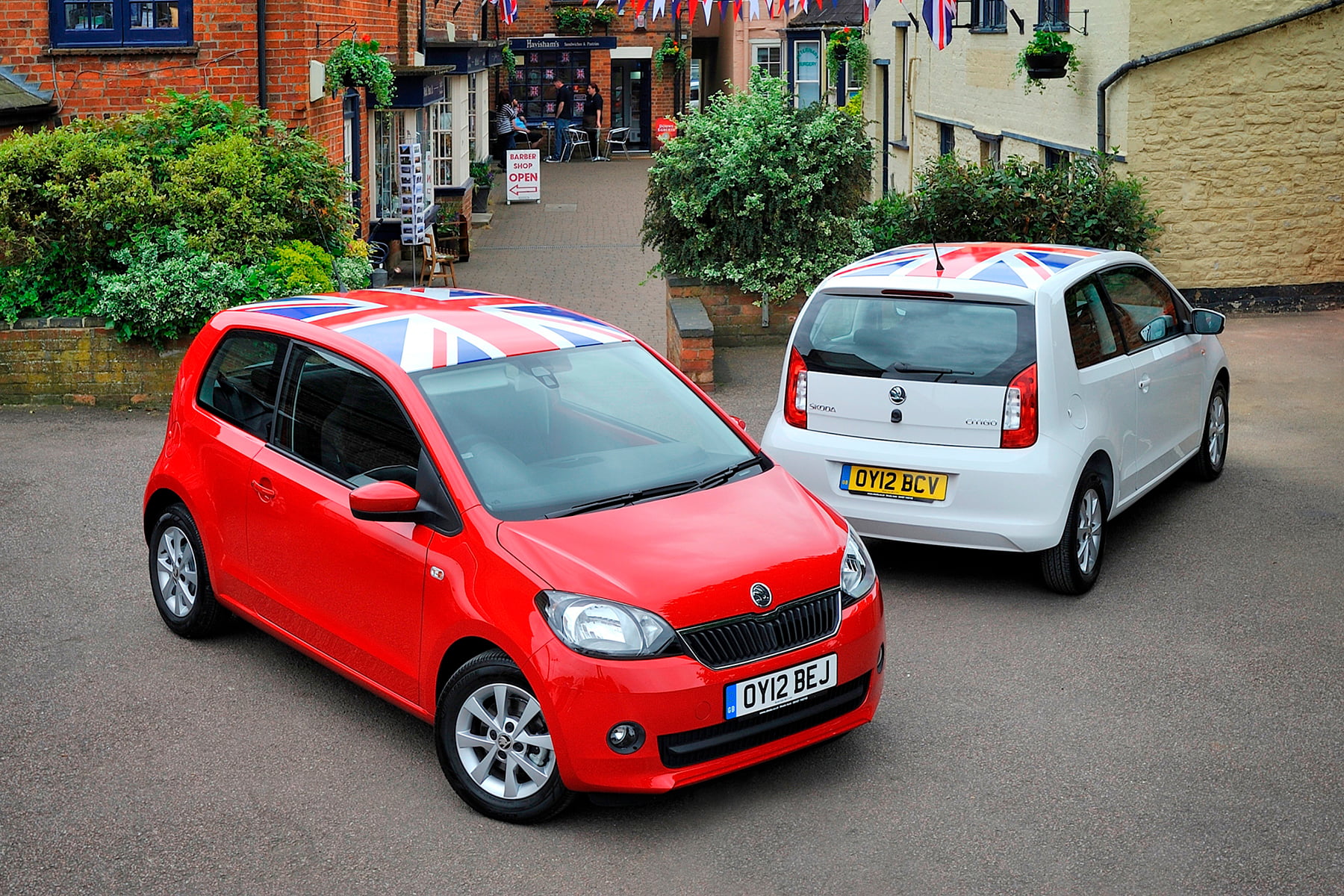
The Skoda Citigo was a compact city car available as a three-door or five-door hatchback. Originally arriving on UK roads in the middle of 2012, the petrol-powered Citigo was replaced in 2019 by the all-electric Citigo-e iV, which we are building a separate page for soon.
Powered by a 1.0-litre petrol engine, with both manual and automatic gearbox options, the Skoda Citigo was essentially identical to the Volkswagen Up and SEAT Mii city cars. The only visual difference was some very light exterior restyling, while the Citigo also carried less kit to justify its slightly lower price tag.
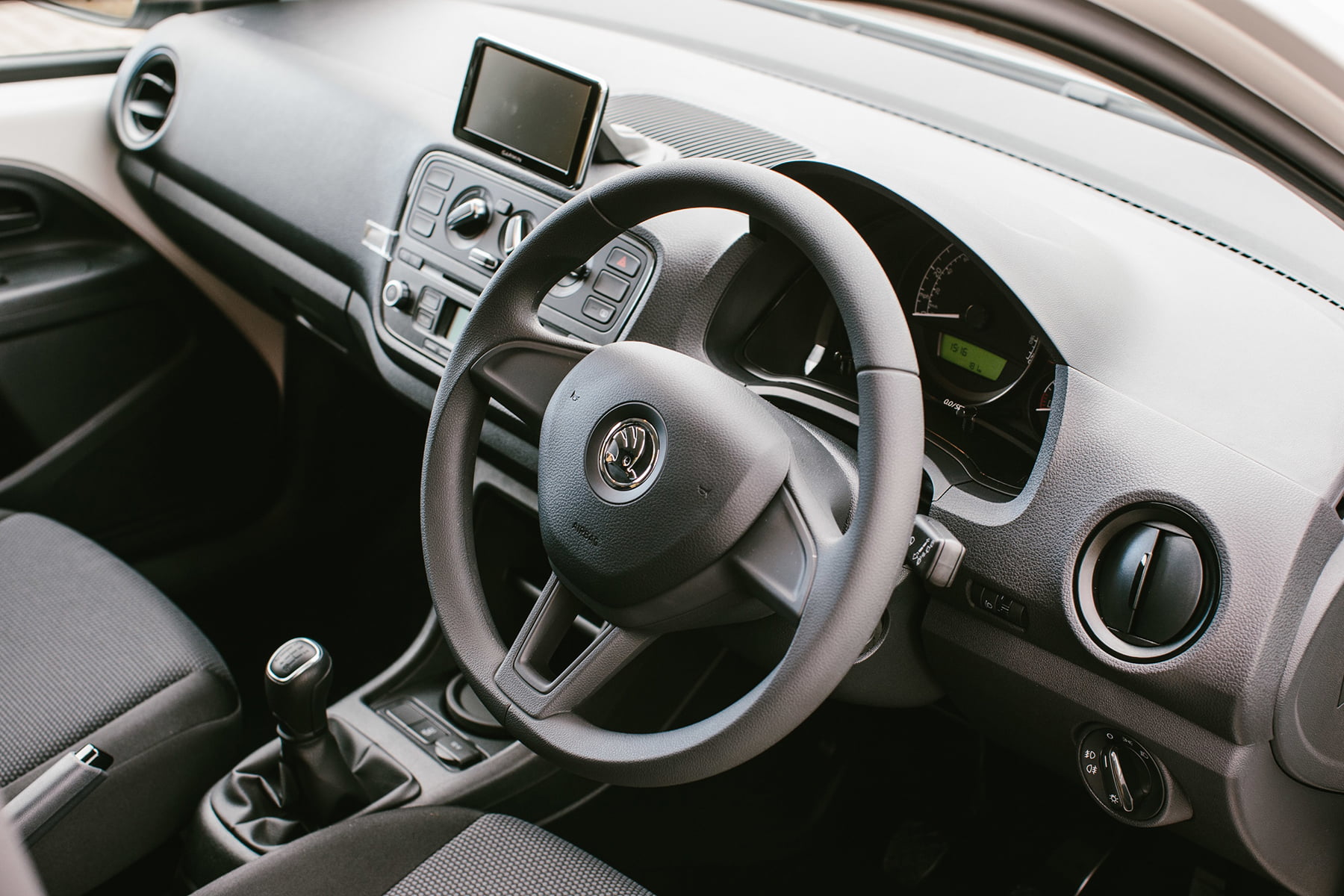
As a result, the Citigo received many of the same plaudits as the Up, including widespread praise of its agile handling, ‘big car’ interior quality and low running costs.
Part of a competitive city car class while on sale, several outlets commented that the Citigo stood out from the crowd thanks to its superior value-for-money – one of the main reasons the compact car received several industry awards during its lifespan, including the title of ‘Best City Car’ at the Auto Express Awards for five years running.
That said, many reviewers concluded that they preferred the Volkswagen Up overall. The Citigo range also did not have as many personalisation options as the Up, and while cheap, the entry-level Citigo trim did not come with much equipment.
No longer on sale, the Skoda Citigo holds a Used Car Expert Rating of D, with a score of 57%. It gets good grades for its media review scores, however its safety rating is relatively poor compared to newer cars.
Highlighted reviews and road tests from across the UK automotive media. Click any of the boxes to view.
Auto Express
Model reviewed: (2012-19) Score: 7 / 10 “The Skoda Citigo is a small car with huge talent. It’s got space for four people, drives superbly, is incredibly efficient and is beautifully built.” Read review
Model reviewed: (2012-19) Score: 8 / 10 “The Skoda Citigo is an impressive all-rounder in the city car class.” Read review
Model reviewed: Score: 5 / 10 “Few new cars on sale for less than £10,000 hold as much appeal as the new five-door Citigo.” Read review
Auto Trader
Model reviewed: Score: 9 / 10 “There are lots of excellent city cars on offer these days, but for our money, the Skoda Citigo is one of the best.” Read review
Car
Model reviewed: Elegance 1.0 (2012) Score: 8 / 10 “The Skoda Citigo is an extremely well-judged city car, and deservedly serves to strengthen the Czech firm’s impressive range further.” Read review
Car Keys
Model reviewed: Score: 8 / 10 “The Skoda Citigo is a likeable car that can be the perfect companion for urban drivers. It won’t be as capable on the motorway as you might like, but it works perfectly well everywhere else – delivering great economy, enough equipment and surprising practicality considering its diminutive size.” Read review
Model reviewed: Score: 8 / 10 “The Skoda Citigo will efficiently get you from A to B in the city environment, it is cheap to run, its small engine means lower tax rates and it’s not a bad looker either.” Read review
Carbuyer
Score: 9.2 / 10 “The Skoda Citigo is a thoroughly grown-up, well made city car that still knows how to have fun.” Read review
Carwow
Model reviewed: Range overview Score: 9 / 10 “The Skoda Citigo is one of the best city cars on sale, with big-car features and low running costs, although it’s not quite as cheap as you might expect.” Read review
Eurekar
Model reviewed: 60 Elegance “The three-door 60 Elegance, the less powerful of the two engines under the 75ps, is remarkably smooth and quiet unless its pushed to the highest revs; and the manual gearbox is light in action, direct and also quiet.” Read review
Model reviewed: 1.0 GreenTech Elegance “Stylish yet sensible, the Citigo works on both visual and practical levels in that it looks bigger than other city cars and has small dimensions.” Read review
Model reviewed: SE L Greentech 1.0 MPI “When it was launched in 2012, the Skoda Citigo was immediately named Best City Car of the Year by Auto Express magazine. It’s held that title ever since and it’s not hard to see why.” Read review
Model reviewed: Monte Carlo “The Monte Carlo edition of Skoda’s Citigo comes with no-cost tornado red paint to reinforce the sporty feel of the black alloy wheels, black front and rear spoilers, grille and door mirrors; and chessboard go-faster stripes on doors and rear hatch.” Read review
Model reviewed: SE L GreenTech “For those who like to count the pennies, and that is often a key factor in this market, the Skoda Citigo is no-brainer.” Read review
Model reviewed: 1.0 MPI SE “From the punchy three-cylinder engine to the surprisingly roomy interior – the Skoda Citigo is a small car with big ideas.” Read review
Evo
Model reviewed: Score: 7 / 10 “Not a true thriller, but the Skoda Citigo is a competent car in which some fun can be had.” Read review
Model reviewed: Monte Carlo Score: 7 / 10 “The Skoda Citigo Monte Carlo is well-screwed together, lightweight fun.” Read review
Fleetworld
Model reviewed: “The Skoda Citigo aims to be a super-efficient car for urbanites who will rarely venture away from their city habitat. And it lives up to its remit.” Read review
Honest John
Model reviewed: Score: 8 / 10 “Small car based on Volkswagen Up, the Skoda Citigo is Ideal for town, economical on fuel, ufn to drive, and delivers lower prices than the Up and SEAT Mii.” Read review
Motoring Research
Model reviewed: Elegance 1.0 MPI “We come away from the Skoda Citigo in top-spec Elegance trim level still in love with the city car, but with a hatred for its automatic transmission.” Read review
Model reviewed: Monte CarIo (2015) “There’s something delightfully old school about the Skoda Monte Carlo and pound for pound, this is one of the most rewarding cars you can buy.” Read review
Motors
Model reviewed: Score: 8 / 10 “The Skoda Citigo is a cheap car to run as well as a cheap car to buy, and the 1.0-litre petrol engine is both simple and easy to maintain; plus, it’s very frugal at the pumps.” Read review
Parkers
Model reviewed: Score: 9 / 10 “Capable and great value Skoda Citigo city car feels surprisingly grown.” Read review
Model reviewed: (2012) Score: 8 / 10 “The Skoda Citigo is good value, a smart buy.” Read review
The Sun
Model reviewed: “The different grille and headlights and tweaks to the tail-lights give the Citigo its individuality. It’s a far more entertaining drive than you would think for a car powered by a little 1.0-litre engine.” Read review
Model reviewed: Monte Carlo “Whether all the extra livery warrants a price hike of £1,810 than the equivalent SE model depends on what your budget dictates. But, for me, it adds a bit more style to what is already the best car of the Up! and Mii triplets.” Read review
The Sunday Times
Model reviewed: Score: 6 / 10 “Great in cities and not bad on the open road but poorly designed boot is a missed opportunity for the Skoda Citigo.” Read review
The Telegraph
Model reviewed: Monte Carlo Score: 8 / 10 “The Citigo Monte Carlo might be a sheep in wolf’s clothing, but it is also fun to drive, cheap to run and remarkably composed for a vehicle of its size.” Read review
Model reviewed: (2017) “At a pinch you could live with this likeable Skoda Citigo as your everyday wheels, and even as the family’s second runabout it would rapidly become the default driver, which is as good as it gets.” Read review
Model reviewed: Score: 8 / 10 “The Skoda Citigo doesn’t feel as classy as the VW Up, but then it is slightly cheaper. And like the Up, the Citigo is safe, efficient and good to drive.” Read review
Safety rating
Independent crash test and safety ratings from Euro NCAP
The Skoda Citigo’s safety rating is based on the essentially identical Volkswagen Up, which was originally tested back in 2011 and awarded five stars by Euro NCAP. It was highly praised at the time for bringing a high safety standard to the city car class.
However, Euro NCAP safety standards have become significantly tougher over the last decade and the Citigo (along with its Volkswagen and SEAT siblings) did not keep up. In 2019, the Volkswagen Up was re-tested by Euro NCAP and only awarded three stars, and again the same score applies to the Skoda Citigo.
Eco rating
Independent economy and emissions ratings from Green NCAP
No eco rating
The Skoda Citigo was not lab tested by Green NCAP during its production life – and neither was the Volkswagen Up or SEAT Mii.
Reliability rating
Reliability data provided exclusively for The Car Expert by MotorEasy
No reliability rating
As of April 2025 (our most recent data point), we don’t have enough reliability data on the Skoda Citigo to generate a reliability rating.
The Car Expert’s reliability information is provided exclusively to us using workshop and extended warranty data from our partner, MotorEasy, sourced from both official dealerships and independent workshops.
As soon as MotorEasy has sufficient data on the Citigo, we’ll publish the results here.
Awards
Trophies, prizes and awards that the Skoda Citigo has received
2018
Carbuyer Awards – Best First Car + Best City Car
2016
Auto Express Awards – Best City Car
2015
Auto Express Awards – Best City Car
2014
Auto Express Awards – Best City Car
Green Apple Awards – Best Supermini
2013
Auto Express Awards – Best City Car
Carbuyer Awards – Best City Car
The Sunday Times Motoring Awards – Best City Car
2012
Auto Express Awards – Car of the Year + Best City Car
Similar cars
If you’re looking at the Skoda Citigo, you might also be interested in these alternatives
Honda has revealed the first pricing and specification details of its all-new Honda Civic family car, which can be ordered in the UK from this month with prices starting at just under £30K.
As The Car Expert reported in March, the upcoming 11th-generation Honda Civic will only be offered as a petrol-electric hybrid, and will also be the first iteration of the Civic for many years not to be built in Britain, after Honda’s factory at Swindon closed in July 2021.
Badged as the Honda Civic e:HEV, this hybrid range is set to challenge electrified rivals like the Hyundai Ioniq and Toyota Corolla, and is powered by a newly-developed 2.0-litre petrol engine that works in tandem with a lithium-ion battery and two electric motors to produce 183hp.
The new range consists of three grades, starting with the ‘Elegance’ trim, which features 17-inch alloy wheels, front and rear parking sensors, a rear parking camera, and a seven-inch digital instrument cluster behind the steering wheel.
The mid-range ‘Sport’ trim adds synthetic leather to the car’s upholstery, and also features bigger 18-inch alloy wheels, LED fog lights and some extra bodywork detailing in black. The top-spec ‘Advance’ trim upgrades the car’s headlights, infotainment and stereo system, and adds a panoramic roof.
The new Civic comes with several safety features as standard, including lane-keeping assistance and blind spot monitoring systems.
Trim level features
Entry-level ‘Elegance’ (£29,595)
17-inch alloy wheels
Fabric seats
LED headlights
Front and rear parking sensors
Rear parking camera
Entry-level infotainment screen (size not specified, likely eight- or nine-inch touchscreen)
Seven-inch digital instrument cluster
Eight-speaker stereo system
Lane keeping assistance
Blind spot monitoring
Mid-range ‘Sport’ (£30,595)
All ‘Elegance’ features that are not replaced
18-inch alloy wheels
Fabric and synthetic leather seats
LED fog lights
‘Sports’ pedals
Wing mirrors and window surrounds finished in black
Range-topping ‘Advance’ (£32,995)
All ‘Elegance’ and ‘Sport’ features that are not replaced
Adaptive LED headlights
Larger ten-inch infotainment screen
12-speaker stereo system
Panoramic sunroof
Two-tone 18-inch alloys, full leather seats and a heated steering wheel are optional extras that can be added for an additional fee.
The new Honda Civic e:HEV will be available to order in the UK this month, with Honda expecting the first vehicles to be delivered to customers in October.
The current tenth-generation Honda Civic has been on sale since early 2017 in the UK, and has been praised for its practicality and generous levels of standard equipment. Now at the end of its life, it holds an Expert Rating of 69% in our Expert Rating Index, meaning that it isn’t rated quite as highly as the leading vehicles in its class, but it is still considered a good car.
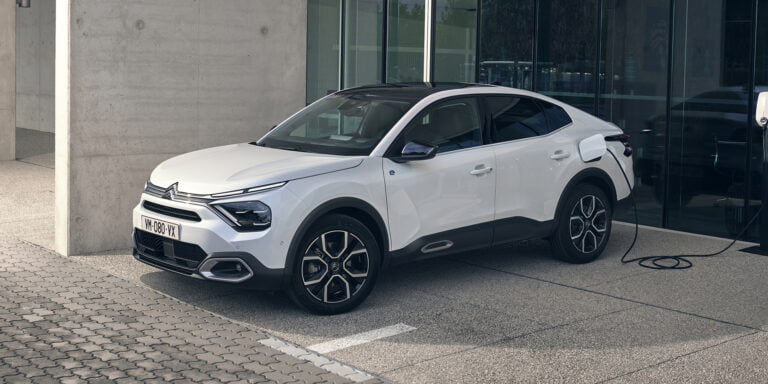
Using a similar fastback formula as the C5 X that launched earlier this year, the Citroën ë-C4 X will arrive on UK roads in 2023, with a 136hp electric powertrain that can travel over 200 miles from full charge.
Sitting somewhere between a conventional car and a crossover/SUV vehicle, this new model is essentially a fastback saloon version of the Citroën ë-C4 crossover. The ë-C4 and the new ë-C4 X share the same front end styling, and have the same cabin length, but this fastback model has a sloping roofline leading to a larger rear overhang.
More rear overhang means that the ë-C4 X has more boot space – 130 litres more to be exact, 510 litres of boot space in total. There is also an extra 39 litres of storage space in cubbies dotted throughout the cabin.
The car’s rear end features a few design revisions, with arrow-head tail lights sitting below a small ducktail spoiler.
Getting behind the wheel, the car’s interior is the same as the ë-C4 crossover, apart from the slightly lower roofline in the rear. To make up for the reduction in rear headspace, the seats in the back have been reclined by more than 25 degrees.
The dashboard has the same layout and fixtures, including a ten-inch infotainment screen in the centre of the dash, which sits next to a digital instrument cluster positioned behind the steering wheel.
While this infotainment touchscreen is the same, the software it uses is more advanced than what you would find in the regular ë-C4. First unveiled with the launch of the C5 X, this infotainment system has a digital assistant feature that allows you to control some of the car’s functions with voice commands. The cabin is equipped with four USB sockets for device charging, two in the front and two in the rear.
Citroën’s ‘Advanced Comfort’ seats, which are designed with more padding and lumbar support for ‘optimal driving comfort’, come as standard.
Like its crossover sibling, the Citroën ë-C4 X is powered by a 50kWh battery mated to a 136hp electric motor – the promised battery range being 223 miles from full charge. Citroën says that it will also be manufacturing petrol and diesel versions, but only the all-electric version will be heading to the UK.
The fastback can reportedly complete a 0-62mph sprint in just under ten seconds, and its top speed is capped at 93mph. Three driving modes are available – ‘Eco’, ‘Normal’ and ‘Sport’ – activated by a mode selector on the centre console. Eco mode prioritises efficiency, Sport mode increases performance output, and Normal mode balances the two.
Citroën has not released any pricing or detailed specification information as of yet – this will be released closer to the car becoming available to order early next year.
On sale since 2021, the Citroën ë-C4 crossover is currently priced at £29,995, praised by the motoring media for its interior quality and 100kW charging ability. With a current Expert Rating of 71%, it is a long way behind the best medium EVs like the Kia EV6 and Hyundai Ioniq 5.
Lexus has announced that its ES saloon is set to receive another infotainment upgrade, among other tweaks, as part of a minor model update that will go into production this year.
This will be the second update that the ES has received in the last 12 months, after the car was given a larger mid-life facelift in October last year, consisting of cosmetic changes, interior trim additions, suspension updates and a bigger 12-inch infotainment screen on the dashboard.
This time around, Lexus has upgraded the software that this infotainment system runs on. Described as “confusing” by many motoring outlets around the time of the saloon’s UK launch in 2019, Lexus promises that this revised multimedia console is more responsive and intuitive than before.
A cloud navigation feature now comes as standard, which provides real-time road and traffic information, and displays information on local fuel prices and parking. The manufacturer also says that it has improved the voice recognition of the on-board assistance feature – activated by saying “Hey Lexus”.
Apple CarPlay is wireless, but if you use an Android smartphone then you’ll still need to plug it in to use the Android Auto feature.
The infotainment update allows the vehicle to communicate with mobile networks and the internet, meaning that the car can connect to Lexus’ ‘e-Care’, an online diagnostic service for drivers in the event that something goes wrong.
This also means that Lexus can monitor the condition of your ES from afar, and also means that the driver can use a smartphone app to lock or unlock the doors, operate the hazard lights and set the air conditioning before driving.
This minor refresh comes with revisions to the centre console below the infotainment screen – Lexus has ditched the trackpad multimedia control next to the gearstick in favour of two cup holders and USB ports for device charging.
Other than these revisions and an additional sand-coloured interior colour scheme, the powertrain, specs and styling of the ES remains the same. Lexus has also announced that a new range-topping trim, the ‘F Sport Design’, will be added to the ES range when this update goes into production in August – but there is not much information on this new trim as of yet.
With a current Expert Rating of 66%, consumer titles have rated the Lexus ES highly for its build quality, comfort and refinement, while performance-oriented titles have criticised its driving dynamics.
Planning for that next family holiday can often be an overlooked aspect of car leasing.
As we prioritise our car search to find a family-friendly school runner or an efficient company car, many questions can get left unanswered when it comes to travelling abroad.
You may be wondering, “Can I take my lease car to another country?”. The answer is, “Yes, you can.”
But there are a few things that you’ll have to do before you set off. You’ll need to prove to the authorities that you have the right to take your car out of the country. Without the correct documents, you could face delays or risk being sent back to the UK.
You need to ensure that you have your full UK photo card driving licence with you when driving abroad. You need to be able to produce one for inspection if you’re stopped and challenged by the police.
If you were taking a car you owned outright abroad, you would need to take your V5C document with you, also known as the vehicle logbook. The V5C contains important details about registration and provides details of the registered keeper.
With a car lease, your finance provider keeps the V5C because they are the registered keeper of the vehicle. Therefore, you would need to contact your finance provider beforehand to get permission from them to take the lease vehicle abroad.
Additionally, if you need help or have any questions, you can ask your lease provider and they’ll guide you into the right direction.
You wouldn’t be given the original V5C document, instead, your finance provider will issue you with the VE103 and VE103B documents.
The VE103 document is a certificate that provides proof that you can take your lease vehicle out of the UK. The VE103B, also known as the Vehicle on Hire certificate, replaces the V5C and will confirm the name and address of the person leasing the vehicle, as well as the length of the lease contract. This verifies that the person driving the vehicle has been given permission from the asset owner to drive the vehicle, therefore it is a very important document.
You could also be given a letter of authorisation. While this isn’t a compulsory thing, it might be quite helpful as an extra document for peace of mind. You can request this along with the other documents from your finance provider. Now, all you need to do is hit the road and enjoy the sun!
Carparison’s best car lease deals can suit your every need. Contact their leasing specialists at www.carparisonleasing.co.uk for more information.
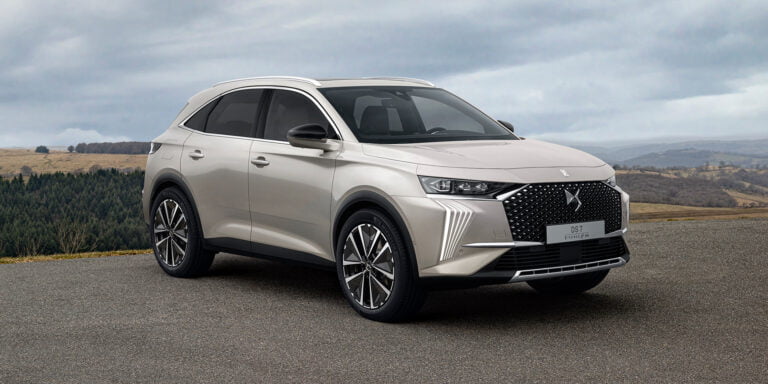
Boutique French brand DS Automobiles has updated its mid-sized SUV range – along with a minor name change. The DS 7 Crossback is now simply the DS 7.
This facelift includes lightly revised styling, an infotainment system update and an additional range-topping plug-in hybrid model with the catchy name of ‘DS 7 E-Tense 4×4 360’.
The changes begin with the DS 7’s revised exterior styling, which are most obvious at the front and include narrower LED headlights, new daytime running lights and a larger grille.
The rear lights have also been slimmed down, while the old ‘Crossback’ lettering actoss the tailate has been replaced by ‘DS Automobiles’ branding instead. New 19-inch wheel designs are said to be more aerodynamic, while the top-spec 4×4 360 plug-in hybrid model gets 21-inch wheels as standard.
Interior updates are mainly limited to a new infotainment system, controlled through an updated 12-inch screen with a higher resolution and voice recognition. This sits next to a larger digital instrument cluster behind the steering wheel. Additionally, there are new leather trims with different stitching and embossing patterns for the various trim levels.
While the pre-facelift DS 7 Crossback range included traditional petrol and diesel powertrains as well as ‘E-Tense’ plug-in hybrid variants, it seems that the pure petrol engines have been removed as part of the update – the range now consisting of three petrol/electric plug-in hybrid choices and a 130hp turbo diesel variant.
The 225hp front-wheel drive ‘E-Tense 225’, and 300hp four-wheel drive ‘E-Tense 4×4 300’ plug-in powertrains were available before the update, but both now feature a larger 14kWh battery to increase the electric range to around 40 miles.
The range-topping model, dubbed the ‘E-Tense 4×4 360’, is a new entrant. This higher-performance model uses the same components as the ‘300’, but has been tweaked to produce an extra 60hp. The package also includes some chassis and suspension changes.
DS will begin taking orders for the updated DS 7 range in August, with the first models arriving in DS showrooms from September. All the UK pricing and specification information will be available in coming weeks.
Praised for its comfort and quality, but criticised for an uninspiring driving experience, the current DS 7 Crossback has been on sale in the UK since 2018. Its current Expert Rating of 58% puts it in the bottom half of the mid-size premium SUV class, with a score that is a long way behind the class-leading Audi Q5 and Volvo XC60.
Consumers are being short-changed by car manufacturers when it comes to the cables supplied as standard with electric cars, according to new research by The Car Expert.
The research puts a spotlight on the need to standardise charging cables to make switching to an electric car as smooth as possible.
The Car Expert’s investigation, which included 22 of the UK’s most popular electric cars, reveals how some car manufacturers provide cables as short as 3.8 metres as standard – shorter than the length of the car in question, rendering them insufficient in many scenarios.
With on-street charging set to grow rapidly in coming years, a large percentage of EV cables currently supplied as standard are impractical for public charging where a tethered cable is not provided.
Additionally, the analysis found that certain manufacturers are effectively forcing customers pay upwards of £600 for higher specification charging cables to replace the inadequate standard cables, a significant extra cost when electric cars are already substantially more expensive than their petrol or diesel counterparts.
“If we want to encourage the switch to electric cars, manufacturers need to provide adequate cables as standard and reduce the cost of expensive cable replacements, particularly as consumers can no longer benefit from the financial advantages of the Government plug-in hybrid grant,” commented Stuart Masson, Editorial Director at The Car Expert.
“It sounds obvious, but your cable needs to be long enough to reach from the charger to the car, however some car companies are still failing to meet this basic requirement.”
Many EV cables were also limited in how rapidly they could transfer electricity from the grid to the car, causing charging times to be longer than outlined by manufacturers.
Most residential and commercial properties can supply electricity to charge an electric car at a rate of 7kW to 22kW. However, the study showed that many cables provided as standard are only rated at between 2.3kW and 11kW.
Manufacturer websites and brochures were found to be unhelpful or even misleading when it came to charging cable information, leaving potential buyers without the knowledge of what cable would be provided and whether it would meet day-to-day requirements.
“What was most striking to us is how difficult it is to get useful information out of car companies about EV charging, with some of the manufacturers we contacted even providing incorrect information. This creates confusion for customers trying to work out whether an EV could be suitable for their needs,” said Stuart Masson.
As a result of the findings, The Car Expert is calling for the industry to adopt a minimum standard for cable length and charging capacity: “We recommend that all new electric cars come with a Mode 3, Type 2 charging cable of at least 6 metres in length and able to charge at a minimum of 22kW.
“It will give customers the best possible outcome as well as making EVs future-proof against improved charging infrastructure. This is an easy win for car buyers that the government can implement immediately.”
The Car Expert was not alone in its call for standardisation across the industry, with subscription provider Mycardirect also frequently disadvantaged by sub-standard cables arriving with new electric cars.
“We are all too aware of the current situation and the confusing information on EVs to the consumer. EV manufacturers and the changes to government grants and taxation policies are certainly not helping consumer confidence, with no agreed standard, even on the simple elements such as a charging cable,” commented Duncan Chumley, CEO at Mycardirect.
“We have seen the EV penetration into the Mycardirect fleet grow to 28% – which is double the UK market EV penetration of 14% – however, my sympathies lie with those drivers trying to navigate the issue on their own. The call for standardisation is definitely timely.”
As sales of electric cars boom, The Car Expert has applied its unique, data-driven Expert Rating Index to all cars currently available in the UK. The top five electric cars on sale according to the unbiased rating system are the Porsche Taycan, Kia EV6, Mercedes-Benz EQS, Hyundai Ioniq 5 and Kia e-Niro.
Founded in 2011, The Car Expert is the UK’s most comprehensive automotive consumer advice site. With an audience of over two million readers a year, The Car Expert provides independent and impartial advice on every aspect of buying, financing, owning, and selling new or used vehicles.
The Rotten Tomatoes equivalent for the automotive world, The Car Expert consolidates reviews from 30 of the UK’s top automotive websites to create the Expert Rating Index. Bringing together science and data analysis, the index calculates a weighted average to give an aggregated score – Expert Rating – that is comparable across different brands and models.
The Expert Rating Index factors in the age of each review, so that newer reviews carry more weight than older reviews. It also breaks down the complex web of different scoring systems that various websites use in their reviews.
The Car Expert has logged over 10,000 reviews covering more than 400 cars and over 50 manufacturers, with its Expert Rating Index now trusted as the gold standard for rating and ranking new cars in the UK.
For media enquiries, please contact Performance Communications:
The Car Expert is calling for a new standard to be set for EV charging cables, amid concerns that car manufacturers are short-changing customers with cables that are too short and too slow.
As part of the goverment’s announcement earlier this month that it was scrapping the plug-in car grant, it said that it would be diverting funds into improving the counrtry’s public charging infrastructure. With that in mind, it seems timely to introduce a suitable minimum standard for charging cables to make life easier for electric car owners.
As it stands, there is no clear standard as to what charging apparatus is supplied with every new car. The Car Expert is calling for this to be changed. This follows detailed research we have carried out into the wide range of power leads supplied by car makers. Now we’re asking for standardisation across the range to make owning an electric vehicle simpler and more practical.
“What was most striking to us is how difficult it is to get useful information out of car companies about EV charging. This creates confusion for customers trying to work out whether an EV could be suitable for their needs,” said Stuart Masson, editorial director at The Car Expert.
“This situation is bewildering and it can be very difficult to even get the information at all. We tasked two people with finding out what cables come standard with every new EV on sale in the UK and it proved to be a genuinely difficult exercise. We also had press offices and dealership staff giving out different information from their company websites or brochures, suggesting that many people within the car companies don’t even know what they’re selling.”
“What was less surprising is that some car manufacturers are short-changing their customers by providing EV cables that are too short to be practical and, in many cases, the cable provided also isn’t up to the job in terms of kilowatt capacity.”
“It sounds obvious, but your cable needs to be long enough to reach from the charger to the car, and some car companies supply cables that are too short.
“And as on-street charging infrastructure becomes more common, with lamp-post charging and other innovations, we need to make sure that the cables supplied with EVs can take advantage of every last kilowatt so car owners spend less time waiting for their cars to charge up.
The Car Expert recommends that all new electric cars should come with a Mode 3, Type 2 charging cable of at least 6 metres in length and able to charge at a minimum of 22kW.
If additional cables are supplied, it should be made clear exactly what they are in all website and brochure information.
“This is an easy win for car buyers that can be implemented immediately,” said Stuart Masson. “The government has said that it wants to improve charging infrastructure for EVs, and this is a simple way of removing one of the obstacles for prospective EV customers. Make car companies supply the right cables, and make sure they’re long enough to do the job.”
Misleading advertising?
In their advertising and press packs, some manufacturers make big claims of their cars’ ability to charge at superfast charging speeds such as 150kW. But that requires a charger and cable to deliver electricity at that rate, which are only found at selected public charging points.
If you’re charging at home, you’re still only going to get the standard charging rate of somewhere between 7kW and 22kW if you’re using a wallbox, or less than 3kW if you’re connecting to a three-point plug.
Car companies also tend to quote very favourable charging times, which are again based on public charging points that can supply electricity faster than a home setup – and, again, it assumes that the cable can cope with that level of performance.
The Car Expert has found that many electric cars don’t even have cables that allow them to take advantage of a fairly common 22kW charge point, making it impossible to achieve that rate of charge unless the customer buys an additional – and expensive – extra cable. Instead, most cars come with a more basic cable that lacks the ability to charge at anything like the claimed maximum rates.
As we move forward into a brave new EV world, the cable you get with your car should be able to take advantage of more rapid charging speeds that will soon become more widely available from on-street charging points.
Cable length is an unreported hassle
The length of cable offered is rarely mentioned in the motoring media, but many car manufacturers are offering sub-par solutions here as well and it creates annoyance for customers.
Most cables supplied with new EVs are no more than about 5m long, and some less than 4m metres. Given that the average car is about 4.5m long, it requires drivers to be parked right next to a charging point (and with the car facing the right way round) for the cable to reach from the wallbox to the vehicle because it’s not long enough to go around the car.
For households that have more than one car – and that’s millions in the UK – it could reduce home parking flexibility if they are constantly having to move cars around in the driveway to make sure their EV can connect to the charging plug. Similarly, as we start to see households with more than one EV in the driveway, you want the cable to be able to reach either car without having to shuffle them around.
Universally speaking
If we want to help customers adapt to an EV society, it’s essential that any cable can charge any car at a reasonable rate. Given that charging time is a key hurdle in EV adoption, supplying cars with cables that don’t allow faster charging is undermining industry attempts to attract hesitant customers.
Chris Montgomery, director of cable supplier EV Chargers Direct, is also calling for consistency across the board.
“There should be some sort of standardisation,” he says. “I believe if manufacturers are to include only one type of cable it should be a Mode 3 cable. This would allow all drivers access to charging, whether that be at home, from a domestic charge point or in public, for instance a supermarket charge point.
“If only a three-pin charging cable is supplied, often this would not be useful for someone who doesn’t have off-street charging, as they would have nowhere to plug it in. I think it would be best for manufacturers to supply a five or six metre, Mode 3 cable matched to the car’s abilities. So 7kW in most cases, or a 3-phase 22kW cable if the car can charge that fast.”
And, if standardisation was brought in, Mode 3 would be the cable of choice for one of Britain’s biggest motoring organisations, the RAC.
“We would like to see all new EVs supplied with a Mode 3, Type 2 AC cable which would let them use public AC 7-22kW charge points,” said an RAC spokesman. “While we don’t believe the Mode 2, three-pin domestic cable is essential, we would like to see manufacturers provide their customers with one for emergency back-up use.
“We feel drivers would like this for peace of mind reasons. But it’s important to note that these cables tend to be more expensive as they feature a safety control unit which communicates with the car to turn off charging.”
Duncan Chumley, CEO at subscription provider Mycardirect (a commercial partner of The Car Expert), said: “We are all too aware of the current situation and the confusing information on EVs to the consumer. EV manufacturers and the changes to government grants and taxation policies are certainly not helping consumer confidence, with no agreed standard, even on the simple elements such as a charging cable.
“We have seen the EV penetration into the Mycardirect fleet grow to 28% – which is double the UK market EV penetration of 14% – however, my sympathies lie with those drivers trying to navigate the issue on their own. The call for standardisation is definitely timely.”
The Car Expert believes that a minimum standard now must be considered.
“The car companies are unlikely to agree on this themselves, so the government needs to make it a requirement for the benefit of consumers,” said Stuart Masson.
“If car manufacturers want to supply additional cables for ultrafast charging, then that’s great but there needs to be a consistent minimum standard across the industry. And advertised charging times need to be based on that standard cable, not one that costs hundreds of pounds on top of the car.”
Cables provided as standard with popular new electric cars
We analysed the charging cables supplied as standard for more than 20 of the UK’s most popular new electric cars. The results below are based on information provided on car company websites or brochures, or provided directly by the manufacturers.
In several cases, the information is incomplete because the information was not readily available on any company material and the car company press offices hadn’t responded to our requests for this data.
Brand
Model
Expert Rating
Cable(s) type
Cable length
Charging rate
Audi
e-tron
72%
Mode 2 Mode 3
6m 4.5m
2.3kW 11kW
Audi
Q4 e-tron
76%
Mode 2 Mode 3
6m 4.5m
2.3kW 11kW
BMW
i3
73%
Mode 2
5m
?kW
BMW
i4
84%
Mode 2 Mode 3
5m ?m
?kW 11kW
BMW
iX3
75%
Mode 2 Mode 3
5m ?m
?kW 11kW
BMW
iX
78%
Mode 2 Mode 3
5m ?m
?kW 11kW
Citroën
ë-C4
71%
Mode 3
?m
?kW
DS Automobiles
DS 3 Crossback
59%
Mode 3
?m
?kW
Fiat
500e
70%
Mode 2 Mode 3
4.5m 3.8m
2.3kW 11kW
Ford
Mustang Mach-E
77%
Mode 2 Mode 3
?m ?m
?kW ?kW
Honda
e
67%
Mode 2
?m
2.3kW
Hyundai
Ioniq 5
86%
Mode 2 Mode 3
?m 5m
?kW 10.5kW
Hyundai
Kona Electric
78%
Mode 2 Mode 3
?m 5m
?kw 10.5kW
Jaguar
I-Pace
85%
Mode 2 Mode 3
?m ?m
?kw ?11kW
Kia
e-Niro
85%
Mode 3
5m
10.5kW
Kia
EV6
87%
Mode 3
5m
10.5kW
Mercedes-Benz
EQA
60%
Mode 3
5m
11kW
Mercedes-Benz
EQB
67%
Mode 3
5m
11kW
Mercedes-Benz
EQC
71%
Mode 3
4m
?kW
Mercedes-Benz
EQS
86%
Mode 3
5m
?kW
MG
ZS EV
62%
Mode 3
?m
7kW
Mini
Electric
67%
Mode 2
6m
2.3kW
Nissan
Leaf
72%
Mode 3
6m
7kW
Peugeot
e-208
76%
Mode 3
6m
7kW
Polestar
2
78%
Mode 2
7m
2.3kW
Renault
Zoe
62%
Mode 3
6.5m
22kW
Skoda
Enyaq iV
84%
Mode 3
6m
135kW
Tesla
Model 3
85%
Mode 2 Mode 3
4m 6m
2.3kW 7.4kW
Tesla
Model Y
82%
Mode 2 Mode 3
4m 6m
2.3kW 7.4kW
Vauxhall
Corsa-e
65%
Mode 3
6m
22kW
Vauxhall
Mokka-e
72%
Mode 3
?m
?kW
Volkswagen
ID.3
77%
Mode 3
6m
11kW
Volkswagen
ID.4
70%
Mode 3
?m
11kW
All data sourced from manufacturer websites and press offices as of June 2022
The Nissan Juke has certainly been a success story. Since the first model was launched in 2010, UK sales of the British-built Juke have topped 340,000 over two generations.
In terms of critical appeal, the results have been more mixed. The current second-generation model holds an Expert Rating of 65%, which is in the top half of its class but a long way behind the class-leading Ford Puma. It is, however, a significant improvement over the original Juke, which finished its production run with a very poor Expert Rating of less than 50%.
Meanwhile Nissan has built a reputation over the last decade for its move into electric vehicles (EVs) with the well-received Leaf. So perhaps it’s a surprise that Juke and some sort of electrification have not previously been combined.
Well now that has been put right – sort of. The vehicle here is not a full-electric Juke, but a hybrid. And perhaps it’s not surprising, given Nissan’s propensity to carve its own path, that this is no typical hybrid. If you are used to the kind of petrol-electric motoring provided by, say, a Toyota Prius or a Honda CR-V, then you will find driving the Juke a whole new experience.
The clue is in the title – there are slight visual tweaks, new alloy wheels, new paint shades and a couple of equipment upgrades that extend to keyless entry and a better Bose sound system with an extra pair of speakers. But the whole point of this car is its engine, a petrol-electric hybrid unit promising more pace for less fuel and fewer emissions too.
The Juke Hybrid looks mostly just like any other Juke. When the current second-generation version was launched in 2019 it offered rather smoothed-out styling compared to its predecessor, the visuals of which had divided opinion.
The car gets the latest iteration of the Nissan logo design on its badge, and this sits on a grille mesh that has also been redesigned – subtle ‘Hybrid’ badges are also dotted about the car. The new colour schemes are dubbed ‘Magnetic Blue’ – chosen as the hybrid launch colour – and ‘Ceramic Grey’.
Both the 17-inch and 19-inch alloy wheels get new design options too. The larger wheels fill the arches better from a visual point of view but one would expect a less compliant ride from such big rims – but hold that thought…
What’s the spec like?
The overall Juke range has five trim levels, but hybrid models are only available in the top three. You will need £27,250 for an N-Connecta, which is £1,730 more than a petrol-engined variant with an automatic transmission (nearest equivalent to the hybrid) and £3,230 more than cars with the five-speed manual gearbox.
Equipment at N-Connecta level includes Nissan’s Connect navigation system (offeringTom Tom traffic alerts and a suite of phone app-based services such as finding where you parking it and remotely locking your doors), keyless entry, leather on the steering wheel and gear knob, automatic climate control and auto wipers.
Pay another £1,500 for the Tekna and the alloys grow to 19 inches while additions include LED front lights and a heated screen and front seats, plus that Bose sound system with ten speakers instead of the previous eight. But perhaps the most important Tekna element is the Advanced Safety Shield Pack, a range of active safety measures including intelligent cruise control, blind spot intervention, a rear cross-traffic alert and the clever monitor that gives a view around all sides of the car. The Juke, by the way, was last crash-tested by Euro NCAP in 2019, earning a top five-star rating.
Range-topper is the Tekna+, another £1,400 buying a different design of 19-inch alloys and a suite of personalisation options outside and inside, including two-tone metallic paint.
What’s the Nissan Juke Hybrid like inside?
If you have driven the current Juke in normal petrol form then you won’t notice anything different on stepping into this one, except directly ahead of the driver. A new digital display sees the rev counter make way for a dial showing when the car is at power, in ‘eco’ cruising mode or charging the battery. And pressing a button brings up an ‘energy flow monitor’, giving a visual representation of which way power is flowing between engine, battery and wheels at any one time.
Otherwise, it’s all the same as before. The driver’s controls are reasonably intuitive while the finish and the surfaces are adequate, if not up to the level of rivals from the likes of Volkswagen. It’s relatively roomy for a smaller SUV, if a bit cosy from three adults in the back. And note, too, that the need to accommodate the hybrid battery does cut the boot space, from 422 to 354 litres.
What’s under the bonnet?
This is where the new Juke gets interesting. Its hybrid drivetrain was first seen in the Captur E-Tech from sister brand Renault. A more compact 1.6-litre petrol engine is combined with an electric motor, while there is a second and smaller electric motor that synchronises the gears in the highly clever gearbox.
We are told that the electronics in control of everything were developed using Renault’s experience gained in Formula One racing. These decide when the petrol engine, electric motor or both should either be contributing to the drive or recharging the battery.
If you are interested in the technical stuff, we have a separate deep dive into that, but the effect is to produce a hybrid car that feels much more like a full battery-electric vehicle to drive – the system tries to drive on electric power alone as much as possible and Nissan’s tech types claim to have achieved 80% of a drive on electric around an urban route.
While doing this, the drivetrain offers more power – 154hp compared to the 114hp of a normal petrol Juke, which takes 1.7 seconds off the 0-62mph time – alongside a promise of improved fuel economy and emissions. We don’t have official government figures yet, but compared to the petrol Juke with auto gearbox Nissan predicts around 10mpg in fuel economy improvements and as much as a 25g/km cut in CO2 emissions.
What’s the Nissan Juke Hybrid like to drive?
A normal hybrid starts in silence, moves away on the electric motor and then very quickly the petrol engine audibly cuts in – travel is then typically obviously on the engine with short bursts of electricity, usually at slow speeds.
The Juke Hybrid also starts and moves away in silence on its electric motor, but the only way of telling when the engine joins in is to watch the energy monitor on the dash – it’s really that smooth. Thereafter the three elements, engine, motor and battery, work together, but you can never tell which is doing what, or when.
It’s reasonably potent, more so than the stock petrol model, though there does seem to be a very slight delay when one kicks down for rapid acceleration. But then it gains speed strongly with invisible gear changes.
An interesting addition is the ‘E-Pedal’. Activated by a button between the front seats, it effectively increases the battery regeneration that occurs when decelerating by applying moderate braking as soon as one’s foot is taken off the accelerator – leave it alone and it will bring the car to a halt. If you are a smooth driver and not a power-brake-power merchant, it becomes quite easy to drive the Juke as a one-pedal car, only using the brake if you need to stop suddenly.
The Juke has never been known as a sporty handling car for the open road, with city streets being its more natural environment. The Hybrid does nothing to change that, with handling that’s competent without being involving.
Ride quality with the cars on the launch event proved slightly odd – driving first with 17-inch wheels we found the ride quite stiff with road imperfections felt in the cabin, which had us not looking forward to trying the 19-inch rims as typically the larger diameter means the less compliant the ride. Yet the bigger-wheeled Juke seemed more composed and a preferable option.
Verdict
The Nissan Juke remains a popular contender in an ever-more crowded market and this new hybrid version will presumably help it maintain that place. If you find driving a traditional hybrid slightly odd and unpredictable, this one is less so. Should you be keen to go electric but less keen on the price or having to plug your car in and recharge it, then you may well find this car to your liking.
The price is more than a stock Juke, but not so much, especially compared to the auto variant. Combined with the estimated 10mpg improvement in average fuel consumption – especially with current perol prices – and you could find yourself recouping the extra spend fairly quickly.
Similar cars
If you are looking at the Nissan Juke Hybrid, you might also be interested in these alternatives
The Hyundai Kona N was a compact five-door SUV/crossover which is the performance-enhanced version of the standard Kona SUV range, and currently the largest model in the Hyundai ‘N’ family.
First arriving on UK roads in Autumn 2021, the Kona N had a fairly short production life as it was discontinued in late 2023 when the overall Kona range was replaced with an all-new model. At this stage, there has been no announcement about an N version of the new Kona.
The Kona N was powered by a 276hp 2.0-litre petrol engine – the same unit found in the Hyundai i30 N hot hatch. Top Gear claimed that the Hyundai was the “most fun small performance crossover on sale”.
This accolade was slightly hollow when you consider that there weren’t many performance crossovers on the market at the time, and many reviewers stated that the class-leading Ford Puma ST was a better option. Parkers added that the Puma ST was also cheaper.
“You do have to accept a few small sacrifices”, Auto Express argued, “but they’re easy to make for the breadth of ability on offer here – the Kona N is more thrilling than many hot hatchbacks on sale.”
No longer on sale, the Hyundai Kona N holds a Used Car Expert Rating of D, with a score of 59%. As a used car, the Kona N is let down heavily by its high running costs. It’s also not helped by fairly poor media reviews and a safety rating that is now out of date.
Body style: Small SUV Engines:petrol Price when new:From £35,820 on-road
Launched: Autumn 2021 Last updated: N/A Discontinued: Winter 2023/24
Image gallery
Media reviews
Highlighted reviews and road tests from across the UK automotive media. Click any of the boxes to view.
Auto Express
Model reviewed: Score: 9 / 10 “The Kona N is arguably the most appealing N model Hyundai has made yet. It’s civilised enough to use every day, yet on the right road it’s more thrilling than many hot hatchbacks on sale. You do have to accept a few small sacrifices – we’d like a little more practicality, for one – but they’re easy to make for the breadth of ability on offer here.” Read review
Auto Trader
Model reviewed: “The Kona N is the second-ever European Hyundai N model to include an eight-speed dual-clutch automatic transmission. It’s fast, fun and brilliant to drive.” Read review
Car
Model reviewed: Score: 8 / 10 “The Kona N is – for better or worse – able to nail the feel of far smaller, lighter and uncompromising hatchback. But while it has the practicality of a crossover, there’s been no quarter given to ride comfort. Some might call it a one-dimensional, I’d call it a brief, nailed.” Read review
Carbuyer
Model reviewed: Score: 8.4 / 10 “In the Kona N, Hyundai has created another fantastic performance model – one that makes a great alternative to a Volkswagen T-Roc R.” Read review
Carwow
Model reviewed: Score: 7 / 10 “The Hyundai Kona N is a small SUV that majors in exciting hot hatchback handling and performance. Practicality isn’t outstanding though, and it looks dull inside.” Read review
Evo
Model reviewed: Score: 8 / 10 “It’s more than just a badging exercise to cash in on what’s been achieved at Namyang and the Nürburgring with the i20 and i30, it’s a performance crossover that’s rich in ability and credibility.” Read review
Heycar
Model reviewed: “The Kona just isn’t all that spacious or practical given its class positioning, and we’ll let you make up your own mind about the styling. What we will say is the Kona N might not be the consummate all-rounder, but it’s got a real sense of personality and feeling of fun that’s sorely missing in some more expensive hot SUVs.” Read review
Parkers
Model reviewed: Range overview Score: 6.4 / 10 “If you really must have a fast SUV and plan to take it on track, you might want to consider the Kona N. However, it’s just too firm for our liking and not as entertaining as the cheaper, more practical Puma ST.” Read review
The Telegraph
Model reviewed: Score: 6 / 10 “The Hyundai Kona N is an uncompromising small car, and it’s true that out on a smooth racing circuit its rock-hard stance, aggressive diff and stonking power would likely make it feel tremendous. On British roads in the depths of winter, though, it feels just a bit too wild.” Read review
Top Gear
Model reviewed: Score: 8 / 10 “It’s joyously silly. And if you can cope with mildly insatiable thirst and a firm ride, it ought to be more than capable of handling everyday life too. ‘Most fun small performance crossover on sale’ may sound like faint praise, but it’s a title true of the Kona N either way.” Read review
Safety rating
Independent crash test and safety ratings from Euro NCAP
The Hyundai Kona N shares its safety rating with the regular Kona range, which was crash tested by Euro NCAP back in 2017 and awarded a five-star rating.
However, this rating expired in January 2024 and is no longer valid as the car no longer meets the standards required for such a rating. This is normal practice, as Euro NCAP reviews its ratings on most cars annually with most ratings expiring after about six or seven years.
However, if you are comparing a used Kona N to vehicles of similar age, whose ratings will have probably also expired, its safety rating score is still useful.
Eco rating
Independent economy and emissions ratings from Green NCAP
No eco rating
The Hyundai Kona N was not lab tested by Green NCAP during its production life.
Reliability rating
Reliability data provided exclusively for The Car Expert by MotorEasy
No reliability rating
As of March 2026, we don’t have enough reliability data on the Hyundai Kona N to generate a reliability rating.
The Car Expert’s reliability information is provided exclusively to us using workshop and extended warranty data from our partner, MotorEasy, sourced from both official dealerships and independent workshops.
As soon as MotorEasy has sufficient data on the Kona N, we’ll publish the score here.
Running cost rating
Monthly cost of ownership data provided exclusively for The Car Expert by Clear Vehicle Data
Fuel consumption
Average
Score
Petrol models
33 mpg
D
CO₂ output
Average
Score
Variation
Score
Petrol models
194 g/km
D
Insurance group
Average
Score
Variation
Score
All models
27
C
Service and maintenance
Cost
Score
Year 1
£324
D
Year 2
£762
D
Year 3
£1,192
D
Year 4
£1,385
D
Year 5
£1,775
D
Overall
£5,438
D
The Hyundai Kona N is a relatively expensive car to own and run, according to whole-life cost numbers provided exclusively to The Car Expert by our data partner, Clear Vehicle Data.
The biggest bill for any car owner is usually petrol, and the Kona N is very thirsty. While this is not that surprising, given that it’s a performance model, it still means that you’ll be shelling out regularly to fill up the tank.
Insurance costs shouldn’t be too bad, while servicing costs are fairly average.
Similar cars
If you’re looking at the Hyundai Kona N, you might also be interested in these alternatives
Nissan has finally electrified its Juke – from the end of July, a hybrid version of the successful small SUV will be on UK roads. “So it will be just like any hybrid?” one of our fellow motoring writers asked at the launch, and the answer is not at all…
The petrol-electric powertrain fitted in the Nissan Juke is quite different to those you might find in other models such as the standard-bearer of hybrid driving, the Toyota Prius. Instead the Nissan uses technology first seen in sister brand Renault’s Captur and dubbed E-Tech, which both brands insist is rather more efficient.
Either, or both…
Hybrids are normally one of two types. In a parallel hybrid (which is most hybrid vehicles on UK roads), both the electric motor and the engine can drive the wheels, usually working together. In a series hybrid, the wheels only receive their propulsion from the electric motor, with the petrol engine merely being there to generate the electricity to power the motor. The Nissan Juke unit, however, can work in series, parallel or both…
We are told the system was developed using technology developed by Renault’s Formula One team and for the first time is based around an internal combustion engine specifically developed with hybrid in mind. It’s a more compact version of a Nissan 1.6-litre unit, combined with a 36kW electric motor also made by Nissan, while Renault’s contribution is the 15kW high voltage starter/generator, the inverter and the 1.2kWh water-cooled battery, which is housed under the boot floor.
All this adds up to rather more potency – 25% up on a typical petrol-powered Juke. We don’t have confirmed fuel economy figures yet, but Nissan reckons that the Juke should return combined fuel consumption improved by up to 20% – 40% if running around town.
Two motors better than one
Where the Juke gets particularly clever compared to a typical hybrid is that it has a second, smaller, electric motor in its gearbox, another Renault item. This gearbox has no conventional synchroniser rings, but dog clutches instead, and no proper clutch as in a conventional car. But these are the elements that enable rather more efficiency.
There are four ‘internal combustion’ (ICE) gears and two ‘electric vehicle’ (EV) gears, and the latter are powered by that second electric motor, sending their propulsion through a different path to the wheels than do the ICE gears – the Juke always starts using electric power only, and the EV gears are used to synchronise the ICE ones.
Clever electronics – the bit supposedly descended from Formula One – control the shift points, regeneration of the battery and which format of hybrid power will deliver the best efficiency for what the driver is demanding through their right foot. And the input between motor, engine or both is so seamless that the driver simply doesn’t notice the changes.
Confused yet? Well you don’t need to understand the tech, just appreciate what it produces. According to Colin Goldsmith, from the Nissan UK technical department, being behind the wheel of the Juke is much closer to driving an electric car than are more typical hybrids. “It’s a much more connected feel. With a standard hybrid you feel like you are driving an ICE car with the hybrid coming in short bursts, with the Juke you get that EV feel all the way through.”
Goldsmith adds that the car always starts in electric mode; “There is then a transition when the system determines that the ICE engine should join in, to give you more power or more drive, while it will also determine if the battery charge is dropping and direct some charge to the battery.
“All this is done by the system and you won’t feel the cutting-in of the engine like you do with a normal hybrid. Effectively it feels like you are driving a normal automatic car – you put your foot down and it drives.”
Extended electric
A key part of designing the Juke Hybrid was maximising the time the car spends in EV mode, and the designers claim to have achieved up to 80% of an around-town drive powered by electricity. Your mileage may vary, but the company is confident that this new hybrid system will provide far more electric (and far less petrol) usage in urban driving.
It can reach speeds up to 34mph in EV mode, and you can push a button to only drive on electric, though you won’t go very far, a mile or two, before the engine needs to cut in and replenish the battery. “You can force the EV mode, perhaps to drive through a city centre or a multi-storey car park, but it won’t go so far as to drain the battery,” Goldsmith says.
Also helping to keep the battery topped up is an ‘e-pedal’, previously seen on the fully-electric Nissan Leaf hatchback. While, like most EVs, when the car slows the electric motor acts as a generator and returns some charge to the battery, using the e-pedal maximises this effect. As soon as one lifts off the accelerator moderate braking is applied, and given enough space the car will slow to a halt – it is very easy to drive the Juke as a one-pedal car, hardly ever needing to use the brake pedal.
The figures? Combined the hybrid power unit produces 143hp, compared to 114 for the petrol-powered Juke. This means it completes a 0-62mph sprint in 10.1 seconds, 1.7 seconds faster than the ICE Juke.
Yet while the latter with an auto transmission returns fuel economy of around 45mpg and produces CO2 emissions of around 137g/km, Nissan expects fuel economy of more than 55mpg and emissions down to around 114g/km from the hybrid. We’re still awaiting the official figures but it’s clear the petrol-electric Juke is the greener and more economic option.
“The engine has been optimised to the hybrid system,” Goldsmith says, “developed to have a lower fuel consumption, with lighter weight because the hybrid is more compact. You’ll see much better performance and fuel consumption compared to a normal ICE engine, and compared to a conventional hybrid you will see improvements but the level will depend on driving conditions and style.”
So does Goldsmith see this as the future of hybrid? “It’s one – there are a range of ways of electrifying cars and we have the Nissan e-Power system in the Qashqai as well as the excellent electric system in the Leaf. But the new hybrid is a very good solution and a definite step forward.”
The global supply shortage caused by the Covid-19 pandemic has put a strain on the new car market for almost two years now, but that is not the only knock-on effect. A shortage of car parts has led to a rise in car thefts in the UK – as we recently reported on The Car Expert, vehicle thefts in Britain in the last twelve months have surpassed 90,000.
Your car is likely to be one of the most valuable things you own, so what steps should you take to defend it against criminals? In truth, the most effective ways to deter criminals can be pretty costly, such as storing your car in a locked garage or fitting an expensive security camera to the side of your house, due to the myriad of headaches they cause for thieves.
That said, the large majority of car thefts in the UK are opportunistic in nature – criminals will look for an easy target that they can quickly steal – and if you park on your driveway or on the street, there are plenty of simple steps and relatively inexpensive products you can buy that are likely to convince potential criminals to keep on walking.
Unsurprisingly, the most commonly stolen cars in the UK are also some of the biggest-selling new cars, as well as some of the most aspirational. Although all new cars come with a level of anti-theft kit, like immobilisers and deadlocking doors, it’s still not enough to prevent a determined criminal.
Simple steps to deter car thieves
Let’s start with the basics, and some effective tips that you can put into action right now:
Park in a secure and well-lit area if possible Where you choose to park can really make all the difference. Parking your car in an illuminated area can be a good deterrent, so keep an eye out for parking spaces on your street with an overhead street lamp, or perhaps line your driveway with some low-maintenance solar lights to increase the chance that potential thieves can be spotted.
Turn your car’s front wheels into the kerb Parking your car in a position where it is not as easy for potential criminals to make a speedy getaway is another simple but effective deterrent. If a thief does manage to gain entry, the extra manoeuvring you have made them do could give you a few crucial seconds to get a good look at them and call the police.
Double-check your car is locked Whether you use a key fob or a manual key, it is a good idea to make sure your car is locked by trying the door handles each time you park up. Even if your car has given you a headlight flash or an audible click to tell you it’s locked, some thieves use ‘jammers’ to intercept the signal between the fob and the car, leaving the car unlocked and vulnerable.
Take your valuables with you A thief doesn’t necessarily want to steal your car – they might just be looking for a quick smash-and-grab of whatever you’ve left on the front seat. Even some loose change can give criminals the required motivation to target your car. If you’re particularly worried about car thefts in your area, it’s also a good idea to remove the rear parcel shelf to show that there’s nothing valuable in your boot.
Store your car’s documents at home The glovebox may seem like a good place to keep your car’s logbook or service records, but storing these documents in your vehicle makes it easier to sell on if it’s stolen. This can also make you a victim of identity fraud, so don’t leave any other identifying documents in your car either, like bank statements or your driver’s licence.
Keep a lookout for suspicious tow trucks Some professional thieves operate by hooking your car up to a tow truck and driving away, then breaking into the vehicle somewhere more private. Keep an eye out for unbranded tow trucks parked on your street, driven by people in casual dress. If you do spot something like this, report it to your local police ASAP.
Keep your keys in a tin box If you’ve just finished off a tin of biscuits from the cupboard, you can use the empty tin – or any similar metal box – to protect your car from criminals. It may seem like a simple idea to hide your keys from sneaky thieves, but it’s actually a really useful way of protecting your car from a relay attack. What’s a relay attack, you ask? Read on…
Relay attacks and how to prevent them happening
Many modern ‘keyless’ car keys emit a near-continuous signal to alert the car that it’s nearby, allowing you to open the door and start the engine without pulling the key out of your pocket. That’s quite convenient, but it also presents a problem.
These keyless entry cars are vulnerable to a particular theft tactic called a relay attack, where one thief uses an inexpensive electronic device to capture the signal from a nearby car key (even if it’s inside your house) and relay it to another thief with another relay device who is waiting by your car. This tricks the vehicle into thinking the key is present and allows the thieves to unlock and potentially start it.
Therefore, it’s always a good idea to keep your key fob – and the spare – as centrally as possible inside your house, rather than close to doors or windows, so that relay thieves have difficulty reaching the fob’s signal. Or, as suggested above, you can shield the fob’s outgoing signal when you’re at home by placing the key in a covered tin box or a specially-designed faraday pouch.
You can also turn this keyless entry feature off. If you can’t find instructions for this in your car’s manual then contact your local dealership, who should be able to help.
Hanoi burglary Named after a police operation to combat such a burglary, this is where criminals gain access to your home using brute force to steal your car keys and make a quick getaway. It is actually a fairly common tactic in the UK, and can be disrupted by keeping your car keys in an inconspicuous locked drawer.
Turbo decoder theft Thieves are known to buy turbo decoders traditionally used by blacksmiths to target cars with manual door locks. It is essentially a skeleton key that aligns to the shape of the empty keyhole to unlock the door.
Transponder key cloning This type of theft can happen if thieves manage to get hold of your keys when it is at the local garage for repairs or at the car wash. The key is cloned, returned to the victim, and the car is stolen later when parked at home.
Handy purchases that improve your car’s security
Motion detector
Where: On your driveway or across the pavement from your car Average price: £15 – £30
These inexpensive systems which monitor movement can alert you to any suspicious activity around your car in real time. However, they are prone to false alarms, either from passing pedestrians, your pets or strong wind.
Faraday pouch
Where: A key pouch that blocks your car key signals Average price: £5 – £9
Storing your keys in these pouches at home greatly decreases the chance of your car being stolen in a relay attack by blocking your key fob’s signal. You can store other valuables in the pouch too, and they are easy to carry when you are out and about too. Faraday pouches are only really useful for those with keyless entry cars however.
Steering wheel lock
Where: Across your car’s steering wheel Average price: £30 – £50
Fitting a steering wheel lock whenever you park will certainly make thieves think twice about targeting your car. They are a visual deterrent for opportunistic criminals, and seriously delay thieves who do manage to gain entry to your car. If a thief gets your car started and attempts to drive off, they won’t be able to manoeuvre the car, making the attempted theft pointless.
Steering wheel brake lock
Where: Hooks behind the car’s brake and the bottom of the steering wheel Average price: £30 – £50
This device is essentially a metal hooked cane that stops thieves from being able to drive the car if they have gained entry. They are sturdy and very hard to remove at short notice.
Universal wheel lock
Where: To your car’s front wheel Average price: £30 – £60
While it might make your car look like it’s been impounded and prompt a few surprised looks from your neighbours, a universal wheel lock fitted to one of your car’s front wheels is a great visual deterrent that’s sure to give any would-be thief a headache. It will delay your daily commute, however, so perhaps this device is best for the car on your driveway that you rarely take out for a spin.
GPS tracker
Where: Hidden inside the car, preferably somewhere difficult to get to Average price: £45 – £150
This device is really for after your car has been stolen and it’s on the move. Most trackers on the market will be able to give you the location of your car accurate to ten metres, which helps you to inform the authorities and hopefully retrieve your car before it’s damaged, stripped or simply vanishes altogether.
Removable security post
Where: At the end of your driveway Average price: £40 – £80
These installations are a useful deterrent if you park on a narrow driveway. It does take a bit more legwork than other security options however, these need to be bolted securely to the concrete of your driveway. When installed, the post will stop thieves who have gained entry to your vehicle from reversing out of the driveway, and the post can be folded to the floor before you drive away.
Security window etching
Where: On the windows of your car Average price: £20
This consists of visibly etching all the windows of a vehicle with the logo of the International Security Register (ISR) and a code unique to the vehicle. It’s a good visual deterrent, and also increases the chances of your car being spotted and retrieved should it be stolen.
Anti-theft clutch pedal lock
Where: Underneath the car’s clutch or accelerator Average price: £12 – £25
This is a small metal stand that sits underneath the car’s clutch or accelerator pedal and locks in place, meaning that the pedals can’t be used. This makes the car useless without removing the pedal lock, which isn’t easy without the keys. Unlike a steering wheel lock, however, it’s not really visible so doesn’t have the same deterrence factor.
At some point most car owners will wonder whether some accidental damage seems so small that they are reluctant to make an insurance claim with the extra cost that may add to their next premium.
We’ve put together some things to consider…
Must I tell my insurer?
If an accident is somebody’s else’s fault your insurer deals with it and recovers the costs from the other person if it can be established who that is. It is recorded as a claim on your record. regardless of blame.
But what some minor damage concerns only you? To take a familiar example, let’s say you’ve biffed the post to your driveway coming home. Does this, in the eyes of an insurer, constitute an accident which you have to declare? Or can it stay between you and the gatepost?
We asked the Association of British Insurers (ABI) if there is an accepted definition of what an accident is (in terms of reporting an accident to an insurer). A spokesman said: “While no industry wide defined definition as such, generally it would be an incident that could give rise to a subsequent claim, either from the policyholder or a third party. It puts your insurer on guard where, for example, what appears to have been a minor bump later results in a claim for damage repair/ personal injury from another person.”
He added: “It is sensible to always notify the insurer if involved in an accident, however minor it may be and regardless of whether there is any damage or intent to file a claim. There could be serious consequences such as invalidating a policy for non-disclosure.”
What’s covered?
The legal minimum cover and the cheapest premium is third party only. This covers you against costs that arise as a result of injuries you cause to other people and damage to their vehicles. They will make a claim against you; you don’t decide. But you can’t claim for damage on your own car not involving anybody else. If it’s third party fire and theft you can claim if your car is damaged, stolen or destroyed in a fire.
Comprehensive is the highest level of cover available. It protects against; injuries to other people and damage to their vehicles your vehicle being damaged, stolen or destroyed in a fire, medical expenses and accidental damage, damage or theft of vehicle’s contents. Windscreen and glass cover is included.
With every type of policy, the longer you go claim-free the bigger your No Claims Discount (NCD) will be. NCDs vary from insurer to insurer, but they can be as much as 30% for one claim-free year and 60% for five claim-free years.
If you pay extra to protect the NCD you can make a number of claims without losing it, but the claims must be declared when it comes to a new quote with a new insurer whether or not they impacted on any protected NCD.
Fix or not?
If you are making any kind of claim (regardless of a third party) you may have agreed to pay a voluntary excess when the policy started. A voluntary excess usually gets you a lower premium. This means you will pay the first, say £150 of a claim. You may also have a compulsory excess depending on your past record, so you must pay a specified amount towards a claim.
If you’ve had a very big argument with your gatepost, smashed a wing and the bumper is hanging off, it may have done structural damage and need a professional repair which will outweigh any excess. You can get a quote from your trusted garage, but insurers have approved repairers which they may insist you use.
If you make a claim for minor damage (not affecting the structure of the car) and your car is old and low value, then the insurer may decide to write it off as economically unrepairable for them. They pay you for the entire value of the car and it is classed as a Category N write-off. However, if you can live with this damage, or have a trusted and cheap repairer and want to keep the car ask at the outset if you can buy it back from your insurer. This can leave you cash-in-hand, but you’ll need to re-register the car and the car will be still recorded as a write-off on the insurance database.
If you’re not making a claim, a paintwork scratch or a small dent can be safely left alone – although if it’s a metal part of the car, not plastic (usually the bumpers) it will start to rust in time. But if you’ve cracked a light, the numberplate or broken a wing mirror the car will be unroadworthy, would fail an MOT and you would be liable to a fine and possibly points on your licence.
Guaranteed Asset Protection insurance, or GAP for short, has its own little dictionary of terminology that can catch buyers out if they’re not careful.
There are several different types of GAP insurance, and the right type of GAP for your will depend on how you have funded your car, whether it’s new or used and how much you want to spend on a policy.
When looking at your options, there may also be various terms mentioned that you haven’t heard of or don’t fully understand. So in conjunction with our GAP insurance partner, ALA Insurance, we’ve compiled this list of typical terminology you might need to understand when considering what sort of GAP policy is right for you.
This type of GAP cover may be suitable if you bought your car privately rather than from a dealer. It covers you for the difference between your insurance payout and the value of the car (based on an industry standard like Glass’s) when you took out the policy.
Depending on the GAP insurance provider, you can often take out this type of GAP policy any time after purchasing the vehicle, rather than being limited to within a few weeks or months of purchase. The value used for determining the level of cover is the date you take out the policy rather than the date you bought the car.
Asset
Asset is the ‘A’ in GAP. It simply refers to the product you’re insuring. That can be a car, a van, a motorcycle or other type vehicle.
Contract Hire GAP
This kind of GAP is available for leased or contract hire vehicles, as opposed to a car you own outright or are funding on a purchase-based car finance agreement like a PCP.
If your car is stolen or written off (known as a total loss; see below), this covers you for the difference between your car insurance payout and your remaining rental payments to the leasing company.
Depreciation plays a crucial role in the consideration of GAP insurance. As soon as you drive your vehicle off the dealer’s forecourt, your car suffers a significant drop in value and it will continue to fall each day from then on.
Most car insurance policies only pay out market value (see below). That means that if your car gets written off or stolen, your car insurance provider will be giving you a cheque for an amount that is much less than what you paid for the car – even if it was only a matter of months ago that you boought it.
The Financial Conduct Authority (FCA) is the regulatory body in the UK that looks to protect consumers from market sharks.
In 2015, the FCA introduced rules to prevent car dealers pressuring consumers into buying something they don’t understand or have never heard of. As a result, there’s now a mandatory two-day waiting period between a dealership selling the car and being able to sell GAP insurance.
Finance GAP is equivalent to Contract Hire GAP (see above) but for a car funded via a purchase agreement like a PCP, HP or conditional sale.
This kind of policy pays out the difference between what your car insurance has paid you and the outstanding amount left on your finance agreement.
This can be critically important if your debt to the finance company is significantly greater than the total loss value of your vehicle, which is very common on PCP car finance agreements.
GAP insurance
GAP stands for Guaranteed Assest Protection. It’s an insurance product that is separate from your regular comprehensive car insuraance. This type of insurance covers your vehicle for a designated level of cover over and above the total loss value (see below) of your vehicle if it is stolen or written off.
As shown on this page, there are several different types of GAP insurance products that offer different levels of cover to suit different circumstances.
Market value is the insurance company’s assessment of what your car is worth right now, which is almost certainly a lot less than what you paid for the car in the first place. For example, if you bought a new car two years ago, its market value today is probably only about half of what you paid for it.
Most car insurance policies pay you market value if your car is stolen or written off. That means that getting another new or near-new car becomes very expensive, even if you don’t have additional debt on the vehicle.
PCP
The Personal Contract Purchase (PCP) is the most common way for private customers to finance a new car, and is increasingly popular for used car purchases as well.
Unfortunately, the low payments provided by PCP finance tend to mean that you have far more debt than you’re paying back each month. This is called negative equity and becomes a real problem if your car is stolen or written off.
If your car is declared a total loss (see below) and you have a PCP finance agreement, the money paid out by your regular car insurance usually won’t be enough to cover the outstanding finance. This is where Finance GAP insurance (see above) comes in to save the day.
This kind of GAP covers the cost to replace your written-off vehicle with a suitable equivalent (make, model and specification, age, mileage, etc) of the same car.
This takes into consideration any change in price of the same car over time. New car prices have been creeping up in recent years, which means the price you paid a couple of years ago may not cover the price for an equivalent car today.
Return to Invoice
This is one of the most popular types of GAP insurance. It means the insurer will cover you for the price between what you paid for the car originally and your market value insurance payout – essentially, the ‘gap’.
Bear in mind that such insurance doesn’t cover on-road costs beyond the price of the car, like registration, fuel or road tax. What’s more, a contribution, albeit small, is made towards the excess on your regular insurance claim.
Top-Up GAP
This kind of GAP insurance is available on cars up to eight years old and can top up a regular insurance payout by another 25%. Similar to Replacement GAP, it can put you in a position to get another set of wheels.
Total Loss
This is the only status GAP insurance covers. If a car is damaged but repairable, your regular insurance company needs to be contacted. However, if your company decides the damage isn’t worth fixing and the car becomes a write-off, then you can contact your GAP insurer and put in motion the wheels of clawing back some of the cash you owe.
The Toyota bZ4X is a mid-size five-door SUV and the first fully electric model range in the Toyota family, which went on sale in the UK in the summer of 2022.
Designed in collaboration with fellow Japanese marque Subaru, the bZ4X is about the same size as the Toyota RAV4, and structurally identical to the all-electric Subaru Solterra. The entry-level model is powered by a 150kW electric motor paired with a 71 kWh battery pack, producing an output of 201hp and a promised battery range of 311 miles on a full charge.
A more powerful dual-motor powertrain is also available, which ups the power output to 215hp but lowers the official all-electric range to 286 miles. Models are front-wheel drive as standard, but all-wheel drive models are also available.
Parkers says that the bZ4X has plenty of useful on-board tech as standard, and that the car’s infotainment is a big step forward for the Toyota brand, with “slick graphics and a responsive interface.” The SUV also comes with a very long ten-year warranty, which has impressed several reviewers.
While the car is a formidable and sensible entrant to the electric SUV market, a number of reviewers have complained that some awkward design elements make the car less usable on a day-to-day basis, such as the absence of a glovebox and a compartment under the bonnet.
An updated version of the bZ4X was launched in the winter of 2025/26. Visually, there were only minor updates inside and out. Mechanically, there’s a bit more power and significantly improved battery life, which is the most important change for buyers.
As of March 2026, the Toyota bZ4X holds a New Car Expert Rating of A, with a score of 73%. It gets top marks for its excellent safety rating and zero tailpipe emissions, while running costs are also good. However, media review scores and Toyota’s standard new car warranty cover are only average.
Model reviewed: Range overview Score: 8 / 10 “The Toyota bZ4X is a capable family car, but there are more impressive and efficient electric cars out there.” Author: Max Adams Read review
Model reviewed: Range overview Score: 9 / 10 “Toyota’s first electric car is a good one. It may be no more of a head-turner than rival EV SUVs, but the way it drives will get people talking. It’s super-comfortable and has plenty of space inside, it’s well made and comes with plenty of tech.” Read review
Auto Trader
Model reviewed: Range overview Score: 9 / 10 “After some early hiccups, the all-electric Toyota bZ4X crossover shows benefits of updates to range, tech and more.” Author: Dan Trent Read review
Business Car
Model reviewed: 71kWh Motion FWD Score: 7 / 10 “we would argue that the Motion represents the sweet spot in the Toyota BZ4X line-up, taking into consideration battery range, price, and equipment levels.” Author: Sean Keywood Read review
Model reviewed: AWD Premiere Edition “The Toyota BZ4X doesn’t look great value compared with its rivals. The equivalent Skoda Enyaq iV is cheaper and more powerful, the Hyundai Ioniq 5 only slightly more expensive and much more powerful, and both offer longer battery ranges.” Read review
Car
Model reviewed: 2025 update range Score: 7.5 / 10 “True, The Tpoyota bZ4X still a functional family car that’s not bubbling with personality – but precious little else is in this class, apart from maybe the Hyundai Ioniq 5. It’s comfortable, functional and can now go further than the end of your driveway before it runs out of puff. That in itself a solid win for Toyota.” Author: Jake Groves Read review
Car Keys
Model reviewed: bZ4X prototype Score: 8 / 10 “It’s very pleasant to drive, practical and looks good, while the sturdy Toyota build quality and long warranty will please those who already own other models from the Japanese firm.” Read review
Carbuyer
Model reviewed: Range overview Score: 8.2 / 10 “The Toyota bZ4X is a great family EV with lots to like, although some rivals are more practical.” Author: Miles Goodson Read review
Driving Electric
Model reviewed: Range overview Score: 8 / 10 “The Toyota bZ4X is a deceptively sporty and plush-feeling family SUV that’s plagued by a limited electric range and awkward driving position.” Author: Tom Jervis Read review
Electrifying.com
Model reviewed: Range overview Score: 7 / 10 “Toyota’s first-ever ground up pure electric car is competent and the 4×4 versions have genuine off-road ability. The real-world range is not great in winter though.” Author: Tom Ford Read review
Parkers
Model reviewed: Range overview Score: 6.6 / 10 “Unfortunately, the poor inefficiency and therefore low range and high running costs of the early models mean we struggle to recommend the Toyota bZ4X over cars like the Skoda Enyaq or Kia EV6.” Author: Keith Adams Read review
The Telegraph
Model reviewed: Score: 8 / 10 “There’s nothing radical, but this family SUV – hybrid specialist Toyota’s landmark debut EV – is all the better for a methodical approach.” (Andrew English) Read review
Top Gear
Model reviewed: Range overview Score: 7 / 10 “The Toyota bZ4X is an extremely competent, well-built example of an EV SUV. But apart from those looks, there’s no stand-out USP.” Author: Paul Horrell Read review
Safety rating
Independent crash test and safety ratings from Euro NCAP
Clean Air Index: 10 / 10 Energy Efficiency Index: 9.4 / 10 Greenhouse Gas Index: 9.7 / 10
Reliability rating
Reliability data provided exclusively for The Car Expert by MotorEasy
No reliability rating
As of March 2026, we don’t have enough reliability data on the Toyota bZ4X to generate a reliability rating.
The Car Expert’s reliability information is provided exclusively to us using workshop and extended warranty data from our partner, MotorEasy, sourced from both official dealerships and independent workshops.
As soon as MotorEasy has sufficient data on the bZ4X, we’ll publish the results here.
Running cost rating
Monthly cost of ownership data provided exclusively for The Car Expert by Clear Vehicle Data
Battery range
Average
Score
Variation
Score
EV models
286 miles
B
Electrical efficiency
Average
Score
Variation
Score
EV models
4 m/KWh
C
Insurance group
Average
Score
Variation
Score
All models
37
D
Service and maintenance
Cost
Score
Year 1
£260
C
Year 2
£584
C
Year 3
£940
C
Year 4
£1,080
C
Year 5
£1,406
B
Overall
£4,270
C
The Toyota bZ4X is quite an affordable car to own and run, according to whole-life cost numbers provided exclusively to The Car Expert by our data partner, Clear Vehicle Data.
Electrical efficiency (the EV equivalent of miles per gallon for petrol and diesel cars) is only average, but the bZ4X still offers a good average official battery range of nearly 300 miles. Insurance costs are also reasonable for the price of the car, while servicing and maintenance costs are expected to be very good for the first five years of ownership.
Similar cars
If you’re looking at the Toyota bZ4X, you might also be interested in these alternatives
Find your next new or used car with Auto Trader. Find out more
Find your next new or used car with Carwow. Find out more
Lease a Toyota bZ4X
If you’re looking to lease a new Toyota bZ4X, The Car Expert’s partners can help you find a competitive deal
Personal contract hire deals from Carparison Leasing. Find out more
Personal contract hire deals from Leasing.com. Find out more
Personal contract hire deals from Carwow. Find out more
Car subscriptions
Subscriptions are becoming a very popular way for consumers to try an electric car for a few weeks or months to help decide whether it’s a suitable alternative to a petrol car. If you’re interested in a car subscription, The Car Expert’s partners can help. (PS: What’s a car subscription?)
MG Motors has updated its electric MG 5 estate with some dramatic styling revisions and a bigger infotainment console on the car’s dashboard.
The MG 5, which remains to be the only all-electric estate car option in the mainstream car market, has been given a exterior facelift for 2022, which MG Motors hopes will make the car an “attractive and compelling” choice for UK buyers moving forward.
The car’s styling has proved to be a sticking point for several reviewers since its launch in 2021, and MG has attempted to address these criticisms with new LED headlights as well as new front and rear bumpers. The alloy wheel design has also been updated.
2021 MG 5 vs. 2022 MG 5
Inside, MG has fitted a larger ten-inch infotainment screen to the centre of the dashboard, replacing the eight-inch console of the original model. The system also now allows you to monitor and control a number of functions in the car from a smartphone app.
Finally, the revised MG 5 comes with the brand’s vehicle-to-load technology also found on the electric version of the ZS SUV, which allows you to take energy out of the car’s battery to charge or power devices like e-bikes, portable heaters or camping equipment.
Currently holding an Expert Rating of 63%, the most prominent criticism of the MG 5 has centred around the car’s driving dynamics, which have not been addressed by this recent update. Therefore, this largely cosmetic range of updates is not likely to alter its review scores by any large margin in the coming months.
BMW has released the first details about its M3 Touring, with the car making its public debut at this weekend’s Goodwood Festival of Speed before going on sale in September.
The new BMW M3 Touring will be the first ever estate version of the M3 to go into production, powered by the same 3.0-litre straight-six petrol engine as the M3 saloon, driving through an eight-speed automatic gearbox.
Like the saloon range, the M3 Touring will only be available in the UK in its range-topping ‘Competition’ guise. Only the all-wheel drive ‘xDrive’ configuration is available, to ensure that the estate car has sufficient traction on the road, accounting for its heavier rear end. That said, switching off the car’s ‘Dynamic Stability Control’ function essentially makes the M3 Touring rear-wheel drive.
BMW says that this new estate car can complete a 0-62mph sprint in 3.6 seconds, which means that it is faster off the line than its closest market rivals, the Audi RS 4 and the soon-to-be replaced Mercedes-AMG C63, which can complete the same run in 4.1 seconds and 4.0 seconds respectively.
The manufacturer has capped the M3 Touring’s top speed at 155mph, but opting for the optional ‘M Driver’s Package’ will increase this figure to 174mph. Adaptive ‘M’ suspension technology with electronically controlled shock absorbers are available as standard, and the M3 Touring can be specced with carbon ceramic brakes and track tyres for an extra fee.
Apart from its extended estate car rear end, the exterior of the BMW M3 Touring is identical to its saloon twin, with the same enormous kidney grilles that extend from the lower front bumper up to the bonnet, sporty bumpers, side skirts and flared wheel arches, and a large four-pipe exhaust spread across the car’s rear diffuser. 19-inch alloy wheels feature in the front, with 20-inch alloy wheels in the rear.
Like estate versions of the standard BMW 3 Series, the M3 Touring has three full seats in the rear. The electrically-operated tailgate includes a rear window that can be opened independently of the boot lid.
When it comes to storage, the estate car has 500 litres of boot space (five litres more than the Audi RS 4), which becomes 1,510 litres with the rear seats folded. Anti-slip rails that rise up automatically from the boot floor to stop luggage from sliding in tight bends can be ordered as an option.
The BMW M3 Touring has the same ‘M’-themed interior design trimmed in leather as the M3 saloon, except for the curved digital console that features prominently on the dashboard – connecting a 12-inch digital cluster to a 15-inch infotainment screen – software that also features in the all-electric BMW i4 saloon.
Further carbon fibre elements with carbon bucket front seats can be added to the interior for an additional price.
At around £5,000 more than its saloon sibling, the M3 Touring Competition is priced at £80,550, which is over £14,000 more expensive than the Audi RS 4, and over £40,000 more than an entry-level BMW 3 Series Touring.
BMW says it will start taking orders for its new performance-enhanced estate car in September this year, ahead of the model going into production in November.
The BMW M3 saloon has been on sale for over a year now, praised for its thrilling performance but criticised for its polarising front-end styling. It currently holds an Expert Rating of 85%.