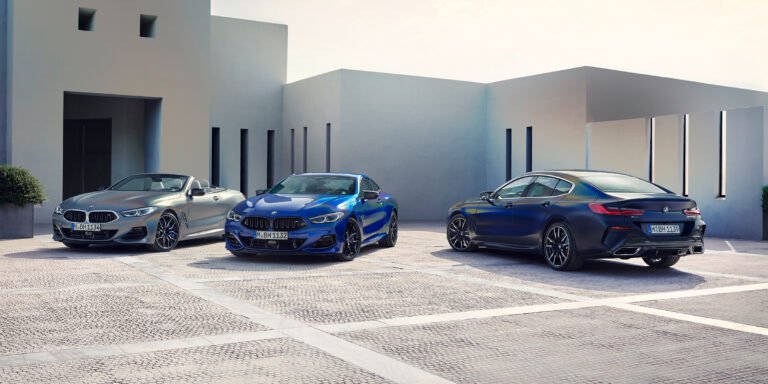
BMW has announced updates for its 8 Series and M8 model line-ups, featuring subtle exterior styling tweaks and on-board tech upgrades.
Building on the design of the current generation 8 Series that arrived in 2018, this mild mid-cycle makeover is available to order now in the UK, with the first orders expected to arrive in Spring 2022. BMW is also taking orders for the facelifted M8 range ahead of its official arrival in a few months time.
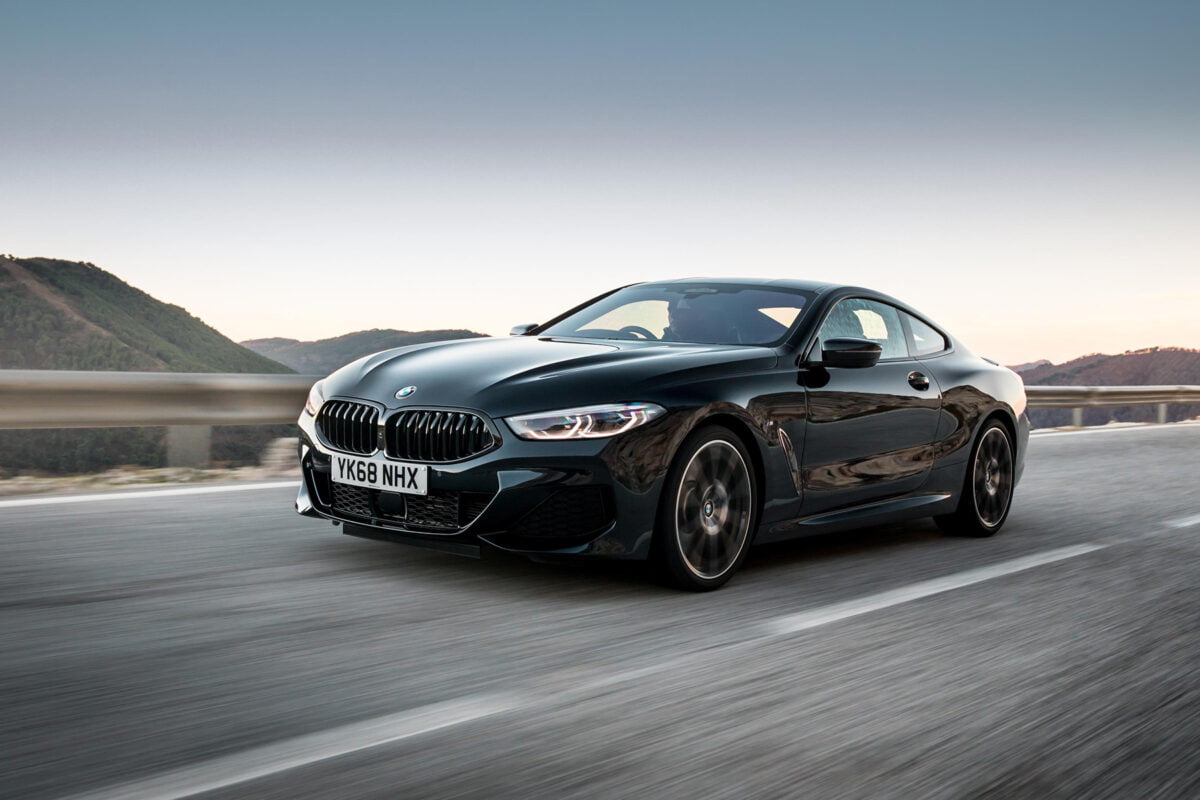
The revised BMW 8 Series continues to be offered in coupé, convertible, and ‘Gran Coupé’ saloon body styles, which are all equipped with the the brand’s M Sport trim as standard in the UK. Updates include a new grille design that becomes illuminated when you open a door, and enlarged air intakes below, swapping the pre-facelift honeycomb mesh design for horizontal struts.
The updated range also features a new design for its 20-inch alloy wheels and four new exterior paint colours, while the sportier V8 xDrive models get ‘M’ sport brakes with callipers finished in high-gloss black, M-spec wing mirrors, and a rear spoiler reserved for the Coupé versions. Otherwise, much remains the same.
BMW 8 Series Coupé (2018 – 2021)
BMW 8 Series Coupé (2022 – present)
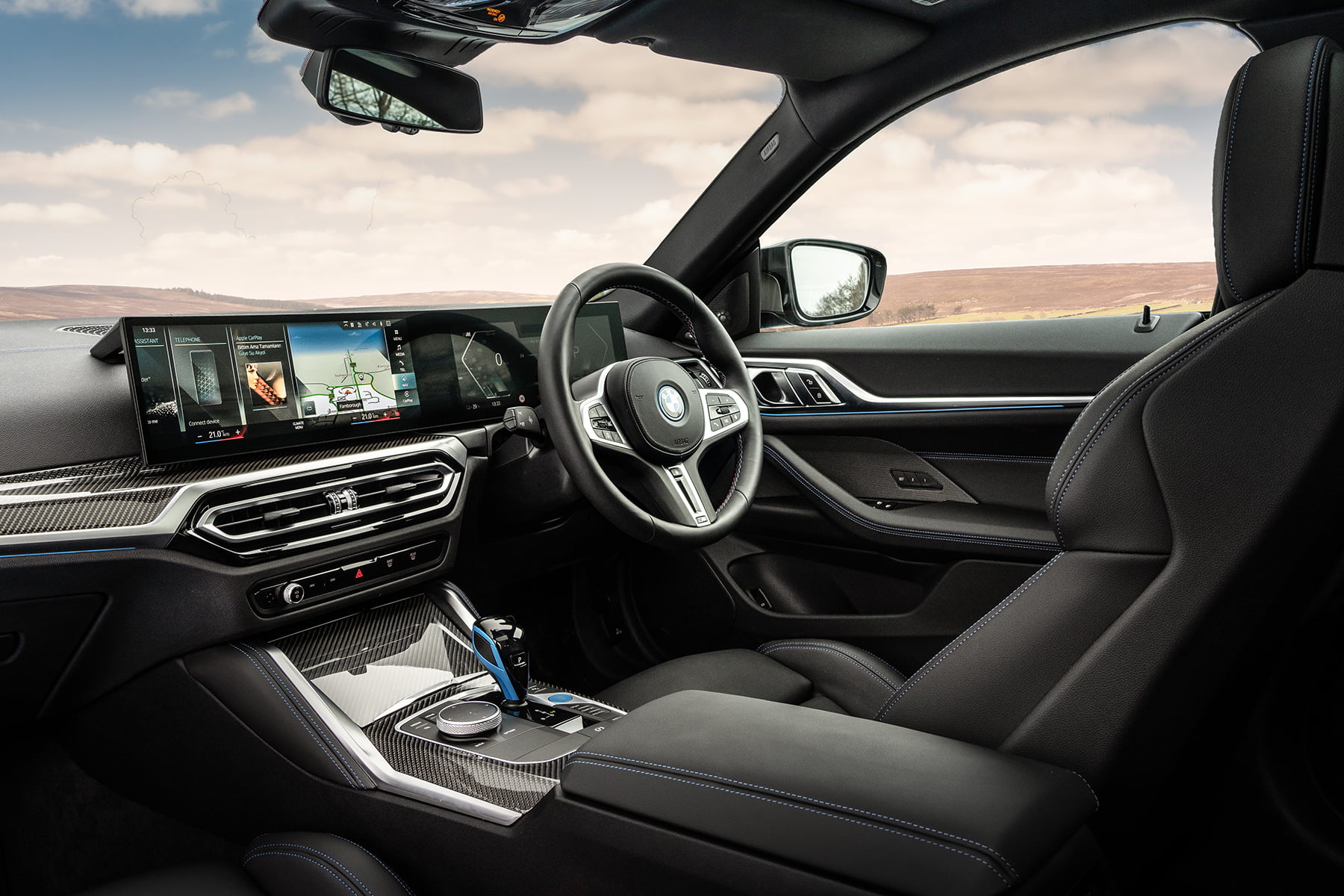
The interior of the 8 Series range has also had a light refresh, with a new steering wheel design also found in the 4 Series range. The infotainment console has been upgraded from a 10-inch touchscreen to a 12-inch display.
The facelifted BMW M8 models get new 20-inch alloy wheels fitted with high-performance tyres, eight new exterior colours and the option of darker ‘Shadow Line’ headlights, but no exterior styling changes.
BMW M8 Coupé
The cheapest model in the facelifted BMW 8 Series range is the Gran Coupé, with prices starting at £72,225 for the entry-level V6 version. Meanwhile, the updated 625hp M8 Gran Coupé Competition is available for £123,300.
Now in its second generation, the BMW 8 Series has received a very positive reception from the UK media since its 2018 arrival, highlighted for its potent performance and its luxurious interior fitted with plenty of impressive on-board tech.
It is possible that this is the last update we see to the combustion-powered 8 Series and M8 models, as BMW continues its expansion into the electric car market – aiming to unveil 20 new EV models by 2025. For now, the BMW 8 Series (not including the M8 or the Gran Coupé saloon versions) holds an Expert Rating of 74% on our industry-leading Expert Ratings Index.
Bentley has announced details of its electrification roadmap – and the first of five new battery-electric vehicles (BEVs) will be British built.
The luxury car maker has announced plans to launch its first EV – details of which are yet to be released – in three years’ time, and to build it at Crewe as part of a £2.5 billion investment in sustainability over the next ten years.
The car will be followed by four additional new electric models from 2026 to 2029, by which time Bentley expects to offer an exclusively electric range, as well as being carbon-neutral across the firm’s operations. It also means that the full Bentley range will be compliant with the government’s plan to ban all new petrol and diesel cars from 2030.
No details of the new cars have been released but, according to industry sources, the first few are likely to be ‘medium-sized vehicles’, which for Bentley means vehicles that are similar in size to the current model range (Continental, Bentayga, Flying Spur).
A flagship replacement for the discontinued Mulsanne limousine and an SUV even larger than the Bentayga could potentially complete the new EV range. These would arrive at the end of the decade when the battery technology to provide enough range for such large and heavy cars is likely to be available.
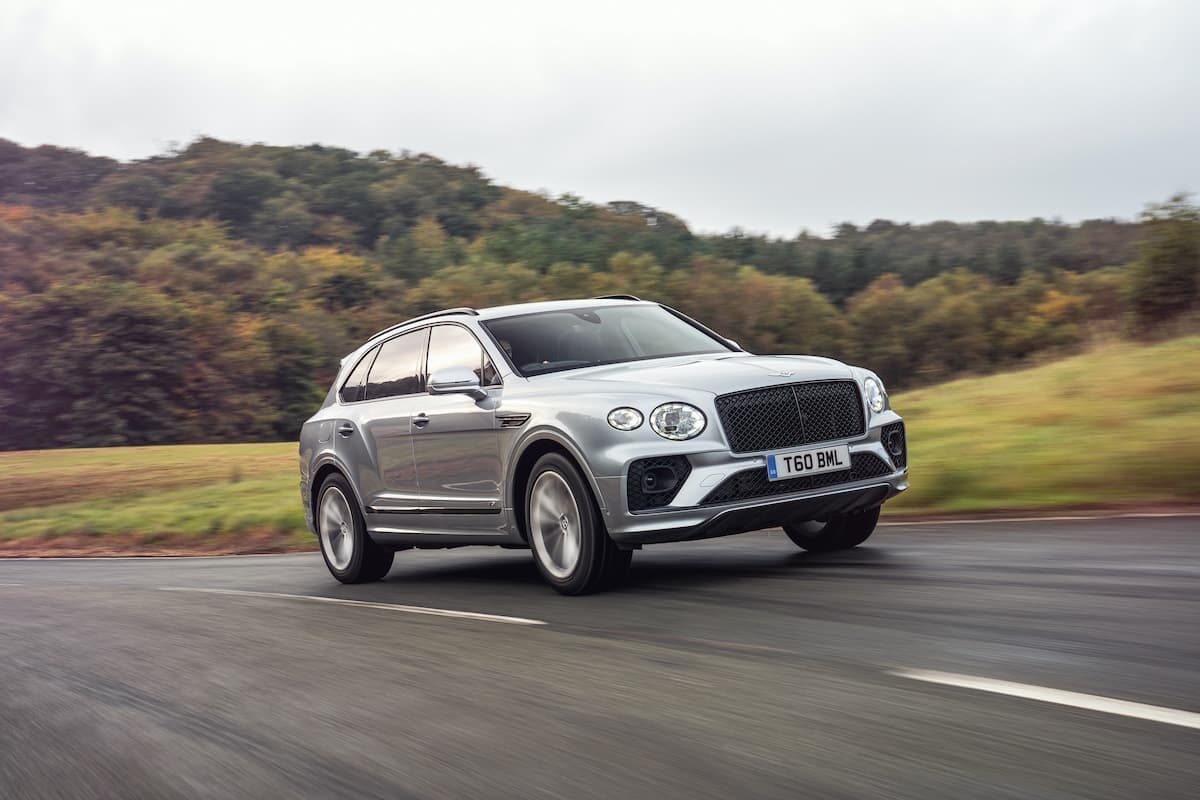
Currently the only electrified option in the Bentley range is a plug-in hybrid (PHEV) version of the Bentayga SUV. The Flying Spur saloon will also gain a PHEV model in 2022 and five more PHEVs are also planned ahead of the all-electric cars. These will almost certainly be plug-in versions of the existing Continental GT and GTC models, and then potentially some higher-performance PHEV models as well.
The Bentley Bentayga PHEV first arrvied in 2020, receiving a facelift in mid-2021.
A PHEV version of the Bentley Flying Spur is set to arrive in 2022.
Bentley has long traded on its British heritage and the historic status of the Crewe plant but these have been diluted in recent times by some manufacturing abroad at other plants operated by the brand’s owner Volkswagen. Some traditionalists feared the inevitable move to EVs would accelerate this dilution.
However as part of its ‘Beyond 100’ strategy first announced in 2020, Bentley plans to build a new ‘Dream Factory’, alongside its existing facilities it Crewe, to produce its EVs. The firm says such vehicles are key to the strategy which aims to “redefine the company as the benchmark luxury automotive manufacturer.”
Industry sources do claim, however, that bodies for the first new EVs will be made in Germany alongside a new Audi EV using the same chassis as the Bentley. The unpainted bodies will then be shipped to the UK for completion at Crewe.
The DS 4 was a five-door family hatchback manufactured by French brand DS Automobiles, launched to challenge the likes of the Audi A3, BMW 1 Series andMercedes-Benz A-Class.
On sale in the UK from 2022 until 2025, has now been replaced by a heavily upgraded model, now called the DS Nº4.
The DS 4 hatchback was available with a range of different powertrains over its short life, covering petrol, diesel, regular hybrid and plug-in hybrid options. There were also several trim level changes over that time.
British reviewers were generally impressed by the range of DS 4 models on offer, particularly Parkers, which also commends DS Automobiles for offering the DS 4 with a range of petrol, diesel and plug-in hybrid powertrains from launch.
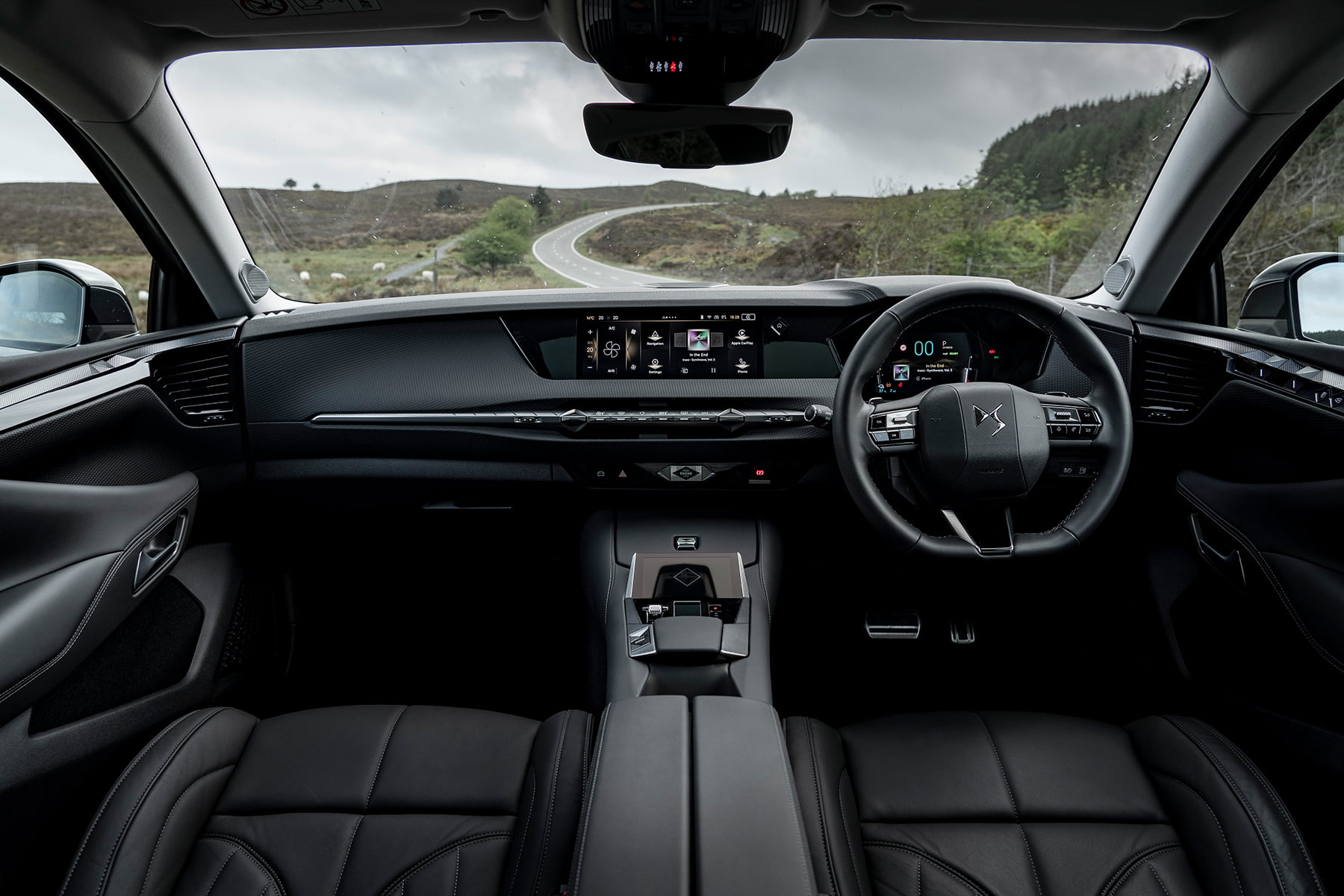
Adding to the wide range of options available, the DS 4’s best trait was a refined interior that Heycar labels “simply scrumptious”, fitted with plenty of intuitive on-board tech as standard – some of this tech only offered as optional extras by key rivals.
That said, there are areas where the DS 4 lags well behind the class leaders. Most notable are its rigid ride comfort, average performance and light steering, all of which culminate in a driving experience that Driving Electric describes as “dull”. In the end, media review scores were below average
As of February 2026, the DS 4 holds a Used Car Expert Rating of C, with a score of 63%. It scores top marks for its low average CO2 emissions (largely thanks to the plug-in hybrid model) and gets good grades for its safety rating. However, its running costs are only average and its media review scores to date have been poor. We also don’t yet have reliability data, so check back again soon.
“Buyers rarely consider a DS if buying new, but that means there are bargains on the used market, and we reckon they’re worth seeking out. As a used buy, the DS 4 offers a great blend of value and style, and it’s definitely different from its rivals, even if under the skin it shares much of its architecture with other Stellantis models.”
Model reviewed: Range overview Score: 8 / 10 “Delivering supreme comfort, good practicality and a premium feel, the DS 4 hatchback is an interesting alternative to class-leading rivals.” (Ellis Hyde) Read review
Auto Trader
Model reviewed: Range overview Score: 7 / 10 “DS remains a quirky, niche brand that emerged from under Citroën’s wing a few years ago, but shares parts and engines. So far it has spawned both a small hatchback and large SUV, but this family hatchback, the updated DS4, feels the best resolved yet. The proportions suit the styling very well, it fills the parental shoes nicely and couldn’t be further away from its clumsy predecessor.” (Erin Baker) Read review
Business Car
Model reviewed: Range overview Score: 7 / 10 “Comfortable rather than dynamic, the DS 4 is a tidy drive, but rivals are more involving. The DS’s strengths against the opposition are its sense of style, attention to detail and the technology.” Read review
Car
Model reviewed: Range overview Score: 8 / 10 “It’s by no means perfect, with the slight fidget to the ride frustrating slightly and versions with the plushest interiors get very pricey. However, if you’re bored of the usual crowd and aren’t too fussed by cornering thrills, the DS 4 should be on your shopping list.” Read review
Carbuyer
Model reviewed: Range overview Score: 8 / 10 “The DS 4 is an upmarket hatchback to rival the Mercedes A-Class and is the brand’s most convincing model yet.” (Tom Jervis) Read review
Company Car Today
Model reviewed: Range overview “Beautiful quality and good PHEV running costs should grab some attention for the low-key French premium brand’s latest and most competitive model.” Read review
Daily Mirror
Model reviewed: 1.6-litre petrol/electric plug-in hybrid Rivoli “Choose the entry-level DS 4 and, although you’d lose a lot of gizmos and be making do with a conventional 130bhp petrol (with a mild-hybrid starter generator) engine, you still get those flush door handles, LED headlamps and extremely appealing styling.” Read review
Driving Electric
Model reviewed: 1.6-litre petrol-electric plug-in hybridE-Tense Score: 7 / 10 “The DS 4 E-Tense is an unusual take on the premium hatchback formula, but certainly isn’t without merit.” Read review
Electrifying.com
Model reviewed: 1.6-litre petrol-electric plug-in hybrid E-Tense Score: 7 / 10 “The DS 4 E-Tense plug-in hybrid offers a dose of hand-crafted French luxury as a viable alternative to an Audi A3 or BMW 1-Series.” Read review
Eurekar
Model reviewed: Range overview “As an alternative to the likes of the Audi A3, Mercedes A-Class and BMW’s 1 Series and X2 models, the DS 4 stacks up well and looks set to give the French brand a major player in the mainstream market.” Read review
Heycar
Model reviewed: Range overview Score: 8 / 10 “With the DS 4, Citroen’s posh spin-off brand might finally be finding its groove. It’s a genuinely premium family hatchback with SUV levels of practicality and a simply scrumptious interior. There’s petrol, diesel and plug-in hybrid power, as well as a choice of sporty or posh trim levels.” Author: Andrew Brady Read review
Honest John
Model reviewed: Range overview Score: 8 / 10 “The DS4 feels genuinely special. The interior is just sublime, with premium finishes and impressive technology, while standard equipment levels are impressive. Are you prepared to stand out from the crowd?” Read review
Motoring Research
Model reviewed: E-Tense Score: 7 / 10 “The DS 4 E-Tense is a relatively affordable luxury car with avant-garde styling and an efficient plug-in hybrid drivetrain. It isn’t a straightforward car to categorise. However, with its striking looks, interesting interior and refined ride, it does enough to justify a luxurious image.” (John Redfern) Read review
Parkers
Model reviewed: Range overview Score: 6 / 10 “It’s by no means perfect, with the slight fidget to the ride frustrating slightly and versions with the plushest interiors get very pricey. However, if you’re bored of the usual rivals and aren’t too fussed by cornering thrills, the DS 4 should be on your shopping list.” Read review
The Sun
Model reviewed: 4 Performance Line + “The DS 4 is no hot hatch but it can get a bit of a wiggle on. True, it’s a bit cramped in the back. But isn’t luxury usually a bit selfish? All in all, a car that turned out not only a bit leftfield but actually very good.” Read review
The Telegraph
Model reviewed: 1.2-litre petrol automatic Performance Line Score: 6 / 10 “If you’re after something that feels a little different to the norm, the DS 4 is it. And if you value comfort over excitement, it fits the bill, too. While that will be enough to ensure a select few find homes, don’t expect the 4 to challenge for class leadership. Likeable though it is, it’s just too handicapped in areas where it matters to make a real dent in the dominance of its German rivals.” (Alex Robbins) Read review
Model reviewed: 225 Rivoli Score: 6 / 10 “The fact is, however, the DS 4 isn’t a premium car. It doesn’t ride as well as others from the Stellantis stable and a Ford Kuga would eat it for lunch. True, it looks different and the interior is interesting and comfortable, but there’s an element of “all fur coat and no knickers” about the DS4.” Read review
Top Gear
Model reviewed: Range overview Score: 7 / 10 “Whether or not you actually want a car with such self-conscious styling is a question that comes up with any DS model. But with the 4, we think it’s easier to want than the others. And that styling wraps a properly competitive car.” Read review
Safety rating
Independent crash test and safety ratings from Euro NCAP
The standard DS 4 was awarded a four-star rating in April 2022 by Euro NCAP. However, if the car is fitted with the optional ‘Safety Pack Plus’, which is standard on higher-spec models, it gets a five-star rating.
The difference is the quality of the emergency braking system, which “performed only marginally well” in standard form. The optional ‘Safety Pack Plus’ uses a more advanced emergency braking system, which boosts the Safety Assist score by a sufficient amount to lift the car into the five-star bracket.
Eco rating
Independent economy and emissions ratings from Green NCAP
Clean Air Index: 3.2 / 10 Energy Efficiency Index: 3.5 / 10 Greenhouse Gas Index: 2 / 10
Achieving a one and a half star emissions rating, Green NCAP comments that the DS 4 does meet European emissions regulations, but the car’s exhaust aftertreatment lacks robustness and its fuel consumption is relatively high.
Reliability rating
Reliability data provided exclusively for The Car Expert by MotorEasy
No reliability rating
As of January 2025, we don’t have enough reliability data on the DS 4 to generate a reliability rating.
The Car Expert’s reliability information is provided exclusively to us using workshop and extended warranty data from our partner, MotorEasy, sourced from both official dealerships and independent workshops.
As soon as MotorEasy has sufficient data on the DS 4, we’ll publish the results here.
Running cost rating
Monthly cost of ownership data provided exclusively for The Car Expert by Clear Vehicle Data
Fuel consumption
Average
Score
Petrol models
54 mpg
B
Diesel models
58 mpg
B
CO₂ output
Average
Score
Variation
Score
Petrol models
129 g/km
B
Diesel models
138 g/km
C
Plug-in hybrid models
33 g/km
A
Battery range
Average
Score
Variation
Score
Plug-in hybrid models
38 miles
E
Insurance group
Average
Score
Variation
Score
All models
25
B
Service and maintenance
Cost
Score
Year 1
£240
C
Year 2
£579
C
Year 3
£920
C
Year 4
£1,139
C
Year 5
£1,560
C
Overall
£4,438
C
The DS 4 is a relatively affordable car to own and run, according to whole-life cost numbers provided exclusively to The Car Expert by our data partner, Clear Vehicle Data.
Fuel consumption data for the petrol models is only average, while the diesel models are better. We don’t have data for the plug-in hybrid models at this time, so check back again soon.
The CO2 levels are good – the plug-in hybrid looks great on paper, but that’s due to the woeful EU/UK goverment lab tests that are completely useless at measuring a plug-in hybrid…
Insurance costs should be good, although servicing and maintenance are mostly average over the car’s first five years.
Similar cars
If you’re looking at the DS 4, you might also be interested in these alternatives
So you have a growing family, a business that takes up space in your car boot, a love of the great outdoors or maybe a house that’s situated at the end of a rutted track. You need a certain type of car. But which one?
A decade ago the answer would have been simple: you need a 4×4: a big, rugged off-roader that went anywhere and carried almost everything. They were often called ‘jeeps’ even though only a small number of them on the UK’s roads were actually built by the famous US manufacturer of 4x4s.
There were all sorts of four wheel drive cars available: big and small (Range Rover to Fiat Panda 4×4), petrol and diesel (no EVs), and built in Europe, Asia and North America.
All change
But the last ten years have seen a massive change. The traditional 4×4 has almost (but not quite) ceased to exist. They were hardly ever used to actually go off road anyway, but the styling was still popular among a broad cross-section of buyers. And the car makers knew this.
They built similar-looking, ruggedly styled cars but without the expensive, complicated, fuel-sapping four-wheel drive systems driving everything underneath.
Many of these popular models became two-wheel drive only: some were given traction control for an element of loose surface capability but many were only fit for the road like their saloon and estate car cousins.
In came a platoon of utility vehicles with varying capabilities but all with one thing in common: their taller, roomier, more rugged styling and design. They were generally also slightly better over rutted, bumpy surfaces due to their increased ride height and they often made superior towing cars for caravan and trailer owners.
Although this sort of vehicle had existed for a while (the Toyota RAV4 was an early pioneer in the mid-1990s), it was the launch of the British-designed and British-built Nissan Qashqai in 2007 that kick-started a soft-roader revolution around the world. It’s become a mainstay in the UK best-sellers list ever since.
And that approval and popularity of these ‘lifestyle’ vehicles in the UK has continued unabated, with increasing numbers of models becoming available and almost every car maker offering a rugged, family alternative into its car range.
That’s before the more established 4×4 brands such as Land Rover, Mercedes-Benz, and SsangYong muscle in. Even Jeep and Toyota, which have built reputations for hard-as-nails off-roaders like the Jeep Wrangler and Toyota Land Cruiser, now sell far more crossovers than genuine 4×4 vehicles today.
Even Ferrari, that most famous manufacturer of supercars and racing cars, is getting in on the act with an SUV model that is set to be unveiled later this year.
So what are the options?
Traditional 4×4 (or 4WD)
Drive from the engine can be directed to all four wheels when necessary and clever locking differentials and electronic technology evenly spreads power to the wheels that need it most ensuring that there’s very little wheel-spin and plenty of grip and traction.
Many 4WD vehicles can be turned into 2WD vehicles at the flick of a switch, or the pull of a lever, when full grip isn’t needed. They also have high and low ratios which can help when the going gets especially tough. Low ratio will allow the car to ‘crawl’ over rocks, boulders and slippery inclines safely and securely.
You’ll need a 4×4 if you live in a remote area, at the end of a farm track, or in a region where there is regular ice, snow and bad weather. If your job involves regularly traversing poor surfaces (farmers, surveyors, builders) or you tow a heavy trailer or caravan you might also consider one. They’re more expensive than two wheel drive versions but they can be worth their investment if they help you out of a hole just when you need them to.
Some of these vehicles are still built using the traditional ‘body-on-frame’ method, which can provide superior off-roading ability but compromises on-road ability. However, this is becoming quite rare and even highly capable off-roaders like the Land Rover Defender are now built using the more modern ‘unibody’ method for more comfort and reduced weight.
If the majority of your driving is going to be on roads rather than off them, your choice of car should reflect that. And there are certainly plenty of choices – so much so, that the lines between passenger car and utility vehicle have been endlessly blurred and smudged.
Although modern SUVs tend to look very similar to traditional 4x4s, they’re generally built to prioritise on-road comfort on a day-to-day basis. They’re all a unibody design, just like any regular saloon or estate, despite the rugged styling.
Smart, modern, good-looking and versatile, they are a popular choice among many drivers in the UK and tick a lot of the boxes a busy family would ask of a car.
Some are still quite capable off-road (especially any Land Rover models), but electronic wizardry tends to help manage that, instead of the driver manually adjusting high and low range transmissions or fiddling with locking differentials.
SUVs can either be 4WD or 2WD, depending on whether you need the extra traction. Even then, most 4WD models will often be capable of running in two-wheel drive on the road and only call on the extra two wheels when they’re really needed. But for some owners, the confidence and peace of mind of having four-wheel drive capability when required is very reassuring.
To make matters more confusing, some models are available in purely 2WD form, for drivers who know absolutely that they’re not going to need any particular off-road ability. With their increased ride height and chunkier tyres, these two-wheel drive SUVs can often still perform reasonably well – and far better than a normal car – over bumpy or slightly slippery surfaces. For many people, that will be all they ever need.
They do, however, want space, flexibility, maybe the option of seven seats (usually folded down in the boot area when not in use), a good high driving position and a generally effective all-round offering. That’s why this sector of the automotive market is so popular and competitive.
Even more difficult to distinguish is the crossover – a term first coined in North America. Despite the chunkier looks and higher seating position, they are essentially just a passenger car underneath.
Compared to the 2WD SUV models above, crossovers may look similar but have very little capability off-road and often run tyres that are similar to what you’d find on a regular saloon or estate, with no additional grip on muddy or icy surfaces.
Some crossovers are available with a form of 4WD, often in hybrid models where the front wheels are driven by the petrol engine while the rear wheels are powered by an electric motor. The car can switch between either system or both together as required. It still doesn’t really help much for off-roading, though.
Want a decent, strong, honest car for ferrying around the kids and work equipment but don’t need any sort of off-road capability? A crossover might just do the job for you.
Winter is a horrible time for cars. Rainfall washes dirt and mud onto roads, street gritting creates a dark film of spray that clings to wheels and bodywork, and high winds blow dust and muck onto windscreens and lights.
It’s not long before your pristine motor is covered in black, sooty grime that turns bright coloured paintwork dark, obscures number plates, dims tail lights and leads to tell-tale finger marks across the boot lids of thousands of cars.
Country roads are especially dirty at this time of year, as local authorities spread greater amounts of salt, and farm vehicles introduce extra layers of mud from fields and yards onto the roads. Low overnight temperatures compound the problem by obscuring windscreens with frost while freezing your car’s screen wash systems solid.
Now road safety organisation GEM Motoring Assist has said drivers should make daily safety checks to reduce the risk of a breakdown and ensure that visibility is not compromised by dirt or ice. And they’ve released some top tips for keeping clean, and safe, this winter.
“It’s difficult to keep cars clean during weather like this,” said a GEM spokesperson. “Layers of salt and dirt will build up quickly. If left, car lights will become less effective, number plates will become unreadable and it could be hard to see properly through the windscreen.”
Operation Clean Up: six top grime-busting safety tips
Wash, wipe and rub
It’s hard to believe how quickly dirt builds on a car at this time of year. Before every journey, take time to remove any excess dirt and ensure all the lights and windows are free of grime.
Top up your washer bottle
If you’re covering lots of miles, you will get through a large amount of water on a journey during the current dirty conditions. So don’t wait for the warning light – check and top up as often as necessary.
Stop scraping your blades
Don’t use your windscreen wipers to clear ice as you risk wearing out the blades and causing stress and damage to the operating system. Equally, don’t use wipers to shift dirt if the windscreen wash is empty or frozen. Stop somewhere safe and clear the windscreen properly.
Get down under
The underside of your car is particularly vulnerable to attack from salt and dirt. Give it a regular hosing to minimise the chances of any damage, and hose off any excess mud from brake discs.
Take it easy
Reduce speed and give yourself more time to complete your journey. By slowing down you will reduce the risk of skidding due to sudden manoeuvres. You will also minimise the spray and dirt that’s thrown up by your wheels.
Keep your distance
Don’t follow too close behind lorries and other heavy vehicles. This is not only safe and prudent, but it will also reduce levels of salt, dirt and other mess that gets sprayed onto your car.
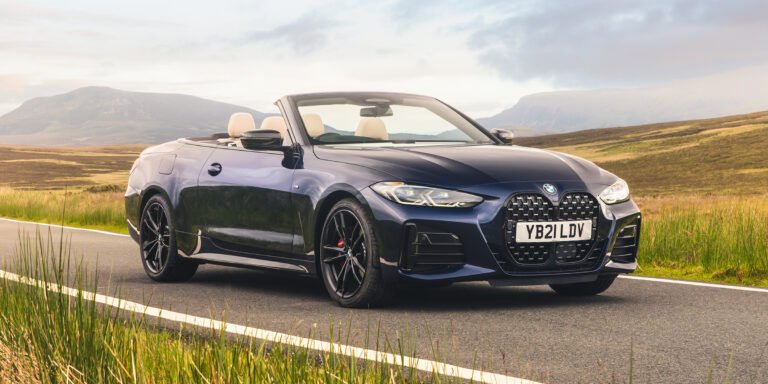
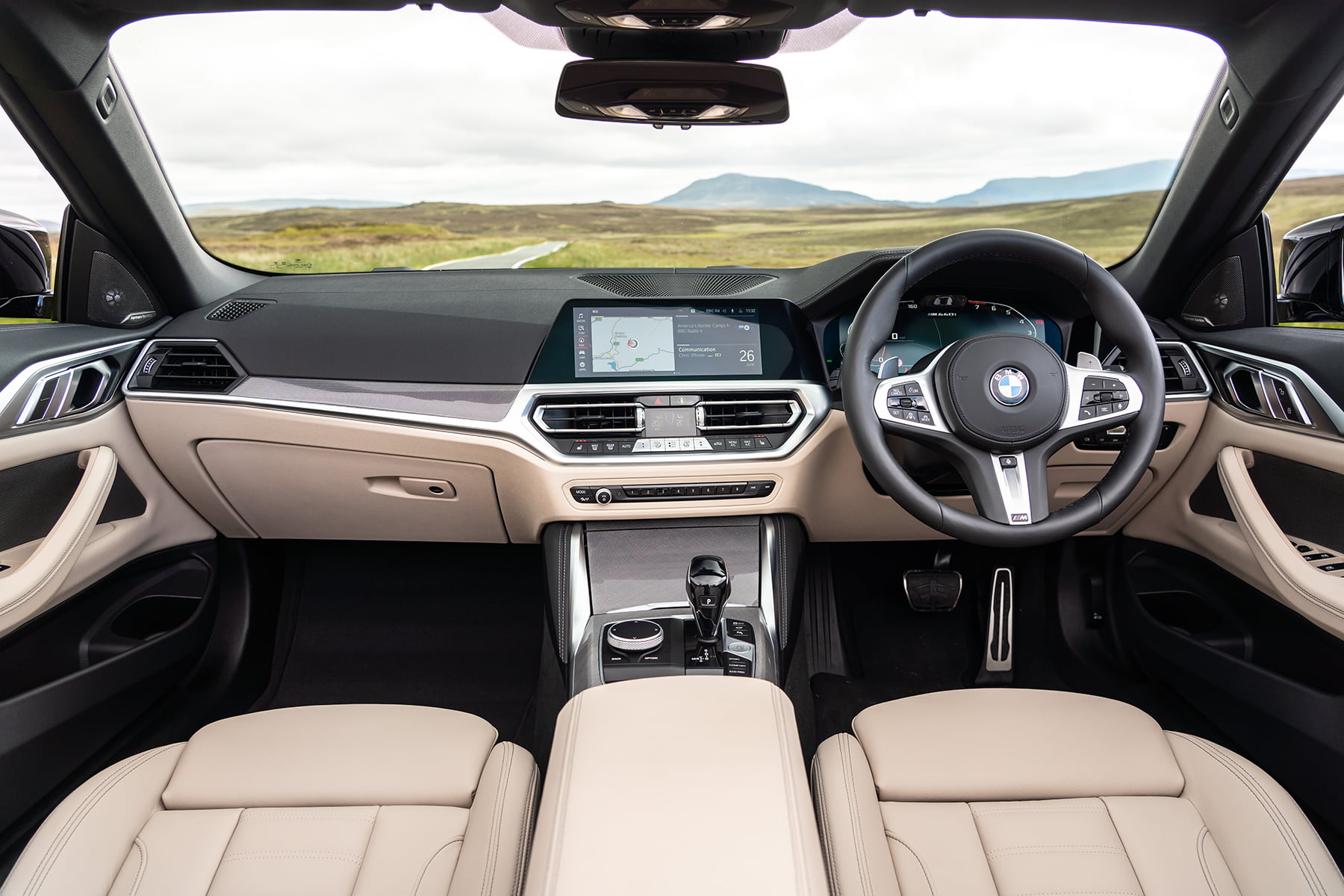
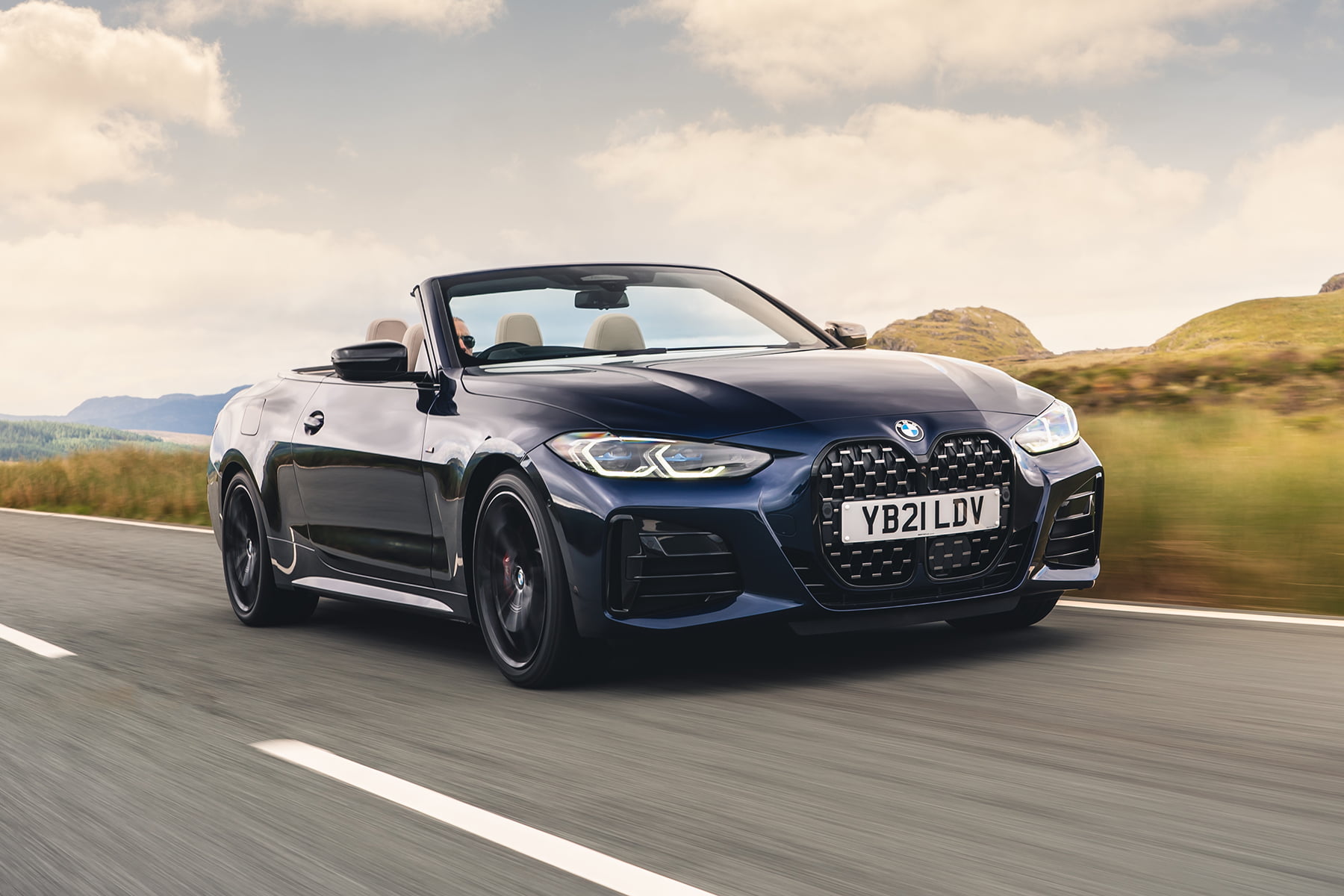
The 4 Series Convertible has received a very positive reception since its UK arrival in Autumn 2021, with reviewers particularly commending the soft-top for its comfortable and refined interior, which comes with plenty of on-board tech as standard.
Now in its second generation since evolving away from the 3 Series Convertibles of old, the 4 Series Convertible has swapped its predecessor’s folding hard-top roof for a fabric alternative, which Carbuyer says is quicker to take down, and leaves more space for passengers and luggage. That said, Carwow explains that limited rear passenger space and boot capacity still slightly hinder the soft-top’s day-to-day practicality.
Like almost all modern BMWs, most publications are not convinced by the 4 Series Convertible’s “toothy” grille design. Regardless of its controversial styling, however, the large majority of reviewers are more than won over by the convertible’s impressive performance – the BMW’s agile handling and range of petrol and diesel engines provide driving dynamics that Top Gear calls “fabulous” and The Telegraph “exhilarating”.
Auto Trader concludes, “The BMW 4 Series Convertible has all the charm and sophistication of its coupé brother with the added bonus of fun in the sun for four.”
As of February 2026, the BMW 4 Series Convertible is the best-rated version of the 4 Series family with a New Car Expert Rating of B and a score of 67%. That rating drops to a C as a used car, with a slightly lower score of 64%. The 4 Series Convertible scores top marks for its excellent media reviews, while its safety rating is still good. However, its CO2 emissions and reliability record are only average, while its running costs are high.
“The BMW 4 Series Convertible packs impressive handling, a smooth ride, impressive engines and an open-top driving experience that’s perfect for sunny days. So it’s a pity it looks the way it does.”
Model reviewed: 4 Series M440i Score: 10 / 10 “The BMW 4 Series Convertible has all the charm and sophistication of its coupe brother with the added bonus of fun in the sun for four.” Read review
Carbuyer
Model reviewed: Range overview Score: 8.4 / 10 “The BMW 4 Series Convertible is one of the best four-seater soft-tops around.” Read review
Evo
Model reviewed: M440i xDrive Score: 8 / 10 “The M440i xDrive continues to be the muscle-bound pick of the BMW 4 Series Convertible bunch, as the most convincing ‘mini 8-series’.” Author: Stuart Gallagher, Ethan Jupp Read review
Honest John
Model reviewed: Range overview “The BMW 4 Series Convertible features a striking appearance and fabric soft-top roof.” Read review
Parkers
Model reviewed: Range overview Score: 8 / 10 “Most people after a swish convertible want something that looks sporty, but isn’t unnecessarily harsh riding. The BMW delivers on this. The interior is a great place to spend time. The weight of the controls points to everything being durable, while the placement is easy to understand too.” Read review
The Telegraph
Model reviewed: 3.0-litre petrol automatic M440i Score: 8 / 10 “This is a very convincing all-rounder. It is, in many ways, the perfect four-seat convertible, mixing exhilarating driving dynamics with practicality, space, quality and impressive fuel economy. It is expensive to buy, though. And then there are those looks…” Read review
Top Gear
Model reviewed: Range overview Score: 8 / 10 “The 4 Series Convertible is a class-leading drop-top. It hits every base: it’s refined top up or down, the engines are fabulous, it’s spacious and reasonably practical, well-finished and can be festooned with all the gadgets and assists you’d expect.” Read review
Safety rating
Independent crash test and safety ratings from Euro NCAP
The BMW 4 Series family has an average reputation for reliability, according to workshop and warranty data provided exclusively to The Car Expert by our partners at MotorEasy. This score covers all versions of the current-generation 4 Series (Convertible, Coupé and Gran Coupé) as well as the original (pre-2020) models.
The average repair bill to date has been just under £850, which is obviously a lot more than a used car warranty – so bear that in mind if you already own a BMW 4 Series or are looking at buying a used 4 Series.
The most common faults with 4 Series models to date have been engine-related. These are also the most expensive to repair, with an average bill of £2,000. Gearbox repairs are even more expensive, averaging more than £2,600, but are thankfully not as common. Other faults – like suspension, fuel system, electrics and brakes – have much lower repair bills.
Running cost rating
Monthly cost of ownership data provided exclusively for The Car Expert by Clear Vehicle Data
Fuel consumption
Average
Score
Petrol models
39 mpg
D
Diesel models
53 mpg
B
CO₂ output
Average
Score
Variation
Score
Petrol models
164 g/km
D
Diesel models
139 g/km
C
Insurance group
Average
Score
Variation
Score
All models
36
D
Service and maintenance
Cost
Score
Year 1
£257
C
Year 2
£638
C
Year 3
£1,056
C
Year 4
£1,404
D
Year 5
£1,837
D
Overall
£5,192
D
Running costs for the BMW 4 Series Convertible are a bit of a mixed bag, according to numbers provided exclusively to The Car Expert by our data partner, Clear Vehicle Data.
Petrol models offer a below-par fuel consumption of 39 mpg on average, while diesel models are much more efficient, offering 53 mpg. Insurance is neither expensive nor cheap, and service and maintenance costs are fairly average, too, when compared to the rest of the market.
Awards
Trophies, prizes and awards that the BMW 4 Series Convertible has received
Running costs for the BMW 4 Series Gran Coupé are a bit of a mixed bag, according to numbers provided exclusively to The Car Expert by our data partner, Clear Vehicle Data.
Petrol models offer a below-par fuel consumption of 40 mpg on average, while diesel models are much more efficient, offering 55 mpg. Insurance is neither expensive nor cheap, and service and maintenance costs are fairly average, too, when compared to the rest of the market.
Similar cars
If you’re looking at the BMW 4 Series Gran Coupé, you might also be interested in these alternatives
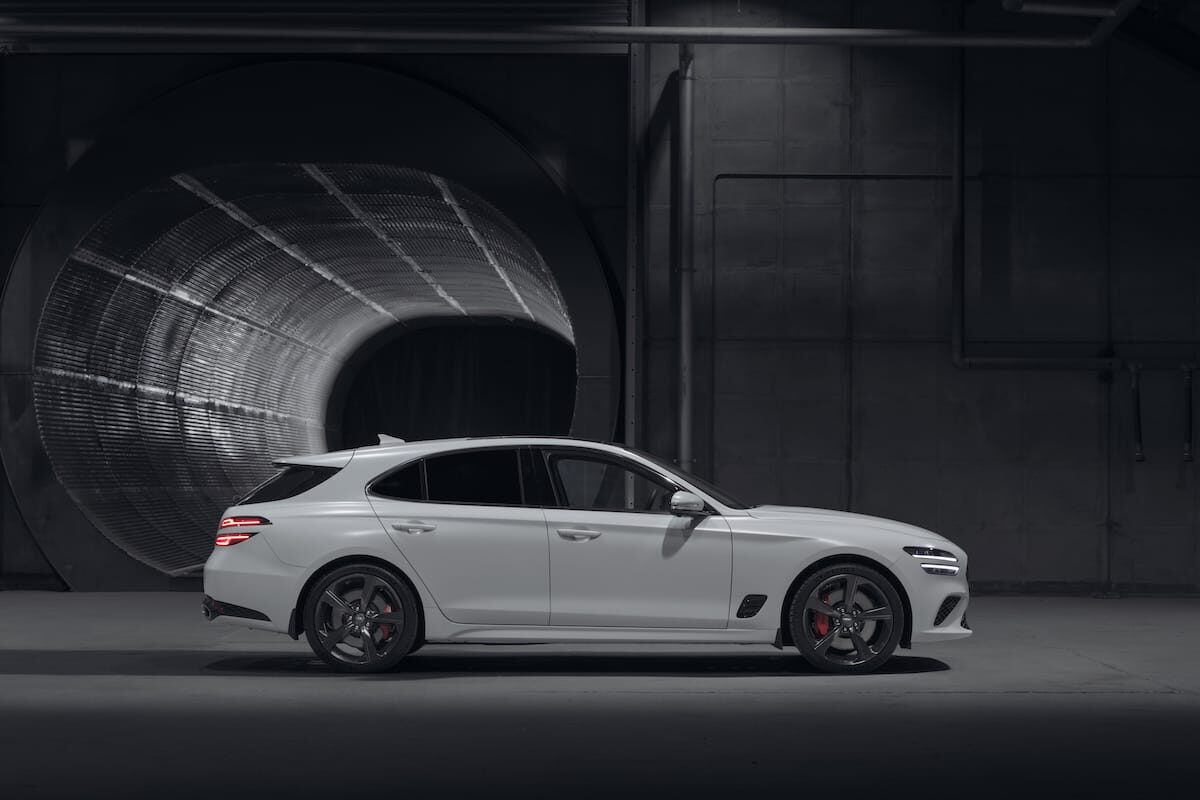
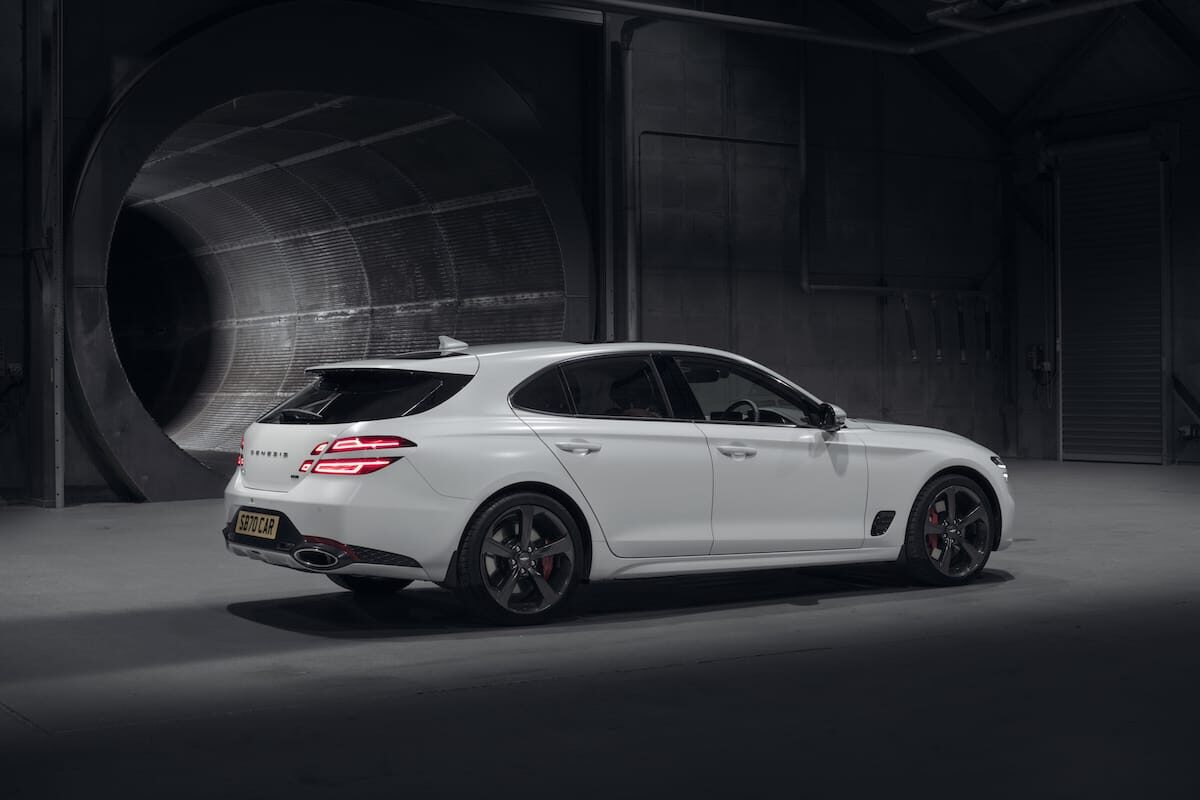
The Genesis G70 Shooting brake is an estate version of the mid-sized G70 saloon that launched soon after the Korean premium brand arrived in the UK in 2021.
Shooting Brake? The term dates back to horse-drawn days and referred to a practical vehicle created to carry guests to shooting parties. It then evolved to describe two-door sports cars with estate-style back halves, particularly from British sports car manufacturers. Today’s manufacturers have hijacked the phrase to describe regular estate cars with more emphasis on style than load-lugging practicality. Genesis is not the first to use the term, with Volkswagen and Mercedes-Benz (among others) offering ‘Shooting Brakes’ of some description.
So what we have here is a version of the G70 saloon with more space, which Hyundai’s upmarket sister brand hopes will take on big hitters such as the Mercedes-Benz C-Class Estate and BMW 3 Series Touring. One major drawback, however, could be the newcomer’s propulsion options – our Expert Rating Index currently scores the G70 at 55%, with the biggest complaint being a weak range of engines with no sign yet of any electric options.
It may be Korean but the fifth Genesis model launched in Europe was also designed in Europe, reflecting where the brand sees most potential sales for the G70 Shooting Brake. Genesis G70 cars share their underpinnings, and handling-friendly rear-wheel-drive powertrain, with the much-admired Stinger from sister brand Kia.
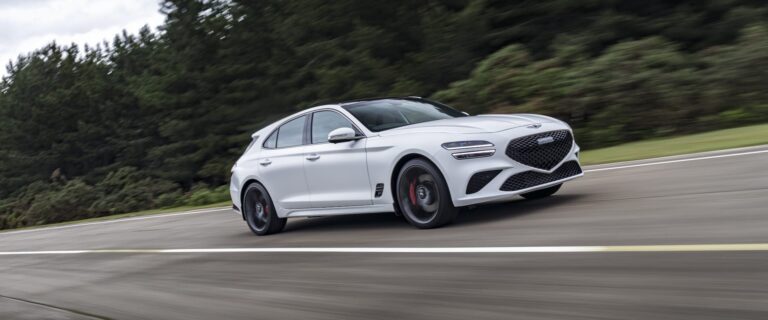
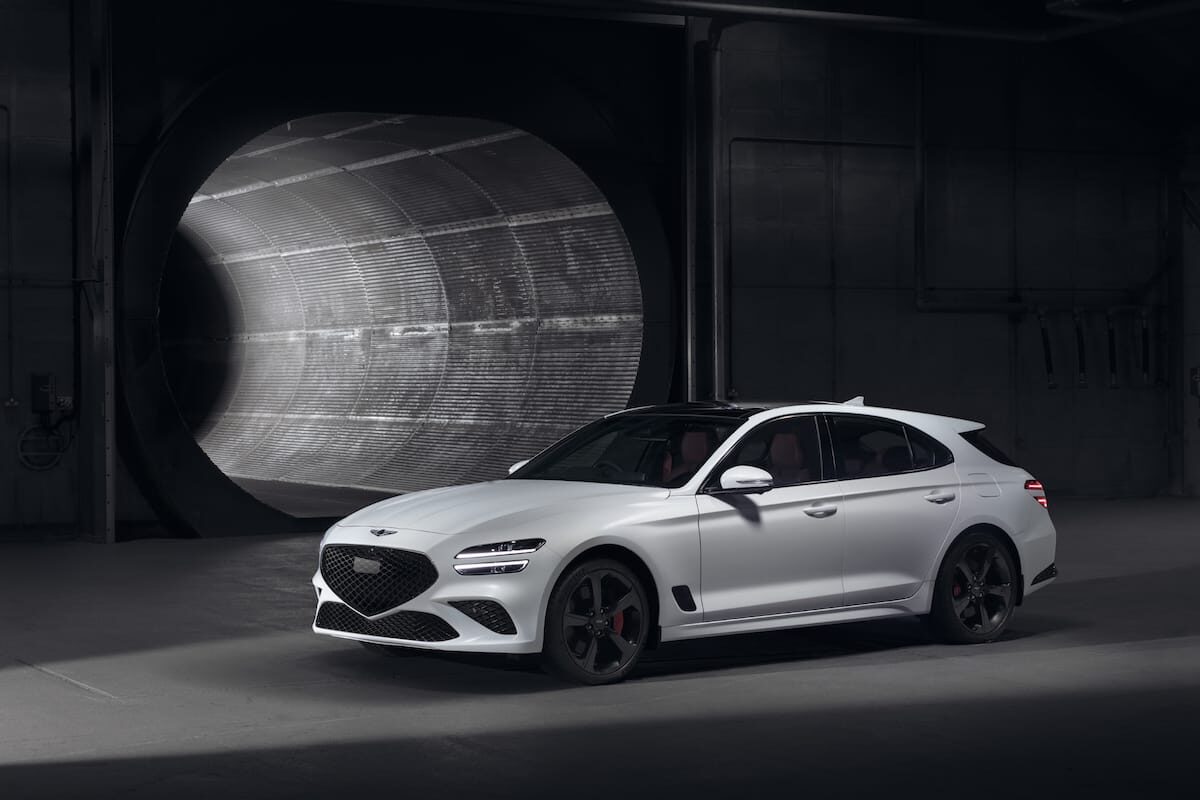
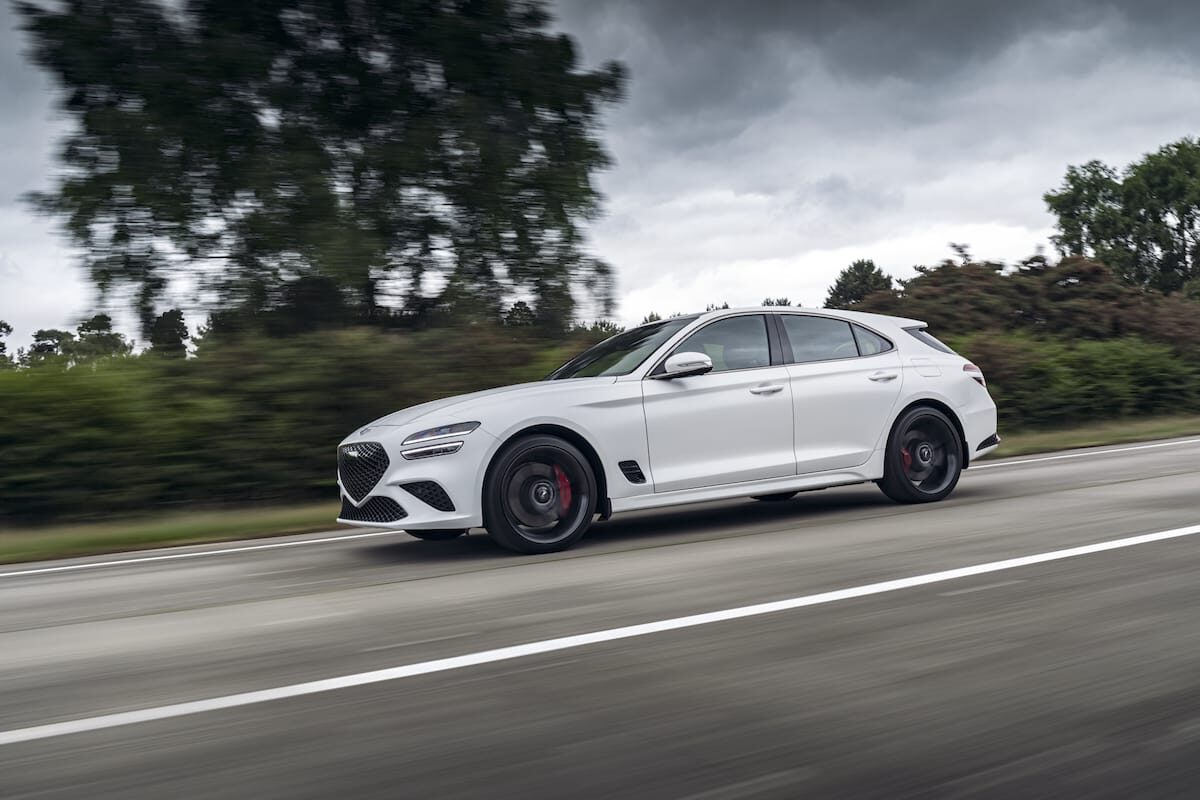
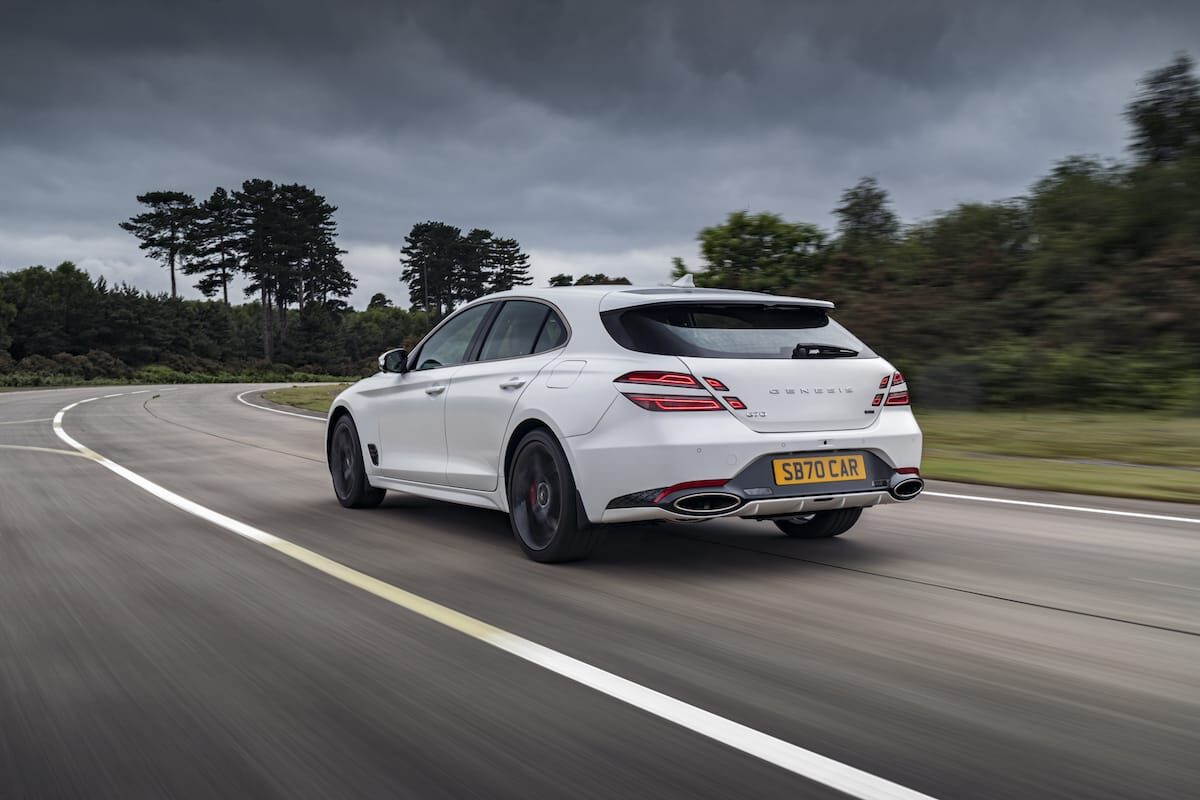
The front half of the G70 Shooting Brake is unsurprisingly identical to the G70 Saloon. But the rear half is very similar too – there are no changes to the side window profiles, instead the rear screen pillars are extended upwards and backwards to meet a gently sloping roof line and combined with a huge lump of a rear spoiler.
All of this makes for a good-looking car, but perhaps not quite the levels of load-lugging practicality that generally sends buyers in the direction of estates.
How does it look?
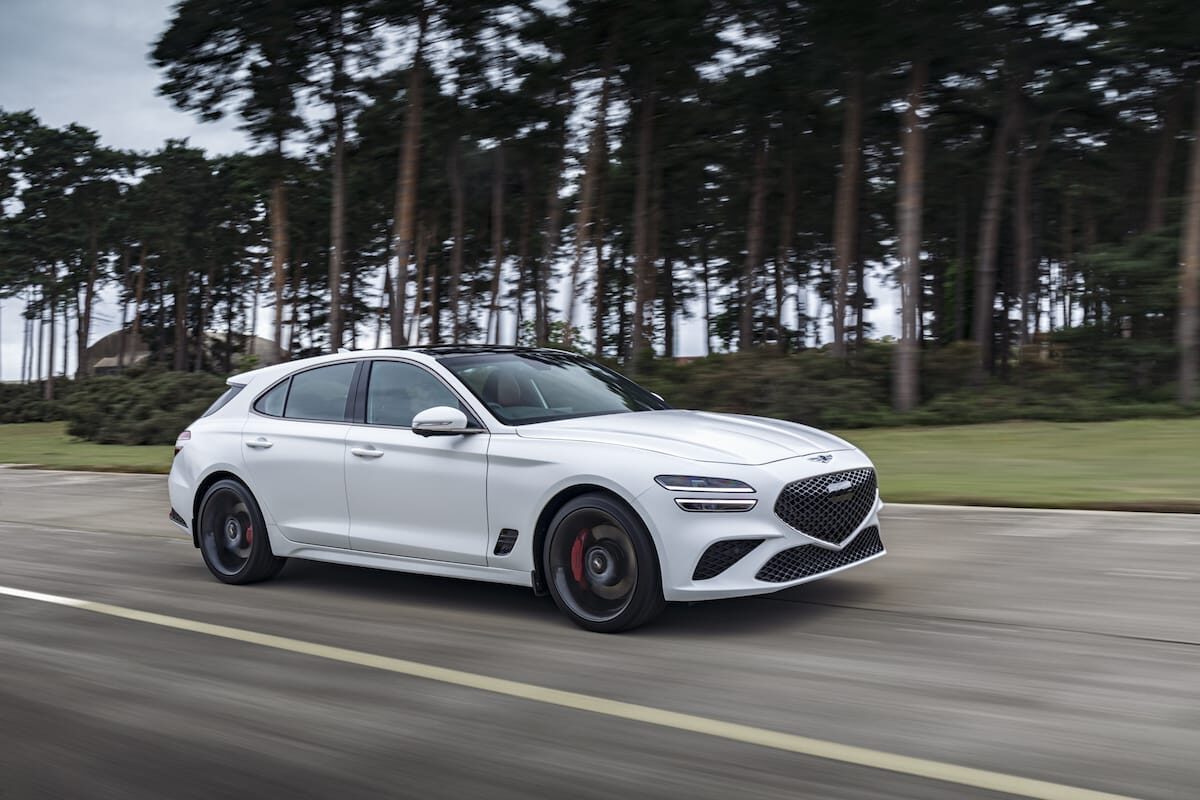
Genesis describes the Shooting Brake profile as having ‘eye-catching coupe design cues’, novel for an estate, but it’s true to say that the car is attractive on the eye. Its general low stance, long bonnet and short front overhang give it a purposeful visual appearance – and yes, the strong side-window design and that roof line that slopes gently downwards towards the rear do offer some coupe-like impressions.
The front end is particularly distinctive, with its large and deeply pointed V-grille flanked by pencil-slim lights. It’s bold and will certainly be noticeable in the rear-view mirror of cars one catches up with, but not in an outrageous way like some rivals. In fact we’d argue that overall the G70 Shooting Brake is a better-looking car than its four-door sister.
What’s the spec like?
Genesis really scores points on its perceived rivals when it comes to specification. Three trim levels are on offer, dubbed Premium Line, Luxury Line and Sport Line, the latter two distinguished by their potential buyers – with Sport Line the emphasis is on a more racy look and enhanced mechanical specification rather than more equipment, adding such items as 19-inch wheels, upgraded Brembo brakes and a mechanical limited-slip differential.
Plenty of equipment is a prime element of Genesis cars and you get a lot for what compared to more mainstream upmarket rivals is not a lot of money – prices start from just over £35,000. For example dual-zone climate control, auto-dipping headlamps and the like are standard on all versions. Note, however that if you want the more powerful of the two petrol engine options you will need to go to Luxury Line trim, which is the car have driven here. It adds such niceties as heated seats and steering wheel, plus bigger wheels.
Safety kit is impressive too – the G70 has earned a five-star rating from Euro NCAP, aided by a standard specification that includes autonomous emergency braking with pedestrian detection, adaptive cruise control that will bring the car to a stop in traffic and restart it, and lane-keeping tech. Genesis also emphasises that it’s not all about active safety, pointing to its introduction of a new centre airbag – should the car suffer a side collision this airbag prevents the two front seat occupants hitting each other.
What’s the Genesis G70 Shooting Brake like inside?
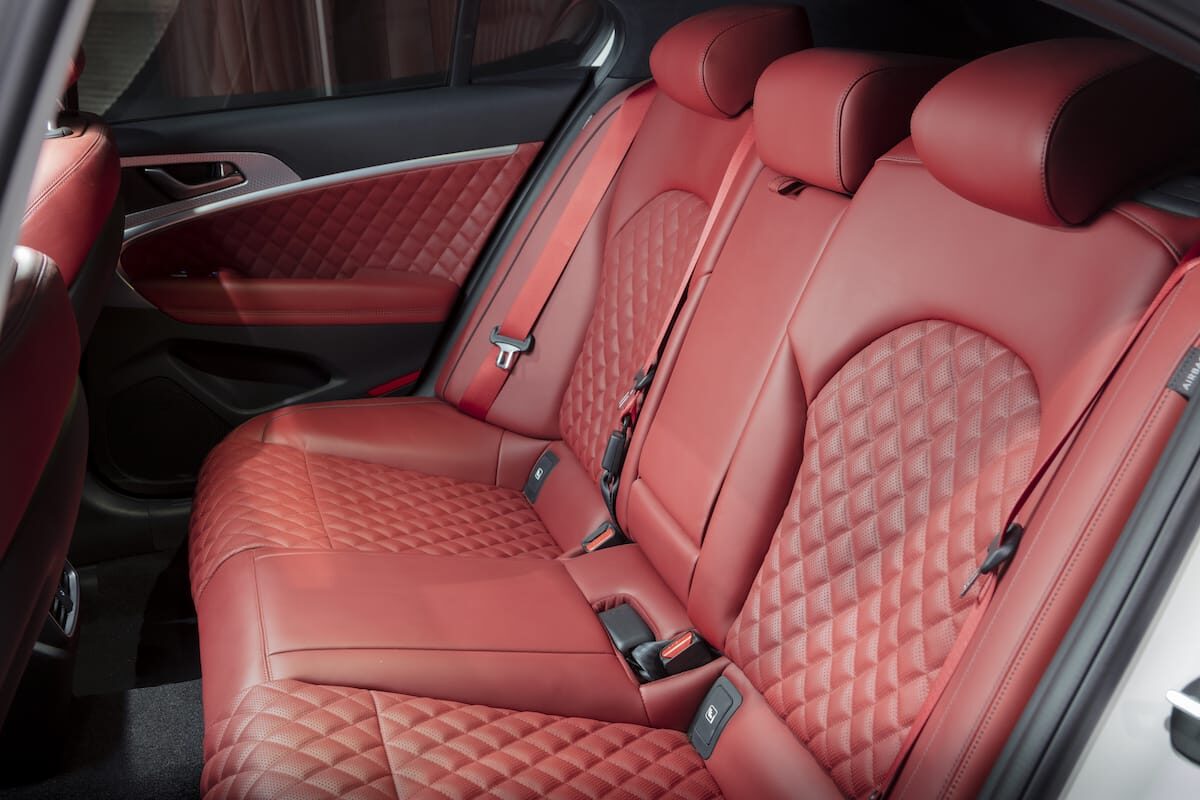
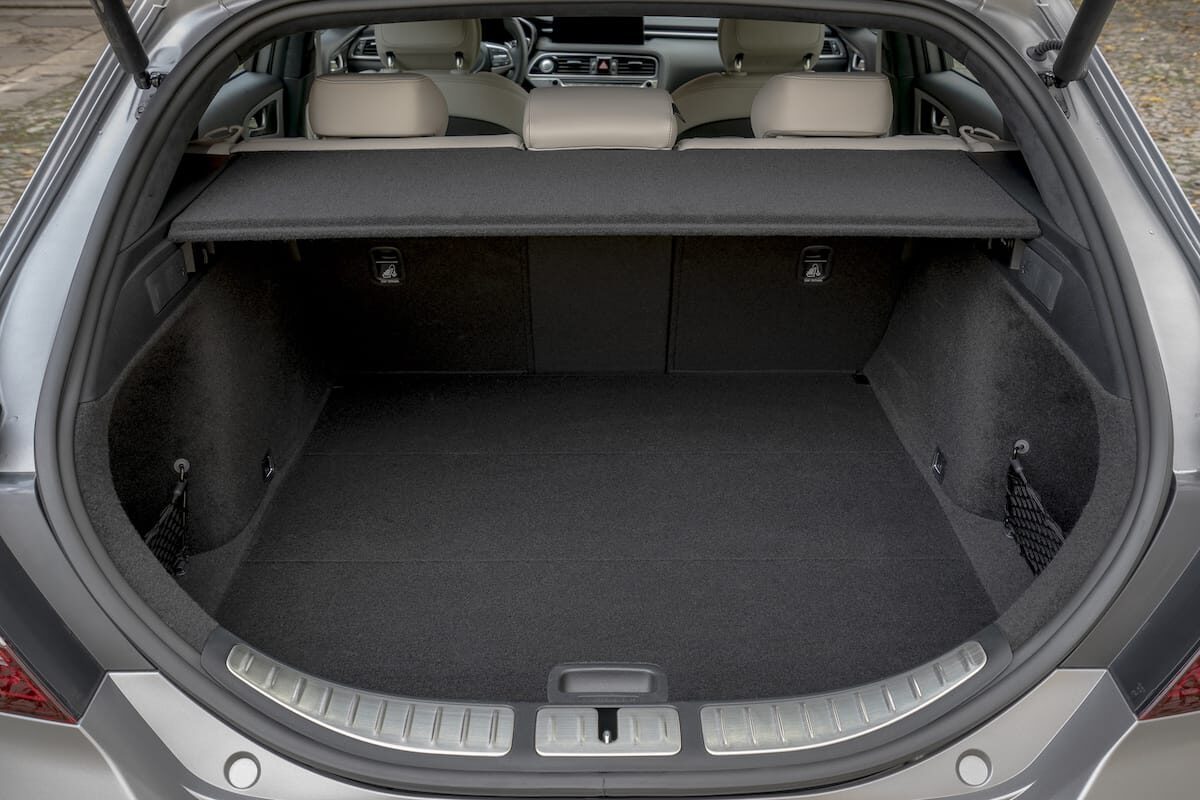
We’ve already said that such ‘lifestyle estates’ prioritise form over function and this is true of the G70 Shooting Brake. While there’s plenty of room up front, the sleek looks translate to a rather cosy rear-seat environment, while the boot space of 465 litres (extending to 1,535 litres with all the rear seats lowered) is not exactly cavernous and with quite a narrow opening to load it.
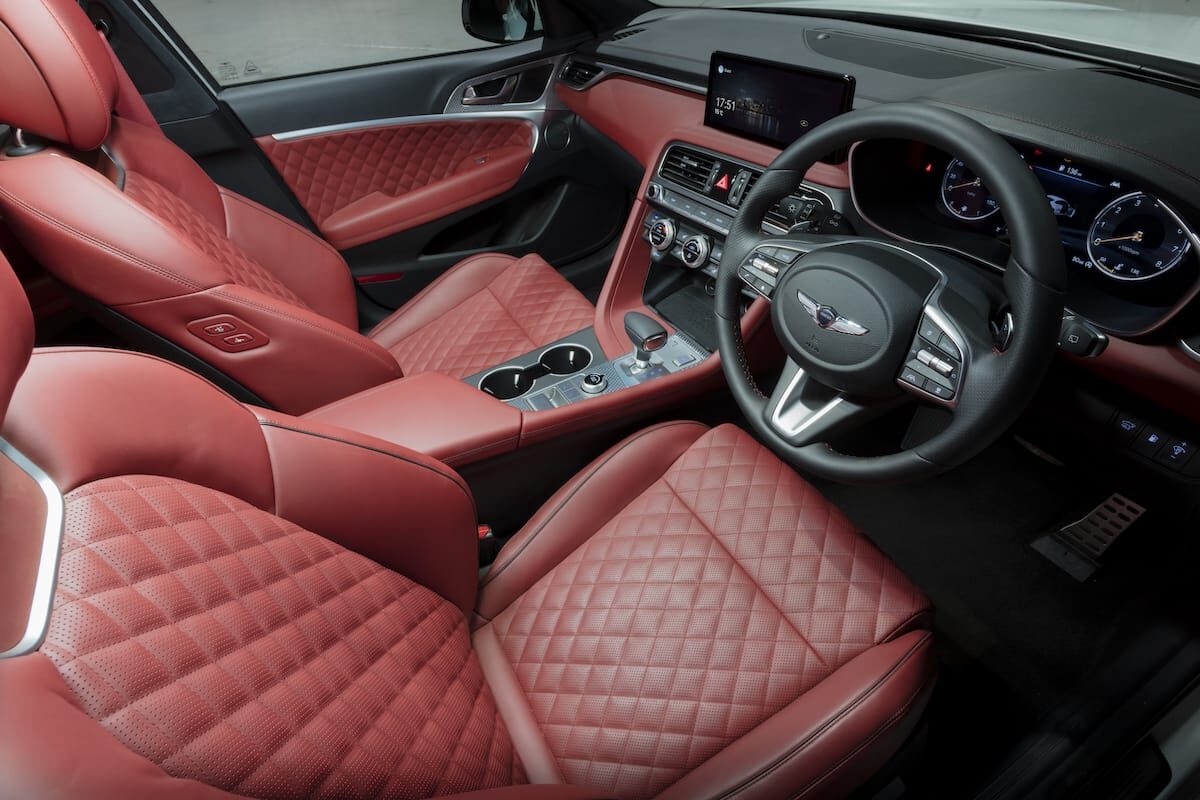
We like the general interior treatment of the G70 – our test car certainly felt upmarket the moment one slipped into the Nappa leather seats, though it’s worth adding that these are options and we haven’t tried the standard fare.
The driver’s environment refreshingly retains a fair few physical dials and knobs, instead of turning everything over to touchscreens. The centre console is, however, dominated by an 11-inch infotainment touchscreen with all the smartphone compatibility one would expect, though the long screen is a big stretch for a driver wishing to use apps that place their controls on the left-hand side.
The seating position is quite low which adds to the sporty feel of the car – visibility is good all round, though relying on technology behind one’s head with blind-spot monitor and parking sensors and cameras all included in the standard specification.
We particularly like the Innovation Pack, a £3,250 fitted option on our test car which replaces the analogue instrument dial with a 12-inch digital display – activating the indicator turns either the speed or rev dial into a camera view of the side one intends to turn into and whether any traffic might be coming up on it. The pack also adds a head-up display and matrix LED headlamps.
Our test car was also fitted with the Comfort seat pack, which adds lots of adjustability in lots of directions, while also including electric steering wheel adjustment.
What’s under the bonnet?
The Shooting Brake engine range replicates that of the G70 Saloon, unsurprisingly, and that means just three options – you can have a four-cylinder turbocharged 2.0-litre petrol unit with either 197 or 244hp, or a turbo diesel of 2.2 litres with 200hp on offer. All are combined as standard with an eight-speed automatic gearbox and drive through the rear wheels.
Our test car was fitted with the more powerful petrol option, and it is certainly a refined yet enthusiastic unit, as one would expect from a car targeting rivals wearing the badges of Audi, BMW and Mercedes-Benz. From rest 62mph comes up in seven seconds while it also offers a sprightly five-second 31-62mph time, great for swift overtaking moves.
But – and it’s a big but – fuel economy that struggles to hit 30mpg and CO2 emissions levels north of 200g/km might have been typical of the premium market not so long ago, but today they are very previous-generation. The lack of any electric element to these powertrains, even to the extent of mild hybrid support, is likely to be a major minus factor for potential G70 buyers and make the car a virtual non-starter for business buyers looking at their benefit-in-kind tax rates.
What’s the G70 Shooting Brake like to drive?
The driving bit is where the G70 Shooting Brake scores most of its plus points – its on-the-road performance is hugely enjoyable behind the wheel and nothing like one might expect from an estate. It’s almost as if the designers made driving dynamics their only priority, and insisted on the low and wide body and well-sorted rear-wheel-drive powertrain.
The petrol engine is certainly keen, but in a relaxed way – it pulls strongly right through the rev range while never sounding as if it’s making any effort doing so. The auto shifts are well-timed, precise and very rapid when needed, which as mentioned combines with the engine’s potency to make rapid overtaking very easily accomplished.
Standard equipment on our test car includes adaptive dampers – switching to the sport setting does add some stiffness to the suspension and aids precise turn-in. Combined with the handling-friendly rear-propulsion this makes for confident cornering, though the feedback through the steering cannot match what one gets from a BMW, still the leader in this area.
Verdict
There’s a lot to like about the Genesis G70 Shooting Brake. It may be more practical than its saloon sister, but it is also arguably better looking with a slippery, rakish style, while inside it combines plenty of luxury touches and loads of comfort with a reasonable degree of space.
On the road, the car is a revelation. It’s highly enjoyable to drive with precise handling, excellent roadholding and quality ride comfort. As such, it really can be considered a viable rival to the German big hitters in the premium market.
The G70 Shooting Brake scores on value too – starting prices are low compared to rivals and even if you go for the base model you get a lot of equipment, which might sway buyers in the direction of the Korean contender.
One can’t get away, however, from the fact that by only offering traditional petrol or diesel engines to buyers, Genesis is off the radar of today’s market which is now racing towards electrification. Until that major failing is addressed, the Genesis G70 Shooting Brake will remain a bit player.
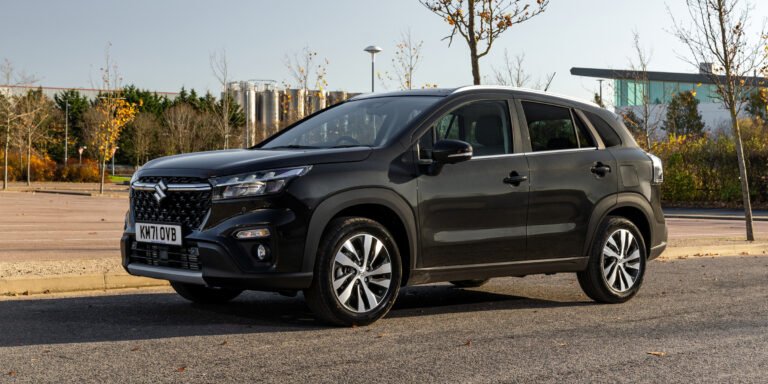
The Suzuki S-Cross is a mid-size five-door SUV/crossover that sits between the smaller Vitara and larger Across in the Suzuki SUV family. This generation is an all-new model that arrived in the UK in January 2022, replacing the previous model which had been on sale in various forms since 2013.
The new S-Cross features more modern styling and more on-board technology than its predecessor. Only one powertrain option is currently offered, which is a 140hp 1.4-litre petrol engine with mild hybrid assistance. A plug-in hybrid variant is planned to arrive in the UK later in 2022.
While UK reviewers almost conclusively agree that the second-generation Suzuki S-Cross is an affordable package that features plenty of on-board tech as standard, many of those same journalists take issue with the SUV’s rather cheap interior design, which Parkers labels “dull”.
Many reviews also note that the S-Cross has less rear headroom and boot space than key rivals like the Nissan Qashqai and Peugeot 3008, while Carbuyer points out that an entry-level S-Cross model is not much of a step up from the cheaper Suzuki Vitara.
Regardless, Heycar concludes that the S-Cross is a perfect example of what Suzuki models do best – remain dependable for decades, potentially “outlasting some of its buyers” Car predicts. Suzuki’s mild hybrid technology means that the S-Cross is cheap to run.
Compared to mainstream rivals, the S-Cross is rather basic, but it does cover the basics well. As of March 2026, the Suzuki S-Cross holds a New Car Expert Rating of D with a score of 56%.
Body style: Medium SUV/crossover Engines: petrol (mild hybrid) Price: From £24,999 on-road
Launched: Spring 2022 Last updated: N/A Replacement due: TBA
Image gallery
Media reviews
Highlighted reviews and road tests from across the UK automotive media. Click any of the boxes to view.
Featured reviews
“There’s a lot to like about the new Suzuki S-Cross. Certainly, the price you pay will make it very tempting for many buyers. You will then have to ask yourself if you are happy with it doing the other stuff only adequately, such as its amount of space and its performance on the road. It’s competent and excellent value but by no means a stand-out contender.”
Model reviewed: Range overview Score: 7 / 10 “The Suzuki S-Cross offers a lot for the money, but its utilitarian interior and unrefined hybrid system let it down.” Author: Max Adams, Dean Gibson Read review
Model reviewed: S-Cross Hybrid Score: 6 / 10 “The Suzuki S-Cross Hybrid is a neat compact SUV that’s packed with plenty of kit at a competitive price, while its option of four-wheel drive is relatively unique in the sector. However, rivals offer more space, while the Hybrid model’s ponderous automated manual gearbox means it’s not very smooth to drive.” Read review
Auto Trader
Model reviewed: Range overview Score: 7 / 10 “No-nonsense and great value for money, the Suzuki S-Cross may not be the snazziest crossover around but appeals for other reasons.” Read review
Car
Model reviewed: Range overview Score: 6 / 10 “The Suzuki S-Cross is a simple and honest family SUV. It’s economical, good value for money, spacious and surprisingly good fun to drive. However, that’s only true if you stick with the 1.4-litre four-cylinder mild hybrid petrol engine. Suzuki’s new full hybrid system doesn’t make a very good case for itself. It’s a bit underpowered, the gearbox isn’t particularly refined and its fuel economy figures aren’t significantly better.” (Luke Wilkinson) Read review
Carbuyer
Model reviewed: Range overview Score: 7.2 / 10 “The new Suzuki S-Cross looks good value in entry-level spec but it’s not the most practical car in its class and the brand’s less expensive Vitara is very similar.” Read review
Heycar
Model reviewed: S-Cross 1.4 Mild Hybrid Ultra Score: 6 / 10 “Suzuki doing what Suzuki does best – a dependable, left-field alternative to mainstream family SUVs like the Vauxhall Mokka, Kia Sportage and Nissan Qashqai.” Read review
Honest John
Model reviewed: Range overview “New Suzuki S-Cross gets generous kit levels and mild-hybrid power.”
Read review
Motoring Research
Model reviewed: S-Cross 1.4 Boosterjet Allgrip Ultra Score: 7 / 10 “The revised Suzuki S-Cross has finally become a car worthy of real-world consideration. It’s not one that knocks rivals such as the Qashqai or 3008 for six, but it’s nevertheless a more competitive proposition alongside them. Particularly with added value on its side.” Read review
Parkers
Model reviewed: Range overview Score: 6.4 / 10 “A sensible but not scintillating family SUV.” Read review
Regit
Score: 6 / 10 “All things considered, the Suzuki S Cross is not bad. But the lack of drivability from the hybrid powertrain and the reduced practicality is a letdown. The Suzuki is not ugly but its exterior design has a whiff of yesteryear about it, as does the interior. And, alas, the infotainment system is low down the rankings. Nevertheless, the S Cross is generously equipped and excellent value for money when you consider the cost of most hybrid 4x4s.” Author: Tim Barnes-Clay Read review
The Sun
Model reviewed: S-Cross 1.4 Mild Hybrid Ultra “Another brilliantly executed Suzuki that offers a lot of comfort and convenience, for not a lot of money.” Read review
The Telegraph
Model reviewed: 1.4-litre petrol manual Boosterjet Ultra Score: 6 / 10 “The Suzuki S-Cross isn’t going to bother the big sellers in this class such as the Ford Kuga or Nissan Qashqai, but there are those who might be tempted by the simple 4×4 system, the dependability of the brand and by the company’s dealers who tend to regard their customers as people and not a job card.” Read review
Top Gear
Model reviewed: Range overview Score: 7 / 10 “A car that used to be purely sensible now lets some style into the mix. Not perfect, but wholeheartedly good value for money.” Read review
Safety rating
Independent crash test and safety ratings from Euro NCAP
No safety rating
As of March 2026, the Suzuki S-Cross has not been tested by Euro NCAP. If and when it is put through its paces by Euro NCAP, we will publish the results here.
Eco rating
Independent economy and emissions ratings from Green NCAP
No eco rating
As of March 2026, the Suzuki S-Cross has not been tested by Green NCAP.
Reliability rating
Reliability data provided exclusively for The Car Expert by MotorEasy
No reliability rating
As of March 2026, we don’t have enough reliability data on the Suzuki S-Cross to generate a reliability rating.
The Car Expert’s reliability information is provided exclusively to us using extended warranty data from our partner, MotorEasy. As soon as MotorEasy has sufficient data on the S-Cross, we’ll publish the score here.
Running cost rating
Monthly cost of ownership data provided exclusively for The Car Expert by Clear Vehicle Data
Fuel consumption
Average
Score
Petrol models
51 mpg
C
Hybrid models
52 mpg
B
CO₂ output
Average
Score
Variation
Score
Petrol models
124 g/km
B
Hybrid models
123 g/km
B
Insurance group
Average
Score
Variation
Score
All models
37
D
Service and maintenance
Cost
Score
Year 1
£191
B
Year 2
£510
B
Year 3
£859
C
Year 4
£1,065
B
Year 5
£1,488
C
Overall
£4,113
C
The Suzuki S-Cross is a relatively affordable car to own and run, according to whole-life cost numbers provided exclusively to The Car Expert by our data partner, Clear Vehicle Data.
Fuel economy for both petrol and diesel models is good, and maintenance costs are predicted to remain on the affordable side during the first five years of ownership. On the insurance front, costs are expected to be fairly average.
Similar cars
If you’re looking at the Suzuki S-Cross, you might also be interested in these alternatives
With a selection of petrol and plug-in hybrid models, the unconventional Citroën C5 X is now available to order in the UK.
Launched as the new flagship model in the Citroën range, the French manufacturer describes the C5 X’s design as a blend between the characteristics of a luxury saloon, SUV and an estate car. It follows a similar design philosphy in the smaller Citroën C4.
Customers in the UK are now able to order from the C5 X range, which includes petrol and plug-in hybrid models (automatic only) across three trim levels, the first orders being expected to arrive on British roads in late Spring 2022.
Exterior design
The 2022 Citroën C5 X takes several front-end exterior styling cues from the C-Xperience concept car which made its debut at the 2016 Paris motor show, such as the narrow LED daytime running lights that are connected to the brand’s double chevron logo using a chrome finish, sitting above the teardrop-shaped main headlights.
From the side, creases feature on the bottom of the doors that match the indentations on the bonnet design, sitting above SUV-style bumper cladding.
This cladding continues to the rear of the car, where the LED taillights form a ‘V’ shape to mirror the styling in the front, and pointed spoilers frame the top and bottom of the rear window. All models come with 19-inch alloy wheels, and the mid-range ‘Shine’ trim adds chrome details to the rear bumper. Customers have a range of six exterior colours to choose from.
Interior styling and equipment
On the inside, the interior colour scheme is different for each trim level, and all models are fitted with Citroën’s ‘Advanced Comfort’ seats – essentially seats with extra padding. LED interior lighting is available with the ‘Shine’ trim, and electrically adjustable and heated front seats come with the range-topping ‘Shine Plus’ trim.
The C5 X also comes with ‘Advanced Comfort’ suspension, which improves ride comfort when driving on uneven terrain. Front and rear parking sensors and a reversing camera are also available as standard, while blind spot monitoring, a heated steering wheel, tinted sound-insulated windows, and a motorised boot lid feature on more expensive models.
The Citroën C5 X comes with a ten-inch infotainment system as standard, which is upgraded to a 12-inch screen for the ‘Shine’ trim and up. Apple CarPlay, Android Auto and satnav are included on the entry-level ‘Sense Plus’ trim, while wireless smartphone charging and a heads-up display behind the steering wheel are available with the ‘Shine’ trim.
Engine range
Customers can opt for a combustion-powered Citroën C5 X, choosing between two petrol engines, or opt for the plug-in hybrid variant. All models are fitted with an automatic gearbox.
If you’d prefer a petrol version of the C5 X, you can select either a 130hp 1.2-litre or a 180hp 1.6-litre unit, the latter reserved for the ‘Shine’ and ‘Shine Plus’ trim levels.
The 225hp plug-in hybrid is the most powerful option in the range, as well as the most expensive. Fitted with a 12.4kWh battery, The C5 X PHEV can manage up to 34 miles running on electric power, and also features a driving mode selector (Electric mode, Hybrid mode and Sport mode) and adjustable regenerative braking.
Trim level features
Entry-level ‘Sense Plus’ (£26,490)
Ten-inch infotainment console
Wireless Apple CarPlay and Android Auto
Citroën’s 3D navigation software
LED headlights
Citroën’s ‘Advanced Comfort’ seats
19-inch alloy wheels
Reversing camera
Front and rear parking sensors
‘Urban Grey’ interior colour scheme
Mid-range ‘Shine’ (£27,990)
All ‘Sense Plus’ features that are not replaced
12-inch infotainment console
Heated steering wheel
LED interior lighting
Wireless smartphone charging
Chrome finish on rear bumper
A head-up display
Radar-controlled Active Safety Brake
‘Metropolitan Grey’ interior colour scheme
Range-topping ‘Shine Plus’ (£29,980)
All ‘Sense Plus’ and ‘Shine’ features that are not replaced
Jeep has announced mild ‘e-Hybrid’ (MHEV) models for its Renegade and Compass SUVs, adding to the existing range which already includes plug-in hybrid models (PHEV).
The new mild-hybrid variants of the Jeep Renegade and Compass both use the same powertrain setup – a 130hp four-cylinder 1.5-litre turbocharged petrol engine paired with 15kWh electric motor. Both new models use the same seven-speed automatic transmission.
Jeep says that this ‘e-Hybrid’ powertrain delivers up to 15% lower fuel consumption and CO2 emissions than the previous petrol versions of the Renegade and Compass, as the electric motor can power the engine when setting off, parking, cruising, and driving at low speeds.
These mild hybrids also have regenerative braking to help charge the electric motor, and an ‘e-Boosting’ feature that uses the motor to send extra torque to the petrol engine, resulting in punchier acceleration.
2022 Jeep Renegade e-Hybrid
2022 Jeep Compass e-Hybrid
The new Jeep Renegade e-Hybrid and Compass e-Hybrid are now available to order in the UK, as is a new special edition trim for both SUVs called the ‘Upland’, which Jeep says features sustainable material and components from recycled plastics.
Prices for the Renegade and Compass e-Hybrid models start at £31,130 and £32,895 respectively, with the first orders expected to arrive on British roads in March 2022.
The Jeep Renegade has received a mediocre reception since it first arrived in the UK in 2015, currently languishing towards the bottom of the small SUV class in our industry-leading Expert Ratings Index, with an Expert Rating of 49%. The Jeep Compass range has not fared much better, currently holding an Expert Rating of 52%.
The growth of online car buying services might make you think visiting a dealer to trade in your old car against a new one is too much hassle.
Not true. With a little preparation part exchange can be straightforward, even enjoyable.
Value first
The first step to part exchange is having your own idea of what your car is worth. Many dealer websites offer an online part exchange valuation in return for your contact details.
However, the data used to compile the valuations will be from a trade and consumer supplier and that same data is used for the independent valuations supplied by used car guides and sites such as Parkers and Auto Trader, combined with their own sold prices. Both offer online valuation tools.
You can get a free valuation, or you can pay to sign up for a month for more precise valuations on multiple cars – usually about £10. Paid valuations allow you to enter your car’s exact mileage and any options which add value.
A low mileage still increases value. You’ll need to go back and check your car’s price nearer the time you visit a dealer and you can also get prices for the cars you are going to see.
If your car is near its MOT test it’s a good idea to put it through to pass before you part exchange. This adds value because the dealer knows there is no remedial work to be done.
Also, if you are due to pay your annual road tax as you are part exchanging, just buy six months. Road tax is cancelled when a car is sold, you get a refund for any whole unused months and the new owner starts again.
Get an online offer first
Before you head to the dealership to present them with your car, take a few moments and get a free valuation (or two) from online buying services. This will give you a starting point for any discussions with the salesperson down at the dealership, and if they can’t match your online price, you don’t have to part-exchange the car at all.
The three companies below are all commercial partners of The Car Expert, but there are other companies around who can offer you a similar service.
Make sure you have the vehicle registration document (the V5C) to prove your ownership of the car, then the MOT certificate and any advisory notes.
That said, if you can’t find the MOT certificate anybody can check if a car has one for free by putting the registration into the GOV.UK website.
To show the car has been cared for, stamps in a service book are ideal but physical service books are less common than they were, as franchised dealers keep digital records which their whole network can access. So, for example if you have your Ford serviced at a Ford dealer, any other Ford dealer will be able to look this up.
Should I clean it?
Absolutely, inside and out.
In fact, consider a full valet near to then time you’re going shopping. If you pitch up at a dealership in a car covered in mud, sticky fingerprints or dog hairs the dealer will assume the car has not been cared for, won’t be able to assess any minor bodywork scuffs and scrapes and will mark its value down straightaway.
The time of a full valet and any major remedial action will have to be taken into account. Also, top up the windscreen washer fluid, check the tyres are good (and legal) and don’t turn up with any warning lights showing. Make sure all your exterior lights are working and replace any blown bulbs – it’s illegal anyway.
What about dents and scratches?
There are companies which can make good small scratches, smarten scuffed alloy wheels and remove small dents (minor enough to be pulled out without needing new paintwork). If it’s not too much trouble you can get a quote before you visit any forecourts, then you can decide how much you’re prepared to pay to get your car shipshape.
However, if we are only talking about minor parking rub marks, paint restoration kits available on certain well-known shopping sites are easy to use and work quite well.
If there are small scratches, these won’t come out at home but the dealership won’t be much concerned as their bodyshop will be able to quickly sort this far cheaper than if you had paid for it.
To the dealer, even if they may want to sell the car you are looking at quickly, they will also want to either sell your car on equally quickly or pass it on to a reseller (for example Cazoo).
The least work involved in preparing it equals less of their profit margin. It really does pay to present your part exchange well. That said, Cazoo leaves minor paint marks intact and include photos in each listing.
It’s worth remembering that even if you use one of the well-publicised car buying services which first give you an online value based on your description, you may still have to take it to a physical location to hand it over, at which point the staff may attempt to reduce the price if they decide you have not described the car accurately online.
Part exchange day
Having booked to see a car and test drive it at a dealership you can assume that as soon as you’ve pulled up and are off with a cup of coffee, an employee will zip over your car to look it over and give you a part exchange value on the spot
This is why you must get a value before you arrive (and print it out). It will help you know if the part exchange price is well out of line. That said, don’t get stressed if the offer is, say a few hundred pounds off.
The money can come off either end. Depending on the amount of profit the dealer has allowed in the asking price and if you are happy to negotiate, the asking price can come down or the part exchange value can go up. Your car’s value can also be influenced on how many of that type of car the dealer chain has at that time or how quickly yours can be sold on with very little preparation.
They key here is what is your cost to change? For example, you are keen on a £15,000 used car and your part exchange is valued at £8,000 by the dealer, even though you believe it is worth £9,000. Your cost to change is now £7,000, so can you move against the £6,000 you might have been expecting?
If your cost to change is fixed and neither the asking price will come down or the part exchange come up, then you’ll have to walk away. If you’re buying a new car then you can negotiate on the finance, ask for a service plan to be thrown in, or optional extras.
Don’t be put off. With some planning part exchange can be fair and even a pleasant experience. One last tip; if you are not handing over your car on the same day as you collect your next one, try not to rack up the mileage in between. Values are usually guaranteed for seven days.
* The Car Expert has commercial partnerships with Cazoo, Exchange My Car and Motorway. If you sell your car to any of these companies, we may receive a small commission.
With the rapid growth of new electric car sales, it’s not surprising that demand for used EVs is also increasing. This is reflected in data from used car dealers about the fastest-selling cars on their forecourts in the last year.
A report published by automotive marketplace Auto Trader crowns the previous-generation Nissan Leaf as the fastest-selling used car in the UK during 2021, taking just 17 days on average to sell once it had arrived on a used car forecourt.
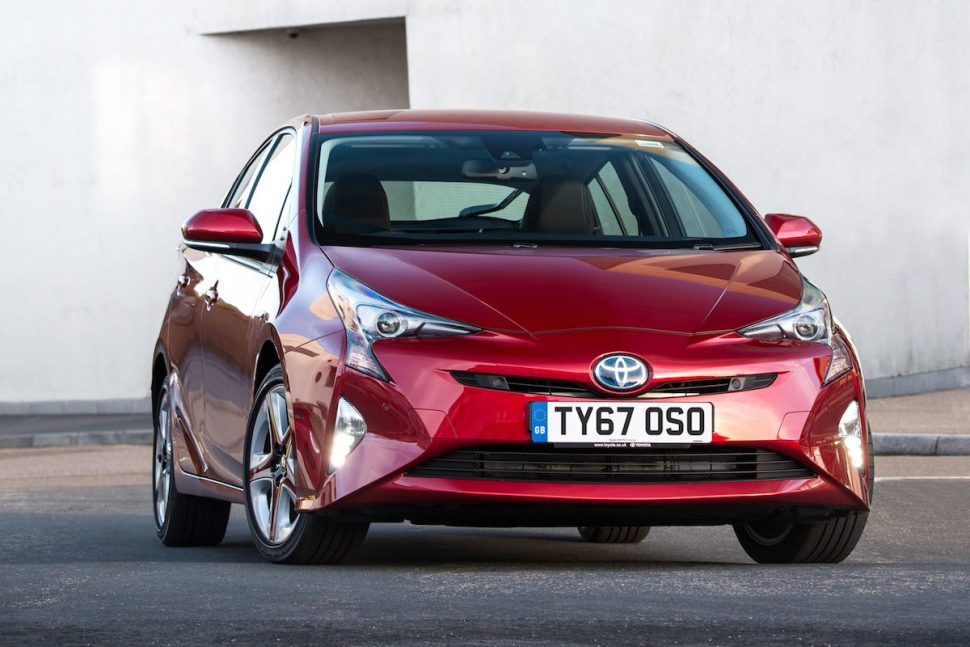
This is the second time that an electric car has been Auto Trader‘s fastest-selling used car, after the Renault Zoe finished in top spot in 2019. In the most recent rankings, the Zoe finished in 7th place, while two Toyota petrol-hybrids also made the top ten – the Prius and Yaris.
Diesel cars make up the rest of the top ten, with the majority of 2021’s fastest-selling used cars being automatic models.
2021’s fastest-selling used cars
Rank
Model
Fuel & Transmission
Predicted Days to Sell
1
2016 Nissan Leaf
Electric – Automatic
17
2
2016 Toyota Prius
Petrol Hybrid – Automatic
19
3
2016 Mazda CX-5
Diesel – Manual
19
4
2016 Peugeot 3008
Diesel – Automatic
19
5
2016 Citroen Grand C4 Picasso
Diesel – Automatic
20
6
2016 Toyota Yaris
Petrol Hybrid – Automatic
20
7
2018 Renault Zoe
Electric – Automatic
20
8
2016 Peugeot 308
Diesel – Manual
21
9
2016 Nissan Qashqai
Diesel – Automatic
21
10
2016 Ford Grand C-Max
Diesel – Manual
21
Source: Auto Trader
These rankings are based on Auto Trader‘s own ‘Fastest Selling Index’, which tracks the potential speed at which vehicles will sell based on live supply and demand in the market.
All of the automotive marketplaces tend to report on this data every month, but that is heavily influenced by specific stock and registration movements by manufacturers, which tends to turn up some very unusual results. Over a full year, however, the data becomes more relevant.
Interestingly, the top three places on the list comprise an electric car, a hybrid car and a diesel SUV. All but one of the models listed are 2016-registered vehicles, suggesting that five-year-old cars are a bit of a sweet spot for used car buyers.
Nissan Leaf (2010 – 2016)
Toyota Prius (2016 onwards)
Mazda CX-5 (2012 – 2017)
An all-electric model takes top spot – proof EV demand is really high?
Auto Trader reports that at the start of 2021, a used electric car took 44 days on average to sell once it was bought by a car dealership. No doubt aided by the fuel shortages that hit the UK towards the end of the year, this average dropped to just 26 days by the end of the year.
By comparison, it took an average of 30 days for a diesel car to sell once it arrived on the forecourt, and 34 days for petrol models.
Auto Trader also reports that searches for electric models on its website rose by 74% in 2021, with the most viewed EVs being the Ford Mustang Mach-e, the Hyundai Ioniq 5, and the Volkswagen ID.3.
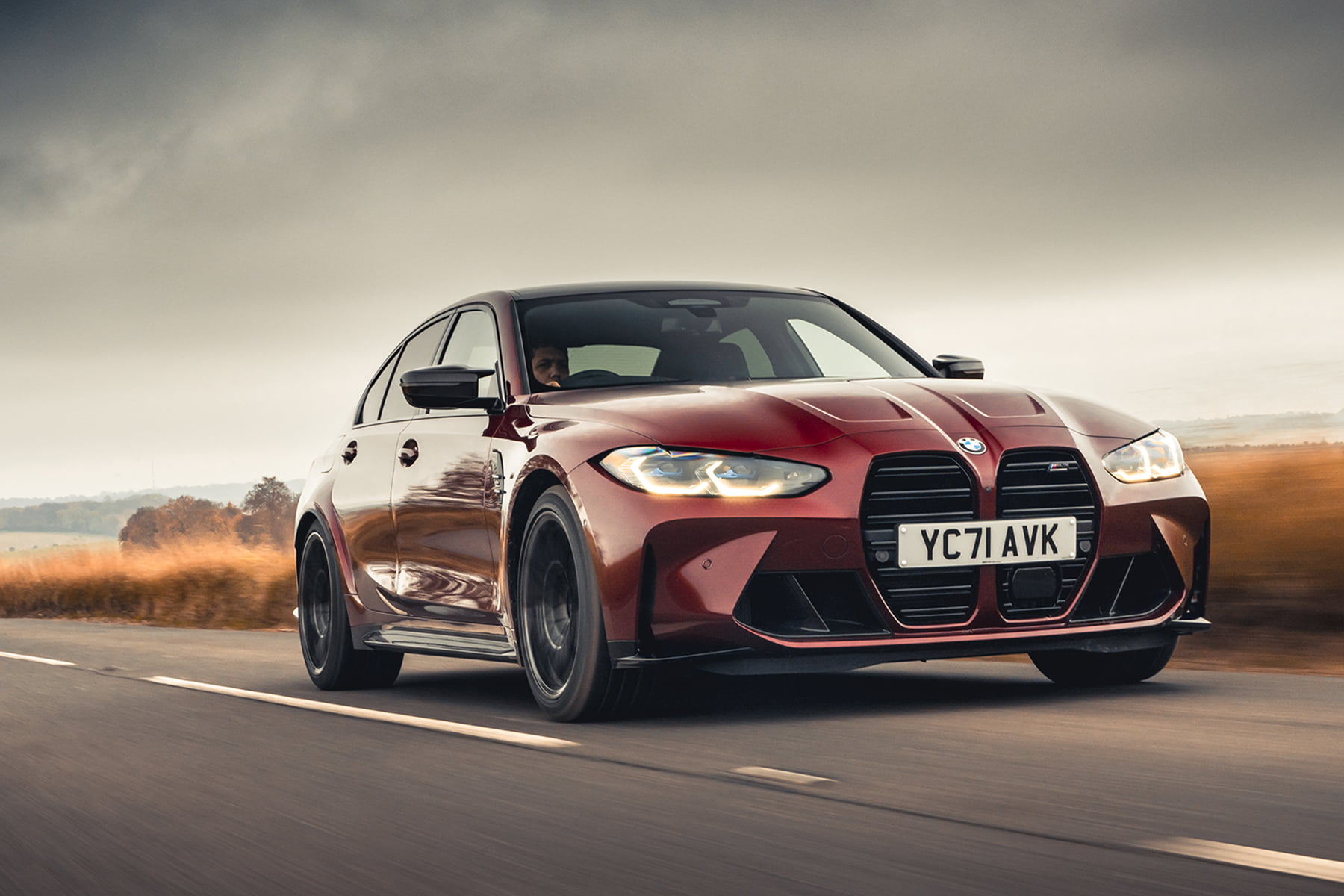
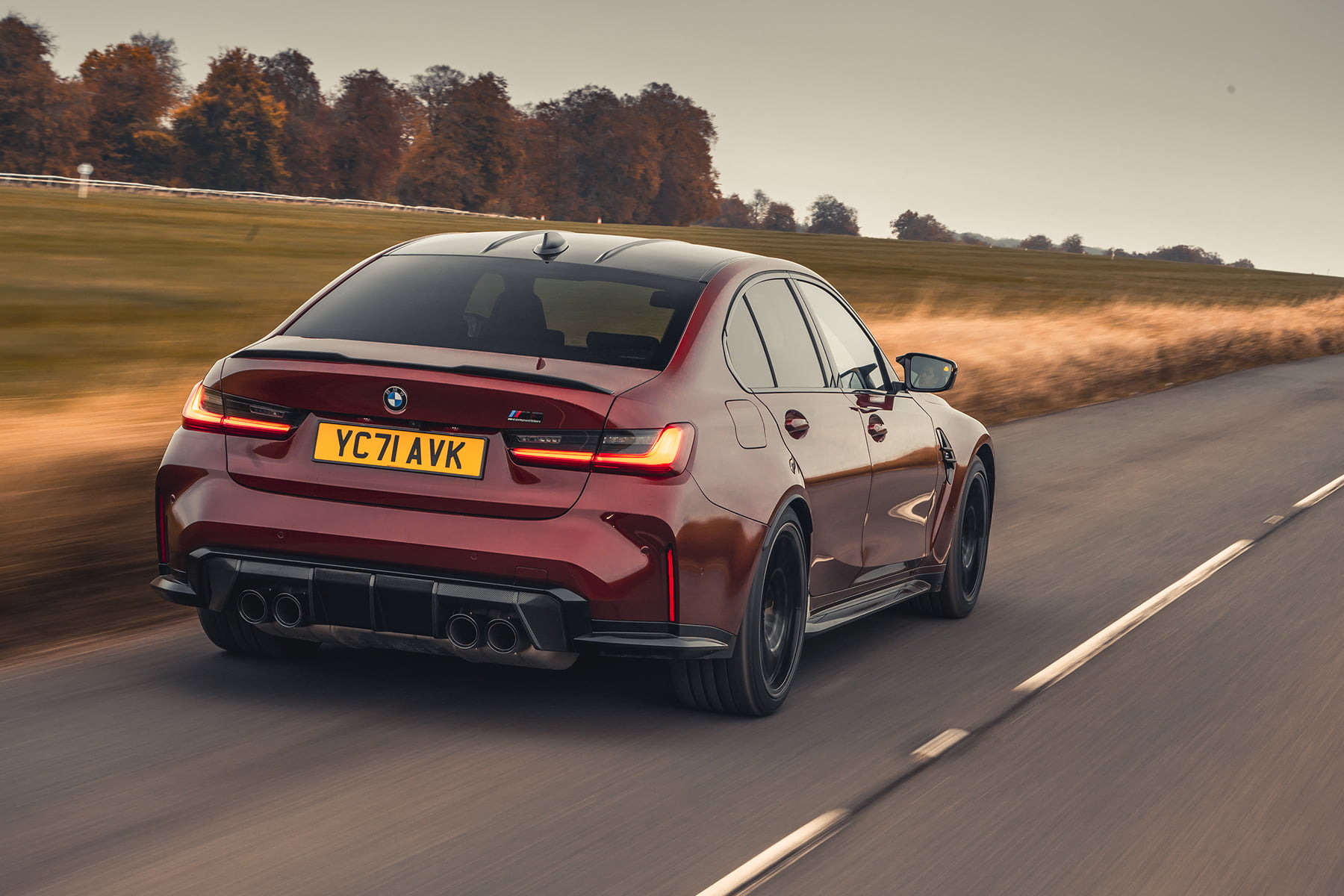
The BMW M3 Competition is a high-performance saloon (and now estate) based on the regular 3 Series range. It is the latest in a long line of performance 3 Series models that dates back to the mid-1980s.
Now in its sixth generation, the BMW M3 had been produced only as a four-door saloon since 2014, coupé and convertible variants being rebranded as the BMW M4. However, an estate version (the BMW M3 Touring) joined the range for the first time in 2022.
In the UK, we only get the M3 Competition model, which is powered by a 3.0-litre, twin-turbo, six-cylinder petrol engine that produces 510hp and drives through an eight-speed automatic transmission. While previous generations were always offered only in BMW’s traditional rear-wheel-drive format, the latest M3 is also available in an all-wheel-drive configuration (called ‘xDrive’ in BMW jargon).
The M3 has had a very positive reception from the UK motoring media since its arrival at the start of 2021, with all of the reviews we track commending the saloon for its impressive performance despite this latest generation being heavier and bulkier than its predecessors.
Auto Trader concludes that the saloon’s blend of performance and practicality makes it the most appealing M3 iteration to date, while Carwow sums up its review by calling the M3 “nothing short of sensational to drive”.
Beyond the polarising grille designs that BMW is rolling out across its entire ‘M’ range, there have been very few criticisms of the M3 beyond the expected quibbles over price, and that ride comfort is compromised in pursuit of handling – which any prospective customer is likely to expect anyway.
Nevertheless, most reviewers would recommend the BMW M3 over any other performance saloon in its class, including the Mercedes-AMG C63 and Audi RS 4. Only the Alfa Romeo Giulia Quadrifoglio is generally considered to be on par with the M3 saloon.
As of February 2026, the BMW M3 holds a New Car Expert Rating of C, with a score of 59%. Notwithstanding its excellent media reviews and decent safety score, the M3 is hampered by its poor scores for reliability and running costs.
Body style: Four-door saloon and estate Engines: petrol Price: From £75,660 on-road
Launched: Spring 2021 Last updated: Summer 2021 Replacement due: TBA
Image gallery
Media reviews
Reviews, road tests and comparisons from across the UK automotive media. Click any of the boxes to view.
Auto Express
Model reviewed: CS (2023) Score: 9 / 10 “The BMW M3 CS treatment squeezes even more performance out of the mighty BMW M3, but its six-figure price is a bit difficult to stomach.” (Steve Fowler) Read review
Model reviewed: M3 Touring Score: 9 / 10 “The BMW M3 Touring drives every bit as well as the saloon, which makes it one hell of a high-performance family car.” Author: Jordan Katsianis Read review
Score: 9 / 10 “More rounded, more versatile but still able to deliver the thunderous performance M cars are famous for, the new BMW M3 hits the mark.” Read review
Auto Trader
Score: 9 / 10 “The BMW M3’s combination of sports car chasing performance and saloon car practicality is as appealing as ever.” Read review
Car
Model reviewed: M3 Touring Score: 8 / 10 “The new 2023 BMW M3 Touring Competition confidently, effortlessly saunters in and settles down at the head of the estate car class. The Audi RS 4 Avant, as appealing as it is, does not have the steering or brakes to live with the M3 Touring.” (Keith Adams) Read review
Car Keys
Model reviewed: Touring (2023) Score: 10 / 10 “Living up to expectations is always a difficult thing, but BMW has managed just that with its M3 Touring. It’s every bit as good as we hoped, with its blend of practicality and performance and able to open up this BMW M model to a wider audience.” Read review
Score: 10 / 10 “BMW has managed to ensure the M3 remains just as exciting and focused as ever, yet while also taming it down in the process and making it a lot more manageable.” Read review
Carbuyer
Model reviewed: Score: 8.2 / 10 “The BMW M3 is still one of the very best sports saloons and now there’s a Touring estate version too.” (Andy Goodwin) Read review
Carwow
Score: 9 / 10 “The new BMW M3 is nothing short of sensational to drive.” Read review
Evo
Model reviewed: Score: 9 / 10 “It’s bigger and heavier than before, and is now auto-only. So can it copy the new M4’s trick of still being fun to drive? You bet it can.” Read review
Heycar
Model reviewed: Estate (Touring) range Score: 9 / 10 “If you’re an enthusiast, the BMW M3 Touring has been a long time coming. To anyone else, it’s just a really fast estate car with a hefty price tag to match. Read our full BMW M3 Touring review to find out if should be on your family car shortlist.” Author: Andrew Brady Read review
Model reviewed: Saloon range Score: 10 / 10 “You don’t get a reputation like the M3’s by accident. BMW has spent almost 40 years honing the concept of the compact performance car, with enormous success, and the latest iteration takes the M3’s legendary dynamic ability to the next level. It’s an absolute masterpiece.” Author: Ivan Aistrop Read review
Motoring Research
Model reviewed: M3 Touring Score: 9 / 10 “Despite a few flaws, the BMW M3 Touring makes a strong case for being the ultimate family wagon. Its price precludes it from being a car I could regularly recommend, and besides, nobody really *needs* a car like this. But that doesn’t stop me from wanting one.” Author: Tim Pitt Read review
Parkers
Model reviewed: Score: 8 / 10 “Devastatingly adept super saloon is flawed and brilliant” Read review
The Sunday Times
Score: 10 / 10 “A flat out winner — get the BMW M3 while you can.” Read review
Top Gear
Model reviewed: Competition Score: 9 / 10 “No other sports or super-saloon is as capable, grippy, tied down, responsive or communicative on a difficult road as a BMW M3 Competition.” Read review
Safety rating
Independent crash test and safety ratings from Euro NCAP
The BMW M3 Competition shares its safety rating with the mainstream BMW 3 Series saloon, which was tested by Euro NCAP back in 2019 and awarded a five-star rating.
The M3 comes with a number of safety features as standard, such as automatic emergency braking and lane-keeping assist.
Eco rating
Independent economy and emissions ratings from Green NCAP
No eco rating
As of February 2026, the BMW M3 has not been tested by Green NCAP. We’re not expecting it to be tested anytime soon.
Awards
Trophies, prizes and awards that the BMW M3 has received
As before, three electrified powertrains will be on offer for the new Niro – hybrid, plug-in hybrid (PHEV) and full battery-electric (BEV). Details of the PHEV and BEV units are still to be revealed but the hybrid combines Kia’s 1.6-litre petrol engine with an electric motor for a combined output of 141hp.
The engine is mated as standard to Kia’s six-speed automatic transmission. European fuel economy figures are yet to be revealed but under Korean testing conditions the car is said to achieve just over 59mpg.
New technology will also debut with the Niro, using the built-in satnav system to determine the most appropriate times for the drivetrain to switch between petrol and electric propulsion. It could, for example, only use the electric motor when close to schools or hospitals. The PHEV model will use the same system.
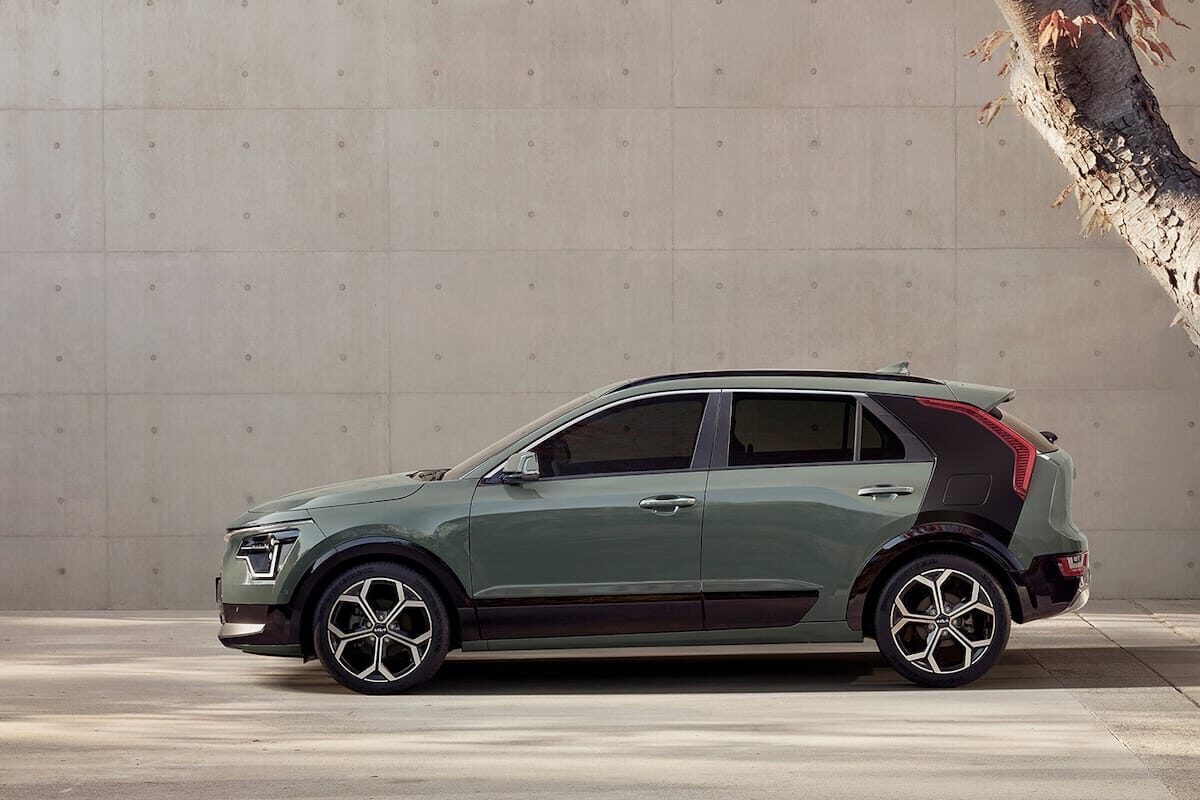
The Mk2 Niro is fractionally larger than its predecessor – 6cm longer, 2cm wider and 1cm taller. Boot space grows slightly as well, by 15 litres to 451 litres, achieved by moving the 12-volt hybrid battery from the boot to under the rear seats next to its high-voltage equivalent.
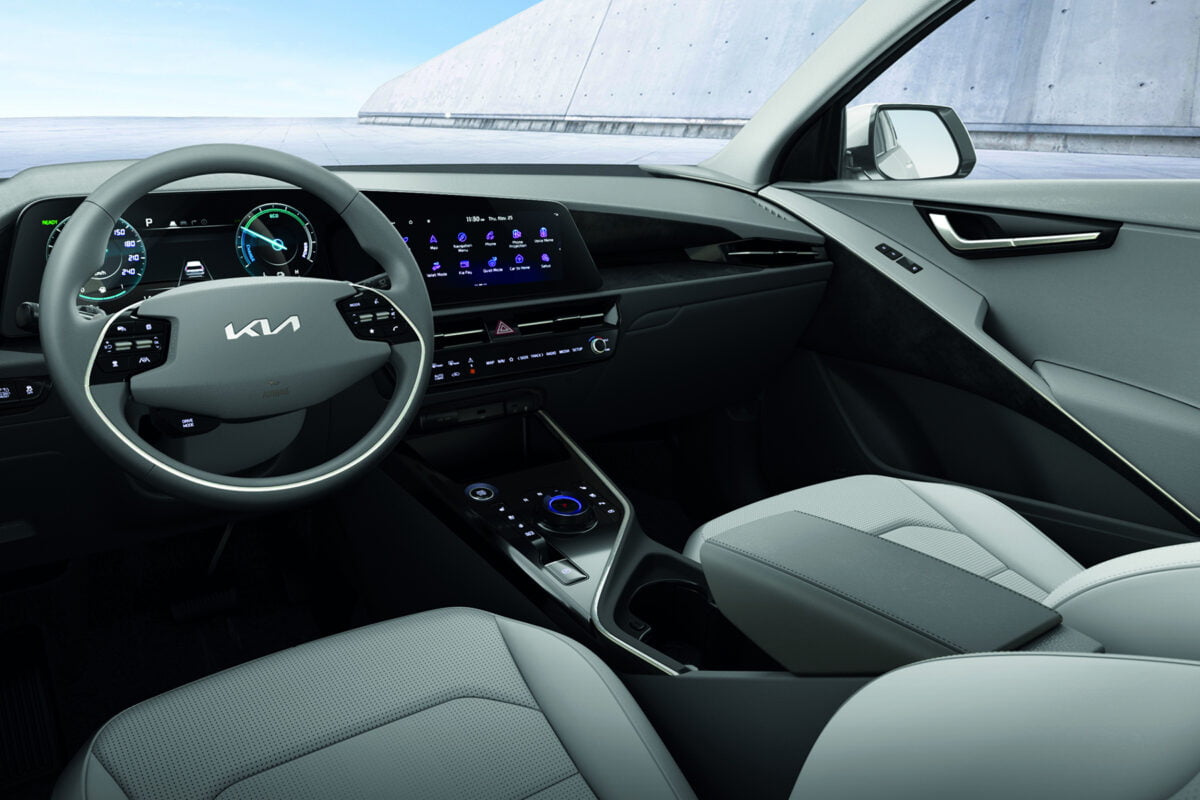
A totally redesigned interior includes a new ten-inch panoramic display panel that incorporates both the driver’s instrument cluster and the infotainment screen. Kia is also emphasising its commitment to sustainability – recycled materials inside the cabin include headlining made from recycled wallpaper, seats made from a material including eucalyptus leaves, and lead-free paint is used on the door panels.
The current Kia Niro family has received varying reviews from the motoring media. The electric e-Niro is one of the top-rated electric cars on sale, with an Expert Rating of 84%. It was also the UK’s second best-selling electric vehicle in 2021. However, the regular Niro hybrid and plug-in model fare more poorly, with an Expert Rating of only 62% that puts the Niro firmly in the bottom half of the small SUV segment.
Car warranties are not cheap to buy but, as we have said before here at The Car Expert, they are a ‘good to have’ if you’re running a reasonably new, average mileage and still valuable car that you want to keep on the road and in good condition.
Like any insurance policy, they offer peace of mind and a safety cushion to fall back on if something goes wrong with your car and you find yourself stranded and faced with a repair bill.
The difference with an extended warranty or an independent provider policy – compared with regular car insurance, or insurance on your home – is that you’re not obliged to buy it.
The law insists that you have at least third-party cover if you want to drive a car on the public road, while your bank or finance company will usually insist on fully comprehensive car insurance for any finance agreement.
But used car warranties aren’t like that. Just like roadside assistance or recovery contracts, it’s personal choice whether you want to buy one or not. And, when all the facts are considered, pondered and contemplated, it all boils down to this: is it worth it? Or, put another way; will my warranty save me money?
How likely are you to claim on the warranty?
It’s normal that you wouldn’t expect to have a major repair costs on your car every year. So most years that you’re paying for a car warranty, you probably won’t have to claim on it. That’s no different to your home insurance, car insurance, health insurance and so on.
But as a car gets older and the mileage keeps increasing, the chances of a major part breaking get ever higher. Sooner or later, you’re likely to be facing a large bill.
The value question then becomes one of judging how likely you are to have an expensive repair at some point compared to the cost of paying for a warranty each year.
If your car suffers a catastrophic problem that requires a lot of new parts and several hours of expensive labour time to fix, then chances are it will be a lot more expensive than a lifetime of warranty payments. If you car never breaks, then obviously you’re losing money by paying for a warranty that you never claim on.
Beyond whether you’re saving money with a warranty, most car owners find that it gives them peace of mind to know that at least some major expenses will be covered if their car breaks down. If you own your car long enough, it’s really more of a gamble not to have a warranty.
Costs and other options
Warranty quotes vary greatly depending on the make and model of your car, its age, mileage, the level of excess you are prepared to pay and other factors. A warranty will usually cost between £150 and £600 a year.
A full service on your car will cost less than that – perhaps £150-£250 depending on the car – and it should weed out many potential problems that could be looming in the future. So in that respect, saving money for the service might be a better bet.
Putting money aside of your own in case you need some repair work is another choice. Rather like having your own ‘warranty policy’. But there are still no ‘savings’.
For most drivers the peace of mind comes from the fact that the warranty is there to provide the repair funds, even if they’re relatively small, just when you need them. You can guarantee your car is going to break down or fail to start at the most expensive time of the month for you – maybe when you don’t really have the funds to cover a garage repair bill, and that warranty policy can suddenly become your saviour.
Is a warranty likely to save you money?
If you have read the small print before you bought it, and are confident that the part that has failed on your car is covered under the terms of the agreement, you can happily contact the provider’s claims department and arrange to have the problem fixed. That’s what warranties are about: convenience, speed, confidence, calmness. But they’re not necessarily a saving.
A ‘saving’ from inconvenience, worry and a potential shortfall in your already tight monthly budget, is what a warranty provides you.
And no money in the world can buy that. Can it?
Here at The Car Expert, we have some fantastic warranty offers for our readers provided by our commercial partners. If you’re interested in a used car warranty, you should check these out:
ALA Insurance provides used car warranties in conjunction with the RAC
MotorEasy offers warranties and many other types of cover for car owners
Warrantywise is a long-established and multi-award-winning warranty provider
Hampered by supply shortages and Covid-19, these are uncertain times for the car industry. However, one constant has been the continued growth of electrification, including surging sales of plug-in hybrid (PHEV) vehicles.
As a middle ground between traditional combustion power and fully electric vehicles, sales of plug-in hybrids grew by more than 70% in the UK last year with more than 114,000 sold in total. That said, petrol power is still king, with over three quarters of a million petrol cars sold throughout 2021.
If you are in the market for a plug-in hybrid, you will no doubt be spoilt for choice, with budget, mainstream and premium brands consistently adding these contestably eco-friendly models to their line-ups.
Whether you are looking to take advantage of lower tax rates, intrigued by the idea of battery-powered driving, or feeling concerned with your carbon footprint, the top ten best-selling PHEVs listed below come in all shapes and sizes, from small hatchbacks to large SUVs.
The ten best-selling plug-in hybrid cars of 2021
1. BMW 3 Series
The BMW 3 Series topped the PHEV sales charts with nearly 11,000 UK registrations in 2021. Available in either saloon or estate form, the 3 Series is widely regarded as one of the best medium-sized cars you can buy at the moment, highlighted for its interior quality and driving experience.
The BMW 3 Series currently holds an Expert Rating of 85% on our industry-leading Expert Rating Index, which is also the highest-rated plug-in hybrid in the top ten.
The Mercedes-Benz A-Class was one of the UK’s best-selling new cars in 2021, finishing fourth in the sales charts. The plug-in hybrid version accounted for 21% of A-Class sales, a percentage which is growing over time.
Praised for its build quality, infotainment and interior, the Mercedes-Benz A-Class currently holds an Expert Rating of 69% on our unique Expert Rating Index.
Another consistent sales performer, the Volvo XC40 has made several appearances in the monthly best-seller rankings. The plug-in hybrid version of the XC40 arrived in 2020, boasting lower tax rates and lower running costs than the regular petrol versions.
The Volvo XC40 range currently holds an Expert Rating of 79% on our industry-leading Expert Rating Index, with consistent praise for its build quality and safety features.
The Ford Kuga may have fallen out of the top ten best-sellers list overall, but the plug-in hybrid version remains highly pooular, recording more than 6,000 PHEV registrations in 2021.
With a current Expert Rating of 72% on our Expert Rating Index, the Kuga has received praise for its spacious interior and affordability, but overall, reviewers comment that the SUV provides an unconvincing driving experience.
The plug-in hybrid version of the Audi A3 only arrived in the second half of 2021 – a fact that makes the A3’s fifth place finish in the PHEV annual sales rankings all the more impressive.
Inheriting advanced on-board tech from its more expensive siblings, the A3 range has received a largely positive reception since its 2020 arrival, and currently holds an Expert Rating of 71% on our Expert Rating Index.
The first of two Land Rover SUVs to appear in these rankings, the plug-in hybrid version of the Range Rover Evoque sold well in 2021, with over 4,500 new models registered throughout the year.
Praised by the media for its comfortable ride and off-road ability, the Range Rover Evoque currently holds an Expert Rating of 75% on our Expert Rating Index.
Praised for its strong performance paired with low running costs, more than 3,700 plug-in hybrid BMW X5s were sold last year. Reviewers commonly agreed that this SUV is one of the best plug-in hybrids you will find on the new car market.
The BMW X5 currently holds an Expert Rating of 77%, meaning that it is the highest-ranked SUV within BMW’s ‘X’ sub-division in our industry-leading Expert Rating Index.
The XC40’s bigger brother, the Volvo XC60 is another example of the Swedish brand successfully electrifying every model in its range. The SUV was crowned World Car of the Year in 2018, and PHEV versions of the XC60 arrived in 2020.
Commended for its interior comfort and safety features, the Volvo XC60 currently holds an Expert Rating of 76% on our Expert Rating Index.
It may be the oldest car in the top ten – the Range Rover Sport in its current iteration has been available since 2013 – but the plug-in hybrid version achieved just short of 3,000 registrations in 2021.
The Range Rover Sport has received a largely positive set of reviews over its tenure, and currently holds an Expert Rating of 73% on our industry-leading Expert Rating Index.
The SEAT Leon plug-in hybrid arrived in 2020, and it has largely become the UK media’s favorite variant in the Leon range, consistently described as an “affordable all-rounder” with very low tax rates.
The SEAT Leon range currently holds an Expert Rating of 71% on our Expert Rating Index, a score that positions the hatchback in the top half of a very competitive medium-sized car market.
With demand for used cars continually rising, it’s important that drivers ask all the right questions before they commit to a vehicle purchase.
All the obvious questions that come to mind will cover service history, checking for damage to the car, the quality of the tyres, and how long the warranty is. There’s one more area that consumers should keep in mind: to check if a car has been recalled before you buy it.
What does it mean if a car has been recalled?
Every year, thousands of cars are recalled in the UK for a range of safety issues. When the car manufacturer or the DVSA (Driver and Vehicle Standards Agency) discover a potential safety issue with a specific component on a vehicle, they will issue a recall for repairs.
Recalls in recent times have happened due to more serious issues including the Ford Puma’s defective airbags, the Vauxhall Corsa’s potential fire risks, and Jaguar Land Rover’s 2019 recall over high, inaccurate CO2 emissions. In some cases, recalls can be down to minor technical issues such as faulty windscreen wipers.
If you receive a recall notice, rest assured that any repair work is carried out for free.
By law, the driver is responsible for making sure that their car is roadworthy. Therefore ignoring a recall could get you in trouble with authorities, and it may even affect any claims you make through your car insurance. Especially if a collision is found to be caused by the fault for which you received a recall notice and failed to comply with.
Furthermore, your car’s value may drastically reduce when you want to sell it on.
Why should I check if a car has been recalled?
When purchasing a used car, it’s advised to do a search and check if the car you want to buy has been the subject of a recall. This is because 10% of cars that have been recalled may not have had the required repairs to fix the problem.
This could be due to a previous owner failing to follow up on the recall notice or it could be due to a lack of record updates by the car manufacturer, dealership, or the government, which means that the owner wasn’t notified of the recall.
It’s fairly simple to do a quick search and check on a used car to see if it has been issued a recall notice. Below we show you how to check if a car has been recalled before you buy it, in just a few clicks.
How to check if a car has been recalled
Simply visit the DVSA website and check any car make and model for registered recall notices. You can search by registration number or by vehicle make and model.
The result will show you if the car has a clean bill of health, displaying the message “No outstanding safety recalls found” – or that the vehicle is subject to certain recalls for repairs that are still pending.
This is also the page that will display the vehicle’s MOT history.
If the recall only applied to a small number of cars, you can contact the dealership or the manufacturer’s customer services to find out what recall repairs were carried out on the car you want to buy.
Who carries out recall repairs?
If a vehicle is issued a recall notice, the repair work is carried out by any of the manufacturer’s franchised dealerships for free. Therefore, if you do find that the used vehicle you want to purchase hasn’t had any recall repairs completed, you can still arrange for this to be done with the vehicle manufacturer.
How long does a recall repair take?
This all depends on the issue that needs to be fixed. Sometimes a recall repair just means a small tweak and that may be a matter of minutes. Other times, it may take a day or two.
The manufacturer’s dealership will have the necessary information and experienced garages. They will advise you accordingly and make arrangements for the repair, which will include the use of a courtesy car if required.
Get a second opinion and check the Motor Ombudsman
Alongside the Government website check, it may be useful to seek another option via the Motor Ombudsman’s Vehicle Recalls tab. Here, you can also enter the car’s VIN (vehicle identification number) which will provide an even more focused search of the vehicle’s existing records and the ability to link back to the manufacturer’s search tools as well.
Get in touch with Hippo Leasing if you want to discuss financing on a new or used car, or visit their website for more information.
New car diesel sales are in freefall, older diesels are banned from some city centres and the electric car is making serious inroads into the marketplace. If you own a diesel car now, should you get sell it now or stick with it? It depends, is the short answer.
Diesel drivers know the benefits, primarily a far larger range than petrol (and certainly electric cars) because of much better fuel economy. If you drive a lot of motorway miles, diesels still make sense, and because of their better pulling power are best if you need to tow caravans or trailers. In the UK, the price difference between a litre of diesel and petrol remains small.
City centre charging and Euro 6
Extras charges may make you sell your diesel car. If you have to park on a city street in a residents’ parking bay, you may already know that it costs more for an annual diesel parking permit than petrol, hybrid or electric.
More importantly, if you live in a UK city which has a clean air zone (or is planning to introduce one), this may mean the diesel goes. You also may want to factor this in if you are moving home to a new city.
Because of demanding emissions legislation and in the wake of the emissions scandals, where manufacturers like Volkswagen cheated the results of tests, the emissions of the very newest diesel cars are as clean as petrol engines thanks to complicated pollution-control systems. However, if you have a diesel built before September 2015 then it will already be posing a problem if you must drive in and out of some UK city centres.
Before September 2015, the emissions regulation which diesel cars had to conform to was called Euro 5. It was then replaced by the much more demanding Euro 6 standard, which have been toughened several times in the last few years (Euro 6d came into effect in January 2021). You can find out to which category your car belongs by looking on its registration document.
You can also put your registration plate (or for that matter any other) into the government’s clean air zone checker. For now, if you have a Euro 6 diesel you can keep calm and carry on.
London’s Ultra Low Emission Zone (ULEZ) came into force in October 2021 and covers the largest area of any UK city. Any pre-Euro 6 diesel car, van or minibus must pay £12.50 a day to drive inside the zone.
Bath, Birmingham and Portsmouth now have clean air zones and Bradford, Greater Manchester, Sheffield and Newcastle all plan to introduce them in 2022. However, for these cities private cars are currently exempt. An up-to date English cities list can be found here.
On the other hand, a pilot scheme starting in a small part of Oxford city centre in 2022 will charge Euro 6 diesel drivers £4, and £8 from 2025. Bristol plans a small city centre zone pilot this summer and will charge non-Euro 6 diesels £8 a day.
Outside of England, Cardiff has decided not to have a clean air zone charge for now and low emission zones are planned for Aberdeen, Dundee, Edinburgh and Glasgow in 2022.
But is now a good time to sell?
For all the previous reasons, or because you feel that it’s the right thing to do for the environment, you may want to sell your diesel car now. Surprisingly, the values of used diesel cars are holding up as well as petrol (as of early 2022), caused by long delivery times for new cars.
According to Richard Walker, Auto Trader’s director of data and insights, the increase in used cars values is set to continue through 2022, including diesels.
He says: “We are seeing the biggest increases among 3–5-year-old used diesel vehicles (up by 32% year on year). Even though the price increase is lower for older diesel vehicles, with the prices of diesel cars aged 10 – 15 years up 19% and diesel cars older than 15 years reporting an increase of 18%, all age groups continue to see significant surges in price.”
Having saved money during the pandemic, a growing number of used car buyers are treating themselves to a prestige SUV from the likesof BMW, Mercedes, Audi or JaguarLand Rover. They have little choice but to buy a diesel version because over the last few years they have dominated the mix of such manufacturers.
If you do decide to sell and you live in a clean air zone, we would advise against selling privately locally but trying one of the national buying services such as our partner Motorway, which offers cars to dealers across the country to bid for the best offer. There are still keen buyers for diesel cars who never drive into city centres.
What if I want to keep my diesel?
If your diesel car is on a personal contract purchase (PCP) deal, you can’t sell it (it still belongs to the manufacturer) but when the end of the agreement is reached you can choose whether to pay off the final (balloon) value or return it. If its final value is now lower than the market value you could pay it off then sell it, but the simplest option is to give it back. Then if you really want a new diesel, consider leasing one.
If you own your Euro 6 diesel and it’s, say, a year old, you aren’t currently subject to city centre charges and can park off-road, consider keeping it long-term. Especially if you just like it and just don’t want to sell. Even though there is currently a blip in the used car market with rising values, selling on any car within the first three years normally means you have lost a huge chunk of its value in depreciation. Keeping it for five years or more flattens this out completely, and diesels are built for racking up large mileages without complaint.
Also, because new diesel sales are falling, in a few years’ time the amount of available used diesels will in turn be far less. If some buyers continue to value them, this scarcity could prop up values. Of course, this is not certain.
Looking even further ahead, from 2030 sales of new cars and vans powered wholly by petrol and diesel will be banned in the UK. In the run-up we can expect to see a rush of financial incentives to trade in or scrap older petrol and diesel cars against new electric vehicles.
As they introduce clean air zones, councils have also launched incentives to scrap older petrol and diesel vehicles. From 2019 London offered £1,000 – £2,000 grants to scrap non-compliant cars and motorcycles. More than 8,000 vehicles were scrapped before the money ran out.
The Genesis GV70 was a mid-sized five-door SUV and estate that arrived in the UK in Autumn 2021, pitched as an alternative to the likes of the Audi Q5, BMW X3 and Mercedes-Benz GLC in the high-end SUV market. It was discontinued in 2024 as the brand shifted to 100% electric models.
Genesis is a spin-off upmarket brand owned by Hyundai. The GV70, alongside the G70 saloon, was part of its first foray into the European automotive market after successes in Asia and the USA.
Genesis offered a rather limited range of engine options for the GV70 SUV; customers could choose between a 2.2-litre diesel and a 2.5-lite petrol, all models being fitted with an automatic gearbox.
TheTelegraph was unimpressed by the slender range on offer, judging that these engines were too thirsty compared to premium rivals. An electric GV70 joined the family in the UK in late 2022, and we have a separate Expert Rating for that model.
While reviewers were not too enthused by what the GV70 offered under the hood, the interior quality was noted by many. Publications like Auto Express and The Sun commended the GV70 for its spacious and comfortable cabin, and the impressive amount of on-board tech fitted to the SUV as standard.
As of February 2026, the Genesis GV70 holds a Used Car Expert Rating of D, with a score of 57%.
Body style: Medium five-door SUV Engines: petrol, diesel Price: From £39,450 on-road
Launched: Autumn 2021 Last updated: N/A Replacement due: TBA
Image gallery
Media reviews
Highlighted reviews and road tests from across the UK automotive media. Click any of the boxes to view.
Auto Express
Model reviewed: Range overview Score: 8 / 10 “The Genesis GV70 is an SUV with plenty of appeal. It’s spacious, very generously equipped and its cabin beats many of the established German rivals for style, and almost matches them for quality. However, it’s not quite on the level of the class best for ride comfort and body control.” Read review
Auto Trader
Model reviewed: Range overview Score: 7 / 10 “A premium SUV from new luxury brand Genesis Motor, the GV70 offers a break from the mainstream norm.” Read review
Business Car
Model reviewed: Range overview Score: 8 / 10 “Overall, while it can’t hope to compete with rivals’ PHEV options as an all-round company car choice, the GV70 has enough going for it for a driver with their heart set on a diesel SUV to find it worthy of consideration.” Read review
Car
Model reviewed: Range overview Score: 8 / 10 “The GV70 isn’t just a car for people that want to be different for the sake of it. Yes, it’s not as sharp to drive as an X3 or Macan, but it’s far less dull than a Q5, manages to be better built and techier inside than a GLC and feels far less brittle than an XC60.” Read review
Carbuyer
Model reviewed: Range overview Score: 7.8 / 10 “The Genesis GV70 is a smooth and comfortable SUV from Hyundai’s upmarket brand” Read review
Carwow
Model reviewed: Range overview Score: 7 / 10 “The GV70 is Genesis’ take on the mid-size luxury SUV. It’s practical, but the handling and ride could do with a little more finesse and it can get very thirsty.” Read review
Company Car Today
Model reviewed: Range overview “Interesting new arrival won’t make a big dent in the share of the major prestige brands, but it’s a classy and premium SUV with an extremely attractive ownership proposition for those that are willing to head down the haggle-free online-purchase route.” Read review
Motoring Research
Model reviewed: 2.2-litre diesel automatic Score: 8 / 10 “The new Genesis GV70 family SUV is packed with technology and should be painless to own. Genesis faces an uphill struggle for recognition, but the GV70 is proficient – and simply different – enough to make a strong start.” Read review
Parkers
Model reviewed: Range overview Score: 7.8 / 10 “Interesting new SUV is surprisingly engaging” Read review
The Sun
Model reviewed: 2.5-litre petrol automatic “The Genesis GV70 has pointless tech and odd controls but its cabin is a lovely place to be” Read review
The Telegraph
Model reviewed: 2.5-litre petrol automatic Sport Line Score: 6 / 10 “The Genesis GV70 isn’t as good as the best premium SUVs. It lacks their polish and it’s too thirsty; what’s more, with no hybrid options in the range, it makes no sense as a company car. But for private buyers, it is extremely good value. Combined with the purchase and after-care experience it comes with, that might just be enough to make it worthy of a place at the school gates. “ Read review
Top Gear
Model reviewed: Range overview Score: 6 / 10 “A decent attempt at a lifestyle SUV which should come with a premium ownership experience, but doesn’t drive as well as its German rivals.” Read review
Safety rating
Independent crash test and safety ratings from Euro NCAP
Clean Air Index: 3.4 / 10 Energy Efficiency Index: 0.7 / 10 Greenhouse Gas Index: 0.01 / 10
The Genesis GV70 was tested by Green NCAP in Summer 2022 – specifically the 2.5-litre petrol variant with an automatic gearbox. The car was awarded a low one star emissions rating – these scores only apply to this powertrain and gearbox combination.
Described as a “a full-bodied cruiser of the old breed”, Green NCAP commented that the car displayed poor fuel economy, and expressed concern over the SUV’s greenhouse gas emissions – giving the model a 0/10 greenhouse Gas Index score.
Reliability rating
Reliability data provided exclusively for The Car Expert by MotorEasy
No reliability rating
As of February 2026, we don’t have enough reliability data on the Genesis GV70 to generate a reliability rating.
The Car Expert’s reliability information is provided exclusively to us using workshop and extended warranty data from our partner, MotorEasy, sourced from both official dealerships and independent workshops.
As soon as MotorEasy has sufficient data on the GV70, we’ll publish the results here.
Running cost rating
Monthly cost of ownership data provided exclusively for The Car Expert by Clear Vehicle Data
Fuel consumption
Average
Score
Petrol models
29 mpg
E
Diesel models
38 mpg
D
CO₂ output
Average
Score
Variation
Score
Petrol models
217 g/km
D
Diesel models
192 g/km
D
Insurance group
Average
Score
Variation
Score
All models
42
E
The Genesis GV70 is an expensive car to own and run, according to whole-life cost numbers provided exclusively to The Car Expert by our data partner, Clear Vehicle Data.
Fuel consumption is poor, from either the petrol or diesel models, while insurance costs are also high.
As yet, we don’t have servicing and repair costs for the GV70, so check back again soon.
Awards
Significant UK trophies and awards that the Genesis GV70 has received
2022
Scottish Car of the Year Awards – Best Large SUV
Similar cars
If you’re looking at the Genesis GV70, you might also be interested in these alternatives
Citroën has announced that its C5 Aircross SUV/crossover will be getting an update in the first half of 2022, featuring tweaks to its front-end styling, new LED rear lights, and a larger infotainment console.
First arriving in the UK in the Winter of 2018, Citroën will hope that the updated C5 Aircross grabs the attention of UK buyers upon arrival, challenging the closely-related Peugeot 3008 and the latest generation of Nissan Qashqai.
The 2022 C5 Aircross features new ‘air curtains’ on the front bumper that Citroën says improves aerodynamics, while the Citroën badge has been enlarged and positioned on the centre of the grille. The air intake below the grille has also had a redesign, and a new chrome-coloured skid plate has been fitted to the bottom of the bumper.
The updated model features new 18-inch alloy wheels. In the rear, the C5 Aircross has been given LED tail-lights, though the oval shape of the design remains the same.
On the inside, a larger ten-inch infotainment screen is centred on the updated dashboard that swaps plastic for new faux-leather touch materials and chrome details. Two USB ports now sit below the dash, with wireless smartphone charging available on top-spec models.
Automatic models get a redesigned gear selector, and plug-in hybrid versions come with an additional button for selecting driving modes (Electric mode, Hybrid mode or Sport mode).
The 2022 C5 Aircross also comes with a 12-inch digital cockpit behind the steering wheel that Citroën says is fully customisable, and the brand’s ‘Advanced Comfort’ seats that have heating and massage features.
With an Expert Rating of 71% on our industry-leading Expert Rating Index, the Citroën C5 Aircross is already well-regarded for its comfortable and practical cabin design. Prices for the updated model will be announced closer to its arrival, sometime in Spring 2022.
First appearing as a concept at the 2017 Frankfurt motor show, the BMW i4 is a premium five-door saloon which is the all-electric equivalent of the 4 Series Gran Coupe.
One of the Tesla Model 3‘s key competitors in the mid-sized EV saloon market, the i4 is the fifth edition to BMW’s electric ‘i’ line-up, currently placed as the middle ground between the compact i3 hatchback and the larger iX3 SUV.
The BMW i4 range launched with two drivetrain options – the rear-wheel drive eDrive40, and the four-wheel drive M50. Both models are fitted with an 84 kWh battery, which BMW claims to deliver up to 367 miles from a full charge. The rear-wheel drive ‘eDrive35’ has since joined the range, offering a smaller range of 299 miles and less horsepower for a cheaper price.
This impressive battery range, coupled with the saloon’s rapid charging ability, has earned the i4 plenty of praise from the UK media. Several titles, including Auto Express and Carwow, have also been impressed by the i4’s refined interior equipped with innovative on-board tech and an “excellent” infotainment system.
Meanwhile, Car Keys is excited by the BMW i4’s pacy performance and exterior styling. That said, BMW’s new approach to its grille design is a contentious topic for reviewers and BMW enthusiasts alike.
The key criticism levelled at the BMW i4 is that it is not as enjoyable to drive as the i4’s combustion-powered equivalent, the 4 Series Gran Coupe. Several reviewers also assert that the more powerful M50 variant is not as sharp as the Tesla Model 3 Performance, and point out that it also lacks Tesla’s industry-leading Supercharger charging station network.
As of September 2025, the BMW i4 holds a New Car Expert Rating of A, with a score of 76%. It also rates an A in our used car calculations, with a slightly lower score of 73%. It scores top marks for its strong media reviews, zero tailpipe emissions and BMW’s new car warranty coverage. In addition, its safety rating is good (although not as good as the 3 Series saloon), and its running costs are impressive given its price tag.
“The BMW i4 is the German brand’s first fully-electric gran coupe that delivers great performance, has a plush interior and excellent infotainment. Its looks might not be to everyone’s taste, though, and there are roomier alternatives.”
Model reviewed: eDrive35 Score: 8 / 10 “The cheaper eDrive35 is a welcome addition to the BMW i4 range, sacrificing little with regards to performance and range, and nothing when it comes to standard equipment, quality or technology. It’s a significant price drop, but there’s no shying away from the fact that at nearly £50k, it’s almost exactly the same price as a facelifted Tesla Model 3 Long Range – a car that’ll officially do more than 400 miles on a charge.” Author: Richard Ingram Read review
Auto Trader
Model reviewed: Range overview Score: 9 / 10 “The BMW i4 has the Tesla Model 3 in its crosshairs, this electrified take on the 4 Series Gran Coupe impressing for its tech, range and performance.” Read review
Car
Model reviewed: Range overview Score: 8 / 10 “In most respects, the BMW i4 is just as much of a cutting-edge electric car experience as the iX, wrapped up in much less controversial packaging. Whichever i4 you choose, there are still so many core BMW traits in here: alert steering, outstanding ride and handling balance, a clean, well-built and user-friendly interior, and more than ample power being just some of them. The post-petrol future is bright.” Read review
Car Keys
Model reviewed: Range overview Score: 9 / 10 “As an electric all-rounder, the i4 is a superb option. It’s got the pace, the style and the quality to make it stand out, while a long electric range and impressive rapid charging capability also adds to its appeal.” Read review
Carbuyer
Model reviewed: Range overview Score: 8.8 / 10 “BMW’s first all-electric compact executive model almost does it all and proves electric cars can indeed be fun to drive.” (Richard Ingram) Read review
Discover EV
Model reviewed: M50 Score: 9 / 10 “If you’re after an EV within the premium midsize segment that’s not an SUV, The BMW i4 is a good contender. It boasts the sporting prowess and performance for which BMW is renowned, as well as useable driving range, refinement, great infotainment, comfort and usability.” Read review
Driving Electric
Model reviewed: Range overview Score: 9 / 10 “The electric BMW 3 Series alternative offers refinement and comfort with exceptional build quality and excellent infotainment, while the M50 packs a punch worthy of its badge.” Read review
Electrifying.com
Model reviewed: Score: 8 / 10 “The BMW i4 is an all-round convincing offer for all those who do not want to completely erase their memories of the good old days when switching to electric motoring.” Read review
Green Car Guide
Model reviewed: eDrive40 M Sport Score: 10 / 10 “The BMW i4 commands a premium price tag but absolutely justifies it, both with the quality of the interior and with the depth of engineering which is immediately apparent. The combination of excellent range, strong performance, outstanding refinement, excellent ride comfort, and engaging handling is unmatched by any rival.” (Paul Clarke) Read review
Model reviewed: M50 Score: 10 / 10 “The BMW i4 M50 offers a solution for motorists who want both an electric car and a driver’s car, thanks to its huge performance, rewarding handling and driver-focused BMW interior.” Read review
Heycar
Model reviewed: Range overview Score: 9 / 10 “The BMW i4 proves that electric vehicles don’t have to be weird and wacky to be desirable. It looks very similar to the BMW 4 Series Gran Coupe, while there’s little inside to make it stand out from its petrol or diesel counterpart. Yet it’s brilliant to drive, feels totally premium and should be very cheap to run – if not to buy.” Author: Andrew Brady Read review
Honest John
Model reviewed: Range overview Score: 10 / 10 “The BMW i4 is excellent to drive and has an impressive interior. We like how it looks, too, and it’s sure to be less divisive than the BMW iX SUV.” Read review
Parkers
Model reviewed: Range overview Score: 8.4 / 10 “Five-door coupe with great electric tech that’s superb to drive” Read review
The Telegraph
Model reviewed: eDrive40 M Sport Score: 10 / 10 “Is the entry-level BMW i4 a Tesla beater? Yes, it is. There’s simply no question that it’s the better car of the two. The i4 is more comfortable, built better, feels better to drive and has a roomier boot. It’s even cheaper to buy. That makes this one of the best EVs on the market.” (Alex Robbins) Read review
Model reviewed: Score: 8 / 10 “Refined, good-looking and rapid, the BMW i4 certainly takes the fight to Tesla. It handles, rides and – apart from the super-sized grille – it’s lovely to look at. Its faults, such as they exist, are mainly inherent with battery-electric driving, but this is the best alternative to fossil fuels I’ve come across.” Read review
Top Gear
Model reviewed: Range overview Score: 8 / 10 “We like the Tesla Model 3 and Polestar 2, but there’s still a vacancy for a really sweet-driving alternative. The BMW i4, especially in RWD spec, is that alternative.” Read review
Which EV?
Model reviewed: Range overview Score: 9 / 10 “The i4 is a solid return to electric form for BMW. The eDrive40 has excellent range and is quite fast, while the M50 is one of the best performing and handling EVs currently on the market, with good range. Couple this with generous interior and cargo space plus a well-designed and luxurious interior, and you have a very tempting luxury EV, although you pay a premium for the BMW brand. A superb electric car.” (James Morris) Read review
Safety rating
Independent crash test and safety ratings from Euro NCAP
Although it is based on the BMW 3 Series saloon, which was given a full five-star rating in 2019, the i4 has been awarded a four-star rating by Euro NCAP in 2022. This is likely due to the significant structural differences caused by the engine, gearbox and associated mechanicals being swapped out for an electric motor and batteries.
While the BMW i4’s adult and child occupant protection scores are high by current standards, the saloon’s safety assistance technology score lags behind other electric saloons, and is actually markedly lower than the safety assist score given to the Toyota Aygo X city car.
Eco rating
Independent economy and emissions ratings from Green NCAP
Clean Air Index: 10 / 10 Energy Efficiency Index: 9.3 / 10 Greenhouse Gas Index: 9.5 / 10
Running cost rating
Monthly cost of ownership data provided exclusively for The Car Expert by Clear Vehicle Data
Battery range
Average
Score
Variation
Score
EV models
330 miles
A
Electrical efficiency
Average
Score
Variation
Score
EV models
4.2 m/KWh
C
Insurance group
Average
Score
Variation
Score
All models
37
D
Service and maintenance
Cost
Score
Year 1
£266
C
Year 2
£485
B
Year 3
£718
B
Year 4
£961
B
Year 5
£1,224
A
Overall
£3,654
B
It is an expensive upfront purchase, but the BMW i4 is very cheap to run, according to numbers provided exclusively to The Car Expert by our data partner, Clear Vehicle Data.
It’s electrical efficiency (the EV equivalent of miles per gallon for a petrol or diesel car) is fairly average, while driving battery range is better than 300 miles according to the official UK/EU government lab tests.
Insurance premiums should be good compared to other electric cars of this size as well, but the even better news is that scheduled servicing costs for the i4 are excellent – even compared to much cheaper cars – and cheaper than combustion-engined BMW models.
Reliability rating
Reliability data provided exclusively for The Car Expert by MotorEasy
No reliability rating
As of September 2025, we don’t have enough reliability data on the BMW i4 to generate a reliability rating.
The Car Expert’s reliability information is provided exclusively to us using workshop and extended warranty data from our partner, MotorEasy, sourced from both official dealerships and independent workshops.
As soon as MotorEasy has sufficient data on the i4, we’ll publish the score here.
Warranty rating
New car warranty information for the BMW i4
Overall rating
A
82%
New car warranty duration
3 years
New car warranty mileage
Unlimited miles
Battery warranty duration
8 years
Battery warranty mileage
100,000 miles
BMW’s new car warranty is only average, and worse than rival brands in a similar price bracket as the i4.
The duration is three years, with no limit on mileage. However, there is a separate eight-year/100,000-mile warranty for the battery components.
Warranty on a used BMW i4
If you are buying an ‘Approved Used’ BMW i4 from an official BMW dealership, you will get a minimum 12-month warranty included.
If you are buying a used BMW i4 from an independent dealership, any warranty offered will vary and will probably be managed by a third-party warranty company.
If you are buying a used BMW i4 from a private seller, there are no warranty protections beyond any remaining portion of the original new car warranty.
If you’re looking to buy a used car that is approaching the end of its warranty period, a used car warranty is usually a worthwhile investment. Check out The Car Expert’s guide to the best used car warranty providers, which will probably be cheaper than a warranty sold by a dealer.
Date: June 2024 Recall number: R/2024/258 Model types: All Build dates: 03/2024 to 05/2024 Number of vehicles affected: 652 Defect: On affected vehicles during production excessive force may have been applied to the rear left hand side chassis longitudinal beam which could lead to it cracking and affecting its structural strength. Remedy: On affected vehicles the rear left hand side chassis longitudinal beam will be checked and if necessary replaced.
Date: February 2024 Recall number: R/2024/211 Model types: All Build dates: 12/2023 only Number of vehicles affected: 1 Defect: On affected vehicles if faulty cell modules have been installed then a malfunction may occur in the high voltage battery. Remedy: On the affected vehicles the faulty cell modules in the High Voltage battery will be replaced.
Date: August 2023 Recall number: R/2023/235 Model types: All Build dates: 06/2022 to 07/2022 Number of vehicles affected: 27 Defect: On affected vehicles due to a supplier component production process error a damaged Combined Charging Unit may have been installed. Remedy: Replace the Combined Charging Unit.
Date: May 2023 Recall number: R/2023/133 Model types: All Build dates: 04/2022 to 11/2022 Number of vehicles affected: 28 Defect: A cable bridge connection connecting two circuit boards within the cell supervision circuit (CSC) might not have been installed properly. Remedy: On the affected vehicles the cell supervision circuit (CSC) inside the high-voltage battery will be replaced.
Date: October 2022 Recall number: R/2022/330 Model types: All Build dates: 07/2021 to 10/2022 Number of vehicles affected: 211 Defect: During assembly of the HV Battery cell the cathode plate may have been damaged and a broken piece may have entered the interior of the cell. BMW strongly recommends refraining from charging the high-voltage battery and to not use the vehicles until the repair is performed. BMW also recommends parking the vehicle outdoors and not in the immediate vicinity of buildings. Remedy: On the affected vehicles the defective cell modules of the high-voltage battery will be replaced.
Date: January 2022 Recall number: R/2022/020 Model types: All Build dates: 09/2021 to 11/2021 Number of vehicles affected: 133 Defect: Crash pads may not have been installed on the high-voltage battery during vehicle assembly. Remedy: Vehicles will be inspected and if necessary the crash pads will be retrofitted.
As of September 2024 (our most recent data point), there have been six DVSA vehicle safety recalls on the BMW i4 addressing various different issues.
Not all vehicles are affected by recalls. You can check to see if your car is included in any of the above recalls by visiting the DVLA website or contacting your local BMW dealer.
If your car is affected by a recall, the vehicle must be repaired and you should not be charged for any work required. If you are buying a used I4, you should insist that any outstanding recall work is completed before you take delivery of the vehicle.
Find your next new or used car with Auto Trader. Find out more
Find your next new or used car with Carwow. Find out more
Lease a BMW i4
If you’re looking to lease a new BMW i4, The Car Expert’s partners can help you find a competitive deal.
Personal contract hire deals from Leasing.com. Find out more
Personal contract hire deals from Carparison Leasing. Find out more
Personal contract hire deals from Select Car Leasing. Find out more
Subscribe to a BMW i4
Subscriptions are becoming a very popular way for consumers to try an electric car for a few weeks or months to help decide whether it’s a suitable alternative to a petrol car. If you’re interested in a car subscription, The Car Expert’s partners can help. (PS: What’s a car subscription?)
Between the continuing Covid-19 pandemic and the semiconductor chip shortage, 2021 turned out to be the second year in a row that the car industry would really like to forget. However, through all the uncertainty and struggle, one constant remained – the rise of the electric car.
With almost every budget, mainstream and premium brand jumping on the all-electric bandwagon this year, 2021 saw a serious acceleration in the registration of battery-powered electric models in the UK – over 190,000 of these new EVs being sold across the Britain during the year.
When you consider that only 160,000 electric cars arrived on UK roads between 2016 and 2020, this is a very impressive accolade for the EV industry. While the number of new diesel cars registered in Britain dropped 48% in 2021, EV sales grew by a staggering 76%, largely thanks to the ten cars listed below.
Despite the car industry as a whole continuing to struggle with supply shortages, 2022 looks like it will be another blockbuster year for EV sales, bolstered by the many new all-electric models scheduled for release in the coming months.
The ten best-selling electric cars of 2021
1. Tesla Model 3
The Tesla Model 3 has set new sales records from EVs in the UK ever since it was launched, and 2021 was no different. Not only was it the most popular new electric car with nearly 35,000 annual sales, but it ended the year second on the best-selling list of all new cars.
The Model 3 has received plenty of positive reviews, and currently holds an Expert Rating of 84% on our industry-leading Expert Rating Index.
Despite being some way behind Tesla in sales figures, Kia sold more than 12,000 e-Niro SUVs in 2021, the highest sales of any EV available with the government’s plug-in car grant. However, we are set to see this generation of the e-Niro replaced soon, the new model expected in mid-2022.
Despite being one of the older EVs in the top ten, the e-Niro continues to be held in high regard, with an Expert Rating of 84% as of January 2022.
Completing the podium is the Volkswagen ID.3, an EV that is widely regarded as one of the leading examples of the new wave of electric cars arriving on our roads, picking up an impressive ten industry awards during 2021.
Praised for its performance and decent battery range, as well as overall comfort and ease of use, the Volkswagen ID.3 currently holds an Expert Rating of 76% – an indentical score to the more traditional Volkswagen Golf.
One of the most popular electric cars around the world, the Nissan Leaf has been establishing itself as a capable and cheaper alternative to the chart-topping Tesla Model 3, with more than 9,000 models sold during 2021.
The second-generation Leaf has had generally positive reviews, commended for its generous equipment levels and smooth ride. It currently holds an Expert Rating of 71% on our industry-leading Expert Rating Index.
Audi’s first ever all-electric production model, the e-tron is a refined and practical premium SUV that is proving to be popular in the UK with British sales of nearly 7,400 in 2021.
The Audi e-tron currently holds an Expert Rating of 71% on our industry-leading Expert Rating Index, with praise for its comfort levels. Other vehicles can go further between charges, however.
The compact Hyundai Kona Electric SUV was facelifted in 2021 and continues to be a competitive value-for-money package for those looking for their first family-sized EV.
The Kona has been praised for its impressive battery range and practicality. It currently holds an Expert Rating of 79%, which is slightly behind the closely-related Kia e-Niro.
With just over 6,600 registrations in 2021, the all-electric version of the Mini hatchback is has been praised for its upmarket interior, but criticised for its underwhelming battery range.
Currently holding an Expert Rating of 63% on our industry-leading Expert Rating Index, the recently-facelifted Mini Electric has one full year of production left, with a new generation expected to arrive in 2023.
Offering an affordable entry to EV ownership, the Renault Zoe spent most of 2021 in the media’s good graces – until it was given an abysmal zero-star crash test rating from Euro NCAP in December.
In light of the Zoe’s low safety score, Renault’s urban EV is now impossible to recommend. It currently holds an Expert Rating of 62%, which has fallen considerably since the crash test results were published.
The Vauxhall Corsa ended 2021 on top of the annual sales charts, with more than 40,000 registrations. However, the electric Corsa-e only made up around 5,600 of those sales, so Vauxhall will be hoping that it can attract more interest in its EV models in 2022.
The Vauxhall Corsa-e has received a mixed bag of reviews since its 2019 arrival, and currently holds an Expert Rating of 64% on our industry-leading Expert Rating Index.
Citroën UK has revised its ë-C4 Electric line-up, dropping prices and tweaking specifications to ensure that two of the three models in the range still qualify for the government’s Plug-in Car Grant.
The latest changes to the government grant announced in December cut the maximum price for qualifying cars from £35,000 to £32,000, which placed all three previous versions of the ë-C4 above the threshold.
But now the ‘Sense Plus’ entry-level model has been dropped and replaced by a new version simply called ‘Sense’ and already available with combustion-engined C4s. This is priced almost £2,600 cheaper than its predecessor at £29,995, which reduces to £28,495 after the government grant is applied.
The new model does without some of the equipment formerly offered on the Sense Plus, including the head-up display, rear parking camera and satellite navigation.
However the specification does include LED headlights, alloy wheels, power folding mirrors, keyless entry & start and a ten-inch touchscreen infotainment system with DAB digital radio, Apple CarPlay and Android Auto. Autonomous braking, speed limit information, lane-keeping assistance and a forward collision warning are among the safety aids.
Meanwhile the mid-range ë-C4 ‘Shine’ model has been renamed ‘Shine Edition’ and its price dropped by £1,540 to bring it jut under the grant threshold – with the grant applied it costs £30,495. There are no specification changes, additions over the Shine including a head-up display, sat nav, reversing camera and significant extra safety features including active cruise control, active blind spot detection and a pack that adds night-time and cyclist detection features to the autonomous braking.
The top ‘Shine Plus’ model, which has previously been the most popular trim choice, remains in the new range but at £34,995 (an increase of £715) does not qualify for the Plug-in Car Grant. Additions include wireless smartphone charging, an upgraded speaker system with subwoofer, heated front seats and a bespoke black-themed interior.
The changes to the ë-C4 specification go some way to addressing one of the criticisms of the model when it was launched a year ago – namely that it was expensive compared to alternative EVs. Citroën has also managed to squeeze a bit more battery range out of ë-C4s built since October 2021 thanks to alterations to the heat pump and transmission.
As of January 2022, the Citroën ë-C4 holds an Expert Rating of 68% according to our industry-leading Expert Rating Index. That’s a fair way off the (slightly more expensive) Volkswagen ID.3, which currently holds a rating of 76%.
Sister brands Vauxhall, Peugeot and Citroën are dropping the combustion-engined versions of their van-based people-carriers with immediate effect, making them only available as electric vehicles (EVs).
The three brands are removing petrol and diesel-engined versions of the Vauxhall Combo Life and Vivaro Life, Peugeot Rifter and Traveller, and Citroën Berlingo and SpaceTourer from UK sale – all of which are near-identical vehicles built as joint projects across the the three brands and based on their delivery van equivalents.
Existing orders will be fulfilled and there will presumably be some vehicles in stock to clear, but customers will no longer be able to order non-electric versions from now on.
Vauxhall and Citroën have also announced price cuts to the electric models to ensure that all Combo-e Life and ë-Berlingo versions qualify for the government’s plug-in grant – this was reduced to £1,500 in December and the upper price limit for qualifying vehicles also cut from £35,000 to £32,000.
Vauxhall Combo-e Life
Vauxhall Vivaro-e Life
Peugeot e-Rifter
Peugeot e-Traveller
Citroën ë-Berlingo
Citroën ë-SpaceTourer
The price reductions range up to £3,000 with the cheapest of the line-up now being the Citroën ë-Berlingo, which starts at £29,495, and the Vauxhall Combo-e Life starting at £29,610. Both prices include the revised government plug-in car grant.
Similar price cuts also ensure that certain versions of the Vauxhall Vivaro-e Life and Citroën ë-SpaceTourer will also qualify for the grant.
Light-commercial versions of the vehicles – the Vauxhall Combo and Vivaro, Peugeot Partner and Expert and Citroën Berlingo and Dispatch, will continue to be available with internal-combustion engines alongside the electric versions.
Buy a new car and you not only have a fresh set of wheels to show your neighbours, but you have the peace of mind that if there’s a major mechanical failure on the car, its repairs and spare parts will be covered by the manufacturer or dealer warranty. This is usually at least three years, but in some cases it can be more.
That’s a good feeling to have! So, as your own car gets older, or if you have bought a vehicle that has no warranty, you might well want that sentiment to continue. The irony is that as vehicles age, they become more likely to fail, not less. And it’s just as your manufacturer warranty is coming to an end that problems can start to loom.
So can you buy a used car warranty to cover you for your car’s later years, whenever you like?
Yes you can, and there are many specialist companies around to help you make that decision. Modern cars are better built and more reliable than ever, but their enhanced features are also more expensive to repair when compared with older vehicles, so a warranty is certainly worth considering.
Timing is key here and waiting too long can affect the premium you’ll pay. Like any insurance, the cost of cover depends on several factors: the make and model of the car, its age, how many miles it has covered, and what it has been used for.
Age is a big factor because it’s assumed that the older a car gets, the more likely it is that something is going to go wrong. Indeed, most warranty providers won’t cover cars over a certain age – usually 10 to 12 years – or if it has done high mileage.
But assuming your car is newer than that, it’s worth getting cover in place before it comes out of its manufacturer warranty. If you wish you can leave a gap of ‘no cover’ and wait until your car starts showing signs of failing, but that’s a gamble. And warranty providers won’t pay for pre-existing issues – problems that are already there when you buy a policy.
Take time to look around
Give yourself some time to research what is available in used car warranties before your existing cover ends. It will give you a chance you study various providers’ small print and descriptions of what they will and won’t pay for, and you’ll also get a good idea of what level of cover you want and how much you’re likely to pay for it.
Most warranty providers will offer different levels of cover. These will include lists of parts insured, the top amount of labour charge they will pay out for, whether electrical parts as well as mechanical are covered, and whether it includes items such as infotainment, satnav and air conditioning.
Some policies also include cover to get your vehicle through an MOT test and even roadside recovery and home start services, so there is a lot to consider here as you might not need everything that’s on the table.
Seamless transition
If you have made the decision to go with a warranty policy, it’s worth making sure there is a seamless transition of coverage – one policy ends and another one starts. Certainly most providers will default to ‘automatic renewal’ once you have signed up with them for this very reason – although you can opt out of this at any time.
When approaching the end of your new car warranty, it is possible to buy a new policy and defer the start date, but providers will have their own timelines on how early you can do that. At least though, everything will be in place when the time comes to change over, and the peace of mind that comes with having warranty cover on your pride and joy can continue.
Here at The Car Expert, we have some fantastic warranty offers for our readers provided by our commercial partners. If you’re interested in a used car warranty, you should check these out:
ALA Insurance provides used car warranties in conjunction with the RAC
MotorEasy offers warranties and many other types of cover for car owners
Warrantywise is a long-established and multi-award-winning warranty provider