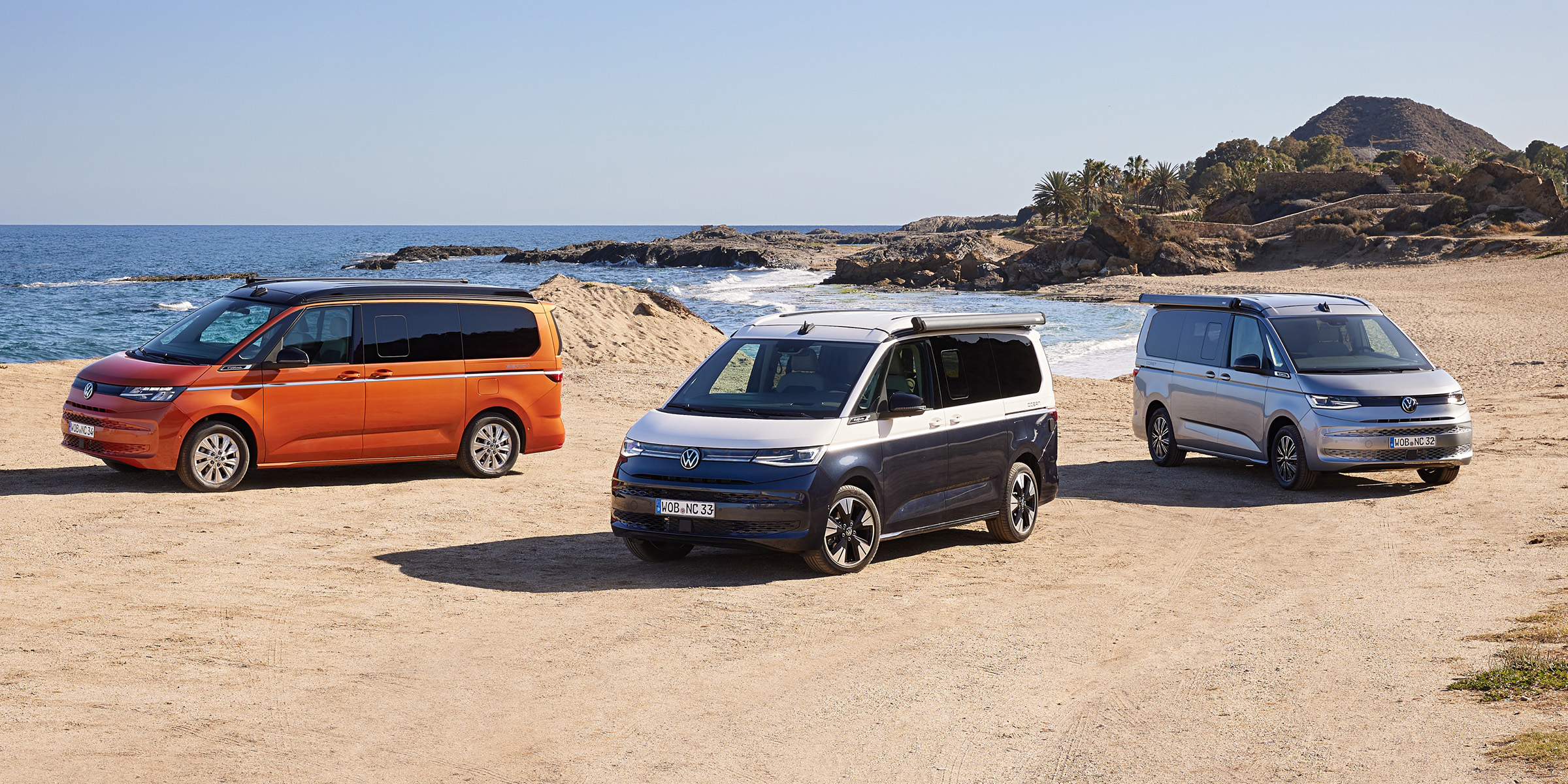
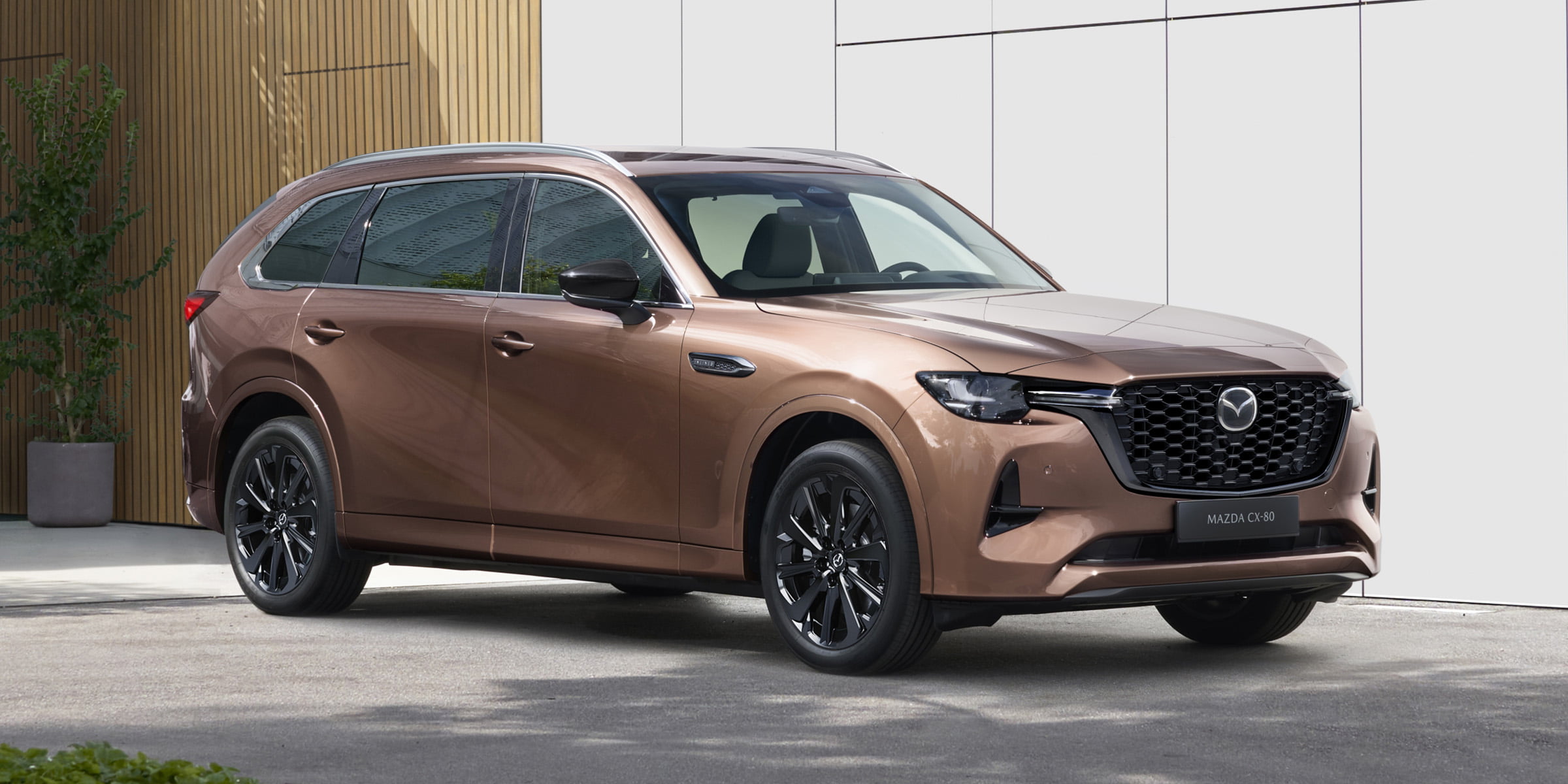
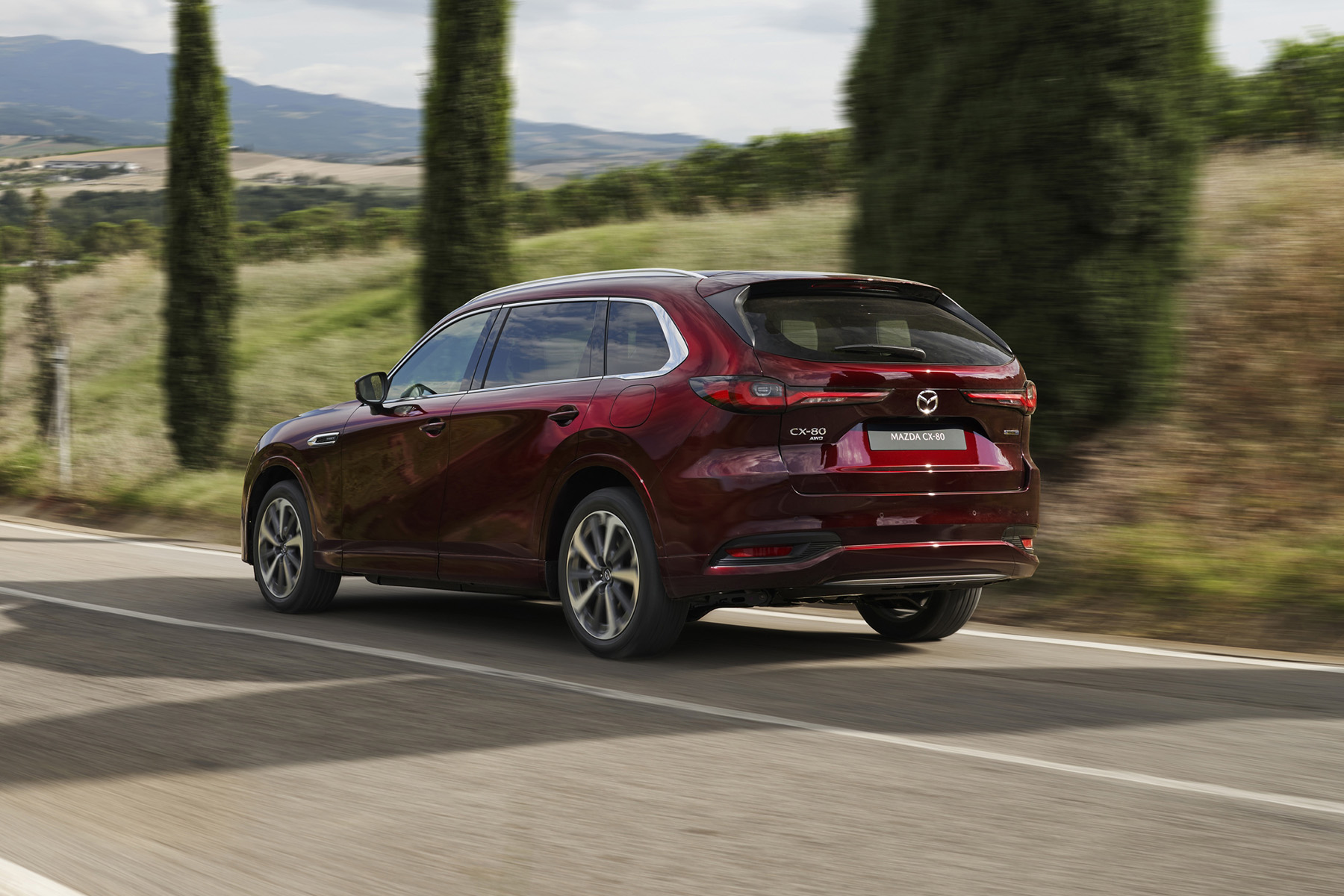
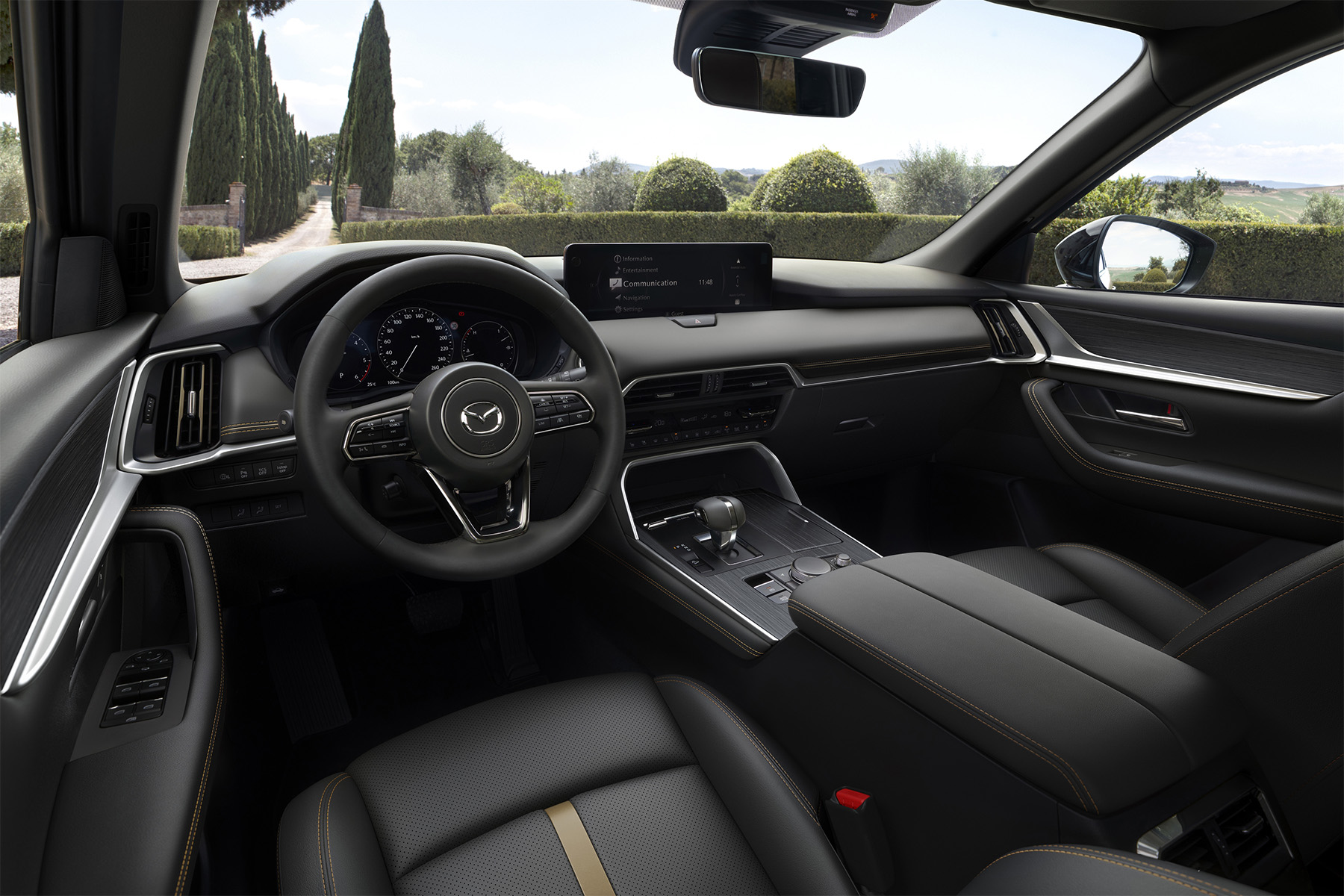
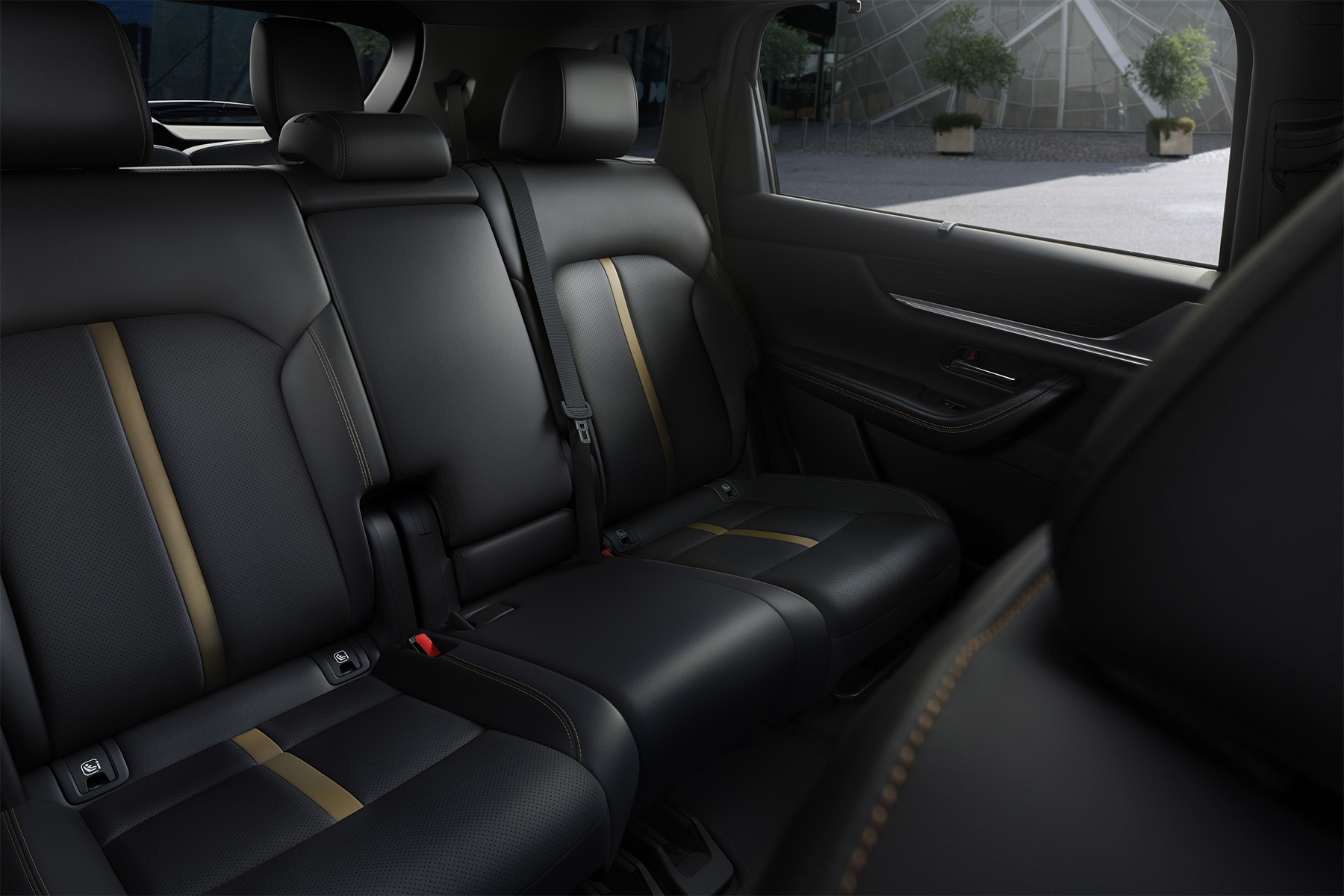
Volkswagen has unveiled its new California camper van range, which features new on-board tech additions, more trims and interior layouts, and a plug-in hybrid powertrain.
Sitting between the smaller Caddy California and the larger Grand California in Volkswagen’s camper line-up, the new California is based on the extended ‘T7’ Multivan. All models come with a pop-up roof and sliding doors on both sides of the vehicle, as well as ambient interior lighting that can all be switched off at the same time by double tapping on one of the several light switches.
The range includes five different variants. The first is the ‘Beach’ model, which Volkswagen describes as “a Multivan with a manual pop-up roof”. Like the Multivan, this version comes with a six-seat layout and space for two people to sleep under the pop-up roof, which is opened and closed manually with a new “easy-to-operate” mechanism.
The ‘Beach Tour’ adds front seats that can swivel 180 degrees, sliding windows for the rear sliding doors, a folding table and removes one seat to add two additional sleeping spaces on a fold-out mattress. Alternatively, the five-seat ‘Beach Camper’ swaps the mattress for a compact mini-kitchen with a single-ring gas cooker, cutlery drawer and additional storage space.
The California ‘Coast’ is a four-seat configuration with a larger kitchen unit on the left hand side of the rear cabin, including cabinet storage, a sink and a single-ring gas cooker. The model also comes with an “extremely stable” fold-out bed which rests on one of the rear seats when it is folded.
Last but not least, the range-topping ‘Ocean’ grade has the same layout as the ‘Coast’, but is trimmed in seat fabrics made of recycled materials and adds heating for the front seats, automatic air conditioning, a roof stowage box and background lighting for the kitchen unit.
Volkswagen has also made the fresh water tank available with ‘Coast’ and ‘Ocean’ models five litres larger (now 28 litres), and both versions have an exterior folding table and an additional socket with shore power on the outside for an electric hob. An optional awning will also be available for the left or right side to shield against rain or too much sun.
The new camper also comes with a five-inch in the rear cabin that displays the van’s systems – such as fresh and waste water levels and the charge of the auxiliary battery – and can be used to control the pop-up roof and ambient lighting.
Three different engine options are available, regardless of interior trim and configuration. First up is a 150hp turbocharged diesel engine, followed by a 204hp turbocharged petrol option. The most expensive will be the top spec 245hp plug-in hybrid powertrain, or ‘eHybrid’, which is four-wheel drive and can travel on electric-only power for a limited number of miles.
The new California will become available to order this June, with eleven single-tone and three two-tone exterior colour schemes available. Volkswagen is yet to confirm UK pricing for the camper range, but this is sure to follow in the coming weeks.
As we’ve described in our guides, the idea of a car subscription is very simple. Instead of buying a car, you choose to pay for a car a little like Netflix; month to month and cancel anytime (subject to conditions).
Car subscriptions can last from one month to several years. There’s usually a small deposit to sign up, and you can end the contract or swap the car when you feel like it (subject to conditions).
All the running costs are often included in the monthly payment. You can change cars to suit your needs and change brands as you feel. We’ve often said that it’s a good way to try out an electric car without a commitment. Van subscriptions are also offered.
Here at The Car Expert, we have commercial partnerships with several of the UK’s top car subscription providers. As well as our partners, there are several other subscription providers as well. Some have a few hundred subscribers, some over a thousand. In addition to subscriptions, some also provide traditional rental (hires as short as a week) and leasing agreements (large advance payment, agreement fixed for several years).
Insurance may be included or optional. Some offer subscriptions which start from one month but they all say that the average length of time somebody has a vehicle is longer, sometimes over 12 months.
Depending on the provider, subscribers can choose to have a one month rolling contract or commit to longer periods. All our partners say that the majority of their subscribers are private individuals rather than companies. The cars supplied are either new or up to three years old (sometimes older in the case of prestige cars).
What about the car makers themselves? Depending on the country, manufacturers have blown hot and cold on the idea. For example, in the US, Mercedes-Benz closed its service because customers tired of the novelty of swapping cars (and all their stuff from one to the other). But this scenario was more about having a convertible for the summer, an estate for the holidays. The usual reason people like subscriptions is because they want an easy short-term, no commitment set of wheels.
Car subscriptions are more popular in mainland Europe than the UK. For example, in Germany, Volkswagen offers ID.3 and ID.4 subscriptions, but not here.
“There are 20 or 30 subscription companies in Germany today,” says Drive Fuze chairman, Nick Rothwell. “The biggest difference is usership versus ownership. Most people don’t own their property and rent. We tend to own our property in this country. And there’s less of a leasing market – subscriptions have a significant opportunity.”
In the UK only a few manufacturers offer car subscriptions. Volvo, Jaguar Land Rover and Genesis have been long-term players (although currently Land Rover and Range Rover choice outnumber available Jaguars).
Looking at less luxurious brands, Mocean is Hyundai’s subscription service (currently with a limited offer) and Cupra is a recent entrant, as are Renault and Nissan.
In 2021 Renault Group acquired Bipi, a multi-brand car subscription platform for used vehicles, which operates in Spain, France, Italy and now the UK. Subscription Renaults come through Bipi.
Over the last few years there have been new car subscription providers enter the arena and some departures. Overall, The Car Expert’s partners predict a growing market. We asked them for their thoughts on the current issues.
How is the car subscription market doing?
“We doubled all of our numbers last year and we’re seeing vehicle volumes grow and better availability coming back into the market, but there’s oversupply of EVs, a disconnect between demand for EV’s and the supply. And that’s a market wide issue.” Toby Kernon, chief executive officer.
“The market is quite stable, cars are coming through but they seem to be back towards ICE models and the enquiries regarding EVs have dropped.” Rhys Adams, company director.
“In terms of people visiting our website, enquiries and the level of interest from customers is increasing month on month. To me this is the first sign that more people are becoming aware of what a subscription is, which is a positive trend.” Duncan Chumley, chief executive officer.
How’s the future shaping up?
“All the independent research talks about this being a significant channel. Another channel for various distribution models to work their way into the marketplace.” Nick Rothwell, company chairman.
“Subscription offers people a flexible model that they understand, because as consumers we are becoming very used to using subscription models in all other parts of our daily life. We think there’s a big future for subscriptions and there’s a lot of industry research out there which suggests the same.”
“I don’t see subscription replacing everything within the marketplace. I just see it enhancing what’s available to give the consumer a choice. I believe this is right for a lot of people, where their lifestyles are maybe changing and don’t want a financial commitment for three or four years at this point in their lives.”
What should we think about high profile failures such as Cazoo subscriptions, and the electric-only Onto and Elmo?
“With the EV providers there was the price war caused by Tesla and the heavy reduction in EV values. But they were also giving free charging and electricity prices went through the roof. It seemed a perfect storm of problems that challenged their business model.”
“As a bank, I wouldn’t want to have concentration of risk and if I’m a subscription company, I don’t want to put all my eggs in one basket. So if I went into hybrids in isolation, or another powertrain in isolation, I’m restricting my target audience.”
“In my view, you never really saw Cazoo promote their subscription business. It was all about their online used car platform and I think subscription was just an additional add-on service.”
Why do we not yet see very many subscription services run by carmakers?
“Manufacturer subscriptions are very important and we watch these closely, as everyone is aware many have dipped their toes in the water. But even a certain Swedish car manufacturer has pushed the subscription model behind other forms of finance for one reason or another.”
“There are other challenges in the automotive industry at the moment and often at a strategic level they need to take precedent over innovation. The OEMs who are offering subscriptions are doing well and see it as a way to have the customer for longer over the lifecycle of the vehicle and subscription also has the potential to attract a new type of customer.”
“I think the challenge that a manufacturer has is how they manage it. They obviously want to provide additional services to clients, but their main aim is to sell new cars. I think it’s how they would manage a large fleet of cars in-life and the logistics and infrastructure behind that. This is why we are working with manufacturers in order that we can provide the infrastructure to be able a subscription offer to their customers.”
How do you find the general awareness of car subscriptions?
“Our consumer research found that for those who have heard of car subscriptions, they were still unclear on what exactly it meant and how it’s different. There’s still quite a lot of confusion about the different ways that people can finance their cars, even with established models like PCP and HP, where we’re still finding that consumers are confused, we’re trying to educate consumers however we can.”
“I don’t think this is a Netflix product per se. But I think that the awareness that you can use rather than buy is very important and that’s an increasing consumer trend.”
“Awareness of Car Subscriptions is still very low, but we’re working hard to try and raise awareness of these in the press and advertising. We’re currently running a campaign called “Subscribe to your next car?” with a QR code and the Cocoon logo.”
“I think it’s still quite niche in terms of awareness but growing, and people are looking at it as an option. We’re trying to educate the consumer that we have all these different options now available. So, if they feel subscription isn’t quite right for them then we do offer leasing and if they want really short term, we offer rental.”
Any there any trends regarding electric car subscriptions?
“There’s a massive debate and two polarised views. One is that there’s a conspiracy theory and the other one is, ‘you’ve just got to take it up because it’s coming’. But my view is very simply from customer feedback on our electric vehicles. When we put them on our site, they go out reasonably quickly.”
“I’ve been driving electric cars for the last two years and I love it. We have seen a steady increase in demand for EV’s on subscription, however there is still customer confusion in the EV arena and there’s been a lot of negative press, maybe unfairly in some cases around electric cars. That obviously impacts what consumers want to take.”
What’s your position on whether to include insurance or not?
“When you look at the price increases that went through the insurance market, people suddenly said ‘I can’t afford my insurance’ – it came as a shock. Most people don’t budget in their head for a surprise. So, it’s about reassurance. It’s about the ability for them to budget with confidence that there are no surprises coming.”
“It’s something for consumers and for suppliers to decide. We have always focused on having an embedded product sitting in the customer journey to give a bespoke price per location per vehicle, per their driving history. And we’ve partnered with Admiral Group to have their pricing sitting within that journey.”
“Our customers don’t want the all-inclusive insurance option, which is why they use us over other companies. They say that policies can be quite restrictive or complicated when it comes to claim.”
“We prefer giving the customer the choice and continue to work with a number of insurance providers to provide both options. We’ve been slightly different. We offer a lease contract rather than a rental contract, which is regulated [by the FCA], which allows the customer to use their own insurance policy if they wish and continue to benefit from their No Claims Discount.”
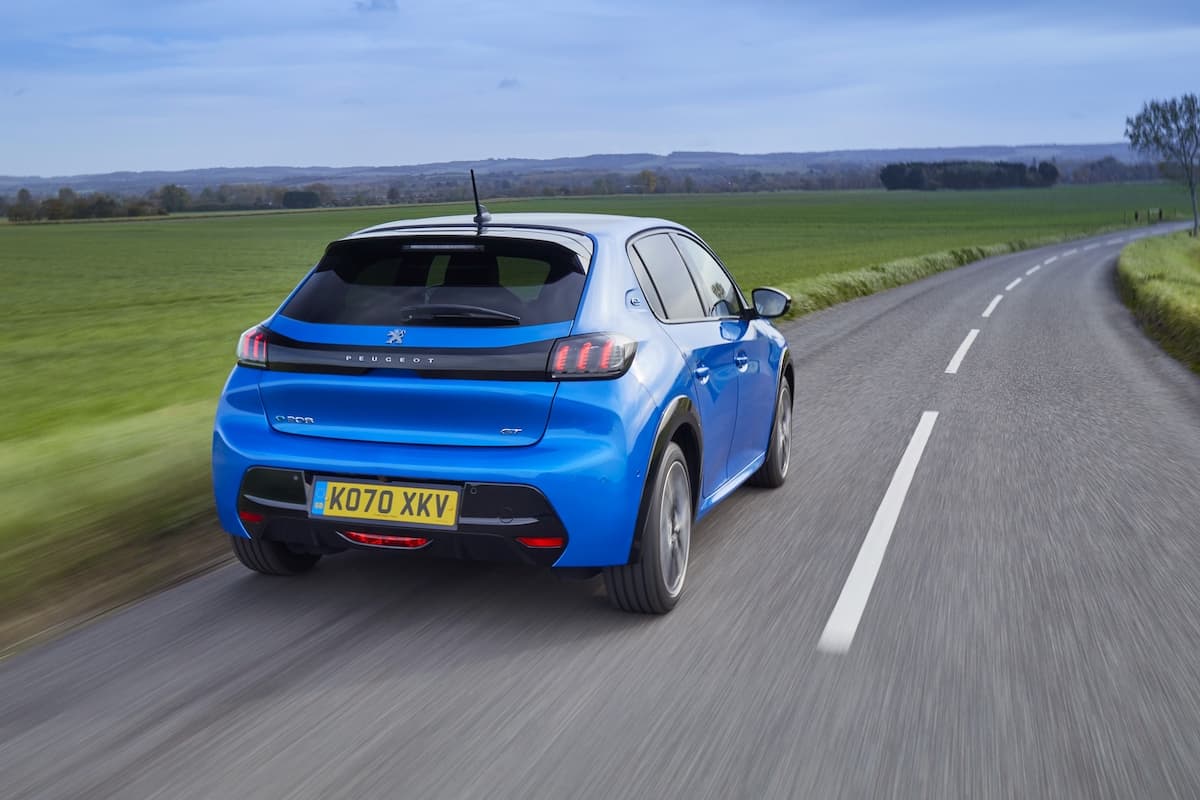
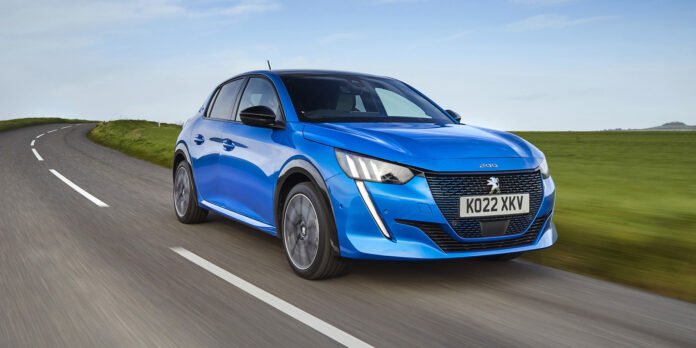
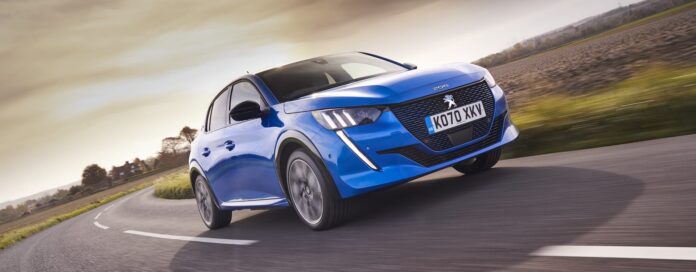
The Peugeot E-208 is a fully-electric version of the regular Peugeot 208 supermini hatchback. It was launched alongside the petrol and diesel versions in late 2019, with the first cars hitting UK roads in early 2020.
The 208 family shares most of its components with the Vauxhall Corsa, so the E-208 runs the same electric motor and battery as the Corsa Electric.
The Peugeot E-208 received very positive reviews from most of the UK motoring media when it was launched, although these have tempered over the last six years. As with the regular 208, there has been considerable praise for its design and interior quality, and less enthusiasm for its driving dynamics.
A facelifted version of the Peugeot 208 range, including the E-208, arrived in the UK in late 2023. This consisted of lightly revised styling and some interior technology upgrades, as well as range and charging improvements.
As of September 2025, the Peugeot E-208 holds a New Car Expert Rating of A, with a score of 70%. It scores top marks for its very low running costs and zero tailpipe emissions. However, its safety score is only average, with average grades also achieved for its media reviews and Peugeot’s new EV warranty offering.
Body style: Small five-door hatch Engines: electric, battery-powered Price: From £30,150 on-road
Launched: Winter 2019 Last updated: Winter 2023/24 Next update due: TBA
Image gallery
Media reviews
Highlighted reviews and road tests from across the UK automotive media. Click any of the boxes to view.
Featured reviews
“Cosmetic upgrades and a new 51kWh battery have given the Peugeot E-208 fresh appeal, but the small EV market has moved faster than this car’s development. It’s sound enough to drive, has a funky (if cramped) cabin, and the extra range will be handy for anyone who regularly drives out of town. But it’s tough to overlook pricing that seems to start where several capable rivals top out.”
“The Peugeot e-208 looks just as fantastic inside and out as petrol and diesel 208s and is good fun to drive. It’s pricey in comparison, though, and still tight in the back.”
Model reviewed: e-208 Allure “The Peugeot e-208 is a fantastic supermini, offering style and a fun driving experience in equal measure. With its 217-mile range and well-mannered motorway character, it’s genuinely capable of being used on longer journeys. Its size means it’s not the most practical car in the world, but if you’re looking for a car in this segment, the e-208 should be high on your shopping list.” Read review
Auto Trader
Model reviewed: 2023 facelift range Score: 8 / 10 “Peugeot updates the e-208 and makes an already excellent small electric car a little better.” Read review
Business Car
Score: 7 / 10 “The Peugeot e-208 comes with a strident battery, which is located evenly under the floor rather than behind the rear seats to help achieve a balanced weight distribution and ensure interior space isn’t compromised.” Read review
Car
Score: 8 / 10 “It’s all so serene. The pillow-soft ride on 16-inch wheels intensifies this feeling of wellbeing, and there’s plenty of grip in corners, but the steering feels a little too light and at times inconsistently weighted as you push through a turn.” Read review
Score: 8 / 10 “With its compact package, peppy take-off from traffic lights and zero-emissions capability, the Peugeot e-208 should feel is at home in the city. But with its comfy, civilised air at motorway speeds and 200-odd miles of range, it won’t be stuck there.” Read review
Car Keys
Score: 8 / 10 “The e-208 is not perfect, but it’s a superb first effort for Peugeot’s first true EV, with an impressive powertrain and glamourous looks helping to cement its place as one of the more appealing electric cars available.” Read review
Carbuyer
Model reviewed: Score: 8 / 10 “The Peugeot e-208 is a mainstream electric car that offers 211 miles of range while looking just as stylish as the conventionally powered 208 models.” (Andy Goodwin) Read review
Company Car Today
Model reviewed: e-208 GT Score: 8.1 / 10 “Peugeot’s first in a new generation of EVs is a great start for the next wave of tech; smart, practical, efficient and with limited drawbacks, apart from price.” Read review
Daily Mail
“The Peugeot e-208 is a little electric pocket rocket, very nippy and would be perfect for commuting.” Read review
Discover EV
Model reviewed: GT Score: 7 / 10 “The Peugeot e-208 looks just as stylish inside and out as its conventional powered siblings, and is good fun to drive but its niggling frustrations put it on a par with its very close cousin – the Corsa-e.” Read review
Driving Electric
Model reviewed: Range overview Score: 7 / 10 “The electric Peugeot 208 is a smart, grown-up package that’s fun to drive and has both a useful range and rapid-charging capability.” Read review
Eurekar
Model reviewed: Allure “The Peugeot e-208 looks good, drives like a warm hatch and feels as well built as cars with posher badges and bigger bottom lines.” Read review
Fleetworld
“The Peugeot e-208 feels torquey and quick off the mark and can be charged from zero to 80% capacity in just eight hours.” Read review
Green Car Guide
Model reviewed: Allure Score: 10 / 10 “The Peugeot e-208 looks great on the outside, it has a stylish interior, it’s excellent to drive, and it has zero tailpipe emissions. What’s not to like?” Read review
Heycar
Model reviewed: 2024 facelift range Score: 7 / 10 “The Peugeot e-208 is like a terraced house that has been decked out with a high-speed data connection, ground pump heating system and smart electronics: it looks like everything else on the street, but it’s actually a bit different beneath the skin.” Author: Phil Hall Read review
Honest John
Score: 8 / 10 “Easy to drive, smartly styled and capable of covering over 200 miles on a single charge, the Peugeot e-208 is an impressive and likeable EV.” Read review
The Independent
Model reviewed: Range overview Score: 7 / 10 “The Peugeot e-208 compact electric hatchback looks sharp and offers a longer range after a recent update. A strong all-rounder that’s been around since 2019 but is still competitive in its class.” Author: Leo Wilkinson Read review
The Sunday Times
“With its nippy performance, snappy charging and sharp design, Peugeot’s charming electric supermini could soon become top dog in the compact EV market.” Read review
The Telegraph
Score: 10 / 10 “The Peugeot e-208 is one of my favourite all-time cars. Comfy, cute, practical and affordable, it’s everything it needs to be and nothing more. That authenticity is a rare quality in a market all too easily swayed by pretense.” Read review
Top Gear
Score: 7 / 10 “The Peugeot e-208’s combination of range, easy personality, value and surprising desirability make it a strong contender.” Read review
Safety rating
Independent crash test and safety ratings from Euro NCAP
The Peugeot E-208 shares its safety rating with the petrol-powered Peugeot 208, which was tested in late 2019. (This is not always the case with electric versions of petrol cars, as there are often significant differences that affect the test results).
Eco rating
Independent economy and emissions ratings from Green NCAP
No eco rating
As of January 2025, the Peugeot E-208 has not been lab tested by Green NCAP.
The Green NCAP programme measures exhaust pollution (which is zero for an electric car) and energy efficiency. Electric cars are much more energy-efficient than combustion cars, so the E-208 is likely to score very highly in Green NCAP testing if and when it ever takes place. Check back again soon.
Running cost rating
Monthly cost of ownership data provided exclusively for The Car Expert by Clear Vehicle Data
Battery range
Average
Score
Variation
Score
EV models
236 miles
B
Electrical efficiency
Average
Score
Variation
Score
EV models
4.6 m/KWh
A
Insurance group
Average
Score
Variation
Score
All models
29
C
Service and maintenance
Cost
Score
Year 1
£121
A
Year 2
£305
A
Year 3
£470
A
Year 4
£634
A
Year 5
£872
A
Overall
£2,402
A
Running costs for the Peugeot E-208 are excellent, according to whole-life cost data provided exclusively to The Car Expert by our technical partner, Clear Vehicle Data.
Electrical efficiency (the equivalent of miles per gallon for a petrol or diesel car) is very good, which means that overall driving range (model range average of 236 miles) is good despite a relatively small battery.
Scheduled servicing costs for the first five years are excellent, although insurance premiums are probably not going to be as good based on a middling group rating.
Reliability rating
Reliability data provided exclusively for The Car Expert by MotorEasy
No reliability rating
As of September 2025, we don’t have enough reliability data on the Peugeot E-208 to generate a rating.
The Car Expert’s reliability information is provided exclusively to us using workshop and extended warranty data from our partner, MotorEasy, sourced from both official dealerships and independent workshops.
As soon as MotorEasy has sufficient data on the E-208, we’ll publish the score here.
Warranty rating
New car warranty information for the Peugeot E-208
Overall rating
C
56%
New car warranty duration
3 years
New car warranty mileage
60,000 miles
Battery warranty duration
8 years
Battery warranty mileage
100,000 miles
Peugeot’s new car warranty is pretty much the bare minimum offered in the UK, with a duration of three years and a limit of 60,000 miles. Other rivals in the price bracket do better (and in some cases, much better).
In addition to the standard new car warranty, the E-208 has an eight-year/100,000-mile warranty for the battery components.
Warranty on a used Peugeot E-208
If you are purchasing an ‘Approved Used’ E-208 from an official Peugeot dealership, you will get a minimum six-month warranty included.
If you are buying a used E-208 from an independent dealership, any warranty offered will vary and will probably be managed by a third-party warranty company.
If you are buying a used E-208 from a private seller, there are no warranty protections beyond any remaining portion of the original new car warranty.
If you’re looking to buy a used car that is approaching the end of its warranty period, a used car warranty is usually a worthwhile investment. Check out The Car Expert’s guide to the best used car warranty providers, which will probably be cheaper than a warranty sold by a dealer.
Date: January 2023 Recall number: R/2023/009 Model types: E-208 Build dates: 07/2022 to 12/2022 Number of vehicles affected: 1,610 Defect: There is an error in the software calibration of the traction battery control unit, which could result in a loss of propulsion when driving. Remedy: Update the software of the traction battery control unit.
Date: January 2022 Recall number: R/2022/012 Model types: E-208 Build dates: 07/2019 to 09/2020 Number of vehicles affected: 1,100 Defect: There is a possibility that the open circuit detection system could be over-sensitive, causing a number of operational issues, including sudden power loss. Remedy: Download the latest software configuration, check some electronic units and replace them if necessary.
Date: March 2020 Recall number: R/2020/097 Model types: All Build dates: 10/2019 to 12/2019 Number of vehicles affected: 137 Defect: The rear lower shock absorber mounting bolt might not be tightened to the correct torque setting. Remedy: The campaign requires the bolt to be loosened and re-torqued to the correct setting.
As of September 2024 (our most recent data point), there have been three DVSA vehicle safety recalls on the Peugeot E-208 to address different issues.
Not all vehicles are affected by recalls. You can check to see if your car is included in any of the above recalls by visiting the DVLA website or contacting your local Peugeot dealer.
If your car is affected by a recall, the vehicle must be repaired and you should not be charged for any work required. If you are buying a used Peugeot E-208, you should insist that any outstanding recall work is completed before you take delivery of the vehicle.
The Peugeot E-208 shares its electric motor and battery pack, as well as most of its other key components, with the Vauxhall Corsa Electric and Citroën ë-C3.
If you’re looking to buy a new or used Peugeot E-208, The Car Expert’s partners can help you find the right car
Search less, live more. We make finding the right car simple. Find out more
Find your next new or used car with Auto Trader. Find out more
Find your next new or used car with Carwow. Find out more
Lease a Peugeot E-208
If you’re looking to lease a new Peugeot E-208, The Car Expert’s partners can help you find a competitive deal
Personal contract hire deals from Carparison Leasing. Find out more
Personal contract hire deals from Leasing.com. Find out more
Personal contract hire deals from Carwow. Find out more
Subscribe to a Peugeot E-208
Subscriptions are becoming a very popular way for consumers to try an electric car for a few weeks or months to help decide whether it’s a suitable alternative to a petrol car. If you’re interested in a car subscription, The Car Expert’s partners can help. (PS: What’s a car subscription?)
Over the last 20 years, the profile of Korean car manufacturer Hyundai has steadily risen to prominence. That has only accelerated in recent years, as a result of the company placed a lot of early emphasis on offering electric vehicles (EVs). Today, Hyundai is an established name on any motor retail park.
What the average car buyer might not realise, however, is just how big Hyundai is. Many buyers now seeking a new car are drawn to a choice between Hyundai or Kia – both are Korean brands with very strong reputations but Kia’s growth is thanks to Hyundai buying its almost bankrupt rival in 1997 and developing it since as a sister company.
Hyundai is now the third-largest automotive manufacturer in the world, beaten only by Toyota and Volkswagen, but the story goes a lot bigger than that – the car maker is a mere part of an enormous conglomerate called Hyundai Heavy Industries, which among other things is the world’s largest shipbuilder.
In terms of car manufacturers Hyundai is quite young. The Hyundai Engineering and Construction Company was founded in 1947, but the Hyundai Motor Company did not follow for another 20 years. Its first car was called the Cortina, thanks to a deal struck with Ford.
By the mid-1970s, Hyundai had decided to develop its own models and turned to the UK, snapping up key British automotive professionals including the former managing director of Austin Morris.
The first bespoke Hyundai was a small car called the Pony, with a Mitsubishi engine and styling by famous Italian designer Giorgio Giugiaro – the same man who designed the original Volkswagen Golf. In 1982, the Pony led Hyundai’s entry into the UK car market. The Stellar, based loosely on the Ford Cortina, followed in 1984.
As Hyundai steadily grew, its model range it also expanded around the world, with the company making its one millionth car in 1985. Further core models included the Excel and then in 1988 the Sonata, the first car to be built with technology developed in-house rather than bought in from other manufacturers. Meanwhile the 1996-launched Coupe found many fans in the UK.
As the new millennium dawned, Hyundai took over its almost bankrupt Korean rival, Kia, and began a major overhaul of its image in a bid to establish itself as a world-class brand. Big investment was poured into the design and development of new models and technology, with cars sold on the US market even including 100,000-mile warranties. This resulted in both Hyundai’s and Kia’s image being transformed from budget buys to mainstream car brands.
The next step in Hyundai’s relentless march towards market leadership took place in the 2010s, with the company focusing on improving the handling of its vehicles and declaring that it wanted to “become a technical leader in ride and handling”. It hired the head of engineering at BMW’s M performance division. Another former BMW man had been leading Hyundai’s German design centre for almost a decade, having previously styled the fourth-generation BMW 3 Series and the 6 Series.
There was significant investment in technology too, which has continued to today. As well as being an early adopter of EVs, Hyundai became the first brand to mass-produce a hydrogen-powered vehicle, the ix35 Fuel Cell launched in 2014. The technology remains under development, although has taken a back seat to battery EV development.
The only potential chink in the ongoing Hyundai success story came with the launch of Genesis, an upmarket sub-brand, in 2015. Soon spun off into a separate company, Genesis did not quite set the world alight as its creators intended and was brought back under direct Hyundai control in 2023, although it still sells cars under its own name.
Hyundai has continued to grow – it sold its millionth car in the UK in 2015, and in 2021 global profits jumped by a remarkable 187%. Another 60% rise in 2023 saw record profits of $9.7 billion and today the company is rated as one of the 100 most valuable brands in the world.
What models does Hyundai have and what else is coming?
Like sister brand Kia, Hyundai offers two distinct ranges of combustion-engined and electric cars. In the former, the company has had particular success with its SUVs, today boasting a three-strong core line-up going up in size from the Kona through the Tucson to the seven-seat Santa Fe. A facelifted Tucson and an all-new Santa Fe with a plug-in hybrid powertrain are going on sale in 2024.
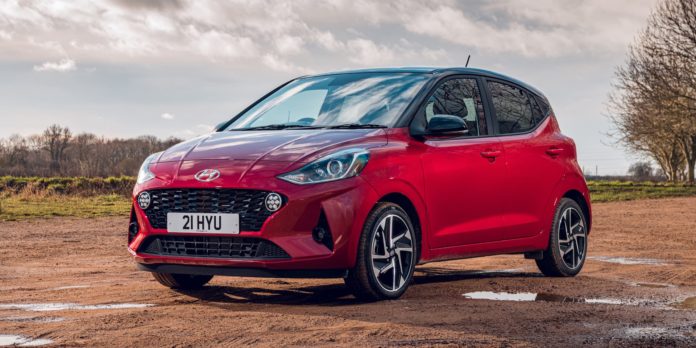
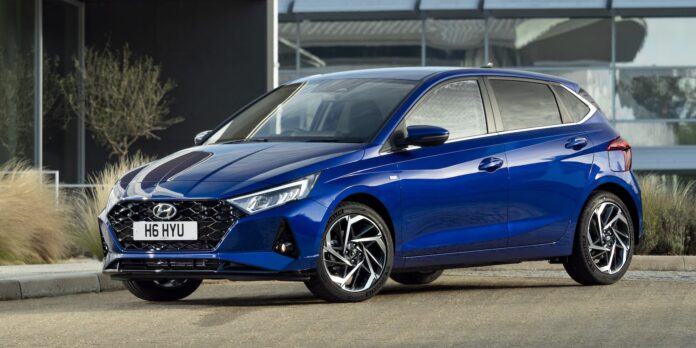
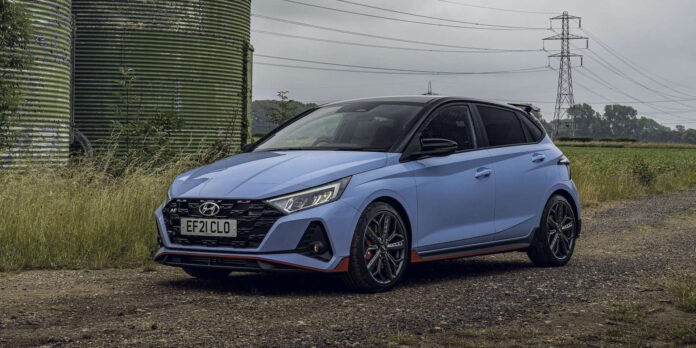
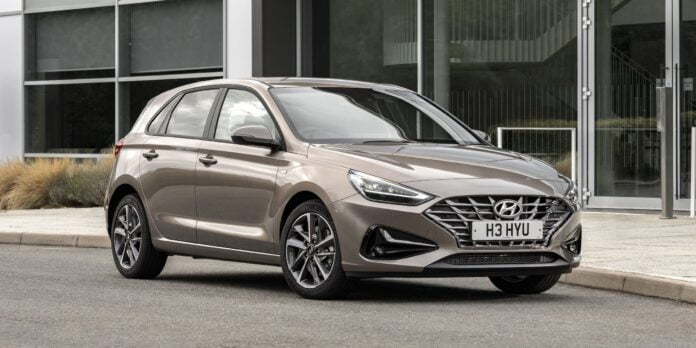
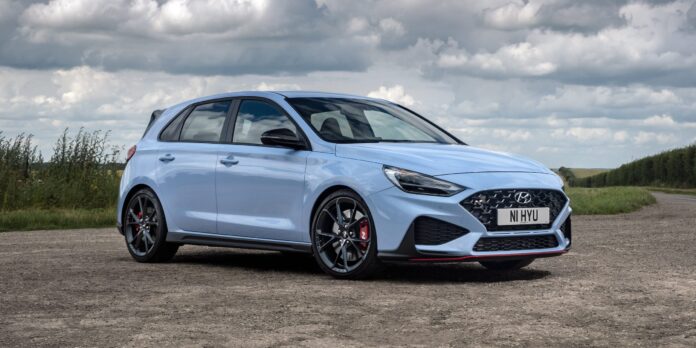
There is also a core ‘i’ range of traditional cars, the smallest being the i10 city car which sits alongside the i20 supermini and the i30 family car – competing against the likes of the Ford Focus and Vauxhall Astra. Both the i20 and i30 are also offered as ‘N’ performance models, while the i20 is also available in crossover form as the Bayon.
The current Kona was designed first as an electric car, the petrol version pitched as an alternative, but Hyundai’s main electric range goes under the name of Ioniq, the first model appearing in 2016. Currently there are two options – the Ioniq 5 was launched to great acclaim in 2021, and it has a larger four-door saloon sister, the Ioniq 6. There is also an N variant of the Ioniq 5.
Also coming is the Ioniq 7, a relative and rival, to the Kia EV9 large seven-seat electric SUV, though Hyundai would probably prefer buyers to be choosing its Ioniq 7 over the likes of the BMW iX.
Hyundai’s continual growth has resulted in the brand now having a significant presence on the UK market – there are currently around 165 showrooms in the UK with plans to add more.
These showrooms are almost entirely traditional outlets but Hyundai is one of the brands that has tried to redefine the way it sells its cars – it opened a ‘Store’ in the Bluewater shopping centre in Kent in 2014 which it dubbed the “world’s first digital automotive retail experience.” However a traditional dealer group took over the centre in 2019.
What makes Hyundai different to the rest?
In many ways Hyundai’s growth has mirrored that of Kia, its cars solidly built, attractive and reliable with long warranties – though Kia’s seven years outdoes the five of its sister brand. Under the skin the two makers use effectively the same hardware, though Hyundai cars are generally more conservatively styled than those of Kia.
With so many of its cars now on the road, and the vast majority of their owners being very happy with their buys, Hyundai enjoys a reputation that many much longer-established European manufacturers envy.
A Hyundai fact to impress your friends
You might think the Hyundai logo is simply an H for ‘Hyundai’ in an oval. In fact it is styled to represent two people shaking hands – a dealer and a satisfied customer. The oval represents the brand’s global presence.
The word Hyundai (pronounced ‘Hyun-day’ rather than ‘High-un-Die’) means ‘modern’ in Korean.
Summary
Hyundai is an automotive success story. Huge investment in technology and quality, combined with snapping up the very best of the industry’s design and engineering talent in Europe, has elevated Hyundai to direct competition with the best-known European and Japanese manufacturers, with most of them left in the Korean brand’s wake.
Renault has announced that its new Rafale hybrid is now on sale, which the brand says has been designed to offer “optimal driving pleasure”.
Slightly larger than the Renault Arkana coupé-SUV and the recently-launched Austral SUV – which are also offered as hybrids – the Rafale is set to join a very competitive medium crossover class, rivalling the likes of the Citroën C5 X and Peugeot 408.
Built on the same foundations as the popular Nissan Qashqai, this new Renault is said to usher in a new era of exterior design for the French manufacturer, giving us an idea of what the brand’s future models might look like.
The car’s muscular design features a new-look grille with a diamond pattern that forms blue chevrons, framing the Renault branding in the centre. Chunky bumper cladding features front to back, sitting above 20-inch alloy wheels. The car sports a sloping rear roofline that Renault says does not impede rear headroom, and has no need for rear wipers.
Compared with the Austral, the Rafale has slightly wider tracks and some extra suspension and anti-roll bar upgrades, which Renault is hoping will give the model more appeal as a driver’s car.
Stepping inside, the Rafale comes with a 12-inch portrait-oriented infotainment screen with a graphics upgrade, a nine-inch head-up display that projects driving information on the windscreen, the square steering wheel that also features in the Mégane E-Tech and Austral, and a “high-tech” rear armrest with two foldout screen stands for smartphones and tablets.
The SUV’s headline interior feature can be found above – a large panoramic glass roof that the brand calls the ‘Solarbay’. It is designed to provide protection from the sun by darkening automatically, or manually by use of four different light settings. Renault asserts that only luxury car manufacturers have offered this technology so far, and says it will be the first mainstream marque to do so.
The seats are trimmed in Alcantara leather – which is reportedly 61% recycled. Ambient lighting features across the cabin, including the seats, which Renault says light up and flash in sync with a beating human heart.
Available to order in the new year, the Rafale will be powered by the same front-wheel drive ‘E-Tech’ 1.2-litre petrol engine and electric motor setup as the new Austral, providing 200hp and up to a reported 683 miles of travel on a full tank.
A four-wheel drive 300hp version is also in the works and scheduled to arrive later in 2024, which will reportedly be a plug-in hybrid model with a much larger battery. This model will also come with a chassis upgrade, offering more comfort in high-speed corners.
Like other model’s in Renault’s current line-up, the range is topped by a ‘esprit Alpine’ trim, which adds a unique stitching pattern to the seats. We are sure to learn more about the Rafale’s trims and UK pricing in the coming months. Currently in its last phase of testing, the coupé-SUV will be manufactured in Spain.
The Rafale is now available to order in the UK with pricing starting at just over £38k. The first customer deliveries are scheduled to arrive in July.
You’re never going to mistake a Jeep Wrangler for anything else. Along with the Porsche 911, it’s probably one of the most recognisable shapes in the car market. In a sea of almost-identical family SUVs, the Wrangler stands out like a beacon. There have been some subtle updates for 2024, but you’ll struggle to spot most of the differences.
Those Tonka-toy looks are matched by the Wrangler’s very essence – this is a tough, capable, no-nonsense vehicle rather than a soft family wagon that’s been dressed up to look like a 4×4. That’s both good and bad, depending on your needs…
What is it?
The Jeep Wrangler is a large-ish, five-seat, petrol 4×4. We say large-ish because the fat wheel arch flares, bulky bumpers, side steps and tailgate-mounted spare wheel all add extra bulk without increasing interior space, so it’s not as roomy inside as you might expect if you’re just looking at the dimensions on a specification sheet.
There’s only engine, one gearbox and two trim levels. That certainly keeps things straightforward. As befits its hardcore nature, there are manual controls to adjust the 4×4 system for your off-roading needs, whereas most soft-roader SUVs let the on-board computers sort it out rather than allowing the driver to meddle with the settings.
Who is this car aimed at?
Wrangler customers tend to buy into the car’s off-road abilities and reputation. There’s a huge aftermarket industry dedicated to making your Wrangler even more extreme as a rock-climbing, river-crossing, desert-smashing adventure vehicle.
If you like the idea of a 4×4 where you can remove the roof, rear windows and doors, the Wrangler will let you do that. If you love being able to manually engage and disconnect the centre differential, and shift between two-wheel drive and four-wheel drive, the Wrangler can do that. If you want a car that can take you anywhere, the Wrangler can probably get you more places than almost any other new car.
If you prefer camping and hiking holidays to five-star resorts, the Wrangler’s probably your kind of car.
Who won’t like it?
All that off-roading adventure capability comes at a cost. If you want a smooth, quiet, comfortable family car that’s never going to go further off-road than a gravel lane, this is almost certainly not the car for you. There are many better options available for the money.
First impressions
From the moment you approach the Jeep Wrangler, you know you’re in for a different experience to other, run-of-the-mill SUVs. The classic Jeep styling, honed over 80-odd years since the original Willys Jeep (short for general purpose) army vehicles of the second world war, promises adventure. If you’re a dedicated Wrangler enthusiast, you may notice that the famous seven-bar grille has been subtly revised for 2024, although most people would need to see it side-by-side with the 2018-2023 version to tell the difference.
Step inside and that feeling continues. The cabin is squared off and utilitarian, rather than soft and luxurious. New for 2024 is a big touchscreen in the centre of the dash, which is a big improvement on earlier models and pulls the Wrangler into the modern era – but not too much.
What do you get for your money?
Jeep keeps your choices simple with the Wrangler. There’s only one engine and gearbox (a 2.0-litre petrol engine driving all four wheels through an eight-speed automatic), and a choice of two trim levels. We’re reviewing the ‘Sahara’ spec here, which is slighhtly more on-road oriented, while the ‘Rubicon’ is a bit more extreme. The Sahara starts at just over £61K, while the Rubicon is £2K dearer.
Sahara gives you 18-inch alloy wheels with more road-focused tyres, and colour coding for the wheel arch flares and three-piece removable hard top. Rubicon has smaller 17-inch wheels with hardcore off-road tyres, while the flares and roof sections are black. Off-roading enthusiasts should also note that the Rubicon also allows you to disconnect the sway bars in the suspension for better off-road articulation.
Inside, the trim levels are pretty similar. They both have part-leather seats, with the Rubicon getting softer Nappa leather. The front seats are electrically adjustable and heated, while rest of the specification is much as you’d expect for a £60K-ish SUV. The new-for-2024 widescreen central touchscreen is decent, although most owners will tend to mainly use it as a display for Apple CarPlay or Android Auto.
There have been some badly-needed safety updates as well. We’ll come to this later, as you’ll want to read about that before heading down to your local Jeep dealer to place an order.
The simple pricing and trim structure makes more sense when you consider that more Wrangler owners will modify their vehicles than pretty much any other new car on the market. Usually, that consists of more hardcore off-roading equipment – raised suspension, winch, tow bar, roof racks, spotlights and so on. So what you get from the factory is really just a starting point.
We like: Simple trim and specification structure, leaving most customisation to aftermarket suppliers We don’t like: Safety still lags behind almost every other SUV around
What’s the Jeep Wrangler like inside?
Despite the £60K price tag, the Wrangler’s cabin has a distinctly utilitarian feel. That’s deliberate, of course, and it still has most of the creature comforts you’d expect to see for the money. But everything has a hard, flat, squared-off look and feel that’s a world away from the rounded, soft interiors you get in other cars.
You step up quite high to climb aboard the Wrangler. The driving position is comfortable enough and the visibility is quite good, helped by the very upright windscreen (which can be folded down or removed). But your head is quite close to the railing over the door – on all the off-roading sections we did on our trip, I bumped my head against it several times as both a driver and passenger. For those rock-and-rolling occasions, there are plenty of grab handles for passengers to hang onto.
The cabin and boot are not as spacious as you might expect. They’re roomy enough, but if you look at the pictures on this page you’ll see how the body shell of the car is quite a bit narrower than the dimensions suggest. The fat wheel arch flares and chunky bumpers are traditional Wrangler fare, but the don’t make the cabin any bigger.
Due to the removable roof design, the boot is a two-piece affair. The lower section also carries the spare wheel, so you have to swing that out (and the wheel makes it fairly heavy) before you can lift the rear window to load your luggage.
The new 12-inch widescreen in the top centre of the dashboard is a big improvement. Like most of these systems, its main role is to serve as a display for Apple CarPlay or Android Auto, rather than using Jeep’s own navigation and radio offerings. The very good news is that the heating and air-conditioning controls are all handled by proper physical dials and buttons, rather than having to swipe through the touchscreen to adjust the cabin temperature on the move.
As usual on modern cars, there are plenty of controls on the steering wheel for cruise control, phone, volume and adjusting various settings. Also as usual on modern cars, many of the controls are not well explained or logically arranged. The volume and station/track controls for the stereo are hidden away on the back of the steering wheel, for example, so you only work out how they work by guessing.
We didn’t get to try the Wrangler with the windscreen, roof and doors removed, but it’s certainly a feature that no other new car on the market offers. Of course, you’ll have to have somewhere to store them all, and you’ll want to be confident that you can back home before it starts raining…
We like: Equipment levels are decent for the price We don’t like: Interior quality falls short of similarly priced rivals
What’s the Jeep Wrangler like to drive?
Unlike most cars, the driving experience of the Jeep Wrangler very much depends on whether you’re on or off the tarmac.
If you’re looking for a family car that’s going to spend all its time on the tarmac, the Wrangler is fairly disappointing. Performance from the 2.0-litre petrol engine isn’t particularly impressive, although the eight-speed automatic is generally pretty good. The ride and comfort levels are very average and the steering feels completely disconnected from the front wheels. It’s also noisy, with plenty of road and wind noise inside the cabin.
However, once you get off the beaten track, the Wrangler really comes into its own. The route we took was arduous, with river crossings, narrow rock-strewn pathways and more. To give you an idea of how rough the terrain was, we were bouncing around inside the cabin so much that my Apple Watch thought I was exercising for nearly an hour and had walked more than 5,000 steps.
Suddenly, the steering felt perfectly suited to the circumstances, ensuring the car stayed on course without the wheel constantly jiggling around in my hands. The roly-poly handling that causes the Wrangler to lean over going around corners now meant that there was plenty of suspension travel for huge dips and troughs in the tracks that we were climbing.
With selectable four-wheel drive, and both high and low range modes, you can control when the car runs as a two-wheel drive vehicle (for bitumen roads and higher speeds) or four-wheel drive vehicle, for precarious goat tracks and river crossings that you traverse at lower speeds.
We like: Supreme off-roading capability We don’t like: … which inevitably compromises on-road comfort
How safe is the Jeep Wrangler?
This is where things get rather awkward for the Wrangler. When the current model was launched six years ago, Euro NCAP tested the Wrangler and awarded it a frankly terrible one-star safety rating. For what was then a brand-new car, it was not a good outcome and the safety body was scathing in its assessment.
Part of the reason that the Wrangler struggled in the Euro NCAP tests was its largely detachable body, which also sits on top of a frame rather than being an integral part of the car’s structural. The removable roof is not a load-bearing part of the car (although there are roll bars) so you inevitably lose stiffness. The same applies to the fold-down and detachable windscreen, which is not as rigid as a fixed windscreen. The very features that make the Wrangler so distinctive and enjoyable also compromise its crash-test results.
It’s also worth pointing out that a lot of the accessories that owners so enjoy fitting to their Wranglers (bumper-mounted winches, jacked-up suspension and so on) are likely to detract from its safety performance rather than improve it.
To be clear, the Wrangler passes all legal tests and complies with all mandatory safety equipment requirements. Euro NCAP tests go above and beyond the bare minimum legal requirements, although they have become the de facto standard for most car manufacturers.
For 2024, Jeep has improved the Wrangler’s safety kit, with additional airbags as well as some accident avoidance technology (which is now required by law anyway). But the company has no plans to re-submit the updated Wrangler for a fresh round of Euro NCAP testing, and you can safely assume that the updates would be unlikely to improve the car’s score beyond the existing one-star rating.
This alone is likely to cause many car buyers to strike the Wrangler off their shortlists, and that’s entirely fair enough.
We like: Belated 2024 improvements to standard safety equipment We don’t like: Still not good enough
Verdict
There’s almost nothing in the new car market like the Jeep Wrangler, which is certainly part of its attraction. The idea of removing the roof, and doors and windscreen, and bouncing across the most challenging tracks you can find is something that only a Wrangler can offer. It’s almost impossible to dislike the Wrangler, and we spent most of our drive time beaming and giggling at the absurd ease with which it dealt with tracks that would have stopped most SUVs dead.
When measured by conventional metrics, however, the Wrangler is fundamentally flawed. It’s impossible to recommend it as a family car when you compare it to dozens of alternatives of similar size and/or price. The poor safety rating alone will disqualify it for many, and its high running costs and poor environmental performance also weigh against it.
In our unique Expert Rating Index, which analyses millions of data points to rank every new car on these sort of issues, the Wrangler scores an overall rating of E, with category scores of E for safety and D for running costs and CO2 emissions.
To spend more than £60K on this sort of vehicle (before you start customising it) is only going to be appealing or viable to a small number of car buyers, however, which is absolutely fine by Jeep. The Wrangler is a niche car for a niche audience, and that audience will love it. For everyone else, there are better alternatives available.
Skoda has given its mid-size Octavia saloon and estate range several minor tweaks, including small exterior design revisions, a new infotainment system and a “simplified” engine line-up.
Starting with the car’s looks, the Octavia now has a chrome strip that runs across the front bumper on lead-in ‘SE’ and ‘SE L’ models, which is installed above lower air intakes. Also available is the brand’s second-generation Matrix LED headlights with ‘crystalline elements’, and the LED tail lights have been revised too, and now feature ‘dynamic direction indicators’ which flash in a sweeping motion.
The Octavia is just under a centimetre longer than the pre-facelift model but rear storage remains the same, with a boot capacity of 600 litres for the saloon and 640 litres for the estate.
Stepping inside, all models now come with a new 13-inch infotainment screen and digital instrument cluster pairing. This infotainment system is wireless compatible with both Android Auto and Apple CarPlay, and comes with Skoda’s satellite navigation software.
A wireless smartphone charging pad, heated seats and traffic sign recognition tech now also come as standard. The entry-level ‘SE’ now includes folding and heated door mirrors too, as well as keyless start and entry and a new ‘turn assist’ sensor.
The entry-level ‘SE’ sits on 16-inch alloy wheels as standard, but larger 17- and 18-inch alloys are available with more expensive trim grades.
Five engine options – three petrols and two diesels – form the revised powertrain line-up, starting with the 116hp 1.5-litre petrol with a six-speed manual gearbox or seven-speed automatic gearbox (the latter coming with a mild-hybrid boost). Available with the ‘SE L’ and up is a 150hp 1.5-litre petrol with the same gearbox options.
Both diesels are powered by a 2.0-litre unit – the first offers 116hp and the second musters up to 150hp. The range-topper is the 265hp 2.0-litre petrol reserved for the Octavia vRS, which is also paired with a seven-speed automatic transmission.
With prices now starting at just under £27k, Skoda says customer orders of the refreshed Octavia will start to arrive on British roads this Summer.
The Skoda Octavia currently holds an Expert Rating of A, with a score of 77%. That’s a fairly impressive score, and the highest for any petrol-powered Skoda in our Expert Rating Index.
At 2,586 sq km, Luxembourg is one of the smallest countries in Europe. But that doesn’t mean is has nothing to offer.
Steeped in history that dates back to 963 AD this western European state – full name the Grand Duchy of Luxembourg – has architecture in abundance: fortified castles, medieval roads, museums, churches and ‘old towns’.
A founding member of the European Union (EU) and with its capital, Luxembourg City, a central hub for countless financial and legal institutions, the country might be small, but it’s an important part of the European continent.
The Court of Justice of the European Union (ECJ), the European Parliament, the European Court of Auditors (ECA) and the European Investment Bank (EIB) are all headquartered in Luxembourg and the country is also home to several UNESCO World Heritage sites, so it’s certainly not a backwater.
Away from city life there’s plenty to explore on the open road. Surrounded by France, Germany and Belgium at its borders, it can’t offer beaches and coastal roads, but the country makes up for that with some of the most stunning forestry in the world.
The Ardennes Forest runs through the Duchy before running into neighbouring France and Germany. Beautiful country roads wander through scenic and quaint villages that connect larger and interesting towns such as Differdange, Dudelange and Ettelbruck.
While Luxembourg isn’t necessarily the first country on a touring holidaymaker’s list, it is certainly worth considering visiting, and thousands of tourists from the UK and Europe take to the roads and drive there every year.
But if you are one of the UK motorists who does choose Luxembourgish roads when it comes to planning a vacation, you’ll need some careful organisation before going there.
To get there you’ll have to motor through France or Belgium, but both of these countries offer wonderful roads on which to take your time, before arriving at your destination. Flying in and hiring a vehicle is another option and you’ll find a selection of car rental companies operating at Luxembourg Airport, 6km outside of Luxembourg City.
Driving in Luxembourg is a completely different experience from doing so in the UK. And that isn’t just because the Luxembourgers drive on a different side of the road from us.
It’s much more than that and planning a driving holiday or taking your car to the Grand Duchy on business, requires careful planning and a good understanding of what you can, and can’t do behind the wheel while there.
This isn’t just for your safety and convenience. Getting on the wrong side of the local traffic police can mean on-the-spot fines, wheel-clamping or even confiscation of your car and its contents. So, it’s well worth spending some time planning your trip, and making sure you have everything in place for your Continental excursion.
Here The Car Expert looks at the most important elements to consider when planning to drive in Luxembourg, and we’ve included a handy checklist. As each journey is unique, always check that you have everything covered for your particular visit.
Basic rules
You must be 18 years or over to drive in Luxembourg and you should hold a full UK driving licence. Just the licence card will do, as the paper counterpart is no longer a requirement. International Driving Permits are also recognised.
You’ll need to prove that you have minimum third party car insurance cover for your vehicle so take your certificate with you (but you don’t need a European ‘green card’). You should always also carry with you documents that show the identity of your car, such as a V5C ‘logbook’. And always carry your personal ID or passport with you too – it can be easy to stray out of Luxembourg’s borders and into a neighbouring state.
Your vehicle’s ‘home country’ must be shown on it. A ‘UK’ sticker on the rear is one way to do this but you can also show a small UK badge on both number plates if you wish. The ‘GB’ badge is no longer allowed, even within European ‘golden stars’ and the same goes for country signs such as the English, Scottish or Welsh flags.
Speed limits
Speed limits are shown in kilometres (km/h) rather than miles (mph). In built-up areas the speed limit is 50 km/h (31 mph) while on more open roads the limit rises to 90 km/h (56 mph). Motorways have a 130 km/h (81 mph) limit, but this drops to 110 km/h (68 mph) if it is raining or snowing.
You are not allowed any kind of speed camera detection devices or equipment that could interfere with police cameras when driving on Luxembourg’s roads. The police take a dim view of these and confiscate them. You could also be handed a fine of up to 5000 Euro (£4000).
If you are stopped for speeding in Luxembourg, you will likely get an on-the-spot fine. These range depending on the severity of your transgression. Exceed the maximum speed limit by less than 15 km/h in built-up areas or by less than 25 km/h on a motorway and you’ll get a 49 Euro (£40) fine.
More serious speeding could bring a fine of 145 Euro (£125) but drive faster than that and the authorities will also start thinking about adding points to your licence. The best way is to watch for speed signs and stick to their limits.
Don’t ever use a mobile phone while driving unless it is ‘hands-free’.
Blood alcohol limits
We don’t recommend any drinking of alcohol if you are going to drive but it’s worth knowing the limits. The drink drive limit is 0.5 g/l (also shown as 0.5 milligrams) but for new drivers with less than two years’ experience, it’s even lower at 0.2 g/l. By comparison, it’s 0.8 g/l (0.8 milligrams) in England and Wales. Van drivers are also governed by the 0.2 g/l rule.
If there is any suspicion of drinking and driving by the police, you’ll probably be asked to take a breath test. There are fines for recording a positive test but if it’s more than 0.8 g/l you can be arrested and the fine will be increased.
What to carry in the car
You must have a warning triangle in your car in case of breakdown and the authorities expect you to have headlamp converters for your headlights (or have manually adjusted lamps) so you don’t dazzle on-coming drivers. It’s recommended to use dipped beams during the day.
It’s also a good idea to have a first aid kit, spare bulbs, a fire extinguisher, and a Hi-Viz reflective jacket in case you have to leave your car at the roadside. None of these is compulsory though.
Specialist suppliers, such as motoring organisations, sell ‘European driving kits’ for around £25, which contain everything you are likely to need for a Continental road trip, and it’s well worth investing in one.
Seatbelt rules
Seatbelt rules are the same as in the UK: if your car has them, they must be worn. It’s the driver’s responsibility to make sure everyone is buckled up – there’s a 145 Euro (£125) fine for not using one.
Children under 3 years old must be an appropriate child carrier. Those under 12 years old and less than 150 cm in height must be in an approved child seat in the front or back of the car. Minors who are over 150 cm tall may use adult seat belts.
Driving
Keep to the right-hand lane as much as possible but if you are overtaking do so on the left. If you come across a vehicle on a hill, the car coming up has priority.
You will usually give way to vehicles on the ‘main’ road unless signs state otherwise. Stop or Give Way junctions are rarer than in some European countries; Luxembourg prefers the use of roundabouts. Buses have the right of way when they want to pull out and always give way to emergency vehicles as soon as you can safely.
Horns should be used sparingly – indeed they are prohibited in major towns and built-up areas, unless in an emergency.
It can get cold and wintry in Luxembourg and if it snows, you will be expected to have the appropriate winter tyres fitted to your vehicle.
If you are towing a trailer or caravan ensure that your car and the rig don’t exceed 18.75 metres in length, 4 metres in height and 2.55 metres in width. Make sure you can see clearly behind you with the use of two wide rear-view mirrors.
Traffic signs
Traffic lights are red, amber and green and follow a similar pattern to the UK. There are spot fines for ignoring a red light. Road signs usually have pictures which are self-explanatory, except the stop sign which has the word ‘Stop’ in English.
Mandatory instructions are usually blue circles with pictures, prohibiting signs are white circles with a red outline while warning signs are white triangles with the
red outline. Directional signs are generally blue or yellow with the town name written in Luxembourgish or French and the distance shown in kilometres.
Fuel availability
Super Plus 98 octane petrol (essence), Euro Super 95 octane (essence), Diesel (gazoil) and LPG liquefied petroleum gas (also shown as GPL) are all widely available on Luxembourg’s six motorways and main roads. There are also hundreds of EV (electric vehicle) charging points, most of them listed on mobile Apps.
Motorways in Luxembourg are toll free to use.
Parking
As Luxembourg has a free public transport system in its towns and cities it’s no surprise that parking for cars that do enter the built-up areas will be expensive. There are some free parking arrangements available, but these will be on the outskirts of cities, encouraging visitors to take a bus into the centre.
The capital Luxembourg City is divided into different parking zones each with their own colour scheme. The colours represent the time allowed and therefore the price. Parking might be on-street or off-street (underground car parks) but make sure you read the signs carefully so that you understand how long you are allowed to stay, and pay accordingly.
If you do park on the street make sure you are facing the direction of traffic. Don’t park less than 5 metres from a pedestrian crossing or cycle crossing, 5 metres from an intersection, 12 metres from a bus or tram stop, or anywhere that the police are likely to consider an ‘obstruction’.
Illegally parked cars can be clamped by the highly vigilant authorities unless they are obstructing traffic – in which case they will be towed away. There will be a fine to pay for a vehicle’s release plus costs for the towing.
Emergency number
In Luxembourg, as with most of Europe, you can dial 112 and make contact with emergency services such as fire, ambulance or police, 24 hours a day. Operators will speak English, French other European languages.
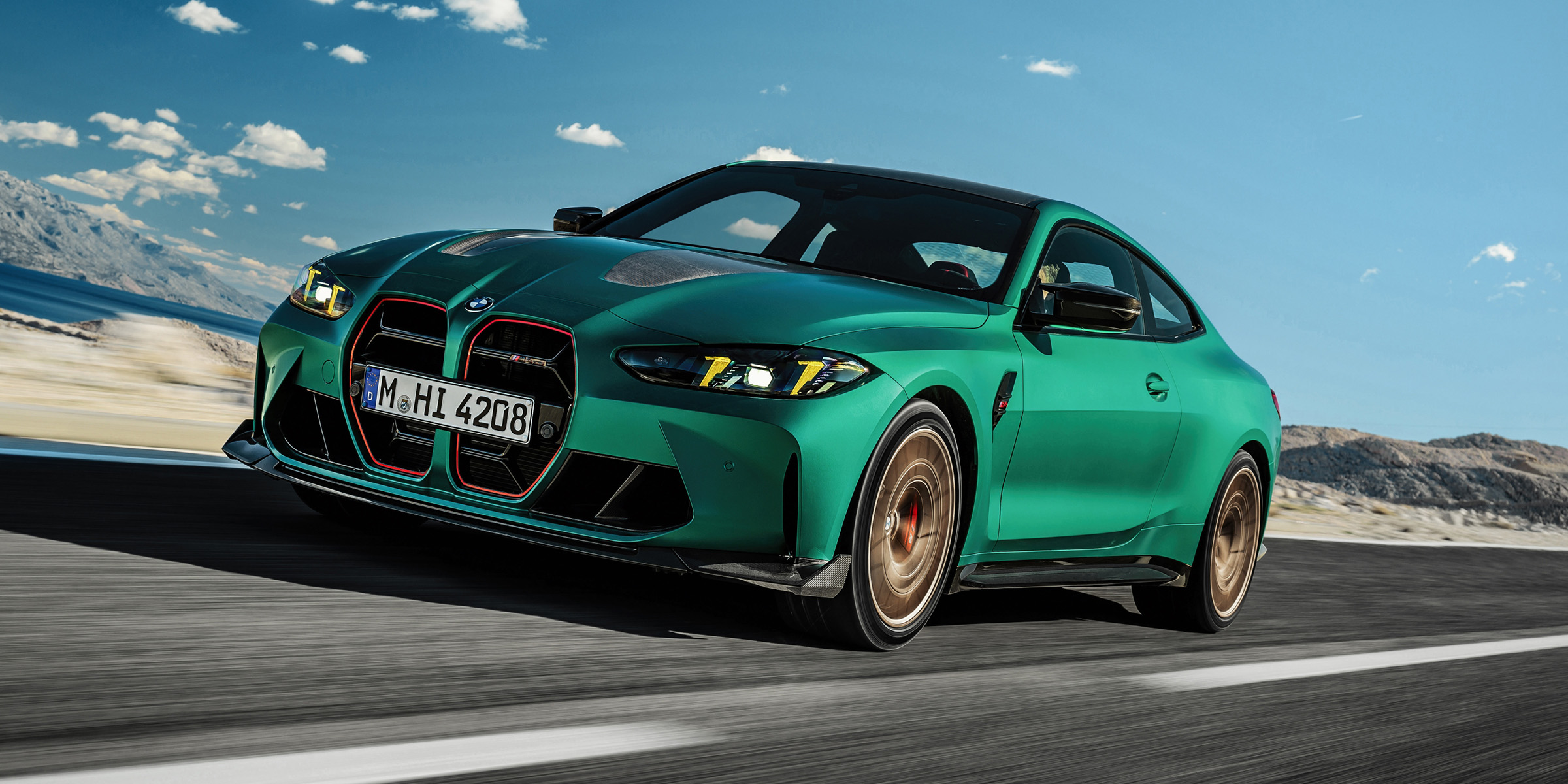
BMW has unveiled another limited edition version of its high-performance M4 coupé with a small power boost over the standard M4 Competition model, a few other engine improvements and a unique exterior design and livery.
With similar exterior looks to that of the limited-run M4 CSL coupé that went on sale in Spring 2022 – including the yellow LED headlights, exposed carbon fibre, enormous kidney grilles with fewer internal vanes and three-tone colour scheme – the car comes in a metallic green (blue also available) as standard with a gold option for the alloy wheels (19-inch at the front axle and 20-inch at the rear) which are wrapped in Michelin Pilot Sport tyres.
The coupé is powered by the same 3.0-litre twin-turbocharged six-cylinder petrol engine as the M4 Competition, but with an added 20hp – 550hp in total – and a revised engine mount and lighter crankshaft to improve throttle response when you put your foot down. The car is four-wheel drive, and drive comes through an eight-speed automatic gearbox.
The M4 CS is 20kg lighter too, and combined with engine tweaks this makes the special edition coupé a tenth of a second faster than the M4 Competition. 0-62mph takes a reported 3.4 seconds, and its top speed is electronically limited at 188mph.
The CS also has lowered and stiffened suspension with model-specific tweaks for the adaptive dampers, springs and anti-roll bars. Inside, the coupé comes with a 12-inch digital instrument cluster and 15-inch infotainment touchscreen in one curved display. This package includes a voice assistant, as well as a lap timer and drift analyser.
This supercar-baiting high-performance coupé should become available to order in the UK in the next few weeks, with pricing beginning at just over £117k.
The BMW M4 currently holds a New Car Expert Rating of B, with a score of 69%. Although it gets fantastic media reviews and has an excellent safety rating, its CO2 emissions and reliability data are only average, and its running costs are inevitably very high.
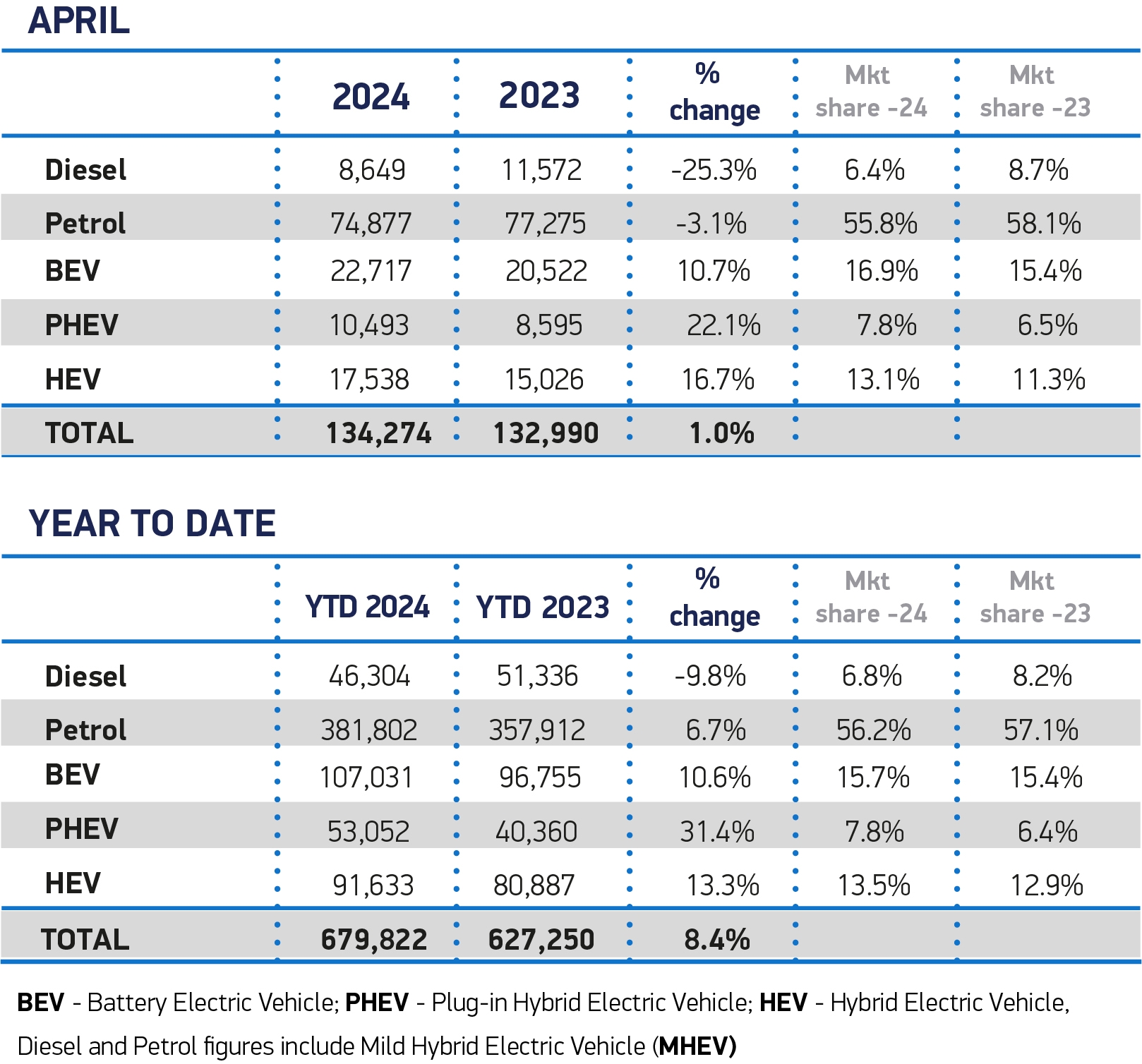
The private new car market showed poor form once again in April as new fleet sales grew year-on-year, culminating in a small overall new car market uptick of 1% last month.
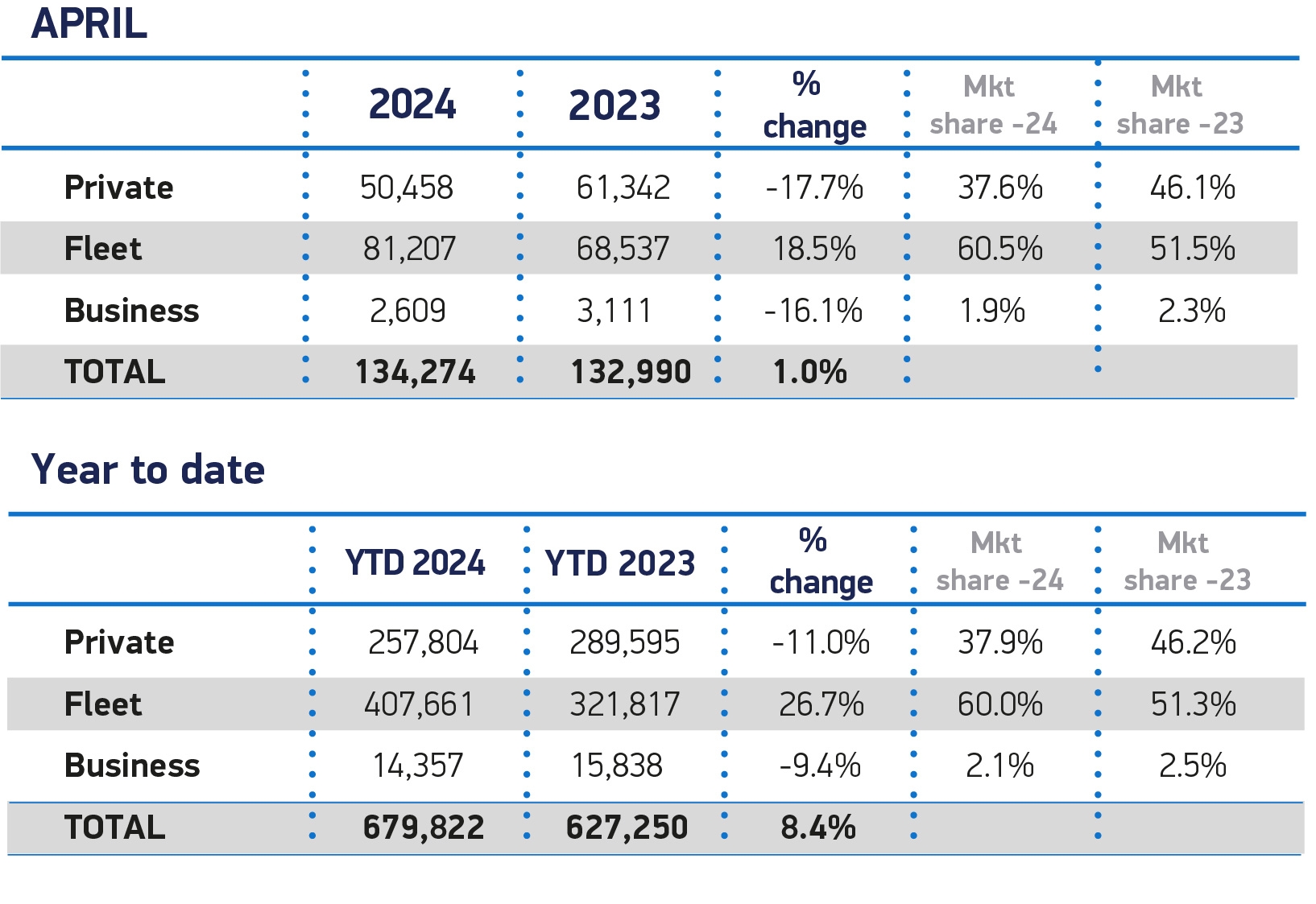
In what is traditionally a low volume sales month after the registration heights caused by the nameplate change in March, the SMMT reports that around 50,000 new cars were registered to private customers in April. That’s a 18% drop when compared to April last year.
Comparatively, new fleet registrations grew by 19% last month, as the new car market continues to be driven primary by fleet sales. In total, just over 134,000 new cars were registered in the UK in April – a rather minor increase of around 1,000 models over the sales recorded in April 2023.
Private new car sales slump continues
Consumer new car sales have been sliding since about halfway through the last decade (peaked in 2015/2016), but the slowdown seems to be accelerating in recent months. It affects all types of new cars, and certainly not just EVs as certain national newspapers would love you to believe.
Unless anything radical changes (even more radical than a rout of the current government at the coming election), this trend is going to continue. New car prices are very high, and interest rates are higher than they’ve been for the last 15 years. Inflation on most consumer bills is squeezing household budgets, so buying a new car is getting harder for many people. Car finance terms are getting longer, so people are changing their cars less often. And so sales keep on falling.
Fleet sales are doing well, continuing their recovery from the depths of Covid. Whether this continues in the longer term remains to be seen.
EV uptake grows 11% in April
Following on from a rather disappointing 4% EV increase year-on-year in March, the electric car market grew by 11% in April when compared to the same month last year.
EV registrations totalled a few hundred under 23,000 last month, which increased the EV market share back up to 16% for 2024 as a whole. That said, the SMMT adds that only one in six of these new EVs went to private buyers, as demand for new private EVs fell by 22%.
As car manufacturers now offer a wide array of electric models and have to meet new EV mandate targets, the SMMT cites “the lack of government incentives for private motorists” as the main barrier that is curbing EV uptake, adding that tax incentives like temporarily halving VAT on new electric car purchases would accelerate the market’s shift towards electric power.
As the year progresses, we expect to see fiercer discounting on electric cars as car manufacturers scramble to hit their mandate targets and avoid large government fines. It’s a good bet that fleet customers, in particular, will be content to wait a bit longer where possible to get better deals before committing to large EV orders.
Good month, bad month
The overall market was up just 1% on last April, but there was significant variation between the manufacturers’ performances.
It was a strong month for Alpine, BMW, BYD, Dacia, GWM Ora, Jaguar, Jeep, Lexus, Mercedes-Benz, Nissan, Renault, SEAT, Skoda, Smart, Subaru, Suzuki, Volkswagen and Volvo. All of these brands outperformed the overall market by at least 10%.
The news wasn’t so good for Abarth, Audi, Bentley, Dacia, DS Automobiles, Fiat, Ford, Honda, Maserati, Mazda, Mini, Peugeot, Polestar, Porsche, Tesla or Vauxhall, who were all at least 10% below the overall market – meaning they sold the same or fewer cars than last April.
That leaves Alfa Romeo, Citroen, Cupra, Genesis, Hyundai, Kia, Land Rover, MG, and Toyota who all pretty much held steady, being within plus or minus 10% of the overall new car market.
Renault and SEAT were the stand-out performers among the volume manufacturers, both increasing their sales by over 75% when compared to the same month last year. Going in the other direction, both Ford and Tesla dipped by over 20%.
Volkswagen continued to be the UK’s best-selling car brand in April, ahead of Audi, BMW, Ford and Kia.
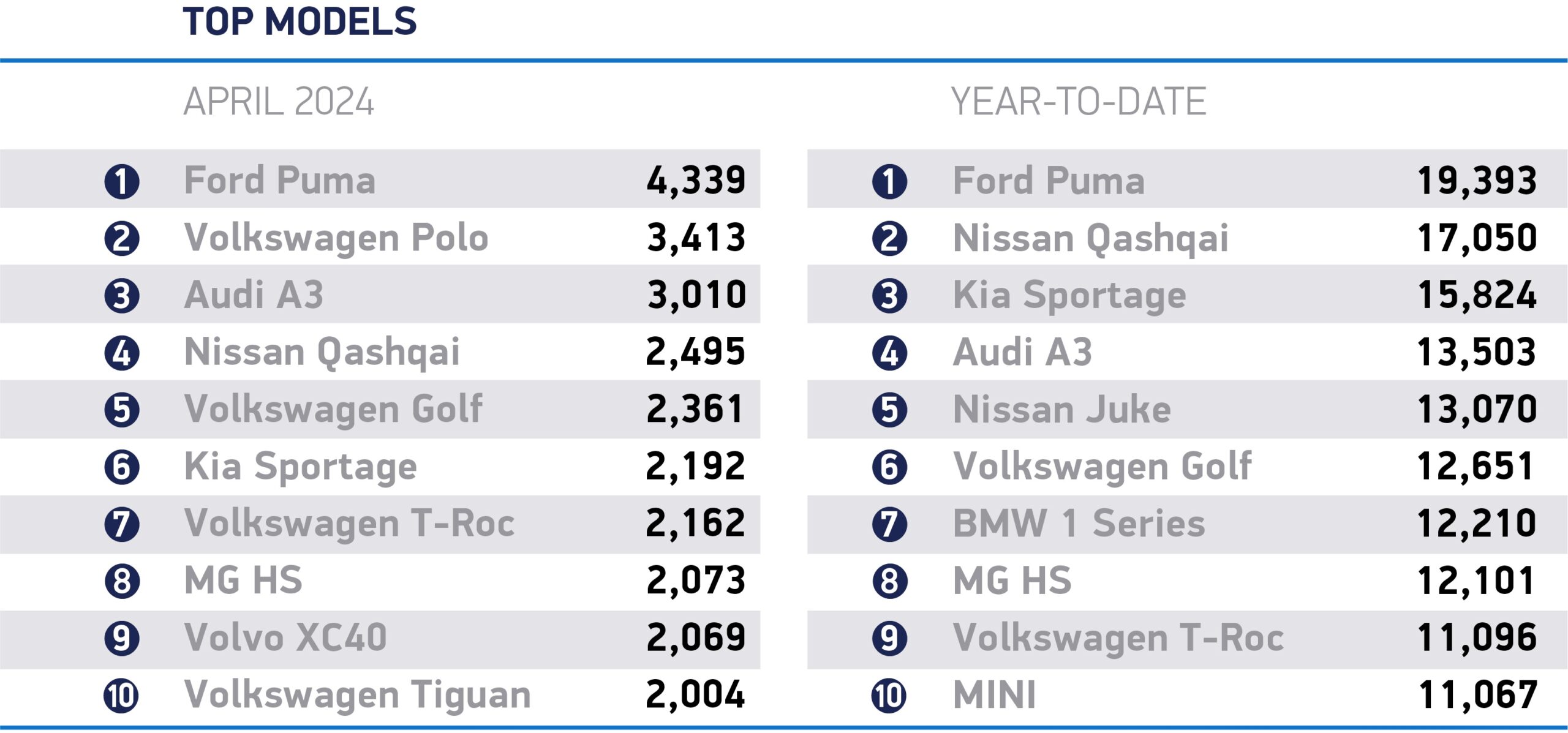
Ford Puma back in the ascendancy
The popular Ford Puma crossover was the best-selling new model in April, as last month’s winner – the British-built Nissan Qashqai – dropped to fourth in the monthly rankings.
The best-selling new car in 2023, the Ford Puma is establishing itself as the car to beat once again in this year’s registrations race, and has built a sales lead of over 2,000 models four months into 2024.
The compact Volkswagen Polo finished April in second place – a surprising result as the small hatchback usually doesn’t make the top ten and has been regularly outsold by Volkswagen’s Golf and T-Roc models.
Capitalising on the retirement of the long-standing Mini hatch, the Audi A3 has continued to sell in consistent numbers – its third place finish in April enough to move the hatchback up to fourth in the annual leaderboard.
We’ll have our usual detailed look at the top ten in the coming days.
The Mini Cooper is a small hatchback and the entry-level model in the Mini range. This is the fourth-generation model, which is available to order in three-door and five-door petrol configurations. There is also a battery-powered version – the Mini Cooper Electric – which we cover separately.
While the electric version has been built from scratch, this petrol-powered model is actually a heavily refreshed version of the third-generation Mini hatch, which first arrived in the UK in 2014.
The ‘Cooper’ name is now used to describe all Mini hatchback models, rather than a specific trim level. This largely brings official Mini naming into line with common usage, since most people have always tended to describe the hatch as a ‘Mini Cooper’ anyway.
The range is divided by the entry-level ‘Cooper C’ and top-spec ‘Cooper S’ models, which are both automatics. These are engine options carried over from the previous third-generation Mini, but have been given performance boosts.
As of October 2025, the Mini Cooper range has a New Car Expert Rating of A, with a score of 71%. It achieves top marks for its safety rating, but only average results for its media review scores, CO2 emissions and running costs. Plus, Mini’s new car warranty offering is poor compared to other brands.
Body style: Small hatchback Engines:petrol Price:From £25,265 on-road
Launched: Spring 2024 Last updated: N/A Replacement due: TBA
Image gallery
Media reviews
Highlighted reviews and road tests from across the UK automotive media. Click any of the boxes to view.
Featured reviews
“The new petrol Mini Cooper S has the same charm and idiosyncrasies as its predecessors – which should make it as popular as ever. It’s impractical, true, and it looks expensive on paper. But rock-solid residuals are likely to mean competitive monthly payments and, truth is, there’s nothing of this size and price that can match the Mini’s mix of keen driving dynamics and stellar cabin finish. It’s flawed, yes, but oh so desirable with it.”
Model reviewed: 2.0-litre petrol automatic Cooper S
“The Mini Cooper hatchback is stylish inside and out and offers more affordable petrol engines compared with its eco-friendly electric alternative, but it’s not very practical.”
Model reviewed: Range overview Score: 8 / 10 “The Cooper must be the most stylish and well-resolved Mini hatch yet, but it’s not a cheap option, plus the rear and boot space remains compromised.” Author: Martyn Collins Read review
Car
Model reviewed: Range overview Score: 8 / 10 “The Mini Cooper wasn’t reinvented in 2024, but it didn’t need to be, as it was always a class act and remains so. It still delivers huge driving fun, real character, and a cabin that now stands among the very best in the class. The downsides are predictable: it’s cramped in the back, the boot is small, and it gets pricey with options. But few small cars bring this much personality to the table, and for that reason the Cooper remains one of the best superminis you can buy today.” Author: Ted Welford, Keith Adams Read review
Carbuyer
Model reviewed: Range overview (petrol and electric) Score: 8 / 10 “The car’s ride can be a little harsh and the Mini Cooper is not very practical, but those aspects have never really been the point and Mini now offers the larger Aceman. We think the Mini Cooper will prove as popular as ever, we just wish there was a manual version for added driver involvement.” Author: Charlie Harvey, John McIlroy Read review
Evo
Model reviewed: Cooper S Score: 7 / 10 “As Mini pivots towards an all-electric future, the F66 signals the end of the line for the petrol Cooper S. It’s not the most effervescent and engaging model of the lineage – particularly with its standard gearbox configuration – but it combines its new design and tech with classic Mini dynamic traits. If that’s your hot hatch flavour of choice, you won’t find it anywhere else.” Author: Yousuf Ashraf Read review
Heycar
Model reviewed: Range overview Score: 8 / 10 “All-new to look at, but a bit more familiar underneath, the latest generation of petrol-powered MINI Cooper majors on all the key points of its predecessors. This also means it has all the drawbacks of those earlier versions as well, but few choosing this car will get too hung up on that when it comes with a sack-full of fun, cheeky looks, and nifty driving manners.” Author: Al Suttie Read review
Honest John
Model reviewed: Range overview Score: 8 / 10 “When you’re facelifting and upgrading one of the best-selling new cars on the market you’d better be particularly careful not to throw out the baby with the bath water, especially when it’s the MINI Cooper, which has always appealed every bit as much to the heart as the head. Happily, the new refreshed MINI Cooper is almost everything your heart desires and your head demands. Almost.” Read review
Parkers
Model reviewed: Range overview Score: 8.2 / 10 “If you’re looking for a fun and stylish small car, the new MINI Cooper is very hard to beat. Nobody makes cars of this size that are quite as charming to drive or look at as MINI, and this new car brilliantly continues where its successor left off.” Author: Luke Wilkinson Read review
Top Gear
Model reviewed: Range overview Score: 8 / 10 “Mini’s tactic to replace its heartland hatch with a heavy facelift was a gamble, but it seems to have paid off.”
Read review
Safety rating
Independent crash test and safety ratings from Euro NCAP
Independent economy and emissions ratings from Green NCAP
No eco rating
As of October 2025, the Mini Cooper has not been assessed by Green NCAP.
Running cost rating
Monthly cost of ownership data provided exclusively for The Car Expert by Clear Vehicle Data
Fuel consumption
Average
Score
Petrol models
47 mpg
C
CO₂ output
Average
Score
Variation
Score
Petrol models
136 g/km
C
Insurance group
Average
Score
Variation
Score
All models
23
B
Service and maintenance
Cost
Score
Year 1
£159
A
Year 2
£432
A
Year 3
£695
A
Year 4
£935
A
Year 5
£1,236
A
Overall
£3,457
A
The Mini Cooper should be a pretty inexpensive car to own and run, according to long-term ownership costs data provided exclusively to The Car Expert by our technical partner, Clear Vehicle Data.
Fuel consumption is only middling, which is somewhat disappointing for a small car. But servicing costs are very low, while insurance should also be very competitively priced.
Reliability rating
Reliability data provided exclusively for The Car Expert by MotorEasy
No reliability rating
As of October 2025, we don’t have enough reliability data on the new Mini Cooper to generate a reliability rating.
The Car Expert’s reliability information is provided exclusively to us using workshop and extended warranty data from our partner, MotorEasy, sourced from both official dealerships and independent workshops.
As soon as MotorEasy has sufficient data on the Cooper, we’ll publish the results here.
Warranty rating
New car warranty information for the Mini Cooper
Overall rating
D
37%
New car warranty duration
3 years
New car warranty mileage
Unlimited miles
Battery warranty duration
0 years
Battery warranty mileage
0 miles
Mini’s new car warranty is pretty poor, and worse than rival brands in a similar price bracket as the Cooper. The duration is three years, with no limit on mileage. Some rivals are offering up to seven years.
Warranty on a used Mini Cooper
As of October 2025, all current Mini Coopers should still be covered by their new car warranty. The first Mini Coopers of this generation hit UK roads in early 2024, so they won’t reach the end of their warranty period until early 2027.
If you’re looking to buy any used car that is approaching the end of its warranty period, a used car warranty is usually a worthwhile investment. Check out The Car Expert’s guide to the best used car warranty providers, which will probably be cheaper than a warranty sold by a dealer.
As of October 2025, we are not aware of any DVSA vehicle safety recalls affecting the Mini Cooper. However, recall information is updated very regularly, so this may have changed.
You can check to see if your car has any outstanding recalls by visiting the DVLA website or contacting your local Mini dealer.
Building on the arrival of its large petrol-powered Torres SUV in February, KGM Motors has announced that an all-electric version – the Torres EVX – is now on sale.
The second KGM model to arrive in the UK after the marque’s re-branding from SsangYong, the Torres EVX costs around £10k more than its combustion-powered counterpart, and comes with a few exterior design differences.
This electric model comes with a thinner LED headlight and daytime running light pairing that forms an illuminated dashed line across the front fascia, and features a bodywork-coloured panel in place of the petrol car’s front grille. The EVX also comes with its own unique alloy wheel design.
Inside, a 12-inch digital instrument cluster and 12-inch infotainment touchscreen combined into one display panel. When it comes to interior layout, KGM says it has focused on “minimising clutter” to maximise “driver visibility and convenience”, limiting the amount of physical control switches in the process.
The large majority of the car’s functions – like media playback, navigation and climate control, can be changed through the infotainment display and steering wheel buttons. This infotainment system is also compatible with both Apple CarPlay and Android Auto.
While the regular Torres is powered by a 163hp 1.5-litre petrol engine, the EVX is the more powerful choice, as its 73kWh battery and electric motor pairing has an output of 205hp. This electric powertrain can also reportedly muster up to 287 miles on a single charge and has the same 1,500kg towing capacity of the petrol variant.
It’s safe to say that KGM is confident about the EVX’s long-term reliability. With prices now starting at over £44k, the brand says that every model comes with a 620,000-mile battery warranty (one million km).
Cupra says it has given its Cupra and Formentor models more “aggressive” exterior looks, an infotainment upgrade and a new plug-in hybrid option.
Moving away from some of the design traits these models shared with the SEAT range – Cupra’s parent brand – the updated Leon and Formentor have been given sharper triangular LED headlights and a wider and lower grille design on a new ‘shark-nose’ front fascia that also features the brand’s updated logo.
In the rear, both cars get the same triangular treatment for the tail lights, and the Cupra badge is now illuminated. The design of the alloy wheels has also been refreshed, with both 18- and 19-inch alloys on offer.
Cupra LeonCupra Formentor
Inside, the interior layout of both models remains largely the same, but there are new material options for the dashboard and seat trims, and a new 13-inch infotainment screen (an inch larger than before) sits above two touch-sensitive sliders for the media volume and heating controls. An optional 12-speaker Sennheiser sound system has also been added to the options list.
Both cars will be available with traditional petrol, mild-hybrid and plug-in hybrid engine options. The pre-facelift options remain, including the lead-in 150hp 1.5-litre petrol, but with two additional options.
First up is a new 333hp 2.0-litre petrol engine option with four-wheel drive paired with a seven-speed automatic gearbox and a ‘torque splitter’ designed to improve traction when cornering. The second is a 272hp plug-in hybrid (joining the 200hp PHEV already available) that can reportedly muster an electric-only driving range of around 62 miles.
That sums up what to expect from the refreshed Leon and Formentor – both are set to become available to order in the Summer, and further details like UK pricing and trim spec confirmation will arrive in the coming months.
The Cupra Leon and Formentor both currently hold a New Car Expert Rating of A with a score of 72%.
To enthusiasts, Aston Martin has always been a thoroughly British maker of desirable sports cars. But it’s probably best known among those who aren’t even remotely interested in cars as the favourite wheels of James Bond.
Aston Martin is indeed a British brand that, despite a somewhat chequered history, has remained renowned for making sports cars and grand tourers that are considered very special. And now the company is planning for a future that includes a major focus on electric vehicles – something which traditionalists will find particularly hard to get their heads round.
Aston Martin traces its history back to 1913, when car dealers Lionel Martin and Robert Bamford decided to make their own cars rather than sell other people’s. Martin was already building cars to race on a local hillclimb course called Aston Hill, so their first car was called an Aston Martin.
The first world war prevented the company commencing production, and Bamford left once the war ended. Funding for the company to carry on was provided by a leading racing driver called Count Louis Zborowski, who competed in a car called ‘Chitty Bang Bang’ (the inspiration for Chitty Chitty Bang Bang from the famous book and movie).
For Aston Martin the inter-war period was one of feast and famine, the company repeatedly lurching towards bankruptcy – a feature of the company throughout it’s 111-year history.
Following the second world war the company was snapped up by David Brown, a Huddersfield businessman who made tractors. He also bought luxury car brand Lagonda, moving it into Aston Martin’s factory at Newport Pagnell in Buckinghamshire. Over the next 25 years Brown would establish Aston Martin’s upmarket reputation and his DB initials remain in the name of some Aston models today.
The first of these was the DB2, a grand tourer launched in 1950 and followed by a host of further DB models in successive years. Undoubtedly the most famous of these models is the DB5 – it was only made between 1963 and 1965, but achieved immortality with its role in several James Bond films, starting with ‘Goldfinger’.
Aston Martin DB2 MkIIIAston Martin DB5
Despite all this, Aston Martin still faced constant financial strife and one of David Brown’s last acts as the man in charge in 1972 was to pay off £5 million of debt. Just three years later the company was in receivership and a host of owners followed.
Stability finally came to Aston Martin after Ford took control of the company in 1987, a period of ownership that would last 20 years. Ford’s control saw a rise to prominence of the ‘V’ models – Vantage, Virage and Vanquish – and the opening of a new factory adjacent to Jaguar Land Rover (also owned by Ford at the time) at Gaydon in Warwickshire in 2003. This replaced the long-established Newport Pagnell factory, which now maintains heritage Aston models.
Ford sold off most of its ‘premium’ brands after 2007, including Aston Martin. For the next few years, the company hoovered up funding from American, Kuwaiti and Italian interests but still suffered losses, reaching £75 million in 2014. A turnaround followed over the next few years, which encouraged the company to float on the stock exchanged – however, that turned out to be disastrous.
Investment fro Mercedes-Benz brought new engines and in-car technology to Aston Martin, replacing Ford-based technology from the previous owners. A new factory was also opened in a former Ministry of Defence facility in Wales to produce the DBX SUV and future electric cars.
In 2020, a consortium led by Canadian billionaire Lawence Stroll took a stake in the firm, with Stroll becoming executive chairman. He has announced plans to begin building EVs using technology from US specialist Lucid, and he has taken the brand back into Formula One racing (conveniently, Stroll also happened to own an F1 team that was re-branded with the Aston Martin name and colours).
What models does Aston Martin have and what else is coming?
There are currently four models in the Aston Martin family: three sports cars and an SUV.
The range starts with the two-seat Vantage sports car, carrying an Aston name that dates back to 1977. It may be the entry point but it doesn’t come cheap – prices start at more than £130K.
The DB12 is a two-door gran touring coupé (technically it has four seats, but the rears are kiddy-sized onlt). It went on sale in 2023, replacing (unsurprisingly) the DB11. Prices start at around £200K.
As of May 2024, the company’s top-level production model is the £270K DBS supercar – although this is now at the end of its production life and is about to be replaced by a new Vanquish model. As with the Vantage and DB12, it’s available in both coupé and convertible (known as Volante) versions, and it’s powered by a twin-turbocharged V12 engine that Jeremy Clarkson described as “almost too fast”.
Finally there is the DBX, Aston Martin’s first SUV – a minimum of £180K buys a car that is the tallest Aston yet but still about as far away as you can get from the typical image of a family SUV, both in terms of styling and performance.
A very special, very limited-edition flagship model is the Valkyrie, created in conjunction with the Red Bull F1 team with major input coming from its superstar designer, Adrian Newey. Only 150 examples were built, each with £3 million price tags.
The first electric Aston Martin is likely to go on sale in 2026. Four EVs are apparently already designed and underdevelopment, with the first expected to be closest in style to the DBX SUV.
The Valkyrie’s successor will be the Valhalla, a slightly less outrageous car and again developed with Red Bull and Adrian Newey. It will have a plug-in hybrid engine producing nearly 1,000hp a more modest price tag of ‘only’ £600K. It had a very brief cameo in the background of a scene in the most recent Bond movie ‘No Time to Die’.
Current Aston Martin rangeon our Expert Rating Index
Aston Martin has 19 official showrooms around the country, which includes Jersey. The experience of visiting an Aston Martin showroom is a little more glamorous than popping down to your local mainstream car dealership on an industrial estate, however. But then you’d hope so, given the amount of money you’ll be handing over.
What makes Aston Martin different to the rest?
Very few car manufacturers hold a Royal Warrant – Bentley, Rolls-Royce and Aston Martin are the only ones that come to mind. The Royals have long been fans of the sports cars, with the King being gifted a rare DB6 Volante by his mother in 1970 and still owning it today, having converted it to run on biofuel.
An Aston Martin fact to impress your friends
Possibly the strangest model to be offered by Aston Martin was the Cygnet, a reworked version of the Toyota iQ two-seat city car, but with a rather more upmarket interior trim and revised styling.
Aston Martin described it as “a luxury solution to urban mobility,” and “an extension to Aston Martin’s range of acclaimed luxury sports cars,” but the project only lasted three years and has not been repeated.
Aston Martin Cygnet
Summary
Aston Martin has lurched from one difficulty to the next over much of its 111-year history, nursing and encouraging a reputation of desirability that has far outperformed its profit levels.
Although it hasn’t been a UK-owned business for decades, Aston Martin remains a quintessentially British sports car company to most people – many of whom dreaming of being able to drive the same car as James Bond…
The pint-sized Kia Picanto has been given an exterior makeover, which gives the car a squarer front end and brings the model up to date with the Korean brand’s latest design ethos.
With the larger Kia Rio hatchback set to be pulled from production, Kia has decided to give its smallest model boxier exterior looks to make the car seem larger than it actually is, as part of an effort to attract buyers who would consider buying a slightly larger model.
The city car’s front and rear design are inspired by the new all-electric EV9 SUV, which Kia hopes will leave a “bold and futuristic impression” on would-be buyers. Replacing the oval LED headlights and grille strip of the current model, the facelifted Picanto features Y-shaped light signatures, as part of a slightly stockier front end with a raised nose and a new front bumper design.
Mid-range ‘GT-Line’ models get full-width LED lights that stretch across the front fascia and boot lid. On standard models, these lights are replaced by black bodywork pieces.
The car’s interior layout remains the same – specced with a eight-inch infotainment touchscreen and a four-inch digital instrument cluster. Two additional interior colour options will be available, with a green and a brown trim finish being added to the options list.
The engine options have been altered – the naturally-aspirated 1.0-litre petrol engine will continue to be sold, but the turbocharged variant of this unit currently offered exclusively with the range-topping ‘GT-Line S’ version will no longer be available. Instead, Kia says that it will be offering a larger 1.2-litre petrol engine, which the brand says offers better performance “driving at high speeds or uphill”.
Now available to order, pricing for the refreshed Picanto now starts at under £16k, with the first customer orders expected to arrive on UK roads in July.
The Kia Picanto’s review scores place it in the midfield of our Expert Rating Index city car segment, with praise for its practicality, interior quality and driving dynamics, and criticism surrounding its rather poor three-star Euro NCAP safety rating. It currently holds an Expert Rating of C with a score of 62%.
The electric BMW i4 saloon has been given a minor model update that includes slight exterior design revisions and infotainment software upgrades.
To keep the battery-powered family car competitive with the likes of the Tesla Model 3, BMW has given the i4 some subtle exterior design changes including new chevron-shaped LED daytime running light signatures and a matt-chrome grille surround.
The car’s rear end is basically unchanged, but should you opt for the optional adaptive LED headlight package, this also now includes ‘Laserlight’ tail lights. This is an alternate tail light signature that uses fibre optics and BMW calls “highly expressive”.
Inside, ‘M Performance’ and ‘M Sport’ trim grades will also now be available with a “low weight and a sustainability-optimised” ‘M Performtex’ interior upholstery, and the steering wheel and air vent designs have been revised too.
The most notable changes can be found on the infotainment screen however, with the introduction of a new route guidance system for BMW’s built-in navigation, which can suggest and add charging stops to your journey.
This system estimates the charge you have left and advises you how long each charging stop will take. The infotainment’s menu system has been simplified too, to make it more user-friendly.
The i4’s combustion-powered counterpart – the BMW 4 Series Gran Coupé has also been given the same treatment. That sums up this minor refresh, the updated i4 will become available to order in the UK from July with prices starting at just under £44k.
The BMW i4 currently holds a New Car Expert Rating of A, with a score of 77%. It scores highly in media reviews and its zero tailpipe emissions, while its safety rating is good (although not as good as the 3 Series saloon) and its running costs are impressive given its price tag.
Audi has announced that its new Q6 e-tron SUV is now available to order – the electric equivalent of the brand’s petrol-powered Q5 – which sits below the marque’s flagship Q8 e-tron.
Described by Audi as its “next technological leap in premium electric mobility”, the brand is confident that the Q6 e-tron will arrive as a class-leader in the medium SUV category, with its impressive battery range being a key taling point.
Built on the same foundations as the new electric Porsche Macan, the Q6 e-tron can reportedly muster up to 381 miles on a single charge – 50 miles more than the larger Q8 e-tron. For further comparison, rivals like the Skoda Enyaq and Nissan Ariya offer a battery range that sits around the 300-mile mark.
The electric SUV can charge at speeds up to 270kW, and at that speed the battery can gain 158 miles of charge in ten minutes.
Inside, Audi has developed a new dashboard layout to house a brand-new operating system for the 15-inch infotainment screen and 12-inch digital instrument cluster. The front passenger also gets a 12-inch media screen, and the large majority of the car’s settings are controlled by these displays or the voice assistant software.
When it comes to storage space, there is 64 litres of ‘frunk’ space under the bonnet, and 526 litres of boot space in the rear.
Two four-wheel drive models are on offer – the Q6 e-tron ‘quattro’ and the SQ6 e-tron. Both will feature a twin-motor layout and a 100kWh battery. The Q6 produces a combined 380hp, while the SQ6’s peak output is 510hp – which means 0-62mph sprint times of 5.9 and 4.3 seconds respectively.
The electric motors can recover up to 220kW of energy when the car is braking, which is some of the strongest brake regeneration tech seen on any EV so far.
A multi-source heat pump draws air not only from the outside environment but also captures waste heat from the powertrain. Audi says that this new tech means more efficient cooling and heating of the cabin, and improved battery range in temperatures between -10 and +20 degrees.
Pricing for the Q6 e-tron starts from £61k, with the SQ6 version costing just under £93k as standard. Single-motor rear-wheel drive models will join the range later this year, which will lower the SUV’s entry-level price.
The Q6 e-tron range includes three trim grades – the ‘Sport’, ‘S Line’ and ‘Edition 1’, while the SQ6 e-tron is only offered in the top spec ‘Edition 1’ guise.
Mini has announced that its long-awaited Aceman crossover will arrive on UK roads in November, with two different powertrain options on offer.
Set to pose a sales challenge to the likes of the Jeep Avenger, Renault Megane E-Tech and the all-new Volvo EX30, the compact Aceman crossover will sit between the latest generation Mini Cooper and Mini Countryman.
The fruit of a partnership between Mini’s owner BMW Group and Chinese manufacturer Great Wall Motors, the Aceman was first shown off as a concept model in 2022, and the recently-announced production model has a very similar exterior design.
The car comes with the same boxy LED headlights – a similar design to those on the larger Countryman – as well as the concept’s oval-shaped grille, chunky SUV-style bumper cladding and black window surrounds and roof. The car sits on 17-inch alloy wheels and comes with roof rails as standard.
Inside, the car comes with a nine-inch circular OLED infotainment screen – fast becoming a Mini specialty – which houses Mini’s virtual canine voice assistant, an avatar called ‘Spike’ that has improved speech recognition and can be used to control numerous vehicle functions, such as navigation, telephone and media playback.
Recycled polyester textile trim features on the door and dashboard panels, and a vegan-friendly upholstery on the seats. The entry-level model comes with a heated steering wheel, as well as a reversing camera.
A wireless charging pad, heated front seats, keyless entry and a head-up display that projects driving information onto the windscreen are also included should you opt for the more powerful ‘SE’ powertrain.
The crossover has 300 litres of boot space, which expands to 1,005 litres with the rear seats folded.
The Aceman has eight different ‘Experience Modes’ that can be selected using toggles below the infotainment screen, which change the display’s graphics and colours, the ambient lighting and engine soundtrack.
Like the new compact Cooper hatchback, this crossover will be available with both 184hp 43kWh and 214hp 54kWh electric powertrains. The former will be able to travel up to 192 miles on a single charge, while the later can reportedly muster up to 252 miles.
In addition to the two powertrains – named ‘E’ and ‘SE’ – there will be three trim grades to choose from. Beyond the entry-level ‘Classic’, the mid-range ‘Exclusive’ has larger 18-inch alloy wheels, a decorative dashboard strap and more included cosmetic options, including six exterior bodywork colours, four roof colours and two interior colour schemes.
The range-topping ‘Sport’ introduces sportier front and rear bumpers, a rear spoiler with airblades, an alternate pattern for the front grille and adds upgraded sport brakes. A panoramic sunroof and a premium Harman Kardon sound system will also be available for an additional fee on the options list.
Pricing begins at just under £32k, with the first customer deliveries expected to arrive this November.
Make and model: Subaru Solterra Description: Medium SUV, electric Price range: from £52,495
Subaru says: “The Solterra moniker was created using the Latin words for ‘Sun’ and ‘Earth’ to represent Subaru’s commitment to delivering traditional SUV capabilities in an environmentally responsible package.”
We say: Moving towards an electric future, Subaru has created a family electric SUV that’s capable of managing passengers, luggage and even a little bit of towing.
Launched in 2023, the Solterra is Subaru’s version of the electric Toyota bZ4X SUV. The Toyota version reached customers more than a year prior but this is Subaru’s first all-electric model in the company’s line up for the UK.
As is common with rebadged cars, the Subaru version has a more limited range of options available. The Solterra comes as an all-wheel drive variant as standard with no entry-level two-wheel drive option on offer.
The two cars score closely in our Expert Rating Index. As of April 2024, the Subaru Solterra holds a New Car Expert Rating of A with a score of 74% and the bZ4X has the same A-grade rating but with a slightly better score of 79% – the difference is a more complete set of servicing costs available for the Toyota and better media scores, which is surprising given that the cars are essentially identical.
What is the Subaru Solterra?
As we move towards an electrified future, more manufacturers are adding all-electric models to their offerings. In collaboration with Toyota, this is Subaru’s first electric model which is a five-seater SUV.
In this same segment other competition includes the likes of the Ford Mustang Mach-E, the Hyundai Kona Electric, the Kia EV6 and the Volvo EX40 (previously known as the XC40 Recharge). Most manufacturers’ first electric cars are focused on the SUV sector so there’s a good amount of choice if you’re in the market for an electric SUV. As well as being Subaru’s only electric car, it’s also the brand’s only SUV option. The rest of the line up features family cars that favour the form of jacked up estate cars rather than the traditional SUV shape.
First impressions
Whilst most of the Subaru range retains rugged exterior styling, signalling off-road capabilities, the Solterra is quite a step away from the brand’s usual styling. This isn’t necessarily a bad thing though. There’s often either a woeful lack of inspiring styling for new EVs or a futuristic flair that has a completely different take on car design. We’re pleased to say the Solterra leans into the futuristic vibe and diverges away from traditional SUV predictability.
As a nod to its Subaru heritage and marketability as an EV that will go off-road the wheel arches feature large plastic surrounds. At the front these also wrap around to create channels for air to flow through, improving aerodynamics. This air-conscious design theme continues at the rear with two fins that stick out over the back window, continuing the roof line.
We like: Futuristic styling We don’t like: Chunky plastic wheel arch surrounds
What do you get for your money?
Two trim options are available for the Solterra: Limited and Touring. The entry-level trim starts from £52,495 and Touring starts at £55,495. As standard the Solterra comes with all-wheel drive which has different driving modes for snow/dirt and deep snow/mud.
Limited is well equipped with 18-inch alloy wheels, automatic headlights and windscreen wipers, heated front and rear seats, electrically adjustable driver’s seat, keyless entry, powered tailgate, heated door mirrors, 12.3-inch touchscreen, wireless Apple CarPlay and wired Android Auto, sat nav, reversing camera, 360 degree view and tire pressure monitoring.
Touring adds 20-inch alloy wheels, panoramic roof, electrically adjustable passenger seat, wireless phone charging, Harman Kardon eight-speaker audio system with subwoofer and memory functions for the driver’s seat and door mirrors.
Subaru advises getting the Solterra serviced every year or 9,000 miles, whichever comes first. The car comes with a standard three-year/60,000 mile warranty with a three-year recovery and assistance package for travelling in the UK and Europe. The battery has a separate eight-year/100,000 mile warranty.
We like: Entry-level spec is well equipped with lots of tech We don’t like: Pricey starting point compared to rivals
What’s the Subaru Solterra like inside?
The modern futuristic theme continues inside with a sleek centre console that houses the touchscreen at the top. This is much simpler to use with Apple CarPlay or Android Auto connected. Climate control buttons are integrated into the piano black finish at the bottom of the screen. Whilst most of the buttons are flat, the icons make them easy to identify and access rather than being buried in screen menus.
The set back driver’s display acts as a cross between a head up display and a traditional instrument panel, so it’s convenient to quickly glance down without taking your eyes off the road for too long.
Storage space comes in the form of door bins and a cubby under the centre console. The middle armrest also lifts up to reveal room for odds and ends and there’s two cup holders between the driver and front passenger. The Solterra doesn’t have a glove box, instead there’s a shelf on the passenger side for paperwork or a notebook.
In the back, the floor is almost flat so the middle passenger doesn’t have their knees up around their ears. Leg room for all is decent and the seats fold down in a 60/40 split to make room for extra long luggage. The boot is a good size and has a flat floor so there’s no lip to load over. Cable storage is tucked away under the boot floor but there’s no frunk space up front.
We like: Modern interior space We don’t like: Competitors offer larger boots
What’s under the bonnet?
There’s just one configuration available in the Solterra, a dual-motor set up with a 71.4kWh battery. This offers official ranges of 289 miles in the Limited specification and 257 miles in a Touring trim variant. Charging is available via a 7kW AC connection which would typically be a wallbox charger at home or work, or it can take up to 150kW DC fast charging at public chargers. Failing either of these, it can be charged from a three-pin plug but this will take a long time. Fast charging allows up to 80% charge in around half an hour.
Braked and unbraked towing capacity is limited to 750kg so it would be suitable for towing a trailer but it wouldn’t be able to tow the vast majority of caravans. Also, towing will have an impact on range capabilities so long journeys with a trailer need some extra planning to ensure regular charging opportunities.
What’s the Subaru Solterra like to drive?
Being electric, it’s super easy to drive and get familiar with the Subaru Solterra. Regenerative braking can be adjusted to give a one-pedal driving experience or something closer to a petrol or diesel car where the brake pedal is needed. Whichever you’re most comfortable with allows for a smooth and relaxed experience.
Out of the front visibility is good but the rear window is quite small so it doesn’t offer great visibility behind. However, the Solterra has blind spot monitoring and lane keeping assist which supports driver awareness of other road users around the vehicle.
Unlike other manufacturers that show blind spot information on the outer edge of the wing mirrors, the Subaru system illuminates an amber light on the inner side of the mirrors. This helps to clearly distinguish in your peripheral vision a blind spot warning and an indicator signal. Lane keeping information is shown using a head up display-style lighting system which flashes an amber line on the side of the lane the car is moving over. This makes it clear what the system is communicating.
Other safety equipment includes driver monitoring which sounds an alert and flashes a reminder on the instrument panel if it deems the driver is not looking at the road. This can be a useful safety feature but it can also be annoying in some instances such as looking out the window to find a house number. When unlocking the car, unless the driver’s door is opened first, other doors won’t open without an additional click of the button. This is a good feature to make sure other people don’t hop into your car but for every day usability it can get frustrating.
On the road, electric power is readily available and getting up to speed is no issue. The 18-inch wheels will offer a more comfortable ride over patches of broken road but that doesn’t mean the 20-inch wheels are uncomfortable. As you’d expect, the cabin is very quiet and the artificial noise at low speeds isn’t annoying.
We like: Great blind spot and lane keeping technology We don’t like: Limited rear visibility
Verdict
As a family electric SUV, the Subaru Solterra is a good pick. Deciding if it’s right for you comes down to price point, range and whether an EV will fit into your lifestyle. Given it’s only available as a four-wheel drive variant, its entry-point is more expensive than rivals like the bZ4X.
While better range figures might be more costly with other car makers, Subaru doesn’t have the option of a larger battery so if 289 miles in the Limited spec isn’t enough then a different EV might be more suitable. However, this will be more than enough for the vast majority of commutes and regular journeys so range figures shouldn’t be off putting. With charging at home or work, the Subaru Solterra would make a great alternative to the traditional petrol or diesel SUV.
Similar cars
If you’re looking at the Subaru Solterra, you might also be interested in these alternatives.
Search for your next new or used car with Auto Trader. Find out more
Discover great deals available on both new and used cars. Find out more
Lease a Subaru Solterra
If you’re looking to lease a new Subaru Solterra, The Car Expert’s partners can help you find a competitive deal.
Personal contract hire deals from Carparison Leasing. Find out more
Personal contract hire deals from Leasing.com. Find out more
Personal contract hire deals from Rivervale Leasing. Find out more
Subscribe to a Subaru Solterra
Subscriptions are becoming a very popular way for consumers to try an electric car for a few weeks or months to help decide whether it’s a suitable alternative to a petrol car. If you’re interested in a car subscription, The Car Expert’s partners can help. (PS: What’s a car subscription?)
Mercedes-Benz has unveiled its long-awaited electric ‘Geländewagen’ – a battery-powered G-Class 4×4 with uniquely developed electric motors and aerodynamic improvements.
Officially named the ‘G 580’ – as Mercedes-Benz opt the ‘EQG’ moniker the 4×4 held during development – this new electric G-Class is essentially identical to the combustion-powered G-Class at first glance, apart from the new-look front grille and a re-sculpted bonnet.
The latter has helped to improve the car’s aerodynamics, which will slightly boost the G 580’s battery range. On the topic of range, the 4×4 can reportedly muster up to 292 miles on a single charge, thanks to its large 116kWh battery which also powers the brand’s luxurious EQS saloon.
The battery works in tandem with four electric motors developed specially for this model – one for each wheel. The car’s total output is 587hp, and while top speed is electronically capped at 112mph, this G-Class can accelerate from 0-62mph in 4.7 seconds.
The car can charge at speeds up to 200kW, and at this speed, the battery can be charged from empty to full in a reported 32 minutes.
One of the first battery-powered 4X4s to be announced for the UK market, the G 580 can comfortably handle off-road terrain with a maximum fording depth of 85 centimetres and the ability to climb steep slopes of up to 35 degrees.
The car also comes with three off-road driving functions. ‘G-Turn’ can reportedly turn the car 720 degrees “almost on the spot”, the ‘G-Steering’ function reduces the reduces 4×4’s usual turning circle of 14 metres while on the move and an off-road crawler function can slow the vehicle down to speeds as low as 1.2mph for particularly difficult off-road surfaces.
Mercedes adds that using the ‘G-Turn’ and ‘G-Steering’ functions on public roads is in “no way authorised, promoted or condoned”, however.
With its large boxy shape and big battery, the electric G-Class is certainly heavy. Curb weight stands at 3,085kg – that’s more than the weight of two A-Class hatchbacks combined. For customers that would miss the engine soundtrack of the ICE-powered G-Class, Mercedes says that the G 580 comes with a special ‘G-Roar’ function that offers an “emotive sound experience” in the cabin.
A single trim choice is now available to order – the ‘Edition One’. Inside, the 4×4 comes with a 12-inch digital instrument cluster and 12-inch infotainment touchscreen pairing on the dashboard, and two more entertainment screens for the rear passengers mounted to the back of the front seats.
Various bits of the dashboard and door panel trim are finished in blue-tinted carbon fibre, and the multi-function steering wheel is wrapped in Nappa leather.
A infotainment voice assistant is also included, as is a new ‘transparent bonnet’ camera view that projects a view underneath the car’s nose onto the infotainment screen. Pricing now begins at just under £181k.
Audi has announced that fresh plug-in hybrid versions of its Q7 and Q8 SUVs are on the way, which offer a longer electric-only range and some mechanical upgrades.
This announcement coincides with the Q7’s facelift that was revealed back in January, which includes exterior styling tweaks, a new infotainment system, a range of mild-hybrid engine options and chassis upgrades. Competing in the same size category, the Q8 is essentially the coupé-SUV version of the Q7, the key difference being the Q8’s sloping rear roofline.
These new plug-in hybrid versions of the Q7 and Q8 – both named the ’55 TFSI e quattro’ – are powered by 3.0-litre six-cylinder petrol engine and 26kWh battery pairing that produces 340hp and an electric-only range that has doubled and now exceeds 50 miles (52 miles for the Q7, and 51 miles for the Q8).
Both SUVs can reportedly complete a 0-62mph sprint in 5.7 seconds, with top speed electronically limited at 149mph. In electric mode, top speed is limited to 84mph. The battery can be charged at speeds up to 7.4kW, and at that speed it takes three hours and 45 minutes to fully charge the battery from empty.
More advanced electronically-controlled air suspension comes as standard, and Vorsprung versions of these plug-in hybrids also come with rear-wheel steering which reduces the SUV’s turning circle by a metre for increased manoeuvrability in tight spaces, and a new active roll stabilisation feature that increases stability on uneven roads and provides a more precise steering response.
The Audi Q7 currently holds a New Car Expert Rating of C with a score of 61%, while the Q8 holds a New Car Expert Rating of D with a score of 59%. Both models have been praised by UK reviewers for their practicality and powerful performance, but several outlets find both model ranges expensive, particularly the options list.
The high-performance Aston Martin DBX 707 SUV has been given a mild update that includes chassis tweaks, a new infotainment system and a revised dashboard layout, and has been shown off in a very orange colour scheme.
Sitting at the top of the DBX range, this 707 model has been on sale in the UK since 2022 and comes with several performance upgrades over the standard SUV.
Aston Martin says that the key addition this update introduces is a new ‘state-of-the-art’ infotainment system on the dashboard – a 12-inch touchscreen developed by Mercedes-Benz that Aston Martin says is ‘entirely bespoke’ and is compatible with wireless Apple CarPlay and Android Auto and is supported by the Aston Martin customer app.
The dashboard layout has also been revised, with a new steering wheel taken from the DB12 grand tourer, redesigned door handles and new-look vertical air vents. The SUV retains a 10-inch digital instrument cluster behind the steering wheel, as physical buttons and switches for the gear selection, drive mode, heating and ventilation, suspension and exhaust settings and lane keep assistance tech.
The door panels are also larger and can be trimmed in several new materials, including smoked oak, titanium mesh and updated ziricote wood, or piano black and carbon fibre veneers.
The 14-speaker Aston Martin ‘Premium Audio’ sound system is now standard, and an alternate 23-speaker Bowers & Wilkins system appears on the options list.
That sums up this minor DBX 707 update. The sole engine option is unchanged – a 707hp 4.0-litre twin-turbocharged V8 paired with a nine-speed automatic gearbox which can reportedly complete a 0-62mph sprint in 3.1 seconds. The first customer orders of this refreshed model are expected to arrive on UK roads this Autumn.
The Aston Martin DBX currently holds a New Car Expert Rating of D, with a score of 57%. Although it has received very positive media reviews, the DBX’s score is weighed down heavily by its enormous running costs and high emissions output.
Skoda has revised its Fabia hatchback and Karoq SUV model ranges, now offering more equipment as standard and an updated engine line-up.
Starting with the Fabia’s trim revisions, the entry-level ‘SE’ comes with a eight-inch digital instrument cluster behind the steering wheel, replacing traditional gauges. A larger ten-inch digital cluster is available with the mid-range ‘SE L’. Skoda has also made the infotainment screen in the centre of dashboard bigger, now measuring eight inches diagonally from corner to corner. Other entry-level additions include a front centre armrest and two additional rear speakers.
The Fabia ‘SE L’ now also comes with LED tail lights, while the range-topping ‘Monte Carlo’ package now features cruise control with a speed limiter and front seat lumbar support.
The standard Karoq ‘SE’ grade now gets a ten-inch infotainment screen and a wireless smartphone charging pad – features formerly reserved for higher trims. The standard Karoq also now comes with lane keeping assistance and traffic sign recognition safety technology.
The mid-range Karoq ‘SE L’ now comes fitted with larger 18-inch silver alloy wheels, while buyers who instead opt for the top-spec ‘SportLine’ will find that it now comes with two tablet holders and ISOFIX on the front passenger seat. All Fabia and Karoq trim levels also come with Skoda’s updated logo inside and out.
The engine options for both cars are almost identical – the sole change being the upgraded entry-level petrol choice. This 1.0-litre unit comes from Volkswagen Group’s latest ‘EVO2’ engine generation, and produces 116hp – an increase of 6hp over the former 1.0-litre option.
Available to order now, pricing for the refreshed Fabia starts just south of £20k, while pricing for the Karoq now starts at over £28k.
The Skoda Fabia currently holds an Expert Rating of A, with a score of 74%, while the Karoq holds a New Car Expert Rating of B, with a score of 66%. Both models have already been praised by the British motoring media for their impressive levels of standard equipment.
Mazda’s new seven-seater CX-80 will arrive in the UK later this year – a diesel mild-hybrid or petrol plug-in hybrid flagship SUV that will rival the likes of the new Hyundai Santa Fe and Volvo XC90.
This model will sit above the closely-related CX-60 SUV in Mazda’s model line-up, and with three rows of seats, Mazda remarks that the CX-80 is “the most spacious SUV” it has “ever offered”. As well as being 25 centimetres longer than the CX-60 – extra length required for the additional row of seating – the SUV is also over two centimetres taller, which means slightly more headroom.
With all seven seats in place, the boot reportedly accommodates up 258 litres, which is actually less than half of the 570 litres that the CX-60 offers. Room for luggage rises to 687 litres with the back row folded and 1221 litres with the two rearmost rows stowed. The vehicle can tow up to 2,500kg.
Inside, a 12-inch infotainment screen that juts out of the centre of the dashboard comes as standard, as well as three-zone air conditioning, wireless smartphone mirroring and seating with a memory function that uses facial recognition to select logged driver preferences.
The CX-80’s engine options are the same as the CX-60. The range begins with a 254hp 3.3-litre straight-six diesel engine with mild-hybrid assistance. The other, more expensive option is 320hp 2.5-litre four-cylinder petrol plug-in hybrid configuration that is assisted by a 18kWh battery and 129kW electric motor to produce an electric-only range of 32 miles.
The diesel can complete a 0-62mph sprint in 8.4 seconds, while the plug-in hybrid can reach the same speed in 6.8 seconds. Both engines are mated to an eight-speed automatic gearbox.
That sums up what we know so far about the new CX-80. Mazda is yet to confirm the car’s UK pricing, but this information is sure to follow in the coming months in the run to up the SUV’s official launch.
If you were driving in the 1990s you might remember the Kia vehicles of the time – they were distinctly bargain basement cars sold from tiny dealers and offering very little to write home about either in specification or quality.
Fast forward to 2024 and Kia is one of the most highly regarded manufacturers on the global market, regularly topping quality surveys and its product constantly appearing in Car of the Year shortlists – the Kia EV6 was our 2022 Car of the Year, one of many awards that model has received. Mix in the extra publicity gained from massive levels of sports sponsorship, the Kia brand today is as well-known as Ford or Volkswagen.
In less than 20 years, Kia has been transformed from a brand on the verge of bankruptcy to a top maker recording more than $4 billion in profit.
This has been masterminded by parent Hyundai, and focused on developing a recognisable and strong brand image. It has led to Kia offering cars that are both practical and of excellent quality, sold through dealers offering top levels of customer service.
Kia is the second largest car manufacturer in South Korea, with almost three million annual global sales. It’s only beaten by its parent company Hyundai, which has owned Kia for close to 30 years.
Kia – the name roughly translates as ‘Rising from East Asia’ – was formed in 1944, initially as the catchy ‘Kyungsung Precision Industry’, making steel tubes and bicycle parts. The company’s first vehicle was a bicycle called the Smachuly, launched in 1951.
Licensing deals enabled Kia to manufacture Honda motorcycles from 1957 and, by 1974, it was producing both cars and trucks under licence from Mazda. Similar deals were later done with European makes Fiat and Peugeot but, when dictator Chun Ddo-When came to power in South Korea in 1981, Kia was forced to give up car manufacture.
By 1987 cars were again emerging from Kia plants, now in partnership with Ford, which had taken a stake in Mazda. One of the first Kia models to come to the UK was the Pride three-door hatchback, which was effectively a Mazda 121. The first Kia Sportage, launched in 1993 and the first Korean SUV, was based on the Mazda Bongo van.
Kia products were aimed firmly at the budget market but the company could not sell enough of them and when the Asian financial crisis hit in 1997, Kia faced bankruptcy. At this point, fellow Korean car maker Hyundai entered the picture. Irt took a 51% stake in its rival and started the process that would transform Kia from budget brand to highly respected mainstream car manufacturer.
1999 Kia Pride vs. 2021 Kia EV62021 Kia Sportage vs. 1999 Kia Sportage
The Sorento mid-sized SUV, launched in 1999, was the first ‘transformative’ Kia. Seven years later, the company shocked the automotive industry by appointing leading car designer Peter Schreyer as its chief design officer – he had previously been working for the Volkswagen Group, creating such design icons as the Audi TT.
Schreyer came up with the ‘tiger nose’ grille design that has been a Kia signature ever since, and led Kia’s new focus on Europe which saw the opening of a major production plant in Slovakia in 2006.
New core models, including the Picanto city car, the Cee’d range of family hatches, and successive generations of the Sportage SUV, accelerated Kia up the car-maker pecking order, fueled by continual improvements in quality and being at the forefront of technology – Kia’s first electric vehicle, the Soul, was launched in 2009 long before EVs became a trend.
By 2016, Kia was winning a host of awards for both its cars and customer satisfaction. The transformed image of Kia has been reflected in the brand’s sales – from 500,000 cars annually in 1998 to more than 3 million in 2023.
What models does Kia have and what else is coming?
Kia’s current model range can be split neatly into two – the traditional, mainly combustion-engined, models and the much newer range designed from the start as electric vehicles – currently this second range numbers just two.
Launched in 2022 and claiming The Car Expert Car of the Year award, the EV6 is a sharply-styled SUV closely related to the Hyundai Ioniq 5. It comes in two or four-wheel-drive form, buyers being able to choose their model with an emphasis on range or power.
Launched late in 2023 was the EV9, a much bigger and blunter model with seven-seat capability and assuming the role of Kia’s flagship offering. It recently won the World Car of the Year award.
These aren’t the only electric choices in the Kia line-up however. The small crossover Niro, and box-shaped Soul, have both been offered as combustion models but are also sold in electric form, with the Niro also available as a hybrid.
Core of the traditional range is the Ceed family hatch. Its range includes a sporty estate called the ProCeed and a crossover, the XCeed.
Some model names have been around a long time – the Sportage and Sorento SUVs have both been through several generations, as have the Picanto city car, the Rio supermini and its SUV sister, the Stonic.
Kia’s future plans are focused firmly on the EV range – first to arrive is expected to be the EV5, effectively a smaller version of the EV9, while in the next five years we are also likely to see an EV4 rivalling the Tesla Model 3, and a smaller SUV dubbed the EV3.
You won’t have too far to go if you fancy trying a Kia for yourself – over the years the brand’s UK network has grown to the point that its around 190 outlets are only beaten for quantity by Ford and Vauxhall.
Kia dealerships all have the same quality corporate image but in terms of size and location vary immensely. The flagship outlet in Brentford, London, rises over four floors and towers over the elevated section of the M4 motorway, whereas Gravells, a Welsh group that consistently takes Kia’s top dealer award, has its main showroom in Kidwelly, a town of only around 3,500 people.
What makes Kia different to the rest?
Most car makers produce a model or two that fail to impress, a sense of ‘why did they bother doing that’ but this is not something that can be levelled at today’s Kia – even the Stinger, a large grand tourer-type car very different to typical Kia product and only on sale for five years, had plenty of fans who were sad to see it go.
Kia’s exterior styling with the signature tiger-nose grille is generally positively received, but the cars sell mainly on a combination of quality and technology that is at the forefront of the mainstream market and comparable to some premium offerings.
A Kia fact to impress your friends
Always had a desire to get yourself an example of a 1990s-era Lotus Elan? Check the badges, as it might not be a Lotus…
After the Norfolk maker canned the Elan in 1995, it sold the rights to the car to Kia, which then built it in South Korea between 1996 and 1999.
On the outside, the Kia Elan looked virtually identical to the Lotus version (the main difference being the tail lights), but under the bonnet it had a Kia 1.8-litre petrol engine rather than the 1.6-litre turbo from Isuzu that Lotus used.
Only around 1,000 were made, sold only in Korea and Japan.
Summary
There’s no such thing as a car maker that can do no wrong but Kia appears to come pretty close – once easily dismissed, Kia is an automotive success story with its cars driven by thousands of happy owners.