It was a predictably disappointing end to a difficult year of new car sales in the UK, with the only bright spot being another strong month for new EV registrations – although even that was not as positive as it may seem.
According to data published today by the Society of Motor Manufacturers and Traders (SMMT), private new car sales were down 2% in December compared to the same month last year. Combined with a flat result for fleet registrations, that meant the overall market was also flat for the month, just 0.2% down on last December.
That means that for the whole year 2024 numbers, private new car sales were down 9% compared to 2023, while fleet registrations were up 12%, for an overall market result of 3% growth.
With a total of just over 746,000 new cars registered to private customers for the full 12 months, 2024 was the worst year for private new car sales in at least a quarter of a century. There are mitigating factors for this, but the simple fact is that there have been fewer consumers walking into dealerships and buying new cars every year since 2015.
Source: SMMT
Record number of EVs registered
The brightest spot in the figures was the strong performance of electric vehicles (EVs), which made up 31% of all registrations. However, all is not as it seems here. A lot of these “sales” were actually car manufacturers and dealers registering cars to themselves rather than to real customers. Many of these cars will be pressed into service as dealer demonstrators, service loan vehicles, employee company cars or press fleet vehicles, or they’ll simply be parked up in a field for at least three months before being sold by the dealers as used cars. This is all to do with the UK’s zero-emission vehicle (ZEV) mandate, which required the car industry to ensure that at least 22% of all new cars sold in 2024 were EVs (minus an allowance for plug-in hybrids and some other loopholes that brought the real targets down or most car manufacturers).
Registrations for petrol and diesel cars both tumbled during December, which is almost completely related to the ZEV mandate as well. For those companies who simply couldn’t register enough EVs, another alternative was to simply sell fewer non-electric cars. Interestingly, this didn’t seem to affect hybrid registrations, which were about where we’d expect them to be based on full-year data.
So the year ended with almost 382,000 new EVs registered, up 21% from last year’s 314,000 cars. That equates to a market share of just under 20% (compared to 16.5% last year) – which is close enough to exceed the 22% mandate once the various loopholes and credit swaps are all exploited.
Source: SMMT
Good month, bad month
Despite the overall registration numbers being almost identical to the same month last year, there was still considerable variation among the different car brands. A lot of this movement was related to both the 2024 and 2025 ZEV mandate targets, as some brands pushed out extra EVs or closed off deliveries for non-EVs in order to hit this year’s 22% target, while other brands were already looking ahead to next year’s tougher 28% target and doing the opposite.
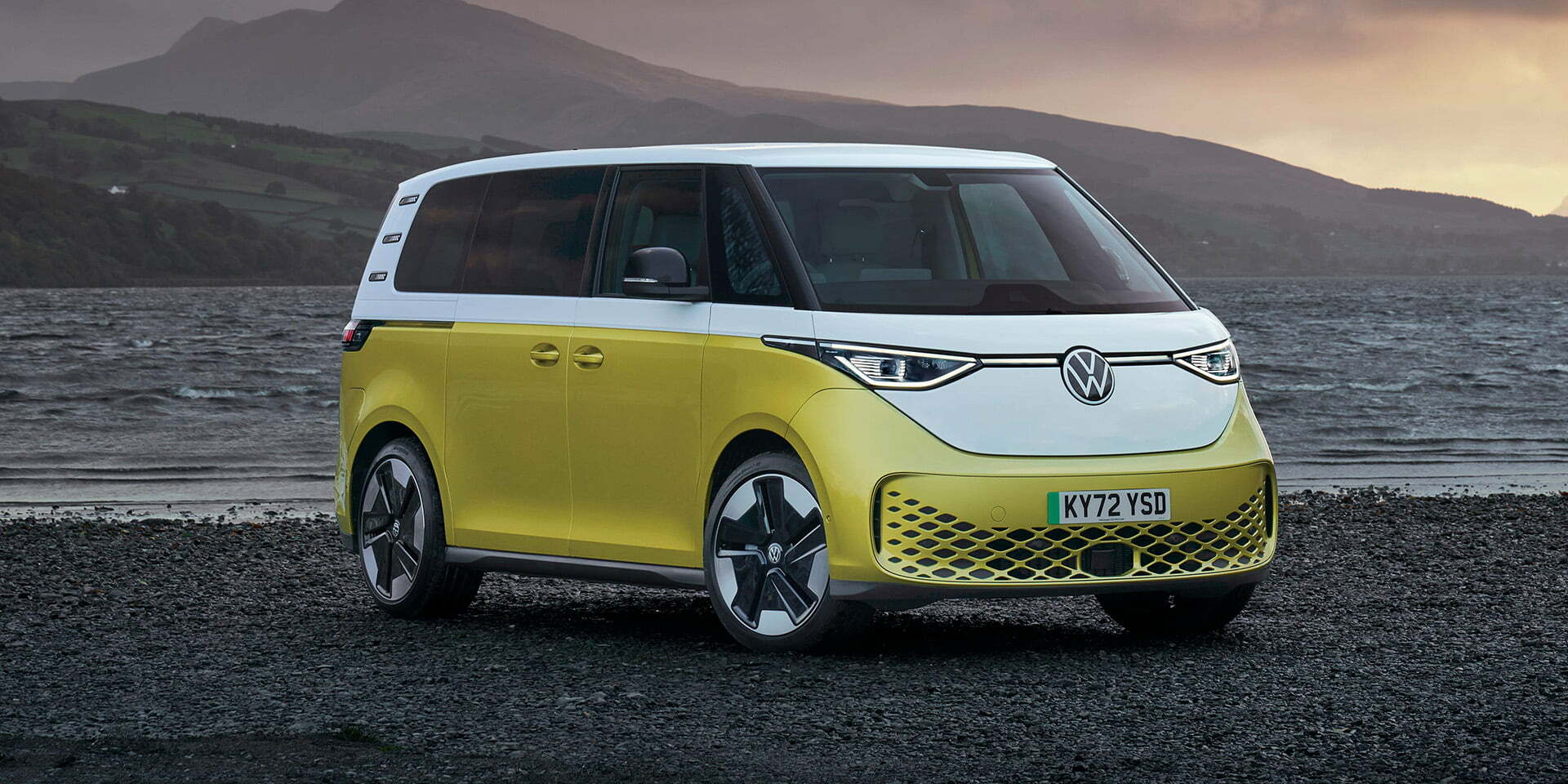
As it has been all year, Volkswagen was comfortably the best-selling brand in December, with Tesla making its usual December appearance in second place ahead of BMW in third. Tesla was the biggest absolute improver, shifting 3,100 more cars than it did last December. The biggest loser was Audi, which registered 2,400 fewer cars than in the same month last year.
In total year sales, Volkswagen was again the nation’s favourite, ahead of BMW, Audi, Kia and Ford.
Tesla pulls usual December rabbit out of hat
For the fifth year in a row, a Tesla topped the best-seller charts in December. There’s clearly something about the company’s sales or logistics schedule that creates this pattern (and we’re just guessing, since the company doesn’t talk to most of the motoring media). So, just as it was last year and the year before that, the Tesla Model Y was the UK’s best-selling car in December – with the Model 3 in second place.
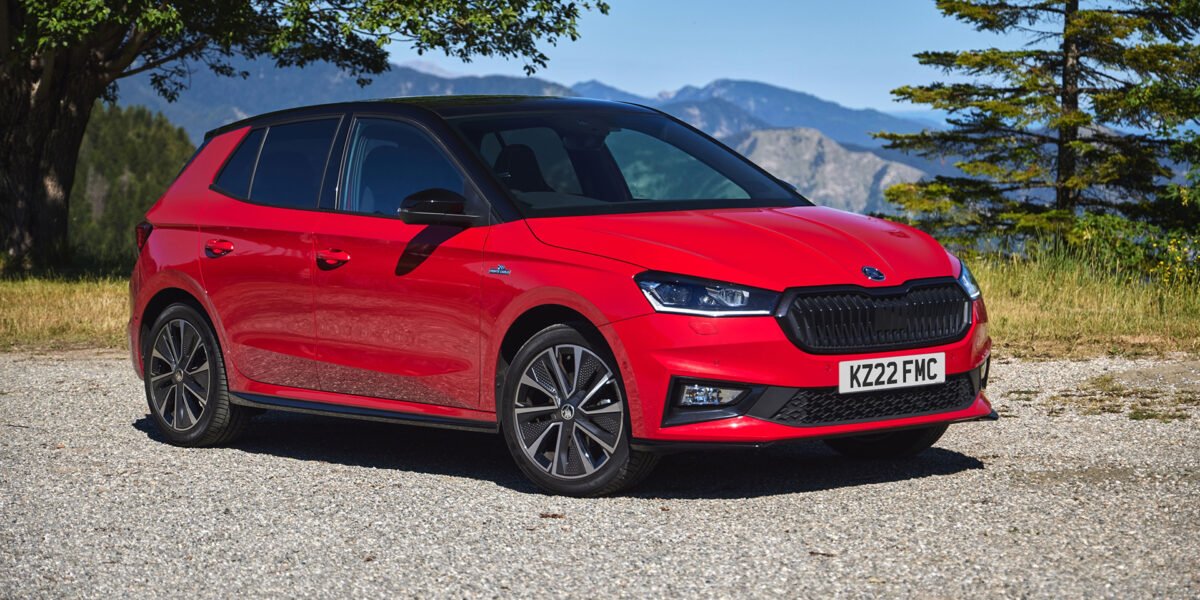
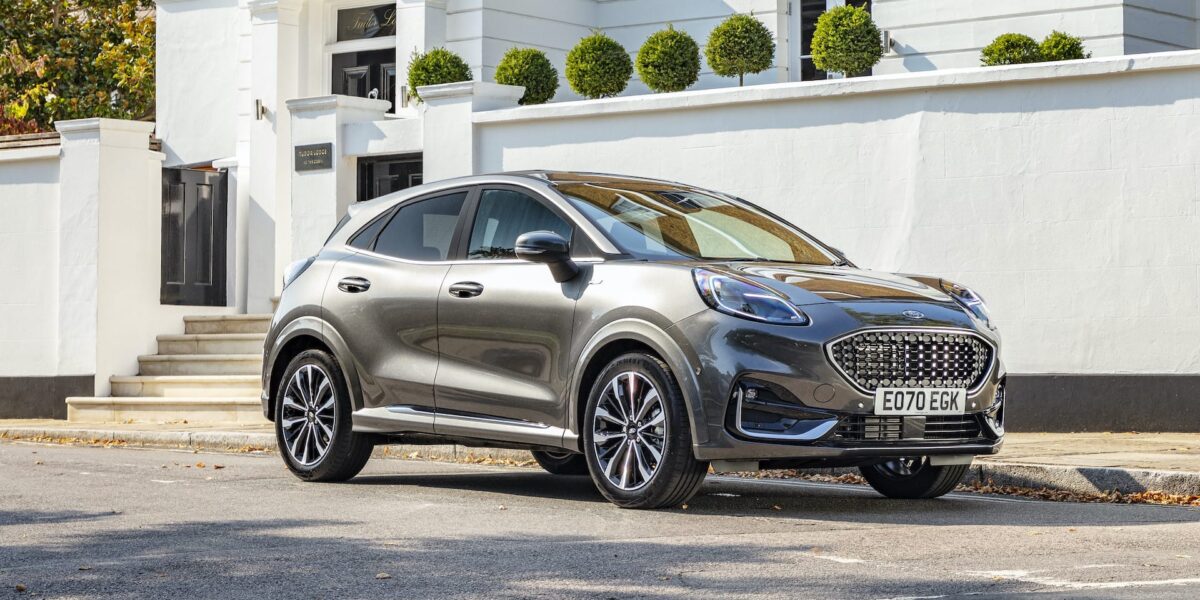
In total 2024 sales, the Ford Puma defended its crown as the country’s best-selling new car, holding off a late-year challenge from the Kia Sportage. A month ago, it looked like the Sportage was going to overhaul the Puma, especially with Ford’s ZEV mandate struggles, but in December it was the Kia’s sales that stalled.
The Puma made up almost 44% of all Ford registrations in 2024 – presumably, you can’t get hold of a Focus or Mustang for love or money at the moment…
We’ll have a fuller analysis of the full-year 2024 data in coming days.
More than once over the last couple of decades, industry insiders have described SEAT as the Volkswagen Group’s ‘problem child’. The former Spanish state-owned manufacturer has been owned by Volkswagen since 1990 and has undergone a few image changes in the last 35 years.
For many years, buyers did find appeal in SEAT’s offerings – cars such as the Leon were better value and more aerodynamic than the Volkswagen Golf, with which they shared much of their metalwork, while the Ibiza supermini has long been seen as an excellent first car for young drivers.
For many years, SEAT was pitched as Volkswagen’s ‘sporty’ brand, and grouped internally alongside Audi and even Lamborghini. For its most potent models, SEAT invented its own version of Volkswagen’s GTI badge, calling it Cupra and applied it to cars that also plied their trade on the race track. Now, however, Cupra has broken away to set up on its own and is in the process of killing off its parent.
Read on to learn how the SEAT of today may not be here tomorrow…
The company that would become SEAT dates back to 1940, when the ‘Sociedad Ibérica de Automóviles de Turismo’ was founded as a means of establishing a major car manufacturer as part of Spain’s efforts to recover from its civil war. The government then got involved in creating a national car brand, but the second world war badly delayed efforts to find partners with suitable technical expertise. Not until 1950 was SEAT – ‘Sociedad Española de Automóviles de Turismo’ or literally the ‘Spanish Passenger Car Company’ founded, in partnership with Fiat.
[Editor’s note: We always write the company name as SEAT, rather than Seat. This is an anomaly, as the company name is pronounced “Say-at” rather than “S-E-A-T”. In contrast, we write Fiat rather than FIAT, despite that company name also being an acronym. This is simply because if we write “Seat”, almost every English-speaking person on the planet will instinctively pronounce the name as if it were a chair. Every. Single. Time. So we ignore grammatical best practice and capitalise the name.]
Fiat pulled most of SEAT’s strings for the next 30 years. Most SEAT models were little more than rebadged or restyled Italian products – though the SEAT 600, developed in-house and launched in 1963, proved the affordable car to effectively motorise the Spanish population. Not until 1967 was SEAT allowed to export cars, and the brand continued to grow, dominating the Spanish market while becoming better known in the rest of Europe.
By the 1980s, however, the Spanish government had decided that SEAT needed major investment to secure its future, and Fiat was not prepared to make the commitment. The two parted company in 1982 and then took each other to court when Fiat argued, unsuccessfully, that the SEAT Ronda was too close to the Fiat Ritmo.
The Spanish Government looked for a new partner, talking to Toyota, Nissan and Mitsubishi, and within months of Fiat’s departure, had signed a cooperation agreement with Volkswagen. In 1986, Volkswagen bought a 51% stake in SEAT and went on to purchase the brand outright by the end of 1990.
Within three years, a brand-new plant had been built in Spain’s Catalonia region at Martorell, which at the time was one of the most modern and efficient car factories in Europe. One of its first products was the Mk2 version of the Ibiza city car, greatly increasing SEAT’s market presence. From 2002 until 2007, SEAT was placed with the likes of fellow Volkswagen-owned brand Audi in a sub-group of what the management considered were the sportier parts of the empire.
One of the major developments of SEAT’s sporty image saw the establishment of the Cupra badge in 1996. Cupra, short for ‘Cup Racing’, was used to describe the most potent SEAT models and was employed in a wide range of motorsport activities.
For many years, however, SEAT had been causing sleepless nights for Volkswagen executives, unsure how best to utilise their Spanish outpost. Eventually, in 2018, Volkswagen decided to establish Cupra as its own brand, which has had the effect of accelerating the decline of SEAT.
SEAT Ibiza through the years
Today it seems SEAT’s diminishing profile is deliberate, as the Volkswagen Group puts all its efforts into Cupra and has not launched any new cars in the last five years. With the German parent company currently fighting to remain competitive against the onslaught of the Chinese car industry, it’s unlikely to have too much money or patience to continue trying to promote SEAT – especially with Cupra proving to be one of the Group’s few bright spots at the current time.
SEAT won’t be completely dispensed with, however, with the brand potentially being reinvented as an urban mobility brand that produces electric scooters and microcars. But, at this stage, we don’t know any more.
What models does SEAT have and what else is coming?
SEAT’s model range has been around a long time now, with the newest model in the range – the current Leon – launched back in 2020. With several models now at the normal end-of-life threshold of seven to eight years, we’re not sure how long some of them will remain on sale.
The Ibiza supermini is now in its fifth generation, which has been on sale since 2017 – meaning it’s one of those models that would normally be replaced shortly. Under the shell, it’s basically a Volkswagen Polo. Available only as a petrol-powered five-door hatch, it underwent a mild facelift in 2021 and is still highly regarded in the small car sector, with an Expert Rating of A from The Car Expert.
The Leon name first appeared in 1999 as SEAT’s family hatch, immediately proving popular as a sportier version of the Volkswagen Golf. The fourth-generation model launched in 2020 and is still based on the Golf. It’s offered in five-door hatch and estate forms, with petrol and plug-in hybrid engines. The current Leon is considered more refined but less sporty than it used to be and also earns an A in the Expert Rating index.
In 2017, SEAT launched the Arona, a small SUV/crossover based on the Ibiza hatch. This time, it’s the Volkswagen T-Cross and T-Roc that share their hardware – the Arona is offered only with petrol engines, and again, it’s highly regarded, another A on the Expert Rating index.
The range is completed by two more SUVs and they maintain the trend. For the Ateca read Volkswagen Tiguan or Skoda Karoq – it was launched in 2016 and facelifted in 2021, but is now nine years old and overdue for replacement in normal car company planning.
Finally, there’s the Tarraco large SUV, SEAT’s version of the Skoda Kodiaq and launched in 2019. Now the only SEAT available with a diesel engine, it offers seven seats but the rear pair are considered cramped compared to rivals.
SEAT’s dealer network is not as large as its fellow Volkswagen Group brands, but with more than 100 locations around the UK, you shouldn’t have to drive too far to check out the brand’s range. Most SEAT outlets are also shared with its spin-off brand, Cupra.
What makes SEAT different to the rest?
For much of its life, SEAT was considered the ‘sporty’ part of the Volkswagen Group. The launch of the potent Cupra models and then major works race programmes in both national and international touring car racing helped to build a solid sporting reputation.
At one time, VW Group separated its brands into the sensible side, occupied by Volkswagen itself and Skoda, and the sporty side. Here we found SEAT rubbing mirrors with Audi and another seriously sporty brand VW owned, called Lamborghini…
The image that resulted in the creation of Cupra certainly helped SEAT stand out from its fellow mainstream VW siblings – and Cupra now looks likely to be its legacy.
A SEAT fact to impress your friends
The SEAT Ibiza was not only the brand’s first independently designed car; it had engines by Porsche and styling by Giorgio Giugiaro – named car designer of the century in 1999 with his other work, including the Ferrari 250 GT and the DeLorean DMC-12.
1984 SEAT Ibiza
Summary
For many years SEAT made better cars than many realised – offering Volkswagen quality with a little extra charisma. But with buying a SEAT seeming to be almost a guilty pleasure, the brand never sold quite enough of its cars. Now Volkswagen thinks it has found the answer for its problem child – reimagine it as Cupra. Will this cement the SEAT legacy? We can only wait and see…
Make and model: Hyundai Ioniq 6 Ultimate Description: Mid-sized saloon, single electric motor Price range: £50,540 (plus options)
Hyundai says: “The electrified streamliner’s array of advanced technologies, personalised space and features and extended range redefine the boundaries of electric mobility.”
We say: The Hyundai Ioniq 6 is a cracking electric saloon, but that sleek streamlined style makes it less practical than the squarer-shaped Ioniq 5.
The Hyundai Group (Hyundai, Kia, Genesis) has been one of the strongest performers in the global car industry over the last few years, especially in electric models. While many European car companies are struggling to make the transition to electric power and keep costs down to compete with the rapidly expanding Chinese car brands, the Korean collective is going from strength to strength.
The Ioniq 6 sits alongside the closely related Hyundai Ioniq 5, Hyundai Kona Electric and new Hyundai Inster in the company’s EV line-up, and will be joined in 2025 by the large Ioniq 9 SUV.
As with the Ioniq 5, the Ioniq 6 has been rated highly by motoring titles. We spent a week with a top-spec Ioniq 6 Ultimate to find out more.
What is it?
The Hyundai Ioniq 6 is a mid-sized electric saloon, broadly similar in size to a Tesla Model 3, BMW i4, Volkswagen ID.7 and BYD Seal. It shares most of its core components with the Ioniq 5 crossover, but in a lower-slung, saloon body style.
Size-wise, it’s slightly longer than a BMW 3 Series or Audi A4 overall. But, being an EV, you get more cabin space thanks to a lack of engine, gearbox and driveshaft. That means you have significantly more cabin space, allowing five adults to travel comfortably.
It’s available in either rear-wheel drive or all-wheel drive versions, and two trim specifications. The all-wheel drive models get more power but slightly less driving range. All models get the same 77kWh battery.
Who is this car aimed at?
The Hyundai Ioniq 5 is pitched as a direct alternative to the likes of other electric saloons like the Tesla Model 3, Volkswagen ID.7, BYD Seal and BMW i4. There will be more rivals joining this party in 2025, with BMW preparing its all-new electric 3 Series, Mercedes-Benz set to launch a new CLA saloon and Audi expected to reveal a new electric A4 saloon.
Underneath its streamlined, retro-futuristic surface, the Ioniq 6 is built on the same platform as the Ioniq 5, plus the Kia EV6 and Genesis GV60 – although all of those are higher-riding crossovers with liftback tailgates rather than a saloon-style boot.
Who won’t like it?
The majority of people who won’t like the Ioniq 6 are the sort of customers who are unlikely to even consider it.
With any electric car, you’ll get people who are simply not interested. That’s unfortunate, as most of the anxieties car buyers have about electric cars are more perception than reality. It’s slowly changing over time, but there remains a large minority of car buyers who claim that they will ‘never’ drive an electric car.
Inevitably, there will also be people who find the Ioniq 6’s styling to be a bit over-the-top. Indeed, we’re still not too sure about the rear-end styling, although the overall shape is quite pleasing.
First impressions
Despite the technical similarities to the Ioniq 5, Hyundai has gone to surprising lengths to differentiate the Ioniq 6 from its squarer sibling – certainly much more than the differences you’ll see between the Tesla Model 3 and Model Y, for example.
The streamliner styling makes the Ioniq 6 look even longer than the measurements suggest. While the front half of the car looks vaguely conventional, the rear half looks like pretty much nothing else around. The tail droops down towards the rear bumper, while the standard two-tone paint makes it look like the bottom of the car sweeps upwards, creating a teardrop shape when viewed side-on. The tail lights, rear bumper and twin rear spoilers don’t look particularly harmonious, and the shape compromises the boot’s size and access – which we’ll come to shortly.
Inside, the designers have leaned into the low-slung look of the Ioniq 6 compared to its higher-riding sibling. A high centre console makes the driver’s seat feel low, unlike the Ioniq 5 which keeps the space between driver and passenger much more open.
What do you get for your money?
Once we’ve got the first impressions out of the way, it’s time to look a bit harder at exactly what you’re getting for your money with the Hyundai Ioniq 6.
There are two drive options – a rear-wheel drive version with a single electric motor, which produces 168kW (228hp), and an all-wheel drive version that adds a smaller 74kW motor at the front for a combined total of 239kW (325hp). Only one battery option is available, with a capacity of 77kWh. We’ll explore the details of performance and range below, but the official battery range for all models is better than 300 miles, so any version will be suitable for the vast majority of households.
In terms of trims, there are two options – Premium and Ultimate. If you’re looking at a used Ioniq 6, you’ll find that there was also a higher-spec, all-wheel drive First Edition model when the car was launched in 2022, but that is no longer available for new car buyers.
So overall, the model range is simpler than the Ioniq 5’s, which is probably a good thing. Pricing starts at £47K for a rear-wheel drive Premium model, and £50.5K for the Ultimate spec version. Going for the all-wheel drive version adds an extra £3.5K on either model.
Overall trim levels are good across the board. We’re not going to get into the details here because that’s what car brochures are for, but it’s pleasing simple compared to the Ioniq 5’s multitude of trim, motor and battery options. And, after all, Tesla manages to sell plenty of Model 3 and Model Y electric cars with a very limited number of choices…
In our view, the Ultimate specification is worth the extra £3.5K over the Premium model. You get useful extras like blind-spot monitoring, 360-degree cameras, leather seats with ventilation and memory function, a sunroof, head-up display, better sound system and a key-operated remote parking function.
Options are limited to premium paint finishes (metallic, pearl or matte options are available) and digital side mirrors.
One particular highlight is that a heat pump is standard on all models. this helps to warm the cabin in winter without placing excessive demands on the battery, improving your driving range. It should be standard on every EV, but many brands still make you pay extra. Good work, Hyundai.
We like: Good overall specifications, heat pumps standard on all models We don’t like: Optional digital side mirrors don’t seem to offer any practical advantage over traditional mirrors
What’s the Hyundai Ioniq 6 like inside?
If you’re stepping into the Hyundai Ioniq 6 from a similarly sized petrol or diesel car, the biggest difference you’ll notice is the extra space in almost every direction. An electric motor takes up less space than an engine and gearbox, so you gain a lot of space at the front of the car. Our car also had a light grey interior, rather than German-spec black everywhere, plus a sunroof to make the cabin feel even larger and airier.
Despite the battery being laid out like a big pancake under the floor, you still sit fairly low to the ground – maybe slightly higher than other saloons, but not much and certainly not as high as a crossover or SUV-style vehicle.
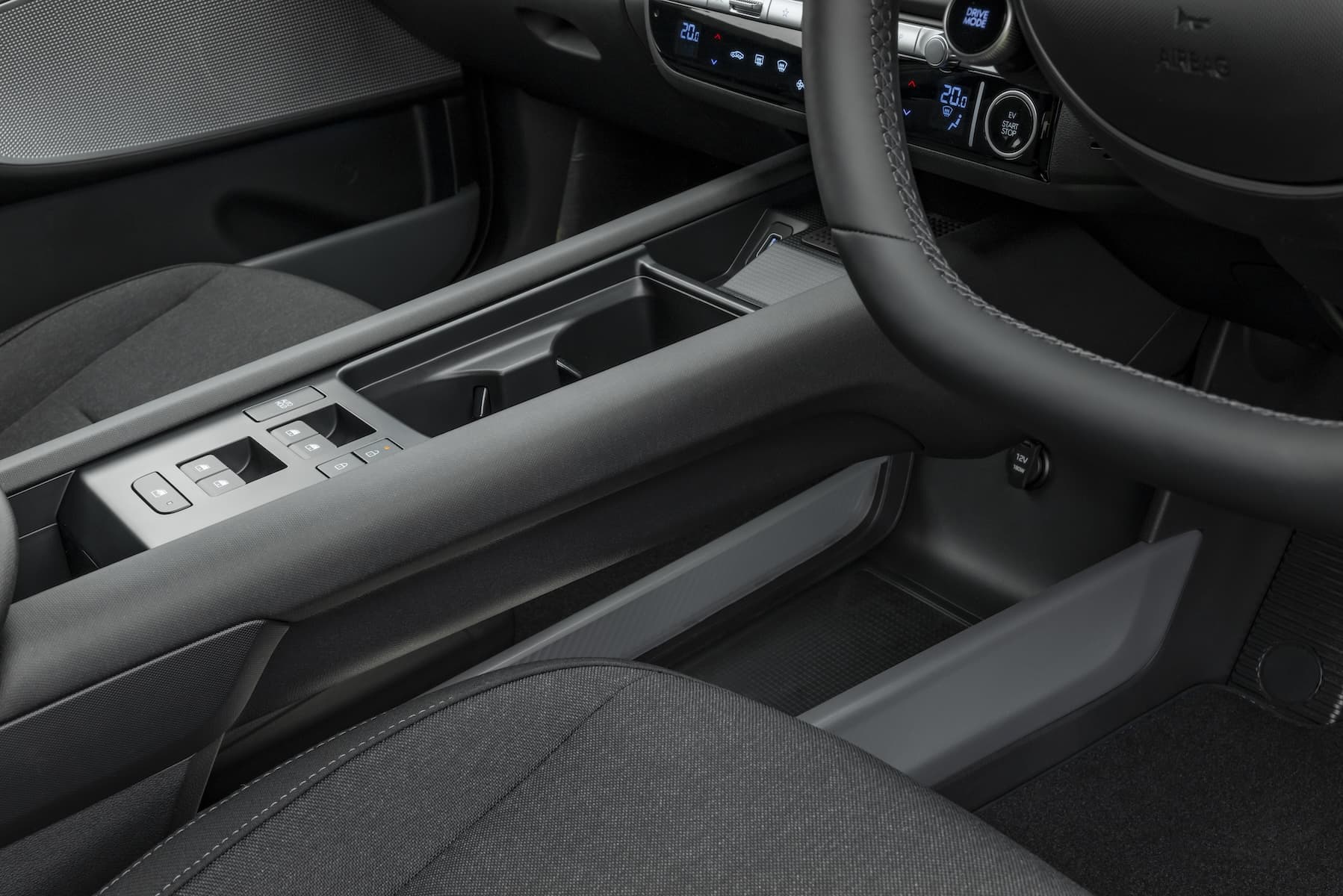
There is a high centre console between the driver and passenger, whereas the Ioniq 5 has a movable unit that keeps space more open. This appears to be a design choice to emphasise the low-slung feel of the Ioniq 6; whether you like it or not is a personal preference. There’s a big open storage space beneath it for a bag or similar.
Unfortunately, Hyundai doesn’t seem to have used the centre console space very effectively. A large chunk of space is devoted to power window switches and door locks, usually located far more conveniently on the driver’s door. This space would be far better devoted to a controller for the central touchscreen (as BMW does) and/or seat heating controls and/or the drive selector (which is on the steering column).
The dashboard is dominated by a pair of 12-inch wide screens mounted side by side, just like the Ioniq 5. The driver’s screen replaces traditional gauges, while the central screen is a touchscreen for controlling almost all the car’s functions. There’s also a row of buttons for key functions under the screen (although no overall ‘home’ button, annoyingly), and dedicated air-conditioning controls.
The central touchscreen is clear and easy to read, although all the usual caveats about trying to operate touchscreens on the move apply here as they do in any car – it’s simply not as easy or safe as physical buttons. Annoyingly, controls for front seat heating/ventilation and steering wheel heating are located within the touchscreen so they’re a pain to operate on the move. Meanwhile, rear passengers get proper buttons for their heated seats, which is MUCH BETTER. Hyundai, this is poor. Do better.
Apple CarPlay and Android Auto are both standard, although in wired form only so your phone has to be plugged into a USB port in the centre console at all times. The ports are only USB-A as well, rather than the newer USB-C. There’s a wireless charging pad on the centre console, which is pointless if you have to have your phone plugged in anyway, and your phone will also slide off when you get to the first corner. An expected 2025 facelift is likely to address these points, as they have on the Ioniq 5.
The driver’s screen is generally good, although some of the screen is blocked by the steering wheel. The fonts and icons also need to be bigger, as they can be difficult to read. We’d prefer to see less information and larger fonts – Most car manufacturers tend to do the same thing (presumably it looks good in the design studio, but it’s not always easy to read on the move). At least the key speed information is large and smack in the middle of the screen.
The seats are comfy and sofa-like, rather than heavily bolstered in the typical German fashion. We found them comfortable enough for a couple of hours, but seating is always a personal preference so you should test drive yourself before making any buying decision. We also wish the steering wheel had just a bit more reach adjustment so you could pull it out further. The glovebox is actually a large drawer, so you don’t have everything falling out when you open the lid like on other cars. Clever.
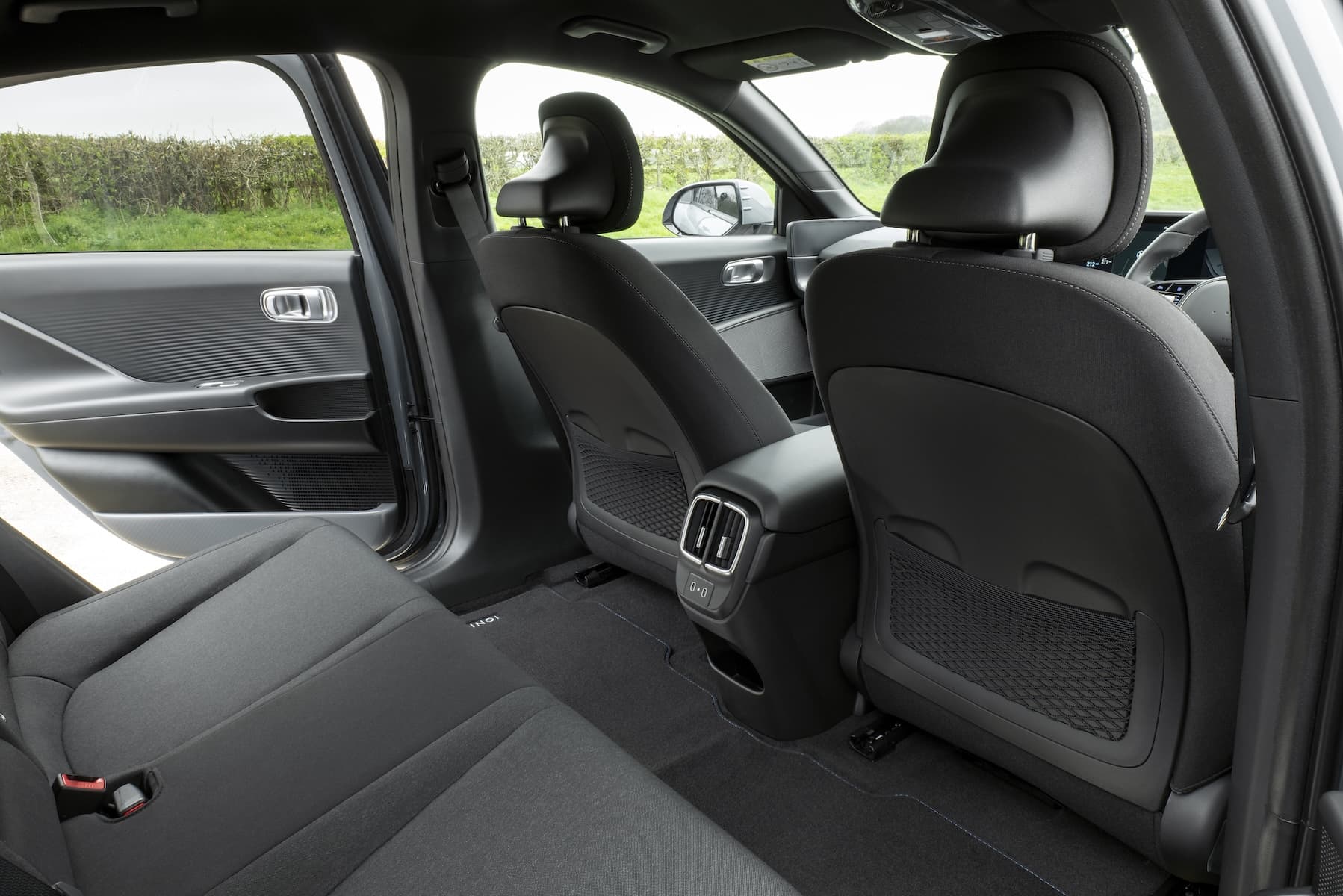
Rear-seat passengers will find plenty of legroom and no central tunnel for the middle passenger to straddle. The rear seats don’t slide like they do on the Ioniq 5, however. Rear headroom is good, and better than you’d expect from looking at the swoopy roofline from the outside.
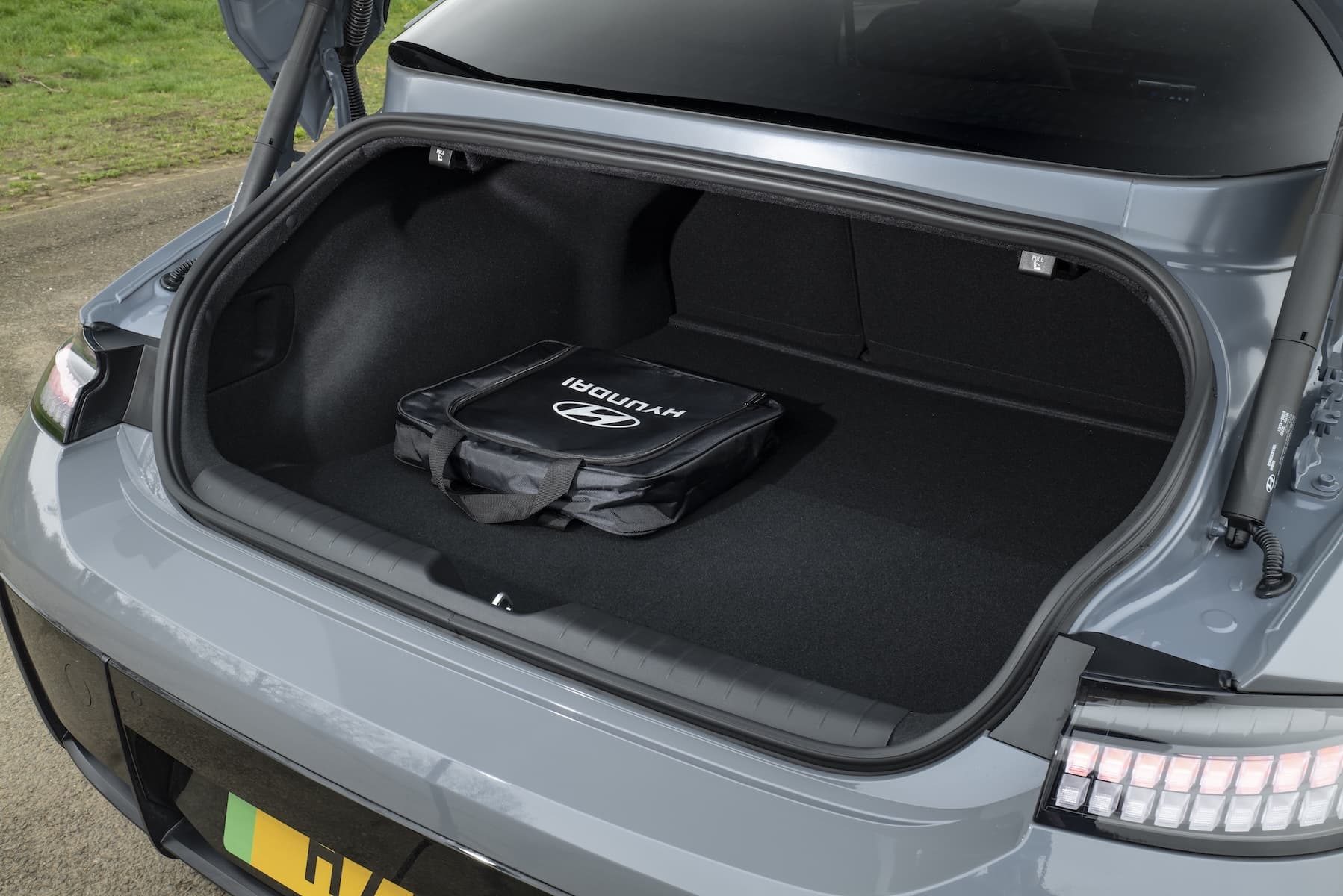
The bad news is further back, however. Boot space is a major drawback compared to other saloons, let alone liftback models. Hyundai claims a total of 401 litres, which is well off the pace for a car this size, and the opening is also small so you’ll almost certainly bang your head while trying to load your luggage (I did, more than a few times).
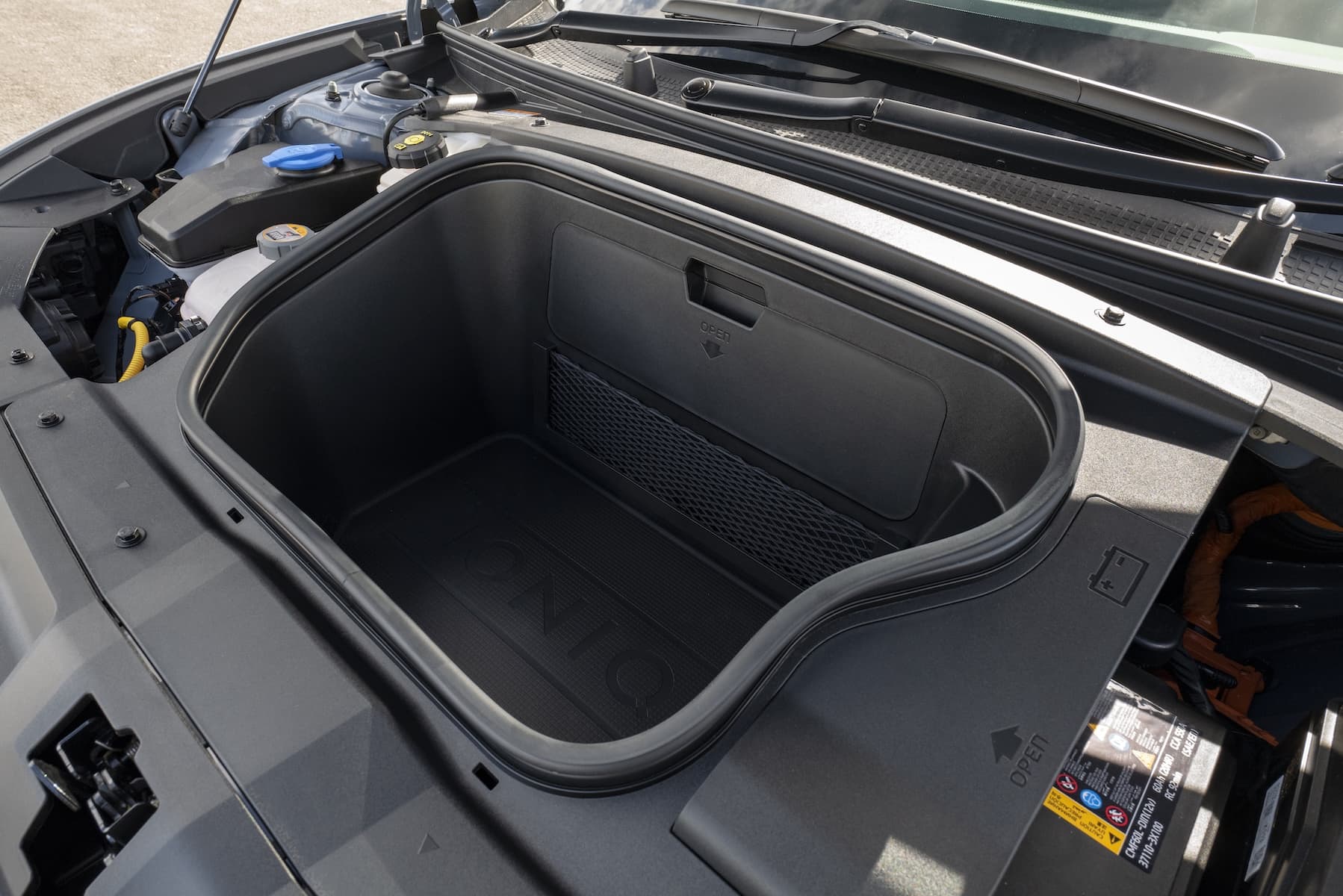
There’s a hidden tray under the boot floor as well as a small frunk (front trunk) for additional storage space, either of which are a good place to keep your charging cables but not much more. The rear-wheel-drive models have more frunk space than all-wheel-drive models (45 litres vs. 14 litres) as they don’t have an electric motor under the bonnet.
Our Ultimate-spec car had optional digital wing cameras instead of traditional mirrors. Based on this model, these seem like a solution to a problem that didn’t really exist. You still have chunky and ugly cameras mounted where the mirrors would be, with a couple of screens inside the cabin. They are supposed to be better in low-visibility situations, but we didn’t really notice any great benefit and they had less range of adjustment than conventional mirrors. In our week with the car, we didn’t find this to be worth £1,000 extra and would prefer ordinary mirrors.
We like: Plenty of space in well-laid out interior, some clever design touches We don’t like: Centre console not well utilised, boot space and access poor
What’s the Hyundai Ioniq 6 like to drive?
Like most Hyundai models, the Ioniq 6 is configured for comfort rather than handling, which is likely to be just fine for most families.
The Ioniq 6 is a heavy car, thanks to the battery pack, but this is placed along the bottom of the car so it keeps the centre of gravity low, helping to reduce body roll when cornering. However, the combination of this weight and large 20-inch wheels makes the ride feel a bit lumpy over potholes or speed humps. To be fair, that’s also the case on most executive saloons with ‘sports packs’ or large alloy wheels. A back-to-back comparison with our usual family car, a Volvo V60 estate with R-Design sports suspension and 19-inch wheels, saw the Hyundai feeling more comfortable for both front and rear occupants.
Assuming that you’re happy to keep your driving within the confines of the speed limits on any given road, the Ioniq 6 is a very comfortable car to drive. There are three driving modes – eco (which is default on start-up), normal and sport – plus a snow mode if it gets icy.
Acceleration will depend on which model you’re driving. The 228hp motor we had will be more than adequate for most people, while the 325hp twin-motor set-up with all-wheel drive offers stronger performance in every situation plus better grip in wintry conditions.
We found the 228hp model offered plenty of performance, even with four people aboard. Being an EV, you get immediate response rather than waiting for an engine to rev up to its preferred powerband, so low-down acceleration is better than petrol cars with higher power outputs. This is less pronounced at higher speeds, so you won’t find it quite as sharp when overtaking at motorway speeds. If you do a lot of motorway driving, the 325hp version is probably worth the extra money. For urban driving, the 228hp version is perfectly fine.
We spent most of the week in eco mode, which requires pressing harder on the accelerator to get a response but is good for normal day-to-day driving. Sport mode, on the other hand, felt mostly unnecessary. We did try it for a bit, but it didn’t really offer any great improvement over normal mode.
Regardless of driving mode, the Ioniq 6 is smooth and whisper-quiet at all speeds. It’s a genuinely lovely place to spend time, with both front and rear passengers comfortable on longer journeys. The steering is light but direct, although lacking in feel as most new cars are.
Hyundai and Kia’s EV models all seem to manage braking better than other manufacturers. In lighter braking applications, an EV doesn’t actually use the brake pads to slow down – the electric motor does that instead. This is used to generate electricity to eke out a few more miles of battery range (and reduces brake pad wear significantly), but on some EVs it makes the brakes feel a bit unnatural when you stand harder on the pedal and the brake pads are called in to slow the car more rapidly. Pleasingly, the Ioniq 6 doesn’t suffer from this at all, so the brakes feel perfectly normal in all the situations we found over the course of a week’s driving.
The biggest problem we found over a few hundred miles was endless beeping and bonging from the car’s safety systems. This isn’t Hyundai’s fault, though. The EU has mandated that all new cars must have electronic nannies that make annoying warning noises every time the speed limit changes, or if you go just 1mph over the speed limit, or if it thinks you’re not looking straight ahead at all times, or a million other regular scenarios. It’s stupid and it does nothing to improve safety. You can switch the warning bongs off, but they will reactivate every time you start the car (again, by EU law). The first manufacturer that codes up a proper and permanent switch-off function for this will earn endless praise from us (and from you, after half an hour of driving any new car…)
We like: Comfortable ride in most situations, whisper-quiet at all speeds We don’t like: Sport mode is largely irrelevant, EU-mandated beeps and bongs are seriously annoying
How safe is the Hyundai Ioniq 6?
Other than the endless bonging, it’s all good news on the safety front. Euro NCAP tested the Ioniq 6 in 2022 and awarded it a five-star rating with some excellent scores in most tests. It also awarded the Ioniq 6 its ‘Best Large Family Car’ accolade for 2023.
It scored well in all the crash tests, with good protection for both adults and children in the event of a collision. There are ISOFIX child seat mounting points in both outer rear seats, but not in the middle or in the front passenger seat.
In terms of avoiding an accident in the first place, the Ioniq 5 also performs well. Although autonomous emergency braking (AEB) systems are now compulsory on all new cars in Europe, the level of performance varies. The Hyundai scored well in all of these tests.
Accident avoidance systems like advanced cruise control and lane-keeping assist are standard on all models, although blind-spot warning is only available on the Ultimate models. The systems all work well, without trying to pull the car in different directions like you get on some other vehicles.
Hyundai Ioniq 6 economy, battery range and charging
The Car Expert’s unique Expert Rating Index pulls running cost data from across the entire new car market, and the Ioniq 6 performs very well here, scoring an A-grade from us overall.
One of the most important factors for an EV is its electrical efficiency – the equivalent of fuel economy for a petrol or diesel car. The Ioniq 6 scores a B-grade here, which is good for this size car. The lower-performance, rear-wheel drive models are better as they use less electricity, so you get a few more miles from every charge.
Official driving range figures are 338 miles on a full battery for the rear-wheel drive cars, and 322 miles for the all-wheel drive models. Given the extra performance on offer, this is not really much of a penalty.
Standard on all models is a battery heating system with pre-conditioning and heat pump, which provides better battery efficiency in all temperatures and helps to heat the cabin without excessively taxing the battery.
When you want to charge up, the news is good. With a maximum 350kW charging rate, the Ioniq 6 can support the fastest chargers currently available in the UK. That means you can potentially charge your battery from 10% to 80% capacity in less than 20 minutes. However, these chargers are currently rare and are more expensive to use than other chargers, so it’s not a big deal at the moment. But once more of them start rolling out, this will become a more useful advantage over many other EVs.
If you’re using a 50kW charger, which is a far more common speed for public chargers, you’re looking at about 1hr 15mins to get a similar 10% to 80% charge. On any EV, charging speeds slow down after 80% to protect the battery, so it’s not usually worth keeping the car charging beyond this point unless you really need the extra charge.
On an 11kW charger, as you get with a home wallbox or in many workplaces, a full charge (0% to 100%) takes just over seven hours. So you can comfortably charge the car overnight, especially as you’re never likely to be at 0% as a starting point.
The charging flap is located on the right-rear corner of the car, so you’ll probably need to reverse into most public charging bays to connect the cable. The Ioniq 6 comes with a 5.0-metre Type 2 cable for wallbox or fast chargers, but there’s no Type 3 cable for plugging into a regular three-point plug. Fewer EV manufacturers are now offering this, which is disappointing but unsurprising as it would take more than a day to charge the battery with one of these cables…
Verdict
If you prefer a saloon body style to the ubiquitous crossovers on offer from every manufacturer, the Hyundai Ioniq 6 is a very good car. It’s no surprise that it’s one of the highest-rated cars in our Expert Rating Index, with straight-A grades in every category – although it’s still too new to have any meaningful reliability data.
The new car warranty on the Ioniq 6 is also good, covering you for five years with unlimited miles. The battery is covered for eight years, although with a 100,000-mile limit. This is one area where Hyundai trails its Kia subsidiary, which comes with a seven-year new car warranty on all its models.
The Ioniq 6 is whisper-quiet, smooth and relaxing to drive at all speeds. The styling is certainly divisive, although it does grow on you. We’re still not convinced about the rear end, especially with its practical shortcomings. Given the sloping shape, a liftback tailgate surely would have been better than a saloon bootlid.
The technical stuff is all good and everything works as it should, so if you’re making the jump from petrol to electric power then your learning curve should be relatively short. The 350kW charging capability makes it pretty much future-proof, too, as you’ll be able to take advantage of the ever-growing number of ultra-rapid charging points across the UK.
The biggest challenge for the Ioniq 6 is whether you’d choose it over the also-excellent Ioniq 5. Technically, they’re basically identical, although the Ioniq 5 has more choices in terms of trims, motors and batteries. That’s not as important as it sounds, as the Ioniq 6 has all the best bits (bigger battery, all the right standard equipment) you’d want anyway.
Based on official pricing, the Ioniq 6 is more expensive than the Ioniq 5 in Premium spec, but slightly cheaper in Ultimate spec. That’s due to various trim differences, plus the fact that the Ioniq 5 has just been updated. The Ioniq 6 is likely to get a similar mid-life refresh in 2025, which may see trims and prices juggled a bit. But prices are likely to fluctuate depending on offers available at any given time, so keep an eye on offers for both new and near-new cars if you’re shopping around.
The Ioniq 6 feels more luxurious and special, although that’s more of a perception than a reality. The lower seating position and sleek profile are plus points, in our opinion at least, which also help it to go further on its battery than the taller and squarer Ioniq 5. It’s also less common on the roads than the 5 – another plus point for many potential customers.
However, that sleek styling affects the car’s practicality. The Ioniq 5’s bigger boot and more practical cabin are the two most obvious points in its favour as a family car, especially for road trips with four or five people and lots of luggage. We’d say the Ioniq 5 is a better family car, whereas the Ioniq 6 is nicer if you’re less fussed about maximum practicality.
Model tested: Hyundai Ioniq 6 Ultimate Price (as tested): £52,235 (including £700 for premium paint and £995 for digital side mirrors) Engine: Single electric motor, rear-wheel drive Gearbox: single-speed automatic
Power: 168 kW / 228 hp Torque: 350 Nm Top speed: 115 mph 0-60 mph: 7.4 seconds
Electric range: 338 miles CO2 emissions: 0 g/km Euro NCAP safety rating: Five stars (November 2022) TCE Expert Rating:A (82%) as of December 2024
Buy a Hyundai Ioniq 6
If you’re looking to buy a new or used Hyundai Ioniq 6, The Car Expert’s partners can help you find the right car
Search less, live more. We make finding the right car simple. Find out more
Search for your next new or used car with Auto Trader. Find out more
Discover great deals available on both new and used cars. Find out more
Lease a Hyundai Ioniq 6
If you’re looking to lease a new Hyundai Ioniq 6, The Car Expert’s partners can help you find a competitive deal
Personal contract hire deals from Carparison Leasing. Find out more
Personal contract hire deals from Leasing.com. Find out more
Personal contract hire deals from Rivervale Leasing. Find out more
Subscribe to a Hyundai Ioniq 6
Subscriptions are becoming a very popular way for consumers to try an electric car for a few weeks or months to help decide whether it’s a suitable alternative to a petrol car. If you’re interested in a car subscription, The Car Expert’s partners can help. (PS: What’s a car subscription?)
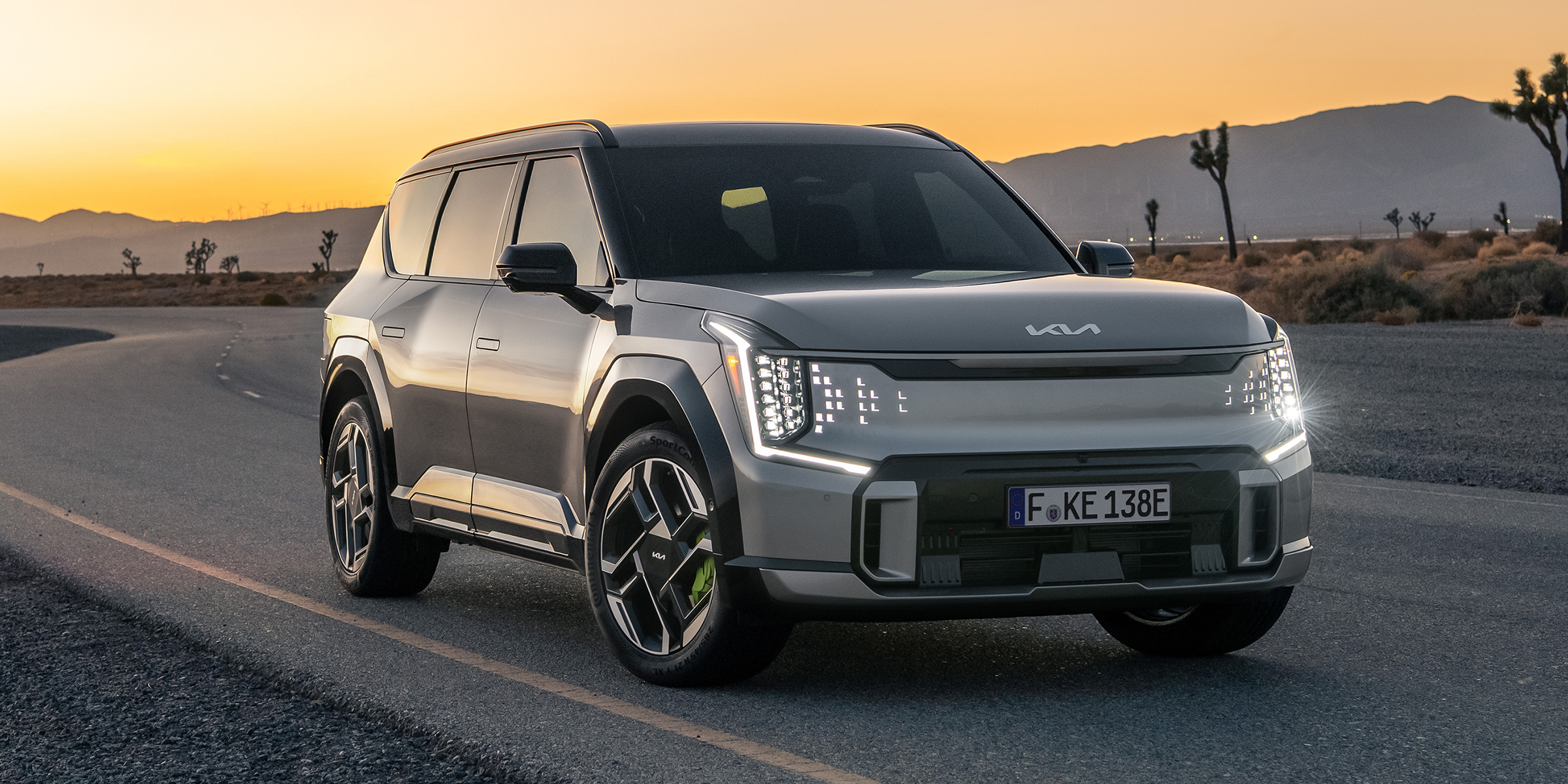
Kia has announced that a sporty version of its large flagship electric EV9 will go on sale in the UK in 2025, which is the most powerful SUV the marque has produced to date.
Structurally identical to the standard EV9 – which has recently been awarded The Car Expert’s ‘Best Premium Large Car‘ award for 2025 – the EV9 GT comes with several performance and driving dynamics improvements, as well as some unique cosmetic design changes inside and out.
Starting with performance, the EV9 GT is an all-wheel drive electric car, with an electric motor on both the front and rear axle that together provide a power output of 508hp – that’s 135hp than the previous range-topper, the EV9 GT-Line S. This power boost means that the large SUV, which weighs over 2,600kg, can complete a 0-62mph sprint in a reported 4.6 seconds.
Kia has also given the GT electronically-controlled suspension (ECS) tech to improve ride comfort, which works in tandem with a ‘road preview’ camera system that detects potholes on the road ahead, which then adjusts the suspension’s shock absorbers to reduce any rough terrain impact.
An electronic limited slip differential limits wheelspin in tight corners to increase stability on high-speed bends, and the SUV also comes with a faux gear shifting feature, where the driver can shift through simulated gears using paddles fitted on the steering wheel column.
The car is powered by a large 100kWh battery pack that provides “more than” 280 miles of charge on a single range. Using a DC fast charge, this battery can be topped up from 10% to 80% charge in a reported 24 minutes. The SUV also comes with vehicle-to-load (V2L) compatibility, allowing the owner to charge external devices like laptops, kettles and even other cars, and the SUV can tow braked weights of up to 2,500kg.
Kia has also given the GT model some minor exterior design tweaks so that the SUV “turn heads everywhere it goes”, including a unique 21-inch alloy wheel design with larger neon green brake callipers and an alternate chevron-shaped daytime running light signature that stretches further across the front fascia.
Neon green also features on light-up inserts on the dashboard, door panels and centre console inside. The sports seats are trimmed in Alcantara leather with other faux leather and suede trimmings also featuring across the cabin.
Like the standard EV9, the GT comes in a seven-seat configuration and the car’s infotainment system is wirelessly compatible with both Apple CarPlay and Android Auto.
That sums up what we know about the new Kia EV9 GT so far. More details, including UK pricing and specifications, will follow in the coming months.
Honda has announced that its petrol-electric hybrid Prelude coupé will be sold across Europe from the first half of 2026 – a car with an automatic gearbox and simulated gear shifting.
A successor to the two-door Prelude sports car that was retired at the turn of the century, we don’t have much information on the new coupé just yet, but it is likely that it will have a front-engined powertrain with similar engine tech to the Civic ‘e:HEV’ petrol-electric hybrid.
A new gearbox will also be introduced for the coupé that Honda calls ‘S+ Shift’. The manufacturer says that it will “simulate the sound and feel of quick automatic gear change.” We will learn more about the new Prelude next year as we get closer to the car’s arrival in 2026.
The all-electric BYD Sealion 7 has now arrived in the UK, with two battery choices across three trim levels available to order.
The Sealion 7 bolsters BYD’s UK range as its largest offering, and has joined a whole host of brand-new electric coupé-SUVs – including the Cupra Tavascan, Ford Capri, Audi Q6 e-tron Sportback and the new Peugeot E-3008 – vying to challenge the sales of established best-sellers like the Tesla Model Y.
The family car is available with the choice of three trims with different powertrain configurations. The first is the ‘Comfort’, which pairs a 308hp electric motor with an 83kWh battery pack, providing a reported battery range of 300 miles and a 0-62mph sprint time of 6.7 seconds.
The mid-range choice is the ‘Design AWD’ – which makes use of the same 83kWh battery but with an additional electric motor that increases power output to 522hp and drops the car’s 0-62mph sprint time to 4.5 seconds. The faster pace is at the expense of battery range, which is a slightly reduced 283 miles.
The range-topper is the ‘Excellence AWD’ variant, which makes use of a larger 91kWh battery. It’s just as quick as the ‘Design AWD’ but can reportedly travel up to 312 miles on a single charge.
A new ‘Intelligent Torque Adaption Control’ system has also been developed for the SUV. BYD says this is available with the dual-motor, all-wheel-drive models and will distribute torque between the front and back wheels to minimise skidding and improve safety. The Chinese manufacturer adds that the suspension is “tailored for excellent handling” and “secure vehicle control”.
Key trim level features
Lead-in ‘Comfort’ (from £44,990)
Heated seats
Dual-zone climate control
Ten-inch digital instrument cluster
16-inch rotatable infotainment screen
Wireless smartphone charging pad
Vehicle-to-load (V2L) capability for powering household devices
Adaptive cruise control
Blind spot monitoring
Mid-range ‘Design’ (from £49,290)
All ‘Comfort’ features that are not replaced
20-inch alloy wheels
Top-spec ‘Excellence’ (from £57,290)
All lower trim features that are not replaced
Nappa leather seats
Head-up display
Inside, the Sealion 7 has a similar interior layout to that of BYD’s Seal U SUV, with a larger 15-inch infotainment screen floating above the nautically-themed dashboard, alongside a ten-inch digital instrument cluster behind the newly-designed steering wheel.
Pricing for the Sealion 7 now starts at just under £45k, rising to £57k for the top-spec ‘Excellence’ model. The first customer orders are scheduled to arrive in Spring next year.
Citroën’s upmarket spin-off marque DS Automobiles has unveiled its new flagship electric executive coupé-SUV – the No 8 – which is set to go on sale in the UK in the middle of next year.
This electric newcomer marks a new model naming strategy for DS – this isn’t the DS 8, but the DS ‘No 8’ – and is the French brand’s answer to premium family cars like the Audi Q6 e-tron, BMW i4, Polestar 4 and Tesla Model Y, the latter being the best selling electric car in the UK right now.
DS says that the car is designed to provide its owner with “absolute” driving comfort, and while the car’s “elegantly sleek” exterior looks more resemble a saloon, the manufacturer describes the No 8 as a coupé-SUV. It sits on large 19-, 20- or 21-inch alloy wheels, and the aerodynamic sloping rear roofline has been designed to provide around eight extra miles of all-electric battery charge at motorway speeds.
The new range will include three different powertrain choices – an entry-level 230hp 74kWh that can complete a 0-62mph sprint in 7.8 seconds, and 92kWh front-wheel drive and all-wheel drive ‘Long Range’ variants that produce 245hp and 350hp respectively.
While we don’t have the full spec sheet confirmed just yet, DS has announced that the front-wheel drive long range can muster up to 466 miles on a single charge (355 miles for the standard model), and that the all-wheel drive ‘Long Range’ can reach 62mph in 5.4 seconds. Speed is electronically capped at 118mph for all models.
That battery range makes the No 8 a class-leader – it’s 80 miles more than any version of the Polestar 4 or Tesla Model Y can provide on a single charge. The DS No 8 also recorded an electrical efficiency (the electric car equivalent of miles per gallon) of 4.8mi/kWh, which makes it one of the most efficient cars of its size.
Stepping inside, the coupé-SUV comes with a ten-inch digital instrument cluster and 16-inch central infotainment touchscreen on the dashboard, as well as a 14-speaker audio system. The boot can hold 620 litres of luggage, and the car can also tow up to 1,600kg of braked weight, which is a fair amount for an electric car.
That just about sums up what we know about the DS no 8 so far. More details, including the UK pricing and trim specifications list, are sure to be announced in the coming months.
Toyota has unveiled its second electric car for the UK market – the Urban Cruiser – which is set to arrive in British showrooms in the second half of next year.
The Urban Cruiser is essentially a slightly bigger battery-powered alternative to the Japanese brand’s Yaris Cross, and is structurally identical to the recently announced Suzuki e-Vitara.
Alongside the electric bZ4X SUV, it could turn out to be a very important model for Toyota as the manufacturer looks to meet the UK government’s rising EV mandate targets – 28% of a brand’s new car sales have to be all-electric models to avoid fines next year.
We don’t have all of the car’s technical specs so far, but we do know that the model line-up will include two powertrain options – an entry-level 144hp 49kWh unit or a 174hp 61kWh battery – and the latter is also available in a range-topping all-wheel drive configuration that ups the power output to 184hp.
That said, Toyota says the choice to opt for an all-wheel drive model will be “according to market”, so it’s not confirmed if this top-spec version will be offered in the UK.
Toyota is also yet to announce the trim specs for the compact crossover, but the display model pictured has a 10-inch digital instrument cluster and ten-inch infotainment screen pairing mounted on the dashboard, as well as a surround-view parking camera, JBL premium audio system and a fixed sunroof, which are presumably reserved for higher trim levels.
The manufacturer says that the Urban Cruiser will come with a “comprehensive package” of safety systems as standard, including adaptive cruise control and lane keeping assistance.
That sums up what we know about the Toyota Urban Cruiser so far. We will learn more in mid-January when the crossover gets its official debut at the Brussels motor show. Check back soon for more details, including the car’s UK price list.
From pint-sized city cars to large flagship SUVs, this year has seen a whole host of new arrivals on the UK automotive market all vying for your attention.
The new Dacia Spring and Citroën ë-C3 have lowered the entry-level pricing of electric cars, the battery-powered performance car category has expanded with the arrival of the Hyundai Ioniq 5 N and MG Cyberster, and this year has marked the launch of several last-of-their-kind petrol cars, like the new Suzuki Swift, Dacia Duster, MG ZS and Skoda Superb to name just a few.
That said, if none of these new cars have properly piqued your interest, here are a dozen upcoming new cars on the way in 2025.
One of ten new electric cars that Volkswagen plans to launch in Europe by 2026, the compact ID.2 hatchback is the electric successor to the petrol-powered Volkswagen Polo.
So far, Volkswagen has shown off its concept for the small EV – called the ID.2all – with the actual production car set to be unveiled sometime next year and go on sale a few months after that. It will become the cheapest all-electric Volkswagen model when it arrives, sitting below the Golf-sized ID.3 in the German brand’s electric range.
The Cupra Raval is the ID.2’s sister model – another small EV that will compete for sales in the budget end of the market.
Recently spotted in testing, it shares a lot of sporty design cues with the 2023 Cupra UrbanRebel concept car, and will be cheaper and smaller than the ID.3-based Born hatchback. Cupra has also announced that we can expect the car to deliver up to 273 miles of travel on a single charge, which is more than the new Mini Cooper Electric and Renault 5 E-Tech can muster.
You may have heard about the new Renault 5 E-Tech which is now available to order, but what about the slightly bigger 4 E-Tech?
Set to rival the likes of the Mini Aceman and Kia EV3, the battery-powered 4 E-Tech will have a maximum battery range of 186 or 250 miles, depending on the model you choose. Renault hopes that the car’s eye-catching retro-futuristic exterior looks and competitive pricing will stand out to buyers in the UK.
Now available to order with first deliveries in 2025
Ford has remained tight-lipped about its all-electric version of the best-selling Puma crossover – that was until the manufacturer announced this month that the Puma Gen-E is now available to order, the first customer deliveries arriving early next year.
With pricing starting at £30k, the crossover can muster up to 234 miles on a single charge and offers more rear boot space than the petrol-powered Puma, thanks to a larger underfloor storage compartment.
The Alpine A290 is a sportier high-performance version of the Renault 5 E-Tech, and following its official debut at the 24 Hours of Le Mans in France earlier this year, UK reviewers are already praising the hot hatch for its fun and engaging driving experience.
Though we don’t have the car’s UK pricing just yet, Alpine says that the top-spec 220hp A290 ‘GTS’ will be able to complete a 0-62mph sprint in 6.4 seconds, with a reported battery range of 226 miles.
Another new car recently spotted in testing, the mid-sized all-electric Jeep Recon SUV is set to go on sale in the UK next year, and we could potentially see a hybrid version arrive soon after.
We don’t know much about the Recon at the moment, including what the production car will look like compared to the 2023 concept shown here, but Jeep has said that the SUV has been designed with off-road ability as a key focus, and that we can expect the SUV to provide 373 miles of travel on a single charge.
Already on sale in China and in other parts of the world, the electric EV5 is the smaller sibling of Kia’s flagship EV9 SUV. We haven’t heard much about the EV5 since late 2023, but we expect the SUV to arrive in UK showrooms in late 2025.
Back in 2023, Kia explained that two different powertrain options will be available in the UK at launch – a ‘Standard’ and ‘Long Range’ model – and that customers will be able to “transform” the rear cabin into a “bedroom” with a second-row “camping” seat that can fold flat.
The first of BMW’s electric ‘Neue Klasse’ models to go on sale in the UK, the next-generation iX3 SUV is anticipated to arrive in the second half of next year, introducing a radical exterior styling update and more advanced battery tech that will improve the SUV’s range and charging times.
In fact, BMW says that it will take less than 12 minutes to add 200 miles to the battery charge using a 270kW charger – as long as you’re using a charging station capable of delivering that rate of charge.
We have covered plenty of electric cars so far, but what about petrol power? New petrol car launches will be few and far between next year, the most notable being the large Dacia Bigster.
The family-friendly SUV is essentially a bigger version of the new Dacia Duster that arrived this year, with more rear head and legroom, as well as a bigger boot. The range will include front-wheel drive and all-wheel drive straight petrol models, as well as a range-topping petrol-electric hybrid.
The eagerly-awaited Range Rover Electric will be arriving in British dealerships sometime next year, Land Rover recently sharing images of the upmarket SUV undergoing testing in the extreme heat of a desert in the United Arab Emirates.
The flagship EV’s exterior looks nearly identical to the ICE-powered version that arrived in the UK in 2022, but Land Rover is testing a new torque management system that reportedly improves off-road traction control and has hinted that the EV will offer performance “comparable” to the V8-powered Range Rover.
Hyundai’s answer to Kia’s large EV9 SUV, the recently-unveiled Ioniq 9 is scheduled to arrive in the UK in the second half of next year.
Designed for buyers looking for an “expansive cabin and grand proportions”, the SUV has a longer wheelbase than any current Hyundai model, including the Santa Fe hybrid, and its 110kW battery is said to deliver up to 385 miles on a single charge. A ‘Performance’ model will also be available, which can complete a 0-62mph sprint in 5.2 seconds.
Rounding out our dozen picks, the Volkswagen Tayron is essentially the successor to the now-retired Tiguan Allspace. It’s expected to arrive in the UK early next year, with both five- and seven-seat configurations available.
The new range will include petrol, diesel and plug-in hybrid options, with the latter able to muster up to 60 miles on only electric power. The SUV’s stand-out feature is its huge 850-litre boot – which is over 200 litres more than the equivalent seven-seat Hyundai Santa Fe can handle.
The dozen models listed above don’t cover all of the new cars scheduled for 2025 arrivals in the UK – far from it. Here are a few other notable mentions to keep an eye out for.
The increasingly crowded budget electric car market will soon be bolstered by the new Fiat Grande Panda and Hyundai Inster, while a new Renault Clio hatchback was spotted undergoing testing last month, which will still be petrol-powered moving into its sixth generation.
In addition to the Recon, Jeep has another electric SUV in the works called the Wagoneer S, which is reportedly the quickest model the manufacturer has ever made. In addition to the EV5 SUV, Kia is also putting the final touches to its electric EV4 hatchback and saloon, which will debut ahead of the EV5 in 2025.
Vauxhall has revived its Frontera nameplate for a new hybrid and all-electric model range that is expected to arrive imminently, while Nissan is working on the replacement for the Sunderland-built Leaf EV – although we may not see that on UK streets next year. Meanwhile, Suzuki has been hard at work developing its first electric car, the e-Vitara SUV.
Chinese car brands will continue to build their presence in the UK, as the world’s largest car-producing country continues its global conquest. Stellantis-backed Leapmotor will launch its B10 crossover in the UK in the coming months, while BYD will have its new Sealion 7 SUV on roads very soon. Smart will be launching its third and largest EV – the Smart #5 (pronounced “Hashtag Five”) – early next year, too, while Omoda is expected to launch its new Omoda 9 large SUV and a hybrid version of the existing Omoda 5. Budget brand Skywell will also be rolling out very soon with its BE11 SUV.
We expect a new-generation Mercedes-Benz CLA saloon next year, available as either a hybrid or full EV, as well as the all-new electric Volvo ES90 saloon. Audi will be rolling out its new A6 e-tron and Q5 SUV models, and we’re likely to see a new A7 (to replace the current petrol and diesel A6 models) and maybe an A4 e-tron as well.
For performance car fans, Abarth will have its electric 600e – a high-performance version of the Fiat model of the same name. The Hyundai Ioniq 6 N is also set to make a splash in the battery-powered performance car category, while for petrol car enthusiasts, BMW is expected to launch a more powerful ‘CS’ version of its BMW M2 coupé.
Last but certainly not least, Ferrari is expected to reveal its first all-electric model – a watershed moment in the move from fossil fuels to electric power for the car industry.
Rather look for a new car now rather than later? Our Expert Rating index compiles and aggregates tens of millions of key data points on every new car, including more than 16,000 new car reviews from 35 of the UK’s top motoring websites, so you can be confident in your next motoring purchase.
Volkswagen has announced that its compact T-Cross crossover and new Tiguan SUV are now available to order in a new range-topping ‘Black Edition’ trim, which feature black exterior styling elements and a unique alloy wheel design.
Now sitting above the respective ‘R-Line’ trims in each model range, the ‘Black Edition’ models distinguish themselves from other trims by featuring wing mirrors, roof rails, air intakes and alloy wheels all finished in black, as well as expanded equipment lists.
The recently-refreshed T-Cross and third-generation Tiguan are the latest ICE-powered Volkswagen models to receive the ‘Black Edition’ treatment, following the Polo, Taigo, T-Roc, T-Roc R, Golf and Golf R ‘Black Edition’ versions that all arrived this year.
Starting with the smaller T-Cross ‘Black Edition’, the trim is available with either the 110hp 1.0-litre petrol with a manual or automatic gearbox, or the automatic 150hp 1.5-litre petrol unit. The car is specced with unique ‘York’ 18-inch alloys.
The Tiguan ‘Black Edition’ is available with either a 204hp 2.0-litre petrol engine or a more powerful 250hp 2.0-litre petrol unit, and the former has also been added to the ‘R-Line’ trim choices as part of this minor model range update. The 204hp and 272hp 1.5-litre plug-in hybrids included in the R-Line’ engine range are not offered.
The Tiguan iteration gets bigger 20-inch ‘York’ alloys and a driver assistance package, which includes Volkswagen’s lane-keeping assistance tech. Both ‘Black Edition’ models also come with more advanced Matrix LED headlights, LED rear tail lights with dynamic turn signals.
This additional trim is slightly more expensive in the T-Cross line-up than the formerly top-spec ‘R-Line’, costing just under £30k, while it is almost £6k more expensive in the Tiguan range, as the Tiguan ‘Black Edition’ has launched with a list price of close to £47k.
The Volkswagen T-Cross currently holds a New Car Expert Rating of A, with a score of 72% in our Expert Rating Index, while the Tiguan holds a New Car Expert Rating of A with a score of 75%. Both models have been praised for their comfortable driving experience by the British motoring media, and criticised for their pricing which is generally a bit higher than their closest rivals.
It’s been a slow year for private new car sales in 2024, which are set to be the worst in 25 years – in other words, since the UK moved to its current twice-yearly number plate changes.
If you’re looking to buy a new car (especially an electric car) this is good news, as there are plenty of deals on offer. If you’re more interested in a petrol, diesel or hybrid car, there are deals to be had but it will very much depend on the car brand and the dealers. Some have got plenty of cars available to sell, while others are holding back at the moment until they can sell more EVs to hit government-mandated targets.
The used car market has been much stronger, with plenty of former new car buyers switching to near-new cars instead. Auto Trader reported the used market being up 4% in the third quarter of 2024 (the most recent data available). But again, there are plenty of bargains to be had if you’re prepared to keep an open mind rather than pursuing one particular car.
Sales staff are paid commissions and have targets to hit each month, quarter and year – and everyone needs to hit their annual targets. There’s a lot of frantic number-crunching going on right now, and plenty of dealerships and salespeople need to shift plenty of new and used cars by December 31.
The automotive retail industry runs on target-based economics. And as car manufacturers have been ramping up production, they’ve been leaning on their dealers to sell more and more cars. Dealers earn money or discounts from the manufacturers as a reward for hitting or exceeding those targets. This can be worth tens of thousands of pounds to a dealership, so it is in their interests to make sure they sell (and deliver) as many cars as possible before the calendar ticks over to January 1.
For everyone in the chain, failing to hit sales targets has serious financial consequences, so they are all ‘incentivised’ to hit those targets, usually by throwing money at customers in one way or another. Obviously the biggest incentives are going to be applied to the cars that the dealer can’t sell at full price, so there’s always a reason for any discount or freebies.
If you’re in the market and the car you’re interested in is available, you can take advantage of some great Christmas deals if you’re prepared to take delivery with full payment by the end of December. If it’s not registered by 31 December, it doesn’t count, so the offers won’t usually apply.
With pressure on struggling dealers to shift metal in the last couple of weeks of the year, salesmen’s bullshit levels will be going through the roof and business managers everywhere will be rehearsing their speeches about how you’ll barely even notice an extra £30 a month on this shiny new car…
“Got a great deal on the car, but all this wrapping paper cost me £500…”
New car Christmas bargains
For the manufacturers, new cars are what it’s all about. They’re far more interested in selling you a brand-new vehicle than one they built five years ago. So the biggest discounts and lowest interest rates will always be found on new cars – but not on every new car.
The best deals will always apply to models that haven’t been flying out the doors during the year or are due for replacement shortly, as manufacturers and dealers try to clear the decks for 2025 models to start rolling in. If you’re not hung up on getting a particular make and model, you may find that a rival brand is offering great deals on a similar sort of vehicle.
These deals usually revolve around deposit contributions and lower rates on their finance offers, and market analysis shows that both of these are far more lucrative than they were last year.
Conventional logic says that the best deals are always on vehicles available for delivery before 31 December, rather than forward orders that won’t arrive until January 2025 or later. Dealers have always prioritised taking your money now, rather than banking sales for the future, so they’d rather push you out the door in a car they have sitting on the showroom floor instead of ordering a car in for you that won’t arrive until later.
That’s still largely the case, but the ongoing shift from fossil fuels to electricity is making a mess of these conventions.
Petrol vs diesel vs hybrid vs electric – where are the best deals?
The market situation will vary from brand to brand, and often from dealer to dealer, but the best deals are likely to be on electric cars this Christmas. While some companies will certainly have deals on fossil-fuel models, they will be fewer and less generous.
Car manufacturers have tough new government-mandated sales targets to hit for EVs, and some car companies are struggling to hit those targets, which means they face big fines from the government (as in £15K per vehicle). That means they would really like to sell you a new EV between now and the end of the year, so there are great deals to be had across almost every car brand that sells both EVs and fossil-fuel cars. For EV-only brands like Tesla or Polestar, there are likely to be fewer deals around but it’s still a very competitive market.
For petrol and diesel cars, it’s the reverse. Deals for internal-combustion vehicles have been wound back this year as the focus shifts to EVs, so there are fewer offers on the table this Christmas. However, there are some brands that have already hit their EV sales targets and will be keen to shift any available petrol/diesel/hybrid cars they have available. Shop around and you may find some good deals, but they’re unlikely to be as attractive as the offers on new EVs.
Used car Christmas bargains
Used car pricing has been continuing to fall this year, as it was last year following two years of massively overinflated values. This is most noticeable in electric cars, which have fallen in value more quickly. That’s due to a combination of factors, but largely because there are simply a lot more second-hand EVs available now than there have been in previous years.
New EV sales have been growing rapidly since 2020, which means a lot more are now filtering through into the used car market. More supply always leads to falling prices, and falling new EV prices have also pushed down used EV prices, so it’s good news if you’re looking to buy a nearly-new used EV (up to three years old). Supply on older EVs (more than five years old) is still limited, so prices haven’t fallen as quickly.
When it comes to used petrol and diesel cars, relatively high interest rates for used car finance have largely offset falling prices, so your monthly payments may still be higher than for a similar age-and-mileage car from before Covid. Used car finance at dealerships is often not that competitive, so you should definitely get finance quotes from online lenders before you start your car hunting. If you’d like some suggestions, we’ve rounded up some of the UK’s best used car finance providers here:
As with new cars, dealers are looking to shift the stock they have on site before the end of the year, so you have to be ready to do business in order to get the best deals on offer. That means money all paid and/or finance all signed up and activated so that you are driving out in your car before 31 December.
If you have all your ducks lined up and are ready to buy, then you can save yourself some money on the advertised price, as well as maybe swing a better finance deal than is normally available. But choose your car carefully, as the market is still falling. If you don’t end up liking it very much, you could lose a lot of money if you want to sell it again in six months’ time…
Pre-registered cars
The EV mandate has meant that some car manufacturers have been registering new EVs to hit their target numbers even though they don’t have enough customers to sell them to. These are called self-registrations if they are used for head office duties, dealer demonstrators, service loan cars and so on, and are called pre-registered cars if they’re registered to the manufacturer or dealer with no specific use in mind, in order to count it as a ‘sale’ on the official records.
Once registered, these cars will sit in a “secure storage facility” (which is usually just a field somewhere) for at least 90 days, after which time they can be sold as used cars.
As a result, there are quite a lot of three-month-old electric cars with very low mileage on the market.
In pre-pandemic times, pre-registered cars could make up as many as 25% of new car registrations for certain brands, which was a crazy situation. This situation almost completely disappeared from 2020 onwards, but has reappeared this year as certain car manufacturers have struggled to sell enough EVs to meet their mandate requirements.
Out-of-season bargains
For years, conventional wisdom has said that the best time to buy a convertible is in winter, because demand is low since it’s freezing cold and raining/snowing/sleeting all the time. The reverse is supposedly true for 4WDs and SUVs, as demand is highest in winter when the roads are muddy and drivers get snowed in.
These ideas are still true to a certain extent, but nowhere near as much as they used to be.
Modern convertibles are perfectly comfortable with the roof up in winter, with few of the problems like leaking and terrible insulation that soft tops of yore used to have. Similarly, SUVs are popular all year round and are now the default type of car for most households.
There will always be more demand for convertibles in warm weather because people are impulsive buyers, but canny sellers will realise this and make sure they have plenty of stock available to match the demand.
So you may be able to snap a better deal on a convertible over Christmas, but not by a massive amount. Likewise, the world is not going to run out of 4x4s over winter, despite what that desperate-looking salesman keeps suggesting.
How to save money on buying a car this Christmas
The potential savings on the car you are looking at could vary wildly, but automotive retail always comes down to supply and demand. This Christmas will be more favourable to buyers than dealers, but only on certain vehicles. For others, holding out until next year could be a better bet.
Make sure you know what sort of car you want, as specifically as possible. Many people get distracted by a deal that sounds great – and ignore the fact that the deal on offer is for a car that is not remotely suitable for their needs. Regardless of what the dealer says, be clear in your own mind about what you want.
Never roll up to a dealership without doing your homework. Check the top used car marketplaces for the going prices for the sort of car you’re looking for, and get a quote for your current car. One of the benefits of still-high used car pricing is that your current car may be worth more than you think. Online car-buying services will often offer you considerably more for your car than a dealer will as a part exchange, so make sure you’re getting as much money for it as you can.
Have a good read of our ten golden rules for buying a car. These are valid all year round but are key when there are potentially confusing offers being thrown at you from dealers.
Finally, and most importantly, know your financial limits. Whether you are paying cash or financing the vehicle, don’t be tempted to blow your budget just because it sounds like a good deal. And with prices being higher then normal, that may mean lowering your expectations a bit this time around.
Be a clever car buyer and you could save a bundle; if you are not so clever, it could cost you a lot more later on than you could ever save up front. Merry Christmas, and happy car shopping!
Looking for a new or used car? Our partners can help
This is one of our most popular articles and is thoroughly updated each year. Originally published in December 2014, it was most recently re-written and updated in December 2024 to reflect the current market situations for both new and used cars.
The first Duster model was launched in 2010 but didn’t make its way to the UK until 2013. A second-generation model arrived in 2017, and another seven years later, a new third-generation Duster has gone on sale.
Thanks to competitive pricing and affordable entry points, Dacia models have become very popular in the UK, and the current lineup includes Duster, Jogger, and Sandero models. Recent additions to the range include the small electric car, the Dacia Spring, and the Bigster SUV, which will sit at the top of the line-up.
Until recently, the Duster was the only SUV-style vehicle in the Dacia range. It will soon be joined by a slightly larger model dubbed the Bigster, and if you’re looking for even more carrying capacity, Dacia offers its Jogger model with seven seats. The new generation of Duster is available with hybrid and bi-fuel powertrains.
In the small SUV segment, the Duster is up against the likes of the MG ZS, Jeep Renegade, SEAT Arona and Renault Captur. Since the range starts from just under £19K and rises to around £27K, it could also be compared to the Nissan Juke, Volkswagen T-Cross, Skoda Kamiq and Honda HR-V.
First impressions
Compared to the previous generation, the Duster has beefed up with more rugged SUV styling. It still features modular roof bars and uses the brand’s new YouClip accessory system, which allows you to add features like extra hooks, cupholders, lights or phone mounts throughout the car. The interior has been updated with ‘Y’-shaped accents on the doors and air vents with copper colours on the top-spec trim level.
Some of the roundness of the last generation has been replaced with a boxier design, while increased dimensions help to improve interior cabin space. The ‘Y’ details continue outside with the front and rear headlights. The wheel arches and black plastic trim details on the exterior apparently contain up to 20% recycled materials.
We like: Bolder styling and more room inside We don’t like: Three-star Euro NCAP safety rating
What do you get for your money?
Dacia likes to keep its range fairly simple, so there are four different trim levels to choose from: Essential, Expression, Extreme and Journey.
The entry-level Essential trim is only available with the bi-fuel petrol and LPG engine and comes with fixed roof bars, six airbags and rear parking sensors. Unlike the rest of the range, Essential uses your smartphone as the media screen in the car with a dedicated phone holder in the centre of the dash. This trim starts from £18,745.
Expression builds on the Essential package with 17-inch alloy wheels, a seven-inch driver’s display, ten-inch central touchscreen with Apple CarPlay and Android Auto and a reversing camera. This version can be had with two-wheel drive, four-wheel drive or with a full hybrid engine. Prices range from £21,245 to £24,245.
Journey trim features 18-inch alloy wheels, fog lights, automatic air conditioning, keyless entry, electronic parking brake, wireless phone charger, navigation and an upgraded sound system. With the two-wheel drive variant, Journey starts from £22,945 and rises to £25,945 for the hybrid version.
Extreme trim is available with the same engine options as Expression and Journey and adds 18-inch alloy wheels, modular roof bars, rubber floor and mats, navigation, YouClip 3-in-1 system, washable upholstery and copper accents throughout. Pricing for the top trim ranges from £23,745 to £26,745.
The safety rating is disappointing, which is unfortunately par for the course with Dacia. Full details further below.
The Dacia Duster range comes with a three-year, 60,000-mile warranty.
We like: Affordable trim options, even on top-spec models We don’t like: Short warranty period compared to rivals
What’s the Dacia Duster like inside?
The Duster’s interior has been given a much-needed makeover with a larger focus on technology and a more cohesive design with its ‘Y’ shaped air vents. The seven-inch driver’s display is accompanied by a central ten-inch touchscreen with Apple CarPlay and Android Auto. The infotainment system takes a few moments to change between menus so it’s easiest to find your preferred settings and leave it alone.
Below the screen, there’s a row of climate control buttons and a shelf for your phone. The upright gearstick feels like a nice upgrade on the automatic version. Elsewhere, there are a lot of plastic finishes, including the armrests on the doors.
There’s no fabric or cushioning on top of these armrests so it almost precludes you from perching your elbow on it for any length of time. The seats feel quite firm as well, so they’re not as comfortable as you might have hoped.
Depending on which powertrain you go for, the boot size can vary. The biggest boot is offered in the front-wheel drive manual version, followed by the bi-fuel, then four-wheel drive, and the hybrid engine has the smallest boot to make room for the battery. Leg and headroom in the rear is plentiful with kids and adults alike finding it spacious.
We like: Good boot size and shape We don’t like: Hard plastic armrests in the doors
What’s under the bonnet?
There are three engine options in the Duster range. The 100hp bi-fuel is the entry-level engine that can run on petrol and LPG. Paired with a six-speed manual gearbox, this is the least powerful choice of the three, with 100hp of power and 160Nm of torque. The bi-fuel’s braked towing capacity is rated at 1,200kg and its unbraked maximum 675kg.
The 130hp engine is available with either front-wheel drive or four-wheel drive, and comes with a six-speed manual gearbox. It has 130hp of power and 230Nm of torque. The front-wheel drive version is slightly quicker, with a 0 to 62mph time of ten seconds, a second quicker than the four-wheel drive model. The 130hp is the best option for caravanners with a braked towing capacity of 1,500kg. The two-wheel drive model gets an unbraked capacity of 685kg, while the all-wheel drive version can tow unbraked trailers up to 730kg.
The 140hp petrol/electric hybrid unit comes with an automatic transmission and is the most powerful of the bunch with 140hp. It’s also the most economical option, offering 55mpg and the lowest CO2 emissions figures. The hybrid version won’t be the best pick for those looking to tow heavy loads, but it can handle a respectable 750kg braked trailer and 725kg unbraked.
What’s the Dacia Duster like to drive?
The hybrid version offers a quieter, more relaxing experience than the petrol version, but both have less road noise than the MG ZS. The steering, clutch and gearstick feel light and easy to use, with the steering firming up as the car travels faster. Forward visibility is good, and the pillars down either side of the windscreen are easy to see around.
Just like Renault’s range, the Duster benefits from a configurable safety settings button so you can easily turn off functions like lane-keeping assistance and speed limit warnings.
While most drivers will likely spend most of their time on the road, the Duster is surprisingly capable off the beaten track. It doesn’t have all the gadgets a proper off-roader will like mechanical differential locks but it has a number of driving modes to match the scenario. Driving modes include eco, auto, snow, mud/sand, and off-road.
The Duster also has a hill descent control function, which can lower the car down a steep incline at 3mph in neutral or 5mph when the vehicle is in gear.
Duster variants with a 4×4 powertrain sit slightly higher than 4×2 versions, so there’s better ground clearance beneath the vehicle. In the event that your journey takes you off-road, the Duster will be far more capable than a standard family SUV. There are few other competitors at this price point that will be able to tackle rough terrain and deep water in the same way.
We like: Surprisingly good all-rounder on- and off-road We don’t like: Engines can be noisy
How safe is the Dacia Duster?
This is where the good news stops, unfortunately.
The Dacia Duster was tested by Euro NCAP in July 2024 and given a three-star safety rating. This is a below-par result – of the 44 cars assessed by Euro NCAP this year, 30 scored five stars, nine scored four stars and only five cars scored three stars (no cars this year scored zero, one or two stars).
In terms of adult crash protection, the Duster ranked 42nd out of the 44 cars tested this year. For child impact protection, it ranked 33rd out of 44. For protecting vulnerable road users (pedestrians and cyclists), it ranked 43rd out of 44. And for accident avoidance technology, it ranked 41st out of 44. So it’s a poor set of results in every category, which has become a regular story for Dacia in recent years.
Renault has previously made the excuse that Dacia is a budget brand and that its customers don’t want to pay for “unnecessary” safety technology. However, given that other budget brands like MG consistently score four and five stars for safety on their cars, this cannot be considered an acceptable excuse.
Verdict
Dacia has become known for its affordable range of family cars. In terms of styling, equipment and price, the new generation Duster is likely to be a big hit with buyers. Inside, the updated screen and smartphone connectivity are on par with more expensive rivals. It’s a shame the seats and armrests aren’t more comfortable, but the overall experience is still good.
The hybrid option is the only version available with an automatic gearbox, so this will be a good pick for lots of town driving or time stuck in traffic. The manual versions are easy to get along with, and it’s becoming rarer to have the choice of a manual gearbox in an SUV now. With its improved off-road capabilities, the new Dacia Duster will be hard to contend with at this price point.
The big downside, once again for a new Dacia, is safety. A three-star Euro NCAP might sound reasonable in isolation, but it has one of the worst set of scores of any car tested this year. Other budget cars can manage excellent safety results so Dacia needs to up its game. It sours the rest of the good work that Dacia has done in engineering a solid vehicle at a competitive price.
Similar cars
If you’re looking at the Dacia Duster, you might also be interested in these alternatives
The KGM Torres EVX is a mid-sized SUV/crossover which arrived in the UK in Spring 2024. Part of the new Torres range, the EVX is KGM’s first electric car following the manufacturer’s re-brand from SsangYong.
John McIlroy of Auto Express says the SUV “offers a huge amount of space and a respectable range”, and agrees that the Torres EVX struggles to stand out in a crowded mid-sized SUV class that includes several more well-rounded rivals from established brands.
Car’s Jake Groves says that he found the EVX “strangely likeable” and “interesting to look at”, but explains that “the price isn’t as attractive as you’d think”, also adding that “it’s quite soggy to drive and the infotainment is quite annoying to use.”
As of March 2026, the KGM Torres EVX holds a New Car Expert Rating of C with a score of 64%. While the SUV has below-average review scores from the British motoring media, this overall score is raised by the car’s relatively affordable running costs.
Score: 6 / 10 “The KGM Torres EVX feels like an old-school EV dynamically, but there’s no denying that it offers a huge amount of space and a respectable range, along with a sensible amount of standard kit.” Author: John McIlroy Read review
Car
Score: 6 / 10 “The KGM Torres EVX is strangely likeable, an interesting car to look at (handsome at the front, weird at the back) and is comfortable on the move. But the price isn’t as attractive as you’d think given what the Torres EVX competes against, it’s quite soggy to drive and the infotainment is quite annoying to use.” Author: Jake Groves Read review
Discover EV
Model reviewed: Range overview Score: 6 / 10 “We had high hopes that this was going to the affordable electric Defender that Land Rover will never build. Alas, it’s not. I also think they’ve missed a trick not offering a third row of seats. On the plus side, the charging stats are competitive, the cabin is spacious and practical, it looks the part, and it’s easy to drive.” Read review
Fleetworld
“A couple of top-up charges through the week have been needed to keep the KGM Torres EVX rolling along, but I’ve never felt it was close to getting low. Totting up the numbers today, the range shown on the dash equates to a total of 292 miles on a full charge, which is greater than the official range of 287 miles. Given I’ve not driven the Torres deliberately gently, this is impressive and underlines the car’s accurate range estimates.” Author: Alisdair Suttie Read review
Green Car Guide
Model reviewed: EVX K40 Score: 7 / 10 “The KGM Torres EVX is likely to be a new name to most people, but if you look past this, it’s a spacious electric SUV that undercuts most other rivals on price.” Author: Paul Clarke Read review
Heycar
Model reviewed: Range overview Score: 6 / 10 “It’s an attractive EV that offers a good range, but several issues make its opposition favourable.” Author: Matthew MacConnell Read review
Regit
Score: 8 / 10 “The Torres EVX is an impressive debut model from KGM, which is the newly rebranded name for SsangYong. It certainly makes a bold statement and is a clear indication of what’s to come from the Korean carmaker with its Powered by Toughness design philosophy evident at every turn.” Author: Maxine Ashford Read review
Safety rating
Independent crash test and safety ratings from Euro NCAP
No safety rating
As of March 2026, the KGM Torres EVX has not been tested by Euro NCAP.
Eco rating
Independent economy and emissions ratings from Green NCAP
No eco rating
As of March 2026, the KGM Torres EVX has not been tested by Green NCAP.
The Green NCAP programme measures exhaust pollution (which is zero for an electric car) and energy efficiency. Electric cars are much more energy-efficient than combustion cars, so the Torres EVX is likely to score very highly in Green NCAP testing whenever it ever takes place. Check back again soon.
Running cost rating
Monthly cost of ownership data provided exclusively for The Car Expert by Clear Vehicle Data
Battery range
Average
Score
Variation
Score
EV models
287 miles
B
Electrical efficiency
Average
Score
Variation
Score
EV models
3.9 m/KWh
C
Insurance group
Average
Score
Variation
Score
All models
34
D
The KGM Torres EVX is a relatively affordable car to own and run, according to whole-life cost numbers provided exclusively to The Car Expert by our data partner, Clear Vehicle Data.
We don’t have a complete picture of the SUV’s running costs yet – with no servicing and maintenance cost data – but the Torres EV3 has a competitive battery range of 287 miles on average, and its electrical efficiency (the EV equivalent of miles per gallon for a petrol or diesel car) is fairly average for an EV of this size. The car’s insurance premiums sit in a middling bracket too.
Reliability rating
Reliability data provided exclusively for The Car Expert by MotorEasy
No reliability rating
As of March 2026, we don’t have enough reliability data on the KGM Torres EVX to generate a reliability rating.
The Car Expert’s reliability information is provided exclusively to us using workshop and extended warranty data from our partner, MotorEasy, sourced from both official dealerships and independent workshops.
As soon as MotorEasy has sufficient data on the Torres EVX, we’ll publish the results here.
As of March 2026, we are not aware of any DVSA vehicle safety recalls affecting the KGM Torres EVX. However, this information is updated very regularly so this may have changed.
You can check to see if your car has any outstanding recalls by visiting the DVLA website or contacting your local KGM Motors dealer.
Find your next new or used car with Auto Trader. Find out more
Find your next new or used car with Carwow. Find out more
Lease a KGM Torres EVX
If you’re looking to lease a new KGM Torres EVX, The Car Expert’s partners can help you find a competitive deal.
Personal contract hire deals from Leasing.com. Find out more
Personal contract hire deals from LeaseLoco. Find out more
Personal contract hire deals from Carwow. Find out more
Subscribe to a KGM Torres EVX
Subscriptions are becoming a very popular way for consumers to try an electric car for a few weeks or months to help decide whether it’s a suitable alternative to a petrol car. If you’re interested in a car subscription, The Car Expert’s partners can help. (PS: What’s a car subscription?)
Škoda’s small electric Elroq SUV is now on sale in the UK, with three powertrains and four trim levels to choose from.
The Elroq is Škoda’s first foray into the compact electric car market, and is essentially a smaller and cheaper alternative to the brand’s highly-regarded Enyaq SUV which has been on sale in the UK since 2021.
Four different trims are now available, with the powertrains restricted to these trim choices. The entry-level ‘SE’ is only available with the least powerful 55kWh battery, which has a single-charge range of 230 miles. This trim sits on 19-inch silver alloy wheels, and comes with LED headlights, LED tail lights, fabric and artificial leather upholstery and a leather-wrapped steering wheel.
The standard spec also includes a 13-inch infotainment touchscreen display, a rear-view camera with rear parking sensors, traffic sign recognition and blind spot detection.
The mid-range ‘SE L’ is instead only offered with a 63kWh battery that has a maximum battery range of 250 miles. This trim adds a heated steering wheel with paddles for energy recuperation settings, heated front seats and Skoda’s navigation system accessed through the infotainment screen.
The ‘SE L’ also comes with dual-zone climate control, front parking sensors and has a faster DC rapid charging speed of up to 145kW.
The next step up – the ‘Elroq Edition’ – introduces the final powertrain option. Alongside the 63kWh battery, this trim is also available with the range-topping 82kWh battery that can travel up to 360 miles on a single charge and can charge at speeds of up to 175kW.
The ‘Elroq Edition’ also adds chrome roof rails and window surrounds to the car’s exterior as well as rear privacy glass, keyless entry and adaptive cruise control.
The final trim choice – the ‘Elroq Sportline’ – has the same powertrain options, but comes with larger 20-inch alloy wheels, matrix LED headlights, a ‘SportLine’ exterior styling pack with sportier bumpers and black roof rails, a microsuede and artificial leather upholstery trimming inside and a motorised tailgate with with kick activation.
The boot can hold up to 470 litres of luggage and the model comes with many of Skoda’s ‘simply clever’ features, including a parcel shelf that can be placed halfway up the boot, an umbrella in the door lining and an ice scraper with tyre tread depth gauge mounted in the boot lid. Storage cubbies in the cabin have a further 48 litres of storage space, including two levels of mini shelves on either side of the boot.
Pricing for the Elroq now begins at £31.5k, which makes the crossover a direct competitor of the new Ford Puma Gen-E and the Kia EV3, which has just been crowned The Car Expert’sCar of the Year 2025. Opting for the top-spec 82kW ‘Sportline’ adds another £10k to the price tag, the trim range price list topping out at over £41k. The similarly-sized but petrol-powered Škoda Karoq range has a slightly cheaper entry-level price of £30k.
Without a doubt, the dominant theme in the UK car retail market over the last couple of years has been the arrival of the Chinese.
Brands such as BYD, GWM Ora, Omoda and Jaecoo have all targeted a slice of the UK market, promising almost entirely electric cars of good quality at keen prices and aggressively signing up extensive dealer networks to sell them out of.
But while the likes of BYD are rapidly becoming names recognised by UK buyers, very few have likely heard of Skywell – a name that sounds like it belongs in a science-fiction movie.
Skywell is, however, a Chinese car brand like many of its potential rivals, with a great deal of commercial clout behind it and a desire to earn its share of the UK appetite for new cars. But compared to some of the other brands, Skywell is starting in a more modest manner, coming to the market with just one model already on sale for four years in Japan and, for now, a small UK dealer network.
So who or what is Skywell?
Skywell’s origins lie in a manufacturer formed in 2000 with the delightful name of the Nanjing Golden Dragon Bus Company. NGDB grew quickly to become one of China’s leading electric bus manufacturers until 2011, when it became part of the Skyworth Group – one of the world’s largest consumer electronics companies, boasting an annual turnover of more than £21 billion.
In its new form and under the name Skywell, the company diversified into trucks, vans and eventually cars, with the Skywell BE11 electric SUV launching in China in 2020. Now, the company is expanding into the UK as part of its overall ambitions in Europe, with the seeming lack of enthusiasm for applying tariffs on Chinese products arriving on our shores no doubt making selling in Britain an attractive prospect.
When did Skywell launch in the UK?
Skywell is a brand-new name only just establishing itself in the UK market in late 2024. The cars are being imported by Cirencester-based Innovation Automotive, which specialises in bringing electric vehicles into the country and already sells a small electric van for Chinese brand Dongfeng Motor (DFSK).
The first Skywell BE11s are likely to be on UK roads at the start of 2025.
What models does Skywell have, and what else is coming?
The launch model is the BE11, officially a mid-sized electric SUV but, in truth, a pretty big machine. It’s available with two battery sizes, claiming a maximum range between charges of just over 300 miles, and one trim level.
Skywell heavily promotes the fact that it does not have options, just extensive standard equipment lists that run to opening panoramic sunroofs, wireless phone chargers and smart electric tailgates – and all this at prices under £40,000.
Skywell’s first ‘proper’ model designed specifically for Europe is the Q, an electric hatchback. Unveiled at the Paris motor show in September 2024, it’s expected in UK showrooms late in 2025.
At the same time, Skywell will broaden its reach by launching a large electric van. Currently without a model name, it was shown alongside the Q in Paris. A fourth exhibit at the show was the Skyhome, a large electric saloon with ‘all the bells and whistles’, but Skywell is yet to confirm whether this will be sold in the UK.
Skywell BE11
Where can I try a Skywell car?
Currently, in not very many places. Skywell admits that it’s been beaten to potential UK dealers by the likes of Omoda Jaecoo with their aggressive network growth ambitions and immediate product to sell.
The company has so far only signed up around ten dealers, curiously mostly on the western side of the UK, though it hopes to expand this to 25 by Spring 2025 and around 50 by the end of the year.
It has made a deal with Halfords to establish 300 servicing venues and opened a large parts hub in Doncaster to ensure dealer technicians won’t have to wait around for components. Doing this will aid residual values and, as a result, insurance costs.
The company is not targeting the big dealer names either – Skywell’s ambitions, or more pertinently those of Innovation Automotive, lie with smaller, local groups and family-run independents that have previously sold the likes of Suzuki or KGM (nee SsangYong).
What’s particularly significant about this company?
Skywell doesn’t lack know-how in electrics and electronics. Its founder, NGDB, has long enjoyed a huge slice of the market in China with larger electric vehicles, initially buses and then commercial vehicles.
Meanwhile, becoming part of the Skyworth Group made available to this start-up the electronic know-how of one of the world’s largest producers of consumer electronics, producing thousands of televisions, audio-visual systems and the like. In theory, all of that expertise should stand the car manufacturer in good stead when competing against the technology and innovation of rivals.
What makes Skywell different to the rest?
Skywell is taking a very different route to the UK market, almost a toe-in-the-water exercise instead of the high-profile big-budget launches we have seen from other Chinese manufacturers. Whether this will change when the brand launches its first ‘proper’ European car towards the end of 2025 remains to be seen.
Summary
So many Chinese brands have launched in the UK in recent times that buyers may wonder if they can all be successful. Will they take over from the established car makers, or will one or two fall by the wayside?
The new car market has never been more cut-throat, and any new entrant is going to have to work very hard not to be left behind. Whether Skywell’s low-key approach will bring it the level of success it needs is a big question. Watch this space…
New car registrations had another slow month in November, with both private sales and fleet registrations down on the same month last year.
According to data published this week by the Society of Motor Manufacturers and Traders (SMMT), total registrations were down 2% compared to last November, with private sales down 3% and fleets down 1%. That was actually a better result for private sales, which are averaging a 9% decline year-to-date, while fleets are still 13% up on 2023 in year-to-date numbers.
As usual, several factors were at play in the overall results, but at least part of the slowdown is due to some car manufacturers limiting sales of their petrol/diesel/hybrid cars to help hit their mandated EV sales targets. With EVs having to make up a net 22% of overall sales, some brands have found it easier to stop supplies of petrol cars rather than sell more EVs.
Private new car sales still declining, but at a slower rate
Source: SMMT
It’s likely that 2024 will end up being the worst year for private new car sales in a quarter of a century. That’s due to a combination of factors, including more people being eligible for company cars or Motability vehicles, or taking leases rather than personal car finance. But it’s also a sign of higher new car prices and interest rates, which is pushing more people out of new cars and into used cars.
After 11 months of the year, private new car sales are down 9% on last year. That’s an improvement in recent months, as it was a 12% decline at the half-year point. But there appears to be no sign of improvement as we look towards 2025.
Great month for EVs, with caveats
While the overall market was down 2%, electric car sales were up 58% on last November’s numbers. On the surface, that’s great news for car makers who need to hit their targets. In reality, it was still good but a bit more complex than it seems.
Firstly, last November was a very poor month for EV sales (down 17% on the year before), with both Tesla and Polestar (both 100% EV brands) recording poor results. So part of this November’s growth was simply catching up what was lost last year.
Secondly, several manufacturers were holding back deliveries of EVs late last year to give them a head start on 2024, so their results were down as well. That’s what we’re also seeing now for petrol cars, which were down 18% on the same month last year. Diesel sales were also down 10%, but that’s pretty normal these days.
Thirdly, there has certainly been a significant amount of self-registration activity going on for particular brands. That means car manufacturers and dealers register cars to themselves as company vehicles, dealer demonstrators, service loan vehicles and so on, rather than as legitimate sales to real customers.
The net result of all of this, however, is that most car brands are believed to have hit their net 22% sales targets with one month still to go. Some will still need another big push in December, but the pressure is off others. Although the overall market share only shows about 18%, car brands get credit for other low CO2 cars like plug-in hybrids and regular hybrids, which comes off their 22% overall target.
Good month, bad month
Although the overall market was down slightly, there was considerable variation in the results for different car brands.
Overall, Volkswagen was once again the UK’s best-selling brand, ahead of BMW, Mercedes-Benz, Audi and Ford. Tesla was the biggest winner, with about 2,900 more cars registered in November 2024 than the same month in 2023. The biggest loser in absolute terms was Vauxhall, with sales down nearly 4,400 on the same month last year.
With just one month to go, Volkswagen is a clear leader at the top of the table, with BMW edging Audi for second place. Kia is fourth, with Ford fifth.
Mini Cooper jumps to the top spot in November
The Mini Cooper topped the sales charts in November, which is a first for the all-new model launched earlier this year. For whatever reason, the Mini hatch (now officially called the Cooper) always seems to perform well in November, generally outperforming its year-to-date results. There’s probably a reason, but we haven’t asked…
In second place was the Nissan Qashqai, making it a British top two for the first time in a long time. The Tesla Model Y had a strong month to place third, while the Kia Sportage ate further into the Ford Puma’s year-long lead in fourth.
With just one month to run, it’s a very tight battle between the Puma and Sportage for the overall sales crown. Since June, Kia has closed the gap down from more than 2,200 cars to little over 100 cars with only December left to go, and Kia certainly has more wiggle room to register extra vehicles if necessary. Ford is hamstrung by its poor EV sales this year, and is one of the brands struggling to get close to the 22% minimum EV sales target. That will limit the number of Pumas it can sell in December, unless it decides to stop selling other models like the Kuga so it can register more Pumas.
We’ll have to see how it plays out, but our bet is on the Kia Sportage taking the title. Come back in early January to find out!
Jeep has decided to reduce the pricing of its electric Jeep Avenger range, making the compact EV’s entry-level price more competitive with the pricing of new rivals like the Mini Aceman.
Bringing the all-electric range closer to the petrol Avenger’s £25k price tag, the entry-level ‘Longitude’ version of the Avenger Electric is now priced at £30k – a £5k price reduction. This means that the electric Avenger is over £1k cheaper than the new Mini Aceman and has the same upfront price tag as the recently unveiled Ford Puma Gen-E.
This rather substantial price cut has possibly been made to counter the array of cheaper electric crossovers that have arrived in the UK since the Avenger’s 2023 debut, which also includes the Kia EV3 and Volvo EX30.
It could also be a response to the government-mandated EV sales targets, as greater demand for the electric Avenger – Jeep’s only battery-powered model on sale at the moment – will help the American Stellantis-owned brand meet these targets, which will be getting tougher in the new year.
Like Vauxhall, which has recently reduced the pricing of its Grandland Electric SUV, Jeep simply explains that this pricing adjustment makes the transition to an electric car “more accessible for its customers.”
The mid-range ‘Altitude’ Avenger trim has also been given a £5k price drop – now priced at £32k – while the top-spec ‘Summit’ model is now priced at £34k, another £5k price cut.
The Jeep Avenger currently holds a New Car Expert Rating of A with a score of 71% in our Expert Rating index, picking up praise from UK reviewers for its attractive styling and competitive battery range. This range-wide price reduction could improve the crossover’s review scores in the near future, as a key criticism the British motoring media levelled against the Jeep was its high pricing when compared to other more affordable rivals.
The compact Ford Puma, Britain’s best-selling new car in 2023, now has an all-electric counterpart that will sit below the brand’s battery-powered Mustang Mach-E, Explorer and Capri.
Ford will be hoping that the sales success of the recently-facelifted ICE-powered Puma – which currently sits at over 42,000 sales in the UK this year – will provide a sales springboard for the Puma Gen-E which, while being slightly taller and longer, has a similar exterior design to that of the popular petrol version.
Built on the same foundations as the Ford E-Transit Courier, the Puma Gen-E is powered by 43kWh battery unit which provides a power output of 164hp and an estimated maximum battery range of 234 miles on a single charge (226 miles instead for the more expensive in ‘Premium’ trim). Charging at speeds of up to 100kW, the electric crossover can charge from 10% to 80% battery in a reported 23 minutes.
Ford says that the car can complete a 0-62mph sprint in eight seconds flat, and top speed is electronically limited at 99mph.
The Puma Gen-E has the same size boot as the standard Puma, with 456 litres of storage space, but has also introduced its new ‘Gigabox’ underfloor storage which is included as standard which boosts rear luggage space up to 523 litres – 48 litres more than the similarly-sized Kia Niro EV.
Stepping inside, the electric crossover is near-identical to the petrol-powered Puma with a 12-inch infotainment touchscreen with wireless Apple CarPlay and Android Auto paired a with 13-inch digital instrument display behind the dashboard.
Heated seats and a phone storage cubby with a wireless charging pad also come as standard. Beyond the entry-level ‘Select’, the top-spec ‘Premium’ trim adds a more advanced Bang & Olufsen speaker system, keyless entry and a motorised boot lid. The optional extra list includes matrix LED headlights and larger 19-inch alloy wheels.
Ford has announced that UK pricing for the Puma Gen-E will begin at £30k, rising to £32k for the ‘Premium’. The electric crossover is now available to order, with the first customer deliveries scheduled to arrive in early 2025.
As another year draws to a close, it’s time to round up the very best new cars launched in the last 12 months for our annual Car of the Year awards. But in a sea of different new car awards, what makes The Car Expert Awards 2025 different?
Rather than just give you our opinion, we manually curate reviews and scores from 35 of the UK’s leading motoring websites (including our own), with more than 16,700 car reviews from all of these titles. In the past 12 months, we’ve added more than 1,000 new car reviews to our database – an average of 20 new reviews every week.
Every score from every review is fed into our sophisticated algorithm, which adjusts them for date and normalises them to account for all the different scoring systems used. That gives us a definitive score for every new car on sale in the UK. So our awards don’t just give you the opinion of one source, but a consensus of all the top motoring titles in the UK.
Unlike the latest version of our Expert Rating Index, which now includes Euro NCAP safety ratings, Green NCAP environmental ratings, running cost data and reliability data, our Awards continue to be based purely on media review scores. This is because these are all brand-new cars to the UK market and we simply don’t have all of that additional data for most of the contenders.
It’s been a bumper year for new car launches, with about 30% more models eligible for our Awards this year than we had last year. Our cut-off date is 31 October, so some of the cars eligible this year actually went on sale at the end of last year.
And the winner is…
Our Expert Rating Index, based on reviews from 35 of the UK’s best motoring websites, shows that electric vehicles are continuing to achieve better review scores than their petrol and diesel equivalents. This has been evident for the last few years, and has continued to be the case this year. And for the fourth year in a row, our overall winner is an electric car.
Based on all of the car reviews published by the UK motoring media over the last year, The Car Expert’s Car of the Year 2025 is the Kia EV3.
The Car Expert Car of the Year 2025: Kia EV3
The Kia EV3 isn’t just another bar-raising new car from Kia. It really shows how electric cars can be objectively superior to fossil-fuel cars in most of the ways that really count. It’s a compact SUV with more cabin and boot space than many larger vehicles. It’s smooth, quiet, comfortable and refined to drive. It has more than enough battery range for the vast majority of UK driving habits. It throws in plenty of standard kit at a very competitive price. And it’s intelligently designed for family car needs.
The Kia EV3 is a fabulous car and a worthy winner of The Car Expert’s Car of the Year 2025 award. It also picks up out Best Small Crossover 2025 award as well.
Kia is really knocking it out of the park these days. The EV3 is the second Kia in four years to win our coveted Car of the Year title, after the EV6 won two years ago. Meanwhile, the EV9 picks up our Best Large Car 2025 award, while the Niro EV won Best Small SUV two years ago. And in addition to our trophies, Kia’s current and former electric models have won a hatful of awards from other motoring titles, both here in the UK and around the world.
For most car brands, that would be enough, but Kia also has two more EVs – plus a major move into the light commercial vehicle market – on the way. The company certainly seems unstoppable at the moment, and is making a lot of European car companies look completely inadequate.
The Car Expert Awards 2025 – all the category winners
We’ve tweaked the award categories for this year to reflect the changing new car market. The old industry definitions of ‘car’ and ‘SUV’ are no longer really relevant, so we’ve had a rethink.
We still differentiate between ‘best small car’ and ‘best small crossover’, as there is a clear distinction between small hatchbacks and taller SUV-style vehicles. But for medium and large vehicles, the lines have become so blurred that it is better to group all different car types together. Instead, we’ve added ‘premium’ categories for medium and large cars, which better reflects how buyers look for cars.
Unlike medium and large cars, we still distinguish between ‘regular’ cars (hatchbacks, basically) and SUVs or crossovers in the small segment.
Our awards recognise both the best new models launched over the last 12 months and the best overall cars in each category – because newest doesn’t always mean best, as you can see below.
Best new small car and class champion: Renault 5 E-Tech (84%)
After such an enormous amount of hype for the Renault 5’s return, it seemed impossible that the car would actually live up to expectations. Yet reviewers have been bowled over by the 5’s driving dynamics and sheer charm. To top it off, Renault announced UK prices that were about £5K less than many pundits were expecting. At a starting price of £23K, it makes rivals like the Vauxhall Corsa Electric look boring and overpriced.
The car industry needs EV heroes like the Renault 5 and it doesn’t disappoint. It’s on sale now, although the first cars won’t reach UK streets until early 2025.
Class champion, petrol/diesel/hybrid: Skoda Fabia (77%)
Maintaining its class champion title for another year, the Skoda Fabia does exactly what you’d expect a Skoda to do – deliver great value for money in a largely unassuming package.
Unlike the Renault, no-one’s likely to be captivated by the Fabia’s fairly anonymous styling. But you can’t go past the Fabia if you’re looking for a petrol-powered car that gives you maximum bang for your buck.
Even at the smallest end of the market, conventional hatchbacks are making way for SUV-styled vehicles – although most of them will never see a road surface more challenging than a gravel driveway, and probably couldn’t cope if they did.
Unlike medium and large cars, we still distinguish between ‘regular’ cars (hatchbacks, basically) and SUVs or crossovers in the small segment. As with larger vehicles, buyers of smaller cars are frequently choosing models that sit higher off the road and have bulkier styling – even if they’re no more practical and no more spacious than an equivalent hatchback.
Although we didn’t see as many new entrants as in the medium sector, there have still been plenty of new models arriving in the small crossover segment. The eligible cars this year were:
Our awards recognise both the best new models launched over the last 12 months and the best overall cars in each category – because newest doesn’t always mean best, as you can see below.
Best new small car and class champion: Kia EV3 (84%)
The Kia EV3 was the stand-out choice in this category, based on media reviews for all the contenders this year. As with all of Kia’s latest electric models, the styling is unconventional and futuristic-ish, but it doesn’t detract from the functionality.
More than just being another bar-raising new car from Kia, the EV3 shows how electric cars can be objectively superior to fossil-fuel cars in most of the ways that really count. It’s a compact SUV with more cabin and boot space than many larger vehicles. It’s smooth, quiet, comfortable and refined to drive. It has more than enough battery range for the vast majority of UK driving habits. It throws in plenty of standard kit at a very competitive price. And it’s intelligently designed for family car needs.
The Kia EV3 is the latest success in a long line of electric small crossovers from the Hyundai/Kia empire – the Hyundai Kona Electric won this award last year, while the Kia Niro EV won it the year before and the previous-generation Kia e-Niro is still one of the best used small EVs you can buy.
Class champion, petrol/diesel/hybrid: Ford Puma (76%)
The Ford Puma is currently the UK’s best-selling car of 2024 (although it’s a very close race), and also retains its class champion position in this segment for another year. This petrol mild-hybrid SUV has been commended for its outstanding driving experience and surprising practicality, especially in its boot capacity and layout. While its looks won’t appeal to everyone, it is a fuel-efficient choice for the daily commute too.
The Puma has also played a part in killing off the smaller Ford Fiesta hatchback, with Ford, like many other manufacturers, very much prioritising small SUV models over superminis.
As yet, there’s no electric version of the Puma. But by the time you read these words, that may have changed…
For the 2025 Awards, we’ve had a bit of a reorganisation. In the mid-sized family vehicle segment, the line between ‘car’ and ‘SUV’ has become so blurred that it’s effectively pointless. So we’ve grouped them together.
Instead, we’ve separated medium cars into mainstream and premium as that tends to better reflect how real-world car buyers look for their next vehicle. The badge and feature list tend to be more important than the body style, although customers are overwhelmingly choosing SUV-style cars instead of conventional hatchback/saloon/estate models – even if they’re no more practical and no more spacious (and have zero off-roading capabilities).
This category is comfortably the largest in our awards this year, with 18 new models. The eligible cars this year were:
Our awards recognise both the best new models launched over the last 12 months and the best overall cars in each category – because newest doesn’t always mean best, as you can see below.
A stylish reinvention of a much-loved name, the new Renault Scenic E-Tech brings style and practicality to the family EV sector in a way that no other new car in its class can match.
The new Scenic is smooth, comfortable and refined to drive, with loads of battery range to cover every household need. If you’re considering the switch from fossil fuels to electricity for your next family car, this would be a great place to start.
Hot on the Scenic’s heels this year was the new Toyota Prius, which shows that you don’t need to choose a high-riding crossover-style vehicle to make a good choice. Whether or not the Prius will appeal to anyone other than its traditional minicab driver market remains to be seen, however.
The new Renault Scenic might be a great car, but it’s not the outright best electric car in this category. Instead, it’s the retro-futuristic Hyundai Ioniq 5 that reviewers rate higher than any other medium-sized vehicle – just edging its Kia EV6 twin in a reversal of last year’s results.
The Hyundai/Kia twins are only slightly more expensive than the Renault, but that extra money gets you two of the finest medium-sized EVs on the new car market. So if your budget stretches to £40K or more, the Hyundai Ioniq 5 remains the best car in this segment.
Class champion, petrol/diesel/hybrid: Hyundai Tucson (75%)
It’s another Hyundai that is reviewers’ pick for the best fossil-fuel-powered medium car, with the Hyundai Tucson edging out the Honda Civic. It’s available with a choice of petrol, basic hybrid and plug-in hybrid powertrains.
It’s been on sale for about four years now (with a facelift earlier this year), but the Tucson continues to deliver quality and practicality in a family-friendly budget. The styling may not to be everyone’s taste, but it’s certainly more distinctive than the average family SUV.
For the 2025 Awards, we’ve had a bit of a reorganisation. When it comes to large family vehicles, the line between ‘car’ and ‘SUV’ has become so blurred that it’s effectively pointless. So we’ve grouped them together.
Instead, we’ve separated large cars into mainstream and premium as that tends to better reflect how real-world car buyers look for their next vehicle. The badge, price tag (or monthly payments) and feature list tend to be more important than the body style, although customers are overwhelmingly choosing SUV-style cars instead of conventional hatchback/saloon/estate models – even if they’re no more practical and no more spacious (and have limited off-roading capabilities).
Our awards recognise both the best new models launched over the last 12 months and the best overall cars in each category – because newest doesn’t always mean best.
Best new large car + class champion: Hyundai Santa Fe (84%)
Over the last few years, Hyundai has launched car after car that all do the boring family stuff brilliantly without having to look like boring family cars. The new Santa Fe is no exception.
Inside and out, the Santa Fe’s styling makes a bold statement without compromising practicality. It makes other seven-seat SUVs look underdone, overpriced, or both.
Class champion, electric: Volkswagen ID. Buzz (77%)
Large cars come in all shapes and sizes, as Volkswagen is here to remind us. The ID. Buzz proves that SUVs don’t have to be the default choice for families and that MPVs can be cool.
Now available in a longer seven-seat version, which joined the five-seat models earlier this year, the ID. Buzz has impressed reviewers with its style and practicality. The only thing really working against it is a high price tag, which limits the number that you see on UK roads.
For the 2025 Awards, we’ve had a bit of a reorganisation. When it comes to large family vehicles, the line between ‘car’ and ‘SUV’ has become so blurred that it’s effectively pointless. So we’ve grouped them together.
Instead, we’ve separated large cars into mainstream and premium as that tends to better reflect how real-world car buyers look for their next vehicle. The badge, price tag (or monthly payments) and feature list tend to be more important than the body style, although customers are overwhelmingly choosing SUV-style cars instead of conventional hatchback/saloon/estate models – even if they’re no more practical and no more spacious (and have limited off-roading capabilities).
This was one of the more controversial categories, as the winning car comes from a brand that wouldn’t normally be considered ‘premium’. But looking at price, quality and features, it was a better fit here than in the mainstream large car category.
Our awards recognise both the best new models launched over the last 12 months and the best overall cars in each category – because newest doesn’t always mean best.
It’s telling that the best premium large car winner doesn’t carry an old-school European badge. The EV9 puts Kia firmly into luxury SUV territory, and it’s a revelation. Not only does the Kia EV9 sit shoulder-to-shoulder with some of the biggest names in the business very comfortably indeed, it puts them in the shade in many ways.
Clever design, strong build quality, loads of standard kit, acres of cabin and boot space, and a warranty that makes so-called ‘premium’ brands look stingy. Plus, it’s fully electric at a price that matches diesel and petrol models from other brands. Kia could charge another £10,000 for the EV9 and it would still be good value.
Class champion, electric: Porsche Taycan Cross Turismo (91%)
The Porsche Taycan continues to be the benchmark for new electric vehicles according to motoring journalists all over the UK, and the Cross Turismo version is the pick of the range.
With stunning performance, impeccable build quality and all the creature comforts you’d expect from a £100K+ luxury car, the Taycan Cross Turismo is one of the best EVs (a lot of) money can buy.
Class champion, petrol/diesel/hybrid: Rolls-Royce Phantom (92%)
Calling a Rolls-Royce ‘premium’ is a bit like calling Buckingham Palace a ‘mansion’ – it just doesn’t quite convey the appropriate level of grandeur. Still, here we are.
The Phantom is, quite simply, the peak of almost every quality that one could want in a luxury car. Well, apart from running costs, but that’s unlikely to put off too many prospective customers. It even drives nicely, although that’s not likely to be of much interest to buyers, either, as they’re far more likely to be luxuriating in the rear seats while the chauffeur drives.
Sleek convertibles have been in decline for several years now – in parallel with the shrinking number of coupé – as car manufacturers prioritise new electric vehicles. But, thankfully, some car companies are keeping the faith.
Although open-top cars remain popular at the über-luxury level, the choices available from volume manufacturers are declining all the time. This year saw just four new models eligible:
Our awards recognise both the best new models launched over the last 12 months and the best overall cars in each category – because newest doesn’t always mean best. As with coupés, there’s no electric class champion here as the MG Cyberster is pretty much on its own there at present.
The new Mercedes-Benz CLE Cabriolet is the latest in a long line of glorious drop-top Mercedes models. Elegant and supremely comfortable, it’s won over media reviewers in recent months and looks set to do the same for UK car buyers.
With a host of advanced technology to keep you cooler in summer and warmer in winter, the CLE Cabriolet is a perfect road trip companion all year round. It’s also generally regarded to be a better vehicle than its coupé sibling, with the comfort-oriented suspension more suited to the drop-top version.
The Mazda MX-5 is now reaching the end of its fourth generation and every model ever built for the last 35 years has been a cracker. On a sunny day with the roof down, it’s almost impossible to have more fun within legal speed limits than behind the wheel of an MX-5.
The current MX-5 has received widespread praise for its driving dynamics, light weight and uncompromised sports car experience. The only real criticisms relate to its lack of space and inevitably poor practicality.