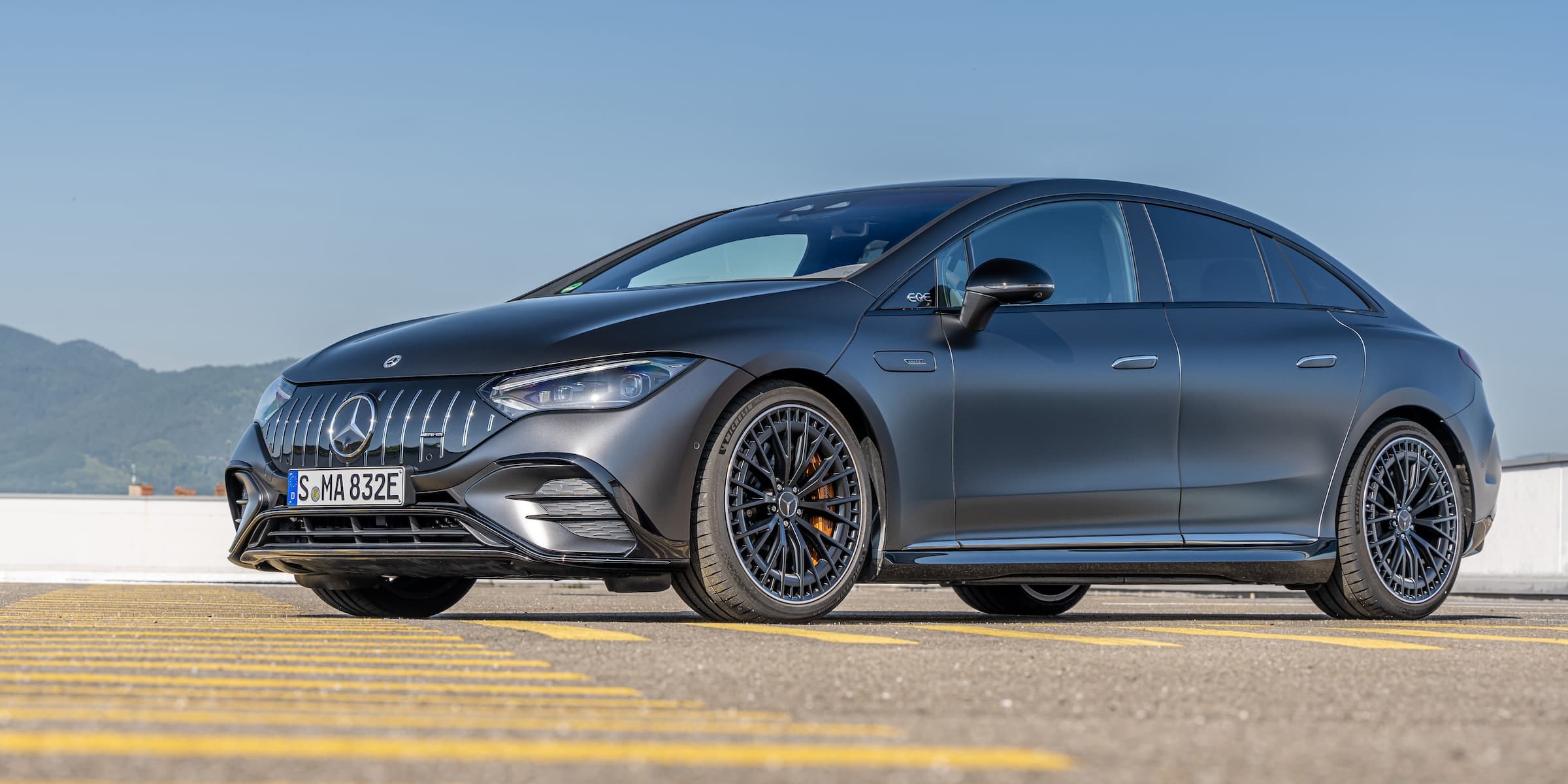
Mercedes’ performance-focused AMG division has unveiled a high-power version of the new E-Class saloon and estate – a plug-in hybrid that the brand says “combines mighty performance with efficiency.”
The Sporty saloon and estate derives most of its power from a turbocharged 3.0-litre straight six petrol engine – like its predecessor with a bit more power – but with the addition of a 21kW battery and electric motor pairing that provides up to 62 miles of electric-only driving.
This electric motor also provides a notable performance boost. With a total output of 585hp, the new E 53 is almost as powerful as the previous top-spec V8-powered E 63, and can complete a 0-62mph sprint in a reported 3.8 seconds (saloon). The car’s engine is mated to a nine-speed automatic gearbox, and its top speed is electronically limited at 174mph.
Above the standard E-Class that has been on sale in the UK since late last year, the E 53 sports an ‘AMG-specific’ front grille with illuminated vertical slats and a sharper front bumper with a larger front inlet design that directs more air flow to the engine. Beefier wheel arches have allowed Mercedes to slightly widen the AMG’s tyre width over the standard E-Class.
In the rear, the E 53 also gets a small duck tail spoiler and an alternate rear diffuser design with two round tailpipes on either side of the lower rear bumper. The car sits on 20-inch AMG-style alloy wheels with red brake callipers, and larger 21-inch alloys also feature on the options list.
As a ‘4Matic+’ model, the new E 53 is four-wheel drive as standard, and the AMG team adds that it has installed several chassis improvements to improve the car’s driving dynamics.
Engineers have stiffened up the front and rear axles, the braking system has been revised to work with the hybrid powertrain’s energy recuperation, and upgraded adaptive suspension dampers provide “clearly noticeable” differences between the various driving modes – ‘Comfort’, ‘Sport’, and ‘Sport Plus’.
Inside, the car’s upholstery is trimmed in synthetic leather as standard, and comes with an AMG steering wheel and some grey-coloured wooden trim elements. The E 53’s dashboard features a 12-inch driver’s display and 14-inch infotainment screen, and the brand’s full-width ‘Superscreen’ is also available for an additional fee.
That sums up what we know about the new AMG E 53 4Matic+ so far. The range, including both saloon and estate variants, will go on sale in the UK later this year, with Mercedes-Benz promising that UK specs and pricing will be confirmed in the coming months.
With new car deliveries times still affecting many new cars, the used car market is booming – particularly busy in the used luxury sector, as car buyers pivot from new to near-new cars.
Looking for a new car is an exciting time, even if you have decided that you’re going down the used route. There’s nothing wrong with that: there are thousands of excellent used examples of just about every make and model available – if you know where to look.
Luxury used cars, while priced towards the upper rather than lower end of the scale, have plenty of attractions. You can often find a relatively low mileage model with several options at a good price. Although it’s certainly not a guarantee, premium and luxury cars also tend to have better service histories and more fastidious owners than more mainstream models.
And we haven’t even mentioned the best bit – buying a used luxury car means that someone else has taken the big hit on depreciation when they bought it brand new, so you can pocket the savings.
There are a lot of sites listing cars today – the number is growing – so we’ve gathered the best websites that can help with buying a luxury motor. Each has its own strengths and drawbacks, but all offer the opportunity to find and secure your next car from the comfort of your own home. We’ve also only concentrated on sites that sell cars from a variety of car manufacturers, rather than brand-specific specialists or franchised dealers.
Here at The Car Expert, we building and updating guides to the top sites to buy used vehicles of all categories. So here are our pick for the best websites for buying a used luxury car.
Some of the sites are marked with an asterisk – these are commercial partner, and we may earn a small commission if you click through to their sites. This does’t affect the price you pay for any car.
The best websites for buying a used luxury car in 2026
URL: autotrader.co.uk They say:“Peace of mind, every step of the way”
We like: Dealer admin fees now clearly displayed We don’t like: Results don’t come in price order – fee-paying dealers head the lists.
Once the go-to for any used car when it was a printed magazine, Auto Trader is still a major force in this area of automotive business and remains a well-known name.
The website is excellent and well-laid out. Instantly, it tells you that there are 404,000 pre-owned cars ‘ready and waiting’, although of course, not all of these are going to be luxury models. But no matter – the search process is easy and there are several ways you can do it too.
One of the key features of Auto Trader, compared to other big-name used car sites, is that it includes both private and trade sellers. With a large number of private sellers in the used luxury car scene, it means that you’ll find some cars here that you simply won’t see anywhere else.
Another recent addition to the Auto Trader site (and app, if you prefer) is that it clearly shows whether a dealer is whacking any additional admin charges onto the selling price. It’s something The Car Expert raised with the site a few years ago, so it’s great to see it finally appearing.
Auto Trader also publishes its own car reviews, and is one of the sites included in our new Expert Rating Index, which aggregates new car reviews from UK websites to create a definitive rating for every new car.
URL:motors.co.uk They say: “We aim to simplify the process of finding the right used car”
We like: Easy to use website We don’t like: Some photography is low quality
Here is another huge business with a lot of used car deals on its books. Motors doesn’t own them all of course, it acts as an agent for franchised and independent dealers across the UK, with a few private sellers in there too.
It’s an easy site to navigate around and allows you to search by make and model, by area so you are only looking for cars closer to home, or cut down to popular body styles. There’s a section highlighting all the cars that have been reduced in price – you’ll find thousands here but some have only been cut by a few hundred pounds.
You can read news and features articles plus car reviews and there is a section showing video reviews. Some of these were duplicated when we looked, but the information contained in them is quite useful, as is the section on ‘tips on selecting the right used car’.
There’s also a car price guide showing what individual model types are selling for, enabling you to make a decision on whether you are getting value for money on the car you’re considering, which is useful when you’re buying an expensive luxury model. Car details are full enough but some of the pictures are a bit unpolished.
We like: Regularly changing stock We don’t like: Limited choice compared to some sellers
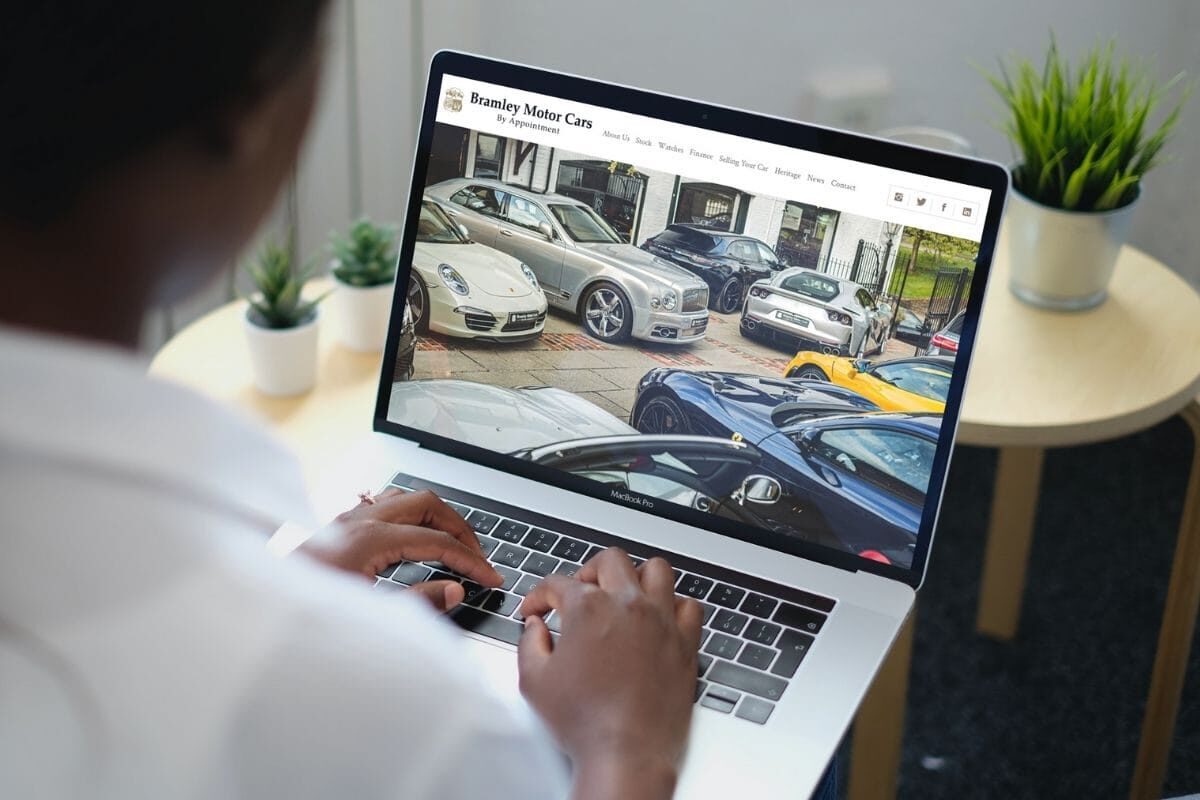
Bramley Motor Group is a highly regarded used luxury car dealership near Guildford in Surrey, with a stock of more than 50 vehicles at any one time. The company specialises in Ferrari, Aston Martin, Porsche, Land Rover and Bentley models from the 1960s to the present day.
It’s clear from every vehicle listing that Bramley is a business that knows its apples – the vehicle descriptions are informative and tailored to the very vehicle for sale, rather than a generic description of the model. The company can also help you to source a specific vehicle if they don’t have what you’re looking for in stock.
Like most luxury car specialists, Bramley Motor Group can also offer you finance and waranty services. As a nice complement to its car sales, Bramley is also a specialist in classic watch sales.
CarGurus
URL:cargurus.co.uk They say: “Find a great deal… and so much more”
We like: They can email you if a car’s price drops We don’t like: Car descriptions quite brief
Launched in the UK in 2016 by the co-founder of TripAdvisor, CarGurus has become the biggest online marketplace for used cars in the US. CarGurus is in a position to use online technology and tools that have been road tested in the US and Canada to give UK car buyers a new online shopping experience.
It’s an easy-to use search engine and, after you have selected ‘make’ such as Bentley, you are given the ‘popular choice’ – in this case Continental – followed by other models. All cars are sourced from franchised and independent dealers and descriptions are accompanied by decent dealer pictures, although with no uniformity. There’s a helpful view on whether the price asked for is a good, fair or great deal, compared with the average market prices.
One section breaks down models by specific variants and tells you how many deals there are available of each.
What’s clever about the search facility is that cars are listed according to the accuracy of their market pricing as well as the reputation of the dealer, as car retailers cannot pay extra to be listed first.
PistonHeads
URL:pistonheads.com They say: Used cars and finance, all in one easy-to-use website
We like: Lots to read online We don’t like: Car description in one big block
PistonHeads is one of the oldest and most popular motoring forums, which has a staggering 20 million-plus posts from car enthusiasts. It’s full of news, features and reviews written by well-known experts. You can spend hours in the forum reading up on your dream car from the enthusiast owners posting everything from common faults, favourite drives and rebuild photos.
In recent years, PistonHeads has expanded to become a performance and luxury car marketplace, bringing together car enthisiasts with a wide variety of exciting cars for sale.
If you are looking for a luxury, special edition or rare vehicle, this is definitely a good place to be. From supercars to prestige editions to classics, there is a great choice and the vehicles often have more extensive descriptions than found elsewhere.
Once you have put in your search parameters you’re taken to a list of relevant vehicles, linking you direct to the dealer who’s selling it – you can phone them or send a message easily. There are plenty of photographs but the car descriptions are a block of text which is not especially easy or comfortable to read.
Redline
URL:redlinespecialistcars.co.uk They say: “The UK’s largest independent supercar, prestige & performance car specialist”
We like: Well presented site, consistent photography We don’t like: Intrusive pop-up chatbox
Although the business has been around for nearly 25 years, Redline Specialist Cars in North Yorkshire has really embraced the digital sales revolution to carve out a solid niche in luxury and performance car sales.
With a marketing and customer service team that operates across social media and online review platforms, Redline is proud of its reputation and customer testimonials, which feature prominently across the site.
The company also offers a VIP collection experience in association with nearby Grantley Hall, so customers can enjoy a five-star afternoon tea or overnight stay when they collect their vehicle.
Saxton 4×4
URL:saxton4x4.co.uk They say: “UK’s number one used 4×4 dealership”
We like: Extensive range of luxury 4x4s We don’t like: £199 admin fee on every car
If your luxury car preference is more high-riding than low-slung, Saxton 4×4 in Essex should be one of the first sites you look at when hunting for your next set of wheels.
Despite the name, Saxton doesn’t only deal with SUVs – a quick check as we were writing this turned up coupés and sports cars from a number of luxury brands – but they do make up the vast majority of cars on offer.
One thing to watch out for is the £199 admin fee on every vehicle, which effectively makes every car £200 more expensive than than advertised price. This is becoming an ever-more common practice in the used car industry, and The Car Expert does not approve in this sort of deceptive behaviour.
Tom Hartley
URL:tomhartley.com They say: “The world’s most successful supercar dealer”
We like: Specialist treatment We don’t like: Lake photography is gimmicky
If you are serious about finding a proper luxury car and have a good budget to play with, this is the place to visit. Tom Hartley in South Derbyshire is a specialist in luxury and high performance cars, and has a collection of newer and classic models that will make your mouth water.
Accompanied by beautiful photography and even video, the cars are simply but well described and there’s more detail about exact specification. If you already have a luxury car, Tom Hartley will entertain the idea of a part exchange to help you perhaps ‘trade up’ to the next car of your dreams.
It’s a small list of cars compared with some websites, but what there is, is beautiful. They can arrange transportation of your car, a new cherished number plate for it – and they can even offer helicopter collection and return to their estate for you to see the car you’re considering.
It’s high end stuff, but done very well.
Tom Hartley Jnr
URL:tomhartleyjnr.com They say: “Dealing in the most significant performance and classic cars”
We like: Truly drool-worthy cars for sale… We don’t like: … which are out of reach for even most luxury car buyers
If you thought Tom Hartley (Snr) had an impressive collection of cars for sale, the vehicles on offer at Tom Hartley Jnr are simply stunning. It’s hard to imagine any used car dealer offering a more fantastic selection of classic and modern cars, both for road and track (and inevitably, with many destined to only ever be displayed rather than driven).
For a start, the site’s homepage opens with a picture of Hartley Jr standing alongside a Ferrari 250 GTO (think of a number somewhere around £30 million), so that gives you an idea of where the company is positioned.
To have such an extensive collection of rare and valuable cars of all era requires a prestigious reputation and plenty of contacts within the car collecting community, and the company claims that Hartley Jnr “has conducted more transactions on super/hypercars than anyone else in the world”.
Vertu Motors
URL:vertumotors.com They say: “The very highest standard of service every single day”
We like: Easy drop-down menus We don’t like: Small photos
Vertu Motors is a nationwide chain with dealerships across the country stocking large and small cars, including a number of high-end luxury vehicles. If you’re looking for a luxury car, it’s certainly worth a visit to the Vertu website – although you do have to navigate through cheaper, less desirable machinery to get to them; Vertu’s broad spectrum means it’s not a luxury car specialist.
However, getting to where you want to be on the website doesn’t take long and it’s a simple process. From the landing page you can go immediately to ‘used cars’ and drop down to view by manufacturer, if you know what you want, or by ‘approved used’ and ‘ex-demonstrators’ although these two choices won’t exclusively give you luxury cars. There’s an initial photo and you scroll left or right to see others, although the pictures are quite small and not all brilliantly lit.
Used cars are checked by technicians and prepared to high standards before selling. Nationwide delivery is available and there’s a 14-day money-back guarantee on all used cars.
This article was originally published in October 2021. Last updated March 2024. Additional reporting by Stuart Masson
*The Car Expert has commercial partnerships with Auto Trader and Motors. If you click through to their websites and view any of their vehicles, we may receive a small commission. We do not receive any payment or commission if you proceed to buy a car or sign an agreement via any of these sites.
The Jeep Grand Cherokee is a large five-seat plug-in hybrid SUV and its American manufacturer’s flagship model.
The Grand Cherokee arrived on UK roads in 2023 but was discontinued in 2025, with limited new car stock still available as of March 2026.
With reviewer responses ranging between enthusiastic praise and indifference, the new Grand Cherokee has split opinion within the UK motoring media. While Car Key‘s Ishan Sonavane argues the Jeep is a “formidable” challenger in the large SUV category, and Liam Shard of The Sunday Times says the car has a “more welcoming cabin than that of the Range Rover“, other outlets have their doubts.
“It’s more expensive than a Porsche Cayenne e-Hybrid – and that car is not only more premium inside and vastly better to drive, it’s also more efficient and cheaper to run”, says Carbuyer‘s Richard Ingram.
Overall, the Grand Cherokee is a certain improvement over its predecessor that was retired in 2020, but struggles to compete in a very competitive luxury SUV crowd.
As of May 2026, the Jeep Grand Cherokee holds a New Car Expert Rating of D with a score of 58%. Despite several poor UK reviews, the SUV’s score is greatly increased by an excellent five-star Euro NCAP safety score.
Body style: Large SUV Engines:plug-in hybrid Price:From £75,915 on-road
Launched: Autumn 2023 Last updated: N/A Replacement due: TBA
Image gallery
Media reviews
Highlighted reviews and road tests from across the UK automotive media. Click any of the boxes to view.
Featured reviews
“Within the luxury SUV market, the Jeep Grand Cherokee is an all-rounder that is capable in any situation but doesn’t excel in most (apart from off-road ability). That’s both a strength and a limitation. This is a car that will do pretty much whatever you want, every day, whatever the weather and conditions, and in comfort.”
Model reviewed: 2.0-litre petrol/electric plug-in hybrid Summit Reserve
“The Jeep Grand Cherokee is decidedly unremarkable. It’s adequate in many respects, but that simply isn’t good enough when similarly expensive rivals include the more dynamic and luxurious BMW X5 and Range Rover Sport. Alternatively, if you’re looking for a premium SUV that can tackle tough terrain head on, the Land Rover Defender is the far superior choice.”
Model reviewed: 2.0-litre petrol/electric plug-in hybrid 4xe Summit Reserve Score: 5 / 10 “The Jeep Grand Cherokee is decidedly unremarkable. It’s adequate in many respects, but that simply isn’t good enough when rivals include the more dynamic and luxurious BMW X5 and Range Rover Sport. Alternatively, if you’re looking for a premium SUV that can tackle tough terrain head on, the Land Rover Defender is the far superior choice.” Author: Ellis Hyde Read review
Auto Trader
Model reviewed: Range overvierw Score: 6 / 10 “Jeep’s luxury flagship is no delicate wallflower, but when the going gets tough the Grand Cherokee gets going.” Author: Catherine King Read review
Business Car
Model reviewed: 2.0-litre petrol/electric plug-in hybrid 4xe Summit Reserve Score: 6 / 10 “The Jeep Grand Cherokee lacks the precision and finish of European SUV rivals and is frighteningly expensive – especially in the range-topping Summit Reserve spec here.” Author: Martyn Collins Read review
Car
Model reviewed: Range overview Score: 6 / 10 “The latest Jeep Grand Cherokee excels at being a laidback cruiser of an SUV – a relatively practical one at that – and can boast about its off-road presence until the, er… bison come home. It’s got presence and you get a lot of equipment on the basic Limited model.” Author: Jake Groves Read review
Car Keys
Model reviewed: 2.0-litre petrol/electric plug-in hybrid Score: 8 / 10 “The Jeep Grand Cherokee emerges as a formidable player in the UK’s luxury SUV market, offering a unique American take on the segment. Although it lacks the prestige of some European brands, its competitive pricing and the dual capability of urban comfort and off-road readiness make it an intriguing option.” Author: Ishan Sonavane Read review
Carbuyer
Model reviewed: Range overview Score: 7.2 / 10 “The latest Jeep Grand Cherokee takes a step upmarket, but it still struggles to keep pace with premium SUV rivals.” Author: Richard Ingram Read review
Carwow
Model reviewed: Range overview “The Jeep Grand Cherokee’s big, rugged styling will appeal to adventurous families, but its expensive starting price probably won’t.” Read review
Honest John
Model reviewed: Range overview Score: 6 / 10 “Don’t expect to see lots of Jeep Grand Cherokees on the road. Its high price tag and below-par interior make it difficult to justify objectively. That exclusiveness adds to the appeal, though, and there’s something pretty cool about a Jeep Grand Cherokee. It’s also exceptionally capable off road, while its plug-in hybrid powertrain means it’s not totally stuck in the past.” Read review
Regit
Model reviewed: 2.0-litre petrol/electric plug-in hybrid Summit Reserve Score: 8 / 10 “With its instantly-recognisable trademark Jeep design and go-anywhere ability, the latest Jeep Grand Cherokee is quite the all-round package. Despite its rough-tough attitude, it has a softer side to its character and delivers refined driving traits. There is a wealth of tech at your disposal and there are luxurious fixtures and fittings that really raise the quality stakes.” Author: Maxine Ashford Read review
The Scotsman
Model reviewed: 2.0-litre petrol/electric plug-in hybrid Summit Reserve Score: 6 / 10 “The Jeep Grand Cherokee has always been a niche product in the UK, where the lure of a German or British badge seems hard to resist. This latest model still struggles to compete with those prestigious brands on overall quality or badge cachet but for buyers who want a slice of modern Americana it’s a big, brash and capable machine with heaps of space and equipment.” Author: Mat Allan Read review
The Times
Model reviewed: Range overview Score: 7 / 10 “Has the new Grand Cherokee pulled it off and defeated the mighty Range Rover? Or at least the Range Rover Sport? No, it hasn’t, but it has come closer to doing so than ever before. The Jeep Grand Cherokee now feels properly luxurious and in many ways it actually has a nicer, more welcoming cabin than that of the Range Rover.” Author: Liam Shard Read review
Top Gear
Model reviewed: Range overview Score: 8 / 10 “The Jeep Grand Cherokee is not a sporty SUV but we’re OK with that. There’s lots of space, equipment and capability.” Read review
Safety rating
Independent crash test and safety ratings from Euro NCAP
Independent economy and emissions ratings from Green NCAP
No eco rating
As of May 2026, the Jeep Grand Cherokee has not been lab tested by Green NCAP.
Reliability rating
Reliability data provided exclusively for The Car Expert by MotorEasy
No reliability rating
As of May 2026, we don’t have enough reliability data on the Jeep Grand Cherokee to generate a reliability rating.
The Car Expert’s reliability information is provided exclusively to us using workshop and extended warranty data from our partner, MotorEasy, sourced from both official dealerships and independent workshops.
As soon as MotorEasy has sufficient data on the Grand Cherokee, we’ll publish the results here.
Running cost rating
Monthly cost of ownership data provided exclusively for The Car Expert by Clear Vehicle Data
Fuel consumption
Average
Score
Plug-in hybrid models
101 mpg
A
CO₂ output
Average
Score
Variation
Score
Plug-in hybrid models
64 g/km
A
Battery range
Average
Score
Variation
Score
Plug-in hybrid models
29 miles
E
Insurance group
Average
Score
Variation
Score
All models
50
F
Service and maintenance
Cost
Score
Year 1
£350
D
Year 2
£843
D
Year 3
£1,344
D
Year 4
£1,632
D
Year 5
£2,058
D
Overall
£6,227
D
Similar cars
If you’re looking at the Jeep Grand Cherokee, you might also be interested in these alternatives.
Over the last six months, we’ve seen used car values starting to fall noticeably after being unusually high for almost four years – ever since Covid-19 entered our lives.
So what’s going, what’s likely to happen over the course of this year and what does it mean for car buyers? Well, the headline news is that used car prices are likely to keep falling all year long, with used EV prices falling further and faster than petrol cars, particularly in the second half of the year.
The used car market is inevitably guided what’s happening in new car sales, and there are major happenings currently going on that are combining to drive down used car prices. To properly understand it, we need to compare what’s going on at the moment (2023/24) with the ‘pandemic years’ (2020 to 2022) and ‘pre-pandemic years’ (2017 to 2019).
Let’s jump in.
The new car market has split in two
If you read the industry propaganda, new car sales are great. As of February 2024, fleet sales have seen 19 consecutive months of growth and are spinning along at levels greater than before the pandemic. Yay!
For private new car buyers, however, the results have not been anywhere near as exciting. Things were inevitably very up and down over the ‘pandemic years’ (2020 to 2022), while 2023 initially saw growth, but then things flattened out over summer and started turning downwards over the second half of the year.
We’re only two months into 2023 at time of writing, but private new car sales are down 11% on the same point last year, and about 25% down on pre-pandemic (2017 to 2019) numbers.
So we’re seeing a two-speed new car market, with fleets powering along and consumers stuck in the slow lane. There are reasons for this.
Pandemic revisited
Sorry if that heading gives you Covid-related flashbacks. I’ll be brief…
Fleet sales were hammered hard during the pandemic years, even more so than private sales. Lockdowns meant that car manufacturers couldn’t build cars and car dealers couldn’t sell cars. Not that there were many fleet customers at that time anyway, as big companies around the world were busy trying to work out how to run their businesses in a work-from-home environment. Even when lockdowns were lifted, things remained in flux for months afterwards.
The knock-on effect of lockdowns around the globe was severe parts shortages. Regardless of where a car is built, it uses components and materials from all over the world. As a result of disjointed shutdowns and re-starts, car manufacturers struggled to build enough cars for a year or more after lockdowns ended. With limited supply, they prioritised selling to private customers – because you and I pay more for our cars than fleets, who typically get massive discounts because they buy in bulk.
That suited the fleets just fine at the time anyway, since many companies were also holding off on any unnecessary spending during all the pandemic upheaval. One of those savings usually meant holding onto their vehicles for longer instead of replacing them.
A shortage of new cars, and vastly reduced fleet turnover, meant far fewer used cars coming onto the market during the pandemic years. This pushed used car prices up significantly, with some used cars even going up in value year-on-year instead of down.
For used car buyers looking for a car during the pandemic years, it normally meant paying much more money than expected, or buying an older/higher-mileage/less-prestigiously badged vehicle than they may have intended.
The boom times return
It’s only been in the last year that large fleets have really returned to normal operations. And that has meant a push to urgently replace all the cars that have been running well past their usual sell-by dates, coinciding nicely with car manufacturers finally returning to normal production levels.
As a result, fleet sales have been turbocharged over the last year and a half. That’s meant a vastly increased number of used cars coming onto the market, which has finally started pushing prices back down again.
And with fewer private customers currently wandering into dealerships, there are more new car discounts on offer. That also inevitably pushes used car prices down. So used cars are now cheaper than they’ve been for at least a couple of years.
What’s in store for the rest of 2024?
The current boom in fleet sales is likely to continue for at least the next few months, although it’s likely to start slowing down eventually. Fleets tend to turn their cars over more regularly than private owners, so 19 months of consecutive fleet growth is already seeing more used cars finding their way to the market, increasing supply and pushing prices down.
Private new car sales are also likely to remain sluggish for the foreseeable future. Inflation is now falling again, but interest rates look set to remain at or close to current levels for the rest of the year, so we’re unlikely to see customers stampeding back into showrooms any time soon.
There’s also the spectre of a general election in the not-too-distant future. Elections and referendums are like kryptonite to car showrooms, so dealership managers are going to be sweating on their targets if Sunak calls an election any time around the next big new car sales month of September.
Another minor concern will be the Olympic Games in Paris – the first Olympics in a UK-friendly time zone since the London games back in 2012. Prime-time scheduling for popular events could mean a quiet fortnight for car dealers this summer as millions of people spend their weekends on the sofa cheering on Team GB instead of going car shopping. It might be a good time to drop into a dealership to hunt for a bargain…
All of this suggests that there will be more cars hitting used car forecourts throughout 2024, and prices will continue falling all year long as well.
What about electric cars?
Electric car resale values have been in the news a lot lately, largely thanks to anti-EV elements of the media doing their best to drive a certain narrative.
Until about 2020, EVs only made up a very small proportion of the new car market – and the cars were generally very expensive compared to petrol or diesel equivalents. That meant that used car values were also high, with only a small number of rather expensive used cars for sale. This situation has changed sharply over the last four years.
As with fossil-fuel cars, the used EV market inevitably follows the new car market. New EV sales really took off in 2020, and are now firmly established in the marketplace. And that has led to a rapidly growing number of EVs arriving onto the used car market in 2023. As to be expected, more supply forces prices down. New EV prices are also falling as the market scales up and competition increases. So EV used car values have fallen quite quickly from very high to pretty much in line with petrol cars.
There are now more than a million EVs on UK roads, but more than half of those cars are less than two years old and more than three-quarters are less than three years old. That means that most of those cars haven’t hit the used car market yet, so we still haven’t seen the full impact of rapid new EV growth into the used car market. The number of used EVs for customers to choose from is set to grow significantly over the course of this year, helping to push prices down further.
There’s also the added complication of the government’s Zero Emissions Vehicle Mandate. This requires at least 22% of all new car sales to be electric vehicles. With two months of the year down, we’re currently sitting at 16%, so there’s certainly work to be done. That means more discounting for private buyers and more encouragement for fleets to turn over their cars more quickly to take more new EVs. Which, to reprise a familiar theme, will mean used EV prices will continue to fall.
However, the reverse could happen for used petrol car values. Car manufacturers who fail to hit the 22% EV mandate face enormous fines, to the extent that some big-name car brands may choose to stop taking orders for petrol, diesel and hybrid cars before the end of the year, forcing customers to wait until next year. This will put upwards pressure on used car demand and prices for those models later this year.
Does this mean it’s a bad time to sell your car?
Falling prices are good news if you’re looking to buy a used car in 2024, but not as good if you’re selling one. If you have a car that you’re thinking about selling, it’s probably worth doing it sooner rather than later.
Used car values have certainly fallen from their high points of the pandemic years, but right now they’re mostly still above average. Give it another few months, however, and they’ll almost certainly have fallen further.
Getting in ahead of the summer holidays, Olympic Games and general election could be a good shout if you’re selling a car.
All of the factors above look like combining to keep driving used car prices down in all segments over the course of this year, with more cars to choose from across almost all makes and models.
This is good news if you’re looking to buy a used car in 2024, but not as good if you have a car that you’re looking to sell. Now’s probably the time to sell a car, rather than waiting until later in the year.
The new car battleground will be in the EV marketplace, with knock-on effects for used EV values and pricing. There’ll be some very keen new car deals likely to be on offer from some (but not all) brands for their EV models. Combined with growing numbers of ex-fleet cars hitting the used car market for the first time, used EV prices are likely to keep falling all year long.
If you’re looking at a new or near-new petrol car, falling prices could level out for some models towards the end of the year. If certain car companies are forced to stop sales of new petrol cars in order to hit their EV targets, it will push used prices up for those cars. However, we don’t yet know which brands and which models may be affected if this happens.
The Mini story really is one of two halves. The first half being the ‘classic’ Mini launched in 1959, and the second half being the ‘BMW’ era.
The original Mini became a symbol of the ‘Swinging Sixties’. It posed with pop stars and models, won the Monte Carlo Rally (several times) and starred in cinemas as Michael Caine and his mates evaded hapless police in The Italian Job. The classic Mini is one of very few cars worthy of that over-used phrase, iconic.
We, however, are focusing on the second half of the story, an all-new Mini which appeared in 2001 as the one positive result of BMW’s short-lived takeover of the debt-ridden Rover Group. The BMW-era Minis have no relation to the original apart from hints of similar styling – in the overall body shape and the dash layout with its huge central dial – plus the fact that most BMW Minis are still built in Cowley, Oxford, a plant that made its first Mini in 1959.
One thing the current Mini certainly isn’t is mini. The latest Cooper dwarfs its classic inspiration and some versions, such as the Countryman SUV, take up virtually double the road space of their forebears.
BMW’s bold move has, however, been well rewarded – the current Mini has become as much of a lifestyle favourite of the 21st century as its inspiration was four decades earlier. And with a host of electric Minis just beginning to arrive in showrooms, this is a success story that will go for a good while yet.
Before we talk of the BMW Mini, a brief ‘pre-history’…
The 1959 original was a response to a flood of cheap ‘bubblecars’ coming into the UK from Europe. Launched as the ‘Morris Mini Minor’ and the ‘Austin Seven’, the Mini suffered early teething problems but soon became a massive hit – by the time production ended in 2000, close to 5.4 million had been built.
In 1994 Rover Group, by that time owner of the Mini brand, was acquired by German manufacturer BMW, and a year later development of a replacement for the Mini began both at Rover’s Longbridge, Birmingham headquarters and in Munich. What followed was a tortuous power struggle between the British and German teams – this only ended when BMW sold off loss-making Rover, while ensuring it kept Mini for itself.
Plans for production were moved from Longbridge, where classic Minis had been built since 1969, back to the spiritual home of Cowley, which now became BMW Plant Oxford. The all-new Mini launched in 2001 as the MINI, the name all in upper case as BMW attempted to differentiate it from its predecessor – but everyone still writes Mini…
No clever wording was needed to tell the two cars apart. While the original Mini was an affordable ‘car for all’ the new one was designed to fit into upmarket BMW’s range as a premium supermini, which the brand didn’t offer at the time.
While the new Mini retained the ‘wheel at each corner’ design and thus was fun to drive – its makers using the term ‘go-kart like handling’ so often it became a cliche – the car was much larger than its inspiration (though still just as cramped in the back). Purists were aghast at the car being called a Mini.
BMW had judged the market perfectly, however. Smart marketing, right from the launch event which had motoring journalists charging around the packed streets of London on a summer evening playing ‘Minopoly’ and exposing the car to thousands of tourists, quickly established the new Mini as 21st century high fashion.
Much more practical, and cheaper, small hatches were ignored by particularly young buyers who simply wanted a Mini – over the launch weekend the brand’s newly established 150 dealerships welcomed more than 50,000 curious potential buyers.
Within six years, more than a million new Minis had been built, the initial three-door hatch spawning a host of sister cars such as the Clubman, which had an estate-style rear end with van-style doors instead of a tailgate and in its first version a second rear-hinged door on one side only – the ‘wrong’ side for UK buyers. Then there was the Countryman, an SUV which really pushed the boundaries of trade description – this car was many things but by no means mini.
A second-generation Mini followed in 2007 and in 2014 a third, which was even larger than previous models. In 2024, an all-new fourth generation is arriving in dealerships, which is based around a core of electric models.
One thing that hasn’t changed, however, is the Mini’s following – rival brands have tried and failed to dent its appeal, notably Smart, but more than two decades on from its rebirth the modern Mini still attracts a very wide range of buyers, most choosing it simply because it is a Mini.
Mini Cooper: 1959 vs. 2024
What models does Mini have and what else is coming?
The first BMW Mini launched in 2001 with an entry-level model called the One, the mid-spec Cooper (reviving an association with former race team Cooper Cars that produced a hugely popular sporty version of the classic Mini), and the top-spec Cooper S. All had 1.6-litre petrol engines of increasing power, the one in the Cooper S supercharged. Owners were also offered a range of tuning and styling add-ons under the JCW – John Cooper Works – banner.
A diesel-powered Mini arrived in 2003 followed by a Convertible in 2004 – all survived into the second generation in 2006 and were joined by the Clubman estate and the five-door Countryman crossover, which apart from its size attracted further controversy as it was built not in Oxford but Austria.
BMW then tried to squeeze as much as was possible out of the Mini brand – next came a two-seat Mini Coupe and a drop-top version called the Roadster, followed by the Paceman, which was a three-door variant of the Countryman. Meanwhile an electric version of the three-door hatch, launched in 2020, attracted mixed reactions.
Perhaps recognising that not all of its previous models have been big hits – the Clubman, Paceman and Roadster coming to mind – Mini is now retreating somewhat, with the fourth generation which is based around three core models.
Cooper is now the umbrella name for the hatchback models, rather than a trim level. It has launched first as an electric three-door model, but is also being offered with five doors and combustion engines. A new Countryman is arriving in 2024 – it’s even bigger than the previous version, with electric powertrains plus petrol versions.
The one all-new model will be the Aceman – this is another crossover, with five doors but not quite as gargantuan as the Countryman, and with an electric-only powertrain. Again angering the purists, the initial Acemans will be built in China. However Mini predicts this model will become its best-seller and will move production to Oxford just as soon as it has finished spending £600 million upgrading the plant.
Currently you can find the Clubman (which these days has rear doors on both sides but still the odd van-door tailgate) and Convertible on sale at dealers but they won’t be there too long…
The Mini Aceman in its testing livery
Where can I try a Mini car?
There are plenty of opportunities for UK buyers wanting to find out what Mini is all about – the brand has 130 dealerships across the UK, many of them on the same site as BMW dealers but in their own bespoke buildings. Often they are easily spotted as they have a Mini hanging off the outside wall…
Mini stands out from the rest of the small(-ish) car crowd not really for anything in the metal but for the following it enjoys. In the early days after the car launched, Mini owners who encountered perfect strangers coming the other way in the car would flash greetings to them.
Today that habit has largely died out due to the sheer numbers of Minis on the roads, but many owners still consider themselves part of a fashionable and in many ways thoroughly British club – something that Mini itself does its best to keep going with such accessories as Union Jack graphics for the roof and lights.
A Mini fact to impress your friends
How much bigger that the classic Mini is the BMW Mini? Well in 2012 28 women gymnasts set a Guinness World record by all squeezing into a current Mini Cooper. The same 28 then tried to fit into a classic Mini, and only 23 of them were able to get in…
Summary
Looked at totally objectively, the Mini is not one of the best ‘superminis’. Rival cars offer more space (Mini has never really cracked the problem of cramped rear seats), cheaper prices and better reliability.
But none of this really matters because BMW has cleverly managed to maintain the Mini’s reputation as a desirable car – many of those driving Minis bought them simply because they wanted them rather than needing transport from A to B. And there is no sign of the Mini losing this basic appeal.
American Automotive brand Rivian has announced that its electric R2 SUV will be coming to the UK, which is set to challenge the sales of the popular Tesla Model Y.
Not heard of Rivian? Founded back in 2009, this marque is better known in the US for creating the world’s first all-electric pick-up truck – the R1T which went on sale in 2021. The R2 SUV will mark the brand’s arrival in the UK – a mid-sized five-seater family car.
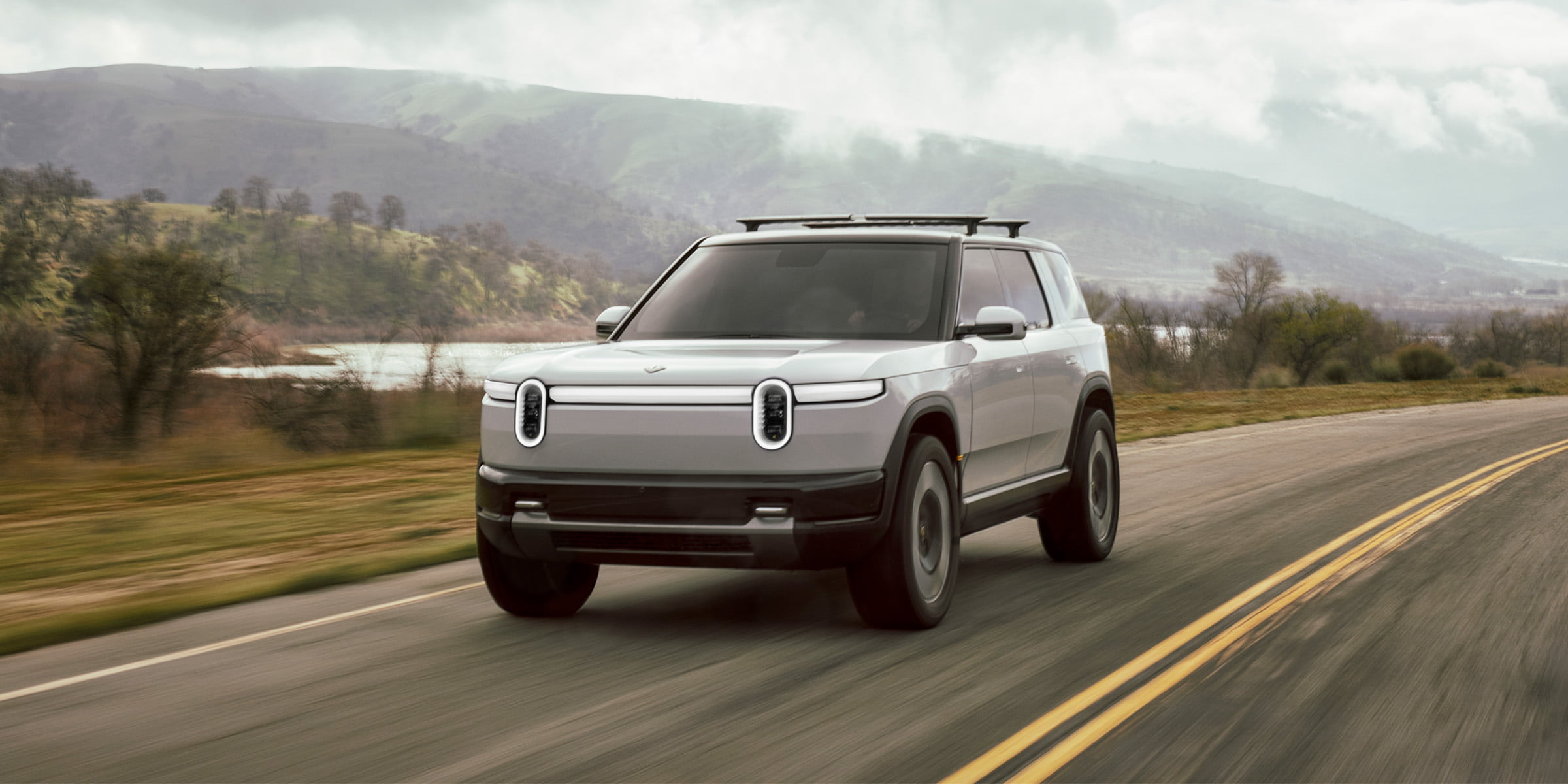
With its boxy silhouette and the brand’s signature oval-shaped ‘stadium headlight’ and full-width light bar treatment, the SUV will be one of the largest offerings in the medium SUV class when it eventually goes on sale in Europe. It’s both longer and taller than the likes of the Skoda Enyaq and Volkswagen ID.4, but shorter than the Kia EV9 and BMW iX in the bigger large SUV category.
With around five centimetres of extra length in the cabin over the Tesla Model Y, Rivian says it has made rear legroom a priority in the vehicle’s design. The interior materials have been chosen for their sustainability and durability, with easy to clean textiles and surfaces throughout, and the rear seats fold completely flat to maximise storage space when needed.
As an electric model with no engine bay, the R2 also comes with ‘frunk’ storage space under the bonnet and two glove compartments (the second under the infotainment) – a response to American buyers who complained about the R1T’s lack of a glovebox.
A large infotainment screen juts out of the centre of the dashboard, alongside a digital instrument cluster embedded behind a newly-designed steering wheel. Unique features include a torch hidden in the driver’s door and the ability to fully lower the rear windscreen like the Fisker Ocean – another rival SUV built by a different American brand now trying to establish itself in the UK.
Now on to the powertrain options. The R2 will be launched with two battery sizes and three different electric motor configurations. Not much else has been confirmed as of yet, but Rivian adds that the bigger battery will be able to muster over 300 miles of travel on a single charge.
Entry-level single-motor, dual-motor and high-power tri-motor setups (one motor on the front axle and two more in the rear) will be available, with the last of these reportedly able to complete a 0-60mph sprint in under three seconds – that’s supercar rivalling acceleration.
The SUV can charge its battery from 10% to 80% in less than 30 minutes using a rapid charging station. Despite its rivalry with Tesla, Rivian has also announced that it plans to make the R2 compatible with Tesla’s Supercharger network in the US sometime in the near future. Whether this compatibility will be available in the UK (or at all) remains to be seen.
If this new SUV peaks your interest, be prepared to wait a while. The R2’s production is scheduled to start in the first half of 2026, and Rivian adds that its UK arrival will be not until sometime after it has been launched in the US.
UK pricing can only be speculated at the moment, but Rivian intends to undercut key rivals with a planned $45k (£35k) price tag when it arrives on the American market. By comparison, the pricing for the Tesla Model Y currently starts at £45k.
Rivian also has a smaller R3 hatchback/crossover in the works, which sports similar exterior looks and a 300-mile battery range for (presumably) a cheaper price. Rivian hasn’t confirmed whether this model will go on sale in Europe yet, however.
That sums up what we know about the Rivian R2 so far. We expect to learn more about the R2, including trim specifications and arrival dates, in the next 12 months.
Who hasn’t heard of the Norwegian fjords? These beautiful narrow bodies of water that stretch for miles inland are a wonder to see if you’re on a cruise ship. But don’t think that’s the only way to enjoy the natural wonders. You can view them by car too.
Common in chilly countries such as Alaska, Greenland and Canada, they are also abundant in one European country in particular – Norway. But it’s not just the fjords that are on offer if you’re planning a road trip in this Scandinavian country. There are lots of other wonderful sights to see, history to learn about and architecture to admire.
And you won’t be short of road to drive on either: Norway is the longest country in Europe and organising a trip by road will take planning, if only to understand the distances you might be travelling. Drive from the north of the country to the south and it could take you 30 hours.
You’ll be on great roads though. With Atlantic coastal routes, mountainous regions and hundreds of glaciers, there’s lots to see and experience. Norwegian motorways are generally in good condition and are not too busy, despite connecting Norway’s cities to one another and offering passage outside of the country and into other states.
Away from the main road, you’ll find hundreds of beautiful local roads to choose from, picturesque in their settings, winding and demanding in places but blessed with fantastic views, interesting towns and villages and good amenities – Norway is home to some of the best public lavatories in the world!
As well as the tourist business that Norway is proud of, the country’s main cities such as capital Oslo, Stavanger and Bergen, are home to industries including oil, petrol, shipping, farming, fishing and fish products.
With a rich history going back to the Viking era and beyond there’s lots of interesting architecture to be found, especially in the smaller towns. The bigger cities feature modern architecture and bright evening skylines.
If you are considering this Scandinavian country for a vacation this year, it’s certainly a good choice for road trips. But you’ll need some careful organisation before going there. Flying in and hiring a vehicle is easy, with all the main rental companies and others, available with a wide variety of vehicles.
Driving in Norway is a completely different experience from doing so in the UK – starting with the fact that Norwegians drive on a different side of the road from us.
It’s much more than that and planning a driving holiday or using a car on business while in the country, requires careful planning and a good understanding of what you can and can’t do behind the wheel there.
So it’s well worth spending some time planning your trip to ensure you have everything in place for your northern European excursion. In the summer it can be warm and fine, but winters can be harsh, and this will make driving by road more hazardous.
Here The Car Expert looks at the most important elements to consider when planning to drive in Norway, and we’ve included a handy checklist. As each journey is unique, always check that you have everything covered for your particular visit.
Basic rules
You must be 18 years or over to drive in Norway and you should hold a full UK driving licence. Just the licence card will do, as the paper counterpart is no longer a requirement.
If you are using your own car, you’ll need to prove that you have insurance cover so take your certificate with you (but you don’t need a European ‘green card’) and you must carry with you documents that show the identity of the car, such as a V5C ‘logbook’.
The vehicle’s ‘home country’ must be shown on it. Most people today have the ‘UK’ letters and the Union Flag incorporated into their vehicle’s number plates but if you don’t have this on your own car, you must affix a ‘UK’ sticker to its rear. The ‘GB’ badge is no longer allowed, even within European ‘golden stars’ and the same goes for country badges such as the English, Scottish or Welsh flags.
If you are hiring a vehicle, always carry the hire company’s paperwork with you to prove you are allowed to drive the car. You must have had a full driving licence for at least one year to hire a vehicle. Whether you are renting or using your own vehicle, always carry your personal ID or passport with you.
Drink drive rules
We don’t recommend any drinking of alcohol if you are going to drive but it’s worth knowing the limits. The drink drive limit is 0.2 g/l (also shown as 0.2 milligrams or 0.02%).
The authorities take a hard line on drink driving – Norway was the first country to impose penalties for ‘impaired driving’ back in 1936. Police officers can demand a random breath test at any time, without reason, and there are severe penalties – fines and possible prison – if you are shown to be over the limit. For comparison, the limit is 0.8 g/l (0.8 milligrams, 0.08%) in England and Wales.
Speed limits
Speed limits are shown in kilometres (km/h) rather than miles (mph). In some built-up and suburban areas, the limit can be a plodding 30km/h (18mph) although many towns prefer a 50km/h (31mph) limit. On main A-roads, it’s 80km/h (50mph) but this can vary so keep an eye on roadside signage. Motorways have a blanket 110km/h (68mph) top speed.
If you have a caravan or trailer the speed limit is 80km/h everywhere. If the trailer does not have brakes, the limit drops to 60km/h.
Norway increased its speeding fines last year. They are high and get steadily worse as your speed over the limit increases. Fines can be issued on the spot.
Go just 5km/h (3mph) over the limit in a 60km/h (35mph) zone and you could be fined 1100 Norwegian Krone (NOK) (£80). For going 20km/h over in a built-up zone, fines start at 7800 NOK (£580). And if you’re stopped going more than 25km/h over the speed limit on a 70km/h road or above, it’s 9100 NOK (£680). There are many other variations of speed versus fine.
There are speed cameras and mobile ‘speed-trap’ cars on roads throughout Norway. You are not allowed any kind of police camera detection equipment in your car. Likewise, if your satnav unit shows where speed cameras are sited, you must de-activate this function as it’s illegal. Don’t use a mobile phone while driving either, unless it’s completely hands-free.
What to carry in the car
While motoring through Norway, ensure you have a warning triangle in the car and a reflective jacket for if you have to get out of the car by the roadside. Make sure your lights don’t dazzle oncoming drivers – you must have beam deflectors fitted (or the ability to manually adjust your lights). You must switch dipped lights on all the time, whatever the weather conditions.
Although not a requirement, it’s also recommended that you have a fire extinguisher, first aid kit, tow rope, spare bulbs and jump leads. Specialist suppliers, such as motoring organisations, sell ‘European driving kits’ for around £25, which contain everything you are likely to need for a holiday road trip, and it’s well worth considering these.
Studded tyres are permitted in most Norwegian towns and cities over the winter months although some charge a fee for driving in their centres with these tyres fitted. Cars that weigh more than 3.5 tonnes must carry snow chains with them and use them if ice or snow is expected.
Seatbelts
Seatbelt rules are the same as in the UK: if your car has them, they must be worn. Children under 36kg in weight or 135cm in height must use an appropriate car seat. If the seat is rear-facing and on the front passenger seat, you should switch the airbag off. Children between 135 and 150cm tall may use a normal seat belt and booster cushion.
Driving
Keep to the right-hand lane as much as possible but if you are overtaking do so on the left. Priority is usually given to vehicles approaching you from the right but look for road signs which might indicate something different. Don’t use your horn unless necessary, for example to avoid an accident happening.
Traffic signals are red, amber and green and follow a similar pattern to the UK. There is no right turn allowed on red as in some European countries, even if the road is clear of other vehicles. In some cities you might see two red lights. These were originally installed as ‘back-up’ if one light failed but were deemed successful in terms of visibility and stayed in operation.
If you are towing a trailer or caravan, ensure that your car and the rig don’t exceed 18.75 metres in length and 2.55 metres in width. There is no height limit but beware of low bridges! Make sure you can see clearly behind you with the use of two wide rear-view mirrors.
Road signs
Road signs are usually triangular with a red outline for those giving advice or warning, and blue circles where something is mandatory. They use pictures and therefore rarely need words, although ‘Stop’ is written in English. Most directional signs are yellow and written in Norwegian with distances in kilometres.
Fuel availability
Petrol and diesel are widely available throughout the country. However, Norway is investing massively in the electric revolution and already has more than 17,000 charging stations and 3,500 rapid chargers available across the country. Hotels are increasingly offering EV charging for free. LPG is also quite widely available.
Norway’s motorways have good service areas with fuel, shops and cafes available. They almost all have automatic, card-operated pumps which take internationally recognised credit cards. If you are heading into remote mountainous areas, stations can become less frequent so make sure you have filled up with fuel before you leave.
Toll roads
There are toll roads in Norway on some motorways, bridges and tunnels. You will also have to pay to drive in main cities. Most toll stations work automatically.
Parking
Parking bays are clearly marked, as are ‘No Parking’ zones. Much of the parking is controlled by meters, but there are also long and short-term parking garages (P-hus) to leave your car for a fee. There are steep fines for illegal parking and while wheel clamps are not used by the police, your car can be towed away. There will be a fine to pay for a vehicle’s release plus costs for the towing.
Park with the car looking towards the direction of travel. Do not park anywhere that the police might consider dangerous – that’s five metres from an intersection, level crossing or pedestrian crossing, or 20 metres from a bus or tram stop.
Don’t park on bicycle lanes or pedestrian paths. Indeed, the whole Norwegian culture on the road is to put pedestrians and cyclists first. Pavement users will expect you to stop for them at a crossing while cyclists will often ignore road signs and ride ‘their own way’ so give them plenty of room.
Emergency number
In Norway as with most of Europe, you can dial 112 and make contact with emergency services such as fire, ambulance or police, 24 hours a day. Operators will speak English, French and other European languages.
The brand’s second electric model after the Eletre SUV and its first battery-powered “hyper-GT”, the Lotus Emeya is now available to order in the UK, with three different variants offered.
Marketed as the “ultimate grand tourer package”, Lotus says that its new saloon proves that “electric cars do not have to be boring”, and that it combines “rich sports car heritage with the latest cutting-edge technologies.”
Set to challenge the likes of the Porsche Taycan, Audi e-tron GT and Tesla Model S, the Emeya will be one of the fastest electric saloons on the market when it eventually arrives next year.
It is powered by the same 905hp dual-motor setup as the top-spec Eletre R, and can reportedly complete a 0-62mph sprint in 2.8 seconds. It also makes use of the Eletre’s large 102kW battery pack, which can charge from near empty to 80% charge in around 18 minutes using a 350kW DC charging station.
Lotus adds that the saloon can muster 379 miles of travel on a single charge, which is actually a 75-mile improvement on the Eletre SUV’s 304-mile maximum.
The Emeya takes several design cues from the Eletre, including narrow angular LED headlights (though the saloon has two strips on either side of the bonnet), deep bonnet contours, a large lower grille and a muscular curvy side profile. Like the Eletre, the saloon also has a two-tone bodywork finish that paints the roof and window pillars in black.
Inside, the four-seater comes with a ‘state-of-the-art’ 15-inch infotainment screen that floats above the dashboard and is powered by Unreal Engine gaming tech, which is said to improve screen response times. The digital instrument cluster behind the steering wheel is quite narrow, which frees up windscreen space for the huge 55-inch head-up display that projects driving information onto the front window.
Drivers can control the ride height, air suspension stiffness, acceleration response, seat position, and the car comes with power-assisted doors, a kick sensor below the boot lid and an ‘intelligent’ panoramic glass roof, which drivers can switch between opaque and clear. The saloon offers 509 litres of boot space, which is around the same amount of luggage room that the Audi A4 saloon offers in the rear.
The new Lotus range consists of three different variants, starting with the entry-level ‘Emeya’ which is priced at just south of £95k. The mid-range ‘Emeya S’ costs around £108k, while pricing for the top-spec ‘Emeya R’ starts at £130k.
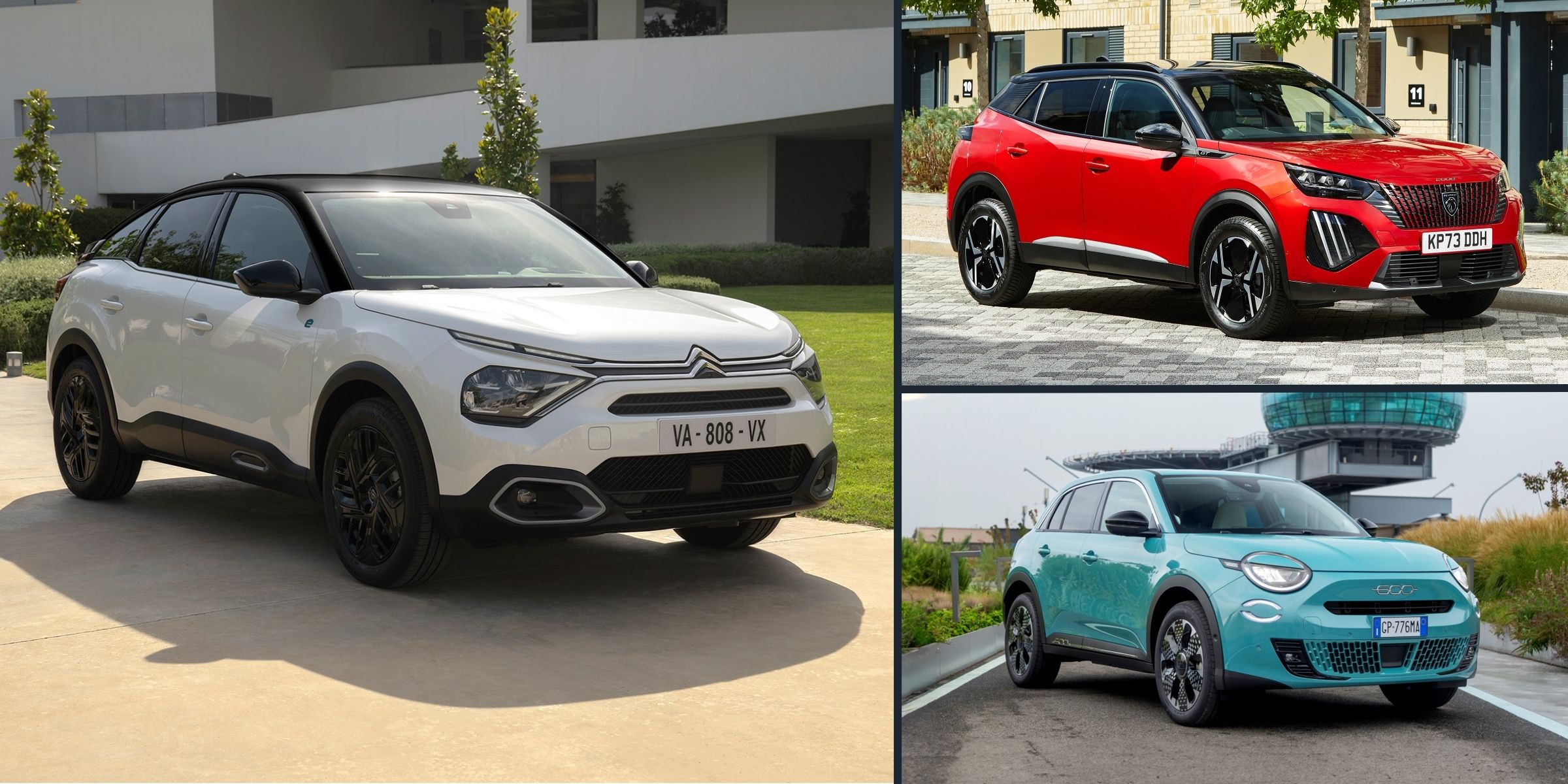
Citroën, Peugeot and Fiat – all brands under the Stellantis umbrella – have announced that they are adding additional mild-hybrid engine options for their compact crossover model lines.
These mild-hybrids, all offering an extra 48V of electrical assistance to a petrol engine, are now available as part of the Peugeot 2008 and Fiat 600 ranges, with Citroën planning to sell mild-hybrid versions of its C4 crossover and C4 X fastback models in the coming months.
Please note that, while each brand markets these new additions under the term ‘Hybrid’, they are mild-hybrids that don’t have the capabilities of proper petrol/electric hybrid cars. The battery is much smaller, and can handle electric start-up and low-speed cruising, but only for just over half a mile. Fuel economy is also improved, but not to the same extent as a petrol/electric hybrid or plug-in hybrid.
Citroën
Starting with Citroën, its C4 crossover and C4 X fastback mild-hybrids are based on the 1.2-litre petrol engine option available only with the mid-range ‘Plus’ and top-spec ‘Max’ trim grades. Priced from £25k, the engine’s 48V mild-hybrid boost adds an additional 6hp – for a total of 136hp – and Citroën says this electrical assistance reduces fuel consumption by 20% and company car drivers will get a lower Benefit-in-Kind Tax rate.
In addition, Citroën has added a more powerful powertrain to its all-electric ë-C4 and ë-C4 X model lines. Now available to order, the new configuration pairs a 156hp electric motor with a larger 54kWh battery, providing a longer reported battery range of 260 miles on a single charge.
Peugeot
Peugeot has rolled out the same mild-hybrid engine option for its facelifted Peugeot 2008 SUV which is now available to order from just under £28k.
The brand adds that the ‘Allure’ 2008 trim is now available with the 100hp entry-level 1.2-litre petrol option, which lowers the trim’s lead-in price by £1,000.
Fiat
Finally, Fiat has opted to offer its new Fiat 600 with a mild-hybrid powertrain – a crossover range that was previously electric-only. This mild-hybrid is less powerful than Citroën and Peugeot’s new battery-assisted additions – offering 100hp – and lowers the crossover’s entry-level price to £24k.
The Peugeot 2008 has the highest score of these models in our Expert Rating Index, with a New Car Expert Rating of A, with a score of 71%. The Citroën C4 isn’t too far behind with a New Car Expert Rating of B, with a score of 65%.
The schism in new car sales continued in February, with fleet and business registrations powering along while private sales fell again – with no real signs of recovery on the horizon.
According to data published yesterday by the Society of Motor Manufacturers and Traders (SMMT), the overall market was up 14% on last February’s numbers. However, that was the result of a 25% increase in fleet registrations, while private sales fell by 3%.
Private sales made up only a third of all new cars registered in February, whereas historically we’d expect to see them making up closer to half (about 45%). While fleets are buying cars at better than pre-pandemic levels, private car sales are about 25% down on what they were before Covid-19.
We’re only going to do a quick round-up of the numbers here, as we’re shifting to a quarterly analysis cycle in 2024. There’s simply too much variation month-by-month to properly analyse market trends, so our new plan is to do short summaries for the first two months of each quarter and then a more in-depth analysis every three months.
It’s also worth noting that January and February data historically show lower personal car finance borrowings than the annual average, which skews sales results in favour of cheaper cars for private car buyers. Inevitably, that works against EVs, which are more expensive to buy than petrol cars.
Source: SMMT
Fleets continue to embrace EVs, private customers less so
While the overall market was up by 14%, EV sales were up by 22% – the second month in a row that they’ve outpaced the market after slowing down at the end of last year.
Part of that 2023 slowdown was that several car companies were holding back on delivering new EVs. With the government’s new Zero Emission Vehicle mandate coming into effect in January, car companies must hit a minimum of 22% of EVs in their new car sales or face a fine of £15,000 per car outside that target. So at least part of the growth this year has been the market ‘catching up’ those deferred deliveries.
The SMMT has pointed out that fewer private customers are buying EVs, which is true – although fewer private customers are buying new cars of any kind. There’s also the probability that a large proportion of private EV sales are actually contained in the fleet data, as a large number of EV customers (up to half, according to some industry figures speaking to The Car Expert off the record) source their cars through salary sacrifice, whereby the leasing company buys the car – unlike traditional car finance where the customer buys the car.
What’s almost certainly true is that the higher up-front and financing cost of an EV (for those who can’t get one as a salary sacrifice) is hurting new EV sales. Until prices come down, that’s going to continue.
Oh, and diesel’s market share hit yet another all-time low, dropping below 6%.
Source: SMMT
Good month, bad month
Rather than our usual list of every car company, we’ll just summarise the biggest winners and losers in February. The overall market was up 14%, but with significant variations in performance from all the car companies. That’s fairly normal for February, so CEOs will refrain from either popping champagne corks or slitting their wrists based on this month’s numbers alone.
Of the volume manufacturers, MG was the biggest winner, tripling its sales over last February. BMW also had a very strong month, up 66%, while Honda was the third biggest improver, up 57% on the same month last year.
In the other direction, quite a few large manufacturers sold far fewer cars this February than they did last year. Ford slipped the furthest in absolute numbers, although Dacia and Toyota were worse in percentage terms. Year-to-date, Toyota is well off the pace, with sales down 25% against an overall market that has grown by 10%.
We’ll be watching the brand numbers with interest, as the Zero Emission Vehicle Mandate is likely to play havoc for some brands that have few electric cars to sell (which may explain Toyota’s slow start to the year).
The Ford Puma was the UK’s best-selling car in February, with a strong result that also pushed it top the top in tear-to-date sales over the Kia Sportage (last month’s best-seller). However, given small overall sales to date, it’s all a bit irrelevant for now. March is usually the biggest month of the year so it will set the tone for the rest of 2024.
January and February often throw up unusual sales results, as car manufacturers and dealers either hold back for March or try to clear the decks of existing stocks. Best not to read too much into it all, so we’ll explore the overall first quarter results next month.
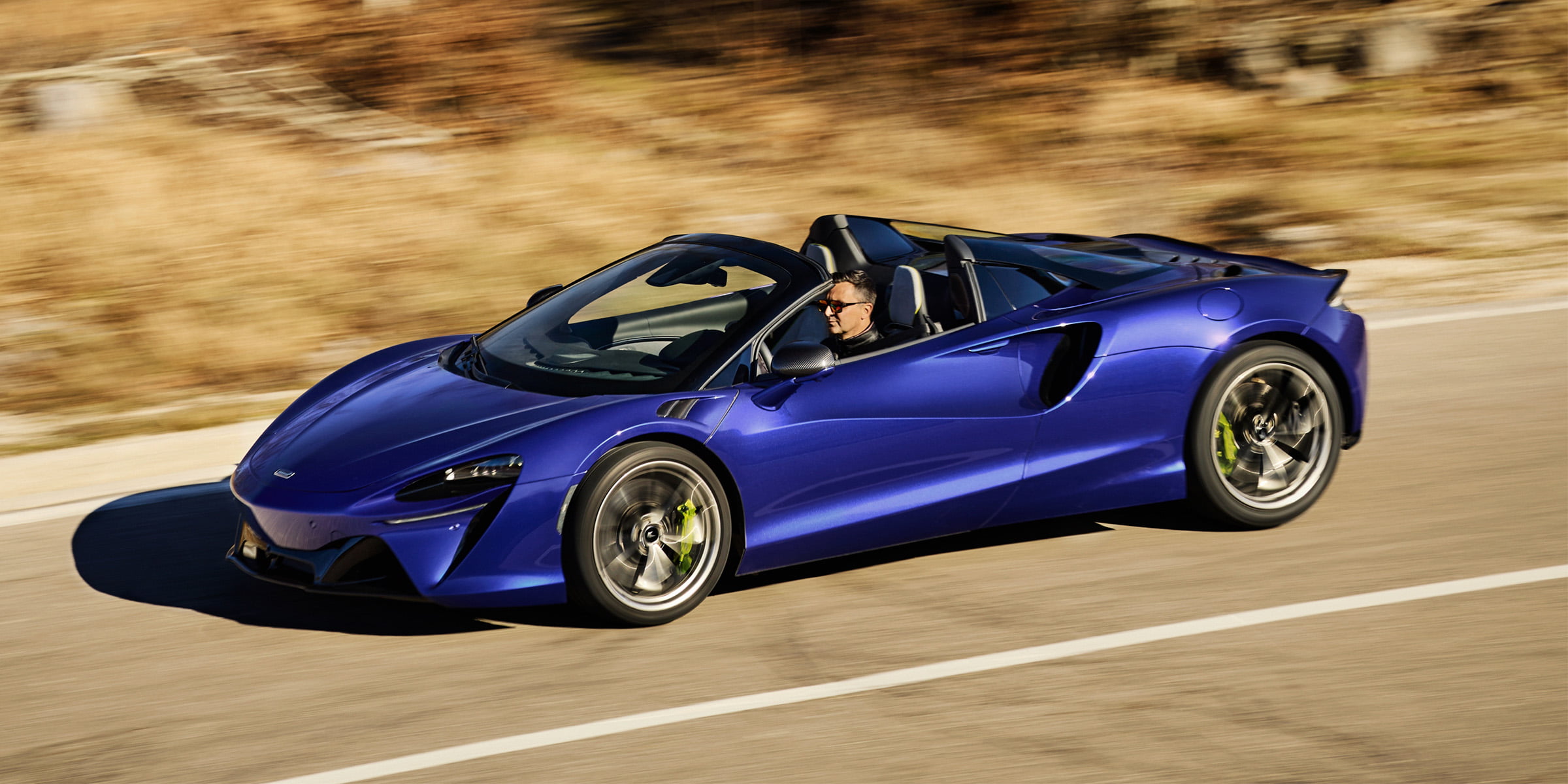
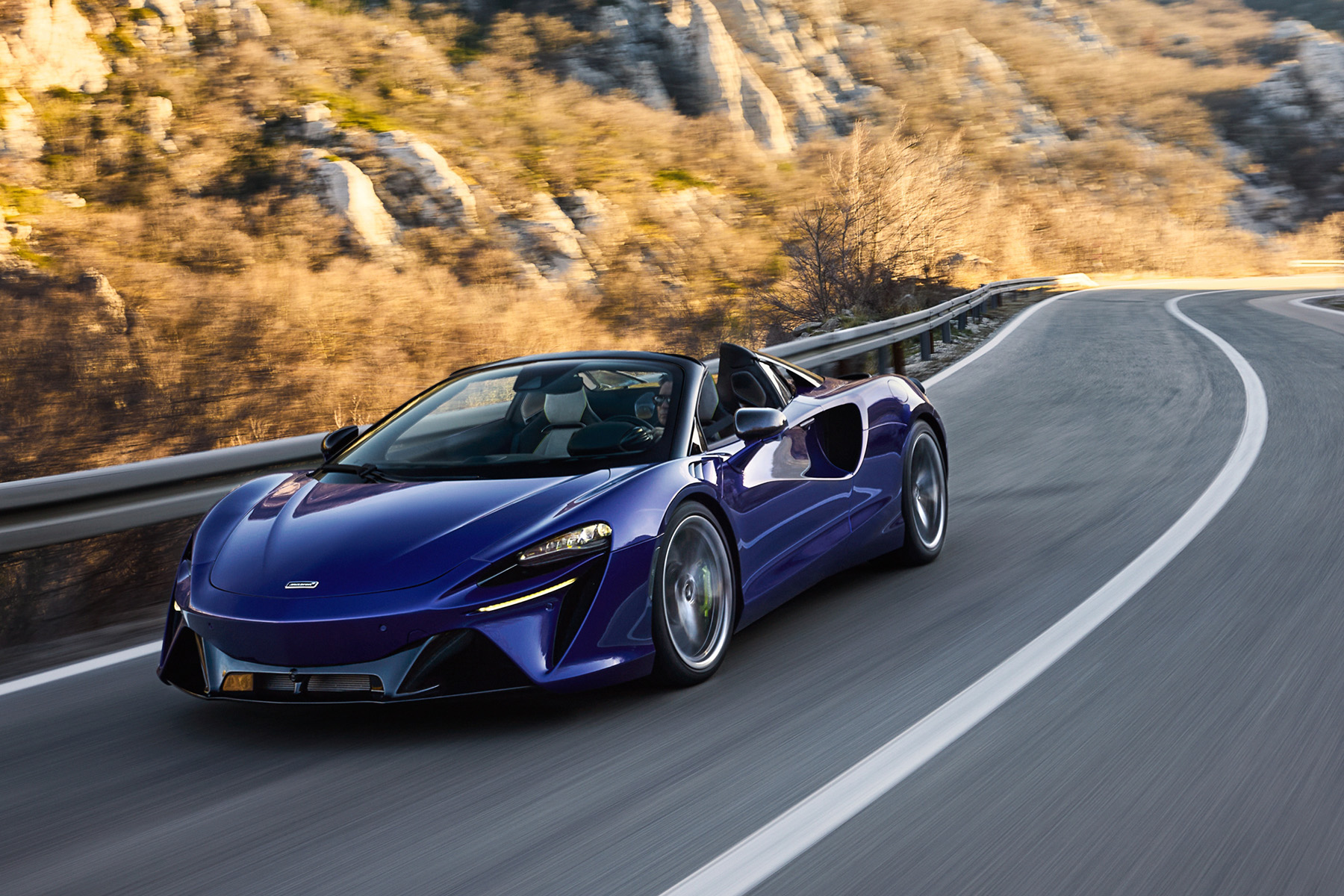
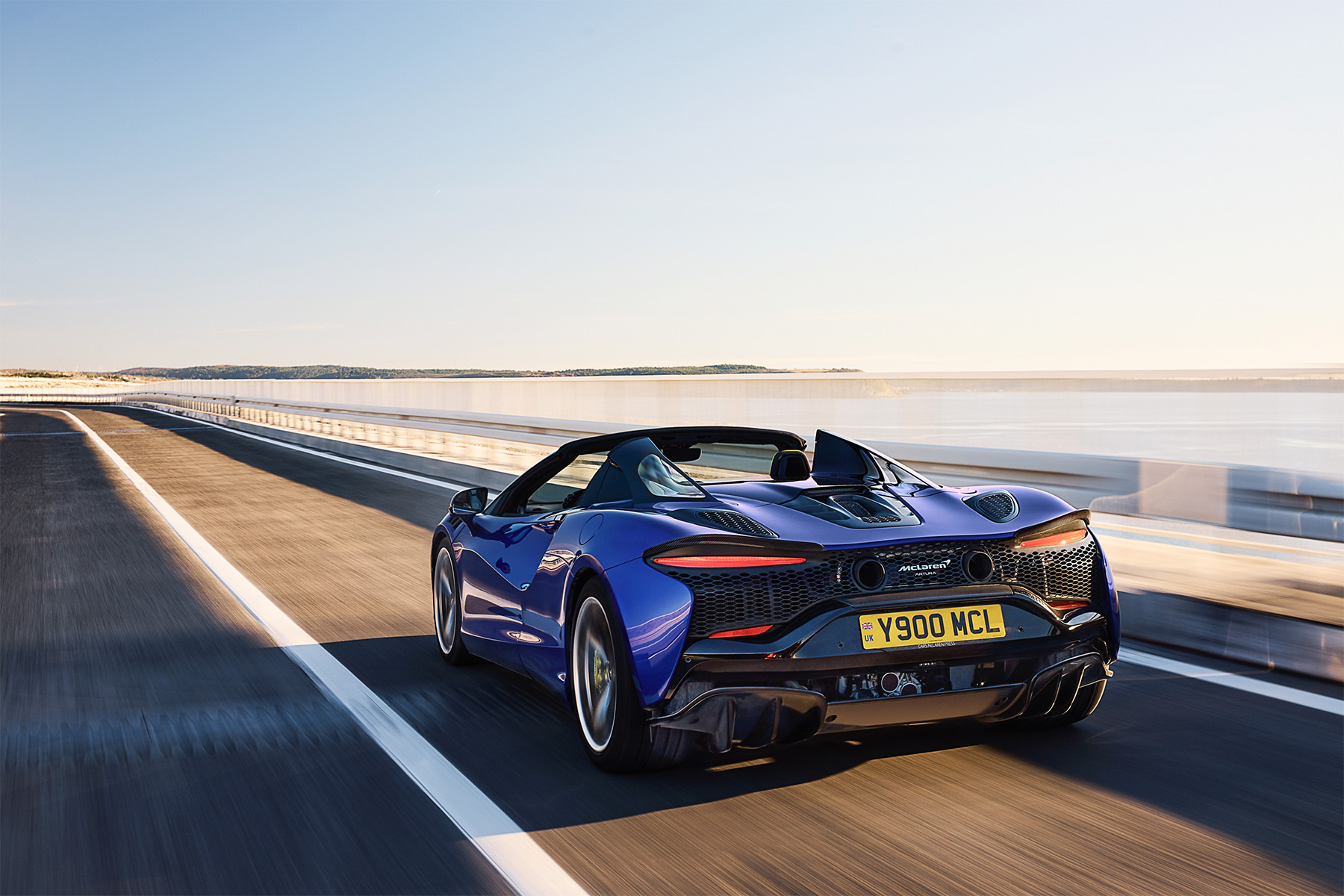
McLaren has announced that its Artura sports car is now available in a convertible ‘Spider’ body style, as part of an announcement that also introduces a wide range of updates to the Artura range as a whole.
The brand promises that this update and range expansion brings “more power, more performance and even greater driver engagement” than the Artura that launched in 2022, thanks to a refreshed hybrid powertrain and several mechanical upgrades that are also now available for the coupé model.
Starting with the engine, the car’s 3.0-litre V6 petrol engine and electric motor have been re-calibrated to provide a small 20hp boost, the power output increasing to 700hp. The car’s electric-only range has been upped to 21 miles too.
The Spider’s electrically-operated roof mechanism does increase the Artura’s weight, but by “just 62kg more than the coupé”, McLaren adding that the model is “comfortably” the lightest convertible in its class.
The convertible’s acceleration reportedly matches the coupé’s three second 0-62mph sprint time, and modifications to the eight-speed automatic gearbox mean that the supercar can shift gears 25% faster than before. The top speed is limited at 205mph.
McLaren has also looked to improve the engine’s soundtrack by installing a revised exhaust system with cone-shaped tailpipes to “refine the engine note at the middle and higher points of the rev range.” The suspension setup and chassis engine mounts have been revised too, to make the Artura more responsive in high speed corners. In addition, the braking system has been re-tuned to provide a slightly shorter stopping distance from speeds above 124mph.
Featuring an optional electrochromic glass panel that can block specific wavelengths of ultraviolet light, the convertible’s folding hard-top can be operated at speeds up to 31mph and opens and closes in 11 seconds.
Pricing for the new Artura Spider now starts at a cool £221k, with the first customer deliveries anticipated to arrive this Summer.
The McLaren Artura holds a New Car Expert Rating of C with a score of 63% in our Expert Rating Index – a score bolstered by high media review scores but hindered by high running costs.
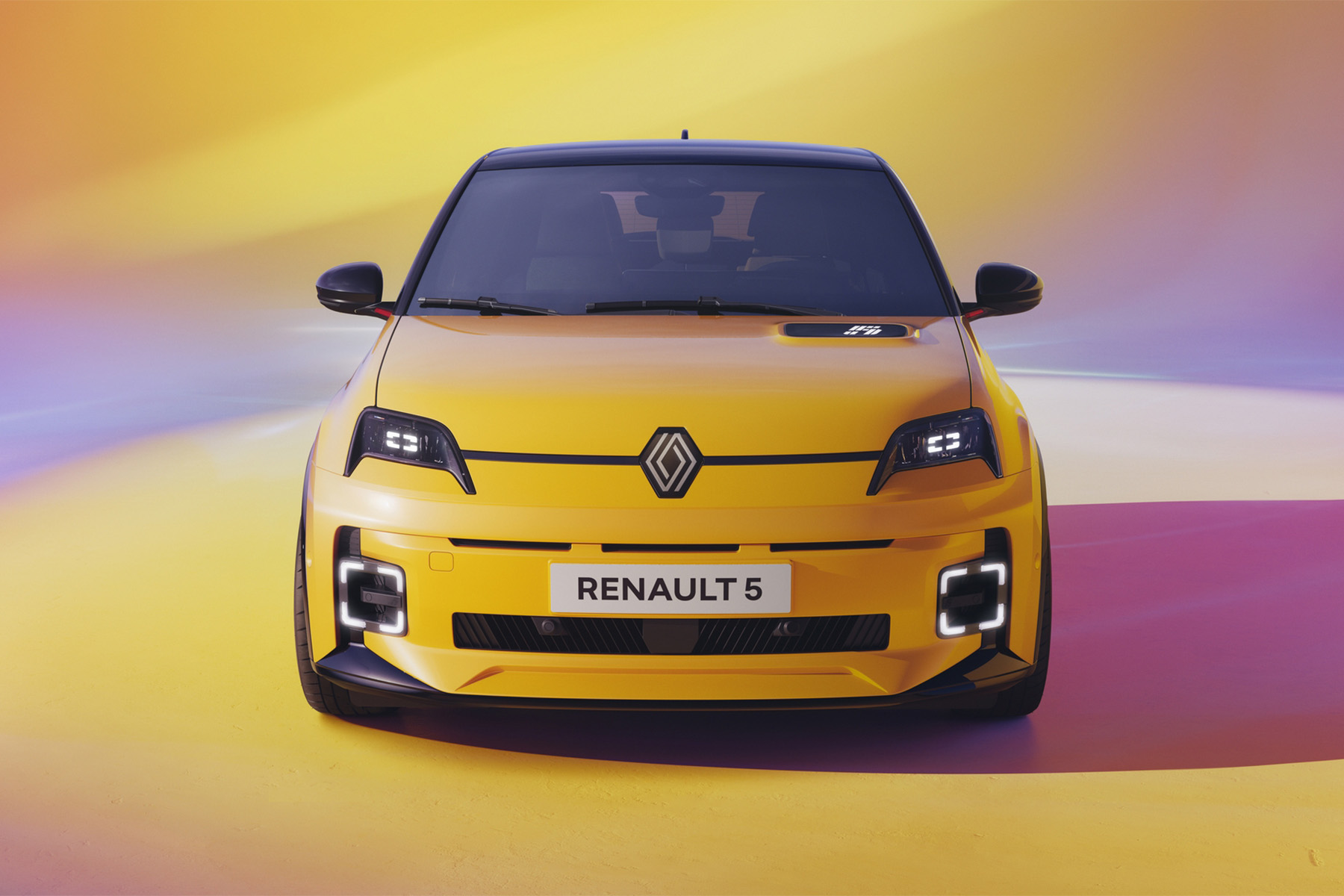
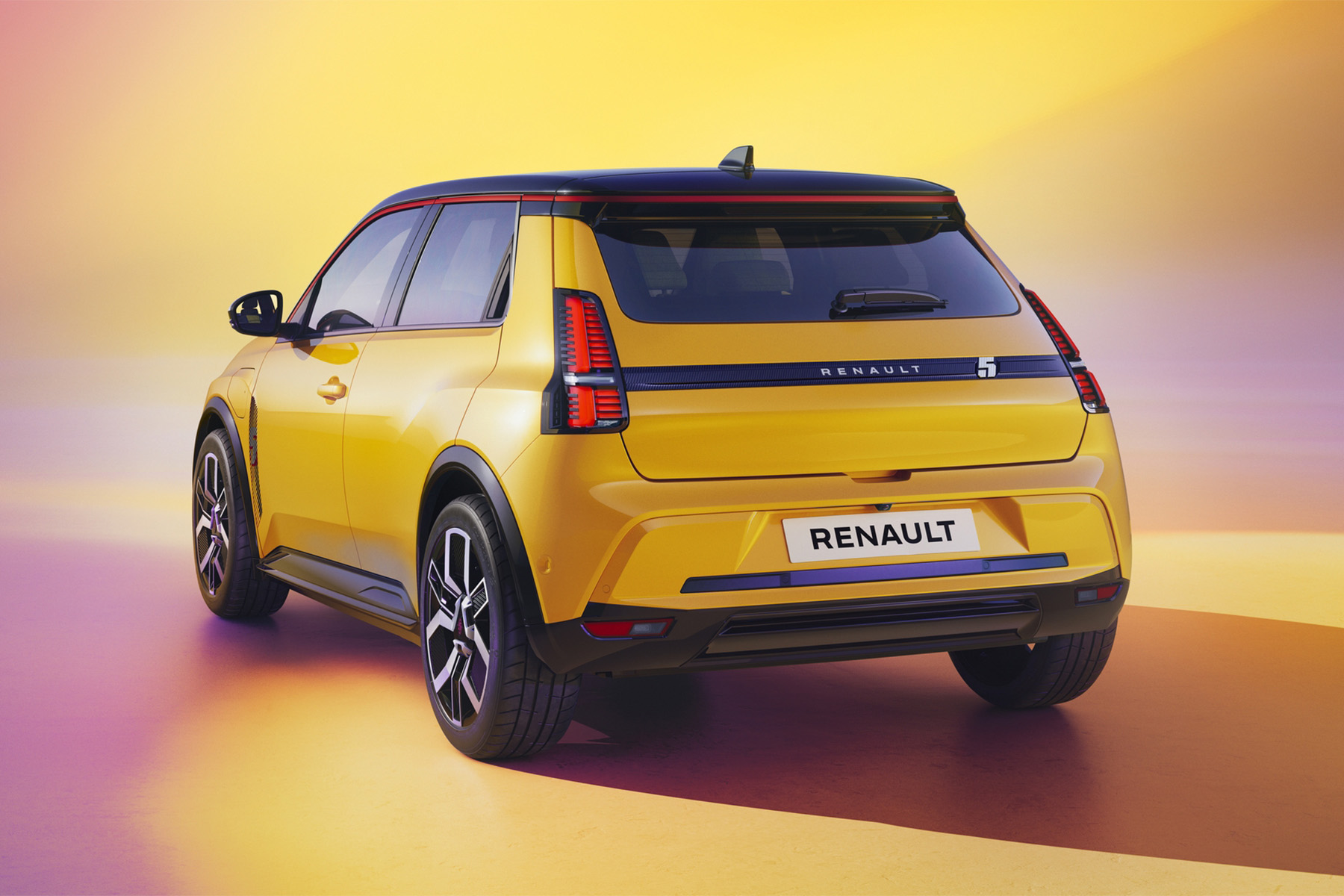
The long-awaited electric Renault 5 has debuted at the Geneva motor show – a Fiat 500 Electric rival with a class-leading battery range that is set to arrive in UK showrooms in early 2025.
A battery-powered successor to the popular Renault 5 hatch of the 1970s and 1980s, Renault says that this new model “harks back to this glorious past” while being a prominent example of the brand’s near future, as it is built on brand-new foundations and comes with several new tech features.
Soon to be Renault’s lead-in all-electric offering, the 5 E-Tech will be one of the smallest superminis on the market when it arrives next year. At less than four metres long, the new hatch is slightly longer than the Fiat 500 Electric, but shorter than the brand’s electric Zoe hatch. Unusually for a car of this size, the 5 sits on large 18-inch alloy wheels as standard. The boot offers 326 litres of luggage space – 12 litres less than the Zoe.
Renault says that one powertrain option will be available at launch – a 52kWh battery and 150hp electric motor pairing that can reportedly muster 248 miles of travel on a single charge. The brand adds that this version can complete a 0-62mph sprint in under eight seconds.
By comparison, the new electric Mini Cooper offers up to 145 miles on a single charge, while the upcoming Citroën ë-C3 offers 198 miles.
Following later will be a cheaper but less powerful 40kWh battery and 120hp electric motor option, which has a reduced maximum battery range of 186 miles. The compact car can also tow trailers, with a towing capacity of 500kg. The top speed is electronically capped at 93mph.
The 5 E-Tech hatch will also be the first Renault model to come with a V2L (vehicle-to-load) bi-directional charging feature, which allows the owner to charge laptops, smartphones and other external electrical devices using the car’s battery. Compatible with 11kW AC and 100kW DC (80kW DC for smaller battery option) charging stations, the hatch’s battery can be charged from 15% to 80% in 30 minutes using the latter.
A heat pump maintains the temperature inside the cabin, which can pre-warm and defrost the car before start-up using physical switches on the dashboard or by a setting in the My Renault app. The car won’t have a single-pedal driving mode at launch, but Renault says this feature could be introduced in a future update.
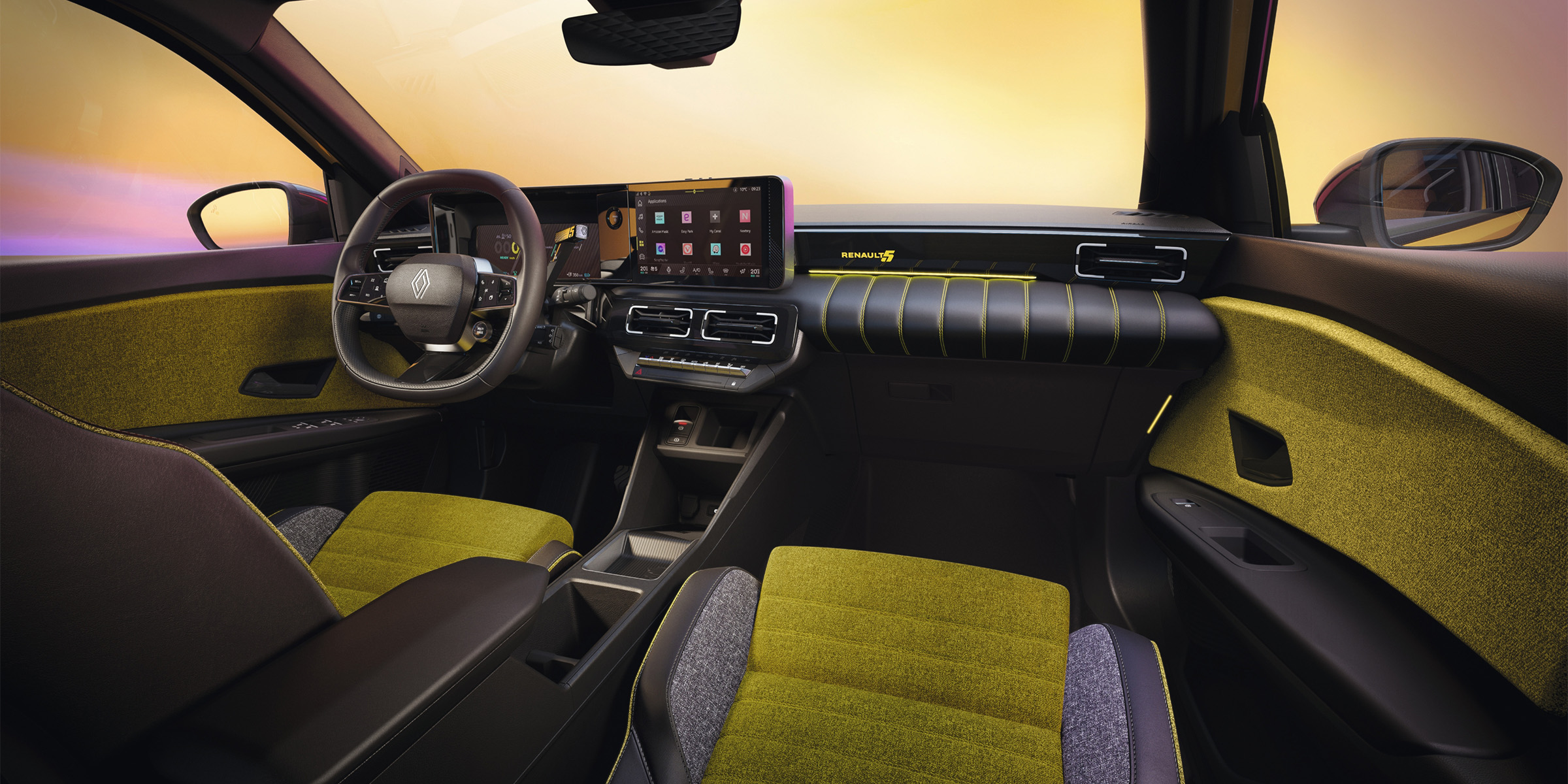
Inside, the car’s colour scheme is as vibrant as it is on the outside. On the tech front, the car comes with a new infotainment setup that pairs a seven-inch digital instrument cluster behind the steering wheel (ten-inch screen for higher trims) with a ten-inch central infotainment screen in the same dashboard housing.
The time it takes to charge the battery can be optimised by pre-conditioning the battery and planning your journey using the infotainment’s Google Maps app. This is one of 50 apps (including Spotify and Amazon Music) available thanks to the integrated Google Play store. The software is also compatible with Android Auto and Apple CarPlay.
The launch of the 5 also marks the introduction of the brand’s ‘Reno’ voice assistant – an ‘EV specialist’ avatar that receives and responds to voice commands – which the brand hopes will build a “closer bond between the user and their car.” The software is powered using Chat GPT AI, and can answer a wide range of questions in a “conversational way”.
The seat fabrics will be made from fully recycled material for the ‘Techno’ and ‘Iconic’ trim levels. This latter will also include bio-sourced materials for its steering wheel and interior insulation. An acoustic windscreen also comes as standard, to reduce noise in the cabin.
Key trim level features
Entry-level ‘Evolution’
Keyless start and entry
LED headlights
18-inch alloy wheels
Mid-range ‘Techno’
All ‘Evolution’ features
Google apps for infotainment
Rear view parking camera
Wireless smartphone charging
Top-spec ‘Iconic’
All lower trim features
Two-tone exterior colour scheme
Heated seats
Heated steering wheel
Renault is keen to show the small hatchback’s safety credentials – an area of concern of the older Zoe which was given a zero-star Euro NCAP safety score in 2021.
The car comes with a driver attention monitoring system that watches out for tired driving, front and rear sensors with lane keep assistance, emergency braking and adaptive cruise control. The car also comes with parking assistance (presumably for higher trims), which can reportedly park the car without prompt from the steering wheel.
That sums up what we know about the new Renault 5 E-Tech so far. More details, including the model’s UK pricing, will be announced in the coming months.
Ask anyone to name different car brands off the top of their head, and one of the first names that will always pop up will be BMW. But how much do you know about one of the world’s most famous car companies?
BMW has been a fixture in the UK car market for decades, with its popularity steadily increasing over time. It’s now one of the UK’s top-selling brands, with more BMWs sold every year than Toyotas, Vauxhalls, Nissans, Renaults, Peugeots and many others.
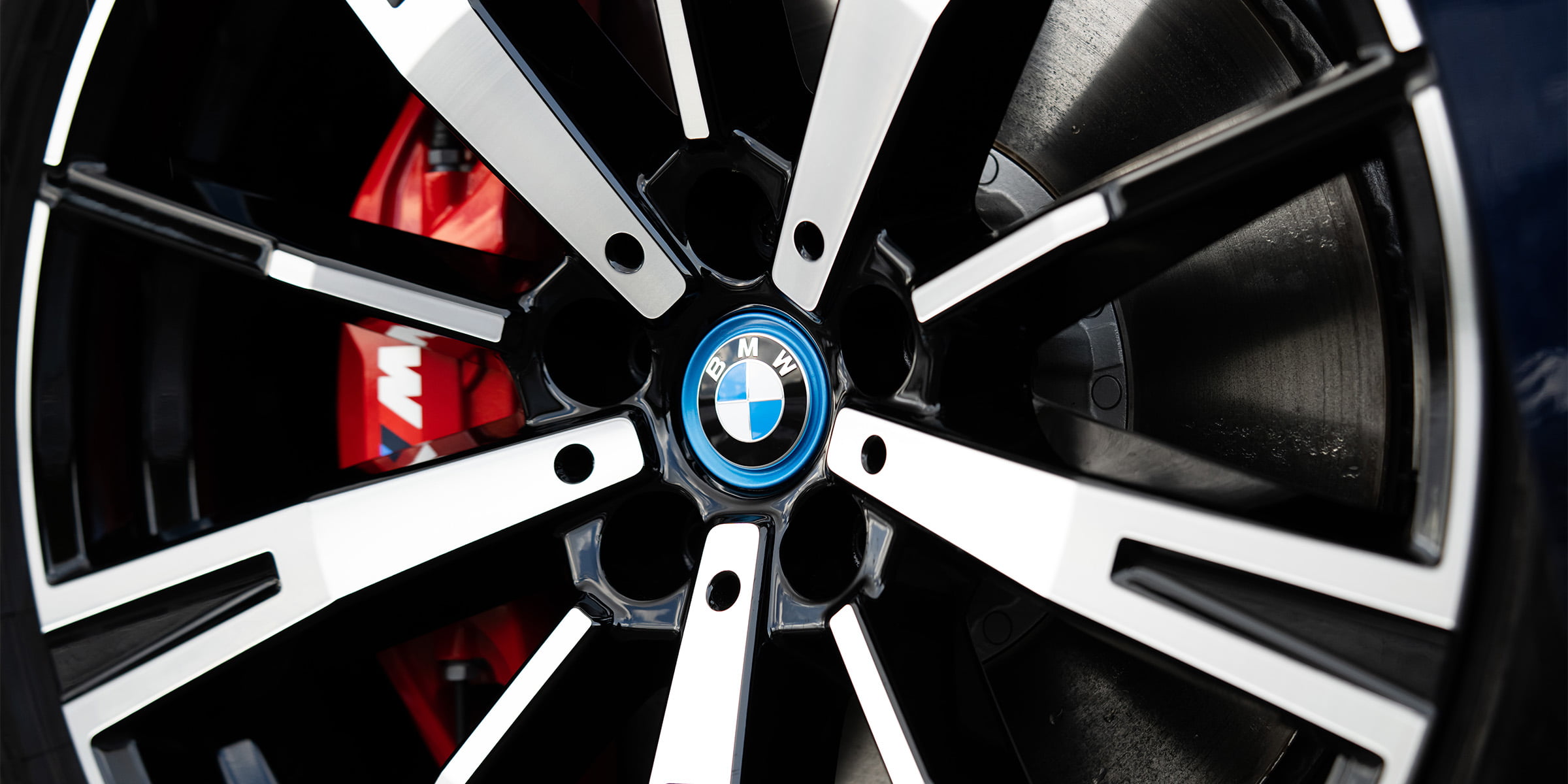
The ‘kidney grille’, so named because even in its most recent bloated form it looks like a pair of kidneys, has been hung on the front of BMW cars since the 1930s, and has become as recognisable a symbol of executive market quality as the three-pointed star of Mercedes-Benz.
BMW has never been afraid to innovate – the company was among the first premium brands to launch an SUV and such models now dominate its line-up. It was also an early adopter of electric propulsion, and today there are a growing number of EV options among the extensive BMW model range – in 2023, a quarter of all BMWs sold in the UK were EVs.
Despite rival brands making inroads into BMW’s long-held reputation as the executive car of choice, today cars with that distinctive grille remain objects of desire for many drivers.
BMW may be one of the most well-known car manufacturers today but that’s not how it started. A German engineer called Karl Rapp founded the ‘Rapp Motorenwerke’ – RMW – in Munich in 1913, primarily making aeroplane engines. Four years later, the company was renamed ‘Bayerische Motoren Werke’ (which translates as Bavarian Motor Works), hence BMW.
Between the wars, BMW added motorcycle engines, farm equipment, railway braking systems and even household pots and pans to its aircraft engines. The first motorcycle was produced in 1923, the first car five years later (it was actually a licenced copy of the Austin 7) and the range quickly expanded until the outbreak of the second world war.
Like every other European car company of its era, BMW was heavily involved in both world wars on behalf of its country. And, like other German manufacturing companies, production during the second world war was one of the darkest aspects of BMW’s history. The company mass-produced engines for German fighters and bombers, using mainly slave labour from Nazi concentration camps. Motorcycle manufacturing also continued, mainly to supply the German army, but car production stopped.
After the war, BMW was not permitted to restart making cars until 1952. The company struggled to make a profit, coming close to collapse in 1959 and almost taken over by its great rival, Mercedes-Benz. However, the company was instead purchased by the Quandt family, whose fortune had been amassed arming the Nazi military. The Quandt family remain major shareholders in BMW today, although the company is publicly traded.
BMW’s rise to success then really began in the 1960s. The introduction of the ‘Neue Klasse’ saloon cars led directly to the 3, 5 and 7 Series saloons, which are still some of the most popular cars in the premium market today. By the 1980s, BMW and fellow German brand Mercedes-Benz were the dominant players in what became known as the executive sector – to drive a BMW company car was considered a sure sign of a successful career.
In the 21st century, BMW is one of the world’s best-known car companies and still making headlines. Not all of them are positive – many recent styling decisions have raised questions, particularly the steadily increasing size of the kidney grille on its vehicles. Plenty of observers consider the gargantuan frontage and overall design of the new BMW XM as several steps too far.
Today, BMW builds cars in Brazil, China, the Netherlands, India, Mexico and South Africa – as well as its home of Munich in Germany.
BMW 3 Series: 1975 vs. 2022
M is for Magic
If there’s one letter of the alphabet that holds special significance for BMW and its fans around the world, it’s the letter M – standing for Motorsport.
The first M model was the BMW M1 – a mid-engined supercar launched in 1978. It even raced at Le Mans, with a paint scheme created by Andy Warhol. That car remains in BMW’s famous Art Car collection, and would immediately become one of the most valuable cars in the world if the company ever decided to sell it.
The first BMW M road car, the M5, was launched in 1984 and M has since been applied to the most potent models in the core road car ranges. Among enthusiasts, the BMW M3 and M5 have earned a reverence almost unmatched by any other major car manufacturer.
Over the years, BMW’s M division has been involved in almost every category of motor racing around the world – currently, it races in GT categories and Le Mans.
Andy Warhol painting his BMW M1 Art Car (shown here on display in London in 2012)
Ownership of other car brands
In 1994, BMW bought the Rover Group, a collection of British car brands – beating Honda to what proved a mistaken prize. Rover’s huge losses meant that the British arm was sold again just six years late, but BMW kept the Mini brand name and the Oxford factory that produced its cars. A completely new Mini range appeared a year later – but that’s another story (coming soon).
By this time, BMW had already swooped on another famous British brand. In 1998, Volkswagen thought it was buying luxury car marques Rolls-Royce and Bentley, along with the factory in Crewe. Instead, BMW managed to snatch the rights to the Rolls-Royce name from under VW’s nose, later building a brand-new factory at Goodwood in Sussex to produce an equally new line of the world’s most luxurious cars.
What models does BMW have today?
The current BMW range is enormous, covering its regular models, its all-electric ‘i’ models and its high-performance ‘M’ models. Take a deep breath:
1 Series (hatchback)
2 Series (coupé, liftback, MPV) + M2 coupé
3 Series (saloon, estate) + M3 versions
4 Series (coupé, convertible, liftback) + M4 coupé and convertible + i4 electric liftback
5 Series (saloon, estate) + M5 saloon + i5 electric versions
7 Series (saloon) + i7 electric version
8 Series (coupé, convertible, liftback) + M8 versions
X1 (small SUV) + iX1 electric version
X2 (small coupé-SUV) + iX2 electric version
X3 (medium SUV) + iX3 electric version + X3 M
X4 (medium coupé-SUV) + X4 M
X5 (large SUV) + X5 M
X6 (large coupé-SUV) + X6 M
X7 (very large SUV)
Z4 (two-seat roadster)
XM (M division large SUV)
iX (large electric SUV)
The range has expanded and diversified over the last few decades, as customer demand has shifted from saloons and coupés into estates and SUVs. The SUV models are now some of the company’s best-selling vehicles.
More than most car companies, BMW loves jargon (and some frankly unintelligible model and trim names). Estate models are called ‘Touring’, while liftback models are called ‘Gran Coupé’. All-wheel drive systems are called xDrive. Sporty-looking models without M performance levels are called ‘M Sport’. Several M models are only available in the UK in ‘Competition’ spec, even though they’re not racing models. It goes on and on, although its major German rivals at Audi and Mercedes-Benz are just as guilty of jargon jibberish.
Current ICE-powered BMW range (not including ‘M’ models)
When it comes to electric vehicles, BMW has taken two different approaches. Most of its EV models are electric-powered versions of its conventional petrol models (i4, i5, i7, iX1, iX2, iX3), while the iX (and the now-discontinued i3 city car) are dedicated electric models without fossil-fuel equivalents.
This second approach will become more dominant as the car industry moves away from combustion engines to purely electric power in the next few years.
BMW is already ahead of most of the car industry when it comes to electric car adoption. In 2023, about a quarter of all new BMWs sold in the UK were electric – well ahead of the overall industry target of 22% by 2024 (which several manufacturers will struggle to achieve).
The next big development for BMW’s electric ambitions is the next-generation BMW 3 Series, which is due to be revealed in 2025. This will be inspired by the ‘Neue Klasse’ concept car (whose name harks back to a highly successful model range from the 1960s), shown below.
BMW Neue Klass concept, which apparently previews the 2025 BMW 3 Series
Where can I try a BMW car?
Enthused by a BMW? You won’t have to travel very far to check out your desired model at a dealer – there are more than 300 of them across the UK. Many, but not all, have Mini dealerships alongside as well.
And you won’t have much trouble spotting a BMW centre on a motor alley either – BMW does not do small dealerships and most outlets tend to dominate their surroundings.
What makes BMW different to the rest?
BMW has always accentuated its sporty credentials; for many years the company only produced rear-wheel-drive cars with chassis renowned for their excellent handling.
The BMW tagline ‘The Ultimate Driving Machine’ was adopted in 1974 and proved so successful it was not dropped until 2010 – and then brought back two years later. With such chassis allied to the potent engines of the M series, BMW could offer company cars that were anything but dull to drive.
Today rear-wheel-drive cars still dominate the BMW model line, despite the arrival of all-wheel-drive SUVs and now front-wheel-drive models (the 1 Series hatch, 2 Series Gran Coupé and 2 Series Active Tourer). And BMW has maintained the jealously-guarded reputation for its cars offering some of the most impressive handling in the business – any rival going up against BMW knows that the first hurdle it has to overcome is the driveability of the Bavarian cars.
A BMW fact to impress your friends
The BMW badge design is commonly referred to as a propellor, referencing the company’s origins in making aeroplane engines. But that’s not the case.
The four quadrants in the centre of the badge don’t represent white propellor blades on a blue sky, as the long-standing myth suggests. In fact, they represent the blue and white diamonds of the flag of Bavaria, BMW’s home state in Germany. The confusion has not been helped by some of BMW’s early advertising in the 1920s, which used the logo to represent an aeroplane propellor when it was promoting one of its new aero engines.
The BMW logo has remained largely the same since 1917, with only minor changes over the years. The biggest change came recently, when the company decided to remove the black ring around the edge and make it transparent. However, production cars still use the traditional badge, with the new version mainly used for digital purposes and concept cars.
Summary
BMW has been one of the world’s most successful car companies for many years. Like every other long-lived company, it has endured growing pains, financial struggles and plenty of controversies, but BMW is as strong today as it has ever been.
Other brands have made inroads into BMW’s dominant status in the executive market – notably Audi, and more recently the upmarket electric cars of Tesla. But there probably isn’t another car company in the world that enjoys similarly strong acclaim across its entire model range.
It’s nearly 90 years since the driving test was introduced in the UK and, since that June 1935 turning point in British motoring history, drivers have largely learned to drive – and taken their test – in a manual transmission car.
It was a given really: passing a manual driving test allowed you to drive the more unusual automatic cars as well as those millions available with a gearshift. But obtaining a certificate for an automatic car only, restricted the type of car you could drive in the future, solely to two-pedalled vehicles.
So, most people opted to go down the manual route.
The UK has traditionally been the home of the manual-geared vehicle. Historically, most cars in this country have been built with a clutch pedal and gearstick, while drivers in Europe and the US have traditionally opted for an automatic.
But are things changing now? With growing numbers of cars now offered in automatic form – and electric vehicles (EVs) coming, by design, as automatics, is the future an auto one? And are manually operated cars destined to be a thing of history, making learning how to drive one redundant?
Auto’s growing status
The auto ‘box has become more popular over the last decade in passenger cars in the UK – the transmission has always been perceived as more expensive than a manual, but fashions are now changing, and more cars are being built and offered with an automatic option as costs fall.
And that is showing in terms of sales – in 2010 around 25% of cars sold in the UK were automatic but by last year that had risen to over 55%, and now that’s heading towards 60%.
Small city cars, mid-size hatchbacks, SUVs, MPVs and 4x4s – all forms of car can now be found in automatic form, and often they are only available in auto. For example, Volkswagen recently announced that the ever-popular Golf model range will no longer be available with a manual gearbox.
Sports cars from the major high-performance manufacturers now almost all come in automatic form with paddle shifts on their steering wheels and tiny transmission levers or push-button controllers to select ‘Drive’. And even the more mainstream sports models, such as the Ford Puma ST, will come only as a seven-speed auto.
Driving test
Automatic driving tests are increasing in popularity. In 2021/22 a total of 1,538,314 practical driving tests were conducted, with 242,713 of these automatics – 16% of all tests. That compares with 2011/12 when there were 1,569,069 driving tests of which 26,400 were automatic – a percentage of under 2%.
The AA motoring group says that its Driving School data shows that in January 2022, 86% of its franchisees were teaching in manual cars and 14% in automatics. But by July 2023, the number of instructors using manual cars had decreased to 81% and those teaching in automatics had increased to 19%. Overall, in 2023, 37% of people training to be a driving instructor with the AA Driving School chose an automatic vehicle.
Research by road safety charity IAM RoadSmart recently showed that the increasing numbers of EVs is massively influencing driving attitudes of young people aged 17-24 years old. More than 60% of 1,000 young drivers questioned by the charity said they plan to apply for an automatic-only driving licence.
And analysis by insurers Direct Line Group revealed that the last manual cars ever built could be in around 2029, with 2043 earmarked as the ‘Age of the Auto’ when every car on the road is automatic.
Researchers there say that means the last person to ever take a driving test in a manual could be born in 2027 (add 17 years to qualify to take a test, equals 2043).
The advantages of auto learning (and driving)
Cost: Learning to drive in an automatic is easier. There’s no mastering of the clutch required or knowing which gear to be in, and where. Autos are simpler to drive and therefore quicker and cheaper in terms of driving lessons.
Ease: Most modern manual cars have six gears – the days of four cogs or even five, are gone. That means a lot of gear changes to be made during any journey, especially if the road is busy. An automatic takes away that stress – you simply select ’Drive’ and the car does all the hard work.
Comfort: Autos are perfect for driving in heavy traffic, removing the need for constant clutch-pumping in stop-start road conditions.
Stall: It’s unlikely you’ll stall an automatic car plus they will move away smoothly as the gearbox does all the work for you. They also creep forward slowly in traffic, controlled by the brake pedal.
Hill start: There’s no chance of rolling back on an incline with an automatic, especially as most modern autos also have a ‘hill start’ facility linked to the handbrake or park brake. They hold the car on the brakes until there’s sufficient power going to the drive wheels.
Manual or auto?
So, will there come a time when it’s not worth learning to drive a manual? Certainly, the traditional split between manual and automatic driving licences is becoming less marked.
The technology on an auto car is greater than a manual, which has traditionally added to the cost, but this is changing as autos become more prevalent. So while manual cars are generally still slightly cheaper than automatic ones – especially on the used market – that will change as more autos and EVs become available.
Undoubtedly, the swing towards automatic-only driving tests is growing, especially in big cities and built-up areas. And some experts now say that automatic tests are likely to out-number manuals by the end of the decade.
BYD has announced that its plug-in hybrid Seal U SUV is set for a UK arrival during the car’s reveal at the Geneva motor show, as the Chinese brand looks to target the UK best-sellers like the Kia Sportage, Hyundai Tucson, and Nissan Qashqai.
BYD’s UK range is currently electric-only, from the compact Dolphin hatchback to the larger Seal saloon and Atto 3 SUV. The Seal U (‘U’ standing for Utility) – which isn’t directly related to the Seal despite sharing some exterior design traits with the saloon, will be BYD’s first plug-in hybrid to go on sale in Europe, powered by a 1.5-litre petrol engine and electric electric motor pairing that can reportedly provide an electric-only range of more than 60 miles.
The SUV’s full name is the BYD Seal U DM-i, the ‘DM-i’ standing for the brand’s ‘Dual Mode’ technology that prioritises electric power, with less reliance on the petrol engine intended to improve overall fuel efficiency. So far, BYD is yet to announce the car’s fuel consumption figures.
Compatible with both AC and DC charging points, the Seal U can recharge its 18kWh battery from 30% to 80% in 35 minutes, and the car also comes with a V2L (vehicle-to-load) feature, which allows the owner to power laptops, kettles and any other external electrical device using the car’s battery.
Sitting on 19-inch alloy wheels as standard, the SUV is 4.7 metres long (around 30 centimetres longer than the smaller electric Atto 3 SUV) and offers 552 litres of space in the boot. This extends to 1,440 litres with the rear seats folded.
Inside, the Seal U’s large centre console leads up to a 16-inch rotatable infotainment touchscreen on the dashboard. The seats are trimmed in vegan leather and ‘atmospheric’ ambient lighting comes as standard. The package also includes a 12-inch digital instrument cluster behind the steering wheel, dual wireless smartphone charging pads and a panoramic sunroof.
That sums up what we know about the BYD Seal U so far – more details, including UK pricing and specs – will be announced closer to the model’s UK arrival in the latter half of this year.
MG Motors has revealed new details about its new third-generation MG 3 hatchback, which is more spacious than its predecessor and will be a hybrid as standard.
This new iteration of the budget ‘MG3’ has been designed by the brand’s Shanghai branch, and as other mainstream manufacturers like Ford retire their ICE-powered compact superminis, this new MG could have a broad appeal with buyers looking for value-for-money.
Asserting that the hatchback has “all the attributes to become a leader in its class”, an MG representative has said that the brand is aiming to sell around 10,000 examples of the new MG 3 per year – an annual sales figure that is three times higher than the previous MG 3 ever achieved.
Let’s start with the ‘Hybrid+’ engine setup – a 102hp 1.5-litre four-cylinder petrol engine and 136hp electric motor pairing which MG says will make the car the fastest accelerating hybrid supermini on the market. The combined output of 238hp is quite high by small hatch standards, and provides a reported 0-62mph time of eight seconds, which is over a second faster than the Toyota Yaris and Renault Clio hybrids in the same sprint.
The driver can select between five different drive modes, including ‘Series’ mode where the petrol engine functions as a generator, ‘Parallel’ mode where the engine and motor work in tandem to provide maximum power, and ‘EV’ mode which uses only electric power (up to 50mph and under).
MG is yet to confirm exactly how many miles the hatch can muster on just electric power, but has said that customers can expect around 64mpg overall – much lower fuel consumption than the previous MG 3. The car is fitted with a three-speed automatic transmission.
Two different trim levels will be available at launch – the lead-in ‘SE’ and the top-spec ‘Trophy’. A seven-inch digital instrument cluster behind the steering wheel and a ten-inch infotainment screen that juts out of the dashboard come as standard, as does a six-speaker audio system, four USB ports, rear parking sensors and a rear view parking camera.
The ‘Trophy’ adds a leather-style upholstery, keyless entry, heated front seats and steering wheel, and a surround view parking camera. As for interior space, the new MG 3 is around ten centimetres longer and a smidge wider than the former model, which frees up cabin room in the front and back, and increases the dimensions of the boot too (293 litres).
That sums up what we know about the new hybridised MG 3, more information including UK pricing and arrival date, are sure to follow in the coming weeks.
After two months on sale, Renault has decided to reduce the entry-level price of its all-new electric Scenic E-Tech SUV range by introducing a less powerful ‘Comfort Range’ powertrain.
Prior to this update, the Scenic E-tech had only been available with the ‘Long Range’ 87kWh battery and 220hp electric motor pairing, which can muster a reported 379-mile range on a single charge. The ‘Comfort Range’ on the other hand uses a smaller 60kWh battery pack and a 170hp motor.
As you might expect, this power reduction reduces the SUV’s range to a reported 260 miles and ups the car’s 0-62mph sprint time to 8.6 seconds – seven tenths slower than the ‘Long Range’.
This additional powertrain is only available in the lead-in ‘Techno’ trim, which includes 19-inch alloy wheels, LED headlights and tail lights, a 12-inch digital instrument cluster behind the steering wheel and a portrait-oriented 12-inch infotainment touchscreen.
The more expensive ‘esprit Alpine’ and ‘Iconic’ trim levels are reserved for the ‘Long Range’ powertrain. Opting for the ‘Comfort Range’ brings a £3.5k price reduction, with pricing now starting at over £37k.
Ineos Automotive has shown off its new electrified 4×4 at a reveal event in London. Called the Fusilier, the off-roader is more compact than its ICE-powered Grenadier sibling, and will be launched with both full electric and range-extender models available.
This will be the third model released by Ineos’ fledgling motoring division following the Grenadier 4×4 and Quartermaster pickup – an off-roading electric SUV that is built on new EV architecture and the brand says provides “a real-world reduction in carbon emissions without compromise to the off-road capability or the on-road performance.”
Ineos adds that it is targeting a battery range of 249 miles for the all-electric variant, while the range extender version is planned to have a battery range of around 168 miles without the additional small petrol engine boost.
Interested? Then it’s best to prepare for a considerable wait. The Fusilier is set to enter production in 2027 – an arrival date delayed slightly by the decision to add a range extender option. Ineos has lined-up Samsung as its battery supplier, but is yet to determine who will manufacture the range extender’s petrol engine.
The 4×4 will be engineered and developed in partnership with Magna – a Canadian manufacturing company that already assembles the electric Jaguar I-Pace and Fisker Ocean at its plant in Austria.
UK pricing and specifications are not likely to be announced anytime soon, but Ineos says that we will learn more about this new electrified range in Autumn this year.
Cupra has announced that a more potent version of its Born hatchback is on the way, which will be the brand’s most powerful model to date.
Called the ‘VZ’ – which stands for ‘veloz’, Spanish for ‘fast’ – this high performance version of the electric Born hatch comes with a 40% horsepower boost over the former range-topper, the 230hp Born ‘e-boost’ powertrain, as well as some improvements to the driving dynamics and some minor cosmetic alterations.
The hot hatch can reportedly muster 322hp – slightly more power than the petrol Volkswagen Golf R – and complete a 0-62mph sprint in 5.7 seconds – one second faster than the Born e-Boost. The electric hatch’s top speed has been increased too, from 99mph to 124mph.
Other areas of mechanical improvement include the steering and suspension, which Cupra says are now ‘sportier’, and the braking which is reportedly more robust in the rear to handle the higher performance.
Cupra is keen to add that this “performance isn’t achieved by sacrificing efficiency”, as the Born VZ can deliver 335 miles on a single charge. The battery pack has been improved and now offers a net capacity of 79kWh – up from 77kWh – and is compatible with 11kW AC and 170kW DC charging points, the latter charging the battery from 10% to 80% within 30 minutes.
There aren’t many visual differences between the VZ and the regular Born at first glance, but the VZ sits on large 20-inch alloy wheels with wider performance tyres. The performance model is also available with two exclusive exterior colour options beyond the standard palette – ‘Dark Forest’ and ‘Midnight Black’.
Inside, the VZ is the only Born model to come with bucket seats as standard, with a “lower seating feeling to deliver a more ergonomic, sporty driving position.” The model also gets a larger 13-inch ‘floating’ infotainment screen in the centre of the dashboard, as well as the new illuminated climate-control slider bar.
The CUPRA Born VZ will be officially launched in the UK around Autumn time, and British pricing and specs will be confirmed in the Summer.
Cupra adds that it has also recently slimmed down the regular Born range – dropping the entry-level 204hp powertrain, leaving just the 230hp variant (with either a 58kWh or 77kWh battery) which is available across three trims (‘V1’, ‘V2’ and ‘V3’). To compensate for this removal, Cupra has also dropped the price of the new lead-in model, the V1 58kWh 230hp, making it the cheapest Born model to date.
The Cupra Born currently holds a New Car Expert Rating of A, with a score of 81% in our Expert Rating Index. It has excellent results in every category, with the only caveat being that we don’t yet have enough data to issue a reliability rating.
Make and model: Ineos Grenadier Description: Large SUV Price range: from £76,000
Ineos says: “Combining rugged British spirit and design with German engineering rigour, the Grenadier is a truly uncompromising 4×4 built from the ground up.”
We say: The Grenadier has a surprising amount of character for a brand new automotive brand and delivers on the brief of being an impressive off-roader.
After trying to buy JLR’s manufacturing equipment for the Defender, Sir Jim Ratcliffe, Ineos’ founder, decided to make his own version. Sitting in a London pub called The Grenadier, a plan was devised to make a highly capable 4×4. Having never made a vehicle before, the whole process was rather unorthodox compared to traditional automotive manufacturers.
The Ineos Group is one of the largest chemical companies in the world, with several businesses under this umbrella. As a newly founded automotive marque, Ratcliffe employed the public’s help in naming the car. More than 6,000 respondents to a social media poll landed on naming it after the pub where it was dreamt up.
Originally intending to manufacture its cars in the UK, Ineos instead purchased a former Mercedes-Benz manufacturing plant in France to build the Grenadier. So it’s not so much British as Brit-ish.
The production version was launched in 2022, available across the UK, Europe, Australia and New Zealand, the Middle East, Asia, North America and parts of Africa.
As of February 2024, the Ineos Grenadier holds a New CarExpertRating of E with a score of 48% in our Expert Rating Index. That doesn’t sound particularly impressive, but there are valid reasons for such a low score, which we’ll explore as we work our way through this review.
What is it?
The Ineos Grenadier was designed to be a capable 4×4, heavily inspired by the original Land Rover Defender. In recent years, these cars have tended to stray away from their utilitarian roots into the luxury segment of the market so the Grenadier retains some luxury features but focuses on functionality.
This results in a car that works well as a commercial vehicle, or for those who regularly traverse rough terrain. But for most on-road applications, other SUVs or pick-up trucks will offer a more comfortable, more sophisticated experience.
First impressions
The best word to describe the Ineos Grenadier’s styling is functional. Its squared-off design features chunky bumpers and exterior plastic details to enhance the utility of the car. Get a bit closer and you can see the bumpers are separated into three parts, so if one element gets damaged it can easily be replaced without tearing the entire front of the vehicle apart.
At the back, a full-size spare wheel is attached to the larger of the side-opening doors and a ladder can be specified over the smaller door. A lockable, 20-litre storage box, holding up to 15kg, can be added to the spare wheel so dirty rags or items needed to be easily accessible can be stored here. The rear space opens using the smaller door first so if the vehicle is towing this still allows access to the rear without needing to uncouple the trailer.
We like: Well thought out, functional design We don’t like: Mostly hard surfaces throughout
What do you get for your money?
The Station Wagon is available in two Belstaff edition trim levels. The clothing brand Belstaff is part of the Ineos Group and the trim names come from its jackets Fieldmaster and Trialmaster. In some markets these trims are also available on the Utility model.
Fieldmaster includes 18-inch alloy wheels, safari windows above the driver and co-driver, leather upholstery, carpet floor mats, heated front seats and an uprated sound system.
Trialmaster is geared towards off-roading so this trim features 17-inch steel wheels, raised air intake, exterior utility belt, access ladder and a 400W power take-off. This trim also comes with the rough pack which includes front and rear differential locks and BFGoodrich all-terrain KO2 tyres.
Both trims come with the smooth pack, featuring a rear-view camera, park assist front, heated exterior mirrors, heated windscreen washer jets, lockable central stowage box, puddle lamps, ambient door lighting and auxiliary charge points.
Despite this being Ineos’ first venture into car manufacturing, sales have started strongly. Compared to other options in this market, including pick-up trucks, the Grenadier is a little pricey. Things start at £64,500 for the two-seat Utility Wagon, stepping up £66,215 for the Quartermaster pickup and from £76,000 for the Station Wagon.
Larger manufacturers are able to produce more trim and model variants to offer a good level of equipment and utility at most price points but the Grenadier is on the higher end compared to the entry level Defender from £51,745 or a double cab Ford Ranger from £29,800. However, used prices for the Grenadier as of January 2024 sit at around £50,000 so this could be a more affordable entry point as there become more used Grenadiers available.
It comes with a 12-year anti-perforation warranty, five-year, unlimited mileage mechanical warranty, two-year parts warranty and three-year accessories warranty.
We like: Great off-roading equipment We don’t like: Pricey and lack of safety equipment for on road driving
What’s the Ineos Grenadier like inside?
The interior is very functional with real buttons for everything. There’s also a large screen in the centre of the dash, which can be controlled by touch or using a control wheel similar to BMW’s iDrive system. In aeroplane-esque fashion, the centre console continues on the roof of the vehicle so more of the specialised off-roading controls are housed above.
Everything is very easy to access and turn on and off, even with gloves on. A big plus of the interior is the ability to wash it down without worrying about messing up all of the electrics. Up to a certain point, the inside can be hosed down or wiped over and drained out through plugs in the floor.
Apple CarPlay and Android Auto come as standard and Pathfinder off-road navigation is included which is a waypoint-based guidance system.
The Recaro seats make a massive difference to the overall comfort of the vehicle and whilst these are generally seen in performance cars it works well in the Grenadier. Rear space isn’t the best in class for this category but the car is marketed as a utilitarian workhorse, so the focus is on load space. If rear passenger space is a priority then the Station Wagon variant is the one to go for.
We like: Easy to use screen with smartphone integration We don’t like: Limited space in the rear seats
What’s under the bonnet?
The Grenadier is equipped with either a petrol or diesel BMW 3.0-litre turbocharged inline six-cylinder engine. Availability is market dependent but, for the UK and Europe, all versions are available with either petrol or diesel engine. Both fuel types are also paired with eight-speed automatic transmissions.
In terms of power, the fuels are closely matched but the diesel edges above as the torquier version. The petrol unit offers 282bhp and 450Nm of torque whilst the diesel has 246bhp and 550Nm of torque. Both can achieve peak torque at low revs, which is ideal for off-roading and towing.
The vehicle is built on a ladder-frame chassis and has a galvanised steel body. It runs in permanent four wheel drive and has up to three locking differentials. As standard it comes with a central diff lock, and front and rear electronically actuated diff locks are optional.
What’s the Ineos Grenadier like to drive?
Unlike the vast majority of modern cars, the Grenadier’s steering wheel doesn’t self-right itself to a straight position after turning. Instead, the wheel stays where you left it so this can take a bit of getting used to. You have to think back to when you passed your driving test and feed the wheel through your hands to get it on the straight and narrow again. The steering feels very light, though, so it’s not a slog to get it in the right position.
The Recaro seats make up for any firmness in the suspension set up. It’s comfortable over challenging terrain and it doesn’t feel like your bones have been rattled after tackling uneven ground. On the road, the ride set up is quite stiff so if it will mainly be used on-road then other rivals can offer smoother experiences.
As a nod to The Ineos Grenadiers road cycling team, the car has a ‘toot’ horn as well as a normal horn. The idea is to make a smaller sound to alert other road users of your presence rather than scaring them off their bikes.
It’s got the right amount of premium features and a good heating system that even in the winter heats up the cabin quickly, especially if the car is equipped with heated seats. Another nice touch is in off-road mode, all the parking sensors get turned off so there’s no annoying beeping going through long grass or wading through water. Although it’s an expensive investment, it feels solid and well thought out.
We like: Well thought out modes and features like ‘toot’ horn We don’t like: Unnatural steering experience takes some getting used to
Verdict
There’s no doubt the Ineos Grenadier is well equipped for off-roading and pairs a good level of comfort and luxury with utilitarian functionality. Despite this being the company’s first venture into automotive, sales figures already indicate the model is a success.
As a daily vehicle – assuming you’re going to spend most of your driving on sealed roads – the Grenadier is a little pricey, starting from £76,000 for the Station Wagon. That’s comparable to a new Land Rover Defender or Discovery, both of which offer considerable more on-road comfort. At a higher price point, the Mercedes-Benz G-Class offer a much higher level of luxury, while still offering more-than-capable off-road dynamics.
The niche for the Grenadier is for those whose main driving needs doesn’t involve tarmac, which is fairly unusual in the UK compared to other regions of the world. However, if that’s what you need from a vehicle, the Ineos Grenadier’s rugged nature and excellent 4×4 abilities may suit you extremely well.
The Mercedes-AMG EQE 53 saloon is a high-performance version of the regular Mercedes-Benz EQE executive saloon, and Mercedes’ second all-electric AMG offering after the larger and more expensive AMG EQS saloon.
Described by Car’s Georg Kacher as AMG’s “most convincing EV effort yet”, the AMG EQE 53 has been praised by the UK motoring media for its combination of comfort and class-leading on-board tech, and its impressive acceleration and agility.
“It’s almost comically fast”, says Top Gear’s Tom Ford, “and it is genuinely noisy, generating the kind of swooshy hums you usually find in sci-fi films.” Keith Adams of Parkers adds that the performance saloon’s ride quality is “top drawer”, while the Driving Electric team commends the EQE 53 for its “cutting-edge” Hyperscreen infotainment.
Malte Büttner of Auto Express adds that the car has “a long range and good charging capability”, but also raises some concerns around material quality of the interior. “Some of the plastics and materials feel very plain”, and this doesn’t match the AMG EQE 53’s expensive six-figure price tag.
There’s now a Mercedes-AMG EQE SUV model as well – we’re still building an Expert Rating page for this car, so check back soon.
As of March 2026, the Mercedes-AMG EQE 53 saloon holds a New Car Expert Rating of A, with a score of 72%. It scores top marks for its safety rating and zero tailpipe emissions, but its media reviews are only average and it’s very expensive to run.
Model reviewed: EQE 53 Score: 8 / 10 “The Mercedes-EMG EQE 53 combines plenty of power and stunning performance with a long range and good charging capability. The handling is also sound for a big EV that weighs this much, and we have no complaints about the refinement or on-board technology. However, at the price this top-spec AMG EQE model is likely to command, quality is not quite up to the level we expect from Mercedes – or where it needs to be in the market.” Author: Malte Büttner Read review
Car
Model reviewed: Range overview Score: 8 / 10 “More desirable than the overpriced EQS 53 AMG and a much better car than the EQE350+, the new clean-air AMG midliner is Stuttgart´s most convincing EV effort yet. If you´re in the market for a high-end EV, don´t buy before you have driven this one.” Author: Georg Kacher Read review
Driving Electric
Model reviewed: EQE 53 Score: 8 / 10 “Apart from some interior quality and practicality reservations, the Mercedes-AMG EQE 53 is a highly impressive all-round package, offering an intoxicating blend of speed, agility, refinement and cutting-edge technology – albeit at a hefty price.” Read review
Evo
Model reviewed: Score: 8 / 10 “Even standing still, the Mercedes-AMG EQE53 4MATIC+ is a thing of wonder. The interior of an Audi e-tron might be futuristic and, but the Merc’s optional MBUX Hyperscreen is the full Tony Stark, the entire facia reconfigured as three touch-sensitive screens under a single glass cover that stretches from A-pillar to A-pillar and interacts with haptic feedback software. Getting familiar with the layers of functionality inevitably takes some time, but at least working with the acres of sat nav display real estate is easy enough.” (David Vivian) Read review
Parkers
Model reviewed: Range overview Score: 6.4 / 10 “Ride quality and refinement are from the top drawer, which is a welcome bonus in a performance-focused saloon.” Author: Keith Adams Read review
Top Gear
Model reviewed: Range overview Score: 7 / 10 “The EQE AMG is almost comically fast, stops, goes and rides with physical brilliance. And it is genuinely noisy, generating the kind of swooshy hums you usually find in sci-fi films. It’s amazing, in its way. But this isn’t the AMG we know of old.” Author: Tom Ford Read review
Safety rating
Independent crash test and safety ratings from Euro NCAP
The Mercedes-AMG EQE 53 saloon shares a full five-star Euro NCAP safety rating with the structurally identical Mercedes-Benz EQE saloon, which was assessed towards the end of 2022.
Eco rating
Independent economy and emissions ratings from Green NCAP
No eco rating
As of March 2026, the Mercedes-AMG EQE 53 saloon has not been assessed by Green NCAP.
The Green NCAP programme measures exhaust pollution (which is zero for an electric car) and energy efficiency. Electric cars are much more energy-efficient than combustion cars, so the AMG EQE is likely to score very highly in Green NCAP testing whenever it ever takes place. Check back again soon.
Reliability rating
Reliability data provided exclusively for The Car Expert by MotorEasy
No reliability rating
As of March 2026, we don’t have enough reliability data on the Mercedes-AMG EQE 53 saloon to generate a reliability rating.
The Car Expert’s reliability information is provided exclusively to us using workshop and extended warranty data from our partner, MotorEasy, sourced from both official dealerships and independent workshops.
As soon as MotorEasy has sufficient data on the AMG EQE 53, we’ll publish the results here.
Running cost rating
Monthly cost of ownership data provided exclusively for The Car Expert by Clear Vehicle Data
Battery range
Average
Score
Variation
Score
EV models
280 miles
B
Electrical efficiency
Average
Score
Variation
Score
EV models
3.2 m/KWh
E
Insurance group
Average
Score
Variation
Score
All models
50
F
Service and maintenance
Cost
Score
Year 1
£419
D
Year 2
£891
D
Year 3
£1,321
D
Year 4
£1,475
D
Year 5
£2,002
D
Overall
£6,108
D
As of March 2026, the Mercedes-AMG EQE saloon is quite an expensive car to run. That’s according to whole life cost data provided exclusively to The Car Expert by out technical partner, Clear Vehicle Data.
Electrical efficiency (the EV equivalent of miles per gallon for a petrol or diesel car) is poor, although a large battery means you still get a decent driving range between recharging stops.
Insurance is predictably expensive, as are most AMG models, although running costs are significantly cheaper than you’d expect to pay for a petrol V8 AMG saloon.
Similar cars
If you’re looking at the Mercedes-AMG EQE saloon, you might also be interested in these alternatives.
Find your next new or used car with Auto Trader. Find out more
Find your next new or used car with Carwow. Find out more
Lease a Mercedes-AMG EQE 53
If you’re looking to lease a new Mercedes-AMG EQE saloon, The Car Expert’s partners can help you find a competitive deal.
Personal contract hire deals from Carwow. Find out more
Personal contract hire deals from Leasing.com. Find out more
Personal contract hire deals from Select Car Leasing. Find out more
Subscribe to a Mercedes-AMG EQE 53
Subscriptions are becoming a very popular way for consumers to try an electric car for a few weeks or months to help decide whether it’s a suitable alternative to a petrol car. If you’re interested in a car subscription, The Car Expert’s partners can help. (PS: What’s a car subscription?)
Volvo has announced that it has changed the nameplate of its XC40 Recharge SUV and C40 coupé-SUV models, to match the newer electric EX30, EX90 and EM90 models that have debuted in the last year.
On sale since 2021, the XC40 Recharge, which is the electric counterpart to the ICE-powered XC40 crossover, is now called the EX40. The C40, which is essentially identical to the EX40 apart from its sloping rear roofline, is instead called the EC40.
The ‘Recharge’ moniker has also been dropped from the brand’s plug-in hybrid range, and EX40 and EC40 twin motor variants are now available with an optional ‘Performance’ pack that ups the powertrain output by a further 25kW to provide faster acceleration. Existing XC40 Recharge and C40 models can get this additional pack too without visiting a dealership, as it can be downloaded on the driveway as a purchased over-the-air update accessed via the Volvo app.
Finally, for customers looking for a new model, Volvo says it will be rolling out a ‘Black Edition’ variants of the EX40, EC40 and ICE-powered XC40 following the sale success of the larger XC60 ‘Black Edition’, which features ‘Onyx Black’ exterior paint, black badging, black 20-inch alloy wheels, and the choice between microtech or textile charcoal interiors.
The Volvo EX40 currently holds an New CarExpert Rating of B, with a score of 67%, while the EC40 holds a New Car Expert Rating of A, with a score of 72% in our Expert Rating Index.
Sales of plug-in hybrid cars staged a bit of a recovery in 2023 after a disastrous year in 2022 which had seen sales plummet.
The picture changes again in 2024, however, as the government’s zero emission vehicle (ZEV) mandate comes into effect. This requires at least 22% of a manufacturer’s sales to be of zero-emission electric vehicles (EVs), and that’s a third more than were sold in 2023.
As a result, there are a whole lot of brand-new EVs heading for showrooms in 2024, as our special feature reveals, and we can expect makers to be heavily pushing their all-electric models. In contrast. we’ll see fewer new plug-in hybrids (also referred to as PHEVs) launching in 2024.
So is the era of the plug-in hybrid coming to an end? The picture remains confused – Jaguar Land Rover, for example is reported to be actually delaying launches of new EVs because it has seen a spike in demand for its plug-in hybrids.
Whatever the future holds, the plug-in hybrid will be with us for a while yet and there remains a wide, and changing, choice for potential buyers, as our guide reveals.
Most of the car companies you know currently offer some plug-in hybrid options. Here’s what they already have on the market and what they’ll be bringing to showrooms over the next 12 months.
Alfa Romeo
Alfa Romeo Tonale
Alfa Romeo finally joined the plug-in hybrid set in 2023, offering the drivetrain on its Tonale small SUV, which is also available with a regular petrol engine (albeit with mild hybrid assistance). Reviewers rated the plug-in version variant rather higher than those models without a plug.
There’s no current hint of any new plug-in models on the way from the Italian brand. Its big forthcoming launch is the Milano electric SUV, which is due to be unveiled in coming weeks.
Audi dived long-ago into all forms of electrification and, alongside a range of EVs, the plug-in hybrid line-up now extends to ten different models, the latest additions in 2023 being the Audi Q5 and Q5 Sportback.
Surprisingly we still haven’t seen a plug-in hybrid variant of that middle-manager staple, the Audi A4. An all-new A4 is expected later this year, but will be an electric vehicle (part of Audi’s new and equally-confusing naming strategy is that all even-numbered models will be electric). The next-generation A5 will essentially replace today’s petrol A4 and A5 models, and is expected to include a plug-in hybrid version.
Similarly, an all-new A7 will replace the current petrol A6 and A7, and is also likely to offer a plug-in version. We may see this model later this year as well.
Bentley has offered plug-in versions of both its Bentayga SUV and Flying Spur luxury saloon for a couple of years now. This year we can expect them to be joined by the Bentley that most people know the best, the Continental GT sports coupe – particularly as some time ago Bentley stated that all its models would be “electrified” by 2025.
The current Bentley Continental GT has been around since 2018, so normal car industry practice would suggest a new model being launched in the next year or two. It may be that Bentley waits to a plug-in model when the new model debuts.
Like Audi, BMW offers plug-in hybrid models right across its model line-up. The latest plug-in models to join the line-up in 2023 were the XM SUV and versions of the new 7 Series saloon, also offered as a performance M model in plug-in hybrid form.
An all-new BMW 5 Series arrived in late 2023, but only as a saloon and only with petrol engines. The estate version, known as Touring in BMW-speak, was unveiled recently and will arrive later this year. Plug-in hybrid versions of both saloon and estates should join the line-up at the same time.
Not a lot has changed for Citroën’s plug-in hybrid offering. There are two choices available in the company’s largest models, the C5 Aircross SUV and C5 X large saloon.
Don’t expect that to change in 2024. While a new version of the C3 small hatch and C3 Aircross SUV are expected, they will offer petrol and electric versions, with no plug-in hybrids in the plan.
Cupra, the sporty spin-off from SEAT, currently offers a two-strong plug-in hybrid range – the Formentor and Leon. The Formentor is due an update over the next year.
Set to appear later in 2024 is the Cupra Terramar – an all-new SUV described as a more family-pitched version of the Formentor and also likely to be the last Cupra release with a combustion engine, which will include a plug-in hybrid.
The upmarket French brand currently offers plug-in hybrid variants of its DS 4, DS 7 and DS 9 models and these will be the last. DS has announced that 2024 will see it become an electric-only brand, with a new DS 4 EV being launched this year alongside a new full-electric model that has yet to be announced.
The slow-selling DS 7 and DS 9 plug-in hybrids will presumably be discontinued before the end of the year, and their eventual replacements will be purely electric models.
Yes you can buy plug-in hybrid Ferraris – not one but two, which are the flagship SF90 Stradale and smaller 296. Both are available in coupé or convertible versions.
Two new cars are rumoured to be appearing in 2024. The first is a replacement for the 812 Superfast and the other is a new hypercar, successor to the LaFerrari from a decade ago. The revered Italian brand is giving no clues but either or both could include plug-in hybrid power.
Ford is another brands that has prioritised going straight to fully electric rather than offering an intermediate plug-in hybrid step. Its two plug-in hybrid models are versions of the Kuga SUV (which gets a major update in 2024, shown above) and the new Tourneo Custom van-based MPV, but the company doesn’t plan to add any more for the foreseeable future.
Honda rivalled Toyota for the title of earliest adopter of hybrid models, but not until last year did the brand offer its first plug-in hybrid model in the new CR-V. Don’t expect this to change in 2024, with Honda apparently focusing on what it describes as “revolutionary” all-electric vehicles coming in the new few years.
Hyundai now has just two plug-in hybrids in its line-up, versions of the Tucson mid-size SUV and its big sister, the Santa Fe. The Tucson is expected to have a mid-life facelift this year and there will be an all-new Santa Fe launched – whether the plug-in powertrains will survive is yet to be revealed.
Jaguar continues in a holding pattern as it awaits its next major relaunch in 2025. The E-Pace and F-Pace SUVs have been on sale for a while with plug-in hybrid options in the drivetrain range, and will soldier on for at least another year.
With the company’s major focus on a £2.5 billion new plant being built at Solihull to build electric powertrains for both Jaguar and Land Rover, you won’t see any new Jaguar models in 2024.
Having said that, recent reports suggest that parent JLR is planning to go against the grain and slow down its launch of electric models across both Jaguar and Land Rover, due to strong demand for its plug-in hybrid models.
Jeep’s three-strong plug-in range of a year ago has remained unchanged in 2023, with two small SUVs in the Compass and Renegade and a big one, the Grand Cherokee.
New electric Jeeps are coming in 2024, as well as the latest version of the popular Wrangler off-road model. But while it has been offered as a plug-in hybrid in other markets, that variant does not appear set for UK sale.
Kia offers the XCeed crossover, Niro mid-sized car and Sportage SUV as plug-in hybrid models and will continue to do so in 2024. The Sorento large SUV is no longer available with a plug-in version but it’s due to be replaced by a new model this year, when the plug-in hybrid version is expected to return.
The styling of the new Sorento is inspired by its new full-electric sister, the EV9, and Kia’s main focus appears to be on pure EVs, with the EV9 the first of nine new models by 2027. No such promises for new plug-in hybrids, though.
It remains a mystery as to why Jaguar can only muster two plug-in hybrids in its range when sister brand Land Rover has over the past year offered plug-in versions of all seven vehicles in its line-up – from the traditionally utilitarian Defender to the brand’s flagship model, the Range Rover.
In 2024 six of those seven remain on sale. The Discovery is no longer on offer in plug-in hybrid form, and there’s not much new to look forward to with the main focus being on the launch of a fully-electrified Range Rover.
Lexus has long been known for its basic hybrid models charged by the engine, but its plug-in range doubled in size in 2023 – from one model to two. The mid-sized NX, best-selling model in the Lexus range, was joined by a new version of the RX large SUV.
There won’t be any new plug-ins in 2024 – Lexus is working on new electric models but we won’t get more details on them, and any potential plug-in hybrid options, for a while yet.
Mazda has been something of a laggard in electrifying its model range, insisting that it can deliver continued improvements in combustion engines. That has proved to be a major political miscalculation as most developed markets have started applying deadlines and targets for switching new cars from fossil fuels to electricity.
The company now offers two plug-in hybrid models, one more conventional than the other. The CX-60 is a large SUV available with plug-in hybrid power, which was launched in 2022 and is a rival for every other large SUV in the market.
The MX-30 is a small SUV, originally launched as a purely electric model but now available as a range-extender plug-in hybrid version. In this model, the petrol engine acts purely as a generator, charging up the battery for the electric motor that actually drives the vehicle.
We’re not likely to see anything new for 2024. A model called the CX-80, a new large SUV flagship model with a plug-in hybrid option, was expected this year but appears to have been delayed to 2025.
Yes, UK supercar maker McLaren has a plug-in hybrid – it’s called the Artura and is a two-door coupe with some 670hp on offer. The powertrain is widely expected to be fitted to more models in future, but so far no details have been released.
Mercedes-Benz vies with BMW for the prize of the largest choice of plug-in hybrid cars on the market – it offers plug-in options in a remarkable nine model lines, and that’s before you take into account long-wheelbase versions and AMG models. It is one model less than less than a year ago, however – the B-class mini MPV is no longer available with a plug-in hybrid option, and is rumoured to be on the way to being entirely discontinued.
Plans for 2024 at Mercedes-Benz appear to centre mainly on mid-life restyles of several models, although we’re likely to see new versions of some of the brand’s most potent cars with plug-in hybrid power.
The new E-Class, which arrived last year, is set to get an AMG variant with a plug-in hybrid drivetrain pushing power past 500hp and in both saloon and estate formats. Similarly, the GLC coupe range will expand with a couple of AMG variants likely to be plug-in hybrids. There’s also likely to be a very powerful plug-in hybrid AMG variant of the new CLE coupé, but this may not reach showrooms until 2025.
MG continues to offer just one plug-in hybrid option, the HS SUV, which has been around a while now. No new plug-in hybrid models are on the horizon, either – like most Chinese brands, MG is firmly focused on the electric market.
MG’s most significant launch of 2023 will be an all-new MG 3, set to make be unveiled at the Geneva Motor Show in March. This will debut a new hybrid which is likely to be a regular (not plug-in) system.
Back in 2021, the then-boss of Mini indicated that the brand did not see much future in fitting plug-in hybrid powertrains to its cars. This has now come to pass, with the only plug-in hybrid model it ever offered, the Countryman SUV, now in the process of being replaced by an-all new Countryman model. It will be available in either fully electric or petrol versions, but there are no more plug-in hybrid Mini models on the horizon.
Peugeot’s three-strong plug-in hybrid range gained a fourth member in 2023, but only right at the end of the year. The 408 fastback model is only now on its way to showrooms to line up alongside the 308 in both family hatch and SW estate variants and the 3008 SUV.
The big launch of 2024 is the all-new 3008, the third generation of the model. This will be spearheaded by an all-electric e-3008 model, but we might see a plug-in hybrid 3008 before the end of the year.
With the new 3008 taking on a sleeker, more coupé-like design, the new 5008 SUV will be pitched as the big family transport in the Peugeot line-up. This is set to be revealed this year, with a plug-in hybrid among its engine options, but likely won’t go on sale until 2025.
Another year and the same pair of Porsche models available to those of a plug-in hybrid preference – the Cayenne SUV and Panamera large saloon. The Cayenne received a substantial update in 2023, and the Panamera will get an even bigger freshen-up this year. The plug-in hybrid remains as the range-topper, likely to cost from not far short of £150,000.
Renault has offered just one plug-in model for more than two years now, the Captur small SUV. However, it’s a rare bird and small plug-in hybrid SUVs do not appear to be popular.
This won’t change in 2024, the brand focused mainly on new full EVs led by the revival of the Renault 5. There was talk of the company’s new Rafale mid-sized coupé-SUV being offered as a plug-in hybrid, but so far only a regular hybrid version has been unveiled.
The one SEAT plug-in option in the range for the last few years, a variant of the Leon family car, seems to have quietly shuffled off the forecourt. Not only is there no news of any potential replacements, but little news of any kind for SEAT as parent brand Volkswagen prefers to focus its energies on spin-off brand Cupra.
Skoda previously offered two plug-in hybrid models, in the Octavia mid-sized car and the larger Superb. You can’t buy the Octavia in this format any longer, while the Superb has ended production ahead of an all-new generation heading to the UK this year. A plug-in hybrid version will be available, but only on the estate model.
Also coming in 2024 is an all-new version of the popular Skoda Kodiaq seven-seat SUV. A plug-in hybrid will be included in its powertrain options.
Suzuki continues to market a singular plug-in hybrid model, the Across SUV, which is actually a rebadged Toyota RAV4. There’s nothing new on the horizon – the brand’s popular supermini, the Swift, will arrive in all-new form this year but only with petrol power, albeit with mild hybrid assistance.
Long an advocate of traditional hybrid models, Toyota has belatedly joined the electric movement and is developing an all-new family of electric models. But while this time last year the brand was offering only the RAV4 SUV with a plug-in hybrid drivetrain, there’s now another choice.
The new, second-generation, version of the sharply styled C-HR SUV launched at the end of 2023. It includes a plug-in hybrid range-topper and will arrive in UK showrooms early in 2024. It matches the electric motor to a 2.0-litre petrol engine and testers have generally got around 30 miles in full-electric mode out of it.
Vauxhall’s leading plug-in hybrid model is the Astra, which joined the range in 2023 along with a fully electric version launching this year. It joins the plug-in hybrid version of the Grandland SUV, which underwent a major facelift in 2022.
It appears there will be no hybrid headlines from Vauxhall in 2024. An all-new Grandland is expected but not until at least 2025, while the second-generation version of the smaller Crossland could launch in 2024 – its engines are said to be ‘electrified’ but more likely to be mild hybrids. Overall, Vauxhall and its parent company Stellantis are tending to jump directly from petrol to electric models rather than stepping via plug-in hybrids.
Volkswagen’s initial enthusiastic adoption of plug-in hybrid powertrains has been steadily waning as it launches new versions of various models with full-electric propulsion instead. A year ago there were five plug-in hybrids on offer, now there are just three: the Golf hatch, the Arteon executive liftback model and the Touareg large SUV.
There’s an all-new Tiguan going on sale this year and it will include a plug-in hybrid option, with the electric motor now matched to a more modern 1.5-litre petrol engine. Similarly, the all-new Passat (now estate-only) will include a plug-in hybrid version. A major facelift for the Golf will also be revealed in 2024, but with the same engine options as at present.
This year is likely to be the final one for the Arteon, as Volkswagen finally accepts that big saloons are an exclusive taste and focuses on future electric models. The new ID.7 EV saloon is effectively a replacement for both the Arteon and the Passat saloon in the VW family.
Volvo’s electrification path is similar to Volkswagen’s. The Swedish brand’s initial forays into electrification saw a wide range of plug-in hybrids on offer, but the marque’s key focus now is fully electric models.
Of the six plug-in hybrid models on offer a year ago, only the XC60 and XC90 options remain. Volvo has decided to go SUV-only for the foreseeable future, dropping the S60/V60 mid-sized and S90/V90 large saloons and estates.
A host of new brands have been arriving in the UK over the past year and the pace is set to accelerate in 2024. Virtually all of them are Chinese, and as a result the models they are putting on sale almost entirely have fully electric rather than plug-in hybrid powertrains – China the acknowledged world leader in electric propulsion.
Having said that, Chinese brand BYD will unveil brand-new plug-in hybrid technology at the Geneva motor show in coming weeks. Called Super Dual Mode, it’s being shown in a version of the Seal saloon, the third of three models that were launched here in 2023. UK sales of the PHEV variant are not yet confirmed but likely.
One other Chinese brand is bucking the trend – GWM (Great Wall Motors). This brand’s latest bid to break the UK market started in 2023 when it put its electric hatchback on sale under the memorable name of the Ora Funky Cat.
The Funky Cat has now been renamed as the GWM Ora 3, and sometime in 2024 it could be joined by the first model from sister and hybrid-focused brand Wey. The first arrival will be the GWM Wey 3, described as a luxury SUV with a plug-in hybrid powertrain.
Vauxhall has expanded its Astra hatchback and Astra Sports Tourer estate offering by introducing an additional mild-hybrid engine choice, which the brand says is more economical than the standard petrol Astra.
Paired with a six-speed automatic gearbox, this extra powertrain option is powered by the same turbocharged 1.2-litre petrol engine already available, but with an additional 48V of mild-hybrid assistance that Vauxhall says reduces fuel consumption by 19% (offering around 60mpg), as well as lowering emissions.
The mild-hybrid offers a slight performance boost too – an extra 6hp for a total of 136hp – which shaves half a second off the car’s 0-62mph sprint time of nine seconds.
This is not to be confused with the 1.6-litre Astra plug-in hybrid which is already on sale – that can cover up to 43 miles in electric-only mode. Instead, this mild-hybrid has a much smaller battery that assists start-up and can cover short distances on electric power at low speeds, like slow-moving city traffic.
Prices for the Astra mild-hybrid in hatchback form start at a smidge over £30k, while the equivalent Sports Tourer package costs £32k. This is a thousand more than the 130hp 1.2-litre petrol without this mild-hybrid boost, and £3k more than the lead-in 110hp petrol option.
The eighth-generation Vauxhall Astra currently holds a New Car Expert Rating of B, with a score of 69% in our Expert Rating Index. It scores highly for its low running costs and low average CO2 emissions (both helped by having a plug-in hybrid model), while questionable reliability stops the Astra from scoring an A.
Toyota has announced that its fifth-generation Toyota Prius plug-in hybrid will soon be available to order, with two different trims on offer.
This is the first Prius news we have heard for some time. We last reported on this new model back in late 2022 when the car was officially unveiled. Since then, Toyota has announced that the new Prius is coming to the UK pretty soon, with order books opening in March.
Built on the same foundations as its predecessor that was removed from sale in the UK two years ago, Toyota says that this new fifth-generation model is almost twice as powerful as the outgoing model. The car is powered by a 2.0-litre petrol engine paired with a 14kWh battery and an electric motor mounted to the front axle, providing a total output of 223hp.
Toyota now adds that the plug-in hybrid can travel further in EV mode than the previous model – 53 miles to be exact. The EV battery and the fuel tank have both been re-positioned too, which the manufacturer says makes the car’s driving dynamics more agile.
The new model inherits the sloping ‘wedge’-shaped silhouette synonymous with the Prius range, but the brand says it has made the car slightly wider, and lowered its height by 5cm. The car’s wheelbase (distance from front tyres to rear tyres) is 5cm longer too, and the new Prius sits on larger 19-inch alloy wheels.
Inside, Toyota has lowered the driving position to give the latest Prius a ‘sportier feel’ and has redesigned the dashboard to improve driver visibility and make things a bit more user-friendly.
A larger infotainment screen juts out of the centre of the dashboard, and a seven-inch digital instrument cluster sits behind the steering wheel – replacing the old driving information screen that stretched across the centre of the dashboard on the old model. The central screen is illuminated, and this backlighting changes colour when alerting the driver of safety hazards.
The launch line-up consists of the lead-in ‘Design’ and the top-spec ‘Excel’. The Prius sits on 17-inch alloy wheels, and comes with keyless entry, rear privacy glass, parking sensors and dual-zone air conditioning as standard. The latest generation Toyota Safety Sense active safety and driver assistance systems are also provided as standard.
The ‘Excel’ comes with larger 19-inch wheels, eight-way power adjustable front seats with heating and ventilation, and a digital rear-view mirror. Pricing for the range will start at just over £37k, with the first orders scheduled to arrive in July.