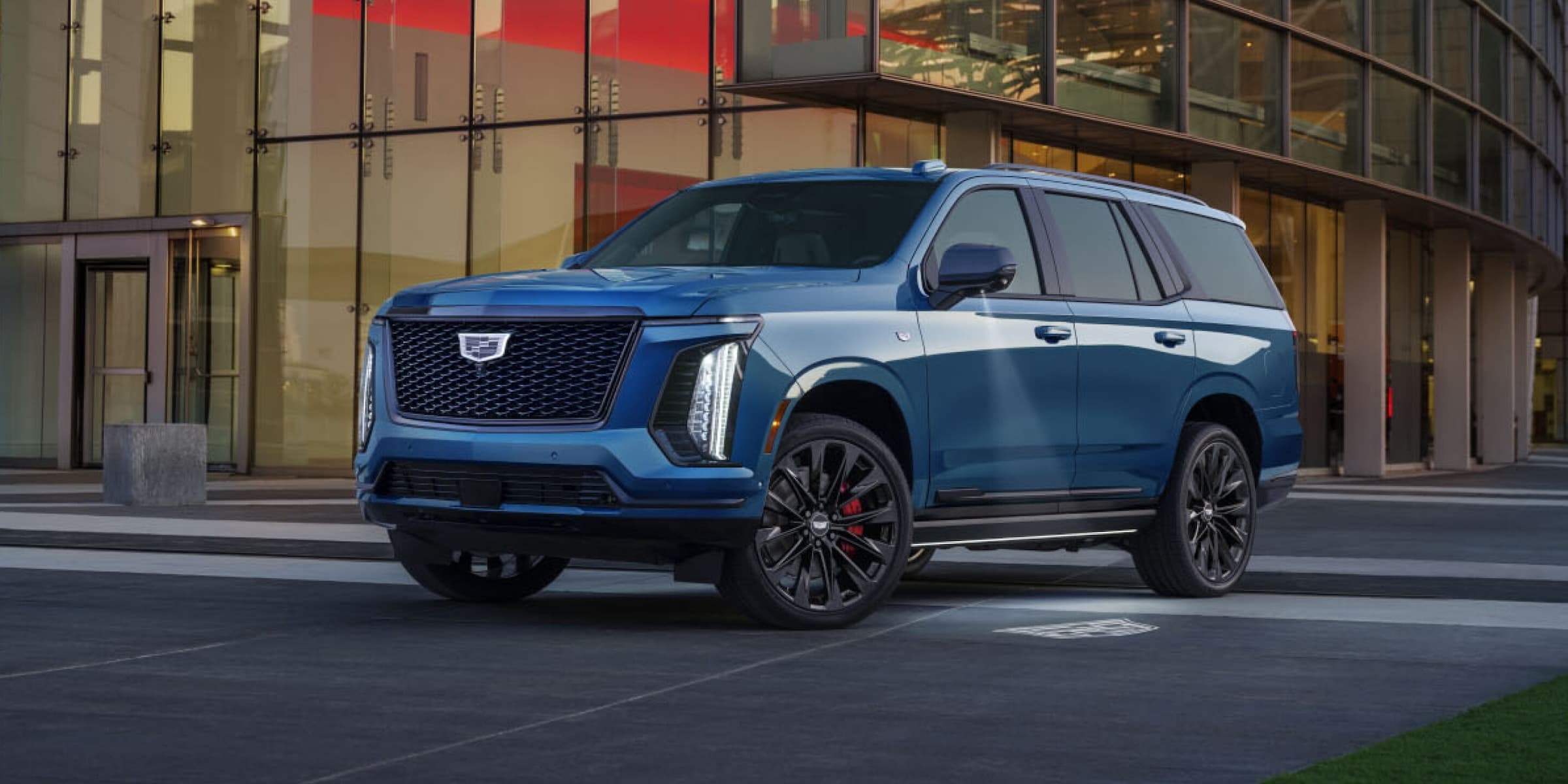
General Motors has officially returned to the UK new car market, although not with a full line-up of brands.
Instead, it has launched a new UK operation called GM Specialty Vehicles, offering a limited range of large American SUVs and pick-up trucks from Cadillac, Chevrolet and GMC through an authorised channel. The company already operates a similar programme in other markets like Australia.
The launch is being handled in partnership with London dealer Clive Sutton, which has considerable experience importing GM models from the US to the UK, and will serve as the first UK retailer for the new operation. A wider network of retailers is planned, though no timeline has been confirmed.
Orders are open now via GMSV.uk, with deliveries expected to begin this spring.
Which GM models are available
The initial line-up covers three brands and ten models:
Cadillac: Escalade, Escalade ESV, Escalade-V
GMC: Yukon Denali, Sierra 1500 Denali, Sierra 1500 AT4
Chevrolet: Tahoe, Suburban, Silverado
All vehicles are supplied directly by GM with full UK homologation – meaning they meet UK legal and technical requirements – although they will only be available in left-hand drive.
The vehicles all come with a three-year, unlimited-mileage new car warranty with two further years of cover available as an optional extra. Official GM finance and aftersales support are also being established, ensuring customers have a complete end-to-end service.
GMC YukonChevrolet Silverado
What this means for buyers
Large American vehicles have always been available in the UK through independent importers, but buyers using those routes have typically faced complications around warranty cover, parts availability and resale value. The GMSV operation removes most of those obstacles by putting GM directly behind the vehicles.
Chevrolet has already offered its Corvette sports car in the UK in an official capacity for the last year, so this announcement builds upon that initial return to the UK market. Cadillac has also been evaluating a formal return with its range of electric SUVs for some time, led by the mid-size Lyriq and the smaller Optiq. These models are not included in today’s news, although they may still be announced later.
Buyers should be aware that all of these vehicles are large by UK standards. The standard Escalade, for example, is over 5.3 metres long. Running costs – particularly fuel – will be significantly higher than mainstream alternatives. Combined with them only being left-hand drive, it’s likely that the market for these vehicles in the UK will be quite small. However, it provides an official outlet for models that have had a niche audience for years but have only been served by independent importers.
More detail still to come
This initial announcement makes no mention of pricing or specifications for the ten new models. GMSV is still building its dealer network, so there is much to come.
The press release describes this as the ‘initial phase’ of GMSV’s UK launch, with the chosen models reflecting existing demand from potential customers. With GM’s vast line-up of brands and models to choose from, there may be more models joining these in time.
After several years of rising motor insurance costs, UK drivers are finally seeing a notable drop in car insurance premiums – but the national averages don’t tell the whole story.
While millions of drivers are paying less than they were two years ago, others have seen their renewal quotes rise. Whether you’re in the good news camp or not depends on your individual circumstances.
How far have prices fallen?
In December 2023, at the end of a post-pandemic period that brought high inflation and supply chain strain, Compare the Market reports that the average annual car insurance payment was £950. Two years later, the average annual cost has dropped to £607 – a 36% fall since 2023 and a 16% drop year-on-year.
Confused.com’s Car Insurance Price Index paints a similar picture, but with a less dramatic fall in average costs. As of November 2025, the company reports that the average annual car insurance cost is £726, which is 13% cheaper than twelve months prior – an £111 saving – and the cheapest average price the index has recorded since March 2023.
The rate at which insurance costs are falling isn’t as dramatic as the rate at which they rose. Prices for new quotes have been declining since all-time highs were reached in late 2023 – almost £1,000 a year according to the Confused.com index – but the fall has been more gradual, and insurance costs are still notably more expensive than they were before prices started to spike in early-to-mid 2023.
Why did my car insurance go up at renewal?
While car insurance is getting cheaper when you look at the UK as a whole, some drivers saw their renewal quotes rise in the last year. Insurers don’t base your quote on the national average. They look at your individual details and external factors out of your control, which is why your costs can rise even while the average falls.
If you’ve received a higher renewal quote, you might assume the insurer is simply betting you won’t look elsewhere. That’s unlikely, because it’s actually illegal. Since January 2022, insurers in the UK are prohibited from charging renewing customers more than they would charge an equivalent new customer.
It’s more likely that your renewal quote rose because:
You’ve changed your car, and your new vehicle sits in a higher insurance group
Previous claims – even those where you weren’t at fault – push your premium up
You’ve changed your occupation, and your insurer views that role as higher risk
Repair costs for your car’s technology are still rising
Car thefts have increased in your area
Don’t simply renew without shopping around – it always helps to look. Confused.com reports that, among drivers quoted a higher price at renewal, 47% switched insurers and saved £87 on average.
British drivers are also cutting costs in other ways. A Financial Conduct Authority survey of 18,000 adults in 2024 found that 15% of British motorists reduced the level of cover on their policy in the period between May 2023 and May 2024. Reducing cover to save money carries its own risks – worth bearing in mind before making that decision.
What’s driving the decline?
Easing inflation
During and after the Covid pandemic, used car prices surged by over 30% according to the Office for National Statistics. Spare parts were also in short supply due to global semiconductor shortages, later complicated by uncertainty surrounding US tariffs.
Thatcham Research reported that newer cars became more expensive to fix due to the rollout of more advanced driver assistance systems, with repair costs rising by over 30% between 2021 and 2023.
Insurers had to price for significantly higher claim payouts – particularly for total loss claims and complex repairs. Now, in 2026:
Used car prices have stabilised
Supply chains have normalised
Parts availability has improved
Repair costs, while still rising, are rising more slowly
With vehicle repair and replacement costs no longer rising at pandemic-era rates, insurers are walking back the emergency pricing adjustments made during the height of post-pandemic inflation.
Market competition
Now that inflation is returning to more normal levels and supply chains are back up to speed, insurers are more willing to compete for your business on comparison websites such as Compare the Market, MoneySuperMarket and Confused.com.
Fewer claims or lower-cost claims
Compare the Market suggests that the fall in prices could partly be due to a shrinking number of insurance claims, with personal injury claims associated with vehicle accidents falling to record lows between July and September 2025.
The UK government’s Civil Liability Act and Whiplash Reform Programme also came into force in May 2021, reducing the value of smaller injury payouts and creating more predictable claims modelling. That may have also contributed to falling premiums, as the government intended.
The Association of British Insurers reports that pressures remain high – its members paid out over £3 billion in car insurance claims in just the third quarter of 2025 (July to September).
Who benefits most?
By age
All age groups have benefited from falling premiums over the past two years, but some have seen bigger savings than others.
Compare the Market reports that the youngest age group – 16 to 24-year-olds – has seen annual insurance costs fall by 34% since late 2023, the biggest percentage drop of any age group.
Despite the fall, young drivers still pay far more than older age groups do, due to the risk insurers associate with younger, less-experienced drivers. The Association of British Insurers reports that this age group is involved in a disproportionate number of fatal and serious injury collisions.
By gender
Insurance providers can’t discriminate based on gender – that’s due to the EU Gender Directive, which came into force in 2012. But men on average pay more for car insurance in the UK, as insurers assess them as carrying a higher risk profile than women on average.
According to Confused.com, prices for both men’s and women’s quotes fell at essentially the same rate from November 2024 to November 2025, so the gap between them remains. As of late 2025, men pay £781 annually on average, while women pay £634.
By region
Car insurance premiums have generally fallen across the UK, but drivers in some regions are seeing larger drops than others – partly because those regions started from very different price levels.
Compare the Market data shows that Greater London has seen one of the sharpest reductions since December 2023, down 37%, but this needs to be viewed in context. London was also one of the regions that experienced the most dramatic premium inflation during the post-Covid cost surge.
London still remains one of the most expensive places to insure a car, with average premiums around £956, while Wales and south-west England are the cheapest regions at £498 and £468 respectively as of December 2025.
The difference in premiums by region reflects long-standing risk factors – including population density, traffic congestion, crime rates and claims frequency – that insurers use when pricing policies.
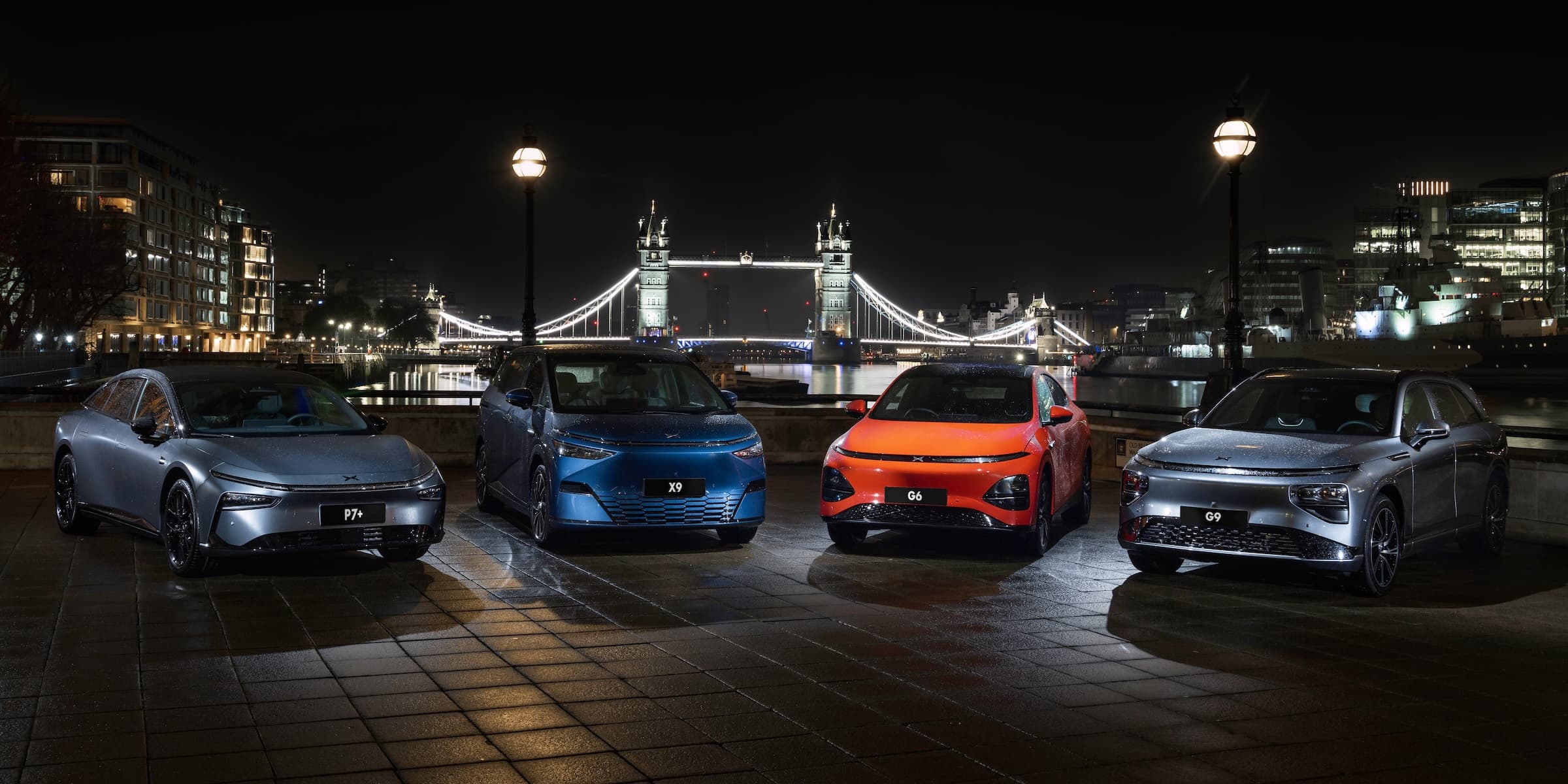
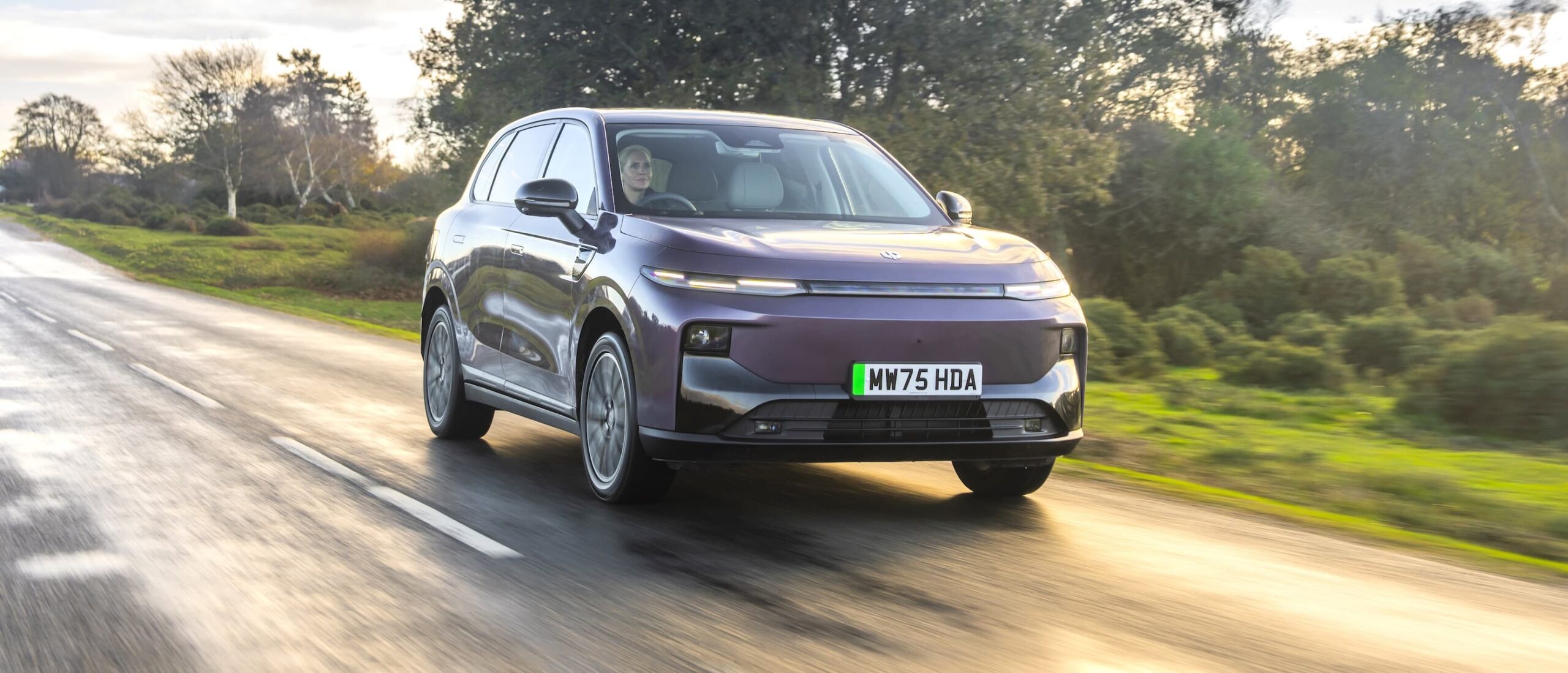
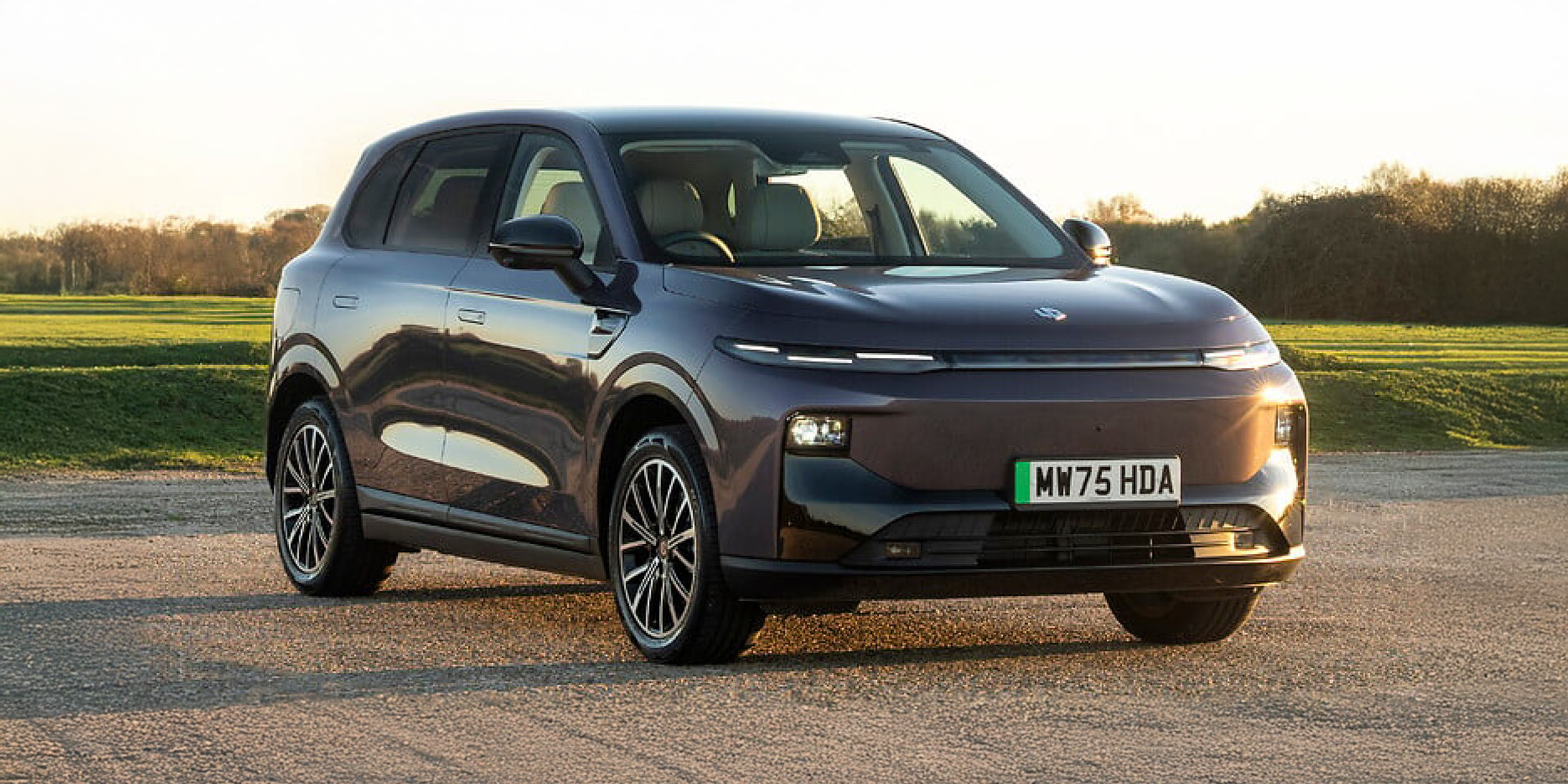
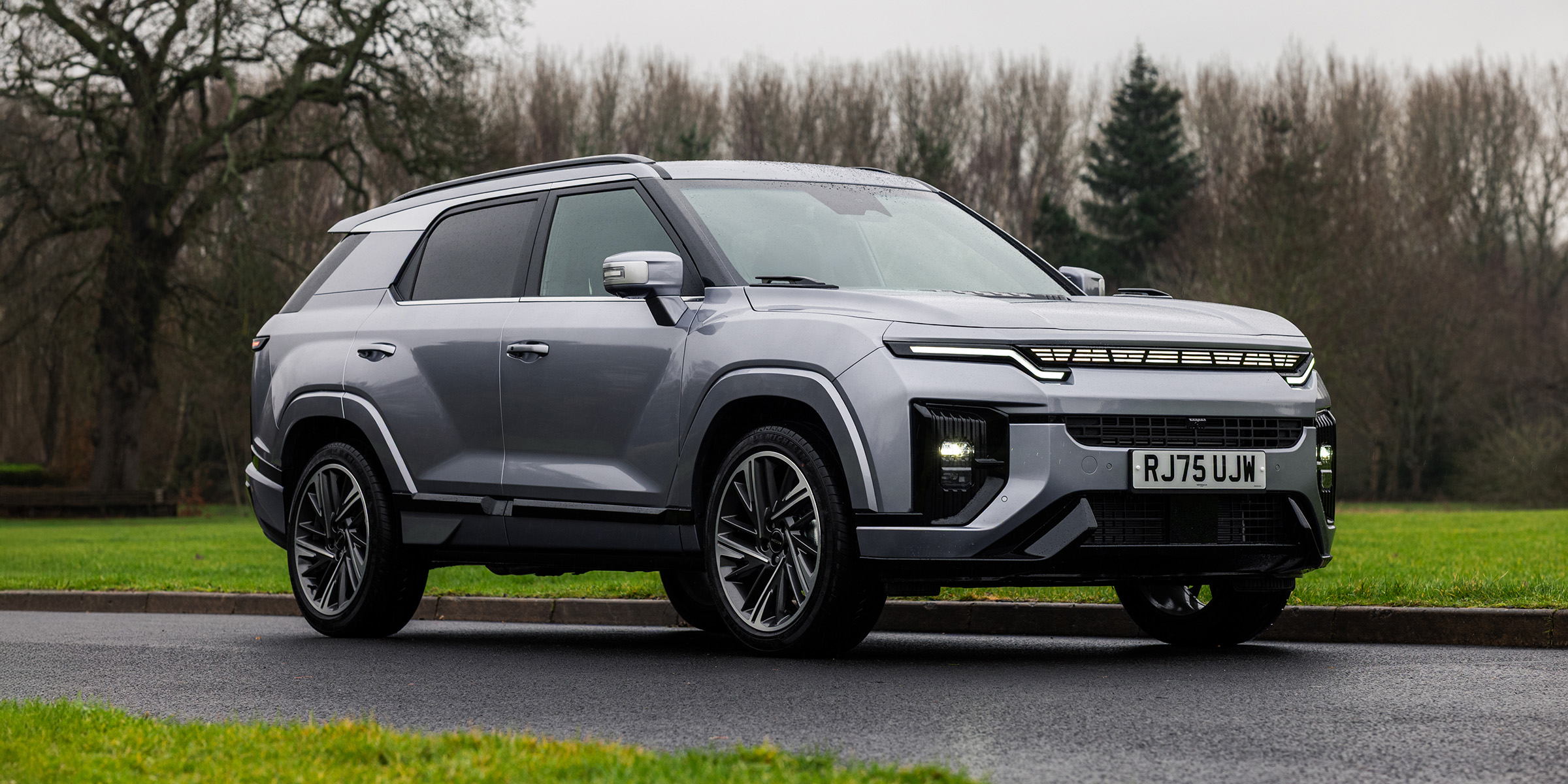
The name on the cars of Xpeng will leave little doubt among most readers that this is the latest of the host of new Chinese brands currently flooding into the UK, but this newcomer claims to be different to most and, in fact, not a typical car manufacturer at all.
Xpeng describes itself as a technology company that also makes cars, and while that might sound like a description of Tesla, the new Chinese brand is confident it won’t experience the same issues currently increasingly afflicting its US counterpart.
A company only in its second decade, Xpeng has grown quickly despite taking a much less aggressive approach than other Chinese brands – its arrival in the UK in early 2025 attracted little fanfare and it has taken a year to get close to selling 1,000 cars.
However, Xpeng has already gained a reputation for the quality of its tech with heavy investments in such areas as driver-assistance systems and self-driving cars. This is one brand that appears well placed for the direction in which new cars are moving.
Xpeng was founded in 2014 by two executives of GAC, Guangzhou Automotive, the fifth-largest Chinese automotive group. Both were experts in technology, research and development, and from the start the company was focused heavily on high tech, focusing on mobility as a whole rather than just vehicles. By the time it launched its first car, the G3 SUV in 2018, Xpeng’s US subsidiary had gained a permit to test self-driving cars in California.
The company quickly grew in its home market, while several funding rounds over the next few years expanded Xpeng’s capital and research and development. Major advances came in 2021 with a five times increase in car sales, adding a third more staff in the R&D department and entry into Xpeng’s first overseas market, in Norway. Today, the company is in 60 markets, including 26 countries in Europe, and has built a production plant for its European cars in Graz, Austria.
Technological innovations included the P5 saloon of 2021 – its driver-assistance systems were the first in a production car to employ laser-based LIDAR sensors, offering a number of advances over conventional systems including the ability to read traffic lights.
A further major move in 2023 saw Xpeng enter a partnership with Volkswagen, the German giant spending $700 million to acquire almost 5% of the Chinese maker. The two now jointly develop Volkswagen models for Xpeng’s home market and are collaborating over the development of new technology for their cars.
Today, technology remains front and centre of Xpeng’s DNA – the company mantra is quoted as “Technology is the game changer for future mobility, shifting focus from horsepower to brainpower.”
Xpeng argues that in the electric world, horsepower is easy because electric motors are far superior to conventional engines – now it is all about brainpower, how the car provides technology not just to the driver but all of the occupants. It is particularly making the most of opportunities offered by AI, autonomous intelligence.
Among technological achievements, the company has developed an autonomous driving system called XPILOT, which has actually rendered LIDAR sensors out of date, Xpeng replacing the LIDAR systems in its model range with XPILOT. There is even an Xpeng humanoid robot called Iron, who we are told will be helping to sell the brand’s cars in Chinese dealerships before the end of 2026.
One of the most recent Xpeng advances is a driver-assistance system specially developed to navigate narrow streets, launched in early 2026. Xpeng intends to make this system available to other makers, with Volkswagen models likely to be some of the first vehicles fitted with it.
When did Xpeng launch in the UK?
Xpeng launched its UK operation in February 2025, signing up with the long-established IM (International Motors) group, which also looks after the interests of Subaru, Isuzu, GWM and the returning Mitsubishi.
The company is taking a steady and evolutionary approach to its growth in Britain, in contrast to other Chinese brands that have aggressively chased rapid sales growth by setting up large dealer networks.
What models does Xpeng have and what else is coming?
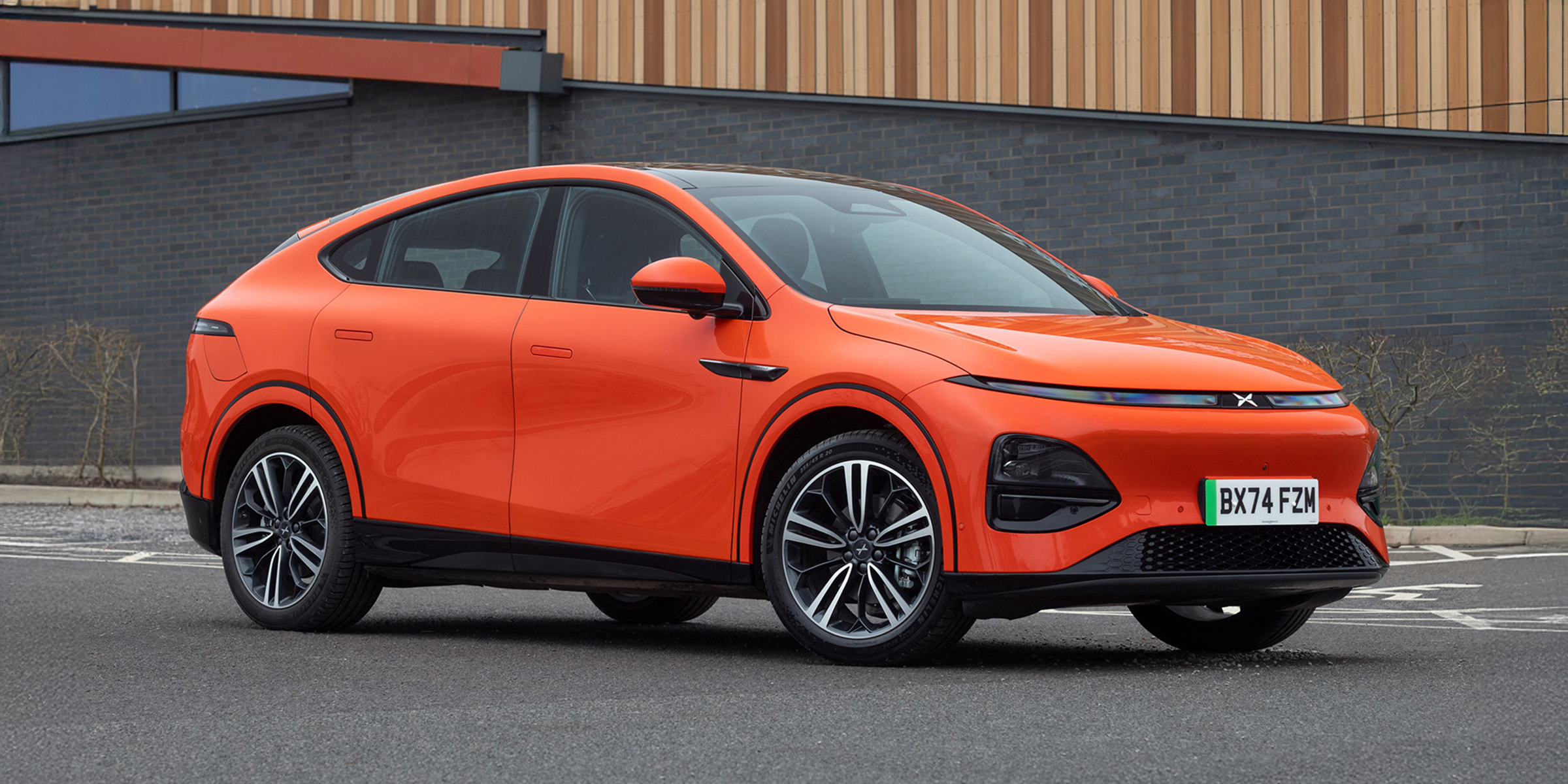
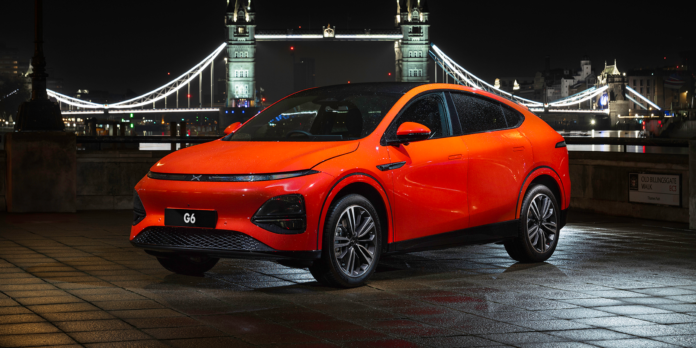
Xpeng’s UK sales have so far relied on a single model – the G6 is a mid-sized electric crossover targeting the likes of the Tesla Model Y. Initial reviews of the G6 have been generally positive, highlighting its quality build and intuitive technology, particularly the driver-assistance systems that are less intrusive than rival systems but still very effective – the car has earned a top five-star safety rating from Euro NCAP.
Despite being on UK sale for only a year, the G6 was facelifted in early 2026 – among a claimed 20,000 changes were updates to the interior, a larger touchscreen and improvements to the voice assistant. Most pertinently an all-wheel-drive dual-motor Performance version with a sub 4.1-second 0-62mph time is now available to UK customers for the first time.
Coming next will be the X9, which is a seven-seat people carrier. Despite UK buyers having fallen out of love with MPVs in favour of SUVs over recent years, the model is said to be highly popular globally, particularly for large families. Xpeng executives have described the sleek-looking machine as “styled like a starship” and it is expected to challenge the likes of the Kia EV9.
What will follow remains open to speculation. While saying more models are on the way “in different market segments”, Xpeng is again bucking the trend by not indicating what type or how many new cars it will produce in future years, though we are told that the first of the additional models will launch before the end of 2026.
Industry sources suggest that the third Xpeng offering in the UK may be the G9, a mid-sized SUV already sold in Europe, with two more cars coming before 2028.
Where can I try a Xpeng car?
Xpeng has not taken the route of several of its Chinese counterparts by aggressively signing up dealers for its UK adventure, arguing that it needs more than one model on sale first to ensure its dealers make enough money.
As of February 2026, a year after launch, the company has only 17 UK showrooms, and management say they will be adding “potentially another seven or eight” to fill gaps in coverage across the country – particularly in cities and the southeast. The intention is that 80% of UK residents will be able to reach an Xpeng showroom in 45 minutes to an hour.
The brand considers its aftersales and service outlets more important, arguing that once they have bought a car customers’ main contact with Xpeng will be through aftersales – currently there are 24 outlets which the company says gives it national coverage.
What makes Xpeng different to the rest?
Xpeng is basing its image on its technology and making the most of how technological advances can be employed in its cars – from making them safer both for occupants and those outside the car to future-proofing them against future advances.
While every car manufacturer is now producing more technological product than ever before, Xpeng believes it has an advantage in focusing on technology first and sharing all of its innovations across all the sectors it works in, from cars to robots.
An Xpeng fact to amuse your friends
Xpeng has turned a transport holy grail from science fiction to reality – the company has built a flying car.
The ‘Land Aircraft Carrier’ is a van-sized six-wheeled EV. From within it emerges an electric two-seat aircraft, a bit like a drone but big enough to carry people and sized, according to Xpeng, to fit into a standard car parking space.
This is no concept; prototypes are testing in China and Xpeng says it has 7,000 orders for them with first deliveries planned for the end of 2026 – senior management in China have even been told to get pilot’s licences.
Summary
Among the unprecedented and confusing choice of new electric cars now available to UK buyers, mainly as a result of the influx of Chinese brands, it would be easy to overlook Xpeng. The name might be considered overly cheesy by some, or the company’s evolutionary approach lost in the shadow of the more in-your-face marketing of rivals.
Xpeng merits a look, however. The Car Expert has driven both the original and updated G6 and while the car lives up to its makers’ claims to be a technology-led company, the tech is not allowed to get in the way of the basic things one needs from a vehicle, such as ease of use, a comfortable ride and plenty of space… This is a new brand worth keeping an eye on.
From 1 March 2026 to 31 August 2026, all new cars in Great Britain will have 26-reg number plates (eg – XX26 XXX). The system changes every six months, so the next change (76-reg) will be 1 September 2026.
“What do the letters and numbers on a number plate mean?” is a question we have been asked many times over the years.
The current number plate system in Great Britain has been around since September 2001. Northern Ireland has its own system that is quite different, but here we’re concentrating on the GB system (England, Scotland, Wales).
We’re also not going to discuss any of the previous number plate systems before 2001. The numbering system has changed several times, so maybe we’ll look at previous systems another time.
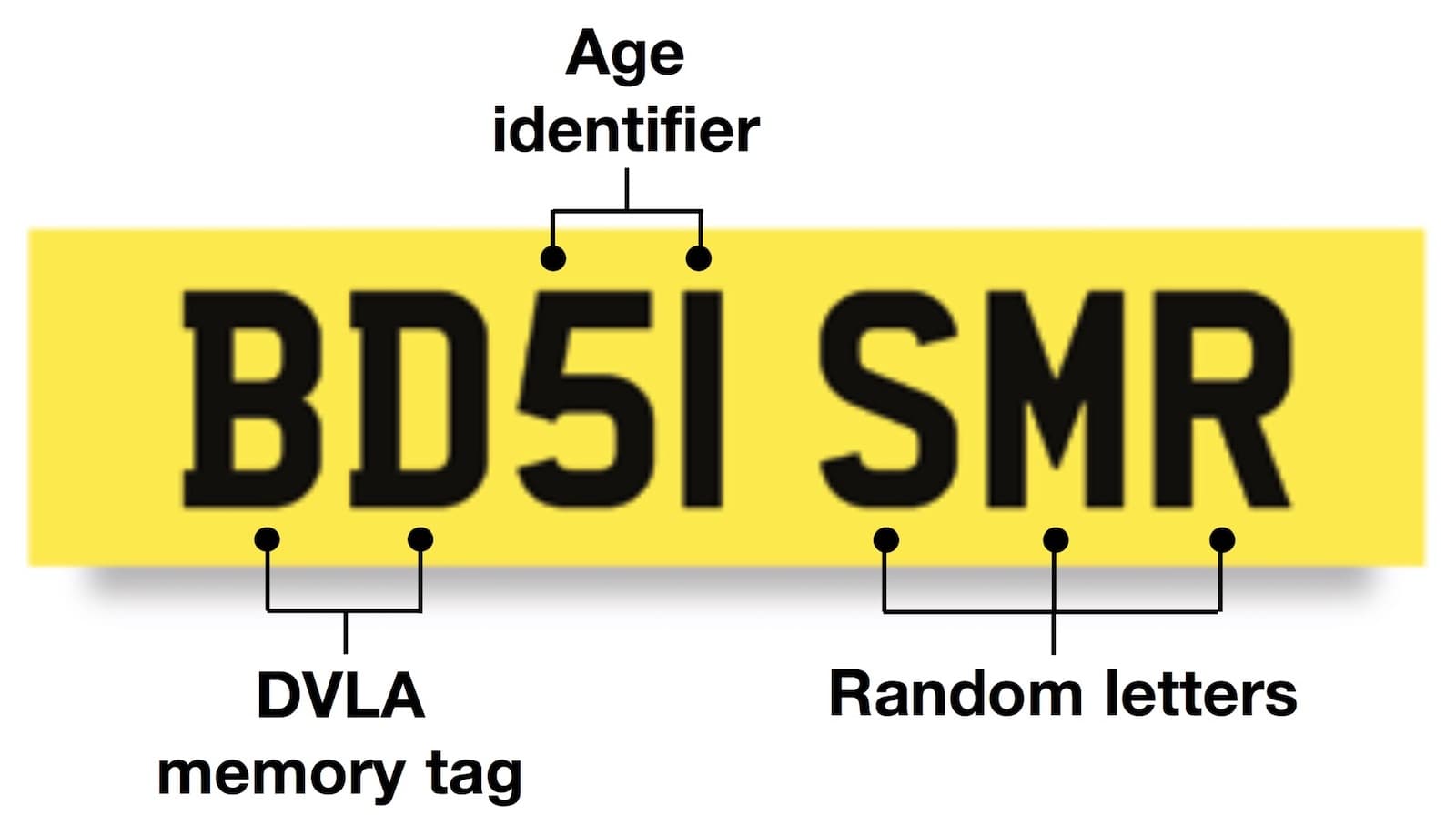
Current British number plates are arranged in the format of two letters, followed by two numbers, followed by a space and then three letters (eg – XX26 XXX) as shown below.
Prior to Brexit, you could have a blue vertical strip (known as a ‘flash’) down the left side of the plate, with the EU logo and the letters ‘GB’ underneath. These are no longer available for new cars, but are still perfectly legal if you already have them fitted to your current car.
You can, however, display either a Union Flag or a national flag (England, Scotland or Wales) where the EU logo used to be, along with identifier tags underneath (eg – UK, GB, ENG, SCO, CYM).
Electric cars can display a green flash down the left side of the plate, which we explain in detail below.
Image (c) DVLA
The first two letters show where the car was first registered
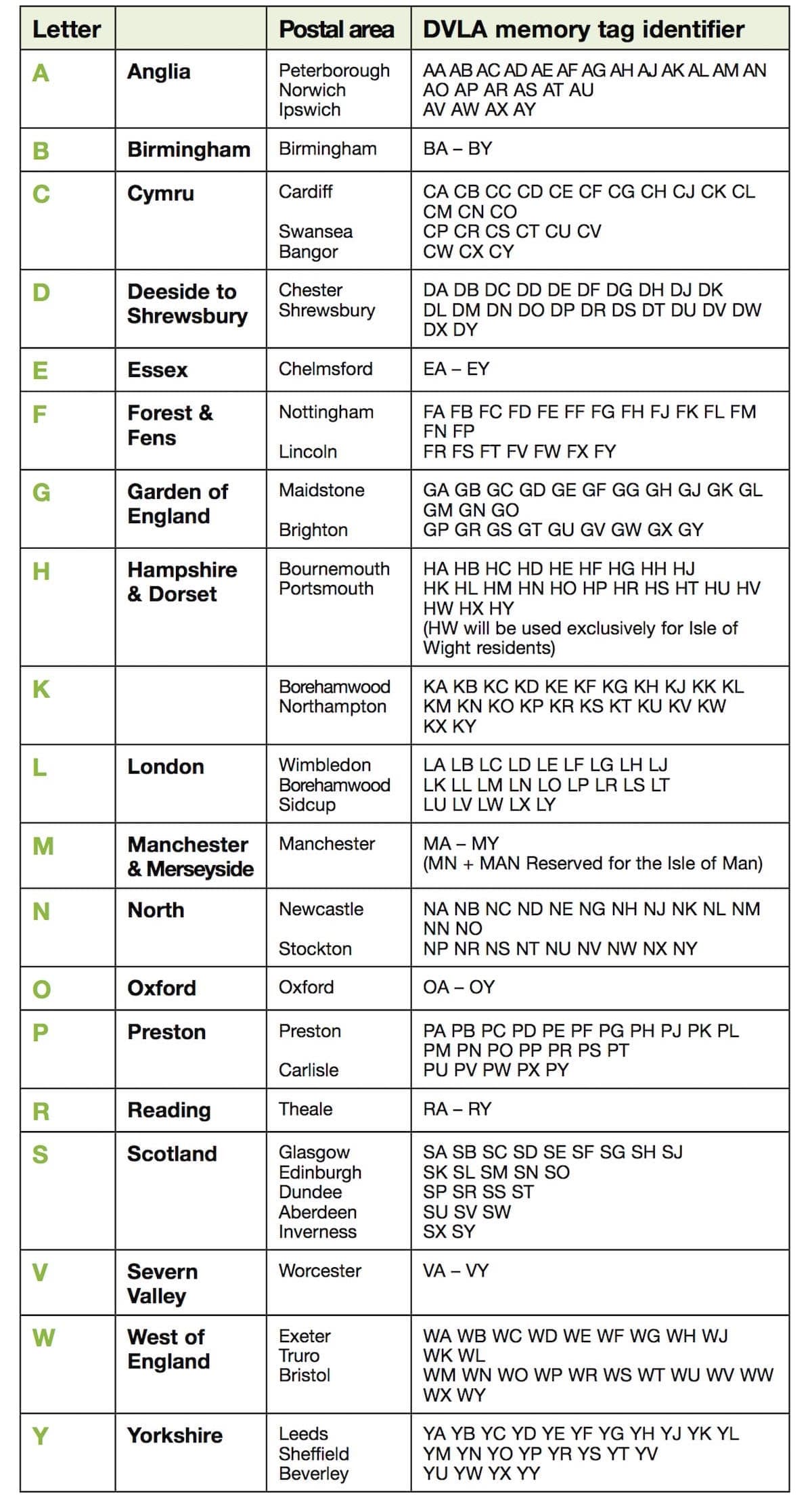
The first two letters are called a ‘memory tag’, which is DVLA-speak for a location identifier for where the car is first registered. This used to be determined by the DVLA office where the registration took place, but the DVLA closed all its regional offices in 2013 and now handles new registrations directly with car dealerships through an online system.
Even though the system is now centralised, dealers still tend to be allocated registration numbers that reflect their region, so (for example) if you are buying a new car from a London dealership, you will almost certainly be allocated a number plate starting with an L.
Other regions of England have their own letter codes; Yorkshire-registered cars start with the letter Y, Hampshire-registered cars start with an H, and so on. If you’re buying a new car in Scotland, it will almost certainly start with an S. For cars registered in Wales, it will start with a C for Cymru.
If you look closely at the list below, you will see that the letters I, Q and Z are not used in any of the two-letter memory tags. This is to avoid any confusion – the letter I could be mistaken for the number 1, the letter Q could be mistaken for the letter O or number 0, and Z could be mistaken for the number 2.
The list of memory tags / location identifiers. Image (c) DVLA
The numbers show when the car was first registered
The two numbers are called the ‘age identifier’, which tells you in which six-month period the car was first registered. This system is unnecessarily confusing, but you eventually get your head around it.
The numbers change every six months, in March and September. The March codes are easy to remember as they follow the year of registration (so a car registered between March and August in 2026 has the number 26, a car that was registered between March and August 2005 has the number 05, and so on.).
For cars registered between September and February, it’s slightly more complicated. The numeric code equals the year (as of September) plus 50. So a car registered from September 2026 until February 2027 will have the number 76 (= 26 + 50). A car registered in September 2006 – February 2007 has the number 56 (= 06 + 50), and so on.
This means that a car registered in 2026 could have a number plate with any of 75, 26 or 76 on it, depending on which month it was registered. Yes, it’s ridiculous.
In theory, this system will run until February 2051, unless a future government changes it before then.
Yes, there should be more numbers on this list but apparently the DVLA is just as lazy as you’d expect. Image (c) DVLA
The last three letters are random
The last three letters are officially random. In practice, dealerships are allocated batches of registration numbers, so your local dealer will probably have a run of consecutive letter combinations. When they have used up all of that allocation, they will be assigned another batch. So it’s not technically random, but close enough.
Again, the letters I and Q are not used because they can be confused with 1 and O, although Z is apparently fine for this section of the number plate.
The DVLA withholds any combinations that may be considered offensive or sweary – we won’t give you any examples, but you can use your imagination…
Personalised number plates are a whole different story and are not covered here but, again, the DVLA will censor anything it considers inappropriate or offensive.
What does the green strip mean on some number plates?
You may have seen that some cars now have a green flash on the left of the number plate, in the same place where the blue EU identifier used to be. This is an identifier for electric cars, introduced in late 2020 (70-plate cars).
The purpose of the green flash is to allow authorities to easily identify electric cars, which may be eligible for cheaper parking, priority parking or use of specific lanes, exemptions from taxes like London’s Ultra Low Emission Zone, and so on.
It’s not compulsory to have these “green plates” on your electric car if you don’t want to shout about it, but uptake seems to be increasing as EVs become more popular.
It’s possible to have an ‘old’ number plate on a ‘new’ car, as the DVLA sells number plates that it thinks have a high commercial value. So you could put a ’56’ plate (Sept 2006 – Feb 2007) on a new 2026 car if you like. This is fairly common with people trying to make words out of their number plate, or owners trying to conceal how old their car really is.
However, you can’t have a newer number plate code than the one allocated for that car’s date of registration. So you couldn’t put a ’26’ or ’75’ plate (which are 2026 plates) on an older car, to reverse the example above.
When you change cars, you are allowed to keep your number plate if you don’t want to have to remember a new number every time you change your car. It simply involves giving the DVLA an unnecessarily large amount of money, filling in an unnecessarily large amount of paperwork and waiting an unnecessarily long time for them to get around to processing it…
It’s illegal to use different fonts or to space the letters in any way other than as illustrated above, despite the fact that thousands of car owners do it. It’s also illegal to alter the digits or strategically use mounting screws to make the plates look like they read something different. Again, this is poorly enforced and the fines are paltry.
Why does Britain have such a pointlessly complicated number plate system?
Well that’s a different question, but it very often follows the original question of “How does the system work?” Beats me, but I guess it gives a lot of civil servants in Swansea (where the DVLA is based) something to do…
This article was originally written in September 2012 and was most recently updated in February 2026 to coincide with the 26-plate festivities.
One of the big issues that is always raised about EVs is a lack of driving range compared to a petrol or diesel car, but are we thinking about this in the wrong way?
It’s no secret – and a lot of noise gets made about the fact – that EVs will not go as far on a full charge as most ICE (internal combustion engine) cars on a full tank. This has given rise to what’s known as range anxiety – the fear that if you’re driving an EV, you’ll run out of electricity somewhere and be stranded by the side of the road.
We’ve become used to the idea that when we fill up with petrol or diesel, we can expect to drive for around 400 miles (or more than 500 in some diesel models) without having to stop at a petrol station. By comparison, the average battery range for new EVs on sale in the UK ranges between 230 and 300 miles, with many higher-end EVs now offering over 400 or even 500 miles on a full charge.
But, hang on. Is 400 miles really necessary? It’s unlikely that you would drive for 400 miles – the distance from London to Edinburgh – without taking at least a few decent breaks or even an overnight stop. In day-to-day driving, running your fuel tank all the way down until the warning light comes on is also a bad idea.
So how much range do we actually need in our cars?
We really don’t drive as far as we think we do
You might be surprised by a few government statistics that show how we really use our cars here in the UK. In fact, the government has an entire page devoted to challenging common misconceptions about EVs (you’ll like this if you like spreadsheets).
Over the nearly 20 years leading up to the Covid-19 pandemic (2002 to 2019), the average car trip made in England in 2019 was consistently about 8.4 miles, according to the Department for Transport. The average trip distance fell to 5.7 miles in 2021 during the pandemic, but bounced back up to 8.4 miles by 2024 as driving habits returned to normal.
In addition to the above, the data reports that the average number of trips taken is less than two a day, which is consistent across the UK. That means the average daily distance travelled is about 15 miles, which works out to less than 100 miles a week.
On top of all that, the Department for Transport reports that 99% of all journeys in England are less than 100 miles. When you consider all of this data, it clearly shows that most drivers’ needs can easily be met by an EV without the fear of running out of electricity.
For those travelling further, there are now plenty of models available with a quoted 300-plus mile range, with some models offering 400 miles or even more – so equivalent to a petrol car.
Working out roughly how many miles you drive in a year is a useful exercise before you choose an EV, but it’s also helpful for any car to get your car insurance quote at the right price, or if you’re about to lease a car.
How often would I need to charge?
With each listing for a new or used EV, our Expert Partner Autotrader presents a ‘How often will I need to charge’ tool which allows you to choose an annual mileage from 4,000 to 30,000 miles and home charging (two or three voltages depending on the car) and public charging (50kw rapid or up to 350kw ultra rapid). It will then estimate how many hours you would have to charge that car each week. Anyone can use it, even if they’re not buying.
Let’s work through some examples. If you drive 100 miles a week (52 weeks is accepted as the average in a year) that’s only 5,200 miles a year. Let’s be generous and take that up to 8,000 (154 miles a week).
As an example of a low-range EV, we input the pint-sized BYD Dolphin Surf city car, which can muster up to 137 miles of travel on a full battery in its entry-level guise. The answer is four hours a week on a normal home charger (22kW) or one hour a week on a rapid public charger (100kW).
On the opposite end of the size scale, the large seven-seat Kia EV9 SUV with an official battery range of 349 miles came in at five hours a week (bigger battery to charge) on a fast home charger (22kW) and an hour a week on a 350kW ultra-rapid charger.
However, when it’s cold the range of an EV suffers, as we have explained in this feature. This is well-known and shouldn’t come as a surprise to EV owners – even the manufacturers are up-front about it. With improving technology this will get better, but you will have to charge more often in winter.
Thinking differently about charging
The majority of EV owners to date have a home with off-street parking and a home charger installed. It’s the best-case scenario for EV ownership – you don’t have to make a detour to fill up as you would with a petrol or diesel car because you’re going home anyway. You can plug it in when you get home, leave it alone and find it fully charged the next time you need to go for a drive.
Many such EV owners have never had to use a public charging point. Just imagine never handling a mucky petrol pump or standing in a queue to pay ever again.
For those who don’t have the ability to charge at home, an EV can still be perfectly capable of meeting your needs. It does require a shift in thinking, but it’s not usually a major hassle.
The key difference is that public charging is more expensive than home charging, so choosing where to charge can make a significant difference to your running costs. As a rule, the faster the charger the more it will cost to use.
We might think we need all of the range in a petrol or diesel car, but most drivers don’t run the tank down to empty before filling it up again. And plenty of others don’t ever fill the tank, instead choosing to add £20 or £30 at a time. So the reality is that people tend not to fill up with 400 miles of fuel in one go at a petrol station anyway.
It’s not too much of a jump to transfer that idea to an EV: top up the charge while you have parked the car to go and do something you would do anyway. There are more places to do this than there are petrol stations – places like supermarkets, gyms, railway station car parks, cinemas, restaurants, or even pubs. You don’t lose time and the car’s always topped up.
As we explain in this feature, it’s called destination charging. If you have a street charger near your flat/house, you can leave it alone charging in the same way as driveway people can.
Beat the long-distance dread
If you’ve not done one, long trips, especially involving motorways, can seem daunting in an EV. But unless you drive as part of your job, you probably don’t do a long journey (over 100 miles) as often as you might think (and it’s worth noting that many high-mile company car drivers are happily in EVs).
Yes, on occasional long-distance trips you may have to use a charger at a motorway services, but you can anticipate this. We all know not to set off on a motorway trip with a thimble of petrol in the tank: you just shift that thinking to an EV. A bit of planning isn’t difficult using an app such as Zap-Map to see where you could stop, how many chargers there are and whether they are working and available.
Motorway charging isn’t really a waste of time. Whatever fuel is powering their car, on a long trip everybody needs a break for safety and for comfort at least every two hours. Given that you’ll probably want to eat something, have a coffee, visit the bathroom or simply stretch your legs, that can easily take 45 minutes to an hour (especially if you’re travelling at a busy time).
If you’d have plugged your EV into a fast charger during that time it would likely be back up at 80% or more. Public charging stations are gaining quicker and quicker charging options that newer cars are compatible with too.
Just a couple of years ago the premium option was charging at 150kW or 175kW, now Gridserve reports that over 80% of motorway services have multiple 350kW-capable chargers. 350kW charging isn’t twice as fast as 175kW charging as you might think, but usually shaves five to ten minutes off the waiting time.
Yes, charging at motorway services is the most expensive option, but remember, you’re not going to do this very often, and you’re not being stung on cost any more than the petrol and diesel drivers filing up at the same services at an extortionate premium.
If you’re still uneasy about long EV trips and if you’re lucky enough to have two cars in your household, swap one for an EV for day-to-day driving and keep a petrol or diesel car for longer trips. Plenty of people do. You can shift to fully electric in the future when the cars, their ranges and the charging opportunities will only have got better.
And here’s an even more radical thought. A long drive in any car in the UK can be a bit traffic-clogged and a bit miserable. If you don’t have masses of bags for a holiday, why not take the train?
The future is accelerating
EV technology is running at a frantic pace because it has to. Petrol and diesel cars have had over a century to get as good as they are now, but even in the last 20 years EV progress had eclipsed this.
In 2009, the Mitsubishi i-MiEV city car was the first truly mass-market electric car and could manage 80 miles on a full charge, the much larger (with much larger battery) Tesla Model S only arrived in 2012 (300 miles).
Now we can expect a Fiat 500e city car to have an official driving range of 199 miles, but big range still means big batteries in big expensive cars. By 2021, the gold standard for battery range was the Mercedes-Benz EQS, which musters up to 453 miles – but the price starts at more than £100K.
Moving into the mid-2020s we’ve recently seen another dramatic shift in the battery tech that underpins the newest battery-powered models – the mainstream adoption of more advanced 800V architecture.
While older 400V architecture remains the standard for EV options on the more budget end of the market, 800V enables significantly faster charging (350kW and faster) and is more energy efficient, which means that you can squeeze more travel distance out of the battery.
800V model examples include the new Volvo EX60 and BMW iX3 SUVs, which can handle up to 503 miles and 500 miles without recharging respectively.
Huge battery tech advances are announced by brands jostling for consumer attention and industry accolades, and the innovation is by no means over. In summer 2023, Toyota announced that it believed it could make a solid-state battery with a range of 745 miles as early as 2027. Offering roughly double the energy density of current lithium-ion batteries and much faster charging times, solid-state batteries have the potential to be game-changing for all-electric motoring.
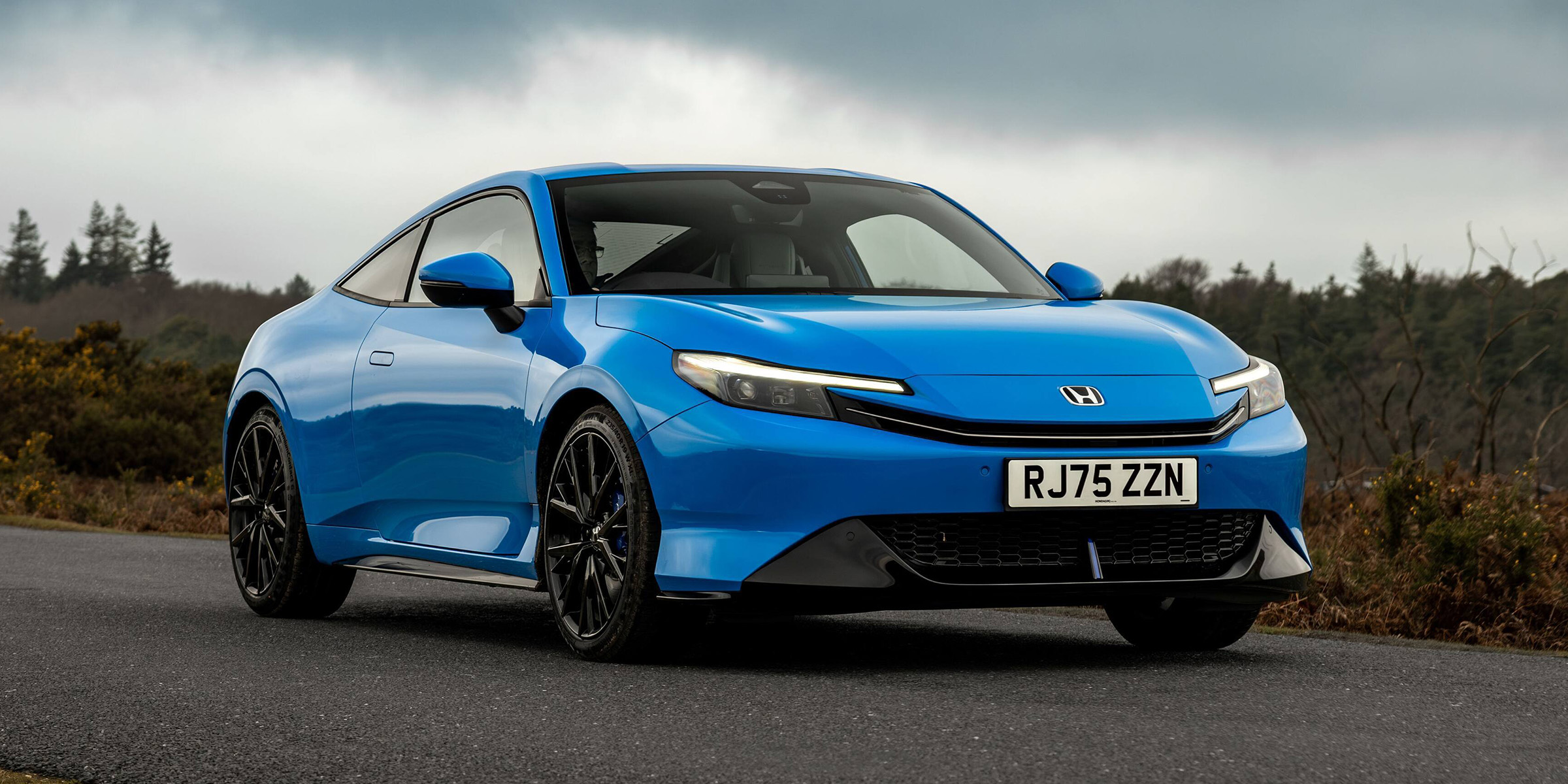
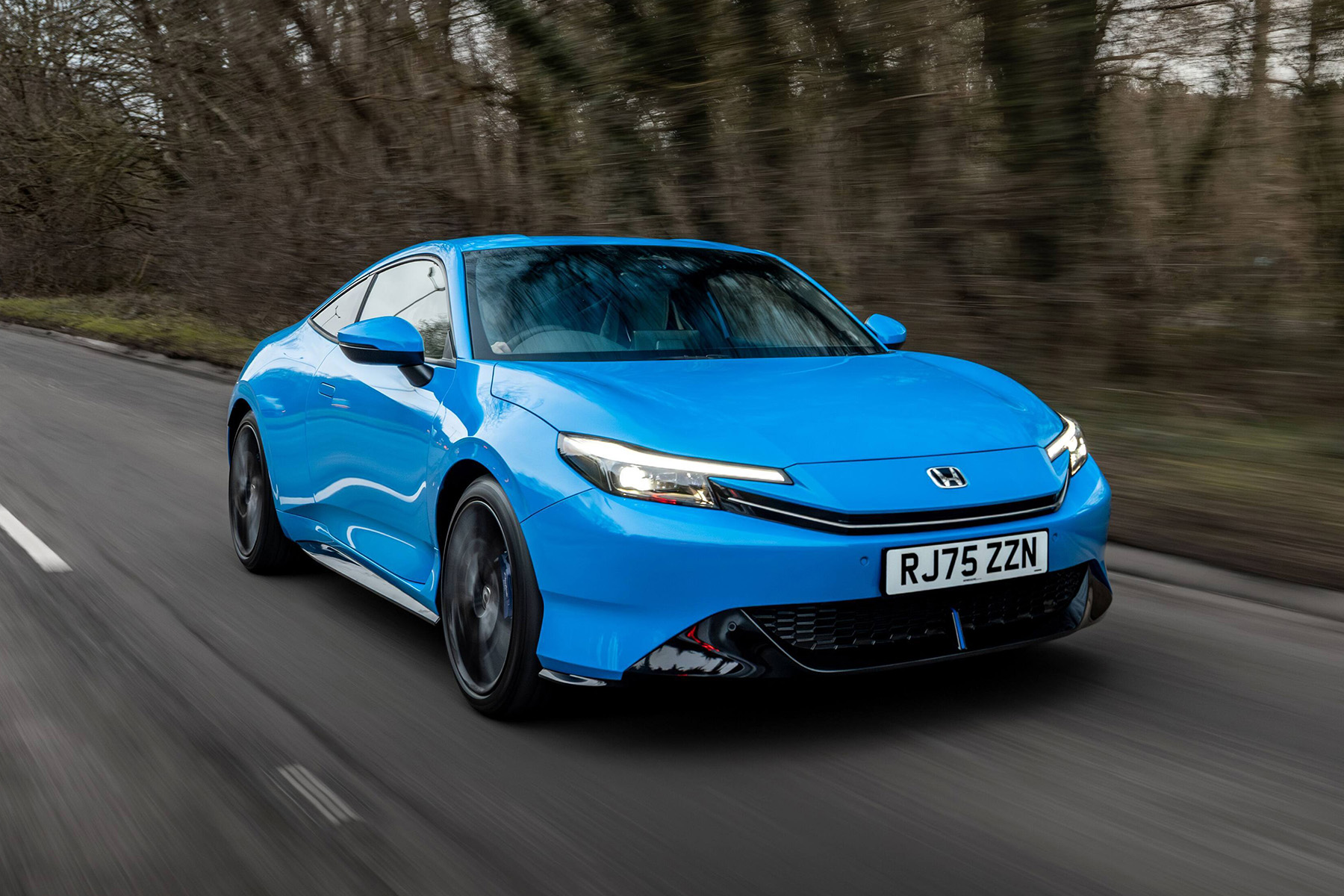
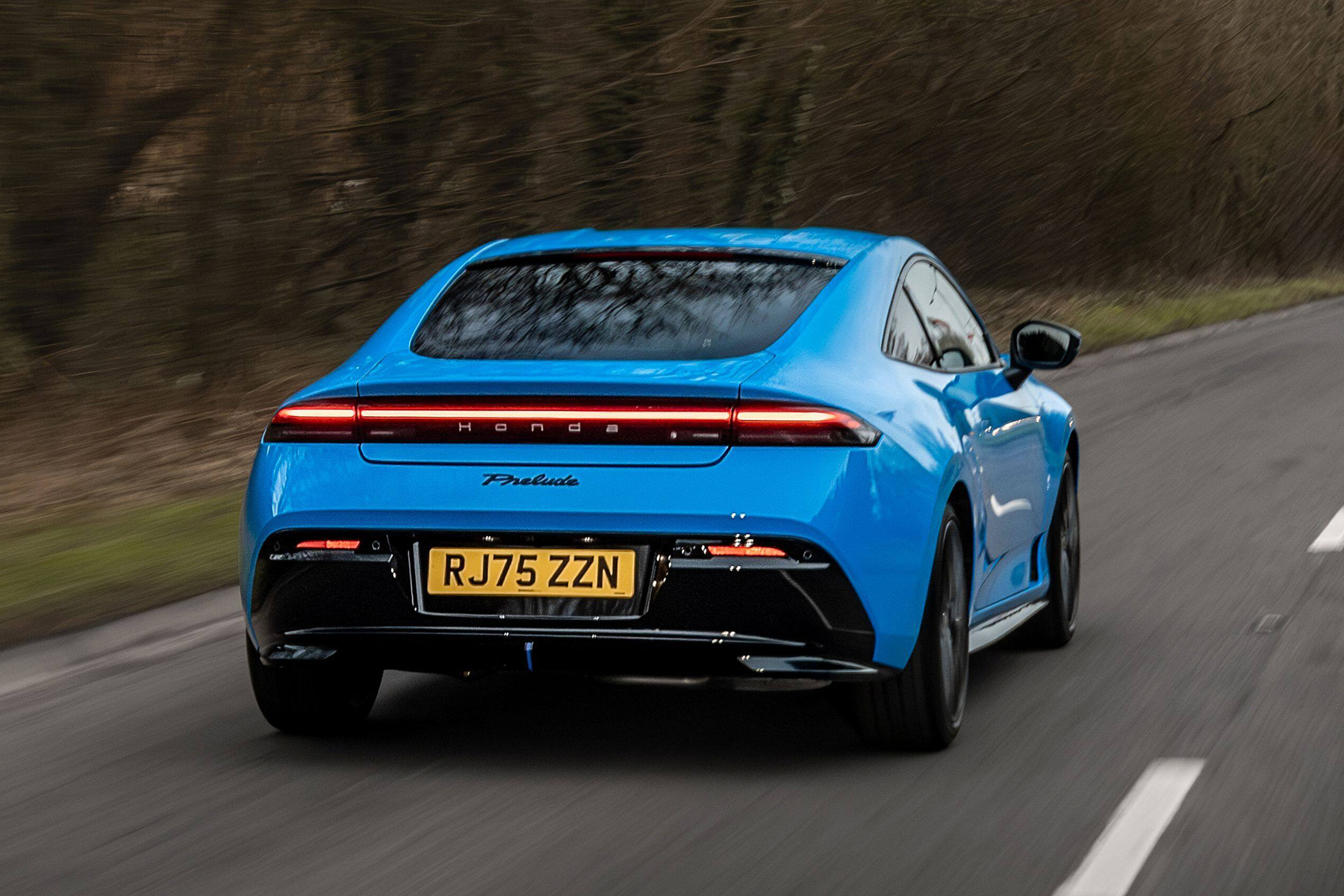
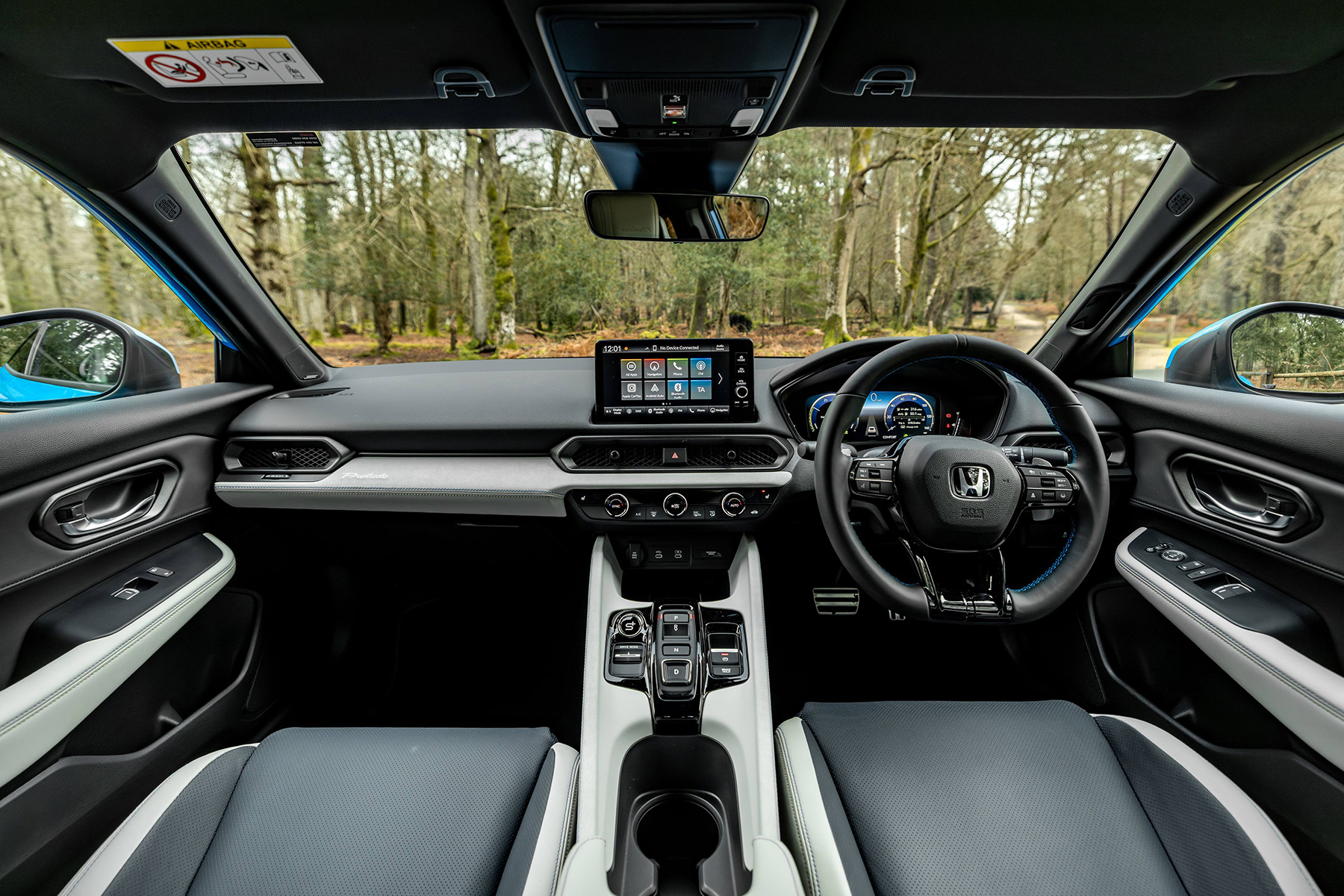
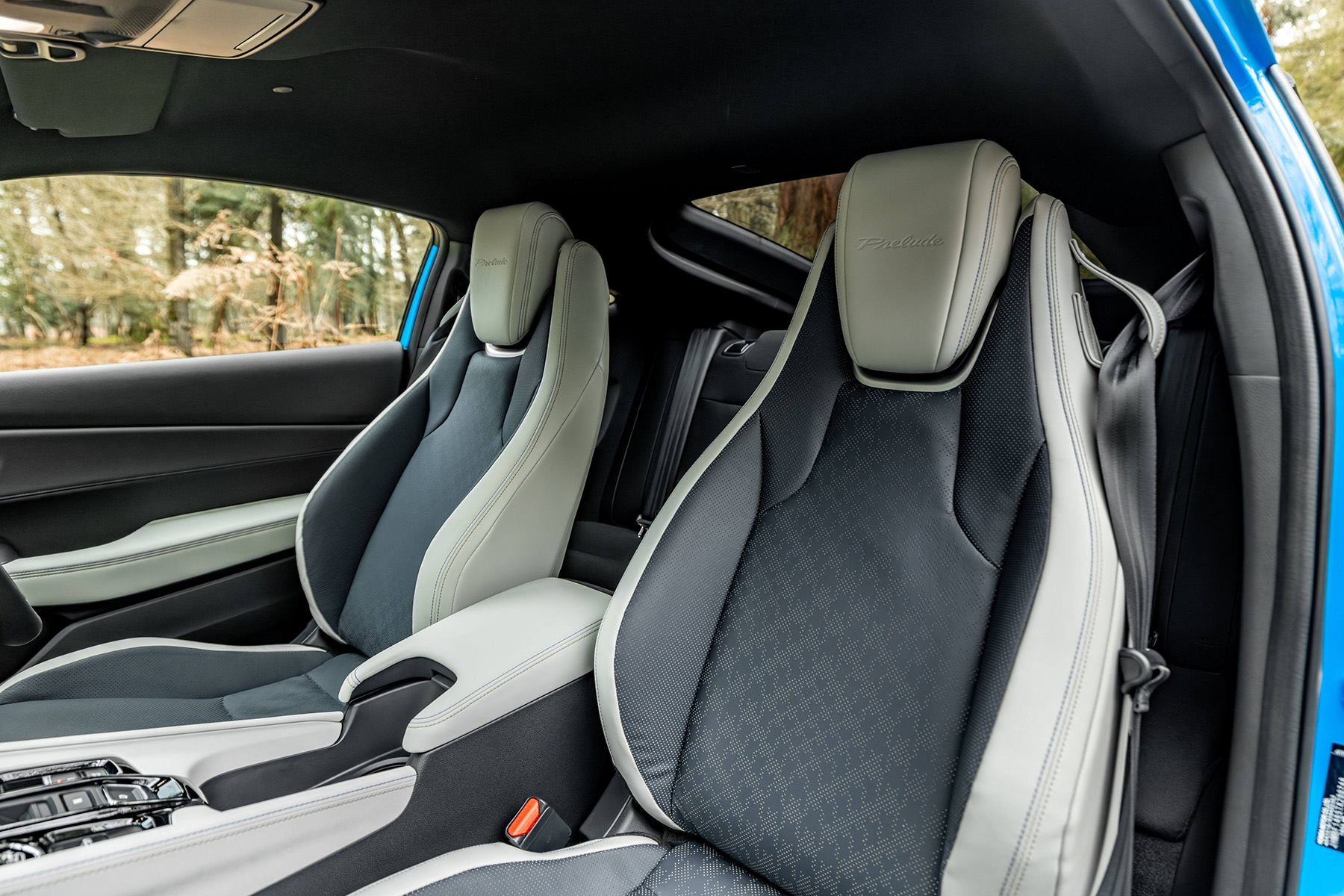
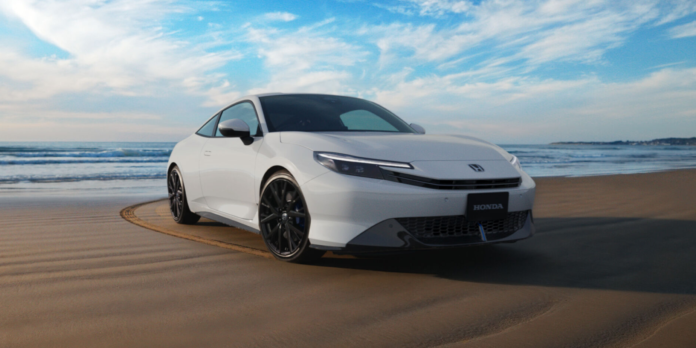
Sharing its name with Honda sports cars of the 1980s and 1990s, the Prelude is a petrol-electric hybrid coupé that first arrived on UK roads in early 2026.It joins a small field of three-door coupé models on sale in the UK, competing against the Alpine A110 and BMW 2 Series Coupé.
Powered by the same hybrid engine as the current iteration of the Honda Civic, the Prelude has picked up plenty of reviewer praise for its composed and agile driving dynamics, as well as its handsome exterior design, but those same reviewers found the car’s performance rather underwhelming.
“If you’re after a fun weekend toy, you’ll be better served elsewhere”, explains Tom Jarvis of Auto Express. The prelude can complete a 0-62mph sprint in just over eight seconds, which isn’t particularly fast by modern sports car standards.
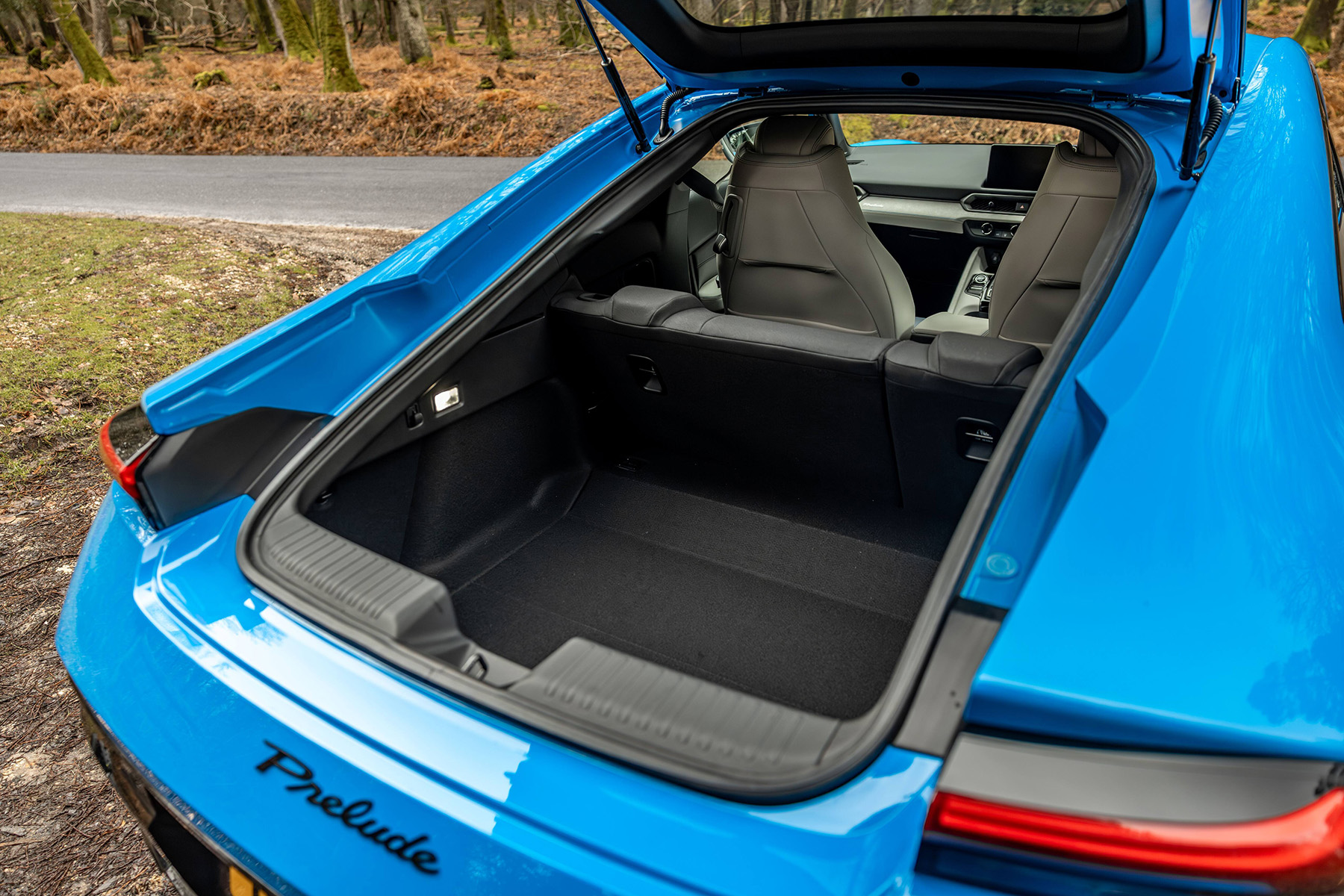
“It’s not quick, rear space is tight, and the price is on the high side”, concludes Parker’s Keith Adams. “But if you’re after something elegant and different that still loves a good road, the Prelude deserves a place on your shortlist.”
Although the Prelude is now available to order in the UK, and there are a number of UK-based reviews published on the model, we are holding off on giving the coupé a full Expert Rating score for the moment. We will update this page in the coming weeks once we receive running cost estimations for the model. Check back soon!
“The new Honda Prelude ticks so many of the coupe boxes; eye-catching looks, superb handling, and just enough practicality to make it easy to live with every day. However, the hybrid powertrain takes the shine off what could otherwise have been a superb, relatively attainable performance car.”
Score: 7 / 10 “The new Honda Prelude is certainly stylish, efficient and fun to drive, but we fear the enthusiasts it plays to may be put off by the sluggish automatic ‘gearbox’ and lack of outright performance.” Author: Dan Trent Read review
Car
Model reviewed: Range overview Score: 8 / 10 “It fits perfectly within the lineage of Preludes that came before it – elegant, intelligent, and just a little contrarian. For those who take the plunge, it will likely prove a long, rewarding relationship rather than a fling.” Author: Keith Adams and Tim Pollard Read review
Heycar
Score: 8 / 10 “The returning Honda Prelude is far from conventional as far as sports cars go, using a modestly powered hybrid powertrain and ‘fake’ gears. It works better than you might imagine, though, and the handling is brilliant.” Author: Matt Robinson Read review
Honest John
Model reviewed: Range overview Score: 8 / 10 “In its revived Honda Prelude, the Japanese brand has taken a very unconventional approach to building a sports car and just about pulled it off. You’re only occasionally left wanting for a bit more power but more importantly its handling is brilliant.” Read review
Parkers
Model reviewed: Range overview Score: 8 / 10 “The Prelude is a welcome addition to the market, and one that’s both in keeping with Honda’s engineering and efficiency-led ethos. It’s a new coupe in a market that’s sorely lacking in options – and for that alone, its maker should be applauded. That it’s also rather good makes it all the more satisfying.” Author: Keith Adams Read review
Top Gear
Model reviewed: Range overview Score: 8 / 10 “Embrace it for being willfully different, as well as meticulously engineered, interesting to look at and precise to drive.” Read review
Safety rating
Independent crash test and safety ratings from Euro NCAP
No safety rating
As of February 2026, the Honda Prelude has not been assessed by Euro NCAP.
Eco rating
Independent economy and emissions ratings from Green NCAP
No eco rating
As of February 2026, the Honda Prelude has not been assessed by Green NCAP.
Running cost rating
Monthly cost of ownership data provided exclusively for The Car Expert by Clear Vehicle Data
No data yet
As of February 2026, we don’t have independently verified data available for the Honda Prelude. Check back again soon.
Reliability rating
Reliability data provided exclusively for The Car Expert by MotorEasy
No reliability rating
As of February 2026, we don’t have enough reliability data on the Honda Prelude to generate a reliability rating.
The Car Expert’s reliability information is provided exclusively to us using workshop and extended warranty data from our partner, MotorEasy, sourced from both official dealerships and independent workshops.
As soon as MotorEasy has sufficient data on the Prelude, we’ll publish the results here.
Warranty rating
New car warranty information for the Honda Prelude
Overall rating
C
50%
New car warranty duration
3 years
New car warranty mileage
60,000 miles
Battery warranty duration
8 years
Battery warranty mileage
100,000 miles
Honda’s new car warranty is fairly boilerplate, and similar to what’s offered rival brands in a similar price bracket as the Prelude.
The duration is three years, with a limit of 60,000 miles. In addition to the standard new car warranty, this hybrid coupé has an eight-year/100,000-mile warranty for the battery components.
As of February 2026, we are not aware of any DVSA vehicle safety recalls affecting the Honda Prelude. However, recall information is updated regularly, so this may have changed.
You can check to see if your car has any outstanding recalls by visiting the DVLA website or contacting your local Honda dealer.
Polestar is a name that has popped into the conscious of many car buyers over the last few years, establishing itself in the UKwith its electric Polestar 2 car and plenty of advertising on social media. So where has it come from?
It’s one of a number of spin-off brands that have come from existing car makers – in this case, Volvo. The diversification of the automotive market has gathered pace in recent years as established manufacturers have launched new brands that are related to, but sit apart from, their parent maker.
This has been going on for a long time – Toyota set up Lexus as a luxury brand more than 30 years ago – but has been accelerating over the last decade. Often, but not always, this has been connected to the shift to electric cars.
In addition to Toyota creating Lexus, we have also seen Nissan setting up Infiniti (which has come and gone from Europe), Hyundai creating Genesis, Citroën spinning off its DS models into a separate company called DS Automobiles, SEAT creating a sporty Cupra brand which then effectively replaced its parent and Volvo doing a similar thing with Polestar.
Never heard of Polestar? For many years the name was a badge hung on Volvo’s higher-performance models, but in 2017 it headed in a new direction, as a standalone sister brand that would market distinctive electric vehicles (EVs).
So far Polestar has launched three mainstream models with more on the way, taking a slice of the upper end of the electric market previously dominated by Tesla.
So who or what is Polestar?
Polestar is actually a bit older than its association with Volvo. It dates back to a Swedish racing team called Flash Engineering in the 1990s, which was subsequently rebranded as Polestar. The name comes from pole star, which refers to the North Star that was used for navigation by Vikings in Scandinavian history.
As Polestar’s relationship with Volvo became more formal, the company began to offer uprated performance versions of Volvos known as Polestar Performance models. In 2015, Volvo went the whole hog and bought Polestar.
Polestar produced its own concept versions of Volvo models as early as 2010 but the first standalone model, the limited-edition Polestar 1, was unveiled in 2017. At the same time the brand revealed its plans to build a new reputation as a distinct marque making performance electric models under its own badge, using Volvo’s manufacturing clout but no longer carrying Volvo branding.
More recently Polestar has experienced the growing pains familiar of several upmarket spin-off brands. In 2025 the company sold around 60,000 cars around the world, but this was not enough with the company recording heavy losses. Some of its earlier distinctions, such as only selling cars online, have been abandoned.
It was a better story in the UK, however, with Polestar sales almost doubling in 2025, and used models also proving popular. The Polestar 4 proved a big hit, with customers seemingly not deterred by its lack of a rear window.
In a bid to boost those global sales numbers closer to 100,000 annually Polestar will double its model range over the next few years. But while many manufacturers are rolling back on all-electric futures and adding new plug-in hybrid models to their ranges, Polestar management have confirmed that it will remain an electric-only brand.
When did Polestar launch in the UK?
The first evidence of Polestar as a standalone brand in the UK came in 2019 with the opening of a research & development department in Coventry. But the first retail outlet, known as a ‘Space’, did not launch until October 2020 in the Westfield shopping centre in West London.
Initially Polestar took a similar route to Hyundai’s upmarket brand Genesis, by not having a traditional dealer network but showrooms called ‘Spaces’ where customers could view a car and arrange a test drive. While showroom staff could assist with selection and purchase, the actual buying was done direct with Polestar, online.
However, again like Genesis, Polestar has realised that such an approach does not really work in the UK and in more recent times has opened a modest network of dealer outlets.
What models does Polestar have and what else is coming?
There have been four Polestar models so far, though the first doesn’t really count. The Polestar 1, with which the brand launched itself in 2017, was a plug-in hybrid GT coupé boasting more than 600hp. It was sold for only little over a year and in small numbers – and only in left-hand drive – and was actually based on an old Volvo concept car.
The three cars launched so far have all been well received, reviewers particularly liking their minimalist interior treatments – all enjoy Expert Ratings of A on The Car Expert‘s industry-leading Expert Rating index.
The Polestar 2 built the brand’s reputation as a mainstream car maker. It’s a mid-sized five-door electric car with crossover styling, similar in size and price to the Tesla Model 3. Reviews contributing to its New Car Expert Rating of A with a score of 73% generally rate the Swedish car better for build quality than the Tesla, but without the huge charging network the rival car offers.
The Polestar 2 underwent a major upgrade in 2023 before the Polestar 3 arrived in 2024. Company management claimed that the twin-motored SUV offers bags of interior space for sports car styling and performance. While reviews question the second part of that claim, particularly the innocuous driving experience, they agree it stacks up well against family SUV rivals.
The Polestar 4 also went on sale in 2024. Another performance SUV designed to fit between the 2 and the 3 in both size and cost, it immediately created headlines for its lack of a rear window, replaced by a rear-view camera. This enabled a change to the body shape freeing up more rear-seat space.
The Polestar 4 has since assumed the mantle of the brand’s best-selling model. Reviews tending to describe it as “good but not thrilling” have not put off customers and it now outsells all its direct rivals except the Tesla Model Y. As of February 2026 it also enjoys the best Expert Rating score of the Polestar range – a New Car Expert Rating of A, with a score of 75%.
Polestar plans to double its model range in the next few years, partly to address those recent losses. The first to arrive, in 2026, will be the long-trailed Polestar 5. This is a large four-door described by its makers as a ‘performance GT’ – it has two motors and will go on sale at prices starting from around £90,000.
Not far behind the Polestar 5 will be an estate version of the Polestar 4, hoping to add an extra element to the 4’s most popular model status. Reports suggest that when it launches it will assume the Polestar 4 moniker with the existing model becoming the 4 Coupé.
The next-generation Polestar 2 is now due to arrive in 2027, earlier than originally planned, and in the following year there will be a Polestar 7, a compact SUV and effectively a sharper-styled version of sister brand Volvo’s EX60.
Sharp-eyed readers will notice a missing number – the Polestar 6 was announced some time ago as a future cabriolet model, but it’s slipped down the company’s pecking order and is not likely to appear until at least 2028.
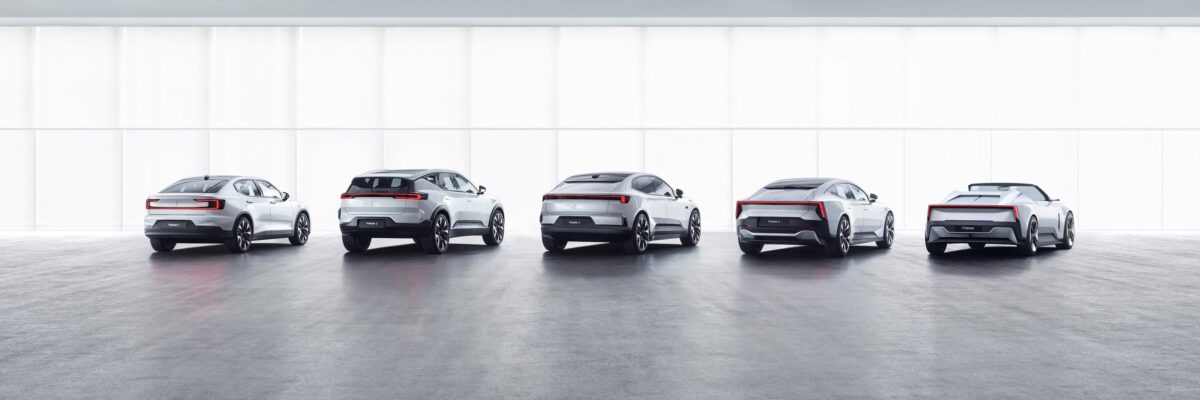
Polestars 2 to 6
Where can I try a Polestar car?
At the time of the brand’s launch Polestar made much of its ‘direct to customer’ approach, with the idea being that rather than making use of a traditional dealer buyers could carry out the entire car choosing and purchase process online. There were six physical locations – not showrooms but ‘Spaces’.
Now the brand has completely reversed that decision, deciding instead that it does need a dealer network – currently there are 15 outlets spaced around the country with many adjacent to existing Volvo outlets, in particular giving Polestar customer access to long-established aftersales services.
The number will likely increase slightly to no more than 20, with potentially some of the initial ‘Spaces’ in shopping centres making way for traditional dealers.
What’s particularly significant about this company?
Polestar is heavily into sustainability, basing much of its promotion around environmental concerns. When it launched the company even announced that by 2030 it will be producing “the first truly climate neutral car” – which means it will eliminate all emissions in the car’s manufacture and operation, rather than taking the route of other manufacturers of planting trees to offset the emissions produced making cars.
Recently, however, this date has been be rolled back as it’s proving difficult to eliminate emissions throughout the supply chain – now the laudable aim is planned to happen by 2040.
Then Polestar boss Thomas Ingelmath, announcing the ‘design towards zero’ Polestar 0 project in 2021, dismissed carbon offsetting as “a cop-out”, adding that while the electric cars don’t produce tailpipe emissions in operations (electric production is another story, of course), the task now is to completely eradicate such emissions from production.
Ingelmath’s successor Michael Lohscheller has continued in similar vein, recently stating that despite being part of Geely and having access to very up-to-date hybrid technology, Polestar will remain electric-only, because its customers believe in climate change and believe the company is taking the right direction.
What makes Polestar different to the rest?
While Polestar has always tried to present itself as different to the average car maker, one distinction has been less positively embraced.
The brand has a major tie-up with software giant Google for its in-car operating system, which goes above and beyond familiar systems like Android Auto. You get three years of internet connectivity through an 11-inch touchscreen display when you buy a Polestar and access to a range of Google apps and services – you even get a full-blown web browser called Vivaldi.
But there have been two criticisms. Firstly, Google is well known for sucking a huge amount of usage data from users in any devices where its products are used, meaning you’ll constantly be sending Google info about where you are, what you’re doing, how fast you’re going, and so on.
Secondly, in the early years there was no support at all for Apple users. In summer 2022, a workaround version of Apple CarPlay was added, and in June 2023, Polestar finally announced a proper integration for Apple iPhone users through Apple CarPlay. More recent models such as the Polestar 4 now offer full-blown wireless Apple CarPlay.
Polestar has argued that its tie-up with Google will ensure its cars’ connectivity “remains as cutting edge in future as it is today”, but it’s certainly been contentious, and the company has been forced to realise it cannot ignore an Apple app so widely used in today’s cars.
A Polestar fact to impress your friends
Polestar expanded quickly in Europe after launching in 2017 but for several years there was one country that you couldn’t buy the cars – France. It was all down to the new company’s badge – Citroën complained that the design, which employs two chevrons, was too close to the French maker’s famous double-chevron logo.
The dispute ended up in court with the French firm winning, and not until the dispute was finally resolved in 2022 could Polestar launch in France.
Summary
Polestar is trying hard to establish its credentials as a brand known for its next-generation technology. Autonomous motoring is firmly in its plans, on top of its sustainability and environmental commitments. Most buyers, however, will want to simply know if the cars are any good, which will govern how familiar the brand comes.
The brand claims that UK sales are buoyant – being directly compared with Tesla is a definite bonus, even if the Swedish interloper has not flooded motorway service areas with its own charging systems. While globally going through growing pains, Polestar has established itself in the UK and looks as if it’s here to stay.
The Xpeng G6 is an all-electric mid-sized SUV, and its arrival marks the debut of Chinese marque Xpeng in the UK. First unveiled in 2023, the model launched in the UK in Spring 2025.
Described by Neil Briscoe of Auto Express as “verging on being desirable” and by James Morris of Which EV? as “the start of something special”, reviewer opinion on the G6 varies but is largely positive – the SUV collecting a solid set of UK-based review scores and favourable comparisons to established rivals.
“”The Xpeng G6 is like a Tesla Model Y with the benefit of hindsight”, says Steve Fowler of The Independent, “bettering its big rival in many key areas especially quality and comfort – and on price.” Parker’s Ted Welford agrees, explaining that the G6’s interior is “generally easier to work with.”
The Top Gear team commended the car for its comfort and space, but concluded “this is not a car for involved drivers”, as the G6 offers a more tech-led experience than most of the long-standing carmakers currently offer.
As of February 2026, the Xpeng G6 holds a New Car Expert Rating of A, with a score of 76%.
Model reviewed: AWD Performance Score: 7 / 10 “Can you improve an EV by making its battery smaller? It would seem so, as the updated XPeng G6 feels more convincing than the original version, and the rapid Black Edition model is verging on being desirable. The cabin quality has been improved, and the charging experience is remarkable. It just needs to be more fun to drive.” Author: Neil Briscoe Read review
Model reviewed: Range overview Score: 8 / 10 “First XPeng to arrive in the UK sets a high bar for what’s to come; competitive and decent value, the XPeng G6 is a worthy rival to the Tesla Model Y.” Author: Richard Ingram Read review
Business Car
Model reviewed: Long Range, Single Motor Score: 8 / 10 “The Xpeng G6 appeals to the head rather than the heart, with its long, reliable range, fast charging, comfortable and specious interior, plus what great value it is compared with rivals. Where the G6 package falls down is on the move. It is a tidy enough drive, but the Renault and Skoda offer more. “ Author: Martyn Collins Read review
Car
Score: 8 / 10 “Xpeng has tried its hardest to keep up with the very best in what is possibly one of the most crowded classes of EV right now, and has mostly succeeded. The G6 is smooth, refined, spacious and well built – making it more than competitive enough against Tesla’s Model Y. Is it perfect? No. It’s also as bland as a Model Y to look at (perhaps even more so) and far from the most interesting thing to drive but offers it plenty else besides.” Author: Jake Groves, Ted Welford Read review
Carbuyer
Model reviewed: Range overview Score: 8.4 / 10 “The XPeng G6 is good to drive, boasts a spacious interior and is well equipped, so you shouldn’t discount it on the basis of never having heard of the brand before. Despite generic styling and some fiddly infotainment, XPeng is clearly hoping to make an impact with the G6, and a competitive warranty should also help sweeten the deal.” Author: Charlie Harvey Read review
Green Car Guide
Model reviewed: RWD Long Range Score: 9 / 10 “The Xpeng G6 takes things to the next level. The driving experience has a genuinely premium feel, it has a long range, ultra-rapid charging, lots of space, and the latest technology. And all that for under £40,000 for the G6 RWD Standard Range model, and under £45,000 for the G6 RWD Long Range model, meaning that the G6 is priced more competitively than many rivals. Author: Paul Clarke Read review
Heycar
Model reviewed: Range overview Score: 7 / 10 “XPeng’s first venture into the UK market is, in many ways, an impressive one. The Chinese firm has delivered a slick, premium SUV with a well-built and comfortable interior, at a price that undercuts many rivals. It’s decent value for money if you can live with its flaws.” Author: Phill Tromans Read review
Parkers
Model reviewed: Range overview Score: 8 / 10 “It’s not the best electric SUV you can buy, but we prefer it to the hugely popular Tesla Model Y. It feels better-built, is more comfortable and its interior is generally easier to work with.” Author: Ted Welford Read review
Regit
Model reviewed: Range overview Score: 7 / 10 “The Xpeng G6 is yet another excellent value-for-money EV from China that will be gaining plenty of traction thanks to its style, kit, handling and asking price.” Read review
The Independent
Score: 9 / 10 “The Xpeng G6 is like a Tesla Model Y with the benefit of hindsight, bettering its big rival in many key areas especially quality and comfort – and on price. It shows that Xpeng could be Tesla’s biggest challenger yet.” Author: Steve Fowler Read review
Top Gear
Model reviewed: Range overview Score: 6 / 10 “It pushes the human into the background. If you’re happy to feel like you’re being transported, that’s fine. This is not a car for involved drivers.”
Author: Paul Horrell Read review
Which EV?
Model reviewed: Range overview Score: 8 / 10 “The Xpeng G6 has definite promise – if the price is right. It has a strong sense of quality and a high level of technology, with good range and performance plus practical space for passengers and cargo. With more models coming from the brand over the next couple of years, this could be the start of something special. But the G6 will face plenty of competition, particularly from Tesla’s market-leading Model Y.” Author: James Morris Read review
Safety rating
Independent crash test and safety ratings from Euro NCAP
Independent economy and emissions ratings from Green NCAP
No eco rating
As of February 2026, the Xpeng G6 has not been assessed by Green NCAP.
The Green NCAP programme measures exhaust pollution (which is zero for an electric car) and energy efficiency. Electric cars are much more energy-efficient than combustion cars, so the G6 is likely to score very highly in Green NCAP testing if and when it takes place. Check back again soon.
Running cost rating
Monthly cost of ownership data provided exclusively for The Car Expert by Clear Vehicle Data
Battery range
Average
Score
Variation
Score
EV models
312 miles
A
Electrical efficiency
Average
Score
Variation
Score
EV models
3.6 m/KWh
D
Insurance group
Average
Score
Variation
Score
All models
44
E
The Xpeng G6 is a relatively expensive car to own and run, according to whole-life cost numbers provided exclusively to The Car Expert by our data partner, Clear Vehicle Data.
While the car’s average battery range of 312 miles (ranging from 270 to 354 miles) is competitive in the medium SUV class, the Xpeng is predicted to sit in a high insurance bracket. Many close rivals, such as the Ford Explorer and Volkswagen ID.4 are estimated to be cheaper to insure. That is possibly due to Xpeng’s unknown reliability record. That said, the Tesla Model Y is predicted to sit in an even higher insurance bracket.
Reliability rating
Reliability data provided exclusively for The Car Expert by MotorEasy
No reliability rating
As of February 2026, we don’t have enough reliability data on the Xpeng G6 to generate a reliability rating.
The Car Expert’s reliability information is provided exclusively to us using workshop and extended warranty data from our partner, MotorEasy, sourced from both official dealerships and independent workshops.
As soon as MotorEasy has sufficient data on the G6, we’ll publish the results here.
Warranty rating
New car warranty information for the Xpeng G6
Overall rating
A
95%
New car warranty duration
5 years
New car warranty mileage
Unlimited miles
Battery warranty duration
8 years
Battery warranty mileage
100,000 miles
Xpeng’s new car warranty is better than average, and better than rival brands in a similar price bracket as the G6.
The duration is five years, with no limit on mileage. In addition to the standard new car warranty, this electric SUV has an eight-year/100,000-mile warranty for the battery components.
As of February 2026, we are not aware of any DVSA vehicle safety recalls affecting the Xpeng G6. However, recall information is updated regularly, so this may have changed.
You can check to see if your car has any outstanding recalls by visiting the DVLA website or contacting your local Xpeng dealer.
Find your next new or used car with Auto Trader. Find out more
Find your next new or used car with Carwow. Find out more
Lease a Xpeng G6
If you’re looking to lease a new Xpeng G6, The Car Expert’s partners can help you find a competitive deal.
Personal contract hire deals from Leasing.com. Find out more
Personal contract hire deals from Carwow. Find out more
Personal contract hire deals from Select Car Leasing. Find out more
Subscribe to a Xpeng G6
Subscriptions are becoming a very popular way for consumers to try an electric car for a few weeks or months to help decide whether it’s a suitable alternative to a petrol car. If you’re interested in a car subscription, The Car Expert’s partners can help. (PS: What’s a car subscription?)
New Chinese brand Lepas has confirmed that the first model it will bring to the UK will be its L8 mid-sized SUV. Orders are set to open in the second half of this year.
Lepas is a new name in Europe, but not a standalone startup. It’s part of the huge Chery Group and a sister brand to Chery, Omoda and Jaecoo, which have all enjoyed successful UK launches in over the last two years.
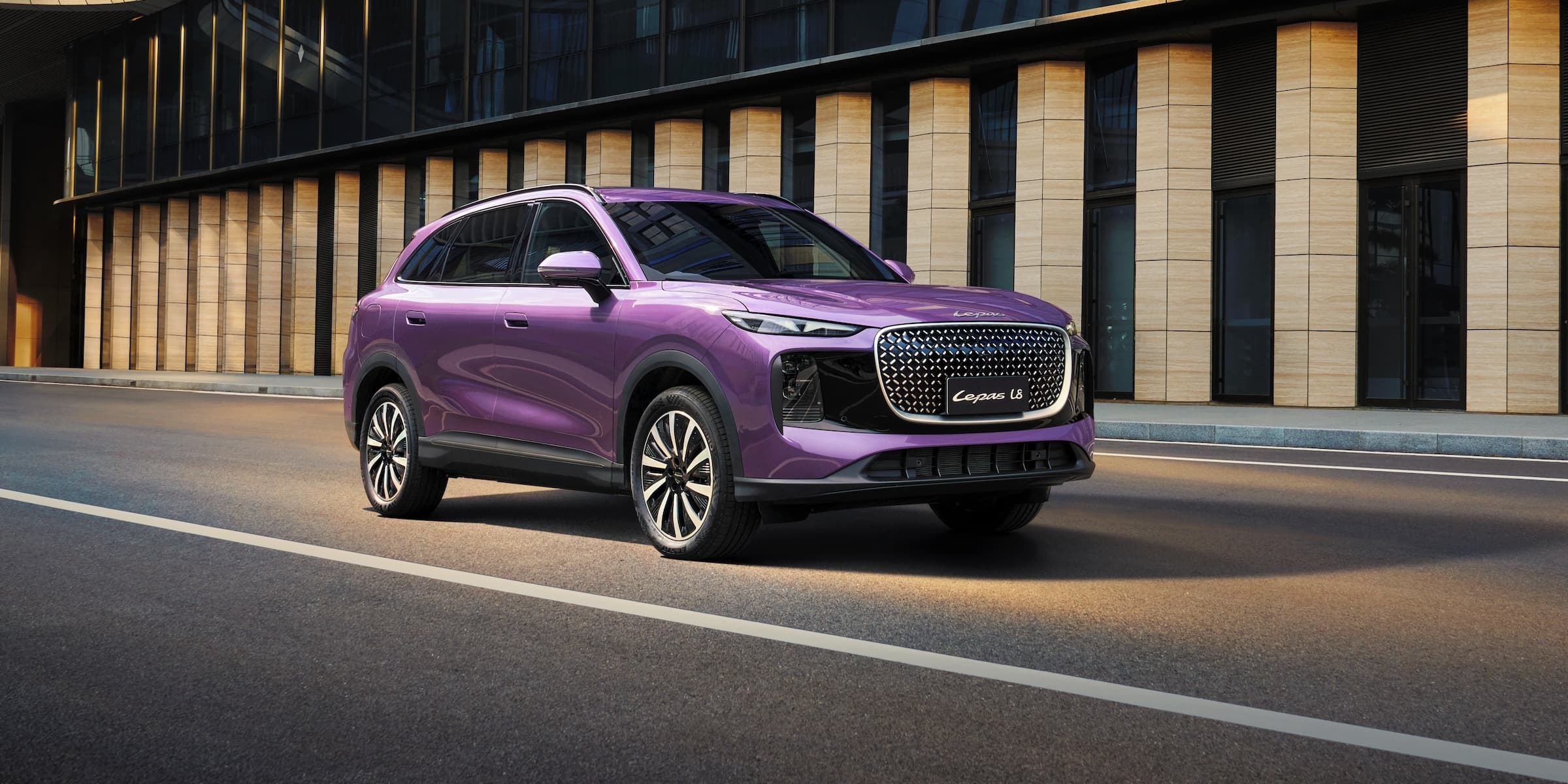
The L8 is a five-seat SUV based on the Chery Tiggo 8, which arrived in the UK late last year. Although technical details have not yet been confirmed, it’s likely to be powered by the same 1.5-litre petrol/electric plug-in hybrid powertrain, promoted by Chery Group as its Super Hybrid System.
Official images show the L8 to be a conventionally styled SUV, with a large grille flanked by narrow LED headlights. Lepas says the headlight design is inspired by the eye of a leopard (the name Lepas is a mash-up of ‘leopard’, ‘leap’ and ‘passion’).
Based on Chery’s approach with its other brands already launched in the UK, we expect the Lepas L8 to offer a high level of standard specification at a price that undercuts most other vehicles in its class.
Lepas will be announcing the details of its UK rollout in coming weeks, but we expect that it will be plugged into the extensive dealer network that Chery Group has already established. It’s also likely that another model or two will soon be announced by the time showrooms open.
We will bring you full UK prices and specifications as soon as we have them. We are expecting the first cars to reach local showrooms in the autumn, probably with preview opportunities across the summer at major events like the Goodwood Festival of Speed.
Make and model: Leapmotor B10 Description: Small SUV/crossover, single electric motor Price range: £31,495 (plus options)
Summary: The Leapmotor B10 offers generous rear space, good equipment and comfortable everyday manners. But average range, intrusive driver aids and unpolished software hold it back from the class leaders.
The Leapmotor B10 is the third model from the Chinese brand to reach the UK after the smaller T03 city car and the larger C10 SUV. It’s a compact electric SUV, priced at just over £30K and aimed squarely at families who might otherwise be looking at an MG, BYD, Kia or Skoda.
Unlike most rivals, there’s only one version of the B10 on offer. One battery, one power output and a fixed specification. Leapmotor’s strategy is to simplify the buying process and include a generous level of standard equipment, rather than offering multiple trims and options.
This is also the most important part of today’s new car market. Compact SUVs have become the default family choice – whether petrol, electric or hybrid – and competition is intense. To succeed here, a car needs to be practical, easy to live with and priced sensibly. It doesn’t have to be the cheapest option, but it does need to be convincing enough to make a buyer’s shortlist.
The B10 represents a clear step forward from Leapmotor’s earlier UK models. The real question is whether that progress is enough in such a crowded field.
For a broader ownership picture, see our full Leapmotor B10 Expert Rating.
Price and equipment
The Leapmotor B10 is priced at £31,500 at the time of writing, although Leapmotor is currently offering a £1,500 discount in lieu of not being eligible for a government EV grant.
Unlike many rivals, there isn’t a range of trim levels or battery options to choose from. There is one version, with one power output and one battery size.
That simplifies the buying decision, but it also removes flexibility. Competitors often offer two or three trims, sometimes with different battery sizes or performance levels, allowing buyers to prioritise range, price or equipment. With the B10, what you see is what you get.
At just over £31K, the B10 doesn’t dramatically undercut most established rivals. It sits in the middle of the small electric SUV market rather than at the bottom of it. Where it makes its case is in standard equipment.
The specification is generous. The large 15-inch touchscreen, digital driver display, panoramic roof and a full suite of driver assistance systems are all included. You are not forced into higher trims to get features that many buyers now expect.
So the B10 is not especially cheap, but it is well equipped for the money.
The Leapmotor B10’s styling is clean and tidy but fairly anonymous, blending easily into a crowded compact SUV market.
Inside the car
The B10 follows the now-familiar minimalist approach. A large 15-inch touchscreen dominates the centre of the dashboard and, aside from the steering wheel buttons and column stalks, there are no physical controls. Even climate adjustments sit within the screen. It looks clean enough, but also fairly anonymous. Most of the cabin is grey and black, and while nothing feels obviously cheap, it’s not especially interesting either.
Material quality is decent for the price. The plastics are mostly hard, but the panels feel solid and well screwed together. The bigger issue is usability. Almost everything runs through the touchscreen and the operating system still isn’t as intuitive as it should be. Basic adjustments can involve more taps than necessary, and given the size of the displays, it’s surprising how small the fonts and icons are. They need to be clearer and easier to read at a glance.
Space is one of the B10’s stronger points. Rear-seat legroom is generous for a car of this size and the flat floor helps make it feel airy. The boot, however, is only average. It’s usable, but not as generous as some rivals. There’s a small storage compartment under the bonnet for charging cables, although it’s barely big enough for them.
The steering wheel would benefit from more adjustment, particularly in and out, as some drivers may struggle to find an ideal position. Overall, the B10’s cabin feels practical and solid, but it lacks the polish and intuitive layout of the best cars in this class.
A large central touchscreen dominates the minimalist cabin, while boot space is usable but only average for this class.
Driving range and charging
Battery and charging details are competitive on paper. The B10 uses a 67kWh battery, which is officially rated at about 270 miles of driving range under official government lab testing.
Fast charging is capable of up to more than 160kW, meaning a typical 10–80% session could take under 30 minutes in ideal conditions. That’s not quite class-leading, but it’s more than good enough since the majority of UK public charging points can’t supply charge that quickly anyway.
During our short launch drive, it was impossible to verify real-world figures properly. Like any EV, your real-world range will depend on factors such as speed, ambient temperature and driving style.
On the road
In everyday driving, the B10 feels well-suited to its likely role. Performance is more than adequate for urban and suburban use, with the instant response you expect from an electric motor. It doesn’t feel slow, and there’s no obvious need for more power in normal conditions. There are three different driving modes – standard, comfort and sport – but switching between them involves diving into the touchscreen menus, so most owners are not likely to bother.
Ride comfort is one of its stronger traits, particularly at lower speeds. Around town it absorbs potholes and speed humps without fuss, and on the motorway it settles into a relaxed, quiet rhythm. For family use and commuting, it does the job well enough.
Push harder on faster, twistier roads and the B10 starts to feel less settled. Over uneven surfaces at speed it loses some composure, and direction changes don’t have quite the polish of some rivals. The overall experience is more competent than engaging. This is a comfort-oriented SUV and it’s less at home on narrow, bumpy country roads.
That’s also where the driver assistance systems become most frustrating. The car will regularly beep at you and tug the steering wheel in directions you didn’t ask for. Leapmotor has improved things compared with the dreadful systems in the C10 and T03, but they’re still among the least refined on sale today. The warnings are not quite as relentless as before, which is progress, yet they remain far more intrusive than in the best competitors.
The B10 is most comfortable in everyday driving, with smooth electric performance and a ride focused more on comfort than sharp handling.
Verdict
The Leapmotor B10 is the brand’s most convincing UK model so far. It offers generous rear-seat space, a comfortable urban driving experience and a strong level of standard equipment in a package that feels better resolved than earlier Leapmotor efforts.
The B10 is not a budget disruptor. At just over £31,000, it sits squarely among established small electric SUVs rather than undercutting them. What strengthens its case is that you get a lot included for that money, with no need to climb a trim ladder to access desirable features. In that sense, it represents good value rather than a bargain.
There are still compromises. The interior design is clean but uninspiring. The touchscreen remains less intuitive than the best systems in this class, and small fonts make it harder to use on the move. Ride comfort is well suited to town driving and steady motorway work, but the car feels less composed on faster, bumpier roads.
If your priority is a well-equipped electric SUV for everyday local use, the B10 makes a sensible, rational case. If you want multiple trim and battery options, sharper driving dynamics or class-leading range for frequent long journeys, there are more polished alternatives.
As a launch impression, the B10 feels like meaningful progress for Leapmotor. Whether it becomes a standout choice will depend on how it performs in long-term UK use, particularly in areas such as software stability and real-world efficiency.
Motoring’s great isn’t it? The open road, the freedom to go wherever you want, whenever you want, for business or pleasure, in all weather, day or night.
So far, so good. But what happens when you hear a tell-tale bang and everything grinds to a halt, leaving you stranded at the side of the road? Even though modern cars are generally very reliable, the sight of a stranded vehicle on the hard shoulder, or stuck in a country layby with the bonnet up, is still a daily occurrence.
You could hope a failure never happens to your car and, if it does, enlist the services of a local breakdown firm to take you hundreds of miles home at great cost. Or you could consider signing up to some form of national breakdown cover, especially if you clock up a large number of miles each year.
Choosing breakdown cover used to be simple as there were only two basic options – the AA or the RAC. Both started as motoring organisations that you became a member of, paying an annual subscription for a number of benefits of which breakdown cover was just one.
The AA still runs in that way today, while the RAC has split its members’ club and breakdown service into separate organisations.
Most car manufacturers provide breakdown cover for a limited number of years, alongside their warranty and as part of their new car buying package. But after that runs out, what next?
Some car insurers offer roadside cover with their motoring policies, usually as an add-on cost. But accepting one of these might not be the best option for you when you can sign up for cover yourself, maybe at a lower cost and with a wider range of benefits.
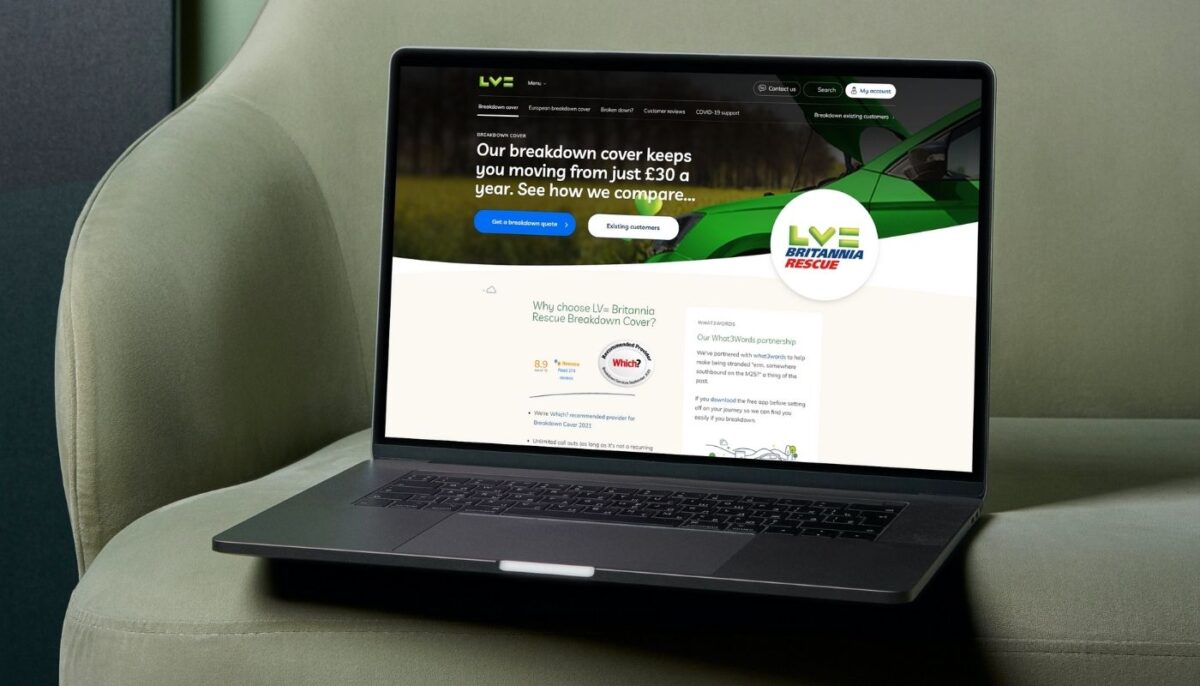
Meanwhile, many more providers have joined the fray. One of the first was Green Flag, which began by working with a network of local garages instead of having its own fleet of mechanics’ vans, with the goal of providing a faster service to stranded motorists. Today, Green Flag is part of the Direct Line insurance group and works in a similar fashion to the AA and RAC, while other providers – such as Britannia Rescue and GEM – have waded into the fray.
What to look for in a breakdown policy
Pricing for breakdown cover has become increasingly complex, with most providers now requiring you to enter your address and vehicle details before you will get a ‘personalised’ quote. What that means in reality is that your prices is highly likely to be higher than the one advertised. So ignore the headline offers and make sure you’re comparing like-for-like packages.
Most breakdown providers charge an annual subscription for cover and almost all offer a full range of options, from basic roadside repairs to rescue in Europe. Most include recovery of your vehicle to your home or designated garage, and there are home-start options if your car has issues before you even set off. In most cases each of these ‘extras’ adds a cost to the annual subscription, and it can soon mount up.
Before you buy any breakdown cover, check whether you already have assistance through your insurance policy and, if you have, what level of cover is provided. That way you should avoid buying the same thing twice, and you’ll only pay for additional cover you actually want.
You should also read the small print carefully. For example, does the cover apply for any vehicle driven by anyone in the household, or for just for one person or one vehicle?
Note, too, that most providers will come out to you in an emergency if you don’t have cover with them, but that will cost you: in some cases operators will want you to pay for a full year’s membership before they come out to help.
Providers make a big deal of their ‘unlimited call-outs’ offer and not penalising you for repeated requests for assistance, unless they are to the same fault. However, very few cars will have repeated failures over and over again. If yours does, maybe it’s not a recovery service you need – it’s a replacement vehicle.
Some of the companies below are marked with an asterisk* – these companies are commercial partners of The Car Expert, so we may receive a small commission if you click through to their websites to find out more. This does not affect the price you pay, but helps us to keep the site running.
With around 2,000 patrols, more than 100 of which are ‘heavy duty’ 4×4 pickup-style vans, the RAC aims to get to more remote areas and recover larger vehicles such as 4x4s and SUVs.
It was once a members’ organisation like the AA and goes back to the turn of the century, but the RAC’s breakdown recovery services were sold off in April 1999. Today it is part of private equity and investment firm CVC Capital Partners.
The RAC has updated its offering in the last year, with three levels of cover available. Basic covers you for five callouts per year and will recover you up to ten miles from where you’ve broken down. Extra broadens that out to national recovery. The top-level Complete package offers unlimited callouts and is the only level to offer at-home cover.
The RAC claims that its patrols in their bright orange vans fix four out of five faults on the spot, on average in 30 minutes. There is also the useful option for having multiple vehicles or people on the same policy, with discounts. Finally, there’s an ‘AA Price Guarantee’ that claims to beat any AA breakdown quote by 10%.
It’s the breakdown organisation that almost everyone has heard of, with familiar yellow rescue vehicles that have been a sight on the UK’s roads for decades. The AA traces its roots back to 1905, and at one time motorists signed up as members had the use of roadside emergency telephone boxes and AA mechanics would salute passing motorists displaying its badge.
Today’s AA fleet of patrols is around 2,900 strong. That’s more than its big rival, the RAC, but down on the 3,500 believed to have been run by the association several years ago. The levels of cover are very similar to the RAC’s, but with both organisations, the price you pay will depend on where you live, how many people are covered and what car(s) you drive.
As the AA is a members’ organisation, you get a number of benefits with your cover. These include discounts on an MOT if you need it, airport parking and car hire.
Another provider offering cover at greatly reduced prices when compared with the big two recovery players, MotorEasy says that 80% of its breakdowns are repaired at the roadside, so ‘you’ll be back on the road in no time’.
The breakdown service is part of the MotorEasy car warranty group. Part of that division’s offering is ‘recovery costs’ so the roadside assistance branch is simply cutting out the middle man. Indeed, if you have a MotorEasy car warranty policy, they pay the bill for your recovery and organise everything for you.
There are four levels of cover on offer so you can tailor something to suit your budget and needs. All levels get as a minimum: roadside help, overnight accommodation, misfuel assist, key recovery, help if the driver falls ill, alternative transport and a message service. That’s for what MotorEasy calls ‘Local Recovery’, and your car must be stranded more than a mile from your home and can be recovered to an address up to 10 miles away.
Level 2 ‘Nationwide Recovery’ adds transport to any chosen destination in the UK. Opt for level 3 and you also get ‘Home Assist’, while level 4 gives you all three levels’ cover plus recovery across Europe and a hire car if you break down seven days or less before a Continental trip.
Part of the Call Assist group, Start Rescue offers some of the cheapest breakdown policies on the market: certainly it boasts on its website ‘vehicle rescue cover for a year, from as little as £21’. They don’t have their own patrols, but use a network of independent garages to handle the call-outs via a 24-hour control centre.
There are five cover levels, ranging from One Star to Five Star. The entry-level One-Star provides car breakdown cover in the UK, if your vehicle breaks down more than a quarter of a mile from your home. The service provides roadside assistance and roadside recovery for you, your vehicle and your passengers up to 10 miles from the breakdown. And it also covers alternative travel and accommodation and a message service.
Two Star adds in nationwide recovery, Three Star additionally includes home assist, while Four Star is similar to Two Star but includes Europe as well as the UK.
The top range Five Star is fully comprehensive breakdown cover and includes roadside assistance and nationwide recovery in the UK and Europe, with home assist, alternative travel, emergency accommodation, and even cover for illness, injury, vandalism or theft.
You have to be an Admiral Insurance customer to buy this breakdown cover, so the website offers two options: ‘add breakdown cover’ or ‘get a car insurance quote’.
Because of this there are no published prices shown – it will depend on who you are, where you live and what car you’re driving. However, your policy will cover you for unlimited roadside recoveries.
There are three options to choose from: Roadside Assistance Cover which gives you rescue from a patrol at the side of the road and a tow if necessary of up to ten miles. There’s National Cover which includes recovery to any destination in the UK plus home breakdown call-outs.
The third option, European Cover, adds in unlimited continental roadside recoveries. In some countries, Admiral might not be able to help you immediately and you might have to first obtain help via the normal SOS phones.
The policies also allow for handy extras such as help with lost or broken keys, misfueling assistance, alternative transport and overnight accommodation.
Britannia Rescue consistently outranks its better-known rivals in customer surveys, earning praise for its efficiency and the turnout of its rescue teams.
Owned by the insurance company LV, Britannia Rescue quotes an average response time of 54 minutes and its most recent figures show that 92% of customers it attended to, were able to complete their journey. Mechanics are trained for both fuel and electric vehicles.
Five levels of cover are on offer, starting with basic roadside assistance and local recovery up to ten miles from where you break down. As you step up the grades, you can get assistance at home, nationwide recovery, car hire or overnight accommodation or alternative travel, and finally European cover.
On top of all of these levels you can add ‘personal cover’, which extends cover for you and a partner for any vehicle in the UK.
If you have car insurance through LV, you’ll receive a discount on your car breakdown fees. A notable free extra is the ability to recharge electric vehicles at the roadside. You can also sign up for short-term cover, for example if going on an important long journey, and there’s also a one-off recovery option.
Formed in 1932 as the Company of Veteran Motorists this was another club, which renamed itself the Guild of Experienced Motorists in 1983, which is where ‘GEM’ comes from. It started offering breakdown services from 1978. Today, while best known for breakdown cover, GEM also gets involved in wide-ranging road safety activities and driver training.
As a membership organisation, GEM’s cover is for the person rather than the vehicle – although you can add more than one person at an extra cost. There are just two options, both of which include home and roadside assistance, nationwide recovery and onward travel in the annual price.
Recovery Extra offers all the features of rivals’ ‘full-house’ levels, including emergency accommodation help. More unusual is Recovery Reclaim, a cheaper option where you get the same breakdown cover but pay for any repair or recovery yourself, then reclaim ‘appropriate costs’ from GEM.
This could work well for those who favour a particular garage or mechanic, such as owners of classic or specialist cars. An organisation that used be called the ‘Company of Veteran Motorists’ is certainly happy to cover that.
GEM does not have its own fleet of rescue vehicles but works with independent suppliers across the UK, which it says makes for a more rapid response. Buying cover means you become a GEM member and so get a range of benefits including a quarterly magazine, road safety advice and various discounts on insurance.
Launched in 1971 as National Breakdown Recovery Club, Green Flag sought to offer a cheaper breakdown cover option than the dominant AA and RAC. By working with a network of local garages, instead of having its own fleet of mechanics, it also hoped to reach stranded motorists more quickly.
Today part of Direct Line Insurance, Green Flag still primarily targets the AA and RAC and still uses independent garages to run its patrol vehicles. Buying online promises discounts of up to 40% compared to quotes by phone, but rather like an insurance company, you have to fill in an online form with your details, including age and address, before getting a personalised quote. There are no standard prices published for you to ponder.
The four main levels of cover mirror those of the AA. Rescue offers roadside assistance, Rescue Plus adds cover at home, Recovery, as the title suggests, will take the car and occupants to the destination of their choice, while Recovery Plus adds the onward travel options of hire car, hotel or transport. European and Business cover is also offered.
All Green Flag policies cover the vehicle no matter who is driving it, though for an extra cost you can add on a personal option allowing you to summon help to any vehicle you are travelling in no matter who owns it. There is a discount applied if you renew and haven’t needed to be rescued in the previous year, plus NHS and school staff reductions.
Do you actually need a recovery service at all?
If your annual mileage is modest, or you hardly ever leave your local town or city, then maybe you can risk going without breakdown cover. But, for most people, it’s well worth considering signing up with a provider.
Like any insurance, you might go a whole year without ever having to call on it (and actually, that’s a good thing). But, if and when the time comes that find yourself stranded by the roadside on a rainy Sunday night, you’ll be pleased you made the investment. The cost of paying a one-off fee to an independent recovery agent to get you and your family home could well outweigh several years of premiums.
Originally published April 2022. Last updated February 2026.
*The Car Expert has commercial partnerships with the AA, MotorEasy and RAC. If you click through to their websites and proceed to purchase any products or services, we may receive a small commission. This does not affect the price you pay.
That’s because during a PCP agreement, you don’t own the car outright. You’re the registered keeper and responsible for looking after it, insuring it and making the payments, but you do not legally own it in clear title until you make the optional final payment (known as the balloon payment).
A PCP agreement is built around one key assumption: the car will be worth a certain amount at the end of the contract. That predicted value is used to calculate your monthly payments.
If you choose not to pay the final lump sum, the finance company takes the car back and sells it. For that to work, it needs to be confident that the car can be sold easily and at the expected value.
Modifications can interfere with that. Some reduce resale appeal. Some make the car harder to sell. Others may void the new car warranty, which also affects value.
Even if you fully intend to buy the car at the end, the lender cannot rely on that. People’s circumstances change. If you lost your job or needed to reduce your outgoings, you might hand the car back instead. From the lender’s perspective, it has to be prepared for that possibility at any time.
That is why most PCP contracts prohibit permanent or value-altering modifications.
What happens if you ignore the agreement?
If you modify the car without permission, you may be in breach of contract. That’s likely to have repercussions.
In serious cases, the finance company can demand early repayment of the outstanding balance. That might sound unlikely, but it has happened in recent years to a prominent YouTuber who modified his BMW M4 without permission and the finance company cancelled his agreement (probably after watching his YouTube videos…).
For most people, settling thousands of pounds at short notice simply isn’t realistic. If payment is not made, the lender can repossess the vehicle and sell it. If the sale price does not cover what you owe, you remain responsible for the shortfall.
More commonly, the issue arises at the end of the agreement. If you hand the car back with unauthorised modifications, the finance company can charge you to return it to standard condition or bill you for any loss in value. Either way, it can become expensive.
There is also an insurance risk that is often overlooked. Any modification, however small, must be declared to your insurer. If you fail to declare it and the car is written off, your insurer could refuse to pay out. You would still owe the finance company the remaining balance on the agreement.
Are any changes allowed?
Small, easily reversible additions are usually considered acceptable, although you should still check your specific agreement. If you’re not sure, speak to your finance company.
Fitting removable accessories is fine. Items such as removable seat covers, floor mats or suction-mounted sun shades are not a problem because they can simply be taken out before the car is returned. Removable roof racks or roof boxes are also generally fine, provided they are not permanently fitted and are removed at the end of the contract.
Towbars sit in a grey area. Some finance companies will allow them, but often only if they are manufacturer-approved and fitted by the supplying dealer. Others may insist that the vehicle is returned to its original condition before it is handed back. If you are considering a towbar, you need written confirmation from the finance provider before going ahead.
Performance upgrades, engine remaps, suspension changes, body kits and non-standard wheels are far more likely to be refused. These can affect reliability, warranty cover and resale value. Even cosmetic changes may be treated as modifications under strict agreements.
Replacing tyres is not normally an issue, as these are consumable items. However, if you’re changing the type of tyre in any way, like fitting tyres designed for racetrack driving, the finance company (and the insurance company) may consider that a performance modification.
Do not assume something is minor simply because it looks minor.
What if I plan to keep the car?
You might be certain that you will pay the optional final payment and keep the car. But until that payment is made, you do not own it.
If you modify the car and later decide not to, or cannot, make the final payment, you may have to pay to remove those modifications before returning the car. Any money you spent on them is effectively lost.
If modifying your car is important to you, PCP is usually not the most suitable way to finance it. Paying cash or using a personal loan means you own the vehicle outright from day one and can modify it as you wish, subject to insurance and warranty implications.
What should you do before making any changes?
If you are thinking about modifying a PCP car, take these steps:
Read your finance agreement carefully, paying attention to clauses about alterations or value.
Contact the finance company directly, rather than relying solely on what a dealer tells you.
Get written confirmation if permission is granted.
Inform your insurer of any approved modification before it is fitted.
Assume that modifications are not allowed unless you have clear written approval. A dealer might be able to explain some terms of a finance agreement, but it’s always a good idea to speak with the finance provider directly to discuss any questions you may have before signing the contract.
The bottom line
With a PCP agreement, it’s best to treat the car as if you are borrowing it. A PCP is a bit like a mortgage on a house in that it’s a secured loan, so you don’t own the car outright until the last penny of the loan is paid off.
If you’re buying a car with the intention of modifying it, you’re better off considering other financing options, like a personal loan (or cash, if you have it available). That way, you own the car outright and can modify it however you like.
The Leapmotor B10 is a compact all-electric SUV/crossover, and the third model from Chinese marque Leapmotor to arrive on UK roads.
Posing a leftfield challenge to the likes of the Skoda Elroq and MG S5 EV, the B10 has received a rather poor set of review scores from the British motoring media, described by Top Gear’s Greg Potts as “boring” and “bland”, and “likeable” but with “rough edges”, by Parker’s Keith Adams.
“The Leapmotor isn’t as polished as its rivals from more established car brands”, says Richard Aucock of Motoring Research, “it’s anonymous to look at, forgettable to drive and some of its tech can be frustrating.” Despite its flaws, reviewers have praised the car’s competitive battery range and value-for-money credentials. “The price is the only reason that you’d choose it over its rivals”, says Electrifying.com’s Vicky Parrott.
While the B10 is hard to recommend in a very competitive small EV class, it’s arrival does mark a significant shift in driving quality for Leapmotor. “It’s comfortably the best Leapmotor yet”, says The Car Expert’s own Stuart Masson. “It’s well-priced, well-equipped and much nicer to drive than the larger C10.”
As of February 2026, the Leapmotor B10 holds a New Car Expert Rating of A, with a score of 75%. Beyond the SUV’s rather poor set of review scores, this overall rating is bolstered by the car’s full five-star Euro NCAP safety credentials, low running cost estimations and Leapmotor’s longer-than-average four-year warranty.
Body style: Small SUV/crossover Engines:electric, battery-powered Price:From £31,495 (£1,500 EV grant available)
Launched: Summer 2025 Last updated: N/A Replacement due: TBA
Image gallery
Media reviews
Highlighted reviews and road tests from across the UK automotive media. Click any of the boxes to view.
Featured reviews
“The Leapmotor B10 is the third model to join the family, and it’s comfortably the best one yet. It’s well-priced, well-equipped and much nicer to drive than the larger C10. The driving aid warnings are still annoying, but less so than in other Leapmotor models. The interior is still minimalist and a bit bland, but it feels well screwed together.”
Model reviewed: Range overview
Score: 7 / 10
The Car Expert
Stuart Masson
“The Leapmotor B10 is very comfortable, extremely well-equipped and feels like great value – but the wallowy driving experience lets it down.”
Score: 8 / 10 “The new Leapmotor B10 is a serious player in the small electric SUV sector, boasting good range, plenty of kit and a tempting price tag.” Author: Alastair Crooks Read review
Auto Trader
Score: 6 / 10 “The Leapmotor B10 is a generic SUV with an unassuming MGS5-esque design and minimalist interior. It is packed with standard features and hoping to strike the right balance of familiarity and value. It ticks a lot of boxes on paper, but models like the Skoda Elroq, Kia EV3 and new Nissan Leaf are better to drive and offer a more rounded package.” Author: Catherine King Read review
Business Car
Model reviewed: Range overview Score: 7 / 10 “Like the other Leapmotor models that have come before, there is plenty to like about the B10. It looks and feels more premium than its price suggests, with impressive levels of interior space and plenty of standard equipment for the price. We know Chinese brands listen to feedback and are quick to act, so we hope Leapmotor has another look at the infotainment and overkeen ADAS safety systems. Plus, some more driving sparkle would be welcome.” Author: Martyn Collins Read review
Car
Score: 6 / 10 “There’s a lot to like about the Leapmotor B10 beyond the lean pricing and nerd’s den worth of gadgets and gizmos. It’s a comfortable, refined and practical electric family SUV. Add in the fact it’s less than £30,000 and it becomes even more recommendable. With less touchscreen dependance, it’d be even better.” Author: Ryan Gilmore Read review
Electrifying.com
Model reviewed: Range overview Score: 6 / 10 “The Leapmotor B10 is a mid-sized electric SUV that promises space, tech and decent charging speeds, but the price is the only reason that you’d choose it over its rivals.” Author: Vicky Parrott Read review
Honest John
Score: 6 / 10 “The electric Leapmotor B10 succeeds in its mission to provide plenty of space and lots of equipment and tech for a bargain price. However, there’s a sense of getting what you pay for, with disappointing interior quality, a hopelessly complicated touchscreen system and a below-par driving experience sullying proceedings.” Read review
Motoring Research
Model reviewed: Range overview Score: 7 / 10 “The Leapmotor isn’t as polished as its rivals from more established car brands; it’s anonymous to look at, forgettable to drive and some of its tech can be frustrating. However, it does offer a decent electric range and very impressive value for money.” Author: Richard Aucock Read review
Parkers
Model reviewed: Range overview Score: 7.6 / 10 “Likeable but there are some rough edges.” Author: Keith Adams, Ryan Gilmore Read review
The Sun
“The Leapmotor B10 is a simple, glass-roofed EV with high-spec trim, but the firm needs to fix the not-so-good bits.” Author: Rob Gill Read review
The Telegraph
Model reviewed: Range overview Score: 4 / 10 “What is a decent enough car under the skin is spoilt by build quality glitches, over-aggressive safety systems, a lacklustre suspension set-up and tyres of dubious quality. What could have been a solid three-star car only merits two.” Author: Andrew English Read review
Top Gear
Score: 6 / 10 “Looking for a small SUV that’s more boring than a Vauxhall Mokka? This is your answer. And it’s even sold in the same showroom. There are rivals that are much better to drive and have more premium interiors, but they’re also quite a bit more expensive than the Leapmotor B10. Perhaps bland is best after all? Author: Greg Potts Read review
Safety rating
Independent crash test and safety ratings from Euro NCAP
Independent economy and emissions ratings from Green NCAP
No eco rating
As of February 2026, the Leapmotor B10 has not been assessed by Green NCAP.
The Green NCAP programme measures exhaust pollution (which is zero for an electric car) and energy efficiency. Electric cars are much more energy-efficient than combustion cars, so the B10 is likely to score very highly in Green NCAP testing if and when it takes place. Check back again soon.
Running cost rating
Monthly cost of ownership data provided exclusively for The Car Expert by Clear Vehicle Data
Battery range
Average
Score
Variation
Score
EV models
261 miles
B
Electrical efficiency
Average
Score
Variation
Score
EV models
3.8 m/KWh
D
Insurance group
Average
Score
Variation
Score
All models
32
C
The Leapmotor B10 is a relatively affordable car to own and run, according to whole-life cost numbers provided exclusively to The Car Expert by our data partner, Clear Vehicle Data.
The car’s average battery range of 261 miles is competitive in the small electric SUV category, but not class-leading. Its electrical efificiency (the battery-powered equivalent of miles per gallon) is also bested by similarly sized and priced models like the Skoda Elroq and Kia EV3. The SUV’s predicted insurance bracket grouping is slightly higher than the market average.
Reliability rating
Reliability data provided exclusively for The Car Expert by MotorEasy
No reliability rating
As of February 2026, we don’t have enough reliability data on the Leapmotor B10 to generate a reliability rating.
The Car Expert’s reliability information is provided exclusively to us using workshop and extended warranty data from our partner, MotorEasy, sourced from both official dealerships and independent workshops.
As soon as MotorEasy has sufficient data on the B10, we’ll publish the results here.
Warranty rating
New car warranty information for the Leapmotor B10
Overall rating
B
62%
New car warranty duration
4 years
New car warranty mileage
60,000 miles
Battery warranty duration
8 years
Battery warranty mileage
100,000 miles
Leapmotor’s new car warranty is better/worse than average, and better/worse than rival brands in a similar price bracket as the B10.
The duration is four years, with a limit of 60,000 miles. In addition to the standard new car warranty, this all-electric SUV has an eight-year/100,000-mile warranty for the battery components.
Warranty on a used Leapmotor B10
If you are buying an ‘Approved Used’ Leapmotor B10 from an official Leapmotor dealership, you will get the remainder of the car’s four-year new car warranty included.
If you are buying a used Leapmotor B10 from an independent dealership, any warranty offered will vary and will probably be managed by a third-party warranty company.
If you are buying a used Leapmotor B10 from a private seller, there are no warranty protections beyond any remaining portion of the original new car warranty.
If you’re looking to buy any used car that is approaching the end of its warranty period, a used car warranty is usually a worthwhile investment. Check out The Car Expert’s guide to the best used car warranty providers, which will probably be cheaper than a warranty sold by a dealer.
As of February 2026, we are not aware of any DVSA vehicle safety recalls affecting the Leapmotor B10. However, recall information is updated regularly, so this may have changed.
You can check to see if your car has any outstanding recalls by visiting the DVLA website or contacting your local Leapmotor dealer.
Find your next new or used car with Auto Trader. Find out more
Find your next new or used car with Carwow. Find out more
Lease a Leapmotor B10
If you’re looking to lease a new Leapmotor B10, The Car Expert’s partners can help you find a competitive deal.
Personal contract hire deals from Leasing.com. Find out more
Personal contract hire deals from Carwow. Find out more
Personal contract hire deals from Select Car Leasing. Find out more
Subscribe to a Leapmotor B10
Subscriptions are becoming a very popular way for consumers to try an electric car for a few weeks or months to help decide whether it’s a suitable alternative to a petrol car. If you’re interested in a car subscription, The Car Expert’s partners can help. (PS: What’s a car subscription?)
The KGM Actyon is a mid-size petrol-powered SUV that arrived on UK roads in the second half of 2025, as KGM’s answer to the likes of the Kia Sportage, Nissan Qashqai and Volkswagen Tiguan.
Built on the same foundations as the slightly smaller Torres SUV, and sharing its name with a previous SsangYong SUV from the noughties which is an amalgam of the words “action” and “young”, the Actyon has been given a rather cold reception by the British motoring media, who criticise the car for its rather uncomfortable ride and poor fuel economy.
“KGM has done an excellent job of modernising SsangYong with the Actyon”, says Parker’s Steve Percy Lawman, “but its material quality disappoints, and its ride quality swings between irritating and downright uncomfortable.”
Reviewers still find several areas of the Actyon to praise. Heycar’s Richard Aucock commends the SUV for its keen pricing and “upmarket looks”, as well as its “extra-large interior with a surprisingly premium feel”, but adds that “the poor fuel economy from the petrol engine is a real let-down.” The Actyon does have a more fuel efficient hybrid version, but that is not currently on sale in the UK at the time of writing.
“The Actyon is a step in the right direction for KGM”, says the Auto Express team, “but there’s still plenty of room for improvement.”
As of February 2026, the KGM Actyon holds a New Car Expert Rating of D, with a score of 57%. Beyond the car’s middling set of review scores, this overall rating is hindered by high running cost estimations and helped by KGM’s generous five-year new car warranty.
Score: 7 / 10 “The new KGM Actyon SUV blends coupe-inspired styling with a spacious and well-equipped interior for a sub-£40,000 starting price.” Author: Tom Roberts Read review
Business Car
Model reviewed: Range overview Score: 6 / 10 “That engine capacity might seem a little small for a car this size, but it can deliver brisk enough acceleration, though the six-speed automatic gearbox can be a little lethargic, and throttle response can be a bit abrupt when setting off.” Author: Sean Keywood Read review
Car
Score: 6 / 10 “KGM has done a great job of dragging Ssangyong into the 21st Century, but it still has work to do. The KGM Actyon’s materials leave a lot to be desired, its ride quality is irritating on even an immaculately finished road, and the utterly woeful fuel economy means you’d be better off owning the more expensive Kia Sportage GT-Line S by the time you’ve driven 20,000 miles.” Author: Luke Wilkinson Read review
Carbuyer
Model reviewed: Range overview Score: 7.4 / 10 “The KGM Actyon has a lot going for it because it’s well equipped and feels more upmarket than you might expect, but the driving experience is unremarkable and the ride quality is disappointing. The engine isn’t particularly efficient and is a bit old-fashioned, which lets it down.” Author: Charlie Harvey Read review
Carwow
“The KGM Actyon is big and practical, but the old-fashioned engine is very thirsty.” Read review
Heycar
Model reviewed: Range overview Score: 6 / 10 “The KGM Actyon is an interesting new SUV with upmarket looks and an extra-large interior with a surprisingly premium feel. It’s well-equipped and well-priced, although the poor fuel economy from the petrol engine is a real let-down.” Author: Richard Aucock Read review
Honest John
Model reviewed: Range overview Score: 6 / 10 “The KGM Actyon offers excellent cabin space, a generous loadspace and lavish levels of standard equipment. But below-par ride quality and handling allied to a lack of fleet-friendly engine choices let it down somewhat in a highly competitive market.” Read review
Parkers
Model reviewed: Range overview Score: 6.2 / 10 “The acres of interior space, the cavernous boot capacity and the surprising refinement. The Actyon is remarkably quiet at speed for a car with such firm suspension. Material quality is disappointing, and the ride is atrocious on even a freshly refinished road.” Author: Luke Wilkinson Read review
Safety rating
Independent crash test and safety ratings from Euro NCAP
No safety rating
As of February 2026, the KGM Actyon has not been assessed by Euro NCAP.
Eco rating
Independent economy and emissions ratings from Green NCAP
No eco rating
As of February 2026, the KGM Actyon has not been assessed by Green NCAP.
Running cost rating
Monthly cost of ownership data provided exclusively for The Car Expert by Clear Vehicle Data
Fuel consumption
Average
Score
Petrol models
33 mpg
D
CO₂ output
Average
Score
Variation
Score
Petrol models
194 g/km
D
Insurance group
Average
Score
Variation
Score
All models
25
B
The KGM Actyon is a rather expensive car to own and run, according to whole-life cost numbers provided exclusively to The Car Expert by our data partner, Clear Vehicle Data.
The car’s average fuel economy of 33 mpg is poor when compared to the rest of the mid-size SUV class, even pure petrol equivalents like the Kia Sportage ‘Pure’ that can muster up to 44 mpg. That said, the Actyon’s insurance premiums are predicted to be on the cheaper side of the market average.
Reliability rating
Reliability data provided exclusively for The Car Expert by MotorEasy
No reliability rating
As of February 2026, we don’t have enough reliability data on the KGM Actyon to generate a reliability rating.
The Car Expert’s reliability information is provided exclusively to us using workshop and extended warranty data from our partner, MotorEasy, sourced from both official dealerships and independent workshops.
As soon as MotorEasy has sufficient data on the Actyon, we’ll publish the results here.
Warranty rating
New car warranty information for the KGM Actyon
Overall rating
A
95%
New car warranty duration
5 years
New car warranty mileage
Unlimited miles
Battery warranty duration
8 years
Battery warranty mileage
100,000 miles
KGM’s new car warranty is better than average, and better than rival brands in a similar price bracket as the Actyon.
The duration is five years, with no limit on mileage.
Warranty on a used KGM Actyon
If you are buying an ‘Approved Used’ KGM Actyon from an official KGM dealership, you will get a minimum three-month warranty included – that’s if the original five-year new car warranty has expired.
If you are buying a used KGM Actyon from an independent dealership, any warranty offered will vary and will probably be managed by a third-party warranty company.
If you are buying a used KGM Actyon from a private seller, there are no warranty protections beyond any remaining portion of the original new car warranty.
If you’re looking to buy any used car that is approaching the end of its warranty period, a used car warranty is usually a worthwhile investment. Check out The Car Expert’s guide to the best used car warranty providers, which will probably be cheaper than a warranty sold by a dealer.
As of February 2026, we are not aware of any DVSA vehicle safety recalls affecting the KGM Actyon. However, recall information is updated regularly, so this may have changed.
You can check to see if your car has any outstanding recalls by visiting the DVLA website or contacting your local KGM dealer.
BYD has announced a series of updates for the Seal electric saloon, adding extra storage space, new technology features and additional paint choices while keeping prices unchanged.
Externally, the changes are subtle and are limited to a new design of 19-inch alloy wheels and three additional paint colours. The BYD badge has also been repositioned more prominently on the boot lid.
The more meaningful update is a significant increase in storage space. BYD says the boot has grown from 400 to 485 litres, although it has not detailed what changes were made to free up the extra space. Under the bonnet, the front storage compartment (known as a ‘frunk’) also increases to 72 litres, making it more practical for stowing charging cables or small bags.
Inside, the layout remains largely the same. The seats are still trimmed in Nappa leather, although the branding stitched into the headrests has been removed for a cleaner look.
The updated BYD Seal interior includes a fixed 16-inch touchscreen, while exterior changes for this model year include revised rear badging on the boot lid.
Additional technology as standard
BYD has added a driver monitoring system, using an in-car camera to monitor driver attention. This is in line with latest EU/UK and Euro NCAP safety standards and is becoming common across new models. Hopefully BYD’s system proves less intrusive than many others we’ve experienced recently.
A new Bluetooth key function allows drivers to use their smartphone as a digital key. This should also allow drivers to share digital access with other users, although BYD has not detailed the full functionality yet.
Other interior specifications remain largely the same, although the central 16-inch touchscreen is now fixed in landscape format and no longer rotates to a portrait layout as before.
Performance and range unchanged
Mechanically, the Seal remains the same. The Design model uses a single rear-mounted motor producing 310bhp, while the Excellence adds a second motor for a combined 525hp and a 0–62mph time of 3.8 seconds.
Both versions use BYD’s 82kWh lithium iron phosphate battery. Official driving range figures remain at 354 miles for the Design and 323 miles for the Excellence. Peak rapid charging speed is 150kW, allowing a 10% to 80% charge in a claimed 37 minutes.
Prices held steady
Prices remain unchanged from before, with the Design model starting at £45.7K and the Excellence priced at £48.7K.
The Seal continues to be covered by BYD’s six-year, 93,750-mile warranty, with the battery covered for up to eight years or 155,350 miles.
The updated Seal is available to order now, with first cars expected within weeks.
For a broader ownership picture — including safety, running costs and warranty cover — see our full BYD Seal Expert Rating.
Make and model: Toyota Urban Cruiser Description: Small SUV/crossover, single electric motor Price range: £29,995 to £35,745 (plus options)
Summary: The Toyota Urban Cruiser is quiet and well equipped, but slow charging and an unremarkable driving experience leave it behind many similarly priced small EVs.
While many brands now offer half a dozen electric models or more, Toyota’s EV range is still small. The Urban Cruiser is only its second fully electric car for the UK.
Rather than being developed entirely in-house, it’s a joint project with Suzuki and built in India. That helps Toyota expand quickly into the small electric SUV market — but it also means this isn’t quite the same as the brand’s newer, more ambitious EV efforts.
We drove the Urban Cruiser at its European launch in Florence, where the roads are smoother and traffic flows more politely than back home. As ever with a launch event, that context matters. A car that feels settled on freshly surfaced Tuscan tarmac may not feel quite so composed on a damp B-road in Surrey.
The question, then, is simple: does the Urban Cruiser feel like a serious contender in a crowded small EV class?
The Urban Cruiser sits in the heart of the small electric SUV market, alongside cars like the Hyundai Kona Electric, Jeep Avenger and various Stellantis cousins. On paper, pricing is broadly mid-table.
However, there’s a catch. Because the car is built in India, it doesn’t qualify for the UK government’s electric car subsidy. That means some rivals can undercut it by £1,500 or even £3,750 depending on eligibility. Once that’s factored in, the Urban Cruiser starts to look less competitive than its headline price suggests.
There are two motor outputs, although we only drove the more powerful 128kW (174hp) version. A lower-output 106kW model will also be offered in the UK.
The Toyota Urban Cruiser is a small electric SUV with two motor options and mid-table pricing in the UK’s growing compact EV market.
Inside the car
Step inside and the Urban Cruiser feels functional rather than fashionable. The cabin is dominated by grey plastics — lots of them — and while nothing appears poorly assembled, it doesn’t feel especially warm or inviting either. It’s more durable than delightful.
The layout follows the now-familiar twin-screen template. Both displays measure ten inches, with the central touchscreen handling most functions. There are a few physical controls for basic air-conditioning adjustments, which is welcome, but much of the interaction still relies on the screen.
Neither display is class-leading. The driver’s screen is clear enough, though slightly plain. The central touchscreen works, but it’s not particularly quick to respond and the menus don’t feel especially slick. Wireless Apple CarPlay and Android Auto are standard, which helps — and many drivers will likely default to that rather than Toyota’s native system.
Seat comfort is broadly average for the class. They’re comfortable enough for everyday driving but don’t offer much in the way of support. On the smooth Italian roads we sampled, that wasn’t a problem, but it’s something we’d want to revisit on a longer UK test.
Boot space is on the small side, and there’s no front storage compartment for charging cables. They’ll have to live under the boot floor, which isn’t ideal if you’re fully loaded for a family trip.
The Toyota Urban Cruiser combines twin digital displays with a simple cabin layout, but boot space is smaller than many other small electric SUVs and there’s no front storage for charging cables.
Driving range and charging
The Urban Cruiser’s maximum charging speed is one of its weaker points. The larger-battery version can charge at up to 67kW, while the smaller-battery model tops out at 53kW. In 2026, those figures are modest. Many rivals can charge significantly faster, which matters if you regularly rely on public charging.
The charging port is located just behind the left front wheel, which makes it easy enough to plug in whether you park nose-in or reverse into a bay.
We didn’t conduct a full range test during the launch event, so we’ll reserve judgement on real-world efficiency until a longer UK drive.
On the road
Around town, the Urban Cruiser is pleasant and easy to manage. The 174hp motor provides brisk acceleration from low speeds, and it feels perfectly at home in busy urban traffic. As is typical of electric cars, response is immediate and smooth.
However, that urgency fades at higher speeds. Once you’re out on open roads, acceleration trails off more noticeably than in many rival EVs. It’s not slow, but it doesn’t feel especially energetic either.
The steering is very light and offers little feedback about what the front wheels are doing. That’s not unusual in modern cars, but here it feels particularly detached. Through corners, there’s more body lean than you might expect from an electric vehicle, which usually benefits from a low centre of gravity. The Urban Cruiser feels slightly floaty rather than planted.
Ride comfort is relatively soft, which helps over smoother roads, but because the car is short, it can feel unsettled over uneven surfaces. On the Tuscan launch route, it was just about acceptable. On rougher UK roads, we suspect that movement may be more noticeable.
Braking performance is reassuringly strong, with good pedal feel — something not all EVs manage well. There’s no one-pedal driving mode, which some drivers will miss. Personally, I don’t mind its absence, but it’s worth noting.
Refinement is mixed. Around town it’s impressively quiet, and the lack of engine noise makes it feel calm and civilised. At higher speeds, however, road noise becomes more intrusive than in some competitors.
The Toyota Urban Cruiser delivers quiet electric driving and everyday comfort, though charging speeds are slower than many rival small electric SUVs.
Verdict
The Toyota Urban Cruiser is likely to be easy to live with. It’s quiet and smooth around town, the controls are simple enough, and there’s nothing here that would make daily driving stressful or complicated. For short journeys and routine family duties, it would slot into life without much fuss.
But this is not Toyota’s strongest work.
The cabin feels built to a budget, charging speeds are well behind much of the competition, and the driving experience lacks the quality and composure you might expect from the badge. It leans more than most electric cars, the steering feels distant, and once you’re out of town the sense of refinement isn’t quite there either.
None of that makes it a bad car. It just makes it a fairly ordinary one in a class that is moving on quickly. And when some rivals are both better to drive and eligible for government incentives that this car misses out on, the Urban Cruiser ends up feeling like a stopgap rather than a standout.
Toyota has shown with the larger bZ4X that it can do electric cars with much more polish. The Urban Cruiser feels more like Toyota covering a space in its line-up than setting a new standard.
Battery range: 164 miles CO2 emissions: 0 g/km Euro NCAP safety rating: Not yet tested (as of February 2026) TCE Expert Rating: Not yet rated (as of February 2026)
Audi has unveiled its new RS 5 saloon and ‘Avant’ estate car range – the first plug-in hybrid line-up in Audi Sport history.
Set to arrive on UK roads in the Summer, this new high-performance executive car line-up is the first of a new generation of RS models to launch in Britain, rivalling the likes of the BMW M3/M4 Competition, Mercedes-AMG C63, and Porsche Panamera.
What is it?
The new Audi RS 5 is the high-performance flagship of the A5 range and the first RS model to adopt a plug-in hybrid (PHEV) powertrain.
At its core is a re-tuned 2.9-litre twin-turbocharged V6 petrol engine producing 510hp, paired with a 177hp electric motor working in tandem with an eight-speed automatic transmission. Together, they deliver a combined system output of 639PS. Audi claims it can complete a 0–62mph sprint in 3.6 seconds, and with optional ‘Audi Sport’ package selected, top speed is capped at 177mph.
A 26kWh battery enables the RS 5 to travel on electric power alone for everyday driving, while also supporting performance functions such as torque vectoring (manages power distribution to individual wheels) and boost. Charging at up to 11kW AC allows a full recharge in around two and a half hours.
Underneath, the RS 5 features RS-specific suspension with twin-valve dampers, a stiffer bodyshell, 20- or 21-inch wheels, and the choice of steel or ceramic brakes. Visually, it stands around nine centimetres wider than the standard A5, with flared arches, a honeycomb pattern grille, darkened Matrix LED headlights and a distinctive RS rear diffuser with oval exhaust tips.
What’s different compared to previous Audi RS models?
The headline change is the switch to a hybrid powertrain. This is the first production RS model to use a plug-in hybrid powertrain, marking what Audi calls the beginning of a “new era” for its performance cars. As well as being the most technologically advanced, its also the heaviest RS model Audi has ever produced, weighing in at over 2,300kg.
The RS 5 is also the first performance model to get Audi’s latest dynamic ‘quattro’ all-wheel drive ‘dynamic torque control’ tech. The car can shift power between the rear wheels in just 15 milliseconds, with the car’s computer recalculating power distribution 200 times per second. Audi says that this gives the car a sharper handling response and a greater breadth of ability than previous RS 5 models – from near-silent electric commuting to full-blooded performance driving.
Inside, the dashboard features a 12-inch digital instrument cluster, 15-inch central infotainment touchscreen and a 11-inch passenger media display as standard. The instrument cluster can display performance data like G forces, temperatures and pressures for individual tires, as well as lap times.
Customers will be able to choose from five different interior colour schemes, all with sports seats and carbon-fibre interior trim pieces. The steering wheel features a ‘Boost’ button, which will unlock maximum power for a ten-second period, no matter the drive mode selected, for overtaking or track use.
Drive modes you can select include ‘RS sport’ and the new ‘RS torque rear’ mode, which biases power to the rear axle and enables controlled oversteer on closed circuits.
How much is it and when is it arriving?
The new Audi RS 5 is now set to enter production at Audi’s plant in Neckarsulm, Germany. UK sales will begin in the middle of 2026. Full UK specifications and pricing have yet to be confirmed and will be announced closer to launch.
Mileage matters when buying a used car. It affects price, resale value and sometimes finance options. But it doesn’t tell you everything about a car’s condition. In many cases, how a car has been used and maintained is just as important as the number on the dashboard.
Here’s what you actually need to know before making a decision.
Why mileage affects price
Mileage is a quick way of estimating how much a car has been used. Mileage tends to be associated with wear and tear, so the lower the mileage for a car of a given age, the more it costs. The higher the mileage, the less.
To give a real example, a three-year-old petrol Volkswagen Golf typically shows clear price differences depending on mileage. Using retail listings from our marketplace partner, Motors:
Around 10,000 miles: roughly £19,000-£21,000
Around 30,000 miles: roughly £17,000-£19,000
Around 60,000 miles: roughly £14,000-£16,000
That’s several thousand pounds of difference for the same car, simply based on mileage.
Used car pricing data is largely set by Cap-HPI, a specialist valuation company that tracks daily prices from trade sales, auctions, rental and leasing firms, and specialist remarketing companies. It adjusts values for age, mileage and condition, and its data underpins most of the online valuation tools you’re likely to use.
High mileage doesn’t automatically mean a bad car
Attitudes to mileage have shifted noticeably in recent years, driven largely by improvements in how reliably modern cars hold up over time. Mileage is still one of the most significant factors in a used car’s price and condition, but it’s no longer the barrier it once was.
Modern cars are generally much more reliable and better built than older ones, especially if they are regularly serviced. A well-maintained car with 90,000 motorway miles can be a safer bet than a poorly serviced car with 40,000 short urban miles.
Mileage matters. But it is not the whole story.
What high mileage really means
When you see a higher-mileage car, you’re really thinking about three things:
Wear and tear
Upcoming maintenance costs
Future resale value
Wear and tear
A five-year-old car with 25,000 miles will usually feel lightly used. The same car with 75,000 miles may show more interior wear, tired suspension and a clutch closer to replacement.
Even with a full service history, higher mileage increases the likelihood of brake and tyre replacement, suspension wear, clutch wear on manual cars, and general deterioration both inside and out.
That doesn’t mean it’s a bad car. It just means some parts may be closer to needing replacement.
Predictable maintenance points
Certain jobs commonly arise at specific mileage bands. For example:
40,000-60,000 miles: brakes and tyres
60,000-80,000 miles: clutch on manual cars, suspension parts
70,000-100,000 miles: timing belt and water pump, if fitted
100,000+ miles: higher risk of turbo, injector or diesel particulate filter issues on diesel cars
These are not guarantees. But they are realistic planning points. If a car is approaching one of these thresholds, factor the cost into your budget.
A cheap high-mileage car can become expensive quickly if several of these items need doing at once.
Depreciation and resale
Depreciation – the loss of a car’s value over time – is steepest in the first year, when a new car can lose 15%–35% of its value, and up to 60% within three years. Mileage accelerates that process at certain thresholds. Broadly speaking:
Under 30,000 miles – strongest resale appeal
30,000-60,000 miles – mainstream sweet spot
60,000-100,000 miles – values start to soften
Over 100,000 miles – smaller buyer pool
Once a car passes 100,000 miles, many buyers simply stop looking. That limits demand, which lowers value. If you plan to keep the car for many years, this may not matter. If you expect to sell in two or three years, it probably will.
Finance and warranty limits
Some lenders are also cautious about financing higher-mileage cars, and many used car warranties have upper mileage limits, often around 100,000 miles. Reduced demand and restricted financing both push prices down.
This can work in your favour if you’re a cash buyer – but it also means a car over 100,000 miles may be harder to sell when the time comes.
Electric cars and mileage
You might expect electric cars to have lower mileages than petrol ones – shorter ranges have historically made them less appealing for long journeys. But the data tells a different story.
According to Cap-HPI, two-to-three-year-old electric cars actually have higher average mileages than petrol cars: around 10,600 miles a year, compared to roughly 9,500 miles for petrol (down from 11,000 in 2019). The reason is partly that many electric cars have been bought by company car drivers, who benefit from significant tax advantages and tend to cover higher annual mileages. High-mileage used electric cars – including Teslas with over 100,000 miles – are not hard to find.
The mechanical simplicity of electric cars means there’s less to go wrong, but the battery is the key unknown. Over time, a battery’s ability to hold its original charge will reduce, and the rate at which that happens depends partly on how the car has been charged. Frequent use of rapid public charging generates more heat and can accelerate battery degradation. Regularly charging to 80% rather than 100%, and avoiding running the battery very low, is generally considered better for long-term battery health.
Battery condition is a growing concern in the used electric car market, and there’s currently no standard way for buyers to assess it. Some companies will test a used electric car’s battery health for a fee, but few dealers offer this as standard. As a basic check, you can charge the car to full and compare the range displayed against the manufacturer’s original figure – though temperature and driving style will affect the result.
Diesel and hybrid considerations
Used diesel cars have traditionally covered higher mileages than petrol or electric cars, and buyers generally accept that. Diesels are built for long-distance driving and tend to be robust when used that way. If you drive mainly on motorways and live outside a clean air zone, a higher-mileage diesel can still represent good value.
However, if you live in a city – particularly one with a clean air zone such as London’s ULEZ – a used diesel is likely to cost you more to run than it saves you in purchase price.
Hybrid cars warrant a specific note of caution. Older hybrids, particularly the Toyota Prius, have long been popular with taxi and private hire operators because of their reliability and fuel economy. That means some low-mileage examples on the used market may have had a harder working life than the clock suggests. If a used Prius or similar hybrid appears unusually low-mileage for its age, it’s worth looking more carefully at the service history.
How to check mileage is genuine
Because mileage affects value, some sellers attempt to alter it. Odometer tampering still happens.
Before buying:
Check the MOT history at gov.uk using the registration number. This shows mileage recorded at each test. Sudden drops or inconsistencies are red flags.
Get a vehicle history check – we recommend The Car Expert’s own free history check, which covers a number of key factors. Or, for just £6.95, you can get a more comprehensive check that flags mileage discrepancies, accident damage or outstanding finance.
Check service records carefully. Digital service histories should be available as a printout. If it’s not offered, ask for it.
Do not rely solely on the number displayed on the dashboard.
So how important is mileage?
Mileage is important because it directly affects price, signals likely wear and upcoming costs, and influences your resale value and finance options. But it is not a verdict on a car’s quality.
A high-mileage car with full service history, mainly motorway use and evidence of careful ownership can be excellent value. A low-mileage car with patchy maintenance can be a financial risk.
The practical takeaway
When viewing a used car:
Use mileage to judge price fairness
Check service history in detail
Anticipate upcoming maintenance costs
Verify mileage through official records
Think about your resale plans
Don’t dismiss a car purely because the mileage looks high. But don’t ignore what that mileage implies for future costs either.
Mileage is a tool. Use it wisely, alongside evidence.
In the UK car tyres must have at least 1.6mm of tread on them – any less is illegal. But is it safe to let your tyres wear right down to the limit, or should you be changing them earlier?
Lots of motorists have experienced the scenario – you take your car for a service, or an annual MOT test, and are told “your tyres are still legal but it won’t be long before they need replacing…” And you happily drive home, grateful to have put a little more expenditure off for a while.
Is it really worth putting it off, however? A tyre may be legal, but does it still offer all of the safety performance that a brand-new one will? After all a brand-new tyre typically has a tread depth of 8 to 9mm, around five times more than the legal limit, and numerous tests carried out by the automotive industry have shown stretching a tyre to its legal limit is anything but a good idea.
The legal tyre tread depth limit
Firstly, what does the UK legal limit actually mean? Well the tread depth, the grooves in the tyre, must be at least 1.6mm across the central 75% of the tyre’s width, around its complete circumference.
Importantly, that’s only the UK law – the rules vary in different countries. In Germany, for example, the legal limit is 3mm, almost twice the depth of a legal UK tyre and something not to be forgotten if you are planning to take the Eurotunnel and drive across Europe.
Quite simply, the less tread your car’s tyres have on them, the longer it will take to stop, particularly in wet conditions – in other words, much of the time here in the UK.
The grooves are principally there to clear water from the road surface under the tyre and to help to maintain a good grip on the road. So the deeper the tread, the more water it can clear.
This reduces the risk of aquaplaning, which is when the tyre breaks contact with the road surface and instead travels on the film of water between tyre and road. If this happens, you lose control of the car’s steering, acceleration and braking – and no amount of pounding the brake pedal will slow the car down.
Measuring the impact of worn tyres
To illustrate the difference in braking performande, German tyre manufacturer Continental carried out a series of wet braking tests with new and worn examples of its tyres back in 2020.
Braking from 80km/h (just under 50mph) to a standstill, a brand-new set of tyres with 8mm of tread depth stopped the car in 27.6 metres.
With the tread worn down to the German legal limit of 3mm, it took another 2.2 metres to stop the car. And at the UK legal limit of 1.6mm, the car took 34.4 metres – an extra 6.8 metres compared to new tyres. That’s more than an extra car length.
The Continental tests highlighted another sobering fact – if we imagine that a car with new tyres braking from 50mph was just able to stop in time to avoid hitting an obstacle, then a car with tyres of only 1.6mm tread depth would hit that obstacle at 22mph.
A 22mph impact is fast enough to cause serious damage and injury. That obstacle could be a wall, another vehicle, or a person…
Minimum requirement vs best practice
One of the world’s leading safety bodies is Euro NCAP, which tests most new cars sold in the UK and across Europe for their safety levels – both in avoiding an accident and coping with an impact. The tests are above and beyond the minimal legal requirements set by the EU and UK, so it’s entirely legal for a car with a zero-star safety rating from Euro NCAP to be sold here in the UK. But we wouldn’t recommend buying it.
The 1.6mm rule is basically the tyre equivalent of a zero-star safety rating. It’s legal, but not recommended.
Most industry studies recommend that the longest you should put off changing your tyres is when they reach 3mm of tread depth. You won’t be getting the performance of a new tyre at that depth, but below 3mm a tyre’s stopping performance falls off a cliff.
Checking your tyre tread depth
How do you know how much tread depth your car tyres have? Well checking tread depth is not a difficult process and there is certainly no excuse for driving on illegal tyres.
Modern tyres have indicators built into the grooves of the tread, which show when you reach the 1.6mm limit, though a much more accurate method of checking is to use a tyre depth gauge, available for very little cost at any automotive aftermarket supplier.
Even simpler is to insert a 20p piece into the groove – if you can’t see the wide outer rim of the coin, then you have at least 3mm of tread depth, which is well within the legal limit. If you can see the rim, you need to make a more accurate check.
In addition to the safety compromises, there are big legal consequences for going below that 1.6mm. If you are stopped by the police and found with illegal tyres, you could be subject to a £2,500 fine and three penalty points on your licence – per tyre. In other words, if all four tyres are under the legal limit, that’s potentially £10,000 and 12 points on your licence – which triggers an automatic driving ban…
This article was originally published in February 2023. Last updated February 2026.
Skoda has introduced a limited-run Kodiaq Edition X to mark ten years since the large SUV first went on sale. Based on the Kodiaq SE L, it adds cosmetic tweaks and extra standard equipment.
The Edition X sits near the top of the Kodiaq range and is powered exclusively by a 1.5-litre petrol engine with mild hybrid assistance, paired with a seven-speed automatic gearbox.
What’s different?
On the outside, the Edition X gains 19-inch anthracite alloy wheels, metallic paint and a dark styling package that includes a black D-pillar, dark chrome grille trim and chrome roof rails. There’s also rear privacy glass and a red strip linking the rear LED lights.
Inside, it features black leather and artificial leather upholstery with grey dashboard inserts. The driver’s seat is electrically adjustable with memory and lumbar support.
Technology upgrades over the SE L include LED Matrix headlights, keyless entry and an electric tailgate.
Engine and practicality
All Edition X models use Skoda’s 1.5-litre petrol engine with mild hybrid assistance, producing 150hp. The electrical support helps smooth stop-start traffic and improve efficiency slightly, but in everyday driving it feels like a conventional petrol engine.
Like the rest of the Kodiaq range, the Edition X offers seven seats, generous cabin space and a large boot, making it one of the more practical large SUVs on sale.
Orders and pricing
Orders open in April, with first deliveries expected in late spring.
The Edition X is priced at £40,590, placing it above the SE L but below the range-topping L&K and vRS models. The wider Kodiaq line-up remains unchanged, with petrol, diesel and plug-in hybrid versions still available.
Make and model: BYD Sealion 5 DM-i Description: Small plug-in hybrid SUV Price range: from £29,990
Summary: The BYD Sealion 5 delivers plug-in hybrid flexibility and strong equipment for the price, but its design, touchscreen usability and driving polish feel a step behind the best rivals.
BYD likes to describe itself as the world’s most advanced battery company. Much of its growing UK car range looks modern and slightly unconventional, which helps reinforce that message.
The BYD Sealion 5 feels different. At first glance, it’s surprisingly ordinary. In fact, it looks more like a ten-year-old MG than a forward-thinking new arrival. That’s partly because it isn’t a brand-new design. Underneath, this car has been on sale in China since 2019 as the BYD Song Pro. In car terms, that makes it older than most of the rest of BYD’s UK line-up.
But the more relevant question at its recent European launch wasn’t whether it looks exciting. It was whether the Sealion 5 makes sense here in the UK.
The Sealion 5’s strongest argument is its price. There are two trims in the UK: Comfort at around £30,000 and Design at roughly £33,000. Both are generously equipped, and even the lower-spec Comfort model doesn’t feel stripped out.
What makes that pricing significant is the powertrain. For the sort of money that would usually buy you a conventional petrol compact SUV, BYD is offering a plug-in hybrid. That alone will catch the attention of plenty of buyers.
The higher-spec Design trim adds a few cosmetic and convenience upgrades, but the core package remains the same. You’re not forced into ticking endless option boxes to get the essentials.
On paper, at least, it looks like strong value.
The BYD Sealion 5 is a compact plug-in hybrid SUV with straightforward exterior styling and a conventional family-friendly shape.
Inside the car
Climb inside and the Sealion 5 feels clean and modern enough. The layout is tidy, the twin-screen setup gives it a contemporary look, and nothing immediately feels cheap or flimsy. For the money, it makes a respectable first impression.
Space is competitive for a compact SUV. There’s enough legroom in the back for growing teenagers, and the boot should cope comfortably with weekly shopping or a family weekend away. It doesn’t feel cramped, and that matters more than flashy design details in this class.
After a bit more time, though, the cabin starts to feel less cohesive. Almost all key functions are controlled through the central touchscreen. That’s not unusual these days, especially for BYD, but it means even simple tasks require too many taps and too long glancing away from the road. The system itself isn’t especially quick either, so you sometimes find yourself waiting for it to catch up. It works, but it doesn’t feel particularly slick.
Seat comfort is much the same story. They’re perfectly acceptable, and fine for everyday journeys, but they don’t offer the sort of support that makes longer drives relaxing. You sit on them rather than in them, and after an hour or so you become more aware of that.
None of this is disastrous. The cabin is spacious and reasonably well put together. It just lacks the sense of polish that some rivals manage, even at similar prices.
The BYD Sealion 5 interior features a large central touchscreen, competitive passenger space and a practical boot for everyday family use.
Driving range and charging
As a plug-in hybrid, the Sealion 5’s appeal rests heavily on its ability to cover short trips on electric power.
Official figures suggest enough electric range to handle many daily errands without using petrol at all, provided you have access to regular home or work charging. We didn’t gather real-world efficiency data on this launch drive, so a longer UK test will be needed to see how closely it matches its claims.
The advantage here is flexibility. Around town, it should be possible to drive quietly on electric power. For longer journeys, the petrol engine takes over without the need to plan charging stops.
On the road
Cold, wet winter roads are not the easiest environment in which to shine, but they do reveal a car’s character quickly.
One clear positive is refinement. The Sealion 5 is impressively quiet. Engine noise is well suppressed and the switch between electric and petrol power is handled smoothly enough that you often have to check the display to see what’s happening. Around town, it feels calm and relaxed.
Most of the power comes from the electric motor, and the petrol engine tends to play a supporting role. Once the battery (which is smaller on the Comfort model than the more expensive Design model) is depleted, the petrol engine will run as a generator to replenish it and keep the electric motor in action. It’s only at higher speeds that the petrol engine is used to directly drive the wheels.
The ride, however, is firmer than you might expect from a comfort-focused family SUV. It doesn’t crash over bumps, but it never really settles either.
More surprisingly, that firmness doesn’t bring much benefit in terms of control. Steering feels slightly vague and the brake pedal lacks the crisp response you’d hope for on faster A-roads. It’s not unsafe, but it doesn’t inspire confidence when you want precise responses.
For everyday urban driving, this probably won’t matter much. But at higher speeds, the Sealion 5 feels competent rather than composed.
Overall, the driving experience is best described as forgettable. That’s not necessarily a deal-breaker for a family SUV, but it does reinforce the sense that this isn’t BYD at its most ambitious.
The BYD Sealion 5 combines plug-in hybrid flexibility with a quiet driving experience, prioritising comfort over sharp handling.
Verdict
The BYD Sealion 5 is a sensible, price-led addition to the brand’s UK range. At around £30,000, it offers plug-in hybrid capability and generous standard equipment for the sort of money that would normally buy you a conventional petrol SUV. For buyers focused on value and the ability to cover short trips on electric power, that alone makes it worth considering.
It’s also impressively quiet and easy to drive in everyday situations. Around town, it feels calm and unobtrusive, and the plug-in system appears flexible enough to suit normal family life.
But it doesn’t feel like BYD at its most impressive. The design is anonymous, the underlying model is older than much of the brand’s current line-up, and the driving experience lacks the polish and precision of the best rivals. The touchscreen-heavy interior works, but it doesn’t feel especially intuitive.
In many ways, the Sealion 5 feels like a pragmatic move to broaden BYD’s appeal rather than a showcase of its latest thinking.
If your priority is getting into a plug-in hybrid SUV at a competitive price, the Sealion 5 makes a rational case. If you’re looking for something that feels especially refined or forward-thinking, you may find stronger options elsewhere.
For a broader ownership picture, including safety, running costs and reliability data, see our full BYD Sealion 5 Expert Rating.
We like:
Competitive pricing for a plug-in hybrid SUV
Generous standard equipment
Impressively quiet when driving
Smooth transition between electric and petrol power
Competitive interior space
We don’t like:
Bland exterior design
Touchscreen-heavy controls are not intuitive
Ride feels firm without delivering sharp handling
Steering and braking lack precision at motorway speeds
Model tested: BYD Sealion 5 DM-i Comfort Price: £29,990 Engine: 1.5-litre petrol engine + electric motor, all-wheel drive Gearbox: Single-speed hybrid automatic
Power: 212 hp (combined) Top speed: 106 mph 0-60 mph: 7.7 seconds Fuel economy (combined): 104 mpg
Battery range: 38 miles CO2 emissions: 62 g/km Euro NCAP safety rating: Not yet tested (as of February 2026) TCE Expert Rating:B (67%) as of February 2026
Buy a BYD Sealion 5
If you’re looking to buy a new or used Omoda 9, The Car Expert’s partners can help you find the right car.
When the MG 4 (officially the MG4 EV, according to its makers) first arrived, it quietly did something quite important. It proved that an electric car didn’t have to cost a fortune to be good. It drove better than most of its similarly priced rivals, it was easy to live with, and it was priced sharply enough to make people take notice. In fact, we liked it so much that it won our Car of the Year 2024 award.
But it wasn’t perfect. The interior felt a bit plain, and the touchscreen system could be slow and occasionally irritating. Nothing disastrous, but enough to remind you that this was a budget-conscious car.
This update doesn’t change the fundamentals. The motor, the batteries and the way it drives are all basically the same. Instead, MG has concentrated on improving the parts you actually touch and use every day.
So the real question isn’t whether the MG 4 was good. It already was. The question is whether it now feels nicer to live with.
or a broader ownership picture, see our full MG 4 Expert Rating, which combines media reviews, safety data, reliability, running costs and warranty cover.
The updated MG 4 features subtle exterior revisions, including new wheel designs and minor styling tweaks at the rear.
Price and equipment
The cheapest version of the old MG 4 has gone, which means the headline starting price is a bit higher than before. But in reality, the versions most people actually bought — the Long Range and Extended Range models — are now around £2,750 cheaper than their direct equivalents used to be.
So although it may look like prices have crept up, they haven’t really. You’re getting even better value than before.
Equipment levels remain strong. You don’t have to tick endless option boxes to get the features most people expect, and compared to many European electric hatchbacks, the MG 4 still undercuts them quite comfortably.
The trim levels, which were previously ‘SE’ and ‘Trophy’, have now been replaced by a single trim called ‘Premium’, which basically replaces Trophy. As before, there’s a higher-performance MG 4 XPower model, which we look at separately. You have a choice of Long Range (64kWh battery, delivering around 280 miles) and Extended Range (77 kWh battery, which delivers around 340 miles) versions.
Value was one of the main reasons we rated the original car so highly, and that hasn’t changed. It remains an exceptional car for the money, although the market has improved significantly since the MG 4 first appeared three years ago.
Inside the car
This is where you really notice the difference in the MG 4’s update. The previous interior wasn’t terrible, but it did feel a bit basic. The touchscreen lagged well behind your finger presses, and the whole operating system felt slightly unfinished.
The new interior has been borrowed almost entirely from the MG S5 compact SUV and immediately feels more sorted. The centre console has been redesigned so it looks cleaner and makes better use of the space between the seats. The seats themselves have been replaced and feel more supportive, although they’re not the best you’ll find (which remains Volvo).
Most importantly, the touchscreen now works properly. It responds more quickly, menus are clearer and you don’t have to wait for it to catch up, which is far more useful and, more importantly, easier to use without taking your eyes off the road for too long. It still isn’t flashy or particularly luxurious, but it no longer feels like the weak point of the car.
The materials are still simple rather than plush. You won’t mistake this for a premium German hatchback. It now feels more considered than before, even if it’s still clearly built to a price.
The main letdown remains MG’s octagonal steering wheel. It’s supposed to reflect the octagonal MG badge, but it isn’t comfortable and you end up fidgeting with where to put your hands. The same issue tends to blight every model in the MG family, and we wish they’d just realise that round steering wheels have worked well for more than 100 years for a reason.
The facelifted MG 4 gains a redesigned dashboard, improved touchscreen system and updated centre console, while boot space remains unchanged.
Driving range and charging
Underneath, this is still the same MG 4 you already know. Official driving range figures are much the same as before for the Long Range, although the Extended Range claims an improvement of about 15 miles on the previous model with the same size battery. On this launch drive, there was nothing to suggest that the car behaves any differently in terms of efficiency.
Charging speeds and battery options also carry over. In other words, this update is about improving the experience inside the car, not about rewriting the spec sheet.
The charging point is on the left rear quarter panel. If you’re charging at a public charging point, you’ll probably need to reverse in to ensure that the cable reaches the car. At home, you’re probably fine to park either forward or backwards as home cables tend to be longer.
On the road
If you liked how the old MG 4 drove, you’ll like this one too. It still feels nicely balanced and more composed than many hatchbacks – either electric or petrol – at this price. It turns into corners confidently and doesn’t feel clumsy or heavy, which is not always a given with electric cars.
The ride is still on the firm side, but that’s not unusual in modern cars with large alloy wheels. You’ll notice potholes and sharper bumps more than you would in something like a Citroën ë-C4, but it doesn’t thump or feel unsettled. It generally keeps itself together, but it isn’t what you’d call cushioned or especially plush.
Because the mechanics haven’t changed, the difference you feel as a driver isn’t about handling or performance. It’s about the cabin being a more pleasant place to sit. With fewer software irritations and a tidier layout, the whole experience feels smoother, even though the car itself hasn’t fundamentally changed.
The MG 4 retains its rear-wheel drive layout and balanced handling, with the 2026 update focusing on cabin improvements rather than mechanical changes.
Verdict
The MG 4 didn’t need reinventing. It just needed polishing. The original version already had the important things sorted — it drove well, it was sensibly priced and it made electric motoring feel straightforward rather than intimidating. That’s why we rated it so highly in the first place.
What held it back was the slightly clunky interior experience. The new version fixes that in a meaningful way. The touchscreen works as it should, the seats are better, and the cabin feels more cohesive.
Mechanically, it’s much the same car. But by smoothing off the rough edges without pushing up the price, MG has made a good car feel easier to live with.
We’ll need a longer UK test to see how the improvements hold up over time, but based on this launch drive, the MG 4 feels like a more grown-up version of an already strong package.
For a broader ownership assessment, including safety, running costs and reliability data, see our full MG 4 Expert Rating.
We like:
Touchscreen now feels quick and easy to use
Cabin layout makes more sense
Still enjoyable to drive for the price
Strong equipment levels
We don’t like:
Price leader no longer available
Ride still a little firm over rough roads
No increase in official driving range
Seats better but still not great
Similar cars
If you’re looking at the MG 4, you might also be interested in these alternatives
The Citroën C3 Aircross is a compact petrol-mild hybrid family car. There is also a an all-electric range which we cover here.
Built on the same foundations as the Vauxhall Frontera, the C3 Aircross has been given a lukewarm welcome by the British motoring media, who largely agree that the compact family car offers great value-for-money and a comfortable driving experience, but that rivals are quicker and sharper to drive.
Carwow’s Tom Wiltshire praises the Citroën for offering up to seven seats in an affordable hatchback-sized package, adding the caveat that buyers shouldn’t “expect it to be too sophisticated”, noting that the petrol engine is a bit “weedy” and that its electric counterpart is nicer to drive.
Parker’s Seth Walton agrees, also noting that the car’s interior trim fells “cheap” in places. “It’s not very refined”, concludes the Car team, but “if you’re after an affordable, inoffensive family wagon, this one is worth considering.”
As of February 2026, the Citroën ë-C3 Aircross holds a New Car Expert Rating of C, with a score of 62%. This score is currently ten points lower than the ë-C3 Aircross, due to the electric version’s higher set of review scores, cheaper running cost estimations and higher eco rating.
Body style: Small SUV/crossover Engines:electric, battery-powered Price:From £21,105 on-road
Launched: Autumn 2025 Last updated: N/A Replacement due: TBA
Image gallery
Media reviews
Highlighted reviews and road tests from across the UK automotive media. Click any of the boxes to view.
Featured reviews
“The Citroen C3 Aircross has grown in stature, but not so much in price. There’s virtual price parity between the petrol and electric variants, and what you get for your money is a roomy family SUV that has more compact overall dimensions than most rivals. The driving experience majors on comfort over driving fun, but as everyday family transport, it gets the job done with a bit of comfort thrown into the mix.”
“The Citroen C3 Aircross fits up to seven seats in a hatchback-sized package, at a very reasonable price – just don’t expect it to be too sophisticated.”
Score: 8 / 10 “Bigger, better looking, more comfortable and a seven-seat option make the new Citroen C3 Aircross very easy to recommend.” Author: Mark Nichol Read review
Business Car
Model reviewed: Range overview (including electric ë-C3 Aircross) Score: 8 / 10 “The Citroën C3 Aircross has an attractive, if unadventurous, design. It also has a spacious and practical interior, and is cheaper and better-equipped than the Vauxhall Frontera. However, it’s only adequate to drive, the seven-seat option is only for kids and short journeys, and the infotainment system is quite basic.” Author: Martyn Collins Read review
Car
Score: 6 / 10 “The Citroen C3 Aircross is limited in its abilities, but there’s no pretence to the way it drives. In a world where most cars are built too firm I found the relaxed, easy-going nature of the C3 Aircross quite refreshing. It’s not very refined, and humble in just about every regard, but the new car still a marked improvement over the last edition. If you’re after an affordable, inoffensive family wagon, this one is worth considering.” Author: Seth Walton Read review
Carbuyer
Model reviewed: Range overview Score: 8.6 / 10 “If you want an SUV that won’t put a black hole in the family budget, the Citroen C3 Aircross offers space, five or seven seats and even the option of electric power.” Author: Andy Goodwin, Alastair Crooks Read review
Heycar
Model reviewed: Range overview (including electric model) Score: 7 / 10 “The Citroen C3 Aircross has taken on a chunky new aesthetic while gaining extra practicality in the form of a seven-seat option and more choice thanks to the new electric e-C3 Aircross. It’s still very affordable, but compromises have inevitably been made, particularly in terms of refinement.” Author: Matt Robinson Read review
Honest John
Model reviewed: Range overview Score: 8 / 10 “The Citroen C3 Aircross has a drastically different look for its second generation but the bigger talking point is its third-row option, making it nearly the cheapest seven-seater around. Its low price means some compromises have been made but this is nonetheless an impressive compact SUV.” Read review
Parkers
Model reviewed: Range overview Score: 7.2 / 10 “The new C3 Aircross is a decent car, and despite some cheap feeling to it among various flaws, it still feels like a lot of Citroen product for the money.” Author: Seth Walton Read review
The Sunday Times
Model reviewed: Range overview (including electric ë-C3 Aircross) Score: 6 / 10 “Not the French brand’s most enthralling car ever, but it’s comfy, cheap, comes with up to seven seats and has a choice of petrol, hybrid or electric power.” Author: Will Dron
The Telegraph
Model reviewed: 1.2-litre petrol/electric hybrid Max Score: 8 / 10 “This estate-style family car is tuned for comfort, with the option of extra folding chairs to seat up to seven – though that is best avoided.” Author: Alex Robbins Read review
Top Gear
Model reviewed: Range overview Score: 7 / 10 “Unpick the cringey slogans on the doors and you’ve got yourself a roomy, sensibly-priced and comfortable take on a supermini.” Read review
Safety rating
Independent crash test and safety ratings from Euro NCAP
No safety rating
As of January 2026, the Citroën C3 Aircross has not been assessed by Euro NCAP.
Eco rating
Independent economy and emissions ratings from Green NCAP
No eco rating
As of January 2026, the Citroën C3 Aircross has not been assessed by Green NCAP.
Running cost rating
Monthly cost of ownership data provided exclusively for The Car Expert by Clear Vehicle Data
Fuel consumption
Average
Score
Petrol models
49 mpg
C
CO₂ output
Average
Score
Variation
Score
Petrol models
129 g/km
B
Insurance group
Average
Score
Variation
Score
All models
20
B
Service and maintenance
Cost
Score
Year 1
£163
A
Year 2
£458
B
Year 3
£726
B
Year 4
£977
B
Year 5
£1,357
B
Overall
£3,681
B
The Citroën C3 Aircross is a relatively affordable car to own and run, according to whole-life cost numbers provided exclusively to The Car Expert by our data partner, Clear Vehicle Data.
Reliability rating
Reliability data provided exclusively for The Car Expert by MotorEasy
No reliability rating
As of January 2026, we don’t have enough reliability data on the Citroën C3 Aircross to generate a reliability rating.
The Car Expert’s reliability information is provided exclusively to us using workshop and extended warranty data from our partner, MotorEasy, sourced from both official dealerships and independent workshops.
As soon as MotorEasy has sufficient data on the C3 Aircross, we’ll publish the results here.
Warranty rating
New car warranty information for the Citroën C3 Aircross
Overall rating
C
50%
New car warranty duration
3 years
New car warranty mileage
60,000 miles
Battery warranty duration
8 years
Battery warranty mileage
100,000 miles
Citroën’s new car warranty is fairly bog standard, and similar to rival brands in a similar price bracket as the C3 Aircross.
The duration is three years, with a limit of 60,000 miles. In addition to the standard new car warranty, this petrol mild-hybrid model has an eight-year/100,000-mile warranty for its battery components.
Recalls
Official DVSA safety recalls that have been issued for the Citroën C3 Aircross
As of February 2026, we are not aware of any DVSA vehicle safety recalls affecting the Citroën C3 Aircross. However, recall information is updated very regularly, so this may have changed.
You can check to see if your car has any outstanding recalls by visiting the DVLA website or contacting your local Citroën dealer.
Find your next new or used car with Auto Trader. Find out more
Find your next new or used car with Carwow. Find out more
Lease a Citroën C3 Aircross
If you’re looking to lease a new Citroën C3 Aircross, The Car Expert’s partners can help you find a competitive deal.
Personal contract hire deals from Leasing.com. Find out more
Personal contract hire deals from Carwow. Find out more
Personal contract hire deals from Select Car Leasing. Find out more
Subscribe to a Citroën C3 Aircross
Subscriptions are becoming a very popular way for consumers to try an electric car for a few weeks or months to help decide whether it’s a suitable alternative to a petrol car. If you’re interested in a car subscription, The Car Expert’s partners can help. (PS: What’s a car subscription?)
Make and model: Omoda 9 Description: Mid-large plug-in hybrid SUV Price range: from £44,990
We say: The Omoda 9 offers more than 50 miles of real-world electric range and generous equipment, but everyday refinement and seat comfort fall short of the best in class.
The Omoda 9 arrived in the UK making quite a bold promise. It offered generous equipment, useful electric range and a competitive price in a crowded family SUV market. It certainly made an impression early on – and it went on to win our Best Family Plug-in Hybrid 2026 award.
But awards are one thing. Living with a car for a full week is something else entirely. Once the launch gloss fades and it becomes your everyday transport, does it still feel convincing?
There’s only one version of the Omoda 9 in the UK, which immediately makes life simpler. No complicated trim ladders, no endless option packs. What you see is what you get.
And what you get is a lot. Heated and ventilated seats, big screens, driver assistance tech, a panoramic roof – features that are often optional on European rivals are included here as standard. On paper, that makes the Omoda 9 look like strong value.
But value isn’t just about how long the equipment list is. It’s about whether all those features work well together and feel properly integrated into the car. That’s where the story becomes more nuanced.
Inside the car
At first glance, the Omoda 9 makes a positive impression. The dashboard looks clean and modern, and the twin screens give it the digital feel buyers now expect in this class. It certainly doesn’t feel sparse.
After a few days, though, some cracks begin to show. The touchscreen looks sharp, but the fonts are too small. You find yourself glancing away from the road for longer than you’d like just to confirm what you’re pressing. That might not sound dramatic, but over a week it becomes irritating. This isn’t a problem unique to Omoda, but it’s noticeable here because the screens are plenty big enough to manage this better.
The front seats are more of an issue. They’re firm and quite flat, with a narrow base that makes you feel as though you’re perched on top rather than settled into them. Around town, it’s fine. After an hour or two, you start shifting around trying to get more comfortable. Rear passengers get decent space for the class, and a flatter bench means that rear-seat passengers are probably happier than their front-seat counterparts.
Boot space, on the other hand, is perfectly competitive. The loading lip is a little high, but that’s normal for this kind of SUV rather than a specific flaw.
Driving range and charging
As a plug-in hybrid, the Omoda 9 stands or falls on how useful its electric range is in the real world.
In normal mixed driving, covering more than 50 miles on electric power alone was straightforward. For many households, that’s enough to handle daily commuting without using petrol at all, provided you can charge at home or at work.
Once the battery was depleted, fuel economy settled at around 45mpg during a week of mainly country-road driving. That’s perfectly respectable for a car of this size and power, even if it’s not class-leading. The battery never truly runs out of energy, so you’ll still have full power available if you need it, but you don’t benefit from electric-only running until the battery has recharged to a sufficient level.
The charging port sits on the rear quarter panel, which makes life easy whether you reverse into a space or park nose-first. We didn’t use public fast charging during this test, but most owners will rely on home charging for day-to-day use anyway.
Overall, the plug-in system works well and delivers genuinely usable electric mileage. That remains one of the Omoda 9’s strongest selling points.
On the road
The Omoda 9 is easy to drive and generally relaxed in everyday use. Around town, running on electric power, it feels smooth and quiet. The transition between electric and petrol power is handled neatly enough that you don’t really think about it.
On smoother roads, the ride is comfortable and composed. It deals with gentle undulations well and feels settled at normal speeds. But on rougher surfaces, it can feel a bit unsettled and there’s noticeable lean through corners. It’s not uncomfortable, but it never quite feels tied down either.
Motorway refinement is decent rather than impressive. The petrol engine is reasonably subdued when it’s working, but tyre noise becomes more noticeable at higher speeds. Over longer journeys, the overall impression is of competence rather than polish.
One area that grated over a full week was the driver assistance systems. The warnings felt overly eager and triggered more often than in many established European alternatives. During a short launch drive, that’s mildly irritating. Over several days, it becomes very frustrating. As with most new cars, you can disable the systems quickly, but you have to remember to do it every single time you start the car. Blame the EU, as it’s their regulation.
The overriding impression was that the longer we lived with the Omoda 9, the less impressive it felt. Nothing is fundamentally wrong and it ticks lots of boxes. It simply lacks the final layer of refinement that makes a car feel properly cohesive.
Verdict
On paper, the Omoda 9 makes a persuasive case. It’s generously equipped, offers genuinely useful electric range and comes with a seven-year warranty for added reassurance. In a segment where plug-in hybrids can become expensive very quickly, that matters.
Spend a week with it, though, and some compromises emerge. The seats could be more comfortable, the touchscreen needs larger fonts, refinement is good rather than excellent, and the driver assistance systems can feel over-sensitive.
None of this makes it a bad car. It’s competent, sensibly priced and well-equipped. But it doesn’t quite feel as settled or polished as some established – and admittedly more expensive – rivals.
If your priority is equipment and electric range for the money, the Omoda 9 deserves a place on your shortlist. If long-distance comfort and overall refinement matter more, it’s worth comparing carefully before deciding.
For a broader ownership picture, including safety, running costs and reliability data, see our full Omoda 9 Expert Rating.
The KGM Torres is a mid-sized SUV/crossover which arrived in the UK in Spring 2024. Part of the new Torres range, the Torres is KGM’s first new model following the manufacturer’s re-brand from SsangYong in 2024.
Positioned between KGM’s smaller Korando and larger Rexton SUVs, and launched alongside an all-electric version called the Torres EVX, the British motoring media has given the Torres a lukewarm reception, with reviewers generally criticising the SUV’s fuel consumption and price.
“It desperately needs a more efficient engine”, comments Max Adams of Auto Express, adding that “several of the car’s rivals offer a better user experience when it comes to the all-important in-car tech.” The Carwow team adds that the car’s entry-level price tag is rather high, particularly “for an unknown brand.”
Parker’s Ted Welford also marks the KGM down for its “stiff ride and sloppy handling”, but concludes that there are plenty of positives, including “a big boot, good rear seat space, KGM’s reliability record, a five-year or 100,000 mile warranty, and friendly, local dealers.”
As of February 2026, the KGM Torres holds an Expert Rating of E, with a score of 51%. Beyond the car’s poor set of review scores, this overall rating is also hindered by high predicted running costs but helped by KGM’s generous new car warranty.
Model reviewed: Range overview (including EVX) Score: 7 / 10 “The KGM Torres has a number of positive attributes, including its distinctive design, huge interior and generous equipment for the money. It also drives pretty well, but the mid-size SUV class is hugely competitive and the Torres struggles in a few places.” Author: Andy Goodwin Read review
Carwow
Model reviewed: Range overview “The KGM Torres is a spacious, practical family SUV, but it’s not cheap for an unknown brand.”
Read review
Heycar
Model reviewed: Range overview Score: 5 / 10 “It has some actual credibility, though, and you do get a lot of physical car for the money. We think it looks cool, too, but you might have to be prepared to make some compromises.” Author: Andrew Brady Read review
Honest John
Model reviewed: Range overview Score: 6 / 10 “The KGM Torres features excellent cabin space, a vast boot and generous levels of standard equipment. Unfortunately, the ride quality, handling and mechanical refinement are markedly off the pace.” Read review
Parkers
Model reviewed: Range overview “It has style, practicality and equipment levels on its side, but the inefficient petrol engine could be the Torres’ weak point.” Author: Ted Welford Read review
Safety rating
Independent crash test and safety ratings from Euro NCAP
No safety rating
As of February 2026, the KGM Torres has not been assessed by Euro NCAP.
Eco rating
Independent economy and emissions ratings from Green NCAP
No eco rating
As of February 2026, the KGM Torres has not been assessed by Green NCAP.
Running cost rating
Monthly cost of ownership data provided exclusively for The Car Expert by Clear Vehicle Data
Fuel consumption
Average
Score
Petrol models
33 mpg
D
CO₂ output
Average
Score
Variation
Score
Petrol models
198 g/km
D
Insurance group
Average
Score
Variation
Score
All models
33
D
The KGM Torres is a relatively expensive car to own and run, according to whole-life cost numbers provided exclusively to The Car Expert by our data partner, Clear Vehicle Data.
The petrol-powered SUV’s average fuel consumption of 33mpg (between 31mpg and 33mpg) make it one of the least fuel efficient models in the medium SUV class, while the car’s insurance premiums sit in a middling bracket.
Reliability rating
Reliability data provided exclusively for The Car Expert by MotorEasy
No reliability rating
As of July 2025, we don’t have enough reliability data on the KGM Torres to generate a reliability rating.
The Car Expert’s reliability information is provided exclusively to us using workshop and extended warranty data from our partner, MotorEasy, sourced from both official dealerships and independent workshops.
As soon as MotorEasy has sufficient data on the Torres, we’ll publish the results here.
Warranty rating
New car warranty information for the KGM Torres
Overall rating
A
96%
New car warranty duration
5 years
New car warranty mileage
Unlimited miles
Battery warranty duration
8 years
Battery warranty mileage
100,000 miles
KGM’s new car warranty is better than average, and better than rival brands in a similar price bracket as the Torres.
The duration is five years, with no limit on mileage.
If you’re looking to buy a used car that is approaching the end of its warranty period, a used car warranty is usually a worthwhile investment. Check out The Car Expert’s guide to the best used car warranty providers, which will probably be cheaper than a warranty sold by a dealer.
As of February 2026, we are not aware of any DVSA vehicle safety recalls affecting the Torres. However, this information is updated very regularly so this may have changed.
You can check to see if your car has any outstanding recalls by visiting the DVLA website or contacting your local KGM dealer.